

ASTM D8064-16
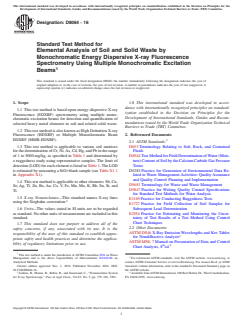
(Test Method)Standard Test Method for Elemental Analysis of Soil and Solid Waste by Monochromatic Energy Dispersive X-ray Fluorescence Spectrometry Using Multiple Monochromatic Excitation Beams
General Information
- Abstract
SIGNIFICANCE AND USE
5.1 Elemental species such as Cr, Ni, As, Cd, Hg, and Pb are widely used in many industrial processes. These elements have been identified in many former industrial sites driving the need for a quick, easy method for testing on-site at trace levels in soil and solid waste matrices.
5.2 This method may be used for quantitative determinations of Cr, Ni, As, Cd, Hg, and Pb in soil matrices and solid waste. Typical test time is 90 seconds to 15 minutes.
SCOPE
1.1 This test method is based upon energy-dispersive X-ray Fluorescence (EDXRF) spectrometry using multiple monochromatic excitation beams for detection and quantification of selected heavy metal elements in soil and related solid waste.
1.2 This test method is also known as High Definition X-ray Fluorescence (HDXRF) or Multiple Monochromatic Beam EDXRF (MMB-EDXRF).
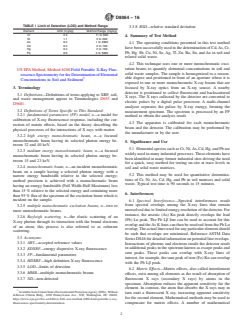
1.3 This test method is applicable to various soil matrices for the determination of Cr, Ni, As, Cd, Hg, and Pb in the range of 1 to 5000 mg/kg, as specified in Table 1 and determined by a ruggedness study using representative samples. The limit of detection (LOD) for each element is listed in Table 1. The LOD is estimated by measuring a SiO2 blank sample (see Table X1.1 in Appendix X1).
1.4 This test method is applicable to other elements: Sb, Cu, Se, Ag, Tl, Zn, Ba, Au, Co, V, Fe, Mn, Mo, K, Rb, Sn, Sr, and Ti.
1.5 X-ray Nomenclature—This standard names X-ray lines using the Siegbahn convention.2
1.6 Units—The values stated in SI units are to be regarded as standard. No other units of measurement are included in this standard.
1.7 This standard does not purport to address all of the safety concerns, if any, associated with its use. It is the responsibility of the user of this standard to establish appropriate safety and health practices and determine the applicability of regulatory limitations prior to use.
- Status
- Published
- Publication Date
- 31-Oct-2016
- Technical Committee
- D34 - Waste Management
- Drafting Committee
- D34.01.06 - Analytical Methods
Overview
ASTM D8064-16 is a standard test method developed by ASTM International for the elemental analysis of soil and solid waste using Monochromatic Energy Dispersive X-ray Fluorescence Spectrometry (EDXRF) with multiple monochromatic excitation beams. Commonly referred to as High Definition X-ray Fluorescence (HDXRF) or Multiple Monochromatic Beam EDXRF (MMB-EDXRF), this method enables rapid, quantitative analysis of trace and high concentrations of key heavy metals. Typical analysis times range from 90 seconds to 15 minutes per sample.
This test method provides a robust, field-deployable solution for detecting hazardous elements, supporting regulatory compliance, environmental site assessments, and waste management processes. The test specifically targets elements such as chromium (Cr), nickel (Ni), arsenic (As), cadmium (Cd), mercury (Hg), and lead (Pb) in concentrations from 1 to 5000 mg/kg, with applicability also extending to a broader set of elements.
Key Topics
- Purpose and Significance
- Addresses need for quick, on-site quantitative analysis of hazardous metals in soils and wastes.
- Supports regulatory requirements and environmental cleanup efforts, particularly at former industrial sites.
- Delivers results at both trace and high levels for a variety of site conditions.
- Analytical Range and Elements
- Primary focus on Cr, Ni, As, Cd, Hg, and Pb.
- Also suitable for Sb, Cu, Se, Ag, Tl, Zn, Ba, Au, Co, V, Fe, Mn, Mo, K, Rb, Sn, Sr, and Ti.
- Detection limits and method ranges are provided for precise quantification.
- Test Principle
- Uses multiple monochromatic X-ray beams to excite targets in the sample.
- Detects and measures characteristic X-ray emissions for each element.
- Involves sample homogenization and preparation with minimal processing.
- Calibration and Quality Control
- Calibration is performed using certified reference materials, either via fundamental parameters or empirical methods.
- Regular validation and use of quality control samples ensure method precision and reliability.
- Precision and bias are monitored through repeatability and reproducibility studies.
Applications
- Contaminated Site Assessments
- Rapid determination of heavy metal levels at brownfields, former industrial properties, and remediation projects.
- Solid Waste Classification
- Identifies hazardous components for proper classification, handling, and disposal of waste materials.
- Regulatory Compliance
- Meets requirements for testing by government agencies, waste processors, and remediation consultants.
- Environmental Monitoring
- Ongoing tracking of soil and waste for metals contamination to ensure safe land use and public health.
Key industries using this standard include environmental consulting, waste management, mining, construction, and regulatory agencies.
Related Standards
Several ASTM and external standards are commonly referenced in conjunction with ASTM D8064-16:
- ASTM D653 – Terminology Relating to Soil, Rock, and Contained Fluids
- ASTM D4944 – Moisture Content of Soil by Calcium Carbide Gas Pressure Tester
- ASTM D5681 – Terminology for Waste and Waste Management
- ASTM D5847 – Writing Quality Control Specifications for Water Analysis
- ASTM E1169 – Conducting Ruggedness Tests
- ASTM E1727 – Field Collection of Soil Samples for Subsequent Lead Determination
- ASTM E2554 – Estimating and Monitoring Test Result Uncertainty Using Control Chart Techniques
- US EPA Method 6200 – Field Portable X-Ray Fluorescence Spectrometry for Elemental Concentrations in Soil and Sediment
Incorporating ASTM D8064-16 into analytical protocols enhances onsite elemental analysis capabilities, supports rapid decision-making, and fosters compliance with environmental standards and regulations.
Keywords: ASTM D8064-16, EDXRF, X-ray fluorescence, soil analysis, solid waste, heavy metals, environmental testing, on-site analysis, lead, arsenic, cadmium, chromium, mercury, nickel, waste management, HDXRF, regulatory compliance.
Relations
- Effective Date
- 01-Mar-2024
- Effective Date
- 01-Nov-2023
- Effective Date
- 01-Nov-2018
- Effective Date
- 01-Sep-2018
- Effective Date
- 01-May-2018
- Effective Date
- 01-Apr-2018
- Effective Date
- 01-Apr-2018
- Effective Date
- 15-Feb-2018
- Effective Date
- 01-Oct-2017
- Effective Date
- 01-Oct-2017
- Effective Date
- 01-Sep-2017
- Effective Date
- 01-Nov-2016
- Effective Date
- 01-Feb-2016
- Effective Date
- 01-Aug-2014
- Effective Date
- 01-May-2014
Get Certified
Connect with accredited certification bodies for this standard

CIS Institut d.o.o.
Personal Protective Equipment (PPE) certification body. Notified Body NB-2890 for EU Regulation 2016/425 PPE.

Kiwa BDA Testing
Building and construction product certification.
Kmetijski inštitut Slovenije
Agricultural Institute of Slovenia. Soil testing, plant health, agricultural product analysis.
Sponsored listings
Frequently Asked Questions
ASTM D8064-16 is a standard published by ASTM International. Its full title is "Standard Test Method for Elemental Analysis of Soil and Solid Waste by Monochromatic Energy Dispersive X-ray Fluorescence Spectrometry Using Multiple Monochromatic Excitation Beams". This standard covers: SIGNIFICANCE AND USE 5.1 Elemental species such as Cr, Ni, As, Cd, Hg, and Pb are widely used in many industrial processes. These elements have been identified in many former industrial sites driving the need for a quick, easy method for testing on-site at trace levels in soil and solid waste matrices. 5.2 This method may be used for quantitative determinations of Cr, Ni, As, Cd, Hg, and Pb in soil matrices and solid waste. Typical test time is 90 seconds to 15 minutes. SCOPE 1.1 This test method is based upon energy-dispersive X-ray Fluorescence (EDXRF) spectrometry using multiple monochromatic excitation beams for detection and quantification of selected heavy metal elements in soil and related solid waste. 1.2 This test method is also known as High Definition X-ray Fluorescence (HDXRF) or Multiple Monochromatic Beam EDXRF (MMB-EDXRF). 1.3 This test method is applicable to various soil matrices for the determination of Cr, Ni, As, Cd, Hg, and Pb in the range of 1 to 5000 mg/kg, as specified in Table 1 and determined by a ruggedness study using representative samples. The limit of detection (LOD) for each element is listed in Table 1. The LOD is estimated by measuring a SiO2 blank sample (see Table X1.1 in Appendix X1). 1.4 This test method is applicable to other elements: Sb, Cu, Se, Ag, Tl, Zn, Ba, Au, Co, V, Fe, Mn, Mo, K, Rb, Sn, Sr, and Ti. 1.5 X-ray Nomenclature—This standard names X-ray lines using the Siegbahn convention.2 1.6 Units—The values stated in SI units are to be regarded as standard. No other units of measurement are included in this standard. 1.7 This standard does not purport to address all of the safety concerns, if any, associated with its use. It is the responsibility of the user of this standard to establish appropriate safety and health practices and determine the applicability of regulatory limitations prior to use.
SIGNIFICANCE AND USE 5.1 Elemental species such as Cr, Ni, As, Cd, Hg, and Pb are widely used in many industrial processes. These elements have been identified in many former industrial sites driving the need for a quick, easy method for testing on-site at trace levels in soil and solid waste matrices. 5.2 This method may be used for quantitative determinations of Cr, Ni, As, Cd, Hg, and Pb in soil matrices and solid waste. Typical test time is 90 seconds to 15 minutes. SCOPE 1.1 This test method is based upon energy-dispersive X-ray Fluorescence (EDXRF) spectrometry using multiple monochromatic excitation beams for detection and quantification of selected heavy metal elements in soil and related solid waste. 1.2 This test method is also known as High Definition X-ray Fluorescence (HDXRF) or Multiple Monochromatic Beam EDXRF (MMB-EDXRF). 1.3 This test method is applicable to various soil matrices for the determination of Cr, Ni, As, Cd, Hg, and Pb in the range of 1 to 5000 mg/kg, as specified in Table 1 and determined by a ruggedness study using representative samples. The limit of detection (LOD) for each element is listed in Table 1. The LOD is estimated by measuring a SiO2 blank sample (see Table X1.1 in Appendix X1). 1.4 This test method is applicable to other elements: Sb, Cu, Se, Ag, Tl, Zn, Ba, Au, Co, V, Fe, Mn, Mo, K, Rb, Sn, Sr, and Ti. 1.5 X-ray Nomenclature—This standard names X-ray lines using the Siegbahn convention.2 1.6 Units—The values stated in SI units are to be regarded as standard. No other units of measurement are included in this standard. 1.7 This standard does not purport to address all of the safety concerns, if any, associated with its use. It is the responsibility of the user of this standard to establish appropriate safety and health practices and determine the applicability of regulatory limitations prior to use.
ASTM D8064-16 is classified under the following ICS (International Classification for Standards) categories: 13.030.10 - Solid wastes; 13.080.05 - Examination of soils in general. The ICS classification helps identify the subject area and facilitates finding related standards.
ASTM D8064-16 has the following relationships with other standards: It is inter standard links to ASTM E1727-24, ASTM D5681-23, ASTM D5681-18, ASTM E1169-18, ASTM D5283-18, ASTM E2554-18, ASTM E2554-18e1, ASTM D4944-18, ASTM E1169-17, ASTM E1169-17e1, ASTM D5681-17, ASTM D5681-16a, ASTM D5681-16, ASTM D653-14, ASTM E1169-14. Understanding these relationships helps ensure you are using the most current and applicable version of the standard.
ASTM D8064-16 is available in PDF format for immediate download after purchase. The document can be added to your cart and obtained through the secure checkout process. Digital delivery ensures instant access to the complete standard document.
Standards Content (Sample)
This international standard was developed in accordance with internationally recognized principles on standardization established in the Decision on Principles for the
Development of International Standards, Guides and Recommendations issued by the World Trade Organization Technical Barriers to Trade (TBT) Committee.
Designation: D8064 − 16
Standard Test Method for
Elemental Analysis of Soil and Solid Waste by
Monochromatic Energy Dispersive X-ray Fluorescence
Spectrometry Using Multiple Monochromatic Excitation
Beams
This standard is issued under the fixed designation D8064; the number immediately following the designation indicates the year of
original adoption or, in the case of revision, the year of last revision. A number in parentheses indicates the year of last reapproval. A
superscript epsilon (´) indicates an editorial change since the last revision or reapproval.
1. Scope 1.8 This international standard was developed in accor-
dance with internationally recognized principles on standard-
1.1 This test method is based upon energy-dispersive X-ray
ization established in the Decision on Principles for the
Fluorescence (EDXRF) spectrometry using multiple mono-
Development of International Standards, Guides and Recom-
chromatic excitation beams for detection and quantification of
mendations issued by the World Trade Organization Technical
selected heavy metal elements in soil and related solid waste.
Barriers to Trade (TBT) Committee.
1.2 ThistestmethodisalsoknownasHighDefinitionX-ray
Fluorescence (HDXRF) or Multiple Monochromatic Beam 2. Referenced Documents
EDXRF (MMB-EDXRF). 3
2.1 ASTM Standards:
1.3 This test method is applicable to various soil matrices D653 Terminology Relating to Soil, Rock, and Contained
forthedeterminationofCr,Ni,As,Cd,Hg,andPbintherange Fluids
of 1 to 5000 mg/kg, as specified in Table 1 and determined by D4944 TestMethodforFieldDeterminationofWater(Mois-
a ruggedness study using representative samples. The limit of ture)ContentofSoilbytheCalciumCarbideGasPressure
detection(LOD)foreachelementislistedinTable1.TheLOD Tester
isestimatedbymeasuringaSiO blanksample(seeTableX1.1 D5283 Practice for Generation of Environmental Data Re-
in Appendix X1). lated to Waste ManagementActivities: QualityAssurance
and Quality Control Planning and Implementation
1.4 Thistestmethodisapplicabletootherelements:Sb,Cu,
D5681 Terminology for Waste and Waste Management
Se,Ag, Tl, Zn, Ba,Au, Co, V, Fe, Mn, Mo, K, Rb, Sn, Sr, and
D5847 Practice for Writing Quality Control Specifications
Ti.
for Standard Test Methods for Water Analysis
1.5 X-ray Nomenclature—This standard names X-ray lines
E1169 Practice for Conducting Ruggedness Tests
using the Siegbahn convention.
E1727 Practice for Field Collection of Soil Samples for
1.6 Units—The values stated in SI units are to be regarded Subsequent Lead Determination
E2554 Practice for Estimating and Monitoring the Uncer-
as standard. No other units of measurement are included in this
standard. tainty of Test Results of a Test Method Using Control
Chart Techniques
1.7 This standard does not purport to address all of the
2.2 Other Documents:
safety concerns, if any, associated with its use. It is the
ASTM DS46 X-Ray Emission Wavelengths and Kev Tables
responsibility of the user of this standard to establish appro-
for Nondiffractive Analysis
priate safety and health practices and determine the applica-
ASTM MNL 7 Manual on Presentation of Data and Control
bility of regulatory limitations prior to use.
th 4
Chart Analysis, 8 ed.
This test method is under the jurisdiction of ASTM Committee D34 on Waste
Management and is the direct responsibility of Subcommittee D34.01.06 on For referenced ASTM standards, visit the ASTM website, www.astm.org, or
Analytical Methods. contact ASTM Customer Service at service@astm.org. For Annual Book of ASTM
Current edition approved Nov. 1, 2016. Published November 2016. DOI: Standards volume information, refer to the standard’s Document Summary page on
10.1520/D8064-16. the ASTM website.
2 4
Jenkins, R., Manne, R., Robin, R., and Senemaud, C., “Nomenclature System AvailablefromASTMInternational,100BarrHarborDr.,WestConshohocken,
for X-ray Spectroscopy,” Pure & Appl Chem., Vol 63, No. 5, pp. 735–746, 1991. PA 19428-2959, www.astm.org.
Copyright © ASTM International, 100 Barr Harbor Drive, PO Box C700, West Conshohocken, PA 19428-2959. United States
D8064 − 16
TABLE 1 Limit of Detection (LOD) and Method Range
3.3.8 RSD—relative standard deviation
Element LOD (mg/kg) Method Range (mg/kg)
Cr 2.3 11 to 500
4. Summary of Test Method
Ni 1.1 5 to 500
As 0.2 1 to 2000
4.1 The operating conditions presented in this test method
Cd 0.4 2 to 100
havebeensuccessfullyusedinthedeterminationofCd,As,Cr,
Hg 0.4 2 to 100
Pb 0.6 3 to 5000 Pb, Hg, Sb, Cu, Ni, Se,Ag, Tl, Zn, Ba, Sn, andAu in soil and
related solid waste.
4.2 This technique uses one or more monochromatic exci-
tation beams to quantify elemental concentrations in soil and
US EPA Method, Method 6200 Field Portable X-Ray Fluo-
solid waste samples. The sample is homogenized to a reason-
rescenceSpectrometryfortheDeterminationofElemental
able degree and positioned in front of an aperture where it is
Concentrations in Soil and Sediment
exposed to one or more monochromatic X-ray beams that are
focused by X-ray optics from an X-ray source. A nearby
3. Terminology
detector is positioned to collect fluorescent and backscattered
3.1 Definitions—Definitions of terms applying to XRF, soil,
X rays. The X rays collected by the detector are converted to
and waste management appear in Terminologies D653 and
electric pulses by a digital pulse processor. A multi-channel
D5681.
analyzer separates the pulses by X-ray energy, forming the
3.2 Definitions of Terms Specific to This Standard:
measurement spectrum. The spectrum is processed by an FP
3.2.1 fundamental parameters (FP) model, n—a model for
method to obtain the analysis result.
calibration of X-ray fluorescence response, including the cor-
4.3 The apparatus is calibrated for each monochromatic
rection of matrix effects, based on the theory describing the
beam and the detector. The calibration may be performed by
physical processes of the interactions of X rays with matter.
the manufacturer or by the user.
3.2.2 high energy monochromatic beam, n—a focused
monochromatic beam having its selected photon energy be-
5. Significance and Use
tween 32 and 40 keV.
5.1 ElementalspeciessuchasCr,Ni,As,Cd,Hg,andPbare
3.2.3 medium energy monochromatic beam, n—a focused
widely used in many industrial processes.These elements have
monochromatic beam having its selected photon energy be-
been identified in many former industrial sites driving the need
tween 15 and 23 keV.
for a quick, easy method for testing on-site at trace levels in
3.2.4 monochromatic beam, n—an incident monochromatic
soil and solid waste matrices.
beam on a sample having a selected photon energy with a
5.2 This method may be used for quantitative determina-
narrow energy bandwidth relative to the selected energy;
tions of Cr, Ni, As, Cd, Hg, and Pb in soil matrices and solid
method precision is achieved with a monochromatic beam
waste. Typical test time is 90 seconds to 15 minutes.
having an energy bandwidth (Full Width Half Maximum) less
than 15 % relative to the selected energy and containing more
6. Interferences
than 95 % flux of the spectrum of the excitation beam which is
incident on the sample.
6.1 Spectral Interference—Spectral interferences result
from spectral overlaps among the X-ray lines that remain
3.2.5 multiple monochromatic excitation beams, n—two or
unresolved due to limited energy resolution of the detector. For
more monochromatic beams.
instance, the arsenic (As) Kα peak directly overlaps the lead
3.2.6 Rayleigh scattering, n—the elastic scattering of an
(Pb) Lα peak. The Pb Lβ line can be used to account for this
X-ray photon through its interaction with the bound electrons
overlapandtheAsKlinescanthenberesolvedfromthePbLα
of an atom; this process is also referred to as coherent
overlap.Theactuallinesusedforanyparticularelementshould
scattering.
be such that overlaps are minimized. Reference ASTM Data
3.3 Acronyms:
SeriesDS46fordetailedinformationonpotentiallineoverlaps.
3.3.1 ARV—accepted reference values
Interactions of photons and electrons inside the detector result
in additional peaks in the spectrum known as escape peaks and
3.3.2 EDXRF—energy dispersive X-ray fluorescence
sum peaks. These peaks can overlap with X-ray lines of
3.3.3 FP—fundamental parameters
interest, for example, the sum peak of iron (Fe) Kα can overlap
3.3.4 HDXRF—high definition X-ray fluorescence
with the Pb Lβ peak.
3.3.5 LOD—limits of detection
6.2 Matrix Effects—Matrix effects, also called interelement
3.3.6 MMB—multiple monochromatic beams
effects, exist among all elements as the result of absorption of
3.3.7 ND—non-detected
fluorescent X rays (secondary X rays) by atoms in the
specimen. Absorption reduces the apparent sensitivity for the
element. In contrast, the atom that absorbs the X rays may in
AvailablefromUnitedStatesEnvironmentalProtectionAgency(EPA),William
turn emit a fluorescent X ray, increasing apparent sensitivity
Jefferson Clinton Bldg., 1200 Pennsylvania Ave., NW, Washington, DC 20460,
for the second element. Mathematical methods may be used to
https://www.epa.gov/hw-sw846/sw-846–test-method-6200-field-portable-x-ray-
fluorescence-spectrometry-determination. compensate for matrix effects. A number of mathematical
D8064 − 16
correction procedures are commonly utilized including full FP spectrometer and is designed to use replaceable X-ray trans-
treatments and mathematical models based on influence coef- parent film to hold a soil specimen with a minimum depth of 1
ficient algorithms. cm.
6.3 Physical Matrix Effects—Physical characteristics of the
8. Reagents and Materials
sample such as particle size and homogeneity. Effects can be
minimized by mixing samples, grinding and sieving them to a 8.1 Purity of Reagents—Reagent grade chemicals shall be
uniformparticlesizepriortoanalysis,orbyincreasingthearea used in all tests. Unless otherwise indicated, it is intended that
exposed to the X-ray beam path by rotating the sample during all reagents conform to the specifications of the Committee on
analysis. Analytical Reagents of the American Chemical Society where
such specifications are available. Other grades may be used,
6.4 Moisture Effects—Soil samples that are in excess of
provided it is first ascertained that the reagent is of sufficiently
15 % moisture content may introduce error to the analysis.
high purity to permit its use without lessening the accuracy of
Samples with high moisture content can be dried in an oven
the determination.
prior to analysis at less than 150°C. If mercury is a target
analyte, a separate portion of the sample should be dried
8.2 Calibration Standard(s)—At least three homogenous
without heating and analyzed on its own. Another option is to reference materials are required for calibration (see Note 1).
use the manufacturer’s auto-moisture correction for moisture
The calibration standards should provide (a) concentrations of
content using FP modeling. Cr, Ni,As, Cd, Hg, and Pb at or near background soil level, (b)
some or all of concentrations of Cr, Ni,As, Cd, Hg, and Pb are
7. Apparatus at low range levels, and (c) some or all of concentrations of Cr,
Ni, As, Cd, Hg, and Pb are at high range levels. It is
7.1 EDXRF Spectrometer, designed for X-ray fluorescence
recommended to use calibration standards that are traceable to
analysis using multiple monochromatic excitation beams with
standardreferencematerialswhensuchmaterialsareavailable.
an energy dispersive detector and with a design that incorpo-
rates at a minimum the following features (unless otherwise
NOTE 1—Additional calibration standards may be used for improved
accuracy.
specified):
7.1.1 Source of X-ray Excitation—An X-ray tube with a
8.3 Calibration Verification Sample(s)—At least one ho-
zirconium, molybdenum, rhodium, palladium, silver target or
mogenous reference material containing Cr, Ni, As, Cd, Hg,
other suitable target can be used.
and Pb is required for calibration.
7.1.2 X-ray Optics—X-ray optical elements capable of ac-
8.4 Drift Correction Monitors (optional)—Duetoinstability
cepting X rays from a tube and directing monochromatic
of the measurement system, the sensitivity and background of
beams on the sample. Two or more X-ray optical elements are
the spectrometer may drift with time. Drift correction monitors
necessary to provide multiple monochromatic beams. At least
may be used to compensate for this drift. The optimum drift
one optical element provides a medium energy monochromatic
correction monitor samples are permanent materials that are
beam, and at least one optical element provides a high energy
stable with repeated exposure to X rays.
monochromatic beam.
8.5 Gloves—Disposable gloves are recommended for han-
7.1.3 Beam Shutter,usedtoselectamonochromaticbeamor
dling reference materials and other samples.
select a combination of monochromatic beams.
7.1.4 X-ray Detector, with energy resolution ≤140 eV full
8.6 Quality Control Sample(s)—To ensure the quality of the
width at half maximum of the manganese (Mn) Kα line.
results, a quality control (QC) sample is used for establishing
7.1.5 Digital Pulse Processor and Multi-channel
and monitoring the stability and precision of an analytical
Analyzer—A digital pulse processor for pulse shaping and
measurement system (see 17.4). If possible, the QC sample
conditioning, and a multi-channel analyzer for binning the
shall be reference material representative of samples typically
pulses according to X-ray energy.
analyzed. The materials shall be stable under the anticipated
7.1.6 Detector Aperture—An aperture in the beam path
storage conditions. The QC sample can be a calibration
between the sample and the detector to limit the field of view
validation sample.
of the detector.
8.7 Reference Materials—Homogenous material with a
7.2 Analyzer Test Stand, may have the following accesso-
known elemental composition. Reference materials are avail-
ries:
able from commercial sources or may be prepared gravimetri-
7.2.1 Sample Cell Rotator (optional), designed to hold a
cally. For purposes of this method, homogenous reference
removable sample cell.
materials in this test method are soils or sludge, unless
7.2.2 Removable Sample Cell—An open ended specimen
otherwise specified.
holder compatible with the geometry of the MMB-EDXRF
Reagent Chemicals, American Chemical Society Specifications, American
The sole source of supply of the apparatus known to the committee at this time Chemical Society, Washington, D.C. For suggestions on the testing of reagents not
is XOS, Inc., 15TechValley Drive, East Greenbush, NY12061. If you are aware of listed by the American Chemical Society, see Analar Standards for Laboratory
alternative suppliers, please provide this information to ASTM International Chemicals, BDH Ltd., Poole, Dorset, U.K., and the United States Pharmacopeia
Headquarters.Your comments will receive careful consideration at a meeting of the and National Formulary, U.S. Pharmaceutical Convention, Inc. (USPC), Rockville,
responsible technical committee, which you may attend. MD.
D8064 − 16
8.8 Independent Reference Material (IRM)—A material of 11.2 Allow the apparatus to stabilize for operation accord-
known purity and concentration obtained either from the ing to the manufacturer’s guidelines.
NationalInstituteofStandardsandTechnology(NIST)orother
11.3 Ensure that the spectral processing operates correctly
reputable supplier.
according to the manufacturer’s guidelines addressing spectral
8.9 Silicon Dioxide Powder (SiO )—For preparing gravi-
and matrix interferences as listed in the interferences section.
metric empirical calibration standards (if using calibration
11.4 When required, reference spectra should be obtained
method B, see 12.5) and for use as a blank sample to monitor
from pure element standards for all deconvoluted elements.
instrument contamination and sample preparation contamina-
tion (see 17.3).
12. Calibration
8.10 Single/Multi-Element Aqueous Standards—Aqueous
12.1 Calibration should, at a minimum, be conducted when
reference material with known elemental composition for
a QC sample is out of range or as recommended by the
preparing gravimetric empirical calibration standards (if using
manufacturer. For some applications including regulatory
calibration method B or matrix spiked).
compliance, more frequent calibration may be required.
8.11 X-ray Transparent Thin-Film—Used as a protective
12.2 Calibration of the X-ray Detector and Digital Pulse
barrier between the sample and the analyzer. See Note 2.
Processor—Using calibration standards, identify one or more
NOTE 2—The user should select a thin film that provides for maximum
elemental emission line peaks from the spectrum of each
transmittance. The thin-film used in the development of this test method
monochromatic excitation beam to calibrate the energy to
was high-purity 12 µm polypropylene film.
channel relationship of the X-ray Detector and Digital Pulse
Processor (see 7.1.4 and 7.1.5). Chosen emission lines should
9. Hazards
be free from major interferences and should have a statistically
9.1 Occupational Health and Safety standards for X rays
significant peak counting area.
and ionizing radiation shall be observed. Guidelines for safe
12.3 Two methods of calibrations are available:
operating procedures are also given in current handbooks and
publications from original equipment manufacturers. For more
12.4 Calibration Method A – Fundamental Parameters
information see similar handbooks on radiation safety.
Method:
12.4.1 Fundamental Parameters calibration should be per-
9.2 Use proper personal protective equipment (PPE) when
formed using multiple soil calibration standards, consisting of
handling contaminated soil and solid waste. Consult chemical
background soil level, low contamination levels and high
safety data sheets for recommended PPE.
contamination levels for selected elements to determine the
initial sensitivity factors from each monochromatic beam. If
10. Sampling and Test Specimen Preparation
appropriate reference soil standards are difficult to be obtained
10.1 Sampling—CollectedsamplesinaccordancewithPrac-
for some elements of interested, a reference standards with
tice E1727 or similar procedure.
adjacentornearbyelementsintheperiodictablecanbeusedin
10.2 Preparation for Measurement:
FP calibration. Soil reference materials may be NIST Soil
10.2.1 Toensurearepresentativesampleisused,thoroughly
Standard Reference Materials or similar. Soil reference mate-
mix the sample in the collection container by stirring, mixing,
rials may also be a soil surrogate like SiO powder spiked with
or kneading. Large agglomerations of soil or solid waste
known metal contents; see 12.5.2 for spike process. By
shouldbebrokenup.Ifmixingisnotpossible,takeatleastfive
measuring the X-ray net intensity (cps) for each element and
portions of the sample when transferring.
using the determined sensitivity factor for each beam plus a set
10.2.2 If sample exceeds 15 % moisture content by wet
of equations to account for the X-ray production, the X-ray
weight it should be dried. Samples that require drying will
absorption and enhancement effect, the concentration of all
appear muddy or have visible excess water. If unable to
elements present can be determined. Due to the use of
determine visibly, use Test Method D4944 or other method to
monochromatic beams for excitation, the FP calculation is
determine moisture content. If drying is needed, place sample
muchmoreaccuratecomparedtothepolychromaticexcitation.
in drying container. Place drying container in oven until mass
12.4.2 Solid waste samples may have a matrix quite differ-
is constant. Sample can also be air dried or sun dried at the site
ent from a soil matrix. At least two reference materials with
alternatively.
lighter matrix and heavier matrix shall be used to refine the FP
10.2.3 Exclude non-representative material such as twigs,
modeltoaccountforsignificantmatrixvariationotherthansoil
leaves, roots, insects, asphalt, and rocks. Completely grind the
matrix.Asolid waste sample that has organic type of matrix is
sample until it will pass through a number 50 sieve or higher
considered to be a light matrix. A solid waste sample that
(<275 µm particle size). Transfer enough material to fill the
contains more than 10 % of metals, like Fe, is considered as a
sample cell and cover with an X-ray film.
heavy matrix. This step is not needed if only soil samples are
tested in an application.
11. Preparation of Apparatus
12.4.3 Most manufacturers provide FP calibration software
11.1 Follow the manufacturer’s instructions for set-up, to perform FP calibration and FP refinement. Follow the
conditioning, preparation, and maintenance of the spectrom- manufacturer’s FP set-up recommendations. The manufacturer
eter. may have an optional setup to use a standard that has similar
D8064 − 16
matrix to the testing sample that can be used to refine FP ence material (see 12.4) that has been stored as recommended
parameters for the best accuracy. by the manufacturer and is within expiration date. In this case,
a FP calibration method may be preferred over empirical
12.5 Method B – Empirical Calibration Method:
calibration.
12.5.1 Empirical calibration for soil matrix is performed
using the following calibration standards: a blank and at least 12.6 After calibrating, verify analyzer calibration by using
four or more concentration levels that bracket between the low one or more calibration validation samples (see 8.4). Results
range and the high range defined in Table 2. The calibration shall have a percent deviation less than 20 % from the known
standards should provide a linear response of element intensity concentration for the target elements. If results for elements of
to concentration. If extended range is needed, then an addi- interest are not within acceptable limits, the analyzer must be
tional calibration shall be performed to cover between the high recalibrated.
range and extended range. For the additional calibration, use
12.7 Calibration should be verified periodically per 12.6.
fourormoreconcentrationlevelsthatbracketbetweenthehigh
The initial validation frequency shall be weekly. If there is
concentration range and the extended range.
sufficient data to demonstrate that the calibration is stable, the
12.5.2 Calibration standards may be prepared by gravi-
calibration validation frequency can be reduced to monthly or
metrically mixing SiO powder with single/multi-element in
longer period.
aqueous standard. The mixing weight ratio for aqueous stan-
dard and SiO is about 1:1. For example, prepare a 200 mg/kg 13. Procedure
Pb in SiO standard by mixing5gof100 mg/kg Pb aqueous
13.1 Measurement of Unknown Sample:
standard solution, and5gofSiO . Dry the standard in a 60°C
13.1.1 Prepare the sample according to Section 10, and
to 100°C oven or allow to air dry.
prepare the instrument according to Section 11. Place the
12.5.3 The matrix effect between the SiO calibrants and
sample in the X-ray beam path and perform the measurement
soil samples should be corrected for by using a correction
as directed by the manufacturer.
factor that is determined by measuring a spiked uncontami-
13.1.2 Process the spectrum using the same procedure as
nated soil sample. An uncontaminated soil sample should be
outlined in Sections 11 and 12.
prepared and spiked (see 12.5.2 and use the uncontaminated
13.2 Measurement of Reference Materials:
soil in the place of the SiO powder) to a known high range
13.2.1 When using reference materials, measure them in the
concentration to obtain a matrix correction factor between the
same manner as an unknown sample (13.1) and before mea-
calibrant and the real soil sample. The correction factor is
suring any unknowns.
typically recorded in a software tool provided by the manufac-
13.2.2 Analysis of result(s) from these samples must be
turer.
carried out following Section 17. When the sample results
12.5.4 Empirical calibration for a specific solid waste ma-
exceed the laboratory’s control limits, drift correction or
trix is performed usin
...