

ASTM E1232-07(2019)
(Test Method)Standard Test Method for Temperature Limit of Flammability of Chemicals
General Information
- Abstract
SIGNIFICANCE AND USE
5.1 The lower temperature limit of flammability is the minimum temperature at which a liquid (or solid) chemical will evolve sufficient vapors to form a flammable mixture with air under equilibrium conditions. Knowledge of this temperature is important in determining guidelines for the safe handling of chemicals, particularly in closed process and storage vessels.
Note 1: As a result of physical factors inherent in flash point apparatus and procedures, closed-cup flash point temperatures are not necessarily the minimum temperature at which a chemical will evolve flammable vapors (see Appendix X2 and Appendix X3, taken in part from Test Method E502). The temperature limit of flammability test is designed to supplement limitations inherent in flash point tests (Appendix X2). It yields a result closely approaching the minimum temperature of flammable vapor formation for equilibrium situations in the chemical processing industry such as in closed process and storage vessels.
Note 2: As a result of flame quenching effects existing when testing in standard closed-cup flash point apparatus, there are certain chemicals that exhibit no flash point but do evolve vapors that will propagate a flame in vessels of adequate size (X3.2). The temperature limit of flammability test chamber is sufficiently large to overcome flame quenching effects in most cases of practical importance, thus, usually indicating the presence of vapor-phase flammability if it does exist (6.2).
Note 3: The lower temperature limit of flammability (LTL) is only one of several characteristics that should be evaluated to determine the safety of a specific material for a specific application. For example, some materials are found to have an LTL by this test method when, in fact, other characteristics such as minimum ignition energy and heat of combustion should also be considered in an overall flammability evaluation.
5.2 The vapor concentration present at the lower temperature limit of flammability e...
SCOPE
1.1 This test method covers the determination of the minimum temperature at which vapors in equilibrium with a liquid (or solid) chemical will be sufficiently concentrated to form flammable mixtures in air at atmospheric pressure. This test method is written specifically for determination of the temperature limit of flammability of systems using air as the source of oxidant and diluent. It may also be used for other oxidant/diluent combinations, including air plus diluent mixtures; however, no oxidant/diluent combination stronger than air should be used. Also, no unstable chemical capable of explosive decomposition reactions should be tested (see 8.3).
1.2 This test method is designed and written to be run at local ambient pressure and is limited to a maximum initial pressure of 1 atm abs. It may also be used for reduced pressures with the practical lower pressure limit being approximately 13.3 kPa (100 mm Hg). The maximum practical operating temperature of this equipment is approximately 150°C (302°F) (Note A1.2).
1.3 The values stated in SI units are to be regarded as standard. The values given in parentheses are mathematical conversions to inch-pound units that are provided for information only and are not considered standard.
1.4 This standard should be used to measure and describe the properties of materials, products, or assemblies in response to heat and flame under controlled laboratory conditions, and should not be used to describe or appraise the fire hazard or fire risk of materials, products, or assemblies under actual fire conditions. However, results of this test may be used as elements of a fire risk assessment which takes into account all of the factors which are pertinent to an assessment of the fire hazard of a particular end use.
1.5 This standard does not purport to address all of the safety concerns, if any, associated with its use. It is the responsibility of the user of this standard to...
- Status
- Published
- Publication Date
- 31-Jan-2019
- Technical Committee
- E27 - Hazard Potential of Chemicals
- Drafting Committee
- E27.04 - Flammability and Ignitability of Chemicals
Overview
ASTM E1232-07(2019), Standard Test Method for Temperature Limit of Flammability of Chemicals is a widely recognized ASTM International standard that specifies a laboratory procedure to determine the minimum temperature at which a liquid or solid chemical produces enough vapors to form a flammable mixture with air under equilibrium conditions. This test method is crucial in guiding the safe handling, processing, and storage of chemicals, particularly in closed systems, by identifying the temperature below which a chemical cannot form a flammable vapor-air mixture.
Understanding the lower temperature limit of flammability (LTL) helps manufacturers, chemical processors, and safety professionals implement effective fire prevention and hazard mitigation strategies. The LTL plays a complementary role to flash point data, offering more precise insight for equilibrium conditions in large vessels and industrial settings.
Key Topics
- Lower Temperature Limit of Flammability (LTL): Defines the minimum temperature at which a chemical emits sufficient vapors to form a flammable mixture with air at atmospheric pressure.
- Scope of Application: Primarily designed for use with air as the oxidant, but compatible with air-plus-diluent mixtures. Not suitable for testing with oxidants stronger than air or with unstable, decomposable chemicals.
- Safe Handling and Storage: Provides critical data for assessing the flammable risks of chemicals in closed process vessels, tanks, and storage containers.
- Test Methodology: Involves heating the sample, creating an equilibrium vapor-air mixture, introducing an ignition source, and observing for flame propagation in a controlled environment.
- Supplement to Flash Point Tests: Addresses limitations of flash point tests-closed-cup apparatus may underestimate the true flammability temperature due to physical and quenching effects.
- Significance for Fire Risk Assessment: While not solely determining overall fire hazard, LTL is a key parameter alongside other combustibility metrics like minimum ignition energy and heat of combustion.
- Precision and Calibration: Emphasizes the need for careful equipment calibration, use of clean vessels, and consideration of variables such as pressure, vessel size, and sample purity.
Applications
The ASTM E1232-07(2019) standard is vital for:
- Chemical Manufacturing and Processing: Determining operating temperatures and ventilation needs to avoid accidental ignition.
- Hazardous Materials Storage: Establishing safe storage limits for volatile and potentially flammable chemicals.
- Industrial Safety and Compliance: Supporting regulatory compliance and internal safety protocols for handling and storing hazardous chemicals in warehouses or process plants.
- Fire Protection Engineering: Supplying data for fire risk assessment models and emergency planning, particularly for large-scale chemical storage.
- Research and Development: Characterizing new materials for safe use and identifying compatibility in mixtures or formulations.
- Mixture Analysis: Testing the flammability of chemical mixtures, where impurities or minor components may influence overall vapor-phase flammability.
Related Standards
In addition to ASTM E1232-07(2019), the following standards provide complementary methods and definitions related to chemical flammability and fire safety:
- ASTM D3278 / ASTM D3828 / ASTM D3941: Test methods for flash point determination of liquids using small scale closed-cup apparatus.
- ASTM E681: Test method for determining the concentration limits of flammability of chemicals (vapors and gases).
- ASTM E502: Selection and use of ASTM standards for flash point determination by closed cup methods.
- ASTM E537 and ASTM E698: Test methods for the thermal stability and kinetic parameters of thermally unstable materials.
- ANSI MC96.1: Temperature measurement thermocouples standard.
- NFPA 325: Standard for fire hazardous properties of liquids.
Using ASTM E1232-07(2019) in conjunction with these related standards ensures a comprehensive approach to evaluating and managing the flammability hazards of chemicals across research, industry, and regulatory contexts.
Keywords: temperature limit of flammability, ASTM E1232, chemical safety, flammable mixtures, lower flammability limit, fire risk assessment, vapor-phase flammability, chemical process safety, storage vessel safety, laboratory flammability test standards.
Relations
- Replaces
ASTM E1232-07(2013) - Standard Test Method for Temperature Limit of Flammability of Chemicals - Effective Date
- 01-Feb-2019
- Effective Date
- 01-Jun-2020
- Effective Date
- 01-Feb-2020
- Effective Date
- 01-Jun-2016
- Effective Date
- 15-Dec-2014
- Effective Date
- 01-Nov-2013
- Effective Date
- 01-Dec-2012
- Effective Date
- 15-May-2012
- Effective Date
- 01-Mar-2011
- Effective Date
- 01-Oct-2009
- Refers
ASTM E220-07a - Standard Test Method for Calibration of Thermocouples By Comparison Techniques - Effective Date
- 01-Nov-2007
- Effective Date
- 01-Oct-2007
- Effective Date
- 15-Jul-2007
- Effective Date
- 01-Jun-2007
- Effective Date
- 15-May-2007
Get Certified
Connect with accredited certification bodies for this standard

ECOCERT
Organic and sustainability certification.

CIS Institut d.o.o.
Personal Protective Equipment (PPE) certification body. Notified Body NB-2890 for EU Regulation 2016/425 PPE.

Eurofins Food Testing Global
Global leader in food, environment, and pharmaceutical product testing.
Sponsored listings
Frequently Asked Questions
ASTM E1232-07(2019) is a standard published by ASTM International. Its full title is "Standard Test Method for Temperature Limit of Flammability of Chemicals". This standard covers: SIGNIFICANCE AND USE 5.1 The lower temperature limit of flammability is the minimum temperature at which a liquid (or solid) chemical will evolve sufficient vapors to form a flammable mixture with air under equilibrium conditions. Knowledge of this temperature is important in determining guidelines for the safe handling of chemicals, particularly in closed process and storage vessels. Note 1: As a result of physical factors inherent in flash point apparatus and procedures, closed-cup flash point temperatures are not necessarily the minimum temperature at which a chemical will evolve flammable vapors (see Appendix X2 and Appendix X3, taken in part from Test Method E502). The temperature limit of flammability test is designed to supplement limitations inherent in flash point tests (Appendix X2). It yields a result closely approaching the minimum temperature of flammable vapor formation for equilibrium situations in the chemical processing industry such as in closed process and storage vessels. Note 2: As a result of flame quenching effects existing when testing in standard closed-cup flash point apparatus, there are certain chemicals that exhibit no flash point but do evolve vapors that will propagate a flame in vessels of adequate size (X3.2). The temperature limit of flammability test chamber is sufficiently large to overcome flame quenching effects in most cases of practical importance, thus, usually indicating the presence of vapor-phase flammability if it does exist (6.2). Note 3: The lower temperature limit of flammability (LTL) is only one of several characteristics that should be evaluated to determine the safety of a specific material for a specific application. For example, some materials are found to have an LTL by this test method when, in fact, other characteristics such as minimum ignition energy and heat of combustion should also be considered in an overall flammability evaluation. 5.2 The vapor concentration present at the lower temperature limit of flammability e... SCOPE 1.1 This test method covers the determination of the minimum temperature at which vapors in equilibrium with a liquid (or solid) chemical will be sufficiently concentrated to form flammable mixtures in air at atmospheric pressure. This test method is written specifically for determination of the temperature limit of flammability of systems using air as the source of oxidant and diluent. It may also be used for other oxidant/diluent combinations, including air plus diluent mixtures; however, no oxidant/diluent combination stronger than air should be used. Also, no unstable chemical capable of explosive decomposition reactions should be tested (see 8.3). 1.2 This test method is designed and written to be run at local ambient pressure and is limited to a maximum initial pressure of 1 atm abs. It may also be used for reduced pressures with the practical lower pressure limit being approximately 13.3 kPa (100 mm Hg). The maximum practical operating temperature of this equipment is approximately 150°C (302°F) (Note A1.2). 1.3 The values stated in SI units are to be regarded as standard. The values given in parentheses are mathematical conversions to inch-pound units that are provided for information only and are not considered standard. 1.4 This standard should be used to measure and describe the properties of materials, products, or assemblies in response to heat and flame under controlled laboratory conditions, and should not be used to describe or appraise the fire hazard or fire risk of materials, products, or assemblies under actual fire conditions. However, results of this test may be used as elements of a fire risk assessment which takes into account all of the factors which are pertinent to an assessment of the fire hazard of a particular end use. 1.5 This standard does not purport to address all of the safety concerns, if any, associated with its use. It is the responsibility of the user of this standard to...
SIGNIFICANCE AND USE 5.1 The lower temperature limit of flammability is the minimum temperature at which a liquid (or solid) chemical will evolve sufficient vapors to form a flammable mixture with air under equilibrium conditions. Knowledge of this temperature is important in determining guidelines for the safe handling of chemicals, particularly in closed process and storage vessels. Note 1: As a result of physical factors inherent in flash point apparatus and procedures, closed-cup flash point temperatures are not necessarily the minimum temperature at which a chemical will evolve flammable vapors (see Appendix X2 and Appendix X3, taken in part from Test Method E502). The temperature limit of flammability test is designed to supplement limitations inherent in flash point tests (Appendix X2). It yields a result closely approaching the minimum temperature of flammable vapor formation for equilibrium situations in the chemical processing industry such as in closed process and storage vessels. Note 2: As a result of flame quenching effects existing when testing in standard closed-cup flash point apparatus, there are certain chemicals that exhibit no flash point but do evolve vapors that will propagate a flame in vessels of adequate size (X3.2). The temperature limit of flammability test chamber is sufficiently large to overcome flame quenching effects in most cases of practical importance, thus, usually indicating the presence of vapor-phase flammability if it does exist (6.2). Note 3: The lower temperature limit of flammability (LTL) is only one of several characteristics that should be evaluated to determine the safety of a specific material for a specific application. For example, some materials are found to have an LTL by this test method when, in fact, other characteristics such as minimum ignition energy and heat of combustion should also be considered in an overall flammability evaluation. 5.2 The vapor concentration present at the lower temperature limit of flammability e... SCOPE 1.1 This test method covers the determination of the minimum temperature at which vapors in equilibrium with a liquid (or solid) chemical will be sufficiently concentrated to form flammable mixtures in air at atmospheric pressure. This test method is written specifically for determination of the temperature limit of flammability of systems using air as the source of oxidant and diluent. It may also be used for other oxidant/diluent combinations, including air plus diluent mixtures; however, no oxidant/diluent combination stronger than air should be used. Also, no unstable chemical capable of explosive decomposition reactions should be tested (see 8.3). 1.2 This test method is designed and written to be run at local ambient pressure and is limited to a maximum initial pressure of 1 atm abs. It may also be used for reduced pressures with the practical lower pressure limit being approximately 13.3 kPa (100 mm Hg). The maximum practical operating temperature of this equipment is approximately 150°C (302°F) (Note A1.2). 1.3 The values stated in SI units are to be regarded as standard. The values given in parentheses are mathematical conversions to inch-pound units that are provided for information only and are not considered standard. 1.4 This standard should be used to measure and describe the properties of materials, products, or assemblies in response to heat and flame under controlled laboratory conditions, and should not be used to describe or appraise the fire hazard or fire risk of materials, products, or assemblies under actual fire conditions. However, results of this test may be used as elements of a fire risk assessment which takes into account all of the factors which are pertinent to an assessment of the fire hazard of a particular end use. 1.5 This standard does not purport to address all of the safety concerns, if any, associated with its use. It is the responsibility of the user of this standard to...
ASTM E1232-07(2019) is classified under the following ICS (International Classification for Standards) categories: 13.220.40 - Ignitability and burning behaviour of materials and products; 71.100.01 - Products of the chemical industry in general. The ICS classification helps identify the subject area and facilitates finding related standards.
ASTM E1232-07(2019) has the following relationships with other standards: It is inter standard links to ASTM E1232-07(2013), ASTM D3941-20, ASTM E537-20, ASTM D3828-16, ASTM D3941-14, ASTM E220-13, ASTM E537-12, ASTM D3828-12, ASTM E698-11, ASTM E681-09, ASTM E220-07a, ASTM E537-07, ASTM D3828-07a, ASTM D3941-90(2007), ASTM D3828-07. Understanding these relationships helps ensure you are using the most current and applicable version of the standard.
ASTM E1232-07(2019) is available in PDF format for immediate download after purchase. The document can be added to your cart and obtained through the secure checkout process. Digital delivery ensures instant access to the complete standard document.
Standards Content (Sample)
This international standard was developed in accordance with internationally recognized principles on standardization established in the Decision on Principles for the
Development of International Standards, Guides and Recommendations issued by the World Trade Organization Technical Barriers to Trade (TBT) Committee.
Designation: E1232 − 07 (Reapproved 2019)
Standard Test Method for
Temperature Limit of Flammability of Chemicals
This standard is issued under the fixed designation E1232; the number immediately following the designation indicates the year of
original adoption or, in the case of revision, the year of last revision. A number in parentheses indicates the year of last reapproval. A
superscript epsilon (´) indicates an editorial change since the last revision or reapproval.
INTRODUCTION
The temperature limit of flammability test measures the minimum temperature at which liquid (or
solid) chemicals evolve sufficient vapors to form a flammable mixture with air under equilibrium
conditions. This temperature is applicable for assessing flammability in large process vessels and
similar equipment (Appendix X1 and Appendix X2).
1. Scope elements of a fire risk assessment which takes into account all
of the factors which are pertinent to an assessment of the fire
1.1 This test method covers the determination of the mini-
hazard of a particular end use.
mum temperature at which vapors in equilibrium with a liquid
1.5 This standard does not purport to address all of the
(or solid) chemical will be sufficiently concentrated to form
safety concerns, if any, associated with its use. It is the
flammable mixtures in air at atmospheric pressure. This test
responsibility of the user of this standard to establish appro-
methodiswrittenspecificallyfordeterminationofthetempera-
priate safety, health, and environmental practices and deter-
ture limit of flammability of systems using air as the source of
mine the applicability of regulatory limitations prior to use.
oxidant and diluent. It may also be used for other oxidant/
Specific safety precautions are given in Section 8.
diluent combinations, including air plus diluent mixtures;
1.6 This international standard was developed in accor-
however, no oxidant/diluent combination stronger than air
dance with internationally recognized principles on standard-
should be used. Also, no unstable chemical capable of explo-
ization established in the Decision on Principles for the
sive decomposition reactions should be tested (see 8.3).
Development of International Standards, Guides and Recom-
1.2 This test method is designed and written to be run at
mendations issued by the World Trade Organization Technical
local ambient pressure and is limited to a maximum initial
Barriers to Trade (TBT) Committee.
pressureof1atmabs.Itmayalsobeusedforreducedpressures
with the practical lower pressure limit being approximately
2. Referenced Documents
13.3 kPa (100 mm Hg). The maximum practical operating
2.1 ASTM Standards:
temperature of this equipment is approximately 150°C (302°F)
(Note A1.2). D3278 Test Methods for Flash Point of Liquids by Small
Scale Closed-Cup Apparatus
1.3 The values stated in SI units are to be regarded as
D3828 Test Methods for Flash Point by Small Scale Closed
standard. The values given in parentheses are mathematical
Cup Tester
conversions to inch-pound units that are provided for informa-
D3941 Test Method for Flash Point by the Equilibrium
tion only and are not considered standard.
Method With a Closed-Cup Apparatus
1.4 This standard should be used to measure and describe
E220 Test Method for Calibration of Thermocouples By
the properties of materials, products, or assemblies in response
Comparison Techniques
to heat and flame under controlled laboratory conditions, and
E230 Specification for Temperature-Electromotive Force
shouldnotbeusedtodescribeorappraisethefirehazardorfire
(emf) Tables for Standardized Thermocouples
risk of materials, products, or assemblies under actual fire
E502 Test Method for Selection and Use of ASTM Stan-
conditions. However, results of this test may be used as
dards for the Determination of Flash Point of Chemicals
by Closed Cup Methods
This test method is under the jurisdiction ofASTM Committee E27 on Hazard
Potential of Chemicals and is the direct responsibility of Subcommittee E27.04 on
Flammability and Ignitability of Chemicals. For referenced ASTM standards, visit the ASTM website, www.astm.org, or
Current edition approved Feb. 1, 2019. Published March 2019. Originally contact ASTM Customer Service at service@astm.org. For Annual Book of ASTM
approved in 1991. Last previous edition approved in 2013 as E1232 – 07 (2013). Standards volume information, refer to the standard’s Document Summary page on
DOI: 10.1520/E1232-07R19. the ASTM website.
Copyright © ASTM International, 100 Barr Harbor Drive, PO Box C700, West Conshohocken, PA 19428-2959. United States
E1232 − 07 (2019)
and procedures, closed-cup flash point temperatures are not necessarily
E537 Test Method for The Thermal Stability of Chemicals
the minimum temperature at which a chemical will evolve flammable
by Differential Scanning Calorimetry
vapors (see Appendix X2 and Appendix X3, taken in part from Test
E681 Test Method for Concentration Limits of Flammability
Method E502). The temperature limit of flammability test is designed to
of Chemicals (Vapors and Gases)
supplement limitations inherent in flash point tests (Appendix X2). It
E698 Test Method for Kinetic Parameters for Thermally
yields a result closely approaching the minimum temperature of flam-
mable vapor formation for equilibrium situations in the chemical process-
Unstable Materials Using Differential Scanning Calorim-
ing industry such as in closed process and storage vessels.
etry and the Flynn/Wall/Ozawa Method
NOTE2—Asaresultofflamequenchingeffectsexistingwhentestingin
2.2 ANSI Standard:
standard closed-cup flash point apparatus, there are certain chemicals that
ANSI-MC96.1 Temperature Measurement Thermocouples
exhibit no flash point but do evolve vapors that will propagate a flame in
vessels of adequate size (X3.2).The temperature limit of flammability test
2.3 NFPA Standard:
chamber is sufficiently large to overcome flame quenching effects in most
NFPA 325 Fire Hazardous Properties Liquids
cases of practical importance, thus, usually indicating the presence of
vapor-phase flammability if it does exist (6.2).
3. Terminology
NOTE3—Thelowertemperaturelimitofflammability(LTL)isonlyone
of several characteristics that should be evaluated to determine the safety
3.1 Definitions:
of a specific material for a specific application. For example, some
3.1.1 flash point, n—the lowest temperature, corrected to a
materialsarefoundtohaveanLTLbythistestmethodwhen,infact,other
pressure of 101.3 kPa (760 mm Hg, 1013 mbar), at which
characteristics such as minimum ignition energy and heat of combustion
application of an ignition source causes the vapors of the
should also be considered in an overall flammability evaluation.
specimen to ignite under specified conditions of test.
5.2 The vapor concentration present at the lower tempera-
3.1.2 lower limit of flammability or lower flammable limit,
ture limit of flammability equals the lower flammable limit
(LFL), n—the minimum concentration of a combustible sub-
concentration as measured by Test Method E681 and extrapo-
stance that is capable of propagating a flame through a
lated back to the same temperature. (This permits estimation of
homogeneous mixture of the combustible and a gaseous
lower temperature limits of flammability if vapor pressure and
oxidizer under the specified conditions of test.
concentrationlimitofflammabilitydataareavailable(A2.3).A
3.1.3 lower temperature limit of flammability, (LTL), n—the comparison of results of the tests, thus, affords a check on test
lowest temperature, corrected to a pressure of 101.3 kPa (760
reliability, the reliability of vapor pressure data, or both.)
mm Hg, 1013 mbar), at which application of an ignition source
causes a homogeneous mixture of a gaseous oxidizer and
6. Interferences
vaporsinequilibriumwithaliquid(orsolid)specimentoignite
6.1 This test method is not applicable to materials that
and propagate a flame away from the ignition source under the
undergo chemical changes when mixed with air. Examples
specified conditions of test.
include, but are not limited to, oxidation and polymerization.
3.2 Definitions of Terms Specific to This Standard:
6.2 Measured temperature limits are influenced by flame
3.2.1 propagation of flame, n—the upward and outward
quenching effects of the test vessel walls. The test vessel
movement of the flame front from the ignition source to the
employed in this test method is of sufficient size to eliminate
vessel walls, that is determined by visual observation.
these effects for most materials. For certain amines, haloge-
nated materials, etc., that have large ignition-quenching
4. Summary of Test Method
distances, tests should be conducted in vessels with larger
4.1 A pool of liquid is stirred in a closed vessel in an air
diameters than the one listed in this test method (A1.1).
atmosphere.The vapor-air mixture above this liquid is exposed
Quenching effects become increasingly significant as the test
to an ignition source and the upward and outward propagation
pressure decreases.
of flame away from the ignition source is noted by visual
6.3 Measured temperature limits of flammability of chemi-
observation. Temperature in the test vessel is varied between
cals can be greatly influenced, as are flash points, by the
trials until the minimum temperature at which flame will
presence of various impurities or known mixture components.
propagate away from the ignition source is determined.
Small quantities of volatile flammable impurities can reduce
5. Significance and Use
temperature limit values, and volatile inert diluents can raise
temperature limit values or produce complete inerting. (See
5.1 The lower temperature limit of flammability is the
8.2.3 and Annex A3 for a discussion of mixture testing.)
minimumtemperatureatwhichaliquid(orsolid)chemicalwill
evolve sufficient vapors to form a flammable mixture with air
7. Apparatus
under equilibrium conditions. Knowledge of this temperature
is important in determining guidelines for the safe handling of
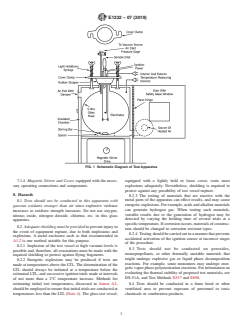
7.1 Fig. 1 is a schematic diagram of the apparatus; details
chemicals, particularly in closed process and storage vessels.
and dimensions are presented in Annex A1. The apparatus
consists of the following:
NOTE1—Asaresultofphysicalfactorsinherentinflashpointapparatus
7.1.1 Glass Test Vessel,
7.1.2 Insulated Chamber, equipped with a source of
Available fromAmerican National Standards Institute (ANSI), 25 W. 43rd St.,
controlled-temperature air,
4th Floor, New York, NY 10036, http://www.ansi.org.
7.1.3 Ignition Device, with an appropriate power supply,
Available from National Fire Protection Association (NFPA), 1 Batterymarch
Park, Quincy, MA 02169-7471, http://www.nfpa.org. and
E1232 − 07 (2019)
FIG. 1 Schematic Diagram of Test Apparatus
7.1.4 Magnetic Stirrer and Cover, equipped with the neces- equipped with a lightly held or loose cover, vents most
sary operating connections and components. explosions adequately. Nevertheless, shielding is required to
protect against any possibility of test vessel rupture.
8. Hazards
8.2.3 The testing of materials that are reactive with the
metal parts of the apparatus can effect results, and may cause
8.1 Tests should not be conducted in this apparatus with
energeticexplosions.Forexample,acidsandalkalinematerials
gaseous oxidants stronger than air since explosive violence
can generate hydrogen gas. When testing such materials,
increases as oxidizer strength increases. Do not use oxygen,
variable results due to the generation of hydrogen may be
nitrous oxide, nitrogen dioxide, chlorine, etc. in this glass
detected by varying the holding time of several trials at a
apparatus.
specifictemperature.Ifcorrosionoccurs,materialsofconstruc-
8.2 Adequateshieldingmustbeprovidedtopreventinjuryin
tion should be changed to corrosion resistant types.
the event of equipment rupture, due to both implosions and
8.2.4 Testingshouldbecarriedoutinamannerthatprevents
explosions. A metal enclosure such as that recommended in
accidental activation of the ignition source at incorrect stages
A1.2 is one method suitable for this purpose.
of the procedure.
8.2.1 Implosion of the test vessel at high vacuum levels is
8.3 Tests should not be conducted on peroxides,
possible and, therefore, all evacuations must be made with the
monopropellants, or other thermally unstable materials that
required shielding to protect against flying fragments.
might undergo explosive gas or liquid phase decomposition
8.2.2 Energetic explosions may be produced if tests are
reactions. For example, some monomers may undergo ener-
made at temperatures above the LTL. The determination of the
geticvaporphasepolymerizationreactions.Forinformationon
LTL should always be initiated at a temperature below the
evaluating the thermal stability of proposed test materials, see
estimated LTL, and successive ignition trials made at intervals
DS-51A, and Test Methods E537 and E698.
of not more than a 2°C temperature increase. Methods for
estimating initial test temperatures, discussed in Annex A2, 8.4 Tests should be conducted in a fume hood or other
shouldbeemployedtoensurethatinitialtrialsareconductedat ventilated area to prevent exposure of personnel to toxic
temperatures less than the LTL (Note 4). The glass test vessel, chemicals or combustion products.
E1232 − 07 (2019)
NOTE 6—If mixing is inadequate, vapor concentrations can vary
8.5 Precautions must be taken to ensure that the high
throughout the flask, and inconsistent results will be obtained. Some
voltage spark ignition source is always adequately insulated
regions may contain insufficient fuel to propagate a flame at temperatures
from other electrical circuits and metal parts of the apparatus,
above the true equilibrium flammable limit temperature.
fume hood, etc. to prevent electrical hazards to personnel and
10.2.5 Turn off the stirrer.
instrumentation. Careful attention to electrical insulation integ-
10.2.6 Record the test temperature and system pressure
rity plus the use of disconnection procedures are required to
(usually barometric pressure unless system is being operated at
achieve a satisfactory protection against electrical hazards.
sub-ambient pressure).
10.2.7 Disconnect instrumentation lines as required and
9. Calibration
connect the ignition wires.
9.1 System temperature and pressure and barometric pres-
10.2.8 Check for liquid condensation or mist in the vapor
sure measuring devices must be calibrated against adequate
regions of the flask. Heat, insulate, or both, to prevent
standards.Forinformationoncalibrationofthermocouples,see
condensation and then repeat the test (10.3).
Test Method E220, Specification E230, and ANSI-MC96.1.
The pressure sensing devices should be calibrated against a
NOTE 7—Although this test method is intended to be applied to vapor
situations only, it is theoretically possible to generate mist in some
traceable standard such as a primary standard piston gage,
situations.Anymisttendstogiveamoreconservative(lower)temperature
commonly called a dead weight gage.
limit.
10.2.9 Darken the viewing area. Activate the ignition
10. Procedures
source. Observe for ignition and flame propagation away from
10.1 Lower Temperature Limit of Flammability Test:
the ignition source. At each test temperature record any
10.1.1 Assemble the equipment, as shown in Fig. 1, within
occurrence of flame propagation.
an appropriate fume hood or other ventilated area and secure
the door of the metal enclosure. Clean and dry the test vessel
NOTE 8—It is recommended that the ignition source not be activated
until 30 s after the stirrer is turned off to allow the mixture to become
and all components. Evacuate the system and flush with air, or
quiescent. However, to prevent stratification activate the ignition source
other specified test gas, sufficiently to ensure removal of
within 60 s.
residual volatile materials that may be present as a result of
NOTE 9—At concentrations just outside the flammable range a small
cleaning or prior tests.
cap of flame will be visible above the arc position.Absence of a flame cap
10.1.2 Based on methods given in Annex A2, adjust the maybeanindicationofinsufficientignitionenergy.Theonsetofspherical,
upward, and partial outward flame propagation signifies a limit or
flask to the desired test temperature below the anticipated
near-limit temperature. It is suggested that detailed observations of flame
lower temperature limit of flammability.
behavior be recorded on all trials. Include such notes as flame cap, no
flame cap, upward and outward propagation, downward propagation, etc.
NOTE 4—A prudent operator will use a wide safety factor in choosing
These observations can serve as a guide to narrowing the region of
initial test temperatures (6.3). This may necessitate a few additional trials
uncertainty between go and no-go trials.
but will provide increased safety for the operation.
10.1.3 It may be necessary to separately heat, insulate, or
10.2.10 Flush the test vessel sufficiently with air, or other
heat and insulate cover components and lines, to prevent vapor specified test gas, to remove possible decomposition, combus-
condensation at cool sites within the vapor space. The liquid,
tion products, or both.
mist, or both, that may otherwise be formed can cause
10.2.11 Raisethevesseltemperatureinstepsnogreaterthan
erroneous results.
2°C to find the minimum temperature, T , that gives flame
10.1.4 Make certain that all safety precautions have been
propagation and the maximum temperature, T , below T , that
2 1
taken.
does not give flame propagation. (The difference between T
and T is a measure of the variability of the procedure for the
10.2 Sample Introduction of Liquids:
material being studied (Note 14.))
10.2.1 Introduce 50 cm of liquid to the flask using a
10.2.12 Conduct several preliminary trials on a given liquid
separatory funnel or other inlet device.
charge. It is necessary to remove the vessel for periodic
NOTE 5—The 50 cm of liquid provide substantially more than
cleaning and recharging with liquid.
theoretically required. Smaller sample sizes are adequate for pure chemi-
10.2.13 Each final trial should be in a clean vessel using a
cals and larger sample sizes may be required for mixtures (Annex A3).
fresh sample.
10.2.2 Turn on the stirrer at a speed of approximately 400
rpm.
NOTE 10—Ignition failures and inconsistent performance are occasion-
ally encountered when, for example, electrically highly conductive or
10.2.3 Close the hood door. (Cover hold-down devices
insulating materials, or materials having a very high ignition energy, are
should be loose).
testedusingthesparkignitionsource.Activatethesparkignitionsourcein
10.2.4 Stir for at least 5 min after attainment of thermal
air to determine whether the equipment or material under test is causing
equilibrium. Slower stirrer speeds, longer mix times, or both,
performance problems. Limits for materials causing inconsistent spark
may be required for viscous materials. Observe results ob- performance should be determined using a fuse wire ignition source. Fuse
wire ignition should also be used to confirm results if temperature limits
tained with different mixing times and speeds, at constant
are conducted at reduced pressure.
temperature, as a check to ensure that complete mixing and
thermal equilibrium are being achieved without generation of 10.2.14 Record the values of the test temperatures, T and
mist. If a visible mist is generated, decrease stirring speed until T , and the test pressure (barometric pressure in most situa-
it is eliminated. tions) in the vessel.
E1232 − 07 (2019)
10.3 Sample Introduction of a Solid: 12. Report
10.3.1 Aswithliquids,place50cm ofthesolidintheflask.
12.1 The report shall include the following:
12.1.1 Temperature limit, LTL, to the nearest 1°C (2°F);
NOTE 11—This technique is only suitable for powdered or small
crystalline solids.
report T , T , and the test pressure,
1 2
12.1.2 Ignition source used,
10.3.2 Add chemicals having melting points above room
12.1.3 Date,
temperature to the test vessel as solids. If the chemical melts at
12.1.4 Purity of the material, if known, and any special
the test temperature, the procedure is identical to that given in
sample preparation,
10.5.
12.1.5 Type and concentration of oxidant and diluent if
10.3.3 An occasional solid will sublime sufficiently to have
other than air,
a temperature limit of flammability while still solid. These
12.1.6 Deviations made from the procedure as written in
materials are tested by the same techniques as liquids.
this method, for example, vessel size or ignition source, and
However, some difficulty can be encountered with stirring.
12.1.7 For those samples tested that do not exhibit the
Employ reduced stirring speeds and longer holding times for
presence of sufficient vapors to form flammable mixtures with
attainment of equilibrium.
air, the report shall state either no flame propagation to boiling
or no flame propagation in tests from __°C to __°C by ASTM
11. Calculation
Test Method E1232.
11.1 Calculate ltl, the uncorrected temperature limit of
flammability, using Eq 1. Correct this limit to LTL at standard
13. Precision and Bias
atmospheric pressure, 101.3 kPa (760 mm Hg), using either Eq
13.1 An interlaboratory study of the repeatability and repro-
2 or Eq 3.
ducibility of this test method has not been carried out.
ltl 51/2 T 1T (1)
~ !
1 2 However, a single laboratory repeatability study is available.
Duplicate or triplicate test were performed over a 12-year
LTL 5 ltl10.25 101.3 2 p (2)
~ !
period by different operators to determine the LTL of 14
where:
substances and UTL of 13 substances. The maximum LTL
p = absolute initial pressure in the vessel in kPa.
deviation has been found to be bounded by the following
formulae:
LTL 5 ltl10.03 760 2 P (3)
~ !
25 2
Abs Max Dev C 5 2.2 10 * LTL deg. R
@ ~ !# @ ~ !#
where:
NOTE 14—Generally a clear-cut change from no flame propagation to
P = absolute initial pressure in the vessel in mm Hg.
flame propagation occurs over a 3°C (5°F), or less, temperature range for
lower limit tests at 38°C (100°F) and over a 6°C (10°F), or less,
All temperatures are in degrees Celsius.
temperature range for tests at 93°C (200°F).
NOTE 12—The barometric pressure used in this calculation is the
13.2 An analysis of a subset (LTLof 7 substances and UTL
ambient pressure for the laboratory at the time of the test. Many aneroid
of 4 substances) of the data covering limit temperatures in the
barometers, such as those used at weather stations and airports, are
precorrected to give sea level readings and would not give the correct range from 42°F to 359°F indicates that there is no discernible
reading for this test.
bias between the test results and the theoretical predictions
NOTE 13—The barometric correction in Eq 2 and Eq 3 is an approxi-
using the vapor pressure data and limit concentration.
mation based on a material of average lower flammable limit, having a
vapor pressure of average slope. Theoretically, a separate barometric
13.3 A report including the data and analysis is available
adjustment would be required for each material; however, the approxima-
from ASTM Headquarters.
tion in Eq 2 and Eq 3 is adequate for most cases. For non-standard
materials, for temperature limit measurements made at high altitudes
(Denver, for example), or for data being used to evaluate hazards at high
Supporting data have been filed at ASTM International Headquarters and may
altitudes, corrections might better be based on the actual vapor pressure beobtainedbyrequestingResearchReportRR:E27-1004.ContactASTMCustomer
data of the material in question. Service at service@astm.org.
E1232 − 07 (2019)
ANNEXES
(Mandatory Information)
A1. DIMENSIONS AND SPECIFICATIONS OF APPARATUS (Fig. 1)
A1.1 Test Vessel—The test vessel shall be a borosilicate or fuse wire, or both. Electrode rods are spaced at least 32 mm
glass boiling flask, short-ring neck, 5000 cm capacity, ap- (1 ⁄4 in.) apart. The spark gap points are suspended approxi-
3 3
proximately 222 mm (8 ⁄4 in.) in diameter and 305 mm (12 in.) mately 70.3 mm (2 ⁄4 in.) above the bottom of the flask. Other
in height. materials of construction may be used as
...