

ASTM E537-20
(Test Method)Standard Test Method for Thermal Stability of Chemicals by Differential Scanning Calorimetry
General Information
- Abstract
SIGNIFICANCE AND USE
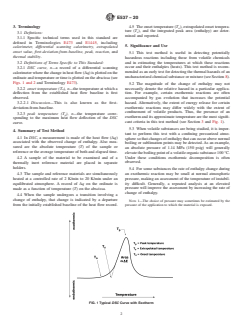
5.1 This test method is useful in detecting potentially hazardous reactions including those from volatile chemicals and in estimating the temperatures at which these reactions occur and their enthalpies (heats). This test method is recommended as an early test for detecting the thermal hazards of an uncharacterized chemical substance or mixture (see Section 8).
5.2 The magnitude of the change of enthalpy may not necessarily denote the relative hazard in a particular application. For example, certain exothermic reactions are often accompanied by gas evolution that increases the potential hazard. Alternatively, the extent of energy release for certain exothermic reactions may differ widely with the extent of confinement of volatile products. Thus, the presence of an exotherm and its approximate temperature are the most significant criteria in this test method (see Section 3 and Fig. 1).
5.3 When volatile substances are being studied, it is important to perform this test with a confining pressurized atmosphere so that changes of enthalpy that can occur above normal boiling or sublimation points may be detected. As an example, an absolute pressure of 1.14 MPa (150 psig) will generally elevate the boiling point of a volatile organic substance 100 °C. Under these conditions exothermic decomposition is often observed.
5.4 For some substances the rate of enthalpy change during an exothermic reaction may be small at normal atmospheric pressure, making an assessment of the temperature of instability difficult. Generally, a repeated analysis at an elevated pressure will improve the assessment by increasing the rate of change of enthalpy.
Note 1: The choice of pressure may sometimes be estimated by the pressure of the application to which the material is exposed.
5.5 The four significant criteria of this test method are: the detection of a change of enthalpy; the approximate temperature at which the event occurs; the estimation of its enthalpy and the observance ...
SCOPE
1.1 This test method describes the ascertainment of the presence of enthalpic changes in a test specimen, using minimum quantities of material, approximates the temperature at which these enthalpic changes occur and determines their enthalpies (heats) using differential scanning calorimetry or pressure differential scanning calorimetry.
1.2 This test method may be performed on solids, liquids, or slurries.
1.3 This test method may be performed in an inert or a reactive atmosphere with an absolute pressure range from 100 Pa through 7 MPa and over a temperature range from 300 K to 800 K (27 °C to 527 °C).
1.4 The values stated in SI units are to be regarded as standard. No other units of measurement are included in this standard.
1.4.1 Exceptions—Inch-pound units are provided as a courtesy to the user in 5.3, 7.2.2.1, 7.2.2.2, and 11.4.
1.5 This standard does not purport to address all of the safety concerns, if any, associated with its use. It is the responsibility of the user of this standard to establish appropriate safety, health, and environmental practices and determine the applicability of regulatory limitations prior to use. Specific safety precautions are given in Section 8.
1.6 This international standard was developed in accordance with internationally recognized principles on standardization established in the Decision on Principles for the Development of International Standards, Guides and Recommendations issued by the World Trade Organization Technical Barriers to Trade (TBT) Committee.
- Status
- Published
- Publication Date
- 31-Jan-2020
- Technical Committee
- E27 - Hazard Potential of Chemicals
- Drafting Committee
- E27.02 - Thermal Stability and Condensed Phases
Buy Documents
ASTM E537-20 - Standard Test Method for Thermal Stability of Chemicals by Differential Scanning Calorimetry
REDLINE ASTM E537-20 - Standard Test Method for Thermal Stability of Chemicals by Differential Scanning Calorimetry
Overview
ASTM E537-20: Standard Test Method for Thermal Stability of Chemicals by Differential Scanning Calorimetry provides an essential methodology for evaluating the thermal stability of chemicals. This test method utilizes differential scanning calorimetry (DSC) and pressure differential scanning calorimetry (PDSC) to detect enthalpic changes, estimate the onset temperature for thermal events, and evaluate associated enthalpies. The method is designed to identify potential thermal hazards in chemicals-both known and uncharacterized-using minimal sample quantities. It is applicable to solids, liquids, and slurries under various atmospheric conditions and a broad range of temperatures and pressures.
Key Topics
- Detection of Hazardous Reactions: The standard is particularly valuable in identifying potentially hazardous exothermic reactions, including those leading to gas evolution or energetic decomposition. Early detection aids safe handling and process development.
- Measurement of Enthalpy and Temperature: Key criteria include determining when an enthalpy change occurs, the temperature at which it starts (onset temperature), and the energy involved (enthalpy).
- Atmosphere and Pressure Effects: Studying chemicals under pressurized, inert, or reactive atmospheres allows for accurate measurement of reactions that may only become apparent above normal boiling points or in confined conditions.
- Sample Size and Sensitivity: The method requires very small specimens-typically 1 mg to 50 mg-which is particularly suitable for hazardous or precious materials and limits the risks during testing.
- Calibration and Precision: The standard outlines calibration procedures and provides guidance on obtaining repeatable and reliable results, including interlaboratory study data on precision and reproducibility.
Applications
ASTM E537-20 is widely used in research, development, safety assessments, and regulatory compliance across various industries:
- Chemical Manufacturing: Early assessment of new compounds for thermal hazards during synthesis or scale-up.
- Process Safety: Evaluation of materials’ stability under potential process conditions to prevent accidental decomposition or ignition.
- Quality Control: Verification that raw materials and finished products do not pose unexpected thermal risks.
- Product Development: Screening of formulation components, especially where thermal events may compromise product performance or safety.
- Regulatory Compliance: Demonstrating due diligence in hazard identification and management as part of chemical registration or transportation requirements.
- Academic and Industrial Research: Supporting fundamental studies on reaction kinetics, thermal decomposition, and stability analysis.
Related Standards
Understanding and applying ASTM E537-20 often involves reference to related ASTM standards and supporting terminology:
- ASTM E473: Terminology Relating to Thermal Analysis and Rheology - defines key concepts and terms used in DSC and related methods.
- ASTM E967: Test Method for Temperature Calibration of Differential Scanning Calorimeters and Differential Thermal Analyzers - ensures accurate temperature measurements.
- ASTM E968: Practice for Heat Flow Calibration of Differential Scanning Calorimeters - for verifying enthalpy measurements.
- ASTM E691: Practice for Conducting an Interlaboratory Study to Determine the Precision of a Test Method - supports precision and reproducibility assessments.
- ASTM E1445: Terminology Relating to Hazard Potential of Chemicals - provides additional safety and hazard descriptors.
- ASTM E1860: Test Method for Elapsed Time Calibration of Thermal Analyzers - important for accurate timing of thermal events.
Practical Value
ASTM E537-20 is an indispensable standard for professionals concerned with chemical thermal stability, process safety, and hazard identification. By using differential scanning calorimetry, facilities can efficiently detect thermal hazards, quantify reaction energies, and better understand the conditions under which dangerous reactions might occur. This contributes directly to safer operations, regulatory compliance, and improved product stewardship throughout the chemical lifecycle. For any organization handling or developing reactive chemicals, adherence to ASTM E537-20 is fundamental for comprehensive thermal analysis and risk mitigation.
Relations
- Effective Date
- 01-Feb-2020
- Effective Date
- 15-Nov-2023
- Effective Date
- 01-Oct-2023
- Effective Date
- 15-Aug-2014
- Effective Date
- 15-Sep-2013
- Effective Date
- 01-May-2013
- Effective Date
- 01-Nov-2011
- Effective Date
- 15-Jun-2011
- Effective Date
- 01-Apr-2011
- Effective Date
- 01-Mar-2010
- Effective Date
- 01-Aug-2009
- Effective Date
- 01-Oct-2008
- Effective Date
- 01-Sep-2008
- Effective Date
- 01-Sep-2008
- Effective Date
- 01-Sep-2008
Buy Documents
ASTM E537-20 - Standard Test Method for Thermal Stability of Chemicals by Differential Scanning Calorimetry
REDLINE ASTM E537-20 - Standard Test Method for Thermal Stability of Chemicals by Differential Scanning Calorimetry
Frequently Asked Questions
ASTM E537-20 is a standard published by ASTM International. Its full title is "Standard Test Method for Thermal Stability of Chemicals by Differential Scanning Calorimetry". This standard covers: SIGNIFICANCE AND USE 5.1 This test method is useful in detecting potentially hazardous reactions including those from volatile chemicals and in estimating the temperatures at which these reactions occur and their enthalpies (heats). This test method is recommended as an early test for detecting the thermal hazards of an uncharacterized chemical substance or mixture (see Section 8). 5.2 The magnitude of the change of enthalpy may not necessarily denote the relative hazard in a particular application. For example, certain exothermic reactions are often accompanied by gas evolution that increases the potential hazard. Alternatively, the extent of energy release for certain exothermic reactions may differ widely with the extent of confinement of volatile products. Thus, the presence of an exotherm and its approximate temperature are the most significant criteria in this test method (see Section 3 and Fig. 1). 5.3 When volatile substances are being studied, it is important to perform this test with a confining pressurized atmosphere so that changes of enthalpy that can occur above normal boiling or sublimation points may be detected. As an example, an absolute pressure of 1.14 MPa (150 psig) will generally elevate the boiling point of a volatile organic substance 100 °C. Under these conditions exothermic decomposition is often observed. 5.4 For some substances the rate of enthalpy change during an exothermic reaction may be small at normal atmospheric pressure, making an assessment of the temperature of instability difficult. Generally, a repeated analysis at an elevated pressure will improve the assessment by increasing the rate of change of enthalpy. Note 1: The choice of pressure may sometimes be estimated by the pressure of the application to which the material is exposed. 5.5 The four significant criteria of this test method are: the detection of a change of enthalpy; the approximate temperature at which the event occurs; the estimation of its enthalpy and the observance ... SCOPE 1.1 This test method describes the ascertainment of the presence of enthalpic changes in a test specimen, using minimum quantities of material, approximates the temperature at which these enthalpic changes occur and determines their enthalpies (heats) using differential scanning calorimetry or pressure differential scanning calorimetry. 1.2 This test method may be performed on solids, liquids, or slurries. 1.3 This test method may be performed in an inert or a reactive atmosphere with an absolute pressure range from 100 Pa through 7 MPa and over a temperature range from 300 K to 800 K (27 °C to 527 °C). 1.4 The values stated in SI units are to be regarded as standard. No other units of measurement are included in this standard. 1.4.1 Exceptions—Inch-pound units are provided as a courtesy to the user in 5.3, 7.2.2.1, 7.2.2.2, and 11.4. 1.5 This standard does not purport to address all of the safety concerns, if any, associated with its use. It is the responsibility of the user of this standard to establish appropriate safety, health, and environmental practices and determine the applicability of regulatory limitations prior to use. Specific safety precautions are given in Section 8. 1.6 This international standard was developed in accordance with internationally recognized principles on standardization established in the Decision on Principles for the Development of International Standards, Guides and Recommendations issued by the World Trade Organization Technical Barriers to Trade (TBT) Committee.
SIGNIFICANCE AND USE 5.1 This test method is useful in detecting potentially hazardous reactions including those from volatile chemicals and in estimating the temperatures at which these reactions occur and their enthalpies (heats). This test method is recommended as an early test for detecting the thermal hazards of an uncharacterized chemical substance or mixture (see Section 8). 5.2 The magnitude of the change of enthalpy may not necessarily denote the relative hazard in a particular application. For example, certain exothermic reactions are often accompanied by gas evolution that increases the potential hazard. Alternatively, the extent of energy release for certain exothermic reactions may differ widely with the extent of confinement of volatile products. Thus, the presence of an exotherm and its approximate temperature are the most significant criteria in this test method (see Section 3 and Fig. 1). 5.3 When volatile substances are being studied, it is important to perform this test with a confining pressurized atmosphere so that changes of enthalpy that can occur above normal boiling or sublimation points may be detected. As an example, an absolute pressure of 1.14 MPa (150 psig) will generally elevate the boiling point of a volatile organic substance 100 °C. Under these conditions exothermic decomposition is often observed. 5.4 For some substances the rate of enthalpy change during an exothermic reaction may be small at normal atmospheric pressure, making an assessment of the temperature of instability difficult. Generally, a repeated analysis at an elevated pressure will improve the assessment by increasing the rate of change of enthalpy. Note 1: The choice of pressure may sometimes be estimated by the pressure of the application to which the material is exposed. 5.5 The four significant criteria of this test method are: the detection of a change of enthalpy; the approximate temperature at which the event occurs; the estimation of its enthalpy and the observance ... SCOPE 1.1 This test method describes the ascertainment of the presence of enthalpic changes in a test specimen, using minimum quantities of material, approximates the temperature at which these enthalpic changes occur and determines their enthalpies (heats) using differential scanning calorimetry or pressure differential scanning calorimetry. 1.2 This test method may be performed on solids, liquids, or slurries. 1.3 This test method may be performed in an inert or a reactive atmosphere with an absolute pressure range from 100 Pa through 7 MPa and over a temperature range from 300 K to 800 K (27 °C to 527 °C). 1.4 The values stated in SI units are to be regarded as standard. No other units of measurement are included in this standard. 1.4.1 Exceptions—Inch-pound units are provided as a courtesy to the user in 5.3, 7.2.2.1, 7.2.2.2, and 11.4. 1.5 This standard does not purport to address all of the safety concerns, if any, associated with its use. It is the responsibility of the user of this standard to establish appropriate safety, health, and environmental practices and determine the applicability of regulatory limitations prior to use. Specific safety precautions are given in Section 8. 1.6 This international standard was developed in accordance with internationally recognized principles on standardization established in the Decision on Principles for the Development of International Standards, Guides and Recommendations issued by the World Trade Organization Technical Barriers to Trade (TBT) Committee.
ASTM E537-20 is classified under the following ICS (International Classification for Standards) categories: 07.030 - Physics. Chemistry. The ICS classification helps identify the subject area and facilitates finding related standards.
ASTM E537-20 has the following relationships with other standards: It is inter standard links to ASTM E537-12, ASTM E1445-08(2023), ASTM E473-23b, ASTM E473-14, ASTM E1860-13, ASTM E691-13, ASTM E691-11, ASTM E473-11a, ASTM E473-11, ASTM E473-10, ASTM E473-09, ASTM E691-08, ASTM E473-08, ASTM E967-08, ASTM E968-02(2008). Understanding these relationships helps ensure you are using the most current and applicable version of the standard.
ASTM E537-20 is available in PDF format for immediate download after purchase. The document can be added to your cart and obtained through the secure checkout process. Digital delivery ensures instant access to the complete standard document.
Standards Content (Sample)
This international standard was developed in accordance with internationally recognized principles on standardization established in the Decision on Principles for the
Development of International Standards, Guides and Recommendations issued by the World Trade Organization Technical Barriers to Trade (TBT) Committee.
Designation: E537 − 20
Standard Test Method for
Thermal Stability of Chemicals by Differential Scanning
Calorimetry
This standard is issued under the fixed designation E537; the number immediately following the designation indicates the year of
original adoption or, in the case of revision, the year of last revision. A number in parentheses indicates the year of last reapproval. A
superscript epsilon (´) indicates an editorial change since the last revision or reapproval.
This standard has been approved for use by agencies of the U.S. Department of Defense.
INTRODUCTION
Committee E27 is currently engaged in developing methods to determine the hazard potential of
chemicals.An estimate of this potential may usually be obtained by the use of program CHETAH 7.0
to compute the maximum energy of reaction of the chemical or mixture of chemicals.
The expression “hazard potential” as used by this committee is defined as the degree of
susceptibility of material to ignition or release of energy under varying environmental conditions.
The primary purpose of this test method is to detect enthalpic changes and to approximate the
temperatureofinitiationandenthalpies(heats)oftheseevents.Differentialscanningcalorimetryoffers
the advantage of using very small specimens on the order of a few milligrams.
1. Scope responsibility of the user of this standard to establish appro-
priate safety, health, and environmental practices and deter-
1.1 This test method describes the ascertainment of the
mine the applicability of regulatory limitations prior to use.
presence of enthalpic changes in a test specimen, using
Specific safety precautions are given in Section 8.
minimum quantities of material, approximates the temperature
1.6 This international standard was developed in accor-
at which these enthalpic changes occur and determines their
dance with internationally recognized principles on standard-
enthalpies (heats) using differential scanning calorimetry or
ization established in the Decision on Principles for the
pressure differential scanning calorimetry.
Development of International Standards, Guides and Recom-
1.2 Thistestmethodmaybeperformedonsolids,liquids,or
mendations issued by the World Trade Organization Technical
slurries.
Barriers to Trade (TBT) Committee.
1.3 This test method may be performed in an inert or a
2. Referenced Documents
reactive atmosphere with an absolute pressure range from 100
Pa through 7 MPa and over a temperature range from 300 K to 2.1 ASTM Standards:
800 K (27 °C to 527 °C). E473 Terminology Relating to Thermal Analysis and Rhe-
ology
1.4 The values stated in SI units are to be regarded as
E691 Practice for Conducting an Interlaboratory Study to
standard. No other units of measurement are included in this
Determine the Precision of a Test Method
standard.
E967 Test Method for Temperature Calibration of Differen-
1.4.1 Exceptions—Inch-pound units are provided as a cour-
tial Scanning Calorimeters and Differential Thermal Ana-
tesy to the user in 5.3, 7.2.2.1, 7.2.2.2, and 11.4.
lyzers
1.5 This standard does not purport to address all of the
E968 Practice for Heat Flow Calibration of Differential
safety concerns, if any, associated with its use. It is the
Scanning Calorimeters
E1445 Terminology Relating to Hazard Potential of Chemi-
cals
This test method is under the jurisdiction ofASTM Committee E27 on Hazard
E1860 Test Method for Elapsed Time Calibration of Ther-
Potential of Chemicals and is the direct responsibility of Subcommittee E27.02 on
Thermal Stability and Condensed Phases.
mal Analyzers
Current edition approved Feb. 1, 2020. Published February 2020. Originally
approved in 1976. Last previous edition approved in 2012 as E537 – 12. DOI:
10.1520/E0537-20. For referenced ASTM standards, visit the ASTM website, www.astm.org, or
A complete assessment of the hazard potential of chemicals must take into contact ASTM Customer Service at service@astm.org. For Annual Book of ASTM
account a number of realistic factors not considered in this test method or the Standards volume information, refer to the standard’s Document Summary page on
CHETAH program. the ASTM website.
Copyright © ASTM International, 100 Barr Harbor Drive, PO Box C700, West Conshohocken, PA 19428-2959. United States
E537 − 20
3. Terminology 4.5 The onset temperature (T ), extrapolated onset tempera-
o
ture (T ), and the integrated peak area (enthalpy) are deter-
s
3.1 Defintions:
mined and reported.
3.1.1 Specific technical terms used in this standard are
defined in Terminologies E473 and E1445, including
5. Significance and Use
calorimeter, differential scanning calorimetry, extrapolated
onset value, first-deviation-from-baseline, peak, reaction, and
5.1 This test method is useful in detecting potentially
thermal stability.
hazardous reactions including those from volatile chemicals
and in estimating the temperatures at which these reactions
3.2 Definitions of Terms Specific to This Standard:
occur and their enthalpies (heats). This test method is recom-
3.2.1 DSC curve, n—a record of a differential scanning
mended as an early test for detecting the thermal hazards of an
calorimeterwherethechangeinheatflow(∆q)isplottedonthe
uncharacterized chemical substance or mixture (see Section 8).
ordinate and temperature or time is plotted on the abscissa (see
Figs. 1 and 2 and Terminology E473).
5.2 The magnitude of the change of enthalpy may not
3.2.2 onset temperature (T ), n—the temperature at which a necessarily denote the relative hazard in a particular applica-
o
deflection from the established heat flow baseline is first
tion. For example, certain exothermic reactions are often
observed. accompanied by gas evolution that increases the potential
3.2.2.1 Discussion—This is also known as the first- hazard. Alternatively, the extent of energy release for certain
deviation-from-baseline. exothermic reactions may differ widely with the extent of
confinement of volatile products. Thus, the presence of an
3.2.3 peak temperature (T ), n—the temperature corre-
p
exotherm and its approximate temperature are the most signifi-
sponding to the maximum heat flow deflection of the DSC
cant criteria in this test method (see Section 3 and Fig. 1).
curve.
5.3 When volatile substances are being studied, it is impor-
4. Summary of Test Method
tant to perform this test with a confining pressurized atmo-
4.1 In DSC, a measurement is made of the heat flow (∆q)
spheresothatchangesofenthalpythatcanoccurabovenormal
associated with the observed change of enthalpy. Also mea-
boiling or sublimation points may be detected.As an example,
sured are the absolute temperature (T) of the sample or
an absolute pressure of 1.14 MPa (150 psig) will generally
reference or the average temperature of both and elapsed time.
elevatetheboilingpointofavolatileorganicsubstance100°C.
Under these conditions exothermic decomposition is often
4.2 A sample of the material to be examined and of a
observed.
thermally inert reference material are placed in separate
holders.
5.4 For some substances the rate of enthalpy change during
4.3 The sample and reference materials are simultaneously an exothermic reaction may be small at normal atmospheric
pressure, making an assessment of the temperature of instabil-
heated at a controlled rate of 2 K/min to 20 K/min under an
equilibrated atmosphere. A record of ∆q on the ordinate is ity difficult. Generally, a repeated analysis at an elevated
made as a function of temperature (T) on the abscissa. pressure will improve the assessment by increasing the rate of
change of enthalpy.
4.4 When the sample undergoes a transition involving a
change of enthalpy, that change is indicated by a departure
NOTE 1—The choice of pressure may sometimes be estimated by the
from the initially established baseline of the heat flow record. pressure of the application to which the material is exposed.
FIG. 1 TypicalDSC Curve with Exotherm
E537 − 20
FIG. 2DSC Curve Illustrating a Melting Process Immediately Fol-
lowed by an Exothermic Decomposition
employed when oxidation in air is a concern. Unless effects of moisture
5.5 The four significant criteria of this test method are: the
are to be studied, use of dry purge gas is recommended and is essential for
detectionofachangeofenthalpy;theapproximatetemperature
operation at subambient temperatures.
atwhichtheeventoccurs;theestimationofitsenthalpyandthe
NOTE 3—Other purge gas rates may be used but shall be reported.
observance of effects due to the cell atmosphere and pressure.
7.2.1.5 Temperature controller, capable of executing a spe-
6. Limitations
cific temperature program by operating the furnace(s) between
selected temperature limits (ambient temperature to 800 K) at
6.1 A host of environmental factors affect the existence,
a rate of temperature change of from 2 K/min to 20 K/min
magnitude, and temperature of an exothermic reaction. Some,
constant to 60.1 K/min, and
including heating rate, instrument sensitivity, degree of
confinement, and atmosphere reactivity, will affect the detect-
NOTE 4—The temperature range of the apparatus and the experiment
ability of an exothermic reaction using this procedure.
may be extended to 120 K with the use of appropriate cooling or to
1273 K or greater with suitable apparatus.
Therefore, it is imperative that the qualitative results obtained
from the application of this test method be viewed only as an
7.2.1.6 A data collection device, to provide a means of
indication of the thermal stability of a chemical.
acquiring, storing, and displaying measured or calculated
signals, or both. The minimum output signals required for
7. Apparatus
differential scanning calorimetry are, heat flow, temperature,
7.1 The equipment used in this test method shall be capable
and time.
of displaying changes of enthalpy as a function of temperature
7.2.2 If experiments are to be carried out under pressure
(T), and shall have the capability of subjecting the sample cell
conditions:
to different atmospheres of equilibrated pressures.
7.2.2.1 Pressure vessel, or similar means of sealing the test
7.2 Differential Scanning Calorimeter (DSC)—Theessential chamber at any applied pressure within 0.10 MPa to 1.27 MPa
instrumentation required to provide the minimum differential (0 psig to 170 psig) pressure limits required by this test
scanning calorimetric capability for this test method include: method,
7.2.1 A test chamber composed of: 7.2.2.2 Pressurized gas source, capable of sustaining a
7.2.1.1 Furnace(s),toprovideuniformcontrolledheatingof
regulated gas pressure in the test chamber between 0.10 MPa
a specimen and reference to a constant temperature or at a and 1.3 MPa (0 psig and 170 psig),
constant rate within the applicable temperature range of this
7.2.2.3 Pressure transducer, or similar device to measure
test method,
the pressure inside the test chamber to 65 % including any
7.2.1.2 Temperature sensor, to provide an indication of the
temperature dependence of the transducer,
specimen/furnace temperature to 60.1 K,
7.2.2.4 Pressure regulator, or similar device to adjust the
7.2.1.3 Differential sensor, to detect a temperature or heat
applied pressure in the test chamber to 65 % of the desired
flow difference between the specimen and reference equivalent
value,
to 0.1 mW,
7.2.2.5 Ballast, or similar means to maintain the applied
7.2.1.4 Means of sustaining a test chamber environment of
pressure in the test chamber constant to 65%,
inert (for example, nitrogen, helium or argon) or reactive (for
7.2.2.6 Valves, to control pressurizing gas in the test cham-
example, air) gas at a purge rate of 50 6 5 mL/min,
ber or to isolate components of the pressure system, or both.
NOTE 2—Typically, at least 99 % pure nitrogen, argon or helium is 7.2.3 If subambient temperatures are desired:
E537 − 20
7.2.3.1 Cooling system, to hasten cool down from elevated reference materials include calcined aluminum oxide, glass
temperatures and to sustain an isothermal subambient tempera- beads, silicone oil, or an empty container.
ture.
11. Recommended Conditions of Tests
7.3 Containers, (pans, crucibles, vials, etc.) which are inert
to the specimen and reference materials and which are of
11.1 Specimen Size—A1-mg to 5-mg specimen is generally
suitable structural shape and integrity to contain the specimen
considered adequate. Decrease the specimen size if
...
This document is not an ASTM standard and is intended only to provide the user of an ASTM standard an indication of what changes have been made to the previous version. Because
it may not be technically possible to adequately depict all changes accurately, ASTM recommends that users consult prior editions as appropriate. In all cases only the current version
of the standard as published by ASTM is to be considered the official document.
Designation: E537 − 12 E537 − 20
Standard Test Method for
The Thermal Stability of Chemicals by Differential Scanning
Calorimetry
This standard is issued under the fixed designation E537; the number immediately following the designation indicates the year of
original adoption or, in the case of revision, the year of last revision. A number in parentheses indicates the year of last reapproval. A
superscript epsilon (´) indicates an editorial change since the last revision or reapproval.
This standard has been approved for use by agencies of the U.S. Department of Defense.
INTRODUCTION
Committee E27 is currently engaged in developing methods to determine the hazard potential of
chemicals. An estimate of this potential may usually be obtained by the use of program CHETAH 7.0
to compute the maximum energy of reaction of the chemical or mixture of chemicals.
The expression “hazard potential” as used by this committee is defined as the degree of
susceptibility of material to ignition or release of energy under varying environmental conditions.
The primary purpose of this test method is to detect enthalpic changes and to approximate the
temperature of initiation and enthalpies (heats) of these events. Differential scanning calorimetry offers
the advantage of using very small specimens on the order of a few milligrams.
1. Scope
1.1 This test method describes the ascertainment of the presence of enthalpic changes in a test specimen, using minimum
quantities of material, approximates the temperature at which these enthalpic changes occur and determines their enthalpies (heats)
using differential scanning calorimetry or pressure differential scanning calorimetry.
1.2 This test method may be performed on solids, liquids, or slurries.
1.3 This test method may be performed in an inert or a reactive atmosphere with an absolute pressure range from 100 Pa through
7 MPa and over a temperature range from 300 K to 800 K (27 °C to 527°C). 527 °C).
1.4 The values stated in SI units are to be regarded as standard. No other units of measurement are included in this standard.
1.4.1 Exceptions—Inch-pound units are provided as a courtesy to the user in 5.3, 7.2.2.1, 7.2.2.2, and 11.4.
1.5 There is no ISO standard equivalent to this test method.
1.5 This standard may involve hazardous materials, operations, and equipment. This standard does not purport to address all
of the safety concerns concerns, if any, associated with its use. It is the responsibility of the user of this standard to establish
appropriate safety safety, health, and healthenvironmental practices and determine the applicability of regulatory limitations prior
to use. Specific safety precautions are given in Section 8.
1.6 This international standard was developed in accordance with internationally recognized principles on standardization
established in the Decision on Principles for the Development of International Standards, Guides and Recommendations issued
by the World Trade Organization Technical Barriers to Trade (TBT) Committee.
2. Referenced Documents
2.1 ASTM Standards:
E473 Terminology Relating to Thermal Analysis and Rheology
This test method is under the jurisdiction of ASTM Committee E27 on Hazard Potential of Chemicals and is the direct responsibility of Subcommittee E27.02 on Thermal
Stability and Condensed Phases.
Current edition approved Dec. 1, 2012Feb. 1, 2020. Published December 2012February 2020. Originally approved in 1976. Last previous edition approved in 20072012
as E537 – 07.E537 – 12. DOI: 10.1520/E0537-12.10.1520/E0537-20.
A complete assessment of the hazard potential of chemicals must take into account a number of realistic factors not considered in this test method or the CHETAH
program.
For referenced ASTM standards, visit the ASTM website, www.astm.org, or contact ASTM Customer Service at service@astm.org. For Annual Book of ASTM Standards
volume information, refer to the standard’sstandard’s Document Summary page on the ASTM website.
Copyright © ASTM International, 100 Barr Harbor Drive, PO Box C700, West Conshohocken, PA 19428-2959. United States
E537 − 20
E691 Practice for Conducting an Interlaboratory Study to Determine the Precision of a Test Method
E967 Test Method for Temperature Calibration of Differential Scanning Calorimeters and Differential Thermal Analyzers
E968 Practice for Heat Flow Calibration of Differential Scanning Calorimeters
E1445 Terminology Relating to Hazard Potential of Chemicals
E1860 Test Method for Elapsed Time Calibration of Thermal Analyzers
3. Terminology
3.1 Definitions:
3.1.1 Specific technical terms used in this standard are defined in Terminologies E473 and E1445, and include calorimeter,
differential scanning calorimetry, extrapolated onset value, first-deviation-from baseline, peak, reaction, and thermal stability.
3.1 Defintions:
3.1.1 Specific technical terms used in this standard are defined in Terminologies E473 and E1445, including calorimeter,
differential scanning calorimetry, extrapolated onset value, first-deviation-from-baseline, peak, reaction, and thermal stability.
3.2 Definitions of Terms Specific to This Standard:
3.2.1 DSC curve—curve, n—a record of a differential scanning calorimeter where the change in heat flow (Δq) is plotted on the
ordinate and temperature or time is plotted on the abscissa (see Figs. 1 and 2 and Terminology E473).
3.2.2 peak temperature (T )—the temperature corresponding to the maximum deflection of the DSC curve.
p
3.2.2 onset temperature (T ), n—)—the temperature at which a deflection from the established heat flow baseline is first
o
observed.
3.2.2.1 Discussion—
This is also known as the first-deviation-from-baseline.
3.2.3 peak temperature (T ), n—the temperature corresponding to the maximum heat flow deflection of the DSC curve.
p
4. Summary of Test Method
4.1 In DSC, a measurement is made of the heat flow (Δq) associated with the observed change of enthalpy. Provisions are made
to measure Also measured are the absolute temperature (T) of the sample or reference or the average temperature of both. both
and elapsed time.
4.2 A sample of the material to be examined and of a thermally inert reference material are placed in separate holders.
4.3 The sample and reference materials are simultaneously heated at a controlled rate of 2 K/min to 20 K/min under an
equilibrated atmosphere. A record of Δq on the ordinate is made as a function of temperature (T) on the abscissa.
4.4 When the sample undergoes a transition involving a change of enthalpy, that change is indicated by a departure from the
initially established baseline of the heat flow record.
FIG. 1 Typical DSC Curve with Exotherm
E537 − 20
FIG. 2 DSC Curve Illustrating a Melting Process Immediately Fol-
lowed by an Exothermic Decomposition
4.5 The onset temperature (T ), extrapolated onset temperature (T ), and the integrated peak area (enthalpy) are determined
oo es
and reported.
5. Significance and Use
5.1 This test method is useful in detecting potentially hazardous reactions including those from volatile chemicals and in
estimating the temperatures at which these reactions occur and their enthalpies (heats). This test method is recommended as an
early test for detecting the thermal hazards of an uncharacterized chemical substance or mixture (see Section 8).
5.2 The magnitude of the change of enthalpy may not necessarily denote the relative hazard in a particular application. For
example, certain exothermic reactions are often accompanied by gas evolution that increases the potential hazard. Alternatively,
the extent of energy release for certain exothermic reactions may differ widely with the extent of confinement of volatile products.
Thus, the presence of an exotherm and its approximate temperature are the most significant criteria in this test method (see Section
3 and Fig. 1).
5.3 When volatile substances are being studied, it is important to perform this test with a confining pressurized atmosphere so
that changes of enthalpy that can occur above normal boiling or sublimation points may be detected. As an example, an absolute
pressure of 1.14 MPa (150 psig) will generally elevate the boiling point of a volatile organic substance 100°C. 100 °C. Under these
conditions exothermic decomposition is often observed.
5.4 For some substances the rate of enthalpy change during an exothermic reaction may be small at normal atmospheric
pressure, making an assessment of the temperature of instability difficult. Generally, a repeated analysis at an elevated pressure will
improve the assessment by increasing the rate of change of enthalpy.
NOTE 1—The choice of pressure may sometimes be estimated by the pressure of the application to which the material is exposed.
5.5 The four significant criteria of this test method are: the detection of a change of enthalpy; the approximate temperature at
which the event occurs; the estimation of its enthalpy and the observance of effects due to the cell atmosphere and pressure.
6. Limitations
6.1 A host of environmental factors affect the existence, magnitude, and temperature of an exothermic reaction. Some, including
heating rate, instrument sensitivity, degree of confinement, and atmosphere reactivity, will affect the detectability of an exothermic
reaction using this procedure. Therefore, it is imperative that the qualitative results obtained from the application of this test method
be viewed only as an indication of the thermal stability of a chemical.
7. Apparatus
7.1 The equipment used in this test method shall be capable of displaying changes of enthalpy as a function of temperature (T),
and shall have the capability of subjecting the sample cell to different atmospheres of equilibrated pressures.
7.2 Differential Scanning Calorimeter (DSC)—theThe essential instrumentation required to provide the minimum differential
scanning calorimetric capability for this test method include:
7.2.1 A test chamber composed of:
E537 − 20
7.2.1.1 Furnace(s), to provide uniform controlled heating of a specimen and reference to a constant temperature or at a constant
rate within the applicable temperature range of this test method,
7.2.1.2 Temperature sensor, to provide an indication of the specimen/furnace temperature to 60.1 K,
7.2.1.3 Differential sensor, to detect a temperature or heat flow difference between the specimen and reference equivalent to 0.1
mW,
7.2.1.4 Means of sustaining a test chamber environment of inert (for example, nitrogen, helium or argon) or reactive (for
example, air) gas at a purge rate of 50 6 5 mL/min,
NOTE 2—Typically, at least 99 % pure nitrogen, argon or helium is employed when oxidation in air is a concern. Unless effects of moisture are to be
studied, use of dry purge gas is recommended and is essential for operation at subambient temperatures.
NOTE 3—Other purge gas rates may be used but shall be reported.
7.2.1.5 Temperature controller, capable of executing a specific temperature program by operating the furnace(s) between
selected temperature limits (ambient temperature to 800 K) at a rate of temperature change of from 2 K/min to 20 K/min constant
to 60.1 K/min, and
NOTE 4—The temperature range of the apparatus and the experiment may be extended to 120 K with the use of appropriate cooling or to 1273 K
1273 K or greater with suitable apparatus.
7.2.1.6 A data collection device, to provide a means of acquiring, storing, and displaying measured or calculated signals, or
both. The minimum output signals required for differential scanning calorimetry are, heat flow, temperature, and time .time.
7.2.2 If experiments are to be carried out under pressure conditions:
7.2.2.1 Pressure vessel, or similar means of sealing the test chamber at any applied pressure within 0.10 MPa to 1.27 MPa (0
psig to 170 psig) pressure limits required by this test method,
7.2.2.2 Pressurized gas source, capable of sustaining a regulated gas pressure in the test chamber between 0.10 MPa and 1.3
MPa (0 psig and 170 psig),
7.2.2.3 Pressure transducer, or similar device to measure the pressure inside the test chamber to 65 % including any
temperature dependence of the transducer,
7.2.2.4 Pressure regulator, or similar device to adjust the applied pressure in the test chamber to 65 % of the desired value,
7.2.2.5 Ballast, or similar means to maintain the applied pressure in the test chamber constant to 65 %,
7.2.2.6 Valves, to control pressurizing gas in the test chamber or to isolate components of the pressure system, or both.
7.2.3 If subambient temperatures are desired:
7.2.3.1 Cooling system, to hasten cool down from elevated temperatures and to sustain an isothermal subambient temperature.
7.3 Containers, (pans, crucibles, vials, etc.) which are inert to the specimen and reference materials and which are of suitable
structural shape and integrity to contain the specimen and reference in accordance with the specific requirements of this t
...