

ASTM E487-20
(Test Method)Standard Test Methods for Constant-Temperature Stability of Chemical Materials
General Information
- Abstract
SIGNIFICANCE AND USE
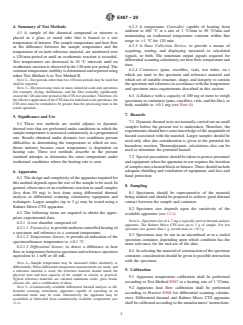
5.1 These test methods are useful adjunct to dynamic thermal tests that are performed under conditions in which the sample temperature is increased continuously at a programmed rate. Results obtained under dynamic test conditions present difficulties in determining the temperature at which an exotherm initiates because onset temperature is dependent on heating rate. These test methods describe in the present standard attempts to determine the onset temperature under isothermal conditions where the heating rate is zero.
SCOPE
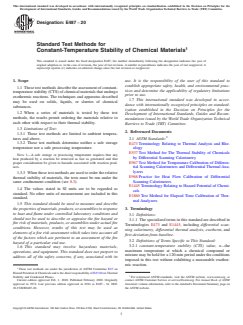
1.1 These test methods describe the assessment of constant-temperature stability (CTS) of chemical materials that undergo exothermic reactions. The techniques and apparatus described may be used on solids, liquids, or slurries of chemical substances.
1.2 When a series of materials is tested by these test methods, the results permit ordering the materials relative to each other with respect to their thermal stability.
1.3 Limitations of Test:
1.3.1 These test methods are limited to ambient temperatures and above.
1.3.2 These test methods determine neither a safe storage temperature nor a safe processing temperature.
Note 1: A safe storage or processing temperature requires that any heat produced by a reaction be removed as fast as generated and that proper consideration be given to hazards associated with reaction products.
1.3.3 When these test methods are used to order the relative thermal stability of materials, the tests must be run under the same confinement condition (see 8.3).
1.4 The values stated in SI units are to be regarded as standard. No other units of measurement are included in this standard.
1.5 This standard should be used to measure and describe the properties of materials, products, or assemblies in response to heat and flame under controlled laboratory conditions and should not be used to describe or appraise the fire hazard or fire risk of materials, products, or assemblies under actual fire conditions. However, results of this test may be used as elements of a fire risk assessment which takes into account all of the factors which are pertinent to an assessment of the fire hazard of a particular end use.
1.6 This standard may involve hazardous materials, operations, and equipment. This standard does not purport to address all of the safety concerns, if any, associated with its use. It is the responsibility of the user of this standard to establish appropriate safety, health, and environmental practices and determine the applicability of regulatory limitations prior to use.
1.7 This international standard was developed in accordance with internationally recognized principles on standardization established in the Decision on Principles for the Development of International Standards, Guides and Recommendations issued by the World Trade Organization Technical Barriers to Trade (TBT) Committee.
- Status
- Published
- Publication Date
- 31-Jan-2020
- Technical Committee
- E27 - Hazard Potential of Chemicals
- Drafting Committee
- E27.02 - Thermal Stability and Condensed Phases

Overview
ASTM E487-20 is the standard test method for determining the constant-temperature stability (CTS) of chemical materials, particularly those prone to exothermic reactions. Developed by ASTM International Committee E27 on Hazard Potential of Chemicals, this standard provides a consistent approach to assess the thermal stability of solids, liquids, or slurries under isothermal (constant-temperature) conditions. Unlike dynamic thermal tests, which increase temperature at a controlled rate and may obscure the precise onset of exothermic reactions, ASTM E487-20 allows for accurate determination of the temperature at which a chemical first starts to react exothermically under stable conditions.
Key Topics
- Constant-Temperature Stability (CTS): The standard defines the CTS value as the highest temperature at which a chemical can be held for 120 minutes without a detectable exothermic reaction.
- Test Methodology: Samples are placed in inert containers and maintained at set temperatures, monitoring for exothermic activity. The temperature is gradually reduced in intervals until CTS is determined.
- Equipment: The test can be conducted with differential thermal analysis (DTA) or differential scanning calorimetry (DSC) apparatus for small samples, or with specific apparatus for larger quantities.
- Sample Types: Methods apply to solids, liquids, or slurries, providing broad application across chemical processing and safety evaluation needs.
- Reporting and Reproducibility: The standard requires the reporting of sample description, weight, testing apparatus details, conditions, temperatures, observed reactions, and time to exotherm, ensuring reproducible and reliable thermal stability data.
- Limitations: The test covers ambient temperatures and above, but results do not directly establish safe storage or processing temperatures. Appropriate safety protocols and hazard assessments are necessary when applying the findings.
Applications
ASTM E487-20 serves various practical purposes in industries dealing with chemical materials:
- Material Selection and Comparison: Facilities can rank chemicals by relative thermal stability, enabling informed choices for safer handling, storage, and processing.
- Risk Assessment: While the test does not determine explicit fire hazards in real-world scenarios, it provides critical data for broader fire risk assessments by identifying exothermic thresholds under controlled conditions.
- Process Design and Safety: The CTS values inform engineers about temperature limits for processing operations to prevent hazardous exothermic events.
- Regulatory and Compliance: Adhering to ASTM E487-20 helps demonstrate compliance with international safety and performance standards for thermal analysis and hazard potential.
Related Standards
- ASTM E473: Terminology Relating to Thermal Analysis and Rheology, providing vocabulary used in thermal testing.
- ASTM E537: Test Method for Thermal Stability of Chemicals by Differential Scanning Calorimetry, for dynamic temperature assessments.
- ASTM E967: Test Method for Temperature Calibration of Differential Scanning Calorimeters and Differential Thermal Analyzers, ensuring measurement accuracy.
- ASTM E968: Practice for Heat Flow Calibration of Differential Scanning Calorimeters.
- ASTM E1445: Terminology Relating to Hazard Potential of Chemicals, supporting proper hazard assessment.
- ASTM E1860: Test Method for Elapsed Time Calibration of Thermal Analyzers.
By following ASTM E487-20, laboratories and industries can robustly evaluate the constant-temperature stability of chemical materials, supporting improved safety, process design, and hazard assessment in accordance with international best practices in thermal analysis and chemical hazard evaluation.
Relations
- Replaces
ASTM E487-14 - Standard Test Method for Constant-Temperature Stability of Chemical Materials - Effective Date
- 01-Feb-2020
- Effective Date
- 15-Nov-2023
- Effective Date
- 01-Oct-2023
- Effective Date
- 01-Feb-2020
- Effective Date
- 15-Aug-2014
- Effective Date
- 15-Sep-2013
- Effective Date
- 01-Dec-2012
- Effective Date
- 15-Jun-2011
- Effective Date
- 01-Apr-2011
- Effective Date
- 01-Mar-2010
- Effective Date
- 01-Aug-2009
- Effective Date
- 01-Sep-2008
- Effective Date
- 01-Sep-2008
- Effective Date
- 01-Sep-2008
- Effective Date
- 15-May-2008
Frequently Asked Questions
ASTM E487-20 is a standard published by ASTM International. Its full title is "Standard Test Methods for Constant-Temperature Stability of Chemical Materials". This standard covers: SIGNIFICANCE AND USE 5.1 These test methods are useful adjunct to dynamic thermal tests that are performed under conditions in which the sample temperature is increased continuously at a programmed rate. Results obtained under dynamic test conditions present difficulties in determining the temperature at which an exotherm initiates because onset temperature is dependent on heating rate. These test methods describe in the present standard attempts to determine the onset temperature under isothermal conditions where the heating rate is zero. SCOPE 1.1 These test methods describe the assessment of constant-temperature stability (CTS) of chemical materials that undergo exothermic reactions. The techniques and apparatus described may be used on solids, liquids, or slurries of chemical substances. 1.2 When a series of materials is tested by these test methods, the results permit ordering the materials relative to each other with respect to their thermal stability. 1.3 Limitations of Test: 1.3.1 These test methods are limited to ambient temperatures and above. 1.3.2 These test methods determine neither a safe storage temperature nor a safe processing temperature. Note 1: A safe storage or processing temperature requires that any heat produced by a reaction be removed as fast as generated and that proper consideration be given to hazards associated with reaction products. 1.3.3 When these test methods are used to order the relative thermal stability of materials, the tests must be run under the same confinement condition (see 8.3). 1.4 The values stated in SI units are to be regarded as standard. No other units of measurement are included in this standard. 1.5 This standard should be used to measure and describe the properties of materials, products, or assemblies in response to heat and flame under controlled laboratory conditions and should not be used to describe or appraise the fire hazard or fire risk of materials, products, or assemblies under actual fire conditions. However, results of this test may be used as elements of a fire risk assessment which takes into account all of the factors which are pertinent to an assessment of the fire hazard of a particular end use. 1.6 This standard may involve hazardous materials, operations, and equipment. This standard does not purport to address all of the safety concerns, if any, associated with its use. It is the responsibility of the user of this standard to establish appropriate safety, health, and environmental practices and determine the applicability of regulatory limitations prior to use. 1.7 This international standard was developed in accordance with internationally recognized principles on standardization established in the Decision on Principles for the Development of International Standards, Guides and Recommendations issued by the World Trade Organization Technical Barriers to Trade (TBT) Committee.
SIGNIFICANCE AND USE 5.1 These test methods are useful adjunct to dynamic thermal tests that are performed under conditions in which the sample temperature is increased continuously at a programmed rate. Results obtained under dynamic test conditions present difficulties in determining the temperature at which an exotherm initiates because onset temperature is dependent on heating rate. These test methods describe in the present standard attempts to determine the onset temperature under isothermal conditions where the heating rate is zero. SCOPE 1.1 These test methods describe the assessment of constant-temperature stability (CTS) of chemical materials that undergo exothermic reactions. The techniques and apparatus described may be used on solids, liquids, or slurries of chemical substances. 1.2 When a series of materials is tested by these test methods, the results permit ordering the materials relative to each other with respect to their thermal stability. 1.3 Limitations of Test: 1.3.1 These test methods are limited to ambient temperatures and above. 1.3.2 These test methods determine neither a safe storage temperature nor a safe processing temperature. Note 1: A safe storage or processing temperature requires that any heat produced by a reaction be removed as fast as generated and that proper consideration be given to hazards associated with reaction products. 1.3.3 When these test methods are used to order the relative thermal stability of materials, the tests must be run under the same confinement condition (see 8.3). 1.4 The values stated in SI units are to be regarded as standard. No other units of measurement are included in this standard. 1.5 This standard should be used to measure and describe the properties of materials, products, or assemblies in response to heat and flame under controlled laboratory conditions and should not be used to describe or appraise the fire hazard or fire risk of materials, products, or assemblies under actual fire conditions. However, results of this test may be used as elements of a fire risk assessment which takes into account all of the factors which are pertinent to an assessment of the fire hazard of a particular end use. 1.6 This standard may involve hazardous materials, operations, and equipment. This standard does not purport to address all of the safety concerns, if any, associated with its use. It is the responsibility of the user of this standard to establish appropriate safety, health, and environmental practices and determine the applicability of regulatory limitations prior to use. 1.7 This international standard was developed in accordance with internationally recognized principles on standardization established in the Decision on Principles for the Development of International Standards, Guides and Recommendations issued by the World Trade Organization Technical Barriers to Trade (TBT) Committee.
ASTM E487-20 is classified under the following ICS (International Classification for Standards) categories: 07.030 - Physics. Chemistry. The ICS classification helps identify the subject area and facilitates finding related standards.
ASTM E487-20 has the following relationships with other standards: It is inter standard links to ASTM E487-14, ASTM E1445-08(2023), ASTM E473-23b, ASTM E537-20, ASTM E473-14, ASTM E1860-13, ASTM E537-12, ASTM E473-11a, ASTM E473-11, ASTM E473-10, ASTM E473-09, ASTM E967-08, ASTM E968-02(2008), ASTM E473-08, ASTM E1445-08. Understanding these relationships helps ensure you are using the most current and applicable version of the standard.
ASTM E487-20 is available in PDF format for immediate download after purchase. The document can be added to your cart and obtained through the secure checkout process. Digital delivery ensures instant access to the complete standard document.
Standards Content (Sample)
This international standard was developed in accordance with internationally recognized principles on standardization established in the Decision on Principles for the
Development of International Standards, Guides and Recommendations issued by the World Trade Organization Technical Barriers to Trade (TBT) Committee.
Designation: E487 − 20
Standard Test Methods for
Constant-Temperature Stability of Chemical Materials
This standard is issued under the fixed designation E487; the number immediately following the designation indicates the year of
original adoption or, in the case of revision, the year of last revision. A number in parentheses indicates the year of last reapproval. A
superscript epsilon (´) indicates an editorial change since the last revision or reapproval.
1. Scope use. It is the responsibility of the user of this standard to
establish appropriate safety, health, and environmental prac-
1.1 These test methods describe the assessment of constant-
tices and determine the applicability of regulatory limitations
temperature stability (CTS) of chemical materials that undergo
prior to use.
exothermic reactions. The techniques and apparatus described
1.7 This international standard was developed in accor-
may be used on solids, liquids, or slurries of chemical
dance with internationally recognized principles on standard-
substances.
ization established in the Decision on Principles for the
1.2 When a series of materials is tested by these test
Development of International Standards, Guides and Recom-
methods, the results permit ordering the materials relative to
mendations issued by the World Trade Organization Technical
each other with respect to their thermal stability.
Barriers to Trade (TBT) Committee.
1.3 Limitations of Test:
2. Referenced Documents
1.3.1 These test methods are limited to ambient tempera-
tures and above.
2.1 ASTM Standards:
1.3.2 These test methods determine neither a safe storage E473 Terminology Relating to Thermal Analysis and Rhe-
temperature nor a safe processing temperature.
ology
E537 Test Method for The Thermal Stability of Chemicals
NOTE 1—A safe storage or processing temperature requires that any
by Differential Scanning Calorimetry
heat produced by a reaction be removed as fast as generated and that
E967 Test Method for Temperature Calibration of Differen-
proper consideration be given to hazards associated with reaction prod-
ucts.
tial Scanning Calorimeters and Differential Thermal Ana-
lyzers
1.3.3 When these test methods are used to order the relative
E968 Practice for Heat Flow Calibration of Differential
thermal stability of materials, the tests must be run under the
Scanning Calorimeters
same confinement condition (see 8.3).
E1445 Terminology Relating to Hazard Potential of Chemi-
1.4 The values stated in SI units are to be regarded as
cals
standard. No other units of measurement are included in this
E1860 Test Method for Elapsed Time Calibration of Ther-
standard.
mal Analyzers
1.5 This standard should be used to measure and describe
the properties of materials, products, or assemblies in response 3. Terminology
to heat and flame under controlled laboratory conditions and
3.1 Definitions:
should not be used to describe or appraise the fire hazard or
3.1.1 The specialized terms in this standard are described in
fire risk of materials, products, or assemblies under actual fire
Terminologies E473 and E1445, including differential scan-
conditions. However, results of this test may be used as
ning calorimetry, differential thermal analysis, exotherm, and
elements of a fire risk assessment which takes into account all
first-deviation-from-baseline.
of the factors which are pertinent to an assessment of the fire
3.2 Definitions of Terms Specific to This Standard:
hazard of a particular end use.
3.2.1 constant-temperature stability (CTS) value, n—the
1.6 This standard may involve hazardous materials,
maximum temperature at which a chemical compound or
operations, and equipment. This standard does not purport to
mixture may be held for a 120-min period under the conditions
address all of the safety concerns, if any, associated with its
imposed in this test without exhibiting a measurable exother-
mic reaction.
These test methods are under the jurisdiction of ASTM Committee E27 on
Hazard Potential of Chemicals and is the direct responsibility of E27.02 on Thermal
Stability and Condensed Phases. For referenced ASTM standards, visit the ASTM website, www.astm.org, or
Current edition approved Feb. 1, 2020. Published February 2020. Originally contact ASTM Customer Service at service@astm.org. For Annual Book of ASTM
approved in 1974. Last previous edition approved in 2014 as E487 – 14. DOI: Standards volume information, refer to the standard’s Document Summary page on
10.1520/E0487-20. the ASTM website.
Copyright © ASTM International, 100 Barr Harbor Drive, PO Box C700, West Conshohocken, PA 19428-2959. United States
E487 − 20
4. Summary of Test Methods 6.2.2 A temperature Controller capable of heating from
ambient to 400 °C at a rate of 1 °C/min to 50 °C/min and
4.1 A sample of the chemical compound or mixture is
maintaining an isothermal temperature constant within that
placed in a glass or metal tube that is heated to a test
range to 61 °C for 120 min.
temperature of interest. The sample temperature and heat flow
6.2.3 A Data Collection Device, to provide a means of
or the difference between the sample temperature and the
acquiring, storing, and displaying measured or calculated
temperature of an inert reference material, are monitored over
signals, or both. The minimum output signals required for
a 120-min period or until an exothermic reaction is recorded.
differentialscanningcalorimetryareheatflow,temperatureand
Test temperatures are decreased in 10 °C intervals until no
time.
exothermicreactionisobservedinthe120-mintestperiod.The
6.2.4 Containers (pans, crucibles, vials, test tubes, etc.)
constant-temperature stability is determined and reported using
which are inert to the specimen and reference material and
either Test Method A or Test Method B.
which are of suitable structure, shape, and integrity to contain
NOTE 2—Test periods other than two 120-min periods may be used but
shall be reported. the specimen and reference in accordance with the temperature
NOTE 3—The processing times in many industrial scale unit operations
and specimen mass requirements described in this section.
(for example, drying, distillations, and the like) normally significantly
6.3 A Balance with a capacity of 100 mg or more to weigh
exceed the 120-min time period in this CTS test procedure. Therefore, for
theeffectiveapplicationoftheCTSdataforindustrialscaleoperations,the
specimensorcontainers(pans,crucibles,vials,andthelike),or
CTS time must be extended to be greater than the processing time in the
both, readable to 60.1 mg (see Note 6).
actual operation.
7. Hazards
5. Significance and Use
7.1 Dynamic thermal tests are normally carried out on small
5.1 These test methods are useful adjunct to dynamic
samples before the present test is undertaken. Therefore, the
thermal tests that are performed under conditions in which the
experimentershouldhavesomeknowledgeofthemagnitudeof
sample temperature is increased continuously at a programmed
hazard associated with the material. Larger samples should be
rate. Results obtained under dynamic test conditions present
used only after due consideration is given to the potential for
difficulties in determining the temperature at which an exo-
hazardous reaction. Thermodynamic calculations also can be
therm initiates because onset temperature is dependent on
used to determine the potential hazard.
heating rate. These test methods describe in the present
standard attempts to determine the onset temperature under 7.2 Special precautions should be taken to protect personnel
and equipment when the apparatus in use requires the insertion
isothermal conditions where the heating rate is zero.
ofsamplesintoaheatedblockorfurnace.Theseshouldinclude
adequate shielding and ventilation of equipment, and face and
6. Apparatus
hand protection.
6.1 The design and complexity of the apparatus required for
this method depends upon the size of the sample to be used. In
8. Sampling
general,observanceofanexothermicreactioninsmallsamples
(less than 50 mg) is best done using differential thermal 8.1 Specimens should be representative of the material
analysis or differential scanning calorimetry equipment and
being studied and should be prepared to achieve good thermal
techniques. Larger samples (up to 2 g) may be tested using a contact between the sample and container.
Kuhner Micro CTS apparatus.
8.2 Specimen size depends upon the sensitivity of the
6.2 The following items are required to obtain the appro-
available apparatus (see 12.1).
priate experimental data:
NOTE 6—Specimen size of 4–7 mg is typically used in thermal analysis
6.2.1 A test chamber composed of:
apparatus. The Kuhner Micro CTS uses up to2gof sample. For test
6.2.1.1 Furnace(s),toprovideuniformcontrolledheatingof
specimen size greater than 1 g, record mass to 60.1 g.
a specimen and reference to a constant temperature.
8.3 Specimens may be run in an unconfined or in a sealed
6.2.1.2 Temperature Sensor, to provide an indication of the
specimen container, depending upon which condition h
...
This document is not an ASTM standard and is intended only to provide the user of an ASTM standard an indication of what changes have been made to the previous version. Because
it may not be technically possible to adequately depict all changes accurately, ASTM recommends that users consult prior editions as appropriate. In all cases only the current version
of the standard as published by ASTM is to be considered the official document.
Designation: E487 − 14 E487 − 20
Standard Test MethodMethods for
Constant-Temperature Stability of Chemical Materials
This standard is issued under the fixed designation E487; the number immediately following the designation indicates the year of
original adoption or, in the case of revision, the year of last revision. A number in parentheses indicates the year of last reapproval. A
superscript epsilon (´) indicates an editorial change since the last revision or reapproval.
1. Scope
1.1 ThisThese test method describesmethods describe the assessment of constant-temperature stability (CTS) of chemical
materials that undergo exothermic reactions. The techniques and apparatus described may be used on solids, liquids, or slurries of
chemical substances.
1.2 When a series of materials is tested by thisthese test method,methods, the results permit ordering the materials relative to
each other with respect to their thermal stability.
1.3 Limitations of Test:
1.3.1 ThisThese test method ismethods are limited to ambient temperatures and above.
1.3.2 ThisThese test method determinesmethods determine neither a safe storage temperature nor a safe processing temperature.
NOTE 1—A safe storage or processing temperature requires that any heat produced by a reaction be removed as fast as generated and that proper
consideration be given to hazards associated with reaction products.
1.3.3 When thisthese test method ismethods are used to order the relative thermal stability of materials, the tests must be run
under the same confinement condition (see 8.3).
1.4 The values stated in SI units are to be regarded as standard. No other units of measurement are included in this standard.
1.5 This standard should be used to measure and describe the properties of materials, products, or assemblies in response to
heat and flame under controlled laboratory conditions and should not be used to describe or appraise the fire hazard or fire risk
of materials, products, or assemblies under actual fire conditions. However, results of this test may be used as elements of a fire
risk assessment which takes into account all of the factors which are pertinent to an assessment of the fire hazard of a particular
end use.
1.6 This standard may involve hazardous materials, operations, and equipment. This standard does not purport to address all
of the safety problems concerns, if any, associated with its use. It is the responsibility of whoever uses the user of this standard
to consult and establish appropriate safety safety, health, and healthenvironmental practices and determine the applicability of
regulatory limitations prior to use.
1.7 This international standard was developed in accordance with internationally recognized principles on standardization
established in the Decision on Principles for the Development of International Standards, Guides and Recommendations issued
by the World Trade Organization Technical Barriers to Trade (TBT) Committee.
2. Referenced Documents
2.1 ASTM Standards:
E473 Terminology Relating to Thermal Analysis and Rheology
E537 Test Method for The Thermal Stability of Chemicals by Differential Scanning Calorimetry
E967 Test Method for Temperature Calibration of Differential Scanning Calorimeters and Differential Thermal Analyzers
E968 Practice for Heat Flow Calibration of Differential Scanning Calorimeters
E1445 Terminology Relating to Hazard Potential of Chemicals
E1860 Test Method for Elapsed Time Calibration of Thermal Analyzers
ThisThese test method ismethods are under the jurisdiction of ASTM Committee E27 on Hazard Potential of Chemicals and is the direct responsibility of E27.02 on
Thermal Stability and Condensed Phases.
Current edition approved March 1, 2014Feb. 1, 2020. Published March 2014February 2020. Originally approved in 1974. Last previous edition approved in 20092014
as E487 – 09.E487 – 14. DOI: 10.1520/E0487-14.10.1520/E0487-20.
For referenced ASTM standards, visit the ASTM website, www.astm.org, or contact ASTM Customer Service at service@astm.org. For Annual Book of ASTM Standards
volume information, refer to the standard’sstandard’s Document Summary page on the ASTM website.
Copyright © ASTM International, 100 Barr Harbor Drive, PO Box C700, West Conshohocken, PA 19428-2959. United States
E487 − 20
3. Terminology
3.1 Definitions:
3.1.1 constant-temperature stability (CTS) value—the maximum temperature at which a chemical compound or mixture may be
held for a 120-min period under the conditions imposed in this test without exhibiting a measurable exothermic reaction.
3.1 The specialized terms in this standard are described in Terminologies E473 and E1445 including differential scanning
calorimetry, differential thermal analysis, exotherm, and first-deviation-from-baseline.Definitions:
3.1.1 The specialized terms in this standard are described in Terminologies E473 and E1445, including differential scanning
calorimetry, differential thermal analysis, exotherm, and first-deviation-from-baseline.
3.2 Definitions of Terms Specific to This Standard:
3.2.1 constant-temperature stability (CTS) value, n—the maximum temperature at which a chemical compound or mixture may
be held for a 120-min period under the conditions imposed in this test without exhibiting a measurable exothermic reaction.
4. Summary of Test MethodMethods
4.1 A sample of the chemical compound or mixture is placed in a glass or metal tube that is heated to a test temperature of
interest. The sample temperature and heat flow or the difference between the sample temperature and the temperature of an inert
reference material, are monitored over a 120-min period or until an exothermic reaction is recorded. Test temperatures are
decreased in 10°C 10 °C intervals until no exothermic reaction is observed in the 120-min test period. The Constant Temperature
Stability constant-temperature stability is determined and reported using either Test Method A or Test Method B.
NOTE 2—Test periods other than two 120-min periods may be used but shall be reported.
NOTE 3—The processing times in many industrial scale unit operations (for example, drying, distillations, and the like) normally significantly exceed
the 120-min time period in this CTS test procedure. Therefore, for the effective application of the CTS data for industrial scale operations, the CTS time
must be extended to be greater than the processing time in the actual operation.
5. Significance and Use
5.1 This test method is a These test methods are useful adjunct to dynamic thermal tests that are performed under conditions
in which the sample temperature is increased continuously at a programmed rate. Results obtained under dynamic test conditions
present difficulties in determining the temperature at which an exotherm initiates because onset temperature is dependent on
heating rate. TheThese test method describedmethods describe in the present standard attempts to determine the onset temperature
under isothermal conditions where the heating rate is zero.
6. Apparatus
6.1 The design and complexity of the apparatus required for this method depends upon the size of the sample to be used. In
general, observance of an exothermic reaction in small samples (less than 50 mg) is best done using differential thermal analysis
or differential scanning calorimetry equipment and techniques. Larger samples (up to 2 g) may be tested using a Kuhner Micro
CTS apparatus.
6.2 The following items are required to obtain the appropriate experimental data:
6.2.1 A test chamber composed of:
6.2.1.1 Furnace(s), to provide uniform controlled heating of a specimen and reference to a constant temperature.
6.2.1.2 Temperature Sensor, to provide an indication of the specimen/furnace temperature to 60.1°C. 60.1 °C.
6.2.1.3 Differential Sensor, to detect a difference in heat flow or temperature between specimen and reference specimen
equivalent to 1 mW or 40 mK.
NOTE 4—Sample temperature may be measured either absolutely or differentially. When differential temperature measurements are made, and a
reference material is used, the reference material should match the physical state and heat capacity of the sample as closely as practical. Typical reference
materials are calcined aluminum oxide, glass beads, silicone oils, and a combination of these.
NOTE 5—Commercially available differential thermal analysis or differential scanning calorimetry apparatus capable of operating in an isothermal mode
may be used. Alternatively, the apparatus may be assembled or fabricated from commercially available components (see 12.1).
6.2.2 A temperature Controller capable of heating from ambient to 400°C 400 °C at a rate of 1°C/min to 50°C/min 1 °C/min
to 50 °C/min and maintaining an isothermal temperature constant within that range to 61°C 61 °C for 120 min.
6.2.3 A Data Collection Device, to provide a means of acquiring, storing, and displaying measured or calculated signals, or both.
The minimum output signals required for differential scanning calorimetry are heat flow, temperature and time.
6.2.4 Containers (pans, crucibles, vials, test tubes, etc.) which are inert to the specimen and reference material and which are
of suitable structure, shape, and integrity to contain the specimen and reference in accordance with the temperature and specimen
mass requirements described in this section.
6.3 A Balance with a capacity of 100 mg or more to weigh specimens and/oror containers (pans, crucibles, vials, and the like)
like), or both, readable to 60.1 mg (see Note 6).
E487 − 20
7. Hazards
7.1 Dynamic thermal tests are normally carried out on small samples before the present test is undertaken. Therefore,
...