

ASTM F2625-24
(Test Method)Standard Test Method for Measurement of Enthalpy of Fusion, Percent Crystallinity, and Melting Point of Ultra-High Molecular Weight Polyethylene by Means of Differential Scanning Calorimetry
General Information
- Abstract
SIGNIFICANCE AND USE
5.1 The crystallinity of UHMWPE will influence its mechanical properties, such as creep and stiffness. The reported crystallinity will depend on the integration range used to determine the heat of fusion, and the theoretical heat of fusion of 100 % crystalline polyethylene used to calculate the percent crystallinity in an unknown specimen. Differential scanning calorimetry is an effective means of accurately measuring both heat of fusion and melting temperature.
5.2 This test method is useful for both process control and research.
SCOPE
1.1 This quantitative test method discusses the measurement of the heat of fusion and the melting point of ultra-high molecular weight polyethylene (UHMWPE), and the subsequent calculation of the percentage of crystallinity. The method uses a differential scanning calorimeter and can be performed in the laboratory or in the field.
1.2 This test method can be used for UHMWPE in powder form, consolidated form, finished product, or a used product. It can also be used for irradiated or chemically crosslinked UHMWPE.
1.3 This test method does not suggest a desired range of crystallinity or melting points for specific applications.
1.4 The values stated in SI units are to be regarded as standard. No other units of measurement are included in this standard.
1.5 This standard does not purport to address all of the safety concerns, if any, associated with its use. It is the responsibility of the user of this standard to establish appropriate safety, health, and environmental practices and determine the applicability of regulatory limitations prior to use.
1.6 This international standard was developed in accordance with internationally recognized principles on standardization established in the Decision on Principles for the Development of International Standards, Guides and Recommendations issued by the World Trade Organization Technical Barriers to Trade (TBT) Committee.
- Status
- Published
- Publication Date
- 14-Mar-2024
- Technical Committee
- F04 - Medical and Surgical Materials and Devices
- Drafting Committee
- F04.15 - Material Test Methods
Buy Documents
ASTM F2625-24 - Standard Test Method for Measurement of Enthalpy of Fusion, Percent Crystallinity, and Melting Point of Ultra-High Molecular Weight Polyethylene by Means of Differential Scanning Calorimetry
REDLINE ASTM F2625-24 - Standard Test Method for Measurement of Enthalpy of Fusion, Percent Crystallinity, and Melting Point of Ultra-High Molecular Weight Polyethylene by Means of Differential Scanning Calorimetry
Overview
ASTM F2625-24 is the internationally recognized standard for measuring the enthalpy of fusion, percent crystallinity, and melting point of ultra-high molecular weight polyethylene (UHMWPE) using differential scanning calorimetry (DSC). Developed by ASTM International, this standard outlines a quantitative test method relevant for UHMWPE material in various forms and conditions, including powder, consolidated, finished, used, irradiated, or chemically crosslinked states.
Accurate determination of UHMWPE crystallinity is critical, as the crystalline structure directly impacts mechanical properties such as creep and stiffness. The test method provides precise, reproducible guidance for material characterization, essential in both quality control and research environments.
Key Topics
Purpose and Significance
- Evaluating crystallinity in UHMWPE to assess material performance.
- Understanding the relationship between crystalline content and mechanical behavior.
Scope of Application
- Suitable for laboratory and field analysis.
- Applicable to a wide range of UHMWPE forms: powder, flake, film, pellet, finished goods, or used products.
Test Method Summary
- Utilizes a differential scanning calorimeter (DSC) to heat UHMWPE samples.
- Measures heat flow to calculate the heat of fusion and identify melting temperatures.
- Calculates percent crystallinity using standardized theoretical values.
Precision and Reproducibility
- Includes details on repeatability and reproducibility from interlaboratory studies.
- Describes best practices for sampling, specimen preparation, and reporting.
Calibration and Reference Materials
- Describes requirements for calibration of DSC equipment.
- Addresses the importance of standardized apparatus and reference samples.
Applications
ASTM F2625-24 is critical across various industries where UHMWPE is utilized, especially in:
- Medical Devices
- Characterization of UHMWPE used in orthopedic implants and prosthetic components to ensure consistent material properties and performance.
- Manufacturing Quality Control
- Assuring material compliance in the production of UHMWPE-based parts.
- Process verification for consolidation, irradiation, or chemical crosslinking treatments.
- Product Development and Research
- Material qualification in R&D for improved performance or durability.
- Comparative studies of new manufacturing or treatment processes.
- Performance Assessment
- Evaluating the mechanical reliability of UHMWPE components based on crystallinity and melting behavior.
Related Standards
ASTM F2625-24 references and aligns with several important ASTM standards for polymer thermal analysis:
- ASTM D3418: Transition Temperatures and Enthalpies of Fusion and Crystallization of Polymers by DSC.
- ASTM E177: Use of the Terms Precision and Bias in ASTM Test Methods.
- ASTM E691: Conducting Interlaboratory Studies for Test Method Precision.
- ASTM E793: Enthalpies of Fusion and Crystallization by DSC.
- ASTM E967: Temperature Calibration of DSC and Differential Thermal Analyzers.
- ASTM E1953: Description of Thermal Analysis and Rheology Apparatus.
These referenced standards provide the technical foundation for accurate thermal analysis, calibration, and consistent reporting of results.
By following ASTM F2625-24, manufacturers, researchers, and quality assurance professionals ensure that UHMWPE materials are characterized with accuracy and reproducibility, supporting advancements in product safety and performance while meeting international compliance requirements. Proper use of this standard is essential for those involved in the production, evaluation, or research of UHMWPE materials, especially where mechanical integrity and reliability are paramount.
Relations
- Effective Date
- 15-Mar-2024
- Effective Date
- 15-Mar-2024
- Effective Date
- 15-Mar-2024
- Effective Date
- 15-Mar-2024
Buy Documents
ASTM F2625-24 - Standard Test Method for Measurement of Enthalpy of Fusion, Percent Crystallinity, and Melting Point of Ultra-High Molecular Weight Polyethylene by Means of Differential Scanning Calorimetry
REDLINE ASTM F2625-24 - Standard Test Method for Measurement of Enthalpy of Fusion, Percent Crystallinity, and Melting Point of Ultra-High Molecular Weight Polyethylene by Means of Differential Scanning Calorimetry
Get Certified
Connect with accredited certification bodies for this standard

BSMI (Bureau of Standards, Metrology and Inspection)
Taiwan's standards and inspection authority.
Sponsored listings
Frequently Asked Questions
ASTM F2625-24 is a standard published by ASTM International. Its full title is "Standard Test Method for Measurement of Enthalpy of Fusion, Percent Crystallinity, and Melting Point of Ultra-High Molecular Weight Polyethylene by Means of Differential Scanning Calorimetry". This standard covers: SIGNIFICANCE AND USE 5.1 The crystallinity of UHMWPE will influence its mechanical properties, such as creep and stiffness. The reported crystallinity will depend on the integration range used to determine the heat of fusion, and the theoretical heat of fusion of 100 % crystalline polyethylene used to calculate the percent crystallinity in an unknown specimen. Differential scanning calorimetry is an effective means of accurately measuring both heat of fusion and melting temperature. 5.2 This test method is useful for both process control and research. SCOPE 1.1 This quantitative test method discusses the measurement of the heat of fusion and the melting point of ultra-high molecular weight polyethylene (UHMWPE), and the subsequent calculation of the percentage of crystallinity. The method uses a differential scanning calorimeter and can be performed in the laboratory or in the field. 1.2 This test method can be used for UHMWPE in powder form, consolidated form, finished product, or a used product. It can also be used for irradiated or chemically crosslinked UHMWPE. 1.3 This test method does not suggest a desired range of crystallinity or melting points for specific applications. 1.4 The values stated in SI units are to be regarded as standard. No other units of measurement are included in this standard. 1.5 This standard does not purport to address all of the safety concerns, if any, associated with its use. It is the responsibility of the user of this standard to establish appropriate safety, health, and environmental practices and determine the applicability of regulatory limitations prior to use. 1.6 This international standard was developed in accordance with internationally recognized principles on standardization established in the Decision on Principles for the Development of International Standards, Guides and Recommendations issued by the World Trade Organization Technical Barriers to Trade (TBT) Committee.
SIGNIFICANCE AND USE 5.1 The crystallinity of UHMWPE will influence its mechanical properties, such as creep and stiffness. The reported crystallinity will depend on the integration range used to determine the heat of fusion, and the theoretical heat of fusion of 100 % crystalline polyethylene used to calculate the percent crystallinity in an unknown specimen. Differential scanning calorimetry is an effective means of accurately measuring both heat of fusion and melting temperature. 5.2 This test method is useful for both process control and research. SCOPE 1.1 This quantitative test method discusses the measurement of the heat of fusion and the melting point of ultra-high molecular weight polyethylene (UHMWPE), and the subsequent calculation of the percentage of crystallinity. The method uses a differential scanning calorimeter and can be performed in the laboratory or in the field. 1.2 This test method can be used for UHMWPE in powder form, consolidated form, finished product, or a used product. It can also be used for irradiated or chemically crosslinked UHMWPE. 1.3 This test method does not suggest a desired range of crystallinity or melting points for specific applications. 1.4 The values stated in SI units are to be regarded as standard. No other units of measurement are included in this standard. 1.5 This standard does not purport to address all of the safety concerns, if any, associated with its use. It is the responsibility of the user of this standard to establish appropriate safety, health, and environmental practices and determine the applicability of regulatory limitations prior to use. 1.6 This international standard was developed in accordance with internationally recognized principles on standardization established in the Decision on Principles for the Development of International Standards, Guides and Recommendations issued by the World Trade Organization Technical Barriers to Trade (TBT) Committee.
ASTM F2625-24 is classified under the following ICS (International Classification for Standards) categories: 07.030 - Physics. Chemistry; 17.200.10 - Heat. Calorimetry. The ICS classification helps identify the subject area and facilitates finding related standards.
ASTM F2625-24 has the following relationships with other standards: It is inter standard links to ASTM F2625-10(2016), ASTM F2848-21, ASTM F2759-19, ASTM F2565-21. Understanding these relationships helps ensure you are using the most current and applicable version of the standard.
ASTM F2625-24 is available in PDF format for immediate download after purchase. The document can be added to your cart and obtained through the secure checkout process. Digital delivery ensures instant access to the complete standard document.
Standards Content (Sample)
This international standard was developed in accordance with internationally recognized principles on standardization established in the Decision on Principles for the
Development of International Standards, Guides and Recommendations issued by the World Trade Organization Technical Barriers to Trade (TBT) Committee.
Designation: F2625 − 24
Standard Test Method for
Measurement of Enthalpy of Fusion, Percent Crystallinity,
and Melting Point of Ultra-High Molecular Weight
Polyethylene by Means of Differential Scanning Calorimetry
This standard is issued under the fixed designation F2625; the number immediately following the designation indicates the year of
original adoption or, in the case of revision, the year of last revision. A number in parentheses indicates the year of last reapproval. A
superscript epsilon (´) indicates an editorial change since the last revision or reapproval.
1. Scope D3418 Test Method for Transition Temperatures and Enthal-
pies of Fusion and Crystallization of Polymers by Differ-
1.1 This quantitative test method discusses the measurement
ential Scanning Calorimetry
of the heat of fusion and the melting point of ultra-high
E177 Practice for Use of the Terms Precision and Bias in
molecular weight polyethylene (UHMWPE), and the subse-
ASTM Test Methods
quent calculation of the percentage of crystallinity. The method
E691 Practice for Conducting an Interlaboratory Study to
uses a differential scanning calorimeter and can be performed
Determine the Precision of a Test Method
in the laboratory or in the field.
E793 Test Method for Enthalpies of Fusion and Crystalliza-
1.2 This test method can be used for UHMWPE in powder
tion by Differential Scanning Calorimetry
form, consolidated form, finished product, or a used product. It
E967 Test Method for Temperature Calibration of Differen-
can also be used for irradiated or chemically crosslinked
tial Scanning Calorimeters and Differential Thermal Ana-
UHMWPE.
lyzers
1.3 This test method does not suggest a desired range of E968 Practice for Heat Flow Calibration of Differential
Scanning Calorimeters (Withdrawn 2023)
crystallinity or melting points for specific applications.
E1953 Practice for Description of Thermal Analysis and
1.4 The values stated in SI units are to be regarded as
Rheology Apparatus
standard. No other units of measurement are included in this
standard.
3. Terminology
1.5 This standard does not purport to address all of the
3.1 Symbols:
safety concerns, if any, associated with its use. It is the
3.1.1 ΔH , n—theoretical heat of fusion of 100 % crystalline
responsibility of the user of this standard to establish appro-
f
material (J/g).
priate safety, health, and environmental practices and deter-
mine the applicability of regulatory limitations prior to use.
3.1.2 ΔH , n—mass normalized heat of fusion of the test
s
1.6 This international standard was developed in accor-
sample (J/g).
dance with internationally recognized principles on standard-
3.1.3 T , n—melting temperature at the peak of the melting
p
ization established in the Decision on Principles for the
endotherm (°C).
Development of International Standards, Guides and Recom-
3.1.4 T , n—onset temperature of the melting endotherm
mendations issued by the World Trade Organization Technical
o
(°C).
Barriers to Trade (TBT) Committee.
3.1.5 %X, n—percentage of crystallinity of material.
2. Referenced Documents
2.1 ASTM Standards:
4. Summary of Test Method
4.1 This test method consists of placing a known mass of
UHMWPE in a sample pan and heating the sample pan at a
This test method is under the jurisdiction of ASTM Committee F04 on Medical
and Surgical Materials and Devices and is the direct responsibility of Subcommittee
controlled temperature while measuring the heat flow to the
F04.15 on Material Test Methods.
sample pan and an empty reference pan. The area under the
Current edition approved March 15, 2024. Published April 2024. Originally
melting endotherm, indicative of the enthalpy of melting, is
approved in 2007. Last previous edition approved in 2016 as F2625 – 10 (2016).
DOI: 10.1520/F2625-24.
For referenced ASTM standards, visit the ASTM website, www.astm.org, or
contact ASTM Customer Service at service@astm.org. For Annual Book of ASTM
Standards volume information, refer to the standard’s Document Summary page on The last approved version of this historical standard is referenced on
the ASTM website. www.astm.org.
Copyright © ASTM International, 100 Barr Harbor Drive, PO Box C700, West Conshohocken, PA 19428-2959. United States
F2625 − 24
NOTE 2—“Test location” is defined as the location on the sample where
normalized with the sample mass. This value is then normal-
the DSC analysis is performed.
ized with the theoretical enthalpy of melting of 100 % crystal-
line polyethylene to determine the percentage of crystallinity in
9. Preparation of Apparatus
the test sample.
9.1 The DSC test chamber should be purged with dry
5. Significance and Use
nitrogen, argon, or helium at a controlled flow rate during all
tests. The same rate and gas should be used for all calibrations
5.1 The crystallinity of UHMWPE will influence its me-
and tests. A purge rate of 10 to 50 mL/min is recommended.
chanical properties, such as creep and stiffness. The reported
crystallinity will depend on the integration range used to
10. Calibration and Standardization
determine the heat of fusion, and the theoretical heat of fusion
10.1 Calibrate the temperature and heat flow signals of the
of 100 % crystalline polyethylene used to calculate the percent
DSC according to Test Method E967 and Practice E968,
crystallinity in an unknown specimen. Differential scanning
respectively. Typically, pure indium is used as a reference
calorimetry is an effective means of accurately measuring both
material. Both onset of the melting endotherm of the reference
heat of fusion and melting temperature.
standard and the heat of fusion shall be reported and compared
5.2 This test method is useful for both process control and
with published values (T = 156.6 °C, Δ H = 28.57 J/g). The
o f
research.
DSC calibration should be verified on at least a monthly basis.
6. Interferences
NOTE 3—The value of the ΔH will vary with the lot of the indium by
f
as much as 3 %. Users should refer to the certificate of analysis for the ΔH
f
6.1 As machining processes can affect the crystalline struc-
of their specific lot of indium.
ture of UHMWPE, care should be taken to obtain a represen-
tative sample away from the surface of a component if bulk
11. Procedure
measurements are desired.
11.1 Weigh an UHMWPE specimen on an analytical bal-
6.2 The integration range used to measure the area of the
ance to a resolution of 0.01 mg. The specimen weight should
melting endotherm will affect the measured value, as can
be between 5 and 10 mg. The replicate specimens should all be
heating rate. Therefore, the same ranges and test conditions
within 62 mg of each other.
must be used to ensure comparative results between laborato-
11.2 Place the specimen into an aluminum DSC sample pan,
ries.
cover with an aluminum lid, and crimp to seal the sample. If
6.3 The sample must not be too tall, as temperature gradi-
the DSC software allows compensation for the pan weight,
ents can then be generated in the sample, leading to erroneous
record the weight.
results. It is suggested that the sample height should be less
11.3 Inspect the bottom of the sample pan to ensure that it
than 2 mm.
is flat. If it is not flat, prepare another sample.
7. Apparatus
11.4 Place the sample pan into the DSC chamber, along with
an empty reference pan.
7.1 Differential scanning calorimeter (DSC), as described in
Test Method D3418 and Practice E1953.
11.5 Equilibrate the sample at ambient temperature for at
least 3 min.
7.2 Aluminum DSC sample pans, crimpable. Pans with
venting holes are optional. The same type of pan must be used
11.6 Heat the sample from ambient to 200 °C at 10 °C ⁄min.
for the sample and reference pan.
An additional cooling cycle and heating run can be performed
if desired.
7.3 Analytical balance, accurate to 60.01 mg.
NOTE 1—According to Test Method E793, the repeatability standard
12. Calculation or Interpretation of Results
deviation for the enthalpy of fusion of a polyolefin is 1.2 % when using a
balance resolution of 0.01 mg. 12.1 Construct a straight baseline by connecting points from
50 to 160 °C on the heating cycle. If the melting endotherm is
8. Sampling, Test Specimens, and Test Units
not complete by 160 °C, the user can change the position of the
8.1 The UHMWPE test specimen can be in the form of baseline construction on the high end, but must report the
powder, flake, film, or pellet. change. The area will depend on the integration range selected.
An example is shown in Fig. 1.
8.2 If a specimen is to be cut from a larger piece of
polyethylene, it is recommended that a clean, sharp razor blade 12.2 Integrate the area under the fusion endotherm from the
or other equivalent tool is used to cut a slice. The specimen heating
...
This document is not an ASTM standard and is intended only to provide the user of an ASTM standard an indication of what changes have been made to the previous version. Because
it may not be technically possible to adequately depict all changes accurately, ASTM recommends that users consult prior editions as appropriate. In all cases only the current version
of the standard as published by ASTM is to be considered the official document.
Designation: F2625 − 10 (Reapproved 2016) F2625 − 24
Standard Test Method for
Measurement of Enthalpy of Fusion, Percent Crystallinity,
and Melting Point of Ultra-High-Molecular Ultra-High
Molecular Weight Polyethylene by Means of Differential
Scanning Calorimetry
This standard is issued under the fixed designation F2625; the number immediately following the designation indicates the year of
original adoption or, in the case of revision, the year of last revision. A number in parentheses indicates the year of last reapproval. A
superscript epsilon (´) indicates an editorial change since the last revision or reapproval.
1. Scope
1.1 This quantitative test method discusses the measurement of the heat of fusion and the melting point of ultra-high-molecular
ultra-high molecular weight polyethylene (UHMWPE), and the subsequent calculation of the percentage of crystallinity. The
method uses a differential scanning calorimeter and can be performed in the laboratory or in the field.
1.2 This test method can be used for UHMWPE in powder form, consolidated form, finished product, or a used product. It can
also be used for irradiated or chemically-crosslinked chemically crosslinked UHMWPE.
1.3 This test method does not suggest a desired range of crystallinity or melting points for specific applications.
1.4 The values stated in SI units are to be regarded as standard. No other units of measurement are included in this standard.
1.5 This standard does not purport to address all of the safety concerns, if any, associated with its use. It is the responsibility
of the user of this standard to establish appropriate safety, health, and environmental practices and determine the applicability of
regulatory limitations prior to use.
1.6 This international standard was developed in accordance with internationally recognized principles on standardization
established in the Decision on Principles for the Development of International Standards, Guides and Recommendations issued
by the World Trade Organization Technical Barriers to Trade (TBT) Committee.
2. Referenced Documents
2.1 ASTM Standards:
D3418 Test Method for Transition Temperatures and Enthalpies of Fusion and Crystallization of Polymers by Differential
Scanning Calorimetry
E177 Practice for Use of the Terms Precision and Bias in ASTM Test Methods
E691 Practice for Conducting an Interlaboratory Study to Determine the Precision of a Test Method
E793 Test Method for Enthalpies of Fusion and Crystallization by Differential Scanning Calorimetry
E967 Test Method for Temperature Calibration of Differential Scanning Calorimeters and Differential Thermal Analyzers
This test method is under the jurisdiction of ASTM Committee F04 on Medical and Surgical Materials and Devices and is the direct responsibility of Subcommittee
F04.15 on Material Test Methods.
Current edition approved April 1, 2016March 15, 2024. Published May 2016April 2024. Originally approved in 2007. Last previous edition approved in 20102016 as
F2625 – 10.F2625 – 10 (2016). DOI: 10.1520/F2625-10R16. 10.1520/F2625-24.
For referenced ASTM standards, visit the ASTM website, www.astm.org, or contact ASTM Customer Service at service@astm.org. For Annual Book of ASTM Standards
volume information, refer to the standard’s Document Summary page on the ASTM website.
Copyright © ASTM International, 100 Barr Harbor Drive, PO Box C700, West Conshohocken, PA 19428-2959. United States
F2625 − 24
E968 Practice for Heat Flow Calibration of Differential Scanning Calorimeters (Withdrawn 2023)
E1953 Practice for Description of Thermal Analysis and Rheology Apparatus
3. Terminology
3.1 Symbols:
3.1.1 ΔH , n—theoretical heat of fusion of 100 % crystalline material (J/g).
f
3.1.2 ΔH , n—mass normalized heat of fusion of the test sample (J/g).
s
3.1.3 T , n—melting temperature at the peak of the melting endotherm (°C).
p
3.1.4 T , n—onset temperature of the melting endotherm (°C).
o
3.1.5 %X, n—percentage of crystallinity of material.
4. Summary of Test Method
4.1 This test method consists of placing a known mass of UHMWPE in a sample pan and heating the sample pan at a controlled
temperature while measuring the heat flow to the sample pan and an empty reference pan. The area under the melting endotherm,
indicative of the enthalpy of melting, is normalized with the sample mass. This value is then normalized with the theoretical
enthalpy of melting of 100 % crystalline polyethylene to determine the percentage of crystallinity in the test sample.
5. Significance and Use
5.1 The crystallinity of UHMWPE will influence its mechanical properties, such as creep and stiffness. The reported crystallinity
will depend on the integration range used to determine the heat of fusion, and the theoretical heat of fusion of 100 % crystalline
polyethylene used to calculate the percent crystallinity in an unknown specimen. Differential scanning calorimetry is an effective
means of accurately measuring both heat of fusion and melting temperature.
5.2 This test method is useful for both process control and research.
6. Interferences
6.1 As machining processes can affect the crystalline structure of UHMWPE, care should be taken to obtain a representative
sample away from the surface of a component if bulk measurements are desired.
6.2 The integration range used to measure the area of the melting endotherm will affect the measured value, as can heating rate.
Therefore, the same ranges and test conditions must be used to ensure comparative results between laboratories.
6.3 The sample must not be too tall, as temperature gradients can then be generated in the sample, leading to erroneous results.
It is suggested that the sample height should be less than 2 mm.
7. Apparatus
7.1 Differential scanning calorimeter (DSC), as described in Test Method D3418 and Practice E1953.
7.2 Aluminum DSC sample pans, crimpable. Pans with venting holes are optional. The same type of pan must be used for the
sample and reference pan.
7.3 Analytical balance, accurate to 60.01 mg.
The last approved version of this historical standard is referenced on www.astm.org.
F2625 − 24
NOTE 1—According to Test Method E793, the repeatability standard deviation for the enthalpy of fusion of a polyolefin is 1.2 % when using a balance
resolution of 0.01 mg.
8. Sampling, Test Specimens, and Test Units
8.1 The UHMWPE test specimen can be in the form of powder, flake, film, or pellet.
8.2 If a specimen is to be cut from a larger piece of polyethylene, it is recommended that a clean, sharp razor blade or other
equivalent tool is used to cut a slice. The specimen must not be cut with a tool that generates enough heat to melt the UHMWPE.
A core borer or punch can also be used to cut a sample from a film of UHMWPE.
8.3 The specimen should be fairly flat to ensure good thermal contact with the sample pan.
8.4 It is recommended that a minimum of three specimens per test location are tested.
NOTE 2—“Test location” is defined as the location on the sample where the DSC analysis is performed.
9. Preparation of Apparatus
9.1 The DSC test chamber should be purged with dry nitrogen, argon, or helium at a controlled flow rate during all tests. The same
rate and gas should be used for all calibrations and tests. A purge rate of 10 to 50 ml/minmL/min is recommended.
10. Calibration and Standardization
10.1 Calibrate the temperature and heat flow signals of the DSC according to Test Method E967 and Practice E968, respectively.
Typically, pure indium is used as a reference material. Both onset of the melting endotherm of the reference standard and the heat
of fusion shall be reported and compared with published values (T = 156.6°C,156.6 °C, Δ H = 28.57 J/g). The DSC calibration
o f
should be verified on at least a monthly basis.
NOTE 3—The value of the ΔH will vary with the lot of the indium by as much as 3 %. Users should refer to the certificate of analysis for the ΔH of
f f
their specific lot of indium.
11. Procedure
11.1 Weigh an UHMWPE specimen on an analytical balance to a resolution of 0.01 mg. The specimen weight should be between
5 and 10 mg. The replicate specimens should all be within 62 mg of each other.
11.2 Place the specimen into an aluminum DSC sample pan, cover with an aluminum lid, and crimp to seal the sample. If the DSC
software allows compensation for the pan weight, record the weight.
11.3 Inspect the bottom of the sample pan to ensure that it is flat. If it is not flat, prepare another sample.
11.4 Place the sample pan into the DSC chamber, along with an empty reference pan.
11.5 Equilibrate the sample at ambient temperature for at least 3 min.
11.6 Heat the sample from ambient to 200°C at 10°C/min.200 °C at 10 °C ⁄min. An additional cooling cycle and heating run can
be performed if desired.
12. Calculation or Interpretation of Results
12.1 Construct a straight baseline by connecting points from 50 to 160°C160 °C on the heating cycle. If the melting endotherm
Linde, D. R., ed., CRC Handbook of Chemistry and Physics, 76th ed, CRC Press, Boca Raton, 1995.
F2625 − 24
is not complete by 160°C,160 °C, the user can change the position of the baseline construction on the high end, but must report
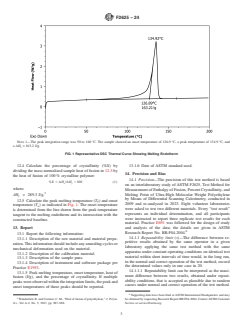
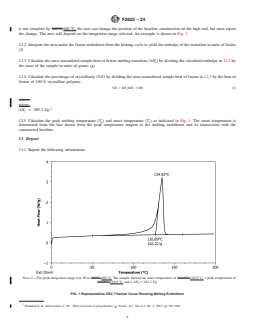
the change. The area will depend on the integration range selected. An example is shown in Fig. 1.
12.2 Integr
...