

ASTM A983/A983M-06(2021)
(Specification)Standard Specification for Continuous Grain Flow Forged Carbon and Alloy Steel Crankshafts for Medium Speed Diesel Engines
General Information
- Abstract
ABSTRACT
This specification deals with continuous grain flow carbon and alloy steel crankshaft forgings intended for medium speed diesel and natural gas engines. The steel used in the manufacture of the forgings is required to be vacuum degassed. Heat treatment, which may be done either before or after rough machining, shall consist of normalizing followed by tempering at a subcritical temperature, or austenitizing, liquid quenching and subcritical tempering. Charpy impact and tensile tests, which shall be performed at a frequency of one test per heat treatment load, shall be used to evaluate tensile strength, yield strength, elongation, reduction of area, and Brinell hardness requirements of forgings. Chemical composition requirements shall also be examined by heat analysis. Grain size tests and non-destructive magnetic particle examinations shall be conducted as well. When required by the purchaser, crankshafts may be surface hardened in designated areas for the purposes of enhanced wear resistance and fatigue strength.
SCOPE
1.1 This specification covers continuous grain flow forged carbon and alloy steel crankshafts for medium speed diesel and natural gas engines.
1.2 The steel used in the manufacture of the forgings is required to be vacuum degassed.
1.3 The choice of steel composition grade for a given strength class is normally made by the forging supplier, unless otherwise specified by the purchaser.
1.4 Provision is made for treatment of designated surfaces of the crankshaft to provide enhanced fatigue strength, or wear resistance, or both.
1.5 Except as specifically required in this specification, all provisions of Specification A788/A788M apply.
1.6 Unless the order specifies the applicable “M” specification designation, the material shall be furnished to the inch-pound units.
1.7 The values stated in either inch-pound units or SI (metric) units are to be regarded separately as standard. Within the text and tables the SI units are shown in brackets. The values stated in each system are not necessarily exact equivalents; therefore, to ensure conformance with the standard, each system shall be used independently of the other, and values from the two systems shall not be combined.
1.8 This international standard was developed in accordance with internationally recognized principles on standardization established in the Decision on Principles for the Development of International Standards, Guides and Recommendations issued by the World Trade Organization Technical Barriers to Trade (TBT) Committee.
- Status
- Published
- Publication Date
- 28-Feb-2021
- Technical Committee
- A01 - Steel, Stainless Steel and Related Alloys
- Drafting Committee
- A01.06 - Steel Forgings and Billets
Overview
ASTM A983/A983M-06(2021) is the standard specification developed by ASTM International for continuous grain flow (CGF) forged carbon and alloy steel crankshafts designed for medium speed diesel and natural gas engines. This standard outlines the critical manufacturing, heat treatment, mechanical, and testing requirements that ensure crankshafts exhibit superior strength, durability, and reliability in demanding engine applications. The specification applies to crankshafts fabricated using CGF technology, which ensures an uninterrupted grain structure, enhancing both fatigue strength and resistance to wear.
Key Topics
- Material Selection and Steelmaking: Requires vacuum degassed carbon and alloy steels, with specific control over chemical composition (as outlined in Table 2), ensuring minimal impurities and high structural integrity.
- Heat Treatment Requirements: Specifies that forgings undergo either normalizing and tempering or austenitizing, quenching, and tempering processes. The procedures are designed to optimize mechanical properties such as strength and toughness.
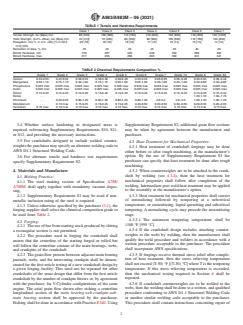
- Mechanical Properties: Sets minimum requirements for tensile strength, yield strength, elongation, reduction of area, and Brinell hardness across various classes (see Table 1). These parameters are essential to withstand operational stresses in medium speed diesel engines.
- Testing and Inspection: Mandates regular mechanical and grain size tests, Charpy impact tests (as needed), and non-destructive magnetic particle examinations per referenced ASTM testing standards.
- Surface Hardening: Allows for optional surface treatments-such as nitriding or induction hardening-to boost wear resistance and fatigue strength, particularly in critical bearing areas.
- Dimensional and Visual Standards: Ensures proper grain flow orientation, soundness, and surface finish consistent with high-quality crankshaft production.
Applications
- Medium Speed Diesel Engines: Widely used in marine propulsion, power generation, and industrial machinery, where reliability and extended service life are crucial.
- Natural Gas Engines: Extends to engines utilized in power plants and large-scale gas compression systems, requiring robust crankshaft performance.
- Custom Engine Builds: The standard’s provision for a range of strength classes and grades makes it suitable for both OEMs and aftermarket suppliers to specify crankshafts optimized for unique operational demands.
- Global Sourcing and Manufacturing: With clearly defined material, mechanical, and quality requirements, ASTM A983/A983M facilitates international trade and consistent quality across global supply chains.
Related Standards
- ASTM A788/A788M: General requirements for steel forgings, providing foundational guidelines also applicable to this specification.
- ASTM A370: Methods for mechanical testing of steel products, including tensile and hardness testing relevant to crankshaft evaluation.
- ASTM E112: Test methods for determining average grain size, used to verify proper grain refinement after heat treatment.
- ASTM A966/A966M: Magnetic particle examination of steel forgings for detecting surface and near-surface discontinuities.
- ASTM E45: Methods for inclusion content analysis to ensure purity of steel.
- ASTM A503/A503M: Ultrasonic examination of forged crankshafts for internal defect detection.
- AWS D1.1: Structural Welding Code, applied where welding of counterweights is required.
Practical Value
Adopting ASTM A983/A983M-06(2021) assures stakeholders-including engine manufacturers, forging suppliers, and component evaluators-of consistent, verifiable quality in crankshaft production. It minimizes risk by specifying rigorous material control and thorough inspection procedures, supporting high performance under cyclical loading and long operating intervals. The specification’s compatibility with both inch-pound and SI units accommodates international use and promotes harmonization with global engineering standards.
Keywords: continuous grain flow crankshafts, medium speed diesel engines, steel forgings, heat treatment, component testing, surface hardening, ASTM standards, mechanical properties, quality assurance.
Relations
- Effective Date
- 01-Mar-2024
- Effective Date
- 15-Nov-2023
- Effective Date
- 01-Nov-2023
- Effective Date
- 01-Mar-2020
- Effective Date
- 01-Jul-2019
- Effective Date
- 01-May-2019
- Effective Date
- 01-Nov-2018
- Effective Date
- 01-Sep-2018
- Effective Date
- 01-Mar-2018
- Refers
ASTM A370-17a - Standard Test Methods and Definitions for Mechanical Testing of Steel Products - Effective Date
- 15-Nov-2017
- Effective Date
- 01-Nov-2017
- Effective Date
- 01-May-2017
- Effective Date
- 01-Jan-2017
- Effective Date
- 01-Dec-2016
- Effective Date
- 01-Nov-2015
Get Certified
Connect with accredited certification bodies for this standard

DNV
DNV is an independent assurance and risk management provider.

Lloyd's Register
Lloyd's Register is a global professional services organisation specialising in engineering and technology.
DNV Energy Systems
Energy and renewable energy certification.
Sponsored listings
Frequently Asked Questions
ASTM A983/A983M-06(2021) is a technical specification published by ASTM International. Its full title is "Standard Specification for Continuous Grain Flow Forged Carbon and Alloy Steel Crankshafts for Medium Speed Diesel Engines". This standard covers: ABSTRACT This specification deals with continuous grain flow carbon and alloy steel crankshaft forgings intended for medium speed diesel and natural gas engines. The steel used in the manufacture of the forgings is required to be vacuum degassed. Heat treatment, which may be done either before or after rough machining, shall consist of normalizing followed by tempering at a subcritical temperature, or austenitizing, liquid quenching and subcritical tempering. Charpy impact and tensile tests, which shall be performed at a frequency of one test per heat treatment load, shall be used to evaluate tensile strength, yield strength, elongation, reduction of area, and Brinell hardness requirements of forgings. Chemical composition requirements shall also be examined by heat analysis. Grain size tests and non-destructive magnetic particle examinations shall be conducted as well. When required by the purchaser, crankshafts may be surface hardened in designated areas for the purposes of enhanced wear resistance and fatigue strength. SCOPE 1.1 This specification covers continuous grain flow forged carbon and alloy steel crankshafts for medium speed diesel and natural gas engines. 1.2 The steel used in the manufacture of the forgings is required to be vacuum degassed. 1.3 The choice of steel composition grade for a given strength class is normally made by the forging supplier, unless otherwise specified by the purchaser. 1.4 Provision is made for treatment of designated surfaces of the crankshaft to provide enhanced fatigue strength, or wear resistance, or both. 1.5 Except as specifically required in this specification, all provisions of Specification A788/A788M apply. 1.6 Unless the order specifies the applicable “M” specification designation, the material shall be furnished to the inch-pound units. 1.7 The values stated in either inch-pound units or SI (metric) units are to be regarded separately as standard. Within the text and tables the SI units are shown in brackets. The values stated in each system are not necessarily exact equivalents; therefore, to ensure conformance with the standard, each system shall be used independently of the other, and values from the two systems shall not be combined. 1.8 This international standard was developed in accordance with internationally recognized principles on standardization established in the Decision on Principles for the Development of International Standards, Guides and Recommendations issued by the World Trade Organization Technical Barriers to Trade (TBT) Committee.
ABSTRACT This specification deals with continuous grain flow carbon and alloy steel crankshaft forgings intended for medium speed diesel and natural gas engines. The steel used in the manufacture of the forgings is required to be vacuum degassed. Heat treatment, which may be done either before or after rough machining, shall consist of normalizing followed by tempering at a subcritical temperature, or austenitizing, liquid quenching and subcritical tempering. Charpy impact and tensile tests, which shall be performed at a frequency of one test per heat treatment load, shall be used to evaluate tensile strength, yield strength, elongation, reduction of area, and Brinell hardness requirements of forgings. Chemical composition requirements shall also be examined by heat analysis. Grain size tests and non-destructive magnetic particle examinations shall be conducted as well. When required by the purchaser, crankshafts may be surface hardened in designated areas for the purposes of enhanced wear resistance and fatigue strength. SCOPE 1.1 This specification covers continuous grain flow forged carbon and alloy steel crankshafts for medium speed diesel and natural gas engines. 1.2 The steel used in the manufacture of the forgings is required to be vacuum degassed. 1.3 The choice of steel composition grade for a given strength class is normally made by the forging supplier, unless otherwise specified by the purchaser. 1.4 Provision is made for treatment of designated surfaces of the crankshaft to provide enhanced fatigue strength, or wear resistance, or both. 1.5 Except as specifically required in this specification, all provisions of Specification A788/A788M apply. 1.6 Unless the order specifies the applicable “M” specification designation, the material shall be furnished to the inch-pound units. 1.7 The values stated in either inch-pound units or SI (metric) units are to be regarded separately as standard. Within the text and tables the SI units are shown in brackets. The values stated in each system are not necessarily exact equivalents; therefore, to ensure conformance with the standard, each system shall be used independently of the other, and values from the two systems shall not be combined. 1.8 This international standard was developed in accordance with internationally recognized principles on standardization established in the Decision on Principles for the Development of International Standards, Guides and Recommendations issued by the World Trade Organization Technical Barriers to Trade (TBT) Committee.
ASTM A983/A983M-06(2021) is classified under the following ICS (International Classification for Standards) categories: 27.020 - Internal combustion engines. The ICS classification helps identify the subject area and facilitates finding related standards.
ASTM A983/A983M-06(2021) has the following relationships with other standards: It is inter standard links to ASTM A370-24, ASTM E340-23, ASTM E45-18a(2023), ASTM A966/A966M-15(2020), ASTM A370-19, ASTM A788/A788M-19, ASTM A788/A788M-18b, ASTM A788/A788M-18a, ASTM A788/A788M-18, ASTM A370-17a, ASTM A788/A788M-17a, ASTM A788/A788M-17, ASTM A370-17, ASTM A788/A788M-16a, ASTM A370-15. Understanding these relationships helps ensure you are using the most current and applicable version of the standard.
ASTM A983/A983M-06(2021) is available in PDF format for immediate download after purchase. The document can be added to your cart and obtained through the secure checkout process. Digital delivery ensures instant access to the complete standard document.
Standards Content (Sample)
This international standard was developed in accordance with internationally recognized principles on standardization established in the Decision on Principles for the
Development of International Standards, Guides and Recommendations issued by the World Trade Organization Technical Barriers to Trade (TBT) Committee.
Designation:A983/A983M −06 (Reapproved 2021)
Standard Specification for
Continuous Grain Flow Forged Carbon and Alloy Steel
Crankshafts for Medium Speed Diesel Engines
This standard is issued under the fixed designationA983/A983M; the number immediately following the designation indicates the year
of original adoption or, in the case of revision, the year of last revision. A number in parentheses indicates the year of last reapproval.
A superscript epsilon (´) indicates an editorial change since the last revision or reapproval.
1. Scope* 2. Referenced Documents
1.1 This specification covers continuous grain flow forged 2.1 ASTM Standards:
carbon and alloy steel crankshafts for medium speed diesel and A370 Test Methods and Definitions for Mechanical Testing
natural gas engines. of Steel Products
A503/A503M Specification for Ultrasonic Examination of
1.2 The steel used in the manufacture of the forgings is
Forged Crankshafts
required to be vacuum degassed.
A788/A788M Specification for Steel Forgings, General Re-
1.3 The choice of steel composition grade for a given
quirements
strength class is normally made by the forging supplier, unless
A966/A966M Practice for Magnetic Particle Examination of
otherwise specified by the purchaser.
Steel Forgings Using Alternating Current
1.4 Provision is made for treatment of designated surfaces A986/A986M Specification for Magnetic Particle Examina-
tion of Continuous Grain Flow Crankshaft Forgings
of the crankshaft to provide enhanced fatigue strength, or wear
resistance, or both. E45 Test Methods for Determining the Inclusion Content of
Steel
1.5 Except as specifically required in this specification, all
E112 Test Methods for Determining Average Grain Size
provisions of Specification A788/A788M apply.
E340 Practice for Macroetching Metals and Alloys
1.6 Unless the order specifies the applicable “M” specifica-
2.2 Other Standards:
tion designation, the material shall be furnished to the inch- 3
AWS D1.1 Structural Welding Code
pound units.
DIN 50 602
1.7 The values stated in either inch-pound units or SI JIS G 0555 Microscopic Testing Method for the Non-
(metric) units are to be regarded separately as standard. Within
Metallic Inclusions in Steel
the text and tables the SI units are shown in brackets. The
3. Ordering Information
values stated in each system are not necessarily exact equiva-
lents; therefore, to ensure conformance with the standard, each
3.1 In addition to the ordering requirements of Specification
system shall be used independently of the other, and values
A788/A788M, the following items should be included:
from the two systems shall not be combined.
3.2 Choice of mechanical property class from Table 1.
1.8 This international standard was developed in accor-
3.3 Choice of chemical composition Grade from Table 2 if
dance with internationally recognized principles on standard-
this purchaser option is exercised (4.1.3).
ization established in the Decision on Principles for the
Development of International Standards, Guides and Recom-
mendations issued by the World Trade Organization Technical 2
For referenced ASTM standards, visit the ASTM website, www.astm.org, or
Barriers to Trade (TBT) Committee. contact ASTM Customer Service at service@astm.org. For Annual Book of ASTM
Standards volume information, refer to the standard’s Document Summary page on
the ASTM website.
1 3
This specification is under the jurisdiction of ASTM Committee A01 on Steel, Available from American Welding Society (AWS), 8669 NW 36 St., #130,
Stainless Steel and Related Alloys and is the direct responsibility of Subcommittee Miami, FL 33166-6672, http://www.aws.org.
A01.06 on Steel Forgings and Billets. AvailablefromStahleisen,MaenkenKommunikation,GmbHVon-der-Wettern-
Current edition approved March 1, 2021. Published March 2021. Originally Str. 25, 51149 Cologne, Germany, http://www.stahleisen.de.
approved in 1998. Last previous edition approved in 2016 as A983/A983M – 06 Available from Japanese StandardsAssociation (JSA), Mita MTBldg., 3-13-12
(2016). DOI: 10.1520/A0983_A0983M-06R21. Mita, Minato-ku, Tokyo 108-0073, Japan, http://www.jsa.or.jp.
*A Summary of Changes section appears at the end of this standard
Copyright © ASTM International, 100 Barr Harbor Drive, PO Box C700, West Conshohocken, PA 19428-2959. United States
A983/A983M−06 (2021)
TABLE 1 Tensile and Hardness Requirements
Class 1 Class 2 Class 3 Class 4 Class 5 Class 6 Class 7
Tensile Strength, ksi [Mpa] min 80 [550] 100 [690] 110 [760] 120 [830] 130 [900] 140 [965] 150 [1035]
Yield Strength, (0.2% offset), ksi [Mpa] min 45 [310] 70 [485] 80 [550] 90 [620] 100 [690] 110 [760] 120 [830]
Elongation, min % in 2 in. (4D) [% in 62.5 20 [18] 18 [16] 18 [16] 17 [15] 16 [14] 15 [13] 14 [12]
mm] (5D)
Reduction of Area, % min 45 45 45 45 40 40 40
Brinell Hardness, min 163 207 229 248 262 285 302
Brinell Hardness, max 217 255 269 293 302 331 341
TABLE 2 Chemical Requirements Composition %
Grade 1 Grade 2 Grade 3 Grade 4 Grade 5 Grade 6 Grade 7 Grade 7A Grade 8 Grade 8A
Carbon 0.43-0.53 0.43-0.52 0.28-0.33 0.38-0.48 0.30-0.48 0.35-0.45 0.28-0.35 0.38–0.48 0.30-0.35 0.38–0.48
Manganese 0.60-1.10 0.75-1.10 0.40-1.00 0.75-1.10 0.65-1.00 0.65-1.00 0.40-1.00 0.40–1.00 0.40-0.80 0.40–0.80
Phosphorous 0.025 max 0.025 max 0.025 max 0.025 max 0.025 max 0.025 max 0.025 max 0.025 max 0.025 max 0.025 max
Sulfur 0.025 max 0.025 max 0.025 max 0.025 max 0.025 max 0.025 max 0.025 max 0.025 max 0.025 max 0.025 max
Silicon 0.15-0.40 0.15-0.40 0.15-0.40 0.15-0.40 0.15-0.40 0.15-0.40 0.15-0.40 0.15–0.40 0.15-0.40 0.15–0.40
Nickel . . . . . . . . . . . . . . . . . . . . . . . . 1.30-1.70 1.30–1.70
Chromium . . . 0.20-0.35 0.80-1.20 0.80-1.20 0.80-1.20 0.80-1.20 2.8-3.3 2.8–3.3 1.00-1.40 1.00–1.40
Molybdenum . . . 0.10 max 0.15-0.25 0.15-0.25 0.15-0.25 0.30-0.50 0.30-0.50 0.30–0.50 0.20-0.35 0.20–0.35
Vanadium 0.10 max 0.10 max 0.10 max 0.10 max 0.10 max 0.10 max 0.10 max 0.10 max 0.15 max 0.15 max
3.4 Whether surface hardening in designated areas is Supplementary Requirement S2, additional grain flow sections
required, referencing Supplementary Requirements S10, S11, may be taken by agreement between the manufacturer and
or S12, and providing the necessary instructions. purchaser.
3.5 For crankshafts designed to include welded counter-
4.3 Heat Treatment for Mechanical Properties:
weightsthepurchasermayspecifyanalternateweldingcodeto
4.3.1 Heat treatment of crankshaft forgings may be done
AWS D1.1 Structural Welding Code.
either before or after rough machining, at the manufacturer’s
option. By the use of Supplementary Requirement S3 the
3.6 For alternate tensile and hardness test requirements
purchaser can specify that heat treatment be done after rough
specify Supplementary Requirement S2.
machining.
4. Materials and Manufacture
4.3.2 When counterweights are to be attached to the crank-
shaft by welding (see 4.3.4), then the heat treatment for
4.1 Melting Practice:
mechanical properties shall follow after completion of the
4.1.1 The steel making section of Specification A788/
welding. Intermediate post weld heat treatment may be applied
A788M shall apply together with mandatory vacuum degas-
to the assembly at the manufacturer’s option.
sing.
4.3.3 Heat treatment for mechanical properties shall consist
4.1.2 Supplementary Requirement S1 may be used if non-
of normalizing followed by tempering at a subcritical
metallic inclusion rating of the steel is required.
temperature, or austenitizing, liquid quenching and subcritical
4.1.3 Unless otherwise specified by the purchaser (3.2), the
tempering. A normalizing cycle may precede the austenitizing
forging supplier shall select the chemical composition grade to
stage.
be used from Table 2.
4.3.3.1 The minimum tempering temperature shall be
4.2 Forging:
1100 °F [595 °C].
4.2.1 The use of bar from starting stock produced by slitting
4.3.4 If the crankshaft design includes attaching counter-
a rectangular section is not permitted.
weights to the webs by welding, then the manufacturer shall
4.2.2 The procedure used in forging the crankshaft shall
qualify the weld procedure and welders in accordance with a
ensure that the centerline of the starting forged or rolled bar
written procedure acceptable to the purchaser. The procedure
will follow the centerline contour of the main bearings, webs,
shall incorporate AWS specifications.
and crankpins of the crankshaft.
4.3.5 If forgings receive thermal stress relief after comple-
4.2.3 The grain flow present between adjacent main bearing
tion of heat treatment, then the stress relieving temperature
journals, webs, and the intervening crankpin shall be demon-
shallnotexceed(T-50) °F[(T-30) °C]whereTisthetempering
strated for the first article testing of a new crankshaft design by
temperature. If this stress relieving temperature is exceeded,
a given forging facility. This need not be repeated for other
then the mechanical testing required in Section 6 shall be
crankshafts of the same design that differ from the first article
repeated.
crankshaft by the number of crankpin throws or, by agreement
with the purchaser, for V-Cylinder configurations of the same 4.3.6 If crankshaft counterweights are to be welded to the
engine. The axial grain flow shown after etching a centerline webs, then the welding shall be done to a written, and qualified
longitudinal section of the main bearing-web-crankpin-web- procedure conforming to AWS D1.1 Structural Welding Code
main bearing section shall be approved by the purchaser. or another similar welding code acceptable to the purchaser.
Etching shall be done in accordance with Practice E340. Using This procedure shall contain instructions concerning repair of
A983/A983M−06 (2021)
counterweight welds, including preheat and post weld heat designated areas for purposes of wear resistance and, when the
treatment requirements. bearing fillets are included, enhanced fatigue strength.
8.2 The method and extent of the surface hardening shall be
5. Chemical Composition
specified by the purchaser by including reference to Supple-
5.1 Heat Analysis—The heat analysis obtained after sam-
mentary Requirements S9 (nitriding), S10 (induction harden-
pling in accordance with Specification A788/A788M shall
ing of the bearing journals), or S11 (full induction hardening of
comply with Table 2 for the chosen grade, and the require-
bearing journals and fillets).
ments agreed upon by Supplementary Requirement S4 if this
was selected.
9. Nondestructive Examination
6. Mechanical Requirements
9.1 Because ac magnetizing equipment is required to be
6.1 Tension Testing:
used, the magnetic particle examination of the crankshaft shall
6.1.1 Theheattreatedforgingshallcomplywiththerequire-
be done on completion of all machining operations. The
ments of Table 1 for the selected grade when tested in
examination shall be in accordance with Practice A966/
accordance with this section. See also Test Methods and
A966M.
Definitions A370. It should be noted that when the SI system
9.1.1 Acceptance criteria for the magnetic particle exami-
is specified the gauge length for the tension test shall be
nation shall be in accordance with Specification A986/A986M.
measured over a length of 5D.
6.1.2 Test Material—An integral test prolongation equal in
9.2 Supplementary Requirement S8 shall be specified if
diameter to that of the starting bar diameter shall be provided ultrasonic examination of the crankshaft bar or the crankshaft
at one end of each crankshaft subject to mechanical testing.
forging is requi
...