

ASTM E340-23
(Practice)Standard Practice for Macroetching Metals and Alloys
General Information
- Abstract
SIGNIFICANCE AND USE
3.1 Applications of Macroetching:
3.1.1 Macroetching is used to reveal the heterogeneity of metals and alloys. Metallographic specimens and chemical analyses will provide the necessary detailed information about specific localities, but they cannot give data about variation from one place to another unless an inordinate number of specimens are taken.
3.1.2 Macroetching, on the other hand, will provide information on variations in (1) structure, such as grain size, flow lines, columnar structure, dendrites, and so forth; (2) variations in chemical composition as evidenced by segregation, carbide and ferrite banding, coring, inclusions, and depth of carburization or decarburization. The information provided about variations in chemical composition is strictly qualitative but the location of extremes in segregation will be shown. Chemical analyses or other means of determining the chemical composition would have to be performed to determine the extent of variation. Macroetching will also show the presence of discontinuities and voids, such as seams, laps, porosity, flakes, bursts, extrusion rupture, cracks, and so forth.
3.1.3 Other applications of macroetching in the fabrication of metals are the study of weld structure, definition of weld penetration, dilution of filler metal by base metals, entrapment of flux, porosity, and cracks in weld and heat affected zones, and so forth. It is also used in the heat-treating shop to determine location of hard or soft spots, tong marks, quenching cracks, case depth in shallow-hardening steels, case depth in carburization, effectiveness of stop-off coatings in carburization, and so forth. In the machine shop, it can be used for the determination of grinding cracks in tools and dies.
3.1.4 Macroetching is used extensively for quality control in the steel industry, to determine the tone of a heat in billets with respect to inclusions, segregation, and structure. Forge shops, in addition, use macroetching to reveal flow...
SCOPE
1.1 These procedures describe the methods of macroetching metals and alloys to reveal their macrostructure.
1.2 The values stated in inch-pound units are to be regarded as standard. The values given in parentheses are mathematical conversions to the International System (SI) units that are provided for information only and are not considered standard.
1.3 This standard does not purport to address all of the safety concerns, if any, associated with its use. It is the responsibility of the user of this standard to establish appropriate safety, health, and environmental practices and determine the applicability of regulatory limitations prior to use.
For specific warning statements, see 6.2, 7.1, 8.1.3, 8.2.1, 8.8.3, 8.10.1.1, and 8.13.2. It is further recommended to review the guidance in Guide E2014.
1.4 This international standard was developed in accordance with internationally recognized principles on standardization established in the Decision on Principles for the Development of International Standards, Guides and Recommendations issued by the World Trade Organization Technical Barriers to Trade (TBT) Committee.
- Status
- Published
- Publication Date
- 14-Nov-2023
- Technical Committee
- E04 - Metallography
- Drafting Committee
- E04.01 - Specimen Preparation
Overview
ASTM E340-23 - Standard Practice for Macroetching Metals and Alloys - is a detailed international standard developed by ASTM for revealing the macrostructure of metals and alloys through chemical etching. Macroetching is an essential metallurgical technique that provides qualitative information about the internal structure and homogeneity of metals, helping identify structural variations, chemical segregation, and potential defects that may impact performance and quality. Unlike localized metallography, macroetching allows examination of larger areas to detect variations, anomalies, and discontinuities across the workpiece.
Key Topics
Purpose of Macroetching
- Revealing the heterogeneity and structural variations in metals and alloys
- Identifying abnormalities such as grain size differences, flow lines, dendrites, banding, inclusions, carburization, or decarburization
- Qualitative mapping of extreme segregations and composition variations
- Uncovering internal and surface defects like seams, laps, porosity, cracks, and discontinuities
Methodology
- Use of chemical etchants specific to various metals and alloys
- Procedures for preparing, cleaning, and etching samples
- Safety practices for handling aggressive chemicals
Sampling and Inspection
- Importance of proper sampling at relevant stages of manufacture to avoid waste and ensure defect identification
- Guidelines on preparing specimens from billets, forgings, sheets, welds, castings, and finished parts
Safety and Compliance
- Adherence to safe handling, environmental, and regulatory requirements
- Reference to ASTM E2014 for laboratory safety guidance
Applications
The macroetching methods defined in ASTM E340-23 are applied throughout the metals and manufacturing industries for:
Quality Control
- Widely used by steelmakers to assess inclusions, segregation, and overall structural integrity in billets, blooms, and forgings
- Inspection of extrusions, sheets, and bars in the copper and aluminum industries
Process and Defect Analysis
- Evaluation of forging and rolling processes by revealing flow lines and internal faults
- Assessment of weld structure, weld penetration, filler metal dilution, flux entrapment, and detection of weld-related defects in assemblies
Fabrication and Heat Treatment
- Determining the effectiveness of carburization, case hardening, and stop-off coatings
- Identifying hard and soft spots, grind cracks, quenching cracks, and surface defects in shop environments
Research and Development
- Useful in research laboratories for understanding alloy behavior under different thermal or mechanical treatments
Related Standards
To achieve comprehensive results and maintain best practices, ASTM E340-23 should be used in conjunction with related ASTM standards, including:
- ASTM E3 - Guide for Preparation of Metallographic Specimens
- ASTM E381 - Method of Macroetch Testing Steel Bars, Billets, Blooms, and Forgings
- ASTM E2014 - Guide on Metallographic Laboratory Safety
These referenced standards provide further guidance on specimen preparation, safety protocols, and specific macroetch testing methods for various metals and alloys.
Macroetching metals and alloys per ASTM E340-23 is a vital procedure for manufacturers, quality assurance professionals, and metallurgists who need to ensure the structural integrity, process performance, and compliance of their metal products. By revealing information that is impossible to obtain through spot metallography alone, macroetching delivers added value in problem-solving, defect analysis, and quality assurance in metals manufacturing operations.
Relations
- Effective Date
- 15-Nov-2023
- Effective Date
- 15-Nov-2023
- Effective Date
- 15-Nov-2023
- Effective Date
- 15-Nov-2023
- Effective Date
- 15-Nov-2023
- Effective Date
- 15-Nov-2023
- Effective Date
- 15-Nov-2023
- Effective Date
- 15-Nov-2023
- Effective Date
- 15-Nov-2023
- Effective Date
- 15-Nov-2023
- Referred By
ASTM E1180-08(2021) - Standard Practice for Preparing Sulfur Prints for Macrostructural Evaluation - Effective Date
- 15-Nov-2023
- Effective Date
- 15-Nov-2023
- Effective Date
- 15-Nov-2023
- Effective Date
- 15-Nov-2023
- Effective Date
- 15-Nov-2023
Get Certified
Connect with accredited certification bodies for this standard

Element Materials Technology
Materials testing and product certification.

Inštitut za kovinske materiale in tehnologije
Institute of Metals and Technology. Materials testing, metallurgical analysis, NDT.
Sponsored listings
Frequently Asked Questions
ASTM E340-23 is a standard published by ASTM International. Its full title is "Standard Practice for Macroetching Metals and Alloys". This standard covers: SIGNIFICANCE AND USE 3.1 Applications of Macroetching: 3.1.1 Macroetching is used to reveal the heterogeneity of metals and alloys. Metallographic specimens and chemical analyses will provide the necessary detailed information about specific localities, but they cannot give data about variation from one place to another unless an inordinate number of specimens are taken. 3.1.2 Macroetching, on the other hand, will provide information on variations in (1) structure, such as grain size, flow lines, columnar structure, dendrites, and so forth; (2) variations in chemical composition as evidenced by segregation, carbide and ferrite banding, coring, inclusions, and depth of carburization or decarburization. The information provided about variations in chemical composition is strictly qualitative but the location of extremes in segregation will be shown. Chemical analyses or other means of determining the chemical composition would have to be performed to determine the extent of variation. Macroetching will also show the presence of discontinuities and voids, such as seams, laps, porosity, flakes, bursts, extrusion rupture, cracks, and so forth. 3.1.3 Other applications of macroetching in the fabrication of metals are the study of weld structure, definition of weld penetration, dilution of filler metal by base metals, entrapment of flux, porosity, and cracks in weld and heat affected zones, and so forth. It is also used in the heat-treating shop to determine location of hard or soft spots, tong marks, quenching cracks, case depth in shallow-hardening steels, case depth in carburization, effectiveness of stop-off coatings in carburization, and so forth. In the machine shop, it can be used for the determination of grinding cracks in tools and dies. 3.1.4 Macroetching is used extensively for quality control in the steel industry, to determine the tone of a heat in billets with respect to inclusions, segregation, and structure. Forge shops, in addition, use macroetching to reveal flow... SCOPE 1.1 These procedures describe the methods of macroetching metals and alloys to reveal their macrostructure. 1.2 The values stated in inch-pound units are to be regarded as standard. The values given in parentheses are mathematical conversions to the International System (SI) units that are provided for information only and are not considered standard. 1.3 This standard does not purport to address all of the safety concerns, if any, associated with its use. It is the responsibility of the user of this standard to establish appropriate safety, health, and environmental practices and determine the applicability of regulatory limitations prior to use. For specific warning statements, see 6.2, 7.1, 8.1.3, 8.2.1, 8.8.3, 8.10.1.1, and 8.13.2. It is further recommended to review the guidance in Guide E2014. 1.4 This international standard was developed in accordance with internationally recognized principles on standardization established in the Decision on Principles for the Development of International Standards, Guides and Recommendations issued by the World Trade Organization Technical Barriers to Trade (TBT) Committee.
SIGNIFICANCE AND USE 3.1 Applications of Macroetching: 3.1.1 Macroetching is used to reveal the heterogeneity of metals and alloys. Metallographic specimens and chemical analyses will provide the necessary detailed information about specific localities, but they cannot give data about variation from one place to another unless an inordinate number of specimens are taken. 3.1.2 Macroetching, on the other hand, will provide information on variations in (1) structure, such as grain size, flow lines, columnar structure, dendrites, and so forth; (2) variations in chemical composition as evidenced by segregation, carbide and ferrite banding, coring, inclusions, and depth of carburization or decarburization. The information provided about variations in chemical composition is strictly qualitative but the location of extremes in segregation will be shown. Chemical analyses or other means of determining the chemical composition would have to be performed to determine the extent of variation. Macroetching will also show the presence of discontinuities and voids, such as seams, laps, porosity, flakes, bursts, extrusion rupture, cracks, and so forth. 3.1.3 Other applications of macroetching in the fabrication of metals are the study of weld structure, definition of weld penetration, dilution of filler metal by base metals, entrapment of flux, porosity, and cracks in weld and heat affected zones, and so forth. It is also used in the heat-treating shop to determine location of hard or soft spots, tong marks, quenching cracks, case depth in shallow-hardening steels, case depth in carburization, effectiveness of stop-off coatings in carburization, and so forth. In the machine shop, it can be used for the determination of grinding cracks in tools and dies. 3.1.4 Macroetching is used extensively for quality control in the steel industry, to determine the tone of a heat in billets with respect to inclusions, segregation, and structure. Forge shops, in addition, use macroetching to reveal flow... SCOPE 1.1 These procedures describe the methods of macroetching metals and alloys to reveal their macrostructure. 1.2 The values stated in inch-pound units are to be regarded as standard. The values given in parentheses are mathematical conversions to the International System (SI) units that are provided for information only and are not considered standard. 1.3 This standard does not purport to address all of the safety concerns, if any, associated with its use. It is the responsibility of the user of this standard to establish appropriate safety, health, and environmental practices and determine the applicability of regulatory limitations prior to use. For specific warning statements, see 6.2, 7.1, 8.1.3, 8.2.1, 8.8.3, 8.10.1.1, and 8.13.2. It is further recommended to review the guidance in Guide E2014. 1.4 This international standard was developed in accordance with internationally recognized principles on standardization established in the Decision on Principles for the Development of International Standards, Guides and Recommendations issued by the World Trade Organization Technical Barriers to Trade (TBT) Committee.
ASTM E340-23 is classified under the following ICS (International Classification for Standards) categories: 77.040.99 - Other methods of testing of metals. The ICS classification helps identify the subject area and facilitates finding related standards.
ASTM E340-23 has the following relationships with other standards: It is inter standard links to ASTM E340-15, ASTM A778/A778M-22, ASTM A668/A668M-23, ASTM A872/A872M-21, ASTM A781/A781M-21, ASTM A988/A988M-23, ASTM F541-12(2020), ASTM A182/A182M-23, ASTM A983/A983M-06(2021), ASTM E1077-14(2021), ASTM E1180-08(2021), ASTM A957/A957M-21, ASTM E2014-17, ASTM A989/A989M-23, ASTM F788/F788M-20e1. Understanding these relationships helps ensure you are using the most current and applicable version of the standard.
ASTM E340-23 is available in PDF format for immediate download after purchase. The document can be added to your cart and obtained through the secure checkout process. Digital delivery ensures instant access to the complete standard document.
Standards Content (Sample)
This international standard was developed in accordance with internationally recognized principles on standardization established in the Decision on Principles for the
Development of International Standards, Guides and Recommendations issued by the World Trade Organization Technical Barriers to Trade (TBT) Committee.
Designation: E340 − 23
Standard Practice for
Macroetching Metals and Alloys
This standard is issued under the fixed designation E340; the number immediately following the designation indicates the year of
original adoption or, in the case of revision, the year of last revision. A number in parentheses indicates the year of last reapproval. A
superscript epsilon (´) indicates an editorial change since the last revision or reapproval.
This standard has been approved for use by agencies of the U.S. Department of Defense.
1. Scope 3.1.1 Macroetching is used to reveal the heterogeneity of
metals and alloys. Metallographic specimens and chemical
1.1 These procedures describe the methods of macroetching
analyses will provide the necessary detailed information about
metals and alloys to reveal their macrostructure.
specific localities, but they cannot give data about variation
1.2 The values stated in inch-pound units are to be regarded
from one place to another unless an inordinate number of
as standard. The values given in parentheses are mathematical
specimens are taken.
conversions to the International System (SI) units that are
3.1.2 Macroetching, on the other hand, will provide infor-
provided for information only and are not considered standard.
mation on variations in (1) structure, such as grain size, flow
1.3 This standard does not purport to address all of the
lines, columnar structure, dendrites, and so forth; (2) variations
safety concerns, if any, associated with its use. It is the in chemical composition as evidenced by segregation, carbide
responsibility of the user of this standard to establish appro-
and ferrite banding, coring, inclusions, and depth of carburiza-
priate safety, health, and environmental practices and deter- tion or decarburization. The information provided about varia-
mine the applicability of regulatory limitations prior to use.For
tions in chemical composition is strictly qualitative but the
specific warning statements, see 6.2, 7.1, 8.1.3, 8.2.1, 8.8.3, location of extremes in segregation will be shown. Chemical
8.10.1.1, and 8.13.2. It is further recommended to review the
analyses or other means of determining the chemical compo-
guidance in Guide E2014. sition would have to be performed to determine the extent of
1.4 This international standard was developed in accor-
variation. Macroetching will also show the presence of discon-
dance with internationally recognized principles on standard- tinuities and voids, such as seams, laps, porosity, flakes, bursts,
ization established in the Decision on Principles for the
extrusion rupture, cracks, and so forth.
Development of International Standards, Guides and Recom- 3.1.3 Other applications of macroetching in the fabrication
mendations issued by the World Trade Organization Technical
of metals are the study of weld structure, definition of weld
Barriers to Trade (TBT) Committee.
penetration, dilution of filler metal by base metals, entrapment
of flux, porosity, and cracks in weld and heat affected zones,
2. Referenced Documents and so forth. It is also used in the heat-treating shop to
determine location of hard or soft spots, tong marks, quenching
2.1 ASTM Standards:
cracks, case depth in shallow-hardening steels, case depth in
E3 Guide for Preparation of Metallographic Specimens
carburization, effectiveness of stop-off coatings in
E381 Method of Macroetch Testing Steel Bars, Billets,
carburization, and so forth. In the machine shop, it can be used
Blooms, and Forgings
for the determination of grinding cracks in tools and dies.
E2014 Guide on Metallographic Laboratory Safety
3.1.4 Macroetching is used extensively for quality control in
the steel industry, to determine the tone of a heat in billets with
3. Significance and Use
respect to inclusions, segregation, and structure. Forge shops,
3.1 Applications of Macroetching:
in addition, use macroetching to reveal flow lines in setting up
the best forging practice, die design, and metal flow. For an
example of the use of macroetching in the steel forging
This test method is under the jurisdiction of ASTM Committee E04 on
industry see Method E381. Forging shops and foundries also
Metallography and is the direct responsibility of Subcommittee E04.01 on Specimen
use macroetching to determine the presence of internal faults
Preparation.
and surface defects. The copper industry uses macroetching for
Current edition approved Nov. 15, 2023. Published November 2023. Originally
control of surface porosity in wire and bar. In the aluminum
approved in 1968. Last previous edition approved in 2015 as E340 – 15. DOI:
10.1520/E0340-23.
industry, macroetching is used to evaluate extrusions as well as
For referenced ASTM standards, visit the ASTM website, www.astm.org, or
the other products such as forgings, sheets, and so forth.
contact ASTM Customer Service at service@astm.org. For Annual Book of ASTM
Defects such as coring, cracks, and porthole die welds are
Standards volume information, refer to the standard’s Document Summary page on
the ASTM website. identified.
Copyright © ASTM International, 100 Barr Harbor Drive, PO Box C700, West Conshohocken, PA 19428-2959. United States
E340 − 23
4. Sampling structure, and so forth. Careful preparation is usually rewarded
with highly detailed structures giving a large amount of
4.1 As in any method of examination, sampling is very
information. Welds involving dissimilar metals will produce
important. When macroetching is used to solve a problem, the
problems in etching. The best method is to etch the least
problem itself largely dictates the source of the sample as to the
corrosion-resistant portion first and the more resistant portion
location on the work piece and the stage of manufacture; for
afterwards. Occasionally, an intermediary etchant may be
example, when looking for pipe, the sample should represent
required. The boundaries between etched and unetched portion
the top of the ingot, or when looking for bursts or flakes, the
will give an idea of weld penetration and dilution.
sample should be taken as soon after hot working as possible.
4.5.4 Castings—Cut the specimen to display the defect or
4.2 When macroetching is used as an inspection procedure,
feature being sought.
sampling ought to be done in an early stage of manufacturing
4.5.5 Machined and Ground Parts—When looking for
so that, if the material proves faulty, no wasteful unnecessary
grinding cracks, and so forth, the surface itself is used as a
work is done. However, the sample should not be taken so
sample. Because the machined or ground part is often the
early that further working can introduce serious defects. In the
finished part, it may be undesirable to immerse the part in acid.
steel industry, for example, the sample is usually taken after
In this case, other methods such as dye penetrant methods may
ingot breakdown and after most chances of bursts or flakes
be more desirable.
occurring have passed. Billets or blooms going into small sizes
5. Preparation
are sampled after initial breakdown. Material going into
forging billets or die blocks is sampled near the desired finish
5.1 Sample preparation need not be elaborate. Any method
size. Sampling may be done systematically or on a random
of presenting a smooth surface with a minimum amount of cold
basis.
work will be satisfactory. Disks may be faced on a lathe or a
shaper. The usual procedure is to take a roughing cut, then a
4.3 Samples may be cold cut from the source by any
finish cut. This will generate a smooth surface and remove cold
convenient method; saws and abrasive cutoff wheels are
work from prior operations. Sharp tools are necessary to
particularly effective. Torch cutting or hot cutting should be
produce a good specimen. Grinding is usually conducted in the
used only when necessary to cut a sample from a large piece.
same manner, using free-cutting wheels and light finishing
The sample then is sectioned well away from the hot-cut
cuts. When fine detail is required, the specimen should be
surface. An example of permissible use of torch cutting is the
ground down through the series of metallographic papers (see
excising of a piece from a large plate and then cutting a sample
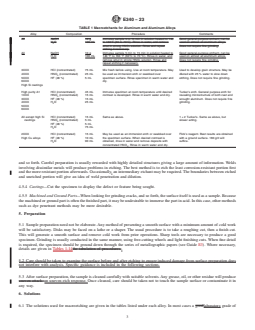
Guide E3). Where necessary, details are given in Tables 1-14.
for macroetching 4 in. to 5 in. (102 mm to 127 mm) away from
the torch-cut edge.
5.2 Care should be taken to examine the surface before and
after etching to ensure induced damage from surface prepara-
4.4 Some common methods of sampling, listed by source,
tion does not interfere with analysis. Specific guidance is
are as follows:
included in the following sections.
4.5 Billets, Blooms, and Hot-Rolled Products—Disks are
5.3 After surface preparation, the sample is cleaned care-
usually cut from these products near the end. Samples cut too
fully with suitable solvents. Any grease, oil, or other residue
close to the end, however, may have false structures because of
will produce an uneven etch response. Once cleaned, care
fish-tailing. Disks from large blooms are sometimes cut into
should be taken not to touch the sample surface or contaminate
smaller pieces for ease in handling.
it in any way.
4.5.1 Forgings and Extrusions—Disks cut transverse to the
long dimension will show flakes, bursts, and so forth. Forgings
6. Solutions
may also be cut parallel to the long dimension to show flow
6.1 The solutions used for macroetching are given in the
lines. In complicated forgings, some thought will have to be
tables listed under each alloy. In most cases a laboratory grade
given to the proper method of cutting so as to show flow lines.
of reagent should be used. Technical grades may provide
Macroetching of an unprepared specimen will show surface
satisfactory results. The solution should be clean and clear, free
defects such as shuts, flats, seams, and so forth. In extrusions,
of suspended particles, scum, and so forth. Solutions may lose
coring and coarse grain are more commonly found in the back
effectiveness through age or reuse, and should be replaced if
end of the extrusion.
not performing consistently.
4.5.2 Sheets and Plates—A sufficiently large sample should
be taken when looking for surface defects. An ideal length
6.2 Caution must be observed in mixing. Many of the
would be the circumference of the last roll, but this may be
etchants are strong acids. In all cases, the various chemicals
inconveniently long. Several samples totaling some given
should be added slowly to the water or solvent while stirring.
fraction of the circumference can be used; however, there is
In the cases where hydrofluoric acid is used, the solution
always a chance then that a defect arising from faulty rolls
should be mixed and used in polyethylene vessels.
would not be detected. When seeking information on
(Warning—Hydrofluoric acid must not be allowed to contact
laminations, a transverse section is used. In many cases,
the skin.)
however, to reduce the size of the specimen, only a section out
7. Procedure
of the center of the plate may be taken.
4.5.3 Weldments—A disk cut perpendicular to the direction 7.1 Many of the solutions are aggressive and may give off
of welding will show weld penetration, heat affected zone, irritating and corrosive fumes. Etching should be done in a
E340 − 23
TABLE 1 Macroetchants for Aluminum and Aluminum Alloys
Alloy Composition Procedure Comments
All NaOH 10 g Immerse sample 5 min to 15 min in solution heated to Good general-purpose etchant, can be
H O 100 mL 140 °F to 160 °F (60°C to 70 °C). Rinse in water, and used on almost all aluminum alloys.
remove smut in strong HNO solution. Rinse and Does not require fine grinding.
repeat etching if necessary.
3XXX HCl (concentrated) 75 mL Mix fresh before using. Use at room temperature. May Used to develop grain structure. May be
4XXX HNO (concentrated) 25 mL be used as immersion etch or swabbed over diluted with 25 % water to slow down
5XXX HF (48 %) 5 mL specimen surface. Rinse specimen in warm water and etching. Does not require fine grinding.
6XXX dry.
High Si castings
High purity A1 HCl (concentrated) 45 mL Immerse specimen at room temperature until desired Tucker’s etch. General purpose etch for
1XXX HNO (concentrated) 15 mL contrast is developed. Rinse in warm water and dry. revealing microstructure of both cast and
3XXX HF (48 %) 15 mL wrought aluminum. Does not require fine
4XXX H O 25 mL grinding.
5XXX
6XXX
All except high Si HCl (concentrated) 15 mL Same as above. 1 + 2 Tucker’s. Same as above, but
castings HNO (concentrated) 5 mL slower acting.
HF (48 %) 5 mL
H O 75 mL
2XXX HCl (concentrated) 15 mL May be used as an immersion etch or swabbed over Flick’s reagent. Best results are obtained
High Cu alloys HF (48 %) 10 mL the specimen surface. When desired contrast is with a ground surface. 180 grit will
H O 90 mL obtained, rinse in water and remove deposits with suffice.
concentrated HNO . Rinse in warm water and dry.
TABLE 2 Macroetchants for Beryllium and Beryllium Alloys
Metal Composition Procedure Comments
Be HCl 10 mL Either swab or immerse at room temperature for a few Works best on coarse grained Be.
NH Cl 4 g minutes, rinse in water and dry.
H O 90 mL
Be HCl 10 mL As above. An alternative when No. 1 does not work. Fine-grained
NH Cl 2 g metal may not give good results in either case.
Picric acid 2 g
H O 90 mL
TABLE 3 Macroetchants for Cobalt and Cobalt Alloys
Alloy Composition Procedure Comments
49Co-49Fe-V HCl 50 mL Immerse specimen in hot solution (140 to 180°F) for General structure,
Some Co-Cr alloys H O 50 mL 30 to 60 min. Rinse in hot water and dry. porosity.
25Cr-10Ni-8W HCl 50 mL Swab until desired contrast is obtained then rinse in Grain size, general
21Cr-20Ni- HNO 10 mL warm water and dry. structure.
3W-3Mo-1Cb FeCl 10 g
H O 100 mL
18Cr-10Ni-14W CuCl ·2NH Cl·2H O 2 g As above. As above.
2 4 2
FeCl 5 g
HNO 5 mL
HCl 50 mL
H O 80 m
well-ventilated room, preferably under a fume hood. The required, dip the specimen into a second solution. After rinsing
solution should be mixed and placed in a corrosion resistant
the specimen with hot water, blow dry with clean compressed
tray or dish and brought to the operating temperature. The
air.
specimen or specimens should be placed in a tray of stainless
7.2 In the case of large specimens, such as ingot sections,
steel screen or on some non-reactive support. Glass rods often
swabbing may be the only practical method of macroetching.
are placed on the bottom of the acid container and the
Saturate a large wad of cotton held in stainless steel or nickel
specimens laid directly on the rods. When etching is
tongs with the etchant and sweep over the surface of the
completed, remove the specimens from the dish taking great
specimen. An effort should be made to wet the entire surface as
care not to touch the etched surface. When desmutting is
E340 − 23
TABLE 4 Macroetchants for Copper and Copper Alloys
Alloys Composition Procedure Comments
Cu and all brasses HNO 10 mL Immerse specimen in solution at room temperature Emphasize grains and cracks.
H O 90 mL for a few minutes. Rinse in water and dry.
Cu and all brasses HNO 50 mL As above. Brings out grain contrast, pits result
H O 50 mL unless agitated. Aluminum bronzes may
form smut which can be removed by brief
immersion in concentrated HNO .
Cu and all brasses HCl 30 mL As above. Good grain contrast.
FeCl 10 g
H O or ethanol 120 mL
Cu, high Cu alloys, K Cr O sat 2 g Immerse specimen in solution at room temperature Emphasizes grain boundaries and oxide
2 2 7
phosphorus, tin soln of NaCl for 15 to 30 min then swab with fresh solution. inclusions.
bronzes H SO Rinse in warm water and dry.
2 3
H O
All HNO 50 mL Immerse specimen in solution at room temperature. Brilliant deep etch.
AgNO 5 g Rinse in warm water and dry.
H O 50 mL
Brass 20 % CH COOH 20 mL As above. Strain lines.
5 % H CrO 10 mL
2 4
10 % FeCl in H O 5 mL
3 2
Silicon brass or bronze CrO 40 g Immerse specimen in solution at room temperature,
NH Cl 7.5 g rinse in warm water and dry.
HNO (concentrated) 50 mL
H SO (concentrated) 8 mL
2 4
H O 100 mL
soon as possible. After the initial wetting, keep the swab 8.1.3 Several of the solutions used in macroetching react
saturated with solution and frequently sweep over the surface vigorously with the metal and can overheat the specimen. In
of the specimen to renew the solution. When the structure has these cases the specimen is periodically removed from the
been suitably developed, rinse the specimen, either with a swab solution, cooled in running water, and re-immersed in the
saturated with water, or better still, by pouring water over the etchant. This procedure is repeated until the desired degree of
specimen. After rinsing with hot water, blow the specimen dry etching is obtained.
with compressed air. Details of the procedure not discussed
8.1.4 Macroetchants for Aluminum and Aluminum Alloys
here are covered in the sections for the various metals and their
(Table 1).
alloys.
8.2 Beryllium:
7.3 The times and temperatures given in individual tabula-
8.2.1 Beryllium and its compounds in the finely divided
tions are only intended as guides. In fact, the progress of
state are extremely poisonous. Even in the massive form,
etching should be closely watched and etching stopped when
beryllium can be hazardous. Warning—Before starting any
the preferred structural details have been revealed. Specimens
work involving beryllium, a review of hazards and plans for
should be etched to develop structure. Generally, a light etch is
handling should be made.
better than a heavy etch; overetching can often lead to
8.2.1.1 Generally speaking, beryllium and its alloys have
misinterpretation. The actual time to develop a structure
given difficulty in obtaining good macroetched specimens.
properly may be quite different from the one suggested.
First, beryllium is a rather brittle metal and sectioning can be
difficult. Secondly, beryllium does not grind easily; hence,
8. Specific Preparation Procedures and Recommended
specimens should be as small as possible to minimize grinding
Solutions
time. Grinding has been most successful with the entire
8.1 Aluminum:
sequence of wet silicon carbide papers.
8.1.1 The specimens can be cut using common cutting tools,
8.2.1.2 The etching of fine grained metal may not always be
hack saws, band saws, shears, abrasive cutoff wheels, and so
entirely successful, and further preparation will be required.
forth. All these methods will cause cold work at the surface and
Rough polishing with 15 μm Al O suspended in water is
2 3
will generate heat. The temperature rise can be enough to cause
performed on a low-nap cloth. Light pressure and frequent
changes in structure. For these reasons sharp tools and gener-
change of cutting direction produce the best results. If further
ous lubrication are necessary for sectioning.
polishing is required, 1-μm green Cr O in water on synthetic
2 3
8.1.2 The cold-worked surface should be removed by ma-
suede works best.
chining the surface. Again sharp tools and copious lubrication
8.2.2 Macroetchants for Beryllium and Beryllium Alloys—
are required. If fine detail is required, the machined surface
(Table 2).
should be ground using silicon carbide paper lubricated with
water or kerosene. 8.3 Cobalt and Cobalt Alloys:
E340 − 23
TABLE 5 Macroetchants for Iron and Steel
Alloys Composition Procedure Comments
Plain and alloy steels, HCl (concentrated) 50 mL Immerse specimen in solution heated to 160 °F to General purpose.
high-speed and tool steels, H O 50 mL 180 °F for 15 min to 30 min. Desmut by vigorous
cutlery (12 %–14 % Cr) and scrubbing with vegetable fiber brush under
stainless steels running water. Stainless steels may be desmutted
by dipping in a warm 20 % HNO to give a bright
finish.
High-alloy steels HCl (concentrated) 50 mL Immerse specimen for 10 min to 15 min in Ratio HCl:HNO runs 2:1 to 3:1.
HNO (concentrated) 25 mL solution at room temperature. Rinse in warm
H O 25 mL water and dry.
Plain and alloy steels, cutlery HCl (concentrated) 38 mL Immerse specimen for 15 min to 45 min in Works well on 12 % Cr steel.
steels H SO (concentrated) 12 mL solution heated to 160 °F to 180 °F. Rinse in
2 4
H O 50 mL warm water and dry.
High-alloy steels HNO (concentrated) 10 mL Immerse specimen in solution heated to 160 °F to Ratio HNO -HF varies.
3 3
HF (48 %) 4 mL 180 °F until desired etch is obtained and rinse in
H O 87 mL warm water and dry.
to
HNO (concentrated) 40 mL
HF (48 %) 10 mL
H O 50 mL
Stainless steels, high-alloy HCl (concentrated) 50 mL Mix HCl and water then heat to 160 °F to 170 °F. Produces bright finish.
steels H O 50 mL Immerse specimen and add H O in several
2 2 2
H O (30 %) 20 mL parts. Do not mix. Make each subsequent
2 2
addition after foaming from previous addition has
stopped.
Austenitic stainless steels HCl (concentrated) 50 mL Immerse specimen in solution which may be Marble’s reagent. Light etch, good for
saturated solution heated or not depending upon alloy. Time also structure.
of CuSO in H O 25 mL depends on alloy. Rinse in warm water and dry.
4 2
Plain and low-alloy steels (NH ) S O (ammo- 10 g Swab solution at room temperature over Grain size, weldments.
4 2 2 8
nium persulfate) specimen. Rinse and dry.
H O 100 mL
Plain and alloy steels CuCl 2.5 g Immerse in solution at room temperature until a Stead’s reagent. Salts dissolved in HCl
MgCl 10 g coppery sheen appears. Rinse thoroughly and with minimum of hot water. To bring out
HCl (concentrated) 5 mL dry. P-rich areas and P banding.
Alcohol—up to 250 mL
Mild steel, Bessemer and high CuCl 90 g The surface should be rubbed with cloth soaked Fry’s reagent. Before etching, sample
N steel HCl (concentrated) 120 mL in etching solution. Wash in alcohol or rinse in should be heated to 200 °C to 250 °C
H O 100 mL HCl (1 + 1) after etching to prevent deposition of (302 °F to 482 °F) for 5 min to 30 min
copper. depending on condition of steel. To
show strain lines due to cold work.
Plain and alloy steels CuCl 45 g As above. Modified Fry’s reagent. Same as Fry’s
HCl (concentrated) 180 mL Reagent but modified by Wazau, may
H O 100 mL give more contrast. Specimen can be
washed in water without depositing
copper.
Stainless and high-Cr steels HCl 10 mL Immerse specimen in solution at room Vilella’s reagent.
Alcohol 100 mL temperature until desired contrast is obtained.
Picric acid 1 g Rinse and dry.
Plain and alloy steels HCl (concentrated) 6 to 12 mL Electrolytic, 5 to 10 A per square inch, specimen Small specimens, <20 in. area.
H O 100 mL vertical, rinse, brush, and dry.
Plain and alloy steels HCl (concentrated) 6 mL Electrolytic, specimen moves past a cathode bar, For specimens over 20 in. area,
H O 100 mL 30 to 40 A per inch of specimen width, rinse, blooms, billets, and slabs.
HBO 1 g brush, and dry.
Plain and alloy steels H O 50 mL Immerse in solution at room temperature until “3-2-1 etch.” Specimens can be
HCl (concentrated) 33 mL reaction stops. Rinse in warm water, brush, dry completely immersed. Refresh for
H O (30 %) 17 mL immediately. reuse with small additions of 30 %
2 2
H O
2 2
E340 − 23
TABLE 6 Macroetchants for Stainless Steels and High-Temperature Alloys
Alloys Composition Procedure Comments
Stainless steels and iron- HCl (concentrated) 50 mL Immerse specimen in solution heated to General purpose.
base H O 50 mL 160 °F to 180 °F for 30 min. Desmut by
high-temperature alloys vigorous scrubbing with vegetable brush
under running water. Stainless steels may
be desmutted by dipping in warm 20 %
HNO to give bright finish. Dropwise or
slow addition of H O is often effective in
accelerating etching.
Iron-, c
...
This document is not an ASTM standard and is intended only to provide the user of an ASTM standard an indication of what changes have been made to the previous version. Because
it may not be technically possible to adequately depict all changes accurately, ASTM recommends that users consult prior editions as appropriate. In all cases only the current version
of the standard as published by ASTM is to be considered the official document.
Designation: E340 − 15 E340 − 23
Standard Practice for
Macroetching Metals and Alloys
This standard is issued under the fixed designation E340; the number immediately following the designation indicates the year of
original adoption or, in the case of revision, the year of last revision. A number in parentheses indicates the year of last reapproval. A
superscript epsilon (´) indicates an editorial change since the last revision or reapproval.
This standard has been approved for use by agencies of the U.S. Department of Defense.
1. Scope
1.1 These procedures describe the methods of macroetching metals and alloys to reveal their macrostructure.
1.2 The values stated in inch-pound units are to be regarded as standard. The values given in parentheses are mathematical
conversions to SI the International System (SI) units that are provided for information only and are not considered standard.
1.3 This standard does not purport to address all of the safety concerns, if any, associated with its use. It is the responsibility
of the user of this standard to establish appropriate safety and healthsafety, health, and environmental practices and determine
the applicability of regulatory limitations prior to use.For specific warning statements, see 6.2, 7.1, 8.1.3, 8.2.1, 8.8.3, 8.10.1.1,
and 8.13.2.For specific warning statements, see 6.2, 7.1, 8.1.3, 8.2.1, 8.8.3, 8.10.1.1, and 8.13.2. It is further recommended to
review the guidance in Guide E2014.
1.4 This international standard was developed in accordance with internationally recognized principles on standardization
established in the Decision on Principles for the Development of International Standards, Guides and Recommendations issued
by the World Trade Organization Technical Barriers to Trade (TBT) Committee.
2. Referenced Documents
2.1 ASTM Standards:
E3 Guide for Preparation of Metallographic Specimens
E381 Method of Macroetch Testing Steel Bars, Billets, Blooms, and Forgings
E2014 Guide on Metallographic Laboratory Safety
3. Significance and Use
3.1 Applications of Macroetching:
3.1.1 Macroetching is used to reveal the heterogeneity of metals and alloys. Metallographic specimens and chemical analyses will
provide the necessary detailed information about specific localities, but they cannot give data about variation from one place to
another unless an inordinate number of specimens are taken.
3.1.2 Macroetching, on the other hand, will provide information on variations in (1) structure, such as grain size, flow lines,
columnar structure, dendrites, and so forth; (2) variations in chemical composition as evidenced by segregation, carbide and ferrite
This test method is under the jurisdiction of ASTM Committee E04 on Metallography and is the direct responsibility of Subcommittee E04.01 on Specimen Preparation.
Current edition approved June 1, 2015Nov. 15, 2023. Published July, 2015November 2023. Originally approved in 1968. Last previous edition approved in 20132015 as
E340 – 13.E340 – 15. DOI: 10.1520/E0340-15.10.1520/E0340-23.
For referenced ASTM standards, visit the ASTM website, www.astm.org, or contact ASTM Customer Service at service@astm.org. For Annual Book of ASTM Standards
volume information, refer to the standard’s Document Summary page on the ASTM website.
Copyright © ASTM International, 100 Barr Harbor Drive, PO Box C700, West Conshohocken, PA 19428-2959. United States
E340 − 23
banding, coring, inclusions, and depth of carburization or decarburization. The information provided about variations in chemical
composition is strictly qualitative but the location of extremes in segregation will be shown. Chemical analyses or other means of
determining the chemical composition would have to be performed to determine the extent of variation. Macroetching will also
show the presence of discontinuities and voids, such as seams, laps, porosity, flakes, bursts, extrusion rupture, cracks, and so forth.
3.1.3 Other applications of macroetching in the fabrication of metals are the study of weld structure, definition of weld penetration,
dilution of filler metal by base metals, entrapment of flux, porosity, and cracks in weld and heat affected zones, and so forth. It
is also used in the heat-treating shop to determine location of hard or soft spots, tong marks, quenching cracks, case depth in
shallow-hardening steels, case depth in carburization of dies, carburization, effectiveness of stop-off coatings in carburization, and
so forth. In the machine shop, it can be used for the determination of grinding cracks in tools and dies.
3.1.4 Macroetching is used extensively for quality control in the steel industry, to determine the tone of a heat in billets with
respect to inclusions, segregation, and structure. Forge shops, in addition, use macroetching to reveal flow lines in setting up the
best forging practice, die design, and metal flow. For an example of the use of macroetching in the steel forging industry see
Method E381. Forging shops and foundries also use macroetching to determine the presence of internal faults and surface defects.
The copper industry uses macroetching for control of surface porosity in wire and bar. In the aluminum industry, macroetching is
used to evaluate extrusions as well as the other products such as forgings, sheets, and so forth. Defects such as coring, cracks, and
porthole die welds are identified.
4. Sampling
4.1 As in any method of examination, sampling is very important. When macroetching is used to solve a problem, the problem
itself largely dictates the source of the sample as to the location on the work piece and the stage of manufacture; for example, when
looking for pipe, the sample should represent the top of the ingot, or when looking for bursts or flakes, the sample should be taken
as soon after hot working as possible.
4.2 When macroetching is used as an inspection procedure, sampling ought to be done in an early stage of manufacturing so that,
if the material proves faulty, no wasteful unnecessary work is done. However, the sample should not be taken so early that further
working can introduce serious defects. In the steel industry, for example, the sample is usually taken after ingot breakdown and
after most chances of bursts or flakes occurring have passed. Billets or blooms going into small sizes are sampled after initial
breakdown. Material going into forging billets or die blocks is sampled near the desired finish size. Sampling may be done
systematically or on a random basis.
4.3 Samples may be cold cut from the source by any convenient fashion;method; saws and abrasive cutoff wheels are particularly
effective. The use of torch Torch cutting or hot cutting should be used only when necessary to cut a sample from a large piece.
The sample then is sectioned well away from the hot-cut surface. An example of permissible use of torch cutting is the excising
of a piece from a large plate and then cutting a sample for macroetching 44 in. to 5 in. (102(102 mm to 127 mm) away from the
torch-cut edge.
4.4 Some common methods of sampling, listed by source, are as follows:
4.5 Billets, Blooms, and Hot-Rolled Products—Disks are usually cut from these products near the end. Samples cut too close to
the end, however, may have false structures because of fish-tailing. Disks from large blooms are sometimes cut into smaller pieces
for ease in handling.
4.5.1 Forgings and Extrusions—Disks cut transverse to the long dimension will show flakes, bursts, and so forth. Forgings may
also be cut parallel to the long dimension to show flow lines. In complicated forgings, some thought will have to be given to the
proper method of cutting so as to show flow lines. Macroetching of an unprepared specimen will show surface defects such as
shuts, flats, seams, and so forth. In extrusions, coring and coarse grain are more commonly found in the back end of the extrusion.
4.5.2 Sheets and Plates—A sufficiently large sample should be taken when looking for surface defects. An ideal length would be
the circumference of the last roll, but this may be inconveniently long. Several samples totaling some given fraction of the
circumference can be used; however, there is always a chance then that a defect arising from faulty rolls would not be detected.
When seeking information on laminations, a transverse section is used. In many cases, however, to reduce the size of the specimen,
only a section out of the center of the plate may be taken.
4.5.3 Weldments—A disk cut perpendicular to the direction of welding will show weld penetration, heat affected zone, structure,
E340 − 23
TABLE 1 Macroetchants for Aluminum and Aluminum Alloys
Alloy Composition Procedure Comments
All NaOH 10 g Immerse sample 5 to 15 min in solution heated to 140 Good general-purpose etchant, can be
H O 100 mL to 160°F (60 to 70°C). Rinse in water, and remove used on almost all aluminum alloys.
smut in strong HNO solution. Rinse and repeat Does not require fine grinding.
etching if necessary.
All NaOH 10 g Immerse sample 5 min to 15 min in solution heated to Good general-purpose etchant, can be
H O 100 mL 140 °F to 160 °F (60°C to 70 °C). Rinse in water, and used on almost all aluminum alloys.
remove smut in strong HNO solution. Rinse and Does not require fine grinding.
repeat etching if necessary.
3XXX HCl (concentrated) 75 mL Mix fresh before using. Use at room temperature. May Used to develop grain structure. May be
4XXX HNO (concentrated) 25 mL be used as immersion etch or swabbed over diluted with 25 % water to slow down
5XXX HF (48 %) 5 mL specimen surface. Rinse specimen in warm water and etching. Does not require fine grinding.
6XXX dry.
High Si castings
High purity A1 HCl (concentrated) 45 mL Immerse specimen at room temperature until desired Tucker’s etch. General purpose etch for
1XXX HNO (concentrated) 15 mL contrast is developed. Rinse in warm water and dry. revealing microstructure of both cast and
3XXX HF (48 %) 15 mL wrought aluminum. Does not require fine
4XXX H O 25 mL grinding.
5XXX
6XXX
All except high Si HCl (concentrated) 15 mL Same as above. 1 + 2 Tucker’s. Same as above, but
castings HNO (concentrated) 5 mL slower acting.
HF (48 %) 5 mL
H O 75 mL
2XXX HCl (concentrated) 15 mL May be used as an immersion etch or swabbed over Flick’s reagent. Best results are obtained
High Cu alloys HF (48 %) 10 mL the specimen surface. When desired contrast is with a ground surface. 180 grit will
H O 90 mL obtained, rinse in water and remove deposits with suffice.
concentrated HNO . Rinse in warm water and dry.
and so forth. Careful preparation is usually rewarded with highly detailed structures giving a large amount of information. Welds
involving dissimilar metals will produce problems in etching. The best method is to etch the least corrosion-resistant portion first
and the more resistant portion afterwards. Occasionally, an intermediary etchant may be required. The boundaries between etched
and unetched portion will give an idea of weld penetration and dilution.
4.5.4 Castings—Cut the specimen to display the defect or feature being sought.
4.5.5 Machined and Ground Parts—When looking for grinding cracks, and so forth, the surface itself is used as a sample. Because
the machined or ground part is often the finished part, it may be undesirable to immerse the part in acid. In this case, other methods
such as dye penetrant methods may be more desirable.
5. Preparation
5.1 Sample preparation need not be elaborate. Any method of presenting a smooth surface with a minimum amount of cold work
will be satisfactory. Disks may be faced on a lathe or a shaper. The usual procedure is to take a roughing cut, then a finish cut.
This will generate a smooth surface and remove cold work from prior operations. Sharp tools are necessary to produce a good
specimen. Grinding is usually conducted in the same manner, using free-cutting wheels and light finishing cuts. When fine detail
is required, the specimen should be ground down through the series of metallographic papers (see Guide E3). Where necessary,
details are given in Tables 1-14the tabulation of procedures.
5.2 Care should be taken to examine the surface before and after etching to ensure induced damage from surface preparation does
not interfere with analysis. Specific guidance is included in the following sections.
5.3 After surface preparation, the sample is cleaned carefully with suitable solvents. Any grease, oil, or other residue will produce
uneven attack. an uneven etch response. Once cleaned, care should be taken not to touch the sample surface or contaminate it in
any way.
6. Solutions
6.1 The solutions used for macroetching are given in the tables listed under each alloy. In most cases a goodlaboratory grade of
E340 − 23
TABLE 2 Macroetchants for Beryllium and Beryllium Alloys
Metal Composition Procedure Comments
Be HCl 10 mL Either swab or immerse at room temperature for a few Works best on coarse grained Be.
NH Cl 4 g minutes, rinse in water and dry.
H O 90 mL
Be HCl 10 mL As above. An alternative when No. 1 does not work. Fine-grained
NH Cl 2 g metal may not give good results in either case.
Picric acid 2 g
H O 90 mL
TABLE 3 Macroetchants for Cobalt and Cobalt Alloys
Alloy Composition Procedure Comments
49Co-49Fe-V HCl 50 mL Immerse specimen in hot solution (140 to 180°F) for General structure,
Some Co-Cr alloys H O 50 mL 30 to 60 min. Rinse in hot water and dry. porosity.
25Cr-10Ni-8W HCl 50 mL Swab until desired contrast is obtained then rinse in Grain size, general
21Cr-20Ni- HNO 10 mL warm water and dry. structure.
3W-3Mo-1Cb FeCl 10 g
H O 100 mL
18Cr-10Ni-14W CuCl ·2NH Cl·2H O 2 g As above. As above.
2 4 2
FeCl 5 g
HNO 5 mL
HCl 50 mL
H O 80 m
TABLE 4 Macroetchants for Copper and Copper Alloys
Alloys Composition Procedure Comments
Cu and all brasses HNO 10 mL Immerse specimen in solution at room temperature Emphasize grains and cracks.
H O 90 mL for a few minutes. Rinse in water and dry.
Cu and all brasses HNO 50 mL As above. Brings out grain contrast, pits result
H O 50 mL unless agitated. Aluminum bronzes may
form smut which can be removed by brief
immersion in concentrated HNO .
Cu and all brasses HCl 30 mL As above. Good grain contrast.
FeCl 10 g
H O or ethanol 120 mL
Cu, high Cu alloys, K Cr O sat 2 g Immerse specimen in solution at room temperature Emphasizes grain boundaries and oxide
2 2 7
phosphorus, tin soln of NaCl for 15 to 30 min then swab with fresh solution. inclusions.
bronzes H SO Rinse in warm water and dry.
2 3
H O
All HNO 50 mL Immerse specimen in solution at room temperature. Brilliant deep etch.
AgNO 5 g Rinse in warm water and dry.
H O 50 mL
Brass 20 % acetic acid 20 mL As above. Strain lines.
5 % chromic acid 10 mL
10 % FeCl in H O 5 mL
3 2
Brass 20 % CH COOH 20 mL As above. Strain lines.
5 % H CrO 10 mL
2 4
10 % FeCl in H O 5 mL
3 2
Silicon brass or bronze CrO 40 g Immerse specimen in solution at room temperature,
NH Cl 7.5 g rinse in warm water and dry.
HNO (concentrated) 50 mL
H SO (concentrated) 8 mL
2 4
H O 100 mL
reagent should be used but need not be chemically pure or of analytical quality. The so-called technical grades are usually
satisfactory. used. Technical grades may provide satisfactory results. The solution should be clean and clear, free of suspended
particles, scum, and so forth. Solutions may lose effectiveness through age or reuse, and should be replaced if not performing
consistently.
6.2 Caution must be observed in mixing. Many of the etchants are strong acids. In all cases, the various chemicals should be added
E340 − 23
TABLE 5 Macroetchants for Iron and Steel
Alloys Composition Procedure Comments
Plain and alloy steels, HCl (concentrated) 50 mL Immerse specimen in solution heated to 160 to General purpose.
high-speed and tool steels, H O 50 mL 180°F for 15 to 30 min. Desmut by vigorous
cutlery (12–14 % Cr) and scrubbing with vegetable fiber brush under
stainless steels running water. Stainless steels may be desmutted
by dipping in a warm 20 % HNO to give a bright
finish.
Plain and alloy steels, HCl (concentrated) 50 mL Immerse specimen in solution heated to 160 °F to General purpose.
high-speed and tool steels, H O 50 mL 180 °F for 15 min to 30 min. Desmut by vigorous
cutlery (12 %–14 % Cr) and scrubbing with vegetable fiber brush under
stainless steels running water. Stainless steels may be desmutted
by dipping in a warm 20 % HNO to give a bright
finish.
High-alloy steels HCl (concentrated) 50 mL Immerse specimen for 10 to 15 min in solution at Ratio HCl:HNO runs 2:1 to 3:1.
HNO (concentrated) 25 mL room temperature. Rinse in warm water and dry.
H O 25 mL
High-alloy steels HCl (concentrated) 50 mL Immerse specimen for 10 min to 15 min in Ratio HCl:HNO runs 2:1 to 3:1.
HNO (concentrated) 25 mL solution at room temperature. Rinse in warm
H O 25 mL water and dry.
Plain and alloy steels, cutlery HCl (concentrated) 38 mL Immerse specimen for 15 to 45 min in solution Works well on 12 % Cr steel.
steels H SO (concentrated) 12 mL heated to 160 to 180°F. Rinse in warm water and
2 4
H O 50 mL dry.
Plain and alloy steels, cutlery HCl (concentrated) 38 mL Immerse specimen for 15 min to 45 min in Works well on 12 % Cr steel.
steels H SO (concentrated) 12 mL solution heated to 160 °F to 180 °F. Rinse in
2 4
H O 50 mL warm water and dry.
High-alloy steels HNO (concentrated) 10 mL Immerse specimen in solution heated to 160 to Ratio HNO -HF varies.
3 3
HF (48 %) 4 mL 180°F until desired etch is obtained and rinse in
H O 87 mL warm water and dry.
H O 87 mL
High-alloy steels HNO (concentrated) 10 mL Immerse specimen in solution heated to 160 °F to Ratio HNO -HF varies.
3 3
HF (48 %) 4 mL 180 °F until desired etch is obtained and rinse in
H O 87 mL warm water and dry.
to
HNO (concentrated) 40 mL
HF (48 %) 10 mL
H O 50 mL
Stainless steels, high-alloy HCl (concentrated) 50 mL Mix HCl and water then heat to 160 to 170°F. Produces bright finish.
steels H O 50 mL Immerse specimen and add H O in several
2 2 2
H O (30 %) 20 mL parts. Do not mix. Make each subsequent
2 2
addition after foaming from previous addition has
stopped.
Stainless steels, high-alloy HCl (concentrated) 50 mL Mix HCl and water then heat to 160 °F to 170 °F. Produces bright finish.
steels H O 50 mL Immerse specimen and add H O in several
2 2 2
H O (30 %) 20 mL parts. Do not mix. Make each subsequent
2 2
addition after foaming from previous addition has
stopped.
Austenitic stainless steels HCl (concentrated) 50 mL Immerse specimen in solution which may be Marble’s reagent. Light etch, good for
sat heated or not depending upon alloy. Time also structure.
soln 25 mL depends on alloy. Rinse in warm water and dry.
CuSO in H O
4 2
Austenitic stainless steels HCl (concentrated) 50 mL Immerse specimen in solution which may be Marble’s reagent. Light etch, good for
saturated solution heated or not depending upon alloy. Time also structure.
of 25 mL depends on alloy. Rinse in warm water and dry.
CuSO in H O
4 2
Plain and low-alloy steels (NH ) S O (ammo- 10 g Swab solution at room temperature over Grain size, weldments.
4 2 2 8
nium persulfate) specimen. Rinse and dry.
H O 100 mL
Plain and alloy steels CuCl 2.5 g Immerse in solution at room temperature until a Stead’s reagent. Salts dissolved in HCl
MgCl 10 g coppery sheen appears. Rinse thoroughly and with minimum of hot water. To bring out
HCl (concentrated) 5 mL dry. P-rich areas and P banding.
Alcohol—up to 250 mL
Mild steel, Bessemer and high CuCl 90 g The surface should be rubbed with cloth soaked Fry’s reagent. Before etching, sample
N steel HCl (concentrated) 120 mL in etching solution. Wash in alcohol or rinse in should be heated to 200 to 250°C (302
H O 100 mL HCl (1 + 1) after etching to prevent deposition of to 482°F) for 5 to 30 min depending on
copper. condition of steel. To show strain lines
due to cold work.
E340 − 23
Alloys Composition Procedure Comments
Mild steel, Bessemer and high CuCl 90 g The surface should be rubbed with cloth soaked Fry’s reagent. Before etching, sample
N steel HCl (concentrated) 120 mL in etching solution. Wash in alcohol or rinse in should be heated to 200 °C to 250 °C
H O 100 mL HCl (1 + 1) after etching to prevent deposition of (302 °F to 482 °F) for 5 min to 30 min
copper. depending on condition of steel. To
show strain lines due to cold work.
Plain and alloy steels CuCl 45 g As above. Modified Fry’s reagent. Same as for
HCl (concentrated) 180 mL reagent No. 9 but modified by Wazau,
H O 100 mL may give more contrast specimen can
be washed in water without depositing
copper.
Plain and alloy steels CuCl 45 g As above. Modified Fry’s reagent. Same as Fry’s
HCl (concentrated) 180 mL Reagent but modified by Wazau, may
H O 100 mL give more contrast. Specimen can be
washed in water without depositing
copper.
Stainless and high-Cr steels HCl 10 mL Immerse specimen in solution at room Vilella’s reagent.
Alcohol 100 mL temperature until desired contrast is obtained.
Picric acid 1 g Rinse and dry.
Plain and alloy steels HCl (concentrated) 6 to 12 mL Electrolytic, 5 to 10 A per square inch, specimen Small specimens, <20 in. area.
H O 100 mL vertical, rinse, brush, and dry.
Plain and alloy steels HCl (concentrated) 6 mL Electrolytic, specimen moves past a cathode bar, For specimens over 20 in. area,
H O 100 mL 30 to 40 A per inch of specimen width, rinse, blooms, billets, and slabs.
HBO 1 g brush, and dry.
Plain and alloy steels H O 50 mL Immerse in solution at room temperature until “3-2-1 etch.” Specimens can be
HCl (concentrated) 33 mL reaction stops. Rinse in warm water, brush, dry completely immersed. Refresh for
H O (30 %) 17 mL immediately. reuse with small additions of 30 %
2 2
H O
2 2
E340 − 23
TABLE 6 Macroetchants for Stainless Steels and High-Temperature Alloys
Alloys Composition Procedure Comments
Stainless steels and iron- HCl (concentrated) 50 mL Immerse specimen in solution heated to General purpose.
base H O 50 mL 160 to 180°F for 30 min. Desmut by
high-temperature alloys vigorous scrubbing with vegetable brush
under running water. Stainless steels may
be desmutted by dipping in warm 20 %
HNO to give bright finish. Dropwise or
slow addition of H O is often effective in
accelerating etching.
Stainless steels and iron- HCl (concentrated) 50 mL Immerse specimen in solution heated to General purpose.
base H O 50 mL 160 °F to 180 °F for 30 min. Desmut by
high-temperature alloys vigorous scrubbing with vegetable brush
under running water. Stainless steels may
be desmutted by dipping in warm 20 %
HNO to give bright finish. Dropwise or
slow addition of H O is often effective in
accelerating etching.
Iron-, cobalt-, and nickel- HCl (concentrated) 50 mL Immerse specimen in solution at room Ratio HCl + HNO runs 2 + 1 to
base HNO (concentrated) 25 mL temperature for 10 to 30 min. Rinse and 3 + 1
high-temperature alloys H O 25 mL dry.
Iron-, cobalt-, and nickel- HCl (concentrated) 50 mL Immerse specimen in solution at room Ratio HCl + HNO runs 2 + 1 to
base HNO (concentrated) 25 mL temperature for 10 min to 30 min. Rinse 3 + 1
high-temperature alloys H O 25 mL and dry.
Stainless steels and high- HNO 10 mL Immerse specimen in solution heated to Ratio HNO -HF varies.
3 3
temperature alloys HF (48 %) 3 mL 160 to 180°F until desired contrast is
H O 87 mL obtained. Rinse and dry.
Stainless steels and high- HNO 10 mL Immerse specimen in solution heated to Ratio HNO -HF varies.
3 3
temperature alloys HF (48 %) 3 mL 160 °F to 180°F until desired contrast is
H O 87 mL obtained. Rinse and dry.
to
HNO (concentrated) 40 mL
HF (48 %) 10 mL
H O 50 mL
Austenitic stainless steels I (NH ) SO 15 g Combine I and II then add III. Immerse Lepito’s etch. I, mix fresh, grain
4 2 4
and H O 75 mL specimen in solution at room temperature structure.
nickel base alloys II FeCl 250 g until desired contrast is obtained.
HCl 100 mL
(concentrated) 30 mL
III HNO
(concentrated)
Austenitic stainless steels HCl (concentrated) 50 mL Mix HCl and water then heat, immerse
and H O 50 mL specimen and add H O in several parts.
2 2 2
high-temperature alloys H O (30 %) 20 mL Do not mix. Make each subsequent
2 2
addition after foaming from previous
addition has stopped.
Austenitic stainless steels HCl (concentrated) 50 mL Immerse specimens in solution which may Marble’s reagent. Light etch, good
and Sat soln of 25 mL be heated up to 170°F until desired for structures. Amount of CuSO
high-temperature alloys CuSO in H O contrast is obtained. Rinse and dry. solution may be increased to 1 + 1
4 2
ratio for difficult alloys.
Austenitic stainless steels HCl (concentrated) 50 mL Immerse specimens in solution which may Marble’s reagent. Light etch, good
and Sat soln of 25 mL be heated up to 170 °F until desired for structures. Amount of CuSO
high-temperature alloys CuSO in H O contrast is obtained. Rinse and dry. solution may be increased to 1 + 1
4 2
ratio for difficult alloys.
slowly to the water or solvent while stirring. In the cases where hydrofluoric acid is used, the solution should be mixed and used
in polyethylene vessels. (Warning—Hydrofluoric acid must not be allowed to contact the skin since it can cause painful serious
ulcers if not washed off immediately.skin.)
7. Procedure
7.1 Many of the solutions are aggressive and may give off irritating and corrosive fumes. Etching should be done in a
well-ventilated room, preferably under a fume hood. The solution should be mixed and placed in a corrosion resistant tray or dish
and brought to the operating temperature. The specimen or specimens should be placed in a tray of stainless steel screen or on some
non-reactive support. Glass rods often are placed on the bottom of the acid container and the specimens laid directly on the rods.
E340 − 23
TABLE 7 Macroetchants for Lead and Lead Alloys
Alloy Composition Procedure Comments
Lead and lead A. H O 250 mL Add A to B and let precipitate redissolve. If B is added to A an
alloys NH OH (sp gr 0.90) 140 mL insoluble precipitate forms.
HNO (concentrated) 60 mL Add C to mixture of A and B after precipitate has redissolved.
Molybdic acid (85 %) 100 mL
B. H O 960 mL Swab surface of the specimen with mixed solution until desired
HNO (concentrated) 400 mL contrast is obtained. Rinse and dry.
C. Glacial acetic acid 100 mL
Antimonial lead A. Glacial acetic acid 30 mL Prepare surface on silk velvet wheel with Al O abrasive at 150
2 3
HNO (concentrated) 40 mL rpm. Etch with solution A at 42°C then repolish until bright. Reetch
H O 16 mL with B at room temperature for 1 to 2 h.
B. Glacial acetic acid 1 mL
H O 400 mL
Antimonial lead A. Glacial acetic acid 30 mL Prepare surface on silk velvet wheel with Al O abrasive at 150
2 3
HNO (concentrated) 40 mL rpm. Etch with solution A at 42 °C then repolish until bright.
H O 16 mL Reetch with B at room temperature for 1 to 2 h.
B. Glacial ac
...