

ASTM E975-22
(Test Method)Standard Test Method for X-Ray Determination of Retained Austenite in Steel with Near Random Crystallographic Orientation
General Information
- Abstract
SIGNIFICANCE AND USE
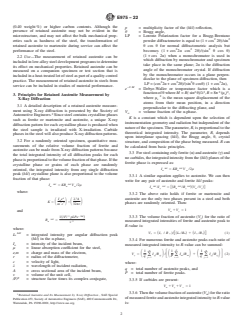
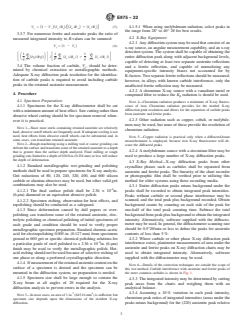
2.1 Significance—Retained austenite with a near random crystallographic orientation is found in the microstructure of heat-treated low-alloy, high-strength steels that have medium (0.40 weight %) or higher carbon contents. Although the presence of retained austenite may not be evident in the microstructure, and may not affect the bulk mechanical properties such as hardness of the steel, the transformation of retained austenite to martensite during service can affect the performance of the steel.
2.2 Use—The measurement of retained austenite can be included in low-alloy steel development programs to determine its effect on mechanical properties. Retained austenite can be measured on a companion specimen or test section that is included in a heat-treated lot of steel as part of a quality control practice. The measurement of retained austenite in steels from service can be included in studies of material performance.
SCOPE
1.1 This test method covers the determination of retained austenite phase in steel using integrated intensities (area under peak above background) of X-ray diffraction peaks using chromium Kα or molybdenum Kα X-radiation.
1.2 The method applies to carbon and alloy steels with near random crystallographic orientations of both ferrite and austenite phases.
1.3 This test method is valid for retained austenite contents from 1 % by volume and above.
1.4 If possible, X-ray diffraction peak interference from other crystalline phases such as carbides should be eliminated from the ferrite and austenite peak intensities.
1.5 Substantial alloy contents in steel cause some change in peak intensities which have not been considered in this method. Application of this method to steels with total alloy contents exceeding 15 weight % should be done with care. If necessary, the users can calculate the theoretical correction factors to account for changes in volume of the unit cells for austenite and ferrite resulting from variations in chemical composition.
1.6 Units—The values stated in inch-pound units are to be regarded as standard. The values given in parentheses are mathematical conversions to SI units that are provided for information only and are not considered standard.
1.7 This standard does not purport to address all of the safety concerns, if any, associated with its use. It is the responsibility of the user of this standard to establish appropriate safety, health, and environmental practices and determine the applicability of regulatory limitations prior to use.
1.8 This international standard was developed in accordance with internationally recognized principles on standardization established in the Decision on Principles for the Development of International Standards, Guides and Recommendations issued by the World Trade Organization Technical Barriers to Trade (TBT) Committee.
- Status
- Published
- Publication Date
- 31-Oct-2022
- Technical Committee
- E04 - Metallography
- Drafting Committee
- E04.11 - X-Ray and Electron Metallography
Overview
ASTM E975-22, "Standard Test Method for X-Ray Determination of Retained Austenite in Steel with Near Random Crystallographic Orientation," establishes procedures for accurately determining the amount of retained austenite phase in steel using X-ray diffraction techniques. Developed by ASTM International, this standard is key for metallurgical analysis, steel quality control, and advanced steel development programs, especially for heat-treated low-alloy, high-strength steels with medium (0.40 weight %) or higher carbon content. The method is valid for steels where both ferrite and austenite phases have near-random crystallographic orientation and is effective for measuring retained austenite content from 1% by volume and above.
Key Topics
- Significance of Retained Austenite: Retained austenite can distinctly impact the in-service performance of heat-treated steels, typically not detectable in the microstructure or affecting bulk properties like hardness, but potentially transforming into martensite during service and altering mechanical properties.
- Scope of Method: The test covers the use of integrated intensities from X-ray diffraction peaks, typically employing chromium Kα or molybdenum Kα radiation, for quantifying retained austenite in steels.
- Random Crystallographic Orientation: Accurate results rely on specimens with near-random orientation of ferrite and austenite grains to avoid error due to preferred orientation effects.
- Equipment and Sample Preparation: The method is designed for unmodified commercial X-ray diffractometers and emphasizes proper sampling, minimal specimen deformation, and elimination of peak interference from carbides or other phases.
- Limitations: The standard cautions use for steels containing more than 15% total alloy content unless correction factors for changes in unit cell volume are applied.
- Precision and Reproducibility: Interlaboratory tests show 3% intralaboratory repeatability and 4% interlaboratory reproducibility for the measurement of retained austenite, provided proper sample preparation and peak separation.
Applications
- Steel Quality Control: Used on companion specimens or test sections from heat-treated lots to ensure retained austenite content is within specified ranges, supporting consistency in product performance.
- Materials Development: Central to R&D programs aimed at optimizing mechanical properties of high-strength, low-alloy steels, particularly those used in automotive, aerospace, and heavy industry applications.
- Performance Analysis: Supports failure analysis and lifetime predictions by quantifying retained austenite transformation in steels that have been in service.
- Research: Assists in metallographic investigations by providing a quantifiable measure of phase balance in multiphase steels.
- Correction Factors: For steels with high alloy contents, users may calculate theoretical corrections to account for alloying effects on X-ray diffraction results.
Related Standards
- ASTM E45 - Standard Test Methods for Determining the Inclusion Content of Steel
- ASTM E566 - Standard Practice for Electromagnetic Sorting of Ferrous Metals
- ASTM E382 - Standard Test Method for Determination of Effective Case Depth of Nitrided Steels
- ISO 6507 - Metallic materials - Vickers hardness test
- SAE Special Publication 453 - Retained Austenite and Its Measurement by X-ray Diffraction
Practical Value
By following ASTM E975-22, laboratories and quality control departments gain a repeatable, reliable X-ray diffraction method for detecting and quantifying retained austenite in steel. This ensures not only product reliability and performance but also regulatory and customer compliance, supporting the steel industry’s need for robust materials and precise metallurgical analysis.
Keywords: retained austenite, X-ray diffraction, steel analysis, metallography, random crystallographic orientation, quality control, ferrite, martensite, ASTM E975
Get Certified
Connect with accredited certification bodies for this standard

Element Materials Technology
Materials testing and product certification.

Inštitut za kovinske materiale in tehnologije
Institute of Metals and Technology. Materials testing, metallurgical analysis, NDT.
Sponsored listings
Frequently Asked Questions
ASTM E975-22 is a standard published by ASTM International. Its full title is "Standard Test Method for X-Ray Determination of Retained Austenite in Steel with Near Random Crystallographic Orientation". This standard covers: SIGNIFICANCE AND USE 2.1 Significance—Retained austenite with a near random crystallographic orientation is found in the microstructure of heat-treated low-alloy, high-strength steels that have medium (0.40 weight %) or higher carbon contents. Although the presence of retained austenite may not be evident in the microstructure, and may not affect the bulk mechanical properties such as hardness of the steel, the transformation of retained austenite to martensite during service can affect the performance of the steel. 2.2 Use—The measurement of retained austenite can be included in low-alloy steel development programs to determine its effect on mechanical properties. Retained austenite can be measured on a companion specimen or test section that is included in a heat-treated lot of steel as part of a quality control practice. The measurement of retained austenite in steels from service can be included in studies of material performance. SCOPE 1.1 This test method covers the determination of retained austenite phase in steel using integrated intensities (area under peak above background) of X-ray diffraction peaks using chromium Kα or molybdenum Kα X-radiation. 1.2 The method applies to carbon and alloy steels with near random crystallographic orientations of both ferrite and austenite phases. 1.3 This test method is valid for retained austenite contents from 1 % by volume and above. 1.4 If possible, X-ray diffraction peak interference from other crystalline phases such as carbides should be eliminated from the ferrite and austenite peak intensities. 1.5 Substantial alloy contents in steel cause some change in peak intensities which have not been considered in this method. Application of this method to steels with total alloy contents exceeding 15 weight % should be done with care. If necessary, the users can calculate the theoretical correction factors to account for changes in volume of the unit cells for austenite and ferrite resulting from variations in chemical composition. 1.6 Units—The values stated in inch-pound units are to be regarded as standard. The values given in parentheses are mathematical conversions to SI units that are provided for information only and are not considered standard. 1.7 This standard does not purport to address all of the safety concerns, if any, associated with its use. It is the responsibility of the user of this standard to establish appropriate safety, health, and environmental practices and determine the applicability of regulatory limitations prior to use. 1.8 This international standard was developed in accordance with internationally recognized principles on standardization established in the Decision on Principles for the Development of International Standards, Guides and Recommendations issued by the World Trade Organization Technical Barriers to Trade (TBT) Committee.
SIGNIFICANCE AND USE 2.1 Significance—Retained austenite with a near random crystallographic orientation is found in the microstructure of heat-treated low-alloy, high-strength steels that have medium (0.40 weight %) or higher carbon contents. Although the presence of retained austenite may not be evident in the microstructure, and may not affect the bulk mechanical properties such as hardness of the steel, the transformation of retained austenite to martensite during service can affect the performance of the steel. 2.2 Use—The measurement of retained austenite can be included in low-alloy steel development programs to determine its effect on mechanical properties. Retained austenite can be measured on a companion specimen or test section that is included in a heat-treated lot of steel as part of a quality control practice. The measurement of retained austenite in steels from service can be included in studies of material performance. SCOPE 1.1 This test method covers the determination of retained austenite phase in steel using integrated intensities (area under peak above background) of X-ray diffraction peaks using chromium Kα or molybdenum Kα X-radiation. 1.2 The method applies to carbon and alloy steels with near random crystallographic orientations of both ferrite and austenite phases. 1.3 This test method is valid for retained austenite contents from 1 % by volume and above. 1.4 If possible, X-ray diffraction peak interference from other crystalline phases such as carbides should be eliminated from the ferrite and austenite peak intensities. 1.5 Substantial alloy contents in steel cause some change in peak intensities which have not been considered in this method. Application of this method to steels with total alloy contents exceeding 15 weight % should be done with care. If necessary, the users can calculate the theoretical correction factors to account for changes in volume of the unit cells for austenite and ferrite resulting from variations in chemical composition. 1.6 Units—The values stated in inch-pound units are to be regarded as standard. The values given in parentheses are mathematical conversions to SI units that are provided for information only and are not considered standard. 1.7 This standard does not purport to address all of the safety concerns, if any, associated with its use. It is the responsibility of the user of this standard to establish appropriate safety, health, and environmental practices and determine the applicability of regulatory limitations prior to use. 1.8 This international standard was developed in accordance with internationally recognized principles on standardization established in the Decision on Principles for the Development of International Standards, Guides and Recommendations issued by the World Trade Organization Technical Barriers to Trade (TBT) Committee.
ASTM E975-22 is classified under the following ICS (International Classification for Standards) categories: 77.040.99 - Other methods of testing of metals; 77.080.20 - Steels. The ICS classification helps identify the subject area and facilitates finding related standards.
ASTM E975-22 is available in PDF format for immediate download after purchase. The document can be added to your cart and obtained through the secure checkout process. Digital delivery ensures instant access to the complete standard document.
Standards Content (Sample)
This international standard was developed in accordance with internationally recognized principles on standardization established in the Decision on Principles for the
Development of International Standards, Guides and Recommendations issued by the World Trade Organization Technical Barriers to Trade (TBT) Committee.
Designation: E975 − 22
Standard Test Method for
X-Ray Determination of Retained Austenite in Steel with
Near Random Crystallographic Orientation
This standard is issued under the fixed designation E975; the number immediately following the designation indicates the year of
original adoption or, in the case of revision, the year of last revision. A number in parentheses indicates the year of last reapproval. A
superscript epsilon (´) indicates an editorial change since the last revision or reapproval.
INTRODUCTION
The volume percent of retained austenite (face-centered cubic phase) in steel is determined by
comparing the integrated chromium or molybdenum X-ray diffraction intensity of ferrite (body-
centered cubic phase) and austenite phases with theoretical intensities. This method should be applied
to steels with near random crystallographic orientations of ferrite and austenite phases because
preferred crystallographic orientations can drastically change these measured intensities from
theoretical values. Chromium radiation was chosen to obtain the best resolution of X-ray diffraction
peaks for other crystalline phases in steel such as carbides. No distinction has been made between
ferrite and martensite phases because the theoretical X-ray diffraction intensities are nearly the same.
Hereafter, the term ferrite can also apply to martensite. This test method has been designed for
unmodified commercial X-ray diffractometers or diffraction lines on film read with a densitometer.
Other types of X-radiations such as cobalt or copper can be used, but most laboratories examining
ferrous materials use chromium radiation for improved X-ray diffraction peak resolution or
molybdenum radiation to produce numerous X-ray diffraction peaks. Because of special problems
associated with the use of cobalt or copper radiation, these radiations are not considered in this test
method.
1. Scope necessary, the users can calculate the theoretical correction
factors to account for changes in volume of the unit cells for
1.1 This test method covers the determination of retained
austenite and ferrite resulting from variations in chemical
austenite phase in steel using integrated intensities (area under
composition.
peak above background) of X-ray diffraction peaks using
chromium K or molybdenum K X-radiation. 1.6 Units—The values stated in inch-pound units are to be
α α
regarded as standard. The values given in parentheses are
1.2 The method applies to carbon and alloy steels with near
mathematical conversions to SI units that are provided for
random crystallographic orientations of both ferrite and aus-
information only and are not considered standard.
tenite phases.
1.7 This standard does not purport to address all of the
1.3 This test method is valid for retained austenite contents
safety concerns, if any, associated with its use. It is the
from 1 % by volume and above.
responsibility of the user of this standard to establish appro-
1.4 If possible, X-ray diffraction peak interference from
priate safety, health, and environmental practices and deter-
other crystalline phases such as carbides should be eliminated
mine the applicability of regulatory limitations prior to use.
from the ferrite and austenite peak intensities.
1.8 This international standard was developed in accor-
dance with internationally recognized principles on standard-
1.5 Substantial alloy contents in steel cause some change in
ization established in the Decision on Principles for the
peak intensities which have not been considered in this
Development of International Standards, Guides and Recom-
method. Application of this method to steels with total alloy
mendations issued by the World Trade Organization Technical
contents exceeding 15 weight % should be done with care. If
Barriers to Trade (TBT) Committee.
This test method is under the jurisdiction of ASTM Committee E04 on
2. Significance and Use
Metallography and is the direct responsibility of Subcommittee E04.11 on X-Ray
and Electron Metallography.
2.1 Significance—Retained austenite with a near random
Current edition approved Nov. 1, 2022. Published February 2023. Originally
crystallographic orientation is found in the microstructure of
approved in 1984. Last previous edition approved in 2013 as E975 –13, which was
withdrawn in July 2022 and reinstated in November 2022. DOI: 10.1520/E0975-22. heat-treated low-alloy, high-strength steels that have medium
Copyright © ASTM International, 100 Barr Harbor Drive, PO Box C700, West Conshohocken, PA 19428-2959. United States
E975 − 22
(0.40 weight %) or higher carbon contents. Although the
p = multiplicity factor of the (hkl) reflection,
presence of retained austenite may not be evident in the
θ = Bragg angle,
microstructure, and may not affect the bulk mechanical prop-
LP = Lorentz Polarization factor for a Bragg-Brentano
2 2
erties such as hardness of the steel, the transformation of powder diffractometer is equal to (1 + cos 2θ)/sin
retained austenite to martensite during service can affect the
θ cos θ for normal diffractometric analysis but
2 2 2
performance of the steel. becomes (1 + cos 2α cos 2θ)/(sin θ cos θ)
(1 + cos 2α) when a monochromator is used in
2.2 Use—The measurement of retained austenite can be
which diffraction by monochromator and specimen
included in low-alloy steel development programs to determine
take place in the same plane; 2α is the diffraction
its effect on mechanical properties. Retained austenite can be
angle of the monochromator crystal. If diffraction
measured on a companion specimen or test section that is
by the monochromator occurs in a plane perpen-
included in a heat-treated lot of steel as part of a quality control
dicular to the plane of specimen diffraction, then
practice. The measurement of retained austenite in steels from
2 2 2 2
LP = (cos 2α + cos 2θ)/(sin θ cosθ) (1 + cos 2α),
service can be included in studies of material performance.
−2 M
e = Debye-Waller or temperature factor which is a
2 2 2 2
function of θ where M = B( sin θ)/λ , B = 8π (μ ) ,
s
3. Principles for Retained Austenite Measurement by
where μ is the mean square displacement of the
s
X-Ray Diffraction
atoms from their mean position, in a direction
3.1 A detailed description of a retained austenite measure-
perpendicular to the diffracting plane, and
ment using X-ray diffraction is presented by the Society of
V = volume fraction of the α-phase.
α
Automotive Engineers. Since steel contains crystalline phases
K is a constant which is dependent upon the selection of
such as ferrite or martensite and austenite, a unique X-ray
instrumentation geometry and radiation but independent of the
diffraction pattern for each crystalline phase is produced when
nature of the specimen. The parameter, R, is proportional to the
the steel sample is irradiated with X-irradiation. Carbide
theoretical integrated intensity. The parameter, R, depends
phases in the steel will also produce X-ray diffraction patterns.
upon interplanar spacing (hkl), the Bragg angle, θ, crystal
3.2 For a randomly oriented specimen, quantitative mea-
structure, and composition of the phase being measured. R can
surements of the relative volume fraction of ferrite and
be calculated from basic principles.
austenite can be made from X-ray diffraction patterns because
3.3 For steel containing only ferrite (α) and austenite (γ) and
the total integrated intensity of all diffraction peaks for each
no carbides, the integrated intensity from the (hkl) planes of the
phase is proportional to the volume fraction of that phase. If the
ferrite phase is expressed as:
crystalline phase or grains of each phase are randomly
hkl hkl
I 5 KR V /2μ
oriented, the integrated intensity from any single diffraction
α α α
peak (hkl) crystalline plane is also proportional to the volume
3.3.1 A similar equation applies to austenite. We can then
fraction of that phase:
write for any pair of austenite and ferrite hkl peaks:
hkl hkl
I 5 KR V /2μ
hkl hkl hkl hkl
α α α
I /I 5 @~R /R !~V /V !#
α γ α γ α γ
where:
3.3.2 The above ratio holds if ferrite or martensite and
4 3
I e λ A austenite are the only two phases present in a steel and both
o
K 5 ×
S D S D
2 4
phases are randomly oriented. Then:
m c 32πr
V 1V 5 1
and α γ
2 22M
3.3.3 The volume fraction of austenite (V ) for the ratio of
1~/F/ pLPe !
γ
hkl
R 5
α
v measured integrated intensities of ferrite and austenite peak to
R-value is:
where:
V 5 I / R !/ I /R 1 I /R (1)
hkl @~ ! #
γ ~ γ γ α α ~ γ γ!
I = integrated intensity per angular diffraction peak
α
(hkl) in the α-phase,
3.3.4 For numerous ferrite and austenite peaks each ratio of
I = intensity of the incident beam,
o measured integrated intensity to R-value can be summed:
μ = linear absorption coefficient for the steel,
q P q
1 1 1
e,m = charge and mass of the electron,
V 5 I ⁄R / I /R 1 I /R (2)
S D FS D S DG
γ ( γj γj ( αi αi ( γj γj
q P q
j51 i51 j51
r = radius of the diffractometer,
c = velocity of light,
where:
λ = wavelength of incident radiation,
q = total number of austenite peaks, and
A = cross sectional area of the incident beam,
P = total number of ferrite peaks.
v = volume of the unit cell,
/F/ = structure factor times its complex conjugate,
3.3.5 If carbides are present:
V 1V 1V 5 1
α γ c
3.3.6 Then the volume fraction of austenite (V ) for the ratio
2 α
Retained Austenite and Its Measurement by X-ray Diffraction , SAE Special
of measured ferrite and austenite integrated intensity to R-value
Publication 453, Society of Automotive Engineers (SAE), 400 Commonwealth Dr.,
Warrendale, PA 15096-0001, http://www.sae.org. is:
E975 − 22
V 5 1 2 V I /R / I /R 1 I /R (3) 4.1.5.1 When using molybdenum radiation, select peaks in
~ !~ ! @~ ! ~ !#
γ c γ γ α α γ γ
the range from 28° to 40° 2θ for best results.
3.3.7 For numerous ferrite and austenite peaks the ratio of
4.2 X-Ray Equipment:
measured integrated intensity to R-values can be summed:
4.2.1 Any diffraction system may be used that consists of an
V 5 ~1 2 V ! (4)
γ c
x-ray source, an angular measurement capability, and an x-ray
q p q detection system. The system shall be capable of obtaining the
1 1 1
~Iγj/Rγj! / ~I i/R i! 1 ~I i/R i!
FS DG F G entire diffraction peak along with adjacent background levels,
( ( a a ( r r
q P q
j51 i51 j51
capable of detecting at least two separate austenite reflections
3.4 The volume fraction of carbide, V , should be deter-
c
and a ferrite reflection, and capable of normalizing any
mined by chemical extraction or metallographic methods.
equipment-specific intensity biases not accounted for by
Adequate X-ray diffraction peak resolution for the identifica-
R-factors. Two separate ferrite reflections should be measured;
tion of carbide peaks is required to avoid including carbide
however, in alloys with known carbide interference, only the
peaks in the retained austenite measurement.
unaffected ferrite reflection may be measured.
4.2.2 A chromium X-ray source with a vanadium metal or
4. Procedure
compound filter to reduce the K radiation is should be used.
β
4.1 Specimen Preparation:
NOTE 4—Chromium radiation produces a minimum of X-ray fluores-
4.1.1 Specimens for the X-ray diffractometer shall be cut cence of iron. Chromium radiation provides for the needed X-ray
diffraction peak resolution and allows for the separation of carbide peaks
with a minimum amount of heat effect. Saw cutting rather than
from austenite and ferrite peaks.
abrasive wheel cutting should be for specimen removal when-
4.2.3 Other radiation such as copper, cobalt, or molybde-
ever it is practical.
num may be used, but none of these provide the resolution of
NOTE 1—Since most steels containing retained austenite are relatively
chromium radiation.
hard, abrasive cutoff wheels are frequently used. If adequate cooling is not
used, heat effects from abrasive cutoff wheels can be substantial and, in
NOTE 5—Copper radiation is practical only when a diffracted-beam
some cases, can transform retained austenite.
monochromator is employed, because iron X-ray fluorescence will ob-
NOTE 2—Rough machining using a milling tool or coarse grinding can
scure the diffracted peaks.
deform the surface and transform some of the retained austenite to a depth
4.2.4 A molybdenum source with a zirconium filter may be
that is greater than the surface depth analyzed. Final milling or rough
used to produce a large number of X-ray diffraction peaks.
grinding cuts limited to a depth of 0.010-in (0.254 mm) or less will reduce
the depth of deformation.
4.3 X-Ray Method—X-ray diffraction peaks from other
4.1.2 Standard metallographic wet-grinding and polishing
crystalline phases such as carbides shall be separated from
methods shall be used to prepare specimens for X-ray analysis.
austenite and ferrite peaks. The linearity of the chart recorder
Grit reductions of 80, 120, 240, 320, 400, and 600 silicon
or photographic film shall be verified prior to utilizing this
carbide or alumina abrasives may be used, but other valid grit
method for older systems using these recording media.
combinations may also be used.
4.3.1 Entire diffraction peaks minus background under the
-4
4.1.2.1 The final surface polish shall be 2.36 × 10 in.
peaks shall be recorded to obtain integrated peak intensities.
(6-μm) diamond or an equivalent abrasive polish. Peaks without carbide or second phase interference may be
4.1.2.2 Specimen etching, observation for heat effects, and scanned, and the total peak plus background recorded. Obtain
background counts by counting on each side of the peak for
repolishing should be conducted as a safeguard.
one-half of the total peak counting time. Subtract the total
4.1.3 Since deformation caused by dull papers or over-
background from peak plus background to obtain the integrated
polishing can transform some of the retained austenite, elec-
intensity. Alternatively, software supplied with the diffracto-
trolytic polishing or chemical polishing of initial specimens of
meter may be used. In general, the diffractometer scanning rate
each grade and condition should be used to verify proper
should be 0.5°2θ/min or less to define the peaks for austenite
metallographic specimen preparation. Standard chromic-acetic
contents of less than 5 %.
acid for electropolishing 0.005-in. (0.127 mm) from specimens
4.3.2 Where carbide or other phase X-ray diffraction peak
ground to 600 grit or specific chemical polishing solutions for
-4
interference exists, planimeter measurements of area under the
a particular grade of steel polished to a 2.36 × 10 in. (
...