

ASTM E1351-01(2020)
(Practice)Standard Practice for Production and Evaluation of Field Metallographic Replicas
General Information
- Abstract
SIGNIFICANCE AND USE
4.1 Replication is a nondestructive sampling procedure that records and preserves the topography of a metallographically prepared surface as a negative relief on a plastic film (replica). The replica permits the examination and analysis of the metallographically prepared surface on the LM or SEM.
4.2 Enhancement procedures for improving replica contrast for microscopic examination are utilized and sometimes necessary (see 8.1).
Note 1: It is recommended that the purchaser of a field replication service specify that each replicator demonstrate proficiency by providing field prepared replica metallography and direct LM and SEM comparison to laboratory prepared samples of an identical material by grade and service exposure.
SCOPE
1.1 This practice covers recognized methods for the preparation and evaluation of cellulose acetate or plastic film replicas which have been obtained from metallographically prepared surfaces. It is designed for the evaluation of replicas to ensure that all significant features of a metallographically prepared surface have been duplicated and preserved on the replica with sufficient detail to permit both LM and SEM examination with optimum resolution and sensitivity.
1.2 This practice may be used as a controlling document in commercial situations.
1.3 The values stated in SI units are to be regarded as the standard. Inch-pound units given in parentheses are for information only.
1.4 This standard does not purport to address all of the safety concerns, if any, associated with its use. It is the responsibility of the user of this standard to establish appropriate safety, health, and environmental practices and determine the applicability of regulatory limitations prior to use.
1.5 This international standard was developed in accordance with internationally recognized principles on standardization established in the Decision on Principles for the Development of International Standards, Guides and Recommendations issued by the World Trade Organization Technical Barriers to Trade (TBT) Committee.
- Status
- Published
- Publication Date
- 31-Oct-2020
- Technical Committee
- E04 - Metallography
- Drafting Committee
- E04.01 - Specimen Preparation
Overview
ASTM E1351-01(2020), Standard Practice for Production and Evaluation of Field Metallographic Replicas, provides recognized methods for the nondestructive replication and evaluation of metallographically prepared surfaces. This standard enables users to generate field metallographic replicas-negative reliefs of surface microstructure, typically using cellulose acetate or plastic film-to capture and preserve critical features for later microscopic analysis using light microscopes (LM) or scanning electron microscopes (SEM). By following this practice, surface condition and microstructural features can be reliably examined and documented without damaging the original material.
This practice is widely used in industries where it is necessary to assess material condition, monitor degradation, or verify heat treatment and weldments in-service or on-site, such as in the power generation, petrochemical, and manufacturing sectors.
Key Topics
- Nondestructive Replication: Field metallographic replication captures the topography of metallographically prepared surfaces as negative images on plastic film, allowing detailed inspection without removing material from the component.
- Preparation of Replicas: Methods include both solvent-based and compound-based techniques to produce accurate surface replicas. The utmost attention must be given to proper surface preparation-manual, mechanical, or electrolytic-to avoid deformation and ensure reproduction of significant microstructural features.
- Quality Evaluation: Replicas must preserve all essential features with sufficient clarity, supporting analysis at high magnification (up to 5000× in SEM). Evaluation criteria include surface fidelity, absence of artifacts, and proper documentation.
- Microscopy Techniques: Replicas are examined using optical or electron microscopy, with contrast enhancement performed by metallic coating (e.g., gold or aluminum) and back-side treatments like ink or paint to optimize visualization.
- Documentation: The practice emphasizes comprehensive documentation, including photomicrographic records and detailed identification for tracking and traceability.
Applications
- In-Service Inspection: This standard is invaluable for metallurgical evaluation in the field, such as on-site assessment of pipes, pressure vessels, and welded joints without removing samples or interrupting service.
- Weld and Heat-Affected Zone Analysis: Replicas enable the capture of microstructural details from weldments, including base metal, weld metal, and heat-affected zones, aiding in quality assurance and failure analysis.
- Condition Monitoring: Routine surveillance for degradation mechanisms (e.g., creep, corrosion, or other microstructural changes) can be performed on critical components in power plants, refineries, and chemical processing facilities.
- Research and Laboratory Comparison: Replicas allow direct comparison of field and laboratory-prepared specimens, supporting material research and process validation.
Related Standards
- ASTM E3: Guide for Preparation of Metallographic Specimens
- ASTM E407: Practice for Microetching Metals and Alloys
- ASTM E7: Terminology Relating to Metallography
- ASTM A335/A335M: Specification for Seamless Ferritic Alloy-Steel Pipe for High-Temperature Service
Following ASTM E1351 ensures that field metallographic replicas are produced and evaluated consistently, enabling nondestructive metallographic analysis with high-resolution detail and robust documentation. This supports maintenance, safety, and quality control objectives across a range of industrial applications involving critical metallic components.
Relations
- Effective Date
- 01-Apr-2024
- Effective Date
- 01-Nov-2023
- Effective Date
- 29-Sep-2023
- Effective Date
- 01-Sep-2018
- Effective Date
- 01-Mar-2018
- Effective Date
- 01-Sep-2015
- Effective Date
- 01-Jun-2015
- Effective Date
- 01-Jun-2015
- Effective Date
- 01-May-2015
- Effective Date
- 01-Nov-2014
- Effective Date
- 01-Oct-2011
- Effective Date
- 01-Nov-2010
- Effective Date
- 01-May-2010
- Effective Date
- 01-Apr-2010
- Effective Date
- 01-Dec-2009
Get Certified
Connect with accredited certification bodies for this standard

Element Materials Technology
Materials testing and product certification.

Inštitut za kovinske materiale in tehnologije
Institute of Metals and Technology. Materials testing, metallurgical analysis, NDT.
Sponsored listings
Frequently Asked Questions
ASTM E1351-01(2020) is a standard published by ASTM International. Its full title is "Standard Practice for Production and Evaluation of Field Metallographic Replicas". This standard covers: SIGNIFICANCE AND USE 4.1 Replication is a nondestructive sampling procedure that records and preserves the topography of a metallographically prepared surface as a negative relief on a plastic film (replica). The replica permits the examination and analysis of the metallographically prepared surface on the LM or SEM. 4.2 Enhancement procedures for improving replica contrast for microscopic examination are utilized and sometimes necessary (see 8.1). Note 1: It is recommended that the purchaser of a field replication service specify that each replicator demonstrate proficiency by providing field prepared replica metallography and direct LM and SEM comparison to laboratory prepared samples of an identical material by grade and service exposure. SCOPE 1.1 This practice covers recognized methods for the preparation and evaluation of cellulose acetate or plastic film replicas which have been obtained from metallographically prepared surfaces. It is designed for the evaluation of replicas to ensure that all significant features of a metallographically prepared surface have been duplicated and preserved on the replica with sufficient detail to permit both LM and SEM examination with optimum resolution and sensitivity. 1.2 This practice may be used as a controlling document in commercial situations. 1.3 The values stated in SI units are to be regarded as the standard. Inch-pound units given in parentheses are for information only. 1.4 This standard does not purport to address all of the safety concerns, if any, associated with its use. It is the responsibility of the user of this standard to establish appropriate safety, health, and environmental practices and determine the applicability of regulatory limitations prior to use. 1.5 This international standard was developed in accordance with internationally recognized principles on standardization established in the Decision on Principles for the Development of International Standards, Guides and Recommendations issued by the World Trade Organization Technical Barriers to Trade (TBT) Committee.
SIGNIFICANCE AND USE 4.1 Replication is a nondestructive sampling procedure that records and preserves the topography of a metallographically prepared surface as a negative relief on a plastic film (replica). The replica permits the examination and analysis of the metallographically prepared surface on the LM or SEM. 4.2 Enhancement procedures for improving replica contrast for microscopic examination are utilized and sometimes necessary (see 8.1). Note 1: It is recommended that the purchaser of a field replication service specify that each replicator demonstrate proficiency by providing field prepared replica metallography and direct LM and SEM comparison to laboratory prepared samples of an identical material by grade and service exposure. SCOPE 1.1 This practice covers recognized methods for the preparation and evaluation of cellulose acetate or plastic film replicas which have been obtained from metallographically prepared surfaces. It is designed for the evaluation of replicas to ensure that all significant features of a metallographically prepared surface have been duplicated and preserved on the replica with sufficient detail to permit both LM and SEM examination with optimum resolution and sensitivity. 1.2 This practice may be used as a controlling document in commercial situations. 1.3 The values stated in SI units are to be regarded as the standard. Inch-pound units given in parentheses are for information only. 1.4 This standard does not purport to address all of the safety concerns, if any, associated with its use. It is the responsibility of the user of this standard to establish appropriate safety, health, and environmental practices and determine the applicability of regulatory limitations prior to use. 1.5 This international standard was developed in accordance with internationally recognized principles on standardization established in the Decision on Principles for the Development of International Standards, Guides and Recommendations issued by the World Trade Organization Technical Barriers to Trade (TBT) Committee.
ASTM E1351-01(2020) is classified under the following ICS (International Classification for Standards) categories: 77.040.99 - Other methods of testing of metals. The ICS classification helps identify the subject area and facilitates finding related standards.
ASTM E1351-01(2020) has the following relationships with other standards: It is inter standard links to ASTM A335/A335M-24, ASTM E407-23, ASTM A335/A335M-95a, ASTM A335/A335M-18a, ASTM A335/A335M-18, ASTM A335/A335M-15a, ASTM E7-15, ASTM E407-07(2015)e1, ASTM A335/A335M-15, ASTM E7-14, ASTM A335/A335M-11, ASTM A335/A335M-10b, ASTM A335/A335M-10a, ASTM A335/A335M-10, ASTM A335/A335M-09a. Understanding these relationships helps ensure you are using the most current and applicable version of the standard.
ASTM E1351-01(2020) is available in PDF format for immediate download after purchase. The document can be added to your cart and obtained through the secure checkout process. Digital delivery ensures instant access to the complete standard document.
Standards Content (Sample)
This international standard was developed in accordance with internationally recognized principles on standardization established in the Decision on Principles for the
Development of International Standards, Guides and Recommendations issued by the World Trade Organization Technical Barriers to Trade (TBT) Committee.
Designation: E1351 − 01 (Reapproved 2020)
Standard Practice for
Production and Evaluation of Field Metallographic Replicas
This standard is issued under the fixed designation E1351; the number immediately following the designation indicates the year of
original adoption or, in the case of revision, the year of last revision.Anumber in parentheses indicates the year of last reapproval.A
superscript epsilon (´) indicates an editorial change since the last revision or reapproval.
INTRODUCTION
Replication is a nondestructive sampling procedure which records and preserves the topography of
a metallographic specimen as a negative relief on a plastic film. The microstructural replica can be
examined using a light microscope (LM) or scanning electron microscope (SEM) for subsequent
analysis. Specimens examined in the SEM are vacuum coated with vaporized carbon or a suitable
metal to provide contrast and conductivity. The convenience of the replication process makes it
suitable for obtaining microstructures from field locations for subsequent examination and analysis in
a laboratory. The proper preparation of the test surface and of the replica itself is of paramount
importance and must receive careful attention. Because of the diversity of metallographic equipment
available and the wide range of environments in which replication is conducted, the preparation of
replicas of high quality should be viewed as a skilled process for which there exists a variety of
techniques that achieve satisfactory results.
This practice presents some guidelines on the preparation of metallic surfaces and production of
replicas and guidelines on evaluation of replica quality. It does not attempt to limit the variations in
technique developed by skilled metallographers, each of which may produce acceptable replicas.
1. Scope 1.5 This international standard was developed in accor-
dance with internationally recognized principles on standard-
1.1 This practice covers recognized methods for the prepa-
ization established in the Decision on Principles for the
ration and evaluation of cellulose acetate or plastic film
Development of International Standards, Guides and Recom-
replicas which have been obtained from metallographically
mendations issued by the World Trade Organization Technical
prepared surfaces. It is designed for the evaluation of replicas
Barriers to Trade (TBT) Committee.
to ensure that all significant features of a metallographically
prepared surface have been duplicated and preserved on the
2. Referenced Documents
replica with sufficient detail to permit both LM and SEM
2.1 ASTM Standards:
examination with optimum resolution and sensitivity.
A335/A335MSpecification for Seamless Ferritic Alloy-
1.2 This practice may be used as a controlling document in
Steel Pipe for High-Temperature Service
commercial situations.
E3Guide for Preparation of Metallographic Specimens
1.3 The values stated in SI units are to be regarded as the
E7Terminology Relating to Metallography
standard. Inch-pound units given in parentheses are for infor-
E407Practice for Microetching Metals and Alloys
mation only.
3. Terminology
1.4 This standard does not purport to address all of the
safety concerns, if any, associated with its use. It is the 3.1 Definitions—For definitions of terms used in this
responsibility of the user of this standard to establish appro- practice, refer to Terminology E7.
priate safety, health, and environmental practices and deter-
4. Significance and Use
mine the applicability of regulatory limitations prior to use.
4.1 Replication is a nondestructive sampling procedure that
records and preserves the topography of a metallographically
This practice is under the jurisdiction of ASTM Committee E04 on Metallog-
raphy and is the direct responsibility of Subcommittee E04.01 on Specimen
Preparation. For referenced ASTM standards, visit the ASTM website, www.astm.org, or
Current edition approved Nov. 1, 2020. Published November 2020. Originally contact ASTM Customer Service at service@astm.org. For Annual Book of ASTM
approved in 1990. Last previous edition approved in 2012 as E1351–01(2012). Standards volume information, refer to the standard’s Document Summary page on
DOI: 10.1520/E1351-01R20. the ASTM website.
Copyright © ASTM International, 100 Barr Harbor Drive, PO Box C700, West Conshohocken, PA 19428-2959. United States
E1351 − 01 (2020)
prepared surface as a negative relief on a plastic film (replica). 6.3 Prepare the surface to be replicated using the methods
The replica permits the examination and analysis of the suggestedinMethodsE3modifiedforfielduse,asappropriate,
metallographically prepared surface on the LM or SEM. in such a way as to obtain a surface free of deformation,
scratches,polishingdefects,etchpits,andotherartifactswhich
4.2 Enhancement procedures for improving replica contrast
may obscure the true microstructural features.
for microscopic examination are utilized and sometimes nec-
essary (see 8.1).
NOTE 3—The presence of decarburization can be detected with a
portable hardness tester during the grinding steps. Further grinding to
NOTE 1—It is recommended that the purchaser of a field replication
reachasurfacefreeofdecarburizationcanbemonitoredwiththehardness
service specify that each replicator demonstrate proficiency by providing
tester.Areplicamayalsobemadeonthedecarburizedsurface,ifitserves
field prepared replica metallography and direct LM and SEM comparison
the purpose of the investigation.
to laboratory prepared samples of an identical material by grade and
service exposure.
6.4 Do not remove any precipitates, carbides, nonmetallic
inclusions such as oxides and sulfides during the polishing or
5. Evaluation Methods
etching operations.
5.1 A suitable replica should accurately reproduce all the
6.5 Etchingproceduresforsurfacemetallographicexamina-
microstructural features present on the surface that was repli-
tion should be performed in accordance with Practice E407.
cated.
6.6 The quality of the surface preparation should be con-
5.2 No visible loss of resolution is permitted over the
trolled by the use of a portable field microscope.
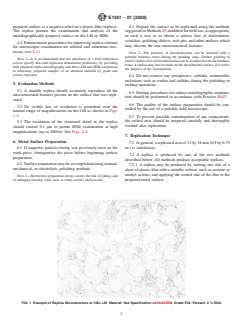
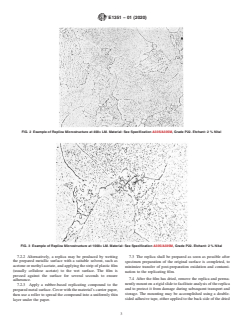
normal range of magnifications on the LM as shown in Figs.
1-3.
6.7 To prevent possible contamination of any components,
the etched area should be prepared carefully and thoroughly
5.3 The resolution of the structural detail in the replica
washed after replication.
should exceed 0.1 µm to permit SEM examination at high
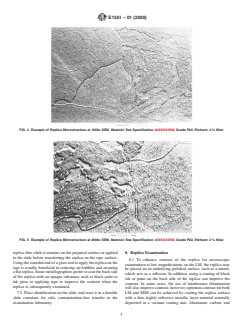
magnifications (up to 5000×). See Figs. 4-6.
7. Replication Technique
6. Metal Surface Preparation
7.1 Ingeneral,areplicatedareaof12by18mm(0.5by0.75
in.) is satisfactory.
6.1 If magnetic particle testing was previously used on the
work-piece, demagnetize the piece before beginning surface
7.2 A replica is produced by one of the two methods
preparation.
described below. All methods produce acceptable replicas.
6.2 Surfacepreparationmaybeaccomplishedusingmanual,
7.2.1 A replica may be produced by wetting one side of a
mechanical, or electrolytic polishing methods.
sheet of plastic film with a suitable solvent, such as acetone or
methyl acetate, and applying the wetted side of the film to the
NOTE 2—Electrolytic preparation always carries the risk of pitting, and
of enlarging existing voids such as creep cavities and porosity. prepared metal surface.
FIG. 1 Example of Replica Microstructure at 100× LM. Material: See Specification A335/A335M, Grade P22. Etchant: 2 % Nital
---
...