

ASTM A989/A989M-23
(Specification)Standard Specification for Hot Isostatically-Pressed Alloy Steel Flanges, Fittings, Valves, and Parts for High Temperature Service
General Information
- Abstract
ABSTRACT
This specification covers hot isostatically-pressed, powder metallurgy, alloy steel piping components such as flanges, fittings, valves, and similar parts for use in pressure systems and high-temperature services. Compacts shall be manufactured by placing a single powder blend into a can, evacuating the can, and sealing it. The entire assembly shall be heated and placed under sufficient pressure for a sufficient period of time to ensure that the final consolidated part meets the density requirements. The powder shall be prealloyed and made by a melting method such as vacuum induction melting followed by gas atomization. Alloy steels shall undergo annealing, liquid quenching, and tempering in accordance to heat treatment temperature and cooling media requirements. The steel both as a blend and as a part shall conform to the chemical composition requirements for carbon, manganese, phosphorus, sulfur, silicon, nickel, chromium, molybdenum, columbium, tantalum, and titanium. Density measurement, microstructural examination, and hydrostatic, tension, hardness, and fatigue tests shall be performed; wherein, the specimens shall conform to the specified structural integrity and mechanical property requirements such as porosity, microstructure, tensile strength, yield strength, elongation, reduction of area, and Brinell hardness.
SCOPE
1.1 This specification covers hot isostatically-pressed, powder metallurgy, alloy steel piping components for use in pressure systems. Included are flanges, fittings, valves, and similar parts made to specified dimensions or to dimensional standards, such as in ASME Specification B16.5.
1.2 Several grades of alloy steels are included in this specification.
1.3 Supplementary requirements are provided for use when additional testing or inspection is desired. These shall apply only when specified individually by the purchaser in the order.
1.4 This specification is expressed in both inch-pound units and in SI units. Unless the order specifies the applicable “M” specification designation (SI units), however, the material shall be furnished to inch-pound units.
1.5 The values stated in either inch-pound units or SI units are to be regarded separately as the standard. Within the text, the SI units are shown in brackets. The values stated in each system are not exact equivalents; therefore, each system must be used independently of the other. Combining values from the two systems may result in nonconformance with the specification.
1.6 The following safety hazards caveat pertains only to test methods portions, 8.1, 8.2, and 9.5 – 9.7 of this specification: This standard does not purport to address all of the safety concerns, if any, associated with its use. It is the responsibility of the user of this standard to establish appropriate safety, health, and environmental practices and to determine the applicability of regulatory limitations prior to use.
1.7 This international standard was developed in accordance with internationally recognized principles on standardization established in the Decision on Principles for the Development of International Standards, Guides and Recommendations issued by the World Trade Organization Technical Barriers to Trade (TBT) Committee.
- Status
- Published
- Publication Date
- 30-Apr-2023
- Technical Committee
- A01 - Steel, Stainless Steel and Related Alloys
Buy Documents
ASTM A989/A989M-23 - Standard Specification for Hot Isostatically-Pressed Alloy Steel Flanges, Fittings, Valves, and Parts for High Temperature Service
REDLINE ASTM A989/A989M-23 - Standard Specification for Hot Isostatically-Pressed Alloy Steel Flanges, Fittings, Valves, and Parts for High Temperature Service
Overview
ASTM A989/A989M-23: Standard Specification for Hot Isostatically-Pressed Alloy Steel Flanges, Fittings, Valves, and Parts for High Temperature Service defines requirements for alloy steel components manufactured through hot isostatic pressing (HIP) and powder metallurgy for use in pressure systems subjected to high temperatures. Covered components include flanges, fittings, valves, and similar parts, produced to specified or standard dimensions. Designed for applications where structural integrity, chemical consistency, and mechanical reliability are critical, this standard addresses chemical composition, manufacturing processes, heat treatment, and quality control measures.
ASTM A989/A989M-23 is intended to ensure performance consistency in environments requiring pressure containment and elevated temperature service, making it highly relevant for industries such as petrochemical, power generation, and other sectors dealing with high-pressure, high-temperature piping systems.
Key Topics
Scope of Application
- Applies to HIP-produced alloy steel flanges, fittings, valves, and parts for pressure systems.
- Components may conform to specified dimensions or standardized sizes (e.g., ASME B16.5).
Manufacturing & Materials
- Components are produced by encapsulating a prealloyed steel powder blend in a sealed can, evacuating, sealing, and consolidating the powder using high pressure and temperature.
- Powders should be made by melting methods such as vacuum induction melting with subsequent gas atomization to ensure homogeneity.
Chemical & Mechanical Requirements
- Alloy steels must adhere to strict chemical composition limits for elements such as carbon, manganese, chromium, molybdenum, nickel, niobium, and others.
- Mechanical properties including tensile strength, yield strength, elongation, reduction of area, and Brinell hardness are rigorously specified.
Heat Treatment & Quality Control
- Required heat treatment sequences include annealing, normalizing, quenching, and tempering appropriate to the alloy type.
- Structural and mechanical verification involves density measurement, microstructural examination, hydrostatic testing, and mechanical testing (tension, hardness, fatigue as applicable).
Supplementary & Marking Requirements
- Provides additional requirements for enhanced testing, product identification (including marking for quenched/tempered and repaired parts), and purchaser-specified supplementary actions.
Applications
ASTM A989/A989M-23 alloy steel flanges, fittings, and valves are primarily used in:
- High-Temperature Pressure Systems: Suitable for industrial environments with continuous pressure and elevated temperatures, reducing risk of failure due to material degradation.
- Power Generation: Used in steam lines, boiler systems, and related high-stress piping.
- Oil, Gas, and Petrochemical Plants: Essential in refineries, chemical plants, and offshore platforms where reliability and heat resistance are vital.
- Process Industries: Adopted in facilities that require robust, high-integrity piping connecting pressurized vessels and units.
The standard's emphasis on powder metallurgy and HIP processes ensures components are dense, with minimized porosity and tailored microstructures for demanding operational conditions. Adoption of ASTM A989/A989M-23 enables improved safety, expanded design flexibility, and longer service life in critical pipelines and assemblies.
Related Standards
- ASME B16.5 - Pipe Flanges and Flanged Fittings, which defines dimensional requirements for many components produced under ASTM A989/A989M.
- ASTM A961/A961M - Covers common requirements for steel flanges, forged fittings, valves, and parts for piping applications.
- ASTM A275/A275M - Practice for Magnetic Particle Examination of Steel Forgings.
- ASTM A751 - Test Methods for Chemical Analysis of Steel Products.
- ASME Section IX - Welding Qualifications, referenced for repair welding requirements.
Leveraging ASTM A989/A989M-23 with these standards helps ensure product compatibility, quality assurance, and regulatory compliance in advanced piping and high temperature pressure systems.
Keywords: hot isostatically-pressed alloy steel parts, HIP, powder metallurgy flanges, pressure systems, high temperature service, steel valves, pipe fittings, ASTM A989, alloy steel specification.
Relations
- Effective Date
- 01-Mar-2024
- Effective Date
- 15-Nov-2023
- Effective Date
- 01-Nov-2023
- Effective Date
- 01-Nov-2019
- Effective Date
- 01-Sep-2017
- Effective Date
- 01-Jun-2016
- Effective Date
- 01-Nov-2015
- Effective Date
- 01-Nov-2015
- Effective Date
- 01-Nov-2014
- Effective Date
- 01-Mar-2014
- Effective Date
- 01-Oct-2013
- Effective Date
- 01-Jun-2013
- Effective Date
- 01-May-2013
- Effective Date
- 01-Apr-2013
- Effective Date
- 01-Apr-2013
Buy Documents
ASTM A989/A989M-23 - Standard Specification for Hot Isostatically-Pressed Alloy Steel Flanges, Fittings, Valves, and Parts for High Temperature Service
REDLINE ASTM A989/A989M-23 - Standard Specification for Hot Isostatically-Pressed Alloy Steel Flanges, Fittings, Valves, and Parts for High Temperature Service
Get Certified
Connect with accredited certification bodies for this standard

BUREAU VERITAS Certification Germany
Bureau Veritas certification in Germany.

Element Materials Technology
Materials testing and product certification.

AQMS Ltd.
AQMS provides ISO certification to SMEs across the UK.
Sponsored listings
Frequently Asked Questions
ASTM A989/A989M-23 is a technical specification published by ASTM International. Its full title is "Standard Specification for Hot Isostatically-Pressed Alloy Steel Flanges, Fittings, Valves, and Parts for High Temperature Service". This standard covers: ABSTRACT This specification covers hot isostatically-pressed, powder metallurgy, alloy steel piping components such as flanges, fittings, valves, and similar parts for use in pressure systems and high-temperature services. Compacts shall be manufactured by placing a single powder blend into a can, evacuating the can, and sealing it. The entire assembly shall be heated and placed under sufficient pressure for a sufficient period of time to ensure that the final consolidated part meets the density requirements. The powder shall be prealloyed and made by a melting method such as vacuum induction melting followed by gas atomization. Alloy steels shall undergo annealing, liquid quenching, and tempering in accordance to heat treatment temperature and cooling media requirements. The steel both as a blend and as a part shall conform to the chemical composition requirements for carbon, manganese, phosphorus, sulfur, silicon, nickel, chromium, molybdenum, columbium, tantalum, and titanium. Density measurement, microstructural examination, and hydrostatic, tension, hardness, and fatigue tests shall be performed; wherein, the specimens shall conform to the specified structural integrity and mechanical property requirements such as porosity, microstructure, tensile strength, yield strength, elongation, reduction of area, and Brinell hardness. SCOPE 1.1 This specification covers hot isostatically-pressed, powder metallurgy, alloy steel piping components for use in pressure systems. Included are flanges, fittings, valves, and similar parts made to specified dimensions or to dimensional standards, such as in ASME Specification B16.5. 1.2 Several grades of alloy steels are included in this specification. 1.3 Supplementary requirements are provided for use when additional testing or inspection is desired. These shall apply only when specified individually by the purchaser in the order. 1.4 This specification is expressed in both inch-pound units and in SI units. Unless the order specifies the applicable “M” specification designation (SI units), however, the material shall be furnished to inch-pound units. 1.5 The values stated in either inch-pound units or SI units are to be regarded separately as the standard. Within the text, the SI units are shown in brackets. The values stated in each system are not exact equivalents; therefore, each system must be used independently of the other. Combining values from the two systems may result in nonconformance with the specification. 1.6 The following safety hazards caveat pertains only to test methods portions, 8.1, 8.2, and 9.5 – 9.7 of this specification: This standard does not purport to address all of the safety concerns, if any, associated with its use. It is the responsibility of the user of this standard to establish appropriate safety, health, and environmental practices and to determine the applicability of regulatory limitations prior to use. 1.7 This international standard was developed in accordance with internationally recognized principles on standardization established in the Decision on Principles for the Development of International Standards, Guides and Recommendations issued by the World Trade Organization Technical Barriers to Trade (TBT) Committee.
ABSTRACT This specification covers hot isostatically-pressed, powder metallurgy, alloy steel piping components such as flanges, fittings, valves, and similar parts for use in pressure systems and high-temperature services. Compacts shall be manufactured by placing a single powder blend into a can, evacuating the can, and sealing it. The entire assembly shall be heated and placed under sufficient pressure for a sufficient period of time to ensure that the final consolidated part meets the density requirements. The powder shall be prealloyed and made by a melting method such as vacuum induction melting followed by gas atomization. Alloy steels shall undergo annealing, liquid quenching, and tempering in accordance to heat treatment temperature and cooling media requirements. The steel both as a blend and as a part shall conform to the chemical composition requirements for carbon, manganese, phosphorus, sulfur, silicon, nickel, chromium, molybdenum, columbium, tantalum, and titanium. Density measurement, microstructural examination, and hydrostatic, tension, hardness, and fatigue tests shall be performed; wherein, the specimens shall conform to the specified structural integrity and mechanical property requirements such as porosity, microstructure, tensile strength, yield strength, elongation, reduction of area, and Brinell hardness. SCOPE 1.1 This specification covers hot isostatically-pressed, powder metallurgy, alloy steel piping components for use in pressure systems. Included are flanges, fittings, valves, and similar parts made to specified dimensions or to dimensional standards, such as in ASME Specification B16.5. 1.2 Several grades of alloy steels are included in this specification. 1.3 Supplementary requirements are provided for use when additional testing or inspection is desired. These shall apply only when specified individually by the purchaser in the order. 1.4 This specification is expressed in both inch-pound units and in SI units. Unless the order specifies the applicable “M” specification designation (SI units), however, the material shall be furnished to inch-pound units. 1.5 The values stated in either inch-pound units or SI units are to be regarded separately as the standard. Within the text, the SI units are shown in brackets. The values stated in each system are not exact equivalents; therefore, each system must be used independently of the other. Combining values from the two systems may result in nonconformance with the specification. 1.6 The following safety hazards caveat pertains only to test methods portions, 8.1, 8.2, and 9.5 – 9.7 of this specification: This standard does not purport to address all of the safety concerns, if any, associated with its use. It is the responsibility of the user of this standard to establish appropriate safety, health, and environmental practices and to determine the applicability of regulatory limitations prior to use. 1.7 This international standard was developed in accordance with internationally recognized principles on standardization established in the Decision on Principles for the Development of International Standards, Guides and Recommendations issued by the World Trade Organization Technical Barriers to Trade (TBT) Committee.
ASTM A989/A989M-23 is classified under the following ICS (International Classification for Standards) categories: 49.025.10 - Steels. The ICS classification helps identify the subject area and facilitates finding related standards.
ASTM A989/A989M-23 has the following relationships with other standards: It is inter standard links to ASTM A941-24, ASTM E340-23, ASTM A275/A275M-23, ASTM A961/A961M-19a, ASTM A941-17, ASTM A961/A961M-16, ASTM A961/A961M-15, ASTM A941-15, ASTM A961/A961M-14, ASTM A751-14, ASTM A961/A961M-13, ASTM A941-13b, ASTM A941-13a, ASTM A941-13, ASTM B311-13. Understanding these relationships helps ensure you are using the most current and applicable version of the standard.
ASTM A989/A989M-23 is available in PDF format for immediate download after purchase. The document can be added to your cart and obtained through the secure checkout process. Digital delivery ensures instant access to the complete standard document.
Standards Content (Sample)
This international standard was developed in accordance with internationally recognized principles on standardization established in the Decision on Principles for the
Development of International Standards, Guides and Recommendations issued by the World Trade Organization Technical Barriers to Trade (TBT) Committee.
Designation: A989/A989M − 23
Standard Specification for
Hot Isostatically-Pressed Alloy Steel Flanges, Fittings,
Valves, and Parts for High Temperature Service
This standard is issued under the fixed designation A989/A989M; the number immediately following the designation indicates the year
of original adoption or, in the case of revision, the year of last revision. A number in parentheses indicates the year of last reapproval.
A superscript epsilon (´) indicates an editorial change since the last revision or reapproval.
1. Scope* mendations issued by the World Trade Organization Technical
Barriers to Trade (TBT) Committee.
1.1 This specification covers hot isostatically-pressed, pow-
der metallurgy, alloy steel piping components for use in
2. Referenced Documents
pressure systems. Included are flanges, fittings, valves, and
similar parts made to specified dimensions or to dimensional
2.1 ASTM Standards:
standards, such as in ASME Specification B16.5.
A275/A275M Practice for Magnetic Particle Examination of
Steel Forgings
1.2 Several grades of alloy steels are included in this
A751 Test Methods and Practices for Chemical Analysis of
specification.
Steel Products
1.3 Supplementary requirements are provided for use when
A941 Terminology Relating to Steel, Stainless Steel, Related
additional testing or inspection is desired. These shall apply
Alloys, and Ferroalloys
only when specified individually by the purchaser in the order.
A961/A961M Specification for Common Requirements for
1.4 This specification is expressed in both inch-pound units
Steel Flanges, Forged Fittings, Valves, and Parts for
and in SI units. Unless the order specifies the applicable “M”
Piping Applications
specification designation (SI units), however, the material shall
B311 Test Method for Density of Powder Metallurgy (PM)
be furnished to inch-pound units. Materials Containing Less Than Two Percent Porosity
E165/E165M Practice for Liquid Penetrant Testing for Gen-
1.5 The values stated in either inch-pound units or SI units
eral Industry
are to be regarded separately as the standard. Within the text,
E340 Practice for Macroetching Metals and Alloys
the SI units are shown in brackets. The values stated in each
E606/E606M Test Method for Strain-Controlled Fatigue
system are not exact equivalents; therefore, each system must
Testing
be used independently of the other. Combining values from the
two systems may result in nonconformance with the specifi-
2.2 MSS Standard:
cation.
SP 25 Standard Marking System for Valves, Fittings,
Flanges, and Unions
1.6 The following safety hazards caveat pertains only to test
methods portions, 8.1, 8.2, and 9.5 – 9.7 of this specification:
2.3 ASME Specifications and Boiler and Pressure Vessel
This standard does not purport to address all of the safety
Codes:
concerns, if any, associated with its use. It is the responsibility
B16.5 Dimensional Standards for Steel Pipe Flanges and
of the user of this standard to establish appropriate safety,
Flanged Fittings
health, and environmental practices and to determine the
2.4 ASME Section IX Welding Qualifications:
applicability of regulatory limitations prior to use.
SFA-5.5 Specification for Low-Alloy Steel Covered Arc-
1.7 This international standard was developed in accor-
Welding Electrodes
dance with internationally recognized principles on standard-
ization established in the Decision on Principles for the
Development of International Standards, Guides and Recom-
For referenced ASTM standards, visit the ASTM website, www.astm.org, or
contact ASTM Customer Service at service@astm.org. For Annual Book of ASTM
Standards volume information, refer to the standard’s Document Summary page on
This specification is under the jurisdiction of ASTM Committee A01 on Steel, the ASTM website.
Stainless Steel and Related Alloys and is the direct responsibility of Subcommittee Available from Manufacturers Standardization Society of the Valve and Fittings
A01.22 on Steel Forgings and Wrought Fittings for Piping Applications and Bolting Industry (MSS), 127 Park St., NE, Vienna, VA 22180-4602, http://www.mss-
Materials for Piping and Special Purpose Applications. hq.com.
Current edition approved May 1, 2023. Published June 2023. Originally Available from American Society of Mechanical Engineers (ASME), ASME
approved in 1998. Last previous edition approved in 2018 as A989/A989M – 18. International Headquarters, Two Park Ave., New York, NY 10016-5990, http://
DOI: 10.1520/A0989_A0989M-23. www.asme.org.
*A Summary of Changes section appears at the end of this standard
Copyright © ASTM International, 100 Barr Harbor Drive, PO Box C700, West Conshohocken, PA 19428-2959. United States
A989/A989M − 23
3. Terminology heated and placed under sufficient pressure for a sufficient
period of time to ensure that the final consolidated part meets
3.1 Definitions—For definitions of terms used in this
the density requirements of 8.1.2.1. One or more parts shall be
standard, refer to Terminology A941.
machined from a single compact.
3.2 Definitions of Terms Specific to This Standard:
5.1.3 The powder shall be prealloyed and made by a melting
3.2.1 can, n—the container used to encapsulate the powder
method capable of producing the specified chemical
during the pressure consolidation process that is removed
composition, such as but not limited to air or vacuum induction
partially or fully from the final part.
melting, followed by gas atomization.
3.2.2 compact, n—the consolidated powder from one can
5.1.4 When powder from more than one heat is used to
that may be used to make one or more parts.
make a blend, the heats shall be mixed thoroughly to ensure
3.2.3 consolidation, n—the bonding of adjacent powder
homogeneity.
particles in a compact under pressure by heating to a tempera-
5.1.5 The compact shall be sectioned and the microstructure
ture below the melting point of the powder.
examined to check for porosity and other internal imperfec-
3.2.4 fill stem, n—the part of the compact used to fill the can tions and shall meet the requirements of 8.1.3. The sample shall
that is not usually integral to the part produced.
be taken from the fill stem or from a location in a part as agreed
upon by the manufacturer and purchaser.
3.2.5 hot isostatic-pressing, n—a process for simultaneously
5.1.6 Unless otherwise specified in the purchase order, the
heating and forming a compact in which the powder is
manufacturer shall remove the can material from the surfaces
contained in a sealed formable enclosure, usually made from
of the consolidated compacts by chemical or mechanical
metal, and the so-contained powder is subjected to equal
methods, such as by pickling or machining. This removal shall
pressure from all directions at a temperature high enough to
be done before or after heat treatment at the option of the
permit plastic deformation and consolidation of the powder
manufacturer (see Note 1).
particles to take place.
3.2.6 lot, n—a number of parts produced from a single
NOTE 1—Often, it is advantageous to leave the can material in place
powder blend following the same manufacturing conditions.
until after heat treatment or further thermal processing of the consolidated
compact.
3.2.7 part, n—a single item coming from a compact, either
prior to or after machining.
6. Chemical Composition
3.2.8 powder blend, n—a homogeneous mixture of powder
6.1 The steel both as a blend and as a part shall conform to
from one or more heats of the same grade.
the requirements for chemical composition prescribed in Table
3.2.9 rough part, n—the part prior to final machining.
1. Test Methods, Practices, and Terminology A751 shall apply.
4. Ordering Information
6.1.1 A representative sample of each blend of powder shall
be analyzed by the manufacturer to determine the percentage of
4.1 It is the responsibility of the purchaser to specify in the
elements prescribed in Table 1. The blend shall conform to the
purchase order all requirements that are necessary for material
chemical composition requirements prescribed in Table 1.
ordered under this specification. Such requirements may
6.1.2 When required by the purchaser, the chemical com-
include, but are not limited to, the following:
position of a sample from one part from each lot of parts shall
4.1.1 Quantity (weight or number of parts).
be determined by the manufacturer. The composition of the
4.1.2 Name of material or UNS number.
sample shall conform to the chemical composition require-
4.1.3 ASTM designation and year of issue.
ments prescribed in Table 1.
4.1.4 Dimensions (tolerances and surface finishes).
4.1.5 Microstructure examination, if required (5.1.5).
6.2 Addition of lead, selenium, or other unspecified ele-
4.1.6 Inspection (14.1).
ments for the purpose of improving the machinability of the
4.1.7 Whether rough part or finished machined part (8.2.2).
compact shall not be permitted.
4.1.8 Supplementary requirements, if any.
6.3 The steel shall not contain an unspecified element, for
4.1.9 Additional requirements (see 7.2.1 and 16.1).
the ordered grade, to the extent that the steel conforms to the
4.1.10 Requirement, if any, that the manufacturer shall
requirements of another grade for which that element is a
submit drawings for approval showing the shape of the rough
specified element having a required minimum content.
part before machining and the exact location of test specimen
material (see 9.3.1).
7. Heat Treatment
5. Materials and Manufacture
7.1 After hot isostatic-pressing, the compacts shall be an-
5.1 Manufacturing Practice:
nealed prior to heat treating in accordance with the require-
5.1.1 Powder should be protected during storage to prevent
ments of Table 2. At the option of the producer, this anneal
the detrimental pick-up of oxygen and other contaminants.
shall be a separate operation following powder consolidation or
5.1.2 Compacts shall be manufactured by placing a single
shall be a part of the consolidation process.
powder blend into a can, evacuating the can, and sealing it. The
can material shall be selected to ensure that it has no deleteri- 7.2 The alloy steels shall be heat treated in accordance with
ous effect on the final product. The entire assembly shall be the requirements of 7.1 and Table 2.
A989/A989M − 23
TABLE 1 Chemical Requirements
A
Composition, %
UNS
Grade Other
B
Designation Carbon Manganese Phosphorus Sulfur Silicon Nickel Chromium Molybdenum Niobium
Elements
Alloy Steels
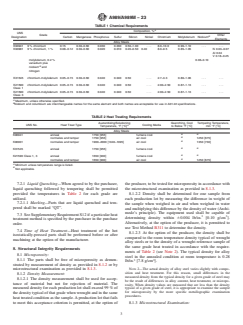
K90941 9 % chromium 0.15 0.30–0.60 0.030 0.030 0.50–1.00 . . . 8.0–10.0 0.90–1.10 . . . . . .
K90901 9 % chromium, 1 % 0.08–0.12 0.30–0.60 0.020 0.010 0.20–0.50 0.40 8.0–9.5 0.85–1.05 N 0.03–0.07
Al 0.04
V 0.18–0.25
molybdenum, 0.2 % 0.06–0.10
vanadium plus
B
niobium and
nitrogen
K31545 chromium-molybdenum 0.05–0.15 0.30–0.60 0.040 0.040 0.50 . . . 2.7–3.3 0.80–1.06 . . . . . .
K21590 chromium-molybdenum 0.05–0.15 0.30–0.60 0.040 0.040 0.50 . . . 2.00–2.50 0.87–1.13 . . . . . .
Class 1
K21590 chromium-molybdenum 0.05–0.15 0.30–0.60 0.040 0.040 0.50 . . . 2.00–2.50 0.87–1.13 . . . . . .
Class 3
A
Maximum, unless otherwise specified.
B
Niobium and columbium are interchangeable names for the same element and both names are acceptable for use in A01.22 specifications.
TABLE 2 Heat Treating Requirements
Austenitizing/Solutioning Quenching, Cool Tempering Temperature,
UNS No. Heat Treat Type Cooling Media
A
Temperature, °F [°C] to Below °F [°C] min °F [°C]
Alloy Steels
B B
K90941 anneal 1750 [955] furnace cool
B
normalize and temper 1750 [955] air cool 1250 [675]
B
K90901 normalize and temper 1900–2000 [1040–1095] air cool 1350 [730]
B B
K31545 anneal 1750 [955] furnace cool
B B
K21590 Class 1, 3 anneal 1650 [900] furnace cool
B
normalize and temper 1650 [900] air cool 1250 [675]
A
Minimum unless temperature range is listed.
B
Not applicable.
7.2.1 Liquid Quenching—When agreed to by the purchaser, the producer, to be tested for microporosity in accordance with
liquid quenching followed by tempering shall be permitted the microstructural examination as provided in 8.1.3.
provided the temperatures in Table 2 for each grade are
8.1.2.2 Density shall be determined for one sample from
utilized.
each production lot by measuring the difference in weight of
7.2.1.1 Marking—Parts that are liquid quenched and tem-
the sample when weighed in air and when weighed in water
pered shall be marked “QT”.
and multiplying this difference by the density of water (Archi-
mede’s principle). The equipment used shall be capable of
7.3 See Supplementary Requirement S12 if a particular heat
3 3
determining density within 60.004 lb/in. [0.10 g/cm ].
treatment method is specified by the purchaser in the purchase
Alternatively, at the option of the producer, it is permitted to
order.
use Test Method B311 to determine the density.
7.4 Time of Heat Treatment—Heat treatment of the hot
8.1.2.3 At the option of the producer, the density shall be
isostatically-pressed parts shall be performed before or after
compared to the room temperature density typical of wrought
machining at the option of the manufacturer.
alloy steels or to the density of a wrought reference sample of
the same grade heat treated in accordance with the require-
8. Structural Integrity Requirements
ments of Table 2 (see Note 2). The typical density for alloy
8.1 Microporosity:
steel in the annealed condition at room temperature is 0.28
8.1.1 The parts shall be free of microporosity as demon- 3 3
lb/in. [7.8 g/cm ].
strated by measurement of density as provided in 8.1.2 or by
NOTE 2—The actual density of alloy steel varies slightly with compo-
microstructural examination as provided in 8.1.3.
sition and heat treatment. For this reason, small differences in the
8.1.2 Density Measurement:
measured density from the typical density for a given grade of steel may
8.1.2.1 The density measurement shall be used for accep-
be the result of differences in alloy content, heat treatment, or micropo-
tance of material but not for rejection of material. The
rosity. When density values are measured that are less than the density
measured density for each production lot shall exceed 99 % of typical of a given grade of steel, it is appropriate to examine the sample
for microporosity by the more specific metallographic examination
the density typical of that grade when wrought and in the same
procedures.
heat treated condition as the sample. A production lot that fails
to meet this acceptance criterion is permitted, at the option of 8.1.3 Microstructural Examination:
A989/A989M − 23
8.1.3.1 The microstructure shall be examined at 20-50×, 9.3 For normalized and tempered parts, or quenched and
100-200×, and 1000-2000× and shall be reasonably uniform tempered parts, the central axis of the test specimen shall
and shall be free of voids, laps, cracks, and porosity. correspond to the ⁄4 T plane or deeper position where T is the
8.1.3.2 One sample from each production lot shall be maximum heat treated thickness of the represented part. In
examined. The sample shall be taken from the component, addition, for quenched and tempered parts, the midlength of the
stem, protrusion, or test part made from a single powder blend test specimen shall be at least T from any second heat treated
consolidated in the same hot isostatic press using the same surface. When the section thickness does not permit this
pressure, temperature, and time parameters and heat-treated in positioning, the test specimen shall be positioned as near as
the same final heat treatment charge, after hot isostatic- possible to the prescribed location, as agreed to by the
pressing or after final heat treatment. The microstructure shall purchaser and the supplier.
meet the requirements of 8.1.3.1.
9.3.1 Alternatively, with prior approval of the purchaser, it
8.1.3.3 If the sample fails to meet the requirements for
is permitted to take the test specimen for the steel parts at a
acceptance, it is permitted to retest each part in the lot. Each
depth (t) corresponding to the distance from the area of
part that passes the requirements of 8.1.3.1 shall be accepted.
significant stress to the nearest heat treated surface and at least
twice this distance (2t) from any second surface. The test
8.2 Hydrostatic Tests—After they have been machined,
depth, however, shall not be nearer to one treated surface than
pressure-containing parts shall be tested to the hydrostatic shell
3 1
⁄4 in. [19 mm] and to the second treated surface than 1 ⁄2 in.
test pressures prescribed in ASME B16.5 for the applicable
[38 mm]. This method of test specimen location would
steel rating for which the part is designed, and shall show no
normally apply to complex parts, or parts with thick cross-
leaks. Parts ordered under these specifications for working
sectional areas where ⁄4 T and T testing (see 9.3) is not
pressures other than those listed in the ASME B16.5 ratings
practical. Sketches showing the exact test locations shall be
shall be tested to such pressures as may be agreed upon
approved by the purchaser when this method is used.
between the manufacturer and purchaser.
8.2.1 No hydrostatic test is required for welding neck or
9.4 For annealed alloy steels the test specimen may be taken
other flanges.
from any convenient location.
8.2.2 The compact manufacturer is not required to perform
9.5 Tension Test:
pressure tests on rough parts that are to be finish machined by
9.5.1 One tension test shall be made for each production lot
others. The fabricator of the finished part is not required to
in each heat treatment charge.
pressure test parts that are designed to be pressure-containing
9.5.1.1 When the heat treating cycles are the same and the
only after assembly by welding into a larger structure. The
furnaces (either batch or continuous type) are controlled within
manufacturer of the compacts, however, shall be responsible as
625 °F [614 °C] and equipped with recording pyrometers so
required in 15.1 for the satisfactory performance of the parts
that complete records of heat treatment are available, then only
under the final test required in 8.2.
one tension test from each production lot of each type of part,
and section size is required instead of one test from each
9. Mechanical Properties
production lot in each heat-treatment charge. The term “type,”
9.1 The material shall conform to the requirements for
as used here, designates a characteristic shape of a part, such as
mechanical properties prescribed in Table 3 at room tempera-
flange, elbow, tee, and so forth.
ture.
9.5.1.2 The tension test specimen shall be made from
9.2 Mechanical test sample
...
This document is not an ASTM standard and is intended only to provide the user of an ASTM standard an indication of what changes have been made to the previous version. Because
it may not be technically possible to adequately depict all changes accurately, ASTM recommends that users consult prior editions as appropriate. In all cases only the current version
of the standard as published by ASTM is to be considered the official document.
Designation: A989/A989M − 18 A989/A989M − 23
Standard Specification for
Hot Isostatically-Pressed Alloy Steel Flanges, Fittings,
Valves, and Parts for High Temperature Service
This standard is issued under the fixed designation A989/A989M; the number immediately following the designation indicates the year
of original adoption or, in the case of revision, the year of last revision. A number in parentheses indicates the year of last reapproval.
A superscript epsilon (´) indicates an editorial change since the last revision or reapproval.
1. Scope*
1.1 This specification covers hot isostatically-pressed, powder metallurgy, alloy steel piping components for use in pressure
systems. Included are flanges, fittings, valves, and similar parts made to specified dimensions or to dimensional standards, such
as in ASME Specification B16.5.
1.2 Several grades of alloy steels are included in this specification.
1.3 Supplementary requirements are provided for use when additional testing or inspection is desired. These shall apply only when
specified individually by the purchaser in the order.
1.4 This specification is expressed in both inch-pound units and in SI units. Unless the order specifies the applicable “M”
specification designation (SI units), however, the material shall be furnished to inch-pound units.
1.5 The values stated in either inch-pound units or SI units are to be regarded separately as the standard. Within the text, the SI
units are shown in brackets. The values stated in each system are not exact equivalents; therefore, each system must be used
independently of the other. Combining values from the two systems may result in nonconformance with the specification.
1.6 The following safety hazards caveat pertains only to test methods portions, 8.1, 8.2, and 9.5 – 9.7 of this specification: This
standard does not purport to address all of the safety concerns, if any, associated with its use. It is the responsibility of the user
of this standard to establish appropriate safety, health, and environmental practices and to determine the applicability of
regulatory limitations prior to use.
1.7 This international standard was developed in accordance with internationally recognized principles on standardization
established in the Decision on Principles for the Development of International Standards, Guides and Recommendations issued
by the World Trade Organization Technical Barriers to Trade (TBT) Committee.
2. Referenced Documents
2.1 ASTM Standards:
A275/A275M Practice for Magnetic Particle Examination of Steel Forgings
A751 Test Methods and Practices for Chemical Analysis of Steel Products
A941 Terminology Relating to Steel, Stainless Steel, Related Alloys, and Ferroalloys
This specification is under the jurisdiction of ASTM Committee A01 on Steel, Stainless Steel and Related Alloys and is the direct responsibility of Subcommittee A01.22
on Steel Forgings and Wrought Fittings for Piping Applications and Bolting Materials for Piping and Special Purpose Applications.
Current edition approved March 1, 2018May 1, 2023. Published March 2018June 2023. Originally approved in 1998. Last previous edition approved in 20152018 as
A989/A989M – 15.A989/A989M – 18. DOI: 10.1520/A0989_A0989M-18. 10.1520/A0989_A0989M-23.
For referenced ASTM standards, visit the ASTM website, www.astm.org, or contact ASTM Customer Service at service@astm.org. For Annual Book of ASTM Standards
volume information, refer to the standard’s Document Summary page on the ASTM website.
*A Summary of Changes section appears at the end of this standard
Copyright © ASTM International, 100 Barr Harbor Drive, PO Box C700, West Conshohocken, PA 19428-2959. United States
A989/A989M − 23
A961/A961M Specification for Common Requirements for Steel Flanges, Forged Fittings, Valves, and Parts for Piping
Applications
B311 Test Method for Density of Powder Metallurgy (PM) Materials Containing Less Than Two Percent Porosity
E165/E165M Practice for Liquid Penetrant Testing for General Industry
E340 Practice for Macroetching Metals and Alloys
E606/E606M Test Method for Strain-Controlled Fatigue Testing
2.2 MSS Standard:
SP 25 Standard Marking System for Valves, Fittings, Flanges, and Unions
2.3 ASME Specifications and Boiler and Pressure Vessel Codes:
B16.5 Dimensional Standards for Steel Pipe Flanges and Flanged Fittings
2.4 ASME Section IX Welding Qualifications:
SFA-5.5 Specification for Low-Alloy Steel Covered Arc-Welding Electrodes
3. Terminology
3.1 Definitions—For definitions of terms used in this standard, refer to Terminology A941.
3.2 Definitions of Terms Specific to This Standard:
3.2.1 can, n—the container used to encapsulate the powder during the pressure consolidation process that is removed partially or
fully from the final part.
3.2.2 compact, n—the consolidated powder from one can that may be used to make one or more parts.
3.2.3 consolidation, n—the bonding of adjacent powder particles in a compact under pressure by heating to a temperature below
the melting point of the powder.
3.2.4 fill stem, n—the part of the compact used to fill the can that is not usually integral to the part produced.
3.2.5 hot isostatic-pressing, n—a process for simultaneously heating and forming a compact in which the powder is contained in
a sealed formable enclosure, usually made from metal, and the so-contained powder is subjected to equal pressure from all
directions at a temperature high enough to permit plastic deformation and consolidation of the powder particles to take place.
3.2.6 lot, n—a number of parts produced from a single powder blend following the same manufacturing conditions.
3.2.7 part, n—a single item coming from a compact, either prior to or after machining.
3.2.8 powder blend, n—a homogeneous mixture of powder from one or more heats of the same grade.
3.2.9 rough part, n—the part prior to final machining.
4. Ordering Information
4.1 It is the responsibility of the purchaser to specify in the purchase order all requirements that are necessary for material ordered
under this specification. Such requirements may include, but are not limited to, the following:
4.1.1 Quantity (weight or number of parts).
4.1.2 Name of material or UNS number.
4.1.3 ASTM designation and year of issue.
Available from Manufacturers Standardization Society of the Valve and Fittings Industry (MSS), 127 Park St., NE, Vienna, VA 22180-4602, http://www.mss-hq.com.
Available from American Society of Mechanical Engineers (ASME), ASME International Headquarters, Two Park Ave., New York, NY 10016-5990, http://
www.asme.org.
A989/A989M − 23
4.1.4 Dimensions (tolerances and surface finishes).
4.1.5 Microstructure examination, if required (5.1.5).
4.1.6 Inspection (14.1).
4.1.7 Whether rough part or finished machined part (8.2.2).
4.1.8 Supplementary requirements, if any.
4.1.9 Additional requirements (see 7.2.1 and 16.1).
4.1.10 Requirement, if any, that the manufacturer shall submit drawings for approval showing the shape of the rough part before
machining and the exact location of test specimen material (see 9.3.1).
5. Materials and Manufacture
5.1 Manufacturing Practice:
5.1.1 Powder should be protected during storage to prevent the detrimental pick-up of oxygen and other contaminants.
5.1.2 Compacts shall be manufactured by placing a single powder blend into a can, evacuating the can, and sealing it. The can
material shall be selected to ensure that it has no deleterious effect on the final product. The entire assembly shall be heated and
placed under sufficient pressure for a sufficient period of time to ensure that the final consolidated part meets the density
requirements of 8.1.2.1. One or more parts shall be machined from a single compact.
5.1.3 The powder shall be prealloyed and made by a melting method capable of producing the specified chemical composition,
such as but not limited to air or vacuum induction melting, followed by gas atomization.
5.1.4 When powder from more than one heat is used to make a blend, the heats shall be mixed thoroughly to ensure homogeneity.
5.1.5 The compact shall be sectioned and the microstructure examined to check for porosity and other internal imperfections and
shall meet the requirements of 8.1.3. The sample shall be taken from the fill stem or from a location in a part as agreed upon by
the manufacturer and purchaser.
5.1.6 Unless otherwise specified in the purchase order, the manufacturer shall remove the can material from the surfaces of the
consolidated compacts by chemical or mechanical methods, such as by pickling or machining. This removal shall be done before
or after heat treatment at the option of the manufacturer (see Note 1).
NOTE 1—Often, it is advantageous to leave the can material in place until after heat treatment or further thermal processing of the consolidated compact.
6. Chemical Composition
6.1 The steel both as a blend and as a part shall conform to the requirements for chemical composition prescribed in Table 1. Test
Methods, Practices, and Terminology A751 shall apply.
6.1.1 A representative sample of each blend of powder shall be analyzed by the manufacturer to determine the percentage of
elements prescribed in Table 1. The blend shall conform to the chemical composition requirements prescribed in Table 1.
6.1.2 When required by the purchaser, the chemical composition of a sample from one part from each lot of parts shall be
determined by the manufacturer. The composition of the sample shall conform to the chemical composition requirements
prescribed in Table 1.
6.2 Addition of lead, selenium, or other unspecified elements for the purpose of improving the machinability of the compact shall
not be permitted.
A989/A989M − 23
TABLE 1 Chemical Requirements
A
Composition, %
B
UNS
Niobium
Grade Phosphorus, Sulfur, Tantalum,
Designation Carbon Manganese Silicon Nickel Chromium Molybdenum plus Titanium
max max max
Tantalum
Other
B
Carbon Manganese Phosphorus Sulfur Silicon Nickel Chromium Molybdenum Niobium
Elements
Alloy Steels
K90941 9 % chromium 0.15 max 0.30–0.60 0.030 0.030 0.50–1.00 . . . 8.0–10.0 0.90–1.10 . . . . . . . . .
K90941 9 % chromium 0.15 0.30–0.60 0.030 0.030 0.50–1.00 . . . 8.0–10.0 0.90–1.10 . . . . . .
K90901 9 % chromium, 1 % 0.08–0.12 0.30–0.60 0.020 0.010 0.20–0.50 0.40 max 8.0–9.5 0.85–1.05 Other
Elements
K90901 9 % chromium, 1 % 0.08–0.12 0.30–0.60 0.020 0.010 0.20–0.50 0.40 8.0–9.5 0.85–1.05 N 0.03–0.07
Al 0.04
V 0.18–0.25
B
molybdenum, 0.2 % Nb 0.06–0.10
molybdenum, 0.2 % 0.06–0.10
vanadium plus N
0.03–0.07
vanadium plus
B
niobium and Al 0.04
max
B
niobium and
nitrogen V
0.18–0.25
nitrogen
K31545 chromium-molybdenum 0.05–0.15 0.30–0.60 0.040 0.040 0.50 max . . . 2.7–3.3 0.80–1.06 . . . . . . . . .
K31545 chromium-molybdenum 0.05–0.15 0.30–0.60 0.040 0.040 0.50 . . . 2.7–3.3 0.80–1.06 . . . . . .
K21590 chromium-molybdenum 0.05–0.15 0.30–0.60 0.040 0.040 0.50 max . . . 2.00–2.50 0.87–1.13 . . . . . . . . .
K21590 chromium-molybdenum 0.05–0.15 0.30–0.60 0.040 0.040 0.50 . . . 2.00–2.50 0.87–1.13 . . . . . .
Class 1
K21590 chromium-molybdenum 0.05–0.15 0.30–0.60 0.040 0.040 0.50 max . . . 2.00–2.50 0.87–1.13 . . . . . . . . .
K21590 chromium-molybdenum 0.05–0.15 0.30–0.60 0.040 0.040 0.50 . . . 2.00–2.50 0.87–1.13 . . . . . .
Class 3
A
Maximum, unless otherwise specified.
B
Niobium and columbium are interchangeable names for the same element and both names are acceptable for use in A01.22 specifications.
6.3 The steel shall not contain an unspecified element, for the ordered grade, to the extent that the steel conforms to the
requirements of another grade for which that element is a specified element having a required minimum content.
7. Heat Treatment
7.1 After hot isostatic-pressing, the compacts shall be annealed prior to heat treating in accordance with the requirements of Table
2. At the option of the producer, this anneal shall be a separate operation following powder consolidation or shall be a part of the
consolidation process.
7.2 The alloy steels shall be heat treated in accordance with the requirements of 7.1 and Table 2.
TABLE 2 Heat Treating Requirements
Austenitizing/Solutioning Quenching, Cool Tempering Temperature,
UNS No. Heat Treat Type Cooling Media
A
Temperature, °F [°C] to Below °F [°C] min °F [°C]
Alloy Steels
B B
K90941 anneal 1750 [955] furnace cool
B
normalize and temper 1750 [955] air cool 1250 [675]
B
K90901 normalize and temper 1900–2000 [1040–1095] air cool 1350 [730]
B B
K31545 anneal 1750 [955] furnace cool
B B
K21590 Class 1, 3 anneal 1650 [900] furnace cool
B
normalize and temper 1650 [900] air cool 1250 [675]
A
Minimum unless temperature range is listed.
B
Not applicable.
A989/A989M − 23
7.2.1 Liquid Quenching—When agreed to by the purchaser, liquid quenching followed by tempering shall be permitted provided
the temperatures in Table 2 for each grade are utilized.
7.2.1.1 Marking—Parts that are liquid quenched and tempered shall be marked “QT”.
7.3 See Supplementary Requirement S12 if a particular heat treatment method is specified by the purchaser in the purchase order.
7.4 Time of Heat Treatment—Heat treatment of the hot isostatically-pressed parts shall be performed before or after machining at
the option of the manufacturer.
8. Structural Integrity Requirements
8.1 Microporosity:
8.1.1 The parts shall be free of microporosity as demonstrated by measurement of density as provided in 8.1.2 or by
microstructural examination as provided in 8.1.3.
8.1.2 Density Measurement:
8.1.2.1 The density measurement shall be used for acceptance of material but not for rejection of material. The measured density
for each production lot shall exceed 99 % of the density typical of that grade when wrought and in the same heat treated condition
as the sample. A production lot that fails to meet this acceptance criterion is permitted, at the option of the producer, to be tested
for microporosity in accordance with the microstructural examination as provided in 8.1.3.
8.1.2.2 Density shall be determined for one sample from each production lot by measuring the difference in weight of the sample
when weighed in air and when weighed in water and multiplying this difference by the density of water (Archimede’s principle).
3 3
The equipment used shall be capable of determining density within 60.004 lb/in. [0.10 g/cm ]. Alternatively, at the option of the
producer, it is permitted to use Test Method B311 to determine the density.
8.1.2.3 At the option of the producer, the density shall be compared to the room temperature density typical of wrought alloy steels
or to the density of a wrought reference sample of the same grade heat treated in accordance with the requirements of Table 2 (see
3 3
Note 2). The typical density for alloy steel in the annealed condition at room temperature is 0.28 lb/in. [7.8 g/cm ].
NOTE 2—The actual density of alloy steel varies slightly with composition and heat treatment. For this reason, small differences in the measured density
from the typical density for a given grade of steel may be the result of differences in alloy content, heat treatment, or microporosity. When density values
are measured that are less than the density typical of a given grade of steel, it is appropriate to examine the sample for microporosity by the more specific
metallographic examination procedures.
8.1.3 Microstructural Examination:
8.1.3.1 The microstructure shall be examined at 20-50×, 100-200×, and 1000-2000× and shall be reasonably uniform and shall
be free of voids, laps, cracks, and porosity.
8.1.3.2 One sample from each production lot shall be examined. The sample shall be taken from the component, stem, protrusion,
or test part made from a single powder blend consolidated in the same hot isostatic press using the same pressure, temperature,
and time parameters and heat-treated in the same final heat treatment charge, after hot isostatic-pressing or after final heat
treatment. The microstructure shall meet the requirements of 8.1.3.1.
8.1.3.3 If the sample fails to meet the requirements for acceptance, it is permitted to retest each part in the lot. Each part that passes
the requirements of 8.1.3.1 shall be accepted.
8.2 Hydrostatic Tests—After they have been machined, pressure-containing parts shall be tested to the hydrostatic shell test
pressures prescribed in ASME B16.5 for the applicable steel rating for which the part is designed, and shall show no leaks. Parts
ordered under these specifications for working pressures other than those listed in the ASME B16.5 ratings shall be tested to such
pressures as may be agreed upon between the manufacturer and purchaser.
A989/A989M − 23
8.2.1 No hydrostatic test is required for welding neck or other flanges.
8.2.2 The compact manufacturer is not required to perform pressure tests on rough parts that are to be finish machined by others.
The fabricator of the finished part is not required to pressure test parts that are designed to be pressure-containing only after
assembly by welding into a larger structure. The manufacturer of the compacts, however, shall be responsible as required in 15.1
for the satisfactory performance of the parts under the final test required in 8.2.
9. Mechanical Properties
9.1 The material shall conform to the requirements for mechanical properties prescribed in Table 3 at room temperature.
9.2 Mechanical test samples shall be obtained from the component stem, protrusion, or test part made from a single powder blend
consolidated in the same hot-isostatic press using the same pressure, temperature, and time parameter and heat-treated in the same
final heat-treatment charge. If repair welding is required (see Section 15), the test specimens prior to testing shall accompany the
repaired parts if a post weld heat treatment is done.
9.3 For normalized and tempered parts, or quenched and tempered parts, the central axis of the test specimen shall correspond to
the ⁄4 T plane or deeper position where T is the maximum heat treated thickness of the represented part. In addition, for quenched
and tempered parts, the midlength of the test specimen shall be at least T from any second heat treated surface. When the section
thickness does not permit this positioning, the test specimen shall be positioned as near as possible to the prescribed location, as
agreed to by the purchaser and the supplier.
9.3.1 Alternatively, with prior approval of the purchaser, it is permitted to take the test specimen for the steel parts at a depth (t)
corresponding to the distance from the area of significant stress to the nearest heat treated surface and at least twice this distance
(2t) from any second surface. The test depth, however, shall not be nearer to one treated surface than ⁄4 in. [19 mm] and to the
second treated surface than 1 ⁄2 in. [38 mm]. This method of test specimen location would normally apply to complex parts, or parts
with thick cross-sectional areas where ⁄4 T and T testing (see 9.3) is not practical. Sketches showing the exact test locations shall
be approved by the purchaser when this method is used.
9.4 For annealed alloy steels the test specimen may be taken from any convenient location.
9.5 T
...