

ASTM A646/A646M-17(2022)
(Specification)Standard Specification for Premium Quality Alloy Steel Blooms and Billets for Aircraft and Aerospace Forgings
General Information
- Abstract
ABSTRACT
This specification deals with the standard requirements for premium quality alloy steel semifinished rolled or forged blooms and billets for reforging into aircraft and aerospace critical parts such as landing-gear forgings. Covered here are three basic classifications of steel, namely: Class I, steel manufactured by vacuum-induction melting or consumable-electrode vacuum melting process; Class II, air-melted steel manufactured by electric-furnace vacuum degassing process; Class III, air-melted steel manufactured by electric-furnace ladle refining and vacuum degassing processes. Steel materials shall be heat-treated and hot-worked by either hot rolling or forging. Alloy steels shall be examined by heat and product analyses and hardenability tests, and shall conform to chemical composition and maximum annealed Brinell hardness requirements. Quality evaluation tests, such as macrotech, microcleanliness, and nondestructive ultrasonic (both immersion and contact examination) inspection, shall be performed as well.
SCOPE
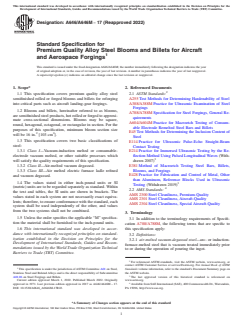
1.1 This specification covers premium quality alloy steel semifinished rolled or forged blooms and billets for reforging into critical parts such as aircraft landing-gear forgings.
1.2 Blooms and billets, hereinafter referred to as blooms, are semifinished steel products, hot rolled or forged to approximate cross-sectional dimensions. Blooms may be square, round, hexagonal, octagonal, or rectangular in section. For the purposes of this specification, minimum bloom section size will be 16 in.2 [103 cm2].
1.3 This specification covers two basic classifications of steel:
1.3.1 Class I—Vacuum-induction melted or consumable-electrode vacuum melted, or other suitable processes which will satisfy the quality requirements of this specification.
1.3.2 Class II—Air-melted vacuum degassed.
1.3.3 Class III—Air melted electric furnace ladle refined and vacuum degassed.
1.4 The values stated in either inch-pound units or SI (metric) units are to be regarded separately as standard. Within the text and tables, the SI units are shown in brackets. The values stated in each system are not necessarily exact equivalents; therefore, to ensure conformance with the standard, each system shall be used independently of the other, and values from the two systems shall not be combined.
1.5 Unless the order specifies the applicable “M” specification the material shall be furnished to the inch-pound units.
1.6 This international standard was developed in accordance with internationally recognized principles on standardization established in the Decision on Principles for the Development of International Standards, Guides and Recommendations issued by the World Trade Organization Technical Barriers to Trade (TBT) Committee.
- Status
- Published
- Publication Date
- 28-Feb-2022
- Technical Committee
- A01 - Steel, Stainless Steel and Related Alloys
- Drafting Committee
- A01.06 - Steel Forgings and Billets
Overview
ASTM A646/A646M-17(2022), "Standard Specification for Premium Quality Alloy Steel Blooms and Billets for Aircraft and Aerospace Forgings," establishes the minimum requirements for premium quality alloy steel semifinished rolled or forged blooms and billets intended for reforging into critical aerospace components. This specification is especially relevant for applications where material integrity is vital, such as aircraft landing gear and other structural parts exposed to high stress.
This standard distinguishes among three classes of steel-Class I (vacuum-melted or vacuum–remelted), Class II (air-melted, vacuum degassed), and Class III (air-melted with ladle refining and vacuum degassing)-ensuring comprehensive coverage for a range of melting and refining practices suited to critical aerospace applications.
Key Topics
Bloom and Billet Requirements
- Covers semifinished, hot-rolled or forged alloy steel products with minimum cross-sectional area requirements.
- Sections may be square, round, hexagonal, octagonal, or rectangular, supporting diverse forging needs.
Steel Classifications
- Class I: Vacuum-induction melted or consumable-electrode vacuum melted steels.
- Class II: Air-melted, electric furnace vacuum degassed steels.
- Class III: Air-melted, electric furnace ladle refined and vacuum degassed steels.
Heat Treatment and Hot Working
- Blooms and billets may be supplied as hot rolled, forged, annealed, or normalized and tempered.
- Requirements for reduction of area and cooling to prevent cracking.
Testing and Quality Evaluation
- Mandatory heat and product analyses ensuring compliance with chemical composition and hardness.
- Comprehensive quality evaluation: macroetch inspection, microcleanliness assessment, and ultrasonic testing (immersion or contact).
- Hardenability tests and standards of acceptance defined by agreement.
Dimensional and Surface Quality
- Permissible variations in weight and conditioning procedures for removing surface discontinuities.
- Requirements for finish and ultrasonic inspectability.
Applications
ASTM A646/A646M is designed for manufacturers and suppliers of premium alloy steel blooms and billets destined for use in the aerospace industry where reliability and structural integrity are paramount. Typical uses include:
- Aircraft landing gear forgings
- Critical aerospace structural components
- Rotating engine parts and high-load bearing structures
- Safety-critical components in space vehicles
By meeting the requirements of this standard, suppliers can ensure their materials satisfy the stringent demands of aerospace OEMs and regulatory authorities. The specification also supports quality assurance programs in aerospace manufacturing by detailing comprehensive testing and inspection methods, helping minimize the risk of material failure.
Related Standards
- ASTM A788/A788M - General requirements for steel forgings, including ordering, marking, retesting, and certification procedures referenced in A646/A646M.
- ASTM A255 - Test methods for determining the hardenability of steel.
- ASTM A388/A388M - Practice for ultrasonic examination of steel forgings.
- ASTM A604/A604M - Macroetch testing for consumable-electrode remelted steel bars and billets.
- ASTM E45 - Test methods for determining the inclusion content of steel (microcleanliness).
- AMS 2300, AMS 2301, AMS 2304 - Aerospace Material Specifications for steel cleanliness.
- Other related practices (e.g., ASTM E114, E381, E428) supporting ultrasonic testing and macro/microstructural evaluation.
Keywords: aerospace alloy steel billets, premium steel blooms, vacuum melted alloy steel, aircraft forgings, ultrasonic inspection, microcleanliness, macroetch testing, hardenability, ASTM A646 compliance.
Relations
- Effective Date
- 01-Nov-2023
- Effective Date
- 01-Nov-2023
- Effective Date
- 01-May-2019
- Effective Date
- 01-Nov-2018
- Effective Date
- 01-Sep-2018
- Effective Date
- 01-Sep-2018
- Effective Date
- 01-Mar-2018
- Effective Date
- 01-Nov-2017
- Effective Date
- 01-May-2017
- Effective Date
- 01-Dec-2016
- Effective Date
- 01-May-2015
- Effective Date
- 01-Oct-2014
- Effective Date
- 01-Oct-2014
- Effective Date
- 15-May-2014
- Effective Date
- 01-Nov-2013
Get Certified
Connect with accredited certification bodies for this standard

BUREAU VERITAS Certification Germany
Bureau Veritas certification in Germany.

Element Materials Technology
Materials testing and product certification.

AQMS Ltd.
AQMS provides ISO certification to SMEs across the UK.
Sponsored listings
Frequently Asked Questions
ASTM A646/A646M-17(2022) is a technical specification published by ASTM International. Its full title is "Standard Specification for Premium Quality Alloy Steel Blooms and Billets for Aircraft and Aerospace Forgings". This standard covers: ABSTRACT This specification deals with the standard requirements for premium quality alloy steel semifinished rolled or forged blooms and billets for reforging into aircraft and aerospace critical parts such as landing-gear forgings. Covered here are three basic classifications of steel, namely: Class I, steel manufactured by vacuum-induction melting or consumable-electrode vacuum melting process; Class II, air-melted steel manufactured by electric-furnace vacuum degassing process; Class III, air-melted steel manufactured by electric-furnace ladle refining and vacuum degassing processes. Steel materials shall be heat-treated and hot-worked by either hot rolling or forging. Alloy steels shall be examined by heat and product analyses and hardenability tests, and shall conform to chemical composition and maximum annealed Brinell hardness requirements. Quality evaluation tests, such as macrotech, microcleanliness, and nondestructive ultrasonic (both immersion and contact examination) inspection, shall be performed as well. SCOPE 1.1 This specification covers premium quality alloy steel semifinished rolled or forged blooms and billets for reforging into critical parts such as aircraft landing-gear forgings. 1.2 Blooms and billets, hereinafter referred to as blooms, are semifinished steel products, hot rolled or forged to approximate cross-sectional dimensions. Blooms may be square, round, hexagonal, octagonal, or rectangular in section. For the purposes of this specification, minimum bloom section size will be 16 in.2 [103 cm2]. 1.3 This specification covers two basic classifications of steel: 1.3.1 Class I—Vacuum-induction melted or consumable-electrode vacuum melted, or other suitable processes which will satisfy the quality requirements of this specification. 1.3.2 Class II—Air-melted vacuum degassed. 1.3.3 Class III—Air melted electric furnace ladle refined and vacuum degassed. 1.4 The values stated in either inch-pound units or SI (metric) units are to be regarded separately as standard. Within the text and tables, the SI units are shown in brackets. The values stated in each system are not necessarily exact equivalents; therefore, to ensure conformance with the standard, each system shall be used independently of the other, and values from the two systems shall not be combined. 1.5 Unless the order specifies the applicable “M” specification the material shall be furnished to the inch-pound units. 1.6 This international standard was developed in accordance with internationally recognized principles on standardization established in the Decision on Principles for the Development of International Standards, Guides and Recommendations issued by the World Trade Organization Technical Barriers to Trade (TBT) Committee.
ABSTRACT This specification deals with the standard requirements for premium quality alloy steel semifinished rolled or forged blooms and billets for reforging into aircraft and aerospace critical parts such as landing-gear forgings. Covered here are three basic classifications of steel, namely: Class I, steel manufactured by vacuum-induction melting or consumable-electrode vacuum melting process; Class II, air-melted steel manufactured by electric-furnace vacuum degassing process; Class III, air-melted steel manufactured by electric-furnace ladle refining and vacuum degassing processes. Steel materials shall be heat-treated and hot-worked by either hot rolling or forging. Alloy steels shall be examined by heat and product analyses and hardenability tests, and shall conform to chemical composition and maximum annealed Brinell hardness requirements. Quality evaluation tests, such as macrotech, microcleanliness, and nondestructive ultrasonic (both immersion and contact examination) inspection, shall be performed as well. SCOPE 1.1 This specification covers premium quality alloy steel semifinished rolled or forged blooms and billets for reforging into critical parts such as aircraft landing-gear forgings. 1.2 Blooms and billets, hereinafter referred to as blooms, are semifinished steel products, hot rolled or forged to approximate cross-sectional dimensions. Blooms may be square, round, hexagonal, octagonal, or rectangular in section. For the purposes of this specification, minimum bloom section size will be 16 in.2 [103 cm2]. 1.3 This specification covers two basic classifications of steel: 1.3.1 Class I—Vacuum-induction melted or consumable-electrode vacuum melted, or other suitable processes which will satisfy the quality requirements of this specification. 1.3.2 Class II—Air-melted vacuum degassed. 1.3.3 Class III—Air melted electric furnace ladle refined and vacuum degassed. 1.4 The values stated in either inch-pound units or SI (metric) units are to be regarded separately as standard. Within the text and tables, the SI units are shown in brackets. The values stated in each system are not necessarily exact equivalents; therefore, to ensure conformance with the standard, each system shall be used independently of the other, and values from the two systems shall not be combined. 1.5 Unless the order specifies the applicable “M” specification the material shall be furnished to the inch-pound units. 1.6 This international standard was developed in accordance with internationally recognized principles on standardization established in the Decision on Principles for the Development of International Standards, Guides and Recommendations issued by the World Trade Organization Technical Barriers to Trade (TBT) Committee.
ASTM A646/A646M-17(2022) is classified under the following ICS (International Classification for Standards) categories: 49.025.10 - Steels. The ICS classification helps identify the subject area and facilitates finding related standards.
ASTM A646/A646M-17(2022) has the following relationships with other standards: It is inter standard links to ASTM A388/A388M-23, ASTM E45-18a(2023), ASTM A788/A788M-19, ASTM A788/A788M-18b, ASTM A255-10(2018), ASTM A788/A788M-18a, ASTM A788/A788M-18, ASTM A788/A788M-17a, ASTM A788/A788M-17, ASTM A788/A788M-16a, ASTM A788/A788M-15, ASTM A255-10(2014), ASTM A788/A788M-14a, ASTM A788/A788M-14, ASTM A788/A788M-13. Understanding these relationships helps ensure you are using the most current and applicable version of the standard.
ASTM A646/A646M-17(2022) is available in PDF format for immediate download after purchase. The document can be added to your cart and obtained through the secure checkout process. Digital delivery ensures instant access to the complete standard document.
Standards Content (Sample)
This international standard was developed in accordance with internationally recognized principles on standardization established in the Decision on Principles for the
Development of International Standards, Guides and Recommendations issued by the World Trade Organization Technical Barriers to Trade (TBT) Committee.
Designation:A646/A646M −17 (Reapproved 2022)
Standard Specification for
Premium Quality Alloy Steel Blooms and Billets for Aircraft
and Aerospace Forgings
This standard is issued under the fixed designationA646/A646M; the number immediately following the designation indicates the year
of original adoption or, in the case of revision, the year of last revision. A number in parentheses indicates the year of last reapproval.
A superscript epsilon (´) indicates an editorial change since the last revision or reapproval.
1. Scope* 2. Referenced Documents
2.1 ASTM Standards:
1.1 This specification covers premium quality alloy steel
A255 Test Methods for Determining Hardenability of Steel
semifinished rolled or forged blooms and billets for reforging
A388/A388M Practice for Ultrasonic Examination of Steel
into critical parts such as aircraft landing-gear forgings.
Forgings
1.2 Blooms and billets, hereinafter referred to as blooms,
A788/A788M Specification for Steel Forgings, General Re-
are semifinished steel products, hot rolled or forged to approxi-
quirements
mate cross-sectional dimensions. Blooms may be square,
A604/A604M Practice for Macroetch Testing of Consum-
round, hexagonal, octagonal, or rectangular in section. For the
able Electrode Remelted Steel Bars and Billets
purposes of this specification, minimum bloom section size
E45 Test Methods for Determining the Inclusion Content of
2 2
will be 16 in. [103 cm ].
Steel
1.3 This specification covers two basic classifications of
E114 Practice for Ultrasonic Pulse-Echo Straight-Beam
steel:
Contact Testing
1.3.1 Class I—Vacuum-induction melted or consumable- E214 Practice for Immersed Ultrasonic Testing by the Re-
electrode vacuum melted, or other suitable processes which
flection Method Using Pulsed Longitudinal Waves (With-
will satisfy the quality requirements of this specification. drawn 2007)
1.3.2 Class II—Air-melted vacuum degassed. E381 Method of Macroetch Testing Steel Bars, Billets,
Blooms, and Forgings
1.3.3 Class III—Air melted electric furnace ladle refined
E428 Practice for Fabrication and Control of Metal, Other
and vacuum degassed.
than Aluminum, Reference Blocks Used in Ultrasonic
1.4 The values stated in either inch-pound units or SI
Testing (Withdrawn 2019)
(metric) units are to be regarded separately as standard. Within
2.2 AMS Standards:
the text and tables, the SI units are shown in brackets. The
AMS 2300 Steel Cleanliness, Premium-Quality
values stated in each system are not necessarily exact equiva-
AMS 2301 Steel Cleanliness, Aircraft-Quality
lents; therefore, to ensure conformance with the standard, each
AMS 2304 Steel Cleanliness, Special Aircraft-Quality
system shall be used independently of the other, and values
from the two systems shall not be combined.
3. Terminology
1.5 Unless the order specifies the applicable “M” specifica-
3.1 In addition to the terminology requirements of Specifi-
tion the material shall be furnished to the inch-pound units.
cation A788/A788M, the following terms that are specific to
this specification apply:
1.6 This international standard was developed in accor-
dance with internationally recognized principles on standard-
3.2 Definitions:
ization established in the Decision on Principles for the
3.2.1 air-melted vacuum-degassed steel—arc- or induction-
Development of International Standards, Guides and Recom-
furnace-melted steel that is vacuum treated immediately prior
mendations issued by the World Trade Organization Technical
to or during the operation of pouring the ingot.
Barriers to Trade (TBT) Committee.
For referenced ASTM standards, visit the ASTM website, www.astm.org, or
contact ASTM Customer Service at service@astm.org. For Annual Book of ASTM
This specification is under the jurisdiction of ASTM Committee A01 on Steel, Standards volume information, refer to the standard’s Document Summary page on
Stainless Steel and Related Alloys and is the direct responsibility of Subcommittee the ASTM website.
A01.06 on Steel Forgings and Billets. The last approved version of this historical standard is referenced on
Current edition approved March 1, 2022. Published March 2022. Originally www.astm.org.
approved in 1971. Last previous edition approved in 2017 as A646/A646M – 17. Available from SAE International (SAE), 400 Commonwealth Dr.,Warrendale,
DOI: 10.1520/A0646_A0646M-17R22. PA 15096, http://www.sae.org.
*A Summary of Changes section appears at the end of this standard
Copyright © ASTM International, 100 Barr Harbor Drive, PO Box C700, West Conshohocken, PA 19428-2959. United States
A646/A646M−17 (2022)
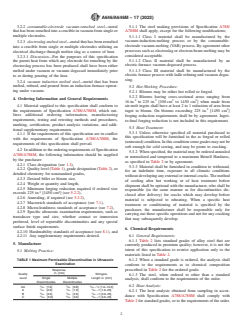
3.2.2 consumable-electrode vacuum-remelted steel—metal 5.1.1 The steel making provisions of Specification A788/
that has been remelted into a crucible in vacuum from single or A788M shall apply, except for the following modifications;
multiple electrodes.
5.1.1.1 Class I material shall be manufactured by the
vacuum-induction-melting process or by the consumable-
3.2.3 electroslag-melted steel—metal that has been remelted
electrode vacuum-melting (VAR) process. By agreement other
into a crucible from single or multiple electrodes utilizing an
processes such as electroslag or electron-beam melting may be
electrical discharge through molten slag as a source of heat.
considered acceptable.
3.2.3.1 Discussion—For the purposes of this specification
5.1.1.2 Class II material shall be manufactured by an
the parent heat from which any electrode for remelting by the
electric-furnace vacuum-degassed process.
electroslag process has been produced shall have been either
5.1.1.3 Class III material shall be manufactured by the
melted under vacuum or vacuum degassed immediately prior
electric furnace process with ladle refining and vacuum degas-
to or during pouring of the heat.
sing.
3.2.4 vacuum induction melted steel—metal that has been
melted, refined, and poured from an induction furnace operat-
5.2 Hot-Working Procedure:
ing under vacuum.
5.2.1 Blooms may be either hot rolled or forged.
5.2.2 Blooms having cross-sectional areas ranging from
4. Ordering Information and General Requirements
2 2 2 2
16 in. to 225 in. [100 cm to 1450 cm ] when made from
4.1 Material supplied to this specification shall conform to
air-melt ingots shall have at least 2 to 1 reduction of area from
2 2
the requirements of Specification A788/A788M, which out-
ingot to bloom. On blooms exceeding 225 in. [1450 cm ]
lines additional ordering information, manufacturing
forging reduction requirements shall be by agreement. Ingot-
requirements, testing and retesting methods and procedures,
to-final forging reduction is not included in this requirement.
marking, certification, product analysis variations, and addi-
5.3 Heat Treatment:
tional supplementary requirements.
5.3.1 Unless otherwise specified all material purchased to
4.1.1 If the requirements of this specification are in conflict
this specification will be furnished in the as forged or rolled
with the requirements of Specification A788/A788M, the
(untreated)condition.Inthisconditionsomegradesmaynotbe
requirements of this specification shall prevail.
soft enough for cold sawing, and may be prone to cracking.
4.2 In addition to the ordering requirements of Specification
5.3.2 When specified, the material may be ordered annealed
A788/A788M, the following information should be supplied
or normalized and tempered to a maximum Brinell Hardness,
by the purchaser:
as specified in Table 2 or by agreement.
4.2.1 Class designation (see 1.3),
5.3.3 Material shall be furnished in condition to withstand,
4.2.2 Quality level (Table 1), grade designation (Table 2), or
for an indefinite time, exposure to all climatic conditions
detailed chemistry for nonstandard grades,
withoutdevelopinganyexternalorinternalcracks.Themethod
4.2.3 Desired billet or bloom size,
of cooling after hot working or of heat treatment before
4.2.4 Weight or quantity and length,
shipment shall be optional with the manufacturer, who shall be
4.2.5 Minimum forging reduction required if ordered size
responsible (in the same manner as for discontinuities dis-
2 2
exceeds 225 in. [1450 cm ] (see 5.2.2),
closed after delivery) for cracks which may develop before
4.2.6 Annealing, if required (see 5.3.2),
material is subjected to reheating. When a specific heat
4.2.7 Macroetch standards of acceptance (see 7.1),
treatment or conditioning of material is specified by the
4.2.8 Microcleanliness standards of acceptance (see 7.2),
purchaser, the manufacturer shall be responsible only for
4.2.9 Specific ultrasonic examination requirements, such as
carrying out those specific operations and not for any cracking
transducer type and size, whether contact or immersion
that may subsequently develop.
preferred, level of reportable discontinuities and any special
surface finish requirements.
6. Chemical Requirements
4.2.10 Hardenability standards of acceptance (see 8.1), and
6.1 General Requirements:
4.2.11 Any supplementary requirements desired.
6.1.1 Table 2 lists standard grades of alloy steel that are
5. Manufacture
currently produced in premium quality; however, it is not the
intent of this specification to restrict application only to the
5.1 Melting Practice:
materials listed in Table 2.
6.1.2 When a standard grade is ordered, the analysis shall
TABLE 1 Maximum Permissible Discontinuities in Ultrasonic
Examination
conform to the requirements as to chemical composition
prescribed in Table 2 for the ordered grade.
Response,
in. [mm]
Quality Stringers,
6.1.3 The steel, when ordered to other than a standard
Level Length in. [mm]
Single Multiple
analysis, shall conform to the requirements of the order.
Discontinuities Discontinuities
3 2 2 1
6.2 Heat Analysis:
AA ⁄64 [1.0] ⁄64 [0.8] ⁄64 – ⁄2 [1.0–12.0]
5 3 3
A ⁄64 [2.0] ⁄64 [1.0] ⁄64 –1 [1.0–25]
6.2.1 The heat analysis obtained from sampling in accor-
8 5 5
B ⁄64 [3.0] ⁄64 [2.0] ⁄64 –1 [2.0–25]
dance with Specification A788/A788M shall comply with
12 8 8
C ⁄64 [5.0] ⁄64 [3.0] ⁄64 –1 [3.0–25]
Table 2 for standard grades, or to the requirements of the order.
A646/A646M−17 (2022)
A
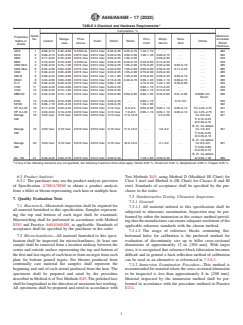
TABLE 2 Chemical and Hardness Requirements
Composition, %
Grade Maximum
Proprietary
No. Manga- Phos- Chro- Molyb- Vana- Annealed
Name or Carbon Sulfur Silicon Nickel Others
nese phorus mium denum dium Brinell
Grade
Hardness
3310 1 0.08–0.13 0.45–0.60 0.015max 0.012 max 0.20–0.35 3.25–3.75 1.40–1.75 . . . . . . . . . 262
9310 2 0.08–0.13 0.45–0.65 0.015 max 0.012 max 0.20–0.35 3.00–3.50 1.00–1.40 0.08–0.15 . . . . . . 262
4620 3 0.17–0.22 0.45–0.65 0.015 max 0.012 max 0.20–0.35 1.65–2.00 . . . 0.20–0.30 . . . . . . 229
8620 4 0.18–0.23 0.70–0.90 0.015max 0.012 max 0.20–0.35 0.40–0.70 0.40–0.60 0.15–0.25 . . . . . . 229
4330 Mod. 5 0.28–0.33 0.75–1.00 0.015 max 0.012 max 0.20–0.35 1.65–2.00 0.70–0.95 0.35–0.50 0.05–0.10 . . . 285
4335 Mod. 6 0.33–0.38 0.60–0.90 0.015 max 0.012 max 0.40–0.60 1.65–2.00 0.65–0.90 0.30–0.40 0.17–0.23 . . . 285
4340 7 0.38–0.43 0.65–0.85 0.015 max 0.012 max 0.20–0.35 1.65–2.00 0.70–0.90 0.20–0.30 . . . . . . 285
300 M 8 0.38–0.43 0.65–0.90 0.012 max 0.012 max 1.45–1.80 1.65–2.00 0.70–0.95 0.35–0.45 0.05–0.10 . . . 285
D6AC 9 0.45–0.50 0.60–0.90 0.010 max 0.010 max 0.15–0.30 0.40–0.70 0.90–1.20 0.90–1.10 0.08–0.15 . . . 285
H-11 10 0.38–0.43 0.20–0.40 0.015 max 0.015 max 0.80–1.00 . . . 4.75–5.25 1.20–1.40 0.40–0.60 . . . 235
4130 11 0.28–0.33 0.40–0.60 0.015 max 0.012 max 0.20–0.35 . . . 0.80–1.10 0.15–0.25 . . . . . . 229
4140 12 0.38–0.43 0.75–1.00 0.015 max 0.012 max 0.20–0.35 . . . 0.80–1.10 0.15–0.25 . . . . . . 235
98BV40 13 0.40–0.46 0.75–1.00 0.015 max 0.012 max 0.50–0.80 0.60–0.90 0.
...