

ASTM A872/A872M-21
(Specification)Standard Specification for Centrifugally Cast Ferritic/Austenitic Stainless Steel Pipe for Corrosive Environments
General Information
- Abstract
ABSTRACT
This specification covers centrifugally cast ferritic/austenitic steel pipe intended for general corrosive service. These steels are susceptible to embrittlement if used for prolonged periods at elevated temperatures. The pipe shall be made by centrifugal casting process and furnished in the specified heat-treatment condition. The pipe shall also be machined. The grades shall conform to the required chemical composition for carbon, manganese, phosphorus, sulfur, silicon, nickel, chromium, molybdenum, nitrogen, copper, and cobalt. Heat analysis and product analysis shall be done. Tensile requirements shall conform to the specified tensile strength, yield strength, and elongation; and hardness requirements shall conform to the specified Brinell and Rockwell C values. Tension test shall also be made.
SCOPE
1.1 This specification covers centrifugally cast ferritic/austenitic steel pipe intended for general corrosive service. These steels are susceptible to embrittlement if used for prolonged periods at elevated temperatures.
1.2 Optional supplementary requirements are provided when additional testing may be required.
1.3 The values stated in either inch-pound units or SI units are to be regarded separately as standard. Within the text, SI units are shown in brackets. The values stated in each system are not exact equivalents; therefore, each system must be used independently of each other. Combining values from the two systems may result in nonconformance with the specification.
1.4 This international standard was developed in accordance with internationally recognized principles on standardization established in the Decision on Principles for the Development of International Standards, Guides and Recommendations issued by the World Trade Organization Technical Barriers to Trade (TBT) Committee.
- Status
- Published
- Publication Date
- 30-Apr-2021
- Technical Committee
- A01 - Steel, Stainless Steel and Related Alloys
- Drafting Committee
- A01.18 - Castings
Buy Documents
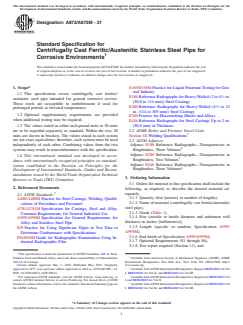
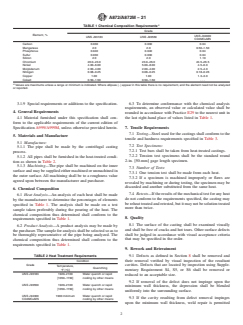
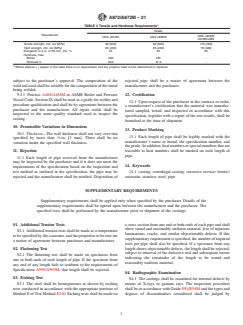

ASTM A872/A872M-21 - Standard Specification for Centrifugally Cast Ferritic/Austenitic Stainless Steel Pipe for Corrosive Environments
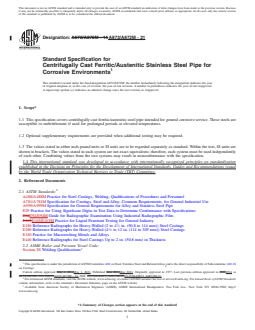
REDLINE ASTM A872/A872M-21 - Standard Specification for Centrifugally Cast Ferritic/Austenitic Stainless Steel Pipe for Corrosive Environments
Overview
ASTM A872/A872M-21 is an international standard specification issued by ASTM International for centrifugally cast ferritic/austenitic stainless steel pipe intended for general corrosive service. This standard defines the manufacturing, chemical, mechanical, and inspection requirements for stainless steel pipe produced by the centrifugal casting process. Products conforming to ASTM A872/A872M-21 are engineered to deliver reliable performance in corrosive environments, though the materials listed are susceptible to embrittlement if used for prolonged periods at elevated temperatures.
This specification covers several grades of stainless steel pipe, requiring strict adherence to shaping, heat treatment, surface condition, chemical composition, and mechanical property demands. It provides guidance for optional supplementary tests if additional verification is required, ensuring confidence in high-integrity industrial applications.
Key Topics
- Centrifugal Casting Process: The standard mandates production of the steel pipe using centrifugal casting, achieving a homogeneous structure and improving overall product quality.
- Heat Treatment and Machining: Pipes must be heat-treated according to defined schedules and machined to specified surface roughness, supporting the mechanical properties and dimensional accuracy required for corrosive service.
- Chemical Composition: Defines limits for elements such as carbon, manganese, phosphorus, sulfur, silicon, chromium, nickel, molybdenum, nitrogen, copper, and cobalt, promoting resistance to chemical attack and ensuring consistent material properties.
- Mechanical Requirements: Specifies minimum tensile strength, yield strength, elongation, and hardness (Brinell and Rockwell C) values for safety and performance.
- Quality Assurance: Includes rigorous inspection criteria for surface quality, dimensional tolerance, and non-destructive testing procedures such as radiographic and liquid penetrant examination (when specified).
- Traceability and Certification: Requires each piece to be marked for traceability, and provides for manufacturer certification and detailed reporting of test results upon purchaser request.
Applications
ASTM A872/A872M-21 stainless steel pipe is widely used in environments where resistance to corrosion is critical. Key application areas include:
- Chemical Processing Plants: For handling corrosive fluids and gases, where material integrity is essential to process safety.
- Petrochemical and Refinery Operations: Used in systems exposed to aggressive chemicals and temperature variations.
- Pulp and Paper Industry: For piping subject to acidic or caustic solutions.
- Water and Wastewater Treatment: Used for contact with potentially corrosive water and effluents, supporting long-term facility reliability.
- Power Generation: For balance-of-plant piping and systems requiring corrosion-resistant materials.
Optional supplementary requirements within this standard, such as additional tension, flattening, etching, radiographic, and hydrostatic tests, provide assurance for demanding project specifications and compliance with strict quality regimes.
Related Standards
Industry professionals often reference ASTM A872/A872M-21 alongside related standards for comprehensive stainless steel pipe system qualification:
- ASTM A999/A999M - General Requirements for Alloy and Stainless Steel Pipe
- ASTM A781/A781M - Common Requirements for Steel and Alloy Castings
- ASTM A488/A488M - Welding of Steel Castings
- ASME Boiler and Pressure Vessel Code, Section IX - Welding Qualifications
- ASTM E94/E94M, E165/E165M - Non-Destructive Testing Methods (Radiographic, Liquid Penetrant)
- ASTM E340 - Macroetching Metals and Alloys
Selecting products compliant with ASTM A872/A872M-21 ensures a high standard of quality, safety, and performance for corrosion-resistant piping in critical industrial sectors. This standard provides the necessary guidance to manufacturers, engineers, and procurement professionals seeking durable solutions for harsh service environments.
Relations
- Effective Date
- 01-Mar-2024
- Effective Date
- 15-Nov-2023
- Effective Date
- 01-Sep-2018
- Effective Date
- 01-Jul-2018
- Effective Date
- 01-Jul-2018
- Effective Date
- 01-Jun-2018
- Effective Date
- 15-May-2018
- Effective Date
- 01-Jan-2018
- Effective Date
- 01-Sep-2017
- Effective Date
- 01-May-2017
- Effective Date
- 01-May-2017
- Effective Date
- 01-Dec-2016
- Effective Date
- 01-Sep-2016
- Effective Date
- 01-Mar-2016
- Effective Date
- 01-Dec-2015
Buy Documents
ASTM A872/A872M-21 - Standard Specification for Centrifugally Cast Ferritic/Austenitic Stainless Steel Pipe for Corrosive Environments
REDLINE ASTM A872/A872M-21 - Standard Specification for Centrifugally Cast Ferritic/Austenitic Stainless Steel Pipe for Corrosive Environments
Get Certified
Connect with accredited certification bodies for this standard

Institut za varilstvo d.o.o. (Welding Institute)
Slovenia's leading welding institute since 1952. ISO 3834, EN 1090, pressure equipment certification, NDT personnel, welder qualification. Only IIW Au
Sponsored listings
Frequently Asked Questions
ASTM A872/A872M-21 is a technical specification published by ASTM International. Its full title is "Standard Specification for Centrifugally Cast Ferritic/Austenitic Stainless Steel Pipe for Corrosive Environments". This standard covers: ABSTRACT This specification covers centrifugally cast ferritic/austenitic steel pipe intended for general corrosive service. These steels are susceptible to embrittlement if used for prolonged periods at elevated temperatures. The pipe shall be made by centrifugal casting process and furnished in the specified heat-treatment condition. The pipe shall also be machined. The grades shall conform to the required chemical composition for carbon, manganese, phosphorus, sulfur, silicon, nickel, chromium, molybdenum, nitrogen, copper, and cobalt. Heat analysis and product analysis shall be done. Tensile requirements shall conform to the specified tensile strength, yield strength, and elongation; and hardness requirements shall conform to the specified Brinell and Rockwell C values. Tension test shall also be made. SCOPE 1.1 This specification covers centrifugally cast ferritic/austenitic steel pipe intended for general corrosive service. These steels are susceptible to embrittlement if used for prolonged periods at elevated temperatures. 1.2 Optional supplementary requirements are provided when additional testing may be required. 1.3 The values stated in either inch-pound units or SI units are to be regarded separately as standard. Within the text, SI units are shown in brackets. The values stated in each system are not exact equivalents; therefore, each system must be used independently of each other. Combining values from the two systems may result in nonconformance with the specification. 1.4 This international standard was developed in accordance with internationally recognized principles on standardization established in the Decision on Principles for the Development of International Standards, Guides and Recommendations issued by the World Trade Organization Technical Barriers to Trade (TBT) Committee.
ABSTRACT This specification covers centrifugally cast ferritic/austenitic steel pipe intended for general corrosive service. These steels are susceptible to embrittlement if used for prolonged periods at elevated temperatures. The pipe shall be made by centrifugal casting process and furnished in the specified heat-treatment condition. The pipe shall also be machined. The grades shall conform to the required chemical composition for carbon, manganese, phosphorus, sulfur, silicon, nickel, chromium, molybdenum, nitrogen, copper, and cobalt. Heat analysis and product analysis shall be done. Tensile requirements shall conform to the specified tensile strength, yield strength, and elongation; and hardness requirements shall conform to the specified Brinell and Rockwell C values. Tension test shall also be made. SCOPE 1.1 This specification covers centrifugally cast ferritic/austenitic steel pipe intended for general corrosive service. These steels are susceptible to embrittlement if used for prolonged periods at elevated temperatures. 1.2 Optional supplementary requirements are provided when additional testing may be required. 1.3 The values stated in either inch-pound units or SI units are to be regarded separately as standard. Within the text, SI units are shown in brackets. The values stated in each system are not exact equivalents; therefore, each system must be used independently of each other. Combining values from the two systems may result in nonconformance with the specification. 1.4 This international standard was developed in accordance with internationally recognized principles on standardization established in the Decision on Principles for the Development of International Standards, Guides and Recommendations issued by the World Trade Organization Technical Barriers to Trade (TBT) Committee.
ASTM A872/A872M-21 is classified under the following ICS (International Classification for Standards) categories: 23.040.10 - Iron and steel pipes. The ICS classification helps identify the subject area and facilitates finding related standards.
ASTM A872/A872M-21 has the following relationships with other standards: It is inter standard links to ASTM A488/A488M-24, ASTM E340-23, ASTM A781/A781M-18c, ASTM A488/A488M-18, ASTM A488/A488M-18e1, ASTM A781/A781M-18b, ASTM A781/A781M-18a, ASTM A781/A781M-18, ASTM A999/A999M-17, ASTM A781/A781M-17, ASTM A488/A488M-17, ASTM A781/A781M-16, ASTM A999/A999M-16, ASTM A488/A488M-16, ASTM A999/A999M-15. Understanding these relationships helps ensure you are using the most current and applicable version of the standard.
ASTM A872/A872M-21 is available in PDF format for immediate download after purchase. The document can be added to your cart and obtained through the secure checkout process. Digital delivery ensures instant access to the complete standard document.
Standards Content (Sample)
This international standard was developed in accordance with internationally recognized principles on standardization established in the Decision on Principles for the
Development of International Standards, Guides and Recommendations issued by the World Trade Organization Technical Barriers to Trade (TBT) Committee.
Designation:A872/A872M −21
Standard Specification for
Centrifugally Cast Ferritic/Austenitic Stainless Steel Pipe for
Corrosive Environments
This standard is issued under the fixed designationA872/A872M; the number immediately following the designation indicates the year
of original adoption or, in the case of revision, the year of last revision. A number in parentheses indicates the year of last reapproval.
A superscript epsilon (´) indicates an editorial change since the last revision or reapproval.
1. Scope* E165/E165M Practice for Liquid Penetrant Testing for Gen-
eral Industry
1.1 This specification covers centrifugally cast ferritic/
E186 Reference Radiographs for Heavy-Walled (2 to 4 ⁄2 in.
austenitic steel pipe intended for general corrosive service.
(50.8 to 114 mm)) Steel Castings
These steels are susceptible to embrittlement if used for
E280 Reference Radiographs for Heavy-Walled (4 ⁄2 to 12
prolonged periods at elevated temperatures.
in. (114 to 305 mm)) Steel Castings
1.2 Optional supplementary requirements are provided
E340 Practice for Macroetching Metals and Alloys
when additional testing may be required.
E446 Reference Radiographs for Steel Castings Up to 2 in.
1.3 The values stated in either inch-pound units or SI units (50.8 mm) in Thickness
are to be regarded separately as standard. Within the text, SI 2.2 ASME Boiler and Pressure Vessel Code:
units are shown in brackets. The values stated in each system Section IX Welding Qualifications
are not exact equivalents; therefore, each system must be used 2.3 ASTM Adjuncts:
independently of each other. Combining values from the two
Adjunct E186 Reference Radiographs—Transparencies in
systems may result in nonconformance with the specification. Ringbinders, Three Volumes
Adjunct E280 Reference Radiographs—Transparencies in
1.4 This international standard was developed in accor-
Ringbinders, Two Volumes
dance with internationally recognized principles on standard-
Adjunct E446 Reference Radiographs—Transparencies in
ization established in the Decision on Principles for the
Ringbinders, Three Volumes
Development of International Standards, Guides and Recom-
mendations issued by the World Trade Organization Technical
3. Ordering Information
Barriers to Trade (TBT) Committee.
3.1 Orders for material to this specification shall include the
2. Referenced Documents
following, as required, to describe the desired material ad-
equately.
2.1 ASTM Standards:
3.1.1 Quantity (feet [metres] or number of lengths),
A488/A488M Practice for Steel Castings, Welding, Qualifi-
3.1.2 Name of material (centrifugally cast ferritic/austenitic
cations of Procedures and Personnel
steel pipe),
A781/A781M Specification for Castings, Steel and Alloy,
3.1.3 Grade (Table 1),
Common Requirements, for General Industrial Use
3.1.4 Size (outside or inside diameter and minimum wall
A999/A999M Specification for General Requirements for
thickness in inches [millimetres]),
Alloy and Stainless Steel Pipe
3.1.5 Length (specific or random, Specification A999/
E29 Practice for Using Significant Digits in Test Data to
A999M),
Determine Conformance with Specifications
3.1.6 End finish of Specification A999/A999M,
E94/E94M Guide for Radiographic Examination Using In-
3.1.7 Optional Requirements (S1 through S6),
dustrial Radiographic Film
3.1.8 Test report required (Section 12), and
This specification is under the jurisdiction of ASTM Committee A01 on Steel,
Stainless Steel and Related Alloys and is the direct responsibility of Subcommittee Available from American Society of Mechanical Engineers (ASME), ASME
A01.18 on Castings. International Headquarters, Two Park Ave., New York, NY 10016-5990, http://
Current edition approved May 1, 2021. Published May 2021. Originally www.asme.org.
approved in 1977. Last previous edition approved in 2014 as A872/A872M – 14. AvailablefromASTMInternationalHeadquarters.RequestRRE018601forVol
DOI: 10.1520/A0872_A0872M-21. I, RRE018602 for Vol II, and RRE018603 for Vol III.
2 5
For referenced ASTM standards, visit the ASTM website, www.astm.org, or AvailablefromASTMInternationalHeadquarters.RequestforRRE028001 Vol
contact ASTM Customer Service at service@astm.org. For Annual Book of ASTM I and RRE028002 for Vol II.
Standards volume information, refer to the standard’s Document Summary page on AvailablefromASTMInternationalHeadquarters.RequestforRRE044601 Vol
the ASTM website. I, RRE044602 for Vol II, and RRE044603 for Vol III.
*A Summary of Changes section appears at the end of this standard
Copyright © ASTM International, 100 Barr Harbor Drive, PO Box C700, West Conshohocken, PA 19428-2959. United States
A872/A872M−21
A
TABLE 1 Chemical Composition Requirements
Grade
Element, %
UNS J94300
UNS J93183 UNS J93550
CD4MCuMN
Carbon 0.030 0.030 0.04
Manganese 2.0 2.0 0.50–1.50
Phosphorus 0.040 0.040 0.04
Sulfur 0.030 0.030 0.04
Silicon 2.0 2.0 1.10
Chromium 20.0–23.0 23.0–26.0 24.5–26.5
Nickel 4.00–6.00 5.00–8.00 4.5–6.0
Molybdenum 2.00–4.00 2.00–4.00 2.5–4.0
Nitrogen 0.08–0.25 0.08–0.25 0.18–0.26
Copper 1.00 1.00 1.3–3.0
Cobalt 0.50–1.50 0.50–1.50 . . .
A
Values are maximums unless a range or minimum is indicated. Where ellipses ({) appear in this table there is no requirement, and the element need not be analyzed
or reported.
3.1.9 Special requirements or additions to the specification. 6.3 To determine conformance with the chemical analysis
requirements, an observed value or calculated value shall be
4. General Requirements
rounded in accordance with Practice E29 to the nearest unit in
the last right-hand place of values listed in Table 1.
4.1 Material furnished under this specification shall con-
form to the applicable requirements of the current edition of
Specification A999/A999M, unless otherwise provided herein. 7. Tensile Requirements
7.1 Testing—Steel used for the castings shall conform to the
5. Materials and Manufacture
tensile and hardness requirements specified in Table 3.
5.1 Manufacture:
7.2 Test Specimens:
5.1.1 The pipe shall be made by the centrifugal casting
7.2.1 Test bars shall be taken from heat-treated castings.
process.
7.2.2 Tension test specimens shall be the standard round
5.1.2 All pipes shall be furnished in the heat-treated condi-
2-in. [50-mm] gage length specimen.
tion as shown in Table 2.
5.1.3 Machining—The pipe shall be machined on the inner
7.3 Number of Tests:
surface and may be supplied either machined or unmachined in
7.3.1 One tension test shall be made from each heat.
the outer surface. All machining shall be to a roughness value
7.3.2 If a specimen is machined improperly or flaws are
agreed upon between the manufacturer and purchaser.
revealed by machining or during testing, the specimen may be
discarded and another substituted from the same heat.
6. Chemical Composition
7.4 Retests—Iftheresultsofthemechanicaltestforanyheat
6.1 Heat Analysis—An analysis of each heat shall be made
do not conform to the requirements specified, the casting may
by the manufacturer to determine the percentages of elements
bereheattreatedandretested,butitmaynotbesolutiontreated
specified in Table 1. The analysis shall be made on a test
more than twice.
sample taken preferably during the pouring of the heat. The
chemical composition thus determined shall conform to the
8. Quality
requirements specified in Table 1.
8.1 The surface of the casting shall be examined visually
6.2 Product Analysis—A product analysis may be made by
and shall be free of cracks and hot tears. Other surface defects
thepurchaser.Thesampleforanalysisshallbeselectedsoasto
shall be judged in accordance with visual acceptance criteria
be thoroughly representative of the pipe being analyzed. The
that may be specified in the order.
chemical composition thus determined shall conform to the
requirements specified in Table 1.
9. Rework and Retreatment
TABLE 2 Heat Treatment Requirements 9.1 Defects as defined in Section 8 shall be removed and
their removal verified by visual inspection of
...
This document is not an ASTM standard and is intended only to provide the user of an ASTM standard an indication of what changes have been made to the previous version. Because
it may not be technically possible to adequately depict all changes accurately, ASTM recommends that users consult prior editions as appropriate. In all cases only the current version
of the standard as published by ASTM is to be considered the official document.
Designation: A872/A872M − 14 A872/A872M − 21
Standard Specification for
Centrifugally Cast Ferritic/Austenitic Stainless Steel Pipe for
Corrosive Environments
This standard is issued under the fixed designation A872/A872M; the number immediately following the designation indicates the year
of original adoption or, in the case of revision, the year of last revision. A number in parentheses indicates the year of last reapproval.
A superscript epsilon (´) indicates an editorial change since the last revision or reapproval.
1. Scope*
1.1 This specification covers centrifugally cast ferritic/austenitic steel pipe intended for general corrosive service. These steels are
susceptible to embrittlement if used for prolonged periods at elevated temperatures.
1.2 Optional supplementary requirements are provided when additional testing may be required.
1.3 The values stated in either inch-pound units or SI units are to be regarded separately as standard. Within the text, SI units are
shown in brackets. The values stated in each system are not exact equivalents; therefore, each system must be used independently
of each other. Combining values from the two systems may result in nonconformance with the specification.
1.4 This international standard was developed in accordance with internationally recognized principles on standardization
established in the Decision on Principles for the Development of International Standards, Guides and Recommendations issued
by the World Trade Organization Technical Barriers to Trade (TBT) Committee.
2. Referenced Documents
2.1 ASTM Standards:
A488/A488M Practice for Steel Castings, Welding, Qualifications of Procedures and Personnel
A781/A781M Specification for Castings, Steel and Alloy, Common Requirements, for General Industrial Use
A999/A999M Specification for General Requirements for Alloy and Stainless Steel Pipe
E29 Practice for Using Significant Digits in Test Data to Determine Conformance with Specifications
E94E94/E94M Guide for Radiographic Examination Using Industrial Radiographic Film
E165E165/E165M Practice for Liquid Penetrant Testing for General Industry
E186 Reference Radiographs for Heavy-Walled (2 to 4 ⁄2 in. (50.8 to 114 mm)) Steel Castings
E280 Reference Radiographs for Heavy-Walled (4 ⁄2 to 12 in. (114 to 305 mm)) Steel Castings
E340 Practice for Macroetching Metals and Alloys
E446 Reference Radiographs for Steel Castings Up to 2 in. (50.8 mm) in Thickness
2.2 ASME Boiler and Pressure Vessel Code:
Section IX Welding Qualifications
This specification is under the jurisdiction of ASTM Committee A01 on Steel, Stainless Steel and Related Alloys and is the direct responsibility of Subcommittee A01.18
on Castings.
Current edition approved May 1, 2014May 1, 2021. Published June 2014May 2021. Originally approved in 1977. Last previous edition approved in 20122014 as
A872/A872M – 07a (2012).A872/A872M – 14. DOI: 10.1520/A0872_A0872M-14.10.1520/A0872_A0872M-21.
For referenced ASTM standards, visit the ASTM website, www.astm.org, or contact ASTM Customer Service at service@astm.org. For Annual Book of ASTM Standards
volume information, refer to the standard’s Document Summary page on the ASTM website.
Available from American Society of Mechanical Engineers (ASME), ASME International Headquarters, Two Park Ave., New York, NY 10016-5990, http://
www.asme.org.
*A Summary of Changes section appears at the end of this standard
Copyright © ASTM International, 100 Barr Harbor Drive, PO Box C700, West Conshohocken, PA 19428-2959. United States
A872/A872M − 21
2.3 ASTM Adjuncts:
Adjunct E186 Reference Radiographs—Transparencies in Ringbinders, 3Three Volumes
Adjunct E280 Reference Radiographs—Transparencies in Ringbinders, 2Two Volumes
Adjunct E446 Reference Radiographs—Transparencies in Ringbinders, 3Three Volumes
3. Ordering Information
3.1 Orders for material to this specification shall include the following, as required, to describe the desired material adequately.
3.1.1 Quantity (feet [metres] or number of lengths),
3.1.2 Name of material (centrifugally cast ferritic/austenitic steel pipe),
3.1.3 Grade (Table 1),
3.1.4 Size (outside or inside diameter and minimum wall thickness in inches [millimetres]),
3.1.5 Length (specific or random, Specification A999/A999M),
3.1.6 End finish of Specification A999/A999M,
3.1.7 Optional Requirements (S1 through S6),
3.1.8 Test report required (Section 12), and
3.1.9 Special requirements or additions to the specification.
A
TABLE 1 Chemical Requirements
Grade
Element
UNS J94300
UNS J93183 UNS J93550
CD4MCuMN
C 0.030 0.030 0.04
Mn 2.0 2.0 0.50–1.50
P 0.040 0.040 0.04
S 0.030 0.030 0.04
Si 2.0 2.0 1.10
Ni 4.00–6.00 5.00–8.00 4.5–6.0
Cr 20.0–23.0 23.0–26.0 24.5–26.5
Mo 2.00–4.00 2.00–4.00 2.5–4.0
N 0.08–0.25 0.08–0.25 0.18–0.26
Cu 1.00 1.00 1.3–3.0
Co 0.50–1.50 0.50–1.50 .
A
TABLE 1 Chemical Composition Requirements
Grade
Element, %
UNS J94300
UNS J93183 UNS J93550
CD4MCuMN
Carbon 0.030 0.030 0.04
Manganese 2.0 2.0 0.50–1.50
Phosphorus 0.040 0.040 0.04
Sulfur 0.030 0.030 0.04
Silicon 2.0 2.0 1.10
Chromium 20.0–23.0 23.0–26.0 24.5–26.5
Nickel 4.00–6.00 5.00–8.00 4.5–6.0
Molybdenum 2.00–4.00 2.00–4.00 2.5–4.0
Nitrogen 0.08–0.25 0.08–0.25 0.18–0.26
Copper 1.00 1.00 1.3–3.0
Cobalt 0.50–1.50 0.50–1.50 . . .
A
Values are maximums unless a range or minimum is indicated. Where ellipses ({) appear in this table there is no requirement, and the element need not be analyzed
or reported.
Available from ASTM International Headquarters. Request RRE018601 for Vol I, RRE018602 for Vol II, and RRE018603 for Vol III.
Available from ASTM International Headquarters. Request for RRE028001 Vol I and RRE028002 for Vol II.
Available from ASTM International Headquarters. Request for RRE044601 Vol I, RRE044602 for Vol II, and RRE044603 for Vol III.
A872/A872M − 21
4. General Requirements
4.1 Material furnished under this specification shall conform to the applicable requirements of the current edition of Specification
A999/A999M, unless otherwise provided herein.
5. Materials and Manufacture
5.1 Manufacture:
5.1.1 The pipe shall be made by the centrifugal casting process.
5.1.2 All pipes shall be furnished in the heat-treated condition as shown in Table 2.
5.1.3 Machining—The pipe shall be machined on the inner surface and may be supplied either machined or unmachined in the
outer surface. All machining shall be to a roughness value agreed upon between the manufacturer and purchaser.
6. Chemical Composition
6.1 Heat Analysis—An analysis of each heat shall be made by the manufacturer to determine the percentages of elements specified
in Table 1. The analysis shall be made on a test sample taken preferably during the pouring of the heat. The chemical composition
thus determined shall conform to the requirements specified in Table 1.
6.2 Product Analysis—A product analysis may be made by the purchaser. The sample for analysis shall be selected so as to be
thoroughly representative of the pipe being analyzed. The chemical composition thus determined shall conform to the requirements
specified in Table 1.
6.3 To determine conformance with the chemical analysis requirements, an observed value or calculated value shall be rounded
in accordance with Practice E29 to the nearest unit in the last right-hand place of values listed in Table 1.
7. Tensile Requirements
7.1 Testing—Steel used for the castings shall conform to the tensile and hardness requirements specified in Table 3.
7.2 Test Specimens:
7.2.1 Test bars shall be taken from heat-treated castings.
7.2.2 Tension test specimens shall be the standard round 2-in[50-mm] 2-in. [50-mm] gage length specimen.
7.3 Number of Tests:
7.3.1 One tension test shall be made from each heat.
TABLE 2 Heat Treatment Requirements
Condition
Grade
Temperature,
Quenching
°F [°C]
UNS J93183 1920–2100 Water quench or rapid
[1050–1150] cooling by other means
UNS J93183 1920–2100 Water quench or rapid
[1050–1150] cooling by other means
UNS J93550 1920–2100 Water quench or rapid
[1050–1150] cooling by other means
UNS J94300 1900 minimum Water quench or rapid
CD4MCuMN cooling by other means
A872/A872M − 21
A
TABLE 3 Tensile and Hardness Requirements
Grade
Requirement
UNS J94300
UNS J93183 UNS J93550
CD4MCuMN
Tensile strength, min, ksi [MPa] 90 [620] 90 [620] 110 [760]
Yield strength, min, ksi [MPa] 65 [450] 65 [450] 70 [480]
Elongation in 2 in. or 50 mm, min, % 25 20 20
Hardness, max:
Brinell 290 297 .
Brinell 290 297 . . .
Rockwell C 30.5 31.5 .
Rockwell C 30.5 31.5 . . .
A
Where ellipses ({) appear in this table ther
...