

ASTM A966/A966M-15(2020)
(Practice)Standard Practice for Magnetic Particle Examination of Steel Forgings Using Alternating Current
General Information
- Abstract
SIGNIFICANCE AND USE
5.1 For ferromagnetic materials, magnetic particle examination is widely specified for the detection of surface and near-surface flaws such as cracks, laps, seams, and linearly oriented nonmetallic inclusions. Such examinations are included as mandatory requirements in some forging standards such as Specifications A508/A508M and A963/A963M.
5.2 Use of alternating current as the power source for magnetic particle examination imposes a significant restriction on the detection of subsurface indications, so that the procedure is essentially limited to the finding of flaws that are open to the surface. Attention therefore is drawn to the need to have the component in the finish-machined condition before conducting the magnetic particle examination.
5.3 The presence of residual magnetic fields in a component may be undesirable, and an advantage of the use of an ac power source for magnetic particle examination is that an acceptable level of demagnetization can be readily achieved.
SCOPE
1.1 This practice covers a procedure for the magnetic particle examination of steel forgings using alternating current as the power source. The procedure will produce consistent results upon which acceptance standards can be based. This practice does not contain acceptance limits or recommended quality levels.
1.2 Only alternating 50–60 cycle current shall be used as the electric power source for any of the magnetizing methods.
1.3 When subsurface indications are sought in forgings, then dc magnetization in accordance with Practice A275/A275M should be used.
1.4 The values stated in either inch-pound units or SI units are to be regarded separately as standard. Within the text, the SI units are shown in brackets. The values stated in each system are not necessarily exact equivalents; therefore, to ensure conformance with the standard, each system shall be used independently of the other, and values from the two systems shall not be combined. Unless the order specifies the applicable “M” specification designation [SI units], the inch-pound units shall be used.
1.5 This standard does not purport to address all of the safety concerns, if any, associated with its use. It is the responsibility of the user of this standard to establish appropriate safety, health, and environmental practices and determine the applicability of regulatory limitations prior to use.
1.6 This international standard was developed in accordance with internationally recognized principles on standardization established in the Decision on Principles for the Development of International Standards, Guides and Recommendations issued by the World Trade Organization Technical Barriers to Trade (TBT) Committee.
- Status
- Published
- Publication Date
- 29-Feb-2020
- Technical Committee
- A01 - Steel, Stainless Steel and Related Alloys
- Drafting Committee
- A01.06 - Steel Forgings and Billets
Overview
ASTM A966/A966M-15(2020) is the international standard practice for the magnetic particle examination of steel forgings using alternating current (AC). Developed by ASTM International, this standard outlines methods for detecting surface and near-surface flaws-such as cracks, laps, seams, and linearly oriented nonmetallic inclusions-in steel forgings. The practice specifically covers the use of 50–60 cycle alternating current as the power source for magnetization, making it essential for applications where only surface discontinuities are required to be detected.
Magnetic particle testing (MT) using AC is a widely recognized and reliable non-destructive testing (NDT) method for quality assurance in steel manufacturing. The standard ensures consistent testing outcomes, enabling acceptance standards to be applied with confidence.
Key Topics
Scope of Application
- Applies to the magnetic particle examination of ferromagnetic steel forgings.
- Only alternating current (50–60 Hz) is used for magnetization.
- Focused on identifying surface-disrupting flaws; subsurface detection is limited.
Process Overview
- Examination requires clean, finish-machined surfaces for optimal detection sensitivity.
- Appropriate agreement is required between manufacturer and supplier regarding locations, types, and orientation of inspections, as well as magnetic field strengths and particles used.
- Both dry and wet particle application methods (including fluorescent particles) are supported.
Operational Best Practices
- Two separate examinations must be conducted on each area, with field directions approximately perpendicular to each other.
- Demagnetization of components after examination is recommended to eliminate unwanted residual magnetic fields.
- Safety, health, and environmental practices are the responsibility of the user according to regulatory requirements.
Limitations
- AC magnetization is essentially limited to surface flaw detection.
- For detection of subsurface indications, DC magnetization as per ASTM A275/A275M is recommended.
- Selection of SI or inch-pound units must be consistent throughout application.
Applications
ASTM A966/A966M-15(2020) is crucial in industrial sectors where the integrity of steel forgings is critical and immediate detection of surface flaws is paramount. Main areas of application include:
Steel Forging Quality Control
- Mandatory in forging specifications such as ASTM A508/A508M (Pressure Vessel Forgings) and referenced in ASTM A963/A963M.
- Used prior to final acceptance of forged components in nuclear, power generation, petrochemical, and heavy machinery industries.
Non-Destructive Testing (NDT) Protocols
- Ideal for on-site or production line testing with portable electromagnetic yokes or fixed installations.
- Appropriate for routine inspection, maintenance, or repair assessments where only surface flaw indications are required.
Compliance and Certification
- Assists manufacturers and suppliers in meeting contractual and regulatory inspection requirements.
- Personnel performing magnetic particle examination must be qualified and certified per national standards such as SNT-TC-1A.
Related Standards
When implementing ASTM A966/A966M-15(2020), it is important to consider reference and companion standards for complete compliance and best practices in magnetic particle inspection:
- ASTM A275/A275M - Practice for Magnetic Particle Examination of Steel Forgings (DC magnetization for subsurface flaw detection)
- ASTM A508/A508M - Specification for Quenched and Tempered Vacuum-Treated Carbon and Alloy Steel Forgings for Pressure Vessels
- ASTM A788/A788M - Specification for Steel Forgings, General Requirements
- Recommended Practice SNT-TC-1A, Supplement B - Personnel qualification and certification for NDT methods
By adhering to ASTM A966/A966M-15(2020) and integrating it with relevant standards, organizations ensure high-quality, reliable steel forgings through effective magnetic particle examination using AC, meeting both customer and regulatory expectations in critical manufacturing environments.
Keywords: ASTM A966/A966M, magnetic particle inspection, steel forgings, alternating current, non-destructive testing, surface flaw detection, NDT standards, quality control
Relations
- Effective Date
- 01-Mar-2020
- Effective Date
- 01-Nov-2023
- Effective Date
- 01-Nov-2023
- Effective Date
- 01-Sep-2023
- Effective Date
- 01-May-2019
- Effective Date
- 01-Nov-2018
- Effective Date
- 01-Sep-2018
- Effective Date
- 01-Mar-2018
- Effective Date
- 01-Nov-2017
- Effective Date
- 01-May-2017
- Effective Date
- 01-May-2017
- Effective Date
- 01-Dec-2016
- Effective Date
- 01-May-2016
- Effective Date
- 01-May-2015
- Effective Date
- 01-Oct-2014
Get Certified
Connect with accredited certification bodies for this standard

Element Materials Technology
Materials testing and product certification.

Inštitut za kovinske materiale in tehnologije
Institute of Metals and Technology. Materials testing, metallurgical analysis, NDT.
Sponsored listings
Frequently Asked Questions
ASTM A966/A966M-15(2020) is a standard published by ASTM International. Its full title is "Standard Practice for Magnetic Particle Examination of Steel Forgings Using Alternating Current". This standard covers: SIGNIFICANCE AND USE 5.1 For ferromagnetic materials, magnetic particle examination is widely specified for the detection of surface and near-surface flaws such as cracks, laps, seams, and linearly oriented nonmetallic inclusions. Such examinations are included as mandatory requirements in some forging standards such as Specifications A508/A508M and A963/A963M. 5.2 Use of alternating current as the power source for magnetic particle examination imposes a significant restriction on the detection of subsurface indications, so that the procedure is essentially limited to the finding of flaws that are open to the surface. Attention therefore is drawn to the need to have the component in the finish-machined condition before conducting the magnetic particle examination. 5.3 The presence of residual magnetic fields in a component may be undesirable, and an advantage of the use of an ac power source for magnetic particle examination is that an acceptable level of demagnetization can be readily achieved. SCOPE 1.1 This practice covers a procedure for the magnetic particle examination of steel forgings using alternating current as the power source. The procedure will produce consistent results upon which acceptance standards can be based. This practice does not contain acceptance limits or recommended quality levels. 1.2 Only alternating 50–60 cycle current shall be used as the electric power source for any of the magnetizing methods. 1.3 When subsurface indications are sought in forgings, then dc magnetization in accordance with Practice A275/A275M should be used. 1.4 The values stated in either inch-pound units or SI units are to be regarded separately as standard. Within the text, the SI units are shown in brackets. The values stated in each system are not necessarily exact equivalents; therefore, to ensure conformance with the standard, each system shall be used independently of the other, and values from the two systems shall not be combined. Unless the order specifies the applicable “M” specification designation [SI units], the inch-pound units shall be used. 1.5 This standard does not purport to address all of the safety concerns, if any, associated with its use. It is the responsibility of the user of this standard to establish appropriate safety, health, and environmental practices and determine the applicability of regulatory limitations prior to use. 1.6 This international standard was developed in accordance with internationally recognized principles on standardization established in the Decision on Principles for the Development of International Standards, Guides and Recommendations issued by the World Trade Organization Technical Barriers to Trade (TBT) Committee.
SIGNIFICANCE AND USE 5.1 For ferromagnetic materials, magnetic particle examination is widely specified for the detection of surface and near-surface flaws such as cracks, laps, seams, and linearly oriented nonmetallic inclusions. Such examinations are included as mandatory requirements in some forging standards such as Specifications A508/A508M and A963/A963M. 5.2 Use of alternating current as the power source for magnetic particle examination imposes a significant restriction on the detection of subsurface indications, so that the procedure is essentially limited to the finding of flaws that are open to the surface. Attention therefore is drawn to the need to have the component in the finish-machined condition before conducting the magnetic particle examination. 5.3 The presence of residual magnetic fields in a component may be undesirable, and an advantage of the use of an ac power source for magnetic particle examination is that an acceptable level of demagnetization can be readily achieved. SCOPE 1.1 This practice covers a procedure for the magnetic particle examination of steel forgings using alternating current as the power source. The procedure will produce consistent results upon which acceptance standards can be based. This practice does not contain acceptance limits or recommended quality levels. 1.2 Only alternating 50–60 cycle current shall be used as the electric power source for any of the magnetizing methods. 1.3 When subsurface indications are sought in forgings, then dc magnetization in accordance with Practice A275/A275M should be used. 1.4 The values stated in either inch-pound units or SI units are to be regarded separately as standard. Within the text, the SI units are shown in brackets. The values stated in each system are not necessarily exact equivalents; therefore, to ensure conformance with the standard, each system shall be used independently of the other, and values from the two systems shall not be combined. Unless the order specifies the applicable “M” specification designation [SI units], the inch-pound units shall be used. 1.5 This standard does not purport to address all of the safety concerns, if any, associated with its use. It is the responsibility of the user of this standard to establish appropriate safety, health, and environmental practices and determine the applicability of regulatory limitations prior to use. 1.6 This international standard was developed in accordance with internationally recognized principles on standardization established in the Decision on Principles for the Development of International Standards, Guides and Recommendations issued by the World Trade Organization Technical Barriers to Trade (TBT) Committee.
ASTM A966/A966M-15(2020) is classified under the following ICS (International Classification for Standards) categories: 77.040.20 - Non-destructive testing of metals. The ICS classification helps identify the subject area and facilitates finding related standards.
ASTM A966/A966M-15(2020) has the following relationships with other standards: It is inter standard links to ASTM A966/A966M-15, ASTM A275/A275M-23, ASTM A508/A508M-23a, ASTM A508/A508M-23, ASTM A788/A788M-19, ASTM A788/A788M-18b, ASTM A788/A788M-18a, ASTM A788/A788M-18, ASTM A788/A788M-17a, ASTM A788/A788M-17, ASTM A508/A508M-17, ASTM A788/A788M-16a, ASTM A508/A508M-16, ASTM A788/A788M-15, ASTM A788/A788M-14a. Understanding these relationships helps ensure you are using the most current and applicable version of the standard.
ASTM A966/A966M-15(2020) is available in PDF format for immediate download after purchase. The document can be added to your cart and obtained through the secure checkout process. Digital delivery ensures instant access to the complete standard document.
Standards Content (Sample)
This international standard was developed in accordance with internationally recognized principles on standardization established in the Decision on Principles for the
Development of International Standards, Guides and Recommendations issued by the World Trade Organization Technical Barriers to Trade (TBT) Committee.
Designation: A966/A966M − 15 (Reapproved 2020)
Standard Practice for
Magnetic Particle Examination of Steel Forgings Using
Alternating Current
This standard is issued under the fixed designationA966/A966M; the number immediately following the designation indicates the year
of original adoption or, in the case of revision, the year of last revision. A number in parentheses indicates the year of last reapproval.
A superscript epsilon (´) indicates an editorial change since the last revision or reapproval.
1. Scope* 2. Referenced Documents
2.1 ASTM Standards:
1.1 This practice covers a procedure for the magnetic
A275/A275M Practice for Magnetic Particle Examination of
particle examination of steel forgings using alternating current
Steel Forgings
as the power source. The procedure will produce consistent
A508/A508M Specification for Quenched and Tempered
results upon which acceptance standards can be based. This
Vacuum-Treated Carbon and Alloy Steel Forgings for
practice does not contain acceptance limits or recommended
Pressure Vessels
quality levels.
A788/A788M Specification for Steel Forgings, General Re-
1.2 Onlyalternating50–60cyclecurrentshallbeusedasthe
quirements
electric power source for any of the magnetizing methods. A963/A963M Specification for Deep Drawing Steel (DDS),
Sheet, Carbon, Cold-Rolled (Withdrawn 2000)
1.3 When subsurface indications are sought in forgings,
2.2 Other Document:
then dc magnetization in accordance with Practice A275/
Practice No. SNT-TC-1A, Supplement B—Magnetic Par-
A275M should be used.
ticle Method
1.4 The values stated in either inch-pound units or SI units
3. Terminology
are to be regarded separately as standard. Within the text, the
SI units are shown in brackets. The values stated in each
3.1 Definitions:
system are not necessarily exact equivalents; therefore, to
3.1.1 (ac) magnetic particle method of examination, n—a
ensure conformance with the standard, each system shall be
method for detecting discontinuities on the surface in suitably
used independently of the other, and values from the two
magnetized materials, which employs finely divided magnetic
systems shall not be combined. Unless the order specifies the
particles that tend to congregate in regions of leakage fields.
applicable “M” specification designation [SI units], the inch-
3.1.2 indication, n—the visual magnetic particle buildup
pound units shall be used.
resulting from leakage fields in the magnetic field.
1.5 This standard does not purport to address all of the
3.1.3 linear indication, n—an indication in which the length
safety concerns, if any, associated with its use. It is the
is at least three times the width. The minimum length of
responsibility of the user of this standard to establish appro-
indications to be considered linear shall be ⁄16 in. [1.5 mm].
priate safety, health, and environmental practices and deter-
3.1.4 magnetic flux, n—the product of the magnetic induc-
mine the applicability of regulatory limitations prior to use.
tion and the area of a surface (or cross section) when the
1.6 This international standard was developed in accor- magnetic induction is uniformly distributed and normal to the
dance with internationally recognized principles on standard- plane of the surface.
ization established in the Decision on Principles for the 3.1.4.1 Discussion—The concept that the magnetic field is
flowing along the lines of force suggests that these lines are
Development of International Standards, Guides and Recom-
therefore “flux” lines, and they are called magnetic flux.
mendations issued by the World Trade Organization Technical
Barriers to Trade (TBT) Committee.
For referenced ASTM standards, visit the ASTM website, www.astm.org, or
contact ASTM Customer Service at service@astm.org. For Annual Book of ASTM
This practice is under the jurisdiction of ASTM Committee A01 on Steel, Standards volume information, refer to the standard’s Document Summary page on
Stainless Steel and Related Alloys and is the direct responsibility of Subcommittee the ASTM website.
A01.06 on Steel Forgings and Billets. The last approved version of this historical standard is referenced on
Current edition approved March 1, 2020. Published March 2020. Originally www.astm.org.
approved in 1996. Last previous edition approved in 2015 as A966/A966M–15. AvailablefromAmericanSocietyforNondestructiveTesting(ASNT),P.O.Box
DOI: 10.1520/A0966_A0966M–15R20. 28518, 1711 Arlingate Ln., Columbus, OH 43228-0518, http://www.asnt.org.
*A Summary of Changes section appears at the end of this standard
Copyright © ASTM International, 100 Barr Harbor Drive, PO Box C700, West Conshohocken, PA 19428-2959. United States
A966/A966M − 15 (2020)
3.1.5 nonrelevant indications, n—indications produced by consist of contacting or clamping elements with sufficient
leakagefieldswheretheconditionscausingthemarepresentby surface area and clamping pressure to allow the required
accident or part design, or other features of the part having no current to flow without damaging (burning) the part being
relation to the damaging flaws being sought. examined.
3.1.5.1 Discussion—This term signifies that such an indica-
8.2 Portable electromagnetic alternating current yokes may
tion has no relation to the discontinuities that might constitute
be used as a magnetizing apparatus.
defects.
9. Magnetic Particles
4. Basis of Application
9.1 The inspection medium shall consist of finely divided
4.1 When in accordance with the requirements of the
ferromagnetic particles (which may be coated with a fluores-
inquiry, contract, order, or specifications, forgings are to be
centmaterial)suspendedinasuitableliquidmediumorusedin
examined by the magnetic particle method using alternating
dry powder form.
current; the manufacturer and the supplier shall be in agree-
ment concerning the following:
10. Surface Preparation
4.1.1 The locations on the forging that are to be subjected to
magnetic particle examination. 10.1 The sensitivity of the magnetic particle examination
will depend to a considerable extent upon the condition of the
4.1.2 The type, size, number, location, and orientation of
indications that are to be considered injurious. surface being examined. While defects may be satisfactorily
4.1.3 The method of application and type of magnetic revealed on shot-blasted or otherwise cleaned forged surfaces,
particles, demagnetization requirements, and magnetic field without any further surface treatment, all heat treatment or
strengths. forging scale must be removed. However, to reveal fine defects
4.1.4 Acceptance standards. of ⁄8 in. [3 mm] or less in length, the surfaces to be examined
shallbesmoothmachinedtoatleasta250µin.[6.35µm]finish
5. Significance and Use
where the definition for surface finish is as per Specification
A788/A788M.
5.1 For ferromagnetic materials, magnetic particle examina-
tion is widely specified for the detection of surface and
10.2 The surfaces shall be free from grease, oils, or other
near-surface flaws such as cracks, laps, seams, and linearly
substances to which the particles may adhere.
oriented nonmetallic inclusions. Such examinations are in-
cluded as mandatory requirements in some forging standards
11. Methods of Magnetization
such as Specifications A508/A508M and A963/A963M.
11.1 The forging may be magnetized either by passing
5.2 Use of alternating current as the power source for
current through the piece or by inducing a magnetic field by
magnetic particle examination imposes a significant restriction
means of a central conductor, by coils, or by yoke.
on the detection of subsurface indications, so that the proce-
11.1.1 Continuous Method—In the continuous method the
dure is essentially limited to the finding of flaws that are open
inspection medium is applied to the surface under examination
to the surface.Attention therefore is drawn to the need to have
while the current is still flowing.The alternating current source
the component in the finish-machined condition before con-
generateshighamperagecurrentinpulsesofupto1sduration.
ducting the magnetic particle examination.
The duration of this flow shall allow at least three pulses of
current, or in the case where machines supply continuous
5.3 The presence of residual magnetic fields in a component
1 1
current flow, a minimum shot of ⁄5 to ⁄2 s duration should be
maybeundesirable,andanadvantageoftheuseofanacpower
applied.
source for magnetic particle examination is that an acceptable
level of demagnetization can be readily achieved. 11.1.2 The surge and residual methods are not applicable to
this practice.
6. Personnel Requirements
11.2 At least two separate examinations shall be carried out
6.1 Personnel performing the magnetic particle examination
on each area.The second examination shall be with the lines of
in this practice shall be qualified and certified in accordance
magnetic flux approximately perpendicular to those used for
with a written procedure conforming to Practice No. SNT- the first examination in that area. A different means of
TC-1A or another national standard that is acceptable to both
magnetization may be used for the second examination. Mag-
the purchaser and supplier.
netizing in more than one direction cannot normally be
accomplishedsimultaneously.Anexceptiontotheaboveruleis
7. Stage of Examination
overall sequential multivector magnetization whereby several
magnetizing circuits are provided for sequentially magnetizing
7.1 Unless otherwise specified by the purchaser, acceptance
a part in multiple directions depending on the locations of the
examination shall be performed on a forging in the final
current connectors. By this technique, indications of any
machined surface condition.
orientation can be detected with a single application of
8. Magnetizing Apparatus magnetic particles.
8.1 A50 or 60 cycle alternating current shall be used.When 11.3 The two general types of magnetization with regard to
current is passed through the forging itself, the equipment shall direction are longitudinal and circular as follows:
A966/A966M − 15 (2020)
11.3.1 Longitudinal—When a forging is magnetized
longitudinally, the magnetic flux lines are usually parallel to
the axis of the piece.Alongitudinally magnetized piece always
has definite poles, readily detectable by compass or magne-
tometer. Longitudinal magnetization is usually accomplished
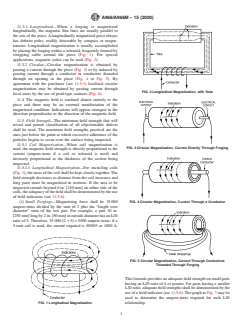
by placing the forging within a solenoid, frequently formed by
wrapping cable around the piece (Fig. 1). For special
applications, magnetic yokes can be used (Fig. 2).
11.3.2 Circular—Circular magnetization is obtained by
passing a current through the piece (Fig. 3) or by induced by
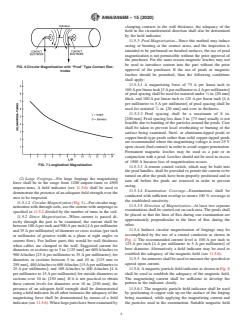
passing current through a conductor or conductors threaded
through an opening in the piece (Fig. 4 or Fig. 5). By
agreement with the purchaser (see 11.5.3) localized circular
magnetization may be obtained by passing current through
FIG. 2 Longitudinal Magnetization, with Yoke
local areas by the use of prod-type contacts (Fig. 6).
11.4 The magnetic field is confined almost entirely to the
piece and there may be no external manifestation of the
magnetized condition. Indications will appear strongest in the
direction perpendicular to the direction of the magnetic field.
11.5 Field Strength—The minimum field strength that will
reveal and permit classification of all objectionable defects
shall be used. The maximum field strengths practical are the
ones just below the point at which excessive adherence of the
particles begins to occur over the surface being inspected.
11.5.1 Coil Magnetization—When coil magnetization is
FIG. 3 Circular Magnetization, Current Directly Through Forging
used, the magnetic field strength is directly proportional to the
current (ampere-turns if a coil or solenoid is used) and
inversely proportional to the thickness of the section being
inspected.
11.5.1.1 Longitudinal Magnetization—For encircling coils
(Fig. 1), the turns of the coil shall be kept closely together.The
field strength decreases as distance from the coil increases and
long parts must be magnetized in sections. If the area to be
inspected extends beyond 6 in. [150 mm] on either side of the
coils,theadequacyofthefieldshallbedemonstratedbytheuse
of field indicators (see 11.5.6).
(1) Small Forgings—Magnetizing force shall be 35 000 FIG. 4 Circular Magnetization, Current Through a Conductor
ampere-turns divided by the sum of 2 plus the “length over
diameter” ratio of the test part. For example, a part 10 in.
[250 mm]longby2in.[50mm]inoutsidediameterhasanL/D
ratio of 5. Therefore, 35 000⁄(2 + 5) = 5000 ampere-turns; if a
5-turn coil is used, the current required is 5000/5 or 1000 A.
FIG. 5 Circular Magnetization, Current Through Conductors
Threaded Thr
...