

ASTM A609/A609M-12(2023)
(Practice)Standard Practice for Castings, Carbon, Low-Alloy, and Martensitic Stainless Steel, Ultrasonic Examination Thereof
General Information
- Abstract
ABSTRACT
This test method deals with the procedures for the standard practice of performing pulse-echo ultrasonic examination of heat-treated carbon, low-alloy, and martensitic stainless steel castings by the longitudinal-beam technique. Calibration shall be executed by either flat-bottomed hole or back-wall reflection. The instrument to be used for examination shall be the ultrasonic, pulsed, reflection type. Personnel and equipment qualifications, materials preparation, casting and test conditions, data recording methods, and the acceptance standards for both types of testing procedure are all detailed thoroughly.
SCOPE
1.1 This practice2 covers the standards and procedures for the pulse-echo ultrasonic examination of heat-treated carbon, low-alloy, and martensitic stainless steel castings.
1.2 This practice is to be used whenever the inquiry, contract, order, or specification states that castings are to be subjected to ultrasonic examination in accordance with Practice A609/A609M.
1.3 This practice contains two procedures. Procedure A is the original A609/A609M practice and requires calibration using a series of test blocks containing flat-bottomed holes. It also provides supplementary requirements for angle beam testing. Procedure B requires calibration using a back wall reflection from a series of solid calibration blocks.
Note 1: Ultrasonic examination and radiography are not directly comparable. This examination technique is intended to complement Guide E94/E94M in the detection of discontinuities.
1.4 Supplementary requirements of an optional nature are provided for use at the option of the purchaser. The supplementary requirements shall apply only when specified individually by the purchaser in the purchase order or contract.
1.5 The values stated in either SI units or inch-pound units are to be regarded separately as standard. The values stated in each system may not be exact equivalents; therefore, each system shall be used independently of the other. Combining values from the two systems may result in nonconformance with the standard.
1.5.1 Within the text, the SI units are shown in brackets.
1.5.2 This practice is expressed in both inch-pound units and SI units; however, unless the purchase order or contract specifies the applicable M-specification designation (SI units), the inch-pound units shall apply.
1.6 This standard does not purport to address all of the safety concerns, if any, associated with its use. It is the responsibility of the user of this standard to establish appropriate safety, health, and environmental practices and determine the applicability of regulatory limitations prior to use.
1.7 This international standard was developed in accordance with internationally recognized principles on standardization established in the Decision on Principles for the Development of International Standards, Guides and Recommendations issued by the World Trade Organization Technical Barriers to Trade (TBT) Committee.
- Status
- Published
- Publication Date
- 31-Oct-2023
- Technical Committee
- A01 - Steel, Stainless Steel and Related Alloys
- Drafting Committee
- A01.18 - Castings
Overview
ASTM A609/A609M-12(2023), Standard Practice for Castings, Carbon, Low-Alloy, and Martensitic Stainless Steel – Ultrasonic Examination, is an internationally recognized guideline developed by ASTM International. This standard outlines the methods and requirements for conducting pulse-echo ultrasonic testing on heat-treated carbon, low-alloy, and martensitic stainless steel castings. Through the longitudinal-beam technique, it ensures the reliable detection of internal discontinuities within cast components. ASTM A609/A609M is applicable whenever contracts, specifications, or customer inquiries require ultrasonic inspection according to this practice, enhancing the quality and safety of critical metal castings in diverse industries.
Key Topics
- Scope and Coverage: The standard covers ultrasonic examination for various types of steel castings, both carbon and alloy, that have undergone heat treatment.
- Dual Calibration Procedures:
- Procedure A: Utilizes flat-bottomed hole reference blocks for calibration. Supplementary requirements for angle beam testing are defined.
- Procedure B: Utilizes back-wall reflection from solid calibration blocks.
- Personnel and Equipment Qualifications:
- Examinations must be conducted by trained and certified personnel, following written procedures aligned with recognized national standards.
- Equipment must be capable of pulse-echo ultrasonic testing within a defined frequency range and be properly calibrated and maintained.
- Materials and Preparation:
- Casting surfaces must be adequately prepared, clean, and free of debris or coatings that could impede ultrasonic transmission.
- Castings should receive appropriate heat treatment prior to examination.
- Test Conditions and Techniques:
- Requirements for scanning rates, transducer overlap, and signal calibration are provided to ensure complete and accurate examination.
- Supplementary angle beam techniques are available for areas with challenging geometries or discontinuity orientations.
- Data Recording and Acceptance Criteria:
- Methods for documenting ultrasonic indications, evaluating results, and reporting are specified.
- Clearly defined acceptance levels and rejection criteria based on amplitude, area, and type of indications.
- Units of Measurement:
- Both SI and inch-pound units are provided, but only one system is to be used per inspection.
Applications
- Quality Control in Steel Foundries: ASTM A609/A609M is widely used in the production of cast components for industries such as power generation, petrochemical, transportation, and defense. It helps ensure that castings are free from unacceptable internal flaws, improving reliability.
- Inspection for Critical Service Components: The standard is especially valuable for castings intended for high-pressure or high-temperature service, where the detection of discontinuities is paramount to safety and performance.
- Procurement and Contract Fulfillment: Purchasers can specify ultrasonic testing according to ASTM A609/A609M in their contracts, ensuring clear quality expectations and compliance with international best practices.
- Regulatory and Code Compliance: Recognized by regulatory agencies, including use in ASME Boiler and Pressure Vessel Codes, and supported by international standardization principles.
Related Standards
- ASTM E94/E94M: Guide for Radiographic Examination Using Industrial Radiographic Film – a complementary method for discontinuity detection.
- ASTM E317: Practice for Evaluating Ultrasonic Pulse-Echo Testing Instruments.
- ASME SA-609: Similar specification adopted for use in the ASME Boiler and Pressure Vessel Code.
- SNT-TC-1A: Recommended Practice for Nondestructive Testing Personnel Qualification and Certification.
- ASTM A217/A217M: Specification for Martensitic Stainless and Alloy Steel Castings for Pressure-Containing Parts.
Keywords: ultrasonic examination, ASTM A609, steel castings, nondestructive testing, pulse-echo, carbon steel, low-alloy steel, martensitic stainless steel, quality standards, defect detection, industrial inspection, ultrasonic testing standards
Relations
- Effective Date
- 01-Nov-2023
- Effective Date
- 01-Nov-2023
- Effective Date
- 01-Nov-2023
- Effective Date
- 01-Nov-2023
- Effective Date
- 01-Nov-2023
- Referred By
ASTM A1001-18 - Standard Specification for High-Strength Steel Castings in Heavy Sections - Effective Date
- 01-Nov-2023
- Effective Date
- 01-Nov-2023
Get Certified
Connect with accredited certification bodies for this standard

Element Materials Technology
Materials testing and product certification.

Inštitut za kovinske materiale in tehnologije
Institute of Metals and Technology. Materials testing, metallurgical analysis, NDT.
Sponsored listings
Frequently Asked Questions
ASTM A609/A609M-12(2023) is a standard published by ASTM International. Its full title is "Standard Practice for Castings, Carbon, Low-Alloy, and Martensitic Stainless Steel, Ultrasonic Examination Thereof". This standard covers: ABSTRACT This test method deals with the procedures for the standard practice of performing pulse-echo ultrasonic examination of heat-treated carbon, low-alloy, and martensitic stainless steel castings by the longitudinal-beam technique. Calibration shall be executed by either flat-bottomed hole or back-wall reflection. The instrument to be used for examination shall be the ultrasonic, pulsed, reflection type. Personnel and equipment qualifications, materials preparation, casting and test conditions, data recording methods, and the acceptance standards for both types of testing procedure are all detailed thoroughly. SCOPE 1.1 This practice2 covers the standards and procedures for the pulse-echo ultrasonic examination of heat-treated carbon, low-alloy, and martensitic stainless steel castings. 1.2 This practice is to be used whenever the inquiry, contract, order, or specification states that castings are to be subjected to ultrasonic examination in accordance with Practice A609/A609M. 1.3 This practice contains two procedures. Procedure A is the original A609/A609M practice and requires calibration using a series of test blocks containing flat-bottomed holes. It also provides supplementary requirements for angle beam testing. Procedure B requires calibration using a back wall reflection from a series of solid calibration blocks. Note 1: Ultrasonic examination and radiography are not directly comparable. This examination technique is intended to complement Guide E94/E94M in the detection of discontinuities. 1.4 Supplementary requirements of an optional nature are provided for use at the option of the purchaser. The supplementary requirements shall apply only when specified individually by the purchaser in the purchase order or contract. 1.5 The values stated in either SI units or inch-pound units are to be regarded separately as standard. The values stated in each system may not be exact equivalents; therefore, each system shall be used independently of the other. Combining values from the two systems may result in nonconformance with the standard. 1.5.1 Within the text, the SI units are shown in brackets. 1.5.2 This practice is expressed in both inch-pound units and SI units; however, unless the purchase order or contract specifies the applicable M-specification designation (SI units), the inch-pound units shall apply. 1.6 This standard does not purport to address all of the safety concerns, if any, associated with its use. It is the responsibility of the user of this standard to establish appropriate safety, health, and environmental practices and determine the applicability of regulatory limitations prior to use. 1.7 This international standard was developed in accordance with internationally recognized principles on standardization established in the Decision on Principles for the Development of International Standards, Guides and Recommendations issued by the World Trade Organization Technical Barriers to Trade (TBT) Committee.
ABSTRACT This test method deals with the procedures for the standard practice of performing pulse-echo ultrasonic examination of heat-treated carbon, low-alloy, and martensitic stainless steel castings by the longitudinal-beam technique. Calibration shall be executed by either flat-bottomed hole or back-wall reflection. The instrument to be used for examination shall be the ultrasonic, pulsed, reflection type. Personnel and equipment qualifications, materials preparation, casting and test conditions, data recording methods, and the acceptance standards for both types of testing procedure are all detailed thoroughly. SCOPE 1.1 This practice2 covers the standards and procedures for the pulse-echo ultrasonic examination of heat-treated carbon, low-alloy, and martensitic stainless steel castings. 1.2 This practice is to be used whenever the inquiry, contract, order, or specification states that castings are to be subjected to ultrasonic examination in accordance with Practice A609/A609M. 1.3 This practice contains two procedures. Procedure A is the original A609/A609M practice and requires calibration using a series of test blocks containing flat-bottomed holes. It also provides supplementary requirements for angle beam testing. Procedure B requires calibration using a back wall reflection from a series of solid calibration blocks. Note 1: Ultrasonic examination and radiography are not directly comparable. This examination technique is intended to complement Guide E94/E94M in the detection of discontinuities. 1.4 Supplementary requirements of an optional nature are provided for use at the option of the purchaser. The supplementary requirements shall apply only when specified individually by the purchaser in the purchase order or contract. 1.5 The values stated in either SI units or inch-pound units are to be regarded separately as standard. The values stated in each system may not be exact equivalents; therefore, each system shall be used independently of the other. Combining values from the two systems may result in nonconformance with the standard. 1.5.1 Within the text, the SI units are shown in brackets. 1.5.2 This practice is expressed in both inch-pound units and SI units; however, unless the purchase order or contract specifies the applicable M-specification designation (SI units), the inch-pound units shall apply. 1.6 This standard does not purport to address all of the safety concerns, if any, associated with its use. It is the responsibility of the user of this standard to establish appropriate safety, health, and environmental practices and determine the applicability of regulatory limitations prior to use. 1.7 This international standard was developed in accordance with internationally recognized principles on standardization established in the Decision on Principles for the Development of International Standards, Guides and Recommendations issued by the World Trade Organization Technical Barriers to Trade (TBT) Committee.
ASTM A609/A609M-12(2023) is classified under the following ICS (International Classification for Standards) categories: 77.040.20 - Non-destructive testing of metals; 77.140.80 - Iron and steel castings. The ICS classification helps identify the subject area and facilitates finding related standards.
ASTM A609/A609M-12(2023) has the following relationships with other standards: It is inter standard links to ASTM A609/A609M-12(2018), ASTM A426/A426M-18, ASTM A957/A957M-21, ASTM A985/A985M-21, ASTM A781/A781M-21, ASTM A1001-18, ASTM A703/A703M-20a. Understanding these relationships helps ensure you are using the most current and applicable version of the standard.
ASTM A609/A609M-12(2023) is available in PDF format for immediate download after purchase. The document can be added to your cart and obtained through the secure checkout process. Digital delivery ensures instant access to the complete standard document.
Standards Content (Sample)
This international standard was developed in accordance with internationally recognized principles on standardization established in the Decision on Principles for the
Development of International Standards, Guides and Recommendations issued by the World Trade Organization Technical Barriers to Trade (TBT) Committee.
Designation: A609/A609M − 12 (Reapproved 2023)
Standard Practice for
Castings, Carbon, Low-Alloy, and Martensitic Stainless
Steel, Ultrasonic Examination Thereof
This standard is issued under the fixed designation A609/A609M; the number immediately following the designation indicates the year
of original adoption or, in the case of revision, the year of last revision. A number in parentheses indicates the year of last reapproval.
A superscript epsilon (´) indicates an editorial change since the last revision or reapproval.
This standard has been approved for use by agencies of the U.S. Department of Defense.
1. Scope 1.6 This standard does not purport to address all of the
2 safety concerns, if any, associated with its use. It is the
1.1 This practice covers the standards and procedures for
responsibility of the user of this standard to establish appro-
the pulse-echo ultrasonic examination of heat-treated carbon,
priate safety, health, and environmental practices and deter-
low-alloy, and martensitic stainless steel castings.
mine the applicability of regulatory limitations prior to use.
1.2 This practice is to be used whenever the inquiry,
1.7 This international standard was developed in accor-
contract, order, or specification states that castings are to be
dance with internationally recognized principles on standard-
subjected to ultrasonic examination in accordance with Prac-
ization established in the Decision on Principles for the
tice A609/A609M.
Development of International Standards, Guides and Recom-
mendations issued by the World Trade Organization Technical
1.3 This practice contains two procedures. Procedure A is
the original A609/A609M practice and requires calibration Barriers to Trade (TBT) Committee.
using a series of test blocks containing flat-bottomed holes. It
also provides supplementary requirements for angle beam 2. Referenced Documents
testing. Procedure B requires calibration using a back wall
2.1 ASTM Standards:
reflection from a series of solid calibration blocks.
A217/A217M Specification for Steel Castings, Martensitic
Stainless and Alloy, for Pressure-Containing Parts, Suit-
NOTE 1—Ultrasonic examination and radiography are not directly
comparable. This examination technique is intended to complement Guide
able for High-Temperature Service
E94/E94M in the detection of discontinuities.
E94/E94M Guide for Radiographic Examination Using In-
1.4 Supplementary requirements of an optional nature are dustrial Radiographic Film
provided for use at the option of the purchaser. The supple- E317 Practice for Evaluating Performance Characteristics of
mentary requirements shall apply only when specified indi- Ultrasonic Pulse-Echo Testing Instruments and Systems
vidually by the purchaser in the purchase order or contract. without the Use of Electronic Measurement Instruments
2.2 Other Document:
1.5 The values stated in either SI units or inch-pound units
are to be regarded separately as standard. The values stated in SNT-TC-1A Recommended Practice for Nondestructive
Testing Personnel Qualification and Certification
each system may not be exact equivalents; therefore, each
system shall be used independently of the other. Combining
3. Ordering Information
values from the two systems may result in nonconformance
with the standard.
3.1 The inquiry and order should specify which procedure is
1.5.1 Within the text, the SI units are shown in brackets.
to be used. If a procedure is not specified, Procedure A shall be
1.5.2 This practice is expressed in both inch-pound units
used.
and SI units; however, unless the purchase order or contract
3.2 The purchaser shall furnish the following information:
specifies the applicable M-specification designation (SI units),
3.2.1 Quality levels for the entire casting or portions
the inch-pound units shall apply.
thereof,
This practice is under the jurisdiction of ASTM Committee A01 on Steel,
Stainless Steel and Related Alloys and is the direct responsibility of Subcommittee
A01.18 on Castings. For referenced ASTM standards, visit the ASTM website, www.astm.org, or
Current edition approved Nov. 1, 2023. Published November 2023. Originally contact ASTM Customer Service at service@astm.org. For Annual Book of ASTM
approved in 1970. Last previous edition approved in 2018 as A609/A609M – 12 Standards volume information, refer to the standard’s Document Summary page on
(2018). DOI: 10.1520/A0609_A0609M-12R23. the ASTM website.
2 4
For ASME Boiler and Pressure Vessel Code applications, see related Specifi- Available from American Society for Nondestructive Testing (ASNT), P.O. Box
cation SA-609 of Section II of that Code. 28518, 1711 Arlingate Ln., Columbus, OH 43228-0518, http://www.asnt.org.
Copyright © ASTM International, 100 Barr Harbor Drive, PO Box C700, West Conshohocken, PA 19428-2959. United States
A609/A609M − 12 (2023)
3.2.2 Sections of castings requiring longitudinal beam
examination,
3.2.3 Sections of castings requiring dual element
examination,
3.2.4 Sections of castings requiring supplementary
examination, using the angle beam procedure described in
Supplementary Requirement S1 in order to achieve more
complete examination, and
3.2.5 Any requirements additional to the provisions of this
practice.
PROCEDURE A – FLAT-BOTTOMED HOLE
CALIBRATION PROCEDURE
4. Apparatus
4.1 Electronic Apparatus:
4.1.1 An ultrasonic, pulsed, reflection type of instrument
that is capable of generating, receiving, and amplifying fre-
quencies of at least 0.5 to 5 MHz.
4.1.2 The ultrasonic instrument shall provide linear presen-
tation (within 65 %) for at least 75 % of the screen height
(sweep line to top of screen). Linearity shall be determined in NOTE 1—Opposite ends of reference block shall be flat and parallel
within 0.001 in. [0.025 mm].
accordance with Practice E317 or equivalent electronic means.
NOTE 2—Bottom of flat-bottom hole shall be flat within 0.002 in.
4.1.3 The electronic apparatus shall contain a signal attenu-
[0.051 mm] and the finished diameter shall be ⁄4 + 0.002 in. [6.4 + 0.050].
ator or calibrated gain control that shall be accurate over its
NOTE 3—Hole shall be straight and perpendicular to entry surface
useful range to 610 % of the nominal attenuation or gain ratio
within 0°, 30 min and located within ⁄32 in. [0.80 mm] of longitudinal
to allow measurement of signals beyond the linear range of the
axis.
1 1
instrument.
NOTE 4—Counter bore shall be ⁄2 in. [15.0 mm] diameter by ⁄8 in.
[5 mm] deep.
4.2 Search Units:
4.2.1 Longitudinal Wave, internally grounded, having a ⁄2
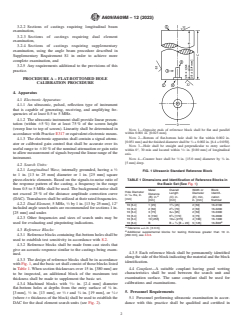
FIG. 1 Ultrasonic Standard Reference Block
to 1 in. [13 to 25 mm] diameter or 1 in. [25 mm] square
piezo-electric elements. Based on the signals-to-noise ratio of
TABLE 1 Dimensions and Identification of Reference Blocks in
the response pattern of the casting, a frequency in the range the Basic Set (See Fig. 1)
from 0.5 to 5 MHz shall be used. The background noise shall
Overall Width or Block
Metal
Hole Diameter
Length Diameter Identifi-
not exceed 25 % of the distance amplitude correction curve Distance
in ⁄64 ths, in.
A
(C), in. (D), min, cation
(B), in.
(DAC). Transducers shall be utilized at their rated frequencies. [mm]
[mm]
[mm] in. [mm] Number
4.2.2 Dual Element, 5 MHz, ⁄2 by 1 in. [13 by 25 mm], 12°
16 [6.4] 1 [25] 1 ⁄4 [45] 2 [50] 16-0100
included angle search units are recommended for sections 1 in.
16 [6.4] 2 [50] 2 ⁄4 [70] 2 [50] 16-0200
16 [6.4] 3 [75] 3 ⁄4 [95] 2 [50] 16-0300
[25 mm] and under.
16 [6.4] 6 [150] 6 ⁄4 [170] 3 [75] 16-0600
4.2.3 Other frequencies and sizes of search units may be
16 [6.4] 10 [255] 10 ⁄4 [275] 4 [100] 16-1000
B
16 [6.4] B B + ⁄4 [B + 20] 5 [125] 16-B00
used for evaluating and pinpointing indications.
A
Tolerance ± ⁄8 in. [3 mm].
4.3 Reference Blocks:
B
Additional supplemental blocks for testing thickness greater than 10 in.
4.3.1 Reference blocks containing flat-bottom holes shall be
[250 mm], see 4.3.3.
used to establish test sensitivity in accordance with 8.2.
4.3.2 Reference blocks shall be made from cast steels that
give an acoustic response similar to the castings being exam-
4.3.5 Each reference block shall be permanently identified
ined.
along the side of the block indicating the material and the block
4.3.3 The design of reference blocks shall be in accordance
identification.
with Fig. 1, and the basic set shall consist of those blocks listed
4.4 Couplant—A suitable couplant having good wetting
in Table 1. When section thicknesses over 15 in. [380 mm] are
characteristics shall be used between the search unit and
to be inspected, an additional block of the maximum test
examination surface. The same couplant shall be used for
thickness shall be made to supplement the basic set.
3 calibrations and examinations.
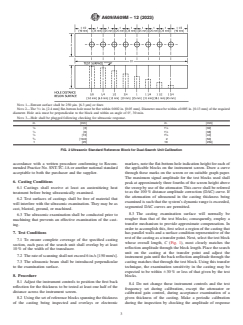
4.3.4 Machined blocks with ⁄32 in. [2.4 mm] diameter
flat-bottom holes at depths from the entry surface of ⁄8 in.
5. Personnel Requirements
1 1 3 3
[3 mm], ⁄2 in. [13 mm], or ⁄2 t and ⁄4 in. [19 mm], or ⁄4 t
(where t = thickness of the block) shall be used to establish the 5.1 Personnel performing ultrasonic examination in accor-
DAC for the dual element search units (see Fig. 2). dance with this practice shall be qualified and certified in
A609/A609M − 12 (2023)
NOTE 1—Entrant surface shall be 250 μin. [6.3 μm] or finer.
NOTE 2—The ⁄32 in. [2.4 mm] flat-bottom hole must be flat within 0.002 in. [0.05 mm]. Diameter must be within +0.005 in. [0.13 mm] of the required
diameter. Hole axis must be perpendicular to the block and within an angle of 0°, 30 min.
NOTE 3—Hole shall be plugged following checking for ultrasonic response.
in. [mm] in. [mm]
1 1
⁄8 [3] 1 ⁄4 [32]
1 1
⁄4 [6] 1 ⁄2 [38]
1 3
⁄2 [13] 1 ⁄4 [44]
⁄4 [19.0] 2 [50]
1 [25] 10 [254]
FIG. 2 Ultrasonic Standard Reference Block for Dual-Search Unit Calibration
accordance with a written procedure conforming to Recom- markers, note the flat-bottom hole indication height for each of
mended Practice No. SNT-TC-1A or another national standard the applicable blocks on the instrument screen. Draw a curve
acceptable to both the purchaser and the supplier. through these marks on the screen or on suitable graph paper.
The maximum signal amplitude for the test blocks used shall
6. Casting Conditions
peak at approximately three fourths of the screen height above
the sweep by use of the attenuator. This curve shall be referred
6.1 Castings shall receive at least an austenitizing heat
to as the 100 % distance amplitude correction (DAC) curve. If
treatment before being ultrasonically examined.
the attenuation of ultrasound in the casting thickness being
6.2 Test surfaces of castings shall be free of material that
examined is such that the system’s dynamic range is exceeded,
will interfere with the ultrasonic examination. They may be as
segmented DAC curves are permitted.
cast, blasted, ground, or machined.
8.3 The casting examination surface will normally be
6.3 The ultrasonic examination shall be conducted prior to
rougher than that of the test blocks; consequently, employ a
machining that prevents an effective examination of the cast-
transfer mechanism to provide approximate compensation. In
ing.
order to accomplish this, first select a region of the casting that
7. Test Conditions has parallel walls and a surface condition representative of the
rest of the casting as a transfer point. Next, select the test block
7.1 To ensure complete coverage of the specified casting
whose overall length, C (Fig. 1), most closely matches the
section, each pass of the search unit shall overlap by at least
reflection amplitude through the block length. Place the search
10 % of the width of the transducer.
unit on the casting at the transfer point and adjust the
7.2 The rate of scanning shall not exceed 6 in./s [150 mm/s].
instrument gain until the back reflection amplitude through the
casting matches that through the test block. Using this transfer
7.3 The ultrasonic beam shall be introduced perpendicular
to the examination surface. technique, the examination sensitivity in the casting may be
expected to be within 630 % or less of that given by the test
8. Procedure
blocks.
8.1 Adjust the instrument controls to position the first back
8.4 Do not change those instrument controls and the test
reflection for the thickness to be tested at least one half of the
frequency set during calibration, except the attenuator or
distance across the instrument screen.
calibrated gain control, during acceptance examination of a
8.2 Using the set of reference blocks spanning the thickness given thickness of the casting. Make a periodic calibration
of the casting being inspected and overlays or electronic during the inspection by checking the amplitude of response
A609/A609M − 12 (2023)
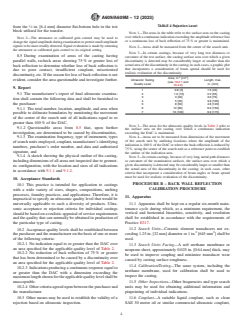
TABLE 2 Rejection Level
from the ⁄4 in. [6.4 mm] diameter flat-bottom hole in the test
block utilized for the transfer.
NOTE 1—The areas in the table refer to the surface area on the casting
over which a continuous indication exceeding the amplitude reference line
NOTE 2—The attenuator or calibrated gain control may be used to
or a continuous loss of back reflection of 75 % or greater is maintained.
change the signal amplitude during examination to permit small amplitude
signals to be more readily detected. Signal evaluation is made by returning
NOTE 2—Areas shall be measured from the center of the search unit.
the attenuator or calibrated gain control to its original setting.
NOTE 3—In certain castings, because of very long test distances or
8.5 During examination of areas of the casting having
curvature of the test surface, the casting surface area over which a given
parallel walls, recheck areas showing 75 % or greater loss of
discontinuity is detected may be considerably larger or smaller than the
actual area of the discontinuity in the casting; in such cases, a graphic plot
back reflection to determine whether loss of back reflection is
that incorporates a consideration of beam spread should be used for
due to poor contact, insufficient couplant, misoriented
realistic evaluation of the discontinuity.
discontinuity, etc. If the reason for loss of back reflection is not
2 2
Area, in. [cm ]
evident, consider the area questionable and investigate further. Ultrasonic Testing Length, max,
(see 10.2.1 and
Quality Level in. [mm]
10.2.2)
9. Report
1 0.8 [5] 1.5 [40]
2 1.5 [10] 2.2 [55]
9.1 The manufacturer’s report of final ultrasonic examina-
3 3 [20] 3.0 [75]
tion shall contain the following data and shall be furnished to
4 5 [30] 3.9 [100]
the purchaser:
5 8 [50] 4.8 [120]
6 12 [80] 6.0 [150]
9.1.1 The total number, location, amplitude, and area when
7 16 [100] 6.9 [175]
possible to delineate boundaries by monitoring the movement
of the center of the search unit of all indications equal to or
greater than 100 % of the DAC,
NOTE 3—The areas for the ultrasonic quality levels in Table 2 refer to
9.1.2 Questionable areas from 8.5 that, upon further
the surface area on the casting over which a continuous indication
investigation, are determined to be caused by discontinuities,
exceeding the DAC is maintained.
9.1.3 The examination frequency, type of instrument, types NOTE 4—Areas are to be measured from dimensions of the movement
of the search unit by outlining locations where the amplitude of the
of search units employed, couplant, manufacturer’s identifying
indication is 100 % of the DAC or where the back reflection is reduced by
numbers, purchaser’s order number, and data and authorized
75 %, using the center of the search unit as a reference point to establish
signature, and
the outline of the indication area.
9.1.4 A sketch showing the physical outline of the casting,
NOTE 5—In certain castings, because of very long metal path distances
or curvature of the examination surfaces, the surface area over which a
including dimensions of all areas not inspected due to geomet-
given discontinuity is detected may be considerably larger or smaller than
ric configuration, with the location and sizes of all indications
the actual area of the discontinuity in the casting; in such cases, other
in accordance with 9.1.1 and 9.1.2.
criteria that incorporate a consideration of beam angles or beam spread
must be used for realistic evaluation of the discontinuity.
10. Acceptance Standards
PROCEDURE B – BACK WALL REFLECTION
10.1 This practice is intended for application to castings
CALIBRATION PROCEDURE
with a wide variety of sizes, shapes, compositions, melting
processes, foundry practices, and applications. Therefore, it is
11. Apparatus
impractical to specify an ultrasonic quality level that would be
11.1 Apparatus shall be kept on a regular six-month main-
universally applicable to such a diversity of products. Ultra-
sonic acceptance or rejection criteria for individual castings tenance cycle during which, as a minimum requirement, the
vertical and horizontal linearities, sensitivity, and resolution
should be based on a realistic appraisal of service requirements
and the quality that can normally be obtained in production of shall be established in accordance with the requirements of
Practice E317.
the particular type of casting.
10.2 Acceptance quality levels shall be established between 11.2 Search Units—Ceramic element transducers not ex-
2 2
ceeding 1.25 in. [32 mm] diameter or 1 in. [645 mm ] shall be
the purchaser and the manufacturer on the basis of one or more
used.
of the following criteria:
10.2.1 No indication equal to or greater than the DAC over
11.3 Search Units Facing—A soft urethane membrane or
an area specified for the applicable quality level of Table 2.
neoprene sheet, approximately 0.025 in. [0.64 mm] thick, may
10.2.2 No reduction of back reflection of 75 % or greater
be used to improve coupling and minimize transducer wear
that has been determined to be caused by a discontinuity over
caused by casting surface roughness.
an area specified for the applicable quality level of Table 2.
11.4 Calibration/Testing—The same system, including the
10.2.3 Indications producing a continuous response equal to
urethane membrane, used for calibration shall be used to
or greater than the DAC with a dimension exceeding the
inspect the casting.
maximum length shown for the applicable quality level shall be
unacceptable. 11.5 Other Inspections—Other frequencies and type search
10.2.4 Other criteria agreed upon between the purchaser and units may be used for obtaining additional information and
the manufacturer. pinpointing of individual indications.
10.3 Other means may be used to establish the validity of a 11.6 Couplant—A suitable liquid couplant, such as clean
rejection based on ultrasonic inspection. SAE 30 motor oil or similar commercial ultrasonic couplant,
A609/A609M − 12 (2023)
shall be used to couple the search unit to the test surface. Other 14. Preparation
couplants may be used when agreed upon between the pur-
14.1 Time of Inspection—The final ultrasonic acceptance
chaser and supplier.
inspection shall be performed after at least an austenitizing heat
11.7 Reference Standards—Reference standards in accor- treatment and preferably after machining. In order to avoid
dance with Fig. 3 shall be used to calibrate the instrument for time loss in production, acceptance inspection of cast surfaces
inspecting machined and cast surfaces. Reference standards may be done prior to machining. Machined surfaces shall be
shall be flaw free and machined within tolerances indicated. acceptance inspected as soon as possible after machining.
Repair welds may be inspected before the post-weld heat
12. Ultrasonic Instrument treatment.
12.1 Type—Pulsed ultrasonic reflection instrument capable
14.2 Surface Finish:
of generating, receiving, and amplifying frequencies of 0.5 to 14.2.1 Machined Surfaces—Machined surfaces subject to
5 MHz shall be used for testing.
ultrasonic inspection shall have a finish that will produce an
ultrasonic response equivalent to that obtained from a 250 μin.
...