

ASTM A508/A508M-23a
(Specification)Standard Specification for Quenched and Tempered Vacuum-Treated Carbon and Alloy Steel Forgings for Pressure Vessels
General Information
- Abstract
ABSTRACT
This specification covers quenched and tempered vacuum-treated carbon and alloy steel forgings for pressure vessels, such as those used in reactor systems, specifically, vessel closures, shells, flanges, tube sheets, rings, heads, and similar parts. Steels shall be manufactured by basic electric-furnace process except when secondary ladle refining or remelting process is employed, and shall be vacuum treated prior to or during the pouring of the ingot. Materials shall also go through preliminary heat treatment and quenching for mechanical properties. Heat and product analyses shall be executed to evaluate the conformance of the forgings with specified chemical requirements. Tension and Charpy impact tests shall also be performed to examine the conformance of steel specimens with the following mechanical properties: tensile strength, yield strength, elongation, and reduction of area. Nondestructive inspection procedures, such as magnetic particle examination, and longitudinal wave and angle beam ultrasonic examination, shall also be carried out. Repair welding may be permitted at the option of the purchaser.
SCOPE
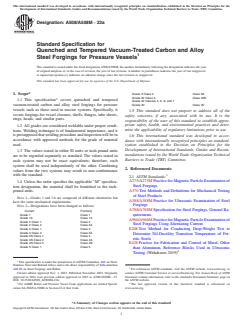
1.1 This specification2 covers quenched and tempered vacuum-treated carbon and alloy steel forgings for pressure vessels such as those used in reactor systems. Specifically, it covers forgings for vessel closures, shells, flanges, tube sheets, rings, heads, and similar parts.
1.2 All grades are considered weldable under proper conditions. Welding technique is of fundamental importance, and it is presupposed that welding procedure and inspection will be in accordance with approved methods for the grade of material used.
1.3 The values stated in either SI units or inch-pound units are to be regarded separately as standard. The values stated in each system may not be exact equivalents; therefore, each system shall be used independently of the other. Combining values from the two systems may result in non-conformance with the standard.
1.4 Unless the order specifies the applicable “M” specification designation, the material shall be furnished to the inch-pound units.
Note 1: Grades 1 and 1A are composed of different chemistries but have the same mechanical requirements.
Note 2: Designations have been changed as follows:
Current
Formerly
Grade 1
Class 1
Grade 1A
Class 1A
Grade 2 Class 1
Class 2
Grade 2 Class 2
Class 2A
Grade 3 Class 1
Class 3
Grade 3 Class 2
Class 3A
Grade 4N Class 1
Class 4
Grade 4N Class 2
Class 4A
Grade 4N Class 3
Class 4B
Grade 5 Class 1
Class 5
Grade 5 Class 2
Class 5A
Grade 22 Class 3
Class 22B
Grade 22 Classes 4, 5, 6, and 7
Grade 3V
Class 3V
1.5 This standard does not purport to address all of the safety concerns, if any, associated with its use. It is the responsibility of the user of this standard to establish appropriate safety, health, and environmental practices and determine the applicability of regulatory limitations prior to use.
1.6 This international standard was developed in accordance with internationally recognized principles on standardization established in the Decision on Principles for the Development of International Standards, Guides and Recommendations issued by the World Trade Organization Technical Barriers to Trade (TBT) Committee.
- Status
- Published
- Publication Date
- 31-Oct-2023
- Technical Committee
- A01 - Steel, Stainless Steel and Related Alloys
- Drafting Committee
- A01.06 - Steel Forgings and Billets
Buy Documents
ASTM A508/A508M-23a - Standard Specification for Quenched and Tempered Vacuum-Treated Carbon and Alloy Steel Forgings for Pressure Vessels
REDLINE ASTM A508/A508M-23a - Standard Specification for Quenched and Tempered Vacuum-Treated Carbon and Alloy Steel Forgings for Pressure Vessels
Overview
ASTM A508/A508M-23a is the internationally recognized standard specification for quenched and tempered, vacuum-treated carbon and alloy steel forgings for pressure vessels. Published by ASTM International, this specification outlines the required manufacturing and testing processes for steel forgings used in critical pressure vessel applications, such as reactor systems. The scope covers vessel closures, shells, flanges, tube sheets, rings, and similar components, ensuring high reliability and safety in service environments where structural integrity is paramount.
Key Topics
- Material Types: Covers a range of carbon and alloy steel grades designated for pressure vessel components, all considered weldable under correct processing conditions.
- Manufacturing Requirements: Steel must be produced primarily via basic electric-furnace process, with allowance for secondary ladle refining or remelting if specified. Vacuum treatment is required to reduce gas content, enhancing toughness and performance.
- Heat Treatment: After forging, products must be quenched and tempered, following specific procedures to achieve desired mechanical properties such as tensile and yield strength.
- Chemical and Mechanical Properties: Mandates strict adherence to specified chemical compositions for each grade. Mechanical property requirements such as tensile strength, yield strength, elongation, and reduction of area are verified through tension and Charpy impact testing.
- Testing and Inspection:
- Mechanical Testing: Includes tension and impact tests to verify mechanical requirements.
- Nondestructive Inspection: Forgings must undergo magnetic particle examination and ultrasonic inspection per referenced ASTM practices to detect any internal or surface defects.
- Product Analysis: Chemical analysis is conducted to confirm that production batches meet specification requirements.
- Certification and Marking: Final products must be certified and marked, with detailed records relating to heat treatment, testing methods, and inspection results.
- Repair Welding: Permitted at purchaser’s discretion, with qualifications according to ASME Boiler and Pressure Vessel Code.
Applications
ASTM A508/A508M-23a applies to industries and projects requiring high-strength, tough, and reliable forged steel components for pressure containment. Typical end uses include:
- Nuclear Reactor Components: Such as vessel closures and heads, requiring superior fracture toughness and quality control.
- Shells, Flanges, Rings, and Tubesheets: Essential parts of boilers and pressure vessels in the energy and chemical processing sectors.
- Heavy Industrial Pressure Vessels: Used for processing, storage, and transport in power generation, oil & gas, and petrochemical industries.
- Installation in Critical Environments: Where resistance to brittle fracture, consistent mechanical properties, and purity (low gas and impurity content) are critical to safe long-term performance.
Related Standards
Adherence to ASTM A508/A508M often requires compliance with or reference to additional key standards for pressure vessel steel forgings:
- ASTM A370 - Test Methods for Mechanical Testing of Steel Products
- ASTM A275/A275M & A966/A966M - Magnetic Particle Examination of Steel Forgings
- ASTM A388/A388M - Ultrasonic Examination of Steel Forgings
- ASTM A788/A788M - General Requirements for Steel Forgings
- ASME Boiler and Pressure Vessel Code - Relevant sections for design and fabrication procedures
- ASTM E208 - Drop-Weight Test for Nil-Ductility Transition Temperature
By following ASTM A508/A508M-23a, manufacturers, fabricators, and engineers ensure the structural reliability, safety, and quality control of steel forgings for demanding pressure vessel applications, meeting the stringent standards required in global industries. This specification supports both SI and inch-pound unit systems, with clear requirements to prevent non-conformity.
Keywords: quenched and tempered steel forgings, vacuum-treated carbon and alloy steel, pressure vessel steel, ASTM A508, reactor vessel components, mechanical property testing, nondestructive examination, ASME, steel quality standards.
Relations
- Effective Date
- 01-Nov-2023
- Effective Date
- 01-Mar-2024
- Effective Date
- 15-Sep-2023
- Effective Date
- 01-Nov-2023
- Referred By
ASTM A275/A275M-23 - Standard Practice for Magnetic Particle Examination of Steel Forgings - Effective Date
- 01-Nov-2023
- Effective Date
- 01-Nov-2023
Buy Documents
ASTM A508/A508M-23a - Standard Specification for Quenched and Tempered Vacuum-Treated Carbon and Alloy Steel Forgings for Pressure Vessels
REDLINE ASTM A508/A508M-23a - Standard Specification for Quenched and Tempered Vacuum-Treated Carbon and Alloy Steel Forgings for Pressure Vessels
Get Certified
Connect with accredited certification bodies for this standard

Element Materials Technology
Materials testing and product certification.

Inštitut za kovinske materiale in tehnologije
Institute of Metals and Technology. Materials testing, metallurgical analysis, NDT.
Sponsored listings
Frequently Asked Questions
ASTM A508/A508M-23a is a technical specification published by ASTM International. Its full title is "Standard Specification for Quenched and Tempered Vacuum-Treated Carbon and Alloy Steel Forgings for Pressure Vessels". This standard covers: ABSTRACT This specification covers quenched and tempered vacuum-treated carbon and alloy steel forgings for pressure vessels, such as those used in reactor systems, specifically, vessel closures, shells, flanges, tube sheets, rings, heads, and similar parts. Steels shall be manufactured by basic electric-furnace process except when secondary ladle refining or remelting process is employed, and shall be vacuum treated prior to or during the pouring of the ingot. Materials shall also go through preliminary heat treatment and quenching for mechanical properties. Heat and product analyses shall be executed to evaluate the conformance of the forgings with specified chemical requirements. Tension and Charpy impact tests shall also be performed to examine the conformance of steel specimens with the following mechanical properties: tensile strength, yield strength, elongation, and reduction of area. Nondestructive inspection procedures, such as magnetic particle examination, and longitudinal wave and angle beam ultrasonic examination, shall also be carried out. Repair welding may be permitted at the option of the purchaser. SCOPE 1.1 This specification2 covers quenched and tempered vacuum-treated carbon and alloy steel forgings for pressure vessels such as those used in reactor systems. Specifically, it covers forgings for vessel closures, shells, flanges, tube sheets, rings, heads, and similar parts. 1.2 All grades are considered weldable under proper conditions. Welding technique is of fundamental importance, and it is presupposed that welding procedure and inspection will be in accordance with approved methods for the grade of material used. 1.3 The values stated in either SI units or inch-pound units are to be regarded separately as standard. The values stated in each system may not be exact equivalents; therefore, each system shall be used independently of the other. Combining values from the two systems may result in non-conformance with the standard. 1.4 Unless the order specifies the applicable “M” specification designation, the material shall be furnished to the inch-pound units. Note 1: Grades 1 and 1A are composed of different chemistries but have the same mechanical requirements. Note 2: Designations have been changed as follows: Current Formerly Grade 1 Class 1 Grade 1A Class 1A Grade 2 Class 1 Class 2 Grade 2 Class 2 Class 2A Grade 3 Class 1 Class 3 Grade 3 Class 2 Class 3A Grade 4N Class 1 Class 4 Grade 4N Class 2 Class 4A Grade 4N Class 3 Class 4B Grade 5 Class 1 Class 5 Grade 5 Class 2 Class 5A Grade 22 Class 3 Class 22B Grade 22 Classes 4, 5, 6, and 7 Grade 3V Class 3V 1.5 This standard does not purport to address all of the safety concerns, if any, associated with its use. It is the responsibility of the user of this standard to establish appropriate safety, health, and environmental practices and determine the applicability of regulatory limitations prior to use. 1.6 This international standard was developed in accordance with internationally recognized principles on standardization established in the Decision on Principles for the Development of International Standards, Guides and Recommendations issued by the World Trade Organization Technical Barriers to Trade (TBT) Committee.
ABSTRACT This specification covers quenched and tempered vacuum-treated carbon and alloy steel forgings for pressure vessels, such as those used in reactor systems, specifically, vessel closures, shells, flanges, tube sheets, rings, heads, and similar parts. Steels shall be manufactured by basic electric-furnace process except when secondary ladle refining or remelting process is employed, and shall be vacuum treated prior to or during the pouring of the ingot. Materials shall also go through preliminary heat treatment and quenching for mechanical properties. Heat and product analyses shall be executed to evaluate the conformance of the forgings with specified chemical requirements. Tension and Charpy impact tests shall also be performed to examine the conformance of steel specimens with the following mechanical properties: tensile strength, yield strength, elongation, and reduction of area. Nondestructive inspection procedures, such as magnetic particle examination, and longitudinal wave and angle beam ultrasonic examination, shall also be carried out. Repair welding may be permitted at the option of the purchaser. SCOPE 1.1 This specification2 covers quenched and tempered vacuum-treated carbon and alloy steel forgings for pressure vessels such as those used in reactor systems. Specifically, it covers forgings for vessel closures, shells, flanges, tube sheets, rings, heads, and similar parts. 1.2 All grades are considered weldable under proper conditions. Welding technique is of fundamental importance, and it is presupposed that welding procedure and inspection will be in accordance with approved methods for the grade of material used. 1.3 The values stated in either SI units or inch-pound units are to be regarded separately as standard. The values stated in each system may not be exact equivalents; therefore, each system shall be used independently of the other. Combining values from the two systems may result in non-conformance with the standard. 1.4 Unless the order specifies the applicable “M” specification designation, the material shall be furnished to the inch-pound units. Note 1: Grades 1 and 1A are composed of different chemistries but have the same mechanical requirements. Note 2: Designations have been changed as follows: Current Formerly Grade 1 Class 1 Grade 1A Class 1A Grade 2 Class 1 Class 2 Grade 2 Class 2 Class 2A Grade 3 Class 1 Class 3 Grade 3 Class 2 Class 3A Grade 4N Class 1 Class 4 Grade 4N Class 2 Class 4A Grade 4N Class 3 Class 4B Grade 5 Class 1 Class 5 Grade 5 Class 2 Class 5A Grade 22 Class 3 Class 22B Grade 22 Classes 4, 5, 6, and 7 Grade 3V Class 3V 1.5 This standard does not purport to address all of the safety concerns, if any, associated with its use. It is the responsibility of the user of this standard to establish appropriate safety, health, and environmental practices and determine the applicability of regulatory limitations prior to use. 1.6 This international standard was developed in accordance with internationally recognized principles on standardization established in the Decision on Principles for the Development of International Standards, Guides and Recommendations issued by the World Trade Organization Technical Barriers to Trade (TBT) Committee.
ASTM A508/A508M-23a is classified under the following ICS (International Classification for Standards) categories: 77.140.30 - Steels for pressure purposes. The ICS classification helps identify the subject area and facilitates finding related standards.
ASTM A508/A508M-23a has the following relationships with other standards: It is inter standard links to ASTM A508/A508M-23, ASTM A370-24, ASTM A370-23, ASTM A966/A966M-15(2020), ASTM A275/A275M-23, ASTM A788/A788M-23. Understanding these relationships helps ensure you are using the most current and applicable version of the standard.
ASTM A508/A508M-23a is available in PDF format for immediate download after purchase. The document can be added to your cart and obtained through the secure checkout process. Digital delivery ensures instant access to the complete standard document.
Standards Content (Sample)
This international standard was developed in accordance with internationally recognized principles on standardization established in the Decision on Principles for the
Development of International Standards, Guides and Recommendations issued by the World Trade Organization Technical Barriers to Trade (TBT) Committee.
Designation: A508/A508M − 23a
Standard Specification for
Quenched and Tempered Vacuum-Treated Carbon and Alloy
Steel Forgings for Pressure Vessels
This standard is issued under the fixed designation A508/A508M; the number immediately following the designation indicates the year
of original adoption or, in the case of revision, the year of last revision. A number in parentheses indicates the year of last reapproval.
A superscript epsilon (´) indicates an editorial change since the last revision or reapproval.
This standard has been approved for use by agencies of the U.S. Department of Defense.
1. Scope*
Grade 5 Class 2 Class 5A
Grade 22 Class 3 Class 22B
1.1 This specification covers quenched and tempered
Grade 22 Classes 4, 5, 6, and 7
vacuum-treated carbon and alloy steel forgings for pressure Grade 3V Class 3V
vessels such as those used in reactor systems. Specifically, it
1.5 This standard does not purport to address all of the
covers forgings for vessel closures, shells, flanges, tube sheets,
safety concerns, if any, associated with its use. It is the
rings, heads, and similar parts.
responsibility of the user of this standard to establish appro-
priate safety, health, and environmental practices and deter-
1.2 All grades are considered weldable under proper condi-
mine the applicability of regulatory limitations prior to use.
tions. Welding technique is of fundamental importance, and it
is presupposed that welding procedure and inspection will be in
1.6 This international standard was developed in accor-
accordance with approved methods for the grade of material
dance with internationally recognized principles on standard-
used. ization established in the Decision on Principles for the
Development of International Standards, Guides and Recom-
1.3 The values stated in either SI units or inch-pound units
mendations issued by the World Trade Organization Technical
are to be regarded separately as standard. The values stated in
Barriers to Trade (TBT) Committee.
each system may not be exact equivalents; therefore, each
system shall be used independently of the other. Combining
2. Referenced Documents
values from the two systems may result in non-conformance
with the standard.
2.1 ASTM Standards:
A275/A275M Practice for Magnetic Particle Examination of
1.4 Unless the order specifies the applicable “M” specifica-
tion designation, the material shall be furnished to the inch- Steel Forgings
A370 Test Methods and Definitions for Mechanical Testing
pound units.
of Steel Products
NOTE 1—Grades 1 and 1A are composed of different chemistries but
A388/A388M Practice for Ultrasonic Examination of Steel
have the same mechanical requirements.
Forgings
NOTE 2—Designations have been changed as follows:
A788/A788M Specification for Steel Forgings, General Re-
Current Formerly
Grade 1 Class 1
quirements
Grade 1A Class 1A
A966/A966M Practice for Magnetic Particle Examination of
Grade 2 Class 1 Class 2
Steel Forgings Using Alternating Current
Grade 2 Class 2 Class 2A
Grade 3 Class 1 Class 3 E208 Test Method for Conducting Drop-Weight Test to
Grade 3 Class 2 Class 3A
Determine Nil-Ductility Transition Temperature of Fer-
Grade 4N Class 1 Class 4
ritic Steels
Grade 4N Class 2 Class 4A
Grade 4N Class 3 Class 4B E428 Practice for Fabrication and Control of Metal, Other
Grade 5 Class 1 Class 5
than Aluminum, Reference Blocks Used in Ultrasonic
Testing (Withdrawn 2019)
This specification is under the jurisdiction of ASTM Committee A01 on Steel,
Stainless Steel and Related Alloys and is the direct responsibility of Subcommittee
A01.06 on Steel Forgings and Billets. For referenced ASTM standards, visit the ASTM website, www.astm.org, or
Current edition approved Nov. 1, 2023. Published November 2023. Originally contact ASTM Customer Service at service@astm.org. For Annual Book of ASTM
approved in 1964. Last previous edition approved in 2023 as A508/A508M – 23. Standards volume information, refer to the standard’s Document Summary page on
DOI: 10.1520/A0508_A0508M-23A. the ASTM website.
2 4
For ASME Boiler and Pressure Vessel Code applications see related Specifi- The last approved version of this historical standard is referenced on
cation SA-508/SA-508M in Section II of that Code. www.astm.org.
*A Summary of Changes section appears at the end of this standard
Copyright © ASTM International, 100 Barr Harbor Drive, PO Box C700, West Conshohocken, PA 19428-2959. United States
A508/A508M − 23a
2.2 American Society of Mechanical Engineers Standard: 5.1.3 Discard—Sufficient discard shall be made from each
Boiler and Pressure Vessel Code—Section III, Articles ingot to secure freedom from piping and excessive segregation.
NB 2300, NC 2300, ND 2300, NE 2300, NF 2300, NG
5.2 Heat Treatment:
5.2.1 Preliminary Heat Treatment—After forging and be-
fore reheating, the forgings shall be cooled to provide substan-
3. Terminology
tially complete transformation of austenite. Preliminary heat
3.1 Definitions:
treatment may be applied to improve machinability and to
3.1.1 controlling cross section thickness (T )—the diameter
C
enhance subsequent heat treatments.
of the largest theoretical sphere which can be inscribed within
5.2.2 Heat Treatment for Mechanical Properties—The forg-
the volume of the forging.
ings shall be heated to a temperature which produces an
austenitic structure and then quenched in a suitable liquid
4. Ordering Information
medium by spraying or immersion. For Grade 4N, Classes 1
4.1 Purchase Order—In addition to the ordering informa-
and 3, the austenitizing temperature shall be 1540 °F [840 °C]
tion required by Specification A788/A788M, the purchaser
min to 1640 °F [895 °C] max. Quenching shall be followed by
shall include with the inquiry and order a detailed drawing that
tempering at a subcritical temperature and holding at this
locates the areas of significant loading in the forging (when
temperature for a minimum time of one-half hour per inch of
required), the method of selecting test locations (see 7.1.5 and
maximum section thickness. Except when Supplementary Re-
7.1.6), and purchase options (see 5.2.2, 7.2, and 11.1) and any
quirement S13 is specified for Grades 2 and 3, the minimum
supplementary requirements desired.
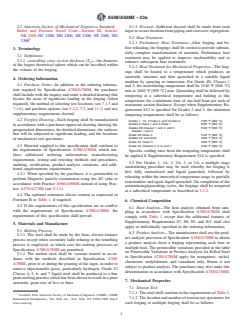
tempering temperatures shall be as follows:
4.2 Forging Drawing—Each forging shall be manufactured
Grades 1, 1A, 2 Class 2, and 3 Class 2 1150 °F [620 °C]
Grades 2 Class 1 and 3 Class 1 1200 °F [650 °C]
in accordance with a purchaser-approved drawing showing the
Grades 4N Classes 1 and 2, and 5 1100 °F [595 °C]
prequenched dimensions, the finished dimensions, the surfaces
Classes 1 and 2
that will be subjected to significant loading, and the locations
Grade 4N Class 3 1125 °F [605 °C]
Grades 3V and 3VCb 1250 °F [675 °C]
of mechanical test specimens.
Grade 22, Class 3 1200 °F [650 °C]
4.3 Material supplied to this specification shall conform to Grade 22, Classes 4, 5, 6, and 7 1100 °F [593 °C]
the requirements of Specification A788/A788M, which out-
Specific cooling rates from the tempering temperature shall
lines additional ordering information, manufacturing
be applied if Supplementary Requirement S14 is specified.
requirements, testing and retesting methods and procedures,
5.3 For Grades 1, 1A, 2, 2A, 3, or 3A, a multiple stage
marking, certification, product analysis variations, and addi-
austenitizing procedure may be used whereby the forging is
tional supplementary requirements.
first fully austenitized and liquid quenched, followed by
4.3.1 When specified by the purchaser, it is permissible to
reheating within the intercritical temperature range to partially
perform Magnetic particle examination using the AC yoke in
reaustenitize and again liquid quenched. On completion of the
accordance with Practice A966/A966M instead of using Prac-
austenitizing/quenching cycles, the forgings shall be tempered
tice A275/A275M (see 9.2.1).
at a subcritical temperature as described in 5.2.2.
4.4 The optional minimum silicon content as expressed in
Footnote B to Table 1, if required.
6. Chemical Composition
4.5 If the requirements of this specification are in conflict
6.1 Heat Analysis—The heat analysis obtained from sam-
with the requirements of Specification A788/A788M, the
pling in accordance with Specification A788/A788M shall
requirements of this specification shall prevail.
comply with Table 1 except that the additional features of
Supplementary Requirements S7, S8, S9, and S11 shall also
5. Materials and Manufacture
apply as individually specified in the ordering information.
5.1 Melting Process:
6.2 Product Analysis—The manufacturer shall use the prod-
5.1.1 The steel shall be made by the basic electric-furnace
uct analysis provision of Specification A788/A788M to obtain
process except when secondary ladle refining or the remelting
a product analysis from a forging representing each heat or
process is employed, in which case the melting processes of
multiple heat. The permissible variations provided in the table
Specification A788/A788M are permitted.
on Permissible Variations in Product Analysis for Killed Steel
5.1.2 The molten steel shall be vacuum treated in accor-
in Specification A788/A788M apply for manganese, nickel,
dance with the methods described in Specification A788/
chromium, molybdenum, and vanadium only. Boron is not
A788M, prior to or during the pouring of the ingot, in order to
subject to product analysis. The purchaser may also make this
remove objectionable gases, particularly hydrogen. Grade 22
determination in accordance with Specification A788/A788M.
Classes 4, 5, 6, and 7 liquid steel shall be produced to a fine
grain melting practice which has been shown to result in a prior
7. Mechanical Properties
austenitic grain size of five or finer.
7.1 Tension Test:
7.1.1 The steel shall conform to the requirements of Table 2.
Available from American Society of Mechanical Engineers (ASME), ASME
7.1.2 The location and number of tension test specimens for
International Headquarters, Two Park Ave., New York, NY 10016-5990, http://
www.asme.org. each forging or multiple forging shall be as follows:
A508/A508M − 23a
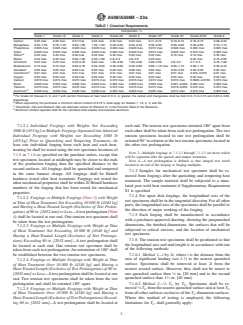
TABLE 1 Chemical Requirements
Composition, %
A
Grade 1 Grade 1A Grade 2 Grade 3 Grade 4N Grade 5 Grade 22 Grade 3V Grade 3VCb Grade 6
Carbon 0.35 max 0.30 max 0.27 max 0.25 max 0.23 max 0.23 max 0.11–0.15 0.10–0.15 0.10–0.15 0.28–0.33
Manganese 0.40–1.05 0.70–1.35 0.50–1.00 1.20–1.50 0.20–0.40 0.20–0.40 0.30–0.60 0.30–0.60 0.30–0.60 0.75–1.15
Phosphorus 0.025 max 0.025 max 0.025 max 0.025 max 0.020 max 0.020 max 0.015 max 0.020 max 0.020 max 0.025 max
Sulfur 0.025 max 0.025 max 0.025 max 0.025 max 0.020 max 0.020 max 0.015 max 0.020 max 0.010 max 0.025 max
B
Silicon 0.40 max 0.40 max 0.40 max 0.40 max 0.40 max 0.30 max 0.35 max 0.10 max 0.10 max 0.35 max
Nickel 0.40 max 0.40 max 0.50–1.00 0.40–1.00 2.8–3.9 2.8–3.9 0.25 max . . . 0.25 max 0.75–0.95
Chromium 0.25 max 0.25 max 0.25–0.45 0.25 max 1.50–2.00 1.50–2.00 2.00–2.50 2.8–3.3 2.7–3.3 0.70–1.00
Molybdenum 0.10 max 0.10 max 0.55–0.70 0.45–0.60 0.40–0.60 0.40–0.60 0.90–1.10 max 0.90–1.10 0.90–1.10 0.30–0.45
Vanadium 0.05 max 0.05 max 0.05 max 0.05 max 0.03 max 0.08 max 0.02 max 0.20–0.30 0.20–0.30 0.05 max
C
Columbium 0.01 max 0.01 max 0.01 max 0.01 max 0.01 max 0.01 max 0.01 max 0.01 max 0.015–0.070 0.01 max
Copper 0.20 max 0.20 max 0.20 max 0.20 max 0.25 max 0.25 max 0.25 max 0.25 max 0.25 max 0.25 max
Calcium 0.015 max 0.015 max 0.015 max 0.015 max 0.015 max 0.015 max 0.015 max 0.015 max 0.0005–0.0150 0.015 max
Boron 0.003 max 0.003 max 0.003 max 0.003 max 0.003 max 0.003 max 0.003 max 0.001–0.003 0.003 max 0.003 max
Titanium 0.015 max 0.015 max 0.015 max 0.015 max 0.015 max 0.015 max 0.015 max 0.015–0.035 0.015 max 0.015 max
D
Aluminum 0.030 max 0.030 max 0.030 max 0.030 max 0.025 max 0.025 max 0.025 max 0.015 max 0.015 max 0.025 max
A
For Grade 22 Classes 5, 6, and 7 with section thickness at heat treat of 8 in. or greater, the carbon and manganese shall be held to 0.13 to 0.15 and 0.50 to 0.60,
respectively.
B
When required by the purchaser a minimum silicon content of 0.15 % shall apply for Grades 1, 1A, 2, 3, and 4N.
C
Columbium (Cb) and Niobium (Nb) are alternate names for Element 41 in the Periodic Table of the Elements.
D
Aluminum content reported shall be the combined total soluble and insoluble aluminum.
7.1.2.1 Individual Forgings with Weights Not Exceeding each end. The tension test specimens oriented 180° apart from
1000 lb [455 kg] or Multiple Forgings Separated into Identical each other shall be taken from each test prolongation. The two
Individual Forgings with Weights not Exceeding 1000 lb tension specimens located in one test prolongation shall be
[455 kg] Prior to Quenching and Tempering Treatment—At oriented 90° in relation to the two tension specimens located in
least one individual forging from each heat and each heat- the other test prolongation.
treating lot shall be tested using the test specimen locations of
NOTE 3—Multiple forgings in 7.1.2.2 through 7.1.2.5 are those which
7.1.5 or 7.1.6 as specified on the purchase orders, except that
will be separated after the quench and temper treatment.
test specimens located at midlength may be closer to the ends
NOTE 4—A test prolongation is defined as that integral test metal
of the production forging than the specified distance to the
located at an end of the forging or forging multiples.
second surfaces. All forgings shall be quenched and tempered
7.1.3 Samples for mechanical test specimen shall be re-
in the same furnace charge. All forgings shall be Brinell
moved from forgings after the quenching and tempering heat
hardness tested after heat treatment. Forgings not tested for
treatment. The sample material shall be subjected to a simu-
other mechanical properties shall be within 20 Brinell hardness
lated post-weld heat treatment if Supplementary Requirement
numbers of the forging that has been tested for mechanical
S1 is specified.
properties.
7.1.4 For upset disk forgings, the longitudinal axis of the
7.1.2.2 Forgings or Multiple Forgings (Note 3) with Weight
test specimens shall be in the tangential direction. For all other
at Time of Heat Treatment Not Exceeding 10 000 lb [4540 kg]
parts, the longitudinal axis of the specimens shall be parallel to
and Having a Heat-Treated Length (Exclusive of Test Prolon-
the direction of major working of the forging.
gation) of 80 in. [2032 mm] or Less—A test prolongation (Note
7.1.5 Each forging shall be manufactured in accordance
4) shall be located at one end. One tension test specimen shall
with a purchaser-approved drawing, showing the prequenched
be taken from the test prolongation.
dimensions, the finished dimensions, the surfaces that will be
7.1.2.3 Forgings or Multiple Forgings with Weight at Time
subjected to critical stresses, and the location of mechanical
of Heat Treatment Not Exceeding 10 000 lb [4540 kg] and
test specimens.
Having a Heat-Treated Length (Exclusive of Test Prolonga-
7.1.6 The tension test specimens shall be positioned so that
tions) Exceeding 80 in. [2032 mm]—A test prolongation shall
the longitudinal axis and mid-length is in accordance with one
be located at each end. One tension test specimen shall be
of the following methods:
taken from each test prolongation. An orientation of 180° shall
7.1.6.1 Method 1—t by 2t, where t is the distance from the
be established between the two tension test specimens.
area of significant loading (see 4.1) to the nearest quenched
7.1.2.4 Forgings or Multiple Forgings with Weight at Time
surface. Specimens shall be removed at least 2t from the
of Heat Treatment Over 10 000 lb [4540 kg] and Having a
nearest second surface. However, they shall not be nearer to
Heat-Treated Length (Exclusive of Test Prolongation) of 80 in.
one quenched surface than ⁄4 in. [20 mm] and to the second
[2032 mm] or Less—A test prolongation shall be located at one
quenched surface than 1 ⁄2 in. [40 mm].
end. Two tension test specimens shall be taken from the test
prolongation and shall be oriented 180° apart. 7.1.6.2 Method 2— ⁄4 T by T . Specimens shall be re-
C C
7.1.2.5 Forgings or Multiple Forgings with Weight at Time moved ⁄4 T from the nearest quenched surface and at least T
C C
of Heat Treatment Over 10 000 lb [4540 kg] and Having a from all other surfaces exclusive of the T dimension surfaces.
C
Heat-Treated Length (Exclusive of Test Prolongations) Exceed- Where this method of testing is employed, the following
ing 80 in. [2032 mm]—A test prolongation shall be located at limitations for T shall generally apply:
C
A508/A508M − 23a
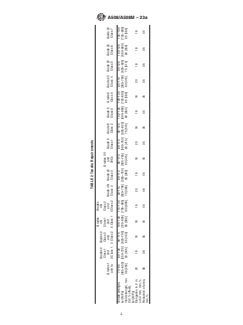
TABLE 2 Tensile Requirements
Grades Grades
Grades 2 Grades 2 4N 4N
Class 1 Class 2 Class 1 Class 2 Grades 3V
Grades 1 and and and and Grade 4N Grade 22 and Grade 6 Grade 6 Grade 6 Grade 6 Grade 22 Grade 22 Grade 22 Grade 22
and 1a 3 Class 1 3 Class 2 5 Class 1 5 Class 2 Class 3 Class 3 3VCb Class 1 Class 2 Class 3 Class 4 Class 4 Class 5 Class 6 Class 7
Tensile strength, 70–95 80–105 90–115 105–130 115–140 90–115 85–110 85–110 85–110 95–120 100–125 105–130 85–110 95–120 100–125 105–130
ksi [MPa] [485–655] [550–725] [620–795] [725–895] [795–965] [620–795] [585–760] [585–760] [585–760] [655–825] [690–860] [725–895] [585–760] [655–825] [690–860] [725–895]
Yield strength, min 36 [250] 50 [345] 65 [450] 85 [585] 100 [690] 70 [485] 55 [380] 60 [415] 60 [415] 75 [515] 80 [550] 85 [585] 60 [415] 75 [515] 80 [550] 85 [585]
[0.2 % offset],
ksi [MPa]
Elongation in 2 in. 20 18 16 18 16 20 18 18 20 18 18 18 20 18 18 18
or 50 mm, min, %
Reduction of area, 38 38 35 45 45 48 45 45 35 35 35 35 35 35 35 35
min, %
A508
...
This document is not an ASTM standard and is intended only to provide the user of an ASTM standard an indication of what changes have been made to the previous version. Because
it may not be technically possible to adequately depict all changes accurately, ASTM recommends that users consult prior editions as appropriate. In all cases only the current version
of the standard as published by ASTM is to be considered the official document.
Designation: A508/A508M − 23 A508/A508M − 23a
Standard Specification for
Quenched and Tempered Vacuum-Treated Carbon and Alloy
Steel Forgings for Pressure Vessels
This standard is issued under the fixed designation A508/A508M; the number immediately following the designation indicates the year
of original adoption or, in the case of revision, the year of last revision. A number in parentheses indicates the year of last reapproval.
A superscript epsilon (´) indicates an editorial change since the last revision or reapproval.
This standard has been approved for use by agencies of the U.S. Department of Defense.
1. Scope*
1.1 This specification covers quenched and tempered vacuum-treated carbon and alloy steel forgings for pressure vessels such
as those used in reactor systems. Specifically, it covers forgings for vessel closures, shells, flanges, tube sheets, rings, heads, and
similar parts.
1.2 All grades are considered weldable under proper conditions. Welding technique is of fundamental importance, and it is
presupposed that welding procedure and inspection will be in accordance with approved methods for the grade of material used.
1.3 The values stated in either SI units or inch-pound units are to be regarded separately as standard. The values stated in each
system may not be exact equivalents; therefore, each system shall be used independently of the other. Combining values from the
two systems may result in non-conformance with the standard.
1.4 Unless the order specifies the applicable “M” specification designation, the material shall be furnished to the inch-pound units.
NOTE 1—Grades 1 and 1A are composed of different chemistries but have the same mechanical requirements.
NOTE 2—Designations have been changed as follows:
Current Formerly
Grade 1 Class 1
Grade 1A Class 1A
Grade 2 Class 1 Class 2
Grade 2 Class 2 Class 2A
Grade 3 Class 1 Class 3
Grade 3 Class 2 Class 3A
Grade 4N Class 1 Class 4
Grade 4N Class 2 Class 4A
Grade 4N Class 3 Class 4B
Grade 5 Class 1 Class 5
Grade 5 Class 2 Class 5A
Grade 22 Class 3 Class 22B
Grade 22 Classes 4, 5, 6, and 7
Grade 3V Class 3V
This specification is under the jurisdiction of ASTM Committee A01 on Steel, Stainless Steel and Related Alloys and is the direct responsibility of Subcommittee A01.06
on Steel Forgings and Billets.
Current edition approved Sept. 1, 2023Nov. 1, 2023. Published November 2023. Originally approved in 1964. Last previous edition approved in 2023 as A508/A508M – 18
(2023).A508/A508M – 23. DOI: 10.1520/A0508_A0508M-23.10.1520/A0508_A0508M-23A.
For ASME Boiler and Pressure Vessel Code applications see related Specification SA-508/SA-508M in Section II of that Code.
*A Summary of Changes section appears at the end of this standard
Copyright © ASTM International, 100 Barr Harbor Drive, PO Box C700, West Conshohocken, PA 19428-2959. United States
A508/A508M − 23a
1.5 This standard does not purport to address all of the safety concerns, if any, associated with its use. It is the responsibility
of the user of this standard to establish appropriate safety, health, and environmental practices and determine the applicability of
regulatory limitations prior to use.
1.6 This international standard was developed in accordance with internationally recognized principles on standardization
established in the Decision on Principles for the Development of International Standards, Guides and Recommendations issued
by the World Trade Organization Technical Barriers to Trade (TBT) Committee.
2. Referenced Documents
2.1 ASTM Standards:
A275/A275M Practice for Magnetic Particle Examination of Steel Forgings
A370 Test Methods and Definitions for Mechanical Testing of Steel Products
A388/A388M Practice for Ultrasonic Examination of Steel Forgings
A788/A788M Specification for Steel Forgings, General Requirements
A966/A966M Practice for Magnetic Particle Examination of Steel Forgings Using Alternating Current
E208 Test Method for Conducting Drop-Weight Test to Determine Nil-Ductility Transition Temperature of Ferritic Steels
E428 Practice for Fabrication and Control of Metal, Other than Aluminum, Reference Blocks Used in Ultrasonic Testing
(Withdrawn 2019)
2.2 American Society of Mechanical Engineers Standard:
Boiler and Pressure Vessel Code—Section III, Articles NB 2300, NC 2300, ND 2300, NE 2300, NF 2300, NG 2300
3. Terminology
3.1 Definitions:
3.1.1 controlling cross section thickness (T )—the diameter of the largest theoretical sphere which can be inscribed within the
C
volume of the forging.
4. Ordering Information
4.1 Purchase Order—In addition to the ordering information required by Specification A788/A788M, the purchaser shall include
with the inquiry and order a detailed drawing that locates the areas of significant loading in the forging (when required), the method
of selecting test locations (see 7.1.5 and 7.1.6), and purchase options (see 5.2.2, 7.2, and 11.1) and any supplementary requirements
desired.
4.2 Forging Drawing—Each forging shall be manufactured in accordance with a purchaser-approved drawing showing the
prequenched dimensions, the finished dimensions, the surfaces that will be subjected to significant loading, and the locations of
mechanical test specimens.
4.3 Material supplied to this specification shall conform to the requirements of Specification A788/A788M, which outlines
additional ordering information, manufacturing requirements, testing and retesting methods and procedures, marking, certification,
product analysis variations, and additional supplementary requirements.
4.3.1 When specified by the purchaser, it is permissible to perform Magnetic particle examination using the AC yoke in
accordance with Practice A966/A966M instead of using Practice A275/A275M (see 9.2.1).
4.4 The optional minimum silicon content as expressed in Footnote B to Table 1, if required.
4.5 If the requirements of this specification are in conflict with the requirements of Specification A788/A788M, the requirements
of this specification shall prevail.
For referenced ASTM standards, visit the ASTM website, www.astm.org, or contact ASTM Customer Service at service@astm.org. For Annual Book of ASTM Standards
volume information, refer to the standard’s Document Summary page on the ASTM website.
The last approved version of this historical standard is referenced on www.astm.org.
Available from American Society of Mechanical Engineers (ASME), ASME International Headquarters, Two Park Ave., New York, NY 10016-5990, http://
www.asme.org.
A508/A508M − 23a
TABLE 1 Chemical Requirements
Composition, %
A
Grade 1 Grade 1A Grade 2 Grade 3 Grade 4N Grade 5 Grade 22 Grade 3V Grade 3VCb Grade 6
Carbon 0.35 max 0.30 max 0.27 max 0.25 max 0.23 max 0.23 max 0.11–0.15 0.10–0.15 0.10–0.15 0.28–0.33
Manganese 0.40–1.05 0.70–1.35 0.50–1.00 1.20–1.50 0.20–0.40 0.20–0.40 0.30–0.60 0.30–0.60 0.30–0.60 0.75–1.15
Phosphorus 0.025 max 0.025 max 0.025 max 0.025 max 0.020 max 0.020 max 0.015 max 0.020 max 0.020 max 0.025 max
Sulfur 0.025 max 0.025 max 0.025 max 0.025 max 0.020 max 0.020 max 0.015 max 0.020 max 0.010 max 0.025 max
B
Silicon 0.40 max 0.40 max 0.40 max 0.40 max 0.40 max 0.30 max 0.35 max 0.10 max 0.10 max 0.35 max
Nickel 0.40 max 0.40 max 0.50–1.00 0.40–1.00 2.8–3.9 2.8–3.9 0.25 max . . . 0.25 max 0.75–0.95
Chromium 0.25 max 0.25 max 0.25–0.45 0.25 max 1.50–2.00 1.50–2.00 2.00–2.50 2.8–3.3 2.7–3.3 0.70–1.00
Molybdenum 0.10 max 0.10 max 0.55–0.70 0.45–0.60 0.40–0.60 0.40–0.60 0.90–1.10 max 0.90–1.10 0.90–1.10 0.30–0.45
Vanadium 0.05 max 0.05 max 0.05 max 0.05 max 0.03 max 0.08 max 0.02 max 0.20–0.30 0.20–0.30 0.05 max
C
Columbium 0.01 max 0.01 max 0.01 max 0.01 max 0.01 max 0.01 max 0.01 max 0.01 max 0.015–0.070 0.01 max
Copper 0.20 max 0.20 max 0.20 max 0.20 max 0.25 max 0.25 max 0.25 max 0.25 max 0.25 max 0.25 max
Calcium 0.015 max 0.015 max 0.015 max 0.015 max 0.015 max 0.015 max 0.015 max 0.015 max 0.0005–0.0150 0.015 max
Boron 0.003 max 0.003 max 0.003 max 0.003 max 0.003 max 0.003 max 0.003 max 0.001–0.003 0.003 max 0.003 max
Titanium 0.015 max 0.015 max 0.015 max 0.015 max 0.015 max 0.015 max 0.015 max 0.015–0.035 0.015 max 0.015 max
D
Aluminum 0.030 max 0.030 max 0.030 max 0.030 max 0.025 max 0.025 max 0.025 max 0.015 max 0.015 max 0.025 max
A
For Grade 22 Classes 5, 6, and 7 with section thickness at heat treat of 8 in. or greater, the carbon and manganese shall be held to 0.13 to 0.15 and 0.50 to 0.60,
respectively.
B
When required by the purchaser a minimum silicon content of 0.15 % shall apply for Grades 1, 1A, 2, 3, and 4N.
C
Columbium (Cb) and Niobium (Nb) are alternate names for Element 41 in the Periodic Table of the Elements.
D
Aluminum content reported shall be the combined total soluble and insoluble aluminum.
5. Materials and Manufacture
5.1 Melting Process:
5.1.1 The steel shall be made by the basic electric-furnace process except when secondary ladle refining or the remelting process
is employed, in which case the melting processes of Specification A788/A788M are permitted.
5.1.2 The molten steel shall be vacuum treated in accordance with the methods described in Specification A788/A788M, prior to
or during the pouring of the ingot, in order to remove objectionable gases, particularly hydrogen. Grade 22 Classes 4, 5, 6, and
7 liquid steel shall be produced to a fine grain melting practice which has been shown to result in a prior austenitic grain size of
five or finer.
5.1.3 Discard—Sufficient discard shall be made from each ingot to secure freedom from piping and excessive segregation.
5.2 Heat Treatment:
5.2.1 Preliminary Heat Treatment—After forging and before reheating, the forgings shall be cooled to provide substantially
complete transformation of austenite. Preliminary heat treatment may be applied to improve machinability and to enhance
subsequent heat treatments.
5.2.2 Heat Treatment for Mechanical Properties—The forgings shall be heated to a temperature which produces an austenitic
structure and then quenched in a suitable liquid medium by spraying or immersion. For Grade 4N, Classes 1 and 3, the austenitizing
temperature shall be 1540 °F [840 °C] min to 1640 °F [895 °C] max. Quenching shall be followed by tempering at a subcritical
temperature and holding at this temperature for a minimum time of one-half hour per inch of maximum section thickness. Except
when Supplementary Requirement S13 is specified for Grades 2 and 3, the minimum tempering temperatures shall be as follows:
Grades 1, 1A, 2 Class 2, and 3 Class 2 1150 °F [620 °C]
Grades 2 Class 1 and 3 Class 1 1200 °F [650 °C]
Grades 4N Classes 1 and 2, and 5 1100 °F [595 °C]
Classes 1 and 2
Grade 4N Class 3 1125 °F [605 °C]
Grades 3V and 3VCb 1250 °F [675 °C]
Grade 22, Class 3 1200 °F [650 °C]
Grade 22, Classes 4, 5, 6, and 7 1100 °F [593 °C]
Specific cooling rates from the tempering temperature shall be applied if Supplementary Requirement S14 is specified.
5.3 For Grades 1, 1A, 2, 2A, 3, or 3A, a multiple stage austenitizing procedure may be used whereby the forging is first fully
A508/A508M − 23a
austenitized and liquid quenched, followed by reheating within the intercritical temperature range to partially reaustenitize and
again liquid quenched. On completion of the austenitizing/quenching cycles, the forgings shall be tempered at a subcritical
temperature as described in 5.2.2.
6. Chemical Composition
6.1 Heat Analysis—The heat analysis obtained from sampling in accordance with Specification A788/A788M shall comply with
Table 1 except that the additional features of Supplementary Requirements S7, S8, S9, and S11 shall also apply as individually
specified in the ordering information.
6.2 Product Analysis—The manufacturer shall use the product analysis provision of Specification A788/A788M to obtain a
product analysis from a forging representing each heat or multiple heat. The permissible variations provided in the table on
Permissible Variations in Product Analysis for Killed Steel in Specification A788/A788M apply for manganese, nickel, chromium,
molybdenum, and vanadium only. Boron is not subject to product analysis. The purchaser may also make this determination in
accordance with Specification A788/A788M.
7. Mechanical Properties
7.1 Tension Test:
7.1.1 The steel shall conform to the requirements of Table 2.
7.1.2 The location and number of tension test specimens for each forging or multiple forging shall be as follows:
7.1.2.1 Individual Forgings with Weights Not Exceeding 1000 lb [455 kg] or Multiple Forgings Separated into Identical Individual
Forgings with Weights not Exceeding 1000 lb [455 kg] Prior to Quenching and Tempering Treatment—At least one individual
forging from each heat and each heat-treating lot shall be tested using the test specimen locations of 7.1.5 or 7.1.6 as specified on
the purchase orders, except that test specimens located at midlength may be closer to the ends of the production forging than the
specified distance to the second surfaces. All forgings shall be quenched and tempered in the same furnace charge. All forgings
shall be Brinell hardness tested after heat treatment and forgings treatment. Forgings not tested for other mechanical properties
shall have a Brinell Hardness within 20 points of the Brinell Hardness be within 20 Brinell hardness numbers of the forging that
has been tested for mechanical properties.
7.1.2.2 Forgings or Multiple Forgings (Note 3) with Weight at Time of Heat Treatment Not Exceeding 10 000 lb [4540 kg] and
Having a Heat-Treated Length (Exclusive of Test Prolongation) of 80 in. [2032 mm] or Less—A test prolongation (Note 4) shall
be located at one end. One tension test specimen shall be taken from the test prolongation.
7.1.2.3 Forgings or Multiple Forgings with Weight at Time of Heat Treatment Not Exceeding 10 000 lb [4540 kg] and Having a
Heat-Treated Length (Exclusive of Test Prolongations) Exceeding 80 in. [2032 mm]—A test prolongation shall be located at each
end. One tension test specimen shall be taken from each test prolongation. An orientation of 180° shall be established between the
two tension test specimens.
7.1.2.4 Forgings or Multiple Forgings with Weight at Time of Heat Treatment Over 10 000 lb [4540 kg] and Having a
Heat-Treated Length (Exclusive of Test Prolongation) of 80 in. [2032 mm] or Less—A test prolongation shall be located at one end.
Two tension test specimens shall be taken from the test prolongation and shall be oriented 180° apart.
7.1.2.5 Forgings or Multiple Forgings with Weight at Time of Heat Treatment Over 10 000 lb [4540 kg] and Having a
Heat-Treated Length (Exclusive of Test Prolongations) Exceeding 80 in. [2032 mm]—A test prolongation shall be located at each
end. The tension test specimens oriented 180° apart from each other shall be taken from each test prolongation. The two tension
specimens located in one test prolongation shall be oriented 90° in relation to the two tension specimens located in the other test
prolongation.
NOTE 3—Multiple forgings in 7.1.2.2 through 7.1.2.5 are those which will be separated after the quench and temper treatment.
NOTE 4—A test prolongation is defined as that integral test metal located at an end of the forging or forging multiples.
7.1.3 Samples for mechanical test specimen shall be removed from forgings after the quenching and tempering heat treatment. The
sample material shall be subjected to a simulated post-weld heat treatment if Supplementary Requirement S1 is specified.
A508/A508M − 23a
TABLE 2 Tensile Requirements
Grades Grades
Grades 2 Grades 2 4N 4N
Class 1 Class 2 Class 1 Class 2 Grades 3V
Grades 1 and and and and Grade 4N Grade 22 and Grade 6 Grade 6 Grade 6 Grade 6 Grade 22 Grade 22 Grade 22 Grade 22
and 1a 3 Class 1 3 Class 2 5 Class 1 5 Class 2 Class 3 Class 3 3VCb Class 1 Class 2 Class 3 Class 4 Class 4 Class 5 Class 6 Class 7
Tensile strength, 70–95 80–105 90–115 105–130 115–140 90–115 85–110 85–110 85–110 95–120 100–125 105–130 85–110 95–120 100–125 105–130
ksi [MPa] [485–655] [550–725] [620–795] [725–895] [795–965] [620–795] [585–760] [585–760] [585–760] [655–825] [690–860] [725–895] [585–760] [655–825] [690–860] [725–895]
Yield strength, min 36 [250] 50 [345] 65 [450] 85 [585] 100 [690] 70 [485] 55 [380] 60 [415] 60 [415] 75 [515] 80 [550] 85 [585] 60 [415] 75 [515] 80 [550] 85 [585]
[0.2 % offset],
ksi [MPa]
Elongation in 2 in. 20 18 16 18 16 20 18 18 20 18 18 18 20 18 18 18
or 50 mm, min, %
Reduction of area, 38 38 35 45 45 48 45 45 35 35 35 35 35 35 35 35
min, %
A508/A508M − 23a
7.1.4 For upset disk forgings, the longitudinal axis of the test specimens shall be in the tangential direction. For all other parts,
the longitudinal axis of the specimens shall be parallel to the direction of major working of the forging.
7.1.5 Each forging shall be manufactured in accordance with a purchaser-approved drawing, showing the prequenched
dimensions, the finished dimensions, the surfaces that will be subjected to critical stresses, and the location of mechanical test
specimens.
7.1.6 The tension test specimens shall be positioned so that the longitudinal axis and mid-length is in accordance with one of the
following methods:
7.1.6.1 Method 1—t by 2t, where t is the distance from the area of significant loading (see 4.1) to the nearest quenched surface.
Specimens shall be removed at least 2t from the nearest second surface. However, they shall not be nearer to one quenched surface
3 1
than ⁄4 in. [20 mm] and to the second quenched surface than 1 ⁄2 in. [40 mm].
1 1
7.1.6.2 Method 2— ⁄4 T by T . Specimens shall be removed ⁄4 T from the nearest quenched surface and at least T from all
C C C C
other surfaces exclusive of the T dimension surfaces. Where this
...