

ASTM A182/A182M-24
(Specification)Standard Specification for Forged or Rolled Alloy and Stainless Steel Pipe Flanges, Forged Fittings, and Valves and Parts for High-Temperature Service
General Information
- Abstract
ABSTRACT
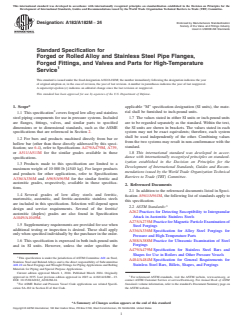
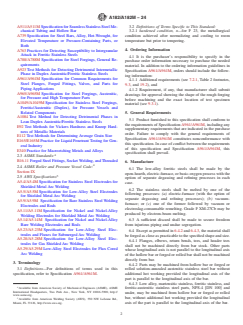
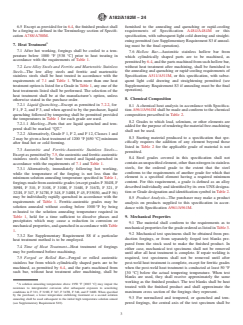
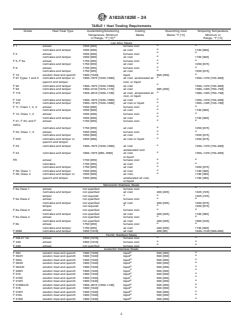
This specification covers forged or rolled alloy and stainless steel pipe flanges, forged fittings, and valves and parts for high-temperature service. After hot working, forgings shall be cooled to a specific temperature prior to heat treatment, which shall be performed in accordance with certain requirements such as heat treatment type, austenitizing/solution temperature, cooling media, and quenching. The materials shall conform to the required chemical composition for carbon, manganese, phosphorus, silicon, nickel, chromium, molybdenum, columbium, titanium. The material shall conform to the requirements as to mechanical properties for the grade ordered such as tensile strength, yield strength, elongation, Brinell hardness. All H grades and grade F 63 shall be tested for average grain size.
SCOPE
1.1 This specification2 covers forged low alloy and stainless steel piping components for use in pressure systems. Included are flanges, fittings, valves, and similar parts to specified dimensions or to dimensional standards, such as the ASME specifications that are referenced in Section 2.
1.2 For bars and products machined directly from bar or hollow bar (other than those directly addressed by this specification; see 6.4), refer to Specifications A479/A479M, A739, or A511/A511M for the similar grades available in those specifications.
1.3 Products made to this specification are limited to a maximum weight of 10 000 lb [4540 kg]. For larger products and products for other applications, refer to Specifications A336/A336M and A965/A965M for the similar ferritic and austenitic grades, respectively, available in those specifications.
1.4 Several grades of low alloy steels and ferritic, martensitic, austenitic, and ferritic-austenitic stainless steels are included in this specification. Selection will depend upon design and service requirements. Several of the ferritic/austenitic (duplex) grades are also found in Specification A1049/A1049M.
1.5 Supplementary requirements are provided for use when additional testing or inspection is desired. These shall apply only when specified individually by the purchaser in the order.
1.6 This specification is expressed in both inch-pound units and in SI units. However, unless the order specifies the applicable “M” specification designation (SI units), the material shall be furnished to inch-pound units.
1.7 The values stated in either SI units or inch-pound units are to be regarded separately as the standard. Within the text, the SI units are shown in brackets. The values stated in each system may not be exact equivalents; therefore, each system shall be used independently of the other. Combining values from the two systems may result in non-conformance with the standard.
1.8 This international standard was developed in accordance with internationally recognized principles on standardization established in the Decision on Principles for the Development of International Standards, Guides and Recommendations issued by the World Trade Organization Technical Barriers to Trade (TBT) Committee.
- Status
- Published
- Publication Date
- 29-Feb-2024
- Technical Committee
- A01 - Steel, Stainless Steel and Related Alloys
Buy Documents
ASTM A182/A182M-24 - Standard Specification for Forged or Rolled Alloy and Stainless Steel Pipe Flanges, Forged Fittings, and Valves and Parts for High-Temperature Service
REDLINE ASTM A182/A182M-24 - Standard Specification for Forged or Rolled Alloy and Stainless Steel Pipe Flanges, Forged Fittings, and Valves and Parts for High-Temperature Service
Overview
ASTM A182/A182M-24 is a globally recognized standard specifying requirements for forged or rolled alloy and stainless steel pipe flanges, forged fittings, valves, and parts designed for high-temperature service. Developed by ASTM International, this standard supports safe, reliable piping systems in demanding pressure applications. It is referenced by major organizations such as the U.S. Department of Defense and the USDOE-NE. The standard enhances material selection, manufacturing practices, and testing procedures to assure quality and compliance in critical systems.
Key Topics
- Scope and Materials: Covers a broad range of low alloy and stainless steels, including ferritic, martensitic, austenitic, and duplex (ferritic-austenitic) grades. Selection is determined by design and operational requirements.
- Product Range: Applies to pipe flanges, forged fittings, valves, and similar components up to 10,000 lb (4,540 kg). For heavier products or alternate applications, related ASTM standards are referenced.
- Heat Treatment: Specifies controlled heat treatment processes for each material grade, including annealing, normalizing, tempering, and solution treating. Proper cooling and quenching methods are essential for achieving required properties.
- Chemical Composition: Establishes detailed chemical requirements for all major alloying elements, including carbon, manganese, chromium, nickel, molybdenum, titanium, and columbium (niobium). Free-machining and certain other modified alloys are excluded.
- Mechanical Properties: Defines minimum standards for tensile strength, yield strength, elongation, and Brinell hardness for each grade. All "H" grades and Grade F 63 require grain size testing.
- Testing and Inspection: Includes supplementary requirements for nondestructive testing, such as magnetic particle, liquid penetrant, and ultrasonic examination, when specified by the purchaser.
- Dimensional Standards: Products may be supplied to specified dimensions or to widely recognized dimensional standards, including ASME references.
Applications
ASTM A182/A182M-24 is integral to industries where piping components operate in high-temperature or high-pressure environments, including:
- Power Generation: Used in fossil-fuel and nuclear power plants for piping systems and steam lines.
- Petrochemical and Refining: Essential for processing units, pressure vessels, and heat exchangers handling corrosive and high-temperature fluids.
- Oil & Gas: Applied heavily in upstream, midstream, and downstream sectors, especially for gathering lines and refinery piping.
- Chemical Processing: Ensures mechanical integrity of process piping in aggressive environments.
- Industrial Boilers and Pressure Vessels: Critical for the manufacture of safe, reliable pressure boundaries under thermal stress.
Compliance with ASTM A182/A182M-24 ensures components perform safely under cyclic thermal loading, pressurization, and corrosive exposure.
Related Standards
Understanding and implementing ASTM A182/A182M-24 often involves consulting additional standards to ensure full compliance and optimal material performance:
- ASTM A479/A479M: Stainless steel bars and shapes for boilers and pressure vessels
- ASTM A336/A336M: Alloy steel forgings for high-temperature parts
- ASTM A965/A965M: Forged austenitic stainless steel for pressure and high-temperature parts
- ASTM A961/A961M: Common requirements for steel flanges, fittings, and valves
- ASME B16.11: Forged steel fittings, socket-welding, and threaded
- ASME Boiler and Pressure Vessel Code (Section II): For code compliance in pressure applications
- AWS A5 series: Welding consumables for alloy and stainless steels
Conclusion
ASTM A182/A182M-24 plays a vital role in regulating the quality, safety, and performance of forged alloy and stainless steel components used in critical high-temperature and pressure piping systems worldwide. By adhering to this standard and integrating related standards, companies ensure their products meet stringent international requirements for safety, reliability, and performance in some of the most demanding industrial applications.
Relations
- Effective Date
- 01-Mar-2024
- Effective Date
- 01-Mar-2024
- Referred By
ASTM F1511-18(2023) - Standard Specification for Mechanical Seals for Shipboard Pump Applications - Effective Date
- 01-Mar-2024
- Effective Date
- 01-Mar-2024
- Referred By
ASTM F987-04(2022) - Standard Specification for Portable Intermediate Flush Deck Stanchion - Effective Date
- 01-Mar-2024
- Effective Date
- 01-Mar-2024
- Effective Date
- 01-Mar-2024
- Effective Date
- 01-Mar-2024
- Referred By
ASTM F1155-10(2019) - Standard Practice for Selection and Application of Piping System Materials - Effective Date
- 01-Mar-2024
- Effective Date
- 01-Mar-2024
- Referred By
ASTM F1565-00(2019) - Standard Specification for Pressure-Reducing Valves for Steam Service - Effective Date
- 01-Mar-2024
Buy Documents
ASTM A182/A182M-24 - Standard Specification for Forged or Rolled Alloy and Stainless Steel Pipe Flanges, Forged Fittings, and Valves and Parts for High-Temperature Service
REDLINE ASTM A182/A182M-24 - Standard Specification for Forged or Rolled Alloy and Stainless Steel Pipe Flanges, Forged Fittings, and Valves and Parts for High-Temperature Service
Get Certified
Connect with accredited certification bodies for this standard

Institut za varilstvo d.o.o. (Welding Institute)
Slovenia's leading welding institute since 1952. ISO 3834, EN 1090, pressure equipment certification, NDT personnel, welder qualification. Only IIW Au
Sponsored listings
Frequently Asked Questions
ASTM A182/A182M-24 is a technical specification published by ASTM International. Its full title is "Standard Specification for Forged or Rolled Alloy and Stainless Steel Pipe Flanges, Forged Fittings, and Valves and Parts for High-Temperature Service". This standard covers: ABSTRACT This specification covers forged or rolled alloy and stainless steel pipe flanges, forged fittings, and valves and parts for high-temperature service. After hot working, forgings shall be cooled to a specific temperature prior to heat treatment, which shall be performed in accordance with certain requirements such as heat treatment type, austenitizing/solution temperature, cooling media, and quenching. The materials shall conform to the required chemical composition for carbon, manganese, phosphorus, silicon, nickel, chromium, molybdenum, columbium, titanium. The material shall conform to the requirements as to mechanical properties for the grade ordered such as tensile strength, yield strength, elongation, Brinell hardness. All H grades and grade F 63 shall be tested for average grain size. SCOPE 1.1 This specification2 covers forged low alloy and stainless steel piping components for use in pressure systems. Included are flanges, fittings, valves, and similar parts to specified dimensions or to dimensional standards, such as the ASME specifications that are referenced in Section 2. 1.2 For bars and products machined directly from bar or hollow bar (other than those directly addressed by this specification; see 6.4), refer to Specifications A479/A479M, A739, or A511/A511M for the similar grades available in those specifications. 1.3 Products made to this specification are limited to a maximum weight of 10 000 lb [4540 kg]. For larger products and products for other applications, refer to Specifications A336/A336M and A965/A965M for the similar ferritic and austenitic grades, respectively, available in those specifications. 1.4 Several grades of low alloy steels and ferritic, martensitic, austenitic, and ferritic-austenitic stainless steels are included in this specification. Selection will depend upon design and service requirements. Several of the ferritic/austenitic (duplex) grades are also found in Specification A1049/A1049M. 1.5 Supplementary requirements are provided for use when additional testing or inspection is desired. These shall apply only when specified individually by the purchaser in the order. 1.6 This specification is expressed in both inch-pound units and in SI units. However, unless the order specifies the applicable “M” specification designation (SI units), the material shall be furnished to inch-pound units. 1.7 The values stated in either SI units or inch-pound units are to be regarded separately as the standard. Within the text, the SI units are shown in brackets. The values stated in each system may not be exact equivalents; therefore, each system shall be used independently of the other. Combining values from the two systems may result in non-conformance with the standard. 1.8 This international standard was developed in accordance with internationally recognized principles on standardization established in the Decision on Principles for the Development of International Standards, Guides and Recommendations issued by the World Trade Organization Technical Barriers to Trade (TBT) Committee.
ABSTRACT This specification covers forged or rolled alloy and stainless steel pipe flanges, forged fittings, and valves and parts for high-temperature service. After hot working, forgings shall be cooled to a specific temperature prior to heat treatment, which shall be performed in accordance with certain requirements such as heat treatment type, austenitizing/solution temperature, cooling media, and quenching. The materials shall conform to the required chemical composition for carbon, manganese, phosphorus, silicon, nickel, chromium, molybdenum, columbium, titanium. The material shall conform to the requirements as to mechanical properties for the grade ordered such as tensile strength, yield strength, elongation, Brinell hardness. All H grades and grade F 63 shall be tested for average grain size. SCOPE 1.1 This specification2 covers forged low alloy and stainless steel piping components for use in pressure systems. Included are flanges, fittings, valves, and similar parts to specified dimensions or to dimensional standards, such as the ASME specifications that are referenced in Section 2. 1.2 For bars and products machined directly from bar or hollow bar (other than those directly addressed by this specification; see 6.4), refer to Specifications A479/A479M, A739, or A511/A511M for the similar grades available in those specifications. 1.3 Products made to this specification are limited to a maximum weight of 10 000 lb [4540 kg]. For larger products and products for other applications, refer to Specifications A336/A336M and A965/A965M for the similar ferritic and austenitic grades, respectively, available in those specifications. 1.4 Several grades of low alloy steels and ferritic, martensitic, austenitic, and ferritic-austenitic stainless steels are included in this specification. Selection will depend upon design and service requirements. Several of the ferritic/austenitic (duplex) grades are also found in Specification A1049/A1049M. 1.5 Supplementary requirements are provided for use when additional testing or inspection is desired. These shall apply only when specified individually by the purchaser in the order. 1.6 This specification is expressed in both inch-pound units and in SI units. However, unless the order specifies the applicable “M” specification designation (SI units), the material shall be furnished to inch-pound units. 1.7 The values stated in either SI units or inch-pound units are to be regarded separately as the standard. Within the text, the SI units are shown in brackets. The values stated in each system may not be exact equivalents; therefore, each system shall be used independently of the other. Combining values from the two systems may result in non-conformance with the standard. 1.8 This international standard was developed in accordance with internationally recognized principles on standardization established in the Decision on Principles for the Development of International Standards, Guides and Recommendations issued by the World Trade Organization Technical Barriers to Trade (TBT) Committee.
ASTM A182/A182M-24 is classified under the following ICS (International Classification for Standards) categories: 23.040.40 - Metal fittings; 23.040.60 - Flanges, couplings and joints. The ICS classification helps identify the subject area and facilitates finding related standards.
ASTM A182/A182M-24 has the following relationships with other standards: It is inter standard links to ASTM A182/A182M-23, ASTM F1508-96(2021), ASTM F1511-18(2023), ASTM F1387-23, ASTM F987-04(2022), ASTM F1545-15a(2021), ASTM A961/A961M-23, ASTM A1049/A1049M-18(2023), ASTM F1155-10(2019), ASTM F721-18(2022), ASTM F1565-00(2019). Understanding these relationships helps ensure you are using the most current and applicable version of the standard.
ASTM A182/A182M-24 is available in PDF format for immediate download after purchase. The document can be added to your cart and obtained through the secure checkout process. Digital delivery ensures instant access to the complete standard document.
Standards Content (Sample)
This international standard was developed in accordance with internationally recognized principles on standardization established in the Decision on Principles for the
Development of International Standards, Guides and Recommendations issued by the World Trade Organization Technical Barriers to Trade (TBT) Committee.
Designation: A182/A182M − 24 Endorsed by Manufacturers Standardization
Society of the Valve and Fittings Industry
Used in USDOE-NE Standards
Standard Specification for
Forged or Rolled Alloy and Stainless Steel Pipe Flanges,
Forged Fittings, and Valves and Parts for High-Temperature
Service
This standard is issued under the fixed designation A182/A182M; the number immediately following the designation indicates the year
of original adoption or, in the case of revision, the year of last revision. A number in parentheses indicates the year of last reapproval.
A superscript epsilon (´) indicates an editorial change since the last revision or reapproval.
This standard has been approved for use by agencies of the U.S. Department of Defense.
1. Scope* applicable “M” specification designation (SI units), the mate-
2 rial shall be furnished to inch-pound units.
1.1 This specification covers forged low alloy and stainless
steel piping components for use in pressure systems. Included 1.7 The values stated in either SI units or inch-pound units
are flanges, fittings, valves, and similar parts to specified are to be regarded separately as the standard. Within the text,
dimensions or to dimensional standards, such as the ASME the SI units are shown in brackets. The values stated in each
specifications that are referenced in Section 2. system may not be exact equivalents; therefore, each system
shall be used independently of the other. Combining values
1.2 For bars and products machined directly from bar or
from the two systems may result in non-conformance with the
hollow bar (other than those directly addressed by this speci-
standard.
fication; see 6.4), refer to Specifications A479/A479M, A739,
1.8 This international standard was developed in accor-
or A511/A511M for the similar grades available in those
dance with internationally recognized principles on standard-
specifications.
ization established in the Decision on Principles for the
1.3 Products made to this specification are limited to a
Development of International Standards, Guides and Recom-
maximum weight of 10 000 lb [4540 kg]. For larger products
mendations issued by the World Trade Organization Technical
and products for other applications, refer to Specifications
Barriers to Trade (TBT) Committee.
A336/A336M and A965/A965M for the similar ferritic and
austenitic grades, respectively, available in those specifica-
2. Referenced Documents
tions.
2.1 In addition to the referenced documents listed in Speci-
1.4 Several grades of low alloy steels and ferritic,
fication A961/A961M, the following list of standards apply to
martensitic, austenitic, and ferritic-austenitic stainless steels
this specification.
are included in this specification. Selection will depend upon
2.2 ASTM Standards:
design and service requirements. Several of the ferritic/
A262 Practices for Detecting Susceptibility to Intergranular
austenitic (duplex) grades are also found in Specification
Attack in Austenitic Stainless Steels
A1049/A1049M.
A275/A275M Practice for Magnetic Particle Examination of
1.5 Supplementary requirements are provided for use when
Steel Forgings
additional testing or inspection is desired. These shall apply
A336/A336M Specification for Alloy Steel Forgings for
only when specified individually by the purchaser in the order.
Pressure and High-Temperature Parts
1.6 This specification is expressed in both inch-pound units A388/A388M Practice for Ultrasonic Examination of Steel
Forgings
and in SI units. However, unless the order specifies the
A479/A479M Specification for Stainless Steel Bars and
Shapes for Use in Boilers and Other Pressure Vessels
This specification is under the jurisdiction of ASTM Committee A01 on Steel,
A484/A484M Specification for General Requirements for
Stainless Steel and Related Alloys and is the direct responsibility of Subcommittee
Stainless Steel Bars, Billets, Shapes, and Forgings
A01.22 on Steel Forgings and Wrought Fittings for Piping Applications and Bolting
Materials for Piping and Special Purpose Applications.
Current edition approved March 1, 2024. Published March 2024. Originally
approved in 1935. Last previous edition approved in 2023 as A182/A182M – 23. For referenced ASTM standards, visit the ASTM website, www.astm.org, or
DOI: 10.1520/A0182_A0182M-24. contact ASTM Customer Service at service@astm.org. For Annual Book of ASTM
For ASME Boiler and Pressure Vessel Code applications see related Specifi- Standards volume information, refer to the standard’s Document Summary page on
cation SA-182 in Section II of that Code. the ASTM website.
*A Summary of Changes section appears at the end of this standard
Copyright © ASTM International, 100 Barr Harbor Drive, PO Box C700, West Conshohocken, PA 19428-2959. United States
A182/A182M − 24
A511/A511M Specification for Seamless Stainless Steel Me- 3.2 Definitions of Terms Specific to This Standard:
chanical Tubing and Hollow Bar 3.2.1 hardened condition, n—for F 23, the metallurgical
A739 Specification for Steel Bars, Alloy, Hot-Wrought, for condition achieved after normalizing and cooling to room
Elevated Temperature or Pressure-Containing Parts, or temperature but prior to tempering.
Both
4. Ordering Information
A763 Practices for Detecting Susceptibility to Intergranular
Attack in Ferritic Stainless Steels
4.1 It is the purchaser’s responsibility to specify in the
A788/A788M Specification for Steel Forgings, General Re-
purchase order information necessary to purchase the needed
quirements
material. In addition to the ordering information guidelines in
A923 Test Methods for Detecting Detrimental Intermetallic
Specification A961/A961M, orders should include the follow-
Phase in Duplex Austenitic/Ferritic Stainless Steels
ing information:
A961/A961M Specification for Common Requirements for
4.1.1 Additional requirements (see 7.2.1, Table 2 footnotes,
Steel Flanges, Forged Fittings, Valves, and Parts for
9.3, and 19.2), and
Piping Applications
4.1.2 Requirement, if any, that manufacturer shall submit
A965/A965M Specification for Steel Forgings, Austenitic,
drawings for approval showing the shape of the rough forging
for Pressure and High Temperature Parts
before machining and the exact location of test specimen
A1049/A1049M Specification for Stainless Steel Forgings,
material (see 9.3.1).
Ferritic/Austenitic (Duplex), for Pressure Vessels and
Related Components
5. General Requirements
A1084 Test Method for Detecting Detrimental Phases in
5.1 Product furnished to this specification shall conform to
Lean Duplex Austenitic/Ferritic Stainless Steels
the requirements of Specification A961/A961M, including any
E92 Test Methods for Vickers Hardness and Knoop Hard-
supplementary requirements that are indicated in the purchase
ness of Metallic Materials
order. Failure to comply with the general requirements of
E112 Test Methods for Determining Average Grain Size
Specification A961/A961M constitutes nonconformance with
E165/E165M Practice for Liquid Penetrant Testing for Gen-
this specification. In case of conflict between the requirements
eral Industry
of this specification and Specification A961/A961M, this
E340 Practice for Macroetching Metals and Alloys
specification shall prevail.
2.3 ASME Standards:
B16.11 Forged Steel Fittings, Socket Welding, and Threaded
6. Manufacture
2.4 ASME Boiler and Pressure Vessel Code:
6.1 The low-alloy ferritic steels shall be made by the
Section IX
open-hearth, electric-furnace, or basic-oxygen process with the
2.5 AWS Specifications
option of separate degassing and refining processes in each
A5.4/A5.4M Specification for Stainless Steel Electrodes for
case.
Shielded Metal Arc Welding
6.2 The stainless steels shall be melted by one of the
A5.5/A5.5M Specification for Low-Alloy Steel Electrodes
following processes: (a) electric-furnace (with the option of
for Shielded Metal Arc Welding
separate degassing and refining processes); (b) vacuum-
A5.9/A5.9M Specification for Bare Stainless Steel Welding
furnace; or (c) one of the former followed by vacuum or
Electrodes and Rods
electroslag-consumable remelting. Grade F XM-27Cb may be
A5.11/A5.11M Specification for Nickel and Nickel-Alloy
produced by electron-beam melting.
Welding Electrodes for Shielded Metal Arc Welding
6.3 A sufficient discard shall be made to secure freedom
A5.14/A5.14M Specification for Nickel and Nickel-Alloy
from injurious piping and undue segregation.
Bare Welding Electrodes and Rods
A5.23/A5.23M Specification for Low-Alloy Steel Elec-
6.4 Except as permitted in 6.4.2 and 6.4.3, the material shall
trodes and Fluxes for Submerged Arc Welding
be forged as close as practicable to the specified shape and size.
A5.28/A5.28M Specification for Low-Alloy Steel Elec-
6.4.1 Flanges, elbows, return bends, tees, and header tees
trodes for Gas Shielded Arc Welding
shall not be machined directly from bar stock. Other parts
A5.29/A5.29M Low-Alloy Steel Electrodes for Flux Cored
whose longitudinal axis is not parallel to the longitudinal axis
Arc Welding
of the hollow bar or forged or rolled bar shall not be machined
directly from bar.
3. Terminology
6.4.2 Parts may be machined from hollow bar or forged or
3.1 Definitions—For definitions of terms used in this
rolled solution-annealed austenitic stainless steel bar without
specification, refer to Specification A961/A961M. additional hot working provided the longitudinal axis of the
part is parallel to the longitudinal axis of the bar.
6.4.3 Low alloy, martensitic stainless, ferritic stainless, and
Available from American Society of Mechanical Engineers (ASME), ASME
ferritic-austenitic stainless steel parts, NPS-4 [DN 100] and
International Headquarters, Two Park Ave., New York, NY 10016-5990, http://
under, may be machined from hollow bar or forged or rolled
www.asme.org.
bar, without additional hot working provided the longitudinal
Available from American Welding Society (AWS), 550 NW LeJeune Rd.,
Miami, FL 33126, http://www.aws.org. axis of the part is parallel to the longitudinal axis of the bar.
A182/A182M − 24
6.5 Except as provided for in 6.4, the finished product shall furnished to the annealing and quenching or rapid-cooling
be a forging as defined in the Terminology section of Specifi- requirements of Specification A484/A484M or this
cation A788/A788M. specification, with subsequent light cold drawing and straight-
ening permitted (see Supplementary Requirement S3 if anneal-
7. Heat Treatment
ing must be the final operation).
7.1 After hot working, forgings shall be cooled to a tem-
7.6 Hollow Bar—Austenitic stainless hollow bar from
perature below 1000 °F [538 °C] prior to heat treating in
which cylindrically shaped parts are to be machined, as
accordance with the requirements of Table 1.
permitted by 6.4, and the parts machined from such hollow bar,
without heat treatment after machining, shall be furnished to
7.2 Low Alloy Steels and Ferritic and Martensitic Stainless
Steels—The low alloy steels and ferritic and martensitic the annealing and quenching or rapid{cooling requirements of
Specification A511/A511M, or this specification, with subse-
stainless steels shall be heat treated in accordance with the
requirements of 7.1 and Table 1. When more than one heat quent light cold drawing and straightening permitted (see
Supplementary Requirement S3 if annealing must be the final
treatment option is listed for a Grade in Table 1, any one of the
heat treatments listed shall be performed. The selection of the operation).
heat treatment shall be at the manufacturer’s option, unless
8. Chemical Composition
otherwise stated in the purchase order.
7.2.1 Liquid Quenching—Except as permitted in 7.2.2, for
8.1 A chemical heat analysis in accordance with Specifica-
F 1, F 2, and F 3, and when agreed to by the purchaser, liquid
tion A961/A961M shall be made and conform to the chemical
quenching followed by tempering shall be permitted provided
composition prescribed in Table 2.
the temperatures in Table 1 for each grade are used.
8.2 Grades to which lead, selenium, or other elements are
7.2.1.1 Marking—Parts that are liquid quenched and tem-
added for the purpose of rendering the material free-machining
pered shall be marked “QT.”
shall not be used.
7.2.2 Alternatively, Grade F 1, F 2, and F 12, Classes 1 and
8.3 Starting material produced to a specification that spe-
2 may be given a heat treatment of 1200 °F [650 °C] minimum
cifically requires the addition of any element beyond those
after final hot or cold forming.
listed in Table 2 for the applicable grade of material is not
7.3 Austenitic and Ferritic-Austenitic Stainless Steels—
permitted.
Except as permitted by 7.5, the austenitic and ferritic-austenitic
8.4 Steel grades covered in this specification shall not
stainless steels shall be heat treated and liquid-quenched in
contain an unspecified element, other than nitrogen in stainless
accordance with the requirements of 7.1 and Table 1.
steels, for the ordered grade to the extent that the steel
7.3.1 Alternatively, immediately following hot working,
conforms to the requirements of another grade for which that
while the temperature of the forging is not less than the
element is a specified element having a required minimum
minimum solution annealing temperature specified in Table 1,
content. For this requirement, a grade is defined as an alloy
forgings made from austenitic grades (except grades F 304H, F
described individually and identified by its own UNS designa-
309H, F 310, F 310S, F 310H, F 316H, F 316Ti, F 321, F
tion or Grade designation and identification symbol in Table 2.
321H, F 347, F 347H, F 348, F 348H, F 45, F35030, and F 56)
may be individually rapidly quenched in accordance with the
8.5 Product Analysis—The purchaser may make a product
requirements of Table 1. Ferritic-austenitic grades may be
analysis on products supplied to this specification in accor-
solution annealed without cooling below 1000 °F by being
dance with Specification A961/A961M.
re-heated to the solution annealing temperature required in
Table 1, held for a time sufficient to dissolve phases and 9. Mechanical Properties
precipitates which may cause a reduction in corrosion or
9.1 The material shall conform to the requirements as to
mechanical properties, and quenched in accordance with Table
mechanical properties for the grade ordered as listed in Table 3.
1.
9.2 Mechanical test specimens shall be obtained from pro-
7.3.2 See Supplementary Requirement S8 if a particular
duction forgings, or from separately forged test blanks pre-
heat treatment method is to be employed.
pared from the stock used to make the finished product. In
7.4 Time of Heat Treatment—Heat treatment of forgings
either case, mechanical test specimens shall not be removed
may be performed before machining.
until after all heat treatment is complete. If repair welding is
7.5 Forged or Rolled Bar—Forged or rolled austenitic required, test specimens shall not be removed until after
stainless bar from which cylindrically shaped parts are to be post-weld heat treatment is complete, except for ferritic grades
machined, as permitted by 6.4, and the parts machined from
when the post-weld heat treatment is conducted at least 50 °F
such bar, without heat treatment after machining, shall be [30 °C] below the actual tempering temperature. When test
blanks are used, they shall receive approximately the same
working as the finished product. The test blanks shall be heat
A solution annealing temperature above 1950 °F [1065 °C] may impair the
treated with the finished product and shall approximate the
resistance to intergranular corrosion after subsequent exposure to sensitizing
conditions in F 321, F 321H, F 347, F 347H, F 348, and F 348H. When specified maximum cross section of the forgings they represent.
by the purchaser, a lower temperature stabilizing treatment or a second solution
9.3 For normalized and tempered, or quenched and tem-
annealing shall be used subsequent to the initial high temperature solution anneal
(see Supplementary Requirement S10). pered forgings, the central axis of the test specimen shall be
A182/A182M − 24
TABLE 1 Heat Treating Requirements
Grade Heat Treat Type Austenitizing/Solutioning Cooling Quenching Cool Tempering Temperature,
Temperature, Minimum Media Below °F [°C] Minimum or
A
or Range, °F [°C] Range, °F [°C]
Low Alloy Steels
B B
F 1 anneal 1650 [900] furnace cool
B
normalize and temper 1650 [900] air cool 1150 [620]
B B
F 2 anneal 1650 [900] furnace cool
B
normalize and temper 1650 [900] air cool 1150 [620]
B B
F 5, F 5a anneal 1750 [955] furnace cool
B
normalize and temper 1750 [955] air cool 1250 [675]
B B
F 9 anneal 1750 [955] furnace cool
B
normalize and temper 1750 [955] air cool 1250 [675]
B
F 10 solution treat and quench 1900 [1040] liquid 500 [260]
B
F 91 Types 1 and 2 normalize and temper or 1900–1975 [1040–1080] air cool, accelerated air 1350–1470 [730–800]
quench and temper cool, or liquid
B
F 92 normalize and temper 1900–1975 [1040–1080] air cool 1350–1470 [730–800]
F 93 normalize and temper 1960–2140 [1070–1170] air cool 385 [200] 1380–1455 [750–790]
B
F 115 normalize and temper 1920–2010 [1050–1100] air cool, accelerated air 1380–1455 [750–790]
cool, or liquid
B
F 122 normalize and temper 1900–1975 [1040–1080] air cool 1350–1470 [730–800]
B
F 911 normalize and temper 1900–1975 [1040–1080] air cool or liquid 1365–1435 [740–780]
B B
F 11, Class 1, 2, 3 anneal 1650 [900] furnace cool
B
normalize and temper 1650 [900] air cool 1150 [620]
B B
F 12, Class 1, 2 anneal 1650 [900] furnace cool
B
normalize and temper 1650 [900] air cool 1150 [620]
B B
F 21, F 3V, and F anneal 1750 [955] furnace cool
3VCb
B
normalize and temper 1750 [955] air cool 1250 [675]
B B
F 22, Class 1, 3 anneal 1650 [900] furnace cool
B
normalize and temper 1650 [900] air cool 1250 [675]
B
F 22V normalize and temper or 1650 [900] air cool or liquid 1250 [675]
quench and temper
B
F 23 normalize and temper 1900–1975 [1040–1080] air cool 1350–1470 [730–800]
accelerated cool
B
F 24 normalize and temper 1800–1975 [980–1080] air cool 1350–1470 [730–800]
or liquid
B B
FR anneal 1750 [955] furnace cool
B B
normalize 1750 [955] air cool
B
normalize and temper 1750 [955] air cool 1250 [675]
B
F 36, Class 1 normalize and temper 1650 [900] air cool 1100 [595]
B
F 36, Class 2 normalize and temper or 1650 [900] air cool, 1100 [595]
quench and temper 1650 [900] accelerated air cool, 1100 [595]
or liquid
Martensitic Stainless Steels
B B
F 6a Class 1 anneal not specified furnace cool
normalize and temper not specified air cool 400 [205] 1325 [725]
B B
temper not required 1325 [725]
B B
F 6a Class 2 anneal not specified furnace cool
normalize and temper not specified air cool 400 [205] 1250 [675]
B B
temper not required 1250 [675]
B B
F 6a Class 3 anneal not specified furnace cool
normalize and temper not specified air cool 400 [205] 1100 [595]
B B
F 6a Class 4 anneal not specified furnace cool
normalize and temper not specified air cool 400 [205] 1000 [540]
B B
F 6b anneal 1750 [955] furnace cool
normalize and temper 1750 [955] air cool 400 [205] 1150 [620]
F 6NM normalize and temper 1850 [1010] air cool 200 [95] 1040–1120 [560–600]
Ferritic Stainless Steels
B B
F XM-27 Cb anneal 1850 [1010] furnace cool
B B
F 429 anneal 1850 [1010] furnace cool
B B
F 430 anneal not specified furnace cool
Austenitic Stainless Steels
E B
F 304 solution treat and quench 1900 [1040] liquid 500 [260]
E B
F 304H solution treat and quench 1900 [1040] liquid 500 [260]
E B
F 304L solution treat and quench 1900 [1040] liquid 500 [260]
E B
F 304N solution treat and quench 1900 [1040] liquid 500 [260]
E B
F 304LN solution treat and quench 1900 [1040] liquid 500 [260]
E B
F 309H solution treat and quench 1900 [1040] liquid 500 [260]
E B
F 310 solution treat and quench 1900 [1040] liquid 500 [260]
E B
F 310S solution treat and quench 1900 [1040] liquid 500 [260]
E B
F 310H solution treat and quench 1900 [1040] liquid 500 [260]
E B
F 310MoLN solution treat and quench 1900–2010 [1050–1100] liquid 500 [260]
E B
F 316 solution treat and quench 1900 [1040] liquid 500 [260]
E B
F 316H solution treat and quench 1900 [1040] liquid 500 [260]
E B
F 316L solution treat and quench 1900 [1040] liquid 500 [260]
E B
F 316N solution treat and quench 1900 [1040] liquid 500 [260]
A182/A182M − 24
TABLE 1 Continued
Grade Heat Treat Type Austenitizing/Solutioning Cooling Quenching Cool Tempering Temperature,
Temperature, Minimum Media Below °F [°C] Minimum or
A
or Range, °F [°C] Range, °F [°C]
E B
F 316LN solution treat and quench 1900 [1040] liquid 500 [260]
E B
F 316Ti solution treat and quench 1900 [1040] liquid 500 [260]
E B
F 317 solution treat and quench 1900 [1040] liquid 500 [260]
E B
F 317L solution treat and quench 1900 [1040] liquid 500 [260]
E B
F317LNCb solution treat and quench 1900 [1040] liquid 500 [260]
E B
F 72 solution treat and quench 1975–2155 [1080–1180] liquid 500 [260]
E B
F 73 solution treat and quench 1975–2155 [1080–1180] liquid 500 [260]
E B
F 347 solution treat and quench 1900 [1040] liquid 500 [260]
E B
F 347H solution treat and quench 2000 [1095] liquid 500 [260]
E B
F 347LN solution treat and quench 1900 [1040] liquid 500 [260]
E B
F 347LNCuB solution treat and quench 1940–2140 liquid 500 [260]
[1060–1170]
E B
F 348 solution treat and quench 1900 [1040] liquid 500 [260]
E B
F 348H solution treat and quench 2000 [1095] liquid 500 [260]
E B
F 321 solution treat and quench 1900 [1040] liquid 500 [260]
E B
F 321H solution treat and quench 2000 [1095] liquid 500 [260]
E B
F XM-11 solution treat and quench 1900 [1040] liquid 500 [260]
E B
F XM-19 solution treat and quench 1900 [1040] liquid 500 [260]
E B
F 20 solution treat and quench 1700-1850 [925-1010] liquid 500 [260]
E B
F 44 solution treat and quench 2100 [1150] liquid 500 [260]
E B
F 45 solution treat and quench 1900 [1040] liquid 500 [260]
E B
F 46 solution treat and quench 2010-2140 [1100-1140] liquid 500 [260]
E B
F 47 solution treat and quench 1900 [1040] liquid 500 [260]
E B
F 48 solution treat and quench 1900 [1040] liquid 500 [260]
E B
F 49 solution treat and quench 2050 [1120] liquid 500 [260]
E B
F 56 solution treat and quench 2050-2160 [1120-1180] liquid 500 [260]
E B
F 58 solution treat and quench 2085 [1140] liquid 500 [260]
E B
F 62 solution treat and quench 2025 [1105] liquid 500 [260]
E B
F 63 solution treat and quench 1900 [1040] liquid 500 [260]
E B
F 64 solution treat and quench 2010-2140 [1100-1170] liquid 500 [260]
E B
F 904L solution treat and quench 1920-2100 [1050-1150] liquid 500 [260]
D B
F 70 solution treat and quench 1900 [1040] liquid 500 [260]
B
F700 solution treat and quench 2025-2100 [1107 -1149] liquid/rapid cool 500 [260]
B
FNIC solution treat and quench 1800-1900 [983-1038] liquid/rapid cool 500 [260]
B
FNIC10 solution treat and quench 2100-2150 [1149-1177] liquid/rapid cool 500 [260]
B
FNIC11 solution treat and quench 2100-2150 [1149-1177] liquid/rapid cool 500 [260]
B
F1925 solution treat and quench 1800-1900 [983-1038] liquid/rapid cool 500 [260]
B
F1925N solution treat and quench 2150 [1177] liquid/rapid cool 500 [260]
B
F35030 solution treat and quench 1900 [1040] liquid 500 [260]
Ferritic-Austenitic Stainless Steels
B
F 50 solution treat and quench 1925 [1050] liquid 500 [260]
B
F 51 solution treat and quench 1870 [1020] liquid 500 [260]
C B
F 52 liquid 500 [260]
B
F 53 solution treat and quench 1880 [1025] liquid 500 [260]
B
F 54 solution treat and quench 1920-2060 [1050-1125] liquid 500 [260]
B
F 55 solution treat and quench 2010-2085 [1100-1140] liquid 500 [260]
B
F 57 solution treat and quench 1940 [1060] liquid 175 [80]
B
F 59 solution treat and quench 1975-2050 [1080-1120] liquid 500 [260]
B
F 60 solution treat and quench 1870 [1020] liquid 500 [260]
B
F 61 solution treat and quench 1920-2060 [1050-1125] liquid 500 [260]
D B
F 65 solution treat and quench 1830-2100 [1000-1150] liquid 500 [260]
B
F 66 solution treat and quench 1870–1975 [1020–1080] liquid 500 [260]
B
F 67 solution treat and quench 1870–2050 [1020–1120] liquid 500 [260]
B
F 68 solution treat and quench 1700–1920 [925–1050] liquid 500 [260]
B
F 69 solution treat and quench 1870 [1020] liquid 500 [260]
B
F 71 solution treat and quench 1925–2100 [1050–1150] liquid 500 [260]
A
Minimum unless temperature range is listed.
B
Not applicable.
C
Grade F 52 shall be solution treated at 1825 to 1875 °F [995 to 1025 °C] 30 min/in. of thickness and water quenched.
D
The cooling media for Grades F 65 and F 70 shall be quenching in water or rapidly cooling by other means.
E
Forged or rolled bar meeting the requirements of 7.5 shall be liquid quenched or rapid-cooled by other means in accordance with Specification A484/A484M.
taken at least ⁄4 T from the nearest surface as-heat-treated, near as possible to the prescribed location, as agreed to by the
where T is the maximum heat-treated thickness of the repre- purchaser and the supplier.
sented forging. In addition, for quenched and tempered 9.3.1 With prior purchase approval, the test specimen for
forgings, the mid-length of the test specimen shall be at least T ferritic steel forgings may be taken at a depth (t) corresponding
from all other surfaces as-heat-treated, exclusive of the T to the distance from the area of significant stress to the nearest
dimension surfaces. When the section thickness does not heat-treated surface and at least twice this distance (2 t) from
permit this positioning, the test specimen shall be positioned as any second surface. However, the test depth shall not be nearer
A182/A182M − 24
A
TABLE 2 Chemical Requirements
Grade/Identifi- UNS Composition, %
cation Desig- B
Carbon Manga- Phos- Sulfur Silicon Nickel Chromium Molybde- Niobium Titan- Other
Symbol nation
nese phorus num ium Elements
Low Alloy Steels
F 1 K12822 0.28 0.60–0.90 0.045 0.045 0.15–0.35 . . 0.44–0.65 . . .
C
F 2 K12122 0.05–0.21 0.30–0.80 0.040 0.040 0.10–0.60 . 0.50–0.81 0.44–0.65 . . .
D
F 5 K41545 0.15 0.30–0.60 0.030 0.030 0.50 0.50 4.0–6.0 0.44–0.65 . . .
D
F 5a K42544 0.25 0.60 0.040 0.030 0.50 0.50 4.0–6.0 0.44–0.65 . . .
F 9 K90941 0.15 0.30–0.60 0.030 0.030 0.50–1.00 . 8.0–10.0 0.90–1.10 . . .
F 10 S33100 0.10–0.20 0.50–0.80 0.040 0.030 1.00–1.40 19.0–22.0 7.0–9.0 . . . .
F 91 Type 1 K90901 0.08–0.12 0.30–0.60 0.020 0.010 0.20–0.50 0.40 8.0–9.5 0.85–1.05 0.06–0.10 . N 0.03–0.07
E
Al 0.02
V 0.18–0.25
E
Ti 0.01
E
Zr 0.01
E E E E E E E E
F 91 Type 2 K90901 0.08–0.12 0.30–0.50 0.020 0.005 0.20–0.40 0.20 8.0–9.5 0.85–1.05 0.06–0.10 0.01 N 0.035–0.070
E
Al 0.020
N/Al ratio, min
4.0
V 0.18–0.25
E
Zr 0.01
E
B 0.001
E
Cu 0.10
E
W 0.05
E
Sn 0.010
E
As 0.010
E
Sb 0.003
F 92 K92460 0.07–0.13 0.30–0.60 0.020 0.010 0.50 0.40 8.50–9.50 0.30–0.60 0.04–0.09 . V 0.15–0.25
N
0.030–0.070
E
Al 0.02
W 1.50–2.00
B
0.001–0.006
E
Ti 0.01
E
Zr 0.01
F 93 K91350 0.05–0.10 0.20–0.70 0.020 0.008 0.05–0.50 0.20 8.50–9.50 . . . V 0.15–0.30
B 0.007–0.015
Al 0.030
W 2.5–3.5
Co 2.5–3.5
N 0.005–0.015
Nb 0.05–0.12
Nd 0.010–0.06
O 0.0050
F 115 K91060 0.08–0.13 0.20–0.50 0.020 0.005 0.15–0.45 0.25 10.0–11.0 0.40–0.60 0.02–0.06 0.01 V 0.18–0.25
B 0.001
Cu 0.10
Al 0.02
W 0.05
N 0.030–0.070
Zr 0.01
As 0.010
Sn 0.010
Sb 0.003
N/Al ratio 4.0
min
P
CNB 10.5
F 122 K91271 0.07–0.14 0.70 0.020 0.010 0.50 0.50 10.00–11.50 0.25–0.60 0.04– . V 0.15–0.30
0.10 B 0.005
N 0.040–0.100
E
Al 0.02
Cu 0.30–1.70
W 1.50–2.50
E
Ti 0.01
E
Zr 0.01
F 911 K91061 0.09–0.13 0.30–0.60 0.020 0.010 0.10–0.50 0.40 8.5–9.5 0.90–1.10 0.060–0.10 . W 0.90–1.10
E
Al 0.02
N 0.04–0.09
V 0.18–0.25
B 0.0003–
0.006
E
Ti 0.01
E
Zr 0.01
F 11 K11597 0.05–0.15 0.30–0.60 0.030 0.030 0.50–1.00 . 1.00–1.50 0.44–0.65 . . .
Class 1
F 11 K11572 0.10–0.20 0.30–0.80 0.040 0.040 0.50–1.00 . 1.00–1.50 0.44–0.65 . . .
Class 2
A182/A182M − 24
TABLE 2 Continued
Grade/Identifi- UNS Composition, %
cation Desig- B
Carbon Manga- Phos- Sulfur Silicon Nickel Chromium Molybde- Niobium Titan- Other
Symbol nation
nese phorus num ium Elements
F 11 K11572 0.10–0.20 0.30–0.80 0.040 0.040 0.50–1.00 . 1.00–1.50 0.44–0.65 . . .
Class 3
F 12 K11562 0.05–0.15 0.30–0.60 0.045 0.045 0.50 max . 0.80–1.25 0.44–0.65 . . .
Class 1
F 12 K11564 0.10–0.20 0.30–0.80 0.040 0.040 0.10–0.60 . 0.80–1.25 0.44–0.65 . . .
Class 2
F 21 K31545 0.05–0.15 0.30–0.60 0.040 0.040 0.50 max . 2.7–3.3 0.80–1.06 . . .
F 3V K31830 0.05–0.18 0.30–0.60 0.020 0.020 0.10 . 2.8–3.2 0.90–1.10 . 0.015– V 0.20–0.30
0.035 B
0.001–0.003
F 3VCb K31390 0.10–0.15 0.30–0.60 0.020 0.010 0.10 0.25 2.7–3.3 0.90–1.10 0.015–0.0700.015 V 0.20–0.30
Cu 0.25
Ca 0.0005–
0.0150
F 22 K21590 0.05–0.15 0.30–0.60 0.040 0.040 0.50 . 2.00–2.50 0.87–1.13 . . .
Class 1 .
F 22 K21590 0.05–0.15 0.30–0.60 0.040 0.040 0.50 . 2.00–2.50 0.87–1.13 . . .
Class 3
F 22V K31835 0.11–0.15 0.30–0.60 0.015 0.010 0.10 0.25 2.00–2.50 0.90–1.10 0.07 0.030 Cu 0.20
V 0.25–0.35
B 0.002
F
Ca 0.015
F 23 K40712 0.04–0.10 0.10–0.60 0.030 0.010 0.50 0.40 1.90–2.60 0.05–0.30 0.02– 0.005– V 0.20–0.30
G
0.08 0.060 B 0.0010–
0.006
G
N 0.015
Al 0.030
W 1.45–1.75
F 24 K30736 0.05–0.10 0.30–0.70 0.020 0.010 0.15–0.45 . 2.20–2.60 0.90–1.10 . 0.06-0.10 V 0.20–0.30
N 0.12
Al 0.020
B 0.0015–
0.0070
FR K22035 0.20 0.40–1.06 0.045 0.050 . 1.60–2.24 . . . . Cu 0.75–1.25
F 36 K21001 0.10–0.17 0.80–1.20 0.030 0.025 0.25–0.50 1.00–1.30 0.30 0.25–0.50 0.015–0.045 N 0.020
Al 0.050
Cu 0.50–0.80
V 0.02
Martensitic Stainless Steels
F 6a S41000 0.15 1.00 0.040 0.030 1.00 0.50 11.5–13.5 . . . .
F 6b S41026 0.15 1.00 0.020 0.020 1.00 1.00–2.00 11.5–13.5 0.40–0.60 . . Cu 0.50
F 6NM S41500 0.05 0.50–1.00 0.030 0.030 0.60 3.5–5.5 11.5–14.0 0.50–1.00 . . .
Ferritic Stainless Steels
H H H
F XM- S44627 0.010 0.40 0.020 0.020 0.40 0.50 25.0–27.5 0.75–1.50 0.05–0.20 . N 0.015
H
Cu 0.20
27Cb
F 429 S42900 0.12 1.00 0.040 0.030 0.75 0.50 14.0–16.0 . . . .
F 430 S43000 0.12 1.00 0.040 0.030 0.75 0.50 16.0–18.0 . . . .
Austenitic Stainless Steels
F 304 S30400 0.08 2.00 0.045 0.030 1.00 8.0–11.0 18.0–20.0 . . . N 0.10
F 304H S30409 0.04–0.10 2.00 0.045 0.030 1.00 8.0–11.0 18.0–20.0 . . . .
F 304L S30403 0.030 2.00 0.045 0.030 1.00 8.0–13.0 18.0–20.0 . . . N 0.10
F 304N S30451 0.08 2.00 0.045 0.030 1.00 8.0–10.5 18.0–20.0 . . . N 0.10–0.16
F 304LN S30453 0.030 2.00 0.045 0.030 1.00 8.0–10.5 18.0–20.0 . . . N 0.10–0.16
F 309H S30909 0.04–0.10 2.00 0.045 0.030 1.00 12.0–15.0 22.0–24.0 . . . .
F 310 S31000 0.25 2.00 0.045 0.030 1.00 19.0–22.0 24.0–26.0 . . . .
F 310S S31008 0.08 2.00 0.045 0.030 1.00 19.0–22.0 24.0–26.0 . . . .
F 310H S31009 0.04–0.10 2.00 0.045 0.030 1.00 19.0–22.0 24.0–26.0 . . . .
F 310MoLN S31050 0.030 2.00 0.030 0.015 0.40 21.0–23.0 24.0–26.0 2.00–3.00 . . N 0.10–0.16
F 316 S31600 0.08 2.00 0.045 0.030 1.00 10.0–14.0 16.0–18.0 2.00–3.00 . . N 0.10
F 316H S31609 0.04–0.10 2.00 0.045 0.030 1.00 10.0–14.0 16.0–18.0 2.00–3.00 . . .
F 316L S31603 0.030 2.00 0.045 0.030 1.00 10.0–15.0 16.0–18.0 2.00–3.00 . . N 0.10
F 316N S31651 0.08 2.00 0.045 0.030 1.00 11.0–14.0 16.0–18.0 2.00–3.00 . . N 0.10–0.16
F 316LN S31653 0.030 2.00 0.045 0.030 1.00 11.0–14.0 16.0–18.0 2.00–3.00 . . N 0.10–0.16
I
F 316Ti S31635 0.08 2.00 0.045 0.030 1.00 10.0–14.0 16.0–18.0 2.00–3.00 . N 0.10 max
F 317 S31700 0.08 2.00 0.045 0.030 1.00 11.0–15.0 18.0–20.0 3.0–4.0 . . .
F 317L S31703 0.030 2.00 0.045 0.030 1.00 11.0–15.0 18.0–20.0 3.0–4.0 . . .
N
F 317LNCb S31740 0.005–0.020 2.00 0.045 0.030 1.00 11.0–15.0 17.0–19.0 3.0–4.5 0.20–0.50 . .
F 72 S31727 0.030 1.00 0.030 0.030 1.00 14.5–16.5 17.5–19.0 3.8–4.5 . . Cu 2.8–4.0
N 0.15–0.21
F 70 S31730 0.030 2.00 0.040 0.010 1.00 15–16.5 17.0–19.0 3.0–4.0 . . Cu 4.0–5.0
N 0.045
F 73 S32053 0.030 1.00 0.030 0.010 1.00 24.0–28.0 22.0–24.0 5.0–6.0 . . N 0.17–0.22
J
F 321 S32100 0.08 2.00 0.045 0.030 1.00 9.0–12.0 17.0–19.0 . . .
A182/A182M − 24
TABLE 2 Continued
Grade/Identifi- UNS Composition, %
cation Desig- B
Carbon Manga- Phos- Sulfur Silicon Nickel Chromium Molybde- Niobium Titan- Other
Symbol nation
nese phorus num ium Elements
K
F 321H S32109 0.04–0.10 2.00 0.045 0.030 1.00 9.0–12.0 17.0–19.0 . . .
L
F 347 S34700 0.08 2.00 0.045 0.030 1.00 9.0–13.0 17.0–20.0 . . .
M
F 347H S34709 0.04–0.10 2.00 0.045 0.030 1.00 9.0–13.0 17.0–20.0 . . .
N
F347LN S34751 0.005–0.020 2.00 0.045 0.030 1.00 9.0–13.0 17.0–19.0 . 0.20–0.50 . N 0.06–0.10
N
F347LNCuB S34752 0.005-0.020 2.00 0.035 0.010 0.60 10.0-13.0 17.0-19.0 0.20-1.20 0.20–0.50 . Cu 2.50-3.50
B 0.001-0.005
N 0.06-0.12
L
F 348 S34800 0.08 2.00 0.045 0.030 1.00 9.0–13.0 17.0–20.0 . . Co 0.20
Ta 0.10
M
F 348H S34809 0.04–0.10 2.00 0.045 0.030 1.00 9.0–13.0 17.0–20.0 . . Co 0.20
Ta 0.10
F XM-11 S21904 0.040 8.0–10.0 0.060 0.030 1.00 5.5–7.5 19.0–21.5 . . . N 0.15–0.40
F XM-19 S20910 0.06 4.0–6.0 0.040 0.030 1.00 11.5–13.5 20.5–23.5 1.50–3.00 0.10– . N 0.20–0.40
0.30 V 0.10–0.30
F 20 N08020 .07 2.00 0.045 0.035 1.00 32.0–38.0 19.0–21.0 2.00–3.00 8xCmin . Cu 3.0–4.0
–1.00
F 44 S31254 0.020 1.00 0.030 0.010 0.80 17.5–18.5 19.5–20.5 6.0–6.5 . . Cu 0.50–1.00
N 0.18–0.25
F 45 S30815 0.05–0.10 0.80 0.040 0.030 1.40–2.00 10.0–12.0 20.0–22.0 . . . N 0.14–0.20
Ce 0.03–0.08
F 46 S30600 0.018 2.00 0.020 0.020 3.7–4.3 14.0–15.5 17.0–18.5 0.20 . . Cu 0.50
F 47 S31725 0.030 2.00 0.045 0.030 0.75 13.0–17.5 18.0–20.0 4.0–5.0 . . N 0.10
F 48 S31726 0.030 2.00 0.045 0.030 0.75 13.5–17.5 17.0–20.0 4.0–5.0 . . N 0.10–0.20
F 49 S34565 0.030 5.0–7.0 0.030 0.010 1.00 16.0–18.0 23.0–25.0 4.0–5.0 0.10 . N 0.40–0.60
F 56 S33228 0.04–0.08 1.00 0.020 0.015 0.30 31.0–33.0 26.0–28.0 . 0.6–1.0 . Ce 0.05–0.10
Al 0.025
F 58 S31266 0.030 2.0–4.0 0.035 0.020 1.00 21.0–24.0 23.0–25.0 5.2–6.2 . . N 0.35–0.60
Cu 1.00–2.50
W 1.50–2.50
F 62 N08367 0.030 2.00 0.040 0.030 1.00 23.5–25.5 20.0–22.0 6.0–7.0 . . N 0.18–0.25
Cu 0.75
F 63 S32615 0.07 2.00 0.045 0.030 4.8–6.0 19.0-22.0 16.5–19.5 0.30–1.50 . . Cu 1.50–2.50
F 64 S30601 0.015 0.50–0.80 0.030 0.013 5.0–5.6 17.0–18.0 17.0–18.0 0.20 . . Cu 0.35, N 0.05
F 904L N08904 0.020 2.0 0.040 0.030 1.00 23.0–28.0 19.0–23.0 4.0–5.0 . . Cu 1.00–2.00
N 0.10
F700 N08700 0.04 2.00 0.040 0.030 1.00 24.0-26.0 19.0-23.0 4.3-5.0 8XC { Cu 0.50
Min
0.40
Max
FNIC N08800 0.10 1.50 0.045 0.015 1.00 30.0-35.0 19.0-23.0 { { 0.15-0.60 Al 0.15-0.60
Cu 0.75
Fe 39.5 min
FNIC10 N08810 0.05-0.10 1.50 0.045 0.015 1.00 30.0-35.0 19.0-23.0 { { 0.15-0.60 Al 0.15-0.60
Cu 0.75
Fe 39.5 min
FNIC11 N08811 0.06-0.10 1.50 0.040 0.015 1.00 30.0-35.0 19.0-23.0 { { 0.25- Cu 0.75
Q Q
0.60 Al 0.25-0.60
Fe 39.5 min
R
F1925 N08925 0.020 1.00 0.045 0.030 0.50 24.0-26.0 19.0-21.0 6.0-7.0 { { N 0.10-0.20
Cu 0.80-1.50
R
F1925N N08926 0.020 2.00 0.030 0.010 0.50 24.0-26.0 19.0-21.0 6.0-7.0 { { N 0.15-0.25
Cu 0.50-1.50
F35030 S35030 0.05-0.10 1.50 0.030 0.015 0.50-2.0 22.5-27.5 18.5-22.5 { 0.25- { N: 0.05-0.15
0.75 Cu: 2.50-3.50
Ferritic-Austenitic Stainless Steels
F 50 S31200 0.030 2.00 0.045 0.030 1.00 5.5–6.5 24.0–26.0 1.20–2.00 . . N 0.14–0.20
F 51 S31803 0.030 2.00 0.030 0.020 1.00 4.5–6.5 21.0–23.0 2.5–3.5 . . N 0.08–0.20
F 69 S32101 0.040 4.00–6.00 0.040 0.030 1.00 1.35–1.70 21.0–22.0 0.10–0.80 . . N 0.20–0.25
Cu 0.10–0.80
F 52 S32950 0.030 2.00 0.035 0.010 0.60 3.5–5.2 26.0–29.0 1.00–2.50 . . N 0.15–0.35
S
F 53 S32750 0.030 1.20 0.035 0.020 0.80 6.0–8.0 24.0–26.0 3.0–5.0 . . N 0.24–0.32
Cu 0.50
F 54 S39274 0.030 1.00 0.030 0.020 0.80 6.0–8.0 24.0–26.0 2.5–3.5 . . N 0.24–0.32
Cu 0.20–0.80
W 1.50–2.50
F 55 S32760 0.030 1.00 0.030 0.010 1.00 6.0–8.0 24.0–26.0 3.0–4.0 . . N 0.20–0.30
Cu 0.50–1.00
O
W 0.50–1.00
F 57 S39277 0.025 0.80 0.025 0.002 0.80 6.5–8.0 24.0–26.0 3.0–4.0 . . Cu 1.20–2.00
W 0.80–1.20
N 0.23–0.33
A182/A182M − 24
TABLE 2 Continued
Grade/Identifi- UNS Composition, %
cation Desig- B
Carbon Manga- Phos- Sulfur Silicon Nickel Chromium Molybde- Niobium Titan- Other
Symbol nation
nese phorus num ium Elements
F 59 S32520 0.030 1.50 0.035 0.020 0.80 5.5–8.0 24.0–26.0 3.0–5.0 . . N 0.20–0.35
Cu 0.50–3.00
F 60 S32205 0.030 2.00 0.030 0.020 1.00 4.5–6.5 22.0–23.0 3.0–3.5 . . N 0.14–0.20
F 61 S32550 0.040 1.50 0.040 0.030 1.00 4.5–6.5 24.0–27.0 2.9–3.9 . . Cu 1.50–2.50
N 0.10–0.25
F 65 S32906 0.030 0.80–1.50 0.030 0.030 0.80 5.8–7.5 28.0–30.0 1.5–2.6 . . Cu 0.80
N 0.30–0.40
F 66 S32202 0.030 2.00 0.040 0.010 1.00 1.00–2.80 21.5–24.0 0.45 . . N 0.18–0.26
F 67 S32506 0.030 1.00 0.040 0.015 0.90 5.5–7.2 24.0–26.0 3.0–3.5 . . N 0.08–0.20
W 0.05–0.30
F 68 S32304 0.030 2.50 0.040 0.030 1.00 3.0–5.5 21.5–24.5 0.05–0.60 . . N 0.05–0.20
Cu 0.05–0.60
F 71 S32808 0.030 1.10 0.030 0.010 0.50 7.0–8.2 27.0–27.9 0.80–1.2 . . N 0.30–0.40
W 2.10–2.50
A
All values are maximum unless otherwise stated. Where ellipses (.) appear in this table, there is no requirement and analysis for the element need not be determined
or reported.
B
Niobium and columbium are interchangeable names for the same element and both names are acceptable for use in A01.22 specifications.
C
Grade F 2 was formerly assigned to the 1 % chromium, 0.5 % molybdenum grade which is now Grade F 12.
D
The present grade F 5a (0.25 max carbon) previous to 1955 was assigned the identification symbol F 5. Identification symbol F 5 in 1955 was assigned to the 0.15 max
carbon grade to be consistent with ASTM specifications for other products such as pipe, tubing, bolting, welding fittings, and the like.
E
Applies to both heat and product analyses.
F
For Grade F 22V, rare earth metals (REM) may be added in place of calcium, subject to agreement between the producer and the purchaser. In that case the total amount
of REM shall be determined and reported.
G
The ratio of Titanium to Nitrogen shall be $ 3.5. Alternatively, in lieu of this ratio limit, Grade F 23 shall have a minimum hardness of 275 HV (26 HRC, 258 HBW) in
the hardened condition (see 3.2.1). Hardness testing shall be performed in accordance with 9.6.3, and the hardness testing results shall be reported on the material test
report (see 18.2.5).
H
Grade F XM-27Cb shall have a nickel plus copper content of 0.50 max %. Product analysis tolerance over the maximum specified limit for carbon and nitrogen shall be
0.002 %.
I
Grade F 316Ti shall have a titanium content not less than five times the carbon plus nitrogen content and not more than 0.70 %.
J
Grade F 321 shall have a titanium content of not less than five times the carbon plus nitrogen content and not more than 0.70 %.
K
Grade F 321H shall have a titanium content of not less than four times the carbon plus nitrogen content and not more than 0.70 %.
L
Grades F 347 and F 348 shall have a niobium (columbium) content of not less than ten times the carbon content and not more than 1.10 %.
M
Grades F 347H and F 348H shall have a niobium (columbium) content of not less than eight times the carbon content and not more than 1.10 %.
N
Grade F 347LN, Grade F 347LNCuB, and Grade F 317LNCb shall have a niobium (columbium) content of not less than 15 times the carbon content.
O
% Cr + 3.3 × % (Mo + ⁄2 W) + 16 × % N = 41 min.
P
Chromium Nickel Balance is defined as CNB = (Cr+6Si+4Mo+1.5W+11V+5Nb+9Ti+12Al) – (40C+30N+4Ni+2Mn+1Cu).
Q
Al + Ti shall be 0.85 % min: 1.20 % max.
R
The method of analysis for nitrogen shall be a matter of agreement between purchaser and manufacturer.
S
% Cr + 3.3 × % Mo + 16 × % N = 41 min.
to one treated surface than ⁄4 in. [19 mm] and to the second 9.5.1 Low Alloy Steels and Ferritic and Martensitic Stain-
treated surface than 1 ⁄2 in. [38 mm]. This method of test less Steels—One tension test shall be made for each heat in
specimen location would normally apply to contour-forged
each heat treatment charge.
parts, or parts with thick cross-sectional areas where ⁄4 T × T
9.5.1.1 When the heat-treating cycles are the same and the
testing (see 9.3) is not practical. Sketches showing the exact
furnaces (either batch or continuous type) are controlled within
test locations shall be approved by the purchaser when this
625 °F [614 °C] and equipped with recording pyrometers so
method is used.
that complete records of heat treatment are available, then only
9.3.2 Metal Buffers—The required distances from heat-
one tension test from each heat of each forging type (see Note
treated surfaces may be obtained with metal buffers instead of
1) and section size is required, instead of one test from each
integral extensions. Buffer material may be carbon or low-alloy
heat in each heat-treatment charge.
steel, and shall be joined to the forging with a partial
penetration weld that seals the buffered surface. Specimens NOTE 1—“Type” in this case is used to describe the forging shape such
as a flange, ell, tee, and the like.
shall be located at ⁄2-in. [13-mm] minimum from the buffered
surface of the forging. Buffers shall be removed and the welded
9.5.2 Austenitic and Ferritic-Austenitic Stainless Steel
areas subjected to magnetic particle test to ensure freedom
Grades—One tension test shall be made for each heat.
from cracks unless the welded areas are completely removed
9.5.2.1 When heat treated in accordance with 7.1, the test
by subsequent machining.
blank or forging used to provide the test specimen shall be heat
9.4 For annealed low alloy steels, ferritic stainless steels,
treated with a finished forged product.
and martensitic stainless steels, and also for austenitic and
9.5.2.2 When the alternative method in 7.3.1 is used, the test
ferritic-austenitic stainless steels, the test specimen may be
blank or forging used to provide the test specimen shall be
taken from any convenient location.
forged and quenched under the same processing conditions as
9.5 Tension Tests: the forgings they represent.
A182/A182M − 24
A
TABLE 3 Tensile and Hardness Requirements
Grade Symbol Tensile Strength, Yield Strength, min, Elongation in 2 in. Reduction of Brinell Hardness
B
min, ksi [MPa] ksi [MPa] [50 mm] or 4D, Area, min, % Number, HBW,
min, % unless otherwise
indicated
Low Alloy Steels
F 1 70 [485] 40 [275] 20 30 143–192
F 2 70 [485] 40 [275] 20 30 143–192
F 5 70 [485] 40 [275] 20 35 143–217
F 5a 90 [620] 65 [450] 22 50 187–248
F 9 85 [585] 55 [380] 20 40 179–217
F 10 80 [550] 30 [205] 30 50 . . .
F 91 Types 1 and 2 90 [620] 60 [415] 20 40 190–248
F 92 90 [620] 64 [440] 20 45 269 max
F 93 90 [620] 64 [440] 19 40 250 max
F 115 90 [620] 65 [450] 20 40 190–248
F 122 90 [620] 58 [400] 20 40 250 max
F 911 90 [620] 64 [440] 18 40 187–248
F 11 Class 1 60 [415] 30 [205] 20 45 121–174
F 11 Class 2 70 [485] 40 [275] 20 30 143–207
F 11 Class 3 75 [515] 45 [310] 20 30 156–207
F 12 Class 1 60 [415] 32 [220] 20 45 121–174
F 12 Class 2 70 [485] 40 [275] 20 30 143–207
F 21 75 [515] 45 [310] 20 30 156–207
F 3V, and F 3VCb 85–110 [585–760] 60 [415] 18 45 174–237
F 22 Class 1 60 [415] 30 [205] 20 35 170 max
F 22 Class 3 75 [515] 45 [310] 20 30 156–207
F 22V 85–110 [585–780] 60 [415] 18 45 174–237
F 23 74 [510] 58 [400] 20 40 220 max
F 24 85 [585] 60 [415] 20 40 248 max
FR 63 [435] 46 [315] 25 38 197 max
F 36, Class 1 90 [620] 64 [440] 15 . . . 252 max
F 36, Class 2 95.5 [660] 66.5 [460] 15 . . . 252 max
Martensitic Stainless Steels
F 6a Class 1 70 [485] 40 [275] 18 35 143–207
F 6a Class 2 85 [585] 55 [380] 18 35 167–229
F 6a Class 3 110 [760] 85 [585] 15 35 235–302
F 6a Class 4 130 [895] 110 [760] 12 35 263–321
F 6b 110–135 [760–930] 90 [620] 16 45 235–285
F 6NM 115 [790] 90 [620] 15 45 295 max
Ferritic Stainless Steels
F XM-27Cb 60 [415] 35 [240] 20 45 190 max
F 429 60 [415] 35 [240] 20 45 190 max
F 430 60 [415] 35 [240] 20 45 190 max
Austenitic Stainless Steels
C
F 304 75 [515] 30 [205] 30 50 . . .
C
F 304H 75 [515] 30 [205] 30 50 . . .
D
F 304L 70 [485] 25 [170] 30 50 . . .
E F
F 304N 80 [550] 35 [240] 30 50 . . .
C
F 304LN 75 [515] 30 [205] 30 50 . . .
C
F 309H 75 [515] 30 [205] 30 50 . . .
C
F 310 75 [515] 30 [205] 30 50 . . .
C
F 310S 75 [515] 30 [203] 30 40 . . .
F 310MoLN 78 [540] 37 [255] 25 40 . . .
C
F 310H 75 [515] 30 [205] 30 50 . . .
C
F 316 75 [515] 30 [205] 30 50 . . .
C
F 316H 75 [515] 30 [205] 30 50 . . .
D
F
...
This document is not an ASTM standard and is intended only to provide the user of an ASTM standard an indication of what changes have been made to the previous version. Because
it may not be technically possible to adequately depict all changes accurately, ASTM recommends that users consult prior editions as appropriate. In all cases only the current version
of the standard as published by ASTM is to be considered the official document.
Designation: A182/A182M − 23 A182/A182M − 24 Endorsed by Manufacturers Standardization
Society of the Valve and Fittings Industry
Used in USDOE-NE Standards
Standard Specification for
Forged or Rolled Alloy and Stainless Steel Pipe Flanges,
Forged Fittings, and Valves and Parts for High-Temperature
Service
This standard is issued under the fixed designation A182/A182M; the number immediately following the designation indicates the year
of original adoption or, in the case of revision, the year of last revision. A number in parentheses indicates the year of last reapproval.
A superscript epsilon (´) indicates an editorial change since the last revision or reapproval.
This standard has been approved for use by agencies of the U.S. Department of Defense.
1. Scope*
1.1 This specification covers forged low alloy and stainless steel piping components for use in pressure systems. Included are
flanges, fittings, valves, and similar parts to specified dimensions or to dimensional standards, such as the ASME specifications
that are referenced in Section 2.
1.2 For bars and products machined directly from bar or hollow bar (other than those directly addressed by this specification; see
6.4), refer to Specifications A479/A479M, A739, or A511/A511M for the similar grades available in those specifications.
1.3 Products made to this specification are limited to a maximum weight of 10 000 lb [4540 kg]. For larger products and products
for other applications, refer to Specifications A336/A336M and A965/A965M for the similar ferritic and austenitic grades,
respectively, available in those specifications.
1.4 Several grades of low alloy steels and ferritic, martensitic, austenitic, and ferritic-austenitic stainless steels are included in this
specification. Selection will depend upon design and service requirements. Several of the ferritic/austenitic (duplex) grades are also
found in Specification A1049/A1049M.
1.5 Supplementary requirements are provided for use when additional testing or inspection is desired. These shall apply only when
specified individually by the purchaser in the order.
1.6 This specification is expressed in both inch-pound units and in SI units. However, unless the order specifies the applicable “M”
specification designation (SI units), the material shall be furnished to inch-pound units.
1.7 The values stated in either SI units or inch-pound units are to be regarded separately as the standard. Within the text, the SI
units are shown in brackets. The values stated in each system may not be exact equivalents; therefore, each system shall be used
independently of the other. Combining values from the two systems may result in non-conformance with the standard.
This specification is under the jurisdiction of ASTM Committee A01 on Steel, Stainless Steel and Related Alloys and is the direct responsibility of Subcommittee A01.22
on Steel Forgings and Wrought Fittings for Piping Applications and Bolting Materials for Piping and Special Purpose Applications.
Current edition approved May 1, 2023March 1, 2024. Published May 2023March 2024. Originally approved in 1935. Last previous edition approved in 20222023 as
A182/A182M – 22a.A182/A182M – 23. DOI: 10.1520/A0182_A0182M-23.10.1520/A0182_A0182M-24.
For ASME Boiler and Pressure Vessel Code applications see related Specification SA-182 in Section II of that Code.
*A Summary of Changes section appears at the end of this standard
Copyright © ASTM International, 100 Barr Harbor Drive, PO Box C700, West Conshohocken, PA 19428-2959. United States
A182/A182M − 24
1.8 This international standard was developed in accordance with internationally recognized principles on standardization
established in the Decision on Principles for the Development of International Standards, Guides and Recommendations issued
by the World Trade Organization Technical Barriers to Trade (TBT) Committee.
2. Referenced Documents
2.1 In addition to the referenced documents listed in Specification A961/A961M, the following list of standards apply to this
specification.
2.2 ASTM Standards:
A262 Practices for Detecting Susceptibility to Intergranular Attack in Austenitic Stainless Steels
A275/A275M Practice for Magnetic Particle Examination of Steel Forgings
A336/A336M Specification for Alloy Steel Forgings for Pressure and High-Temperature Parts
A388/A388M Practice for Ultrasonic Examination of Steel Forgings
A479/A479M Specification for Stainless Steel Bars and Shapes for Use in Boilers and Other Pressure Vessels
A484/A484M Specification for General Requirements for Stainless Steel Bars, Billets, Shapes, and Forgings
A511/A511M Specification for Seamless Stainless Steel Mechanical Tubing and Hollow Bar
A739 Specification for Steel Bars, Alloy, Hot-Wrought, for Elevated Temperature or Pressure-Containing Parts, or Both
A763 Practices for Detecting Susceptibility to Intergranular Attack in Ferritic Stainless Steels
A788/A788M Specification for Steel Forgings, General Requirements
A923 Test Methods for Detecting Detrimental Intermetallic Phase in Duplex Austenitic/Ferritic Stainless Steels
A961/A961M Specification for Common Requirements for Steel Flanges, Forged Fittings, Valves, and Parts for Piping
Applications
A965/A965M Specification for Steel Forgings, Austenitic, for Pressure and High Temperature Parts
A1049/A1049M Specification for Stainless Steel Forgings, Ferritic/Austenitic (Duplex), for Pressure Vessels and Related
Components
A1084 Test Method for Detecting Detrimental Phases in Lean Duplex Austenitic/Ferritic Stainless Steels
E92 Test Methods for Vickers Hardness and Knoop Hardness of Metallic Materials
E112 Test Methods for Determining Average Grain Size
E165/E165M Practice for Liquid Penetrant Testing for General Industry
E340 Practice for Macroetching Metals and Alloys
2.3 ASME Standards:
B16.11 Forged Steel Fittings, Socket Welding, and Threaded
2.4 ASME Boiler and Pressure Vessel Code:
Section IX
2.5 AWS Specifications
A5.4/A5.4M Specification for Stainless Steel Electrodes for Shielded Metal Arc Welding
A5.5/A5.5M Specification for Low-Alloy Steel Electrodes for Shielded Metal Arc Welding
A5.9/A5.9M Specification for Bare Stainless Steel Welding Electrodes and Rods
A5.11/A5.11M Specification for Nickel and Nickel-Alloy Welding Electrodes for Shielded Metal Arc Welding
A5.14/A5.14M Specification for Nickel and Nickel-Alloy Bare Welding Electrodes and Rods
A5.23/A5.23M Specification for Low-Alloy Steel Electrodes and Fluxes for Submerged Arc Welding
A5.28/A5.28M Specification for Low-Alloy Steel Electrodes for Gas Shielded Arc Welding
A5.29/A5.29M Low-Alloy Steel Electrodes for Flux Cored Arc Welding
3. Terminology
3.1 Definitions—For definitions of terms used in this specification, refer to Specification A961/A961M.
3.2 Definitions of Terms Specific to This Standard:
3.2.1 hardened condition, n—for F 23, the metallurgical condition achieved after normalizing and cooling to room temperature
but prior to tempering.
For referenced ASTM standards, visit the ASTM website, www.astm.org, or contact ASTM Customer Service at service@astm.org. For Annual Book of ASTM Standards
volume information, refer to the standard’s Document Summary page on the ASTM website.
Available from American Society of Mechanical Engineers (ASME), ASME International Headquarters, Two Park Ave., New York, NY 10016-5990, http://
www.asme.org.
Available from American Welding Society (AWS), 550 NW LeJeune Rd., Miami, FL 33126, http://www.aws.org.
A182/A182M − 24
4. Ordering Information
4.1 It is the purchaser’s responsibility to specify in the purchase order information necessary to purchase the needed material. In
addition to the ordering information guidelines in Specification A961/A961M, orders should include the following information:
4.1.1 Additional requirements (see 7.2.1, Table 2 footnotes, 9.3, and 19.2), and
4.1.2 Requirement, if any, that manufacturer shall submit drawings for approval showing the shape of the rough forging before
machining and the exact location of test specimen material (see 9.3.1).
5. General Requirements
5.1 Product furnished to this specification shall conform to the requirements of Specification A961/A961M, including any
supplementary requirements that are indicated in the purchase order. Failure to comply with the general requirements of
Specification A961/A961M constitutes nonconformance with this specification. In case of conflict between the requirements of this
specification and Specification A961/A961M, this specification shall prevail.
6. Manufacture
6.1 The low-alloy ferritic steels shall be made by the open-hearth, electric-furnace, or basic-oxygen process with the option of
separate degassing and refining processes in each case.
6.2 The stainless steels shall be melted by one of the following processes: (a) electric-furnace (with the option of separate
degassing and refining processes); (b) vacuum-furnace; or (c) one of the former followed by vacuum or electroslag-consumable
remelting. Grade F XM-27Cb may be produced by electron-beam melting.
6.3 A sufficient discard shall be made to secure freedom from injurious piping and undue segregation.
6.4 Except as permitted in 6.4.2 and 6.4.3, the material shall be forged as close as practicable to the specified shape and size.
6.4.1 Flanges, elbows, return bends, tees, and header tees shall not be machined directly from bar stock. Other parts whose
longitudinal axis is not parallel to the longitudinal axis of the hollow bar or forged or rolled bar shall not be machined directly from
bar.
6.4.2 Parts may be machined from hollow bar or forged or rolled solution-annealed austenitic stainless steel bar without additional
hot working provided the longitudinal axis of the part is parallel to the longitudinal axis of the bar.
6.4.3 Low alloy, martensitic stainless, ferritic stainless, and ferritic-austenitic stainless steel parts, NPS-4 [DN 100] and under, may
be machined from hollow bar or forged or rolled bar, without additional hot working provided the longitudinal axis of the part is
parallel to the longitudinal axis of the bar.
6.5 Except as provided for in 6.4, the finished product shall be a forging as defined in the Terminology section of Specification
A788/A788M.
7. Heat Treatment
7.1 After hot working, forgings shall be cooled to a temperature below 1000 °F [538 °C] prior to heat treating in accordance with
the requirements of Table 1.
7.2 Low Alloy Steels and Ferritic and Martensitic Stainless Steels—The low alloy steels and ferritic and martensitic stainless steels
shall be heat treated in accordance with the requirements of 7.1 and Table 1. When more than one heat treatment option is listed
A solution annealing temperature above 1950 °F [1065 °C] may impair the resistance to intergranular corrosion after subsequent exposure to sensitizing conditions in
F 321, F 321H, F 347, F 347H, F 348, and F 348H. When specified by the purchaser, a lower temperature stabilizing treatment or a second solution annealing shall be used
subsequent to the initial high temperature solution anneal (see Supplementary Requirement S10).
A182/A182M − 24
TABLE 1 Heat Treating Requirements
Grade Heat Treat Type Austenitizing/Solutioning Cooling Quenching Cool Tempering Temperature,
Temperature, Minimum Media Below °F [°C] Minimum or
A
or Range, °F [°C] Range, °F [°C]
Low Alloy Steels
B B
F 1 anneal 1650 [900] furnace cool
B
normalize and temper 1650 [900] air cool 1150 [620]
B B
F 2 anneal 1650 [900] furnace cool
B
normalize and temper 1650 [900] air cool 1150 [620]
B B
F 5, F 5a anneal 1750 [955] furnace cool
B
normalize and temper 1750 [955] air cool 1250 [675]
B B
F 9 anneal 1750 [955] furnace cool
B
normalize and temper 1750 [955] air cool 1250 [675]
B
F 10 solution treat and quench 1900 [1040] liquid 500 [260]
B
F 91 Types 1 and 2 normalize and temper or 1900–1975 [1040–1080] air cool, accelerated air 1350–1470 [730–800]
quench and temper cool, or liquid
B
F 92 normalize and temper 1900–1975 [1040–1080] air cool 1350–1470 [730–800]
F 93 normalize and temper 1960–2140 [1070–1170] air cool 385 [200] 1380–1455 [750–790]
B
F 115 normalize and temper 1920–2010 [1050–1100] air cool, accelerated air 1380–1455 [750–790]
cool, or liquid
B
F 122 normalize and temper 1900–1975 [1040–1080] air cool 1350–1470 [730–800]
B
F 911 normalize and temper 1900–1975 [1040–1080] air cool or liquid 1365–1435 [740–780]
B B
F 11, Class 1, 2, 3 anneal 1650 [900] furnace cool
B
normalize and temper 1650 [900] air cool 1150 [620]
B B
F 12, Class 1, 2 anneal 1650 [900] furnace cool
B
normalize and temper 1650 [900] air cool 1150 [620]
B B
F 21, F 3V, and F anneal 1750 [955] furnace cool
3VCb
B
normalize and temper 1750 [955] air cool 1250 [675]
B B
F 22, Class 1, 3 anneal 1650 [900] furnace cool
B
normalize and temper 1650 [900] air cool 1250 [675]
B
F 22V normalize and temper or 1650 [900] air cool or liquid 1250 [675]
quench and temper
B
F 23 normalize and temper 1900–1975 [1040–1080] air cool 1350–1470 [730–800]
accelerated cool
B
F 24 normalize and temper 1800–1975 [980–1080] air cool 1350–1470 [730–800]
or liquid
B B
FR anneal 1750 [955] furnace cool
B B
normalize 1750 [955] air cool
B
normalize and temper 1750 [955] air cool 1250 [675]
B
F 36, Class 1 normalize and temper 1650 [900] air cool 1100 [595]
B
F 36, Class 2 normalize and temper or 1650 [900] air cool, 1100 [595]
quench and temper 1650 [900] accelerated air cool, 1100 [595]
or liquid
Martensitic Stainless Steels
B B
F 6a Class 1 anneal not specified furnace cool
normalize and temper not specified air cool 400 [205] 1325 [725]
B B
temper not required 1325 [725]
B B
F 6a Class 2 anneal not specified furnace cool
normalize and temper not specified air cool 400 [205] 1250 [675]
B B
temper not required 1250 [675]
B B
F 6a Class 3 anneal not specified furnace cool
normalize and temper not specified air cool 400 [205] 1100 [595]
B B
F 6a Class 4 anneal not specified furnace cool
normalize and temper not specified air cool 400 [205] 1000 [540]
B B
F 6b anneal 1750 [955] furnace cool
normalize and temper 1750 [955] air cool 400 [205] 1150 [620]
F 6NM normalize and temper 1850 [1010] air cool 200 [95] 1040–1120 [560–600]
Ferritic Stainless Steels
B B
F XM-27 Cb anneal 1850 [1010] furnace cool
B B
F 429 anneal 1850 [1010] furnace cool
B B
F 430 anneal not specified furnace cool
Austenitic Stainless Steels
E B
F 304 solution treat and quench 1900 [1040] liquid 500 [260]
E B
F 304H solution treat and quench 1900 [1040] liquid 500 [260]
E B
F 304L solution treat and quench 1900 [1040] liquid 500 [260]
E B
F 304N solution treat and quench 1900 [1040] liquid 500 [260]
E B
F 304LN solution treat and quench 1900 [1040] liquid 500 [260]
E B
F 309H solution treat and quench 1900 [1040] liquid 500 [260]
E B
F 310 solution treat and quench 1900 [1040] liquid 500 [260]
E B
F 310S solution treat and quench 1900 [1040] liquid 500 [260]
E B
F 310H solution treat and quench 1900 [1040] liquid 500 [260]
E B
F 310MoLN solution treat and quench 1900–2010 [1050–1100] liquid 500 [260]
E B
F 316 solution treat and quench 1900 [1040] liquid 500 [260]
E B
F 316H solution treat and quench 1900 [1040] liquid 500 [260]
E B
F 316L solution treat and quench 1900 [1040] liquid 500 [260]
E B
F 316N solution treat and quench 1900 [1040] liquid 500 [260]
A182/A182M − 24
TABLE 1 Continued
Grade Heat Treat Type Austenitizing/Solutioning Cooling Quenching Cool Tempering Temperature,
Temperature, Minimum Media Below °F [°C] Minimum or
A
or Range, °F [°C] Range, °F [°C]
E B
F 316LN solution treat and quench 1900 [1040] liquid 500 [260]
E B
F 316Ti solution treat and quench 1900 [1040] liquid 500 [260]
E B
F 317 solution treat and quench 1900 [1040] liquid 500 [260]
E B
F 317L solution treat and quench 1900 [1040] liquid 500 [260]
E B
F317LNCb solution treat and quench 1900 [1040] liquid 500 [260]
E B
F 72 solution treat and quench 1975–2155 [1080–1180] liquid 500 [260]
E B
F 73 solution treat and quench 1975–2155 [1080–1180] liquid 500 [260]
E B
F 347 solution treat and quench 1900 [1040] liquid 500 [260]
E B
F 347H solution treat and quench 2000 [1095] liquid 500 [260]
E B
F 347LN solution treat and quench 1900 [1040] liquid 500 [260]
E B
F 347LNCuB solution treat and quench 1940–2140 liquid 500 [260]
[1060–1170]
E B
F 348 solution treat and quench 1900 [1040] liquid 500 [260]
E B
F 348H solution treat and quench 2000 [1095] liquid 500 [260]
E B
F 321 solution treat and quench 1900 [1040] liquid 500 [260]
E B
F 321H solution treat and quench 2000 [1095] liquid 500 [260]
E B
F XM-11 solution treat and quench 1900 [1040] liquid 500 [260]
E B
F XM-19 solution treat and quench 1900 [1040] liquid 500 [260]
E B
F 20 solution treat and quench 1700-1850 [925-1010] liquid 500 [260]
E B
F 44 solution treat and quench 2100 [1150] liquid 500 [260]
E B
F 45 solution treat and quench 1900 [1040] liquid 500 [260]
E B
F 46 solution treat and quench 2010-2140 [1100-1140] liquid 500 [260]
E B
F 47 solution treat and quench 1900 [1040] liquid 500 [260]
E B
F 48 solution treat and quench 1900 [1040] liquid 500 [260]
E B
F 49 solution treat and quench 2050 [1120] liquid 500 [260]
E B
F 56 solution treat and quench 2050-2160 [1120-1180] liquid 500 [260]
E B
F 58 solution treat and quench 2085 [1140] liquid 500 [260]
E B
F 62 solution treat and quench 2025 [1105] liquid 500 [260]
E B
F 63 solution treat and quench 1900 [1040] liquid 500 [260]
E B
F 64 solution treat and quench 2010-2140 [1100-1170] liquid 500 [260]
E B
F 904L solution treat and quench 1920-2100 [1050-1150] liquid 500 [260]
D B
F 70 solution treat and quench 1900 [1040] liquid 500 [260]
B
F700 solution treat and quench 2025-2100 [1107 -1149] liquid/rapid cool 500 [260]
B
FNIC solution treat and quench 1800-1900 [983-1038] liquid/rapid cool 500 [260]
B
FNIC10 solution treat and quench 2100-2150 [1149-1177] liquid/rapid cool 500 [260]
B
FNIC11 solution treat and quench 2100-2150 [1149-1177] liquid/rapid cool 500 [260]
B
F1925 solution treat and quench 1800-1900 [983-1038] liquid/rapid cool 500 [260]
B
F1925N solution treat and quench 2150 [1177] liquid/rapid cool 500 [260]
B
F35030 solution treat and quench 1900 [1040] liquid 500 [260]
Ferritic-Austenitic Stainless Steels
B
F 50 solution treat and quench 1925 [1050] liquid 500 [260]
B
F 51 solution treat and quench 1870 [1020] liquid 500 [260]
C B
F 52 liquid 500 [260]
B
F 53 solution treat and quench 1880 [1025] liquid 500 [260]
B
F 54 solution treat and quench 1920-2060 [1050-1125] liquid 500 [260]
B
F 55 solution treat and quench 2010-2085 [1100-1140] liquid 500 [260]
B
F 57 solution treat and quench 1940 [1060] liquid 175 [80]
B
F 59 solution treat and quench 1975-2050 [1080-1120] liquid 500 [260]
B
F 60 solution treat and quench 1870 [1020] liquid 500 [260]
B
F 61 solution treat and quench 1920-2060 [1050-1125] liquid 500 [260]
D B
F 65 solution treat and quench 1830-2100 [1000-1150] liquid 500 [260]
B
F 66 solution treat and quench 1870–1975 [1020–1080] liquid 500 [260]
B
F 67 solution treat and quench 1870–2050 [1020–1120] liquid 500 [260]
B
F 68 solution treat and quench 1700–1920 [925–1050] liquid 500 [260]
B
F 69 solution treat and quench 1870 [1020] liquid 500 [260]
B
F 71 solution treat and quench 1925–2100 [1050–1150] liquid 500 [260]
A
Minimum unless temperature range is listed.
B
Not applicable.
C
Grade F 52 shall be solution treated at 1825 to 1875 °F [995 to 1025 °C] 30 min/in. of thickness and water quenched.
D
The cooling media for Grades F 65 and F 70 shall be quenching in water or rapidly cooling by other means.
E
Forged or rolled bar meeting the requirements of 7.5 shall be liquid quenched or rapid-cooled by other means in accordance with Specification A484/A484M.
for a Grade in Table 1, any one of the heat treatments listed shall be performed. The selection of the heat treatment shall be at the
manufacturer’s option, unless otherwise stated in the purchase order.
7.2.1 Liquid Quenching—Except as permitted in 7.2.2, for
F 1, F 2, and F 3, and when agreed to by the purchaser, liquid quenching followed by tempering shall be permitted provided the
temperatures in Table 1 for each grade are used.
A182/A182M − 24
7.2.1.1 Marking—Parts that are liquid quenched and tempered shall be marked “QT.”
7.2.2 Alternatively, Grade F 1, F 2, and F 12, Classes 1 and 2 may be given a heat treatment of 1200 °F [650 °C] minimum after
final hot or cold forming.
7.3 Austenitic and Ferritic-Austenitic Stainless Steels—Except as permitted by 7.5, the austenitic and ferritic-austenitic stainless
steels shall be heat treated and liquid-quenched in accordance with the requirements of 7.1 and Table 1.
7.3.1 Alternatively, immediately following hot working, while the temperature of the forging is not less than the minimum solution
annealing temperature specified in Table 1, forgings made from austenitic grades (except grades F 304H, F 309H, F 310, F 310S,
F 310H, F 316H, F 316Ti, F 321, F 321H, F 347, F 347H, F 348, F 348H, F 45, F35030, and F 56) may be individually rapidly
quenched in accordance with the requirements of Table 1. Ferritic-austenitic grades may be solution annealed without cooling
below 1000 °F by being re-heated to the solution annealing temperature required in Table 1, held for a time sufficient to dissolve
phases and precipitates which may cause a reduction in corrosion or mechanical properties, and quenched in accordance with Table
1.
7.3.2 See Supplementary Requirement S8 if a particular heat treatment method is to be employed.
7.4 Time of Heat Treatment—Heat treatment of forgings may be performed before machining.
7.5 Forged or Rolled Bar—Forged or rolled austenitic stainless bar from which cylindrically shaped parts are to be machined, as
permitted by 6.4, and the parts machined from such bar, without heat treatment after machining, shall be furnished to the annealing
and quenching or rapid-cooling requirements of Specification A484/A484M or this specification, with subsequent light cold
drawing and straightening permitted (see Supplementary Requirement S3 if annealing must be the final operation).
7.6 Hollow Bar—Austenitic stainless hollow bar from which cylindrically shaped parts are to be machined, as permitted by 6.4,
and the parts machined from such hollow bar, without heat treatment after machining, shall be furnished to the annealing and
quenching or rapid{cooling requirements of Specification A511/A511M, or this specification, with subsequent light cold drawing
and straightening permitted (see Supplementary Requirement S3 if annealing must be the final operation).
8. Chemical Composition
8.1 A chemical heat analysis in accordance with Specification A961/A961M shall be made and conform to the chemical
composition prescribed in Table 2.
8.2 Grades to which lead, selenium, or other elements are added for the purpose of rendering the material free-machining shall
not be used.
8.3 Starting material produced to a specification that specifically requires the addition of any element beyond those listed in Table
2 for the applicable grade of material is not permitted.
8.4 Steel grades covered in this specification shall not contain an unspecified element, other than nitrogen in stainless steels, for
the ordered grade to the extent that the steel conforms to the requirements of another grade for which that element is a specified
element having a required minimum content. For this requirement, a grade is defined as an alloy described individually and
identified by its own UNS designation or Grade designation and identification symbol in Table 2.
8.5 Product Analysis—The purchaser may make a product analysis on products supplied to this specification in accordance with
Specification A961/A961M.
9. Mechanical Properties
9.1 The material shall conform to the requirements as to mechanical properties for the grade ordered as listed in Table 3.
9.2 Mechanical test specimens shall be obtained from production forgings, or from separately forged test blanks prepared from
A182/A182M − 24
A
TABLE 2 Chemical Requirements
Grade/Identifi- UNS Composition, %
cation Desig- B
Carbon Manga- Phos- Sulfur Silicon Nickel Chromium Molybde- Niobium Titan- Other
Symbol nation
nese phorus num ium Elements
Low Alloy Steels
F 1 K12822 0.28 0.60–0.90 0.045 0.045 0.15–0.35 . . 0.44–0.65 . . .
C
F 2 K12122 0.05–0.21 0.30–0.80 0.040 0.040 0.10–0.60 . 0.50–0.81 0.44–0.65 . . .
D
F 5 K41545 0.15 0.30–0.60 0.030 0.030 0.50 0.50 4.0–6.0 0.44–0.65 . . .
D
F 5a K42544 0.25 0.60 0.040 0.030 0.50 0.50 4.0–6.0 0.44–0.65 . . .
F 9 K90941 0.15 0.30–0.60 0.030 0.030 0.50–1.00 . 8.0–10.0 0.90–1.10 . . .
F 10 S33100 0.10–0.20 0.50–0.80 0.040 0.030 1.00–1.40 19.0–22.0 7.0–9.0 . . . .
F 91 Type 1 K90901 0.08–0.12 0.30–0.60 0.020 0.010 0.20–0.50 0.40 8.0–9.5 0.85–1.05 0.06–0.10 . N 0.03–0.07
E
Al 0.02
V 0.18–0.25
E
Ti 0.01
E
Zr 0.01
E E E E E E E E
F 91 Type 2 K90901 0.08–0.12 0.30–0.50 0.020 0.005 0.20–0.40 0.20 8.0–9.5 0.85–1.05 0.06–0.10 0.01 N 0.035–0.070
E
Al 0.020
N/Al ratio, min
4.0
V 0.18–0.25
E
Zr 0.01
E
B 0.001
E
Cu 0.10
E
W 0.05
E
Sn 0.010
E
As 0.010
E
Sb 0.003
F 92 K92460 0.07–0.13 0.30–0.60 0.020 0.010 0.50 0.40 8.50–9.50 0.30–0.60 0.04–0.09 . V 0.15–0.25
N
0.030–0.070
E
Al 0.02
W 1.50–2.00
B
0.001–0.006
E
Ti 0.01
E
Zr 0.01
F 93 K91350 0.05–0.10 0.20–0.70 0.020 0.008 0.05–0.50 0.20 8.50–9.50 . . . V 0.15–0.30
B 0.007–0.015
Al 0.030
W 2.5–3.5
Co 2.5–3.5
N 0.005–0.015
Nb 0.05–0.12
Nd 0.010–0.06
O 0.0050
F 115 K91060 0.08–0.13 0.20–0.50 0.020 0.005 0.15–0.45 0.25 10.0–11.0 0.40–0.60 0.02–0.06 0.01 V 0.18–0.25
B 0.001
Cu 0.10
Al 0.02
W 0.05
N 0.030–0.070
Zr 0.01
As 0.010
Sn 0.010
Sb 0.003
N/Al ratio 4.0
min
P
CNB 10.5
F 122 K91271 0.07–0.14 0.70 0.020 0.010 0.50 0.50 10.00–11.50 0.25–0.60 0.04– . V 0.15–0.30
0.10 B 0.005
N 0.040–0.100
E
Al 0.02
Cu 0.30–1.70
W 1.50–2.50
E
Ti 0.01
E
Zr 0.01
F 911 K91061 0.09–0.13 0.30–0.60 0.020 0.010 0.10–0.50 0.40 8.5–9.5 0.90–1.10 0.060–0.10 . W 0.90–1.10
E
Al 0.02
N 0.04–0.09
V 0.18–0.25
B 0.0003–
0.006
E
Ti 0.01
E
Zr 0.01
F 11 K11597 0.05–0.15 0.30–0.60 0.030 0.030 0.50–1.00 . 1.00–1.50 0.44–0.65 . . .
Class 1
F 11 K11572 0.10–0.20 0.30–0.80 0.040 0.040 0.50–1.00 . 1.00–1.50 0.44–0.65 . . .
Class 2
A182/A182M − 24
TABLE 2 Continued
Grade/Identifi- UNS Composition, %
cation Desig- B
Carbon Manga- Phos- Sulfur Silicon Nickel Chromium Molybde- Niobium Titan- Other
Symbol nation
nese phorus num ium Elements
F 11 K11572 0.10–0.20 0.30–0.80 0.040 0.040 0.50–1.00 . 1.00–1.50 0.44–0.65 . . .
Class 3
F 12 K11562 0.05–0.15 0.30–0.60 0.045 0.045 0.50 max . 0.80–1.25 0.44–0.65 . . .
Class 1
F 12 K11564 0.10–0.20 0.30–0.80 0.040 0.040 0.10–0.60 . 0.80–1.25 0.44–0.65 . . .
Class 2
F 21 K31545 0.05–0.15 0.30–0.60 0.040 0.040 0.50 max . 2.7–3.3 0.80–1.06 . . .
F 3V K31830 0.05–0.18 0.30–0.60 0.020 0.020 0.10 . 2.8–3.2 0.90–1.10 . 0.015– V 0.20–0.30
0.035 B
0.001–0.003
F 3VCb K31390 0.10–0.15 0.30–0.60 0.020 0.010 0.10 0.25 2.7–3.3 0.90–1.10 0.015–0.0700.015 V 0.20–0.30
Cu 0.25
Ca 0.0005–
0.0150
F 22 K21590 0.05–0.15 0.30–0.60 0.040 0.040 0.50 . 2.00–2.50 0.87–1.13 . . .
Class 1 .
F 22 K21590 0.05–0.15 0.30–0.60 0.040 0.040 0.50 . 2.00–2.50 0.87–1.13 . . .
Class 3
F 22V K31835 0.11–0.15 0.30–0.60 0.015 0.010 0.10 0.25 2.00–2.50 0.90–1.10 0.07 0.030 Cu 0.20
V 0.25–0.35
B 0.002
F
Ca 0.015
F 23 K40712 0.04–0.10 0.10–0.60 0.030 0.010 0.50 0.40 1.90–2.60 0.05–0.30 0.02– 0.005– V 0.20–0.30
G
0.08 0.060 B 0.0010–
0.006
G
N 0.015
Al 0.030
W 1.45–1.75
F 24 K30736 0.05–0.10 0.30–0.70 0.020 0.010 0.15–0.45 . 2.20–2.60 0.90–1.10 . 0.06-0.10 V 0.20–0.30
N 0.12
Al 0.020
B 0.0015–
0.0070
FR K22035 0.20 0.40–1.06 0.045 0.050 . 1.60–2.24 . . . . Cu 0.75–1.25
F 36 K21001 0.10–0.17 0.80–1.20 0.030 0.025 0.25–0.50 1.00–1.30 0.30 0.25–0.50 0.015–0.045 N 0.020
Al 0.050
Cu 0.50–0.80
V 0.02
Martensitic Stainless Steels
F 6a S41000 0.15 1.00 0.040 0.030 1.00 0.50 11.5–13.5 . . . .
F 6b S41026 0.15 1.00 0.020 0.020 1.00 1.00–2.00 11.5–13.5 0.40–0.60 . . Cu 0.50
F 6NM S41500 0.05 0.50–1.00 0.030 0.030 0.60 3.5–5.5 11.5–14.0 0.50–1.00 . . .
Ferritic Stainless Steels
H H H
F XM- S44627 0.010 0.40 0.020 0.020 0.40 0.50 25.0–27.5 0.75–1.50 0.05–0.20 . N 0.015
H
Cu 0.20
27Cb
F 429 S42900 0.12 1.00 0.040 0.030 0.75 0.50 14.0–16.0 . . . .
F 430 S43000 0.12 1.00 0.040 0.030 0.75 0.50 16.0–18.0 . . . .
Austenitic Stainless Steels
F 304 S30400 0.08 2.00 0.045 0.030 1.00 8.0–11.0 18.0–20.0 . . . N 0.10
F 304H S30409 0.04–0.10 2.00 0.045 0.030 1.00 8.0–11.0 18.0–20.0 . . . .
F 304L S30403 0.030 2.00 0.045 0.030 1.00 8.0–13.0 18.0–20.0 . . . N 0.10
F 304N S30451 0.08 2.00 0.045 0.030 1.00 8.0–10.5 18.0–20.0 . . . N 0.10–0.16
F 304LN S30453 0.030 2.00 0.045 0.030 1.00 8.0–10.5 18.0–20.0 . . . N 0.10–0.16
F 309H S30909 0.04–0.10 2.00 0.045 0.030 1.00 12.0–15.0 22.0–24.0 . . . .
F 310 S31000 0.25 2.00 0.045 0.030 1.00 19.0–22.0 24.0–26.0 . . . .
F 310S S31008 0.08 2.00 0.045 0.030 1.00 19.0–22.0 24.0–26.0 . . . .
F 310H S31009 0.04–0.10 2.00 0.045 0.030 1.00 19.0–22.0 24.0–26.0 . . . .
F 310MoLN S31050 0.030 2.00 0.030 0.015 0.40 21.0–23.0 24.0–26.0 2.00–3.00 . . N 0.10–0.16
F 316 S31600 0.08 2.00 0.045 0.030 1.00 10.0–14.0 16.0–18.0 2.00–3.00 . . N 0.10
F 316H S31609 0.04–0.10 2.00 0.045 0.030 1.00 10.0–14.0 16.0–18.0 2.00–3.00 . . .
F 316L S31603 0.030 2.00 0.045 0.030 1.00 10.0–15.0 16.0–18.0 2.00–3.00 . . N 0.10
F 316N S31651 0.08 2.00 0.045 0.030 1.00 11.0–14.0 16.0–18.0 2.00–3.00 . . N 0.10–0.16
F 316LN S31653 0.030 2.00 0.045 0.030 1.00 11.0–14.0 16.0–18.0 2.00–3.00 . . N 0.10–0.16
I
F 316Ti S31635 0.08 2.00 0.045 0.030 1.00 10.0–14.0 16.0–18.0 2.00–3.00 . N 0.10 max
F 317 S31700 0.08 2.00 0.045 0.030 1.00 11.0–15.0 18.0–20.0 3.0–4.0 . . .
F 317L S31703 0.030 2.00 0.045 0.030 1.00 11.0–15.0 18.0–20.0 3.0–4.0 . . .
N
F 317LNCb S31740 0.005–0.020 2.00 0.045 0.030 1.00 11.0–15.0 17.0–19.0 3.0–4.5 0.20–0.50 . .
F 72 S31727 0.030 1.00 0.030 0.030 1.00 14.5–16.5 17.5–19.0 3.8–4.5 . . Cu 2.8–4.0
N 0.15–0.21
F 70 S31730 0.030 2.00 0.040 0.010 1.00 15–16.5 17.0–19.0 3.0–4.0 . . Cu 4.0–5.0
N 0.045
F 73 S32053 0.030 1.00 0.030 0.010 1.00 24.0–28.0 22.0–24.0 5.0–6.0 . . N 0.17–0.22
J
F 321 S32100 0.08 2.00 0.045 0.030 1.00 9.0–12.0 17.0–19.0 . . .
A182/A182M − 24
TABLE 2 Continued
Grade/Identifi- UNS Composition, %
cation Desig- B
Carbon Manga- Phos- Sulfur Silicon Nickel Chromium Molybde- Niobium Titan- Other
Symbol nation
nese phorus num ium Elements
K
F 321H S32109 0.04–0.10 2.00 0.045 0.030 1.00 9.0–12.0 17.0–19.0 . . .
L
F 347 S34700 0.08 2.00 0.045 0.030 1.00 9.0–13.0 17.0–20.0 . . .
M
F 347H S34709 0.04–0.10 2.00 0.045 0.030 1.00 9.0–13.0 17.0–20.0 . . .
N
F347LN S34751 0.005–0.020 2.00 0.045 0.030 1.00 9.0–13.0 17.0–19.0 . 0.20–0.50 . N 0.06–0.10
N
F347LNCuB S34752 0.005-0.020 2.00 0.035 0.010 0.60 10.0-13.0 17.0-19.0 0.20-1.20 0.20–0.50 . Cu 2.50-3.50
B 0.001-0.005
N 0.06-0.12
L
F 348 S34800 0.08 2.00 0.045 0.030 1.00 9.0–13.0 17.0–20.0 . . Co 0.20
Ta 0.10
M
F 348H S34809 0.04–0.10 2.00 0.045 0.030 1.00 9.0–13.0 17.0–20.0 . . Co 0.20
Ta 0.10
F XM-11 S21904 0.040 8.0–10.0 0.060 0.030 1.00 5.5–7.5 19.0–21.5 . . . N 0.15–0.40
F XM-19 S20910 0.06 4.0–6.0 0.040 0.030 1.00 11.5–13.5 20.5–23.5 1.50–3.00 0.10– . N 0.20–0.40
0.30 V 0.10–0.30
F 20 N08020 .07 2.00 0.045 0.035 1.00 32.0–38.0 19.0–21.0 2.00–3.00 8xCmin . Cu 3.0–4.0
–1.00
F 44 S31254 0.020 1.00 0.030 0.010 0.80 17.5–18.5 19.5–20.5 6.0–6.5 . . Cu 0.50–1.00
N 0.18–0.25
F 45 S30815 0.05–0.10 0.80 0.040 0.030 1.40–2.00 10.0–12.0 20.0–22.0 . . . N 0.14–0.20
Ce 0.03–0.08
F 46 S30600 0.018 2.00 0.020 0.020 3.7–4.3 14.0–15.5 17.0–18.5 0.20 . . Cu 0.50
F 47 S31725 0.030 2.00 0.045 0.030 0.75 13.0–17.5 18.0–20.0 4.0–5.0 . . N 0.10
F 48 S31726 0.030 2.00 0.045 0.030 0.75 13.5–17.5 17.0–20.0 4.0–5.0 . . N 0.10–0.20
F 49 S34565 0.030 5.0–7.0 0.030 0.010 1.00 16.0–18.0 23.0–25.0 4.0–5.0 0.10 . N 0.40–0.60
F 56 S33228 0.04–0.08 1.00 0.020 0.015 0.30 31.0–33.0 26.0–28.0 . 0.6–1.0 . Ce 0.05–0.10
Al 0.025
F 58 S31266 0.030 2.0–4.0 0.035 0.020 1.00 21.0–24.0 23.0–25.0 5.2–6.2 . . N 0.35–0.60
Cu 1.00–2.50
W 1.50–2.50
F 62 N08367 0.030 2.00 0.040 0.030 1.00 23.5–25.5 20.0–22.0 6.0–7.0 . . N 0.18–0.25
Cu 0.75
F 63 S32615 0.07 2.00 0.045 0.030 4.8–6.0 19.0-22.0 16.5–19.5 0.30–1.50 . . Cu 1.50–2.50
F 64 S30601 0.015 0.50–0.80 0.030 0.013 5.0–5.6 17.0–18.0 17.0–18.0 0.20 . . Cu 0.35, N 0.05
F 904L N08904 0.020 2.0 0.040 0.030 1.00 23.0–28.0 19.0–23.0 4.0–5.0 . . Cu 1.00–2.00
N 0.10
F700 N08700 0.04 2.00 0.040 0.030 1.00 24.0-26.0 19.0-23.0 4.3-5.0 8XC { Cu 0.50
Min
0.40
Max
FNIC N08800 0.10 1.50 0.045 0.015 1.00 30.0-35.0 19.0-23.0 { { 0.15-0.60 Al 0.15-0.60
Cu 0.75
Fe 39.5 min
FNIC10 N08810 0.05-0.10 1.50 0.045 0.015 1.00 30.0-35.0 19.0-23.0 { { 0.15-0.60 Al 0.15-0.60
Cu 0.75
Fe 39.5 min
FNIC11 N08811 0.06-0.10 1.50 0.040 0.015 1.00 30.0-35.0 19.0-23.0 { { 0.25- Cu 0.75
Q Q
0.60 Al 0.25-0.60
Fe 39.5 min
R
F1925 N08925 0.020 1.00 0.045 0.030 0.50 24.0-26.0 19.0-21.0 6.0-7.0 { { N 0.10-0.20
Cu 0.80-1.50
R
F1925N N08926 0.020 2.00 0.030 0.010 0.50 24.0-26.0 19.0-21.0 6.0-7.0 { { N 0.15-0.25
Cu 0.50-1.50
F35030 S35030 0.05-0.10 1.50 0.030 0.015 0.50-2.0 22.5-27.5 18.5-22.5 { 0.25- { N: 0.05-0.15
0.75 Cu: 2.50-3.50
Ferritic-Austenitic Stainless Steels
F 50 S31200 0.030 2.00 0.045 0.030 1.00 5.5–6.5 24.0–26.0 1.20–2.00 . . N 0.14–0.20
F 51 S31803 0.030 2.00 0.030 0.020 1.00 4.5–6.5 21.0–23.0 2.5–3.5 . . N 0.08–0.20
F 69 S32101 0.040 4.00–6.00 0.040 0.030 1.00 1.35–1.70 21.0–22.0 0.10–0.80 . . N 0.20–0.25
Cu 0.10–0.80
F 52 S32950 0.030 2.00 0.035 0.010 0.60 3.5–5.2 26.0–29.0 1.00–2.50 . . N 0.15–0.35
S
F 53 S32750 0.030 1.20 0.035 0.020 0.80 6.0–8.0 24.0–26.0 3.0–5.0 . . N 0.24–0.32
Cu 0.50
F 54 S39274 0.030 1.00 0.030 0.020 0.80 6.0–8.0 24.0–26.0 2.5–3.5 . . N 0.24–0.32
Cu 0.20–0.80
W 1.50–2.50
F 55 S32760 0.030 1.00 0.030 0.010 1.00 6.0–8.0 24.0–26.0 3.0–4.0 . . N 0.20–0.30
Cu 0.50–1.00
O
W 0.50–1.00
F 57 S39277 0.025 0.80 0.025 0.002 0.80 6.5–8.0 24.0–26.0 3.0–4.0 . . Cu 1.20–2.00
W 0.80–1.20
N 0.23–0.33
A182/A182M − 24
TABLE 2 Continued
Grade/Identifi- UNS Composition, %
cation Desig- B
Carbon Manga- Phos- Sulfur Silicon Nickel Chromium Molybde- Niobium Titan- Other
Symbol nation
nese phorus num ium Elements
F 59 S32520 0.030 1.50 0.035 0.020 0.80 5.5–8.0 24.0–26.0 3.0–5.0 . . N 0.20–0.35
Cu 0.50–3.00
F 60 S32205 0.030 2.00 0.030 0.020 1.00 4.5–6.5 22.0–23.0 3.0–3.5 . . N 0.14–0.20
F 61 S32550 0.040 1.50 0.040 0.030 1.00 4.5–6.5 24.0–27.0 2.9–3.9 . . Cu 1.50–2.50
N 0.10–0.25
F 65 S32906 0.030 0.80–1.50 0.030 0.030 0.80 5.8–7.5 28.0–30.0 1.5–2.6 . . Cu 0.80
N 0.30–0.40
F 66 S32202 0.030 2.00 0.040 0.010 1.00 1.00–2.80 21.5–24.0 0.45 . . N 0.18–0.26
F 67 S32506 0.030 1.00 0.040 0.015 0.90 5.5–7.2 24.0–26.0 3.0–3.5 . . N 0.08–0.20
W 0.05–0.30
F 68 S32304 0.030 2.50 0.040 0.030 1.00 3.0–5.5 21.5–24.5 0.05–0.60 . . N 0.05–0.20
Cu 0.05–0.60
F 71 S32808 0.030 1.10 0.030 0.010 0.50 7.0–8.2 27.0–27.9 0.80–1.2 . . N 0.30–0.40
W 2.10–2.50
A
All values are maximum unless otherwise stated. Where ellipses (.) appear in this table, there is no requirement and analysis for the element need not be determined
or reported.
B
Niobium and columbium are interchangeable names for the same element and both names are acceptable for use in A01.22 specifications.
C
Grade F 2 was formerly assigned to the 1 % chromium, 0.5 % molybdenum grade which is now Grade F 12.
D
The present grade F 5a (0.25 max carbon) previous to 1955 was assigned the identification symbol F 5. Identification symbol F 5 in 1955 was assigned to the 0.15 max
carbon grade to be consistent with ASTM specifications for other products such as pipe, tubing, bolting, welding fittings, and the like.
E
Applies to both heat and product analyses.
F
For Grade F 22V, rare earth metals (REM) may be added in place of calcium, subject to agreement between the producer and the purchaser. In that case the total amount
of REM shall be determined and reported.
G
The ratio of Titanium to Nitrogen shall be $ 3.5. Alternatively, in lieu of this ratio limit, Grade F 23 shall have a minimum hardness of 275 HV (26 HRC, 258 HBW) in
the hardened condition (see 3.2.1). Hardness testing shall be performed in accordance with 9.6.3, and the hardness testing results shall be reported on the material test
report (see 18.2.5).
H
Grade F XM-27Cb shall have a nickel plus copper content of 0.50 max %. Product analysis tolerance over the maximum specified limit for carbon and nitrogen shall be
0.002 %.
I
Grade F 316Ti shall have a titanium content not less than five times the carbon plus nitrogen content and not more than 0.70 %.
J
Grade F 321 shall have a titanium content of not less than five times the carbon plus nitrogen content and not more than 0.70 %.
K
Grade F 321H shall have a titanium content of not less than four times the carbon plus nitrogen content and not more than 0.70 %.
L
Grades F 347 and F 348 shall have a niobium (columbium) content of not less than ten times the carbon content and not more than 1.10 %.
M
Grades F 347H and F 348H shall have a niobium (columbium) content of not less than eight times the carbon content and not more than 1.10 %.
N
Grade F 347LN, Grade F 347LNCuB, and Grade F 317LNCb shall have a niobium (columbium) content of not less than 15 times the carbon content.
O 1
% Cr + 3.3 × % (Mo + ⁄2 W) + 16 × % N = 41 min.
P
Chromium Nickel Balance is defined as CNB = (Cr+6Si+4Mo+1.5W+11V+5Nb+9Ti+12Al) – (40C+30N+4Ni+2Mn+1Cu).
Q
Al + Ti shall be 0.85 % min: 1.20 % max.
R
The method of analysis for nitrogen shall be a matter of agreement between purchaser and manufacturer.
S
% Cr + 3.3 × % Mo + 16 × % N = 41 min.
the stock used to make the finished product. In either case, mechanical test specimens shall not be removed until after all heat
treatment is complete. If repair welding is required, test specimens shall not be removed until after post-weld heat treatment is
complete, except for ferritic grades when the post-weld heat treatment is conducted at least 50 °F [30 °C] below the actual
tempering temperature. When test blanks are used, they shall receive approximately the same working as the finished product. The
test blanks shall be heat treated with the finished product and shall approximate the maximum cross section of the forgings they
represent.
9.3 For normalized and tempered, or quenched and tempered forgings, the central axis of the test specimen shall be taken at least
⁄4 T from the nearest surface as-heat-treated, where T is the maximum heat-treated thickness of the represented forging. In
addition, for quenched and tempered forgings, the mid-length of the test specimen shall be at least T from all other surfaces
as-heat-treated, exclusive of the T dimension surfaces. When the section thickness does not permit this positioning, the test
specimen shall be positioned as near as possible to the prescribed location, as agreed to by the purchaser and the supplier.
9.3.1 With prior purchase approval, the test specimen for ferritic steel forgings may be taken at a depth (t) corresponding to the
distance from the area of significant stress to the nearest heat-treated surface and at least twice this distance (2 t) from any second
surface. However, the test depth shall not be nearer to one treated surface than ⁄4 in. [19 mm] and to the second treated surface
than 1 ⁄2 in. [38 mm]. This method of test specimen location would normally apply to contour-forged parts, or parts with thick
cross-sectional areas where ⁄4 T × T testing (see 9.3) is not practical. Sketches showing the exact test locations shall be approved
by the purchaser when this method is used.
9.3.2 Metal Buffers—The required distances from heat-treated surfaces may be obtained with metal buffers instead of integral
extensions. Buffer material may be carbon or low-alloy steel, and shall be joined to the forging with a partial penetration weld that
seals the buffered surface. Specimens shall be located at ⁄2-in. [13-mm] minimum from the buffered surface of the forging. Buffers
A182/A182M − 24
A
TABLE 3 Tensile and Hardness Requirements
Grade Symbol Tensile Strength, Yield Strength, min, Elongation in 2 in. Reduction of Brinell Hardness
B
min, ksi [MPa] ksi [MPa] [50 mm] or 4D, Area, min, % Number, HBW,
min, % unless otherwise
indicated
Low Alloy Steels
F 1 70 [485] 40 [275] 20 30 143–192
F 2 70 [485] 40 [275] 20 30 143–192
F 5 70 [485] 40 [275] 20 35 143–217
F 5a 90 [620] 65 [450] 22 50 187–248
F 9 85 [585] 55 [380] 20 40 179–217
F 10 80 [550] 30 [205] 30 50 . . .
F 91 Types 1 and 2 90 [620] 60 [415] 20 40 190–248
F 92 90 [620] 64 [440] 20 45 269 max
F 93 90 [620] 64 [440] 19 40 250 max
F 115 90 [620] 65 [450] 20 40 190–248
F 122 90 [620] 58 [400] 20 40 250 max
F 911 90 [620] 64 [440] 18 40 187–248
F 11 Class 1 60 [415] 30 [205] 20 45 121–174
F 11 Class 2 70 [485] 40 [275] 20 30 143–207
F 11 Class 3 75 [515] 45 [310] 20 30 156–207
F 12 Class 1 60 [415] 32 [220] 20 45 121–174
F 12 Class 2 70 [485] 40 [275] 20 30 143–207
F 21 75 [515] 45 [310] 20 30 156–207
F 3V, and F 3VCb 85–110 [585–760] 60 [415] 18 45 174–237
F 22 Class 1 60 [415] 30 [205] 20 35 170 max
F 22 Class 3 75 [515] 45 [310] 20 30 156–207
F 22V 85–110 [585–780] 60 [415] 18 45 174–237
F 23 74 [510] 58 [400] 20 40 220 max
F 24 85 [585] 60 [415] 20 40 248 max
FR 63 [435] 46 [315] 25 38 197 max
F 36, Class 1 90 [620] 64 [440] 15 . . . 252 max
F 36, Class 2 95.5 [660] 66.5 [460] 15 . . . 252 max
Martensitic Stainless Steels
F 6a Class 1 70 [485] 40 [275] 18 35 143–207
F 6a Class 2 85 [585] 55 [380] 18 35 167–229
F 6a Class 3 110 [760] 85 [585] 15 35 235–302
F 6a Class 4 130 [895] 110 [760] 12 35 263–321
F 6b 110–135 [760–930] 90 [620] 16 45 235–285
F 6NM 115 [790] 90 [620] 15 45 295 max
Ferritic Stainless Steels
F XM-27Cb 60 [415] 35 [240] 20 45 190 max
F 429 60 [415] 35 [240] 20 45 190 max
F 430 60 [415] 35 [240] 20 45 190 max
Austenitic Stainless Steels
C
F 304 75 [515] 30 [205] 30 50 . . .
C
F 304H 75 [515] 30 [205] 30 50 . . .
D
F 304L 70 [485] 25 [170] 30 50 . . .
E F
F 304N 80 [550] 35 [240] 30 50 . . .
C
F 304LN 75 [515] 30 [205] 30 50 . . .
C
F 309H 75 [515] 30 [205] 30 50 . . .
C
F 310 75 [515] 30 [205] 30 50 . . .
C
F 310S 75 [515] 30 [203] 30 40 . . .
F 310MoLN 78 [540] 37 [255] 25 40 . . .
C
F 310H 75 [515] 30 [205] 30 50 . . .
C
F 316 75 [515] 30 [205] 30 50 . . .
C
F 316H 75 [515] 30 [205] 30 50 . . .
D
F 316L 70 [485] 25 [170] 30 50 . . .
E F
F 316N 80 [550] 35 [240] 30 50 . . .
C
F 316LN 75 [515] 30 [205] 30 50 . . .
F 316Ti 75 [515] 30 [205] 30 40 . . .
C
F 317 75 [515] 30 [205] 30 50 . . .
D
F 317L 70 [485] 25 [170] 30 50 . . .
F 317LNCb 75 [515] 30 [205] 35 50 . . .
F 72 80 [550] 36 [245] 35 50 217
F 73 93 [640] 43 [295] 40 50 217
C
F 347 75 [515] 30 [205] 30 50 . . .
C
F 347H 75 [515] 30 [205] 30 50 . . .
F 347LN 75 [515] 30 [205] 30 50 . . .
F 347LNCuB 75 [515] 30 [205] 30 50 . . .
C
F 348 75 [515] 30 [205] 30 50 . . .
C
F 348H 75 [515] 30 [205] 30 50 . . .
C
F 321 75 [515] 30 [205] 30 50 . . .
C
F 321H 75 [515] 30 [205] 30 50 . . .
F XM-11 90 [620] 50 [345] 45 60 . . .
F XM-19 100 [690] 55 [380] 35 55 . . .
A182/A182M − 24
TABLE 3 Continued
Grade Symbol Tensile Strength, Yield Strength, min, Elongation in 2 in. Reduction of Brinell Hardness
B
min, ksi [MPa] ksi [MPa] [50 mm] or 4D, Area, min, % Number, HBW,
min, % unless otherwise
indicated
F 20 80 [550] 35 [240] 30 50 . . .
F 44 94 [650] 44 [300] 35 50 . . .
F 45 87 [600] 45 [310] 40 50 . . .
F 46 78 [540] 35 [240] 40 50 . . .
F 47 75 [525] 30 [205] 40 50 . . .
F 48 80 [550] 35 [240] 40 50 . . .
F 49 115 [795] 60 [415] 35 40 . . .
F 56 73 [500] 27 [185] 30 35 . . .
F 58 109 [750] 61 [420] 35 50 . . .
F 62 9
...