

ASTM F1511-18(2023)
(Specification)Standard Specification for Mechanical Seals for Shipboard Pump Applications
General Information
- Abstract
ABSTRACT
This specification covers mechanical end-face seals for centrifugal and positive displacement pumps for shipboard use. Mechanical seals shall be classified by type, grade, and class. Types: type A - inside single mounted seals, type B - outside single mounted seals, type C - double seals, type D - tandem seals, type E - gas seal, and type F - special arrangement/applications vacuum or gas seal. Grades: grade 1 - basic end face seal, grade 2 - cartridge seal, and grade 3 - split seal. Classes: class 0 - nonsplit seal assembly, class 1 - partial split seal assembly, solid gland, class 2 - partial split seal assembly, split gland, class 3 - fully split seal assembly, solid gland, and class 4 - fully split seal assembly, split gland. Seal life shall be defined in terms of the time period in which the mechanical seal functions properly under its specified service.
SCOPE
1.1 This specification covers mechanical end-face seals for centrifugal and positive displacement pumps for shipboard use.
1.2 The following types of seals are not included in this specification: lip seals, oil seals, circumferential seals, or labyrinth seals.
1.3 The values stated in inch-pound units are to be regarded as standard. The values given in parentheses are mathematical conversions to SI units that are provided for information only and are not considered standard. A companion hard metric standard is in the process of preparation.
1.4 Special requirements for U.S. Navy Shipboard Pump Applications are included in Supplement S1.
1.5 This international standard was developed in accordance with internationally recognized principles on standardization established in the Decision on Principles for the Development of International Standards, Guides and Recommendations issued by the World Trade Organization Technical Barriers to Trade (TBT) Committee.
- Status
- Published
- Publication Date
- 30-Apr-2023
- Technical Committee
- F25 - Ships and Marine Technology
- Drafting Committee
- F25.11 - Machinery and Piping Systems
Overview
ASTM F1511-18(2023), Standard Specification for Mechanical Seals for Shipboard Pump Applications, establishes the requirements for mechanical end-face seals used in centrifugal and positive displacement pumps on ships. Developed by ASTM International, this standard ensures that mechanical seals used in maritime environments meet stringent requirements for durability, reliability, and safety. The specification emphasizes correct classification, material selection, performance, installation, and quality assurance for mechanical seals in shipboard pump systems.
Key Topics
Seal Classification
- Type:
- Type A: Inside single mounted seals
- Type B: Outside single mounted seals
- Type C: Double seals
- Type D: Tandem seals
- Type E: Gas seals
- Type F: Special arrangements (vacuum or gas seal)
- Grade:
- Grade 1: Basic end-face seal
- Grade 2: Cartridge seal
- Grade 3: Split seal
- Class:
- Class 0: Nonsplit seal assembly
- Class 1: Partial split, solid gland
- Class 2: Partial split, split gland
- Class 3: Fully split, solid gland
- Class 4: Fully split, split gland
- Type:
Material Requirements
- Mechanical seals must be constructed from corrosion-resistant materials suitable for marine environments.
- Sealing faces may use carbon, tungsten carbide, ceramic, or silicon carbide. Material selection must consider temperature, pressure, and chemical compatibility.
- Elastomer components (such as O-rings and bellows) are chosen based on their fluid compatibility, typically using nitrile, fluorocarbon, PTFE, and related materials.
Performance Criteria
- Seals are expected to have a minimum operational life of 16,000 hours under normal service conditions.
- Leakage rates and tolerance standards are clearly defined, with additional provisions for split seal assemblies.
Quality Assurance
- Conformance with ISO 9001 quality management standards is required.
- Manufacturers are responsible for comprehensive inspection and documentation.
- Specific acceptance quality levels (AQLs) for seal components and packaging are mandated.
Applications
ASTM F1511 is vital for ship operators, pump manufacturers, and naval contractors who require robust and reliable mechanical sealing solutions for shipboard pump systems. Typical applications include:
- Centrifugal and positive displacement pumps transporting various liquids, fuel, lubricants, and seawater.
- Pumps used in demanding marine environments where performance and environmental safety are critical.
- Compliance for U.S. Navy pumps, with supplementary requirements for naval applications detailed in the standard.
By following this standard, organizations ensure pumps operate efficiently, minimize downtime for maintenance, and significantly reduce the risk of leaks or failures that could lead to environmental contamination or operational hazards.
Related Standards
- ASTM A240/A240M: Stainless steel specifications for plates, sheets, and strips used in lubrication and corrosion-sensitive environments.
- ASTM B271/B584: Requirements for copper alloy and bronze castings often used in marine pump components.
- ISO 9001: International standard for quality management systems, applicable to seal manufacturing processes.
- ASQC Z1.4: Sampling procedures for inspection by attributes, important for quality assurance.
- MIL-STD-167-1 & MIL-S-901: U.S. military standards for vibration and shock testing of shipboard machinery.
Practical Value
Implementing ASTM F1511 ensures that shipboard pump applications utilize mechanical seals that are safe, efficient, and reliable throughout their service life. The specification assists buyers, engineers, and inspectors in selecting appropriate seal types and materials, ensures consistent performance, and fosters compliance with both international maritime standards and specific naval requirements. This gives ship owners and operators confidence in the operational safety of their vessel’s critical pumping systems.
Relations
- Effective Date
- 01-Apr-2024
- Refers
ASTM B473-24 - Standard Specification for Nickel-Iron-Chromium-Molybdenum-Copper Alloy Bar and Wire - Effective Date
- 01-Apr-2024
- Effective Date
- 01-Mar-2024
- Effective Date
- 01-Mar-2024
- Effective Date
- 01-Dec-2023
- Effective Date
- 01-Dec-2023
- Effective Date
- 01-Nov-2023
- Effective Date
- 01-Nov-2023
- Effective Date
- 01-Oct-2023
- Effective Date
- 01-Oct-2023
- Effective Date
- 01-May-2020
- Effective Date
- 01-Mar-2020
- Effective Date
- 01-Nov-2019
- Effective Date
- 01-Nov-2019
- Effective Date
- 01-Nov-2019
Get Certified
Connect with accredited certification bodies for this standard

DNV
DNV is an independent assurance and risk management provider.

Lloyd's Register
Lloyd's Register is a global professional services organisation specialising in engineering and technology.

FSC International
Forest Stewardship Council certification.
Sponsored listings
Frequently Asked Questions
ASTM F1511-18(2023) is a technical specification published by ASTM International. Its full title is "Standard Specification for Mechanical Seals for Shipboard Pump Applications". This standard covers: ABSTRACT This specification covers mechanical end-face seals for centrifugal and positive displacement pumps for shipboard use. Mechanical seals shall be classified by type, grade, and class. Types: type A - inside single mounted seals, type B - outside single mounted seals, type C - double seals, type D - tandem seals, type E - gas seal, and type F - special arrangement/applications vacuum or gas seal. Grades: grade 1 - basic end face seal, grade 2 - cartridge seal, and grade 3 - split seal. Classes: class 0 - nonsplit seal assembly, class 1 - partial split seal assembly, solid gland, class 2 - partial split seal assembly, split gland, class 3 - fully split seal assembly, solid gland, and class 4 - fully split seal assembly, split gland. Seal life shall be defined in terms of the time period in which the mechanical seal functions properly under its specified service. SCOPE 1.1 This specification covers mechanical end-face seals for centrifugal and positive displacement pumps for shipboard use. 1.2 The following types of seals are not included in this specification: lip seals, oil seals, circumferential seals, or labyrinth seals. 1.3 The values stated in inch-pound units are to be regarded as standard. The values given in parentheses are mathematical conversions to SI units that are provided for information only and are not considered standard. A companion hard metric standard is in the process of preparation. 1.4 Special requirements for U.S. Navy Shipboard Pump Applications are included in Supplement S1. 1.5 This international standard was developed in accordance with internationally recognized principles on standardization established in the Decision on Principles for the Development of International Standards, Guides and Recommendations issued by the World Trade Organization Technical Barriers to Trade (TBT) Committee.
ABSTRACT This specification covers mechanical end-face seals for centrifugal and positive displacement pumps for shipboard use. Mechanical seals shall be classified by type, grade, and class. Types: type A - inside single mounted seals, type B - outside single mounted seals, type C - double seals, type D - tandem seals, type E - gas seal, and type F - special arrangement/applications vacuum or gas seal. Grades: grade 1 - basic end face seal, grade 2 - cartridge seal, and grade 3 - split seal. Classes: class 0 - nonsplit seal assembly, class 1 - partial split seal assembly, solid gland, class 2 - partial split seal assembly, split gland, class 3 - fully split seal assembly, solid gland, and class 4 - fully split seal assembly, split gland. Seal life shall be defined in terms of the time period in which the mechanical seal functions properly under its specified service. SCOPE 1.1 This specification covers mechanical end-face seals for centrifugal and positive displacement pumps for shipboard use. 1.2 The following types of seals are not included in this specification: lip seals, oil seals, circumferential seals, or labyrinth seals. 1.3 The values stated in inch-pound units are to be regarded as standard. The values given in parentheses are mathematical conversions to SI units that are provided for information only and are not considered standard. A companion hard metric standard is in the process of preparation. 1.4 Special requirements for U.S. Navy Shipboard Pump Applications are included in Supplement S1. 1.5 This international standard was developed in accordance with internationally recognized principles on standardization established in the Decision on Principles for the Development of International Standards, Guides and Recommendations issued by the World Trade Organization Technical Barriers to Trade (TBT) Committee.
ASTM F1511-18(2023) is classified under the following ICS (International Classification for Standards) categories: 47.020.30 - Piping systems. The ICS classification helps identify the subject area and facilitates finding related standards.
ASTM F1511-18(2023) has the following relationships with other standards: It is inter standard links to ASTM B166-24, ASTM B473-24, ASTM A108-24, ASTM A182/A182M-24, ASTM B472-23, ASTM B637-23, ASTM B446-23, ASTM A240/A240M-23a, ASTM D3951-18(2023), ASTM B505/B505M-23, ASTM A436-84(2020), ASTM A579/A579M-20, ASTM B127-19, ASTM B443-19, ASTM A182/A182M-19a. Understanding these relationships helps ensure you are using the most current and applicable version of the standard.
ASTM F1511-18(2023) is available in PDF format for immediate download after purchase. The document can be added to your cart and obtained through the secure checkout process. Digital delivery ensures instant access to the complete standard document.
Standards Content (Sample)
This international standard was developed in accordance with internationally recognized principles on standardization established in the Decision on Principles for the
Development of International Standards, Guides and Recommendations issued by the World Trade Organization Technical Barriers to Trade (TBT) Committee.
Designation: F1511 − 18 (Reapproved 2023) An American National Standard
Standard Specification for
Mechanical Seals for Shipboard Pump Applications
This standard is issued under the fixed designation F1511; the number immediately following the designation indicates the year of
original adoption or, in the case of revision, the year of last revision. A number in parentheses indicates the year of last reapproval. A
superscript epsilon (´) indicates an editorial change since the last revision or reapproval.
1. Scope A313/A313M Specification for Stainless Steel Spring Wire
A351/A351M Specification for Castings, Austenitic, for
1.1 This specification covers mechanical end-face seals for
Pressure-Containing Parts
centrifugal and positive displacement pumps for shipboard use.
A436 Specification for Austenitic Gray Iron Castings
1.2 The following types of seals are not included in this
A494/A494M Specification for Castings, Nickel and Nickel
specification: lip seals, oil seals, circumferential seals, or
Alloy
labyrinth seals.
A564/A564M Specification for Hot-Rolled and Cold-
1.3 The values stated in inch-pound units are to be regarded
Finished Age-Hardening Stainless Steel Bars and Shapes
as standard. The values given in parentheses are mathematical
A579/A579M Specification for Superstrength Alloy Steel
conversions to SI units that are provided for information only
Forgings
and are not considered standard. A companion hard metric
A693 Specification for Precipitation-Hardening Stainless
standard is in the process of preparation.
and Heat-Resisting Steel Plate, Sheet, and Strip
1.4 Special requirements for U.S. Navy Shipboard Pump A744/A744M Specification for Castings, Iron-Chromium-
Applications are included in Supplement S1. Nickel, Corrosion Resistant, for Severe Service
B62 Specification for Composition Bronze or Ounce Metal
1.5 This international standard was developed in accor-
Castings
dance with internationally recognized principles on standard-
B127 Specification for Nickel-Copper Alloy Plate, Sheet,
ization established in the Decision on Principles for the
and Strip
Development of International Standards, Guides and Recom-
B164 Specification for Nickel-Copper Alloy Rod, Bar, and
mendations issued by the World Trade Organization Technical
Wire
Barriers to Trade (TBT) Committee.
B166 Specification for Nickel-Chromium-Aluminum Alloy,
2. Referenced Documents
Nickel-Chromium-Iron Alloys, Nickel-Chromium-Cobalt-
Molybdenum Alloy, Nickel-Iron-Chromium-Tungsten
2.1 ASTM Standards:
Alloy, and Nickel-Chromium-Molybdenum-Copper Alloy
A108 Specification for Steel Bar, Carbon and Alloy, Cold-
Finished Rod, Bar, and Wire
A182/A182M Specification for Forged or Rolled Alloy and B168 Specification for Nickel-Chromium-Aluminum Alloys
Stainless Steel Pipe Flanges, Forged Fittings, and Valves
(UNS N06699), Nickel-Chromium-Iron Alloys (UNS
and Parts for High-Temperature Service N06600, N06601, N06603, N06690, N06693, N06025,
A240/A240M Specification for Chromium and Chromium-
N06045, and N06696), Nickel-Chromium-Cobalt-
Nickel Stainless Steel Plate, Sheet, and Strip for Pressure
Molybdenum Alloy (UNS N06617), Nickel-Iron-
Vessels and for General Applications
Chromium-Tungsten Alloy (UNS N06674), and
A276 Specification for Stainless Steel Bars and Shapes
B271 Specification for Copper-Base Alloy Centrifugal Cast-
ings
B333 Specification for Nickel-Molybdenum Alloy Plate,
This specification is under the jurisdiction of ASTM Committee F25 on Ships
and Marine Technology and is the direct responsibility of Subcommittee F25.11 on
Sheet, and Strip
Machinery and Piping Systems.
B335 Specification for Nickel-Molybdenum Alloy Rod
Current edition approved May 1, 2023. Published June 2023. Originally
B338 Specification for Seamless and Welded Titanium and
approved in 1994. Last previous edition approved in 2018 as F1511 – 18. DOI:
10.1520/F1511-18R23. Titanium Alloy Tubes for Condensers and Heat Exchang-
For referenced ASTM standards, visit the ASTM website, www.astm.org, or
ers
contact ASTM Customer Service at service@astm.org. For Annual Book of ASTM
B348 Specification for Titanium and Titanium Alloy Bars
Standards volume information, refer to the standard’s Document Summary page on
the ASTM website. and Billets
Copyright © ASTM International, 100 Barr Harbor Drive, PO Box C700, West Conshohocken, PA 19428-2959. United States
F1511 − 18 (2023)
B367 Specification for Titanium and Titanium Alloy Cast- 2.6 SAE Standards:
ings AMS 7259 Rings, Sealing, Fluorocarbon (FKM) Rubber
B443 Specification for Nickel-Chromium-Molybdenum- High-Temperature—Fluid Resistant Low Compression
Columbium Alloy and Nickel-Chromium-Molybdenum- Set 85 to 95
Silicon Alloy Plate, Sheet, and Strip AMS 7276 Rings, Sealing, Fluorocarbon (FKM) Rubber
B446 Specification for Nickel-Chromium-Molybdenum- High-Temperature—Fluid Resistant Low Compression
Columbium Alloy (UNS N06625), Nickel-Chromium- Set 70 to 80
Molybdenum-Silicon Alloy (UNS N06219), and Nickel- AMS 3216 Fluorocarbon (FKM) Rubber, High-
Chromium-Molybdenum-Tungsten Alloy (UNS N06650) Temperature—Fluid Resistant, Low Compression, Set 70
Rod and Bar to 80
B472 Specification for Nickel Alloy Billets and Bars for AMS 3218 Fluorocarbon (FKM) Rubber, High-
Reforging Temperature—Fluid Resistant, Low Compression, Set 85
B473 Specification for UNS N08020, UNS N08024, and to 95
UNS N08026 Nickel Alloy Bar and Wire J1926-1 Standard Dimensions for Gasket Seal Straight
B505/B505M Specification for Copper Alloy Continuous Thread Tube Fitting
Castings
2.7 Other Document:
B584 Specification for Copper Alloy Sand Castings for 2
DS56I Metals and Alloys in the Unified Numbering System
General Applications
B637 Specification for Precipitation-Hardening and Cold
3. Terminology
Worked Nickel Alloy Bars, Forgings, and Forging Stock
3.1 Definitions—Refer to Annex A1 for terminology relat-
for Moderate or High Temperature Service
ing to mechanical seals.
B670 Specification for Precipitation-Hardening Nickel Alloy
(UNS N07718) Plate, Sheet, and Strip for High-
4. Classification of Seal Arrangements
Temperature Service
D1141 Practice for Preparation of Substitute Ocean Water
4.1 For this specification, mechanical seals shall be classi-
D1418 Practice for Rubber and Rubber Latices—
fied by type, grade, and class. The categories are divided by
Nomenclature
application arrangement in the equipment in which it is
D3294 Specification for Polytetrafluoroethylene (PTFE)
installed:
Resin Molded Sheet and Molded Basic Shapes
4.1.1 Type A—Inside Single Mounted Seals
D3951 Practice for Commercial Packaging
4.1.2 Type B—Outside Single Mounted Seals
2.2 ASQ Standards:
4.1.3 Type C—Double Seals
ASQC Z1.4 American Society of Quality, Quality Confor-
4.1.4 Type D—Tandem Seals
mance Inspection
4.1.5 Type E—Gas Seals
2.3 ANSI Standards:
4.1.6 Type F—Special Arrangements/Applications Vacuum
ANSI Y14.1 Drawing Sheet Size and Format
or Gas Seal
ANSI Y14.2 Line Convention and Lettering
4.1.7 Grade 1—Basic End Face Seal
ANSI Y14.3 Multi and Sectional View Drawings
4.1.8 Grade 2—Cartridge Seal
ANSI Y14.5 Dimensioning and Tolerancing for Engineering
4.1.9 Grade 3—Split Seal
Drawings
4.1.10 Class 0—Nonsplit Seal Assembly
ANSI Y14.6 Screw Thread Representation
ANSI Y14.26.3 Computer-Aided Preparation of Production 4.1.11 Class 1—Partial Split Seal Assembly, Solid Gland
Definition Data, Terms and Definitions
4.1.12 Class 2—Partial Split Seal Assembly, Split Gland
2.4 Military Standards:
4.1.13 Class 3—Fully Split Seal Assembly, Solid Gland
MIL-S-901 Shock Tests, H.I. (High Impact); Shipboard
4.1.14 Class 4—Fully Split Seal Assembly, Split Gland
Machinery, Equipment & Systems, Requirements for
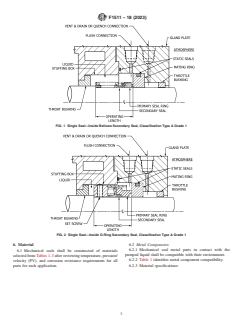
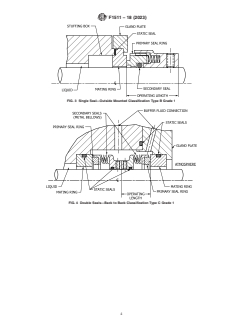
4.2 Figs. 1-6 give general orientation information for vari-
MIL-P-16789 Packaging of Pumps, Including Prime Movers
ous types of seals. The specific design of seal shown is not
and Associated Repair Parts
limited to that particular application.
MIL-STD-167-1 Environmental Vibration Testing
2.5 ISO Standard:
5. Ordering Information
ISO 9001 Quality Systems—Model for Quality Assurance in
Design/Development, Production, Installation, and Ser-
5.1 The purchaser (buyer) shall provide the manufacturer
vice
with all of the pertinent application data shown in Figs. 7-9. If
special operating conditions exist that are not shown in the
3 checklist, they shall also be described.
Available from American Society for Quality (ASQ), 600 N. Plankinton Ave.,
Milwaukee, WI 53203, http://www.asq.org.
Available from American National Standards Institute (ANSI), 25 W. 43rd St.,
4th Floor, New York, NY 10036, http://www.ansi.org.
5 6
Available from DLA Document Services, Building 4/D, 700 Robbins Ave., Available from SAE International (SAE), 400 Commonwealth Dr., Warrendale,
Philadelphia, PA 19111-5094, http://quicksearch.dla.mil. PA 15096, http://www.sae.org.
F1511 − 18 (2023)
FIG. 1 Single Seal—Inside Bellows Secondary Seal, Classification Type A Grade 1
FIG. 2 Single Seal—Inside O-Ring Secondary Seal, Classification Type A Grade 1
6. Material 6.2 Metal Components:
6.2.1 Mechanical seal metal parts in contact with the
6.1 Mechanical seals shall be constructed of materials
pumped liquid shall be compatible with their environment.
selected from Tables 1-3 after reviewing temperature, pressure/
6.2.2 Table 1 identifies metal component compatibility.
velocity (PV), and corrosion resistance requirements for all
parts for each application. 6.2.3 Material specifications:
F1511 − 18 (2023)
FIG. 3 Single Seal—Outside Mounted Classification Type B Grade 1
FIG. 4 Double Seals—Back to Back Classification Type C Grade 1
F1511 − 18 (2023)
FIG. 5 Double Seals—Face to Face Classification Type C Grade 1
FIG. 6 Tandem Seals Classification Type D Grade 1
F1511 − 18 (2023)
Material ASTM
Copper alloy B271, B584, B505/B505M
Bronze B62
Alloy 20 B472 and B473 (UNS N08020, N08026)
316 stainless steel A240/A240M, A276, and A313/A313M
(UNS S316XX)
304 stainless steel A182/A182M, A313/A313M (UNS
S304XX),A351/A351M (CF3, 3A;
CF8,8A; CF8C; CF10)
Alloyed stainless steel (cast) A744/A744M (CN-7M, CN-7MS)
17-4 PH A564/A564M and A693 (UNS S17400)
AM 350 A579/A579M (Grade 61)
A
NiCu B164 (UNS N04400, N04405), B127,
A494/A494M (Grades M35-1,
M35-2,M-30H, M-25S)
NiMo A494/A494M (Grades CW-2M, N-12 MV)
B
NiMo (Alloy B) B333 and B335 (UNS N10001, N10665,
N10675)
C
NiCrFe NiCrMoCo B166, B168
NiCr B637, B670
D
NiCrMoCb B443, B446
Steel A108
Austenetic grey iron A436
Titanium B338, B348, B367
Nickel cast iron (ductile nodular A436 Type 1
or graphitic)
A 7
Monel or equivalent has been found satisfactory for this purpose.
B
Hastelloy B or equivalent has been found satisfactory for this purpose.
C 8
Inconel X750 or equivalent has been found satisfactory for this purpose.
D 8
Inconel 625 or equivalent has been found satisfactory for this purpose.
6.3 Face Materials—Mechanical seal-wearing faces shall
be selected to provide the desired performance and corrosion
resistance for the specified design life of the seal.
6.3.1 Performance ranges for face combinations are listed in
Table 2.
6.3.2 Face materials shall be of solid construction only; no
overlays, deposited coatings, or sprayed on coatings are
permitted.
6.3.3 Carbon is preferred for one of the faces unless the
service is abrasive, dirty, or chemically active.
6.3.4 For special service requirements, hard on hard seal
face combinations may be required. Face material
combinations, such as silicon carbide versus silicon carbide,
FIG. 7 Ordering Data Checklist
silicon carbide versus tungsten carbide, and tungsten carbide
versus tungsten carbide, may be used as similar or dissimilar
contacting face materials when recommended by the supplier
and approved by the user.
6.4 Face Material Specifications:
6.4.1 Carbon—Suitable for service as recommended by the
manufacturer. A carbon seal grade is a material having carbo-
naceous filler system comprised of pitch and resins, compacted
and baked to a final temperature. These grades are subse-
quently impregnated with resin until they become impervious.
All available carbons may not be suitable for a particular
application. Carbons considered for use in a particular appli-
cation shall be checked for suitability in accordance with the
requirements of this specification.
6.4.2 Tungsten Carbide—6 % to 10 % nickel or cobalt-
bound solid tungsten carbide.
The term “Monel” and the Monel logo are trademarks of the Special Metals
Corporation, Huntington, WV, USA.
The term “Inconel” and the Inconel logo are trademarks of the Special Metals
Corporation, Huntington, WV, USA.
F1511 − 18 (2023)
FIG. 8 Stuffing Box Arrangement
F1511 − 18 (2023)
FIG. 9 Stuffing Box Dimensions
TABLE 1 Metal Component Compatibility
NOTE 1—For fluids or materials not covered here, seal selection to be mutually agreed upon by seal manufacturer, pump supplier, and end user.
NOTE 2— X = Suitable for use as seal components.
A
Materials
Highly Alloyed
Fluid
316 Stainless
Brass Ni-Cu Alloy 20 Stainless Ni-Mo Ni-Cr-Mo-Cb Ni-Cr-Fe
Steel
Steel
Fresh Water
Demineralized water X X X X X
Boiler feed X X X X X
Potable X X X X X X X
Salt Water
Seawater X X X X X
Distiller brine X X X X
Fuel Oil
Navy distillate X X X X X X
JP-5 X X X X X X
Diesel X X X X X X
Kerosene X X X X X X
Crude oil X X X X X X
Lube oil X X X X X X
Sewage X X X X X
A
See Section 6 for material specifications.
6.4.3 Ceramic—99.5 % minimum alumina ceramic suitable 10 % free graphite. (e) Siliconized Carbon Graphite—
for the service as recommended by the manufacturer.
Approximately 0.025 in. (0.64 mm) thick conversion of silicon
6.4.4 Silicon Carbide—(a) Reaction-Bonded—Solid fine- carbide on carbon substructure and impregnated with thermo-
grained reaction-bonded silicon carbide 8 % to 12 % free
setting resin.
silicon, essentially free of carbon, impervious structure requir-
6.5 Elastomeric Materials:
ing no impregnant. (b) Reaction-Bonded With Graphite—A
6.5.1 Special care should be given to the selection and
composite material of fine-grain reaction-bonded silicon car-
installation of elastomeric components, such as bellows and
bide; 5 % to 10 % free silicon and 10 % to 30 % graphite;
O-rings. One of the most important considerations for elasto-
impervious structure requiring no impregnant. (c) Direct
mers is fluid compatibility. Table 3 references most shipboard
Sintered—Solid homogeneous silicon carbide essentially free
applications. Consult the seal manufacturer for fluids not listed.
of silicon and carbon, impervious structure requiring no
impregnant. (d) Direct Sintered Silicon Carbide—Contains 6.5.2 Material Classification/Specification:
F1511 − 18 (2023)
TABLE 2 Seal Face Materials
conditions, or combination thereof, should be examined to
determine the probable cause for the leakage. If the seal
NOTE 1—Faces for chemically active materials and special applications
installation is determined to be the root cause of the leakage,
shall be agreed upon by seal manufacturer and end user.
then the seal should be inspected for nicked or cut O-rings,
Seal Face Compatibility Chart
A 2 misaligned seal faces halves, chipped or cracked seal faces, or
PV Limit, lb/in. ×
Primary Ring Mating Ring
ft/min (MPa·m/s)
any other issues that may cause the leakage.
Carbon Tungsten carbide 500 000 (17.75)
7.1.4 In special applications of extreme environmental
Carbon Silicon carbide 500 000 (17.75)
B
parameters, such as high temperature with limited cooling,
Carbon Ceramic 100 000 (3.55)
Siliconized carbon Tungsten carbide 350 000 (12.43)
high pressure/velocity, extreme abrasion, unusual equipment
Siliconized carbon Silicon carbide 350 000 (12.43)
vibration, shaft end-play, or run-out, the pump and seal
Silicon carbide Tungsten carbide 300 000 (10.65)
manufacturers shall agree upon the best achievable minimum
Silicon carbide Silicon carbide 350 000 (12.43)
C
Tungsten carbide Tungsten carbide 120 000 (4.26)
operating life requirements and leakage performance.
A
Values of PV apply to aqueous solutions at 120 °F (49 °C). For lubricating liquids,
7.1.5 Double or special seal arrangements may be required
such as oil, 60 % higher can be used. Given limits are to be used as a general
in applications in which zero product leakage to the environ-
guide in material selection. Values used consider a pressure drop across the seal
faces as 0.5. ment is required such as hazardous fluids, fuel oil, acids,
B
Limited to chemical service requirements only.
chemicals, and sewage. Consult the seal manufacturer for
C
PV limit of 185 000 (6.57) can be used with two different grades of tungsten
recommendations.
carbide, that is, cobalt versus nickel binders.
8. Design Requirements
6.5.2.1 Nitrile—Practice D1418, Class Designation NBR.
8.1 Installation Arrangements:
6.5.2.2 Chloroprene—Practice D1418, Class Designation
8.1.1 Type A mechanical seals shall be provided unless
CR.
otherwise specified.
6.5.2.3 Fluorocarbon—Practice D1418, Class Designation
8.1.2 Tandem or double mechanical seals may be installed
FKM.
in special applications in which it is determined that a buffer
6.5.2.4 Ethylene Propylene (EP)—Practice D1418, Class
fluid system is required for lubrication, containment, or safety.
Designation EPM/EPDM.
8.2 Finish and tolerance requirements for primary seal ring
6.5.2.5 Perfluoroelastomer—Practice D1418, Class Desig-
and mating ring surface flatness of Class 0 mechanicals seals
nation FFKM.
shall be three light bands or better as measured under a
6.5.2.6 Polytetrafluorethylene (PTFE)—Specification
monochromatic, helium light source.
D3294.
6.5.2.7 Corrugated graphite ribbon packing.
8.3 Requirements for Installation of Classes 1 Through 4
6.5.3 Ethylene propylene (EP) rubber shall not be lubricated
Split Mechanical Seals:
with any petroleum base substances. Check Section 11 and
8.3.1 Classes 1 through 4, split mechanical seals, may be
Appendix X1 or manufacturer’s recommendations before using
furnished for shaft/sleeve diameters of 1 ⁄2 in. (38.1 mm) and
any lubricant.
above.
7. Performance Requirements 8.3.2 For split mechanical seal installations, a minimum of
3 in. (76.2 mm) of axial space, measured from the stuffing box
7.1 Seal life shall be defined in terms of the time period in
face to the first obstruction, shall be provided for Classes 2 and
which the mechanical seal functions properly under its speci-
4 seals. Additional space, at least equal to the gland thickness,
fied service.
may be required for Classes 1 and 3 seals.
7.1.1 The minimum operational life of a mechanical seal
8.3.3 Classes 1 through 4, split mechanical seals, shall be
shall be 16 000 statistical hours provided that the equipment is
designed to operate under a minimum reverse differential
maintained and operated in accordance with the requirements
pressure condition of 15 in. Hg (50.8 kPa).
of Section 8.
7.1.2 During any portion of the service life, the dynamic
8.4 The requirement for a balanced or unbalanced seal will
leakage shall not exceed five drops per minute for Class 0
vary dependent upon the combination of various design and
seals. After initial installation, hydrostatic leakage shall be zero
performance factors. Balanced seals shall normally be supplied
for a 5-min period, when the equipment is subjected to system
for pressures greater than 150 psi (1.03 MPa) unless the seal
pressure.
manufacturer provides alternative recommendations for spe-
7.1.3 All split mechanical seals, Classes 1 through 4, may
cific applications. Selection of a balanced or unbalanced seal
experience higher leakage rates than Class 0, solid mechanical
design must satisfy the performance requirements of Section 7.
seals. A leakage rate of five drops per minute shall be
8.5 The mechanical seal shall be designed to operate satis-
acceptable after completion of the manufacturer’s recom-
factorily under the following:
mended break-in period.
7.1.3.1 Some leakage may occur between the seal faces 8.5.1 Shaft or sleeve surface finish for pusher-type seals
upon startup. If leakage is less than 30 drops a minute this shall be 32 rms (0.80 μm) maximum. Shaft or sleeve surface
should improve as the faces “run-in.” If leakage is greater than finish non-pusher seals should be 32 rms to 64 rms (0.80 μm to
30 drops a minute, then the seal, equipment, or the operating 1.60 μm).
F1511 − 18 (2023)
TABLE 3 Elastomer Compatibility
NOTE 1—X = Suitable for fluids within temperature range indicated.
Corrugated Graphite
A B
Fluid Nitrile-N EP Chloroprene
Fluorocarbon PTFE
Ribbon
Temp. Limits: Min −50 °F (−46 °C) −25 °F (−32 °C) −150 °F (−101 °C) −50 °F (−46 °C) −50 °F (−46 °C)
−400 °F (−46 °C)
+400 °F (204 °C) +500 °F (260 °C)
Max +250 °F (121 °C) +300 °F (149 °C) +200 °F (93 °C)
+750 °F (400 °C)
Fresh Water
Demineralized water X X X X X X
Boiler feedwater X X X X
Potable water X X X X X X
Salt Water
Seawater X X X X X X
Distiller brine X X X X
Fuel and Lubricants
Navy distillate X X X X X
JP-5 X X X X X
Bunker C X X X X
Diesel oil X X X X X
Kerosene X X X X X
Lube oil (mineral base) X X X
Sewage X X X X X X
A
Fluorocarbon shall be limited to 275 °F (135 °C) in water.
B
Care should be used in selecting PTFE. Its use is only dictated when other elastomers are not suitable and PTFE is acceptable. PTFE is not acceptable for nuclear
service, or in a radiation area. Glass-filled PTFE has a temperature range of −350 °F (−212 °C) to +500 °F (260 °C).
8.5.2 Shaft radial run-out to be 0.002 in. (0.0508 mm) TIR 9.5 Quality Conformance Inspection—All seal components
per inch of sleeve or shaft diameter, add 0.001 in. (0.0254 mm) shall be inspected in accordance with ASQC Z1.4 listing
TIR per inch greater than 2.000 in. shaft or sleeve diameter. critical, major, and minor characteristics and type of inspection
8.5.3 Shaft end-play maximum 60.015 in. (0.38 mm). equipment used to determine said characteristics.
8.5.4 Concentricity of stuffing box bore to shaft axis
9.5.1 Acceptable Quality Level for Characteristics—The
0.005 in. (0.13 mm) TIR maximum. Gland plate design must acceptable quality levels for characteristics, as in accordance
accommodate eccentricity stated herein.
with ASQC Z1.4, shall be as follows:
8.5.5 Perpendicularity of stuffing box face to shaft axis
9.5.1.1 Critical—1.5 AQL.
0.003 in. (0.08 mm) TIR maximum.
9.5.1.2 Major—2.5 AQL.
9.5.1.3 Minor—4.0 AQL.
8.6 Environmental Controls—Environmental control
9.5.2 Tests—All tests shall be performed in accordance with
considerations, such as flushing, cooling, heating, and quench-
ASTM, ASME, or manufacturer’s standards as specified.
ing shall be specified by the seal manufacturer.
9.5.3 Test Data—All test data shall remain on file at the
9. Quality Assurance Provisions
manufacturer’s facility for review by buyer upon request. It
shall be retained in the manufacturer’s files for at least three
9.1 Quality Systems—Mechanical seals shall be supplied in
years.
accordance with ISO 9001.
9.6 Inspection of Packaging:
9.2 Responsibility for Inspection—Unless otherwise
9.6.1 Unit of Product—For the purpose of inspection, a
specified, the manufacturer is responsible for the performance
completed package prepared for shipment shall be considered
of all inspection requirements. The manufacturer may use his
as a unit of product.
own or any other facilities suitable for inspection. The pur-
9.6.2 Sampling—Sampling for examination shall be in ac-
chaser (buyer) reserves the right to perform any of the
inspections set forth in the specification where such inspections cordance with ASQC Z1.4. The AQL shall be 4.0 % defective.
are deemed necessary to assure supplies and services conform 9.6.3 Examination—Samples selected in accordance with
to prescribed requirements. 9.5.2 shall be examined for the following defects:
9.6.3.1 Materials, methods, container,
9.3 Material Inspection—The manufacturer shall be respon-
9.6.3.2 Strapping,
sible for ensuring that materials used are manufactured,
9.6.3.3 Consolidated seals not of like description, and
examined, and tested in accordance with the specifications and
9.6.3.4 Marking illegible, incorrect, incomplete, or missing.
standards as applicable.
9.7 Warranty:
9.4 Classification of Inspections—The inspection require-
ments specified herein shall be classified as follows: 9.7.1 Responsibility for Warranty—Unless otherwise
specified, the manufacturer is responsible for the following:
9.4.1 Quality Conformance Inspection.
9.4.2 Inspection of Packaging. 9.7.1.1 All materials used to produce a unit,
F1511 − 18 (2023)
9.7.1.2 Workmanship, and 10.3.1 Each of Classes 1 through 4, split mechanical seals,
shall be supplied with detailed assembly and installation
9.7.1.3 Manufacturer will warrant his product to be free
instructions.
from defect of workmanship.
10.3.2 All special or nonstandard tools and fixtures required
9.8 Certification—When specified in the purchase order or
to assemble and install the seal in the pump shall be identified
contract, the purchaser (buyer) shall be furnished certification
and supplied with each seal package.
that samples representing each lot have been either tested or
10.4 Any special packaging requirements for shipment or
inspected as directed in this specification and the requirements
storage shall be identified in the ordering data. See Section 5.
have been met. When specified in the purchase order or
10.5 Marking and Coding—When specified, a mechanical
contract, a report of the test results shall be furnished.
seal marking and coding system shall be used in accordance
with Appendix X2.
10. Packing and Preparation for Delivery
11. Installation of the Seal Assembly
10.1 Unit of Product—For the purpose of inspection, a
11.1 Seal suppliers shall provide instructions for each me-
completed package prepared for shipment shall be considered
chanical seal installation to include the applicable information
as a unit of product.
required herein as a minimum.
10.2 Packaging of Product for Delivery—Product should be
11.2 Because of the variety of seal types and designs,
packaged for shipment in accordance with standard industry
Appendix X1 is provided for general guidance.
practice.
11.3 For specific detailed instructions, consult the seal
10.3 Instructions—Instructions and manufacturer’s special supplier’s installation procedures. For reference to component
provisions for handling shall be included in complete package. identification terms, see Section 3 and Annex A1.
SUPPLEMENTARY REQUIREMENTS
The following supplementary requirements established by the U.S. Navy, Commander Naval Sea
Systems Command (NAVSEA), shall apply when specified in the contract or purchase order. When
there is a conflict between the specifications and this Supplement S1, the requirements of Supplement
S1 shall take precedence.
S1. Scope S5. Design Requirements
S1.1 This supplementary requirement applies to mechanical S5.1 All mechanical seals shall meet the dimensional re-
end face seals for use in U.S. Navy shipboard pumps. quirements from the applicable Tables S5.1-S5.4. Guidelines
S1.2 Magnetic seals shall not be used. for seal/pump for S5 and S6 seals for cartridge and split
S2. Referenced Documents
S2.1 ASTM Standards:
D1141 Specification for Substitute Ocean Water
D3951 Practice for Commercial Packaging
S2.2 Military Standards:
MIL-S-901 Shock Tests, H.I. (High Impact); Shipboard
Machinery, Equipment & Systems, Requirements for
MIL-P-16789 Packaging of Pumps, Including Prime Movers
and Associated Repair Parts
MIL-STD-167-1 Environmental Vibration Testing
S2.3 SAE Standards:
AMS 7259, AMS 7276, AMS 3216, and AMS 3218 Rubber
Fluorocarbon Elastomer, High Temperature, Fluid, and Com-
pression Resistant
J1926-1 Standard Dimensions for Gasket Seal Straight
Thread Tube Fitting
S3. Terminology
S3.1 See Annex A1.
NOTE 1—For shaft sizes less than 1 in., not including 1 in. The
S4. Classification and Seal Arrangements
anti-rotation slot is not required.
S4.1 See Section 4. FIG. S5.1 Standard Mating Ring Anti-Rotation Slot Detail
F1511 − 18 (2023)
TABLE S5.1 Standard Long Mechanical Seal
NOTE 1—Standard (long) mechanical seal dimensions for Navy shipboard pump applications (low pressure, 150 psi (1.03 MPa) max, for new or
replacement applications).
A ± (A') ± B ± (B') ± C (C') D (D') E (E') L ± (L') ± (M) ± (M') ± (N) ± (N') ±
0.002 0.05 0.002 −0.05 REF REF min min max max 0.020 −0.5 0.005 0.12 0.15 0.38
0.375 9.52 0.875 22.23 0.438 11.13 1.062 26.98 0.937 23.80 1.188 30.2 0.250 6.35 0.312 7.92
0.500 12.70 1.000 25.40 0.563 14.30 1.187 30.15 1.062 26.97 1.188 30.2 0.250 6.35 0.312 7.92
0.625 15.87 1.250 31.75 0.688 17.48 1.343 34.12 1.218 30.93 1.312 33.3 0.344 8.74 0.406 10.31
0.750 19.05 1.375 34.93 0.813 20.65 1.468 37.29 1.343 34.11 1.312 33.3 0.344 8.74 0.406 10.31
0.875 22.22 1.500 38.10 0.938 23.83 1.656 42.07 1.531 38.88 1.375 34.9 0.344 8.74 0.406 10.31
1.000 25.40 1.625 41.28 1.063 27.00 1.750 44.45 1.625 41.27 1.562 39.7 0.375 9.53 0.438 11.13
1.125 28.57 1.750 44.45 1.188 30.18 1.870 47.50 1.745 44.32 1.625 41.3 0.375 9.53 0.438 11.13
1.250 31.75 1.875 47.63 1.313 33.35 2.000 50.80 1.875 47.62 1.625 41.3 0.375 9.53 0.438 11.13
1.375 34.92 2.000 50.80 1.438 36.53 2.125 53.98 2.000 50.80 1.687 42.9 0.375 9.53 0.438 11.13
1.500 38.10 2.125 53.98 1.563 39.70 2.250 57.15 2.125 53.97 1.687 42.9 0.375 9.53 0.438 11.13
1.625 41.27 2.375 60.33 1.688 42.88 2.500 63.50 2.375 60.32 2.000 50.8 0.438 11.13 0.500 12.70
1.750 44.45 2.500 63.50 1.813 46.05 2.625 66.68 2.500 63.50 2.000 50.8 0.438 11.13 0.500 12.70
1.875 47.62 2.625 66.68 1.938 49.23 2.750 69.85 2.625 66.67 2.125 54.0 0.438 11.13 0.500 12.70
2.000 50.80 2.750 69.85 2.063 52.40 2.937 74.60 2.812 71.42 2.125 54.0 0.438 11.13 0.500 12.70
2.125 53.97 3.000 76.20 2.188 55.58 3.125 79.38 3.000 76.20 2.375 60.3 0.500 12.70 0.562 14.27
2.250 57.15 3.125 79.38 2.313 58.75 3.250 82.55 3.125 79.37 2.375 60.3 0.500 12.70 0.562 14.27
2.375 60.32 3.250 82.55 2.438 61.93 3.375 85.73 3.250 82.55 2.500 63.5 0.500 12.70 0.562 14.27
2.500 63.50 3.375 85.73 2.563 65.10 3.500 88.90 3.375 85.72 2.500 63.5 0.500 12.70 0.562 14.27
2.625 66.67 3.375 85.73 2.688 68.28 3.750 95.25 3.625 92.07 2.750 69.8 0.562 14.30 0.625 15.87
2.750 69.85 3.500 88.90 2.813 71.45 3.875 98.43 3.750 95.25 2.750 69.8 0.562 14.30 0.625 15.87
2.875 73.02 3.750 95.25 2.938 74.63 4.000 101.60 3.875 98.42 2.875 73.0 0.562 14.30 0.625 15.87
3.000 76.20 3.875 98.43 3.125 79.38 4.187 106.35 4.062 103.17 2.875 73.0 0.562 14.30 0.625 15.87
3.125 79.37 4.000 101.60 3.250 82.55 4.437 112.70 4.250 107.95 3.125 79.4 0.656 16.66 0.781 19.84
3.250 82.55 4.125 104.78 3.375 85.73 4.562 115.88 4.375 111.12 3.125 79.4 0.656 16.66 0.781 19.84
3.375 85.72 4.250 107.95 3.500 88.90 4.687 119.05 4.500 114.30 3.125 79.4 0.656 16.66 0.781 19.84
3.500 88.90 4.375 111.13 3.625 92.08 4.812 122.23 4.625 117.47 3.125 79.4 0.656 16.66 0.781 19.84
3.625 92.07 4.500 114.30 3.750 95.25 4.937 125.40 4.750 120.65 3.250 82.6 0.656 16.66 0.781 19.84
3.750 95.25 4.625 117.48 3.875 98.43 5.062 128.58 4.875 123.82 3.250 82.6 0.656 16.66 0.781 19.84
3.875 98.42 4.750 120.65 4.000 101.60 5.187 131.75 5.000 127.00 3.375 85.7 0.656 16.66 0.781 19.84
4.000 101.60 4.875 123.83 4.125 104.78 5.312 134.93 5.125 130.17 3.375 85.7 0.656 16.66 0.781 19.84
Notes:
A to N = English units. A' to N' = SI (metric) units.
(I) For mating ring antirotation slot detail see Fig. S5.2
(II) B—Gland counterbore
C—Min shaft clearance bore recommended tolerance +0.030 (0.076)/–0.000
D—Min stuffing box bore
E—Max seal O.D. (within stuffing box)
mechanical seals are provided in Table S5.5 and Table S5.6. S5.3 Mechanical seals to Tables S5.1-S5.4 shall be axially
Mechanical seals as shown in Table S5.1, Standard Long positioned or located on the shaft by positive means such as a
Mechanical Seals, and Table S5.2, Standard Short Mechanical stub, step, or shoulder on the shaft or a sleeve that is positively
Seals, shall be of the single spring elastomeric bellows type. located on the shaft.
Slot details for antirotation pins applicable to Tables S5.1 and S5.4 Mechanical seals to Tables S5.1-S5.4 shall not be
S5.2 are shown in Fig. S5.2. axially positioned by the use of set screws.
S5.2 Pusher type seals may be used for hydraulic oils, fuels, S5.5 Any special tools or spacers required to install and
and lubricants. remove a mechanical seal shall be included with the seal.
F1511 − 18 (2023)
TABLE S5.2 Standard Short Mechanical Seal
NOTE 1—Standard (short length), mechanical seal dimensions for Navy shipboard pump applications (low pressure, 150 psi (1.03 MPa) max, for new
or replacement applications).
A ± (A') ± B ± (B') ± C (C') D (D') E (E') L ± (L') ± (M) ± (M') ± (N) ± (N') ±
0.002 0.05 0.002 −0.05 REF REF min min max max 0.020 −0.5 0.005 0.12 0.15 0.38
0.375 9.52 0.875 22.23 0.438 11.13 1.218 30.94 1.031 26.18 0.812 20.7 0.250 6.35 0.312 7.92
0.500 12.70 1.000 25.40 0.563 14.30 1.375 34.93 1.187 30.15 0.812 20.7 0.250 6.35 0.312 7.92
0.625 15.87 1.250 31.75 0.688 17.48 1.562 39.68 1.375 34.92 0.875 22.7 0.344 8.74 0.406 10.31
0.750 19.05 1.375 34.93 0.813 20.65 1.687 42.85 1.500 38.10 0.875 22.7 0.344 8.74 0.406 10.31
0.875 22.22 1.500 38.10 0.938 23.83 1.812 46.03 1.625 41.27 0.937 23.8 0.344 8.74 0.406 10.31
1.000 25.40 1.625 41.28 1.063 27.00 2.000 50.80 1.812 46.02 1.000 25.4 0.375 9.53 0.438 11.13
1.125 28.57 1.750 44.45 1.188 30.18 2.125 53.98 1.937 49.20 1.062 27.0 0.375 9.53 0.438 11.13
1.250 31.75 1.875 47.63 1.313 33.35 2.250 57.15 2.062 52.37 1.062 27.0 0.375 9.53 0.438 11.13
1.375 34.92 2.000 50.80 1.438 36.53 2.437 61.90 2.250 57.15 1.125 28.6 0.375 9.53 0.438 11.13
1.500 38.10 2.125 53.98 1.563 39.70 2.562 65.08 2.375 60.32 1.125 28.6 0.375 9.53 0.438 11.13
1.625 41.27 2.375 60.33 1.688 42.88 2.937 74.60 2.718 69.03 1.375 34.9 0.438 11.13 0.500 12.70
1.750 44.45 2.500 63.50 1.813 46.05 3.062 77.78 2.750 69.85 1.375 34.9 0.438 11.13 0.500 12.70
1.875 47.62 2.625 66.68 1.938 49.23 3.187 80.95 2.875 73.02 1.500 38.1 0.438 11.13 0.500 12.70
2.000 50.80 2.750 69.85 2.063 52.40 3.312 84.13 3.000 76.20 1.500 38.1 0.438 11.13 0.500 12.70
2.125 53.97 3.000 76.20 2.188 55.58 3.625 92.08 3.250 82.55 1.687 42.9 0.500 12.70 0.562 14.27
2.250 57.15 3.125 79.38 2.313 58.75 3.750 95.25 3.375 85.72 1.687 42.9 0.500 12.70 0.562 14.27
2.375 60.32 3.250 82.55 2.438 61.93 3.875 98.43 3.500 88.90 1.812 46.0 0.500 12.70 0.562 14.27
2.500 63.50 3.375 85.73 2.563 65.10 4.000 101.60 3.625 92.07 1.812 46.0 0.500 12.70 0.562 14.27
2.625 66.67 3.375 85.73 2.688 68.28 4.312 109.53 3.875 98.42 1.937 49.2 0.562 14.30 0.625 15.87
2.750 69.85 3.500 88.90 2.813 71.45 4.437 112.70 4.000 101.60 1.937 49.2 0.562 14.30 0.625 15.87
2.875 73.02 3.750 95.25 2.938 74.63 4.562 115.88 4.125 104.77 2.062 52.4 0.562 14.30 0.625 15.87
3.000 76.20 3.875 98.43 3.125 79.38 4.687 119.05 4.250 107.95 2.062 52.4 0.562 14.30 0.625 15.87
3.125 79.37 4.000 101.60 3.250 82.55 5.000 127.00 4.562 115.87 2.187 55.6 0.656 16.66 0.781 19.84
3.250 82.55 4.125 104.78 3.375 85.73 5.125 130.18 4.687 119.05 2.187 55.6 0.656 16.66 0.781 19.84
3.375 85.72 4.250 107.95 3.500 88.90 5.250 133.35 4.812 122.22 2.187 55.6 0.656 16.66 0.781 19.84
3.500 88.90 4.375 111.13 3.625 92.08 5.500 139.70 4.937 125.40 2.187 55.6 0.656 16.66 0.781 19.84
3.625 92.07 4.500 114.30 3.750 95.25 5.687 144.45 5.125 130.17 2.312 58.8 0.656 16.66 0.781 19.84
3.750 95.25 4.625 117.48 3.875 98.43 5.812 147.63 5.250 133.35 2.312 58.8 0.656 16.66 0.781 19.84
3.875 98.42 4.750 120.65 4.000 101.60 6.000 152.40 5.437 138.10 2.437 61.9 0.656 16.66 0.781 19.84
4.000 101.60 4.875 123.83 4.125 104.78 6.125 155.58 5.562 141.27 2.437 61.9 0.656 16.66 0.781 19.84
Notes:
A to N = English units. A' to N' = SI (metric) units.
(I) For mating ring antirotation slot detail see Fig. S5.2
(II) B—Gland counterbore
C—Min shaft clearance bore recommended tolerance +0.030 (0.076)/–0.000
D—Min stuffing box bore
E—Max seal O.D. (within stuffing box)
S5.6 Mechanical seals supplied in accordance with Table or fraction thereof. Mechanical seals used for lube oil and fuel
S5.5 shall meet the following requirements: services may use backup packing instead of throttle bushings.
S5.6.1 Table S5.5 mechanical seals may use setscrews to S5.6.3 Non-sparking metallic assembly clips shall be used.
position the seal. S5.6.4 Throttle bushing drain and seal flushing connections
S5.6.2 A throttle bushing or secondary containment seal shall be provided with straight “O” ring fittings to MS 16142,
shall be used to limit leakage in event of seal failure. The minimum size ⁄8 in.
diametrical clearance of the throttle bushing bore shall not be S5.7 Mechanical seals supplied in accordance with Table
more than 0.025 in. for sleeve diameters up to 2.0 in. For larger S5.6 shall meet the following requirements:
diameters, the maximum diametrical clearance shall be S5.7.1 No provision for back-up packing is required for split
0.025 in. plus 0.005 in. for each additional 1.0 in. of diameter mechanical seals unless requested by the customer.
F1511 − 18 (2023)
TABLE S5.3 Special Cartridge Seals Grade 2
A ± (A') ± B ± (B') ± C (C') D (D') E (E') E (F') G (G') H (H')
0.002 0.05 0.002 0.05 Ref Ref min min max max min min min min max max
1.186 30.12 3.066 77.88 2.726 69.24 2.44 61.98 2.348 59.64 1.29 32.77 0.19 4.83 0.50 12.70
1.377 34.98 3.066 77.88 2.726 69.24 2.44 61.98 2.420 61.47 1.51 38.35 0.31 7.87 0.50 12.70
1.436 36.47 3.877 98.48 3.416 86.77 2.94 74.68 2.763 70.18 1.54 39.12 0.19 4.83 0.62 15.75
1.771 44.98 3.877 98.48 3.416 86.77 2.94 74.68 2.861 72.67 2.00 50.80 0.12 3.05 0.62 15.75
J (J') K (K') L ± (L') ± M ± (M') ± N ± (N') ± Q (Q') R (R')
min min min min 020 0.5 0.005 0.13 0.015 0.38 min min max max
2.82 71.63 00 00 0.741 18.82 0.340 8.64 0.408 10.36 0.25 6.35 0.38 9.65
2.82 71.63 0.18 4.57 0.794 20.17 0.340 8.64 0.408 10.36 0.31 7.87 0.38 9.65
3.56 90.42 00 00 0.820 20.83 0.380 9.65 0.408 10.36 0.31 7.87 0.50 12.70
3.56 90.42 00 00 0.877 22.28 0.380 9.65 0.408 10.36 0.31 7.87 0.50 12.70
Notes:
A to R = English units. A' to R' = SI (metric) units.
B—Gland counterbore
C—Seal support shoulder tolerance +0.030 (0.76)/−0.000
D—Minimum stuffing box bore
E—Maximum seal O.D. (within stuffing box)
F—Positive drive recess for seal assembly drive lug. 2 each 180° apart
G—Positive drive recess for seal assembly drive lug. 2 each 180° apart
H—Maximum pin length shown, max pin diameter 0.125
J—Positive drive recess for stationary seal ring
K—Clearance required between seal and seal locating shoulder
R—Four lugs equally spaced at 90°
S5.7.2 Split mechanical seals shall not be used for fuel or hydrostatic test pressure shall not exceed the maximum pres-
lube oil service pumps. sure rating of the split mechanical seal.
S5.7.3 Mechanical seals supplied in accordance with Table S5.8 Type E mechanical seals shall be the non-contacting
S5.6 may leak at the seal faces during hydrostatic testing of the design where the mating faces are designed to intentionally
pump. Leakage should not constitute failure of the hydrostatic create aerodynamic or hydrodynamic separating forces to
test of the pump or failure of the split mechanical seal. Pump sustain a specific separation gap.
F1511 − 18 (2023)
TABLE S5.4 Special Cartridge Seals Grade 1
A ± (A') ± B ± (B') ± C (C') D (D') E (E') E (F') G (G') H (H')
0.002 0.05 0.002 0.05 Ref Ref min min max max min min min min max max
0.811 20.60 1.851 47.02 1.605 40.77 1.67 42.42 1.583 40.21 0.94 23.88 0.12 3.02 NA NA
1.000 25.40 1.877 47.68 1.100 27.94 2.09 53.09 2.011 51.08 1.10 27.94 0.09 2.29 0.13 3.30
1.876 47.65 2.752 69.90 2.100 53.34 3.36 85.34 3.315 84.20 2.00 50.80 0.21 5.33 0.18 4.57
2.162 54.91 3.127 79.43 2.218 56.34 3.60 91.44 3.252 82.60 2.38 60.45 0.31 7.87 0.18 4.57
2.750 69.85 4.002 10.17 2.875 73.03 4.47 113.54 4.310 109.47 3.05 77.47 0.44 11.18 0.10 2.54
J (J') K (K') L ± (L') ± M ± (M') ± N ± (N') ± Q (Q') R (R') S (S')
min min min min 020 0.5 0.005 0.13 0.015 0.38 min min max max max min
NA NA 0.190 4.83 0.679 17.25 0.280 7.11 0.362 9.19 0.19 4.83 NA NA NA NA
1.44 36.58 000 000 0.590 14.99 0.250 6.35 0.317 8.05 0.25 6.35 0.38 9.65 0.190 1.83
2.34 59.44 0.250 6.35 0.868 22.05 0.250 6.35 0.437 11.10 0.31 7.87 0.38 9.65 0.128 3.25
2.70 68.58 0.595 15.11 0.770 19.56 0.280 7.11 0.375 9.53 0.31 7.87 0.38 9.65 0.254 6.45
3.44 87.38 0.250 6.35 1.002 25.45 0.280 7.11 0.500 12.70 0.44 11.18 0.38 9.65 0.230 5.84
Notes:
A to S = English units. A' to S' = SI (metric) units.
B—Gland counterbore
C—Seal support shoulder tolerance + 0.030 (0.76)/−0.000
D—Minimum stuffing box bore
E—Maximum seal O.D. (within stuffing box)
F—Positive drive recess for seal assembly drive lug. 2 each 180° apart
G—Positive drive recess for seal assembly drive lug. 2 each 180° apart
H—Maximum pin length shown, max pin diameter 0.125
J—Positive drive recess for stationary seal ring
K—Clearance required between seal and seal locating shoulder 2 each 180° apart
R—One recess only
N/A—Not applicable
S5.8.1 Type E seals shall be used only on fuel/oil services S5.8.3 A self-contained gas seal support system (GSSS) shall
with a shaft speed greater than 300 ft per min (fpm) measured be provided. The GSSS shall include check valve, gas
at the shaft diameter. regulator, pressure gage, and flowmeter. The GSSS compo-
S5.8.2 Nodular or graphitic ductile nickel cast iron mating nents shall be enclosed in a box to protect from the elements.
rings allowed in accordance with Table S5.7 are not permitted Flow and pressure indicators shall be visible from the outside
in Type E seals. of the box. GSSS shall be used to support the Type E seal
F1511 − 18 (2023)
TABLE S5.5 Cartridge Seal
Maximum Dimensions for Seal Installation
D F F F F
A C C E
B Box Bolt Bolt Bolt Bolt
Shaft Box Bore Box Bore Nearest
Gland OD Depth Circle Circle Circle Circle
Size min max Obstruction
min min min min min
Bolt Size Bolt Size Bolt Size Bolt Size
3 1 5 3
⁄8 in. ⁄2 in. ⁄8 in. ⁄4 in.
1.000 4.11 1.63 1.88 0.91 2.11 2.88 N/A N/A N/A
1.125 4.13 1.75 2.01 0.66 2.13 2.88 N/A N/A N/A
1.250 4.25 1.88 2.27 0.78 2.13 3.14 3.25 N/A N/A
1.375 4.38 2.00 2.33 0.69 2.13 3.26 3.34 N/A N/A
1.500 4.88 2.21 2.44 0.96 2.19 3.48 3.60 N/A N/A
1.625 5.00 2.34 2.69 1.02 2.19 N/A 3.77 N/A N/A
1.750 5.49 2.50 2.81 1.04 2.19 N/A 3.88 N/A N/A
1.875 5.49 2.63 2.91 1.04 2.19 N/A 3.91 N/A N/A
2.000 5.50 2.75 3.01 1.27 2.38 N/A 4.16 N/A N/A
2.125 5.86 2.88 3.44 1.27 2.38 N/A 4.41 4.50 N/A
2.250 6.50 3.00 3.48 1.39 2.38 N/A 4.53 4.62 N/A
2.375 6.50 3.13 3.59 1.13 2.53 N/A 4.60 4.72 N/A
2.500 6.75 3.37 3.81 1.39 2.63 N/A 4.88 5.00 N/A
2.625 6.75 3.63 4.04 1.60 2.56 N/A N/A 5.17 N/A
2.750 7.70 3.75 4.06 1.60 2.56 N/A N/A 5.55 N/A
2.875 7.83 3.88 4.18 1.60 2.56 N/A N/A 5.62 N/A
3.000 7.94 4.00 4.46 1.74 2.63 N/A N/A 5.77 N/A
3.125 7.99 4.13 4.60 1.75 2.69 N/A N/A 5.92 N/A
3.250 8.19 4.25 4.60 1.80 2.64 N/A N/A 6.05 N/A
3.375 8.30 4.38 4.85 1.94 2.69 N/A N/A 6.14 6.27
3.500 8.44 4.50 4.97 1.91 2.69 N/A N/A 6.31 6.43
3.625 8.49 4.63 5.10 2.19 2.69 N/A N/A 6.44 N/A
3.750 8.75 4.78 5.19 2.00 2.69 N/A N/A 6.77 N/A
3.875 8.84 4.96 5.37 2.06 2.69 N/A N/A 6.64 6.77
4.000 9.00 5.11 5.50 2.38 2.69 N/A N/A 6.78 6.91
during Section S7 testing. The GSSS shall undergo shock S5.9 Unless otherwise specified, the seal manufacturer shall
testing in accordance with MIL-S-901 and environmental prepare drawings in accordance with ANSI Standards Y14.1,
vibration testing in accordance with MIL-STD-167-1. Y14.2, Y14.3, Y14.5, Y14.6, and Y14.26.3.
F1511 − 18 (2023)
TABLE S5.6 Split Mechanical Seals
Maximum Dimensions for Seal Interface
B B C C1 D G
A E F G G
Box Box Box Box Outboard Bolt
Shaft Nearest Gland Bolt Bolt
Bore Bore Face Depth Space Circle
Diameter Obstruction Diameter Circle, min Circle, min
min max min min Required min
Bolt Bolt Bolt
Size Size Size
3 1 5
⁄8 in. ⁄2 in. ⁄8 in.
1.250 1.86 2.10 2.35 N/A 1.78 3.00 4.91 3.17 3.29 3.42
1.375 1.94 2.38 2.63 N/A 1.78 3.00 5.01 3.25 3.38 3.5
...