

ASTM F1030-86(2023)
(Practice)Standard Practice for Selection of Valve Operators
General Information
- Abstract
ABSTRACT
This practice provides guidance in the selection of manual and power-actuated valve operators. The selection criteria for manual valve operators apply to handwheels and tee-wrenches. The selection criteria for power-actuated valve operators, on the other hand, apply to stem nut and handwheel driven valve operators of the electric, pneumatic, and hydraulic types.
SCOPE
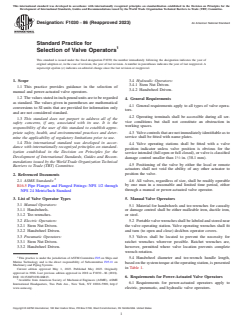
1.1 This practice provides guidance in the selection of manual and power-actuated valve operators.
1.2 The values stated in inch-pound units are to be regarded as standard. The values given in parentheses are mathematical conversions to SI units that are provided for information only and are not considered standard.
1.3 This standard does not purport to address all of the safety concerns, if any, associated with its use. It is the responsibility of the user of this standard to establish appropriate safety, health, and environmental practices and determine the applicability of regulatory limitations prior to use.
1.4 This international standard was developed in accordance with internationally recognized principles on standardization established in the Decision on Principles for the Development of International Standards, Guides and Recommendations issued by the World Trade Organization Technical Barriers to Trade (TBT) Committee.
- Status
- Published
- Publication Date
- 30-Apr-2023
- Technical Committee
- F25 - Ships and Marine Technology
- Drafting Committee
- F25.11 - Machinery and Piping Systems


Overview
ASTM F1030-86(2023), Standard Practice for Selection of Valve Operators, provides comprehensive guidance on the selection and application of manual and power-actuated valve operators. Developed by ASTM International, this standard helps users choose the appropriate operator types for valves in industrial, marine, and process piping systems. It covers selection criteria for handwheels, tee-wrenches, and power-actuated operators such as electric, pneumatic, and hydraulic types. The standard ensures that valve operators are compatible with operational and safety requirements, promoting efficient and reliable valve actuation across diverse environments.
Key Topics
Manual Valve Operators:
- Selection of handwheels and tee-wrenches based on torque requirements and accessibility.
- Criteria for material selection (malleable iron, ductile iron, steel) to ensure durability.
- Guidelines for sizing, labeling, and storage of portable valve wrenches.
- Emphasis on ergonomic operation and minimization of ratchet wrench use.
Power-Actuated Valve Operators:
- Electric, pneumatic, and hydraulic operator selection for stem nut or handwheel-driven designs.
- Safety measures including manual override and prevention of unintended motion.
- Requirements for operator enclosures: explosion-proof and submersible construction where applicable.
- Gear system attributes, such as prevention of backdrive and robust transmission systems.
General Requirements:
- Accessibility of operating terminals and avoidance of obstructions.
- Use of nameplates and position indicators for unambiguous valve identification.
- Local or remote actuation must not override each other unless reset.
- All valves should be operable by one person within a reasonable time frame.
System-Specific Guidance:
- Specific requirements for electric motors, including types and protective features.
- Hydraulic fluid selection based on operating pressures and temperature range.
- Design safeguards for pneumatic valve systems, including pressure indication and pulsation dampening.
- Pump scheduling and configuration for hydraulic actuation systems.
Applications
The ASTM F1030-86(2023) standard is essential for organizations involved in the design, installation, and maintenance of piping systems requiring reliable valve operation. Typical applications include:
- Marine engineering: Vital for shipboard machinery and piping systems, ensuring safe and efficient manual or powered operation under varied environmental conditions.
- Industrial plants: Used in process industries where valves are critical to safety and production continuity.
- Oil & gas facilities: Critical for hazardous environments, requiring explosion-proof and durable actuators.
- Power generation: Applied in both conventional and renewable power plants for dependable valve control.
- Water treatment plants: Supporting the robust actuation of valves in municipal and industrial water systems.
The standard supports compliance with international safety practices, helping organizations manage operational risks and meet regulatory requirements.
Related Standards
- ASME B16.5: Pipe Flanges and Flanged Fittings, referenced for compatibility of valve operators with flanged connections.
- ASTM F1387: Standard Specification for Performance of Piping and Tubing Mechanically Attached Fittings.
- ISO 5210: Industrial valves - Multi-turn valve actuator attachments, for interoperability of valve operators.
- API 609: Butterfly Valves: Double-flanged, Lug- and Wafer-type, offering actuator guidelines for specific valve types.
Implementing ASTM F1030-86(2023) alongside related standards streamlines the selection process of valve operators, helps achieve optimal system performance, and reinforces commitment to safety and quality in valve automation.
Keywords: valve operator selection, handwheels, power-actuated valves, electric valves, pneumatic valves, hydraulic valves, ASTM F1030, industrial standards, marine piping systems.
Get Certified
Connect with accredited certification bodies for this standard

DNV
DNV is an independent assurance and risk management provider.

Lloyd's Register
Lloyd's Register is a global professional services organisation specialising in engineering and technology.

FSC International
Forest Stewardship Council certification.
Sponsored listings
Frequently Asked Questions
ASTM F1030-86(2023) is a standard published by ASTM International. Its full title is "Standard Practice for Selection of Valve Operators". This standard covers: ABSTRACT This practice provides guidance in the selection of manual and power-actuated valve operators. The selection criteria for manual valve operators apply to handwheels and tee-wrenches. The selection criteria for power-actuated valve operators, on the other hand, apply to stem nut and handwheel driven valve operators of the electric, pneumatic, and hydraulic types. SCOPE 1.1 This practice provides guidance in the selection of manual and power-actuated valve operators. 1.2 The values stated in inch-pound units are to be regarded as standard. The values given in parentheses are mathematical conversions to SI units that are provided for information only and are not considered standard. 1.3 This standard does not purport to address all of the safety concerns, if any, associated with its use. It is the responsibility of the user of this standard to establish appropriate safety, health, and environmental practices and determine the applicability of regulatory limitations prior to use. 1.4 This international standard was developed in accordance with internationally recognized principles on standardization established in the Decision on Principles for the Development of International Standards, Guides and Recommendations issued by the World Trade Organization Technical Barriers to Trade (TBT) Committee.
ABSTRACT This practice provides guidance in the selection of manual and power-actuated valve operators. The selection criteria for manual valve operators apply to handwheels and tee-wrenches. The selection criteria for power-actuated valve operators, on the other hand, apply to stem nut and handwheel driven valve operators of the electric, pneumatic, and hydraulic types. SCOPE 1.1 This practice provides guidance in the selection of manual and power-actuated valve operators. 1.2 The values stated in inch-pound units are to be regarded as standard. The values given in parentheses are mathematical conversions to SI units that are provided for information only and are not considered standard. 1.3 This standard does not purport to address all of the safety concerns, if any, associated with its use. It is the responsibility of the user of this standard to establish appropriate safety, health, and environmental practices and determine the applicability of regulatory limitations prior to use. 1.4 This international standard was developed in accordance with internationally recognized principles on standardization established in the Decision on Principles for the Development of International Standards, Guides and Recommendations issued by the World Trade Organization Technical Barriers to Trade (TBT) Committee.
ASTM F1030-86(2023) is classified under the following ICS (International Classification for Standards) categories: 47.020.30 - Piping systems. The ICS classification helps identify the subject area and facilitates finding related standards.
ASTM F1030-86(2023) is available in PDF format for immediate download after purchase. The document can be added to your cart and obtained through the secure checkout process. Digital delivery ensures instant access to the complete standard document.
Standards Content (Sample)
This international standard was developed in accordance with internationally recognized principles on standardization established in the Decision on Principles for the
Development of International Standards, Guides and Recommendations issued by the World Trade Organization Technical Barriers to Trade (TBT) Committee.
Designation: F1030 − 86 (Reapproved 2023) An American National Standard
Standard Practice for
Selection of Valve Operators
This standard is issued under the fixed designation F1030; the number immediately following the designation indicates the year of
original adoption or, in the case of revision, the year of last revision. A number in parentheses indicates the year of last reapproval. A
superscript epsilon (´) indicates an editorial change since the last revision or reapproval.
1. Scope 3.4 Hydraulic Operators:
3.4.1 Stem Nut Driven.
1.1 This practice provides guidance in the selection of
3.4.2 Handwheel Driven.
manual and power-actuated valve operators.
1.2 The values stated in inch-pound units are to be regarded
4. General Requirements
as standard. The values given in parentheses are mathematical
4.1 General requirements apply to all types of valve opera-
conversions to SI units that are provided for information only
tors.
and are not considered standard.
4.2 Operating terminals shall be accessible during all ser-
1.3 This standard does not purport to address all of the
vice conditions but shall not constitute an obstruction in
safety concerns, if any, associated with its use. It is the
working spaces.
responsibility of the user of this standard to establish appro-
4.3 Valve controls that are not immediately identifiable as to
priate safety, health, and environmental practices and deter-
mine the applicability of regulatory limitations prior to use. service shall be fitted with name plates.
1.4 This international standard was developed in accor-
4.4 Valve operating stations shall be fitted with a valve
dance with internationally recognized principles on standard-
position indicator unless valve position is obvious for the
ization established in the Decision on Principles for the
service intended (full open or full closed), or valve is classified
Development of International Standards, Guides and Recom-
damage control smaller than 1 ⁄2 in. (38.1 mm).
mendations issued by the World Trade Organization Technical
4.5 Positioning of the valve by either the local or remote
Barriers to Trade (TBT) Committee.
actuators shall not void the ability of any other actuator to
position the valve.
2. Referenced Documents
4.6 All valves, regardless of size, shall be readily operable
2.1 ASME Standards:
by one man in a reasonable and limited time period, either
B16.5 Pipe Flanges and Flanged Fittings: NPS 1/2 through
through a manual or power-actuated valve operator.
NPS 24 Metric/Inch Standard
3. List of Valve Operator Types
5. Manual Valve Operators
3.1 Manual Operators:
5.1 Material for handwheels and tee-wrenches for casualty
3.1.1 Handwheels.
or damage control shall be either malleable iron, ductile iron,
3.1.2 Tee-wrenches.
or steel.
3.2 Electric Operators:
5.2 Portable valve wrenches shall be labeled and stored near
3.2.1 Stem Nut Driven.
the valve operating station. Valve operating wrenches shall fit
3.2.2 Handwheel Driven.
and turn (to open and close) deckbox operator covers.
3.3 Pneumatic Operators:
5.3 Valves shall be located to prevent the necessity for
3.3.1 Stem Nut Driven.
ratchet wrenches wherever possible. Ratchet wrenches are,
3.3.2 Handwheel Driven.
however, permitted where valve location prevents complete
wrench rotation.
This practice is under the jurisdiction of ASTM Committee F25 on Ships and
5.4 Handwheel diameter and tee-wrench handle length,
Marine Technology and is the direct responsibility of Subcommittee F25.11 on
based on the system torque at the operating station, is presented
Machinery and Piping Systems.
in Table 1.
Current edition approved May 1, 2023. Published May 2023. Originally
approved in 1986. Last previous edition approved in 2018 as F1030 – 86 (2018).
DOI: 10.1520/F1030-86R23. 6. Requirements for Power-Actuated Valve Operators
Available from American Society of Mechanical Engineers (ASME), ASME
6.1 Requirements for power-actuated operators apply to
International Headquarters, Two Park Ave., New York, NY 10016-5990, http://
www.asme.org. electric, pneumatic, and hydraulic valve operators.
Copyright © ASTM International, 100 Barr Harbor Drive, PO Box C700, West Conshohocken, PA 19428-2959. United States
F1030 − 86 (2023)
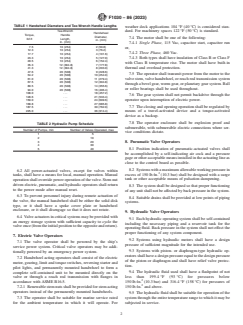
TABLE 1 Handwheel Diameters and Tee-Wrench Handle Lengths
weather deck applications 104 °F (40 °C) is considered stan-
Tee-Wrench dard. For machinery spaces 122 °F (50 °C) is standard.
Handwheel
Torque, Handle
Diameter,
7.4 The motor shall be one of the following:
lbf·ft Length,
in. (mm)
in. (mm)
7.4.1 Single Phase, 115 Vac, capacitor start, capacitor run
7.5 10 (254) 2 (50.8)
or,
12.3 10 (254) 3 (76.2)
7.4.2 Three Phase, 460 Vac.
17.7 10 (254) 4 (101.6)
23.3 10 (254) 5 (127.0)
7.4.3 Both types shall have insulation of Class B or Class F
29.5 10 (254) 6 (152.4)
with Class B temperature rise. The motor shall have built-in
35.3 12 (304.8) 7 (177.8)
thermal and overload protection.
41.3 12 (304.8) 8 (203.0)
47.6 20 (508) 9 (228.6)
7.5 The operator shall transmit power from the motor to the
54.2 20 (508) 10 (254.0)
61.0 20 (508) 11 (279.4) valve stem, valve handwheel, or reach rod transmission system
67.5 20 (508) 12 (304.8)
through a bevel gear, worm gear, or planetary gear system. Ball
80.5 20 (508) 14 (355.6)
or roller bearings shall be used throughout.
94.0 20 (508) 16 (406.4)
108.0 . . . 18 (457.2)
7.6 The gear system shall not permit backdrive through the
128.6 . . . 21 (533.4)
150.0 . . . 24 (609.6) operator upon interruption of el
...