

ASTM B472-23
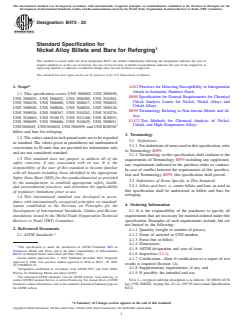
(Specification)Standard Specification for Nickel Alloy Billets and Bars for Reforging
General Information
- Abstract
ABSTRACT
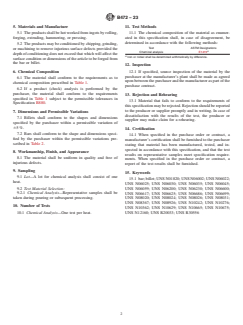
This specification covers UNS N06002, UNS N06030, UNS N06035, UNS N06022, UNS N06200, UNS N06230, UNS N06600, UNS N06617, UNS N06625, UNS N08020, UNS N08026, UNS N08024, UNS N08120, UNS N08926, UNS N08367, UNS N10242, UNS N10276, UNS N10665, UNS N10675, UNS N12160, UNS R20033, UNS N06059, UNS N06686, UNS N10629, UNS N08031, UNS N06045, UNS N06025, and UNS R30556 nickel alloy billets and bars for reforging. The products shall be hot worked from ingots by rolling, forging, extruding, hammering, or pressing. The material shall conform to the chemical composition requirements prescribed by the reference material. The chemical composition of the material shall be determined by chemical analysis in accordance with test method E1473.
SCOPE
1.1 This specification covers UNS N06002, UNS N06030, UNS N06035, UNS N06022, UNS N06200, UNS N10362, UNS N06230, UNS N06600, UNS N06617, UNS N06625, UNS N08020, UNS N08026, UNS N08024, UNS N08120, UNS N08926, UNS N08367, UNS N10242, UNS N10276, UNS N10665, UNS N10675, UNS N12160, UNS R20033, UNS N06059, UNS N06686, UNS N10629, UNS N08031, UNS N06045, UNS N06025, UNS N06699, and UNS R305562 billets and bars for reforging.
1.2 The values stated in inch-pound units are to be regarded as standard. The values given in parentheses are mathematical conversions to SI units that are provided for information only and are not considered standard.
1.3 This standard does not purport to address all of the safety concerns, if any, associated with its use. It is the responsibility of the user of this standard to become familiar with all hazards including those identified in the appropriate Safety Data Sheet (SDS) for this product/material as provided by the manufacturer, to establish appropriate safety, health, and environmental practices, and determine the applicability of regulatory limitations prior to use.
1.4 This international standard was developed in accordance with internationally recognized principles on standardization established in the Decision on Principles for the Development of International Standards, Guides and Recommendations issued by the World Trade Organization Technical Barriers to Trade (TBT) Committee.
- Status
- Published
- Publication Date
- 30-Nov-2023
- Technical Committee
- B02 - Nonferrous Metals and Alloys
- Drafting Committee
- B02.07 - Refined Nickel and Cobalt and Their Alloys
Buy Documents
ASTM B472-23 - Standard Specification for Nickel Alloy Billets and Bars for Reforging
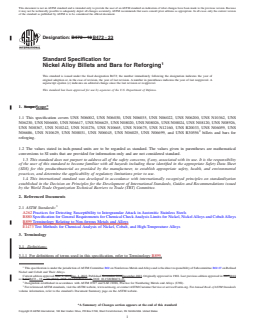
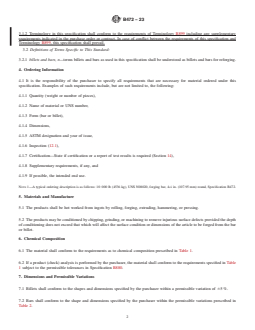
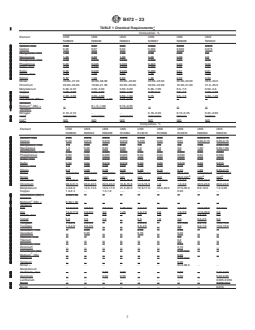
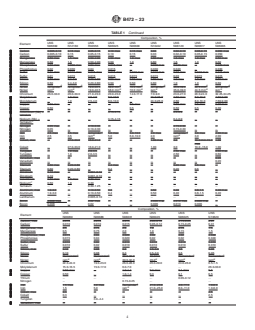
REDLINE ASTM B472-23 - Standard Specification for Nickel Alloy Billets and Bars for Reforging
Overview
ASTM B472-23 is the latest edition of the Standard Specification for Nickel Alloy Billets and Bars for Reforging, issued by ASTM International. This standard specifies the requirements for billets and bars made from a wide range of nickel alloys identified by various UNS (Unified Numbering System) numbers, intended specifically for reforging applications. The scope includes coverage of multiple types of nickel alloys used in fields requiring high-performance materials such as chemical processing, power generation, and aerospace.
The document outlines essential criteria for material production, chemical composition, permissible variations, inspection, and certification, ensuring a consistent and reliable supply of nickel alloy billets and bars for subsequent forging and fabrication processes.
Key Topics
- Material Coverage: The standard includes numerous nickel alloys, such as UNS N06002, N06022, N06625, N06600, N08020, N10276, and others, making it applicable to a wide array of corrosion-resistant and high-temperature applications.
- Manufacturing Processes: Products covered must be hot worked from ingots by rolling, forging, extruding, hammering, or pressing to achieve the required end-use properties.
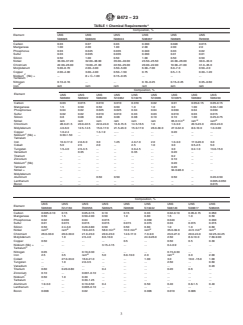
- Chemical Composition: The chemical composition requirements are detailed and must be verified through accepted ASTM test methods. Conformance ensures that billets and bars possess the necessary mechanical and corrosion-resistance properties.
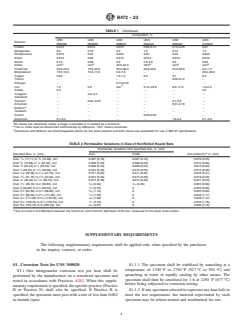
- Dimensional Tolerances: Strict guidelines for shapes, sizes, and permissible variations are set to ensure compatibility with forging operations and final product requirements.
- Inspection and Certification: Details procedures for inspection, sampling, and certification to confirm compliance with the specification, supporting confidence in material traceability and performance.
- Supplementary and Safety Requirements: Optional corrosion testing requirements for certain alloys (e.g., UNS N08020) are included when specified. The standard also addresses the user’s responsibility for safety, health, and environmental practices.
Applications
Nickel alloy billets and bars produced to ASTM B472-23 are fundamental in manufacturing components that demand superior performance in aggressive or high-temperature environments. Typical application sectors include:
- Aerospace: Engine parts, fasteners, and structural components require high-strength, heat- and corrosion-resistant materials.
- Chemical Processing: Reactor vessels, piping, heat exchangers, and valves benefit from nickel alloys’ exceptional corrosion resistance.
- Power Generation: Components for turbines, boilers, and superheaters are often forged from nickel alloys due to their strength and stability at elevated temperatures.
- Oil and Gas: Downhole tools and equipment frequently use nickel alloys for their durability in harsh, corrosive environments.
- Marine: Hardware and assemblies exposed to seawater leverage the anti-corrosive properties of specified nickel alloys.
Related Standards
Several other ASTM standards are referenced or related to ASTM B472-23, providing additional technical details or supporting requirements for nickel alloy products:
- ASTM B880 - Specification for general requirements for chemical check analysis limits for nickel, nickel alloys, and cobalt alloys.
- ASTM E1473 - Test Methods for Chemical Analysis of Nickel, Cobalt, and High-Temperature Alloys.
- ASTM A262 - Practices for detecting susceptibility to intergranular attack in austenitic stainless steels (applicable as a supplementary test).
- ASTM B899 - Terminology relating to non-ferrous metals and alloys.
Practical Value
Adhering to ASTM B472-23 ensures consistency, quality, and traceability in the supply chain for nickel alloy billets and bars designated for reforging. By following this specification, manufacturers and purchasers benefit from:
- Assured Material Performance: Consistent chemical and dimensional properties suited for critical forging and end-use requirements.
- Reduced Risk: Clear inspection and certification requirements strengthen quality assurance.
- Market Access: Compliance with recognized international standards facilitates use in global projects across industries.
ASTM B472-23 is a key document for stakeholders seeking to specify or source reliable nickel alloy billets and bars for advanced manufacturing and engineering applications.
Relations
- Effective Date
- 01-Dec-2023
- Referred By
ASTM F1511-18(2023) - Standard Specification for Mechanical Seals for Shipboard Pump Applications - Effective Date
- 01-Dec-2023
- Effective Date
- 01-Dec-2023
- Effective Date
- 01-Dec-2023
Buy Documents
ASTM B472-23 - Standard Specification for Nickel Alloy Billets and Bars for Reforging
REDLINE ASTM B472-23 - Standard Specification for Nickel Alloy Billets and Bars for Reforging
Get Certified
Connect with accredited certification bodies for this standard

Element Materials Technology
Materials testing and product certification.

Inštitut za kovinske materiale in tehnologije
Institute of Metals and Technology. Materials testing, metallurgical analysis, NDT.
Sponsored listings
Frequently Asked Questions
ASTM B472-23 is a technical specification published by ASTM International. Its full title is "Standard Specification for Nickel Alloy Billets and Bars for Reforging". This standard covers: ABSTRACT This specification covers UNS N06002, UNS N06030, UNS N06035, UNS N06022, UNS N06200, UNS N06230, UNS N06600, UNS N06617, UNS N06625, UNS N08020, UNS N08026, UNS N08024, UNS N08120, UNS N08926, UNS N08367, UNS N10242, UNS N10276, UNS N10665, UNS N10675, UNS N12160, UNS R20033, UNS N06059, UNS N06686, UNS N10629, UNS N08031, UNS N06045, UNS N06025, and UNS R30556 nickel alloy billets and bars for reforging. The products shall be hot worked from ingots by rolling, forging, extruding, hammering, or pressing. The material shall conform to the chemical composition requirements prescribed by the reference material. The chemical composition of the material shall be determined by chemical analysis in accordance with test method E1473. SCOPE 1.1 This specification covers UNS N06002, UNS N06030, UNS N06035, UNS N06022, UNS N06200, UNS N10362, UNS N06230, UNS N06600, UNS N06617, UNS N06625, UNS N08020, UNS N08026, UNS N08024, UNS N08120, UNS N08926, UNS N08367, UNS N10242, UNS N10276, UNS N10665, UNS N10675, UNS N12160, UNS R20033, UNS N06059, UNS N06686, UNS N10629, UNS N08031, UNS N06045, UNS N06025, UNS N06699, and UNS R305562 billets and bars for reforging. 1.2 The values stated in inch-pound units are to be regarded as standard. The values given in parentheses are mathematical conversions to SI units that are provided for information only and are not considered standard. 1.3 This standard does not purport to address all of the safety concerns, if any, associated with its use. It is the responsibility of the user of this standard to become familiar with all hazards including those identified in the appropriate Safety Data Sheet (SDS) for this product/material as provided by the manufacturer, to establish appropriate safety, health, and environmental practices, and determine the applicability of regulatory limitations prior to use. 1.4 This international standard was developed in accordance with internationally recognized principles on standardization established in the Decision on Principles for the Development of International Standards, Guides and Recommendations issued by the World Trade Organization Technical Barriers to Trade (TBT) Committee.
ABSTRACT This specification covers UNS N06002, UNS N06030, UNS N06035, UNS N06022, UNS N06200, UNS N06230, UNS N06600, UNS N06617, UNS N06625, UNS N08020, UNS N08026, UNS N08024, UNS N08120, UNS N08926, UNS N08367, UNS N10242, UNS N10276, UNS N10665, UNS N10675, UNS N12160, UNS R20033, UNS N06059, UNS N06686, UNS N10629, UNS N08031, UNS N06045, UNS N06025, and UNS R30556 nickel alloy billets and bars for reforging. The products shall be hot worked from ingots by rolling, forging, extruding, hammering, or pressing. The material shall conform to the chemical composition requirements prescribed by the reference material. The chemical composition of the material shall be determined by chemical analysis in accordance with test method E1473. SCOPE 1.1 This specification covers UNS N06002, UNS N06030, UNS N06035, UNS N06022, UNS N06200, UNS N10362, UNS N06230, UNS N06600, UNS N06617, UNS N06625, UNS N08020, UNS N08026, UNS N08024, UNS N08120, UNS N08926, UNS N08367, UNS N10242, UNS N10276, UNS N10665, UNS N10675, UNS N12160, UNS R20033, UNS N06059, UNS N06686, UNS N10629, UNS N08031, UNS N06045, UNS N06025, UNS N06699, and UNS R305562 billets and bars for reforging. 1.2 The values stated in inch-pound units are to be regarded as standard. The values given in parentheses are mathematical conversions to SI units that are provided for information only and are not considered standard. 1.3 This standard does not purport to address all of the safety concerns, if any, associated with its use. It is the responsibility of the user of this standard to become familiar with all hazards including those identified in the appropriate Safety Data Sheet (SDS) for this product/material as provided by the manufacturer, to establish appropriate safety, health, and environmental practices, and determine the applicability of regulatory limitations prior to use. 1.4 This international standard was developed in accordance with internationally recognized principles on standardization established in the Decision on Principles for the Development of International Standards, Guides and Recommendations issued by the World Trade Organization Technical Barriers to Trade (TBT) Committee.
ASTM B472-23 is classified under the following ICS (International Classification for Standards) categories: 77.150.40 - Nickel and chromium products. The ICS classification helps identify the subject area and facilitates finding related standards.
ASTM B472-23 has the following relationships with other standards: It is inter standard links to ASTM B472-18, ASTM F1511-18(2023), ASTM B462-18e1, ASTM B366/B366M-23. Understanding these relationships helps ensure you are using the most current and applicable version of the standard.
ASTM B472-23 is available in PDF format for immediate download after purchase. The document can be added to your cart and obtained through the secure checkout process. Digital delivery ensures instant access to the complete standard document.
Standards Content (Sample)
This international standard was developed in accordance with internationally recognized principles on standardization established in the Decision on Principles for the
Development of International Standards, Guides and Recommendations issued by the World Trade Organization Technical Barriers to Trade (TBT) Committee.
Designation: B472 − 23
Standard Specification for
Nickel Alloy Billets and Bars for Reforging
This standard is issued under the fixed designation B472; the number immediately following the designation indicates the year of
original adoption or, in the case of revision, the year of last revision. A number in parentheses indicates the year of last reapproval. A
superscript epsilon (´) indicates an editorial change since the last revision or reapproval.
This standard has been approved for use by agencies of the U.S. Department of Defense.
1. Scope* A262 Practices for Detecting Susceptibility to Intergranular
Attack in Austenitic Stainless Steels
1.1 This specification covers UNS N06002, UNS N06030,
B880 Specification for General Requirements for Chemical
UNS N06035, UNS N06022, UNS N06200, UNS N10362,
Check Analysis Limits for Nickel, Nickel Alloys and
UNS N06230, UNS N06600, UNS N06617, UNS N06625,
Cobalt Alloys
UNS N08020, UNS N08026, UNS N08024, UNS N08120,
B899 Terminology Relating to Non-ferrous Metals and Al-
UNS N08926, UNS N08367, UNS N10242, UNS N10276,
loys
UNS N10665, UNS N10675, UNS N12160, UNS R20033,
E1473 Test Methods for Chemical Analysis of Nickel,
UNS N06059, UNS N06686, UNS N10629, UNS N08031,
2 Cobalt, and High-Temperature Alloys
UNS N06045, UNS N06025, UNS N06699, and UNS R30556
billets and bars for reforging.
3. Terminology
1.2 The values stated in inch-pound units are to be regarded
3.1 Definitions:
as standard. The values given in parentheses are mathematical
3.1.1 For definitions of terms used in this specification, refer
conversions to SI units that are provided for information only
to Terminology B899.
and are not considered standard.
3.1.2 Terminology in this specification shall conform to the
1.3 This standard does not purport to address all of the
requirements of Terminology B899 including any supplemen-
safety concerns, if any, associated with its use. It is the
tary requirements indicated in the purchase order or contract.
responsibility of the user of this standard to become familiar
In case of conflict between the requirements of this specifica-
with all hazards including those identified in the appropriate
tion and Terminology B899, this specification shall prevail.
Safety Data Sheet (SDS) for this product/material as provided
3.2 Definitions of Terms Specific to This Standard:
by the manufacturer, to establish appropriate safety, health,
3.2.1 billets and bars, n—terms billets and bars as used in
and environmental practices, and determine the applicability
this specification shall be understood as billets and bars for
of regulatory limitations prior to use.
reforging.
1.4 This international standard was developed in accor-
dance with internationally recognized principles on standard-
4. Ordering Information
ization established in the Decision on Principles for the
Development of International Standards, Guides and Recom- 4.1 It is the responsibility of the purchaser to specify all
mendations issued by the World Trade Organization Technical requirements that are necessary for material ordered under this
specification. Examples of such requirements include, but are
Barriers to Trade (TBT) Committee.
not limited to, the following:
2. Referenced Documents
4.1.1 Quantity (weight or number of pieces),
4.1.2 Name of material or UNS number,
2.1 ASTM Standards:
4.1.3 Form (bar or billet),
4.1.4 Dimensions,
This specification is under the jurisdiction of ASTM Committee B02 on
4.1.5 ASTM designation and year of issue,
Nonferrous Metals and Alloys and is the direct responsibility of Subcommittee
B02.07 on Refined Nickel and Cobalt and Their Alloys. 4.1.6 Inspection (12.1),
Current edition approved Dec. 1, 2023. Published December 2023. Originally
4.1.7 Certification—State if certification or a report of test
approved in 1968. Last previous edition approved in 2018 as B472 – 18. DOI:
results is required (Section 14),
10.1520/B0472-23.
2 4.1.8 Supplementary requirements, if any, and
Designation established in accordance with ASTM E527 and SAE J1086,
Practice for Numbering Metals and Alloys (UNS).
4.1.9 If possible, the intended end use.
For referenced ASTM standards, visit the ASTM website, www.astm.org, or
NOTE 1—A typical ordering description is as follows: 10 000 lb (4536
contact ASTM Customer Service at service@astm.org. For Annual Book of ASTM
Standards volume information, refer to the standard’s Document Summary page on kg), UNS N08020, forging bar, 4 ⁄4 in. (107.95 mm) round, Specification
the ASTM website. B472.
*A Summary of Changes section appears at the end of this standard
Copyright © ASTM International, 100 Barr Harbor Drive, PO Box C700, West Conshohocken, PA 19428-2959. United States
B472 − 23
5. Materials and Manufacture 11. Test Methods
5.1 The products shall be hot worked from ingots by rolling, 11.1 The chemical composition of the material as enumer-
forging, extruding, hammering, or pressing. ated in this specification shall, in case of disagreement, be
determined in accordance with the following methods:
5.2 The products may be conditioned by chipping, grinding,
Test ASTM Designations
or machining to remove injurious surface defects provided the
A
Chemical analysis E1473
depth of conditioning does not exceed that which will affect the
A
Iron or nickel shall be determined arithmetically by difference.
surface condition or dimensions of the article to be forged from
the bar or billet.
12. Inspection
6. Chemical Composition
12.1 If specified, source inspection of the material by the
purchaser at the manufacturer’s plant shall be made as agreed
6.1 The material shall conform to the requirements as to
upon between the purchaser and the manufacturer as part of the
chemical composition prescribed in Table 1.
purchase contract.
6.2 If a product (check) analysis is performed by the
purchaser, the material shall conform to the requirements
13. Rejection and Rehearing
specified in Table 1 subject to the permissible tolerances in
13.1 Material that fails to conform to the requirements of
Specification B880.
this specification may be rejected. Rejection should be reported
to the producer or supplier promptly and in writing. In case of
7. Dimensions and Permissible Variations
dissatisfaction with the results of the test, the producer or
7.1 Billets shall conform to the shapes and dimensions
supplier may make claim for a rehearing.
specified by the purchaser within a permissible variation of
65 %.
14. Certification
7.2 Bars shall conform to the shape and dimensions speci-
14.1 When specified in the purchase order or contract, a
fied by the purchaser within the permissible variations pre-
manufacturer’s certification shall be furnished to the purchaser
scribed in Table 2.
stating that material has been manufactured, tested, and in-
spected in accordance with this specification, and that the test
8. Workmanship, Finish, and Appearance
results on representative samples meet specification require-
8.1 The material shall be uniform in quality and free of
ments. When specified in the purchase order or contract, a
injurious defects.
report of the test results shall be furnished.
9. Sampling
15. Keywords
9.1 Lot—A lot for chemical analysis shall consist of one
15.1 bar; billet; UNS N01820; UNS N06002; UNS N06022;
heat.
UNS N06025; UNS N06030; UNS N06035; UNS N06045;
9.2 Test Material Selection:
UNS N06059; UNS N06200; UNS N06230; UNS N06600;
9.2.1 Chemical Analysis—Representative samples shall be UNS N06617; UNS N06625; UNS N06686; UNS N06699;
taken during pouring or subsequent processing.
UNS N08020; UNS N08024; UNS N08026; UNS N08031;
UNS N08367; UNS N08926; UNS N10242; UNS N10276;
10. Number of Tests
UNS N10362; UNS N10629; UNS N10665; UNS N10675;
10.1 Chemical Analysis—One test per heat. UNS N12160; UNS R20033; UNS R30556
B472 − 23
A
TABLE 1 Chemical Requirements
Composition, %
Element
UNS UNS UNS UNS UNS UNS
N08026 N08020 N08024 N08367 N08926 R20033
Carbon 0.03 0.07 0.03 0.030 0.020 0.015
Manganese 1.00 2.00 1.00 2.00 2.00 2.0
Phosphorus 0.03 0.045 0.035 0.040 0.03 0.02
Sulfur 0.03 0.035 0.035 0.030 0.01 0.01
Silicon 0.50 1.00 0.50 1.00 0.50 0.50
Nickel 33.00–37.20 32.00–38.00 35.00–40.00 23.50–25.50 24.00–26.00 30.0–33.0
Chromium 22.00–26.00 19.00–21.00 22.50–25.00 20.00–22.00 19.00–21.00 31.0–35.0
Molybdenum 5.00–6.70 2.00–3.00 3.50–5.00 6.00–7.00 6.0–7.0 0.50–2.0
Copper 2.00–4.00 3.00–4.00 0.50–1.50 0.75 0.5–1.5 0.30–1.20
C
Niobium (Nb) + . 8 × C–1.00 0.15–0.35 .
...
This document is not an ASTM standard and is intended only to provide the user of an ASTM standard an indication of what changes have been made to the previous version. Because
it may not be technically possible to adequately depict all changes accurately, ASTM recommends that users consult prior editions as appropriate. In all cases only the current version
of the standard as published by ASTM is to be considered the official document.
Designation: B472 − 18 B472 − 23
Standard Specification for
Nickel Alloy Billets and Bars for Reforging
This standard is issued under the fixed designation B472; the number immediately following the designation indicates the year of
original adoption or, in the case of revision, the year of last revision. A number in parentheses indicates the year of last reapproval. A
superscript epsilon (´) indicates an editorial change since the last revision or reapproval.
This standard has been approved for use by agencies of the U.S. Department of Defense.
1. Scope Scope*
1.1 This specification covers UNS N06002, UNS N06030, UNS N06035, UNS N06022, UNS N06200, UNS N10362, UNS
N06230, UNS N06600, UNS N06617, UNS N06625, UNS N08020, UNS N08026, UNS N08024, UNS N08120, UNS N08926,
UNS N08367, UNS N10242, UNS N10276, UNS N10665, UNS N10675, UNS N12160, UNS R20033, UNS N06059, UNS
N06686, UNS N10629, UNS N08031, UNS N06045, UNS N06025, UNS N06699, and UNS R30556 billets and bars for
reforging.
1.2 The values stated in inch-pound units are to be regarded as standard. The values given in parentheses are mathematical
conversions to SI units that are provided for information only and are not considered standard.
1.3 This standard does not purport to address all of the safety concerns, if any, associated with its use. It is the responsibility
of the user of this standard to become familiar with all hazards including those identified in the appropriate Safety Data Sheet
(SDS) for this product/material as provided by the manufacturer, to establish appropriate safety, health, and environmental
practices, and determine the applicability of regulatory limitations prior to use.
1.4 This international standard was developed in accordance with internationally recognized principles on standardization
established in the Decision on Principles for the Development of International Standards, Guides and Recommendations issued
by the World Trade Organization Technical Barriers to Trade (TBT) Committee.
2. Referenced Documents
2.1 ASTM Standards:
A262 Practices for Detecting Susceptibility to Intergranular Attack in Austenitic Stainless Steels
B880 Specification for General Requirements for Chemical Check Analysis Limits for Nickel, Nickel Alloys and Cobalt Alloys
B899 Terminology Relating to Non-ferrous Metals and Alloys
E1473 Test Methods for Chemical Analysis of Nickel, Cobalt, and High-Temperature Alloys
3. Terminology
3.1 Definitions:
3.1.1 For definitions of terms used in this specification, refer to Terminology B899.
This specification is under the jurisdiction of ASTM Committee B02 on Nonferrous Metals and Alloys and is the direct responsibility of Subcommittee B02.07 on Refined
Nickel and Cobalt and Their Alloys.
Current edition approved Nov. 1, 2018Dec. 1, 2023. Published November 2018December 2023. Originally approved in 1968. Last previous edition approved in 20152018
as B472B472 – 18. – 10 (2015). DOI: 10.1520/B0472-18. DOI: 10.1520/B0472-23.
Designation established in accordance with ASTM E527 and SAE J1086, Practice for Numbering Metals and Alloys (UNS).
For referenced ASTM standards, visit the ASTM website, www.astm.org, or contact ASTM Customer Service at service@astm.org. For Annual Book of ASTM Standards
volume information, refer to the standard’s Document Summary page on the ASTM website.
*A Summary of Changes section appears at the end of this standard
Copyright © ASTM International, 100 Barr Harbor Drive, PO Box C700, West Conshohocken, PA 19428-2959. United States
B472 − 23
3.1.2 Terminology in this specification shall conform to the requirements of Terminology B899 including any supplementary
requirements indicated in the purchase order or contract. In case of conflict between the requirements of this specification and
Terminology B899, this specification shall prevail.
3.2 Definitions of Terms Specific to This Standard:
3.2.1 billets and bars, n—terms billets and bars as used in this specification shall be understood as billets and bars for reforging.
4. Ordering Information
4.1 It is the responsibility of the purchaser to specify all requirements that are necessary for material ordered under this
specification. Examples of such requirements include, but are not limited to, the following:
4.1.1 Quantity (weight or number of pieces),
4.1.2 Name of material or UNS number,
4.1.3 Form (bar or billet),
4.1.4 Dimensions,
4.1.5 ASTM designation and year of issue,
4.1.6 Inspection (12.1),
4.1.7 Certification—State if certification or a report of test results is required (Section 14),
4.1.8 Supplementary requirements, if any, and
4.1.9 If possible, the intended end use.
NOTE 1—A typical ordering description is as follows: 10 000 lb (4536 kg), UNS N08020, forging bar, 4 ⁄4 in. (107.95 mm) round, Specification B472.
5. Materials and Manufacture
5.1 The products shall be hot worked from ingots by rolling, forging, extruding, hammering, or pressing.
5.2 The products may be conditioned by chipping, grinding, or machining to remove injurious surface defects provided the depth
of conditioning does not exceed that which will affect the surface condition or dimensions of the article to be forged from the bar
or billet.
6. Chemical Composition
6.1 The material shall conform to the requirements as to chemical composition prescribed in Table 1.
6.2 If a product (check) analysis is performed by the purchaser, the material shall conform to the requirements specified in Table
1 subject to the permissible tolerances in Specification B880.
7. Dimensions and Permissible Variations
7.1 Billets shall conform to the shapes and dimensions specified by the purchaser within a permissible variation of 65 %.
7.2 Bars shall conform to the shape and dimensions specified by the purchaser within the permissible variations prescribed in
Table 2.
B472 − 23
A
TABLE 1 Chemical Requirements
Composition, %
Element
UNS UNS UNS UNS UNS UNS
N08026 N08020 N08024 N08367 N08926 R20033
Carbon, max 0.03 0.07 0.03 0.030 0.020 0.015
Carbon 0.03 0.07 0.03 0.030 0.020 0.015
Manganese, max 1.00 2.00 1.00 2.00 2.00 2.0
Manganese 1.00 2.00 1.00 2.00 2.00 2.0
Phosphorus, max 0.03 0.045 0.035 0.040 0.03 0.02
Phosphorus 0.03 0.045 0.035 0.040 0.03 0.02
Sulfur, max 0.03 0.035 0.035 0.030 0.01 0.01
Sulfur 0.03 0.035 0.035 0.030 0.01 0.01
Silicon, max 0.50 1.00 0.50 1.00 0.50 0.50
Silicon 0.50 1.00 0.50 1.00 0.50 0.50
Nickel 33.00–37.20 32.00–38.00 35.00–40.00 23.50–25.50 24.00–26.00 30.0–33.0
Chromium 22.00–26.00 19.00–21.00 22.50–25.00 20.00–22.00 19.00–21.00 31.0–35.0
Molybdenum 5.00–6.70 2.00–3.00 3.50–5.00 6.00–7.00 6.0–7.0 0.50–2.0
Copper 2.00–4.00 3.00–4.00 0.50–1.50 0.75 max 0.5–1.5 0.30–1.20
Copper 2.00–4.00 3.00–4.00 0.50–1.50 0.75 0.5–1.5 0.30–1.20
Columbium (Nb) + . 8 × carbon–1.00 0.15–0.35 . . .
tantalum
C
Niobium (Nb) + . 8 × C–1.00 0.15–0.35 . . .
Tantalum
Nitrogen 0.10–0.16 . . 0.18–0.25 0.15–0.25 0.35–0.60
A
Iron remainder remainder remainder remainder balance balance
B
Iron rem rem rem rem rem rem
Composition, %
Element
UNS UNS UNS UNS UNS UNS UNS UNS UNS
N06030 N06022 N06200 N10362 N10276 N10665 N10675 N06002 N06230
Carbon, max 0.03 0.015 0.010 0.010 0.010 0.02 0.01 0.05-0.15 0.05-0.15
Carbon 0.03 0.015 0.010 0.010 0.010 0.02 0.01 0.05-0.15 0.05-0.15
Manganese, max 1.5 0.50 0.50 0.60 1.0 1.0 3.0 1.00 0.30-1.00
Manganese 1.5 0.50 0.50 0.60 1.0 1.0 3.0 1.00 0.30-1.00
Phosphorous, max 0.04 0.02 0.025 0.025 0.04 0.04 0.030 0.04 0.030
Phosphorous 0.04 0.02 0.025 0.025 0.04 0.04 0.030 0.04 0.030
Sulfur, max 0.02 0.02 0.010 0.010 0.03 0.03 0.010 0.03 0.015
Sulfur 0.02 0.02 0.010 0.010 0.03 0.03 0.010 0.03 0.015
Silicon, max 0.8 0.08 0.08 0.08 0.08 0.10 0.10 1.00 0.25-0.75
Silicon 0.8 0.08 0.08 0.08 0.08 0.10 0.10 1.00 0.25-0.75
A A
Nickel remainder remainder remainder remainder remainder remainder 65.0 min remainder remainder
B B B
Nickel rem rem rem rem rem rem 65.0 min rem rem
Chromium 28.0-31.5 20.0-22.5 22.0-24.0 13.8-15.6 14.5-16.5 1.0 max 1.0-3.0 20.5-23.0 20.0-24.0
Chromium 28.0-31.5 20.0-22.5 22.0-24.0 13.8-15.6 14.5-16.5 1.0 1.0-3.0 20.5-23.0 20.0-24.0
Molybdenum 4.0-6.0 12.5-14.5 15.0-17.0 21.5-23.0 15.0-17.0 26.0-30.0 27.0-32.0 8.0-10.0 1.0-3.00
Copper 1.0-2.4 . 1.3-1.9 . . . 0.20 . .
Columbium (Nb) + 0.30-1.50 . . . . . . . .
tantalum
C
Niobium (Nb) + 0.30-1.50 . . . . . . . .
Tantalum
Iron 13.0-17.0 2.0-6.0 3.0 max 1.25 max 4.0-7.0 2.0 max 1.0-3.0 17.0-20.0 3.0 max
Iron 13.0-17.0 2.0-6.0 3.0 1.25 4.0-7.0 2.0 1.0-3.0 17.0-20.0 3.0
Cobalt, max 5.0 2.5 2.0 . 2.5 1.0 3.0 0.5-2.5 5.0
Cobalt 5.0 2.5 2.0 . 2.5 1.0 3.0 0.5-2.5 5.0
Tungsten 1.5-4.0 2.5-3.5 . . 3.0-4.5 . 3.0 max 0.2-1.0 13.0-15.0
Tungsten 1.5-4.0 2.5-3.5 . . 3.0-4.5 . 3.0 0.2-1.0 13.0-15.0
Vanadium, max . 0.35 . . 0.35 . 0.20 . .
Vanadium . 0.35 . . 0.35 . 0.20 . .
Titanium, max . . . . . . 0.2 . .
Titanium . . . . . . 0.2 . .
Zirconium, max . . . . . . 0.10 . .
Zirconium . . . . . . 0.10 . .
Columbium (Nb) . . . . . . 0.20 max . .
C
Niobium (Nb) . . . . . . 0.20 . .
Tantalum . . . . . . 0.20 max
Tantalum . . . . . . 0.20
Nickel + . . . . . . 94.0-98.0 . .
Molybdenum
Aluminum, max . . 0.50 0.50 . . 0.50 . 0.20-0.50
Aluminum . . 0.50 0.50 . . 0.50 . 0.20-0.50
Lanthanum . . . . . . . . 0.005-0.050
Boron . . . . . . . . 0.015 max
Boron . . . . . . . . 0.015
B472 − 23
TABLE 1 Continued
Composition, %
UNS UNS UNS UNS UNS UNS UNS UNS UNS
Element
N06699 N12160 R30556 N06625 N06600 N10242 N08120 N06617 N06035
Carbon 0.005-0.10 0.15 max 0.05-0.15 0.10 max 0.15 max 0.03 0.02-0.10 0.05-0.15 0.050 max
Carbon 0.005-0.10 0.15 0.05-0.15 0.10 0.15 0.03 0.02-0.10 0.05-0.15 0.050
Manganese 0.50 max 1.5 max 0.50-2.00 0.50 max 1.0 max 0.80 max 1.5 max 1.0 max 0.50 max
Manganese 0.50 1.5 0.50-2.00 0.50 1.0 0.80 1.5 1.0 0.50
Phosphorous 0.02 max 0.030 max 0.04 max 0.015 max . 0.030 max 0.040 max . 0.030 max
Phosphorous 0.02 0.030 0.04 0.015 . 0.030 0.040 . 0.030
Sulfur 0.01 max 0.015 max 0.015 max 0.015 max 0.015 max 0.015 max 0.03 max 0.015 max 0.015 max
Sulfur 0.01 0.015 0.015 0.015 0.015 0.015 0.03 0.015 0.015
Silicon 0.50 max 2.4-3.0 0.20-0.80 0.50 max 0.50 max 0.80 max 1.0 max 1.0 max 0.6
...