

ASTM A126-04(2023)
(Specification)Standard Specification for Gray Iron Castings for Valves, Flanges, and Pipe Fittings
General Information
- Abstract
ABSTRACT
This guide covers standard specification for three classes of gray iron for castings intended for use as valve pressure retaining parts, pipe fittings, and flanges. Chemical analysis shall be performed in each lot and shall conform to the required chemical composition for phosphorous and sulfur. Tension test shall be conducted on each class of gray iron castings and shall conform to the specified values of tensile strength. Tension test specimens shall have threaded ends and shall conform to the prescribed dimensions.
SCOPE
1.1 This specification covers three classes of gray iron for castings intended for use as valve pressure-retaining parts, pipe fittings, and flanges.
1.2 The values stated in inch-pound units are to be regarded as standard. The values given in parentheses are mathematical conversions to SI units that are provided for information only and are not considered standard.
Note 1: The text of this standard references notes and footnotes which provide explanatory material. These notes and footnotes (excluding those in tables and figures) shall not be considered as requirements of the standard.
1.3 This international standard was developed in accordance with internationally recognized principles on standardization established in the Decision on Principles for the Development of International Standards, Guides and Recommendations issued by the World Trade Organization Technical Barriers to Trade (TBT) Committee.
- Status
- Published
- Publication Date
- 31-Oct-2023
- Technical Committee
- A04 - Iron Castings
- Drafting Committee
- A04.01 - Grey and White Iron Castings


Overview
ASTM A126-04(2023): Standard Specification for Gray Iron Castings for Valves, Flanges, and Pipe Fittings sets out essential requirements for gray iron castings used in critical infrastructure such as pressure-retaining valve parts, pipe fittings, and flanges. Developed by ASTM International, this specification enables manufacturers and users to ensure consistent quality, chemical composition, and mechanical properties in gray iron materials. Compliance with ASTM A126 provides assurance that cast components will perform reliably under pressure and within specified design parameters, supporting safety and efficacy in waterworks, utility, and industrial piping systems.
Key Topics
- Material Classes: The standard defines three classes of gray iron castings (Classes A, B, and C), differentiated by minimum tensile strength requirements. This classification assists users in selecting the appropriate type of gray iron for their application.
- Chemical Composition: Each lot of castings must undergo chemical analysis to confirm phosphorus (max 0.75%) and sulfur (max 0.15%) content. This quality control step safeguards against undesirable material characteristics that could affect performance.
- Mechanical Properties: Tensile strength tests must be conducted for every class using specified test specimens with threaded ends and prescribed dimensions. Results must conform to standardized values, ensuring castings meet structural expectations.
- Workmanship and Finish: Castings are required to be free from defects such as adhering sand, scale, cracks, and hot tears, as determined by visual inspection. This requirement helps prevent premature failure and ensures seamless integration with other components.
- Ordering and Certification: Clear guidance is provided on ordering requirements, including designation, class, quantity, and certification needs. Manufacturers must retain complete records of tests and supply certifications upon request.
Applications
ASTM A126 is crucial for sectors relying on robust and safe pressure-retaining pipe systems. Typical applications include:
- Valves: Use in pressure-retaining valve bodies and bonnets, delivering controlled flow in municipal water systems and industrial processing plants.
- Flanges: Essential for secure and leak-resistant joining of pipes, particularly in water supply, sewage, irrigation, and fire protection systems.
- Pipe Fittings: Ensures reliability in elbows, tees, reducers, and other fittings, helping maintain system integrity under pressure.
By specifying gray iron with proven mechanical properties and chemical integrity, this standard supports enhanced safety, reliability, and interoperability of infrastructure components. Manufacturers, utilities, and engineers benefit from easier sourcing, inspection, and compliance processes due to the openly defined criteria.
Related Standards
Several other ASTM standards intersect with or complement ASTM A126:
- ASTM A48/A48M: Governs general gray iron castings and provides alternative test bar procedures referenced in A126.
- ASTM A644: Contains terminology and definitions relevant to iron castings, supporting clear communication and interpretation.
- ASTM E8/E8M: Outlines tensile testing methodologies, which are applied for mechanical property evaluation in A126.
Upholding ASTM A126-04(2023) ensures that gray iron castings for valves, flanges, and pipe fittings meet recognized benchmarks for safety, quality, and international compliance. Adoption of this standard is strongly recommended for organizations engaged in piping system specification, fabrication, and maintenance.
Relations
- Effective Date
- 01-Nov-2023
- Effective Date
- 01-Jan-2024
- Effective Date
- 01-May-2022
- Referred By
ASTM F1150-22 - Standard Specification for Commercial Food Waste Pulper and Waterpress Assembly - Effective Date
- 01-Nov-2023
- Effective Date
- 01-Nov-2023
- Referred By
ASTM F1899-14a(2019) - Standard Specification for Food Waste Pulper Without Waterpress Assembly - Effective Date
- 01-Nov-2023
- Effective Date
- 01-Nov-2023
- Effective Date
- 01-Nov-2023
Get Certified
Connect with accredited certification bodies for this standard

Institut za varilstvo d.o.o. (Welding Institute)
Slovenia's leading welding institute since 1952. ISO 3834, EN 1090, pressure equipment certification, NDT personnel, welder qualification. Only IIW Au
Sponsored listings
Frequently Asked Questions
ASTM A126-04(2023) is a technical specification published by ASTM International. Its full title is "Standard Specification for Gray Iron Castings for Valves, Flanges, and Pipe Fittings". This standard covers: ABSTRACT This guide covers standard specification for three classes of gray iron for castings intended for use as valve pressure retaining parts, pipe fittings, and flanges. Chemical analysis shall be performed in each lot and shall conform to the required chemical composition for phosphorous and sulfur. Tension test shall be conducted on each class of gray iron castings and shall conform to the specified values of tensile strength. Tension test specimens shall have threaded ends and shall conform to the prescribed dimensions. SCOPE 1.1 This specification covers three classes of gray iron for castings intended for use as valve pressure-retaining parts, pipe fittings, and flanges. 1.2 The values stated in inch-pound units are to be regarded as standard. The values given in parentheses are mathematical conversions to SI units that are provided for information only and are not considered standard. Note 1: The text of this standard references notes and footnotes which provide explanatory material. These notes and footnotes (excluding those in tables and figures) shall not be considered as requirements of the standard. 1.3 This international standard was developed in accordance with internationally recognized principles on standardization established in the Decision on Principles for the Development of International Standards, Guides and Recommendations issued by the World Trade Organization Technical Barriers to Trade (TBT) Committee.
ABSTRACT This guide covers standard specification for three classes of gray iron for castings intended for use as valve pressure retaining parts, pipe fittings, and flanges. Chemical analysis shall be performed in each lot and shall conform to the required chemical composition for phosphorous and sulfur. Tension test shall be conducted on each class of gray iron castings and shall conform to the specified values of tensile strength. Tension test specimens shall have threaded ends and shall conform to the prescribed dimensions. SCOPE 1.1 This specification covers three classes of gray iron for castings intended for use as valve pressure-retaining parts, pipe fittings, and flanges. 1.2 The values stated in inch-pound units are to be regarded as standard. The values given in parentheses are mathematical conversions to SI units that are provided for information only and are not considered standard. Note 1: The text of this standard references notes and footnotes which provide explanatory material. These notes and footnotes (excluding those in tables and figures) shall not be considered as requirements of the standard. 1.3 This international standard was developed in accordance with internationally recognized principles on standardization established in the Decision on Principles for the Development of International Standards, Guides and Recommendations issued by the World Trade Organization Technical Barriers to Trade (TBT) Committee.
ASTM A126-04(2023) is classified under the following ICS (International Classification for Standards) categories: 23.040.40 - Metal fittings; 23.040.60 - Flanges, couplings and joints. The ICS classification helps identify the subject area and facilitates finding related standards.
ASTM A126-04(2023) has the following relationships with other standards: It is inter standard links to ASTM A126-04(2019), ASTM E8/E8M-24, ASTM E8/E8M-22, ASTM F1150-22, ASTM F1545-15a(2021), ASTM F1899-14a(2019), ASTM C660-81(2020), ASTM F3215-22. Understanding these relationships helps ensure you are using the most current and applicable version of the standard.
ASTM A126-04(2023) is available in PDF format for immediate download after purchase. The document can be added to your cart and obtained through the secure checkout process. Digital delivery ensures instant access to the complete standard document.
Standards Content (Sample)
This international standard was developed in accordance with internationally recognized principles on standardization established in the Decision on Principles for the
Development of International Standards, Guides and Recommendations issued by the World Trade Organization Technical Barriers to Trade (TBT) Committee.
Designation: A126 − 04 (Reapproved 2023)
Standard Specification for
Gray Iron Castings for Valves, Flanges, and Pipe Fittings
This standard is issued under the fixed designation A126; the number immediately following the designation indicates the year of
original adoption or, in the case of revision, the year of last revision. A number in parentheses indicates the year of last reapproval. A
superscript epsilon (´) indicates an editorial change since the last revision or reapproval.
This standard has been approved for use by agencies of the U.S. Department of Defense.
1. Scope 5. Ordering Information
1.1 This specification covers three classes of gray iron for 5.1 Orders for material in this specification should include
castings intended for use as valve pressure-retaining parts, pipe
the following information:
fittings, and flanges. 5.1.1 ASTM designation and year date,
5.1.2 Class of iron required,
1.2 The values stated in inch-pound units are to be regarded
5.1.3 Quantity, and
as standard. The values given in parentheses are mathematical
5.1.4 Certification, if required (see Section 16).
conversions to SI units that are provided for information only
and are not considered standard.
6. Workmanship, Finish, and Appearance
NOTE 1—The text of this standard references notes and footnotes which
6.1 The castings shall be made in a workmanlike manner
provide explanatory material. These notes and footnotes (excluding those
in tables and figures) shall not be considered as requirements of the and the surface shall be free of adhering sand, scale, cracks,
standard.
and hot tears as determined by visual examination.
1.3 This international standard was developed in accor-
dance with internationally recognized principles on standard- 7. Chemical Requirements
ization established in the Decision on Principles for the
7.1 A chemical analysis shall be performed on each lot and
Development of International Standards, Guides and Recom-
shall conform to the following requirements for phosphorus
mendations issued by the World Trade Organization Technical
and sulfur:
Barriers to Trade (TBT) Committee.
Phosphorus, max, % 0.75
Sulfur, max, % 0.15
2. Referenced Documents
2 7.2 The chemical analysis shall be performed on a sample
2.1 ASTM Standards:
obtained during the pouring of the lot.
A48/A48M Specification for Gray Iron Castings
A644 Terminology Relating to Iron Castings
8. Tensile Properties
E8/E8M Test Methods for Tension Testing of Metallic Ma-
8.1 One tension test shall be performed on each lot and shall
terials
conform to the mechanical properties specified in Table 1.
3. Terminology
3.1 Definitions of many terms common to gray iron castings 9. Cast Test Bars
are found in Terminology A644.
9.1 Separately cast 1 ⁄8 in. (28.6 mm) diameter test bars
shown in Fig. 1 shall be poured in sand molds from the same
4. Classification
lot as the castings represented.
4.1 Castings produced to this specification are classified
NOTE 2—The numbering on the test specimens shown in Figs. 1 and 2
based upon the minimum tensile strength of the iron (see Table
is intended simply to illustrate a method of designation. In the particular
1).
method shown refers to December 8, B1 is the cupola number, and the
numeral 1 which follows shows the hour cast (1 p.m.).
This specification is under the jurisdiction of ASTM Committee A04 on Iron
9.2 Test bars that are intended to represent castings which
Castings and is the direct responsibility of Subcommittee A04.01 on Grey and White
Iron Castings.
are cooled in the mold to less than 900 °F (480 °C) before
Current edition approved Nov. 1, 2023. Published November 2023. Originally
shakeout shall be cooled in their molds to a temperature less
approved in 1929. Last previous edition approved in 2019 as A126 – 04 (2019).
than 900 °F, and then may be cooled in still air to room
DOI: 10.1520/A0126-04R23.
For referenced ASTM standards, visit the ASTM website, www.astm.org, or temperature.
contact ASTM Customer Service at service@astm.org. For Annual Book of ASTM
9.3 Test bars that are intended to represent castings which
Standards volume information, refer to the standard’s Document Summary page on
the ASTM website. are hotter than 900 °F when shaken out of their molds shall be
Copyright © ASTM International, 100 Barr Harbor Drive, PO Box C700, West Conshohocken, PA 19428-2959. United States
A126 − 04 (2023)
Metric Equivalents
1 1 1 3 7 1 9 1 3 3
in. ⁄8 ⁄4 ⁄2 ⁄4 ⁄8 1 ⁄8 1.2 1 ⁄32 1 ⁄2 1 ⁄4 2 ⁄4 13
mm 3.2 6.4 12.7 19.0 22.2 28.6 30.5 32.5 38.1 44.4 69.8 1330
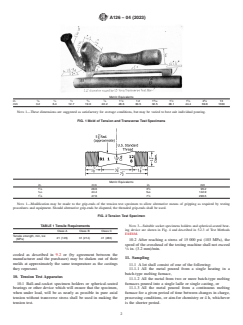
NOTE 1—These dimensions are suggested as satisfactory for average conditions, but may be varied to best suit individual pouring.
FIG. 1 Mold of Tension and Transverse Test Specimens
Metric Equivalents
in. mm in. mm
1 3
1 ⁄8 28.6 3 ⁄4 95.2
3 5
1 ⁄4 44.4 5 ⁄8 142.9
7 1
1 ⁄8 47.6 7 ⁄2 290.5
NOTE 1—Modification may be made to the grip-ends of the tension test specimen to allow alternative means of gripping as required by testing
procedures and equipment. Should alternative grip-ends be disputed, the threaded grip-ends shall be used.
FIG. 2 Tension Test Spec
...