

ASTM F1150-22
(Specification)Standard Specification for Commercial Food Waste Pulper and Waterpress Assembly
General Information
- Abstract
ABSTRACT
This specification establishes the material, design, and performance requirements pertinent to the construction of commercial pulping and waterpress assemblies that are intended for grinding food scraps, paper, cardboard, and disposable plastic food-service ware. Unless otherwise specified, materials used to fabricate pulpers and waterpresses may include corrosion-resistant steel and other corrosion-resisting materials, abrasion-resistant cast iron, austenitic gray iron, copper tube, brass pipe, alloy steel, black and galvanized pipe, gaskets and seals, perforated metal, stainless steel pipe, plastic piping and fitting, and austenitic gray iron pipe fitting. Assembled pulpers and waterpresses shall meet operational, electrical, lubrication, finish, and performance requirements, and should function satisfactorily as specified.
SCOPE
1.1 This specification covers commercial pulping and waterpress assemblies intended for grinding of food scraps, paper, cardboard, and disposable plastic food-service ware.
1.2 The values stated in inch-pound units are to be regarded as standard. The values given in parentheses are mathematical conversions to SI units that are provided for information only and are not considered standard.
1.3 The following safety hazards caveat pertains only to the test method portion, Section 13, of this specification: This standard does not purport to address all of the safety concerns, if any, associated with its use. It is the responsibility of the user of this standard to establish appropriate safety, health, and environmental practices and determine the applicability of regulatory limitations prior to use.
1.4 This international standard was developed in accordance with internationally recognized principles on standardization established in the Decision on Principles for the Development of International Standards, Guides and Recommendations issued by the World Trade Organization Technical Barriers to Trade (TBT) Committee.
- Status
- Published
- Publication Date
- 31-Mar-2022
- Technical Committee
- F26 - Food Service Equipment
- Drafting Committee
- F26.01 - Cleaning and Sanitation Equipment
Buy Documents
ASTM F1150-22 - Standard Specification for Commercial Food Waste Pulper and Waterpress Assembly
REDLINE ASTM F1150-22 - Standard Specification for Commercial Food Waste Pulper and Waterpress Assembly
Overview
ASTM F1150-22 is a key international standard that specifies the requirements for commercial food waste pulper and waterpress assemblies. Developed by ASTM International, this specification covers units intended for the grinding and processing of food scraps, paper, cardboard, and disposable plastic food-service ware in commercial and institutional settings. The standard ensures that these assemblies meet rigorous material, construction, operational, and performance criteria, promoting safety, efficiency, and durability within food service waste management systems.
Key Topics
- Materials: Assemblies must be constructed from corrosion-resistant and abrasion-resistant materials such as stainless steel, alloy steel, austenitic gray iron, brass, and high-grade plastics, ensuring robustness and hygiene.
- Design and Construction: Standards address tank construction, waterpress enclosure, cutter specifications, frame strength, valves, pumps, and electrical components. Units must be easy to install, operate, and maintain.
- Performance Requirements: Pulper and waterpress assemblies are tested for their ability to process set amounts of waste efficiently, handle high-load conditions, and avoid leakage.
- Safety and Compliance: Equipment must comply with applicable electrical and health code standards, such as UL 430, UL 508, NSF/ANSI 13, and NFPA 70. All products should feature clear marking for identification and certified performance.
- Manuals and Documentation: Installation, operation, and maintenance manuals must be provided to support proper use and longevity of the equipment.
- Quality Assurance: Manufacturers are responsible for meeting all requirements through documented testing and quality controls.
Applications
Commercial food waste pulper and waterpress assemblies specified under ASTM F1150-22 are critical for:
- Restaurants and Cafeterias: Efficient grinding and separation of food scraps and food-service disposables, supporting waste reduction and more sustainable operations.
- Institutional Kitchens: Universities, hospitals, hotels, and correctional facilities use these assemblies to handle large volumes of mixed waste, improving sanitation and reducing landfill loads.
- Waste Processing Facilities: Systems offer pre-processing solutions for municipal and private facilities handling commercial foodservice and packaging waste.
- Document and Cardboard Shredding: Secure shredding of sensitive paper and efficient handling of paper/cardboard waste streams.
These assemblies provide significant practical benefits:
- Reduced waste volume and transport costs.
- Improved hygiene and odor control.
- Support for recycling and composting initiatives by processing suitable materials into manageable slurries.
Related Standards
ASTM F1150-22 references and is complemented by several key standards, ensuring comprehensive safety, performance, and material compliance:
- ASTM A240/A240M: Chromium and chromium-nickel stainless steel for pressure and general applications.
- ASTM A532/A532M: Abrasion-resistant cast irons.
- UL 430 / UL 508: Waste disposers and electrical industrial control equipment safety.
- NSF/ANSI 13: Refuse processors and processing systems for food equipment safety.
- NFPA 70: National Electrical Code for safe electrical installation.
- ASTM D3951: Packaging requirements for commercial equipment.
- ASTM F760: Manuals for food service equipment.
Implementing ASTM F1150-22 ensures that commercial food waste pulper and waterpress assemblies not only meet industry expectations for performance and durability but also comply with the highest international standards for food service waste management. This results in safer, more efficient, and environmentally responsible waste processing within commercial environments.
Relations
- Effective Date
- 01-Apr-2024
- Effective Date
- 01-Apr-2024
- Effective Date
- 01-Mar-2024
- Effective Date
- 01-Mar-2024
- Effective Date
- 01-Nov-2023
- Effective Date
- 01-Nov-2023
- Effective Date
- 01-Nov-2023
- Effective Date
- 01-Nov-2023
- Effective Date
- 01-Oct-2023
- Effective Date
- 01-May-2020
- Effective Date
- 01-Apr-2020
- Effective Date
- 01-Jan-2020
- Effective Date
- 01-Nov-2019
- Effective Date
- 01-Nov-2019
- Effective Date
- 01-Nov-2019
Buy Documents
ASTM F1150-22 - Standard Specification for Commercial Food Waste Pulper and Waterpress Assembly
REDLINE ASTM F1150-22 - Standard Specification for Commercial Food Waste Pulper and Waterpress Assembly
Get Certified
Connect with accredited certification bodies for this standard

CIS Institut d.o.o.
Personal Protective Equipment (PPE) certification body. Notified Body NB-2890 for EU Regulation 2016/425 PPE.

Kiwa BDA Testing
Building and construction product certification.
Kmetijski inštitut Slovenije
Agricultural Institute of Slovenia. Soil testing, plant health, agricultural product analysis.
Sponsored listings
Frequently Asked Questions
ASTM F1150-22 is a technical specification published by ASTM International. Its full title is "Standard Specification for Commercial Food Waste Pulper and Waterpress Assembly". This standard covers: ABSTRACT This specification establishes the material, design, and performance requirements pertinent to the construction of commercial pulping and waterpress assemblies that are intended for grinding food scraps, paper, cardboard, and disposable plastic food-service ware. Unless otherwise specified, materials used to fabricate pulpers and waterpresses may include corrosion-resistant steel and other corrosion-resisting materials, abrasion-resistant cast iron, austenitic gray iron, copper tube, brass pipe, alloy steel, black and galvanized pipe, gaskets and seals, perforated metal, stainless steel pipe, plastic piping and fitting, and austenitic gray iron pipe fitting. Assembled pulpers and waterpresses shall meet operational, electrical, lubrication, finish, and performance requirements, and should function satisfactorily as specified. SCOPE 1.1 This specification covers commercial pulping and waterpress assemblies intended for grinding of food scraps, paper, cardboard, and disposable plastic food-service ware. 1.2 The values stated in inch-pound units are to be regarded as standard. The values given in parentheses are mathematical conversions to SI units that are provided for information only and are not considered standard. 1.3 The following safety hazards caveat pertains only to the test method portion, Section 13, of this specification: This standard does not purport to address all of the safety concerns, if any, associated with its use. It is the responsibility of the user of this standard to establish appropriate safety, health, and environmental practices and determine the applicability of regulatory limitations prior to use. 1.4 This international standard was developed in accordance with internationally recognized principles on standardization established in the Decision on Principles for the Development of International Standards, Guides and Recommendations issued by the World Trade Organization Technical Barriers to Trade (TBT) Committee.
ABSTRACT This specification establishes the material, design, and performance requirements pertinent to the construction of commercial pulping and waterpress assemblies that are intended for grinding food scraps, paper, cardboard, and disposable plastic food-service ware. Unless otherwise specified, materials used to fabricate pulpers and waterpresses may include corrosion-resistant steel and other corrosion-resisting materials, abrasion-resistant cast iron, austenitic gray iron, copper tube, brass pipe, alloy steel, black and galvanized pipe, gaskets and seals, perforated metal, stainless steel pipe, plastic piping and fitting, and austenitic gray iron pipe fitting. Assembled pulpers and waterpresses shall meet operational, electrical, lubrication, finish, and performance requirements, and should function satisfactorily as specified. SCOPE 1.1 This specification covers commercial pulping and waterpress assemblies intended for grinding of food scraps, paper, cardboard, and disposable plastic food-service ware. 1.2 The values stated in inch-pound units are to be regarded as standard. The values given in parentheses are mathematical conversions to SI units that are provided for information only and are not considered standard. 1.3 The following safety hazards caveat pertains only to the test method portion, Section 13, of this specification: This standard does not purport to address all of the safety concerns, if any, associated with its use. It is the responsibility of the user of this standard to establish appropriate safety, health, and environmental practices and determine the applicability of regulatory limitations prior to use. 1.4 This international standard was developed in accordance with internationally recognized principles on standardization established in the Decision on Principles for the Development of International Standards, Guides and Recommendations issued by the World Trade Organization Technical Barriers to Trade (TBT) Committee.
ASTM F1150-22 is classified under the following ICS (International Classification for Standards) categories: 13.030.40 - Installations and equipment for waste disposal and treatment; 97.030 - Domestic electrical appliances in general. The ICS classification helps identify the subject area and facilitates finding related standards.
ASTM F1150-22 has the following relationships with other standards: It is inter standard links to ASTM F439-24, ASTM F437-24, ASTM A6/A6M-24, ASTM A53/A53M-24, ASTM A6/A6M-23, ASTM A532/A532M-10(2023), ASTM A240/A240M-23a, ASTM A126-04(2023), ASTM D3951-18(2023), ASTM A436-84(2020), ASTM B43-20, ASTM F104-11(2020), ASTM D2287-19, ASTM A532/A532M-10(2019), ASTM A126-04(2019). Understanding these relationships helps ensure you are using the most current and applicable version of the standard.
ASTM F1150-22 is available in PDF format for immediate download after purchase. The document can be added to your cart and obtained through the secure checkout process. Digital delivery ensures instant access to the complete standard document.
Standards Content (Sample)
This international standard was developed in accordance with internationally recognized principles on standardization established in the Decision on Principles for the
Development of International Standards, Guides and Recommendations issued by the World Trade Organization Technical Barriers to Trade (TBT) Committee.
Designation:F1150 −22 AnAmerican National Standard
Standard Specification for
Commercial Food Waste Pulper and Waterpress Assembly
This standard is issued under the fixed designation F1150; the number immediately following the designation indicates the year of
original adoption or, in the case of revision, the year of last revision. A number in parentheses indicates the year of last reapproval. A
superscript epsilon (´) indicates an editorial change since the last revision or reapproval.
1. Scope Vessels and for General Applications
A269 Specification for Seamless and Welded Austenitic
1.1 This specification covers commercial pulping and wa-
Stainless Steel Tubing for General Service
terpress assemblies intended for grinding of food scraps, paper,
A276 Specification for Stainless Steel Bars and Shapes
cardboard, and disposable plastic food-service ware.
A436 Specification for Austenitic Gray Iron Castings
1.2 The values stated in inch-pound units are to be regarded
A505 Specification for Steel, Sheet and Strip, Alloy, Hot-
as standard. The values given in parentheses are mathematical
Rolled and Cold-Rolled, General Requirements for
conversions to SI units that are provided for information only
A513 Specification for Electric-Resistance-Welded Carbon
and are not considered standard.
and Alloy Steel Mechanical Tubing
1.3 The following safety hazards caveat pertains only to the
A519 Specification for Seamless Carbon and Alloy Steel
test method portion, Section 13, of this specification: This
Mechanical Tubing
standard does not purport to address all of the safety concerns,
A532/A532M Specification for Abrasion-Resistant Cast
if any, associated with its use. It is the responsibility of the user
Irons
of this standard to establish appropriate safety, health, and
A554 Specification for Welded Stainless Steel Mechanical
environmental practices and determine the applicability of
Tubing
regulatory limitations prior to use.
A582/A582M Specification for Free-Machining Stainless
1.4 This international standard was developed in accor-
Steel Bars
dance with internationally recognized principles on standard-
A681 Specification for Tool Steels Alloy
ization established in the Decision on Principles for the
B43 Specification for Seamless Red Brass Pipe, Standard
Development of International Standards, Guides and Recom-
Sizes
mendations issued by the World Trade Organization Technical
B75 Specification for Seamless Copper Tube (Metric)
Barriers to Trade (TBT) Committee.
B0075_B0075M
D2000 Classification System for Rubber Products in Auto-
2. Referenced Documents
motive Applications
2.1 ASTM Standards:
D2287 Classification System and Basis for Specification for
A6/A6M Specification for General Requirements for Rolled
Nonrigid Vinyl Chloride Polymer and Copolymer Mold-
Structural Steel Bars, Plates, Shapes, and Sheet Piling
ing and Extrusion Compounds
A29/A29M SpecificationforGeneralRequirementsforSteel
D3915 Specification for Rigid Poly(Vinyl Chloride) (PVC)
Bars, Carbon and Alloy, Hot-Wrought
and Chlorinated Poly(Vinyl Chloride) (CPVC) Com-
A53/A53M Specification for Pipe, Steel, Black and Hot-
pounds for Plastic Pipe and Fittings Used in Pressure
Dipped, Zinc-Coated, Welded and Seamless
Applications (Withdrawn 2015)
A126 Specification for Gray Iron Castings for Valves,
D3951 Practice for Commercial Packaging
Flanges, and Pipe Fittings
E674 Specification for Industrial Perforated Plate and
A240/A240M Specification for Chromium and Chromium-
Screens (Round Opening Series)
Nickel Stainless Steel Plate, Sheet, and Strip for Pressure
F104 Classification System for Nonmetallic Gasket Materi-
als
F437 Specification for Threaded Chlorinated Poly(Vinyl
This specification is under the jurisdiction of ASTM Committee F26 on Food
Service Equipment and is the direct responsibility of Subcommittee F26.01 on
Chloride) (CPVC) Plastic Pipe Fittings, Schedule 80
Cleaning and Sanitation Equipment.
F439 Specification for Chlorinated Poly (Vinyl Chloride)
Current edition approved April 1, 2022. Published April 2022. Originally
(CPVC) Plastic Pipe Fittings, Schedule 80
approved in 1988. Last previous edition approved in 2016 as F1150 – 16. DOI:
10.1520/F1150-22.
For referenced ASTM standards, visit the ASTM website, www.astm.org, or
contact ASTM Customer Service at service@astm.org. For Annual Book of ASTM
Standards volume information, refer to the standard’s Document Summary page on The last approved version of this historical standard is referenced on
the ASTM website. www.astm.org.
Copyright ©ASTM International, 100 Barr Harbor Drive, PO Box C700, West Conshohocken, PA19428-2959. United States
F1150−22
TABLE 1 Type, Size, and Options
F441/F441M Specification for Chlorinated Poly(Vinyl Chlo-
ride) (CPVC) Plastic Pipe, Schedules 40 and 80 Type Pulper with Waterpress A B
Size Pulper Diameter
F442/F442M Specification for Chlorinated Poly(Vinyl Chlo-
24 30 24 30
Options Inches—Maximum
ride) (CPVC) Plastic Pipe (SDR–PR)
Pulper Motor HP 5 7.5 5 7.5
F760 Specification for Food Service Equipment Manuals Waterpress Motor HP 2 3 2 3
1 Automatic Shutdown Timer 3 3 3 3
2.2 National Fire Protection Agency Standard:
2 18 In. Higher than Standard
NFPA 70 National Electric Code
Waterpress 3 3 3 3
3 Tray Flush (Recirculated
2.3 NSF International Standards:
Water) 3 3 3 3
NSF/ANSI 13 Refuse Processors and Processing Systems
4 Trough Flush (Recirculated) 2 2 3 3
NSF Listings–Food Equipment
5 Single Feed Through
Connection 2 2 3 3
2.4 Underwriters Laboratory Standards:
6 Double Feed Through
UL 430 Waste Disposers
Connection 2 2 3 3
UL 508 Industrial Control Equipment 7 Feed Hood with Tray 4 4 3 3
(1) Pulper cover plate supplied in lieu of feed hood.
3. Terminology (2) Pulper and waterpress type not compatible with optional feature.
(3) Indicates available option for given type pulper with waterpress.
3.1 General—Commercial pulpers with waterpresses are
(4) Standard for TypeA.
intended for grinding food waste, food service paper and
cardboard products, food service plastic products, documents
including computer printouts, general office and retail store
4.3 All equipment of the same model designation and
paper, and cardboard waste. Materials are ground in a water-
options on the same purchase order shall have component
filled tank (pulper) to produce a slurry which is then passed to
interchangeability for serviceability.
the waterpress to be de-watered. Pulpers are not intended to be
used for grinding glass, china, metal, wood, clam, or oyster
5. Ordering Information
shells. Any small pieces of metal inadvertently placed in the
5.1 Purchasers should select the preferred options permitted
pulper, such as cardboard box staples, aluminum refreshment
in this specification and include the following information in
cans, or tin food cans, shall be removable from a trap in the
procurement documents:
pulper tank.
5.1.1 Title, number, and date of this standard.
3.2 Definitions of Terms Specific to This Standard:
5.1.2 Classification of size and type (see Section 4).
3.2.1 pulper—the pulper tank has a motor driven grinding
5.1.3 Electrical power supply voltage range (see 9.1).
disk to grind and cut waste material, and mixes this material
5.1.4 Electrical controls when specified to be remote from
with water to produce a slurry that is pumped to the waterpress
the unit (see 9.3).
through a sizing screen. Pulpers may consist of the following
5.1.5 Optional automatic shutdown timer when specified
principle parts: tank, motor, grinding disk, particle sizing ring,
(see Section 4).
trash box, legs, feed chute, stationary, and rotating cutters.
5.1.6 Spare and maintenance parts required.
5.1.7 Optional tray flush uses recycled water from the
3.3 waterpress—the waterpress de-waters the slurry gener-
waterpress when specified (see Section 4).
ated in the pulper by use of a vertical, inclined, or horizontal
5.1.8 Optional waterpress for high profile pulp discharge 18
screw and perforated screen, then discharges the pulp down a
in. above standard height optional when specified (see Section
chute to a waste container. Water removed during this process
4).
is pumped to the pulper tank in order to conserve fresh water
5.1.9 Optional trough flush when specified (see Section 4).
use. Waterpresses may consist of the following parts: shell,
5.1.10 Optional single feed trough connections on when
helical transport screw, perforated screen, gearbox, motor,
specified (see Section 4).
compression cone, discharge housing, chute, and pump.
5.1.11 Optionaldoublefeedtroughconnectionswhenspeci-
4. Classification fied (see Section 4).
5.1.12 Optional feed hood with tray for Type B (see Section
4.1 General—Pulper and waterpress assemblies shall be of
4).
the following type, size, and options as specified.
5.1.13 Designate special features required for installation,
4.2 Type, Size, and Options (See Table 1):
such as location of controls, location of feed-hood and trough
4.2.1 Type A—Free-standing pulper and waterpress assem-
openings, waterpress discharge location, and location for cold
bly with tray assembly and flanged feet.
water and drain connections.
4.2.2 Type B—Undercounter pulper for 34-in. (86-cm) high
counter and waterpress with feed hood and bullet feet.
6. Materials
6.1 Unless otherwise specified, pulpers and waterpresses
shall be fabricated of materials specified in documents refer-
Available from National Fire Protection Association (NFPA), 1 Batterymarch
Park, Quincy, MA 02269-9101.
enced in Section 2. Materials used shall be free from defects
Available from NSF International, P.O. Box 130140, 789 N. Dixboro Rd.,Ann
which would adversely affect the performance or maintainabil-
Arbor, MI 48113-0140.
ityofindividualcomponentsortheoverallassembly.Unitshall
Available from Underwriters Laboratories (UL), 333 Pfingsten Rd.,
Northbrook, IL 60062. be manufactured for cleanability.
F1150−22
6.1.1 Corrosion-Resistant Steel—Shall conform to the re- thescreenandamanualcoldwaterscreenflushsystemshallbe
quirements of any 300 series steel specified in Specifications provided. The waterpress flight screw shall be of corrosion-
A240/A240M, A554, A276, and A582/A582M.
resistant steel. Thickness of the flight shall be 0.125-in.
6.1.2 Corrosion-Resisting Material—Corrosion-resisting
(3.18-mm) minimum thickness.
material is other than corrosion resistant steel that is equivalent
7.5 Level Sensor—A level sensor shall be supplied with
in the pulper and waterpress application.
each pulper for the purpose of controlling water level in the
6.1.3 Abrasion-Resistant Cast Iron—Shall conform to the
pulper tank. The sensor shall
...
This document is not an ASTM standard and is intended only to provide the user of an ASTM standard an indication of what changes have been made to the previous version. Because
it may not be technically possible to adequately depict all changes accurately, ASTM recommends that users consult prior editions as appropriate. In all cases only the current version
of the standard as published by ASTM is to be considered the official document.
Designation: F1150 − 16 F1150 − 22 An American National Standard
Standard Specification for
Commercial Food Waste Pulper and Waterpress Assembly
This standard is issued under the fixed designation F1150; the number immediately following the designation indicates the year of
original adoption or, in the case of revision, the year of last revision. A number in parentheses indicates the year of last reapproval. A
superscript epsilon (´) indicates an editorial change since the last revision or reapproval.
1. Scope
1.1 This specification covers commercial pulping and waterpress assemblies intended for grinding of food scraps, paper,
cardboard, and disposable plastic food-service ware.
1.2 The values stated in inch-pound units are to be regarded as standard. The values given in parentheses are mathematical
conversions to SI units that are provided for information only and are not considered standard.
1.3 The following safety hazards caveat pertains only to the test method portion, Section 13, of this specification: This standard
does not purport to address all of the safety concerns, if any, associated with its use. It is the responsibility of the user of this
standard to establish appropriate safety safety, health, and healthenvironmental practices and determine the applicability of
regulatory limitations prior to use.
1.4 This international standard was developed in accordance with internationally recognized principles on standardization
established in the Decision on Principles for the Development of International Standards, Guides and Recommendations issued
by the World Trade Organization Technical Barriers to Trade (TBT) Committee.
2. Referenced Documents
2.1 ASTM Standards:
A6/A6M Specification for General Requirements for Rolled Structural Steel Bars, Plates, Shapes, and Sheet Piling
A29/A29M Specification for General Requirements for Steel Bars, Carbon and Alloy, Hot-Wrought
A53/A53M Specification for Pipe, Steel, Black and Hot-Dipped, Zinc-Coated, Welded and Seamless
A126 Specification for Gray Iron Castings for Valves, Flanges, and Pipe Fittings
A240/A240M Specification for Chromium and Chromium-Nickel Stainless Steel Plate, Sheet, and Strip for Pressure Vessels and
for General Applications
A269 Specification for Seamless and Welded Austenitic Stainless Steel Tubing for General Service
A276 Specification for Stainless Steel Bars and Shapes
A436 Specification for Austenitic Gray Iron Castings
A505 Specification for Steel, Sheet and Strip, Alloy, Hot-Rolled and Cold-Rolled, General Requirements for
A513 Specification for Electric-Resistance-Welded Carbon and Alloy Steel Mechanical Tubing
A519 Specification for Seamless Carbon and Alloy Steel Mechanical Tubing
A532/A532M Specification for Abrasion-Resistant Cast Irons
A554 Specification for Welded Stainless Steel Mechanical Tubing
A582/A582M Specification for Free-Machining Stainless Steel Bars
This specification is under the jurisdiction of ASTM Committee F26 on Food Service Equipment and is the direct responsibility of Subcommittee F26.01 on Cleaning
and Sanitation Equipment.
Current edition approved Dec. 1, 2016April 1, 2022. Published January 2017April 2022. Originally approved in 1988. Last previous edition approved in 20112016 as
F1150 – 11.F1150 – 16. DOI: 10.1520/F1150-16.10.1520/F1150-22.
For referenced ASTM standards, visit the ASTM website, www.astm.org, or contact ASTM Customer Service at service@astm.org. For Annual Book of ASTM Standards
volume information, refer to the standard’s Document Summary page on the ASTM website.
Copyright © ASTM International, 100 Barr Harbor Drive, PO Box C700, West Conshohocken, PA 19428-2959. United States
F1150 − 22
A681 Specification for Tool Steels Alloy
B43 Specification for Seamless Red Brass Pipe, Standard Sizes
B75 Specification for Seamless Copper Tube (Metric) B0075_B0075M
D2000 Classification System for Rubber Products in Automotive Applications
D2287 Classification System and Basis for Specification for Nonrigid Vinyl Chloride Polymer and Copolymer Molding and
Extrusion Compounds
D3915 Specification for Rigid Poly(Vinyl Chloride) (PVC) and Chlorinated Poly(Vinyl Chloride) (CPVC) Compounds for
Plastic Pipe and Fittings Used in Pressure Applications (Withdrawn 2015)
D3951 Practice for Commercial Packaging
E674 Specification for Industrial Perforated Plate and Screens (Round Opening Series)
F104 Classification System for Nonmetallic Gasket Materials
F437 Specification for Threaded Chlorinated Poly(Vinyl Chloride) (CPVC) Plastic Pipe Fittings, Schedule 80
F439 Specification for Chlorinated Poly (Vinyl Chloride) (CPVC) Plastic Pipe Fittings, Schedule 80
F441/F441M Specification for Chlorinated Poly(Vinyl Chloride) (CPVC) Plastic Pipe, Schedules 40 and 80
F442/F442M Specification for Chlorinated Poly(Vinyl Chloride) (CPVC) Plastic Pipe (SDR–PR)
F443F760 Specification for Bell-End Chlorinated Poly(Vinyl Chloride) (Cpvc) Pipe Schedule 40Food Service Equipment
Manuals (Withdrawn 1986)
2.2 National Fire Protection Agency Standard:
NFPA 70 National Electric Code
2.3 NSF International Standards:
NSF/ANSI 13 Refuse Processors and Processing Systems
NSF Listings–Food Equipment
2.4 Underwriters Laboratory Standards:
UL 430 Waste Disposers
UL 508 Electrical Industrial Control Equipment
3. Terminology
3.1 General—Commercial pulpers with waterpresses are intended for grinding food waste, food service paper and cardboard
products, food service plastic products, documents including computer printouts, general office and retail store paper, and
cardboard waste. Materials are ground in a water-filled tank (pulper) to produce a slurry which is then passed to the waterpress
to be de-watered. Pulpers are not intended to be used for grinding glass, china, metal, wood, clam, or oyster shells. Any small
pieces of metal inadvertently placed in the pulper, such as cardboard box staples, aluminum refreshment cans, or tin food cans,
shall be removable from a trap in the pulper tank.
3.2 Definitions of Terms Specific to This Standard:
3.2.1 pulper—the pulper tank has a motor driven grinding disk to grind and cut waste material, and mixes this material with water
to produce a slurry that is pumped to the waterpress through a sizing screen. Pulpers may consist of the following principle parts:
tank, motor, grinding disk, particle sizing ring, trash box, legs, feed chute, stationary, and rotating cutters.
3.3 waterpress—the waterpress de-waters the slurry generated in the pulper by use of a vertical, inclined, or horizontal screw and
perforated screen, then discharges the pulp down a chute to a waste container. Water removed during this process is pumped to
the pulper tank in order to conserve fresh water use. Waterpresses may consist of the following parts: shell, helical transport screw,
perforated screen, gearbox, motor, compression cone, discharge housing, chute, and pump.
4. Classification
4.1 General—Pulper and waterpress assemblies shall be of the following type, size, and options as specified.
4.2 Type, Size, and Options (See Table 1):
4.2.1 Type A—Free-standing pulper and waterpress assembly with tray assembly and flanged feet.
The last approved version of this historical standard is referenced on www.astm.org.
Available from National Fire Protection Association (NFPA), 1 Batterymarch Park, Quincy, MA 02269-9101.
Available from NSF International, P.O. Box 130140, 789 N. Dixboro Rd., Ann Arbor, MI 48113-0140.
Available from Underwriters Laboratories (UL), 333 Pfingsten Rd., Northbrook, IL 60062.
F1150 − 22
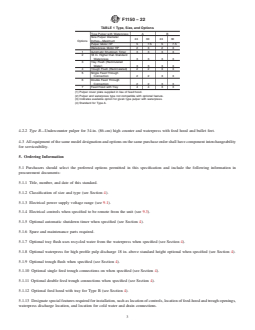
TABLE 1 Type, Size, and Options
Type Pulper with Waterpress A B
Size Pulper Diameter
24 30 24 30
Options Inches—Maximum
Pulper Motor HP 5 7.5 5 7.5
Waterpress Motor HP 2 3 2 3
1 Automatic Shutdown Timer 3 3 3 3
2 18 In. Higher than Standard
Waterpress 3 3 3 3
3 Tray Flush (Recirculated
Water) 3 3 3 3
4 Trough Flush (Recirculated) 2 2 3 3
5 Single Feed Through
Connection 2 2 3 3
6 Double Feed Through
Connection 2 2 3 3
7 Feed Hood with Tray 4 4 3 3
(1) Pulper cover plate supplied in lieu of feed hood.
(2) Pulper and waterpress type not compatible with optional feature.
(3) Indicates available option for given type pulper with waterpress.
(4) Standard for Type A.
4.2.2 Type B—Undercounter pulper for 34-in. (86-cm) high counter and waterpress with feed hood and bullet feet.
4.3 All equipment of the same model designation and options on the same purchase order shall have component interchangeability
for serviceability.
5. Ordering Information
5.1 Purchasers should select the preferred options permitted in this specification and include the following information in
procurement documents:
5.1.1 Title, number, and date of this standard.
5.1.2 Classification of size and type (see Section 4).
5.1.3 Electrical power supply voltage range (see 9.1).
5.1.4 Electrical controls when specified to be remote from the unit (see 9.3).
5.1.5 Optional automatic shutdown timer when specified (see Section 4).
5.1.6 Spare and maintenance parts required.
5.1.7 Optional tray flush uses recycled water from the waterpress when specified (see Section 4).
5.1.8 Optional waterpress for high profile pulp discharge 18 in. above standard height optional when specified (see Section 4).
5.1.9 Optional trough flush when specified (see Section 4).
5.1.10 Optional single feed trough connections on when specified (see Section 4).
5.1.11 Optional double feed trough connections when specified (see Section 4).
5.1.12 Optional feed hood with tray for Type B (see Section 4).
5.1.13 Designate special features required for installation, such as location of controls, location of feed-hood and trough openings,
waterpress discharge location, and location for cold water and drain connections.
F1150 − 22
6. Materials
6.1 Unless otherwise specified, pulpers and waterpresses shall be fabricated of materials specified in documents referenced in
Section 2. Materials used shall be free from defects which would adversely affect the performance or maintainability of individual
components or the overall assembly. Unit shall be manufactured for cleanability.
6.1.1 Corrosion-Resistant Steel—Shall conform to the requirements of any 300 series steel specified in Specifications
A240/A240M, A554, A276, and A582/A582M.
6.1.2 Corrosion-Resisting Material—Corrosion-resisting material is other than corrosion resistant steel that is equivalent in the
pulper and waterpress application.
6.1.3 Abrasion-Resistant Cast Iron—Shall conform to the requirements specified in Specification A532/A532M.
6.1.4 Austenitic Gray Iron—Shall conform to the requirements specified in Specification A436.
6.1.5 Copper Tube—Shall conform to the requirements specified in Specification B75.
...