

ASTM D5740-18
(Guide)Standard Guide for Writing Material Standards in the Classification D4000 Format
General Information
- Abstract
ABSTRACT
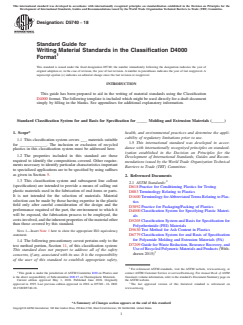
This guide has been prepared to aid in the writing of material standards using the Classification D 4000 format.
SCOPE
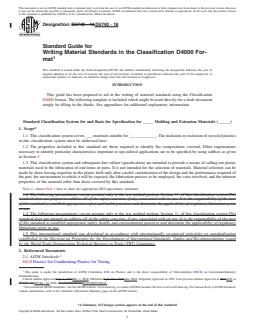
1.1 This classification system covers ___ materials suitable for _____________. The inclusion or exclusion of recycled plastics in this classification system must be addressed here.
1.2 The properties included in this standard are those required to identify the compositions covered. Other requirements necessary to identify particular characteristics important to specialized applications are to be specified by using suffixes as given in Section 5.
1.3 This classification system and subsequent line callout (specification) are intended to provide a means of calling out plastic materials used in the fabrication of end items or parts. It is not intended for the selection of materials. Material selection can be made by those having expertise in the plastic field only after careful consideration of the design and the performance required of the part, the environment to which it will be exposed, the fabrication process to be employed, the costs involved, and the inherent properties of the material other than those covered by this standard.
Note 1: Insert Note 1 here to show the appropriate ISO equivalency statement.
1.4 The following precautionary caveat pertains only to the test method portion, Section 11, of this classification system: This standard does not purport to address all of the safety concerns, if any, associated with its use. It is the responsibility of the user of this standard to establish appropriate safety, health, and environmental practices and determine the applicability of regulatory limitations prior to use.
1.5 This international standard was developed in accordance with internationally recognized principles on standardization established in the Decision on Principles for the Development of International Standards, Guides and Recommendations issued by the World Trade Organization Technical Barriers to Trade (TBT) Committee.
- Status
- Published
- Publication Date
- 30-Apr-2018
- Technical Committee
- D20 - Plastics
- Drafting Committee
- D20.15 - Thermoplastic Materials
Overview
ASTM D5740-18: Standard Guide for Writing Material Standards in the Classification D4000 Format provides a comprehensive framework for developing material standards specifically using the established D4000 classification system. Developed by ASTM International, this guide is designed to streamline the creation of material specifications that ensure clear communication, standardization, and efficient classification of plastic materials and their variations-including reinforced, filled, and lubricated types.
By following D5740-18, standards writers can produce consistent, technically sound documents, facilitating clear identification, evaluation, and specification of plastic materials for use in manufacturing, quality assurance, and regulatory compliance.
Key Topics
- Classification Fundamentals: Guidance on categorizing plastic materials into groups, classes, and grades based on composition, properties, and intended applications using D4000 format.
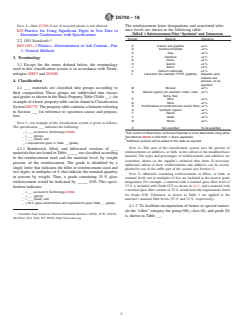
- Property Tables: Instructions for preparing basic property tables and utilizing symbols for material attributes such as reinforcement type and filler percentage.
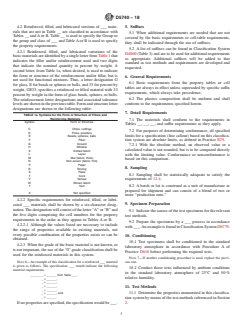
- Use of Suffixes: Explanation on how to specify additional performance requirements using suffix codes as outlined in D4000.
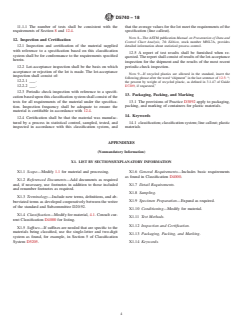
- Testing and Certification: Recommendations for standardized testing procedures, statistical sampling, lot acceptance, and certification processes.
- Safety and Regulatory Considerations: Emphasis on user responsibility to address safety, health, and environmental regulations relevant to material testing and application.
- Recycled Plastics: Guidance on addressing the inclusion or exclusion of recycled plastics within the classification and specification process.
- Referenced Standards: Integration with key ASTM and ISO standards for terminology, testing, and packaging relevant to plastic materials.
- Document Structure: Suggestions on organizing terminology, sampling, specimen preparation, conditioning, inspection, and reporting for clarity and compliance.
Applications
The ASTM D5740-18 guide is used by:
- Standards Developers: Assists both industry and government organizations in drafting new or revised material standards for plastic materials.
- Material Suppliers: Enables producers to communicate technical requirements and ensure product consistency across markets by referencing standardized material specifications.
- Quality Assurance Teams: Provides a framework for certifying and verifying conformance of plastic materials to specified standards in manufacturing operations.
- Regulatory Agencies: Supports transparent, internationally-recognized documentation aligned with WTO Technical Barriers to Trade (TBT) principles.
- Design and Engineering Professionals: Offers a uniform method for identifying required properties and performance criteria of plastics used in end products, though not for initial material selection.
- Environmental Stakeholders: Establishes protocols for declaring and verifying recycled content in material specifications where applicable.
By implementing D5740-18, organizations benefit from improved clarity, interoperability, and efficiency in specifying and procuring plastic materials for molding, extrusion, and fabrication of parts or components.
Related Standards
- ASTM D4000: Classification System for Specifying Plastic Materials
- ASTM D618: Practice for Conditioning Plastics for Testing
- ASTM D883: Terminology Relating to Plastics
- ASTM D1600: Terminology for Abbreviated Terms Relating to Plastics
- ASTM D3892: Practice for Packaging/Packing of Plastics
- ASTM D5630: Test Method for Ash Content in Plastics
- ASTM D6779: Classification System for Polyamide Molding and Extrusion Materials
- ISO 3451-1: Plastics - Determination of Ash Content - Part 1: General Methods
By referencing ASTM D5740-18 and its related standards, organizations can ensure that their material standards and product documentation meet globally accepted criteria, minimize ambiguity, and promote best practices within the plastics industry.
Relations
- Effective Date
- 01-Feb-2024
- Effective Date
- 01-Feb-2024
- Effective Date
- 01-Nov-2023
- Effective Date
- 01-Jan-2020
- Effective Date
- 01-Aug-2019
- Effective Date
- 15-Apr-2019
- Effective Date
- 01-Feb-2019
- Effective Date
- 01-Dec-2018
- Effective Date
- 01-Nov-2018
- Refers
ASTM D1600-18 - Standard Terminology for Abbreviated Terms Relating to Plastics (Withdrawn 2024) - Effective Date
- 01-Jan-2018
- Effective Date
- 15-Aug-2017
- Effective Date
- 01-Mar-2017
- Effective Date
- 01-Sep-2016
- Effective Date
- 01-May-2016
- Effective Date
- 01-Sep-2015
Get Certified
Connect with accredited certification bodies for this standard

BSI Group
BSI (British Standards Institution) is the business standards company that helps organizations make excellence a habit.

Control Union Certifications
Global certification for agriculture and sustainability.

Gozdarski inštitut Slovenije
Slovenian Forestry Institute. Forest management certification support, timber testing.
Sponsored listings
Frequently Asked Questions
ASTM D5740-18 is a guide published by ASTM International. Its full title is "Standard Guide for Writing Material Standards in the Classification D4000 Format". This standard covers: ABSTRACT This guide has been prepared to aid in the writing of material standards using the Classification D 4000 format. SCOPE 1.1 This classification system covers ___ materials suitable for _____________. The inclusion or exclusion of recycled plastics in this classification system must be addressed here. 1.2 The properties included in this standard are those required to identify the compositions covered. Other requirements necessary to identify particular characteristics important to specialized applications are to be specified by using suffixes as given in Section 5. 1.3 This classification system and subsequent line callout (specification) are intended to provide a means of calling out plastic materials used in the fabrication of end items or parts. It is not intended for the selection of materials. Material selection can be made by those having expertise in the plastic field only after careful consideration of the design and the performance required of the part, the environment to which it will be exposed, the fabrication process to be employed, the costs involved, and the inherent properties of the material other than those covered by this standard. Note 1: Insert Note 1 here to show the appropriate ISO equivalency statement. 1.4 The following precautionary caveat pertains only to the test method portion, Section 11, of this classification system: This standard does not purport to address all of the safety concerns, if any, associated with its use. It is the responsibility of the user of this standard to establish appropriate safety, health, and environmental practices and determine the applicability of regulatory limitations prior to use. 1.5 This international standard was developed in accordance with internationally recognized principles on standardization established in the Decision on Principles for the Development of International Standards, Guides and Recommendations issued by the World Trade Organization Technical Barriers to Trade (TBT) Committee.
ABSTRACT This guide has been prepared to aid in the writing of material standards using the Classification D 4000 format. SCOPE 1.1 This classification system covers ___ materials suitable for _____________. The inclusion or exclusion of recycled plastics in this classification system must be addressed here. 1.2 The properties included in this standard are those required to identify the compositions covered. Other requirements necessary to identify particular characteristics important to specialized applications are to be specified by using suffixes as given in Section 5. 1.3 This classification system and subsequent line callout (specification) are intended to provide a means of calling out plastic materials used in the fabrication of end items or parts. It is not intended for the selection of materials. Material selection can be made by those having expertise in the plastic field only after careful consideration of the design and the performance required of the part, the environment to which it will be exposed, the fabrication process to be employed, the costs involved, and the inherent properties of the material other than those covered by this standard. Note 1: Insert Note 1 here to show the appropriate ISO equivalency statement. 1.4 The following precautionary caveat pertains only to the test method portion, Section 11, of this classification system: This standard does not purport to address all of the safety concerns, if any, associated with its use. It is the responsibility of the user of this standard to establish appropriate safety, health, and environmental practices and determine the applicability of regulatory limitations prior to use. 1.5 This international standard was developed in accordance with internationally recognized principles on standardization established in the Decision on Principles for the Development of International Standards, Guides and Recommendations issued by the World Trade Organization Technical Barriers to Trade (TBT) Committee.
ASTM D5740-18 is classified under the following ICS (International Classification for Standards) categories: 01.120 - Standardization. General rules; 35.260 - Office machines; 85.080 - Paper products. The ICS classification helps identify the subject area and facilitates finding related standards.
ASTM D5740-18 has the following relationships with other standards: It is inter standard links to ASTM D5205-24, ASTM D883-24, ASTM D883-23, ASTM D883-20, ASTM D883-19c, ASTM D883-19a, ASTM D883-19, ASTM D883-18a, ASTM D883-18, ASTM D1600-18, ASTM D883-17, ASTM D6779-17, ASTM D5205-16, ASTM D6779-16, ASTM D3892-15. Understanding these relationships helps ensure you are using the most current and applicable version of the standard.
ASTM D5740-18 is available in PDF format for immediate download after purchase. The document can be added to your cart and obtained through the secure checkout process. Digital delivery ensures instant access to the complete standard document.
Standards Content (Sample)
This international standard was developed in accordance with internationally recognized principles on standardization established in the Decision on Principles for the
Development of International Standards, Guides and Recommendations issued by the World Trade Organization Technical Barriers to Trade (TBT) Committee.
Designation: D5740 − 18
Standard Guide for
Writing Material Standards in the Classification D4000
Format
This standard is issued under the fixed designation D5740; the number immediately following the designation indicates the year of
original adoption or, in the case of revision, the year of last revision. A number in parentheses indicates the year of last reapproval. A
superscript epsilon (´) indicates an editorial change since the last revision or reapproval.
INTRODUCTION
This guide has been prepared to aid in the writing of material standards using the Classification
D4000 format. The following template is included which might be used directly for a draft document
simply by filling in the blanks. See appendixes for additional explanatory information.
Standard Classification System for and Basis for Specification for _____ Molding and Extrusion Materials (______)
1. Scope* health, and environmental practices and determine the appli-
cability of regulatory limitations prior to use.
1.1 This classification system covers ___ materials suitable
1.5 This international standard was developed in accor-
for _____________. The inclusion or exclusion of recycled
dance with internationally recognized principles on standard-
plastics in this classification system must be addressed here.
ization established in the Decision on Principles for the
1.2 The properties included in this standard are those
Development of International Standards, Guides and Recom-
required to identify the compositions covered. Other require-
mendations issued by the World Trade Organization Technical
ments necessary to identify particular characteristics important
Barriers to Trade (TBT) Committee.
to specialized applications are to be specified by using suffixes
as given in Section 5.
2. Referenced Documents
1.3 This classification system and subsequent line callout
2.1 ASTM Standards:
(specification) are intended to provide a means of calling out
D618 Practice for Conditioning Plastics for Testing
plastic materials used in the fabrication of end items or parts.
D883 Terminology Relating to Plastics
It is not intended for the selection of materials. Material
D1600 Terminology for Abbreviated Terms Relating to Plas-
selection can be made by those having expertise in the plastic
tics
field only after careful consideration of the design and the
D3892 Practice for Packaging/Packing of Plastics
performance required of the part, the environment to which it
D4000 Classification System for Specifying Plastic Materi-
will be exposed, the fabrication process to be employed, the
als
costs involved, and the inherent properties of the material other
D5205 Classification System and Basis for Specification for
than those covered by this standard.
Polyetherimide (PEI) Materials
D5630 Test Method for Ash Content in Plastics
NOTE 1—Insert Note 1 here to show the appropriate ISO equivalency
statement. D6779 Classification System for and Basis of Specification
for Polyamide Molding and Extrusion Materials (PA)
1.4 The following precautionary caveat pertains only to the
D7209 Guide for Waste Reduction, Resource Recovery, and
test method portion, Section 11, of this classification system:
Use of Recycled Polymeric Materials and Products (With-
This standard does not purport to address all of the safety
drawn 2015)
concerns, if any, associated with its use. It is the responsibility
of the user of this standard to establish appropriate safety,
For referenced ASTM standards, visit the ASTM website, www.astm.org, or
This guide is under the jurisdiction of ASTM Committee D20 on Plastics and contact ASTM Customer Service at service@astm.org. For Annual Book of ASTM
is the direct responsibility of Subcommittee D20.15 on Thermoplastic Materials. Standards volume information, refer to the standard’s Document Summary page on
Current edition approved May 1, 2018. Published June 2018. Originally the ASTM website.
approved in 1995. Last previous edition approved in 2016 as D5740 – 16. DOI: The last approved version of this historical standard is referenced on
10.1520/D5740-18. www.astm.org.
*A Summary of Changes section appears at the end of this standard
Copyright © ASTM International, 100 Barr Harbor Drive, PO Box C700, West Conshohocken, PA 19428-2959. United States
D5740 − 18
The reinforcement letter designations and associated toler-
NOTE 2—Omit D7209 if use of recycled plastic is not allowed.
ance levels are shown in the following table:
E29 Practice for Using Significant Digits in Test Data to
A B
TABLE 1 Reinforcement-Filler Symbols and Tolerances
Determine Conformance with Specifications
Symbol Material Tolerance
2.2 ISO Standards:
C Carbon and graphite ±2 %
ISO 3451–1 Plastics—Determination of Ash Content—Part
D Alumina trihydrate ±2 %
1: General Methods
E Clay ±2 %
F Cellulose ±2 %
3. Terminology
G Glass ±2 %
H Aramid ±2 %
3.1 Except for the terms defined below, the terminology
J Boron ±2 %
used in this classification system is in accordance with Termi-
K Calcium carbonate ±2 %
nologies D883 and D1600.
L Lubricants (for example: PTFE, graphite) Depends upon
material and
4. Classification process—to be
specified.
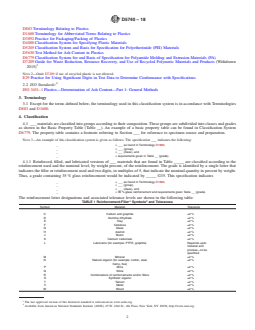
4.1 ___ materials are classified into groups according to
M Mineral ±2 %
N Natural organic (for example: cotton, sisal, ±2 %
their composition. These groups are subdivided into classes
hemp, flax)
and grades as shown in the Basic Property Table (Table __). An
P Mica ±2 %
example of a basic property table can be found in Classification
Q Silica ±2 %
R Combinations of reinforcements and/or fillers ±2 %
System D6779. The property table contains a footnote referring
S Synthetic organic ±2 %
to Section ___ for reference to specimen source and prepara-
T Talcum ±2 %
tion.
V Metal ±2 %
W Wood ±2 %
NOTE 3—An example of this classification system is given as follows:
The specification ___ indicates the following:
X Not specified To be specified
A
_ = ___ as found in Terminology D1600,
Ash content of filled and/or reinforced materials is to be determined using either
_ = ___ (group),
Test Method D5630 or ISO 3451-1 where applicable.
_ = ___ (class), and B
Additional symbols will be added to this table as required.
_ = requirements given in Table __ (grade).
NOTE 4—This part of the classification system uses the percent of
4.1.1 Reinforced, filled, and lubricated versions of ___
reinforcements or additives, or both, in the callout of the modified basic
materials that are found in Table _____ are classified according
material. The types and percentages of reinforcements and additives are
to the reinforcement used and the nominal level, by weight
sometimes shown on the supplier’s technical data sheet. If necessary,
percent, of the reinforcement. The grade is identified by a
additional callout of these reinforcements and additives can be accom-
single letter that indicates the filler or reinforcement used and
plished by use of the suffix part of the system (see Section 5).
two digits, in multiples of 5, that indicate the nominal quantity
NOTE 5—Materials containing reinforcements or fillers, or both, at
in percent by weight. Thus, a grade containing 35 % glass
nominal levels not in multiples of five are included in the nearest grade
reinforcement would be indicated by _____ G35. This speci- designation. For example, a material with a nominal glass fiber level of
33 % is included with Grade G35 as shown in 4.1.1, and a material with
fication indicates
a nominal glass fiber content of 32 % would meet the requirements listed
_ = ___ as found in Terminology D1600,
for Grade G30. Tolerances as shown in Table 1 are applied to the
_ = ___ (group),
material’s nominal filler levels (33 % and 32 %, respectively).
_ = ___ (class), and
_ = 35 % glass reinforcement and requirements given Table __ (grade).
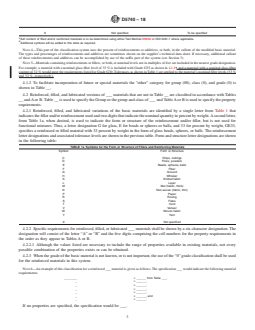
4.1.2 To facilitate incorporation of future or special materi-
als the “other” category for group (00), class (0), and grade (0)
Available from American National Standards Institute (ANSI), 25 W. 43rd St.,
is shown in Table __.
4th Floor, New York, NY 10036, http://www.ansi.org.
D5740 − 18
4.2 Reinforced, filled, and lubricated versions of ___ mate- 5. Suffixes
rials that are not in Table __ are classified in accordance with
5.1 When additional requirements are needed that are not
Tables __ and A or B. Table __ is used to specify the Group or
covered by the basic requirements or cell-table requirements,
the group and class of ___ and Table A or B is used to specify
they shall be indicated through the use of suffixes.
the property requirements.
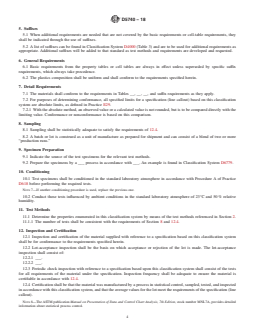
5.2 A list of suffixes can be found in Classification System
4.2.1 Reinforced, filled, and lubricated variations of the
D4000 (Table 3) and are to be used for additional requirements
basic materials are identified by a single letter from Table 1 that
as appropriate. Additional suffixes will be added to that
indicates the filler and/or reinforcement used and two digits
standard as test methods and requirement
...
This document is not an ASTM standard and is intended only to provide the user of an ASTM standard an indication of what changes have been made to the previous version. Because
it may not be technically possible to adequately depict all changes accurately, ASTM recommends that users consult prior editions as appropriate. In all cases only the current version
of the standard as published by ASTM is to be considered the official document.
Designation: D5740 − 16 D5740 − 18
Standard Guide for
Writing Material Standards in the Classification D4000 For-
mat
This standard is issued under the fixed designation D5740; the number immediately following the designation indicates the year of
original adoption or, in the case of revision, the year of last revision. A number in parentheses indicates the year of last reapproval. A
superscript epsilon (´) indicates an editorial change since the last revision or reapproval.
INTRODUCTION
This guide has been prepared to aid in the writing of material standards using the Classification
D4000 format. The following template is included which might be used directly for a draft document
simply by filling in the blanks. See appendixes for additional explanatory information.
Standard Classification System for and Basis for Specification for _____ Molding and Extrusion Materials (______)
1. Scope*
1.1 This classification system covers ___ materials suitable for _____________. The inclusion or exclusion of recycled plastics
in this classification system must be addressed here.
1.2 The properties included in this standard are those required to identify the compositions covered. Other requirements
necessary to identify particular characteristics important to specialized applications are to be specified by using suffixes as given
in Section 5.
1.3 This classification system and subsequent line callout (specification) are intended to provide a means of calling out plastic
materials used in the fabrication of end items or parts. It is not intended for the selection of materials. Material selection can be
made by those having expertise in the plastic field only after careful consideration of the design and the performance required of
the part, the environment to which it will be exposed, the fabrication process to be employed, the costs involved, and the inherent
properties of the material other than those covered by this standard.
NOTE 1—Insert Note 1 here to show the appropriate ISO equivalency statement.
1.4 The following precautionary caveat pertains only to the test method portion, Section 11, of this classification system:This
standard does not purport to address all of the safety concerns, if any, associated with its use. It is the responsibility of the user
of this standard to establish appropriate safety and health practices and determine the applicability of regulatory limitations prior
to use.
1.4 The following precautionary caveat pertains only to the test method portion, Section 11, of this classification system:This
standard does not purport to address all of the safety concerns, if any, associated with its use. It is the responsibility of the user
of this standard to establish appropriate safety, health, and environmental practices and determine the applicability of regulatory
limitations prior to use.
1.5 This international standard was developed in accordance with internationally recognized principles on standardization
established in the Decision on Principles for the Development of International Standards, Guides and Recommendations issued
by the World Trade Organization Technical Barriers to Trade (TBT) Committee.
2. Referenced Documents
2.1 ASTM Standards:
D618 Practice for Conditioning Plastics for Testing
This guide is under the jurisdiction of ASTM Committee D20 on Plastics and is the direct responsibility of Subcommittee D20.94 on Government/Industry
Standardization.
Current edition approved Sept. 1, 2016May 1, 2018. Published September 2016June 2018. Originally approved in 1995. Last previous edition approved in 20112016 as
D5740 – 11.D5740 – 16. DOI: 10.1520/D5740-16.10.1520/D5740-18.
For referenced ASTM standards, visit the ASTM website, www.astm.org, or contact ASTM Customer Service at service@astm.org. For Annual Book of ASTM Standards
volume information, refer to the standard’s Document Summary page on the ASTM website.
*A Summary of Changes section appears at the end of this standard
Copyright © ASTM International, 100 Barr Harbor Drive, PO Box C700, West Conshohocken, PA 19428-2959. United States
D5740 − 18
D883 Terminology Relating to Plastics
D1600 Terminology for Abbreviated Terms Relating to Plastics
D3892 Practice for Packaging/Packing of Plastics
D4000 Classification System for Specifying Plastic Materials
D5205 Classification System and Basis for Specification for Polyetherimide (PEI) Materials
D5630 Test Method for Ash Content in Plastics
D6779 Classification System for and Basis of Specification for Polyamide Molding and Extrusion Materials (PA)
D7209 Guide for Waste Reduction, Resource Recovery, and Use of Recycled Polymeric Materials and Products (Withdrawn
2015)
NOTE 2—Omit D7209 if use of recycled plastic is not allowed.
E29 Practice for Using Significant Digits in Test Data to Determine Conformance with Specifications
2.2 ISO Standards:
ISO 3451–1 Plastics—Determination of Ash Content—Part 1: General Methods
3. Terminology
3.1 Except for the terms defined below, the terminology used in this classification system is in accordance with Terminologies
D883 and D1600.
4. Classification
4.1 ___ materials are classified into groups according to their composition. These groups are subdivided into classes and grades
as shown in the Basic Property Table (Table __). An example of a basic property table can be found in Classification System
D6779. The property table contains a footnote referring to Section ___ for reference to specimen source and preparation.
NOTE 3—An example of this classification system is given as follows: The specification ___ indicates the following:
_ = ___ as found in Terminology D1600,
_ = ___ (group),
_ = ___ (class), and
_ = requirements given in Table __ (grade).
4.1.1 Reinforced, filled, and lubricated versions of ___ materials that are found in Table _____ are classified according to the
reinforcement used and the nominal level, by weight percent, of the reinforcement. The grade is identified by a single letter that
indicates the filler or reinforcement used and two digits, in multiples of 5, that indicate the nominal quantity in percent by weight.
Thus, a grade containing 35 % glass reinforcement would be indicated by _____ G35. This specification indicates
_ = ___ as found in Terminology D1600,
_ = ___ (group),
_ = ___ (class), and
_ = 35 % glass reinforcement and requirements given Table __ (grade).
The reinforcement letter designations and associated tolerance levels are shown in the following table:
A B
TABLE 1 Reinforcement-Filler Symbols and Tolerances
Symbol Material Tolerance
C Carbon and graphite ±2 %
D Alumina trihydrate ±2 %
E Clay ±2 %
F Cellulose ±2 %
G Glass ±2 %
H Aramid ±2 %
J Boron ±2 %
K Calcium carbonate ±2 %
L Lubricants (for example: PTFE, graphite) Depends upon
material and
process—to be
specified.
M Mineral ±2 %
N Natural organic (for example: cotton, sisal, ±2 %
hemp, flax)
P Mica ±2 %
Q Silica ±2 %
R Combinations of reinforcements and/or fillers ±2 %
S Synthetic organic ±2 %
T Talcum ±2 %
V Metal ±2 %
W Wood ±2 %
The last approved version of this historical standard is referenced on www.astm.org.
Available from American National Standards Institute (ANSI), 25 W. 43rd St., 4th Floor, New York, NY 10036, http://www.ansi.org.
D5740 − 18
X Not specified To be specified
A
Ash content of filled and/or reinforced materials is to be determined using either Test Method D5630 or ISO 3451-1 where applicable.
B
Additional symbols will be added to this table as required.
NOTE 4—This part of the classification system uses the percent of reinforcements or additives, or both, in the callout of the modified basic material.
The types and percentages of reinforcements and additives are sometimes shown on the supplier’s technical data sheet. If necessary, additional callout
of these reinforcements and additives can be accomplished by use of the suffix part of the system (see Section 5).
NOTE 5—Materials containing reinforcements or fillers, or both, at nominal levels not in multiples of five are included in the nearest grade designation.
For example, a material with a nominal glass fiber level of 33 % is included with Grade G35 as shown in 4.1.1., and a material with a nominal glass fiber
content of 32 % would meet the requirements listed for Grade G30. Tolerances as shown in Table 1 are applied to the material’s nominal filler levels (33 %
and 32 %, respectively).
4.1.2 To facilitate incorporation of future or special materials the “other” category for group (00), class (0), and grade (0) is
shown in Table __.
4.2 Reinforced, filled, and lubricated versions of ___ materials that are not in Table __ are classified in accordance with Tables
__ and A or B. Table __ is used to specify the Group or the group and class of ___ and Table A or B is used to specify the property
requirements.
4.2.1 Reinforced, filled, and lubricated variations of the basic materials are identified by a single letter from Table 1 that
indicates the filler and/or reinforcement used and two digits that indicate the nominal quantity in percent by weight. A second letter,
from Table 1a, when desired, is used to indicate the form or structure of the reinforcement and/or filler, but is not used for
f
...