

ASTM D5205-24
(Specification)Standard Classification System and Basis for Specification for Polyetherimide (PEI) Molding and Extrusion Materials
General Information
- Abstract
ABSTRACT
This classification system covers unfilled, filled, and reinforced polyetherimide materials suitable for injection molding and extrusion. Unfilled polyetherimide materials are classified into groups according to their composition. These groups are subdivided into classes and grades. The plastic compositions shall be uniform and shall conform to the requirements specified. Determine the properties enumerated in this classification system using the referenced test methods.
SCOPE
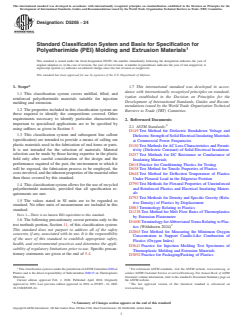
1.1 This classification system covers unfilled, filled, and reinforced polyetherimide materials suitable for injection molding and extrusion.
1.2 The properties included in this classification system are those required to identify the compositions covered. Other requirements necessary to identify particular characteristics important to specialized applications are to be specified by using suffixes as given in Section 5.
1.3 This classification system and subsequent line callout (specification) are intended to provide a means of calling out plastic materials used in the fabrication of end items or parts. It is not intended for the selection of materials. Material selection can be made by those having expertise in the plastic field only after careful consideration of the design and the performance required of the part, the environment to which it will be exposed, the fabrication process to be employed, the costs involved, and the inherent properties of the material other than those covered by this standard.
1.4 This classification system allows for the use of recycled polyetherimide materials, provided that all specification requirements are met.
1.5 The values stated in SI units are to be regarded as standard. No other units of measurement are included in this standard.
Note 1: There is no known ISO equivalent to this standard.
1.6 The following precautionary caveat pertains only to the test methods portion, Section 11, of this classification system: This standard does not purport to address all of the safety concerns, if any, associated with its use. It is the responsibility of the user of this standard to establish appropriate safety, health, and environmental practices and determine the applicability of regulatory limitations prior to use. Specific precautionary statements are given at the end of 5.4.
1.7 This international standard was developed in accordance with internationally recognized principles on standardization established in the Decision on Principles for the Development of International Standards, Guides and Recommendations issued by the World Trade Organization Technical Barriers to Trade (TBT) Committee.
- Status
- Published
- Publication Date
- 31-Jan-2024
- Technical Committee
- D20 - Plastics
- Drafting Committee
- D20.15 - Thermoplastic Materials
Buy Documents
ASTM D5205-24 - Standard Classification System and Basis for Specification for Polyetherimide (PEI) Molding and Extrusion Materials
REDLINE ASTM D5205-24 - Standard Classification System and Basis for Specification for Polyetherimide (PEI) Molding and Extrusion Materials
Overview
ASTM D5205-24, titled Standard Classification System and Basis for Specification for Polyetherimide (PEI) Molding and Extrusion Materials, establishes a comprehensive system for classifying and specifying polyetherimide (PEI) materials used in injection molding and extrusion. Developed and maintained by ASTM International, this standard provides manufacturers, suppliers, and end users with a standardized method for identifying unfilled, filled, and reinforced PEI plastics based on their composition and essential properties. The standard is intended for consistent product callouts, enabling effective communication and documentation across the plastics industry, especially in applications requiring precise material properties for end-use parts.
Key Topics
Classification System:
Polyetherimide (PEI) materials are classified according to composition (unfilled, filled, or reinforced), as well as group, class, and grade. This systematic approach ensures uniformity and clarity in specifying raw materials for manufacturing.Specification Basis:
The standard provides a line callout format for plastic material identification, not for selection. Material selection is left to professionals who must consider design, performance, manufacturing process, environment, and costs.Reinforcement and Additives Notation:
Reinforcement types (glass, carbon, mineral, lubricants, combinations) and the percentage by mass are identified with specific letter and numerical codes.Test Methods and Conformance:
Conformance is determined through referenced ASTM test methods for properties such as tensile strength, flexural strength, flexural modulus, flow rate, deflection temperature, and specific gravity. Only SI units are used.Suffixes for Special Requirements:
Additional physical, electrical, or flammability requirements important for specialized applications can be noted using suffixes defined in Section 5 of the standard and related ASTM standards.Recycled Materials:
The standard allows the use of recycled PEI materials, provided they meet all specified requirements.
Applications
ASTM D5205-24 is employed extensively in industries where consistent and reliable specification of polyetherimide materials is critical, including:
- Automotive - Under-the-hood components, lighting, and sensor housings requiring high thermal stability and dimensional accuracy.
- Electrical/Electronics - Insulators, connectors, and parts exposed to electrical load, leveraging PEI’s dielectric properties and flame resistance.
- Aerospace - Interior components needing lightweight, tough, and heat-resistant plastic for structural or insulation purposes.
- Medical Devices - Disposable instruments and components where biocompatibility and sterilization stability are essential (subject to additional regulatory requirements).
- Industrial Equipment - Structural pieces, gears, and specialty housings that benefit from PEI’s mechanical and thermal properties.
The standard is also referenced for packaging and labeling of PEI materials, ensuring quality control and compliance throughout the supply chain.
Related Standards
ASTM D5205-24 references several key standards to define test procedures and terminology for PEI materials, including:
- ASTM D638 – Test Method for Tensile Properties of Plastics
- ASTM D790 – Test Methods for Flexural Properties of Plastics
- ASTM D648 – Test Method for Deflection Temperature Under Load
- ASTM D1238 – Test Method for Melt Flow Rates of Thermoplastics
- ASTM D792 – Test Methods for Density and Specific Gravity
- ASTM D149, D150, D257 – For electrical insulation properties
- UL 94 – Tests for Flammability of Plastic Materials
- ASTM D4000 – Classification System for Specifying Plastic Materials
Additionally, references are made to relevant Military (MIL-P-46184, MIL-M-24519) and Underwriters Laboratories (UL) standards where appropriate.
Summary
The ASTM D5205-24 Standard provides a robust system for classifying and specifying PEI materials for molding and extrusion processes. It ensures consistent identification, documentation, and quality assurance throughout the design, manufacturing, and supply chain. By following this standard, stakeholders can achieve greater consistency, reduce miscommunication, and improve product reliability in applications where high-performance engineering plastics are required.
Relations
- Effective Date
- 01-Feb-2024
- Effective Date
- 01-Feb-2024
- Effective Date
- 01-Feb-2024
- Referred By
ASTM D5740-18 - Standard Guide for Writing Material Standards in the Classification D4000 Format - Effective Date
- 01-Feb-2024
Buy Documents
ASTM D5205-24 - Standard Classification System and Basis for Specification for Polyetherimide (PEI) Molding and Extrusion Materials
REDLINE ASTM D5205-24 - Standard Classification System and Basis for Specification for Polyetherimide (PEI) Molding and Extrusion Materials
Get Certified
Connect with accredited certification bodies for this standard

DIN CERTCO
DIN Group product certification.

Smithers Quality Assessments
US management systems and product certification.
Sponsored listings
Frequently Asked Questions
ASTM D5205-24 is a technical specification published by ASTM International. Its full title is "Standard Classification System and Basis for Specification for Polyetherimide (PEI) Molding and Extrusion Materials". This standard covers: ABSTRACT This classification system covers unfilled, filled, and reinforced polyetherimide materials suitable for injection molding and extrusion. Unfilled polyetherimide materials are classified into groups according to their composition. These groups are subdivided into classes and grades. The plastic compositions shall be uniform and shall conform to the requirements specified. Determine the properties enumerated in this classification system using the referenced test methods. SCOPE 1.1 This classification system covers unfilled, filled, and reinforced polyetherimide materials suitable for injection molding and extrusion. 1.2 The properties included in this classification system are those required to identify the compositions covered. Other requirements necessary to identify particular characteristics important to specialized applications are to be specified by using suffixes as given in Section 5. 1.3 This classification system and subsequent line callout (specification) are intended to provide a means of calling out plastic materials used in the fabrication of end items or parts. It is not intended for the selection of materials. Material selection can be made by those having expertise in the plastic field only after careful consideration of the design and the performance required of the part, the environment to which it will be exposed, the fabrication process to be employed, the costs involved, and the inherent properties of the material other than those covered by this standard. 1.4 This classification system allows for the use of recycled polyetherimide materials, provided that all specification requirements are met. 1.5 The values stated in SI units are to be regarded as standard. No other units of measurement are included in this standard. Note 1: There is no known ISO equivalent to this standard. 1.6 The following precautionary caveat pertains only to the test methods portion, Section 11, of this classification system: This standard does not purport to address all of the safety concerns, if any, associated with its use. It is the responsibility of the user of this standard to establish appropriate safety, health, and environmental practices and determine the applicability of regulatory limitations prior to use. Specific precautionary statements are given at the end of 5.4. 1.7 This international standard was developed in accordance with internationally recognized principles on standardization established in the Decision on Principles for the Development of International Standards, Guides and Recommendations issued by the World Trade Organization Technical Barriers to Trade (TBT) Committee.
ABSTRACT This classification system covers unfilled, filled, and reinforced polyetherimide materials suitable for injection molding and extrusion. Unfilled polyetherimide materials are classified into groups according to their composition. These groups are subdivided into classes and grades. The plastic compositions shall be uniform and shall conform to the requirements specified. Determine the properties enumerated in this classification system using the referenced test methods. SCOPE 1.1 This classification system covers unfilled, filled, and reinforced polyetherimide materials suitable for injection molding and extrusion. 1.2 The properties included in this classification system are those required to identify the compositions covered. Other requirements necessary to identify particular characteristics important to specialized applications are to be specified by using suffixes as given in Section 5. 1.3 This classification system and subsequent line callout (specification) are intended to provide a means of calling out plastic materials used in the fabrication of end items or parts. It is not intended for the selection of materials. Material selection can be made by those having expertise in the plastic field only after careful consideration of the design and the performance required of the part, the environment to which it will be exposed, the fabrication process to be employed, the costs involved, and the inherent properties of the material other than those covered by this standard. 1.4 This classification system allows for the use of recycled polyetherimide materials, provided that all specification requirements are met. 1.5 The values stated in SI units are to be regarded as standard. No other units of measurement are included in this standard. Note 1: There is no known ISO equivalent to this standard. 1.6 The following precautionary caveat pertains only to the test methods portion, Section 11, of this classification system: This standard does not purport to address all of the safety concerns, if any, associated with its use. It is the responsibility of the user of this standard to establish appropriate safety, health, and environmental practices and determine the applicability of regulatory limitations prior to use. Specific precautionary statements are given at the end of 5.4. 1.7 This international standard was developed in accordance with internationally recognized principles on standardization established in the Decision on Principles for the Development of International Standards, Guides and Recommendations issued by the World Trade Organization Technical Barriers to Trade (TBT) Committee.
ASTM D5205-24 is classified under the following ICS (International Classification for Standards) categories: 83.080.20 - Thermoplastic materials. The ICS classification helps identify the subject area and facilitates finding related standards.
ASTM D5205-24 has the following relationships with other standards: It is inter standard links to ASTM D5205-16, ASTM D4000-23, ASTM D7293-19, ASTM D5740-18. Understanding these relationships helps ensure you are using the most current and applicable version of the standard.
ASTM D5205-24 is available in PDF format for immediate download after purchase. The document can be added to your cart and obtained through the secure checkout process. Digital delivery ensures instant access to the complete standard document.
Standards Content (Sample)
This international standard was developed in accordance with internationally recognized principles on standardization established in the Decision on Principles for the
Development of International Standards, Guides and Recommendations issued by the World Trade Organization Technical Barriers to Trade (TBT) Committee.
Designation: D5205 − 24
Standard Classification System and Basis for Specification for
Polyetherimide (PEI) Molding and Extrusion Materials
This standard is issued under the fixed designation D5205; the number immediately following the designation indicates the year of
original adoption or, in the case of revision, the year of last revision. A number in parentheses indicates the year of last reapproval. A
superscript epsilon (´) indicates an editorial change since the last revision or reapproval.
This standard has been approved for use by agencies of the U.S. Department of Defense.
1. Scope* 1.7 This international standard was developed in accor-
dance with internationally recognized principles on standard-
1.1 This classification system covers unfilled, filled, and
ization established in the Decision on Principles for the
reinforced polyetherimide materials suitable for injection
Development of International Standards, Guides and Recom-
molding and extrusion.
mendations issued by the World Trade Organization Technical
1.2 The properties included in this classification system are
Barriers to Trade (TBT) Committee.
those required to identify the compositions covered. Other
requirements necessary to identify particular characteristics
2. Referenced Documents
important to specialized applications are to be specified by
2.1 ASTM Standards:
using suffixes as given in Section 5.
D149 Test Method for Dielectric Breakdown Voltage and
1.3 This classification system and subsequent line callout
Dielectric Strength of Solid Electrical Insulating Materials
(specification) are intended to provide a means of calling out
at Commercial Power Frequencies
plastic materials used in the fabrication of end items or parts.
D150 Test Methods for AC Loss Characteristics and Permit-
It is not intended for the selection of materials. Material
tivity (Dielectric Constant) of Solid Electrical Insulation
selection can be made by those having expertise in the plastic
D257 Test Methods for DC Resistance or Conductance of
field only after careful consideration of the design and the
Insulating Materials
performance required of the part, the environment to which it
D618 Practice for Conditioning Plastics for Testing
will be exposed, the fabrication process to be employed, the
D638 Test Method for Tensile Properties of Plastics
costs involved, and the inherent properties of the material other
D648 Test Method for Deflection Temperature of Plastics
than those covered by this standard.
Under Flexural Load in the Edgewise Position
D790 Test Methods for Flexural Properties of Unreinforced
1.4 This classification system allows for the use of recycled
and Reinforced Plastics and Electrical Insulating Materi-
polyetherimide materials, provided that all specification re-
als
quirements are met.
D792 Test Methods for Density and Specific Gravity (Rela-
1.5 The values stated in SI units are to be regarded as
tive Density) of Plastics by Displacement
standard. No other units of measurement are included in this
D883 Terminology Relating to Plastics
standard.
D1238 Test Method for Melt Flow Rates of Thermoplastics
NOTE 1—There is no known ISO equivalent to this standard.
by Extrusion Plastometer
1.6 The following precautionary caveat pertains only to the
D1600 Terminology for Abbreviated Terms Relating to Plas-
test methods portion, Section 11, of this classification system: 3
tics (Withdrawn 2024)
This standard does not purport to address all of the safety
D2863 Test Method for Measuring the Minimum Oxygen
concerns, if any, associated with its use. It is the responsibility
Concentration to Support Candle-Like Combustion of
of the user of this standard to establish appropriate safety,
Plastics (Oxygen Index)
health, and environmental practices and determine the appli-
D3641 Practice for Injection Molding Test Specimens of
cability of regulatory limitations prior to use. Specific precau-
Thermoplastic Molding and Extrusion Materials
tionary statements are given at the end of 5.4.
D3892 Practice for Packaging/Packing of Plastics
1 2
This classification system is under the jurisdiction of ASTM Committee D20 on For referenced ASTM standards, visit the ASTM website, www.astm.org, or
Plastics and is the direct responsibility of Subcommittee D20.15 on Thermoplastic contact ASTM Customer Service at service@astm.org. For Annual Book of ASTM
Materials. Standards volume information, refer to the standard’s Document Summary page on
Current edition approved Feb. 1, 2024. Published April 2024. Originally the ASTM website.
approved in 1991. Last previous edition approved in 2016 as D5205 – 16. DOI: The last approved version of this historical standard is referenced on
10.1520/D5205-24. www.astm.org.
*A Summary of Changes section appears at the end of this standard
Copyright © ASTM International, 100 Barr Harbor Drive, PO Box C700, West Conshohocken, PA 19428-2959. United States
D5205 − 24
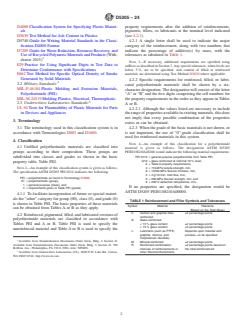
D4000 Classification System for Specifying Plastic Materi- property requirements after the addition of reinforcements,
als pigments, fillers, or lubricants at the nominal level indicated
D5630 Test Method for Ash Content in Plastics (see 4.2.1).
D5740 Guide for Writing Material Standards in the Classi- 4.2.1 A single letter shall be used to indicate the major
fication D4000 Format category of the reinforcement, along with two numbers that
D7209 Guide for Waste Reduction, Resource Recovery, and indicate the percentage of additive(s) by mass, with the
Use of Recycled Polymeric Materials and Products (With- tolerances as tabulated in Table 1.
drawn 2015)
NOTE 3—If necessary, additional requirements are specified using
E29 Practice for Using Significant Digits in Test Data to
suffixes as described in Section 5. Any special tolerances, when levels are
Determine Conformance with Specifications
below 5 %, are to be specified. Ash content of filled or reinforced
materials are determined using Test Method D5630 where applicable.
E662 Test Method for Specific Optical Density of Smoke
Generated by Solid Materials
4.2.2 Specific requirements for reinforced, filled, or lubri-
2.2 Military Standards:
cated polyetherimide materials shall be shown by a six-
MIL-P-46184 Plastic Molding and Extrusion Materials,
character designation. The designation will consist of the letter
Polyetherimide (PEI).
“A” or “B” and the five digits comprising the cell numbers for
MIL-M-24519 Molding Plastics, Electrical, Thermoplastic
the property requirements in the order as they appear in Tables
2.3 Underwriters Laboratories Standards:
A or B.
UL 94 Tests for Flammability of Plastic Materials for Parts
4.2.2.1 Although the values listed are necessary to include
in Devices and Appliances
the range of properties available in existing materials, this does
not imply that every possible combination of the properties
3. Terminology
exists or can be obtained.
3.1 The terminology used in this classification system is in 4.2.3 When the grade of the basic materials is not shown, or
accordance with Terminologies D883 and D1600. is not important, the use of “0”-grade classification shall be
used for reinforced materials in this system.
4. Classification
NOTE 4—An example of this classification for a polyetherimide
4.1 Unfilled polyetherimide materials are classified into
material is given as follows. The designation ASTM D5205
groups according to their composition. These groups are PEI0110G10A48266 would indicate the following material requirements:
subdivided into classes and grades as shown in the basic
PEI 0110 = general-purpose polyetherimide from Table PEI,
G10 = glass reinforced at nominal 10 % level,
property table, Table PEI.
A = Table A property requirements,
4 = 110-MPa tensile strength, min,
NOTE 2—An example of this classification system is given as follows.
8 = 13790-MPa flexural modulus, min,
The specification ASTM D5205 PEI 0114 indicates the following:
2 = 4 g/10 min; melt flow, min,
PEI = polyetherimide as found in Terminology D1600,
6 = 205-MPa flexural strength, min, and
01 = polyetherimide (group),
6 = 230°C deflection temperature, min.
1 = general purpose (class), and
If no properties are specified, the designation would be
4 = requirements given in Table PEI (grade).
ASTM D5205 PEI0110G10A00000.
4.1.1 To facilitate incorporation of future or special materi-
als the “other” category for group (00), class (0), and grade (0)
TABLE 1 Reinforcement and Filler Symbols and Tolerances
is shown in Table PEI. The basic properties of these materials
Symbol Material Tolerance
can be obtained from Tables A or B as they apply.
(Based on the Total Mass)
C Carbon and graphite fiber- ±2 percentage points
4.2 Reinforced, pigmented, filled, and lubricated versions of
reinforced
polyetherimide materials are classified in accordance with
G Glass-reinforced
< 15 % glass content ±2 percentage points
Tables PEI and A or B. Table PEI is used to specify the
> 15 % glass content ±3 percentage points
unreinforced material and Table A or B is used to specify the
L Lubricants (such as PTFE, Depends upon material and
graphite, silicone, and process—to be specified
molybdenum disulfide)
Available from Standardization Documents Order Desk, Bldg. 4 Section D,
M Mineral-reinforced ±2 percentage points
Available from Standardization Documents Order Desk, Bldg. 4 Section D, 700
R Reinforced-combination/ ±3 percentage points based on
Robbins Ave., Philadelphia, PA 19111-5094, Attn: NPODS.
mixtures of reinforcements or the total reinforcement
Available from Underwriters Laboratories (UL), 2600 N.W. Lake Rd., Camas,
other fillers/reinforcements
WA 98607-8542, http://www.ul.com.
D5205 − 24
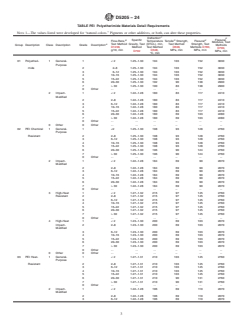
TABLE PEI Polyetherimide Materials Detail Requirements
NOTE 1—The values listed were developed for “natural colors.” Pigments or other additives, or both, can alter these properties.
C
Deflection
E
Flexural
B D E
Specific
Flow-Rate, Temperature Tensile Strength, Flexural
Modulus, Test
Gravity, Test
A Test Method (DTUL), min, Test Method Strength, Test
Group Description Class Description Grade Description Methods
D1238, Method Test Method D638, Methods D790,
D790,
g/10, min D648, MPa, min MPa, min
D792
MPa, min
°C, min
01 Polyetheri- 1 General- 1 < 2 1.25–1.30 194 103 152 3030
Purpose
mide 2 2–8 1.25–1.30 194 103 152 3030
3 6–12 1.25–1.30 194 103 152 3030
4 10–16 1.25–1.30 194 103 152 3030
5 15–22 1.25–1.30 194 103 152 3030
6 20–30 1.25–1.30 192 90 138 2900
7 > 30 1.25–1.30 190 83 138 2900
0 Other . . . . . .
2 Impact- 1 < 2 1.22–1.28 180 83 117 2410
Modified
2 2–8 1.22–1.28 180 83 117 2410
3 6–12 1.22–1.28 180 83 117 2410
4 10–16 1.22–1.28 180 83 117 2410
5 15–22 1.22–1.28 180 83 117 2410
6 20–30 1.22–1.28 180 69 103 2280
7 > 30 1.22–1.28 180 69 103 2280
0 Other . . . . . .
0 Other 0 Other . . . . . .
02 PEI Chemical 1 General- 1 <2 1.25–1.30 198 93 128 2760
Purpose
Resistant 2 2–8 1.25–1.30 198 93 128 2760
3 6–12 1.25–1.30 198 93 128 2760
4 10–16 1.25–1.30 198 93 128 2760
5 15–22 1.25–1.30 198 93 128 2760
6 20–30 1.25–1.30 196 90 124 2760
7 > 30 1.25–1.30 196 90 124 2760
0 Other . . . . . .
2 Impact- 1 < 2 1.22–1.28 184 69 90 2070
Modified
2 2–8 1.22–1.28 184 69 90 2070
3 6–12 1.22–1.28 184 69 90 2070
4 10–16 1.22–1.28 184 69 90 2070
5 15–22 1.22–1.28 184 69 90 2070
6 20–30 1.22–1.28 184 69 90 2070
7 > 30 1.22–1.28 184 69 90 2070
0 Other . . . . . .
3 High-Heat 1 < 2 1.27–1.32 215 97 145 2760
Resistant 2 2–8 1.27–1.32 215 97 145 2760
3 6–12 1.27–1.32 215 97 145 2760
4 10–16 1.27–1.32 215 97 145 2760
5 15–22 1.27–1.32 215 97 145 2760
6 20–30 1.27–1.32 215 97 145 2760
7 > 30 1.27–1.32 215 97 145 2760
0 Other . . . . . .
4 High-Heat 1 < 2 1.23–1.30 200 69 103 2070
Impact- 2 2–8 1.23–1.30 200 69 103 2070
Modified
3 6–12 1.23–1.30 200 69 103 2070
4 10–16 1.23–1.30 200 69 103 2070
5 15–22 1.23–1.30 200 69 103 2070
6 20–30 1.23–1.30 200 69 103 2070
7 > 30 1.23–1.30 200 69 103 2070
0 Other . . . . . .
0 Other 0 Other . . . . . .
03 PEI Heat- 1 General- 1 < 2 1.27–1.31 210 103 145 2760
Purpose
Resistant 2 2–8 1.27–1.31 210 103 145 2760
3 6–12 1.27–1.31 210 103 145 2760
4 10–16 1.27–1.31 210 103 145 2760
5 15–22 1.27–1.31 210 103 145 2760
6 20–30 1.27–1.31 210 90 131 2760
7 > 30 1.27–1.31 210 90 131 2760
0 Other . . . . . .
2 Impact- 1 < 2 1.22–1.28 196 69 110 2070
Modified
2 2–8 1.22–1.28 196 69 110 2070
3 6–12 1.22–1.28 196 69 110 2070
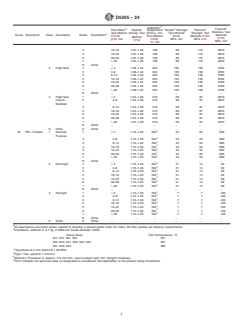
D5205 − 24
C
Deflection
E
Flexural
B Specific D E
Flow-Rate, Temperature Tensile Strength, Flexural
Modulus, Test
Test Method Gravity, Test (DTUL), min, Test Method Strength, Test
A
Group Description Class Description Grade Description Methods
D1238, Test Method D638, Methods D790,
Method
D790,
g/10, min D648, MPa, min MPa, min
D792
MPa, min
°C, min
4 10–16 1.22–1.28 196 69 110 2070
5 15–22 1.22–1.28 196 69 110 2070
6 20–30 1.22–1.28 196 69 110 2070
7 > 30 1.22–1.28 196 69 110 2070
0 Other . . . . . .
3 High-Heat 1 < 2 1.28–1.32 225 103 138 2760
2 2–8 1.28–1.32 225 103 138 2760
3 6–12 1.28–1.32 225 103 138 2760
4 10–16 1.28–1.32 225 103 138 2760
5 15–22 1.28–1.32 225 103 138 2760
6 20–30 1.28–1.32 225 103 138 2760
7 > 30 1.28–1.32 225 103 138 2760
0 Other . . . . . .
4 High-Heat 1 < 2 1.24–1.28 210 69 97 2070
Impact- 2 2–8 1.24–1.28 210 69 97 2070
Modified
3 6–12 1.24–1.28 210 69 97 2070
4 10–16 1.24–1.28 210 69 97 2070
5 15–22 1.24–1.28 210 69 97 2070
6 20–30 1.24–1.28 210 69 97 2070
...
This document is not an ASTM standard and is intended only to provide the user of an ASTM standard an indication of what changes have been made to the previous version. Because
it may not be technically possible to adequately depict all changes accurately, ASTM recommends that users consult prior editions as appropriate. In all cases only the current version
of the standard as published by ASTM is to be considered the official document.
Designation: D5205 − 16 D5205 − 24
Standard Classification System and Basis for Specification for
Polyetherimide (PEI) Molding and Extrusion Materials
This standard is issued under the fixed designation D5205; the number immediately following the designation indicates the year of
original adoption or, in the case of revision, the year of last revision. A number in parentheses indicates the year of last reapproval. A
superscript epsilon (´) indicates an editorial change since the last revision or reapproval.
This standard has been approved for use by agencies of the U.S. Department of Defense.
1. Scope*
1.1 This classification system covers unfilled, filled, and reinforced polyetherimide materials suitable for injection molding and
extrusion.
1.2 This classification system is not intended for the selection of materials, but only as a means to call out plastic materials to be
used for the manufacture of parts. The selection of these materials is to be made by personnel with expertise in the plastics field
where the environment, inherent properties of the materials, performance of the parts, part design, manufacturing process, and
economics are considered.
1.2 The properties included in this classification system are those required to identify the compositions covered. Other
requirements necessary to identify particular characteristics important to specialized applications are to be specified by using
suffixes as given in Section 5.
1.3 This classification system and subsequent line callout (specification) are intended to provide a means of calling out plastic
materials used in the fabrication of end items or parts. It is not intended for the selection of materials. Material selection can be
made by those having expertise in the plastic field only after careful consideration of the design and the performance required of
the part, the environment to which it will be exposed, the fabrication process to be employed, the costs involved, and the inherent
properties of the material other than those covered by this standard.
1.4 Polyetherimide materials, being thermoplastic, are reprocessable and recyclable. This classification system allows for the use
of thoserecycled polyetherimide materials, provided that all specific requirements of this classification system specification
requirements are met.
1.5 The values stated in SI units are to be regarded as standard. No other units of measurement are included in this standard.
NOTE 1—There is no known ISO equivalent to this standard.
1.6 The following precautionary caveat pertains only to the test methods portion, Section 1211, of this classification system:
This standard does not purport to address all of the safety concerns, if any, associated with its use. It is the responsibility of the
user of this standard to establish appropriate safety and healthsafety, health, and environmental practices and determine the
applicability of regulatory limitations prior to use. Specific precautionary statements are given at the end of 5.4.
NOTE 1—There is no known ISO equivalent to this standard.
This classification system is under the jurisdiction of ASTM Committee D20 on Plastics and is the direct responsibility of Subcommittee D20.15 on Thermoplastic
Materials.
Current edition approved Sept. 1, 2016Feb. 1, 2024. Published September 2016April 2024. Originally approved in 1991. Last previous edition approved in 20102016 as
D5205 – 10.D5205 – 16. DOI: 10.1520/D5205-16.10.1520/D5205-24.
*A Summary of Changes section appears at the end of this standard
Copyright © ASTM International, 100 Barr Harbor Drive, PO Box C700, West Conshohocken, PA 19428-2959. United States
D5205 − 24
1.7 This international standard was developed in accordance with internationally recognized principles on standardization
established in the Decision on Principles for the Development of International Standards, Guides and Recommendations issued
by the World Trade Organization Technical Barriers to Trade (TBT) Committee.
2. Referenced Documents
2.1 ASTM Standards:
D149 Test Method for Dielectric Breakdown Voltage and Dielectric Strength of Solid Electrical Insulating Materials at
Commercial Power Frequencies
D150 Test Methods for AC Loss Characteristics and Permittivity (Dielectric Constant) of Solid Electrical Insulation
D257 Test Methods for DC Resistance or Conductance of Insulating Materials
D618 Practice for Conditioning Plastics for Testing
D638 Test Method for Tensile Properties of Plastics
D648 Test Method for Deflection Temperature of Plastics Under Flexural Load in the Edgewise Position
D790 Test Methods for Flexural Properties of Unreinforced and Reinforced Plastics and Electrical Insulating Materials
D792 Test Methods for Density and Specific Gravity (Relative Density) of Plastics by Displacement
D883 Terminology Relating to Plastics
D1238 Test Method for Melt Flow Rates of Thermoplastics by Extrusion Plastometer
D1600 Terminology for Abbreviated Terms Relating to Plastics (Withdrawn 2024)
D2863 Test Method for Measuring the Minimum Oxygen Concentration to Support Candle-Like Combustion of Plastics
(Oxygen Index)
D3641 Practice for Injection Molding Test Specimens of Thermoplastic Molding and Extrusion Materials
D3892 Practice for Packaging/Packing of Plastics
D4000 Classification System for Specifying Plastic Materials
D5630 Test Method for Ash Content in Plastics
D5740 Guide for Writing Material Standards in the Classification D4000 Format
D7209 Guide for Waste Reduction, Resource Recovery, and Use of Recycled Polymeric Materials and Products (Withdrawn
2015)
E29 Practice for Using Significant Digits in Test Data to Determine Conformance with Specifications
E662 Test Method for Specific Optical Density of Smoke Generated by Solid Materials
2.2 Military Standards:
MIL-P-46184 Plastic Molding and Extrusion Materials, Polyetherimide (PEI).
MIL-M-24519 Molding Plastics, Electrical, Thermoplastic
2.3 Underwriters Laboratories Standards:
UL 94 Tests for Flammability of Plastic Materials for Parts in Devices and Appliances
3. Terminology
3.1 Definitions—The terminology used in this classification system is in accordance with Terminologies D883 and D1600.
3.2 Abbreviation—The polyetherimide materials will be designated “PEI” as specified in Terminology D1600.
4. Classification
4.1 Unfilled polyetherimide materials are classified into groups according to their composition. These groups are subdivided into
classes and grades as shown in Table PEI.
NOTE 2—An example of this classification system is given as follows. The designation ASTM D5205 PEI 0114 indicates the following:
PEI = polyetherimide as found in Terminology D1600,
01 = polyetherimide (group),
1 = general purpose (class), and
4 = requirements given in Table PEI (grade).
For referenced ASTM standards, visit the ASTM website, www.astm.org, or contact ASTM Customer Service at service@astm.org. For Annual Book of ASTM Standards
volume information, refer to the standard’s Document Summary page on the ASTM website.
The last approved version of this historical standard is referenced on www.astm.org.
Available from Standardization Documents Order Desk, Bldg. 4 Section D, Available from Standardization Documents Order Desk, Bldg. 4 Section D, 700 Robbins Ave.,
Philadelphia, PA 19111-5094, Attn: NPODS.
Available from Underwriters Laboratories (UL), 2600 N.W. Lake Rd., Camas, WA 98607-8542, http://www.ul.com.
D5205 − 24
4.1.1 To facilitate incorporation of future or special materials the “other” category (0) for group, class, and grade is shown in Table
PEI. The basic properties of these materials can be obtained from Tables A or B as they apply.
4.2 Reinforced, pigmented, filled, and lubricated versions of polyetherimide materials are classified in accordance with Tables PEI
and A or B. Table PEI is used to specify the unreinforced material and Table A or B is used to specify the property requirements
after the addition of reinforcements, pigments, fillers, or lubricants at the nominal level indicated (see 4.2.1).
4.2.1 A single letter shall be used to indicate the major category of the reinforcement, along with two numbers that indicate the
percentage of additive(s) by mass, with the tolerances as tabulated as follows:
Category Material Tolerance
(Based on the Total Mass)
C Carbon and graphite fiber- ±2 percentage points
reinforced
G Glass-reinforced
< 15 % glass content ±2 percentage points
> 15 % glass content ±3 percentage points
L Lubricants (such as PTFE, Depends upon material and
graphite, silicone, and process—to be specified
molybdenum disulfide)
M Mineral-reinforced ±2 percentage points
R Reinforced-combination/ ±3 percentage points based on
mixtures of reinforcements or the total reinforcement
other fillers/reinforcements
NOTE 3—If necessary, additional requirements are specified using suffixes as described in Section 5. Any special tolerances, when levels are below 5 %,
are to be specified. Ash content of filled or reinforced materials are determined using Test Method D5630 where applicable.
4.2.2 Specific requirements for reinforced, filled, or lubricated polyetherimide materials shall be shown by a six-character
designation. The designation will consist of the letter “A” or “B” and the five digits comprising the cell numbers for the property
requirements in the order as they appear in Tables A or B.
4.2.2.1 Although the values listed are necessary to include the range of properties available in existing materials, this does not
imply that every possible combination of the properties exists or can be obtained.
4.2.3 When the grade of the basic materials is not shown, or is not important, the use of “O”-grade classification shall be used
for reinforced materials in this system.
NOTE 4—An example of this classification for a polyetherimide material is given as follows. The designation ASTM D5205 PEI0110G10A48266 would
indicate the following material requirements:
PEI 0110 = general-purpose polyetherimide from Table PEI,
G10 = glass reinforced at nominal 10 % level,
A = Table A property requirements,
4 = 110-MPa tensile strength, min,
8 = 13790-MPa flexural modulus, min,
2 = 4 g/10 min; melt flow, min,
6 = 205-MPa flexural strength, min, and
6 = 230°C deflection temperature, min.
If no properties are specified, the designation would be ASTM D5205 PEI0110G10A00000.
5. Suffixes
5.1 When additional requirements are needed that are not covered by the basic requirements or cell-table requirements, they shall
be indicated through the use of suffixes.
5.2 A list of suffixes can be found in Classification System D4000 (Table 3) and are to be used for additional requirements as
appropriate. Additional suffixes will be added to that standard as test methods and requirements are developed and requested.
D5205 − 24
5.3 Electrical requirements are designated by a suffix which uses the letter E followed by two digits. These digits refer to use of
Table 1.
First Digit
0 = specimen to be specified by user
1 = specimens as appropriate for test methods as defined in Table 1
Second Digit
0 = to be specified by user
1 = meets requirements of Table 1, Column A
2 = meets requirements of Table 1, Column B
3 = meets requirements of Table 1, Column C
4 = meets requirements of Table 1, Column D
5 = meets requirements of Table 1, Column E
5.4 Flammability requirements are designated by a suffix that uses the letter F followed by two digits. (Warning—By publication
of this classification system and its use of flammability ratings, ASTM does not intend that their use in any way reflects hazards
presented under actual fire conditions.)
TABLE 12 Electrical Detail Requirements
NOTE 1—Resin samples should be dried 4 h at 160°C in an air-circulating oven before molding specimens to be used in these tests.
A
Property Condition Units A B C D E
B
Dielectric constant, max 48/50 + D24 ⁄23
1 KHz, 50 % RH, 23°C . 3.2 3.7 3.7 3.8 .
1 MHz . . . . . 3.5
B
Dissipation factor, max 48/50 + D24 ⁄23
1 KHz, 50 % RH, 23°C . 0.0015 0.0016 0.0017 0.0017 .
2450 MH, 50 % RH, 23°C . 0.003 . . . .
1 MH, 50 % RH, 23°C . . . . . 0.007
C 16 16 16 16
Volume resistivity, min 24/23/50 ohm-cm 10 10 10 10 .
D
Dielectric strength, min (1.6-mm thickness, in 48/ KV/mm 23.6 23.0 22.0 21.0 17.0
oil, S/T)
50 + 96 ⁄23 ⁄50 (V/mil)
E
Specific gravity . . 1.27 1.34 1.42 1.51 .
A
In accordance with Practice D618.
B
See Test Methods D150.
C
See Test Methods D257.
D
See Test Methods D149.
E
See Test Method D792 (tolerance ± 0.02).
D5205 − 24
First Digit
0 = to be specified by user,
1 = product is tested according to UL94 at 3.05-mm minimum thickness,
2 = product is tested according to UL94 at 1.47-mm minimum thickness,
3 = product is tested according to UL94 at 0.71-mm minimum thickness,
4 = product is tested according to Test Method D2863,
5 = product is tested according to Test Method E662.
Second Digit
0 = To be specified by user
1 = 94V-0 flammability class
2 = 94V-1 flammability class
3 = 94V-2 flammability class
4 = 94-5V flammability class
5 = Oxygen index 44 % minimum
6 = Specific optical density, flaming mode, D4 # 2, D max # 50.
4. General Requirements Classification
4.1 Unfilled polyetherimide materials are classified into groups according to their composition. These groups are subdivided into
classes and grades as shown in the basic property table, Table PEI.
NOTE 2—An example of this classification system is given as follows. The specification ASTM D5205 PEI 0114 indicates the following:
PEI = polyetherimide as found in Terminology D1600,
01 = polyetherimide (group),
1 = general purpose (class), and
4 = requirements given in Table PEI (grade).
4.1.1 To facilitate incorporation of future or special materials the “other” category for group (00), class (0), and grade (0) is shown
in Table PEI. The basic properties of these materials can be obtained from Tables A or B as they apply.
4.2 The plastic compositions shall be uniform and shall conform to the requirements specified herein.Reinforced, pigmented,
filled, and lubricated versions of polyetherimide materials are classified in accordance with Tables PEI and A or B. Table PEI is
used to specify the unreinforced material and Table A or B is used to specify the property requirements after the addition of
reinforcements, pigments, fillers, or lubricants at the nominal level indicated (see 4.2.1).
TABLE PEI Polyetherimide Materials Detail Requirements
NOTE 1—The values listed were developed for “natural colors.” Pigments or other additives, or both, can alter these properties.
C
Deflection
E
B D E Flexural
Specific
Flow-Rate, Temperature Tensile Strength, Flexural
Modulus, Test
Gravity, Test
Test Method (DTUL), min, Test Method Strength, Test
A
Group Description Class Description Grade Description Methods
D1238, Test Method D638, Methods D790,
Method
D790,
g/10, min D648, MPa, min MPa, min
D792
MPa, min
°C, min
01 Polyetheri- 1 General- 1 < 2 1.25–1.30 194 103 152 3030
Purpose
mide 2 2–8 1.25–1.30 194 103 152 3030
3 6–12 1.25–1.30 194 103 152 3030
4 10–16 1.25–1.30 194 103 152 3030
5 15–22 1.25–1.30 194 103 152 3030
6 20–30 1.25–1.30 192 90 138 2900
7 > 30 1.25–1.30 190 83 138 2900
0 Other . . . . . .
2 Impact- 1 < 2 1.22–1.28 180 83 117 2410
Modified
2 2–8 1.22–1.28 180 83 117 2410
3 6–12 1.22–1.28 180 83 117 2410
4 10–16 1.22–1.28 180 83 117 2410
5 15–22 1.22–1.28 180 83 117 2410
6 20–30 1.22–1.28 180 69 103 2280
7 > 30 1.22–1.28 180 69 103 2280
0 Other . . . . . .
0 Other 0 Other . . . . . .
02 PEI Chemical 1 General- 1 <2 1.25–1.30 198 93 128 2760
Purpose
D5205 − 24
C
Deflection
E
Flexural
B Specific D E
Flow-Rate, Temperature Tensile Strength, Flexural
Modulus, Test
Test Method Gravity, Test (DTUL), min, Test Method Strength, Test
A
Group Description Class Description Grade Description Methods
D1238, Test Method D638, Methods D790,
Method
D790,
g/10, min D648, MPa, min MPa, min
D792
MPa, min
°C, min
Resistant 2 2–8 1.25–1.30 198 93 128 2760
3 6–12 1.25–1.30 198 93 128 2760
4 10–16 1.25–1.30 198 93 128 2760
5 15–22 1.25–1.30 198 93 128 2760
6 20–30 1.25–1.30 196 90 124 2760
7 > 30 1.25–1.30 196 90 124 2760
0 Other . . . . . .
2 Impact- 1 < 2 1.22–1.28 184 69 90 2070
Modified
2 2–8 1.22–1.28 184 69 90 2070
3 6–12 1.22–1.28 184 69 90 2070
4 10–16 1.22–1.28 184 69 90 2070
5 15–22 1.22–1.28 184 69 90 2070
6 20–30 1.22–1.28 184 69 90 2070
7 > 30 1.22–1.28 184 69 90 2070
0 Other . . . . . .
3 High-Heat 1 < 2 1.27–1.32 215 97 145 2760
Resistant 2 2–8 1.27–1.32 215 97 145 2760
3 6–12 1.27–1.32 215 97 145 2760
4 10–16 1.27–1.32 215 97 145 2760
5 15–22 1.27–1.32 215 97 145 2760
6 20–30 1.27–1.32 215 97 145 2760
7 > 30 1.27–1.32 215 97 145 2760
0 Other . . . . . .
4 High-Heat 1 < 2 1.23–1.30 200 69 103 2070
Impact- 2 2–8 1.23–1.30 200 69 103 2070
Modified
3 6–12 1.23–1.30 200 69 103 2070
4 10–16 1.23–1.30 200 69 103 2070
5 15–22 1.23–1.30 200 69 103 2070
6 20–30 1.23–1.30 200 69 103 2070
7 > 30 1.23–1.30 200 69 103 2070
0 Other 0 Other . . . . . .
03 PEI Heat- 1 General- 1 < 2 1.27–1.31 210 103 145 2760
Purpose
Resistant 2 2–8 1.27–1.31 210 103 145 2760
3 6–12 1.27–1.31 210 103 145 2760
4 10–16 1.27–1.31 210 103 145 2760
5 15–22 1.27–1.31 210 103 145 2760
6 20–30 1.27–1.31 210 90 131 2760
7 > 30 1.27–1.31 210 90 131 2760
0 Other . . . . . .
2 Impact- 1 < 2 1.22–1.28 196 69 110 2070
Modified
2 2–8 1.22–1.28 196 69 110 2070
3 6–12 1.22–1.28 196 69 110 2070
4 10–16 1.22–1.28 196 69 110 2070
5 15–22 1.22–1.28 196 69 110 2070
6 20–30 1.22–1.28 196 69 110 2070
7 > 30 1.22–1.28 196 69 110 2070
0 Other . . . . . .
3 High-Heat 1 < 2 1.28–1.32 225 103 138 2760
2 2–8 1.28–1.32 225 103 138 2760
3 6–12 1.28–1.32 225 103 138 2760
4 10–16 1.28–1.32 225 103 138 2760
5 15–22 1.28–1.32 225 103 138 2760
6 20–30 1.28–1.32 225 103 138 2760
7 > 30 1.28–1.32 225 103 138 2760
0 Other . . . . . .
4 High-Heat 1 < 2 1.24–1.28 210 69 97 2070
Impact- 2 2–8 1.24–1.28 210 69 97 2070
Modified
3 6–12 1.24–1.28 210 69 97 2070
4 10–16 1.24–1.28 210 69 97 2070
5 15–22 1.24–1.28 210 69 97 2070
6 20–30 1.24–1.28 210 69 97 2070
7 > 30 1.24–1.28 210 69 97 2070
0 Other . . . . . .
0 Other 0 Other . . . . . .
F
04 PEI—Flexible 1 General- 1 < 2 1.16–1.20 N/A 34 52 690
Purpose
D5205 − 24
C
Deflection
E
Flexural
B Specific D E
Flow-Rate, Temperature Tensile Strength, Flexural
Modulus, Test
Test Method Gravity, Test (DTUL), min, Test Method Strength, Test
A
Group Description Class Description Grade Description Methods
D1238, Test Method D638, Methods D790,
Method
D790,
g/10, min D648, MPa, min MPa, min
D792
MPa, min
°C, min
F
Resistant 2 2–8 1.16–1.20 N/A 34 52 690
F
3 6–12 1.16–1.20 N/A 34 52 690
F
4 10–16 1.16–1.20 N/A 34 52 690
F
5 15–22 1.16–1.20 N/A 34 52 690
F
6 20–30 1.16–1.20 N/A 34 52 690
F
7 > 30 1.16–1.20 N/A 34 52 690
0 Other . . . . . .
F
2 Semirigid 1 < 2 1.16–1.20 N/A 21 14 69
F
2 2–8 1.16–1.20 N/A 21 14 69
F
3 6–12 1.16–1.20 N/A 21 14 69
F
4 10–16 1.16–1.20 N/A 21 14 69
F
5 15–22 1.16–1.20 N/A 21 14 69
F
6 20–30 1.16–1.20 N/A 21 14 69
F
7 > 30 1.16–1.20 N/A 21 14 69
0 Other . . . . . .
F
3 Nonrigid 1 < 2 1.10–1.20 N/A 7 7 <69
F
2 2–8 1.10–1.20 N/A 7 7 <69
F
3 6–12 1.10–1.20 N/A 7 7 <69
F
4 10–16 1.10–1.20 N/A 7 7 <69
F
5 15–22 1.10–1.20 N/A 7 7 <69
F
6 20–30 1.10–1.20 N/A 7 7 <69
F
7 > 30 1.10–1.20 N/A 7 7 <69
0 Other . . . . . .
0 Other 0 Other . . . . . .
A
No descriptions are listed unless needed to describe a special grade under the class. All other grades are listed by requirements.
B
Conditions—Method A, 6.7 kg, 2.0955-mm inside diameter orifice:
Group-Class Test Temperatures, °C
011, 012, 021, 022 337
023, 024, 031, 032, 033, 034 367
041, 042, 043 295
C
Specimens 6.4 mm tested at 1.82 MPa.
D
Type 1 bar, speed 5.1 mm/min.
E
Method I, Procedure A, speed = 2.5 mm ⁄min, span-to-depth ratio 16/1 (tangent modulus).
F
“N/A” indicates the particular data so designated is considered “Not Applicable” to the product being considered.
4.2.1 A single letter shall be used to indicate the major category of the reinforcement, along with two numbers that indicate the
percentage of additive(s) by mass, with the tolerances as tabulated in Table 1.
NOTE 3—If necessary, additional requirements are specified using suffixes as described in Section 5. Any special tolerances, when levels are below 5 %,
are to be specified. Ash content of filled or reinforced materials are determined using Test Method D5630 where applicable.
TABLE 1 Reinforcement and Filler Symbols and Tolerances
Symbol Material Tolerance
(Based on the Total Mass)
C Carbon and graphite fiber- ±2 percentage points
reinforced
G Glass-reinforced
< 15 % glass content ±2 percentage points
> 15 % glass content ±3 percentage points
L Lubricants (such as PTFE, Depends upon material and
graphite, silicone, and process—to be specified
molybdenum disulfide)
M Mineral-reinforced ±2 percentage points
R Reinforced-combination/ ±3 percentage points based on
mixtures of reinforcements or the total reinforcement
other fillers/reinforcements
D5205 − 24
TABLE A Detail Requirements Filled or Reinforced PEI, or Both
NOTE 1—Resin samples should be dried 4 h at 160°C in an air-circulating oven before molding s
...