

ASTM D4101-24
(Specification)Standard Classification System and Basis for Specification for Polypropylene Injection and Extrusion Materials
General Information
- Abstract
ABSTRACT
This specification covers polypropylene materials, suitable for injection molding and extrusion, that include unreinforced polypropylene with natural color only, unfilled and unreinforced polypropylene, calcium carbonate filled polypropylene, glass reinforced polypropylene, polypropylene copolymers, and talc filled polypropylene. Polymers consist of homopolymer, copolymers, and elastomer compounded with or without the addition of impact modifiers (ethylene-propylene rubber, polyisobutylene rubber, and butyl rubber), colorants, stabilizers, lubricants, or reinforcements. Tests shall be conducted on each of the specimens to determine the required physical and mechanical properties of the materials. The specimens for the various materials shall conform to the following requirements: nominal flow rate; test specimen dimensions; tensile stress at yield; flexural modulus; Izod impact resistance; deflection temperature; and multiaxial impact ductile-brittle transition temperature.
SCOPE
1.1 This classification system covers polypropylene materials suitable for injection molding and extrusion. Polymers consist of homopolymer, copolymers, and elastomer compounded with or without the addition of impact modifiers, for example, ethylene-propylene rubber, polyisobutylene rubber, and butyl rubber, colorants, stabilizers, lubricants, or reinforcements.
1.2 This classification system allows for the use of those polypropylene materials that can be recycled, reconstituted, and reground, provided that: (1) the requirements as stated in this classification system are met, and (2) the material has not been modified in any way to alter its conformance to food contact regulations or similar requirements. The proportions of recycled, reconstituted, and reground material used, as well as the nature and the amount of any contaminant, cannot be practically covered in this classification system. It is the responsibility of the supplier and the buyer of recycled, reconstituted, and reground materials to ensure compliance. (See Guide D7209.)
1.3 The values stated in SI units are to be regarded as standard. No other units of measurement are included in this standard.
Note 1: The properties included in this classification system are those required to identify the compositions covered. If other requirements are necessary to identify particular characteristics important to specific applications, these shall be designated by using the suffixes given in Section 1.
1.4 The following safety hazards caveat pertains only to the test methods portion, Section 13, of this specification: This standard does not purport to address all of the safety concerns, if any, associated with its use. It is the responsibility of the user of this standard to establish appropriate safety, health, and environmental practices and determine the applicability of regulatory limitations prior to use.
Note 2: This classification system and ISO 19069-1 and -2 address the same subject matter, but differ in technical content.
1.5 This international standard was developed in accordance with internationally recognized principles on standardization established in the Decision on Principles for the Development of International Standards, Guides and Recommendations issued by the World Trade Organization Technical Barriers to Trade (TBT) Committee.
- Status
- Published
- Publication Date
- 31-Jan-2024
- Technical Committee
- D20 - Plastics
- Drafting Committee
- D20.15 - Thermoplastic Materials
Buy Documents
ASTM D4101-24 - Standard Classification System and Basis for Specification for Polypropylene Injection and Extrusion Materials
REDLINE ASTM D4101-24 - Standard Classification System and Basis for Specification for Polypropylene Injection and Extrusion Materials
Overview
ASTM D4101-24 - Standard Classification System and Basis for Specification for Polypropylene Injection and Extrusion Materials provides a comprehensive framework for classifying and specifying polypropylene (PP) materials used in injection molding and extrusion processes. Published by ASTM International, this standard details the categories of polypropylene, addresses requirements for recycled content, and outlines physical and mechanical properties required for material identification and quality assurance. The standard covers homopolymer, copolymer, and elastomer-modified PP-with or without fillers, colorants, stabilizers, lubricants, or reinforcements.
This classification system enables manufacturers, suppliers, and buyers to communicate effectively about the requirements and properties of polypropylene resins intended for use in a wide range of applications. The standard is recognized internationally and supports global trade and compliance.
Key Topics
- Material Categories: Covers unreinforced, filled (e.g., calcium carbonate, talc), glass reinforced, copolymer, and impact modified PP.
- Physical & Mechanical Properties: Requirements include nominal flow rate, tensile stress at yield, flexural modulus, impact resistance (Izod), deflection temperature, and ductile-brittle transition temperature.
- Additives and Modifiers: Specifies allowable impact modifiers (such as ethylene-propylene rubber), colorants, stabilizers, and reinforcements.
- Recycled Content: Permits the use of recycled, reconstituted, or reground PP if the final material meets all specification requirements and maintains compliance with food contact or other regulatory standards.
- Test Methods: Mandates the use of SI units and references a comprehensive suite of standardized ASTM methods for determining critical properties.
- Designation System: Provides a coding framework using group, class, and grade (e.g., PP0113) to identify compositions, including suffixes to denote additional property requirements.
Applications
ASTM D4101-24 is essential for any industry utilizing polypropylene for manufactured parts where consistency, performance, and regulatory compliance matter. Key application areas include:
- Automotive Components: Interior and exterior parts, under-the-hood components, and protective covers.
- Packaging: Rigid and flexible containers, caps, closures, and films.
- Consumer Goods: Household appliances, toys, luggage, and reusable containers.
- Industrial Products: Pipes, fittings, sheets, and extruded profiles used in construction, agriculture, and infrastructure.
- Electrical and Electronic Assemblies: Insulating parts, housings, and connectors.
- Medical Devices and Food Contact Items: Provided that compliance with relevant health and safety regulations is demonstrated.
The standard is widely used to ensure the reliability and performance of polypropylene materials in high-volume and safety-critical applications.
Related Standards
Many other ASTM, ISO, and SAE standards are referenced within ASTM D4101-24 to enable comprehensive testing and facilitate global trade. Notable related documents include:
- ASTM D638 - Test Method for Tensile Properties of Plastics
- ASTM D790 - Test Methods for Flexural Properties of Unreinforced and Reinforced Plastics
- ASTM D1238 - Test Method for Melt Flow Rates of Thermoplastics by Extrusion Plastometer
- ASTM D256 - Test Methods for Determining the Izod Pendulum Impact Resistance of Plastics
- ASTM D648 - Test Method for Deflection Temperature of Plastics Under Flexural Load
- ISO 19069-1 and ISO 19069-2 - International standards covering designation and testing of polypropylene materials
For proper compliance and specification, practitioners should reference ASTM D4101-24 alongside these supporting standards to cover designations, testing procedures, and property verification. By following this standard, organizations contribute to quality assurance, interoperability, and the reliable use of polypropylene in manufacturing and product development.
Keywords: ASTM D4101-24, polypropylene classification, injection molding materials, extrusion materials, polymer standards, PP specification, recycled polypropylene, plastics industry standards, mechanical property testing.
Relations
- Effective Date
- 01-Feb-2024
- Effective Date
- 10-Apr-1999
- Referred By
ASTM F2389-23 - Standard Specification for Pressure-rated Polypropylene (PP) Piping Systems - Effective Date
- 01-Feb-2024
- Effective Date
- 01-Feb-2024
- Effective Date
- 01-Feb-2024
- Effective Date
- 01-Feb-2024
- Effective Date
- 01-Feb-2024
- Effective Date
- 01-Feb-2024
- Effective Date
- 01-Feb-2024
- Effective Date
- 01-Feb-2024
- Effective Date
- 01-Feb-2024
- Effective Date
- 01-Feb-2024
- Effective Date
- 01-Feb-2024
- Effective Date
- 01-Feb-2024
- Effective Date
- 01-Feb-2024
Buy Documents
ASTM D4101-24 - Standard Classification System and Basis for Specification for Polypropylene Injection and Extrusion Materials
REDLINE ASTM D4101-24 - Standard Classification System and Basis for Specification for Polypropylene Injection and Extrusion Materials
Get Certified
Connect with accredited certification bodies for this standard

DIN CERTCO
DIN Group product certification.

Smithers Quality Assessments
US management systems and product certification.
Sponsored listings
Frequently Asked Questions
ASTM D4101-24 is a technical specification published by ASTM International. Its full title is "Standard Classification System and Basis for Specification for Polypropylene Injection and Extrusion Materials". This standard covers: ABSTRACT This specification covers polypropylene materials, suitable for injection molding and extrusion, that include unreinforced polypropylene with natural color only, unfilled and unreinforced polypropylene, calcium carbonate filled polypropylene, glass reinforced polypropylene, polypropylene copolymers, and talc filled polypropylene. Polymers consist of homopolymer, copolymers, and elastomer compounded with or without the addition of impact modifiers (ethylene-propylene rubber, polyisobutylene rubber, and butyl rubber), colorants, stabilizers, lubricants, or reinforcements. Tests shall be conducted on each of the specimens to determine the required physical and mechanical properties of the materials. The specimens for the various materials shall conform to the following requirements: nominal flow rate; test specimen dimensions; tensile stress at yield; flexural modulus; Izod impact resistance; deflection temperature; and multiaxial impact ductile-brittle transition temperature. SCOPE 1.1 This classification system covers polypropylene materials suitable for injection molding and extrusion. Polymers consist of homopolymer, copolymers, and elastomer compounded with or without the addition of impact modifiers, for example, ethylene-propylene rubber, polyisobutylene rubber, and butyl rubber, colorants, stabilizers, lubricants, or reinforcements. 1.2 This classification system allows for the use of those polypropylene materials that can be recycled, reconstituted, and reground, provided that: (1) the requirements as stated in this classification system are met, and (2) the material has not been modified in any way to alter its conformance to food contact regulations or similar requirements. The proportions of recycled, reconstituted, and reground material used, as well as the nature and the amount of any contaminant, cannot be practically covered in this classification system. It is the responsibility of the supplier and the buyer of recycled, reconstituted, and reground materials to ensure compliance. (See Guide D7209.) 1.3 The values stated in SI units are to be regarded as standard. No other units of measurement are included in this standard. Note 1: The properties included in this classification system are those required to identify the compositions covered. If other requirements are necessary to identify particular characteristics important to specific applications, these shall be designated by using the suffixes given in Section 1. 1.4 The following safety hazards caveat pertains only to the test methods portion, Section 13, of this specification: This standard does not purport to address all of the safety concerns, if any, associated with its use. It is the responsibility of the user of this standard to establish appropriate safety, health, and environmental practices and determine the applicability of regulatory limitations prior to use. Note 2: This classification system and ISO 19069-1 and -2 address the same subject matter, but differ in technical content. 1.5 This international standard was developed in accordance with internationally recognized principles on standardization established in the Decision on Principles for the Development of International Standards, Guides and Recommendations issued by the World Trade Organization Technical Barriers to Trade (TBT) Committee.
ABSTRACT This specification covers polypropylene materials, suitable for injection molding and extrusion, that include unreinforced polypropylene with natural color only, unfilled and unreinforced polypropylene, calcium carbonate filled polypropylene, glass reinforced polypropylene, polypropylene copolymers, and talc filled polypropylene. Polymers consist of homopolymer, copolymers, and elastomer compounded with or without the addition of impact modifiers (ethylene-propylene rubber, polyisobutylene rubber, and butyl rubber), colorants, stabilizers, lubricants, or reinforcements. Tests shall be conducted on each of the specimens to determine the required physical and mechanical properties of the materials. The specimens for the various materials shall conform to the following requirements: nominal flow rate; test specimen dimensions; tensile stress at yield; flexural modulus; Izod impact resistance; deflection temperature; and multiaxial impact ductile-brittle transition temperature. SCOPE 1.1 This classification system covers polypropylene materials suitable for injection molding and extrusion. Polymers consist of homopolymer, copolymers, and elastomer compounded with or without the addition of impact modifiers, for example, ethylene-propylene rubber, polyisobutylene rubber, and butyl rubber, colorants, stabilizers, lubricants, or reinforcements. 1.2 This classification system allows for the use of those polypropylene materials that can be recycled, reconstituted, and reground, provided that: (1) the requirements as stated in this classification system are met, and (2) the material has not been modified in any way to alter its conformance to food contact regulations or similar requirements. The proportions of recycled, reconstituted, and reground material used, as well as the nature and the amount of any contaminant, cannot be practically covered in this classification system. It is the responsibility of the supplier and the buyer of recycled, reconstituted, and reground materials to ensure compliance. (See Guide D7209.) 1.3 The values stated in SI units are to be regarded as standard. No other units of measurement are included in this standard. Note 1: The properties included in this classification system are those required to identify the compositions covered. If other requirements are necessary to identify particular characteristics important to specific applications, these shall be designated by using the suffixes given in Section 1. 1.4 The following safety hazards caveat pertains only to the test methods portion, Section 13, of this specification: This standard does not purport to address all of the safety concerns, if any, associated with its use. It is the responsibility of the user of this standard to establish appropriate safety, health, and environmental practices and determine the applicability of regulatory limitations prior to use. Note 2: This classification system and ISO 19069-1 and -2 address the same subject matter, but differ in technical content. 1.5 This international standard was developed in accordance with internationally recognized principles on standardization established in the Decision on Principles for the Development of International Standards, Guides and Recommendations issued by the World Trade Organization Technical Barriers to Trade (TBT) Committee.
ASTM D4101-24 is classified under the following ICS (International Classification for Standards) categories: 83.080.20 - Thermoplastic materials. The ICS classification helps identify the subject area and facilitates finding related standards.
ASTM D4101-24 has the following relationships with other standards: It is inter standard links to ASTM D4101-17e1, ASTM D1822-99, ASTM F2389-23, ASTM D4967-21, ASTM D4000-23, ASTM F3508-21a, ASTM F3219-19, ASTM D790-17, ASTM D7254-21, ASTM F3430-20, ASTM F1545-15a(2021), ASTM E2952-23, ASTM F1412-22, ASTM F409-22, ASTM F2418-23. Understanding these relationships helps ensure you are using the most current and applicable version of the standard.
ASTM D4101-24 is available in PDF format for immediate download after purchase. The document can be added to your cart and obtained through the secure checkout process. Digital delivery ensures instant access to the complete standard document.
Standards Content (Sample)
This international standard was developed in accordance with internationally recognized principles on standardization established in the Decision on Principles for the
Development of International Standards, Guides and Recommendations issued by the World Trade Organization Technical Barriers to Trade (TBT) Committee.
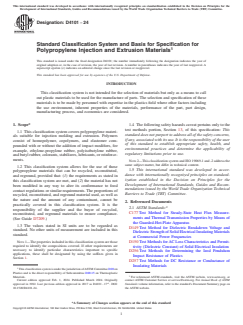
Designation: D4101 − 24
Standard Classification System and Basis for Specification for
Polypropylene Injection and Extrusion Materials
This standard is issued under the fixed designation D4101; the number immediately following the designation indicates the year of
original adoption or, in the case of revision, the year of last revision. A number in parentheses indicates the year of last reapproval. A
superscript epsilon (´) indicates an editorial change since the last revision or reapproval.
This standard has been approved for use by agencies of the U.S. Department of Defense.
INTRODUCTION
This classification system is not intended for the selection of materials but only as a means to call
out plastic materials to be used for the manufacture of parts. The selection and specification of these
materials is to be made by personnel with expertise in the plastics field where other factors including
the use environment, inherent properties of the materials, performance of the part, part design,
manufacturing process, and economics are considered.
1. Scope* 1.4 The following safety hazards caveat pertains only to the
test methods portion, Section 13, of this specification: This
1.1 This classification system covers polypropylene materi-
standard does not purport to address all of the safety concerns,
als suitable for injection molding and extrusion. Polymers
if any, associated with its use. It is the responsibility of the user
consist of homopolymer, copolymers, and elastomer com-
of this standard to establish appropriate safety, health, and
pounded with or without the addition of impact modifiers, for
environmental practices and determine the applicability of
example, ethylene-propylene rubber, polyisobutylene rubber,
regulatory limitations prior to use.
and butyl rubber, colorants, stabilizers, lubricants, or reinforce-
ments.
NOTE 2—This classification system and ISO 19069-1 and -2 address the
same subject matter, but differ in technical content.
1.2 This classification system allows for the use of those
1.5 This international standard was developed in accor-
polypropylene materials that can be recycled, reconstituted,
dance with internationally recognized principles on standard-
and reground, provided that: (1) the requirements as stated in
ization established in the Decision on Principles for the
this classification system are met, and (2) the material has not
Development of International Standards, Guides and Recom-
been modified in any way to alter its conformance to food
mendations issued by the World Trade Organization Technical
contact regulations or similar requirements. The proportions of
Barriers to Trade (TBT) Committee.
recycled, reconstituted, and reground material used, as well as
the nature and the amount of any contaminant, cannot be
2. Referenced Documents
practically covered in this classification system. It is the
2.1 ASTM Standards:
responsibility of the supplier and the buyer of recycled,
C177 Test Method for Steady-State Heat Flux Measure-
reconstituted, and reground materials to ensure compliance.
ments and Thermal Transmission Properties by Means of
(See Guide D7209.)
the Guarded-Hot-Plate Apparatus
1.3 The values stated in SI units are to be regarded as
D149 Test Method for Dielectric Breakdown Voltage and
standard. No other units of measurement are included in this
Dielectric Strength of Solid Electrical Insulating Materials
standard.
at Commercial Power Frequencies
NOTE 1—The properties included in this classification system are those D150 Test Methods for AC Loss Characteristics and Permit-
required to identify the compositions covered. If other requirements are
tivity (Dielectric Constant) of Solid Electrical Insulation
necessary to identify particular characteristics important to specific
D256 Test Methods for Determining the Izod Pendulum
applications, these shall be designated by using the suffixes given in
Impact Resistance of Plastics
Section 1.
D257 Test Methods for DC Resistance or Conductance of
Insulating Materials
This classification system is under the jurisdiction of ASTM Committee D20 on
Plastics and is the direct responsibility of Subcommittee D20.15 on Thermoplastic
Materials. For referenced ASTM standards, visit the ASTM website, www.astm.org, or
Current edition approved Feb. 1, 2024. Published March 2024. Originally contact ASTM Customer Service at service@astm.org. For Annual Book of ASTM
ɛ1
approved in 1982. Last previous edition approved in 2017 as D4101 - 17 . DOI: Standards volume information, refer to the standard’s Document Summary page on
10.1520/D4101-24. the ASTM website.
*A Summary of Changes section appears at the end of this standard
Copyright © ASTM International, 100 Barr Harbor Drive, PO Box C700, West Conshohocken, PA 19428-2959. United States
D4101 − 24
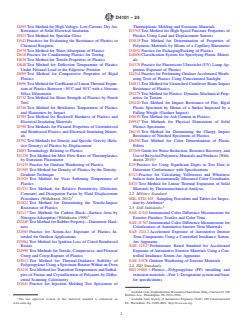
D495 Test Method for High-Voltage, Low-Current, Dry Arc Thermoplastic Molding and Extrusion Materials
Resistance of Solid Electrical Insulation D3763 Test Method for High Speed Puncture Properties of
D523 Test Method for Specular Gloss Plastics Using Load and Displacement Sensors
D543 Practices for Evaluating the Resistance of Plastics to D3835 Test Method for Determination of Properties of
Chemical Reagents Polymeric Materials by Means of a Capillary Rheometer
D570 Test Method for Water Absorption of Plastics D3892 Practice for Packaging/Packing of Plastics
D618 Practice for Conditioning Plastics for Testing D4000 Classification System for Specifying Plastic Materi-
D638 Test Method for Tensile Properties of Plastics als
D648 Test Method for Deflection Temperature of Plastics D4329 Practice for Fluorescent Ultraviolet (UV) Lamp Ap-
Under Flexural Load in the Edgewise Position paratus Exposure of Plastics
D695 Test Method for Compressive Properties of Rigid D4364 Practice for Performing Outdoor Accelerated Weath-
Plastics ering Tests of Plastics Using Concentrated Sunlight
D696 Test Method for Coefficient of Linear Thermal Expan- D4812 Test Method for Unnotched Cantilever Beam Impact
sion of Plastics Between −30°C and 30°C with a Vitreous Resistance of Plastics
Silica Dilatometer D5279 Test Method for Plastics: Dynamic Mechanical Prop-
D732 Test Method for Shear Strength of Plastics by Punch erties: In Torsion
Tool D5420 Test Method for Impact Resistance of Flat, Rigid
D746 Test Method for Brittleness Temperature of Plastics Plastic Specimen by Means of a Striker Impacted by a
and Elastomers by Impact Falling Weight (Gardner Impact)
D785 Test Method for Rockwell Hardness of Plastics and D5630 Test Method for Ash Content in Plastics
Electrical Insulating Materials D5947 Test Methods for Physical Dimensions of Solid
D790 Test Methods for Flexural Properties of Unreinforced Plastics Specimens
and Reinforced Plastics and Electrical Insulating Materi- D6110 Test Method for Determining the Charpy Impact
als Resistance of Notched Specimens of Plastics
D792 Test Methods for Density and Specific Gravity (Rela- D6290 Test Method for Color Determination of Plastic
tive Density) of Plastics by Displacement Pellets
D883 Terminology Relating to Plastics D7209 Guide for Waste Reduction, Resource Recovery, and
D1238 Test Method for Melt Flow Rates of Thermoplastics Use of Recycled Polymeric Materials and Products (With-
by Extrusion Plastometer drawn 2015)
D1435 Practice for Outdoor Weathering of Plastics E29 Practice for Using Significant Digits in Test Data to
D1505 Test Method for Density of Plastics by the Density- Determine Conformance with Specifications
Gradient Technique E313 Practice for Calculating Yellowness and Whiteness
D1525 Test Method for Vicat Softening Temperature of Indices from Instrumentally Measured Color Coordinates
Plastics E831 Test Method for Linear Thermal Expansion of Solid
D1531 Test Methods for Relative Permittivity (Dielectric Materials by Thermomechanical Analysis
Constant) and Dissipation Factor by Fluid Displacement 2.2 Military Standard:
Procedures (Withdrawn 2012)
MIL-STD-105 Sampling Procedure and Tables for Inspec-
D1822 Test Method for Determining the Tensile-Impact tion by Attributes
Resistance of Plastics
2.3 SAE Standards:
D2117 Test Methods for Carbon Black—Surface Area by SAE J1545 Instrumental Color Difference Measurement for
Nitrogen Adsorption (Withdrawn 1999)
Exterior Finishes, Textiles and Color Trim
D2240 Test Method for Rubber Property—Durometer Hard- SAE J1767 Instrumental Color Difference Measurement for
ness
Colorfastness of Automotive Interior Trim Materials
D2565 Practice for Xenon-Arc Exposure of Plastics In- SAE J2412 Accelerated Exposure of Automotive Interior
tended for Outdoor Applications
Trim Components Using a Controlled Irradiance Xenon-
D2584 Test Method for Ignition Loss of Cured Reinforced Arc Apparatus
Resins
SAE J2527 Performance Based Standard for Accelerated
D2990 Test Methods for Tensile, Compressive, and Flexural Exposure of Automotive Exterior Materials Using a Con-
Creep and Creep-Rupture of Plastics
trolled Irradiance Xenon-Arc Apparatus
D3012 Test Method for Thermal-Oxidative Stability of SAE J1976 Outdoor Weathering of Exterior Materials
Polypropylene Using a Specimen Rotator Within an Oven
2.4 ISO Standards:
D3418 Test Method for Transition Temperatures and Enthal- ISO 19069-1 Plastics—Polypropylene (PP) moulding and
pies of Fusion and Crystallization of Polymers by Differ-
extrusion materials—Part 1: Designation system and basis
ential Scanning Calorimetry
for specifications
D3641 Practice for Injection Molding Test Specimens of
Available from Standardization Documents Order Desk, Bldg. 4 Section D, 700
Robbins Ave., Philadelphia, PA 19111-5094.
3 5
The last approved version of this historical standard is referenced on Available from Society of Automotive Engineers (SAE), 400 Commonwealth
www.astm.org. Dr., Warrendale, PA 15096-0001, http://www.sae.org.
D4101 − 24
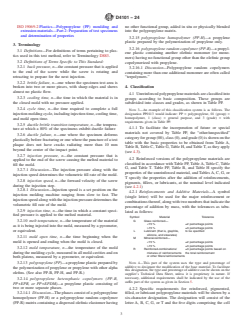
ISO 19069-2 Plastics—Polypropylene (PP) moulding and no other functional group, added in situ or physically blended
extrusion materials—Part 2: Preparation of test specimens into the polypropylene matrix.
and determination of properties
3.2.15 polypropylene homopolymer (PP-H)—a propylene
plastic prepared by the polymerization of propylene only.
3. Terminology
3.2.16 polypropylene random copolymer (PP-R)—a propyl-
3.1 Definitions—For definitions of terms pertaining to plas-
ene plastic containing another olefinic monomer (or mono-
tics used in this test method, refer to Terminology D883.
mers) having no functional group other than the olefinic group
3.2 Definitions of Terms Specific to This Standard:
copolymerized with propylene.
3.2.1 back pressure, n—the constant pressure that is applied
3.2.16.1 Discussion—Polypropylene random copolymers
to the end of the screw while the screw is rotating and
containing more than one additional monomer are often called
retracting to prepare for the next injection.
“terpolymers.”
3.2.2 brittle failure, n—one where the specimen test area is
broken into two or more pieces, with sharp edges and shows 4. Classification
almost no plastic flow.
4.1 Unreinforced polypropylene materials are classified into
3.2.3 cooling time, n—the time in which the material is in
groups according to basic composition. These groups are
the closed mold with no pressure applied.
subdivided into classes and grades, as shown in Table PP.
3.2.4 cycle time, n—the time required to complete a full
NOTE 3—An example of this classification system is as follows. The
injection molding cycle, including injection time, cooling time,
designation PP0113 would indicate: PP = polypropylene, 01 (group) =
homopolymer, 1 (class) = general purpose, and 3 (grade) = with
and mold open time.
requirements given in Table PP.
3.2.5 ductile brittle transition temperature, n—the tempera-
4.1.1 To facilitate the incorporation of future or special
ture at which a 80% of the specimens exhibit ductile failure
materials not covered by Table PP, the “other/unspecified”
3.2.6 ductile failure, n—one where the specimen deforms
category for group (00), class (0), and grade (0) is shown on the
plastically before fracturing or one where the puncture of a test
table with the basic properties to be obtained from Table A,
plaque does not have cracks radiating more than 10 mm
Table B, Table C, Table G, Table H, and Table T, as they apply
beyond the center of the impact point.
(see 4.3).
3.2.7 injection pressure, n—the constant pressure that is
4.2 Reinforced versions of the polypropylene materials are
applied to the end of the screw causing the melted material to
classified in accordance with Table PP, Table A, Table C, Table
fill the mold.
G, and Table T. Table PP, Table B, and Table H specify the
3.2.7.1 Discussion—The injection pressure along with the
properties of the unreinforced material, and Tables A, C, G, or
injection speed determines the volumetric fill rate of the mold.
T specify the properties after the addition of reinforcements,
3.2.8 injection speed, n—the forward velocity of the screw
pigments, fillers, or lubricants, at the nominal level indicated
during the injection step.
(see 4.2.1)
3.2.8.1 Discussion—Injection speed is a set position on the
4.2.1 Reinforcements and Additive Materials—A symbol
injection molding machine ranging from slow to fast. The
(single letter) will be used for the major reinforcement or
injection speed along with the injection pressure determines the
combinations thereof, along with two numbers that indicate the
volumetric fill rate of the mold.
percentage of addition by mass, with the tolerances as tabu-
3.2.9 injection time, n—the time in which a constant speci-
lated as follows:
fied pressure is applied to the melted material.
Symbol Material Tolerance
G Glass reinforced—
3.2.10 melt temperature, n—the temperature of the material
<15 % ±2 percentage points
as it is being injected into the mold, measured by a pyrometer,
>15 % ±3 percentage points
or equivalent.
L Lubricant (that is, graphite, to be specified
silicone, and stearates)
3.2.11 mold open time, n—the time beginning when the
M Mineral-reinforced—
mold is opened and ending when the mold is closed.
<15 % ±2 percentage points
>15 % ±3 percentage points
3.2.12 mold temperature, n—the temperature of the mold
R Reinforced-combinations/ ±3 percentage points based on
during the molding cycle, measured in all mold cavities and on
mixtures of reinforcements the total reinforcement
or other fillers/reinforcements
both platens, measured by a pyrometer, or equivalent.
NOTE 4—This part of the system uses the type and percentage of
3.2.13 polypropylene (PP)—a propylene plastic prepared by
additive to designate the modification of the base material. To facilitate
the polymerization of propylene or propylene with other alpha
this designation, the type and percentage of additive can be shown on the
olefins. (See also PP-B, PP-H, and PP-R.)
supplier’s Technical Data Sheet, unless it is proprietary in nature. If
necessary, additional requirements shall be indicated by the use of the
3.2.14 polypropylene heterophasic copolymers (PP-B,
suffix part of the system as given in Section 5.
PP+EPR, or PP+EPDM)—a propylene plastic consisting of
two or more separate phases. 4.2.2 Specific requirements for reinforced, pigmented,
3.2.14.1 Discussion—The phases consist of a polypropylene filled, or lubricant polypropylene materials will be shown by a
homopolymer (PP-H) or a polypropylene random copolymer six-character designation. The designation will consist of the
(PP-R) matrix containing a dispersed olefinic elastomer having letter A, B, C, G, or T and the five digits comprising the cell
D4101 − 24
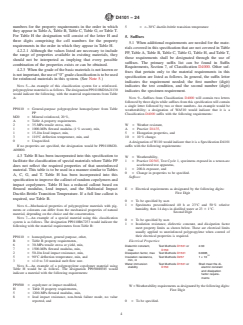
numbers for the property requirements in the order in which
5 = <–30°C ductile-brittle transition temperature
they appear in Table A, Table B, Table C, Table G, or Table T.
For Table H the designation will consist of the letter H and
5. Suffixes
three digits comprising the cell numbers for the property
5.1 When additional requirements are needed for the mate-
requirements in the order in which they appear in Table H.
rials covered in this specification that are not covered in Table
4.2.2.1 Although the values listed are necessary to include
PP, Table A, Table B, Table C, Table G, Table H, and Table T,
the range of properties available in existing materials, they
those requirements shall be designated through the use of
should not be interpreted as implying that every possible
suffixes. The primary suffix list can be found in Suffix
combination of the properties exists or can be obtained.
Requirements, Section 7, of Classification D4000. Other suf-
4.2.3 When the grade of the basic materials is not known or
fixes that pertain only to the material requirements in this
is not important, the use of “0” grade classification is to be used
specification are listed as follows. In general, the suffix letter
for reinforced materials in this system. (See Note 5.)
indicates the requirement needed; the first number (digit)
NOTE 5—An example of this classification system for a reinforced-
indicates the test condition, and the second number (digit)
polypropylene material is as follows. The designation PP0110M20A21130
indicates the specimen requirement.
would indicate the following, with the material requirements from Table
A: NOTE 9—Suffixes from Classification D4000 will contain two letters
followed by three digits while suffixes from this specification will contain
a single letter followed by two or three numbers. An example would be
PP0110 = General-purpose polypropylene homopolymer from Table
weatherability; a designation of WA510 would indicate that it is a
PP
Classification D4000 suffix with the following requirements:
M20 = Mineral reinforced, 20 %,
A = Table A property requirements.
2 = 35-MPa tensile stress, min, W = Weather resistant,
1 = 1000-MPa flexural modulus (1 % secant), min, A = Practice D1435,
5 = Elongation properties, and
1 = 15-J/m Izod impact, min,
10 = 10 % change.
3 = 110°C deflection temperature, min, and
0 = Unspecified.
A designation of W110 would indicate that it is a Specification D4101
suffix with the following requirements:
If no properties are specified, the designation would be PP0110M20-
A00000.
4.3 Table B has been incorporated into this specification to
W = Weatherability,
facilitate the classification of special materials where Table PP 1 = Practice D2565, Test Cycle 1, specimens exposed in a xenon-arc
accelerated test apparatus,
does not reflect the required properties of that unreinforced
1 = 200-h exposure, and
material. This table is to be used in a manner similar to Tables
0 = Change in properties to be specified.
A, C, G, and T. Table H has been incorporated into this
Suffıxes:
specification to improve the callout of random copolymers and
impact copolymers. Table H has a reduced callout based on
E = Electrical requirements as designated by the following digits:
flexural modulus, Izod impact, and the Multiaxial Impact
First Digit
Ductile-Brittle Transition Temperature. If a full line callout is
required, use Table B.
0 = To be specified by user.
1 = Specimens preconditioned 40 h at 23°C and 50 % relative
NOTE 6—Mechanical properties of polypropylene materials with pig-
humidity, then 14 days in distilled water at 23 6 1°C.
ments or colorants can differ from the mechanical properties of natural
Second Digit
material, depending on the choice and the concentration.
NOTE 7—An example of a special material using this classification
0 = To be specified by user.
system is as follows. The designation PP0110B67253 would indicate the
1 = Insulation resistance, dielectric constant, and dissipation factor
following with the material requirements from Table B:
meet property limits as shown below. These are electrical limits
usually applied to unreinforced polypropylene when control of
their electrical properties is required.
PP0110 = homopolymer, general purpose, other,
B = Table B property requirements, Electrical Properties:
6 = 30-MPa tensile stress at yield, min,
Dielectric constant, Test Methods D1531 or 2.30
7 = 1500-MPa flexural modulus, min,
max D150
2 = 50-J/m Izod impact resistance, min, Dissipation factor, max Test Methods D1531 0.0005
Insulation resistance, Test Methods D257 1 × 10
5 = 90°C deflection temperature, min, and
min, Ω
3 = >1.0 to 3.0 nominal melt flow rate.
Water immersion Test Methods D1531 or Shall meet the di-
NOTE 8—An example of a polypropylene copolymer material using
stability D150 electric constant
Table H would be as follows. The designation PP0500H585 would
and dissipation
indicate a material with the following requirements:
factor require-
ments
PP0500 = copolymer or impact modified,
W = Weatherability requirements as designated by the following digits:
H = Table H property requirements,
First Digit
5 = 1200-MPa flexural modulus, min,
8 = Izod impact resistance, non-break failure mode, no value
reported, and 0 = To be specified.
D4101 − 24
1 = Specimens exposed in a xenon arc accelerated test apparatus that 9 = Colorfastness by SAE J1767, for interior materials, CIELAB color
conforms to Practice D2565 using Test Cycle 1 for exterior difference, 10° observer, Illuminant D65, specular included, ∆E =
applications. 3.0 max.
2 = Specimens exposed in a fluorescent UV/condensation accelerated Z = Reserved for other special requirement characteristics (for
test apparatus that conforms to Practice D4329 using Test Cycle A example, internal mold release agent) not covered by existing
for exterior applications. call-out capabilities. These are to be assigned and be spelled out in
detail and identified in sequence, that is, 01 UV-stabilized, 02
3 = Specimens exposed in a xenon-arc accelerated test apparatus that
conforms to SAE J2527 or equivalent for exterior applications. special color, and 03, etc.
4 = Specimens exposed in a xenon-arc accelerated test apparatus that
Additional suffixes will be added to this specification as test methods
conforms to SAE J2412 or equivalent for interior applications.
and requirements are developed or requested, or both.
5 = Specimens exposed to concentrated natural sunlight in accordance
with Practice D4364 without water spray. 6. Basic Requirements
6 = Specimens exposed to concentrated natural sunlight in accordance
6.1 Basic requirements from property or cell tables, as they
with Practice D4364 with water spray (Table 1, Cycle 1).
apply, are always in effect unless these requirements are
7 = Specimens exposed to natural sunlight in accordance with Practice
D1435 using a rack angle of 45° from the horizontal facing the superseded by specific suffix requirements in the “Line Call-
equator , unless specified otherwise.
Out.”
8 = Specimens exposed to natural sunlight in accordance with SAE
J1976 Procedure A, unless specified otherwise.
7. General Requirements
Second Alphanumeric
7.1 The plastic composition shall be uniform and shall
0 = To be specified by user.
conform to the requirements specified herein. The color and
1 = 200-h exposure.
form of the material shall be specified. Note specification
2 = 500-h exposure.
changes due to the effects of colorants and, when necessary,
3 = 1000-h exposure.
cover them by suffixes.
4 = 2000-h exposure.
5 = 1240.8 kJ/(m .nm) at 340 nm.
7.2 For recycled, reconstituted, and reground materials the
6 = 2500 kJ/(m .nm) at 340 nm.
level of contamination by nonpolymeric materials other than
7 = 1000 MJ/m solar total UV irradiation (approximately 3 years).
fillers and additives shall not be of a significant level that it
8 = 336-h exposure
prevents the product from meeting the performance criteria for
9 = 720-h exposure
which it was manufactured.
A = 5000-h exposure
B = 10000-h exposure
C = 225.6 kJ/(m .nm) at 340 nm 8. Detail Requirements
D = 601.6 kJ/(m .nm) at 340 nm.
8.1 Test specimens for the various materials shall conform
NOTE 10—Conversion from hours to kilojoules (kJ) varies with
to the requirements prescribed in Table PP, Table A, Table B,
irradiance and the light/dark cycle. Conversion to kJ from actual light
Table C, Table G, Table H, Table T and to the suffix require-
hours (h) is based on the following relation:
ments as they apply.
kJ 5 Irradiance in Watts × 3.6 kJ/h × h of light
8.2 Observed or calculated values obtained from analysis,
Thus, at an irradiance level of 0.55 W/(m .nm) at 340 nm, the multipli-
measurement, or test shall be rounded in accordance with
cation factor for converting light hours to kJ is 1.98 (0.55 × 3.6).
Practice E29 to the nearest unit in the last right-hand place of
Therefore, 100 light hours is equivalent to 396 kJ/(m .nm) at 340 nm at
figures used in expressing the specified limiting value. The
this irradiance level.
Third Alphanumeric value obtained is compared directly with the specified limiting
value. Conformance or nonconformance with the specification
is based on this comparison.
0 = To be specified by user.
1 = The exposed specimens shall not exhibit surface changes (such as
9. Sampling
dulling and chalking) or deep-seated changes (such as checking,
crazing, warping, and discoloration).
9.1 Sampling shall be statistically adequate to satisfy the
2 = The tensile strength after exposure must be no less than 50 % of
requirements of 14.4. A batch or lot of resin shall be considered
the original.
as a unit of manufacture as prepared for shipment and can
3 = The tensile strength after exposure must be no less than 90 % of
consist of a blend of two or more production runs of material.
the original.
4 = American Association of Textile Chemists and Colorists (AATCC)
10. Number of Tests
rating 4 to 5.
5 = Colorfastness by SAE J1545, for exterior materials, CIELAB color
10.1 The number of tests conducted shall be consistent with
difference, 10° observer, Illuminant D65, specular included, ∆E =
the requirements of Section 13.
2.5 max.
6 = Colorfastness by SAE J1545, for exterior materials, CIELAB color
11. Specimen Preparation
difference, 10° observer, Illuminant D65, specular included, ∆E =
2.0 max.
11.1 All test specimens other than those for heat stability
7 = Colorfastness by SAE J1545, for exterior materials, CIELAB color
testing (see 11.2) shall be injection molded in accordance with
difference, 10° observer, Illuminant D65, specular included, ∆E =
the following specific procedures:
3.0 max.
8 = Colorfastness by SAE J1767, for interior materials, CIELAB color
NOTE 11—Physical and mechanical properties are dependent upon the
difference, 10° observer, Illuminant D65, specular included, ∆E =
technique of specimen preparation. Specimen preparation by means other
2.5 max.
than those described as follows can lead to significant variation in test
D4101 − 24
results, with resultant departure from specification values.
nique shall only be used after a correlation between the
NOTE 12—Limited data have shown that, for Polypropylenes, mechani-
needle-type pyrometer and the infrared pyrometer has been
cal test values can be significantly affected by the cross sectional area of
established. This correlation shall be verified at least every six
the runner. Specimens molded using the specified minimum runner size of
months. The correlation shall be re-established each time either
5 mm D (~20 mm ) exhibited lower values of most mechanical properties
pyrometer is recalibrated.
than specimens molded using runners with cross-sectional areas of 50 and
80 mm . Higher viscosity (lower MFR) materials appear to be more
11.1.5 Back Pressure—The back pressure shall be set at 0.7
sensitive. This effect needs to be considered when comparing data
MPa (gage).
obtained from different sources.
11.1.6 Injection Pressure and Speed—All materials less
11.1.1 Specimen Mold—Molds designed in compliance with
than 30-g/10 min melt flow shall be molded using a single
Practice D3641 to mold the following test specimens:
stage pressure. For a given machine and a given mold, the
11.1.1.1 A Test Method D638, Type I tension test specimen
injection pressure and the injection speed controls shall be set
with a thickness of 3.2 6 0.1 mm.
to produce equal part weights, including sprue and runners
11.1.1.2 A rectangular bar, with dimensions of 127 mm by
(62 %) regardless of material flow rates. The injection speed
12.7 mm by 3.2 6 0.1 mm.
and injection pressure shall be set to minimize sink and flash.
11.1.1.3 Plate, with minimum dimensions of 100 mm or
The maximum amount of flash shall not exceed 1 mm and will
100-mm diameter with a thickness of 3.2 6 0.2 mm.
only be acceptable in the nontesting area. Once the injection
11.1.2 Mold Temperature—The temperature of the mold
speed and pressure are determined for a given machine and
shall be 60 6 3°C. Temperature measurements shall be made
mold they shall not be varied by more than 62 %. A single
in each cavity of the mold after machine conditions are at
stage pressure can be obtained in two different ways.
equilibrium and shall be made with a surface-type pyrometer,
11.1.6.1 Set the injection pressure to a specified pressure
or equivalent, to an accuracy of 62°C after equilibrium or
then allow a shift over to a hold pressure; the hold pressure
cycle conditions have been established.
maintains the pressure at the maximum pressure generated by
11.1.3 Cycle—The total molding cycle time shall be 45 s,
the injection pressure, fill the cavity using hold pressure only.
consisting of 20-s injection, 20-s cooling, and 5-s mold open.
11.1.6.1.1 Discussion—The first method is the preferred
11.1.4 Melt Temperature—The melt temperature for mold-
method. For materials with melt flow rates above 30 g/10 min,
ing test specimens for materials with melt flows of 1 to 30 g/10
different injection and hold pressures are permitted. Normally
min shall correlate with the polymer melt flow (Test Method
the hold pressure is set lower than the injection pressure, but
D1238, Condition 230/2.16) as shown in Table 1. Melt
must be high enough to finish filling out the molded part. It is
temperatures shall be measured on cycle by taking the tem-
recommended that, for these high melt flow rate materials, the
peratures of several successive free shots with a needle-type
manufacturer be contacted for guidance in establishing the
pyrometer, or equivalent, to an accuracy of 63°C.
injection and hold pressures. It is also recommended that screw
rotation speed be set to a minimum to allow the screw to rotate
NOTE 13—The needle should be moved around in the plastic mass, and
for 17 to 19 s of the 20-s cooling time. This slower screw speed
a sufficient number of measurements be made to establish a reliable result.
To minimize heat loss from the plastic during measurement, the mass will provide greater uniformity of the melt with respect to
should be collected in a heated container, or in one made from material of
viscosity and temperature. If necessary, adjust the screw
low thermal conductivity. The quantity of plastic in the free shot should be
rotation speed for the various material types in order to achieve
controlled to be equivalent to the weight of a complete injection-molded
the 17 to 19-s time frame. The rate of screw movement
shot.
backwards away from the mold is dependent on the back
11.1.4.1 To avoid excessive thermal history the shot size
pressure, frictional effects, various additive types, and melt
shall be kept to a minimum and the cushion shall be 5 to 10
viscosity.
mm.
11.1.7 Reporting—Report the injection molding conditions
11.1.4.2 For materials with melt flows less than 1 g/10 min,
in accordance with Practice D3641.
raise the temperature of the melt in 5°C increments from 250°C
11.2 Prepare test specimens for heat stability testing in
until the part weight of the entire shot is equivalent to the part
accordance with Test Method D3012.
weight of a 1 to 5-g/10 min material.
NOTE 14—Due to degradation and thermal expansion of the material,
12. Conditioning
the melt temperature should not exceed 270°C. If unable to obtain the
weight at 270°C, slight adjustments can be made in the injection pressure
12.1 Conditioning:
to achieve the proper weight.
12.1.1 Once specimens are molded, they shall be moved to
11.1.4.3 The melt temperature shall be 190°C for materials a standard laboratory atmosphere or a controlled laboratory
with melt flows greater than 30 g/10 min. atmosphere. For natural unfilled polypropylene the controlled
11.1.4.4 Since the needle-type pyrometer technique is some- laboratory atmosphere shall be 23 6 2°C. Specimens shall be
what tedious, a second technique using an infrared pyrometer stored in storage medium, such as boxes, paper bags or
is an acceptable alternative. The infrared pyrometer used must envelopes, plastic bags, or racks, whichever is most practical
have an accuracy of 1 % of reading or 62°C, whichever is for the laboratory storing the specimens. It is recommended
smaller, a response time of at least 0.5 s, and a distance to that specimens be allowed to cool for about 30 min on a bench
target ratio of at least 30:1. It is recommended that the infrared or in a rack before they are placed in any container where the
pyrometer have a laser beam to establish the position being specimens might come in contact with each other. For filled
measured on the molten mass of polymer. This second tech- and reinforced polypropylene or polypropylene blends, which
D4101 − 24
contain a hydrophilic comonomer or modifier the specimens 13.1.1 Flow Rate—Condition 230/2.16 of Test Method
shall be conditioned in a standard laboratory atmosphere of 23 D1238. Make two determinations on the material in the form
6 2°C and 50 6 10 % relative humidity, unless sufficient that it is to be molded (such as powder, pellets, or granules).
testing has been conducted that indicates that specific material
NOTE 17—This test method serves to indicate the degree of uniformity
type’s properties are not affected by humidity. In those cases,
of the flow rate of the polymer of a single manufacturer as made by an
the storage medium can be the same as for unfilled materials.
individual process and, in this case, is only indicative of the degree of
Materials whose properties are affected by humidity, must be uniformity of molded specimens, and therefore other properties. However,
uniformity of flow rate among various polymers of various manufacturers
stored in accordance with Practice D618, Procedure A. For all
as made by various processes does not, in the absence of other tests,
materials to be conditioned for electrical testing, conditioning
indicate uniformity of other properties and vice versa.
shall comply with the requirements of the standard test
13.1.2 Measurement of Test Specimen Dimensions—The
methods for electrical testing. In all cases the laboratory shall
width and thickness of the test specimen shall be measured to
report both the temperature and humidity conditions during the
an incremental discrimination of at least 0.025 mm. Measure-
conditioning period.
ments shall be made with a micrometer, preferably with
12.1.2 When the temperature in the molding area exceeds
ratchet, having a movable circular contact foot and a lower
28°C or the humidity level exceeds 60 % (applicable only to
anvil foot, both 6.35 6 0.025 mm in diameter. Specimens shall
materials that contain a hydrophilic comonomer or modifier)
be measured in accordance with Test Methods D5947.
specimens shall be moved as quickly as possible to the
13.1.3 Tensile Stress (Yield)—Test Type I specimens using
standard laboratory atmosphere.
Test Method D638. The material shall be tested at 50 mm/min
12.1.3 Testing, except for those tests where a test time is
when the material is one that shows a breaking strain greater
specified, shall be conducted not less than 40 h after molding.
than 10 %, or at 5 mm/min when the material breaks at a strain
The aging times as specified in this and subsequent sections
equal to or less than 10 %.
shall apply to all testing conducted for development of a line
13.1.4 Flexural Modulus (1 % Secant)—Test Methods
callout, data for publication, or for cases of dispute over testing
values. D790, Method I, Procedure A, with a 50-mm span, a 5.0 6
0.1-mm radius support and loading nose, and a 1.3-mm/min
12.1.4 Specimens that are to be tested for Izod or Charpy
impact shall be notched within 1 to 16 h after molding. Once testing speed using the center test region of a Test Method
D638, Type I specimen. It is mandatory that the toe correction
notched the specimens shall condition for a minimum of 40 h
before testing. be made to correct for the slack in the test fixture and load cell.
Center the specimen between the span flatwise and test with a
NOTE 15—Data have shown that, for some polypropylene impact
crosshead speed of 1.3 mm/min. Calculate the average value of
copolymers with higher xylene solubles or higher rubber content, Izod
the flexural modulus (1 % secant) at 1 % strain in the outer
impact values can vary significantly over time.
surface of the test specimen.
12.1.5 Specimens that are to be tested for tensile or flexural
properties shall be tested within 40 to 96 h after molding.
NOTE 18—If the Test Method D638 Type I specimens were molded on
a mold containing a draft angle, the specimens will be trapezoidal. It is
NOTE 16—Polypropylene properties change with time as a result of
possible that the flexural modulus will vary slightly depending on which
amorphous densification and, in some cases, due to a small degree of
side is placed away from the loading nose.
secondary crystallization in the rubbery phase.
13.1.4.1 Calculate the deflection of the test specimen corre-
12.2 Test Conditions—Natural unfilled polypropylene shall
sponding to 1 % strain (0.01 mm/mm) as follows:
be tested in a controlled laboratory atmosphere of 23 6 2°C.
D 5 rL /6d (1)
For filled and reinforced polypropylene and polypropylene
blends, which contain a hydrophilic comonomer or modifier
where:
the specimens shall be tested in a standard laboratory atmo-
D = deflection of the center of the test specimen at 1 %
sphere of 23 6 2°C and 50 6 10 % relative humidity, unless
strain, mm
sufficient testing has been conducted that indicates that specific
r = strain in the outer surface of the test specimen = 0.01
materials type’s properties are not affected by humidity. For all
mm/mm,
materials to be tested for electrical properties, the laboratory
L = test span = 50 mm, and
shall comply with the requirements of the standard test
d = specimen depth = 3.2 mm (nominal).
methods for electrical testing. In all cases the laboratory shall
Warning—The load measured must be a minimum of 1 %
report both the temperature and humidity conditions during
of the load cell capacity. The test span shall be known to an
testing.
accuracy of 0.05 mm, and this value shall be used in the
calculations in 13.1.4.1. The loading nose shall be precisely
13. Test Methods
centered between the supports. The test specimen shall be
13.1 Determine the properties enumerated in this specifica-
aligned perpendicular to the supports to an accuracy of 2° and
tion in accordance with the ASTM test methods as they apply,
the center of the specimen shall be directly below the center of
unless otherwise stated herein.
the loading nose.
13.1.4.2 Calculate the stress corresponding to 1 % strain as
follows:
Supporting data have been filed at ASTM International Headquarters and may
be obtained by requesting Research Report RR:D20-1213. S 5 3PL/2bd (2)
D4101 − 24
where: specifications detailed in the Tables shall be based on a
material having a complete, hinge, or partial break.
S = stress in the outer surface of the test specimen at 1 %
13.1.6 Deflection Temperature—Test Method D648 shall be
strain, MPa,
used to test a rectangular specimen 3.2 by 12.7 by 127 mm with
P = load corresponding to 1 % strain, N
a load applied at the center to give maximum fiber stresses of
L = test span = 50 mm,
d = specimen depth = 3.2 mm (nominal), and
455 kPa.
b = specimen width = 12.7 mm (nominal).
13.1.7 Multiaxial Impact Ductile-Brittle Transition
Temperature—Test Method D3763 shall be used to test speci-
The secant modulus at 1 % strain is the ratio of stress to
mens equal to or greater in dimensions than 100 mm or 100
strain or S/0.01.
mm in diameter and 3.2 6 0.2 mm in thickness. The test speed
13.1.5 Impact Resistance (Izod)—Test Method D256 (A)
shall be 2.2 m/s with the 12.7-mm diameter impact dart and
shall be used for notched specimens tested at 23°C. Specimens
76-mm support ring. The temperature at which 80 % of the
shall be cut from the center section of the Test Method D638,
specimens exhibit ductile failure shall be determined based on
Type I tensile test specimen. Before cutting the test specimen
the definitions listed in Section 3. This temperature shall be
from the tensile bar, draw a symbol of any design in the straight
determined by either a standard graphical method or through a
center section of the bar to indicate which is the gate end of the
probability graphical method. When using the standard graphic
specimen. Cut out the 57.2 mm straight center-section of the
method to determine the 80 % passing temperature, it is
bar. The specimens shall be notched in accordance with Test
necessary to repeat this procedure of testing ten specimens at a
Method D256 for tests at 23°C. Specimens shall be notched
series of temperatures differing by uniform increments of 5°C.
such that the notch is off-center on the 57.2 6 1 mm long
The transition region of the curve shall be established using
specimen. When notched, the apex of the notch shall be 25.4 6
either 5°C or 10°C increments, but -5°C increments must be
2 mm from the non-gated end and 31.8 6 1 mm from the gated
used when testing in the transition temperature region. When
end of the specimen. The more critical dimension is the 31.8 6
using probability graph paper, it is not necessary to obtain the
1 mm from the gated end of the specimen. Notched specimens
lowest no-failure temperatures, at which no failure is obtained,
must be conditioned after notching for a minimum of 40 h
or the highest failure temperature. Draw a straight line through
before testing. The specimen shall be inserted in the clamp with
a minimum of four points, two above and two below the 50 %
the 25.4 6 2 mm in the clamp and the 31.8 6 1 mm length
failure point. The temperature indicated at the intersection of
above the clamp. When testing, the specimen shall be clamped
the data line with the 20 % failure line shall be reported as the
in the grips with the minimum pressure necessary to prevent
ductile-brittle temperature or 80 % passing temperature.
any movement of the specimen upwards or downwards during
impact.
NOTE 21—In addition to visually examining the plaques for ductile
failure, review the load versus time or load versus displacement curve for
13.1.5.1 Should this pressure deform the specimen, reduce
the impact for signs of ductility.
the clamp pressure and note this in the report.
13.1.8 Reinforcement and Additive Concentrations:
NOTE 19—Although the 57.2 mm length of specimen does not comply
13.1.8.1 Glass Percentage—Use Test Method D2584.
with the minimum specimen length of 61.5 mm specified by Test Method
13.1.8.2 All Others—Method to be specified.
D256, studies with numerous types of polypropylene specimens has
shown that clamp lengths as short as 19 mm are acceptable, with no 13.1.8.3 Additional testing methods and conditions, refer to
change in test results. What is critical is that the length of material above
Appendix X1.
the clamp, which is specified as 31.8 6 1 mm. Failure to maintain the 31.8
6 1 mm above the clamp will result in reduced or increased Izod impact
14. Inspection and Certification
values depending on whether the specimen length above the clamp is
longer or shorter than that specified by Test Method D256, Method A.
14.1 Inspection and certification of the material supplied
NOTE 20—With the design of each clamping system and the capacity of
with reference to a specification based on this classification
the pendulum used different from instrument to instrument it is difficult to
system shall be for conformance to the requirements specified
specify a pressure, which will hold the specimen securely. What is
herein.
important is that the clamp pressure be maintained constant from
specimen to specimen and be sufficient to prevent specimen movement
14.2 Lot-acceptance inspection shall be the basis on which
during the impact. Too low a clamp pressure may result in slightly higher
accept
...
This document is not an ASTM standard and is intended only to provide the user of an ASTM standard an indication of what changes have been made to the previous version. Because
it may not be technically possible to adequately depict all changes accurately, ASTM recommends that users consult prior editions as appropriate. In all cases only the current version
of the standard as published by ASTM is to be considered the official document.
´1
Designation: D4101 − 17 D4101 − 24
Standard Classification System and Basis for Specification for
Polypropylene Injection and Extrusion Materials
This standard is issued under the fixed designation D4101; the number immediately following the designation indicates the year of
original adoption or, in the case of revision, the year of last revision. A number in parentheses indicates the year of last reapproval. A
superscript epsilon (´) indicates an editorial change since the last revision or reapproval.
This standard has been approved for use by agencies of the U.S. Department of Defense.
ε NOTE—Editorially corrected Table X1.1 in June 2019.
INTRODUCTION
This classification system is not intended for the selection of materials but only as a means to call
out plastic materials to be used for the manufacture of parts. The selection and specification of these
materials is to be made by personnel with expertise in the plastics field where other factors including
the use environment, inherent properties of the materials, performance of the part, part design,
manufacturing process, and economics are considered.
1. Scope*
1.1 This classification system covers polypropylene materials suitable for injection molding and extrusion. Polymers consist of
homopolymer, copolymers, and elastomer compounded with or without the addition of impact modifiers, for example,
ethylene-propylene rubber, polyisobutylene rubber, and butyl rubber, colorants, stabilizers, lubricants, or reinforcements.
1.2 This classification system allows for the use of those polypropylene materials that can be recycled, reconstituted, and reground,
provided that: (1) the requirements as stated in this classification system are met, and (2) the material has not been modified in
any way to alter its conformance to food contact regulations or similar requirements. The proportions of recycled, reconstituted,
and reground material used, as well as the nature and the amount of any contaminant, cannot be practically covered in this
classification system. It is the responsibility of the supplier and the buyer of recycled, reconstituted, and reground materials to
ensure compliance. (See Guide D7209.)
1.3 The values stated in SI units are to be regarded as standard. No other units of measurement are included in this standard.
NOTE 1—The properties included in this classification system are those required to identify the compositions covered. If other requirements are necessary
to identify particular characteristics important to specific applications, these shall be designated by using the suffixes given in Section 1.
1.4 The following safety hazards caveat pertains only to the test methods portion, Section 13, of this specification: This standard
does not purport to address all of the safety concerns, if any, associated with its use. It is the responsibility of the user of this
standard to establish appropriate safety, health, and environmental practices and determine the applicability of regulatory
limitations prior to use.
NOTE 2—This classification system and ISO 19069-1 and -2 address the same subject matter, but differ in technical content.
This classification system is under the jurisdiction of ASTM Committee D20 on Plastics and is the direct responsibility of Subcommittee D20.15 on Thermoplastic
Materials.
Current edition approved Dec. 1, 2017Feb. 1, 2024. Published January 2018March 2024. Originally approved in 1982. Last previous edition approved in 20142017 as
ɛ2ɛ1
D4101 - 14D4101 - 17 . DOI: 10.1520/D4101-17E01.10.1520/D4101-24.
*A Summary of Changes section appears at the end of this standard
Copyright © ASTM International, 100 Barr Harbor Drive, PO Box C700, West Conshohocken, PA 19428-2959. United States
D4101 − 24
1.5 This international standard was developed in accordance with internationally recognized principles on standardization
established in the Decision on Principles for the Development of International Standards, Guides and Recommendations issued
by the World Trade Organization Technical Barriers to Trade (TBT) Committee.
2. Referenced Documents
2.1 ASTM Standards:
C177 Test Method for Steady-State Heat Flux Measurements and Thermal Transmission Properties by Means of the
Guarded-Hot-Plate Apparatus
D149 Test Method for Dielectric Breakdown Voltage and Dielectric Strength of Solid Electrical Insulating Materials at
Commercial Power Frequencies
D150 Test Methods for AC Loss Characteristics and Permittivity (Dielectric Constant) of Solid Electrical Insulation
D256 Test Methods for Determining the Izod Pendulum Impact Resistance of Plastics
D257 Test Methods for DC Resistance or Conductance of Insulating Materials
D495 Test Method for High-Voltage, Low-Current, Dry Arc Resistance of Solid Electrical Insulation
D523 Test Method for Specular Gloss
D543 Practices for Evaluating the Resistance of Plastics to Chemical Reagents
D570 Test Method for Water Absorption of Plastics
D618 Practice for Conditioning Plastics for Testing
D638 Test Method for Tensile Properties of Plastics
D648 Test Method for Deflection Temperature of Plastics Under Flexural Load in the Edgewise Position
D695 Test Method for Compressive Properties of Rigid Plastics
D696 Test Method for Coefficient of Linear Thermal Expansion of Plastics Between −30°C and 30°C with a Vitreous Silica
Dilatometer
D732 Test Method for Shear Strength of Plastics by Punch Tool
D746 Test Method for Brittleness Temperature of Plastics and Elastomers by Impact
D785 Test Method for Rockwell Hardness of Plastics and Electrical Insulating Materials
D790 Test Methods for Flexural Properties of Unreinforced and Reinforced Plastics and Electrical Insulating Materials
D792 Test Methods for Density and Specific Gravity (Relative Density) of Plastics by Displacement
D883 Terminology Relating to Plastics
D1238 Test Method for Melt Flow Rates of Thermoplastics by Extrusion Plastometer
D1435 Practice for Outdoor Weathering of Plastics
D1505 Test Method for Density of Plastics by the Density-Gradient Technique
D1525 Test Method for Vicat Softening Temperature of Plastics
D1531 Test Methods for Relative Permittivity (Dielectric Constant) and Dissipation Factor by Fluid Displacement Procedures
(Withdrawn 2012)
D1600 Terminology for Abbreviated Terms Relating to Plastics (Withdrawn 2024)
D1822 Test Method for Determining the Tensile-Impact Resistance of Plastics
D2117 Test Methods for Carbon Black—Surface Area by Nitrogen Adsorption (Withdrawn 1999)
D2240 Test Method for Rubber Property—Durometer Hardness
D2565 Practice for Xenon-Arc Exposure of Plastics Intended for Outdoor Applications
D2584 Test Method for Ignition Loss of Cured Reinforced Resins
D2990 Test Methods for Tensile, Compressive, and Flexural Creep and Creep-Rupture of Plastics
D3012 Test Method for Thermal-Oxidative Stability of Polypropylene Using a Specimen Rotator Within an Oven
D3418 Test Method for Transition Temperatures and Enthalpies of Fusion and Crystallization of Polymers by Differential
Scanning Calorimetry
D3641 Practice for Injection Molding Test Specimens of Thermoplastic Molding and Extrusion Materials
D3763 Test Method for High Speed Puncture Properties of Plastics Using Load and Displacement Sensors
D3835 Test Method for Determination of Properties of Polymeric Materials by Means of a Capillary Rheometer
D3892 Practice for Packaging/Packing of Plastics
D4000 Classification System for Specifying Plastic Materials
D4329 Practice for Fluorescent Ultraviolet (UV) Lamp Apparatus Exposure of Plastics
D4364 Practice for Performing Outdoor Accelerated Weathering Tests of Plastics Using Concentrated Sunlight
D4805 Terminology for Plastics Standards (Withdrawn 2002)
For referenced ASTM standards, visit the ASTM website, www.astm.org, or contact ASTM Customer Service at service@astm.org. For Annual Book of ASTM Standards
volume information, refer to the standard’s Document Summary page on the ASTM website.
The last approved version of this historical standard is referenced on www.astm.org.
D4101 − 24
D4812 Test Method for Unnotched Cantilever Beam Impact Resistance of Plastics
D5279 Test Method for Plastics: Dynamic Mechanical Properties: In Torsion
D5420 Test Method for Impact Resistance of Flat, Rigid Plastic Specimen by Means of a Striker Impacted by a Falling Weight
(Gardner Impact)
D5630 Test Method for Ash Content in Plastics
D5947 Test Methods for Physical Dimensions of Solid Plastics Specimens
D6110 Test Method for Determining the Charpy Impact Resistance of Notched Specimens of Plastics
D6290 Test Method for Color Determination of Plastic Pellets
D7209 Guide for Waste Reduction, Resource Recovery, and Use of Recycled Polymeric Materials and Products (Withdrawn
2015)
E29 Practice for Using Significant Digits in Test Data to Determine Conformance with Specifications
E313 Practice for Calculating Yellowness and Whiteness Indices from Instrumentally Measured Color Coordinates
E831 Test Method for Linear Thermal Expansion of Solid Materials by Thermomechanical Analysis
2.2 Military Standard:
MIL-STD-105 Sampling Procedure and Tables for Inspection by Attributes
2.3 SAE Standards:
SAE J1545 Instrumental Color Difference Measurement for Exterior Finishes, Textiles and Color Trim
SAE J1767 Instrumental Color Difference Measurement for Colorfastness of Automotive Interior Trim Materials
SAE J2412 Accelerated Exposure of Automotive Interior Trim Components Using a Controlled Irradiance Xenon-Arc Apparatus
SAE J2527 Performance Based Standard for Accelerated Exposure of Automotive Exterior Materials Using a Controlled
Irradiance Xenon-Arc Apparatus
SAE J1976 Outdoor Weathering of Exterior Materials
2.4 ISO Standards:
ISO 19069-1 Plastics—Polypropylene (PP) moulding and extrusion materials—Part 1: Designation system and basis for
specifications
ISO 19069-2 Plastics—Polypropylene (PP) moulding and extrusion materials—Part 2: Preparation of test specimens and
determination of properties
3. Terminology
3.1 Definitions— See TerminologiesFor definitions of D883 andterms pertaining D4805 for definitions of terms related to this
specification.to plastics used in this test method, refer to Terminology D883.
3.2 Definitions of Terms Specific to This Standard:
3.2.1 back pressure, n—the constant pressure that is applied to the end of the screw while the screw is rotating and retracting to
prepare for the next injection.
3.2.2 brittle failure, n—one where the specimen test area is broken into two or more pieces, with sharp edges and shows almost
no plastic flow.
3.2.3 cooling time, n—the time in which the material is in the closed mold with no pressure applied.
3.2.4 cycle time, n—the time required to complete a full injection molding cycle, including injection time, cooling time, and mold
open time.
3.2.5 ductile brittle transition temperature, n—the temperature at which a 80% of the specimens exhibit ductile failure
3.2.6 ductile failure, n—one where the specimen deforms plastically before fracturing or one where the puncture of a test plaque
does not have cracks radiating more than 10 mm beyond the center of the impact point.
3.2.7 injection pressure, n—the constant pressure that is applied to the end of the screw causing the melted material to fill the mold.
3.2.7.1 Discussion—
The injection pressure along with the injection speed determines the volumetric fill rate of the mold.
Available from Standardization Documents Order Desk, Bldg. 4 Section D, 700 Robbins Ave., Philadelphia, PA 19111-5094.
Available from Society of Automotive Engineers (SAE), 400 Commonwealth Dr., Warrendale, PA 15096-0001, http://www.sae.org.
D4101 − 24
3.2.8 injection speed, n—the forward velocity of the screw during the injection step.
3.2.8.1 Discussion—
Injection speed is a set position on the injection molding machine ranging from slow to fast. The injection speed along with the
injection pressure determines the volumetric fill rate of the mold.
3.2.9 injection time, n—the time in which a constant specified pressure is applied to the melted material.
3.2.10 melt temperature, n—the temperature of the material as it is being injected into the mold, measured by a pyrometer, or
equivalent.
3.2.11 mold open time, n—the time beginning when the mold is opened and ending when the mold is closed.
3.2.12 mold temperature, n—the temperature of the mold during the molding cycle, measured in all mold cavities and on both
platens, measured by a pyrometer, or equivalent.
3.2.13 polypropylene (PP)—a propylene plastic prepared by the polymerization of propylene or propylene with other alpha olefins.
(See also PP-B, PP-H, and PP-R.)
3.2.14 polypropylene heterophasic copolymers (PP-B, PP+EPR, or PP+EPDM)—a propylene plastic consisting of two or more
separate phases.
3.2.14.1 Discussion—
The phases consist of a polypropylene homopolymer (PP-H) or a polypropylene random copolymer (PP-R) matrix containing a
dispersed olefinic elastomer having no other functional group, added in situ or physically blended into the polypropylene matrix.
3.2.15 polypropylene homopolymer (PP-H)—a propylene plastic prepared by the polymerization of propylene only.
3.2.16 polypropylene random copolymer (PP-R)—a propylene plastic containing another olefinic monomer (or monomers) having
no functional group other than the olefinic group copolymerized with propylene.
3.2.16.1 Discussion—
Polypropylene random copolymers containing more than one additional monomer are often called “terpolymers.”
4. Classification
4.1 Unreinforced polypropylene materials are classified into groups according to basic composition. These groups are subdivided
into classes and grades, as shown in Table PP.
NOTE 3—An example of this classification system is as follows. The designation PP0113 would indicate: PP = polypropylene, as found in Terminology
D1600, 01 (group) = homopolymer, 1 (class) = general purpose, and 3 (grade) = with requirements given in Table PP.
4.1.1 To facilitate the incorporation of future or special materials not covered by Table PP, the “other/unspecified” category for
group (00), class (0), and grade (0) is shown on the table with the basic properties to be obtained from Table A, Table B, Table
C, Table G, Table H, and Table T, as they apply (see 4.3).
4.2 Reinforced versions of the polypropylene materials are classified in accordance with Table PP, Table A, Table C, Table G, and
Table T. Table PP, Table B, and Table H specify the properties of the unreinforced material, and Tables A, C, G, or T specify the
properties after the addition of reinforcements, pigments, fillers, or lubricants, at the nominal level indicated (see 4.2.1)
4.2.1 Reinforcements and Additive Materials—A symbol (single letter) will be used for the major reinforcement or combinations
thereof, along with two numbers that indicate the percentage of addition by mass, with the tolerances as tabulated as follows:
D4101 − 24
Symbol Material Tolerance
G Glass reinforced—
<15 % ±2 percentage points
>15 % ±3 percentage points
L Lubricant (that is, graphite, to be specified
silicone, and stearates)
M Mineral-reinforced—
<15 % ±2 percentage points
>15 % ±3 percentage points
R Reinforced-combinations/ ±3 percentage points based on
mixtures of reinforcements the total reinforcement
or other fillers/reinforcements
NOTE 4—This part of the system uses the type and percentage of additive to designate the modification of the base material. To facilitate this designation,
the type and percentage of additive can be shown on the supplier’s Technical Data Sheet, unless it is proprietary in nature. If necessary, additional
requirements shall be indicated by the use of the suffix part of the system as given in Section 5.
4.2.2 Specific requirements for reinforced, pigmented, filled, or lubricant polypropylene materials will be shown by a six-character
designation. The designation will consist of the letter A, B, C, G, or T and the five digits comprising the cell numbers for the
property requirements in the order in which they appear in Table A, Table B, Table C, Table G, or Table T. For Table H the
designation will consist of the letter H and three digits comprising the cell numbers for the property requirements in the order in
which they appear in Table H.
4.2.2.1 Although the values listed are necessary to include the range of properties available in existing materials, they should not
be interpreted as implying that every possible combination of the properties exists or can be obtained.
4.2.3 When the grade of the basic materials is not known or is not important, the use of “0” grade classification is to be used for
reinforced materials in this system. (See Note 5.)
NOTE 5—An example of this classification system for a reinforced-polypropylene material is as follows. The designation PP0110M20A21130 would
indicate the following, with the material requirements from Table A:
PP0110 = General-purpose polypropylene homopolymer from Table PP
M20 = Mineral reinforced, 20 %,
A = Table A property requirements.
2 = 35-MPa tensile stress, min,
1 = 1000-MPa flexural modulus (1 % secant), min,
1 = 15-J/m Izod impact, min,
3 = 110°C deflection temperature, min, and
0 = Unspecified.
If no properties are specified, the designation would be PP0110M20-A00000.
4.3 Table B has been incorporated into this specification to facilitate the classification of special materials where Table PP does
not reflect the required properties of that unreinforced material. This table is to be used in a manner similar to Tables A, C, G, and
T. Table H has been incorporated into this specification to improve the callout of random copolymers and impact copolymers. Table
H has a reduced callout based on flexural modulus, Izod impact, and the Multiaxial Impact Ductile-Brittle Transition Temperature.
If a full line callout is required, use Table B.
NOTE 6—Mechanical properties of polypropylene materials with pigments or colorants can differ from the mechanical properties of natural material,
depending on the choice and the concentration.
NOTE 7—An example of a special material using this classification system is as follows. The designation PP0110B67253 would indicate the following
with the material requirements from Table B:
PP0110 = homopolymer, general purpose, other,
B = Table B property requirements,
6 = 30-MPa tensile stress at yield, min,
7 = 1500-MPa flexural modulus, min,
2 = 50-J/m Izod impact resistance, min,
5 = 90°C deflection temperature, min, and
D4101 − 24
3 = >1.0 to 3.0 nominal melt flow rate.
NOTE 8—An example of a polypropylene copolymer material using Table H would be as follows. The designation PP0500H585 would indicate a material
with the following requirements:
PP0500 = copolymer or impact modified,
H = Table H property requirements,
5 = 1200-MPa flexural modulus, min,
8 = Izod impact resistance, non-break failure mode, no value reported, and
5 = <–30°C ductile-brittle transition temperature
5. Suffixes
5.1 When additional requirements are needed for the materials covered in this specification that are not covered in Table PP, Table
A, Table B, Table C, Table G, Table H, and Table T, those requirements shall be designated through the use of suffixes. The primary
suffix list can be found in Suffix Requirements, Section 7, of Classification D4000. Other suffixes that pertain only to the material
requirements in this specification are listed as follows. In general, the suffix letter indicates the requirement needed; the first number
(digit) indicates the test condition, and the second number (digit) indicates the specimen requirement.
NOTE 9—Suffixes from Classification D4000 will contain two letters followed by three digits while suffixes from this specification will contain a single
letter followed by two or three numbers. An example would be weatherability; a designation of WA510 would indicate that it is a Classification D4000
suffix with the following requirements:
W = Weather resistant,
A = Practice D1435,
5 = Elongation properties, and
10 = 10 % change.
A designation of W110 would indicate that it is a Specification D4101 suffix with the following requirements:
W = Weatherability,
1 = Practice D2565, Test Cycle 1, specimens exposed in a xenon-arc accelerated test apparatus,
1 = 200-h exposure, and
0 = Change in properties to be specified.
Suffıxes:
E = Electrical requirements as designated by the following digits:
First Digit
0 = To be specified by user.
1 = Specimens preconditioned 40 h at 23°C and 50 % relative humidity, then 14 days in distilled water at 23 6 1°C.
Second Digit
0 = To be specified by user.
1 = Insulation resistance, dielectric constant, and dissipation factor meet property limits as shown below. These are electrical limits usually applied
to unreinforced polypropylene when control of their electrical properties is required.
Electrical Properties:
Dielectric constant, Test Methods D1531 or 2.30
max D150
Dissipation factor, max Test Methods D1531 0.0005
Insulation resistance, Test Methods D257 1 × 10
min,
Water immersion Test Methods D1531 or Shall meet the di-
stability D150 electric constant
and dissipation
factor require-
ments
W = Weatherability requirements as designated by the following digits:
First Digit
D4101 − 24
0 = To be specified.
1 = Specimens exposed in a xenon arc accelerated test apparatus that conforms to Practice D2565 using Test Cycle 1 for exterior applications.
2 = Specimens exposed in a fluorescent UV/condensation accelerated test apparatus that conforms to Practice D4329 using Test Cycle A for exterior
applications.
3 = Specimens exposed in a xenon-arc accelerated test apparatus that conforms to SAE J2527 or equivalent for exterior applications.
4 = Specimens exposed in a xenon-arc accelerated test apparatus that conforms to SAE J2412 or equivalent for interior applications.
5 = Specimens exposed to concentrated natural sunlight in accordance with Practice D4364 without water spray.
6 = Specimens exposed to concentrated natural sunlight in accordance with Practice D4364 with water spray (Table 1, Cycle 1).
7 = Specimens exposed to natural sunlight in accordance with Practice D1435 using a rack angle of 45° from the horizontal facing the equator , unless
specified otherwise.
8 = Specimens exposed to natural sunlight in accordance with SAE J1976 Procedure A, unless specified otherwise.
Second Alphanumeric
0 = To be specified by user.
1 = 200-h exposure.
2 = 500-h exposure.
3 = 1000-h exposure.
4 = 2000-h exposure.
5 = 1240.8 kJ/(m .nm) at 340 nm.
6 = 2500 kJ/(m .nm) at 340 nm.
7 = 1000 MJ/m solar total UV irradiation (approximately 3 years).
8 = 336-h exposure
9 = 720-h exposure
A = 5000-h exposure
B = 10000-h exposure
C = 225.6 kJ/(m .nm) at 340 nm
D = 601.6 kJ/(m .nm) at 340 nm.
NOTE 10—Conversion from hours to kilojoules (kJ) varies with irradiance and the light/dark cycle. Conversion to kJ from actual light hours (h) is based
on the following relation:
kJ 5 Irradiance in Watts ×3.6 kJ/h ×h of light
Thus, at an irradiance level of 0.55 W/(m .nm) at 340 nm, the multiplication factor for converting light hours to kJ is 1.98 (0.55 × 3.6). Therefore,
100 light hours is equivalent to 396 kJ/(m .nm) at 340 nm at this irradiance level.
Third Alphanumeric
0 = To be specified by user.
1 = The exposed specimens shall not exhibit surface changes (such as dulling and chalking) or deep-seated changes (such as checking, crazing,
warping, and discoloration).
2 = The tensile strength after exposure must be no less than 50 % of the original.
3 = The tensile strength after exposure must be no less than 90 % of the original.
4 = American Association of Textile Chemists and Colorists (AATCC) rating 4 to 5.
5 = Colorfastness by SAE J1545, for exterior materials, CIELAB color difference, 10° observer, Illuminant D65, specular included, ∆E = 2.5 max.
6 = Colorfastness by SAE J1545, for exterior materials, CIELAB color difference, 10° observer, Illuminant D65, specular included, ∆E = 2.0 max.
7 = Colorfastness by SAE J1545, for exterior materials, CIELAB color difference, 10° observer, Illuminant D65, specular included, ∆E = 3.0 max.
8 = Colorfastness by SAE J1767, for interior materials, CIELAB color difference, 10° observer, Illuminant D65, specular included, ∆E = 2.5 max.
9 = Colorfastness by SAE J1767, for interior materials, CIELAB color difference, 10° observer, Illuminant D65, specular included, ∆E = 3.0 max.
Z = Reserved for other special requirement characteristics (for example, internal mold release agent) not covered by existing call-out capabilities.
These are to be assigned and be spelled out in detail and identified in sequence, that is, 01 UV-stabilized, 02 special color, and 03, etc.
Additional suffixes will be added to this specification as test methods and requirements are developed or requested, or both.
6. Basic Requirements
6.1 Basic requirements from property or cell tables, as they apply, are always in effect unless these requirements are superseded
by specific suffix requirements in the “Line Call-Out.”
7. General Requirements
7.1 The plastic composition shall be uniform and shall conform to the requirements specified herein. The color and form of the
material shall be specified. Note specification changes due to the effects of colorants and, when necessary, cover them by suffixes.
D4101 − 24
7.2 For recycled, reconstituted, and reground materials the level of contamination by nonpolymeric materials other than fillers and
additives shall not be of a significant level that it prevents the product from meeting the performance criteria for which it was
manufactured.
8. Detail Requirements
8.1 Test specimens for the various materials shall conform to the requirements prescribed in Table PP, Table A, Table B, Table C,
Table G, Table H, Table T and to the suffix requirements as they apply.
8.2 Observed or calculated values obtained from analysis, measurement, or test shall be rounded in accordance with Practice E29
to the nearest unit in the last right-hand place of figures used in expressing the specified limiting value. The value obtained is
compared directly with the specified limiting value. Conformance or nonconformance with the specification is based on this
comparison.
9. Sampling
9.1 Sampling shall be statistically adequate to satisfy the requirements of 14.4. A batch or lot of resin shall be considered as a unit
of manufacture as prepared for shipment and can consist of a blend of two or more production runs of material.
10. Number of Tests
10.1 The number of tests conducted shall be consistent with the requirements of Section 13.
11. Specimen Preparation
11.1 All test specimens other than those for heat stability testing (see 11.2) shall be injection molded in accordance with the
following specific procedures:
NOTE 11—Physical and mechanical properties are dependent upon the technique of specimen preparation. Specimen preparation by means other than those
described as follows can lead to significant variation in test results, with resultant departure from specification values.
NOTE 12—Limited data have shown that, for Polypropylenes, mechanical test values can be significantly affected by the cross sectional area of the runner.
Specimens molded using the specified minimum runner size of 5 mm D (~20 mm ) exhibited lower values of most mechanical properties than specimens
molded using runners with cross-sectional areas of 50 and 80 mm . Higher viscosity (lower MFR) materials appear to be more sensitive. This effect needs
to be considered when comparing data obtained from different sources.
11.1.1 Specimen Mold—Molds designed in compliance with Practice D3641 to mold the following test specimens:
11.1.1.1 A Test Method D638, Type I tension test specimen with a thickness of 3.2 6 0.1 mm.
11.1.1.2 A rectangular bar, with dimensions of 127 mm by 12.7 mm by 3.2 6 0.1 mm.
11.1.1.3 Plate, with minimum dimensions of 100 mm or 100-mm diameter with a thickness of 3.2 6 0.2 mm.
11.1.2 Mold Temperature—The temperature of the mold shall be 60 6 3°C. Temperature measurements shall be made in each
cavity of the mold after machine conditions are at equilibrium and shall be made with a surface-type pyrometer, or equivalent, to
an accuracy of 62°C after equilibrium or cycle conditions have been established.
11.1.3 Cycle—The total molding cycle time shall be 45 s, consisting of 20-s injection, 20-s cooling, and 5-s mold open.
11.1.4 Melt Temperature—The melt temperature for molding test specimens for materials with melt flows of 1 to 30 g/10 min shall
correlate with the polymer melt flow (Test Method D1238, Condition 230/2.16) as shown in Table 1. Melt temperatures shall be
measured on cycle by taking the temperatures of several successive free shots with a needle-type pyrometer, or equivalent, to an
accuracy of 63°C.
NOTE 13—The needle should be moved around in the plastic mass, and a sufficient number of measurements be made to establish a reliable result. To
minimize heat loss from the plastic during measurement, the mass should be collected in a heated container, or in one made from material of low thermal
D4101 − 24
conductivity. The quantity of plastic in the free shot should be controlled to be equivalent to the weight of a complete injection-molded shot.
11.1.4.1 To avoid excessive thermal history the shot size shall be kept to a minimum and the cushion shall be 5 to 10 mm.
11.1.4.2 For materials with melt flows less than 1 g/10 min, raise the temperature of the melt in 5°C increments from 250°C until
the part weight of the entire shot is equivalent to the part weight of a 1 to 5-g/10 min material.
NOTE 14—Due to degradation and thermal expansion of the material, the melt temperature should not exceed 270°C. If unable to obtain the weight at
270°C, slight adjustments can be made in the injection pressure to achieve the proper weight.
11.1.4.3 The melt temperature shall be 190°C for materials with melt flows greater than 30 g/10 min.
11.1.4.4 Since the needle-type pyrometer technique is somewhat tedious, a second technique using an infrared pyrometer is an
acceptable alternative. The infrared pyrometer used must have an accuracy of 1 % of reading or 62°C, whichever is smaller, a
response time of at least 0.5 s, and a distance to target ratio of at least 30:1. It is recommended that the infrared pyrometer have
a laser beam to establish the position being measured on the molten mass of polymer. This second technique shall only be used
after a correlation between the needle-type pyrometer and the infrared pyrometer has been established. This correlation shall be
verified at least every six months. The correlation shall be re-established each time either pyrometer is recalibrated.
11.1.5 Back Pressure—The back pressure shall be set at 0.7 MPa (gage).
11.1.6 Injection Pressure and Speed—All materials less than 30-g/10 min melt flow shall be molded using a single stage pressure.
For a given machine and a given mold, the injection pressure and the injection speed controls shall be set to produce equal part
weights, including sprue and runners (62 %) regardless of material flow rates. The injection speed and injection pressure shall be
set to minimize sink and flash. The maximum amount of flash shall not exceed 1 mm and will only be acceptable in the nontesting
area. Once the injection speed and pressure are determined for a given machine and mold they shall not be varied by more than
62 %. A single stage pressure can be obtained in two different ways.
11.1.6.1 Set the injection pressure to a specified pressure then allow a shift over to a hold pressure; the hold pressure maintains
the pressure at the maximum pressure generated by the injection pressure, fill the cavity using hold pressure only.
11.1.6.1.1 Discussion—
The first method is the preferred method. For materials with melt flow rates above 30 g/10 min themin, different injection and hold
pressures may be set to different pressures. are permitted. Normally the hold pressure is set lower than the injection pressure, but
must be high enough to finish filling out the molded part. It is recommended that, for these high melt flow rate materials, the
manufacturer be contacted for guidance in establishing the injection and hold pressures. It is also recommended that screw rotation
speed be set to a minimum to allow the screw to rotate for 17 to 19 s of the 20-s cooling time. This slower screw speed will provide
greater uniformity of the melt with respect to viscosity and temperature. If necessary, adjust the screw rotation speed for the various
material types in order to achieve the 17 to 19-s time frame. The rate of screw movement backwards away from the mold is
dependent on the back pressure, frictional effects, various additive types, and melt viscosity.
11.1.7 Reporting—Report the injection molding conditions in accordance with Practice D3641.
11.2 Prepare test specimens for heat stability testing in accordance with Test Method D3012.
12. Conditioning
12.1 Conditioning:
12.1.1 Once specimens are molded, they shall be moved to a standard laboratory atmosphere or a controlled laboratory
atmosphere. For natural unfilled polypropylene the controlled laboratory atmosphere shall be 23 6 2°C. Specimens shall be stored
in storage medium, such as boxes, paper bags or envelopes, plastic bags, or racks, whichever is most practical for the laboratory
storing the specimens. It is recommended that specimens be allowed to cool for about 30 min on a bench or in a rack before they
are placed in any container where the specimens might come in contact with each other. For filled and reinforced polypropylene
or polypropylene blends, which contain a hydrophilic comonomer or modifier the specimens shall be conditioned in a standard
laboratory atmosphere of 23 6 2°C and 50 6 10 % relative humidity, unless sufficient testing has been conducted that indicates
that specific material type’s properties are not affected by humidity. In those cases, the storage medium can be the same as for
unfilled materials. Materials whose properties are affected by humidity, must be stored in accordance with Practice D618,
D4101 − 24
Procedure A. For all materials to be conditioned for electrical testing, conditioning shall comply with the requirements of the
standard test methods for electrical testing. In all cases the laboratory shall report both the temperature and humidity conditions
during the conditioning period.
12.1.2 When the temperature in the molding area exceeds 28°C or the humidity level exceeds 60 % (applicable only to materials
that contain a hydrophilic comonomer or modifier) specimens shall be moved as quickly as possible to the standard laboratory
atmosphere.
12.1.3 Testing, except for those tests where a test time is specified, shall be conducted not less than 40 h after molding. The aging
times as specified in this and subsequent sections shall apply to all testing conducted for development of a line callout, data for
publication, or for cases of dispute over testing values.
12.1.4 Specimens that are to be tested for Izod or Charpy impact shall be notched within 1 to 16 h after molding. Once notched
the specimens shall condition for a minimum of 40 h before testing.
NOTE 15—Data have shown that, for some polypropylene impact copolymers with higher xylene solubles or higher rubber content, Izod impact values
can vary significantly over time.
12.1.5 Specimens that are to be tested for tensile or flexural properties shall be tested within 40 to 96 h after molding.
NOTE 16—Polypropylene properties change with time as a result of amorphous densification and, in some cases, due to a small degree of secondary
crystallization in the rubbery phase.
12.2 Test Conditions—Natural unfilled polypropylene shall be tested in a controlled laboratory atmosphere of 23 6 2°C. For filled
and reinforced polypropylene and polypropylene blends, which contain a hydrophilic comonomer or modifier the specimens shall
be tested in a standard laboratory atmosphere of 23 6 2°C and 50 6 10 % relative humidity, unless sufficient testing has been
conducted that indicates that specific materials type’s properties are not affected by humidity. For all materials to be tested for
electrical properties, the laboratory shall comply with the requirements of the standard test methods for electrical testing. In all
cases the laboratory shall report both the temperature and humidity conditions during testing.
13. Test Methods
13.1 Determine the properties enumerated in this specification in accordance with the ASTM test methods as they apply, unless
otherwise stated herein.
13.1.1 Flow Rate—Condition 230/2.16 of Test Method D1238. Make two determinations on the material in the form that it is to
be molded (such as powder, pellets, or granules).
NOTE 17—This test method serves to indicate the degree of uniformity of the flow rate of the polymer of a single manufacturer as made by an individual
process and, in this case, is only indicative of the degree of uniformity of molded specimens, and therefore other properties. However, uniformity of flow
rate among various polymers of various manufacturers as made by various processes does not, in the absence of other tests, indicate uniformity of other
properties and vice versa.
13.1.2 Measurement of Test Specimen Dimensions—The width and thickness of the test specimen shall be measured to an
incremental discrimination of at least 0.025 mm. Measurements shall be made with a micrometer, preferably with ratchet, having
a movable circular contact foot and a lower anvil foot, both 6.35 6 0.025 mm in diameter. Specimens shall be measured in
accordance with Test Methods D5947.
13.1.3 Tensile Stress (Yield)—Test Type I specimens using Test Method D638. The material shall be tested at 50 mm/min when
the material is one that shows a breaking strain greater than 10 %, or at 5 mm/min when the material breaks at a strain equal to
or less than 10 %.
13.1.4 Flexural Modulus (1 % Secant)—Test Methods D790, Method I, Procedure A, with a 50-mm span, a 5.0 6 0.1-mm radius
support and loading nose, and a 1.3-mm/min testing speed using the center test region of a Test Method D638, Type I specimen.
It is mandatory that the toe correction be made to correct for the slack in the test fixture and load cell. Center the specimen between
Supporting data have been filed at ASTM International Headquarters and may be obtained by requesting Research Report RR:D20-1213.
D4101 − 24
the span flatwise and test with a crosshead speed of 1.3 mm/min. Calculate the average value of the flexural modulus (1 % secant)
at 1 % strain in the outer surface of the test specimen.
NOTE 18—If the Test Method D638 Type I specimens were molded on a mold containing a draft angle, the specimens will be trapezoidal. It is possible
that the flexural modulus will vary slightly depending on which side is placed away from the loading nose.
13.1.4.1 Calculate the deflection of the test specimen corresponding to 1 % strain (0.01 mm/mm) as follows:
D 5 rL /6d (1)
where:
D = deflection of the center of the test specimen at 1 % strain, mm
r = strain in the outer surface of the test specimen = 0.01 mm/mm,
L = test span = 50 mm, and
d = specimen depth = 3.2 mm (nominal).
Warning—The load measured must be a minimum of 1 % of the load cell capacity. The test span shall be known to an accuracy
of 0.05 mm, and this value shall be used in the calculations in 13.1.4.1. The loading nose shall be precisely centered between the
supports. The test specimen shall be aligned perpendicular to the supports to an accuracy of 2° and the center of the specimen shall
be directly below the center of the loading nose.
13.1.4.2 Calculate the stress corresponding to 1 % strain as follows:
S 5 3PL/2bd (2)
where:
S = stress in the outer surface of the test specimen at 1 % strain, MPa,
P = load corresponding to 1 % strain, N
L = test span = 50 mm,
d = specimen depth = 3.2 mm (nominal), and
b = specimen width = 12.7 mm (nominal).
The secant modulus at 1 % strain is the ratio of stress to strain or S/0.01.
13.1.5 Impact Resistance (Izod)—Test Method D256 (A) shall be used for notched specimens tested at 23°C. Specimens shall be
cut from the center section of the Test Method D638, Type I tensile test specimen. Before cutting the test specimen from the tensile
bar, draw a symbol of any design in the straight center section of the bar to indicate which is the gate end of the specimen. Cut
out the 57.2 mm straight center-section of the bar. The specimens shall be notched in accordance with Test Method D256 for tests
at 23°C. Specimens shall be notched such that the notch is off-center on the 57.2 6 1 mm long specimen. When notched, the apex
of the notch shall be 25.4 6 2 mm from the non-gated end and 31.8 6 1 mm from the gated end of the specimen. The more critical
dimension is the 31.8 6 1 mm from the gated end of the specimen. Notched specimens must be conditioned after notching for
a minimum of 40 h before testing. The specimen shall be inserted in the clamp with the 25.4 6 2 mm in the clamp and the 31.8
6 1 mm length above the clamp. When testing, the specimen shall be clamped in the grips with the minimum pressure necessary
to prevent any movement of the specimen upwards or downwards during impact.
13.1.5.1 Should this pressure deform the specimen, reduce the clamp pressure and note this in the report.
NOTE 19—Although the 57.2 mm length of specimen does not comply with the minimum specimen length of 61.5 mm specified by Test Method D256,
studies with numerous types of polypropylene specimens has shown that clamp lengths as short as 19 mm are acceptable, with no change in test results.
What is critical is that the length of material above the clamp, which is specified as 31.8 6 1 mm. Failure to maintain the 31.8 6 1 mm above the clamp
will result in reduced or increased Izod impact values depending on whether the specimen length above the clamp is longer or shorter than that specified
by Test Method D256, Method A.
NOTE 20—With the design of each clamping system and the capacity of the pendulum used different from instrument to instrument it is difficult to specify
a pressure, which will hold the specimen securely. What is important is that the clamp pressure be maintained constant from specimen to specimen and
be sufficient to prevent specimen movement during the impact. Too low a clamp pressure may result in slightly higher Izod values with a wider scatter
of impact values within a set of specimens. Too high a clamp pressure will induce stress in the specimen resulting in lower than expected test values.
This is particularly true of propylene plastics when tested at sub-ambient temperatures close to their brittleness temperature.
Set up the test instrument with the lowest capacity pendulum recognized by Test Method D256, which is the 2.7 J (2 ft-lb)
pendulum. This pendulum shall be used for all Izod impact resistance measurements where the specimen exhibits a complete,
hinge, or partial break. For specimens showing non-break behavior, progressively increase the hammer capacity to move the type
D4101 − 24
of break from non-break with the 2.7 J hammer to complete, hinge, or partial break so that an impact value is measured.
Conformance or nonconformance with the specifications detailed in the Tables shall be based on a material having a complete,
hinge, or partial break.
13.1.6 Deflection Temperature—Test Method D648 shall be used to test a rectangular specimen 3.2 by 12.7 by 127 mm with a load
applied at the center to give maximum fiber stresses of 455 kPa.
13.1.7 Multiaxial Impact Ductile-Brittle Transition Temperature—Test Method D3763 shall be used to test specimens equal to or
greater in dimensions than 100 mm or 100 mm in diameter and 3.2 6 0.2 mm in thickness. The test speed shall be 2.2 m/s with
the 12.7-mm diameter impact dart and 76-mm support ring. The temperature at which 80 % of the specimens exhibit ductile failure
shall be determined based on the definitions listed in Section 3. This temperature shall be determined by eit
...