

ASTM D5492-17(2024)
(Test Method)Standard Test Method for Determination of Xylene Solubles in Propylene Plastics
General Information
- Abstract
SIGNIFICANCE AND USE
5.1 The results of this test provide a relative measure of the total soluble fraction of polypropylene homopolymers and copolymers. The soluble fraction approximately correlates to the amorphous fraction in the polypropylene. Xylene is widely used for determining the soluble fraction in polypropylene as it is more specific to the atactic fraction than other solvents. The concentration of a soluble fraction obtained with a specific solvent has been found to relate closely to the performance characteristics of a product in certain applications, for example film and fiber. Data obtained by one solvent and at one precipitation time cannot be compared with data obtained by another solvent or precipitation time, respectively.
SCOPE
1.1 This test method is to be used for determining the 25 °C xylene-soluble fraction of polypropylene homopolymers and copolymers.
1.2 This standard does not purport to address all of the safety concerns, if any, associated with its use. It is the responsibility of the user of this standard to establish appropriate safety, health, and environmental practices and determine the applicability of regulatory limitations prior to use.
Note 1: This test method is technically equivalent to ISO 16152.
1.3 This international standard was developed in accordance with internationally recognized principles on standardization established in the Decision on Principles for the Development of International Standards, Guides and Recommendations issued by the World Trade Organization Technical Barriers to Trade (TBT) Committee.
- Status
- Published
- Publication Date
- 31-Jan-2024
- Technical Committee
- D20 - Plastics
- Drafting Committee
- D20.15 - Thermoplastic Materials
Overview
ASTM D5492-17(2024), titled Standard Test Method for Determination of Xylene Solubles in Propylene Plastics, defines a procedure to determine the xylene-soluble fraction in polypropylene homopolymers and copolymers. This internationally recognized ASTM standard provides a reliable method to measure the portion of a polymer that does not precipitate out when a solution is cooled under defined conditions, giving insight into the amorphous fraction of the material. The test method closely correlates to performance characteristics in applications such as polymer films and fibers, enabling quality control and product optimization for manufacturers and users of polypropylene plastics.
Key Topics
- Xylene-Soluble Fraction: The method establishes a procedure for quantifying the percentage of a polymer sample that is soluble in xylene at 25 °C after cooling from reflux. This fraction is often associated with the amorphous, atactic portion of polypropylene.
- Performance Correlation: The concentration of xylene-soluble components can significantly influence physical properties like flexibility, clarity, and processability, especially in products like films and fibers.
- Test Procedure Basics:
- Dissolving a weighed amount of polypropylene in xylene under reflux
- Cooling the solution to 25 °C
- Isolating and weighing the precipitated (insoluble) and soluble fractions
- Calculating the xylene-solubles content as a mass percentage of the original sample
- Interferences: Additives, fillers, pigments, and insoluble gels may affect the accuracy of measurements if present in significant amounts.
- Repeatability and Reproducibility: The standard describes the importance of strict temperature and timing controls for reliable and reproducible results.
Applications
ASTM D5492 is widely used in the polypropylene manufacturing and processing industry to:
- Quality Assurance: Ensure consistency in the composition and properties of polypropylene products, particularly those for films and fibers where the amorphous content is critical.
- Research and Development: Assist polymer scientists in correlating the xylene-soluble fraction to product performance and optimizing polymer formulations.
- Product Comparison: Provide a technical basis for comparing polypropylene resins from different suppliers or production batches concerning their amorphous content and expected application performance.
- Material Certification: Serve as a reference test in certification and specification sheets for polypropylene materials.
- Troubleshooting: Identify variations in products that could affect downstream processing or end-use properties, enabling manufacturers to address processing or formulation issues effectively.
Related Standards
This standard references and aligns with several key documents in the plastics industry:
- ISO 16152: Plastics - Determination of Xylene Solubles of Polypropylene (technically equivalent; facilitates global harmonization of test data)
- ASTM D883: Terminology Relating to Plastics (for definitions)
- ASTM E691: Practice for Conducting an Interlaboratory Study to Determine the Precision of a Test Method
- ASTM E2935: Practice for Evaluating Equivalence of Two Testing Processes
- Past standards for abbreviations and terminology (such as the withdrawn ASTM D1600)
By adhering to these cross-referenced standards, ASTM D5492-17(2024) ensures consistency and compatibility within international and cross-industry quality systems. This contributes to global trade, regulatory compliance, and clear communication between suppliers, processors, and end-users across the polypropylene value chain.
Keywords: xylene solubles, ASTM D5492, polypropylene, amorphous fraction, propylene plastics, polymer testing, quality control, film, fiber, plastics standards, ISO 16152
Relations
- Replaces
ASTM D5492-17 - Standard Test Method for Determination of Xylene Solubles in Propylene Plastics - Effective Date
- 01-Feb-2024
- Effective Date
- 01-Feb-2024
- Effective Date
- 01-Nov-2023
- Effective Date
- 01-Apr-2022
- Effective Date
- 01-Apr-2022
- Referred By
ASTM D8539-23 - Standard Guide for Measurement of Polyolefin Properties Using TD-NMR Relaxometry - Effective Date
- 01-Feb-2024
Get Certified
Connect with accredited certification bodies for this standard

DIN CERTCO
DIN Group product certification.

Smithers Quality Assessments
US management systems and product certification.
Sponsored listings
Frequently Asked Questions
ASTM D5492-17(2024) is a standard published by ASTM International. Its full title is "Standard Test Method for Determination of Xylene Solubles in Propylene Plastics". This standard covers: SIGNIFICANCE AND USE 5.1 The results of this test provide a relative measure of the total soluble fraction of polypropylene homopolymers and copolymers. The soluble fraction approximately correlates to the amorphous fraction in the polypropylene. Xylene is widely used for determining the soluble fraction in polypropylene as it is more specific to the atactic fraction than other solvents. The concentration of a soluble fraction obtained with a specific solvent has been found to relate closely to the performance characteristics of a product in certain applications, for example film and fiber. Data obtained by one solvent and at one precipitation time cannot be compared with data obtained by another solvent or precipitation time, respectively. SCOPE 1.1 This test method is to be used for determining the 25 °C xylene-soluble fraction of polypropylene homopolymers and copolymers. 1.2 This standard does not purport to address all of the safety concerns, if any, associated with its use. It is the responsibility of the user of this standard to establish appropriate safety, health, and environmental practices and determine the applicability of regulatory limitations prior to use. Note 1: This test method is technically equivalent to ISO 16152. 1.3 This international standard was developed in accordance with internationally recognized principles on standardization established in the Decision on Principles for the Development of International Standards, Guides and Recommendations issued by the World Trade Organization Technical Barriers to Trade (TBT) Committee.
SIGNIFICANCE AND USE 5.1 The results of this test provide a relative measure of the total soluble fraction of polypropylene homopolymers and copolymers. The soluble fraction approximately correlates to the amorphous fraction in the polypropylene. Xylene is widely used for determining the soluble fraction in polypropylene as it is more specific to the atactic fraction than other solvents. The concentration of a soluble fraction obtained with a specific solvent has been found to relate closely to the performance characteristics of a product in certain applications, for example film and fiber. Data obtained by one solvent and at one precipitation time cannot be compared with data obtained by another solvent or precipitation time, respectively. SCOPE 1.1 This test method is to be used for determining the 25 °C xylene-soluble fraction of polypropylene homopolymers and copolymers. 1.2 This standard does not purport to address all of the safety concerns, if any, associated with its use. It is the responsibility of the user of this standard to establish appropriate safety, health, and environmental practices and determine the applicability of regulatory limitations prior to use. Note 1: This test method is technically equivalent to ISO 16152. 1.3 This international standard was developed in accordance with internationally recognized principles on standardization established in the Decision on Principles for the Development of International Standards, Guides and Recommendations issued by the World Trade Organization Technical Barriers to Trade (TBT) Committee.
ASTM D5492-17(2024) is classified under the following ICS (International Classification for Standards) categories: 83.080.20 - Thermoplastic materials. The ICS classification helps identify the subject area and facilitates finding related standards.
ASTM D5492-17(2024) has the following relationships with other standards: It is inter standard links to ASTM D5492-17, ASTM D883-24, ASTM D883-23, ASTM E456-13a(2022)e1, ASTM E456-13a(2022), ASTM D8539-23. Understanding these relationships helps ensure you are using the most current and applicable version of the standard.
ASTM D5492-17(2024) is available in PDF format for immediate download after purchase. The document can be added to your cart and obtained through the secure checkout process. Digital delivery ensures instant access to the complete standard document.
Standards Content (Sample)
This international standard was developed in accordance with internationally recognized principles on standardization established in the Decision on Principles for the
Development of International Standards, Guides and Recommendations issued by the World Trade Organization Technical Barriers to Trade (TBT) Committee.
Designation: D5492 − 17 (Reapproved 2024)
Standard Test Method for
Determination of Xylene Solubles in Propylene Plastics
This standard is issued under the fixed designation D5492; the number immediately following the designation indicates the year of
original adoption or, in the case of revision, the year of last revision. A number in parentheses indicates the year of last reapproval. A
superscript epsilon (´) indicates an editorial change since the last revision or reapproval.
1. Scope 3. Terminology
1.1 This test method is to be used for determining the 25 °C 3.1 Definitions:
xylene-soluble fraction of polypropylene homopolymers and
3.1.1 For definitions of plastic terms see Terminology D883
copolymers.
and for abbreviations see Terminology D1600.
1.2 This standard does not purport to address all of the
3.2 Definitions of Terms Specific to This Standard:
safety concerns, if any, associated with its use. It is the
3.2.1 soluble-fraction (S )—the percentage of the polymer
S
responsibility of the user of this standard to establish appro-
mass that does not precipitate out when the polymer solution is
priate safety, health, and environmental practices and deter-
cooled from reflux temperature to +25 °C 6 0.5 °C and held at
mine the applicability of regulatory limitations prior to use.
that temperature for a specified period of time.
NOTE 1—This test method is technically equivalent to ISO 16152.
4. Summary of Test Method
1.3 This international standard was developed in accor-
dance with internationally recognized principles on standard-
4.1 A weighed amount of sample is dissolved in xylene
ization established in the Decision on Principles for the
under reflux conditions. The solution is cooled under con-
Development of International Standards, Guides and Recom-
trolled conditions and maintained at a +25 °C equilibrium
mendations issued by the World Trade Organization Technical
temperature so that the crystallization of the insoluble fraction
Barriers to Trade (TBT) Committee.
takes place. When the solution is cooled the insoluble portion
precipitates and is isolated by filtration. The xylene is evapo-
2. Referenced Documents
rated from the filtrate, leaving the soluble fraction in the
2.1 ASTM Standards:
residue. The percentage of this fraction in the plastic is
D883 Terminology Relating to Plastics determined gravimetrically.
D1600 Terminology for Abbreviated Terms Relating to Plas-
tics (Withdrawn 2024) 5. Significance and Use
E456 Terminology Relating to Quality and Statistics
5.1 The results of this test provide a relative measure of the
E691 Practice for Conducting an Interlaboratory Study to
total soluble fraction of polypropylene homopolymers and
Determine the Precision of a Test Method
copolymers. The soluble fraction approximately correlates to
E2935 Practice for Evaluating Equivalence of Two Testing
the amorphous fraction in the polypropylene. Xylene is widely
Processes
used for determining the soluble fraction in polypropylene as it
2.2 ISO Standard:
is more specific to the atactic fraction than other solvents. The
ISO 16152 Plastics—Determination of Xylene Solubles of
concentration of a soluble fraction obtained with a specific
Polypropylene
solvent has been found to relate closely to the performance
characteristics of a product in certain applications, for example
film and fiber. Data obtained by one solvent and at one
This test method is under the jurisdiction of ASTM Committee D20 on Plastics
and is the direct responsibility of Subcommittee D20.15 on Thermoplastic Materi- precipitation time cannot be compared with data obtained by
als.
another solvent or precipitation time, respectively.
Current edition approved Feb. 1, 2024. Published February 2024. Originally
approved in 1994. Last previous edition approved in 2017 as D5492 – 17. DOI:
6. Interferences
10.1520/D5492-17R24.
For referenced ASTM standards, visit the ASTM website, www.astm.org, or
6.1 It is possible that materials with solubilities similar to
contact ASTM Customer Service at service@astm.org. For Annual Book of ASTM
the soluble fraction, such as additives, can interfere with the
Standards volume information, refer to the standard’s Document Summary page on
the ASTM website.
measurement of solubles. When present in concentrations that
The last approved version of this historical standard is referenced on
are judged to impart a significant error to the soluble-fraction
www.astm.org.
data, the level of interference must be determined and correc-
Available from American National Standards Institute (ANSI), 25 W. 43rd St.,
4th Floor, New York, NY 10036. tions made.
Copyright © ASTM International, 100 Barr Harbor Drive, PO Box C700, West Conshohocken, PA 19428-2959. United States
D5492 − 17 (2024)
6.2 It is possible that small-particle fillers and pigments and 8. Reagents
insoluble gels present in the polymer can pass through the filter
8.1 Reagent-Grade Ortho-Xylene (o-Xylene)—Assay gas
and cause errors in the measurement.
chromatography (GC) = 98 % min; less than 2 % ethylbenzene
as established by GC; evaporation residue at 140 °C less than
6.3 The polymer flakes and spheres must be dried before
0.002 g ⁄100 mL; boiling point 144 °C.
testing to eliminate moisture that can influence the initial
weight of sample added to the flask.
8.2 Reagent-Grade Para-Xylene (p-Xylene)—Assay gas
chromatography (GC) = 98 % min; less than 2 % ethyl-
7. Apparatus
benzene as established by GC, evaporation residue at 140 °C
less than 0.002 g ⁄100 mL; boiling point 138 °C.
7.1 Reflux-Condenser Apparatus, minimum 400 mL, with
24/40 glass joint.
NOTE 2—Mixed xylene may be used within a laboratory if the ratio of
para-xylene to ortho-xylene remains constant and the level of ethyl-
7.1.1 The use a teflon seal sleeve around the glass joint is an
benzene is less than 2 %.
acceptable option provided it has been determined that com-
ponents from the sleeve or tape are not extracted by the xylene. 8.3 Reagent grade ortho-xylene shall be used as the refer-
7.1.2 The use of silicone greases or other greases shall be ence solvent whenever there is a dispute between laboratories
on test results, unless the laboratories agree otherwise.
avoided.
7.2 Flat- or Round-Bottom Boiling Flask, with one or two
9. Reagent and Specimen Preparation
necks, minimum 400 mL with 24/40 joint, Erlenmeyer flask, or
9.1 Preparation of the Xylene:
flat-bottomed cylindrical bottle.
9.1.1 Stabilization of the xylene is not required.
7.3 Insulation Disk, made of fiberglass or rock wool.
NOTE 3—When testing non-stabilized polypropylene powders, (that is,
unstabilized reactor products) it is recommended that antioxidants be
7.4 Electromagnetic Stirrer Unit, with temperature-
added to prevent degradation. This addition is optional if previous testing
controlled heating plate, oil bath, heater block, or heating
has shown there is no significant change in xylene soluble level.
mantle capable of maintaining 145 °C to 150 °C.
NOTE 4—Butylated hydroxyl toluene (BHT), 4,4 thiobis (6-tert-butyl-
m-cresol), or tetrakis (3,5-di-tert-butyl-4-hydroxy-hydrocinnamate) meth-
7.5 Stirring Bar.
ane at an approximate concentration of 0.02 g ⁄L of xylene have been
found to be effective stabilizers. Agitate with a magnetic stirring bar and
7.6 Pipet, Class A, 200 mL or equivalent.
heat for a minimum of one hour at 80 °C to 90 °C to ensure the thorough
7.7 Pipet, Class A, 100 mL or equivalent.
mixing of the antioxidants and the xylene. This is a suitable heating
temperature for BHT, which is highly volatile.
7.8 Glass-Stoppered Volumetric Flask, 250 mL.
9.1.2 Degas the xylene. Using nitrogen gas, purge the
7.9 Thermostatically Controlled Water Bath, at +25 °C 6
xylene for a minimum of 1 h every 24 h.
0.5 °C.
9.2 Determine the Level of Contamination in the Xylene
7.10 Electromagnetic Stirrers.
(Solvent Blank):
9.2.1 The purpose of the solvent blank is to determine
7.11 Filter Paper, fluted, Whatman No. 4, No. 541, or
whether the xylene to be used contains significant amounts of
equivalent, at least 125 mm in diameter.
evaporation residue or foreign components. A solvent-blank
7.12 Funnel, 60°, or equivalent, at least 125 mm in diam-
test for residue shall be run on every new lot of xylene. Test
eter.
and average the solvent-blank results, for three aliquots per
7.13 Heated Vacuum Oven.
bottle or lot of xylene. Each aliquot shall be 200 mL.
9.2.2 If the xylene is an extra pure grade (minimum 99.5 %)
7.14 Aluminum or stainless steel pans or beaker at a
and is used within three days after being opened, the determi-
minimum 125 mL capacity, but not larger than 300 mL, with
nation of the blank is not required. If used more than three days
smooth sides or other suitable container of similar design.
after being opened, a solvent blank must be run.
7.15 Temperature-Controlled Heating Plate.
NOTE 5—It is recommended that xylene be purchased in glass or
7.16 Analytical Balance, with minimum weighing sensitiv- glass-lined containers and of a size such that the xylene is used within
three days, once opened. Containers of larger size may be used if the
ity to 0.0001 g (a sensitivity of 0.00001 g is preferred).
xylene is used up within a short period of time. The purpose of the short
7.17 Desiccator, containing appropriate desiccant.
time period is to ensure purity and minimize moisture pickup and other
contaminants.
7.18 Timer, preferably with an alarm, in minutes.
9.2.3 Pipet 200 mL of unstabilized or stabilized xylene into
7.19 Oven, conventional forced air or gravity.
a clean empty flask.
9.2.4 Place a 125 mm diameter or larger No. 4 filter paper or
equivalent in a 125 mm diameter of larger funnel in a funnel
rack over a 250 mL glass-stoppered flask.
The sole sources of supply (EU/U.S.) of the apparatus known to the committee
at this time are Whatman Int’l. Ltd., Maidstone, England or from Fisher Scientific,
9.2.5 For each sample blank, pour the contents from the
711 Forbes Ave., Pittsburgh, PA 15219. If you are aware of alternative suppliers,
flask into a funnel and allow the filtrate to drip into a second
please provide this information to ASTM International Headquarters. Your com-
flask. Continue the filtration until all the filtrate has been
ments will receive careful consideration at a meeting of the responsible technical
committee, which you may attend. collected.
D5492 − 17 (2024)
TABLE 1 Sample Size
A
Expected Solubles Initial Sample Mass, g
<8 % by mass 4.0000 ± 0.1000 or 2.000 ± 0.1000
8.0 % to 30.0 % by mass 2.0000 ± 0.1000
>30.0 % by mass 2.0000 ± 0.1000 or 1.0000 ± 0.1000
A
See 10.2.
9.2.6 Dry the aluminum or stainless steel vessel (or other
suitable container) for 30 min in an oven at 200 °C. Cool the
pans in a desiccator until ready to use. For each sample weigh
a clean, dry vessel on the analytical balance to the nearest
0.0001 g.
9.2.7 With a Class A pipet, pipet a 100 mL aliquot of the
filtered xylene into the weighed vessel.
9.2.8 Place the vessel on a temperature-controlled heating
plate maintained at 145 °C to 150 °C. Allow the aliquot to
obtain a rolling boil to prevent splashing. Blanket the pan with
a slow stream of nitrogen. Continue heating the vessel until the
residue in the dish is almost dry.
9.2.9 Place the vessel into a vacuum oven at
100 °C 6 10 °C at a pressure less than 13 kPa to 13.5 kPa for
a known suitable time where constant weight is observed.
9.2.10 Cool the vessel to room temperature in a desiccator
for a minimum of 15 minutes and weigh the pan to the nearest
0.0001 g. Calculate the average blank-residual mass of the
three determinations.
9.3 Determine the Percent Soluble Fraction in the Polymer:
FIG. 1 Equipment Setup
9.3.1 Dry polypropylene reactor powder before analysis. If
pellets or other large particles are used, drying is not necessary
unless it is known that they contain high levels of moisture. If
necessary, dry the samples in a vacuum oven at 70 °C 6 5 °C, 10.5 Place an insulation disk on top of the electromagnetic
at a pressure range of 13 kPa to 13.5 kPa for a minimum of
stirrer plate to prevent localized heating of the flask. Position
20 min. Cool the sample in a desiccator to prevent moisture the flask and condenser system on top of the insulation disk
pickup.
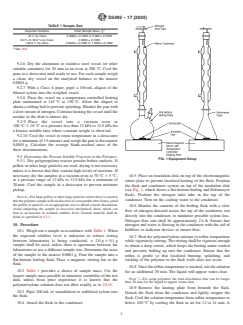
(see Fig. 1, which shows a flat-bottom boiling and Erlenmeyer
flask). Position the nitrogen inlet tube in the top of the
NOTE 6—For large pellets or other large particles where there is concern
condenser. Turn on the cooling water to the condenser.
that the polymer sample will not dissolve in a reasonable time frame, grind
the pellets or particles to an appropriate size to afford a faster dissolution.
10.6 Blanket the contents of the boiling flask with a slow
Avoid subjecting the sample to excessive mechanical shear, which can
flow of nitrogen directed across th
...