

ASTM F3430-20
(Specification)Standard Specification for Closed-Cell Cellular Polypropylene (PP) Corrugated Wall Stormwater Collection Chambers
General Information
- Abstract
SCOPE
1.1 This specification covers requirements, test methods, materials, and marking for closed-cell cellular polypropylene (PP), open bottom, buried chambers of corrugated wall construction used for collection, detention, and retention of stormwater runoff. Applications include commercial, residential, agricultural, and highway drainage, including installation under parking lots and roadways.
1.2 Chambers are produced in arch shapes with dimensions based on chamber rise, chamber span, and wall stiffness. Chambers are manufactured with integral feet that provide base support. Perforations to enhance water flow are permitted. Chambers must meet test requirements for arch stiffness, and flattening. Chamber end caps shall be produced of PP or polyethylene (PE) by a suitable manufacturing process provided that all other product requirements in this standard are met.
1.3 Analysis and experience have shown that the successful performance of this product depends upon the type and depth of bedding and backfill, and care in installation. This specification includes requirements for the manufacturer to provide chamber installation instructions to the purchaser.
1.4 The values stated in inch-pound units are to be regarded as standard. The values given in parentheses are mathematical conversions to SI units that are provided for information only and are not considered standard.
1.5 This standard does not purport to address water quality issues or hydraulic performance requirements associated with its use. It is the responsibility of the user to ensure that appropriate engineering analysis is performed to evaluate the water quality issues and hydraulic performance requirements for each installation.
1.6 The following safety hazards caveat pertains only to the test method portion, Section 6, of this specification: This standard does not purport to address all of the safety concerns, if any, associated with its use. It is the responsibility of the user of this standard to establish appropriate safety, health, and environmental practices and determine the applicability of regulatory limitations prior to use.
1.7 This international standard was developed in accordance with internationally recognized principles on standardization established in the Decision on Principles for the Development of International Standards, Guides and Recommendations issued by the World Trade Organization Technical Barriers to Trade (TBT) Committee.
- Status
- Published
- Publication Date
- 31-Jan-2020
- Technical Committee
- F17 - Plastic Piping Systems
- Drafting Committee
- F17.65 - Land Drainage
Overview
ASTM F3430-20 is the internationally recognized standard specification for closed-cell cellular polypropylene (PP) corrugated wall stormwater collection chambers. Developed by ASTM, this standard defines the minimum requirements for open-bottom, arch-shaped, corrugated wall chambers used in various stormwater management applications. These chambers are designed for the collection, detention, and retention of stormwater runoff and are suitable for installation in commercial, residential, agricultural, and highway drainage systems, including locations under parking lots and roadways.
The specification covers essential aspects such as material requirements, structural design, test methods, workmanship, marking, and installation instructions. Adhering to ASTM F3430-20 ensures product quality, consistent performance, and compliance with international best practices for sustainable stormwater management.
Key Topics
- Materials: The chambers must be made from closed-cell cellular polypropylene (PP). End caps can be produced from PP or polyethylene (PE), provided they meet the relevant material requirements.
- Design: Chambers are manufactured in arch shapes, with integral feet for base support, and may include perforations to facilitate water flow. The design accounts for chamber rise, span, wall stiffness, and foot width.
- Test Methods: ASTM F3430-20 details standardized test procedures for critical properties such as wall thickness, arch stiffness constant, flattening, and creep resistance, ensuring reliable long-term performance.
- Installation and Handling: The specification emphasizes that successful installation and long-term function depend on proper bedding, backfill depth, and careful handling. Manufacturers are required to provide clear installation instructions.
- Marking and Certification: Chambers must be marked with manufacturer and material information for traceability. Certification under ASTM F3430-20 provides assurance of compliance with all specified requirements.
- Safety and Units: The standard provides safety caveats for test methods and uses inch-pound units as standard, with SI (metric) conversions available for reference.
Applications
Stormwater management is critical for urban and rural development. The closed-cell cellular PP corrugated wall chambers covered by ASTM F3430-20 offer robust, versatile solutions for:
- Commercial Projects: Effective for underground stormwater detention and retention systems under parking lots, landscapes, and large paved areas.
- Residential Developments: Suitable for subsurface drainage and rainwater harvesting systems in housing communities.
- Agricultural Fields: Helps with water capture, infiltration, and drainage in farmland or greenhouse settings.
- Highway and Roadway Drainage: Ideal for installation under or adjacent to roads and transportation infrastructure to manage runoff and minimize flooding risks.
- Sustainable Urban Drainage Systems (SUDS): Supports green infrastructure by allowing infiltration and reducing peak runoff volumes.
Adopting chambers conforming to ASTM F3430-20 supports efficient site drainage, flood mitigation, and long-term environmental sustainability.
Related Standards
Implementing ASTM F3430-20 often involves cross-referencing additional ASTM standards, including:
- ASTM D4101: Specification for polypropylene injection and extrusion materials.
- ASTM D3350: Specification for polyethylene plastic pipe and fittings materials.
- ASTM D256, D618, D638, D790, D2122, D2412, D2990, D6992: Test methods and practices for evaluating key physical and mechanical properties of plastics, such as tensile strength, flexural properties, impact resistance, and creep.
- ASTM F412: Terminology relating to plastic piping systems.
- ASTM F2787: Practice for the structural design of thermoplastic corrugated wall stormwater collection chambers.
Using ASTM F3430-20 in conjunction with these related standards ensures comprehensive stormwater system performance, from material selection to finished installation.
Keywords: ASTM F3430-20, closed-cell cellular polypropylene, corrugated wall chambers, stormwater detention, retention, subsurface drainage, stormwater management, highway drainage, underground infiltration, ASTM standards, installation requirements.
Relations
- Effective Date
- 01-Feb-2024
- Effective Date
- 01-Apr-2020
- Effective Date
- 01-Jan-2019
- Effective Date
- 01-Feb-2018
- Refers
ASTM D1600-18 - Standard Terminology for Abbreviated Terms Relating to Plastics (Withdrawn 2024) - Effective Date
- 01-Jan-2018
- Effective Date
- 01-Aug-2017
- Effective Date
- 01-Jul-2017
- Effective Date
- 01-Mar-2017
- Effective Date
- 01-Feb-2017
- Effective Date
- 15-Nov-2016
- Effective Date
- 01-Aug-2016
- Effective Date
- 01-Dec-2015
- Effective Date
- 01-Dec-2015
- Effective Date
- 01-Jun-2015
- Effective Date
- 01-May-2015
Get Certified
Connect with accredited certification bodies for this standard

DIN CERTCO
DIN Group product certification.
Institut za varilstvo d.o.o. (Welding Institute)
Slovenia's leading welding institute since 1952. ISO 3834, EN 1090, pressure equipment certification, NDT personnel, welder qualification. Only IIW Au

Smithers Quality Assessments
US management systems and product certification.
Sponsored listings
Frequently Asked Questions
ASTM F3430-20 is a technical specification published by ASTM International. Its full title is "Standard Specification for Closed-Cell Cellular Polypropylene (PP) Corrugated Wall Stormwater Collection Chambers". This standard covers: SCOPE 1.1 This specification covers requirements, test methods, materials, and marking for closed-cell cellular polypropylene (PP), open bottom, buried chambers of corrugated wall construction used for collection, detention, and retention of stormwater runoff. Applications include commercial, residential, agricultural, and highway drainage, including installation under parking lots and roadways. 1.2 Chambers are produced in arch shapes with dimensions based on chamber rise, chamber span, and wall stiffness. Chambers are manufactured with integral feet that provide base support. Perforations to enhance water flow are permitted. Chambers must meet test requirements for arch stiffness, and flattening. Chamber end caps shall be produced of PP or polyethylene (PE) by a suitable manufacturing process provided that all other product requirements in this standard are met. 1.3 Analysis and experience have shown that the successful performance of this product depends upon the type and depth of bedding and backfill, and care in installation. This specification includes requirements for the manufacturer to provide chamber installation instructions to the purchaser. 1.4 The values stated in inch-pound units are to be regarded as standard. The values given in parentheses are mathematical conversions to SI units that are provided for information only and are not considered standard. 1.5 This standard does not purport to address water quality issues or hydraulic performance requirements associated with its use. It is the responsibility of the user to ensure that appropriate engineering analysis is performed to evaluate the water quality issues and hydraulic performance requirements for each installation. 1.6 The following safety hazards caveat pertains only to the test method portion, Section 6, of this specification: This standard does not purport to address all of the safety concerns, if any, associated with its use. It is the responsibility of the user of this standard to establish appropriate safety, health, and environmental practices and determine the applicability of regulatory limitations prior to use. 1.7 This international standard was developed in accordance with internationally recognized principles on standardization established in the Decision on Principles for the Development of International Standards, Guides and Recommendations issued by the World Trade Organization Technical Barriers to Trade (TBT) Committee.
SCOPE 1.1 This specification covers requirements, test methods, materials, and marking for closed-cell cellular polypropylene (PP), open bottom, buried chambers of corrugated wall construction used for collection, detention, and retention of stormwater runoff. Applications include commercial, residential, agricultural, and highway drainage, including installation under parking lots and roadways. 1.2 Chambers are produced in arch shapes with dimensions based on chamber rise, chamber span, and wall stiffness. Chambers are manufactured with integral feet that provide base support. Perforations to enhance water flow are permitted. Chambers must meet test requirements for arch stiffness, and flattening. Chamber end caps shall be produced of PP or polyethylene (PE) by a suitable manufacturing process provided that all other product requirements in this standard are met. 1.3 Analysis and experience have shown that the successful performance of this product depends upon the type and depth of bedding and backfill, and care in installation. This specification includes requirements for the manufacturer to provide chamber installation instructions to the purchaser. 1.4 The values stated in inch-pound units are to be regarded as standard. The values given in parentheses are mathematical conversions to SI units that are provided for information only and are not considered standard. 1.5 This standard does not purport to address water quality issues or hydraulic performance requirements associated with its use. It is the responsibility of the user to ensure that appropriate engineering analysis is performed to evaluate the water quality issues and hydraulic performance requirements for each installation. 1.6 The following safety hazards caveat pertains only to the test method portion, Section 6, of this specification: This standard does not purport to address all of the safety concerns, if any, associated with its use. It is the responsibility of the user of this standard to establish appropriate safety, health, and environmental practices and determine the applicability of regulatory limitations prior to use. 1.7 This international standard was developed in accordance with internationally recognized principles on standardization established in the Decision on Principles for the Development of International Standards, Guides and Recommendations issued by the World Trade Organization Technical Barriers to Trade (TBT) Committee.
ASTM F3430-20 is classified under the following ICS (International Classification for Standards) categories: 23.040.05 - Pipeline and its parts for external sewage systems; 83.140.99 - Other rubber and plastics products. The ICS classification helps identify the subject area and facilitates finding related standards.
ASTM F3430-20 has the following relationships with other standards: It is inter standard links to ASTM D4101-24, ASTM F412-20, ASTM F412-19, ASTM F2787-13(2018), ASTM D1600-18, ASTM F412-17a, ASTM D790-17, ASTM D2990-17, ASTM F412-17, ASTM F412-16a, ASTM F412-16, ASTM D790-15e1, ASTM D790-15, ASTM F412-15, ASTM D6992-03(2015). Understanding these relationships helps ensure you are using the most current and applicable version of the standard.
ASTM F3430-20 is available in PDF format for immediate download after purchase. The document can be added to your cart and obtained through the secure checkout process. Digital delivery ensures instant access to the complete standard document.
Standards Content (Sample)
This international standard was developed in accordance with internationally recognized principles on standardization established in the Decision on Principles for the
Development of International Standards, Guides and Recommendations issued by the World Trade Organization Technical Barriers to Trade (TBT) Committee.
Designation:F3430 −20
Standard Specification for
Closed-Cell Cellular Polypropylene (PP) Corrugated Wall
Stormwater Collection Chambers
This standard is issued under the fixed designation F3430; the number immediately following the designation indicates the year of
original adoption or, in the case of revision, the year of last revision. A number in parentheses indicates the year of last reapproval. A
superscript epsilon (´) indicates an editorial change since the last revision or reapproval.
1. Scope if any, associated with its use. It is the responsibility of the user
of this standard to establish appropriate safety, health, and
1.1 This specification covers requirements, test methods,
environmental practices and determine the applicability of
materials, and marking for closed-cell cellular polypropylene
regulatory limitations prior to use.
(PP), open bottom, buried chambers of corrugated wall con-
1.7 This international standard was developed in accor-
struction used for collection, detention, and retention of storm-
dance with internationally recognized principles on standard-
water runoff. Applications include commercial, residential,
ization established in the Decision on Principles for the
agricultural, and highway drainage, including installation un-
Development of International Standards, Guides and Recom-
der parking lots and roadways.
mendations issued by the World Trade Organization Technical
1.2 Chambers are produced in arch shapes with dimensions
Barriers to Trade (TBT) Committee.
based on chamber rise, chamber span, and wall stiffness.
Chambersaremanufacturedwithintegralfeetthatprovidebase
2. Referenced Documents
support. Perforations to enhance water flow are permitted.
2.1 ASTM Standards:
Chambers must meet test requirements for arch stiffness, and
D256 Test Methods for Determining the Izod Pendulum
flattening. Chamber end caps shall be produced of PP or
Impact Resistance of Plastics
polyethylene (PE) by a suitable manufacturing process pro-
D618 Practice for Conditioning Plastics for Testing
vided that all other product requirements in this standard are
D638 Test Method for Tensile Properties of Plastics
met.
D790 Test Methods for Flexural Properties of Unreinforced
1.3 Analysis and experience have shown that the successful
and Reinforced Plastics and Electrical Insulating Materi-
performance of this product depends upon the type and depth
als
of bedding and backfill, and care in installation. This specifi-
D1600 Terminology forAbbreviatedTerms Relating to Plas-
cation includes requirements for the manufacturer to provide
tics
chamber installation instructions to the purchaser.
D2122 Test Method for Determining Dimensions of Ther-
1.4 The values stated in inch-pound units are to be regarded moplastic Pipe and Fittings
D2412 Test Method for Determination of External Loading
as standard. The values given in parentheses are mathematical
conversions to SI units that are provided for information only Characteristics of Plastic Pipe by Parallel-Plate Loading
D2990 Test Methods for Tensile, Compressive, and Flexural
and are not considered standard.
Creep and Creep-Rupture of Plastics
1.5 This standard does not purport to address water quality
D3350 Specification for Polyethylene Plastics Pipe and Fit-
issues or hydraulic performance requirements associated with
tings Materials
its use. It is the responsibility of the user to ensure that
D4101 Classification System and Basis for Specification for
appropriate engineering analysis is performed to evaluate the
Polypropylene Injection and Extrusion Materials
water quality issues and hydraulic performance requirements
D6992 Test Method for Accelerated Tensile Creep and
for each installation.
Creep-Rupture of Geosynthetic Materials Based on Time-
1.6 The following safety hazards caveat pertains only to the
Temperature Superposition Using the Stepped Isothermal
test method portion, Section 6, of this specification: This
Method
standard does not purport to address all of the safety concerns,
F412 Terminology Relating to Plastic Piping Systems
This specification is under the jurisdiction ofASTM Committee F17 on Plastic
Piping Systems and is the direct responsibility of Subcommittee F17.65 on Land For referenced ASTM standards, visit the ASTM website, www.astm.org, or
Drainage. contact ASTM Customer Service at service@astm.org. For Annual Book of ASTM
Current edition approved Feb. 1, 2020. Published March 2020. DOI: 10.1520/ Standards volume information, refer to the standard’s Document Summary page on
F3430–20. the ASTM website.
Copyright © ASTM International, 100 Barr Harbor Drive, PO Box C700, West Conshohocken, PA 19428-2959. United States
F3430−20
F2787 Practice for Structural Design of Thermoplastic Cor- 3.2.10 period—the length of a single repetition of the
rugated Wall Stormwater Collection Chambers repeated corrugation, defined as the distance from the center-
line of a valley element to the centerline of the next valley
3. Terminology
element (see Fig. 2).
3.1 Definitions used in this specification are in accordance
3.2.11 rise—the vertical distance from the chamber base
with the definitions in Terminology F412, and abbreviations
(bottom of the chamber foot) to the inside of a chamber wall
are in accordance with Terminology D1600, unless otherwise
valley element at the crown as depicted in Fig. 1.
indicated.
3.2.12 span—the horizontal distance from the interior of
3.2 Definitions:
one sidewall valley element to the interior of the other sidewall
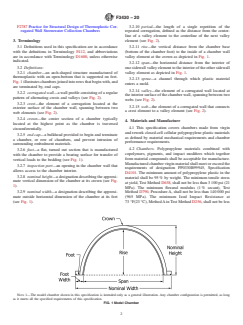
3.2.1 chamber—an arch-shaped structure manufactured of
valley element as depicted in Fig. 1.
thermoplastic with an open-bottom that is supported on feet.
3.2.13 sprue—a channel through which plastic material
Fig.1illustrateschambersjoinedintorowsthatbeginwith,and
enters a mold.
are terminated by, end caps.
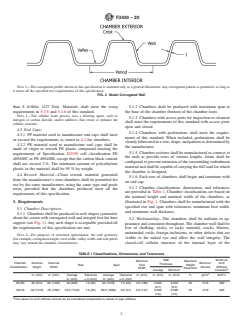
3.2.14 valley—the element of a corrugated wall located at
3.2.2 corrugated wall—a wall profile consisting of a regular
the interior surface of the chamber wall, spanning between two
pattern of alternating crests and valleys (see Fig. 2).
webs (see Fig. 2).
3.2.3 crest—the element of a corrugation located at the
3.2.15 web—the element of a corrugated wall that connects
exterior surface of the chamber wall, spanning between two
a crest element to a valley element (see Fig. 2).
web elements (see Fig. 2).
3.2.4 crown—the center section of a chamber typically
4. Materials and Manufacture
located at the highest point as the chamber is traversed
4.1 This specification covers chambers made from virgin
circumferentially.
and rework closed-cell cellular polypropylene plastic materials
3.2.5 end cap—a bulkhead provided to begin and terminate
as defined by material mechanical requirements and chamber
a chamber, or row of chambers, and prevent intrusion of
performance requirements.
surrounding embedment materials.
4.2 Chambers. Polypropylene materials combined with
3.2.6 foot—a flat, turned out section that is manufactured
copolymers, pigments, and impact modifiers which together
with the chamber to provide a bearing surface for transfer of
form material compounds shall be acceptable for manufacture.
vertical loads to the bedding (see Fig. 1).
Manufacturedchambervirginmaterialshallmeetorexceedthe
3.2.7 inspection port—an opening in the chamber wall that
requirements of designation PP0330B99945, Specification
allows access to the chamber interior.
D4101. The minimum amount of polypropylene plastic in the
3.2.8 nominal height—a designation describing the approxi-
material shall be 95 % by weight. The minimum tensile stress
mate vertical dimension of the chamber at its crown (see Fig.
at yield,Test Method D638, shall not be less than 3 100 psi (21
1).
MPa). The minimum flexural modulus (1 % secant), Test
3.2.9 nominal width—a designation describing the approxi- Method D790, ProcedureA, shall not be less than 140 000 psi
mate outside horizontal dimension of the chamber at its feet (965 MPa). The minimum Izod Impact Resistance at
(see Fig. 1). 73 °F(23 °C), MethodAinTest Method D256, shall not be less
NOTE 1—The model chamber shown in this specification is intended only as a general illustration. Any chamber configuration is permitted, as long
as it meets all the specified requirements of this specification.
FIG. 1Model Chamber
F3430−20
NOTE 1—The corrugation profile shown in this specification is intended only as a general illustration.Any corrugation pattern is permitted, as long as
it meets all the specified test requirements of this specification.
FIG. 2 Model Corrugated Wall
than 8 ft-lb/in. (427 J/m). Materials shall meet the creep 5.1.2 Chambers shall be produced with maximum span at
requirements in 5.3.5 and 5.3.6 of this standard. the base of the chamber (bottom of the chamber foot).
NOTE 1—The cellular foam process uses a blowing agent, such as
5.1.3 Chambers with access ports for inspection or cleanout
nitrogen or carbon dioxide, and/or additives that create or enhance the
shall meet the requirements of this standard with access ports
cellular structure.
open and closed.
4.3 End Caps:
5.1.4 Chambers with perforations shall meet the require-
4.3.1 PP material used to manufacture end caps shall meet
ments of this standard. When included, perforations shall be
or exceed the requirements as stated in 4.2 for chambers.
cleanlyfabricatedinasize,shape,andpatternasdeterminedby
4.3.2 PE material used to manufacture end caps shall be
the manufacturer.
made of virgin or rework PE plastic compound meeting the
5.1.5 Chamber sections shall be manufactured to connect at
requirements of Specification D3350 cell classification PE
the ends to provide rows of various lengths. Joints shall be
405400C or PE 405400E, except that the carbon black content
configured to prevent intrusion of the surrounding embedment
shall not exceed 3 %. The minimum amount of polyethylene
materialandshallbecapableofcarryingthefullloadforwhich
plastic in the material shall be 95 % by weight.
the chamber is designed.
4.4 Rework Material—Clean rework material generated
5.1.6 Each row of chambers shall begin and terminate with
from the manufacturer’s own chambers shall be permitted for
an end cap.
use by the same manufacturer, using the same type and grade
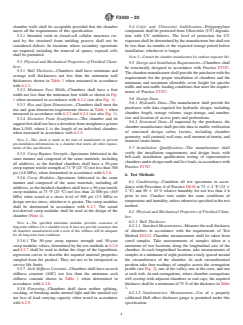
5.1.7 Chamber classifications, dimensions, and tolerances
resin, provided that the chambers produced meet all the
are provided in Table 1. Chamber classifications are based on
requirements of this specification.
the nominal height and nominal width of the chambers, as
illustrated in Fig. 1. Chambers shall be manufactured with the
5. Requirements
specified rise and span with tolerances, minimum foot width,
5.1 Chamber Description:
and minimum wall thickness.
5.1.1 Chambers shall be produced in arch shapes symmetric
about the crown with corrugated wall and integral feet for base
5.2 Workmanship—The chambers shall be uniform in ap-
support (see Fig. 1).Any arch shape is acceptable provided all
pearance and consistent throughout. The chamber wall shall be
the requirements of this specification are met.
free of chalking, sticky, or tacky material, cracks, blisters,
unintended voids, foreign inclusions, or other defects that are
NOTE 2—For purposes of structural optimization, the wall geometry
visible to the naked eye and affect the wall integrity. The
(forexample,corrugationheight,crestwidth,valleywidth,andwebpitch)
may vary around the chamber circumference. closed-cell cellular structure of the internal layer of the
TABLE 1 Classifications, Dimensions, and Tolerances
Minimum
Wall
Minimum Maximum
Chamber Nominal Nominal Minimum Arch
Thickness
Rise Span Foot Weight
Classification Height Width Density Stiffness
Width Reduction
A
Average Minimum
Constant
in. (mm) in. (mm) Average Tolerance Average Tolerance in. (mm) in. (mm) in. (mm) % g/cm lb/ft/%
in. (mm) ±in(mm) in. (mm) ±in(mm)
36×60 36 (914) 60 (1254) 33 (838) 1.0 (25) 50 (1270) 1.0 (25) 4.0 (100) 0.265 0.250 20 0.70 300
(6.7) (6.4)
48×78 48 (1219) 78 (1981) 44.2 (1123) 1.0 (25) 66.5 (1690) 2.0 (51) 5.8 (147) 0.300 0.290 20 0.70 300
(7.6) (7.2)
A
The values for arch stiffness should not be considered comparable to values of pipe stiffness.
F3430−20
chamber walls shall be acceptable provided that the chamber 5.4 Color and Ultraviolet Stabilization—Polypropylene
meets all the requirements of this specification. compounds shall be protected from Ultraviolet (UV) degrada-
5.2.1 Intended voids in closed-cell cellular structures cre- tion with UV stabilizers. The level of protection for UV
ated by the structural foam molding process shall not be exposure shall be determined by the manufacturer but shall not
considered defects. In locations where secondary operations be less than six months or the expected storage period before
are required, including the removal of sprues, exposed cells installation, whichever is longer.
shall be permitted.
NOTE 5—Consult the chamber manufacturer for outdoor exposure life.
5.3 Physical and Mechanical Properties of Finished Cham-
5.5 Design and Installation Requirements—Chambers shall
bers:
be structurally designed in accordance with Practice F2787.
5.3.1 Wall Thickness—Chambers shall have minimum and
Thechambermanufacturershallprovidethepurchaserwiththe
average wall thicknesses not less than the minimum wall
requirements for the proper installation of chambers and the
thicknesses shown in Table 1 when measured in accordance
minimum and maximum allowable cover height for specific
with 6.2.1.
traffic and non-traffic loading conditions that meet the require-
5.3.2 Minimum Foot Width—Chambers shall have a foot
ments of Practice F2787.
width not less than the minimum foot width as shown in Fig.
5.6 Design Data:
1 when measured in accordance with 6.2.2 (see also Fig. 1).
5.6.1 Hydraulic Data—The manufacturer shall provide the
5.3.3 Rise and Span Dimensions—Chambers shall meet the
purchaser with data required for hydraulic design, including
rise and span dimension requirements shown in Table 1 when
chamber length, storage volume, stage-storage, and number,
measured in accordance with 6.2.3 and 6.2.4 (see also Fig. 1).
size and location of access ports and perforations.
5.3.4 Deviation From Straightness—The chamber and its
5.6.2 Structural Data—If requested by the purchaser, the
supportfeetshallnothaveadeviationfromstraightnessgreater
chamber manufacturer shall provide data to enable verification
than L/100, where L is the length of an individual chamber,
of structural design safety factors, including chamber
when measured in accordance with 6.2.5.
geometry, wall centroid, wall area, wall moment of inertia, and
NOTE 3—This check is made at the time of manufacture to prevent
material strain limits.
pre-installation deformations in a chamber that meets all other require-
ments of this specification. 5.7 Installation Qualification—The manufacturer shall
verify the installation requirements and design basis with
5.3.5 Creep Rupture Strength—Specimens fabricated in the
full-scale installation qualification testing of representative
same manner and composed of the same materials, including
chambers under design earth and live loads, in accordance with
all additives, as the finished chambers shall have a 50-year
Practice F2787.
creep rupture tensile strength at 73 °F (23 °C) not less than 700
psi (4.8 MPa), when determined in accordance with 6.2.6.
6. Test Methods
5.3.6 Creep Modulus—Specimens fabricated in the same
6.1 Conditioning—Condition all test specimens in accor-
manner and composed of the same materials, including all
dance with Procedure A of Practice D618 at 73 6 4 °F (23 6
additives, as the finished chambers shall have a 50-year tensile
2 °C) and 50 6 10 % relative humidity for not less than 4 h
creep modulus at 73 °F (23 °C) not less than 24 000 psi (165
prior to test. Conduct tests under the same conditions of
MPa) when tested at a stress level of 500 psi (3.5 MPa) or
temperaturea
...