

ASTM D4967-21
(Guide)Standard Guide for Selecting Materials to Be Used for Insulation, Jacketing, and Strength Components in Fiber-Optic Cables
General Information
- Abstract
SIGNIFICANCE AND USE
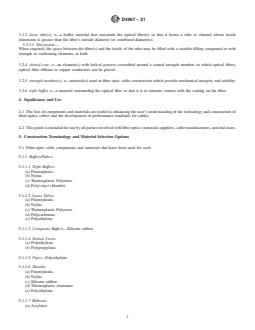
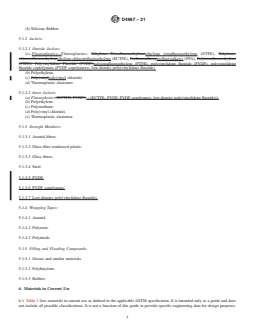
4.1 The lists of components and materials are useful in enhancing the user's understanding of the technology and construction of fiber-optics cables and the development of performance standards for cables.
4.2 This guide is intended for use by all parties involved with fiber optics: materials suppliers, cable manufacturers, and end-users.
SCOPE
1.1 This guide is intended to provide a list of materials commonly used in components that provide insulation, jacketing and strength in fiber-optic cables. Where these materials are covered by ASTM standards, an appropriate reference is made. Due to changing technology, not all materials being used are necessarily listed here.
1.2 This guide does not include materials used in components for optical purposes (optical fiber and its coating) or external metallic armoring (such as for a barrier to rodents).
1.3 This guide offers two general lists of materials:
1.3.1 A subdivision of fiber-optic cable construction into components that are used for insulation, jacketing, or strength, with a generic material classification for specific applications in each component (see Section 5), and
1.3.2 An alphabetical list of the generic material classifications, showing ASTM standards where they exist (see Table 1).
1.4 This international standard was developed in accordance with internationally recognized principles on standardization established in the Decision on Principles for the Development of International Standards, Guides and Recommendations issued by the World Trade Organization Technical Barriers to Trade (TBT) Committee.
- Status
- Published
- Publication Date
- 28-Feb-2021
- Technical Committee
- D09 - Electrical and Electronic Insulating Materials
- Drafting Committee
- D09.07 - Electrical Insulating Materials
Buy Documents


ASTM D4967-21 - Standard Guide for Selecting Materials to Be Used for Insulation, Jacketing, and Strength Components in Fiber-Optic Cables
REDLINE ASTM D4967-21 - Standard Guide for Selecting Materials to Be Used for Insulation, Jacketing, and Strength Components in Fiber-Optic Cables
Overview
ASTM D4967-21 provides a comprehensive guide for selecting materials used in insulation, jacketing, and strength components in fiber-optic cables. Published by ASTM International, this standard aids all stakeholders in the fiber optics industry, including material suppliers, cable manufacturers, and end-users. By outlining common materials used in non-optical fiber cable components and cross-referencing relevant ASTM standards, ASTM D4967-21 supports informed material selection and encourages standardization in cable construction.
Key Topics
- Material Classifications: Lists generic material types commonly used for insulation, jacketing, and strength members in fiber-optic cables, such as fluoroplastics, aramids, polyethylene, polyvinyl chloride (PVC), and silicone rubber.
- Component Functions:
- Buffers and Tubes: Tight buffers, loose tubes, and composite buffers often employ materials like nylon, thermoplastic polyester, and fluoroplastics for mechanical protection.
- Jackets: Both inner and outer jackets utilize materials such as fluoroplastics (e.g., ETFE, PVDF), polyethylene, thermoplastic elastomers, and PVC to provide environmental resistance and durability.
- Strength Members: Materials like aramid fibers, glass-fiber reinforced plastic, steel, and specialized fluoroplastics add mechanical integrity to fiber-optic cables.
- Wrapping Tapes & Fillers: Polyester, aramid, and polyimide tapes are used for wrapping, while grease, polybutylene, and rubber compounds serve as filling and flooding materials for added environmental protection.
- Referenced ASTM Standards: The guide references numerous ASTM standards that define quality and performance criteria for these material categories.
- Materials in Current Use: An alphabetical listing provides quick access to materials and their associated ASTM specifications, supporting precise material identification and compliance.
Applications
ASTM D4967-21 is essential for a wide range of fiber-optic cable applications across telecommunications, data centers, industrial automation, and infrastructure projects. Its practical applications include:
- Material Selection: Enables engineers, designers, and purchasing professionals to specify appropriate materials based on performance needs, durability, and environmental factors.
- Quality Assurance: Ensures that fiber-optic cable components align with international performance and safety standards, helping minimize failure risk and maintenance costs.
- Product Development: Assists manufacturers in developing new cable products by providing updated lists of recognized materials and standards, encouraging innovation while maintaining compatibility.
- Procurement & Compliance: Supports buyers and regulatory bodies in verifying that supplied cable materials adhere to established specifications, fostering consistency and reliability.
Related Standards
Several ASTM standards referenced by ASTM D4967-21 play a critical role in fiber-optic cable material specification:
- ASTM D1248: Specification for polyethylene plastics used in wire and cable extrusion.
- ASTM D2116: Specification for FEP (fluorinated ethylene propylene) resin molding and extrusion materials.
- ASTM D3159: Specification for modified ETFE (ethylene tetrafluoroethylene) fluoropolymer materials.
- ASTM D2287: Classification for nonrigid PVC compounds for molding and extrusion.
- ASTM D3935: Classification for polycarbonate materials.
- ASTM D4066: Classification for nylon injection and extrusion materials.
- ASTM D4101: Polypropylene injection and extrusion specification.
- ASTM D3317, D3664, D3275, D3307, D3222, D5575, D8318, D4731, D4732, D4507, D4246, D2526: Cover further materials such as aramids, polyester films, fluoroplastics, PVDF, polyimides, and different rubber compounds.
Conclusion
ASTM D4967-21 serves as a foundational reference for selecting appropriate insulation, jacketing, and strength materials in fiber-optic cable construction, supporting product reliability and international compliance. By following this guide, organizations ensure their fiber-optic cables meet current industry requirements and future-proof their infrastructure with proven, standardized materials.
Relations
- Effective Date
- 01-Mar-2024
- Effective Date
- 01-Feb-2024
- Effective Date
- 01-Aug-2020
- Effective Date
- 01-Aug-2020
- Effective Date
- 01-Nov-2019
- Effective Date
- 01-Nov-2019
- Effective Date
- 01-May-2018
- Effective Date
- 15-Nov-2016
- Effective Date
- 01-Nov-2015
- Effective Date
- 01-Sep-2015
- Effective Date
- 01-May-2015
- Effective Date
- 01-Nov-2014
- Effective Date
- 01-Nov-2014
- Effective Date
- 01-May-2014
- Effective Date
- 01-Mar-2014
Buy Documents
ASTM D4967-21 - Standard Guide for Selecting Materials to Be Used for Insulation, Jacketing, and Strength Components in Fiber-Optic Cables
REDLINE ASTM D4967-21 - Standard Guide for Selecting Materials to Be Used for Insulation, Jacketing, and Strength Components in Fiber-Optic Cables
Get Certified
Connect with accredited certification bodies for this standard

ANCE
Mexican certification and testing association.

Intertek Slovenia
Intertek testing, inspection, and certification services in Slovenia.

LNE (Laboratoire National de Métrologie et d'Essais)
French national laboratory for metrology and testing.
Sponsored listings
Frequently Asked Questions
ASTM D4967-21 is a guide published by ASTM International. Its full title is "Standard Guide for Selecting Materials to Be Used for Insulation, Jacketing, and Strength Components in Fiber-Optic Cables". This standard covers: SIGNIFICANCE AND USE 4.1 The lists of components and materials are useful in enhancing the user's understanding of the technology and construction of fiber-optics cables and the development of performance standards for cables. 4.2 This guide is intended for use by all parties involved with fiber optics: materials suppliers, cable manufacturers, and end-users. SCOPE 1.1 This guide is intended to provide a list of materials commonly used in components that provide insulation, jacketing and strength in fiber-optic cables. Where these materials are covered by ASTM standards, an appropriate reference is made. Due to changing technology, not all materials being used are necessarily listed here. 1.2 This guide does not include materials used in components for optical purposes (optical fiber and its coating) or external metallic armoring (such as for a barrier to rodents). 1.3 This guide offers two general lists of materials: 1.3.1 A subdivision of fiber-optic cable construction into components that are used for insulation, jacketing, or strength, with a generic material classification for specific applications in each component (see Section 5), and 1.3.2 An alphabetical list of the generic material classifications, showing ASTM standards where they exist (see Table 1). 1.4 This international standard was developed in accordance with internationally recognized principles on standardization established in the Decision on Principles for the Development of International Standards, Guides and Recommendations issued by the World Trade Organization Technical Barriers to Trade (TBT) Committee.
SIGNIFICANCE AND USE 4.1 The lists of components and materials are useful in enhancing the user's understanding of the technology and construction of fiber-optics cables and the development of performance standards for cables. 4.2 This guide is intended for use by all parties involved with fiber optics: materials suppliers, cable manufacturers, and end-users. SCOPE 1.1 This guide is intended to provide a list of materials commonly used in components that provide insulation, jacketing and strength in fiber-optic cables. Where these materials are covered by ASTM standards, an appropriate reference is made. Due to changing technology, not all materials being used are necessarily listed here. 1.2 This guide does not include materials used in components for optical purposes (optical fiber and its coating) or external metallic armoring (such as for a barrier to rodents). 1.3 This guide offers two general lists of materials: 1.3.1 A subdivision of fiber-optic cable construction into components that are used for insulation, jacketing, or strength, with a generic material classification for specific applications in each component (see Section 5), and 1.3.2 An alphabetical list of the generic material classifications, showing ASTM standards where they exist (see Table 1). 1.4 This international standard was developed in accordance with internationally recognized principles on standardization established in the Decision on Principles for the Development of International Standards, Guides and Recommendations issued by the World Trade Organization Technical Barriers to Trade (TBT) Committee.
ASTM D4967-21 is classified under the following ICS (International Classification for Standards) categories: 33.180.01 - Fibre optic systems in general; 33.180.10 - Fibres and cables. The ICS classification helps identify the subject area and facilitates finding related standards.
ASTM D4967-21 has the following relationships with other standards: It is inter standard links to ASTM D1711-24, ASTM D4101-24, ASTM D4730-13(2020), ASTM D4246-14(2020), ASTM D2287-19, ASTM D4066-13(2019), ASTM D3222-18, ASTM D1248-16, ASTM D1711-15, ASTM D3159-15, ASTM D3222-05(2015), ASTM D1711-14a, ASTM D4246-14, ASTM D1711-14, ASTM D4101-14. Understanding these relationships helps ensure you are using the most current and applicable version of the standard.
ASTM D4967-21 is available in PDF format for immediate download after purchase. The document can be added to your cart and obtained through the secure checkout process. Digital delivery ensures instant access to the complete standard document.
Standards Content (Sample)
This international standard was developed in accordance with internationally recognized principles on standardization established in the Decision on Principles for the
Development of International Standards, Guides and Recommendations issued by the World Trade Organization Technical Barriers to Trade (TBT) Committee.
Designation: D4967 − 21
Standard Guide for
Selecting Materials to Be Used for Insulation, Jacketing, and
Strength Components in Fiber-Optic Cables
This standard is issued under the fixed designation D4967; the number immediately following the designation indicates the year of
original adoption or, in the case of revision, the year of last revision. A number in parentheses indicates the year of last reapproval. A
superscript epsilon (´) indicates an editorial change since the last revision or reapproval.
1. Scope* Molding and Extrusion Materials (Withdrawn 1996)
D1711 Terminology Relating to Electrical Insulation
1.1 This guide is intended to provide a list of materials
D2116 Specification for FEP Resin Molding and Extrusion
commonly used in components that provide insulation, jacket-
Materials
ingandstrengthinfiber-opticcables.Wherethesematerialsare
D2287 Classification System and Basis for Specification for
covered byASTM standards, an appropriate reference is made.
Nonrigid Vinyl Chloride Polymer and Copolymer Mold-
Due to changing technology, not all materials being used are
ing and Extrusion Compounds
necessarily listed here.
D2526 Specification for Ozone-Resisting Silicone Rubber
1.2 This guide does not include materials used in compo-
Insulation for Wire and Cable (Withdrawn 2006)
nents for optical purposes (optical fiber and its coating) or
D3159 Specification for Modified ETFE Fluoropolymer
external metallic armoring (such as for a barrier to rodents).
Molding and Extrusion Materials
D3222 Specification for Unmodified Poly(Vinylidene Fluo-
1.3 This guide offers two general lists of materials:
ride) (PVDF) Molding Extrusion and Coating Materials
1.3.1 A subdivision of fiber-optic cable construction into
D3275 Classification System for E-CTFE-Fluoroplastic
components that are used for insulation, jacketing, or strength,
Molding, Extrusion, and Coating Materials
with a generic material classification for specific applications
D3307 Specification for Perfluoroalkoxy (PFA) Resin Mold-
in each component (see Section 5), and
ing and Extrusion Materials
1.3.2 An alphabetical list of the generic material
D3317 Specification for High Modulus, Organix Yarn and
classifications, showingASTM standards where they exist (see 3
Roving (Withdrawn 1985)
Table 1).
D3664 Specification for Biaxially Oriented Polymeric Resin
1.4 This international standard was developed in accor-
Film for Capacitors in Electrical Equipment
dance with internationally recognized principles on standard- D3935 Classification System and Basis for Specification for
ization established in the Decision on Principles for the Polycarbonate (PC) Unfilled and Reinforced Material
Development of International Standards, Guides and Recom- D4066 Classification System for Nylon Injection and Extru-
mendations issued by the World Trade Organization Technical sion Materials (PA)
Barriers to Trade (TBT) Committee. D4101 Classification System and Basis for Specification for
Polypropylene Injection and Extrusion Materials
2. Referenced Documents D4246 Specification for Ozone-Resistant Thermoplastic
Elastomer Insulation for Wire and Cable, 90 °C Operation
2.1 ASTM Standards:
D4507 Specification for Thermoplastic Polyester (TPES)
D1248 Specification for Polyethylene Plastics Extrusion
Materials (Withdrawn 1999)
Materials for Wire and Cable
D4730 Specification for Flooding Compounds for Telecom-
D1457 Specification for Polytetrafluoroethylene (PTFE)
munications Wire and Cable
D4731 Specification for Hot-Application Filling Com-
pounds for Telecommunications Wire and Cable
This guide is under the jurisdiction ofASTM Committee D09 on Electrical and
D4732 Specification for Cool-Application Filling Com-
Electronic Insulating Materials and is the direct responsibility of Subcommittee
pounds for Telecommunications Wire and Cable
D09.07 on Electrical Insulating Materials.
D5575 Classification System for Copolymers of Vinylidene
Current edition approved March 1, 2021. Published May 2021. Originally
approved in 1989. Last previous edition approved in 2013 as D4967 – 99 (2013). Fluoride (VDF) with Other Fluorinated Monomers
DOI: 10.1520/D4967-21.
For referenced ASTM standards, visit the ASTM website, www.astm.org, or
contact ASTM Customer Service at service@astm.org. For Annual Book of ASTM
Standards volume information, refer to the standard’s Document Summary page on The last approved version of this historical standard is referenced on
the ASTM website. www.astm.org.
*A Summary of Changes section appears at the end of this standard
Copyright © ASTM International, 100 Barr Harbor Drive, PO Box C700, West Conshohocken, PA 19428-2959. United States
D4967 − 21
TABLE 1 Materials in Current Use
3.2.6 tight buffer, n—a material surrounding the optical fiber
Material ASTM Specification so that it is in intimate contact with the coating on the fiber.
Acrylates .
Aramids:
4. Significance and Use
fibers D3317
tape . 4.1 The lists of components and materials are useful in
Fluoroplastics:
enhancing the user’s understanding of the technology and
ECTFE D3275
construction of fiber-optics cables and the development of
ETFE D3159
FEP D2116 performance standards for cables.
PFA D3307
4.2 This guide is intended for use by all parties involved
PTFE D1457
PVDF D3222
with fiber optics: materials suppliers, cable manufacturers, and
PVDF copolymers D5575
end-users.
Low-density poly(vinylidene fluoride) D8318
Glass fibers .
Glass-fiber reinforced plastics .
5. Construction Terminology and Material Selection
Grease and similar materials D4730, D4731, D4732
Options
Nylon D4066
Polybutylene D4730, D4731, D4732
5.1 Fiber-optic cable components and materials that have
Polycarbonate D3935
been used for each:
Polyester tape D3664
5.1.1 Buffers/Tubes:
Polyethylene D1248
Pol
...
This document is not an ASTM standard and is intended only to provide the user of an ASTM standard an indication of what changes have been made to the previous version. Because
it may not be technically possible to adequately depict all changes accurately, ASTM recommends that users consult prior editions as appropriate. In all cases only the current version
of the standard as published by ASTM is to be considered the official document.
Designation: D4967 − 99 (Reapproved 2013) D4967 − 21
Standard Guide for
Selecting Materials to Be Used for Insulation, Jacketing, and
Strength Components in Fiber-Optic Cables
This standard is issued under the fixed designation D4967; the number immediately following the designation indicates the year of
original adoption or, in the case of revision, the year of last revision. A number in parentheses indicates the year of last reapproval. A
superscript epsilon (´) indicates an editorial change since the last revision or reapproval.
1. Scope Scope*
1.1 This guide is intended to provide a list of materials commonly used in components that provide insulation, jacketing and
strength in fiber-optic cables. Where these materials are covered by ASTM standards, an appropriate reference is made. Due to
changing technology, not all materials being used are necessarily listed here.
1.2 This guide does not include materials used in components for optical purposes (optical fiber and its coating) or external
metallic armoring (such as for a barrier to rodents).
1.3 This guide offers two general lists of materials:
1.3.1 A subdivision of fiber-optic cable construction into components that are used for insulation, jacketing, or strength, with a
generic material classification for specific applications in each component (see Section 5);), and
1.3.2 An alphabetical list of the generic material classifications, showing ASTM standards where they exist (see Table 1).
1.4 This international standard was developed in accordance with internationally recognized principles on standardization
established in the Decision on Principles for the Development of International Standards, Guides and Recommendations issued
by the World Trade Organization Technical Barriers to Trade (TBT) Committee.
2. Referenced Documents
2.1 ASTM Standards:
D1248 Specification for Polyethylene Plastics Extrusion Materials for Wire and Cable
D1457 Specification for Polytetrafluoroethylene (PTFE) Molding and Extrusion Materials (Withdrawn 1996)
D1711 Terminology Relating to Electrical Insulation
D2116 Specification for FEP Resin Molding and Extrusion Materials
D2287 Classification System and Basis for Specification for Nonrigid Vinyl Chloride Polymer and Copolymer Molding and
Extrusion Compounds
D2526 Specification for Ozone-Resisting Silicone Rubber Insulation for Wire and Cable (Withdrawn 2006)
D3159 Specification for Modified ETFE Fluoropolymer Molding and Extrusion Materials
This guide is under the jurisdiction of ASTM Committee D09 on Electrical and Electronic Insulating Materials and is the direct responsibility of Subcommittee D09.07
on Electrical Insulating Materials.
Current edition approved Nov. 1, 2013March 1, 2021. Published December 2013May 2021. Originally approved in 1989. Last previous edition approved in 20092013 as
D4967 – 99 (2009).(2013). DOI: 10.1520/D4967-99R13.10.1520/D4967-21.
For referenced ASTM standards, visit the ASTM website, www.astm.org, or contact ASTM Customer Service at service@astm.org. For Annual Book of ASTM Standards
volume information, refer to the standard’s Document Summary page on the ASTM website.
The last approved version of this historical standard is referenced on www.astm.org.
*A Summary of Changes section appears at the end of this standard
Copyright © ASTM International, 100 Barr Harbor Drive, PO Box C700, West Conshohocken, PA 19428-2959. United States
D4967 − 21
TABLE 1 Materials in Current Use
Material ASTM Specification
Acrylates .
Aramids:
fibers D3317
tape .
Fluoroplastics:
ECTFE D3275
ETFE D3159
FEP D2116
PFA D3307
PTFE D1457
PVDF D3222
PVDF copolymers D5575
Low-density poly(vinylidene fluoride) D8318
Glass fibers .
Glass-fiber reinforced plastics .
Grease and similar materials D4730, D4731, D4732
Nylon D4066
Polybutylene D4730, D4731, D4732
Polycarbonate D3935
Polyester tape D3664
Polyethylene D1248
Polyimide tape .
Polypropylene D4101
Polyurethane .
Poly(vinyl chloride) D2287
Rubber D4730, D4731, D4732
Silicone rubber D2526
Steel .
Thermoplastic elastomer D4246
Thermoplastic polyester D4507
D3222 Specification for Unmodified Poly(Vinylidene Fluoride) (PVDF) Molding Extrusion and Coating Materials
D3275 Classification System for E-CTFE-Fluoroplastic Molding, Extrusion, and Coating Materials
D3307 Specification for Perfluoroalkoxy (PFA) Resin Molding and Extrusion Materials
D3317 Specification for High Modulus, Organix Yarn and Roving (Withdrawn 1985)
D3664 Specification for Biaxially Oriented Polymeric Resin Film for Capacitors in Electrical Equipment
D3935 Classification System and Basis for Specification for Polycarbonate (PC) Unfilled and Reinforced Material
D4066 Classification System for Nylon Injection and Extrusion Materials (PA)
D4101 Classification System and Basis for Specification for Polypropylene Injection and Extrusion Materials
D4246 Specification for Ozone-Resistant Thermoplastic Elastomer Insulation for Wire and Cable, 90 °C Operation
D4507 Specification for Thermoplastic Polyester (TPES) Materials (Withdrawn 1999)
D4730 Specification for Flooding Compounds for Telecommunications Wire and Cable
D4731 Specification for Hot-Application Filling Compounds for Telecommunications Wire and Cable
D4732 Specification for Cool-Application Filling Compounds for Telecommunications Wire and Cable
D5575 Classification System for Copolymers of Vinylidene Fluoride (VDF) with Other Fluorinated Monomers
D8318 Specification for Low-Density Poly (Vinylidene Fluoride) Based Material Intended for Use in Wire and Cable Jacketing
3. Terminology
3.1 Definitions—For definitions of terms used in this guide, refer to Terminology D1711.
3.1 Definitions:
3.1.1 For definitions of terms used in this guide, refer to Terminology D1711.
3.2 Definitions of Terms Specific to This Standard:
3.2.1 buffer, n—a material that is applied over an optical fiber’s protective coating to further protect the fiber from physical damage
and provide mechanical protection.
3.2.2 composite buffer
...