

ASTM F3508-21a
(Guide)Standard Guide for In-Situ Pipeline Renovation As Dual-Wall Composite Pipeline by Push/Pull Installation of Compressed-Fit Shape-Memory-Polymer Tubular (SMPT)
General Information
- Abstract
SCOPE
1.1 This guide describes the specification and re-construction of in-situ pipelines and conduits 2 in. to 63 in. (50 mm to 1600 mm) diameter) by the pulled-in-place installation, into an existing conduit, of circular, radially reduced, Shape-Memory-Polymer Tubular (SMPT) that after installation, re-expands (by “memory”) to press against the ID of the host pipe, thus coupling the interior pipe, by friction fit, as reinforcement to the host pipe. The added SMPT pipe wall restores leak tightness and adds its strength to the host pipe (Dual-Wall Composite-Pipe). It becomes a continuous compressed-fit dual-wall pipeline. Depending upon the SMPT compound used, the re-constructed pipelines or conduits are suitable for pressure and nonpressure pipeline applications such as process piping, raw and treated water transmission, water pipe systems, forced-mains, industrial and oil-patch gathering and transmission pipelines, sanitary sewers, storm sewers, and culverts.
Note 1: This standard guide covers circular SMPT tubulars which are radially reduced by mechanical means at the time of installation. This guide does not address “liners” that at the time of manufacture are deformed (folded) into U-shape, C-shape, H-shape, or other such configurations. This guide refers to dual-wall meaning two layers of pipe co-joined in the field, which is different from dual-wall factory-made co-extruded pipe or corrugated pipe. This guide does not provide a complete design basis covering the many variables required for design and construction of this field fabricated product; the advice of professional contractors and/or registered professional engineers may be incorporated as an adjunct to this guide.
1.2 The values stated in inch-pound units are to be regarded as standard. The values given in parentheses are mathematical conversions to SI units that are provided for information only and are not considered standard.
Note 2: There are no ISO standards covering the primary subject matter of this guide.
1.3 This standard does not purport to address all of the safety concerns, if any, associated with its use. It is the responsibility of the user of this standard to establish appropriate safety, health, and environmental practices and determine the applicability of regulatory limitations prior to use.
1.4 This international standard was developed in accordance with internationally recognized principles on standardization established in the Decision on Principles for the Development of International Standards, Guides and Recommendations issued by the World Trade Organization Technical Barriers to Trade (TBT) Committee.
- Status
- Published
- Publication Date
- 31-Oct-2021
- Technical Committee
- F17 - Plastic Piping Systems
- Drafting Committee
- F17.67 - Trenchless Plastic Pipeline Technology
Buy Documents
ASTM F3508-21a - Standard Guide for In-Situ Pipeline Renovation As Dual-Wall Composite Pipeline by Push/Pull Installation of Compressed-Fit Shape-Memory-Polymer Tubular (SMPT)
REDLINE ASTM F3508-21a - Standard Guide for In-Situ Pipeline Renovation As Dual-Wall Composite Pipeline by Push/Pull Installation of Compressed-Fit Shape-Memory-Polymer Tubular (SMPT)
Overview
ASTM F3508-21a is a comprehensive standard guide developed by ASTM International for the in-situ renovation of pipelines and conduits using dual-wall composite pipe technology. This method involves the pull-in-place installation of circular, radially reduced shape-memory-polymer tubulars (SMPTs) into existing pipelines ranging from 2 in. to 63 in. (50 mm to 1600 mm) in diameter. After installation, the SMPT re-expands against the host pipe’s interior, creating a continuous, compressed-fit, leak-tight dual-wall pipeline. This technique is applicable to a broad spectrum of pressure and non-pressure applications, including water transmission, industrial pipelines, sanitary and storm sewers, and culverts.
Key Benefits
- Restores leak tightness and structural strength
- Minimally invasive trenchless technology
- Applicable for both pressure and non-pressure pipelines
Key Topics
- In-Situ Pipeline Renovation: Focuses on reconstructing existing conduit interiors without full replacement, extending asset life and reducing excavation.
- Shape-Memory-Polymer Tubular (SMPT): Utilizes thermoplastic materials engineered to temporarily reduce diameter for installation, then return to original size, creating a tight friction fit within the host pipe.
- Dual-Wall Composite Structure: Achieves reinforcement by fusing a new interior SMPT layer to the host pipe, producing a composite pipe with enhanced mechanical properties.
- Pipe Sizes and Materials: Applicable to a wide diameter range (2–63 in.) and compatible with industry-standard thermoplastics like PE, PP, PA, and others.
- Procedure and Quality Assurance: Emphasizes certified installers, adherence to detailed cleaning and inspection protocols, system performance testing, and proper documentation.
- Design Flexibility: Provides guidance for various pipe and material types, project conditions, and regulatory environments.
Applications
ASTM F3508-21a offers practical solutions for pipeline owners, engineers, contractors, and utilities seeking targeted, cost-effective pipeline rehabilitation. Key applications include:
- Water Transmission and Distribution: Strengthen and restore leak-tightness to aging potable and raw water pipelines.
- Industrial and Oil Patch Pipelines: Suitable for gathering, transmission, and process piping where both internal and external pressures are present.
- Sanitary and Storm Sewers: Renovate sewer mains and culverts without significant surface disruption.
- Force Mains and Pressure Pipelines: Enhance operational integrity in high-pressure municipal and industrial systems.
- Culverts and Gravity Pipelines: Maintain and extend the service lives of large-diameter conduits beneath roads and infrastructure.
- Pipeline Renewal Projects: An essential method in asset management, reducing the need for costly full replacements.
Advantages
- Trenchless Installation: Reduces site disruption, traffic impact, and restoration costs.
- Structural Rehabilitation: Adds new strength to compromised pipelines, bridging holes and spanning defects.
- Versatility: Accommodates a range of host pipe materials and conditions.
Related Standards
ASTM F3508-21a references numerous supporting and performance standards, ensuring compatibility with a broad set of pipeline materials, installation practices, and test methods. Essential related documents include:
- ASTM D638 / D2290 / D2412: Test methods for evaluating plastic pipe mechanical properties.
- ASTM F714 / D3035 / D2513 / F2619: Specifications for polyethylene pipe and fittings.
- ASTM F2620 / F3183: Heat fusion and joint evaluation practices.
- AWWA C906 / NSF/ANSI 61: Standards for potable water components and pipe specifications.
- NACE SP0102 / ISO 8501: Cleaning and inspection standards for pressure pipelines and metallic substrates.
- F1417 / F2164 / F2786: Pressure and leak testing practices for new or rehabilitated pipelines.
Adopting ASTM F3508-21a ensures pipeline renovation projects align with recognized best practices for safety, performance, and long-term reliability in trenchless technology and composite pipe rehabilitation. By following these guidelines and related standards, stakeholders can achieve efficient, high-quality, and sustainable pipeline infrastructure renewal.
Relations
- Effective Date
- 01-Feb-2024
- Effective Date
- 01-Feb-2024
- Refers
ASTM D1238-23a - Standard Test Method for Melt Flow Rates of Thermoplastics by Extrusion Plastometer - Effective Date
- 15-Nov-2023
- Effective Date
- 01-Nov-2023
- Effective Date
- 01-Apr-2020
- Effective Date
- 01-Apr-2020
- Effective Date
- 01-Nov-2019
- Effective Date
- 01-Sep-2019
- Effective Date
- 01-Aug-2019
- Effective Date
- 01-Aug-2019
- Effective Date
- 01-Aug-2019
- Effective Date
- 01-Jan-2019
- Effective Date
- 01-Jan-2019
- Effective Date
- 01-Sep-2018
- Refers
ASTM F2945-18 - Standard Specification for Polyamide 11 Gas Pressure Pipe, Tubing, and Fittings - Effective Date
- 01-Sep-2018
Buy Documents
ASTM F3508-21a - Standard Guide for In-Situ Pipeline Renovation As Dual-Wall Composite Pipeline by Push/Pull Installation of Compressed-Fit Shape-Memory-Polymer Tubular (SMPT)
REDLINE ASTM F3508-21a - Standard Guide for In-Situ Pipeline Renovation As Dual-Wall Composite Pipeline by Push/Pull Installation of Compressed-Fit Shape-Memory-Polymer Tubular (SMPT)
Get Certified
Connect with accredited certification bodies for this standard

Institut za varilstvo d.o.o. (Welding Institute)
Slovenia's leading welding institute since 1952. ISO 3834, EN 1090, pressure equipment certification, NDT personnel, welder qualification. Only IIW Au
Sponsored listings
Frequently Asked Questions
ASTM F3508-21a is a guide published by ASTM International. Its full title is "Standard Guide for In-Situ Pipeline Renovation As Dual-Wall Composite Pipeline by Push/Pull Installation of Compressed-Fit Shape-Memory-Polymer Tubular (SMPT)". This standard covers: SCOPE 1.1 This guide describes the specification and re-construction of in-situ pipelines and conduits 2 in. to 63 in. (50 mm to 1600 mm) diameter) by the pulled-in-place installation, into an existing conduit, of circular, radially reduced, Shape-Memory-Polymer Tubular (SMPT) that after installation, re-expands (by “memory”) to press against the ID of the host pipe, thus coupling the interior pipe, by friction fit, as reinforcement to the host pipe. The added SMPT pipe wall restores leak tightness and adds its strength to the host pipe (Dual-Wall Composite-Pipe). It becomes a continuous compressed-fit dual-wall pipeline. Depending upon the SMPT compound used, the re-constructed pipelines or conduits are suitable for pressure and nonpressure pipeline applications such as process piping, raw and treated water transmission, water pipe systems, forced-mains, industrial and oil-patch gathering and transmission pipelines, sanitary sewers, storm sewers, and culverts. Note 1: This standard guide covers circular SMPT tubulars which are radially reduced by mechanical means at the time of installation. This guide does not address “liners” that at the time of manufacture are deformed (folded) into U-shape, C-shape, H-shape, or other such configurations. This guide refers to dual-wall meaning two layers of pipe co-joined in the field, which is different from dual-wall factory-made co-extruded pipe or corrugated pipe. This guide does not provide a complete design basis covering the many variables required for design and construction of this field fabricated product; the advice of professional contractors and/or registered professional engineers may be incorporated as an adjunct to this guide. 1.2 The values stated in inch-pound units are to be regarded as standard. The values given in parentheses are mathematical conversions to SI units that are provided for information only and are not considered standard. Note 2: There are no ISO standards covering the primary subject matter of this guide. 1.3 This standard does not purport to address all of the safety concerns, if any, associated with its use. It is the responsibility of the user of this standard to establish appropriate safety, health, and environmental practices and determine the applicability of regulatory limitations prior to use. 1.4 This international standard was developed in accordance with internationally recognized principles on standardization established in the Decision on Principles for the Development of International Standards, Guides and Recommendations issued by the World Trade Organization Technical Barriers to Trade (TBT) Committee.
SCOPE 1.1 This guide describes the specification and re-construction of in-situ pipelines and conduits 2 in. to 63 in. (50 mm to 1600 mm) diameter) by the pulled-in-place installation, into an existing conduit, of circular, radially reduced, Shape-Memory-Polymer Tubular (SMPT) that after installation, re-expands (by “memory”) to press against the ID of the host pipe, thus coupling the interior pipe, by friction fit, as reinforcement to the host pipe. The added SMPT pipe wall restores leak tightness and adds its strength to the host pipe (Dual-Wall Composite-Pipe). It becomes a continuous compressed-fit dual-wall pipeline. Depending upon the SMPT compound used, the re-constructed pipelines or conduits are suitable for pressure and nonpressure pipeline applications such as process piping, raw and treated water transmission, water pipe systems, forced-mains, industrial and oil-patch gathering and transmission pipelines, sanitary sewers, storm sewers, and culverts. Note 1: This standard guide covers circular SMPT tubulars which are radially reduced by mechanical means at the time of installation. This guide does not address “liners” that at the time of manufacture are deformed (folded) into U-shape, C-shape, H-shape, or other such configurations. This guide refers to dual-wall meaning two layers of pipe co-joined in the field, which is different from dual-wall factory-made co-extruded pipe or corrugated pipe. This guide does not provide a complete design basis covering the many variables required for design and construction of this field fabricated product; the advice of professional contractors and/or registered professional engineers may be incorporated as an adjunct to this guide. 1.2 The values stated in inch-pound units are to be regarded as standard. The values given in parentheses are mathematical conversions to SI units that are provided for information only and are not considered standard. Note 2: There are no ISO standards covering the primary subject matter of this guide. 1.3 This standard does not purport to address all of the safety concerns, if any, associated with its use. It is the responsibility of the user of this standard to establish appropriate safety, health, and environmental practices and determine the applicability of regulatory limitations prior to use. 1.4 This international standard was developed in accordance with internationally recognized principles on standardization established in the Decision on Principles for the Development of International Standards, Guides and Recommendations issued by the World Trade Organization Technical Barriers to Trade (TBT) Committee.
ASTM F3508-21a is classified under the following ICS (International Classification for Standards) categories: 23.040.20 - Plastics pipes. The ICS classification helps identify the subject area and facilitates finding related standards.
ASTM F3508-21a has the following relationships with other standards: It is inter standard links to ASTM F714-24, ASTM D4101-24, ASTM D1238-23a, ASTM F2945-18(2023), ASTM F2619/F2619M-20, ASTM F412-20, ASTM D4066-13(2019), ASTM F2619/F2619M-19, ASTM D2290-19a, ASTM F1417-11a(2019), ASTM F1417-11A(2019)e1, ASTM D2290-19, ASTM F412-19, ASTM D1599-18, ASTM F2945-18. Understanding these relationships helps ensure you are using the most current and applicable version of the standard.
ASTM F3508-21a is available in PDF format for immediate download after purchase. The document can be added to your cart and obtained through the secure checkout process. Digital delivery ensures instant access to the complete standard document.
Standards Content (Sample)
This international standard was developed in accordance with internationally recognized principles on standardization established in the Decision on Principles for the
Development of International Standards, Guides and Recommendations issued by the World Trade Organization Technical Barriers to Trade (TBT) Committee.
Designation: F3508 − 21a
Standard Guide for
In-Situ Pipeline Renovation As Dual-Wall Composite
Pipeline by Push/Pull Installation of Compressed-Fit Shape-
Memory-Polymer Tubular (SMPT)
This standard is issued under the fixed designation F3508; the number immediately following the designation indicates the year of
original adoption or, in the case of revision, the year of last revision. A number in parentheses indicates the year of last reapproval. A
superscript epsilon (´) indicates an editorial change since the last revision or reapproval.
1. Scope 1.3 This standard does not purport to address all of the
safety concerns, if any, associated with its use. It is the
1.1 This guide describes the specification and re-
responsibility of the user of this standard to establish appro-
construction of in-situ pipelines and conduits 2 in. to 63 in. (50
priate safety, health, and environmental practices and deter-
mm to 1600 mm) diameter) by the pulled-in-place installation,
mine the applicability of regulatory limitations prior to use.
into an existing conduit, of circular, radially reduced, Shape-
1.4 This international standard was developed in accor-
Memory-Polymer Tubular (SMPT) that after installation, re-
dance with internationally recognized principles on standard-
expands (by “memory”) to press against the ID of the host
ization established in the Decision on Principles for the
pipe, thus coupling the interior pipe, by friction fit, as rein-
Development of International Standards, Guides and Recom-
forcement to the host pipe.The added SMPTpipe wall restores
mendations issued by the World Trade Organization Technical
leak tightness and adds its strength to the host pipe (Dual-Wall
Barriers to Trade (TBT) Committee.
Composite-Pipe). It becomes a continuous compressed-fit
dual-wall pipeline. Depending upon the SMPT compound
2. Referenced Documents
used, the re-constructed pipelines or conduits are suitable for
2.1 ASTM Standards:
pressure and nonpressure pipeline applications such as process
D638 Test Method for Tensile Properties of Plastics
piping,rawandtreatedwatertransmission,waterpipesystems,
D1238 Test Method for Melt Flow Rates of Thermoplastics
forced-mains, industrial and oil-patch gathering and transmis-
by Extrusion Plastometer
sion pipelines, sanitary sewers, storm sewers, and culverts.
D1598 Test Method for Time-to-Failure of Plastic Pipe
NOTE 1—This standard guide covers circular SMPTtubulars which are
Under Constant Internal Pressure
radially reduced by mechanical means at the time of installation. This
D1599 Test Method for Resistance to Short-Time Hydraulic
guide does not address “liners” that at the time of manufacture are
Pressure of Plastic Pipe, Tubing, and Fittings
deformed (folded) into U-shape, C-shape, H-shape, or other such configu-
D1600 TerminologyforAbbreviatedTermsRelatingtoPlas-
rations. This guide refers to dual-wall meaning two layers of pipe
co-joined in the field, which is different from dual-wall factory-made tics
co-extruded pipe or corrugated pipe. This guide does not provide a
D2290 Test Method for Apparent Hoop Tensile Strength of
completedesignbasiscoveringthemanyvariablesrequiredfordesignand
Plastic or Reinforced Plastic Pipe
construction of this field fabricated product; the advice of professional
D2412 Test Method for Determination of External Loading
contractors and/or registered professional engineers may be incorporated
Characteristics of Plastic Pipe by Parallel-Plate Loading
as an adjunct to this guide.
D2513 Specification for Polyethylene (PE) Gas Pressure
1.2 The values stated in inch-pound units are to be regarded
Pipe, Tubing, and Fittings
as standard. The values given in parentheses are mathematical
D2837 Test Method for Obtaining Hydrostatic Design Basis
conversions to SI units that are provided for information only
forThermoplasticPipeMaterialsorPressureDesignBasis
and are not considered standard.
for Thermoplastic Pipe Products
D3035 SpecificationforPolyethylene(PE)PlasticPipe(DR-
NOTE 2—There are no ISO standards covering the primary subject
matter of this guide. PR) Based on Controlled Outside Diameter
D3350 Specification for Polyethylene Plastics Pipe and Fit-
tings Materials
This test method is under the jurisdiction of ASTM Committee F17 on Plastic
Piping Systems and is the direct responsibility of Subcommittee F17.67 on
Trenchless Plastic Pipeline Technology. For referenced ASTM standards, visit the ASTM website, www.astm.org, or
Current edition approved Nov. 1, 2021. Published December 2021. Originally contact ASTM Customer Service at service@astm.org. For Annual Book of ASTM
approved in 2021. Last previous edition approved in 2021 as F3508–21. DOI: Standards volume information, refer to the standard’s Document Summary page on
10.1520/F3508–21A the ASTM website.
Copyright © ASTM International, 100 Barr Harbor Drive, PO Box C700, West Conshohocken, PA 19428-2959. United States
F3508 − 21a
D4066 Classification System for Nylon Injection and Extru- NASSCO Recommended Specifications for Sewer Collec-
sion Materials (PA) tion System Rehabilitation.
D4101 Classification System and Basis for Specification for ISO 8501 Preparation Cleaning of Metallic Substrates
Polypropylene Injection and Extrusion Materials
3. Terminology
F412 Terminology Relating to Plastic Piping Systems
F714 Specification for Polyethylene (PE) Plastic Pipe (DR-
3.1 Thermoplastic definitions are in accordance withTermi-
PR) Based on Outside Diameter
nology F412, and abbreviations are in accordance with Termi-
F1417 Practice for Installation Acceptance of Plastic Non-
nology D1600.
pressure Sewer Lines Using Low-Pressure Air
3.2 Definitions of Terms Specific to This Standard:
F1606 Practice for Rehabilitation of Existing Sewers and
3.2.1 compressed fit—the dimensional frictional fit, or inter-
Conduits with Deformed Polyethylene (PE) Liner
ference fit, between the in-situ host pipe and internal SMPT,
F2164 Practice for Field Leak Testing of Polyethylene (PE)
resulting in a compressive strain between the ID of the host
and Crosslinked Polyethylene (PEX) Pressure Piping
pipe and the OD of the SMPT, resulting in a conjoining held
Systems Using Hydrostatic Pressure
together by friction, forming the composite pipe structure.
F2389 Specification for Pressure-rated Polypropylene (PP)
3.2.1.1 Discussion—The interlaminar stress is mathemati-
Piping Systems
cally estimated from the measured differential strain, the layer
F2620 PracticeforHeatFusionJoiningofPolyethylenePipe
thicknesses, each cylindrical layer’s Modulus of Elasticity,
and Fittings
Poisson’s Ratio.
F2619/F2619M SpecificationforHigh-DensityPolyethylene
3.2.2 composite pipe—Pipe consisting of two or more dif-
(PE) Line Pipe
ferent materials arranged with specific functional purpose to
F2785 Specification for Polyamide 12 Gas Pressure Pipe,
serve as pipe. F412
Tubing, and Fittings
3.2.3 hydrostatic design basis and hydrostatic design
F2786 Practice for Field Leak Testing of Polyethylene (PE)
Pressure Piping Systems Using Gaseous Testing Media stress—the hydrostatic design stress, HDS, is determined by
multiplying the hydrostatic design basis, HDB, by a design
Under Pressure (Pneumatic Leak Testing)
F2945 Specification for Polyamide 11 Gas Pressure Pipe, factor, DF that has a value less than 1.0.
3.2.3.1 Discussion—Refer to Test Method D2837.
Tubing, and Fittings
F3183 Practice for Guided Side Bend Evaluation of Poly-
3.2.4 relationship between dimension ratio, hydrostatic de-
ethylene Pipe Butt Fusion Joint
sign stress, and pressure rating, for thermoplastic tubulars—
2.2 AWWA Standard:
2*S
AWWA C651 Disinfecting Water Mains P 5
DR 2 1
AWWAC906 Polyethylene Pressure Pipe and Fittings, 4-in.
where:
through 65-in. (110mm – 1650 mm) for Waterworks
2.3 NSF/ANSI Standards: S = hydrostatic design stress, HDS, for water at
Standard No. 61 for DrinkingWater Systems Components— 73 °F (23 °C), psi (or kPa or MPa),
Health Effects P = pressure rating, PR, psi (or kPa or MPa),
DO = outside diameter, in. (or mm),
2.4 NACE Standards:
t = minimum wall thickness, in. (or mm),
SP0102 Cleaning and Inspection of Pressure Pipelines
DR = DO/t = dimension ratio
2.5 API Standards:
3.2.5 shape memory polymer tubular (SMPT)—A specified
API 15LE Specification for Polyethylene Line Pipe
diameter, ductile, plastic pipe extruded from a thermoplastic
2.6 Other Standards:
polymer with a high degree of rubber-like elastic properties
PPI TR-4 HDB/SDB/PDB/MRS Listed Materials, PPI List-
(memory reversion characteristics), suitable for temporary
ing of Hydrostatic Design Basis (HDB), Strength Design
radial diameter reduction, such that the mechanical deforma-
Basis(SDB),PressureDesignBasis(PDB),andMinimum
tion is recoverable back to a very high proportion of the
Required Strength (MRS) Ratings for Thermoplastic Pip-
7 original shape.
ing Materials or Pipe
3.2.5.1 Discussion—Shape memory polymers (SMPs) are
APWA Uniform Color Code
polymers which can be deformed into a temporary shape and
then return to the original shape, when triggered by an external
Available fromAmerican Water WorksAssociation (AWWA), 6666 W. Quincy stimulus. Depending upon the deformation process, the exter-
Ave., Denver, CO 80235, http://www.awwa.org.
nal stimulus may be removal of axial tensile load, imposition
Available from NSF International, P.O. Box 130140, 789 N. Dixboro Rd.,Ann
of heat internal to the SMPT, application of pressure interior to
Arbor, MI 48105, http://www.nsf.org.
the SMPT, or a combination there-of.
Available from NACE International (NACE), 15835 ParkTen Pl., Houston,TX
77084, http://www.nace.org.
Available from American Petroleum Institute (API), 200 Massachusetts
Avenue, NW Suite 1100 Washington, DC 20001-5571, http://www.api.org. Available from NASSCO 5285 Westview Drive, Suite 202, Frederick, MD
Available from Plastics Pipe Institute (PPI), 105 Decker Court, Suite 825, 21703 info@nassco.org
Irving, TX 75062, http://www.plasticpipe.org. Available from International Organization for Standardization (ISO), ISO
Available from the American Public Works Association (APWA) https:// Central Secretariat, Chemin de Blandonnet 8, CP 401, 1214 Vernier, Geneva,
www.apwa.net/ Switzerland, https://www.iso.org.
F3508 − 21a
2p
i
p 5
f 2 2
1 R 11 1 R 11
i o
E R 2 1 2 ν 1 2 ν
H ~ !F S D S DGJ
2 2
i i i o
E R 2 1 E R 2 1
i i o o
(1)
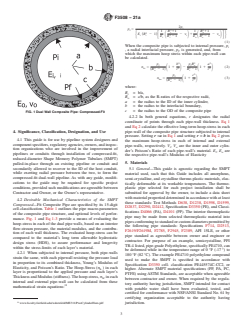
When the composite pipe is subjected to internal pressure, p
i
, a radial interfacial pressure, p, is generated, and, from
f
which the maximum hoop stress within each pipe-wall can
be calculated.
2 2 2
p b p R a
f f o
σ 5 1 1 2 1 1 (2)
2 S 2D 2 S 2D
hi
R 2 1 r R 2 1 r
~ !
o i
p c
f
σ 5 1 1 (3)
S D
ho 2 2
~R 2 1! r
o
where:
R = b/a,
i
R = c/b, as the R-ratios of the respective radii,
o
a = the radius to the ID of the inner cylinder,
b = the radius to the interfacial boundary,
c = the radius to the OD of the composite pipe
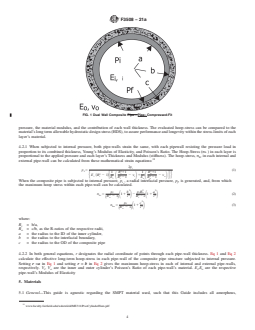
FIG. 1 Dual Wall Composite Pipe: Compressed-Fit
4.2.2 In both general equations, r designates the radial
coordinate of points through each pipe-wall thickness. Eq 1
and Eq 2 calculate the effective long-term hoop-stress in each
pipe-wall of the composite pipe structure subjected to internal
4. Significance, Classification, Designation, and Use
pressure. Setting r =a in Eq 1 and setting r = b in Eq 2 gives
4.1 This guide is for use by pipeline system designers and
the maximum hoop-stress in each of internal and external
component specifiers, regulatory agencies, owners, and inspec-
pipe-walls, respectively. V, V are the inner and outer cylin-
i o
tion organizations who are involved in the improvement of
der’s Poisson’s Ratio of each pipe-wall’s material. E, E are
i o
pipelines or conduits through installation of compressed-fit,
the respective pipe-wall’s Modulus of Elasticity
reduced-diameter Shape Memory Polymer Tubulars (SMPT)
5. Materials
pulled-in-place through an existing pipeline or conduit and
secondarily allowed to recover to the ID of the host conduit,
5.1 General—This guide is agnostic regarding the SMPT
while exerting radial pressure between the two, to form the
material used, such that this Guide includes all amorphous,
compressed-fit dual-wall pipeline. As with any guide, modifi-
semi-crystalline, and crystalline thermo-plastic materials, elas-
cations to the guide may be required for specific project
tically deformable at its workable temperatures. The thermo-
conditions, provided such modifications are agreeable between
plastic pipe selected for each project installation shall be
Contractor and Owner, or the Owner’s representative.
submitted for approval by the owner, to include a data sheet
with material propertied determined in accordance with at least
4.2 Desirable Mechanical Characteristics of the SMPT
these standards: Test Methods D638, D1238, D1598, D1599,
Compressed—Fit Composite Pipe are specified by its 15-digit
D2837, D2290, D2412, Specification D3350 (PE), and Classi-
cell-classification. Table 1 outlines the pipe macro-parameters
fications D4066 (PA), D4101 (PP). The interior thermoplastic
of the composite pipe structure, and optional levels of perfor-
pipe may be made from selected thermoplastic material into
mance. Fig. 1 and Eq 1-3 provide a means of evaluating the
pipesconformingtostandardorcustomdiameterspermittedby
hoop-stress in each of the dual pipe walls, based on an interior
the following pipe standards: Specifications F714, D2513,
flow-stream pressure, the material modulus, and the contribu-
F2619/F2619M, F2785, F2945, F2389, API 15LE, or other
tion of each wall thickness. The evaluated hoop-stress can be
pipe standard as agreeable between owner and engineer or
compared to the material’s long term allowable hydrostatic
contractor. For purpose of an example, semicrystalline, PPI
design stress (HDS), to assure performance and longevity
TR-4 listed, pipe-grade Polyethylene, specifically PE4710, can
within the stress-limits of each layer’s material.
be deformed while in the temperature range of 0 °F (-17 °) to
4.2.1 When subjected to internal pressure, both pipe-walls
180 °F (82 °C). The example PE4710 polyethylene compound
strain the same, with each pipewall resisting the pressure load
used to make the SMPT is specified in accordance with
in proportion to its combined thickness, Young’s Modulus of
Specification D3350 cell- classification PE445574C-CC2, or
Elasticity, and Poisson’s Ratio. The Hoop-Stress (σ ) in each
h
higher. Alternate SMPT material specifications (PP, PA, PC,
layer is proportional to the applied pressure and each layer’s
PTFE) usingASTM Standards, are acceptable when agreeable
ThicknessandModulus(stiffness).Thehoop-stress,σ ,ineach
h
between contractor and owner. When required by the regula-
internal and external pipe-wall can be calculated from these
tory authority having jurisdiction, SMPT intended for contact
mathematical strain equations:
with potable water shall have been evaluated, tested, and
certified for conformance with NSF/ANSI Standard No. 61 by
certifying organization acceptable to the authority having
www.faculty.fairfield.edu/wdornfeld/ME311/PresCylinderHam.pdf jurisdiction.
F3508 − 21a
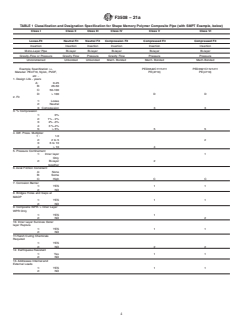
TABLE 1 Classification and Designation Specification for Shape Memory Polymer Composite Pipe (with SMPT Example, below)
Class I Class II Class III Class IV Class V Class VI
Loose-Fit Neutral Fit Neutral Fit Compression Fit Compressed Fit Compressed Fit
Insertion Insertion Insertion Insertion Insertion Insertion
Mono-Layer Pipe Bi-layer Bi-layer Bi-layer Bi-layer Bi-layer
Gravity-Flow or Pressure Gravity Flow Pressure Gravity Flow Pressure Pressure
Unconstrained Unbonded Unbonded Mech. Bonded Mech. Bonded Mech.Bonded
Example Specification >> PED3542C1111211 PED3521C1121211
Material: PE4710, Nylon, PVDF, PE(4710) PE(4710)
etc .
1. Design Life - years
A: 0-25
B: 26-50
C: 50-100
D: > 100 DD
2. Fit
1: Loose
2: Neutral
3: Compression 33
3. % Compression
1: 0%
2: 1% - 2%
3: 2% -3%
4: 3 %-4%
5: > 5% 55
4. Diff. Press. Multiplier
1: 1.0
2: 2to5 2
3: 6to10
4: > 10 4
5. Pressure Confinement
1: Inner layer 1
Only
2: Bi-layer 2
together
6. Axial Friction Constraint
A: None
B: Some
C: High CC
7. Corrosion Barrier
1: YES 11
2: NO
8. Bridges Holes and Gaps at
MAOP
1: YES 11
2: NO
9. Composite WPR. > Inner Layer
WPR Only
1: YES 1
2: NO 2
10. Inner Layer Survives Outer
layer Rupture
1: YES 11
2: NO
11.Harsh Curing Chemicals
Required
1: YES
2: NO 22
12. Earthquake Resistant
1: Yes 11
2: NO
13. Addresses Internal and
External Loads
1: YES 11
2: NO
F3508 − 21a
5.2 Tubular Dimensions and Dimension Ratio—The SMPT (6) environmental concerns (weather, waste disposal),
shall be made in accordance with pipe standards agreeable (7) flow bypass requirements and arrangements,
between Contractor and Project Owner / Project Engineer. As (8) traffic control,
an example, using Polyethylene SMPT, the project’s PE4710 (9) availability of water and provisions for alternative
tubular shall be made in accordance with the specifications, supplies,
dimensions, and requirements of Specification F714, or, Speci- (10) discussions and meetings with other utilities, highway
fication D3035, or, Specification F2619/F2619M, or Specifi- authorities and fire services, disinfection regulations and
cation D2513, orAWWAC906, orAPI-15LE. The SMPT may operations,
be ordered as standard outside diameters and standard dimen- (11) permitted hours for lining operations, and
sion ratios, or, as custom outside diameters and dimension (12) bylaws/regulations affecting SMPT construction op-
ratios, as permitted by the pipe standards. erations.
5.3 SMPT Pipeline Construction—Prior to on-site construc-
6.3 Flow Bypass—Whenever the continuance of the water
tion of the composite dual-wall pipeline, the ‘long’ SMPT
supply or sewage removal is required for customers connected
pipeline shall be assembled from ‘short’ tube segments using
to the pipeline under construction, the bypass system shall be
thermoplastic heat fusion practice. Most Thermoplastics heat-
designed, installed, and tested to meet the requirements of the
fusion practices are published in ASTM Standards. As an
contract documents and local health regulations. The bypass
example, for Polyethylene material, the specified heat fusion
system shall receive the approval of the owner and local health
practice is Practice F2620.
officer prior to the commencement of construction operations.
The bypass system shall be monitored and maintained for the
NOTE 3—(Heat fusion Standards for Polyamid and Polypropyene pipes
full duration of construction operations. The bypass system
are in development.) The exterior butt-fusion bead shall be trimmed flush
to the OD of the SMPT, in accordance with the trim-tool and pipe must remain in service until the lined main has been fully
manufacturer recommendations. The heat butt-fusion jointing process
returned to service. If bypassing of the host-pipe’s flow is
shall be evaluated by reverse bend testing, or, in accordance with the
requiredaroundthesectionsofpipedesignatedforrenewal,the
procedures of Practice F3183 for thicker wall pipe.
bypass shall be made by isolating the line at a point upstream
5.4 Design Performance—It is beyond the scope of this
of the pipe to be renewed and pumping the flow to a
guide to list or specify the numerous design parameters or
downstream point or adjacent system. The pump and bypass
performance characteristics for polymeric SMPTpipes that are
lines shall be of adequate capacity and size to handle the flow.
importantdeterminantsofphysicalperformanceoverthelifeof
Services within this reach will be temporarily out-of-service,
an installation; for example, moduli (flexural, creep), ductility,
unless a temporary service-line header is installed until the
life span, hole and gap spanning, abrasion resistance, etc. It
renewed pipeline is ready for re-connection.
shall be the contractor’s responsibility to provide such
6.4 Pipeline Access:
independently-verified data to the owner’s representative when
6.4.1 The main to be lined is isolated by closing all relevant
requested.
supply valves and accessed at planned locations above ground
or by localized removal of the surface pavement or concrete
6. Installation
where the main is buried below ground.
6.1 Interior Pipe—shall be installed in accordance with the
6.4.2 For buried pipe-mains, pits are then excavated, fol-
contractor’s recommended procedures. using the means and
lowed by the cutting and removal of a section of pipeline, and
methods specified by the contractor. Typically, the SMPT is
draining the host pipe prior to cleaning. Access is preferably
pulled through a mechanical diameter reduction die of custom
completed at a valve, bend, fitting, or other location wherever
configuration. The pulling means is typically by means of
an excavation is needed for cleaning and lining operations.
hydraulicallydrawnlinkagesorwenchedcontinuouswire-rope
Piping components such as air valves, flow meters, butterfly
of sufficient strength. All interior pipe installation shall be
valves, and pressure reducing valves should (are generally) be
completedbymanufacturer-approved,certifiedinstallers,using
removed prior to cleaning, and
...
This document is not an ASTM standard and is intended only to provide the user of an ASTM standard an indication of what changes have been made to the previous version. Because
it may not be technically possible to adequately depict all changes accurately, ASTM recommends that users consult prior editions as appropriate. In all cases only the current version
of the standard as published by ASTM is to be considered the official document.
Designation: F3508 − 21 F3508 − 21a
Standard Guide for
In-Situ Pipeline Re-ConstructionRenovation As Coupled
Dual-Wall Composite Pipeline by Push/Pull Installation of
Compressed-Fit Shape-Memory-Polymer Tubular (SMPT)
This standard is issued under the fixed designation F3508; the number immediately following the designation indicates the year of
original adoption or, in the case of revision, the year of last revision. A number in parentheses indicates the year of last reapproval. A
superscript epsilon (´) indicates an editorial change since the last revision or reapproval.
1. Scope
1.1 This guide describes the the specification and re-construction of in-situ pipelines and conduits 2 in. to 63 in. (50 mm to 1600
mm) diameter) by the pulled-in-place installation, into an existing conduit, of circular, radially reduced, Shape-Memory-Polymer
Tubular (SMPT) that after installation, re-expands (by “memory”) to press against the ID of the host pipe, thus coupling the interior
pipe, by friction fit, as reinforcement to the host pipe. The added SMPT pipe wall restores leak tightness and adds its strength to
the host pipe (Dual-Wall Composite-Pipe). It becomes a continuous compressed-fit dual-wall pipeline. Depending upon the SMPT
compound used, the re-constructed pipelines or conduits are suitable for pressure and nonpressure pipeline applications such as
process piping, raw and treated water transmission, water pipe systems, forced-mains, industrial and oil-patch gathering and
transmission pipelines, sanitary sewers, storm sewers, and culverts.
NOTE 1— This standard guide covers circular SMPT tubulars which are radially reduced by mechanical means at the time of installation. This guide does
not address “liners” that at the time of manufacture are deformed (folded) into U-shape, C-shape, H-shape, or other such configurations. This guide refers
to dual-wall meaning two layers of pipe co-joined in the field, which is different from dual-wall factory-made co-extruded pipe or corrugated pipe. This
guide does not provide a complete design basis covering the many variables required for design and construction of this field fabricated product; the
advice of professional contractors and/or registered professional engineers may be incorporated as an adjunct to this guide.
1.2 The values stated in inch-pound units are to be regarded as standard. The values given in parentheses are mathematical
conversions to SI units that are provided for information only and are not considered standard.
NOTE 2—There are no ISO standards covering the primary subject matter of this guide.
1.3 This standard does not purport to address all of the safety concerns, if any, associated with its use. It is the responsibility
of the user of this standard to establish appropriate safety, health, and environmental practices and determine the applicability of
regulatory limitations prior to use.
1.4 This international standard was developed in accordance with internationally recognized principles on standardization
established in the Decision on Principles for the Development of International Standards, Guides and Recommendations issued
by the World Trade Organization Technical Barriers to Trade (TBT) Committee.
This test method is under the jurisdiction of ASTM Committee F17 on Plastic Piping Systems and is the direct responsibility of Subcommittee F17.67 on Trenchless
Plastic Pipeline Technology.
Current edition approved Aug. 1, 2021Nov. 1, 2021. Published August 2021December 2021. Originally approved in 2021. Last previous edition approved in 2021 as
F3508–21. DOI: 10.1520/F3508–2110.1520/F3508–21A
Copyright © ASTM International, 100 Barr Harbor Drive, PO Box C700, West Conshohocken, PA 19428-2959. United States
F3508 − 21a
2. Referenced Documents
2.1 ASTM Standards:
D638 Test Method for Tensile Properties of Plastics
D1238 Test Method for Melt Flow Rates of Thermoplastics by Extrusion Plastometer
D1598 Test Method for Time-to-Failure of Plastic Pipe Under Constant Internal Pressure
D1599 Test Method for Resistance to Short-Time Hydraulic Pressure of Plastic Pipe, Tubing, and Fittings
D1600 Terminology for Abbreviated Terms Relating to Plastics
D2290 Test Method for Apparent Hoop Tensile Strength of Plastic or Reinforced Plastic Pipe
D2412 Test Method for Determination of External Loading Characteristics of Plastic Pipe by Parallel-Plate Loading
D2513 Specification for Polyethylene (PE) Gas Pressure Pipe, Tubing, and Fittings
D2837 Test Method for Obtaining Hydrostatic Design Basis for Thermoplastic Pipe Materials or Pressure Design Basis for
Thermoplastic Pipe Products
D3035 Specification for Polyethylene (PE) Plastic Pipe (DR-PR) Based on Controlled Outside Diameter
D3350 Specification for Polyethylene Plastics Pipe and Fittings Materials
D4066 Classification System for Nylon Injection and Extrusion Materials (PA)
D4101 Classification System and Basis for Specification for Polypropylene Injection and Extrusion Materials
F412 Terminology Relating to Plastic Piping Systems
F714 Specification for Polyethylene (PE) Plastic Pipe (DR-PR) Based on Outside Diameter
F1417 Practice for Installation Acceptance of Plastic Non-pressure Sewer Lines Using Low-Pressure Air
F1606 Practice for Rehabilitation of Existing Sewers and Conduits with Deformed Polyethylene (PE) Liner
F2164 Practice for Field Leak Testing of Polyethylene (PE) and Crosslinked Polyethylene (PEX) Pressure Piping Systems Using
Hydrostatic Pressure
F2389 Specification for Pressure-rated Polypropylene (PP) Piping Systems
F2620 Practice for Heat Fusion Joining of Polyethylene Pipe and Fittings
F2619/F2619M Specification for High-Density Polyethylene (PE) Line Pipe
F2785 Specification for Polyamide 12 Gas Pressure Pipe, Tubing, and Fittings
F2786 Practice for Field Leak Testing of Polyethylene (PE) Pressure Piping Systems Using Gaseous Testing Media Under
Pressure (Pneumatic Leak Testing)
F2945 Specification for Polyamide 11 Gas Pressure Pipe, Tubing, and Fittings
F3183 Practice for Guided Side Bend Evaluation of Polyethylene Pipe Butt Fusion Joint
2.2 AWWA Standard:
AWWA C651 Disinfecting Water Mains
AWWA C906 Polyethylene Pressure Pipe and Fittings, 4-in. through 65-in. (110mm – 1650 mm) for Waterworks
2.3 NSF/ANSI Standards:
Standard No. 61 for DrinkingWater Systems Components—Health Effects
2.4 NACE Standards:
SP0102 Cleaning and Inspection of Pressure Pipelines
2.5 API Standards:
API 15LE Specification for Polyethylene Line Pipe
2.6 Other Standards:
PPI TR-4 HDB/SDB/PDB/MRS Listed Materials, PPI Listing of Hydrostatic Design Basis (HDB), Strength Design Basis
(SDB), Pressure Design Basis (PDB), and Minimum Required Strength (MRS) Ratings for Thermoplastic Piping Materials
or Pipe
APWA Uniform Color Code
NASSCO Recommended Specifications for Sewer Collection System Rehabilitation.
ISO 8501 Preparation Cleaning of Metallic Substrates
For referenced ASTM standards, visit the ASTM website, www.astm.org, or contact ASTM Customer Service at service@astm.org. For Annual Book of ASTM Standards
volume information, refer to the standard’s Document Summary page on the ASTM website.
Available from American Water Works Association (AWWA), 6666 W. Quincy Ave., Denver, CO 80235, http://www.awwa.org.
Available from NSF International, P.O. Box 130140, 789 N. Dixboro Rd., Ann Arbor, MI 48105, http://www.nsf.org.
Available from NACE International (NACE), 15835 Park Ten Pl., Houston, TX 77084, http://www.nace.org.
Available from American Petroleum Institute (API), 200 Massachusetts Avenue, NW Suite 1100 Washington, DC 20001-5571, http://www.api.org.
Available from Plastics Pipe Institute (PPI), 105 Decker Court, Suite 825, Irving, TX 75062, http://www.plasticpipe.org.
Available from the American Public Works Association (APWA) https://www.apwa.net/
Available from NASSCO 5285 Westview Drive, Suite 202, Frederick, MD 21703 info@nassco.org
Available from International Organization for Standardization (ISO), ISO Central Secretariat, Chemin de Blandonnet 8, CP 401, 1214 Vernier, Geneva, Switzerland,
https://www.iso.org.
F3508 − 21a
3. Terminology
3.1 Thermoplastic definitions are in accordance with Terminology F412, and abbreviations are in accordance with Terminology
D1600.
3.2 Definitions of Terms Specific to This Standard:
3.2.1 compressed fit—the dimensional interference fitfrictional fit, or interference fit, between the in-situ host pipe and internal
SMPT, resulting in a compressive strain between the ID of the host pipe and the OD of the SMPT, which compressive strain results
in mechanical coupling or bonding the two layers together, becoming a resulting in a conjoining held together by friction, forming
the composite pipe structure.
3.2.1.1 Discussion—
The interlaminar stress is mathematically estimated from the measured differential strain, the layer thicknesses, each cylindrical
layer’s Modulus of Elasticity, Poisson’s Ratio.
3.2.2 composite pipe—A fluid-containing long cylindrical structure, capable of sustaining internal pressure and/or external
pressure, without radial leakage, being formed of at least two layers of same or differing materials, with each layer exerting a
degree of mutual radial interfacial pressure (compression-fit) between the tubular layers.Pipe consisting of two or more different
materials arranged with specific functional purpose to serve as pipe. F412
3.2.3 hydrostatic design basis and hydrostatic design stress—the hydrostatic design stress, HDS, is determined by multiplying the
hydrostatic design basis, HDB, by a design factor, DF that has a value less than 1.0.
3.2.3.1 Discussion—
Refer to Test Method D2837.
3.2.4 relationship between dimension ratio, hydrostatic design stress, and pressure rating, for thermoplastic tubulars—
2*S
P 5
DR 2 1
where:
S = hydrostatic design stress, HDS, for water at 73 °F (23 °C), psi (or kPa or MPa),
P = pressure rating, PR, psi (or kPa or MPa),
DO = outside diameter, in. (or mm),
t = minimum wall thickness, in. (or mm),
DR = DO/t = dimension ratio
3.2.5 shape memory polymer tubular (SMPT)—A specified diameter, ductile, plastic pipe extruded from a thermoplastic polymer
with a high degree of rubber-like elastic properties (memory reversion characteristics), suitable for temporary radial diameter
reduction, such that the mechanical deformation is recoverable back to a very high proportion of the original shape.
3.2.5.1 Discussion—
Shape memory polymers (SMPs) are polymers which can be deformed into a temporary shape and then return to the original shape,
when triggered by an external stimulus. Depending upon the deformation process, the external stimulus may be removal of axial
tensile load, imposition of heat internal to the SMPT, application of pressure interior to the SMPT, or a combination there-of.
4. Significance, Classification, Designation, and Use
4.1 This guide is for use by pipeline system designers and component specifiers, regulatory agencies, owners, and inspection
organizations who are involved in the improvement of pipelines or conduits through installation of compressed-fit, reduced-
diameter Shape Memory Polymer Tubulars (SMPT) pulled-in-place through an existing pipeline or conduit and secondarily
allowed to recover to the ID of the host conduit, while exerting radial pressure between the two, to form the compressed-fit
dual-wall pipeline. As with any guide, modifications to the guide may be required for specific project conditions, provided such
modifications are agreeable between Contractor and Owner, or the Owner’s representative.
4.2 Desirable Mechanical Characteristics of the SMPT Compressed—Fit Composite Pipe are specified by its 15-digit
cell-classification. Table 1 outlines the pipe macro-parameters of the composite pipe structure, and optional levels of performance.
Fig. 1 and Eq 1-3 provide a means of evaluating the hoop-stress in each of the dual pipe walls, based on an interior flow-stream
F3508 − 21a
FIG. 1 Dual Wall Composite Pipe : Pipe: Compressed-Fit
pressure, the material modulus, and the contribution of each wall thickness. The evaluated hoop-stress can be compared to the
material’s long term allowable hydrostatic design stress (HDS), to assure performance and longevity within the stress-limits of each
layer’s material.
4.2.1 When subjected to internal pressure, both pipe-walls strain the same, with each pipewall resisting the pressure load in
proportion to its combined thickness, Young’s Modulus of Elasticity, and Poisson’s Ratio. The Hoop-Stress (σ ) in each layer is
h
proportional to the applied pressure and each layer’s Thickness and Modulus (stiffness). The hoop-stress, σ , in each internal and
h
external pipe-wall can be calculated from these mathematical strain equations:
2p
i
p 5 (1)
2 2
f
1 R 11 1 R 11
i o
E R 2 1 2 ν 1 2 ν
H ~ !F S D S DGJ
i i 2 i 2 o
E R 2 1 E R 2 1
i i o o
When the composite pipe is subjected to internal pressure, p , a radial interfacial pressure, p , is generated, and, from which
i f
the maximum hoop stress within each pipe-wall can be calculated.
2 2 2
p b p R a
f f o
σ 5 1 1 2 1 1 (2)
S D S D
2 2 2 2
hi
R 2 1 r R 2 1 r
~ !
o i
p c
f
σ 5 1 1 (3)
S D
ho 2 2
~R 2 1! r
o
where:
R = b/a,
i
R = c/b, as the R-ratios of the respective radii,
o
a = the radius to the ID of the inner cylinder,
b = the radius to the interfacial boundary,
c = the radius to the OD of the composite pipe
4.2.2 In both general equations, r designates the radial coordinate of points through each pipe-wall thickness. Eq 1 and Eq 2
calculate the effective long-term hoop-stress in each pipe-wall of the composite pipe structure subjected to internal pressure.
Setting r =a in Eq 1 and setting r = b in Eq 2 gives the maximum hoop-stress in each of internal and external pipe-walls,
respectively. V , V are the inner and outer cylinder’s Poisson’s Ratio of each pipe-wall’s material. E ,E are the respective
i o i o
pipe-wall’s Modulus of Elasticity
5. Materials
5.1 General—This guide is agnostic regarding the SMPT material used, such that this Guide includes all amorphous,
www.faculty.fairfield.edu/wdornfeld/ME311/PresCylinderHam.pdf
F3508 − 21a
TABLE 1 Classification and Designation Specification for Shape Memory Polymer Composite Pipe (with SMPT Example, below)
Class I Class II Class III Class IV Class V Class VI
Loose-Fit Neutral Fit Neutral Fit Compression Fit Compressed Fit Compressed Fit
Insertion Insertion Insertion Insertion Insertion Insertion
Mono-Layer Pipe Bi-layer Bi-layer Bi-layer Bi-layer Bi-layer
Gravity-Flow or Pressure Gravity Flow Pressure Gravity Flow Pressure Pressure
Unconstrained Unbonded Unbonded Mech. Bonded Mech. Bonded Mech.Bonded
Example Specification >> PED3542C1111211 PED3521C1121211
Material: PE4710, Nylon, PVDF, PE(4710) PE(4710)
etc .
1. Design Life - years
A: 0-25
B: 26-50
C: 50-100
D: > 100 D D
2. Fit
1: Loose
2: Neutral
3: Compression 3 3
3. % Compression
1: 0%
2: 1% - 2%
3: 2% -3%
4: 3 %-4%
5: > 5% 5 5
4. Diff. Press. Multiplier
1 : 1.0
2: 2 to 5 2
3: 6 to 10
4: > 10 4
5. Pressure Confinement
1: Inner layer 1
Only
2: Bi-layer 2
together
6. Axial Friction Constraint
A: None
B: Some
C: High C C
7. Corrosion Barrier
1: YES 1 1
2: NO
8. Bridges Holes and Gaps at
MAOP
1: YES 1 1
2: NO
9. Composite WPR. > Inner Layer
WPR Only
1: YES 1
2: NO 2
10. Inner Layer Survives Outer
layer Rupture
1: YES 1 1
2: NO
11.Harsh Curing Chemicals
Required
1: YES
2: NO 2 2
12. Earthquake Resistant
1: Yes 1 1
2: NO
13. Addresses Internal and
External Loads
1: YES 1 1
2: NO
F3508 − 21a
semi-crystalline, and crystalline thermo-plastic materials, elastically deformable at its workable temperatures. The thermoplastic
pipe selected for each project installation shall be submitted for approval by the owner, to include a data sheet with material
propertied determined in accordance with at least these standards: Test Methods D638, D1238, D1598, D1599, D2837, D2290,
D2412, Specification D3350 (PE), and Classifications D4066 (PA), D4101 (PP). The interior thermoplastic pipe may be made from
selected thermoplastic material into pipes conforming to standard or custom diameters permitted by the following pipe standards:
Specifications F714, D2513, F2619/F2619M, F2785, F2945, F2389, API 15LE, or other pipe standard as agreeable between owner
and engineer or contractor. For purpose of an example, semicrystalline, PPI TR-4 listed, pipe-grade Polyethylene, specifically
PE4710, can be deformed while in the temperature range of 0 °F (-17 °) to 180 °F (82 °C). The example PE4710 polyethylene
compound used to make the SMPT is specified in accordance with Specification D3350 cell- classification PE445574C-CC2, or
higher. Alternate SMPT material specifications (PP, PA, PC, PTFE) using ASTM Standards, are acceptable when agreeable
between contractor and owner. When required by the regulatory authority having jurisdiction, SMPT intended for contact with
potable water shall have been evaluated, tested, and certified for conformance with NSF/ANSI Standard No. 61 by certifying
organization acceptable to the authority having jurisdiction.
5.2 Tubular Dimensions and Dimension Ratio—The SMPT shall be made in accordance with pipe standards agreeable between
Contractor and Project Owner / Project Engineer. As an example, using Polyethylene SMPT, the project’s PE4710 tubular shall
be made in accordance with the specifications, dimensions, and requirements of Specification F714, or, Specification D3035, or,
Specification F2619/F2619M, or Specification D2513, or AWWA C906, or API-15LE. The SMPT may be ordered as standard
outside diameters and standard dimension ratios, or, as custom outside diameters and dimension ratios, as permitted by the pipe
standards.
5.3 SMPT Pipeline Construction—Prior to on-site construction of the composite dual-wall pipeline, the ‘long’ SMPT pipeline shall
be assembled from ‘short’ tube segments using thermoplastic heat fusion practice. Most Thermoplastics heat-fusion practices are
published in ASTM Standards. As an example, for Polyethylene material, the specified heat fusion practice is Practice F2620.
NOTE 3—(Heat fusion Standards for Polyamid and Polypropyene pipes are in development.) The exterior butt-fusion bead shall be trimmed flush to the
OD of the SMPT, in accordance with the trim-tool and pipe manufacturer recommendations. The heat butt-fusion jointing process shall be evaluated by
reverse bend testing, or, in accordance with the procedures of Practice F3183 for thicker wall pipe.
5.4 Design Performance—It is beyond the scope of this guide to list or specify the numerous design parameters or performance
characteristics for polymeric SMPT pipes that are important determinants of physical performance over the life of an installation;
for example, moduli (flexural, creep), ductility, life span, hole and gap spanning, abrasion resistance, etc. It shall be the contractor’s
responsibility to provide such independently-verified data to the owner’s representative when requested.
6. Installation
6.1 Interior Pipe—shall be installed in accordance with the contractor’s recommended procedures. using the means and methods
specified by the contractor. Typically, the SMPT is pulled through a mechanical diameter reduction die of custom configuration.
The pulling means is typically by means of hydraulically drawn linkages or wenched continuous wire-rope of sufficient strength.
All interior pipe installation shall be completed by manufacturer-approved, certified installers, using manufacturer-approved,
specialty equipment following written procedures. For each installation length, the installer shall calculate the maximum pulling
force to be used to pull the liner through the host pipe for the overall length; such records shall be maintained with the Project
QA files.
6.2 Preparatory Planning—Comprehensive planning is required before the commencement of SMPT installation operations. The
following list of considerations is provided to the owner/contractor for guidance and is not exhaustive:
(1) Review and analysis of system architecture, surface and subsurface information,
(2) zoning restrictions and regulations,
(3) safety and health concerns and requirements,
(4) access and egress considerations,
(5) customer care planning,
(6) environmental concerns (weather, waste disposal),
(7) flow bypass requirements and arrangements,
(8) traffic control,
(9) availability of water and provisions for alternative supplies,
(10) discussions and meetings with other utilities, highway authorities and fire services, disinfection regulations and operations,
(11) permitted hours for lining operations, and
F3508 − 21a
(12) bylaws/regulations affecting SMPT construction operations.
6.3 Flow Bypass—Whenever the continuance of the water supply or sewage removal is required for customers connected to the
pipeline under construction, the bypass system shall be designed, installed, and tested to meet the requirements of the contract
documents and local health regulations. The bypass system shall receive the approval of the owner and local health officer prior
to the commencement of construction operations. The bypass system shall be monitored and maintained for the full duration of
construction operations. The bypass system must remain in service until the lined main has been fully returned to service. If
bypassing of the host-pipe’s flow is required around the sections of pipe designated for renewal, the bypass shall be made by
isolating the line at a
...