

ASTM F1697-24
(Specification)Standard Specification for Poly(Vinyl Chloride) (PVC) Profile Strip for Machine Spiral-Wound Liner Pipe Rehabilitation of Existing Sewers and Conduit
General Information
- Abstract
ABSTRACT
This specification covers the requirements and test methods for materials, dimensions, workmanship, stiffness factor, extrusion quality, and test procedures for extruded poly(vinyl chloride) (PVC) profile strips used for machine-made field fabrication of spirally wound pipe liners in the rehabilitation of a variety of existing pipelines and conduits including sanitary sewers, storm water sewers, process flow piping, and non-circular pipelines (such as arched or oval shapes and rectangular shapes) under gravity flow conditions. Certification, packaging, and product marking for quality assurance are also considered.
SIGNIFICANCE AND USE
9.1 The requirements of this specification are intended to provide extruded PVC profile strip suitable for the field fabrication of spirally wound liner pipe for the rehabilitation of existing pipelines and conduits conveying sewage, process flow, and storm water under gravity flowconditions.
Note 3: Industrial waste disposal lines should be installed only with the specific approval of the cognizant code authority since chemicals not commonly found in drains and sewers and temperatures in excess of 140 °F (60 °C) may be encountered.
SCOPE
1.1 This specification covers requirements and test methods for materials, dimensions, workmanship, stiffness factor, extrusion quality, and a form of marking for extruded poly(vinyl chloride) (PVC) profile strips used for machine made field fabrication of spirally wound pipe liners in the rehabilitation of a variety of gravity applications such as sanitary sewers, storm sewers, and process piping in diameters of 6 to 180 in. and for similar sizes of non-circular pipelines such as arched or oval shapes and rectangular shapes.
1.2 Profile strip produced to this specification is for use in field fabrication of spirally wound liner pipes in nonpressure sewer and conduit rehabilitation, where the spirally wound liner pipe is expanded until it presses against the interior surface of the existing sewer or conduit, or, alternatively, where the spirally wound liner pipe is inserted as a fixed diameter into the existing sewer or conduit and the annular space between the liner pipe and the existing sewer or conduit is grouted.
1.3 This specification includes extruded profile strips made only from materials specified in 5.1.
1.4 The values stated in inch-pound units are to be regarded as standard. The values given in parentheses are mathematical conversions to SI units that are provided for information only and are not considered standard.
1.5 The following precautionary caveat pertains only to the test method portion, Section 11, of this specification: This standard does not purport to address all of the safety concerns, if any, associated with its use. It is the responsibility of the user of this standard to establish appropriate safety, health, and environmental practices and determine the applicability of regulatory limitations prior to use.
1.6 This international standard was developed in accordance with internationally recognized principles on standardization established in the Decision on Principles for the Development of International Standards, Guides and Recommendations issued by the World Trade Organization Technical Barriers to Trade (TBT) Committee.
- Status
- Published
- Publication Date
- 31-Mar-2024
- Technical Committee
- F17 - Plastic Piping Systems
- Drafting Committee
- F17.67 - Trenchless Plastic Pipeline Technology
Buy Documents
ASTM F1697-24 - Standard Specification for Poly(Vinyl Chloride) (PVC) Profile Strip for Machine Spiral-Wound Liner Pipe Rehabilitation of Existing Sewers and Conduit
REDLINE ASTM F1697-24 - Standard Specification for Poly(Vinyl Chloride) (PVC) Profile Strip for Machine Spiral-Wound Liner Pipe Rehabilitation of Existing Sewers and Conduit
Overview
ASTM F1697-24 is the international standard specification for extruded poly(vinyl chloride) (PVC) profile strips used in the machine-made field fabrication of spirally wound liner pipes. These liners are essential in the rehabilitation of existing gravity pipelines and conduits, such as sanitary and storm sewers, process flow piping, and non-circular pipelines under gravity flow. This standard ensures strict requirements for materials, dimensions, physical properties, workmanship, quality control, and certification, assuring that PVC profile strips used in trenchless pipeline rehabilitation are reliable, safe, and meet industry needs.
The spirally wound liner pipe method is widely adopted for pipe rehabilitation, offering a trenchless solution to extend the lifecycle of aging infrastructure while minimizing excavation and surface disruption.
Key Topics
ASTM F1697-24 addresses several critical components to ensure material suitability for trenchless pipe rehabilitation:
- Material Specifications: The PVC profile strip must be produced from compounds meeting rigid requirements as per ASTM D1784, with configurations based on installation needs.
- Dimensions and Tolerances: Strict guidelines on strip width, height, wall thickness, and minimum stiffness factors support uniform product performance.
- Workmanship and Quality: Extruded profile strips must be homogeneous, free from visible defects, and uniform in appearance.
- Reinforcement: Designs may include zinc-galvanized or stainless steel reinforcing strips for added stiffness, especially in high-load conditions.
- Testing Methods: All critical performance attributes, including stiffness, adequate fusion (acetone immersion), and joint tightness, are subject to standardized test procedures.
- Product Marking and Certification: Clear guidelines establish requirements for traceable product marking at set intervals, along with documentation for manufacturing compliance.
- Quality Assurance: The manufacturer’s certification confirms adherence to the standard and is required with each shipment when specified in the purchase order.
Applications
PVC profile strips manufactured to ASTM F1697-24 are primarily used in spiral wound pipe liner systems for gravity flow sewer and conduit rehabilitation. Major applications include:
- Sanitary Sewer Rehabilitation: Renewing pipelines without excavation, restoring structural integrity, and preventing infiltration.
- Storm Sewer Upgrades: Addressing aging stormwater infrastructure in urban and industrial areas.
- Process Flow Piping: Suitable for non-pressurized industrial and municipal pipelines, subject to chemical compatibility and temperature restrictions.
- Non-Circular Pipelines: Designed not only for circular pipes but also arched, oval, and rectangular geometries.
- Trenchless Technology Projects: Ideal for urban environments where open trenching is disruptive or impractical.
The standard enables cost-effective, durable solutions for public works departments, utilities, and contractors engaged in pipe rehabilitation projects aiming to extend infrastructure service life while reducing environmental and community impacts.
Related Standards
ASTM F1697-24 is aligned with several referenced and related standards, providing a robust framework for materials, terminology, and installation practices:
- ASTM D1784: Specification for Rigid PVC Compounds and Chlorinated PVC Compounds
- ASTM D790: Test Methods for Flexural Properties of Plastics
- ASTM D2122: Test Methods for Dimensions of Thermoplastic Pipe and Fittings
- ASTM D2152: Test Method for Adequacy of Fusion of Extruded PVC (acetone test)
- ASTM F1741: Practice for Installation of Machine Spiral Wound PVC Liner Pipe
- ASTM F412 / D883: Terminology Related to Plastic Piping Systems
- Referenced Steel Standards: Such as ASTM A879/A879M, A653/A653M, and A167 for steel reinforcement
By adhering to ASTM F1697-24, project stakeholders ensure that PVC profile strips for spiral wound liner pipe rehabilitation deliver consistent quality, performance, and regulatory compliance, supporting sustainable infrastructure renewal worldwide.
Relations
- Effective Date
- 01-Apr-2024
- Effective Date
- 01-Apr-2024
Buy Documents
ASTM F1697-24 - Standard Specification for Poly(Vinyl Chloride) (PVC) Profile Strip for Machine Spiral-Wound Liner Pipe Rehabilitation of Existing Sewers and Conduit
REDLINE ASTM F1697-24 - Standard Specification for Poly(Vinyl Chloride) (PVC) Profile Strip for Machine Spiral-Wound Liner Pipe Rehabilitation of Existing Sewers and Conduit
Get Certified
Connect with accredited certification bodies for this standard

DIN CERTCO
DIN Group product certification.
Institut za varilstvo d.o.o. (Welding Institute)
Slovenia's leading welding institute since 1952. ISO 3834, EN 1090, pressure equipment certification, NDT personnel, welder qualification. Only IIW Au

Smithers Quality Assessments
US management systems and product certification.
Sponsored listings
Frequently Asked Questions
ASTM F1697-24 is a technical specification published by ASTM International. Its full title is "Standard Specification for Poly(Vinyl Chloride) (PVC) Profile Strip for Machine Spiral-Wound Liner Pipe Rehabilitation of Existing Sewers and Conduit". This standard covers: ABSTRACT This specification covers the requirements and test methods for materials, dimensions, workmanship, stiffness factor, extrusion quality, and test procedures for extruded poly(vinyl chloride) (PVC) profile strips used for machine-made field fabrication of spirally wound pipe liners in the rehabilitation of a variety of existing pipelines and conduits including sanitary sewers, storm water sewers, process flow piping, and non-circular pipelines (such as arched or oval shapes and rectangular shapes) under gravity flow conditions. Certification, packaging, and product marking for quality assurance are also considered. SIGNIFICANCE AND USE 9.1 The requirements of this specification are intended to provide extruded PVC profile strip suitable for the field fabrication of spirally wound liner pipe for the rehabilitation of existing pipelines and conduits conveying sewage, process flow, and storm water under gravity flowconditions. Note 3: Industrial waste disposal lines should be installed only with the specific approval of the cognizant code authority since chemicals not commonly found in drains and sewers and temperatures in excess of 140 °F (60 °C) may be encountered. SCOPE 1.1 This specification covers requirements and test methods for materials, dimensions, workmanship, stiffness factor, extrusion quality, and a form of marking for extruded poly(vinyl chloride) (PVC) profile strips used for machine made field fabrication of spirally wound pipe liners in the rehabilitation of a variety of gravity applications such as sanitary sewers, storm sewers, and process piping in diameters of 6 to 180 in. and for similar sizes of non-circular pipelines such as arched or oval shapes and rectangular shapes. 1.2 Profile strip produced to this specification is for use in field fabrication of spirally wound liner pipes in nonpressure sewer and conduit rehabilitation, where the spirally wound liner pipe is expanded until it presses against the interior surface of the existing sewer or conduit, or, alternatively, where the spirally wound liner pipe is inserted as a fixed diameter into the existing sewer or conduit and the annular space between the liner pipe and the existing sewer or conduit is grouted. 1.3 This specification includes extruded profile strips made only from materials specified in 5.1. 1.4 The values stated in inch-pound units are to be regarded as standard. The values given in parentheses are mathematical conversions to SI units that are provided for information only and are not considered standard. 1.5 The following precautionary caveat pertains only to the test method portion, Section 11, of this specification: This standard does not purport to address all of the safety concerns, if any, associated with its use. It is the responsibility of the user of this standard to establish appropriate safety, health, and environmental practices and determine the applicability of regulatory limitations prior to use. 1.6 This international standard was developed in accordance with internationally recognized principles on standardization established in the Decision on Principles for the Development of International Standards, Guides and Recommendations issued by the World Trade Organization Technical Barriers to Trade (TBT) Committee.
ABSTRACT This specification covers the requirements and test methods for materials, dimensions, workmanship, stiffness factor, extrusion quality, and test procedures for extruded poly(vinyl chloride) (PVC) profile strips used for machine-made field fabrication of spirally wound pipe liners in the rehabilitation of a variety of existing pipelines and conduits including sanitary sewers, storm water sewers, process flow piping, and non-circular pipelines (such as arched or oval shapes and rectangular shapes) under gravity flow conditions. Certification, packaging, and product marking for quality assurance are also considered. SIGNIFICANCE AND USE 9.1 The requirements of this specification are intended to provide extruded PVC profile strip suitable for the field fabrication of spirally wound liner pipe for the rehabilitation of existing pipelines and conduits conveying sewage, process flow, and storm water under gravity flowconditions. Note 3: Industrial waste disposal lines should be installed only with the specific approval of the cognizant code authority since chemicals not commonly found in drains and sewers and temperatures in excess of 140 °F (60 °C) may be encountered. SCOPE 1.1 This specification covers requirements and test methods for materials, dimensions, workmanship, stiffness factor, extrusion quality, and a form of marking for extruded poly(vinyl chloride) (PVC) profile strips used for machine made field fabrication of spirally wound pipe liners in the rehabilitation of a variety of gravity applications such as sanitary sewers, storm sewers, and process piping in diameters of 6 to 180 in. and for similar sizes of non-circular pipelines such as arched or oval shapes and rectangular shapes. 1.2 Profile strip produced to this specification is for use in field fabrication of spirally wound liner pipes in nonpressure sewer and conduit rehabilitation, where the spirally wound liner pipe is expanded until it presses against the interior surface of the existing sewer or conduit, or, alternatively, where the spirally wound liner pipe is inserted as a fixed diameter into the existing sewer or conduit and the annular space between the liner pipe and the existing sewer or conduit is grouted. 1.3 This specification includes extruded profile strips made only from materials specified in 5.1. 1.4 The values stated in inch-pound units are to be regarded as standard. The values given in parentheses are mathematical conversions to SI units that are provided for information only and are not considered standard. 1.5 The following precautionary caveat pertains only to the test method portion, Section 11, of this specification: This standard does not purport to address all of the safety concerns, if any, associated with its use. It is the responsibility of the user of this standard to establish appropriate safety, health, and environmental practices and determine the applicability of regulatory limitations prior to use. 1.6 This international standard was developed in accordance with internationally recognized principles on standardization established in the Decision on Principles for the Development of International Standards, Guides and Recommendations issued by the World Trade Organization Technical Barriers to Trade (TBT) Committee.
ASTM F1697-24 is classified under the following ICS (International Classification for Standards) categories: 23.040.20 - Plastics pipes; 83.080.20 - Thermoplastic materials. The ICS classification helps identify the subject area and facilitates finding related standards.
ASTM F1697-24 has the following relationships with other standards: It is inter standard links to ASTM F1697-18, ASTM F1741-22. Understanding these relationships helps ensure you are using the most current and applicable version of the standard.
ASTM F1697-24 is available in PDF format for immediate download after purchase. The document can be added to your cart and obtained through the secure checkout process. Digital delivery ensures instant access to the complete standard document.
Standards Content (Sample)
This international standard was developed in accordance with internationally recognized principles on standardization established in the Decision on Principles for the
Development of International Standards, Guides and Recommendations issued by the World Trade Organization Technical Barriers to Trade (TBT) Committee.
Designation: F1697 − 24
Standard Specification for
Poly(Vinyl Chloride) (PVC) Profile Strip for Machine Spiral-
Wound Liner Pipe Rehabilitation of Existing Sewers and
1,2
Conduit
This standard is issued under the fixed designation F1697; the number immediately following the designation indicates the year of
original adoption or, in the case of revision, the year of last revision. A number in parentheses indicates the year of last reapproval. A
superscript epsilon (´) indicates an editorial change since the last revision or reapproval.
1. Scope* if any, associated with its use. It is the responsibility of the user
of this standard to establish appropriate safety, health, and
1.1 This specification covers requirements and test methods
environmental practices and determine the applicability of
for materials, dimensions, workmanship, stiffness factor, ex-
regulatory limitations prior to use.
trusion quality, and a form of marking for extruded poly(vinyl
1.6 This international standard was developed in accor-
chloride) (PVC) profile strips used for machine made field
dance with internationally recognized principles on standard-
fabrication of spirally wound pipe liners in the rehabilitation of
ization established in the Decision on Principles for the
a variety of gravity applications such as sanitary sewers, storm
Development of International Standards, Guides and Recom-
sewers, and process piping in diameters of 6 to 180 in. and for
mendations issued by the World Trade Organization Technical
similar sizes of non-circular pipelines such as arched or oval
Barriers to Trade (TBT) Committee.
shapes and rectangular shapes.
1.2 Profile strip produced to this specification is for use in
2. Referenced Documents
field fabrication of spirally wound liner pipes in nonpressure
2.1 ASTM Standards:
sewer and conduit rehabilitation, where the spirally wound
A167 Specification for Stainless and Heat-Resisting
liner pipe is expanded until it presses against the interior
Chromium-Nickel Steel Plate, Sheet, and Strip (With-
surface of the existing sewer or conduit, or, alternatively, where
drawn 2014)
the spirally wound liner pipe is inserted as a fixed diameter into
A176 Specification for Stainless and Heat-Resisting Chro-
the existing sewer or conduit and the annular space between the
mium Steel Plate, Sheet, and Strip (Withdrawn 2015)
liner pipe and the existing sewer or conduit is grouted.
A653/A653M Specification for Steel Sheet, Zinc-Coated
1.3 This specification includes extruded profile strips made
(Galvanized) or Zinc-Iron Alloy-Coated (Galvannealed)
only from materials specified in 5.1.
by the Hot-Dip Process
1.4 The values stated in inch-pound units are to be regarded A879/A879M Specification for Steel Sheet, Zinc Coated by
the Electrolytic Process for Applications Requiring Des-
as standard. The values given in parentheses are mathematical
conversions to SI units that are provided for information only ignation of the Coating Mass on Each Surface
A924/A924M Specification for General Requirements for
and are not considered standard.
Steel Sheet, Metallic-Coated by the Hot-Dip Process
1.5 The following precautionary caveat pertains only to the
D618 Practice for Conditioning Plastics for Testing
test method portion, Section 11, of this specification: This
D790 Test Methods for Flexural Properties of Unreinforced
standard does not purport to address all of the safety concerns,
and Reinforced Plastics and Electrical Insulating Materi-
als
This specification is under the jurisdiction of ASTM Committee F17 on Plastic D883 Terminology Relating to Plastics
Piping Systems and is the direct responsibility of Subcommittee F17.67 on
D1600 Terminology for Abbreviated Terms Relating to Plas-
Trenchless Plastic Pipeline Technology.
tics (Withdrawn 2024)
Current edition approved April 1, 2024. Published April 2024. Originally
D1784 Classification System and Basis for Specification for
approved in 1996. Last previous edition approved in 2018 as F1697–18. DOI:
10.1520/F1697-24.
The rehabilitation of existing pipelines and conduits by the insertion of a spiral
wound liner pipe is covered by patents. (RibLoc Group Limited, Dry Creek, South
Australia, Australia and Danby of North America, Inc., Cary, NC, USA). Interested For referenced ASTM standards, visit the ASTM website, www.astm.org, or
parties are invited to submit information regarding the identification of acceptable contact ASTM Customer Service at service@astm.org. For Annual Book of ASTM
alternatives to this patented item to the Committee on Standards, ASTM Standards volume information, refer to the standard’s Document Summary page on
Headquarters, 100 Barr Harbor Drive, West Conshohocken, PA 19428-2959. Your the ASTM website.
comments will receive careful consideration at a meeting of the responsible The last approved version of this historical standard is referenced on
technical committee which you may attend. www.astm.org.
*A Summary of Changes section appears at the end of this standard
Copyright © ASTM International, 100 Barr Harbor Drive, PO Box C700, West Conshohocken, PA 19428-2959. United States
F1697 − 24
Rigid Poly(Vinyl Chloride) (PVC) Compounds and Chlo- 3.2.5 steel reinforcement—a shaped steel strip or clip in-
rinated Poly(Vinyl Chloride) (CPVC) Compounds serted into the inside of the PVC profile to provide additional
D2122 Test Method for Determining Dimensions of Ther- reinforcement and stiffening (See Fig. 4 and Fig. 5.)
moplastic Pipe and Fittings
4. Application of Materials
D2152 Test Method for Adequacy of Fusion of Extruded
Poly(Vinyl Chloride) (PVC) Pipe and Molded Fittings by
4.1 The profile strip designations specified in Table 1 may
Acetone Immersion
be used for a range of existing sewer and conduit diameters.
F412 Terminology Relating to Plastic Piping Systems
The selection of the profile designation to be used should be
F1741 Practice for Installation of Machine Spiral Wound
determined based on analysis of installation conditions.
Poly (Vinyl Chloride) (PVC) Liner Pipe for Rehabilitation
4.2 The steel reinforcing strips shall be used to reinforce the
of Existing Sewers and Conduits
extruded PVC profile strip where required by the design
NOTE 1—F1741 Practice for Installation of Machine Spiral Wound Poly conditions, such as for pipes under high soil, surcharge or live
(Vinyl Chloride) (PVC) Liner Pipe for Rehabilitation of Existing Sewers
loads throughout the design life. The steel reinforcing strips
and Conduits, is an accompanying standard to this document.
may be used to maintain the profile position during grouting.
2.2 Federal Standard:
5. Materials and Manufacture
Federal Standard No. 123 Marking for Shipment (Civil
Agencies)
5.1 PVC Materials—The extruded profile strip shall be
2.3 Military Standard:
made from PVC compound meeting all the minimum require-
MIL-STD-129 Marking for Shipment and Storage
ments for Cell Classifications 13354 (for Type A) or 15233 (for
Type B) or higher, as defined in Specification D1784.
3. Terminology
5.2 Steel Materials—The steel reinforcing strip shall be
3.1 General—Definitions are in accordance with Terminolo-
made of zinc-galvanized coated steel or stainless steel as
gies D883 and F412. Abbreviations are in accordance with
defined in Specifications A879/A879M, A167, A176, A924/
Terminology D1600, unless otherwise indicated.
A924M or A653/A653M.
3.2 Definitions of Terms Specific to This Standard:
5.3 Rework Material—Clean rework material generated
3.2.1 extruded PVC profile strips—a product, available in
from the manufacturer’s own extruded PVC strip production
various widths, consisting of a smooth inside surface and a
may be used by the same manufacturer provided extruded
ribbed outer surface with mechanically locked male and female
profile strip produced meets all the requirements of this
edges which are self interlocking, or separate locking strips
specification.
which serve the same purpose. Type A and Type B are different
profiles and are installed by different installation methods. (See
6. Other Requirements
Fig. 1 and Table 1 for Type A and Fig. 2 and Table 2 for Type
6.1 Stiffness Factor—Stiffness factor values for the extruded
B.)
profile strip shall comply with Table 1 when tested in accor-
3.2.2 non-circular pipe—arched, oval or rectangular, or a
dance with 11.3.
combination thereof, shaped pipes.
6.2 Acetone Immersion—The profile strip shall not flake or
3.2.3 production run—a continuous extrusion of a given
disintegrate when tested in accordance with 11.4.
profile type.
NOTE 2—This is intended only for use as a quality control test and not
3.2.4 spirally wound liner pipe—a product field fabricated
for use as a simulated service test.
from extruded PVC profile strip into a round, or non-circular
shape such as arched or oval or rectangular pipe (see Fig. 3). 7. Dimensions and Permissible Variation
7.1 Width of Profile Strip—The width of the profile strip
shall meet the requirements given in Table 1 when measured in
Available from DLA Document Services, Building 4D, 700 Robbins Ave.,
accordance with 11.2.1.
Philadelphia, PA 19111-5094, http://quicksearch.dla.mil.
NOTE 1—For values of width, height, and waterway minimum wall, see Table 1.
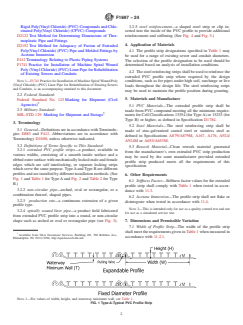
FIG. 1 Type A-Typical PVC Profile Strip
F1697 − 24
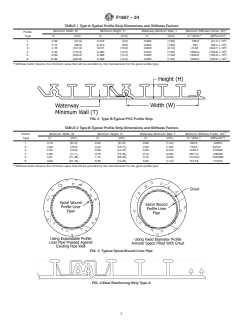
TABLE 1 Type A-Typical Profile Strip Dimensions and Stiffness Factors
A
Minimum Width, W Minimum Height, H Waterway Minimum Wall, T Minimum Stiffness Factor, (EI)
Profile
3 2 3
Type
in. (mm) in. (mm) in. (mm) in. -lbf/in. (MPa-mm )
1 2.00 (51.0) 0.216 (5.5) 0.063 (1.60) 188.0 (21.2 × 10 )
2 3.14 (80.0) 0.314 (8.0) 0.063 (1.60) 561 (63.4 × 10 )
3 4.76 (121.0) 0.511 (13.0) 0.083 (2.10) 2148 (242.7 × 10 )
4 4.33 (110.0) 0.480 (12.2) 0.040 (1.00) 1600.0 (180.8 × 10 )
5 8.00 (203.2) 0.488 (12.4) 0.060 (1.50) 1600.0 (180.8 × 10 )
6 12.00 (304.8) 0.488 (12.4) 0.060 (1.50) 1600.0 (180.8 × 10 )
A
Stiffness factor listed is the minimum value that will be provided by the manufacturer for the given profile type.
FIG. 2 Type B-Typical PVC Profile Strip
TABLE 2 Type B-Typical Profile Strip Dimensions and Stiffness Factors
A
Minimum Width, W Minimum Height, H Waterway Minimum Wall, T Minimum Stiffness Factor, (EI)
Profile
3 2 3
Type
in. (mm) in. (mm) in. (mm) in. -lbf/in. (MPa-mm )
1 3.19 (81.0) 0.32 (8.10) 0.06 (1.44) 362.5 40955
2 3.09 (78.3) 0.42 (10.71) 0.06 (1.62) 745.0 84127
3 2.84 (72.0) 0.58 (14.67) 0.09 (2.34) 1946.3 219900
4 2.80 (71.1) 0.76 (19.35) 0.12 (3.06) 3971.0 448656
5 2.81 (71.28) 1.12 (28.53) 0.15 (3.69) 14116.0 1594900
6 3.60 (91.44) 0.56 (14.22) 0.06 (1.44) 1513.8 171042
A
Stiffness factor listed is the minimum value that will be provided by the manufacturer for the given profile type.
FIG. 3 Typical Spiral-Wound Liner Pipe
FIG. 4 Steel Reinforcing Strip Type A
F1697 − 24
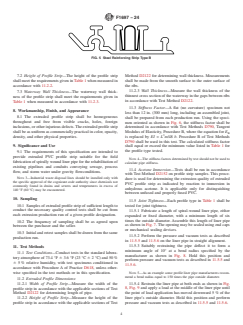
FIG. 5 Steel Reinforcing Strip Type B
7.2 Height of Profile Strip—The height of the profile strip Method D2122 for determining wall thickness. Measurements
shall meet the requirements given in Table 1 when measured in shall be made from the smooth surface to the outer surface of
accordance with 11.2.2. the ribs.
11.2.3 Wall Thickness—Measure the wall thickness of the
7.3 Waterway Wall Thickness—The waterway wall thick-
thinnest cross section of the waterway in the gaps betwe
...
This document is not an ASTM standard and is intended only to provide the user of an ASTM standard an indication of what changes have been made to the previous version. Because
it may not be technically possible to adequately depict all changes accurately, ASTM recommends that users consult prior editions as appropriate. In all cases only the current version
of the standard as published by ASTM is to be considered the official document.
Designation: F1697 − 18 F1697 − 24
Standard Specification for
Poly(Vinyl Chloride) (PVC) Profile Strip for Machine Spiral-
Wound Liner Pipe Rehabilitation of Existing Sewers and
1,2
Conduit
This standard is issued under the fixed designation F1697; the number immediately following the designation indicates the year of
original adoption or, in the case of revision, the year of last revision. A number in parentheses indicates the year of last reapproval. A
superscript epsilon (´) indicates an editorial change since the last revision or reapproval.
1. Scope*
1.1 This specification covers requirements and test methods for materials, dimensions, workmanship, stiffness factor, extrusion
quality, and a form of marking for extruded poly(vinyl chloride) (PVC) profile strips used for machine made field fabrication of
spirally wound pipe liners in the rehabilitation of a variety of gravity applications such as sanitary sewers, storm sewers, and
process piping in diameters of 6 to 180 in. and for similar sizes of non-circular pipelines such as arched or oval shapes and
rectangular shapes.
1.2 Profile strip produced to this specification is for use in field fabrication of spirally wound liner pipes in nonpressure sewer and
conduit rehabilitation, where the spirally wound liner pipe is expanded until it presses against the interior surface of the existing
sewer or conduit, or, alternatively, where the spirally wound liner pipe is inserted as a fixed diameter into the existing sewer or
conduit and the annular space between the liner pipe and the existing sewer or conduit is grouted.
1.3 This specification includes extruded profile strips made only from materials specified in 5.1.
1.4 The values stated in inch-pound units are to be regarded as standard. The values given in parentheses are mathematical
conversions to SI units that are provided for information only and are not considered standard.
1.5 The following precautionary caveat pertains only to the test method portion, Section 11, of this specification: This standard
does not purport to address all of the safety concerns, if any, associated with its use. It is the responsibility of the user of this
standard to establish appropriate safety, health, and environmental practices and determine the applicability of regulatory
limitations prior to use.
1.6 This international standard was developed in accordance with internationally recognized principles on standardization
established in the Decision on Principles for the Development of International Standards, Guides and Recommendations issued
by the World Trade Organization Technical Barriers to Trade (TBT) Committee.
This specification is under the jurisdiction of ASTM Committee F17 on Plastic Piping Systems and is the direct responsibility of Subcommittee F17.67 on Trenchless
Plastic Pipeline Technology.
Current edition approved April 1, 2018April 1, 2024. Published July 2018April 2024. Originally approved in 1996. Last previous edition approved in 20152018 as
F1697–09(2015).F1697–18. DOI: 10.1520/F1697-18.10.1520/F1697-24.
The rehabilitation of existing pipelines and conduits by the insertion of a spiral wound liner pipe is covered by patents. (RibLoc Group Limited, Dry Creek, South
Australia, Australia and Danby of North America, Inc., Cary, NC, USA). Interested parties are invited to submit information regarding the identification of acceptable
alternatives to this patented item to the Committee on Standards, ASTM Headquarters, 100 Barr Harbor Drive, West Conshohocken, PA 19428-2959. Your comments will
receive careful consideration at a meeting of the responsible technical committee which you may attend.
*A Summary of Changes section appears at the end of this standard
Copyright © ASTM International, 100 Barr Harbor Drive, PO Box C700, West Conshohocken, PA 19428-2959. United States
F1697 − 24
2. Referenced Documents
2.1 ASTM Standards:
A167 Specification for Stainless and Heat-Resisting Chromium-Nickel Steel Plate, Sheet, and Strip (Withdrawn 2014)
A176 Specification for Stainless and Heat-Resisting Chromium Steel Plate, Sheet, and Strip (Withdrawn 2015)
A653/A653M Specification for Steel Sheet, Zinc-Coated (Galvanized) or Zinc-Iron Alloy-Coated (Galvannealed) by the
Hot-Dip Process
A879/A879M Specification for Steel Sheet, Zinc Coated by the Electrolytic Process for Applications Requiring Designation of
the Coating Mass on Each Surface
A924/A924M Specification for General Requirements for Steel Sheet, Metallic-Coated by the Hot-Dip Process
D618 Practice for Conditioning Plastics for Testing
D790 Test Methods for Flexural Properties of Unreinforced and Reinforced Plastics and Electrical Insulating Materials
D883 Terminology Relating to Plastics
D1600 Terminology for Abbreviated Terms Relating to Plastics (Withdrawn 2024)
D1784 Classification System and Basis for Specification for Rigid Poly(Vinyl Chloride) (PVC) Compounds and Chlorinated
Poly(Vinyl Chloride) (CPVC) Compounds
D2122 Test Method for Determining Dimensions of Thermoplastic Pipe and Fittings
D2152 Test Method for Adequacy of Fusion of Extruded Poly(Vinyl Chloride) (PVC) Pipe and Molded Fittings by Acetone
Immersion
F412 Terminology Relating to Plastic Piping Systems
F1741 Practice for Installation of Machine Spiral Wound Poly (Vinyl Chloride) (PVC) Liner Pipe for Rehabilitation of Existing
Sewers and Conduits
NOTE 1—F1741 Practice for Installation of Machine Spiral Wound Poly (Vinyl Chloride) (PVC) Liner Pipe for Rehabilitation of Existing Sewers and
Conduits, is an accompanying standard to this document.
2.2 Federal Standard:
Federal Standard No. 123 Marking for Shipment (Civil Agencies)
2.3 Military Standard:
MIL-STD-129 Marking for Shipment and Storage
3. Terminology
3.1 General—Definitions are in accordance with Terminologies D883 and F412. Abbreviations are in accordance with
Terminology D1600, unless otherwise indicated.
3.2 Definitions of Terms Specific to This Standard:
3.2.1 extruded PVC profile strips—a product, available in various widths, consisting of a smooth inside surface and a ribbed outer
surface with mechanically locked male and female edges which are self interlocking, or separate locking strips which serve the
same purpose. Type A and Type B are different profiles and are installed by different installation methods. (See Fig. 1 and Table
NOTE 1—For values of width, height, and waterway minimum wall, see Table 1.
FIG. 1 Type A-Typical PVC Profile Strip
For referenced ASTM standards, visit the ASTM website, www.astm.org, or contact ASTM Customer Service at service@astm.org. For Annual Book of ASTM Standards
volume information, refer to the standard’s Document Summary page on the ASTM website.
The last approved version of this historical standard is referenced on www.astm.org.
Available from DLA Document Services, Building 4D, 700 Robbins Ave., Philadelphia, PA 19111-5094, http://quicksearch.dla.mil.
F1697 − 24
1 for Type A and Fig. 2 and Table 2 for Type B.)
3.2.2 non-circular pipe—arched, oval or rectangular, or a combination thereof, shaped pipes.
3.2.3 production run—a continuous extrusion of a given profile type.
3.2.4 spirally wound liner pipe—a product field fabricated from extruded PVC profile strip into a round, or non-circular shape such
as arched or oval or rectangular pipe (see Fig. 3).
3.2.5 steel reinforcement—a shaped steel strip or clip inserted into the inside of the PVC profile to provide additional
reinforcement and stiffening (See Fig. 4 and Fig. 5.)
4. Application of Materials
4.1 The profile strip designations specified in Table 1 may be used for a range of existing sewer and conduit diameters. The
selection of the profile designation to be used should be determined based on analysis of installation conditions.
4.2 The steel reinforcing strips shall be used to reinforce the extruded PVC profile strip where required by the design conditions,
such as for pipes under high soil, surcharge or live loads throughout the design life. The steel reinforcing strips may be used to
maintain the profile position during grouting.
5. Materials and Manufacture
5.1 PVC Materials—The extruded profile strip shall be made from PVC compound meeting all the minimum requirements for Cell
Classifications 13354 (for Type A) or 12344or 15233 (for Type B) or higher, as defined in Specification D1784.
5.2 Steel Materials—The steel reinforcing strip shall be made of zinc-galvanized coated steel or stainless steel as defined in
Specifications A879/A879M, A167, A176, A924/A924M or A653/A653M.
5.3 Rework Material—Clean rework material generated from the manufacturer’s own extruded PVC strip production may be used
by the same manufacturer provided extruded profile strip produced meets all the requirements of this specification.
6. Other Requirements
6.1 Stiffness Factor—Stiffness factor values for the extruded profile strip shall comply with Table 1 when tested in accordance with
11.3.
6.2 Acetone Immersion—The profile strip shall not flake or disintegrate when tested in accordance with 11.4.
NOTE 2—This is intended only for use as a quality control test and not for use as a simulated service test.
7. Dimensions and Permissible Variation
7.1 Width of Profile Strip—The width of the profile strip shall meet the requirements given in Table 1 when measured in
accordance with 11.2.1.
TABLE 1 Type A-Typical Profile Strip Dimensions and Stiffness Factors
A
Minimum Width, W Minimum Height, H Waterway Minimum Wall, T Minimum Stiffness Factor, (EI)
Profile
3 2 3
Type
in. (mm) in. (mm) in. (mm) in. -lbf/in. (MPa-mm )
1 2.00 (51.0) 0.216 (5.5) 0.063 (1.60) 188.0 (21.2 × 10 )
2 3.14 (80.0) 0.314 (8.0) 0.063 (1.60) 561 (63.4 × 10 )
3 4.76 (121.0) 0.511 (13.0) 0.083 (2.10) 2148 (242.7 × 10 )
4 4.33 (110.0) 0.480 (12.2) 0.040 (1.00) 1600.0 (180.8 × 10 )
5 8.00 (203.2) 0.488 (12.4) 0.060 (1.50) 1600.0 (180.8 × 10 )
6 12.00 (304.8) 0.488 (12.4) 0.060 (1.50) 1600.0 (180.8 × 10 )
A
Stiffness factor listed is the minimum value that will be provided by the manufacturer for the given profile type.
F1697 − 24
FIG. 2 Type B-Typical PVC Profile Strip
TABLE 2 Type B-Typical Profile Strip Dimensions and Stiffness Factors
A
Minimum Width, W Minimum Height, H Waterway Minimum Wall, T Minimum Stiffness Factor, (EI)
Profile
3 2 3
Type
in. (mm) in. (mm) in. (mm) in. -lbf/in. (MPa-mm )
1 3.19 (81.0) 0.32 (8.10) 0.06 (1.44) 362.5 40955
2 3.09 (78.3) 0.42 (10.71) 0.06 (1.62) 745.0 84127
3 2.84 (72.0) 0.58 (14.67) 0.09 (2.34) 1946.3 219900
4 2.80 (71.1) 0.76 (19.35) 0.12 (3.06) 3971.0 448656
5 2.81 (71.28) 1.12 (28.53) 0.15 (3.69) 14116.0 1594900
6 3.60 (91.44) 0.56 (14.22) 0.06 (1.44) 1513.8 171042
A
Stiffness factor listed is the minimum value that will be provided by the manufacturer for the given profile type.
FIG. 3 Typical Spiral-Wound Liner Pipe
FIG. 4 Steel Reinforcing Strip Type A
FIG. 5 Steel Reinforcing Strip Type B
7.2 Height of Profile Strip—The height of the profile strip shall meet the requirements given in Table 1 when measured in
accordance with 11.2.2.
F1697 − 24
7.3 Waterway Wall Thickness—The waterway wall thickness of the profile strip shall meet the requirements given in Table 1 when
measured in accordance with 11.2.3.
8. Workmanship, Finish, and Appearance
8.1 The extruded profile strip shall be homogeneous throughout and free from visible cracks, holes, foreign inclusions, or other
injurious defects. The extruded profile strip shall be as uniform as commercially practical in color, opacity, density, and other
physical
...