

ASTM F1871-24
(Specification)Standard Specification for Folded/Formed Poly-(Vinyl Chloride) Pipe Type A for Existing Sewer and Conduit Rehabilitation
General Information
- Abstract
SCOPE
1.1 This specification covers requirements and test methods for materials, dimensions, workmanship, flattening resistance, impact resistance, pipe stiffness, extrusion quality, and a form of marking for folded/formed poly-(vinyl chloride) (PVC) pipe for existing sewer and conduit rehabilitation.
1.2 Folded pipe produced to this specification is for use in non-pressure sewer and conduit rehabilitation where the folded PVC pipe is installed into and then expanded to provide a close fit to the wall of the original conduit, forming a new structural pipe-within-a-pipe.
Note 1: For installation procedures and design calculations refer to Practice F1867.
1.3 This specification includes pipe made only from materials specified in Section 6. This specification does not include folded pipe manufactured from reprocessed, recycled, or reclaimed PVC.
1.4 The values stated in inch-pound units are to be regarded as standard. The values given in parentheses are mathematical conversions to SI units that are provided for information only and are not considered standard.
1.5 There is no similar or equivalent ISO Standard.
1.6 The following precautionary statement pertains only to the test method portion, Section 11, of this specification. This standard does not purport to address all of the safety concerns, if any, associated with its use. It is the responsibility of the user of this standard to establish appropriate safety, health, and environmental practices and determine the applicability of regulatory limitations prior to use.
1.7 This international standard was developed in accordance with internationally recognized principles on standardization established in the Decision on Principles for the Development of International Standards, Guides and Recommendations issued by the World Trade Organization Technical Barriers to Trade (TBT) Committee.
- Status
- Published
- Publication Date
- 31-Jan-2024
- Technical Committee
- F17 - Plastic Piping Systems
- Drafting Committee
- F17.67 - Trenchless Plastic Pipeline Technology
Buy Documents
ASTM F1871-24 - Standard Specification for Folded/Formed Poly-(Vinyl Chloride) Pipe Type A for Existing Sewer and Conduit Rehabilitation
REDLINE ASTM F1871-24 - Standard Specification for Folded/Formed Poly-(Vinyl Chloride) Pipe Type A for Existing Sewer and Conduit Rehabilitation
Overview
ASTM F1871-24 is the internationally recognized standard specification for folded or formed poly-(vinyl chloride) (PVC) pipe, Type A, designed for the rehabilitation of existing sewer and conduit systems. Issued by ASTM International, this specification covers the requirements for materials, dimensions, mechanical properties, workmanship, and quality control methods for folded/formed PVC pipe intended for non-pressure applications, where a PVC liner is inserted and expanded to fit closely against the old conduit, forming a new structural "pipe-within-a-pipe."
This standard was developed by ASTM Committee F17 on Plastic Piping Systems and is primarily used by designers, engineers, and regulators focused on trenchless sewer and conduit rehabilitation.
Key Topics
Scope and Material Requirements
- Specifies requirements for virgin PVC compound only, excluding reprocessed or recycled materials.
- Covers critical attributes such as tensile strength, flexural modulus, heat deflection, pipe stiffness, flattening resistance, and impact resistance.
- Outlines dimensional and appearance tolerances, including average outside diameter and minimum wall thickness for a variety of pipe sizes.
Testing and Quality Assurance
- Mandates comprehensive testing for product performance, including:
- Pipe flattening and impact resistance
- Extrusion quality via acetone immersion and heat reversion tests
- Flexural properties and pipe stiffness
- Provides specific test methods for preparation and evaluation of samples, referencing ASTM standards like D638 (tensile properties) and D790 (flexural properties).
- Sets product marking and certification requirements, ensuring clear identification and traceability.
Installation and Manufacturing
- Folded/formed PVC pipe is supplied in a compact shape for insertion into existing pipes and then expanded to closely fit the existing conduit, restoring structural integrity and hydraulics.
- Only clean rework from the manufacturer’s production that meets all property requirements may be reused.
- Packaging and shipping routines require pipe to be coiled on spools of specified minimum diameter for protection during transport and storage.
Applications
- Trenchless Rehabilitation: The standard supports trenchless technology methods, where existing underground non-pressure sewer and conduit infrastructure can be renewed without extensive excavation.
- Structural Pipe Lining: Folded/formed PVC pipe provides a cost-effective solution for creating a durable, corrosion-resistant new liner, ideal for aging municipal sewer and conduit systems.
- Industrial and Institutional Use: With its strict material and mechanical requirements, this standard applies to environments encountering typical sewer and stormwater flows. Use in industrial settings with higher temperature or chemical exposure must be approved by appropriate code authorities.
Practical Value:
- Enables extended service life for aging sewers
- Reduces downtime and surface disruption during rehabilitation
- Ensures consistent quality and safety via standardized product and testing requirements
Related Standards
The following ASTM standards are directly referenced or relevant when using ASTM F1871-24:
- ASTM D1784: PVC Compound Specifications
- ASTM F1867: Installation Best Practices for Folded/Formed PVC Pipe
- ASTM D618: Conditioning Plastics for Testing
- ASTM D638/D790: Mechanical Properties of Plastics
- ASTM D2122/D2412/D2444: Test Methods for Pipe Dimensions, Stiffness, and Impact Resistance
- ASTM F412: Plastic Piping Systems Terminology
- ASTM F1057: Quality of Extruded PVC Pipe (Heat Reversion)
- Federal Standard No. 123 & MIL-STD-129: Marking for Shipment
Note: This ASTM standard has no ISO equivalent, making it the primary reference for folded/formed PVC pipe used in sewer and conduit rehabilitation worldwide.
Keywords: folded PVC pipe, formed PVC pipe, sewer rehabilitation, trenchless technology, ASTM F1871, conduit rehabilitation, non-pressure pipe lining, plastic pipe standards, ASTM plastic piping, pipe-within-a-pipe installation.
Relations
- Effective Date
- 01-Feb-2024
- Effective Date
- 01-Feb-2024
Buy Documents
ASTM F1871-24 - Standard Specification for Folded/Formed Poly-(Vinyl Chloride) Pipe Type A for Existing Sewer and Conduit Rehabilitation
REDLINE ASTM F1871-24 - Standard Specification for Folded/Formed Poly-(Vinyl Chloride) Pipe Type A for Existing Sewer and Conduit Rehabilitation
Get Certified
Connect with accredited certification bodies for this standard

DIN CERTCO
DIN Group product certification.
Institut za varilstvo d.o.o. (Welding Institute)
Slovenia's leading welding institute since 1952. ISO 3834, EN 1090, pressure equipment certification, NDT personnel, welder qualification. Only IIW Au

Smithers Quality Assessments
US management systems and product certification.
Sponsored listings
Frequently Asked Questions
ASTM F1871-24 is a technical specification published by ASTM International. Its full title is "Standard Specification for Folded/Formed Poly-(Vinyl Chloride) Pipe Type A for Existing Sewer and Conduit Rehabilitation". This standard covers: SCOPE 1.1 This specification covers requirements and test methods for materials, dimensions, workmanship, flattening resistance, impact resistance, pipe stiffness, extrusion quality, and a form of marking for folded/formed poly-(vinyl chloride) (PVC) pipe for existing sewer and conduit rehabilitation. 1.2 Folded pipe produced to this specification is for use in non-pressure sewer and conduit rehabilitation where the folded PVC pipe is installed into and then expanded to provide a close fit to the wall of the original conduit, forming a new structural pipe-within-a-pipe. Note 1: For installation procedures and design calculations refer to Practice F1867. 1.3 This specification includes pipe made only from materials specified in Section 6. This specification does not include folded pipe manufactured from reprocessed, recycled, or reclaimed PVC. 1.4 The values stated in inch-pound units are to be regarded as standard. The values given in parentheses are mathematical conversions to SI units that are provided for information only and are not considered standard. 1.5 There is no similar or equivalent ISO Standard. 1.6 The following precautionary statement pertains only to the test method portion, Section 11, of this specification. This standard does not purport to address all of the safety concerns, if any, associated with its use. It is the responsibility of the user of this standard to establish appropriate safety, health, and environmental practices and determine the applicability of regulatory limitations prior to use. 1.7 This international standard was developed in accordance with internationally recognized principles on standardization established in the Decision on Principles for the Development of International Standards, Guides and Recommendations issued by the World Trade Organization Technical Barriers to Trade (TBT) Committee.
SCOPE 1.1 This specification covers requirements and test methods for materials, dimensions, workmanship, flattening resistance, impact resistance, pipe stiffness, extrusion quality, and a form of marking for folded/formed poly-(vinyl chloride) (PVC) pipe for existing sewer and conduit rehabilitation. 1.2 Folded pipe produced to this specification is for use in non-pressure sewer and conduit rehabilitation where the folded PVC pipe is installed into and then expanded to provide a close fit to the wall of the original conduit, forming a new structural pipe-within-a-pipe. Note 1: For installation procedures and design calculations refer to Practice F1867. 1.3 This specification includes pipe made only from materials specified in Section 6. This specification does not include folded pipe manufactured from reprocessed, recycled, or reclaimed PVC. 1.4 The values stated in inch-pound units are to be regarded as standard. The values given in parentheses are mathematical conversions to SI units that are provided for information only and are not considered standard. 1.5 There is no similar or equivalent ISO Standard. 1.6 The following precautionary statement pertains only to the test method portion, Section 11, of this specification. This standard does not purport to address all of the safety concerns, if any, associated with its use. It is the responsibility of the user of this standard to establish appropriate safety, health, and environmental practices and determine the applicability of regulatory limitations prior to use. 1.7 This international standard was developed in accordance with internationally recognized principles on standardization established in the Decision on Principles for the Development of International Standards, Guides and Recommendations issued by the World Trade Organization Technical Barriers to Trade (TBT) Committee.
ASTM F1871-24 is classified under the following ICS (International Classification for Standards) categories: 23.040.20 - Plastics pipes; 83.080.20 - Thermoplastic materials. The ICS classification helps identify the subject area and facilitates finding related standards.
ASTM F1871-24 has the following relationships with other standards: It is inter standard links to ASTM F1871-20, ASTM F1867-22. Understanding these relationships helps ensure you are using the most current and applicable version of the standard.
ASTM F1871-24 is available in PDF format for immediate download after purchase. The document can be added to your cart and obtained through the secure checkout process. Digital delivery ensures instant access to the complete standard document.
Standards Content (Sample)
This international standard was developed in accordance with internationally recognized principles on standardization established in the Decision on Principles for the
Development of International Standards, Guides and Recommendations issued by the World Trade Organization Technical Barriers to Trade (TBT) Committee.
Designation: F1871 − 24
Standard Specification for
Folded/Formed Poly-(Vinyl Chloride) Pipe Type A for
Existing Sewer and Conduit Rehabilitation
This standard is issued under the fixed designation F1871; the number immediately following the designation indicates the year of
original adoption or, in the case of revision, the year of last revision. A number in parentheses indicates the year of last reapproval. A
superscript epsilon (´) indicates an editorial change since the last revision or reapproval.
1. Scope* mendations issued by the World Trade Organization Technical
Barriers to Trade (TBT) Committee.
1.1 This specification covers requirements and test methods
for materials, dimensions, workmanship, flattening resistance,
2. Referenced Documents
impact resistance, pipe stiffness, extrusion quality, and a form
of marking for folded/formed poly-(vinyl chloride) (PVC) pipe 2.1 ASTM Standards:
for existing sewer and conduit rehabilitation.
D618 Practice for Conditioning Plastics for Testing
D638 Test Method for Tensile Properties of Plastics
1.2 Folded pipe produced to this specification is for use in
D648 Test Method for Deflection Temperature of Plastics
non-pressure sewer and conduit rehabilitation where the folded
Under Flexural Load in the Edgewise Position
PVC pipe is installed into and then expanded to provide a close
D790 Test Methods for Flexural Properties of Unreinforced
fit to the wall of the original conduit, forming a new structural
and Reinforced Plastics and Electrical Insulating Materi-
pipe-within-a-pipe.
als
NOTE 1—For installation procedures and design calculations refer to
D1600 Terminology for Abbreviated Terms Relating to Plas-
Practice F1867.
tics (Withdrawn 2024)
1.3 This specification includes pipe made only from mate-
D1784 Classification System and Basis for Specification for
rials specified in Section 6. This specification does not include
Rigid Poly(Vinyl Chloride) (PVC) Compounds and Chlo-
folded pipe manufactured from reprocessed, recycled, or re-
rinated Poly(Vinyl Chloride) (CPVC) Compounds
claimed PVC.
D2122 Test Method for Determining Dimensions of Ther-
1.4 The values stated in inch-pound units are to be regarded
moplastic Pipe and Fittings
as standard. The values given in parentheses are mathematical
D2152 Test Method for Adequacy of Fusion of Extruded
conversions to SI units that are provided for information only
Poly(Vinyl Chloride) (PVC) Pipe and Molded Fittings by
and are not considered standard.
Acetone Immersion
D2412 Test Method for Determination of External Loading
1.5 There is no similar or equivalent ISO Standard.
Characteristics of Plastic Pipe by Parallel-Plate Loading
1.6 The following precautionary statement pertains only to
D2444 Practice for Determination of the Impact Resistance
the test method portion, Section 11, of this specification. This
of Thermoplastic Pipe and Fittings by Means of a Tup
standard does not purport to address all of the safety concerns,
(Falling Weight)
if any, associated with its use. It is the responsibility of the user
F412 Terminology Relating to Plastic Piping Systems
of this standard to establish appropriate safety, health, and
F1057 Practice for Estimating the Quality of Extruded Poly
environmental practices and determine the applicability of
(Vinyl Chloride) (PVC) Pipe by the Heat Reversion
regulatory limitations prior to use.
Technique
1.7 This international standard was developed in accor-
dance with internationally recognized principles on standard- F1867 Practice for Installation of Folded/Formed Poly (Vi-
ization established in the Decision on Principles for the nyl Chloride) (PVC) Pipe Type A for Existing Sewer and
Development of International Standards, Guides and Recom- Conduit Rehabilitation
1 2
This specification is under the jurisdiction of Committee F17 on Plastic Piping For referenced ASTM standards, visit the ASTM website, www.astm.org, or
Systems and is the direct responsibility of Subcommittee F17.67 on Trenchless contact ASTM Customer Service at service@astm.org. For Annual Book of ASTM
Plastic Pipeline Technology. Standards volume information, refer to the standard’s Document Summary page on
Current edition approved Feb. 1, 2024. Published February 2024. Originally the ASTM website.
approved in 1998. Last previous edition approved in 2020 as F1871-20. DOI: The last approved version of this historical standard is referenced on
10.1520/F1871-24. www.astm.org.
*A Summary of Changes section appears at the end of this standard
Copyright © ASTM International, 100 Barr Harbor Drive, PO Box C700, West Conshohocken, PA 19428-2959. United States
F1871 − 24
2.2 Federal Standard: squeegee device or similar device to provide a close fit to the
Fed. Std. No. 123 Marking for Shipment (Civil Agencies) existing pipe (see Fig. 1).
2.3 Military Standard:
3.2.3 rounded pipe sample, n—A folded pipe that has been
MIL-STD-129 Marking for Shipment and Storage
inserted into a pipe mold and expanded with heat and pressure
to conform to the mold pipe, intended for testing purposes.
3. Terminology
3.2.3.1 Discussion—A “field sample” can be formed in the
3.1 Definitions—Definitions are in accordance with Termi-
same manner as a rounded pipe sample.
nology F412, and abbreviations are in accordance with Termi-
nology D1600, unless otherwise specified. The abbreviation for
4. Significance and Use
poly(vinyl chloride) plastics is PVC.
4.1 This specification is for use by designers and specifiers,
3.1.1 The term TYPE A is not an abbreviation, but rather an
regulatory agencies, owners, and inspection organizations who
arbitrary designation for PVC compounds with a minimum
are involved in the rehabilitation of non-pressure sewers and
value for modulus in tension as listed in 6.1.
conduits. Modifications may be required, depending on specific
3.2 Definitions of Terms Specific to This Standard:
job conditions, to establish a project specification. The manu-
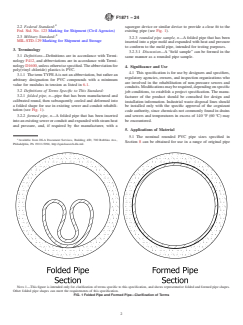
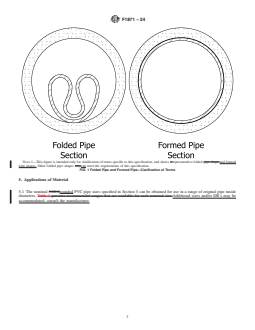
3.2.1 folded pipe, n—pipe that has been manufactured and
facturer of the product should be consulted for design and
calibrated round, then subsequently cooled and deformed into
installation information. Industrial waste disposal lines should
a folded shape for use in existing sewer and conduit rehabili-
be installed only with the specific approval of the cognizant
tation (see Fig. 1).
code authority, since chemicals not commonly found in drains
and sewers and temperatures in excess of 140 °F (60 °C) may
3.2.2 formed pipe, n—A folded pipe that has been inserted
be encountered.
into an existing sewer or conduit and expanded with steam heat
and pressure, and, if required by the manufacturer, with a
5. Applications of Material
5.1 The nominal rounded PVC pipe sizes specified in
Available from DLA Document Services, Building 4/D, 700 Robbins Ave.,
Section 8 can be obtained for use in a range of original pipe
Philadelphia, PA 19111-5094, http://quicksearch.dla.mil.
NOTE 1—This figure is intended only for clarification of terms specific to this specification, and shows representative folded and formed pipe shapes.
Other folded pipe shapes can meet the requirements of this specification.
FIG. 1 Folded Pipe and Formed Pipe—Clarification of Terms
F1871 − 24
inside diameters. Additional sizes and/or DR’s may be accom- 7.4.2 Heat Reversion—The pipe extrusion quality shall be
modated; consult the manufacturer. estimated by heat reversion method in accordance with 11.7.2.
7.5 Flexural Properties—Flexural modulus of elasticity val-
6. Materials and Manufacture
ues for the rounded pipe shall comply with 6.1 when tested in
6.1 Basic Materials—The folded pipe shall be made from accordance with 11.7.3.
virgin PVC compound meeting all the requirements for cell
classification 12111 or 32111 as defined in Specification D1784
8. Dimensions, Mass, and Permissible Variations
and with minimum physical properties as listed below:
8.1 Rounded Pipe Diameter—The average outside diameter
Tensile Strength Test Method D638 3 600 PSI (25 MPa)
of the rounded pipe shall meet the requirements given in Table
Tensile Modulus Test Method D638 155 000 PSI (1069 MPa)
3 when measured in accordance with 11.3.1.
Flexural Strength Test Method D790 4 100 PSI (28 MPa)
Flexural Modulus Test Method D790 145 000 PSI (1000 MPa)
8.2 Rounded Pipe Wall Thickness—The pipe wall thickness
Heat Deflection Test Method D648 115 °F (46 °C)
of the rounded pipe shall not be less than the values specified
Temperature tested at (2 MPa)
264 psi
in Table 4 when measured in accordance with 11.3.2.
6.1.1 Compounds meeting the above minimum properties
9. Workmanship, Finish, and Appearance
that have different cell classifications because one or more
properties are greater than those of the specified compounds
9.1 The folded, formed, and/or rounded pipe shall be
are also acceptable.
homogeneous throughout and free from visible cracks, holes,
6.2 Rework Material—Clean rework material from this type foreign inclusions, or other injurious defects. The pipe shall be
as uniform as commercially practical in color, opacity, density,
of pipe, generated from the manufacturer’s own production
may be used by the same manufacturer, provided that the and other physical properties.
rework material meets all the requirements of 6.1 and that the
rounded pipe produced meets all the requirements of this 10. Sampling
specification.
10.1 The rounded pipe sample preparation shall involve the
unfolding and expanding of a folded pipe within a pipe mold
7. Other Requirements (Typically Evaluated on Rounded
with an inside diameter equal to the nominal outside diameter
Pipe Samples)
as shown in Table 4. A folded pipe of sufficient length, 10 ft (3
7.1 Pipe Flattening—There shall be no evidence of m) minimum, to complete the testing requirements shall be
splitting, cracking, or breaking when the rounded pipe is tested
inserted into the pipe mold and secured at the ends. The
in accordance with 11.4. assembly shall then be placed in an enclosed chamber for
heating. Ambient pressure steam shall be applied to the
7.2 Pipe Impact Resistance—The impact resistance of
chamber for at least 15-min at a minimum temperature of
rounded pipe shall not be less than the values specified in Table
200 °F (93 °C). While maintaining the minimum 200 °F
1 when tested in accordance with 11.5.
(93 °C) temperature, the folded pipe shall then be formed by
NOTE 2—This test is intended only for use as a quality control test, not
applying internal steam pressure at 5 psig (34 kPa) minimum
as a simulated service test.
for a period of at least 2 minutes. While maintaining the
7.3 Pipe Stiffness—Pipe stiffness values for the rounded
internal pressure, transition to air pressure and cool the sample
pipe shall comply with Table 2, when tested in accordance with
to 100 °F (38 °C) or less. Remove the rounded sample from the
11.6.
mold for testing.
7.4 Extrusion Quality—The adequacy of fusion and the
11. Test Methods
extrusion quality of the rounded pipe shall be evaluated by the
test methods specified in 7.4.1 and 7.4.2, respectively.
11.1 Test Conditions—Conduct tests in the Standard Labo-
7.4.1 Acetone Immersion—The pipe shall not flake or dis-
ratory Atmosphere of 73 °F 6 4 °F (23 °C 6 2 °C) and 50 %
integrate when tested in accordance with 11.7.1.
6 10 % relative humidity, with test specimens conditioned in
accordance with Procedure A of Test Methods D618, unless
otherwise specified in the test methods or in this specification.
TABLE 1 Minimum Impact Resistance at 73 °F (23 °C) 11.2 Test Frequency:
11.2.1 The frequency of testing shall be as agreed upon by
Nominal Rounded Pipe Size, Impact Energy (J)
NPS
the purchaser and the seller. If no frequency is specified, the
Inch/Pound Units
minimum frequency should be once per production run.
4 150
Rounded pipe samples for testing should be prepared in
6-8 210
accordance with Section 10.
8-48 220
Nominal Rounded Pipe Size, Impact Energy (J)
11.2.2 Retest samples shall be drawn from the same pro-
DN
duction shift within the same production run.
SI (Metric) Units
100 204
11.3 Rounded Pipe Dimensions:
150–200 284
11.3.1 Pipe Diameters—Measure the outside diameter of
225–1200 299
the pipe in accordance with the applicable section of Test
----------------------
...
This document is not an ASTM standard and is intended only to provide the user of an ASTM standard an indication of what changes have been made to the previous version. Because
it may not be technically possible to adequately depict all changes accurately, ASTM recommends that users consult prior editions as appropriate. In all cases only the current version
of the standard as published by ASTM is to be considered the official document.
Designation: F1871 − 20 F1871 − 24
Standard Specification for
Folded/Formed Poly (Vinyl Poly-(Vinyl Chloride) Pipe Type A
for Existing Sewer and Conduit Rehabilitation
This standard is issued under the fixed designation F1871; the number immediately following the designation indicates the year of
original adoption or, in the case of revision, the year of last revision. A number in parentheses indicates the year of last reapproval. A
superscript epsilon (´) indicates an editorial change since the last revision or reapproval.
1. Scope*
1.1 This specification covers requirements and test methods for materials, dimensions, workmanship, flattening resistance, impact
resistance, pipe stiffness, extrusion quality, and a form of marking for folded/formed poly (vinyl poly-(vinyl chloride) (PVC) pipe
for existing sewer and conduit rehabilitation.
1.2 Pipe Folded pipe produced to this specification is for use in non-pressure sewer and conduit rehabilitation where the folded
PVC pipe is installed into and then expanded to provide a close fit to the wall of the original conduit, forming a new structural
pipe-within-a-pipe.
NOTE 1—For installation procedures and design calculations refer to Practice F1867.
1.3 This specification includes pipe made only from materials specified in Section 6. This specification does not include folded
pipe manufactured from reprocessed, recycled, or reclaimed PVC.
1.4 The values stated in inch-pound units are to be regarded as the standard. The SI units values given in parentheses are
mathematical conversions to SI units that are provided for information only.only and are not considered standard.
1.5 There is no similar or equivalent ISO Standard.
1.6 The following precautionary statement pertains only to the test method portion, Section 11, of this specification. This
standard does not purport to address all of the safety concerns, if any, associated with its use. It is the responsibility of the user
of this standard to establish appropriate safety, health, and environmental practices and determine the applicability of regulatory
limitations prior to use.
1.7 This international standard was developed in accordance with internationally recognized principles on standardization
established in the Decision on Principles for the Development of International Standards, Guides and Recommendations issued
by the World Trade Organization Technical Barriers to Trade (TBT) Committee.
2. Referenced Documents
2.1 ASTM Standards:
This specification is under the jurisdiction of Committee F17 on Plastic Piping Systems and is the direct responsibility of Subcommittee F17.67 on Trenchless Plastic
Pipeline Technology.
Current edition approved Nov. 1, 2020Feb. 1, 2024. Published November 2020February 2024. Originally approved in 1998. Last previous edition approved in 20182020
as F1871-18. DOI: 10.1520/F1871-20.-20. DOI: 10.1520/F1871-24.
For referenced ASTM standards, visit the ASTM website, www.astm.org, or contact ASTM Customer Service at service@astm.org. For Annual Book of ASTM Standards
volume information, refer to the standard’s Document Summary page on the ASTM website.
*A Summary of Changes section appears at the end of this standard
Copyright © ASTM International, 100 Barr Harbor Drive, PO Box C700, West Conshohocken, PA 19428-2959. United States
F1871 − 24
D618 Practice for Conditioning Plastics for Testing
D638 Test Method for Tensile Properties of Plastics
D648 Test Method for Deflection Temperature of Plastics Under Flexural Load in the Edgewise Position
D790 Test Methods for Flexural Properties of Unreinforced and Reinforced Plastics and Electrical Insulating Materials
D1600 Terminology for Abbreviated Terms Relating to Plastics (Withdrawn 2024)
D1784 Classification System and Basis for Specification for Rigid Poly(Vinyl Chloride) (PVC) Compounds and Chlorinated
Poly(Vinyl Chloride) (CPVC) Compounds
D2122 Test Method for Determining Dimensions of Thermoplastic Pipe and Fittings
D2152 Test Method for Adequacy of Fusion of Extruded Poly(Vinyl Chloride) (PVC) Pipe and Molded Fittings by Acetone
Immersion
D2412 Test Method for Determination of External Loading Characteristics of Plastic Pipe by Parallel-Plate Loading
D2444 Practice for Determination of the Impact Resistance of Thermoplastic Pipe and Fittings by Means of a Tup (Falling
Weight)
F412 Terminology Relating to Plastic Piping Systems
F1057 Practice for Estimating the Quality of Extruded Poly (Vinyl Chloride) (PVC) Pipe by the Heat Reversion Technique
F1867 Practice for Installation of Folded/Formed Poly (Vinyl Chloride) (PVC) Pipe Type A for Existing Sewer and Conduit
Rehabilitation
2.2 Federal Standard:
Fed. Std. No. 123 Marking for Shipment (Civil Agencies)
2.3 Military Standard:
MIL-STD-129 Marking for Shipment and Storage
3. Terminology
3.1 Definitions—Definitions are in accordance with Terminology F412, and abbreviations are in accordance with Terminology
D1600, unless otherwise specified. The abbreviation for poly(vinyl chloride) plastics is PVC.
3.1.1 The term TYPE A is not an abbreviation, but rather an arbitrary designation for PVC compounds with a minimum value for
modulus in tension as listed in 6.1.
3.2 Definitions of Terms Specific to This Standard:
3.2.1 folded pipe, n—pipe that has been manufactured and calibrated round, then subsequently cooled and deformed into a folded
shape for use in existing sewer and conduit rehabilitation (see Fig. 1).
3.2.2 formed pipe, n—A folded pipe that has been inserted into an existing sewer or conduit and expanded with steam heat and
pressure, and, if required by the manufacturer, with a squeegee device or similar device to provide a close fit to the existing pipe
(see Fig. 1).
3.2.3 formed fieldrounded pipe sample, n—A formed field sample is formed when the folded pipe folded pipe that has been
inserted into a mold pipe mold and expanded with steam heat and pressure, and, if required by the manufacturer, with a squeegee
device or similar device to provide a close fit heat and pressure to conform to the mold pipe.pipe, intended for testing purposes.
3.2.3.1 Discussion—
A “field sample” can be formed in the same manner as a rounded pipe sample.
4. Significance and Use
4.1 This specification is for use by designers and specifiers, regulatory agencies, owners, and inspection organizations who are
involved in the rehabilitation of non-pressure sewers and conduits. Modifications may be required, depending on specific job
conditions, to establish a project specification. The manufacturer of the product should be consulted for design and installation
information. Industrial waste disposal lines should be installed only with the specific approval of the cognizant code authority,
since chemicals not commonly found in drains and sewers and temperatures in excess of 140°F (60°C)140 °F (60 °C) may be
encountered.
The last approved version of this historical standard is referenced on www.astm.org.
Available from DLA Document Services, Building 4/D, 700 Robbins Ave., Philadelphia, PA 19111-5094, http://quicksearch.dla.mil.
F1871 − 24
NOTE 1—This figure is intended only for clarification of terms specific to this specification, and shows a representative folded pipe shape.and formed
pipe shapes. Other folded pipe shapes maycan meet the requirements of this specification.
FIG. 1 Folded Pipe and Formed Pipe—Clarification of Terms
5. Applications of Material
5.1 The nominal foldedrounded PVC pipe sizes specified in Section 8 can be obtained for use in a range of original pipe inside
diameters. Table 1 presents recommended ranges that are available for each nominal size.Additional sizes and/or DR’s may be
accommodated; consult the manufacturer.
F1871 − 24
6. Materials and Manufacture
6.1 Basic Materials—The folded pipe shall be made from virgin PVC compound meeting all the requirements for cell
classification 12111 or 32111 as defined in Specification D1784 and with minimum physical properties as listed below:
Tensile Strength Test Method D638 3 600 PSI (25 MPa)
Tensile Modulus Test Method D638 155 000 PSI (1069 MPa)
Flexural Strength Test Method D790 4 100 PSI (28 MPa)
Flexural Modulus Test Method D790 145 000 PSI (1000 MPa)
Heat Deflection Test Method D648 115 °F (46 °C)
Temperature tested at (2 MPa)
264 psi
6.1.1 Compounds meeting the above minimum properties that have different cell classifications because one or more properties
are greater than those of the specified compounds are also acceptable.
6.2 Rework Material—Clean rework material from this type of pipe, generated from the manufacturer’smanufacturer’s own
production may be used by the same manufacturer, provided that the rework material meets all the requirements of 6.1 and that
the rounded pipe produced meets all the requirements of this specification.
7. Other Requirements (Typically Evaluated on Rounded Pipe Samples)
7.1 Pipe Flattening—There shall be no evidence of splitting, cracking, or breaking when the rounded pipe is tested in accordance
with 11.4.
7.2 Pipe Impact Strength—Resistance—The impact strengthresistance of rounded pipe shall not be less than the values
givenspecified in Table 21 when tested in accordance with 11.5.
TABLE 1 Folded PVC Pipe Recommended Size Ranges of Use
NOTE 1—The minimum and maximum recommended existing pipe
inside diameters shown are mean inside diameters along the pipe length
and are not intended as absolute limits on localized dimensions. Consult
the manufacturer for use of folded PVC pipe for sizes of existing pipe
beyond the recommended ranges shown.
Folded Pipe Nominal Outside Diameter, Recommended Existing Resulting Installed DR Range
in. Pipe
(mm) Inside Diameter Range,
in. (mm)
DR DR 32.5 DR DR
Min Max
26 35 41
4 (102) 3.6 (91) 4.1 (104) 24-27 31-38
6 (152) 5.7 (145) 6.1 (155) 25-27 31-38
8 (203) 7.6 (193) 8.2 (208) 25-27 31-38 34-36
9 (229) 8.6 (218) 9.2 (234) 25-27 31-38 34-36
10 (254) 9.5 (241) 10.2 (259) 25-27 31-38 34-36
12 (305) 11.6 (295) 12.6 (320) 25-27 31-3834-36
15 (381) 14.5 (368) 15.4 (391) 25-27 31-38 34-36
18 (457) 17.6 (447) 18.2 (462) 34-3640-42
TABLE 1 Minimum Impact Resistance at 73 °F (23 °C)
Nominal Rounded Pipe Size, Impact Energy (J)
NPS
Inch/Pound Units
4 150
6-8 210
8-48 220
Nominal Rounded Pipe Size, Impact Energy (J)
DN
SI (Metric) Units
100 204
150–200 284
225–1200 299
F1871 − 24
NOTE 2—This test is intended only for use as a quality control test, not as a simulated service test.
7.3 Pipe Stiffness—Pipe stiffness values for the rounded pipe shall comply with Table 32, when tested in accordance with 11.6.
7.4 Extrusion Quality—The adequacy of fusion and the extrusion quality of the rounded pipe shall be evaluated by both of the
following test methods.test methods specified in 7.4.1 and 7.4.2, respectively.
7.4.1 Acetone Immersion—The pipe shall not flake or disintegrate when tested in accordance with 11.7.1.
7.4.2 Heat Reversion—The pipe extrusion quality shall be estimated by heat reversion method in accordance with 11.7.2.
7.5 Flexural Properties—Flexural modulus of elasticity values for the rounded pipe shall comply with 6.1 when tested in
accordance with 11.7.3.
TABLE 2 Minimum Impact Strength at 73 °F (23 °C)
Pipe Size, in. (mm) Impact
Strength,
ft-lbf (J)
4 (102) 150 (203)
6 (152) 210 (284)
8 (203) 210 (284)
9 (229) 220 (299)
10 (254) 220 (299)
12 (305) 220 (299)
15 (381) 220 (299)
18 (457) 220 (299)
TABLE 2 Minimum Pipe Stiffness at 5 % Deflection
Inch/Pound Units
Nominal Rounded Pipe
Pipe Stiffness, psi (lb/in/in)
Size
NPS DR 26 DR 32.5 DR 35 DR 41 DR50 DR60 DR69 DR77 DR86 DR103
4 41 22 . . . . . . . .
6 41 22 . . . . . . . .
8 41 22 16.5 . . . . . . .
9 41 22 16.5 . . . . . . .
10 41 22 16.5 . . . . . . .
12 41 22 16.5 11 . . . . . .
15 41 22 16.5 11 4.5 . . . . .
18 . . 16.5 11 4.5 . . . . .
21 . . . 11 4.5 3.1 . . . .
24 . . . . 4.5 3.1 1.8 . . .
27 . . . . . 3.1 1.8 1.1 . .
30 . . . . . 3.1 1.8 1.1 0.8 .
36 . . . . . . 1.8 1.1 0.8 0.5
42 . . . . . . . 1.1 0.8 0.5
48 . . . . . . . . 0.8 0.5
SI (Metric) Units
Nominal Rounded Pipe
Pipe Stiffness, psi (kPa)
Size
DN DR 26 DR 32.5 DR 35 DR 41 DR50 DR60 DR69 DR77 DR86 DR103
100 283 152 . . . . . . . .
150 283 152 . . . . . . . .
200 283 152 114 . . . . . . .
225 283 152 114 . . . . . . .
250 283 152 114 . . . . . . .
300 283 152 114 76 . . . . . .
375 283 152 114 76 31 . . . . .
450 . . 114 76 31 . . . . .
525 . . . 76 31 21 . . . .
600 . . . . 31 21 12 . . .
675 . . . . . 21 12 7.6 . .
750 . . . . . 21 12 7.6 5.5 .
900 . . . . . . 12 7.6 5.5 3.4
1050 . . . . . . . 7.6 5.5 3.4
1200 . . . . . . . . 5.5 3.4
F1871 − 24
8. Dimensions, Mass, and Permissible Variations
8.1 FormedRounded Pipe Diameter—The average outside diameter of the formedrounded pipe shall meet the requirements given
in Table 43 with a tolerance of plus or minus 1.0 % when measured in accordance with 11.3.1.
8.2 Rounded Pipe Wall Thickness—Formed PipeThe pipe wall thickness of the rounded pipe, when measured in accordance with
pipe 11.3.2, shall not be less than the values specified i
...