

ASTM F1698-21
(Practice)Standard Practice for Installation of Poly(Vinyl Chloride)(PVC) Profile Strip Liner and Cementitious Grout for Rehabilitation of Existing Man-Entry Sewers and Conduits
General Information
- Abstract
SIGNIFICANCE AND USE
4.1 This practice is for use by designers and specifiers, regulatory agencies, owners, and inspection organizations involved in the rehabilitation of non-pressure sewers and conduits. As for any practice, modifications may be required for specific job conditions.
SCOPE
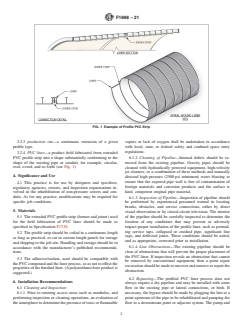
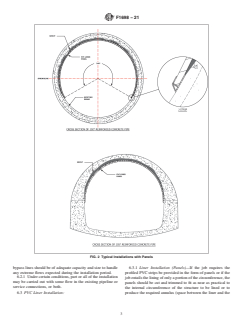
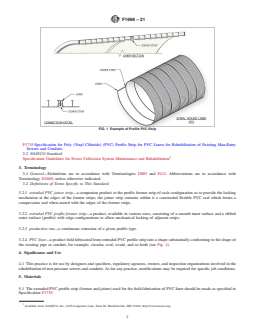
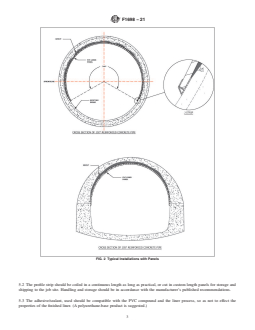
1.1 This practice describes the procedures for the rehabilitation of sewer lines and conduits by the installation of a field-fabricated PVC liner. After installation of the liner, cementitious grout is injected into the annular space between the liner and the existing sewer or conduit. The rehabilitation of the host structure by this installation practice results in a rigid composite structure (PVC/grout/existing pipe). This rehabilitation process may be used in a variety of gravity applications, such as sanitary sewers, storm sewers and process piping of man-entry sizes (36 to 144 in. in vertical dimension). The profile strips used for field fabrication of PVC liners are supplied in coils for spiral winding of the liner or in custom-cut flat panels for circumferential lining of all or any portion of the circumference of the host conduit (see Figs. 1 and 2).
FIG. 1 Example of Profile PVC Strip
FIG. 2 Typical Installations with Panels
1.2 The values stated in inch-pound units are to be regarded as standard. The values given in parentheses are mathematical conversions to SI units that are provided for information only and are not considered standard.
1.3 This standard does not purport to address all of the safety concerns, if any, associated with its use. It is the responsibility of the user of this standard to establish appropriate safety, health, and environmental practices and determine the applicability of regulatory limitations prior to use. Particular attention is drawn to those safety regulations and requirements involving entering into and working in confined spaces.
1.4 This international standard was developed in accordance with internationally recognized principles on standardization established in the Decision on Principles for the Development of International Standards, Guides and Recommendations issued by the World Trade Organization Technical Barriers to Trade (TBT) Committee.
- Status
- Published
- Publication Date
- 30-Jun-2021
- Technical Committee
- F17 - Plastic Piping Systems
- Drafting Committee
- F17.67 - Trenchless Plastic Pipeline Technology
Buy Documents
ASTM F1698-21 - Standard Practice for Installation of Poly(Vinyl Chloride)(PVC) Profile Strip Liner and Cementitious Grout for Rehabilitation of Existing Man-Entry Sewers and Conduits
REDLINE ASTM F1698-21 - Standard Practice for Installation of Poly(Vinyl Chloride)(PVC) Profile Strip Liner and Cementitious Grout for Rehabilitation of Existing Man-Entry Sewers and Conduits
Overview
ASTM F1698-21 is the standard practice published by ASTM International for the installation of Poly(Vinyl Chloride) (PVC) profile strip liner and cementitious grout for rehabilitating existing man-entry sewers and conduits. This practice outlines procedures for field-fabricated PVC liner installation and subsequent cementitious grouting, primarily aimed at non-pressure gravity sewer applications such as sanitary sewers, storm sewers, and large-diameter process piping.
This standard is intended for designers, specifiers, regulatory agencies, asset owners, and inspection organizations involved in pipeline rehabilitation. It provides guidance on transforming deteriorated sewer infrastructure into a rigid, composite structure by combining a newly installed PVC liner with specially prepared grout and the existing host pipe.
Key Topics
PVC Profile Strip Liner Installation
- Describes the materials and configuration of the PVC profile strips.
- Outlines methods for fabricating liners in the field from continuous coils or pre-cut panels.
- Details procedures for spiral winding or circumferential panel installation within host pipelines.
Cementitious Grout Application
- Provides guidelines for injecting grout into the annular space between the PVC liner and the original conduit.
- Stresses the significance of full grout filling to ensure the finished composite structure’s integrity.
Inspection and Acceptance
- Recommends visual or closed-circuit television inspection post-installation.
- Highlights the importance of verifying continuous lining, unobstructed flow, and proper sealing.
Design Considerations
- Discusses conditions for partially and fully deteriorated pipes.
- Suggests general approaches for wall thickness and composite structure design tailored to specific site conditions.
Safety and Compliance
- Stresses adherence to confined space entry regulations and safety best practices.
- Draws attention to the need for project-specific safety, health, and environmental precautions.
Applications
Rehabilitation of Gravity Sewers and Conduits
- Ideal for non-pressure pipelines with man-entry dimensions (typically 36 to 144 inches) where structural renewal is required without full replacement.
- Applicable to both large-diameter sanitary and stormwater sewers, as well as process piping susceptible to structural degradation.
Extension of Service Life for Aging Infrastructure
- Provides a cost-effective, trenchless solution for extending the operational lifespan of existing pipelines by forming a strong, composite pipe structure.
Asset Management and Regulatory Compliance
- Assists municipalities and utilities in meeting regulatory requirements for sewer system integrity and infiltration/exfiltration control.
Project Flexibility
- Can be adapted for various pipe shapes and sizes with profile strips supplied as coils for spiral installation or flat panels for partial or complete circumferential lining.
Related Standards
ASTM F1698-21 references several key standards to ensure quality, compatibility, and safety, including:
- ASTM F1735: Specification for Poly(Vinyl Chloride) (PVC) Profile Strip for Liners.
- ASTM C942: Test method for grout compressive strength.
- ASTM D790: Methods for measurement of flexural properties of unreinforced and reinforced plastics.
- ASTM D883, D1600, F412: Terminologies relating to plastics and plastic piping systems.
- NASSCO Guidelines: Specification Guidelines for Sewer Collection System Maintenance and Rehabilitation.
By following ASTM F1698-21, stakeholders can ensure robust, long-lasting rehabilitation solutions for large-diameter, man-entry sewers and conduits, while maintaining best practices in materials selection, installation procedures, and safety compliance. This standard supports sustainable asset management strategies for critical sewer infrastructure.
Relations
- Effective Date
- 01-Feb-2024
- Effective Date
- 01-Nov-2023
- Effective Date
- 01-Apr-2020
- Effective Date
- 01-Jan-2020
- Effective Date
- 01-Aug-2019
- Effective Date
- 15-Apr-2019
- Effective Date
- 01-Feb-2019
- Effective Date
- 01-Jan-2019
- Effective Date
- 01-Dec-2018
- Effective Date
- 01-Nov-2018
- Refers
ASTM D1600-18 - Standard Terminology for Abbreviated Terms Relating to Plastics (Withdrawn 2024) - Effective Date
- 01-Jan-2018
- Effective Date
- 15-Aug-2017
- Effective Date
- 01-Aug-2017
- Effective Date
- 01-Jul-2017
- Effective Date
- 01-Feb-2017
Buy Documents
ASTM F1698-21 - Standard Practice for Installation of Poly(Vinyl Chloride)(PVC) Profile Strip Liner and Cementitious Grout for Rehabilitation of Existing Man-Entry Sewers and Conduits
REDLINE ASTM F1698-21 - Standard Practice for Installation of Poly(Vinyl Chloride)(PVC) Profile Strip Liner and Cementitious Grout for Rehabilitation of Existing Man-Entry Sewers and Conduits
Get Certified
Connect with accredited certification bodies for this standard

DIN CERTCO
DIN Group product certification.
Institut za varilstvo d.o.o. (Welding Institute)
Slovenia's leading welding institute since 1952. ISO 3834, EN 1090, pressure equipment certification, NDT personnel, welder qualification. Only IIW Au

Smithers Quality Assessments
US management systems and product certification.
Sponsored listings
Frequently Asked Questions
ASTM F1698-21 is a standard published by ASTM International. Its full title is "Standard Practice for Installation of Poly(Vinyl Chloride)(PVC) Profile Strip Liner and Cementitious Grout for Rehabilitation of Existing Man-Entry Sewers and Conduits". This standard covers: SIGNIFICANCE AND USE 4.1 This practice is for use by designers and specifiers, regulatory agencies, owners, and inspection organizations involved in the rehabilitation of non-pressure sewers and conduits. As for any practice, modifications may be required for specific job conditions. SCOPE 1.1 This practice describes the procedures for the rehabilitation of sewer lines and conduits by the installation of a field-fabricated PVC liner. After installation of the liner, cementitious grout is injected into the annular space between the liner and the existing sewer or conduit. The rehabilitation of the host structure by this installation practice results in a rigid composite structure (PVC/grout/existing pipe). This rehabilitation process may be used in a variety of gravity applications, such as sanitary sewers, storm sewers and process piping of man-entry sizes (36 to 144 in. in vertical dimension). The profile strips used for field fabrication of PVC liners are supplied in coils for spiral winding of the liner or in custom-cut flat panels for circumferential lining of all or any portion of the circumference of the host conduit (see Figs. 1 and 2). FIG. 1 Example of Profile PVC Strip FIG. 2 Typical Installations with Panels 1.2 The values stated in inch-pound units are to be regarded as standard. The values given in parentheses are mathematical conversions to SI units that are provided for information only and are not considered standard. 1.3 This standard does not purport to address all of the safety concerns, if any, associated with its use. It is the responsibility of the user of this standard to establish appropriate safety, health, and environmental practices and determine the applicability of regulatory limitations prior to use. Particular attention is drawn to those safety regulations and requirements involving entering into and working in confined spaces. 1.4 This international standard was developed in accordance with internationally recognized principles on standardization established in the Decision on Principles for the Development of International Standards, Guides and Recommendations issued by the World Trade Organization Technical Barriers to Trade (TBT) Committee.
SIGNIFICANCE AND USE 4.1 This practice is for use by designers and specifiers, regulatory agencies, owners, and inspection organizations involved in the rehabilitation of non-pressure sewers and conduits. As for any practice, modifications may be required for specific job conditions. SCOPE 1.1 This practice describes the procedures for the rehabilitation of sewer lines and conduits by the installation of a field-fabricated PVC liner. After installation of the liner, cementitious grout is injected into the annular space between the liner and the existing sewer or conduit. The rehabilitation of the host structure by this installation practice results in a rigid composite structure (PVC/grout/existing pipe). This rehabilitation process may be used in a variety of gravity applications, such as sanitary sewers, storm sewers and process piping of man-entry sizes (36 to 144 in. in vertical dimension). The profile strips used for field fabrication of PVC liners are supplied in coils for spiral winding of the liner or in custom-cut flat panels for circumferential lining of all or any portion of the circumference of the host conduit (see Figs. 1 and 2). FIG. 1 Example of Profile PVC Strip FIG. 2 Typical Installations with Panels 1.2 The values stated in inch-pound units are to be regarded as standard. The values given in parentheses are mathematical conversions to SI units that are provided for information only and are not considered standard. 1.3 This standard does not purport to address all of the safety concerns, if any, associated with its use. It is the responsibility of the user of this standard to establish appropriate safety, health, and environmental practices and determine the applicability of regulatory limitations prior to use. Particular attention is drawn to those safety regulations and requirements involving entering into and working in confined spaces. 1.4 This international standard was developed in accordance with internationally recognized principles on standardization established in the Decision on Principles for the Development of International Standards, Guides and Recommendations issued by the World Trade Organization Technical Barriers to Trade (TBT) Committee.
ASTM F1698-21 is classified under the following ICS (International Classification for Standards) categories: 23.040.20 - Plastics pipes; 83.080.20 - Thermoplastic materials. The ICS classification helps identify the subject area and facilitates finding related standards.
ASTM F1698-21 has the following relationships with other standards: It is inter standard links to ASTM D883-24, ASTM D883-23, ASTM F412-20, ASTM D883-20, ASTM D883-19c, ASTM D883-19a, ASTM D883-19, ASTM F412-19, ASTM D883-18a, ASTM D883-18, ASTM D1600-18, ASTM D883-17, ASTM F412-17a, ASTM D790-17, ASTM F412-17. Understanding these relationships helps ensure you are using the most current and applicable version of the standard.
ASTM F1698-21 is available in PDF format for immediate download after purchase. The document can be added to your cart and obtained through the secure checkout process. Digital delivery ensures instant access to the complete standard document.
Standards Content (Sample)
This international standard was developed in accordance with internationally recognized principles on standardization established in the Decision on Principles for the
Development of International Standards, Guides and Recommendations issued by the World Trade Organization Technical Barriers to Trade (TBT) Committee.
Designation: F1698 −21
Standard Practice for
Installation of Poly(Vinyl Chloride)(PVC) Profile Strip Liner
and Cementitious Grout for Rehabilitation of Existing Man-
Entry Sewers and Conduits
This standard is issued under the fixed designation F1698; the number immediately following the designation indicates the year of
original adoption or, in the case of revision, the year of last revision.Anumber in parentheses indicates the year of last reapproval.A
superscript epsilon (´) indicates an editorial change since the last revision or reapproval.
1. Scope 2. Referenced Documents
2.1 ASTM Standards:
1.1 This practice describes the procedures for the rehabili-
C942Test Method for Compressive Strength of Grouts for
tation of sewer lines and conduits by the installation of a
Preplaced-Aggregate Concrete in the Laboratory
field-fabricated PVC liner. After installation of the liner,
D790Test Methods for Flexural Properties of Unreinforced
cementitious grout is injected into the annular space between
and Reinforced Plastics and Electrical Insulating Materi-
thelinerandtheexistingsewerorconduit.Therehabilitationof
als
the host structure by this installation practice results in a rigid
D883Terminology Relating to Plastics
composite structure (PVC/grout/existing pipe).This rehabilita-
D1600TerminologyforAbbreviatedTermsRelatingtoPlas-
tion process may be used in a variety of gravity applications,
tics
such as sanitary sewers, storm sewers and process piping of
F412Terminology Relating to Plastic Piping Systems
man-entry sizes (36 to 144 in. in vertical dimension). The
F1735Specification for Poly (Vinyl Chloride) (PVC) Profile
profile strips used for field fabrication of PVC liners are
suppliedincoilsforspiralwindingofthelinerorincustom-cut Strip for PVC Liners for Rehabilitation of Existing Man-
Entry Sewers and Conduits
flatpanelsforcircumferentialliningofalloranyportionofthe
circumference of the host conduit (see Figs. 1 and 2).
2.2 NASSCO Standard:
SpecificationGuidelinesforSewerCollectionSystemMain-
1.2 Thevaluesstatedininch-poundunitsaretoberegarded
tenance and Rehabilitation
as standard. The values given in parentheses are mathematical
conversions to SI units that are provided for information only
3. Terminology
and are not considered standard.
3.1 General—Definitions are in accordance with Termi-
1.3 This standard does not purport to address all of the
nologiesD883andF412.Abbreviationsareinaccordancewith
safety concerns, if any, associated with its use. It is the
Terminology D1600, unless otherwise indicated.
responsibility of the user of this standard to establish appro-
3.2 Definitions of Terms Specific to This Standard:
priate safety, health, and environmental practices and deter-
3.2.1 extruded PVC joiner strip—a companion product to
mine the applicability of regulatory limitations prior to use.
the profile former strip of such configuration as to provide the
Particular attention is drawn to those safety regulations and
locking mechanism at the edges of the former strips; the joiner
requirements involving entering into and working in confined
strip contains within it a coextruded flexible PVC seal which
spaces.
forms a compression seal when mated with the edges of the
1.4 This international standard was developed in accor-
former strips.
dance with internationally recognized principles on standard-
ization established in the Decision on Principles for the
3.2.2 extruded PVC profile former strip—a product, avail-
Development of International Standards, Guides and Recom-
able in various sizes, consisting of a smooth inner surface and
mendations issued by the World Trade Organization Technical
a ribbed outer surface (profile) with edge configurations to
Barriers to Trade (TBT) Committee.
allow mechanical locking of adjacent strips.
1 2
This practice is under the jurisdiction of ASTM Committee F17 on Plastic For referenced ASTM standards, visit the ASTM website, www.astm.org, or
Piping Systems and is the direct responsibility of Subcommittee F17.67 on contact ASTM Customer Service at service@astm.org. For Annual Book of ASTM
Trenchless Plastic Pipeline Technology. Standards volume information, refer to the standard’s Document Summary page on
Current edition approved July 1, 2021. Published August 2021. Originally the ASTM website.
ɛ1 3
approved in 2002. Last previous edition approved in 2015 as F1698–02 (2015) . Available from, NASSCO, Inc., 2470 Longstone Lane, Suite M, Marriottsville,
DOI: 10.1520/F1698-21. MD 21104, http://www.nassco.org.
Copyright © ASTM International, 100 Barr Harbor Drive, PO Box C700, West Conshohocken, PA 19428-2959. United States
F1698 − 21
FIG. 1 Example of Profile PVC Strip
3.2.3 production run—a continuous extrusion of a given vapors or lack of oxygen shall be undertaken in accordance
profile type. with local, state, or federal safety and confined space entry
regulations.
3.2.4 PVC liner—a product field fabricated from extruded
PVC profile strip into a shape substantially conforming to the 6.1.2 Cleaning of Pipeline—Internal debris should be re-
shape of the existing pipe or conduit, for example, circular, moved from the existing pipeline. Gravity pipes should be
oval, ovoid, and so forth (see Fig. 1). cleaned with hydraulically powered equipment, high-velocity
jet cleaners, or a combination of these methods and manually
4. Significance and Use
directed high-pressure (2500psi minimum) water blasting to
ensure that the exposed pipe wall is free of contamination of
4.1 This practice is for use by designers and specifiers,
foreign materials and corrosion products and the surface is
regulatory agencies, owners, and inspection organizations in-
hard, competent original pipe material.
volved in the rehabilitation of non-pressure sewers and con-
duits. As for any practice, modifications may be required for
6.1.3 Inspection of Pipeline—Inspection of pipeline should
specific job conditions.
be performed by experienced personnel trained in locating
breaks, obstacles, and service connections, either by direct
5. Materials
visual observation or by closed-circuit television. The interior
of the pipeline should be carefully inspected to determine the
5.1 The extruded PVC profile strip (former and joiner) used
location of any conditions that may prevent or adversely
for the field fabrication of PVC liner should be made as
specified in Specification F1735. impact proper installation of the profile liner, such as protrud-
ing service taps, collapsed or crushed pipe, significant line
5.2 The profile strip should be coiled in a continuous length
sags, and deflected joints. These conditions should be noted,
as long as practical, or cut in custom length panels for storage
and as appropriate, corrected prior to installation.
and shipping to the job site. Handling and storage should be in
6.1.4 Line Obstructions—The existing pipeline should be
accordance with the manufacturer’s published recommenda-
clear of obstructions that will prevent the proper placement of
tions.
the PVC liner. If inspection reveals an obstruction that cannot
5.3 The adhesive/sealant, used should be compatible with
be removed by conventional equipment, then a point repair
thePVCcompoundandthelinerprocess,soasnottoeffectthe
excavationshouldbemadetouncoverandremoveorrepairthe
propertiesofthefinishedliner.(Apolyurethane-baseproductis
obstruction.
suggested.)
6.2 Bypassing—The profiled PVC liner process does not
6. Installation Recommendations
always require a dry pipeline and may be installed with some
flow in the existing pipe or lateral connections, or both. If
6.1 Cleaning and Inspection:
6.1.1 Prior to entering access areas such as manholes, and necessary, the bypass should be made by plugging the line at a
point upstream of the pipe to be rehabilitated and pumping the
performing inspection or cleaning operations, an evaluation of
theatmospheretodeterminethepresenceoftoxicorflammable flow to a downstream point or adjacent system. The pump and
F1698 − 21
FIG. 2 Typical Installations with Panels
bypass lines should be of adequate capacity and size to handle 6.3.1 Liner Installation (Panels)—If the job requires the
any extreme flows expected during the installation period. profiled PVC strips be provided in the form of panels or if the
6.2.1 Under certain conditions, part or all of the installation
jobentailstheliningofonlyaportionofthecircumference,the
may be carried out with some flow in the existing pipeline or
panels should be cut and trimmed to fit as near as practical to
service connections, or both.
the internal circumference of the structure to be lined or to
produce the required annulus (space between the liner and the
6.3 PVC Liner Installation:
F1698 − 21
pipe wall). The panels should be placed square with the pipe specifications determines the required minimum grout fill of
wall, that is, circumferentially (see Fig. 2). The adjacent panel the annulus. If no specification for the job exists, it is
edges should be locked together using the manufacturer-
recommendedthattherequiredgroutfilloftheannulusbesuch
supplied joiner strip by means recommended by the manufac-
that there be no voids greater in circumferential extent than
turer. End joints or supports should be made with a
5%oftheinsidecircumferenceoftheliner.Voidsfoundlarger
manufacturer-supplied connector section or support (for
than specified shall be filled by drilling a hole in the void,
example, “J” strips) and sealed with a bead of an approved
pumping grout into the void, and then plugging the grouting
sealant/adhesive. If necessary, the panels may be shimmed off
hole with a PVC plug as above. For purposes of this practice,
the wall to avoid discontinuities on the surface or to ensure a
adjacent voids separated circumferentially less than 4 in.
minimum annulus required by the specified design. These
should be considered one void.Also, the total void circumfer-
shims should be of such a configuration as to not significantly
ential extent in any one-foot section of the pipe should not
impede the flow of grout into the annulus.
exceed10%ofthecircumferenceoftheliner,regardlessofthe
6.3.2 Liner Installation (Coils)—If the job requires the
sizes of the individual voids.As both the compressive strength
profiled PVC be provided in the form of coils, the coil should
and the grout thickness (size of annulus) are design variables
be placed over the open access manhole and the strip pulled
and, therefore, job specific, no general specification can be
down into the pipe through the manhole from the center of the
given here.
coil.Thelinershouldbespirallywoundwiththeribbedprofile
6.4.2 The grout should consist of the following: Cement,
of the strip as near as practical to the wall of the existing
water, fly ash or lime, and admixtures. The grout mix design,
structure, or as specified by the owner. If necessary, the strip
including viscosity and minimum compressive strength to be
may be shimmed off the wall to avoid discontinuities of the
used for the project application, should be as recommended by
wall surface or to maintain the specified annulus. Such shims
the manufacturer (of the PVC strips) and approved by the
should be of a configuration that they will not significantly
owner’s representative prior to commencement of work. Grout
impede the flow of grout into the annulus.The adjacent profile
componentsshouldbeclean,fresh,andstoredinasuitablydry
strip edges should be locked together using the manufacturer-
condition. Premixed grouts and grout admixtures should be
supplied joiner strip by means approved by
...
This document is not an ASTM standard and is intended only to provide the user of an ASTM standard an indication of what changes have been made to the previous version. Because
it may not be technically possible to adequately depict all changes accurately, ASTM recommends that users consult prior editions as appropriate. In all cases only the current version
of the standard as published by ASTM is to be considered the official document.
´1
Designation: F1698 − 02 (Reapproved 2015) F1698 − 21
Standard Practice for
Installation of Poly(Vinyl Chloride)(PVC) Profile Strip Liner
and Cementitious Grout for Rehabilitation of Existing Man-
Entry Sewers and Conduits
This standard is issued under the fixed designation F1698; the number immediately following the designation indicates the year of
original adoption or, in the case of revision, the year of last revision. A number in parentheses indicates the year of last reapproval. A
superscript epsilon (´) indicates an editorial change since the last revision or reapproval.
ε NOTE—Sections 2.1 and 5.1 were editorially corrected in May 2017.
1. Scope
1.1 This practice describes the procedures for the rehabilitation of sewer lines and conduits by the installation of a field-fabricated
PVC liner. After installation of the liner, cementitious grout is injected into the annular space between the liner and the existing
sewer or conduit. The rehabilitation of the host structure by this installation practice results in a rigid composite structure
(PVC/grout/existing pipe). This rehabilitation process may be used in a variety of gravity applications, such as sanitary sewers,
storm sewers and process piping of man-entry sizes (36 to 144 in. in vertical dimension). The profile strips used for field fabrication
of PVC liners are supplied in coils for spiral winding of the liner or in custom-cut flat panels for circumferential lining of all or
any portion of the circumference of the host conduit (see Figs. 1 and 2).
1.2 The values stated in inch-pound units are to be regarded as standard. The values given in parentheses are mathematical
conversions to SI units that are provided for information only and are not considered standard.
1.3 This standard does not purport to address all of the safety concerns, if any, associated with its use. It is the responsibility
of the user of this standard to establish appropriate safety safety, health, and healthenvironmental practices and determine the
applicability of regulatory limitations prior to use. Particular attention is drawn to those safety regulations and requirements
involving entering into and working in confined spaces.
1.4 This international standard was developed in accordance with internationally recognized principles on standardization
established in the Decision on Principles for the Development of International Standards, Guides and Recommendations issued
by the World Trade Organization Technical Barriers to Trade (TBT) Committee.
2. Referenced Documents
2.1 ASTM Standards:
C942 Test Method for Compressive Strength of Grouts for Preplaced-Aggregate Concrete in the Laboratory
C969D790 Practice for Infiltration and Exfiltration Acceptance Testing of Installed Precast Concrete Pipe Sewer LinesTest
Methods for Flexural Properties of Unreinforced and Reinforced Plastics and Electrical Insulating Materials
D883 Terminology Relating to Plastics
D1600 Terminology for Abbreviated Terms Relating to Plastics
F412 Terminology Relating to Plastic Piping Systems
This practice is under the jurisdiction of ASTM Committee F17 on Plastic Piping Systems and is the direct responsibility of Subcommittee F17.67 on Trenchless Plastic
Pipeline Technology.
Current edition approved March 1, 2015July 1, 2021. Published April 2015August 2021. Originally approved in 2002. Last previous edition approved in 20082015 as
ɛ1
F1698–02 (2008).(2015) . DOI: 10.1520/F1698-02R15E01.10.1520/F1698-21.
For referenced ASTM standards, visit the ASTM website, www.astm.org, or contact ASTM Customer Service at service@astm.org. For Annual Book of ASTM Standards
volume information, refer to the standard’s Document Summary page on the ASTM website.
Copyright © ASTM International, 100 Barr Harbor Drive, PO Box C700, West Conshohocken, PA 19428-2959. United States
F1698 − 21
FIG. 1 Example of Profile PVC Strip
F1735 Specification for Poly (Vinyl Chloride) (PVC) Profile Strip for PVC Liners for Rehabilitation of Existing Man-Entry
Sewers and Conduits
2.2 NASSCO Standard:
Specification Guidelines for Sewer Collection System Maintenance and Rehabilitation
3. Terminology
3.1 General—Definitions are in accordance with Terminologies D883 and F412. Abbreviations are in accordance with
Terminology D1600, unless otherwise indicated.
3.2 Definitions of Terms Specific to This Standard:
3.2.1 extruded PVC joiner strip—a companion product to the profile former strip of such configuration as to provide the locking
mechanism at the edges of the former strips; the joiner strip contains within it a coextruded flexible PVC seal which forms a
compression seal when mated with the edges of the former strips.
3.2.2 extruded PVC profile former strip—a product, available in various sizes, consisting of a smooth inner surface and a ribbed
outer surface (profile) with edge configurations to allow mechanical locking of adjacent strips.
3.2.3 production run—a continuous extrusion of a given profile type.
3.2.4 PVC liner—a product field fabricated from extruded PVC profile strip into a shape substantially conforming to the shape of
the existing pipe or conduit, for example, circular, oval, ovoid, and so forth (see Fig. 1).
4. Significance and Use
4.1 This practice is for use by designers and specifiers, regulatory agencies, owners, and inspection organizations involved in the
rehabilitation of non-pressure sewers and conduits. As for any practice, modifications may be required for specific job conditions.
5. Materials
5.1 The extruded PVC profile strip (former and joiner) used for the field fabrication of PVC liner should be made as specified in
Specification F1735.
Available from, NASSCO, Inc., 2470 Longstone Lane, Suite M, Marriottsville, MD 21104, http://www.nassco.org.
F1698 − 21
FIG. 2 Typical Installations with Panels
5.2 The profile strip should be coiled in a continuous length as long as practical, or cut in custom length panels for storage and
shipping to the job site. Handling and storage should be in accordance with the manufacturer’s published recommendations.
5.3 The adhesive/sealant, used should be compatible with the PVC compound and the liner process, so as not to effect the
properties of the finished liner. (A polyurethane-base product is suggested.)
F1698 − 21
6. Installation Recommendations
6.1 Cleaning and Inspection:
6.1.1 Prior to entering access areas such as manholes, and performing inspection or cleaning operations, an evaluation of the
atmosphere to determine the presence of toxic or flammable vapors or lack of oxygen shall be undertaken in accordance with local,
state, or federal safety and confined space entry regulations.
6.1.2 Cleaning of Pipeline—Internal debris should be removed from the existing pipeline. Gravity pipes should be cleaned with
hydraulically powered equipment, high-velocity jet cleaners, or a combination of these methods and manually directed
high-pressure (2500-psi(2500 psi minimum) water blasting to ensure that the exposed pipe wall is free of contamination of foreign
materials and corrosion products and the surface is hard, competent original pipe material.
6.1.3 Inspection of Pipeline—Inspection of pipeline should be performed by experienced personnel trained in locating breaks,
obstacles, and service connections, either by direct visual observation or by closed-circuit television. The interior of the pipeline
should be carefully inspected to determine the location of any conditions that may prevent or adversely impact proper installation
of the profile liner, such as protruding service taps, collapsed or crushed pipe, significant line sags, and deflected joints. These
conditions should be noted, and as appropriate, corrected prior to installation.
6.1.4 Line Obstructions—The existing pipeline should be clear of obstructions that will prevent the proper placement of the PVC
liner. If inspection reveals an obstruction that cannot be removed by conventional equipment, then a point repair excavation should
be made to uncover and remove or repair the obstruction.
6.2 Bypassing—The profiled PVC liner process does not always require a dry pipeline and may be installed with some flow in the
existing pipe or lateral connections, or both. If necessary, the bypass should be made by plugging the line at a point upstream of
the pipe to be rehabilitated and pumping the flow to a downstream point or adjacent system. The pump and bypass lines should
be of adequate capacity and size to handle any extreme flows expected during the installation period.
6.2.1 Under certain conditions, part or all of the installation may be carried out with some flow in the existing pipeline or service
connections, or both.
6.3 PVC Liner Installation:
6.3.1 Liner Installation (Panels)—If the job requires the profiled PVC strips be provided in the form of panels or if the job entails
the lining of only a portion of the circumference, the panels should be cut and trimmed to fit as near as practical to the internal
circumference of the structure to be lined or to produce the required annulus (space between the liner and the pipe wall). The panels
should be placed square with the pipe wall, that is, circumferentially (see Fig. 2). The adjacent panel edges should be locked
together using the manufacturer-supplied joiner strip by means recommended by the manufacturer. End joints or supports should
be made with a manufacturer-supplied connector section or support (for example, “J” strips) and sealed with a bead of an approved
sealant/adhesive. If necessary, the panels may be shimmed off the wall to avoid discontinuities on the surface or to ensure a
minimum annulus required by the specified design. These shims should be of such a configuration as to not significantly impede
the flow of grout into the annulus.
6.3.2 Liner Installation (Coils)—If the job requires the profiled PVC be provided in the form of coils, the coil should be placed
over the open access manhole and the strip pulled down into the pipe through the manhole from the center of the coil. The liner
should be spirally wound with the ribbed profile of the strip as near as practical to the wall of the existing structure, or as specified
by the owner. If necessary, the strip may be shimmed off the wall to avoid discontinuities of the wall surface or to maintain the
specified annulus. Such shims should be of a configuration that they will not significantly impede the flow of grout into the annulus.
The adjacent profile strip edges should be locked together using the manufacturer-supplied joiner strip by means approved by the
material supplier. Additional coils of PVC strip may be introduced by joining the ends of the strip by means of a
manufacturer-supplied PVC splicing profile (for example, “H” connector section). The splice should be sealed on both sides of the
splice with an approved sealant/adhesive.
6.4 Grouting—Once the PVC liner is in place, the ends of the pipe at the manhole are sealed by dry packing with rapid-setting
mortar. Through this mortar and around the liner are placed a series of tubes which act as grout injection tubes or breather tubes,
or both. Alternatively, or in addition, grout holes may be drilled in the PVC lining at appropriate points and flowable grout injected
into them until satisfactory fill is obtained. Grout holes in the liner should be sealed with PVC plugs which, in turn, should be
F1698 − 21
sealed by a bead of approved sealant/adhesive (a polyurethane-base product is suggested). Grouting should proceed in lifts or
stages; generally the rise of the first lift is limited by the allowable floating of the liner off the pipe invert and avoiding contact
of the liner with the crown of the existing pipe, while the succeeding lifts are limited in vertical rise by liner wall deflection. There
should be no leakage of the grout at the joints/seams of the liner. Due to the presence of the
...