

ASTM E2750-23
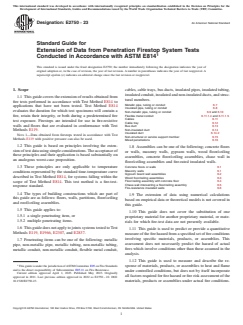
(Guide)Standard Guide for Extension of Data from Penetration Firestop System Tests Conducted in Accordance with ASTM E814
General Information
- Abstract
SIGNIFICANCE AND USE
4.1 The methods and procedures set forth in this guide relate to the extension of the fire test results to firestop systems that have not been tested.
4.2 Users of this guide must have knowledge and understanding of the provisions of Test Methods E119 and Test Method E814 including those pertaining to conditions of acceptance.
4.3 In order to apply some of the principles described in this guide, reference to the original fire test report will be necessary.
4.4 In Test Method E814, the specimens are subjected to specific laboratory fire test exposure conditions. Differences between the tested assembly and the as-built assembly impact the fire-test-response characteristics. Substitution of different test conditions also impacts the fire-test-response characteristics.
4.5 The extension of data is valid only for the fire test exposure described in Test Method E814.
4.6 This guide shall not be used to extrapolate the fire resistance rating to a higher value.
4.7 Limitations:
4.7.1 The extension of fire resistance data is to be used only for changes to the tested specimen that fall within normal and reasonable limits of accepted construction practices.
4.7.2 Conclusions derived from using this guide are valid only if the identified change is the only change in the construction or properties of the components.
4.7.3 Evaluation of changes to the fire-resistive assembly in which the firestop is installed is governed by the Extension of Data principles in Practice E2032.
4.8 The statements in this guide are based on a single change to a system.
Note 2: It is possible that multiple changes have a different cumulative effect than that of individual changes evaluated separately. The principles contained herein may provide useful information for the application of sound engineering principles to evaluate the effect of multiple differences between tested and installed firestops.
4.9 Extensions of data using this document shall be done by individ...
SCOPE
1.1 This guide covers the extension of results obtained from fire tests performed in accordance with Test Method E814 to applications that have not been tested. Test Method E814 evaluates the duration for which test specimens will contain a fire, retain their integrity, or both during a predetermined fire test exposure. Firestops are intended for use in fire-resistive walls and floors that are evaluated in conformance with Test Methods E119.
Note 1: Data obtained from firestops tested in accordance with Test Methods E119 with positive pressure can also be used.
1.2 This guide is based on principles involving the extension of test data using simple considerations. The acceptance of these principles and their application is based substantially on an analogous worst-case proposition.
1.3 These principles are only applicable to temperature conditions represented by the standard time-temperature curve described in Test Method E814, for systems falling within the scope of Test Method E814. This test method is a fire-test-response standard.
1.4 The types of building constructions which are part of this guide are as follows: floors, walls, partitions, floor/ceiling and roof/ceiling assemblies.
1.5 This guide applies to:
1.5.1 a single penetrating item, or
1.5.2 multiple penetrating items.
1.6 This guide does not apply to joints systems tested to Test Methods E119, E1966, E2307, and E2837.
1.7 Penetrating items can be one of the following: metallic pipe, non-metallic pipe, metallic tubing, non-metallic tubing, metallic conduit, non-metallic conduit, flexible metal conduit, cables, cable trays, bus ducts, insulated pipes, insulated tubing, insulated conduit, insulated and non-insulated ducts, and structural members.
Metallic pipe, tubing or conduit
6.7
Insulated pipe, tubing or conduit
6.8
Non-metallic pipe, tubing or conduit
6.9 and 6.10
Flexible metal conduit
6.11.1.4 and 6....
- Status
- Published
- Publication Date
- 31-Mar-2023
- Technical Committee
- E05 - Fire Standards
- Drafting Committee
- E05.11 - Fire Resistance
Buy Documents
ASTM E2750-23 - Standard Guide for Extension of Data from Penetration Firestop System Tests Conducted in Accordance with ASTM E814
REDLINE ASTM E2750-23 - Standard Guide for Extension of Data from Penetration Firestop System Tests Conducted in Accordance with ASTM E814
Overview
ASTM E2750-23: Standard Guide for Extension of Data from Penetration Firestop System Tests Conducted in Accordance with ASTM E814 provides comprehensive guidance for extending the results of penetration firestop system tests. Developed by ASTM International, this standard supports engineers, fire protection professionals, and construction teams in determining if firestop systems tested under ASTM E814 can be applied to assemblies or penetrations not specifically tested. The guide is essential for maintaining fire safety in building construction, particularly where modifications or variances from tested assemblies are necessary.
Key Topics
- Scope of Application: ASTM E2750-23 outlines methods for extending fire test data to untested firestop systems based on analogical comparisons and worst-case scenarios.
- Applicable Construction Types: The guidance applies to a range of building assemblies, including
- Concrete floors or walls
- Masonry walls
- Gypsum board wall assemblies
- Wood floor/ceiling assemblies
- Concrete floor/ceiling assemblies
- Chase wall assemblies and fire-resistance insulated walls
- Permissible Penetrating Items: Covers metallic and non-metallic pipes, tubing, conduits, flexible metal conduits, cables, cable trays, bus ducts, insulated/uninsulated ducts, and structural/support members.
- Key Limitations: Extensions are valid only within the context of acceptance criteria and exposure conditions set by ASTM E814. The guide does not support extrapolation of fire resistance to higher ratings or substitution of materials not previously tested.
- Criteria for Valid Evaluations: The use of this guide requires:
- Understanding of ASTM E814 and ASTM E119 test methods
- Reference to original fire test reports
- Application by qualified technical personnel, such as registered professional engineers or knowledgeable firestop manufacturer personnel
Applications
ASTM E2750-23 is used in the following practical scenarios:
- Design Modifications: When there are minor changes to a construction, such as alterations in penetrant size, insulation density, or supporting assembly dimensions, this guide helps determine if tested firestop systems remain valid.
- Building Renovations and Upgrades: Useful when retrofitting or upgrading buildings, allowing for engineering judgment regarding the reapplication of tested firestop solutions for new configurations.
- Code Compliance: Provides an accepted methodology to support code arguments or approvals when exact match-tested systems are unavailable.
- Engineering Judgments: Assists engineers in sound decision-making for firestop system modifications by referencing worst-case tested data rather than requiring new testing for every minor assembly change.
Examples of allowable extensions include:
- Increasing the thickness of concrete or gypsum board in assemblies
- Reducing the size of penetrants or tray dimensions
- Substituting certain materials (e.g., fibrous insulation types) within specified parameters
All changes must be within the documented test ranges, and the assembled firestop system must not be modified in ways that could lower its tested fire resistance rating.
Related Standards
ASTM E2750-23 frequently references and is used in conjunction with the following standards:
- ASTM E814: Test Method for Fire Tests of Penetration Firestop Systems
- ASTM E119: Test Methods for Fire Tests of Building Construction and Materials
- ASTM E2032: Practice for Extension of Data from Fire Resistance Tests Conducted in Accordance with ASTM E119
- ASTM E1966, E2307, and E2837: Additional fire resistance and joint system testing standards
- ACI 216: Fire Resistance of Concrete
- ISO/TR 12470: International guidance on the extension of fire resistance test results
Keywords: fire resistance, firestop systems, ASTM E814, extension of test data, building fire safety, penetration firestop, engineering judgment, building code compliance
By following ASTM E2750-23, professionals support safe, code-compliant building modifications and ensure tested firestop performance is appropriately extended to similar but untested applications.
Relations
- Effective Date
- 15-Apr-2024
- Effective Date
- 01-Jan-2024
- Effective Date
- 01-Dec-2023
- Effective Date
- 01-Nov-2023
- Effective Date
- 01-Oct-2019
- Effective Date
- 01-Jul-2019
- Effective Date
- 01-Mar-2019
- Effective Date
- 15-Dec-2018
- Effective Date
- 01-Nov-2018
- Effective Date
- 01-Nov-2018
- Effective Date
- 01-Sep-2018
- Effective Date
- 01-Jun-2018
- Effective Date
- 15-Apr-2018
- Effective Date
- 01-Mar-2018
- Effective Date
- 01-Mar-2018
Buy Documents
ASTM E2750-23 - Standard Guide for Extension of Data from Penetration Firestop System Tests Conducted in Accordance with ASTM E814
REDLINE ASTM E2750-23 - Standard Guide for Extension of Data from Penetration Firestop System Tests Conducted in Accordance with ASTM E814
Get Certified
Connect with accredited certification bodies for this standard

CIS Institut d.o.o.
Personal Protective Equipment (PPE) certification body. Notified Body NB-2890 for EU Regulation 2016/425 PPE.

Kiwa BDA Testing
Building and construction product certification.
Kmetijski inštitut Slovenije
Agricultural Institute of Slovenia. Soil testing, plant health, agricultural product analysis.
Sponsored listings
Frequently Asked Questions
ASTM E2750-23 is a guide published by ASTM International. Its full title is "Standard Guide for Extension of Data from Penetration Firestop System Tests Conducted in Accordance with ASTM E814". This standard covers: SIGNIFICANCE AND USE 4.1 The methods and procedures set forth in this guide relate to the extension of the fire test results to firestop systems that have not been tested. 4.2 Users of this guide must have knowledge and understanding of the provisions of Test Methods E119 and Test Method E814 including those pertaining to conditions of acceptance. 4.3 In order to apply some of the principles described in this guide, reference to the original fire test report will be necessary. 4.4 In Test Method E814, the specimens are subjected to specific laboratory fire test exposure conditions. Differences between the tested assembly and the as-built assembly impact the fire-test-response characteristics. Substitution of different test conditions also impacts the fire-test-response characteristics. 4.5 The extension of data is valid only for the fire test exposure described in Test Method E814. 4.6 This guide shall not be used to extrapolate the fire resistance rating to a higher value. 4.7 Limitations: 4.7.1 The extension of fire resistance data is to be used only for changes to the tested specimen that fall within normal and reasonable limits of accepted construction practices. 4.7.2 Conclusions derived from using this guide are valid only if the identified change is the only change in the construction or properties of the components. 4.7.3 Evaluation of changes to the fire-resistive assembly in which the firestop is installed is governed by the Extension of Data principles in Practice E2032. 4.8 The statements in this guide are based on a single change to a system. Note 2: It is possible that multiple changes have a different cumulative effect than that of individual changes evaluated separately. The principles contained herein may provide useful information for the application of sound engineering principles to evaluate the effect of multiple differences between tested and installed firestops. 4.9 Extensions of data using this document shall be done by individ... SCOPE 1.1 This guide covers the extension of results obtained from fire tests performed in accordance with Test Method E814 to applications that have not been tested. Test Method E814 evaluates the duration for which test specimens will contain a fire, retain their integrity, or both during a predetermined fire test exposure. Firestops are intended for use in fire-resistive walls and floors that are evaluated in conformance with Test Methods E119. Note 1: Data obtained from firestops tested in accordance with Test Methods E119 with positive pressure can also be used. 1.2 This guide is based on principles involving the extension of test data using simple considerations. The acceptance of these principles and their application is based substantially on an analogous worst-case proposition. 1.3 These principles are only applicable to temperature conditions represented by the standard time-temperature curve described in Test Method E814, for systems falling within the scope of Test Method E814. This test method is a fire-test-response standard. 1.4 The types of building constructions which are part of this guide are as follows: floors, walls, partitions, floor/ceiling and roof/ceiling assemblies. 1.5 This guide applies to: 1.5.1 a single penetrating item, or 1.5.2 multiple penetrating items. 1.6 This guide does not apply to joints systems tested to Test Methods E119, E1966, E2307, and E2837. 1.7 Penetrating items can be one of the following: metallic pipe, non-metallic pipe, metallic tubing, non-metallic tubing, metallic conduit, non-metallic conduit, flexible metal conduit, cables, cable trays, bus ducts, insulated pipes, insulated tubing, insulated conduit, insulated and non-insulated ducts, and structural members. Metallic pipe, tubing or conduit 6.7 Insulated pipe, tubing or conduit 6.8 Non-metallic pipe, tubing or conduit 6.9 and 6.10 Flexible metal conduit 6.11.1.4 and 6....
SIGNIFICANCE AND USE 4.1 The methods and procedures set forth in this guide relate to the extension of the fire test results to firestop systems that have not been tested. 4.2 Users of this guide must have knowledge and understanding of the provisions of Test Methods E119 and Test Method E814 including those pertaining to conditions of acceptance. 4.3 In order to apply some of the principles described in this guide, reference to the original fire test report will be necessary. 4.4 In Test Method E814, the specimens are subjected to specific laboratory fire test exposure conditions. Differences between the tested assembly and the as-built assembly impact the fire-test-response characteristics. Substitution of different test conditions also impacts the fire-test-response characteristics. 4.5 The extension of data is valid only for the fire test exposure described in Test Method E814. 4.6 This guide shall not be used to extrapolate the fire resistance rating to a higher value. 4.7 Limitations: 4.7.1 The extension of fire resistance data is to be used only for changes to the tested specimen that fall within normal and reasonable limits of accepted construction practices. 4.7.2 Conclusions derived from using this guide are valid only if the identified change is the only change in the construction or properties of the components. 4.7.3 Evaluation of changes to the fire-resistive assembly in which the firestop is installed is governed by the Extension of Data principles in Practice E2032. 4.8 The statements in this guide are based on a single change to a system. Note 2: It is possible that multiple changes have a different cumulative effect than that of individual changes evaluated separately. The principles contained herein may provide useful information for the application of sound engineering principles to evaluate the effect of multiple differences between tested and installed firestops. 4.9 Extensions of data using this document shall be done by individ... SCOPE 1.1 This guide covers the extension of results obtained from fire tests performed in accordance with Test Method E814 to applications that have not been tested. Test Method E814 evaluates the duration for which test specimens will contain a fire, retain their integrity, or both during a predetermined fire test exposure. Firestops are intended for use in fire-resistive walls and floors that are evaluated in conformance with Test Methods E119. Note 1: Data obtained from firestops tested in accordance with Test Methods E119 with positive pressure can also be used. 1.2 This guide is based on principles involving the extension of test data using simple considerations. The acceptance of these principles and their application is based substantially on an analogous worst-case proposition. 1.3 These principles are only applicable to temperature conditions represented by the standard time-temperature curve described in Test Method E814, for systems falling within the scope of Test Method E814. This test method is a fire-test-response standard. 1.4 The types of building constructions which are part of this guide are as follows: floors, walls, partitions, floor/ceiling and roof/ceiling assemblies. 1.5 This guide applies to: 1.5.1 a single penetrating item, or 1.5.2 multiple penetrating items. 1.6 This guide does not apply to joints systems tested to Test Methods E119, E1966, E2307, and E2837. 1.7 Penetrating items can be one of the following: metallic pipe, non-metallic pipe, metallic tubing, non-metallic tubing, metallic conduit, non-metallic conduit, flexible metal conduit, cables, cable trays, bus ducts, insulated pipes, insulated tubing, insulated conduit, insulated and non-insulated ducts, and structural members. Metallic pipe, tubing or conduit 6.7 Insulated pipe, tubing or conduit 6.8 Non-metallic pipe, tubing or conduit 6.9 and 6.10 Flexible metal conduit 6.11.1.4 and 6....
ASTM E2750-23 is classified under the following ICS (International Classification for Standards) categories: 13.220.50 - Fire-resistance of building materials and elements; 21.140 - Seals, glands. The ICS classification helps identify the subject area and facilitates finding related standards.
ASTM E2750-23 has the following relationships with other standards: It is inter standard links to ASTM C168-24, ASTM E176-24, ASTM E2837-23a, ASTM E2307-23b, ASTM E119-19, ASTM E2307-19, ASTM E1966-15(2019), ASTM E176-18a, ASTM E119-18c, ASTM E119-18ce1, ASTM E119-18b, ASTM E119-18a, ASTM C168-18, ASTM E119-18, ASTM E176-18. Understanding these relationships helps ensure you are using the most current and applicable version of the standard.
ASTM E2750-23 is available in PDF format for immediate download after purchase. The document can be added to your cart and obtained through the secure checkout process. Digital delivery ensures instant access to the complete standard document.
Standards Content (Sample)
This international standard was developed in accordance with internationally recognized principles on standardization established in the Decision on Principles for the
Development of International Standards, Guides and Recommendations issued by the World Trade Organization Technical Barriers to Trade (TBT) Committee.
Designation: E2750 − 23 An American National Standard
Standard Guide for
Extension of Data from Penetration Firestop System Tests
Conducted in Accordance with ASTM E814
This standard is issued under the fixed designation E2750; the number immediately following the designation indicates the year of
original adoption or, in the case of revision, the year of last revision. A number in parentheses indicates the year of last reapproval. A
superscript epsilon (´) indicates an editorial change since the last revision or reapproval.
1. Scope cables, cable trays, bus ducts, insulated pipes, insulated tubing,
insulated conduit, insulated and non-insulated ducts, and struc-
1.1 This guide covers the extension of results obtained from
tural members.
fire tests performed in accordance with Test Method E814 to
Metallic pipe, tubing or conduit 6.7
applications that have not been tested. Test Method E814
Insulated pipe, tubing or conduit 6.8
evaluates the duration for which test specimens will contain a
Non-metallic pipe, tubing or conduit 6.9 and 6.10
Flexible metal conduit 6.11.1.4 and 6.11.1.5
fire, retain their integrity, or both during a predetermined fire
Cables 6.11
test exposure. Firestops are intended for use in fire-resistive
Cable tray 6.12
walls and floors that are evaluated in conformance with Test
Bus duct 6.13
Non-insulated duct 6.14
Methods E119.
Insulated duct 6.14.2
NOTE 1—Data obtained from firestops tested in accordance with Test
Non-structural or service support member 6.15
Methods E119 with positive pressure can also be used.
Mixed penetrations 6.16
1.2 This guide is based on principles involving the exten-
1.8 Assemblies can be one of the following; concrete floors
sion of test data using simple considerations. The acceptance of
or walls, masonry walls, gypsum walls, wood floor/ceiling
these principles and their application is based substantially on
assemblies, concrete floor/ceiling assemblies, chase wall in
an analogous worst-case proposition.
floor/ceiling assemblies and fire-rated insulated walls.
1.3 These principles are only applicable to temperature Concrete floors or walls 6.1
Masonry walls 6.1
conditions represented by the standard time-temperature curve
Gypsum board wall assemblies 6.2
described in Test Method E814, for systems falling within the
Wood floor/ceiling assemblies 6.3
Floor/ceiling assembly with concrete floor 6.4
scope of Test Method E814. This test method is a fire-test-
Chase wall intersecting a floor/ceiling assembly 6.5
response standard.
Fire-resistance insulated walls 6.6
1.4 The types of building constructions which are part of
1.9 The extension of data using numerical calculations
this guide are as follows: floors, walls, partitions, floor/ceiling
based on empirical data or theoretical models is not covered in
and roof/ceiling assemblies.
this guide.
1.5 This guide applies to:
1.10 This guide does not cover the substitution of one
1.5.1 a single penetrating item, or
proprietary material for another proprietary material, or mate-
1.5.2 multiple penetrating items.
rials for which fire-test data are not presently available.
1.6 This guide does not apply to joints systems tested to Test
1.11 This guide is used to predict or provide a quantitative
Methods E119, E1966, E2307, and E2837.
measure of the fire hazard from a specified set of fire conditions
involving specific materials, products, or assemblies. This
1.7 Penetrating items can be one of the following: metallic
assessment does not necessarily predict the hazard of actual
pipe, non-metallic pipe, metallic tubing, non-metallic tubing,
fires which involve conditions other than those assumed in the
metallic conduit, non-metallic conduit, flexible metal conduit,
analysis.
1.12 This guide is used to measure and describe the re-
This guide is under the jurisdiction of ASTM Committee E05 on Fire Standards
sponse of materials, products, or assemblies to heat and flame
and is the direct responsibility of Subcommittee E05.11 on Fire Resistance.
under controlled conditions, but does not by itself incorporate
Current edition approved April 1, 2023. Published May 2023. Originally
all factors required for fire hazard or fire risk assessment of the
approved in 2011. Last previous edition approved in 2022 as E2750 – 22. DOI:
10.1520/E2750-23. materials, products or assemblies under actual fire conditions.
Copyright © ASTM International, 100 Barr Harbor Drive, PO Box C700, West Conshohocken, PA 19428-2959. United States
E2750 − 23
1.13 Units—The values stated in SI units are to be regarded 4.3 In order to apply some of the principles described in this
as standard. No other units of measurement are included in this guide, reference to the original fire test report will be necessary.
standard.
4.4 In Test Method E814, the specimens are subjected to
1.14 This standard does not purport to address all of the
specific laboratory fire test exposure conditions. Differences
safety concerns, if any, associated with its use. It is the
between the tested assembly and the as-built assembly impact
responsibility of the user of this standard to establish appro-
the fire-test-response characteristics. Substitution of different
priate safety, health, and environmental practices and deter-
test conditions also impacts the fire-test-response characteris-
mine the applicability of regulatory limitations prior to use.
tics.
1.15 This international standard was developed in accor-
4.5 The extension of data is valid only for the fire test
dance with internationally recognized principles on standard-
exposure described in Test Method E814.
ization established in the Decision on Principles for the
4.6 This guide shall not be used to extrapolate the fire
Development of International Standards, Guides and Recom-
resistance rating to a higher value.
mendations issued by the World Trade Organization Technical
Barriers to Trade (TBT) Committee.
4.7 Limitations:
4.7.1 The extension of fire resistance data is to be used only
2. Referenced Documents
for changes to the tested specimen that fall within normal and
2.1 ASTM Standards:
reasonable limits of accepted construction practices.
C168 Terminology Relating to Thermal Insulation
4.7.2 Conclusions derived from using this guide are valid
E119 Test Methods for Fire Tests of Building Construction
only if the identified change is the only change in the
and Materials
construction or properties of the components.
E176 Terminology of Fire Standards
4.7.3 Evaluation of changes to the fire-resistive assembly in
E631 Terminology of Building Constructions
which the firestop is installed is governed by the Extension of
E814 Test Method for Fire Tests of Penetration Firestop
Data principles in Practice E2032.
Systems
4.8 The statements in this guide are based on a single
E1966 Test Method for Fire-Resistive Joint Systems
change to a system.
E2032 Practice for Extension of Data From Fire Resistance
NOTE 2—It is possible that multiple changes have a different cumulative
Tests Conducted in Accordance with ASTM E 119
effect than that of individual changes evaluated separately. The principles
E2307 Test Method for Determining Fire Resistance of
contained herein may provide useful information for the application of
sound engineering principles to evaluate the effect of multiple differences
Perimeter Fire Barriers Using Intermediate-Scale, Multi-
between tested and installed firestops.
story Test Apparatus
4.9 Extensions of data using this document shall be done by
E2837 Test Method for Determining the Fire Resistance of
Continuity Head-of-Wall Joint Systems Installed Between individuals possessing the following minimum qualifications
and attributes:
Rated Wall Assemblies and Nonrated Horizontal Assem-
4.9.1 an understanding of the Test Method E814 test
blies
procedure,
2.2 Other Standards:
4.9.2 an understanding of the fire behavior of firestop
ACI 216 Fire Resistance of Concrete
materials,
3. Terminology
4.9.3 knowledge of the elements of the construction to be
protected, and
3.1 Definitions:
4.9.4 an understanding of the probable behavior of the
3.1.1 For definitions used in this guide, refer to Terminolo-
underlying construction and the recommended firestop system
gies in E176, C168 and E631.
protecting it, were they to be subjected to testing in accordance
3.1.2 For definitions of terms specific to this standard, refer
with Test Method E814.
to Test Method E814 and Practice E2032.
4.10 The person performing evaluations based on tested or
4. Significance and Use
listed firestops shall be one of the following:
4.1 The methods and procedures set forth in this guide relate
4.10.1 the firestop manufacturer’s knowledgeable and quali-
to the extension of the fire test results to firestop systems that
fied technical personnel,
have not been tested.
4.10.2 a registered professional engineer, or Fire Protection
Engineer, knowledgeable in firestopping systems,
4.2 Users of this guide must have knowledge and under-
4.10.3 an independent testing agency or a listing agency, or
standing of the provisions of Test Methods E119 and Test
4.10.4 technical personnel with experience in firestopping.
Method E814 including those pertaining to conditions of
acceptance.
5. General Principles
5.1 The principles in this section shall apply to all subse-
For referenced ASTM standards, visit the ASTM website, www.astm.org, or
quent sections.
contact ASTM Customer Service at service@astm.org. For Annual Book of ASTM
Standards volume information, refer to the standard’s Document Summary page on
5.2 The rating criteria and conditions of acceptance as set
the ASTM website.
out in Test Method E814 shall be used in the evaluation of the
Available from American Concrete Institute (ACI), P.O. Box 9094, Farmington
Hills, MI 48333-9094, http://www.concrete.org. effect of the change to the firestop system.
E2750 − 23
NOTE 5—Where it is known or suspected that locating a material further
5.3 Conclusions derived from using this guide indicate only
from the fire or on the unexposed side of the assembly will reduce the
whether or not a change in the application or design of the
resistance to the test.
firestop system “reduces” the fire resistance rating.
Exception 3: Where it is known that locating a material on
5.4 The firestop system is limited to the maximum dimen-
the non-fire side of the assembly further from the fire will
sions of the opening in the assembly that have been fire tested
reduce the performance of the firestop.
according to Test Methods E814 or E119 under positive
6.2.2 Firestop systems cannot be used in assemblies of
furnace pressure as specified in Test Method E814.
lower resistance ratings without fire testing.
5.5 The firestop product(s) is limited to the product(s) fire
Exception: A firestop system that is tested and listed for a
tested.
symmetrical gypsum wall assembly that includes multiple
5.6 Angled Penetrations—Where the uninsulated penetrat-
layers of gypsum board per side, can be used to maintain the
ing item in the individual design is indicated as a metallic pipe, fire resistance rating of a gypsum wall assembly that includes
conduit, tube, duct or cable, and the firestop system consists at
fewer layers of gypsum board per side, as long as the sealant
minimum of a fill material (such as sealants, putty, or mortar), depth in the listed system, does not exceed the thickness of that
the penetrant may pass through the opening in the wall or floor reduced number of layers of gypsum board.
assembly at any angle, provided the annular space is main-
6.2.3 Symmetrical Installations:
tained on both sides of the wall or floor assembly and all other
6.2.3.1 The results of the fire resistance test are deemed to
specifications in the design are satisfied. In all other cases,
be applicable to a similar type of untested system providing the
except where otherwise indicated in the system, the penetrating
following are true.
item shall penetrate the wall or floor assembly at a 90° angle.
(1) The maximum dimension of the opening is not in-
creased.
6. Principles for Firestops
(2) The total area of the opening is not increased.
NOTE 3—Information regarding the fire resistance of the wall or floor
(3) Neither the firestop product(s) or damming material is
assemblies can be found in Practice E2032 or ACI 216. See Appendix X3
changed.
for additional information.
(4) The thickness of neither the firestop product(s) or
6.1 Concrete or Masonry Assemblies:
damming material is decreased.
6.1.1 Increase in thickness of the assembly will not decrease
6.2.3.2 Refer to 6.1 for restrictions related to changes in the
the fire resistance of the firestop. Exception: Where it is known
supporting construction.
or suspected that locating a material further from the fire or on
6.3 Wood Deck Floor/Ceiling Assemblies:
the unexposed side of the assembly will reduce the F-rating.
6.1.2 Firestop systems tested in concrete floor assemblies 6.3.1 The following changes, individually or in
can be used in concrete or masonry wall assemblies providing combination, would not reduce the F-rating, provided that: (1)
that they are installed symmetrically on both sides of the wall the firestop is in the same position relative to the heat source,
and consideration is given to the effect of the orientation on the and (2) the firestop is at least in contact with the same material
penetrating items. as tested;
6.3.1.1 Increase in the depth of joists or trusses,
NOTE 4—The orientation of the penetrating item may create a more
severe condition resulting in failure of the firestop system. As an example, 6.3.1.2 Increase in thickness or number of layers of gypsum
penetrants containing multiple layers of cable or thin gauge sheet metal
board,
ductwork may represent a more severe condition in a wall orientation.
6.3.1.3 Increase in the overall assembly thickness due to
6.1.2.1 Firestop systems need not be installed on both sides
additional floor coverings or ceiling finishes.
of the wall assembly if they are symmetrical and equidistant
Exception 1: In assemblies where there are firestop materials
from both surfaces.
not part of the exposed side that is part of the tested or listed
6.1.3 Firestop systems fire tested in wall assemblies cannot
firestop configuration.
be installed in floor assemblies unless fire tested according to
Exception 2: Where it is known or suspected that locating a
Test Method E814 as a floor assembly.
material further from the fire or on the unexposed side of the
6.1.4 Firestop systems can be used in concrete or masonry
assembly will reduce the resistance to the test.
assemblies of equal or lower fire resistance as long as the
6.3.2 Firestop systems cannot be used in assemblies of
Firestop system tested design is not modified in relation to
lower resistance ratings without fire testing.Exception: A
firestop thickness, bonding and support, and is not modified in
firestop system that is tested and listed for a floor/ceiling
relation to the assembly thickness.
assembly that includes multiple layers of gypsum board, can be
6.2 Gypsum Board Wall Assemblies:
used to maintain the fire resistance rating of a floor/ceiling
6.2.1 Increase in the depth of studs or thickness or number
assembly that includes fewer layers of gypsum board, as long
of layers of gypsum board will not decrease the fire resistance
as the sealant depth in the listed system, does not exceed the
of the firestop.Exception 1: Where the firestop materials are at
thickness of that reduced number of layers of gypsum board.
different positions within the assembly relative to the heat
6.4 Floor/Ceiling Assembly with Concrete Floor:
source.
Exception 2: In assemblies where the active components on
NOTE 6—This section does not apply to floor/ceiling assemblies
both sides of the assembly contribute to the test performance. protected with direct applied fireproofing.
E2750 − 23
6.4.1 The following changes, individually or in 6.6.4.2 The total area of the opening is not increased,
combination, would not reduce the F-rating, provided that: (1) 6.6.4.3 Neither the firestop product(s) or damming material
the firestop is in the same position relative to the heat source,
is changed,
and (2) the firestop is at least in contact with the same material
6.6.4.4 The thickness of neither the firestop product(s) or
as tested;
damming material is decreased.
6.4.1.1 Increase in the depth of joists or trusses,
6.7 Metallic Pipe, Conduit or Tubing Penetrating Items:
6.4.1.2 Increase in thickness or number of layers of gypsum
6.7.1 The fire resistance of a tested system is deemed
board,
applicable to a similar type of untested system when only one
6.4.1.3 Increase in the overall assembly thickness due to
of the following changes is made:
additional floor coverings or ceiling finishes.Exception: In
6.7.1.1 Steel, cast iron pipes, steel conduit and EMT of the
assemblies where there are firestop materials not part of the
same nominal dimension is permitted to be installed based on
exposed side that is part of the tested or listed firestop
results obtained with copper pipes and tubing.
configuration.
NOTE 8—Aluminum penetrants shall be fire tested.
Exception: Where it is known or suspected that locating a
material further from the fire or on the unexposed side of the
6.7.1.2 Maximum and minimum annular space must be
assembly will reduce the resistance to the test.
within the tested range.
6.4.2 Firestop systems should not be used in assemblies of
6.7.1.3 Penetrations with continuous point of contact must
lower resistance ratings without fire testing (that is, a 2-h
be tested.
floor/ceiling firestop system should not be used in a 1-h
6.7.1.4 Decreasing the penetrant size will not decrease the
floor/ceiling assembly without fire testing).
fire resistance rating.
6.7.1.5 The distance between multiple penetrants must be
6.5 Penetrants Contained Within Chase Walls:
within the tested range.
6.5.1 Floor or floor/ceiling penetrations tested without a
6.7.1.6 The pentrant wall thickness can only be increased
chase wall can be installed within a rated or non-rated chase
without reducing the fire resistance rating.
wall without reducing the F-rating, provided the flo
...
This document is not an ASTM standard and is intended only to provide the user of an ASTM standard an indication of what changes have been made to the previous version. Because
it may not be technically possible to adequately depict all changes accurately, ASTM recommends that users consult prior editions as appropriate. In all cases only the current version
of the standard as published by ASTM is to be considered the official document.
Designation: E2750 − 22 E2750 − 23 An American National Standard
Standard Guide for
Extension of Data from Penetration Firestop System Tests
Conducted in Accordance with ASTM E814
This standard is issued under the fixed designation E2750; the number immediately following the designation indicates the year of
original adoption or, in the case of revision, the year of last revision. A number in parentheses indicates the year of last reapproval. A
superscript epsilon (´) indicates an editorial change since the last revision or reapproval.
1. Scope
1.1 This guide covers the extension of results obtained from fire tests performed in accordance with Test Method E814 to
applications that have not been tested. Test Method E814 evaluates the duration for which test specimens will contain a fire, retain
their integrity, or both during a predetermined fire test exposure. Firestops are intended for use in fire-resistive walls and floors that
are evaluated in conformance with Test MethodMethods E119.
NOTE 1—Data obtained from firestops tested in accordance with Test Methods E119 with positive pressure can also be used.
1.2 This guide is based on principles involving the extension of test data using simple considerations. The acceptance of these
principles and their application is based substantially on an analogous worst-case proposition.
1.3 These principles are only applicable to temperature conditions represented by the standard time-temperature curve described
in Test Method E814, for systems falling within the scope of Test Method E814. This test method is a fire-test-response standard.
1.4 The types of building constructions which are part of this guide are as follows: floors, walls, partitions, floor/ceiling and
roof/ceiling assemblies.
1.5 This guide applies to:
1.5.1 a single penetrating item, or
1.5.2 multiple penetrating items.
1.6 This guide does not apply to joints systems tested to Test Methods E119, E1966, E2307, and E2837.
1.7 Penetrating items can be one of the following: metallic pipe, non-metallic pipe, metallic tubing, non-metallic tubing, metallic
conduit, non-metallic conduit, flexible metal conduit, cables, cable trays, bus ducts, insulated pipes, insulated tubing, insulated
conduit, insulated and non-insulated ducts, and structural members.
Metallic pipe, tubing or conduit 6.7
Insulated pipe, tubing or conduit 6.8
Non-metallic pipe, tubing or conduit 6.9 and 6.10
Flexible metal conduit 6.11.1.4 and 6.11.1.5
Cables 6.11
This standard guide is under the jurisdiction of ASTM Committee E05 on Fire Standards and is the direct responsibility of Subcommittee E05.11 on Fire Resistance.
Current edition approved May 1, 2022April 1, 2023. Published May 2022May 2023. Originally approved in 2011. Last previous edition approved in 20172022 as
E2750E2750 – 22.-17. DOI: 10.1520/E2750-22. 10.1520/E2750-23.
Copyright © ASTM International, 100 Barr Harbor Drive, PO Box C700, West Conshohocken, PA 19428-2959. United States
E2750 − 23
Cable tray 6.12
Bus duct 6.13
Non-insulated duct 6.14
Insulated duct 6.14.2
Non-structural or service support member 6.15
Mixed penetrations 6.16
1.8 Assemblies can be one of the following; concrete floors or walls, masonry walls, gypsum walls, wood floor/ceiling assemblies,
concrete floor/ceiling assemblies, chase wall in floor/ceiling assemblies and fire-rated insulated walls.
Concrete floors or walls 6.1
Masonry walls 6.1
Gypsum board wall assemblies 6.2
Wood floor/ceiling assemblies 6.3
Floor/ceiling assembly with concrete floor 6.4
Chase wall intersecting a floor/ceiling assembly 6.5
Fire-resistance insulated walls 6.6
1.9 The extension of data using numerical calculations based on empirical data or theoretical models is not covered in this guide.
1.10 This guide does not cover the substitution of one proprietary material for another proprietary material, or materials for which
fire-test data are not presently available.
1.11 This guide is used to predict or provide a quantitative measure of the fire hazard from a specified set of fire conditions
involving specific materials, products, or assemblies. This assessment does not necessarily predict the hazard of actual fires which
involve conditions other than those assumed in the analysis.
1.12 This guide is used to measure and describe the response of materials, products, or assemblies to heat and flame under
controlled conditions, but does not by itself incorporate all factors required for fire hazard or fire risk assessment of the materials,
products or assemblies under actual fire conditions.
1.13 Units—The values stated in SI units are to be regarded as standard. No other units of measurement are included in this
standard.
1.14 This standard does not purport to address all of the safety concerns, if any, associated with its use. It is the responsibility
of the user of this standard to establish appropriate safety, health, and environmental practices and determine the applicability of
regulatory limitations prior to use.
1.15 This international standard was developed in accordance with internationally recognized principles on standardization
established in the Decision on Principles for the Development of International Standards, Guides and Recommendations issued
by the World Trade Organization Technical Barriers to Trade (TBT) Committee.
2. Referenced Documents
2.1 ASTM Standards:
C168 Terminology Relating to Thermal Insulation
E119 Test Methods for Fire Tests of Building Construction and Materials
E176 Terminology of Fire Standards
E631 Terminology of Building Constructions
E814 Test Method for Fire Tests of Penetration Firestop Systems
E1966 Test Method for Fire-Resistive Joint Systems
E2032 Practice for Extension of Data From Fire Resistance Tests Conducted in Accordance with ASTM E 119
E2307 Test Method for Determining Fire Resistance of Perimeter Fire Barriers Using Intermediate-Scale, Multi-story Test
Apparatus
E2837 Test Method for Determining the Fire Resistance of Continuity Head-of-Wall Joint Systems Installed Between Rated Wall
Assemblies and Nonrated Horizontal Assemblies
2.2 Other Standards:
ACI 216 Fire Resistance of Concrete
For referenced ASTM standards, visit the ASTM website, www.astm.org, or contact ASTM Customer Service at service@astm.org. For Annual Book of ASTM Standards
volume information, refer to the standard’s Document Summary page on the ASTM website.
Available from American Concrete Institute (ACI), P.O. Box 9094, Farmington Hills, MI 48333-9094, http://www.concrete.org.
E2750 − 23
3. Terminology
3.1 Definitions:
3.1.1 For definitions used in this guide, refer to Terminologies in E176, C168 and E631.
3.1.2 For definitions of terms specific to this standard, refer to Test Method E814 and Practice E2032.
4. Significance and Use
4.1 The methods and procedures set forth in this guide relate to the extension of the fire test results to firestop systems that have
not been tested.
4.2 Users of this guide must have knowledge and understanding of the provisions of Test MethodMethods E119 and Test Method
E814 including those pertaining to conditions of acceptance.
4.3 In order to apply some of the principles described in this guide, reference to the original fire test report will be necessary.
4.4 In Test Method E814, the specimens are subjected to specific laboratory fire test exposure conditions. Differences between the
tested assembly and the as-built assembly impact the fire-test-response characteristics. Substitution of different test conditions also
impacts the fire-test-response characteristics.
4.5 The extension of data is valid only for the fire test exposure described in Test Method E814.
4.6 This guide shall not be used to extrapolate the fire resistance rating to a higher value.
4.7 Limitations:
4.7.1 The extension of fire resistance data is to be used only for changes to the tested specimen that fall within normal and
reasonable limits of accepted construction practices.
4.7.2 Conclusions derived from using this guide are valid only if the identified change is the only change in the construction or
properties of the components.
4.7.3 Evaluation of changes to the fire-resistive assembly in which the firestop is installed is governed by the Extension of Data
principles in GuidePractice E2032.
4.8 The statements in this guide are based on a single change to a system.
NOTE 2—It is possible that multiple changes have a different cumulative effect than that of individual changes evaluated separately. The principles
contained herein may provide useful information for the application of sound engineering principles to evaluate the effect of multiple differences between
tested and installed firestops.
4.9 Extensions of data using this document shall be done by individuals possessing the following minimum qualifications and
attributes:
4.9.1 an understanding of the Test Method E814 test procedure,
4.9.2 an understanding of the fire behavior of firestop materials,
4.9.3 knowledge of the elements of the construction to be protected, and
4.9.4 an understanding of the probable behavior of the underlying construction and the recommended firestop system protecting
it, were they to be subjected to testing in accordance with Test Method E814.
4.10 The person performing evaluations based on tested or listed firestops shall be one of the following:
E2750 − 23
4.10.1 the firestop manufacturer’s knowledgeable and qualified technical personnel,
4.10.2 a registered professional engineer, or Fire Protection Engineer, knowledgeable in firestopping systems,
4.10.3 an independent testing agency or a listing agency, or
4.10.4 technical personnel with experience in firestopping.
5. General Principles
5.1 The principles in this section shall apply to all subsequent sections.
5.2 The rating criteria and conditions of acceptance as set out in Test Method E814 shall be used in the evaluation of the effect
of the change to the firestop system.
5.3 Conclusions derived from using this guide indicate only whether or not a change in the application or design of the firestop
system “reduces” the fire resistance rating.
5.4 The firestop system is limited to the maximum dimensions of the opening in the assembly that have been fire tested according
to Test Methods E814 or E119 under positive furnace pressure as specified in Test Method E814.
5.5 The firestop product(s) is limited to the product(s) fire tested.
5.6 Angled Penetrations—Where the uninsulated penetrating item in the individual design is indicated as a metallic pipe, conduit,
tube, duct or cable, and the firestop system consists at minimum of a fill material (such as sealants, putty, or mortar), the penetrant
may pass through the opening in the wall or floor assembly at any angle, provided the annular space is maintained on both sides
of the wall or floor assembly and all other specifications in the design are satisfied. In all other cases, except where otherwise
indicated in the system, the penetrating item shall penetrate the wall or floor assembly at a 90° angle.
6. Principles for Firestops
NOTE 3—Information regarding the fire resistance of the wall or floor assemblies can be found in GuidePractice E2032 or ACI 216. See Appendix X3
for additional information.
6.1 Concrete or Masonry Assemblies:
6.1.1 Increase in thickness of the assembly will not decrease the fire resistance of the firestop. Exception: Where it is known or
suspected that locating a material further from the fire or on the unexposed side of the assembly will reduce the F-rating.
6.1.2 Firestop systems tested in concrete floor assemblies can be used in concrete or masonry wall assemblies providing that they
are installed symmetrically on both sides of the wall.wall and consideration is given to the effect of the orientation on the
penetrating items.
NOTE 4—The orientation of the penetrating item may create a more severe condition resulting in failure of the firestop system. As an example, penetrants
containing multiple layers of cable or thin gauge sheet metal ductwork may represent a more severe condition in a wall orientation.
6.1.2.1 Firestop systems need not be installed on both sides of the wall assembly if they are symmetrical and equidistant from both
surfaces.
6.1.3 Firestop systems fire tested in wall assemblies cannot be installed in floor assemblies unless fire tested according to Test
Method E814 as a floor assembly.
6.1.4 Firestop systems can be used in concrete or masonry assemblies of equal or lower fire resistance as long as the Firestop
system tested design is not modified in relation to firestop thickness, bonding and support, and is not modified in relation to the
assembly thickness.
E2750 − 23
6.2 Gypsum Board Wall Assemblies:
6.2.1 Increase in the depth of studs or thickness or number of layers of gypsum board will not decrease the fire resistance of the
firestop.Exception 1: Where the firestop materials are at different positions within the assembly relative to the heat source.
Exception 2: In assemblies where the active components on both sides of the assembly contribute to the test performance.
NOTE 5—Where it is known or suspected that locating a material further from the fire or on the unexposed side of the assembly will reduce the resistance
to the test.
Exception 3: Where it is known that locating a material on the non-fire side of the assembly further from the fire will reduce
the performance of the firestop.
6.2.2 Firestop systems cannot be used in assemblies of lower resistance ratings without fire testing.
Exception: A firestop system that is tested and listed for a symmetrical gypsum wall assembly that includes multiple layers of
gypsum board per side, can be used to maintain the fire resistance rating of a gypsum wall assembly that includes fewer layers
of gypsum board per side, as long as the sealant depth in the listed system, does not exceed the thickness of that reduced number
of layers of gypsum board.
6.2.3 Symmetrical Installations:
6.2.3.1 The results of the fire resistance test are deemed to be applicable to a similar type of untested system providing the
following are true.
(1) The maximum dimension of the opening is not increased.
(2) The total area of the opening is not increased.
(3) Neither the firestop product(s) or damming material is changed.
(4) The thickness of neither the firestop product(s) or damming material is decreased.
6.2.3.2 Refer to 6.1 for restrictions related to changes in the supporting construction.
6.3 Wood Deck Floor/Ceiling Assemblies:
6.3.1 The following changes, individually or in combination, would not reduce the F-rating, provided that: (1) the firestop is in
the same position relative to the heat source, and (2) the firestop is at least in contact with the same material as tested;
6.3.1.1 Increase in the depth of joists or trusses,
6.3.1.2 Increase in thickness or number of layers of gypsum board,
6.3.1.3 Increase in the overall assembly thickness due to additional floor coverings or ceiling finishes.
Exception 1: In assemblies where there are firestop materials not part of the exposed side that is part of the tested or listed
firestop configuration.
Exception 2: Where it is known or suspected that locating a material further from the fire or on the unexposed side of the
assembly will reduce the resistance to the test.
6.3.2 Firestop systems cannot be used in assemblies of lower resistance ratings without fire testing.Exception: A firestop system
that is tested and listed for a floor/ceiling assembly that includes multiple layers of gypsum board, can be used to maintain the fire
resistance rating of a floor/ceiling assembly that includes fewer layers of gypsum board, as long as the sealant depth in the listed
system, does not exceed the thickness of that reduced number of layers of gypsum board.
6.4 Floor/Ceiling Assembly with Concrete Floor:
NOTE 6—This section does not apply to floor/ceiling assemblies protected with direct applied fireproofing.
6.4.1 The following changes, individually or in combination, would not reduce the F-rating, provided that: (1) the firestop is in
the same position relative to the heat source, and (2) the firestop is at least in contact with the same material as tested;
E2750 − 23
6.4.1.1 Increase in the depth of joists or trusses,
6.4.1.2 Increase in thickness or number of layers of gypsum board,
6.4.1.3 Increase in the overall assembly thickness due to additional floor coverings or ceiling finishes.Exception: In assemblies
where there are firestop materials not part of the exposed side that is part of the tested or listed firestop configuration.
Exception: Where it is known or suspected that locating a material further from the fire or on the unexposed side of the assembly
will reduce the resistance to the test.
6.4.2 Firestop systems should not be used in assemblies of lower resistance ratings without fire testing (that is, a 2-h floor/ceiling
firestop system should not be used in a 1-h floor/ceiling assembly without fire testing).
6.5 Penetrants Contained Within Chase Walls:
6.5.1 Floor or floor/ceiling penetrations tested without a chase wall can be installed within a rated or non-rated chase wall without
reducing the F-rating, provided the floor/ceiling assembly in which the firestop is installed is not changed or compromised in any
way.
6.5.2 Wood Floor/ceiling penetrations tested without a chase wall can be installed within a rated wood framed chase wall having
a fire resistance rating no less than that of the floor/ceiling assembly without reducing the F-rating, provided a double top plate
of nominal 2-in. thick lumber is continuous with the lower membrane of the floor/ceiling assembly.
6.5.3 Any construction other than the 2 cases enumerated above should be tested to determine the F-rating.
6.6 Fire-resistance Rated Insulated Wall Assemblies:
6.6.1 Increase in the wall thickness will not decrease the fire resistance of the firestop.Exception 1: Where the firestop materials
are at different position within the assembly relative to the heat source.
Exception 2: In assemblies where the active components on both sides of the assembly contribute to the test performance.
NOTE 7—Where it is known or suspected that locating a mater
...