

ASTM E1966-15(2019)
(Test Method)Standard Test Method for Fire-Resistive Joint Systems
General Information
- Abstract
SIGNIFICANCE AND USE
5.1 This test method evaluates, under the specified test conditions: (1) the ability of a fire resistive joint system to undergo movement without reducing the fire rating of the adjacent fire separating elements and (2) the duration for which test specimens will contain a fire and retain their integrity during a predetermined test exposure.
5.2 This test method provides for the following measurements and evaluations where applicable:
5.2.1 Capability of the joint system to movement cycle.
5.2.2 Loadbearing capacity of the joint system.
5.2.3 Ability of the joint system to prohibit the passage of flames and hot gases.
5.2.4 Transmission of heat through the joint system.
5.2.5 Ability of the joint system, that is an extension of a wall, to resist the passage of water during a hose stream test.
5.3 This test method does not provide the following:
5.3.1 Evaluation of the degree by which the joint system contributes to the fire hazard by generation of smoke, toxic gases, or other products of combustion.
5.3.2 Measurement of the degree of control or limitation of the passage of smoke or products of combustion through the joint system.
5.3.3 Measurement of flame spread over the surface of the joint system.
Note 1: The information in 5.3.1 – 5.3.3 may be determined by other suitable fire test methods. For example, 5.3.3 may be determined by Test Method E84.
5.3.4 Evaluation of joints formed by the rated or non-rated exterior walls and the floors of the building.
5.4 In this procedure, the test specimens are subjected to one or more specific sets of laboratory test conditions. When different test conditions are substituted or the end-use conditions are changed, it is not always possible by, or from, this test method to predict changes to the characteristics measured. Therefore, the results are valid only for the exposure conditions described in this test method.
SCOPE
1.1 This fire-test-response test method measures the performance of joint systems designed to be used with fire rated floors and walls during a fire endurance test exposure. The fire endurance test end point is the period of time elapsing before the first performance criteria is reached when the joint system is subjected to one of two time-temperature fire exposures.
1.2 The fire exposure conditions used are either those specified by Test Method E119 for testing assemblies to standard time-temperature exposures or Test Method E1529 for testing assemblies to rapid-temperature rise fires.
1.3 This test method specifies the heating conditions, methods of test, and criteria for the evaluation of the ability of a joint system to maintain the fire resistance where hourly rated fire-separating elements meet.
1.4 Test results establish the performance of joint systems during the fire-exposure period and shall not be construed as having determined the joint systems suitability for use after that exposure.
1.5 This test method does not provide quantitative information about the joint system relative to the rate of leakage of smoke or gases or both. However, it requires that such phenomena be noted and reported when describing the general behavior of joint systems during the fire endurance test but is not part of the conditions of compliance.
1.6 Potentially important factors and fire characteristics not addressed by this test method include, but are not limited to:
1.6.1 The performance of the fire-resistive joint system constructed with components other than those tested.
1.6.2 The cyclic movement capabilities of joint systems other than the cycling conditions tested.
1.7 The values stated in inch-pound units are to be regarded as standard. The values given in parentheses are mathematical conversions to SI units that are provided for information only and are not considered standard.
1.8 The text of this standard references notes and footnotes which provide explanatory material. Th...
- Status
- Published
- Publication Date
- 28-Feb-2019
- Technical Committee
- E05 - Fire Standards
- Drafting Committee
- E05.11 - Fire Resistance
Overview
ASTM E1966-15(2019) Standard Test Method for Fire-Resistive Joint Systems is a key standard established by ASTM International to assess the performance of fire-resistive joint systems used in conjunction with fire-rated floors and walls. Fire-resistive joint systems are critical building components placed in the joints, gaps, or voids between structural elements, ensuring fire resistance continuity in compartmented construction. This test method evaluates the ability of these systems to maintain their integrity, prevent the passage of flames and hot gases, and support movement during a fire event for a specified time period.
Key Topics
- Fire Resistance Integrity: Evaluates how well joints prevent the passage of fire, hot gases, and heat, aligning with hourly fire ratings established for floors and walls.
- Movement Cycling: Tests the joint system's ability to accommodate movement (expansion, contraction, seismic or wind-sway) without compromising fire resistance.
- Loadbearing Capacity: Assess the joint’s ability to support loads as designed during fire exposure.
- Hose Stream Resistance: For wall extensions, assesses the joint’s resistance to water penetration following simulated fire conditions.
- Testing Conditions:
- Utilizes standard fire exposure curves (ASTM E119) or rapid-temperature rise curves (ASTM E1529).
- Establishes rigorous laboratory simulation, including temperature measurement, pressure differentials, and controlled test environments.
- Limitations of the Standard:
- Does not quantify smoke or toxic gas leakage.
- Does not assess flame spread along the joint surface.
- Results are only applicable to tested exposure conditions.
Applications
Fire-resistive joint systems are vital in numerous building and industrial scenarios where fire safety is a regulatory and functional requirement. Practical applications include:
- Commercial and Residential Construction: Ensuring the continuity of fire barrier performance across movement joints, expansion joints, or seismic joints between floors, and between walls and floors.
- Industrial Facilities: Protecting joints in mechanical rooms, service corridors, and other high-risk fire areas.
- Critical Infrastructure: Hospitals, airports, and transportation hubs where egress routes and compartmentation are essential for occupant safety during a fire incident.
- Building Renovation and Retrofit Projects: Verifying the effectiveness of added or repaired joint systems under both fire and movement conditions.
- Quality Assurance and Regulatory Compliance: Assisting manufacturers, specifiers, and building officials with selecting or approving compliant joint systems as part of holistic fire protection strategies.
Related Standards
Understanding the relevance of this standard is enhanced when considered with related ASTM fire test standards:
- ASTM E119: Standard Test Methods for Fire Tests of Building Construction and Materials, used to establish time-temperature fire exposures for assemblies.
- ASTM E1529: Test Methods for Effects of Large Hydrocarbon Pool Fires, providing rapid-temperature rise fire exposures.
- ASTM E84: Test Method for Surface Burning Characteristics of Building Materials, referenced for flame spread, which is outside the E1966 test scope.
- ASTM E1399: Test Method for Cyclic Movement and Measuring the Minimum and Maximum Joint Widths of Architectural Joint Systems.
- ASTM E814: Test Methods for Fire Tests of Penetration Firestop Systems.
- ASTM E2307: Standard Test Method for Determining Fire Resistance of Perimeter Fire Barriers.
- ASTM E176/E631: Terminology standards for clarity and uniformity in fire testing nomenclature.
ASTM E1966-15(2019) provides architects, engineers, manufacturers, and code officials with a robust method for evaluating the fire performance of joint protection systems in buildings. Its thorough testing protocols ensure safety and compliance in environments where the integrity of fire barriers is mission-critical. For best results, integrate this standard as part of a comprehensive fire safety and risk management strategy aligned with applicable building codes and fire regulations.
Relations
- Effective Date
- 01-Mar-2019
- Effective Date
- 01-Jan-2024
- Effective Date
- 01-Dec-2023
- Effective Date
- 01-Dec-2023
- Effective Date
- 01-Nov-2023
- Effective Date
- 15-Oct-2023
- Effective Date
- 01-Sep-2023
- Effective Date
- 01-Oct-2019
- Effective Date
- 01-Jul-2019
- Effective Date
- 01-Jul-2019
- Effective Date
- 15-Apr-2019
- Effective Date
- 01-Mar-2019
- Effective Date
- 15-Dec-2018
- Effective Date
- 01-Nov-2018
- Effective Date
- 01-Nov-2018
Get Certified
Connect with accredited certification bodies for this standard

DIBt (Deutsches Institut für Bautechnik)
German Institute for Building Technology.
DIN CERTCO
DIN Group product certification.

Aboma Certification B.V.
Specialized in construction, metal, and transport sectors.
Sponsored listings
Frequently Asked Questions
ASTM E1966-15(2019) is a standard published by ASTM International. Its full title is "Standard Test Method for Fire-Resistive Joint Systems". This standard covers: SIGNIFICANCE AND USE 5.1 This test method evaluates, under the specified test conditions: (1) the ability of a fire resistive joint system to undergo movement without reducing the fire rating of the adjacent fire separating elements and (2) the duration for which test specimens will contain a fire and retain their integrity during a predetermined test exposure. 5.2 This test method provides for the following measurements and evaluations where applicable: 5.2.1 Capability of the joint system to movement cycle. 5.2.2 Loadbearing capacity of the joint system. 5.2.3 Ability of the joint system to prohibit the passage of flames and hot gases. 5.2.4 Transmission of heat through the joint system. 5.2.5 Ability of the joint system, that is an extension of a wall, to resist the passage of water during a hose stream test. 5.3 This test method does not provide the following: 5.3.1 Evaluation of the degree by which the joint system contributes to the fire hazard by generation of smoke, toxic gases, or other products of combustion. 5.3.2 Measurement of the degree of control or limitation of the passage of smoke or products of combustion through the joint system. 5.3.3 Measurement of flame spread over the surface of the joint system. Note 1: The information in 5.3.1 – 5.3.3 may be determined by other suitable fire test methods. For example, 5.3.3 may be determined by Test Method E84. 5.3.4 Evaluation of joints formed by the rated or non-rated exterior walls and the floors of the building. 5.4 In this procedure, the test specimens are subjected to one or more specific sets of laboratory test conditions. When different test conditions are substituted or the end-use conditions are changed, it is not always possible by, or from, this test method to predict changes to the characteristics measured. Therefore, the results are valid only for the exposure conditions described in this test method. SCOPE 1.1 This fire-test-response test method measures the performance of joint systems designed to be used with fire rated floors and walls during a fire endurance test exposure. The fire endurance test end point is the period of time elapsing before the first performance criteria is reached when the joint system is subjected to one of two time-temperature fire exposures. 1.2 The fire exposure conditions used are either those specified by Test Method E119 for testing assemblies to standard time-temperature exposures or Test Method E1529 for testing assemblies to rapid-temperature rise fires. 1.3 This test method specifies the heating conditions, methods of test, and criteria for the evaluation of the ability of a joint system to maintain the fire resistance where hourly rated fire-separating elements meet. 1.4 Test results establish the performance of joint systems during the fire-exposure period and shall not be construed as having determined the joint systems suitability for use after that exposure. 1.5 This test method does not provide quantitative information about the joint system relative to the rate of leakage of smoke or gases or both. However, it requires that such phenomena be noted and reported when describing the general behavior of joint systems during the fire endurance test but is not part of the conditions of compliance. 1.6 Potentially important factors and fire characteristics not addressed by this test method include, but are not limited to: 1.6.1 The performance of the fire-resistive joint system constructed with components other than those tested. 1.6.2 The cyclic movement capabilities of joint systems other than the cycling conditions tested. 1.7 The values stated in inch-pound units are to be regarded as standard. The values given in parentheses are mathematical conversions to SI units that are provided for information only and are not considered standard. 1.8 The text of this standard references notes and footnotes which provide explanatory material. Th...
SIGNIFICANCE AND USE 5.1 This test method evaluates, under the specified test conditions: (1) the ability of a fire resistive joint system to undergo movement without reducing the fire rating of the adjacent fire separating elements and (2) the duration for which test specimens will contain a fire and retain their integrity during a predetermined test exposure. 5.2 This test method provides for the following measurements and evaluations where applicable: 5.2.1 Capability of the joint system to movement cycle. 5.2.2 Loadbearing capacity of the joint system. 5.2.3 Ability of the joint system to prohibit the passage of flames and hot gases. 5.2.4 Transmission of heat through the joint system. 5.2.5 Ability of the joint system, that is an extension of a wall, to resist the passage of water during a hose stream test. 5.3 This test method does not provide the following: 5.3.1 Evaluation of the degree by which the joint system contributes to the fire hazard by generation of smoke, toxic gases, or other products of combustion. 5.3.2 Measurement of the degree of control or limitation of the passage of smoke or products of combustion through the joint system. 5.3.3 Measurement of flame spread over the surface of the joint system. Note 1: The information in 5.3.1 – 5.3.3 may be determined by other suitable fire test methods. For example, 5.3.3 may be determined by Test Method E84. 5.3.4 Evaluation of joints formed by the rated or non-rated exterior walls and the floors of the building. 5.4 In this procedure, the test specimens are subjected to one or more specific sets of laboratory test conditions. When different test conditions are substituted or the end-use conditions are changed, it is not always possible by, or from, this test method to predict changes to the characteristics measured. Therefore, the results are valid only for the exposure conditions described in this test method. SCOPE 1.1 This fire-test-response test method measures the performance of joint systems designed to be used with fire rated floors and walls during a fire endurance test exposure. The fire endurance test end point is the period of time elapsing before the first performance criteria is reached when the joint system is subjected to one of two time-temperature fire exposures. 1.2 The fire exposure conditions used are either those specified by Test Method E119 for testing assemblies to standard time-temperature exposures or Test Method E1529 for testing assemblies to rapid-temperature rise fires. 1.3 This test method specifies the heating conditions, methods of test, and criteria for the evaluation of the ability of a joint system to maintain the fire resistance where hourly rated fire-separating elements meet. 1.4 Test results establish the performance of joint systems during the fire-exposure period and shall not be construed as having determined the joint systems suitability for use after that exposure. 1.5 This test method does not provide quantitative information about the joint system relative to the rate of leakage of smoke or gases or both. However, it requires that such phenomena be noted and reported when describing the general behavior of joint systems during the fire endurance test but is not part of the conditions of compliance. 1.6 Potentially important factors and fire characteristics not addressed by this test method include, but are not limited to: 1.6.1 The performance of the fire-resistive joint system constructed with components other than those tested. 1.6.2 The cyclic movement capabilities of joint systems other than the cycling conditions tested. 1.7 The values stated in inch-pound units are to be regarded as standard. The values given in parentheses are mathematical conversions to SI units that are provided for information only and are not considered standard. 1.8 The text of this standard references notes and footnotes which provide explanatory material. Th...
ASTM E1966-15(2019) is classified under the following ICS (International Classification for Standards) categories: 91.080.40 - Concrete structures. The ICS classification helps identify the subject area and facilitates finding related standards.
ASTM E1966-15(2019) has the following relationships with other standards: It is inter standard links to ASTM E1966-15, ASTM E176-24, ASTM E84-23d, ASTM E2226-23a, ASTM E2307-23b, ASTM E2226-23, ASTM E84-23c, ASTM E119-19, ASTM E2307-19, ASTM E84-19b, ASTM E84-19a, ASTM E84-19, ASTM E176-18a, ASTM E119-18ce1, ASTM E119-18c. Understanding these relationships helps ensure you are using the most current and applicable version of the standard.
ASTM E1966-15(2019) is available in PDF format for immediate download after purchase. The document can be added to your cart and obtained through the secure checkout process. Digital delivery ensures instant access to the complete standard document.
Standards Content (Sample)
This international standard was developed in accordance with internationally recognized principles on standardization established in the Decision on Principles for the
Development of International Standards, Guides and Recommendations issued by the World Trade Organization Technical Barriers to Trade (TBT) Committee.
Designation: E1966 − 15 (Reapproved 2019) An American National Standard
Standard Test Method for
Fire-Resistive Joint Systems
This standard is issued under the fixed designation E1966; the number immediately following the designation indicates the year of
original adoption or, in the case of revision, the year of last revision. A number in parentheses indicates the year of last reapproval. A
superscript epsilon (´) indicates an editorial change since the last revision or reapproval.
INTRODUCTION
Joint systems are positioned in joints, voids, gaps, or other discontinuities between or bounded by
two or more supporting elements. Normally such openings are denoted as “linear” because the length
is greater than their width—defined by a typical ratio of at least 10:1 as in practice. Joints are present
in buildings as a result of:
(i) Design to accommodate various movements induced by thermal differentials, seismicity, and
wind loads and exist as a clearance separation.
(ii) Acceptable dimensional tolerances between two or more building elements, for example,
between non-loadbearing walls and floors.
(iii) Inadequate design, inaccurate assembly, repairs, or damage to the building.
1. Scope behavior of joint systems during the fire endurance test but is
not part of the conditions of compliance.
1.1 This fire-test-response test method measures the perfor-
mance of joint systems designed to be used with fire rated 1.6 Potentially important factors and fire characteristics not
floors and walls during a fire endurance test exposure. The fire addressed by this test method include, but are not limited to:
endurance test end point is the period of time elapsing before 1.6.1 The performance of the fire-resistive joint system
the first performance criteria is reached when the joint system
constructed with components other than those tested.
is subjected to one of two time-temperature fire exposures.
1.6.2 The cyclic movement capabilities of joint systems
other than the cycling conditions tested.
1.2 The fire exposure conditions used are either those
specified by Test Method E119 for testing assemblies to 1.7 The values stated in inch-pound units are to be regarded
standardtime-temperatureexposuresorTestMethodE1529for
as standard. The values given in parentheses are mathematical
testing assemblies to rapid-temperature rise fires. conversions to SI units that are provided for information only
and are not considered standard.
1.3 This test method specifies the heating conditions, meth-
ods of test, and criteria for the evaluation of the ability of a 1.8 The text of this standard references notes and footnotes
joint system to maintain the fire resistance where hourly rated
which provide explanatory material. These notes and footnotes
fire-separating elements meet. (excluding those in tables and figures) shall not be considered
as requirements of the standard.
1.4 Test results establish the performance of joint systems
during the fire-exposure period and shall not be construed as 1.9 This standard is used to measure and describe the
having determined the joint systems suitability for use after response of materials, products, or assemblies to heat and
that exposure.
flame under controlled conditions, but does not by itself
incorporate all factors required for fire hazard or fire risk
1.5 This test method does not provide quantitative informa-
assessment of the materials, products, or assemblies under
tion about the joint system relative to the rate of leakage of
actual fire conditions.
smoke or gases or both. However, it requires that such
phenomena be noted and reported when describing the general 1.10 Fire testing is inherently hazardous. Adequate safe-
guards for personnel and property shall be employed in
conducting these tests.
1.11 This standard does not purport to address all of the
This test method is under the jurisdiction of ASTM Committee E05 on Fire
Standards and is the direct responsibility of Subcommittee E05.11 on Fire
safety concerns, if any, associated with its use. It is the
Resistance.
responsibility of the user of this standard to establish appro-
Current edition approved March 1, 2019. Published March 2019. Originally
priate safety, health, and environmental practices and deter-
approved in 1998. Last previous edition approved in 2015 as E1966 – 15. DOI:
10.1520/E1966-15R19. mine the applicability of regulatory limitations prior to use.
Copyright © ASTM International, 100 Barr Harbor Drive, PO Box C700, West Conshohocken, PA 19428-2959. United States
E1966 − 15 (2019)
1.12 This international standard was developed in accor- 3.1.10 supporting construction, n—the arrangement of
dance with internationally recognized principles on standard- building sections forming the fire-separating elements into
ization established in the Decision on Principles for the which the joint systems are installed.
Development of International Standards, Guides and Recom-
3.1.11 test assembly, n—the complete assembly of test
mendations issued by the World Trade Organization Technical
specimens together with their supporting construction.
Barriers to Trade (TBT) Committee.
3.1.12 test specimen, n—a joint system of a specific
material(s), design, and width.
2. Referenced Documents
2.1 ASTM Standards:
4. Summary of Test Method
E84 Test Method for Surface Burning Characteristics of
4.1 This test method describes the following test sequence
Building Materials
and procedure:
E119 Test Methods for Fire Tests of Building Construction
4.1.1 When the maximum joint width does not equal the
and Materials
minimum joint width, joint systems shall be movement cycled
E176 Terminology of Fire Standards
before being fire tested.
E631 Terminology of Building Constructions
4.1.2 Joint systems and their supporting construction shall
E814 Test Method for Fire Tests of Penetration Firestop
be conditioned and fire tested.
Systems
4.1.3 A duplicate test specimen, that is an extension of a
E1399 TestMethodforCyclicMovementandMeasuringthe
wall, is subject to a fire of lesser duration than the fire
Minimum and Maximum Joint Widths of Architectural
resistance rating. After which, the duplicate test specimen is
Joint Systems
subject to the hose stream test.
E1529 Test Methods for Determining Effects of Large Hy-
drocarbon Pool Fires on Structural Members and Assem-
5. Significance and Use
blies
E2226 Practice for Application of Hose Stream
5.1 This test method evaluates, under the specified test
E2307 Test Method for Determining Fire Resistance of
conditions: (1) the ability of a fire resistive joint system to
Perimeter Fire Barriers Using Intermediate-Scale, Multi-
undergo movement without reducing the fire rating of the
story Test Apparatus
adjacentfireseparatingelementsand(2)thedurationforwhich
test specimens will contain a fire and retain their integrity
3. Terminology
during a predetermined test exposure.
3.1 Definitions:
5.2 This test method provides for the following measure-
3.1.1 For the purpose of this standard, the definitions given
ments and evaluations where applicable:
in Terminologies E176 and E631, together with the following,
5.2.1 Capability of the joint system to movement cycle.
apply:
5.2.2 Loadbearing capacity of the joint system.
3.1.2 fire-separating element, n—floors, walls, and parti-
5.2.3 Ability of the joint system to prohibit the passage of
tions having a period of fire resistance determined in accor-
flames and hot gases.
dance with Test Methods E119 or E1529.
5.2.4 Transmission of heat through the joint system.
3.1.3 fire resistive joint system, n—a device or designed
5.2.5 Ability of the joint system, that is an extension of a
feature that provides a fire separating function along continu-
wall, to resist the passage of water during a hose stream test.
ous linear openings, including changes in direction, between or
5.3 This test method does not provide the following:
bounded by fire separating elements.
5.3.1 Evaluation of the degree by which the joint system
3.1.4 joint, n—the linear void located between juxtaposed
contributes to the fire hazard by generation of smoke, toxic
fire-separating elements.
gases, or other products of combustion.
3.1.5 maximum joint width, n—the widest opening of an
5.3.2 Measurement of the degree of control or limitation of
installed joint system.
the passage of smoke or products of combustion through the
joint system.
3.1.6 minimum joint width, n—the narrowest opening of an
5.3.3 Measurement of flame spread over the surface of the
installed joint system.
joint system.
3.1.7 movement cycle, n—the change between the minimum
and the maximum joint widths of a joint system.
NOTE 1—The information in 5.3.1 – 5.3.3 may be determined by other
suitable fire test methods. For example, 5.3.3 may be determined by Test
3.1.8 nominal joint width, n—the specified opening of a
Method E84.
joint in practice that is selected for test purposes.
5.3.4 Evaluation of joints formed by the rated or non-rated
3.1.9 splice, n—the connection or junction within the length
exterior walls and the floors of the building.
of a joint system.
5.4 Inthisprocedure,thetestspecimensaresubjectedtoone
or more specific sets of laboratory test conditions. When
For referenced ASTM standards, visit the ASTM website, www.astm.org, or
different test conditions are substituted or the end-use condi-
contact ASTM Customer Service at service@astm.org. For Annual Book of ASTM
tions are changed, it is not always possible by, or from, this test
Standards volume information, refer to the standard’s Document Summary page on
the ASTM website. method to predict changes to the characteristics measured.
E1966 − 15 (2019)
Therefore,theresultsarevalidonlyfortheexposureconditions
described in this test method.
6. Apparatus
6.1 Cycling Apparatus—Equipment (or device) capable of
being used to induce movement of a joint system and meeting
the required cyclic rate and number of cycles selected from
Table 1.
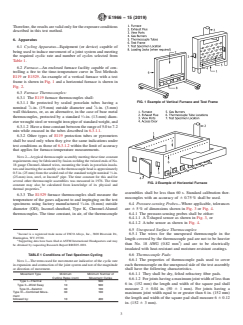
6.2 Furnace—An enclosed furnace facility capable of con-
trolling a fire to the time-temperature curve in Test Methods
E119 or E1529. An example of a vertical furnace with a test
frame is shown in Fig. 1 and a horizontal furnace is shown in
Fig. 2.
6.3 Furnace Thermocouples:
6.3.1 The E119 furnace thermocouples shall:
FIG. 1 Example of Vertical Furnace and Test Frame
6.3.1.1 Be protected by sealed porcelain tubes having a
3 1
nominal ⁄4-in. (19-mm) outside diameter and ⁄8-in. (3-mm)
wall thickness, or, as an alternative, in the case of base metal
thermocouples, protected by a standard ⁄2-in. (13-mm) diam-
eter wrought steel or wrought iron pipe of standard weight, and
6.3.1.2 Have a time constant between the range of 5.0 to 7.2
min while encased in the tubes described in 6.3.1.1.
6.3.2 Other types of E119 protection tubes or pyrometers
shall be used only when they give the same indications under
test conditions as those of 6.3.1.2 within the limit of accuracy
that applies for furnace-temperature measurements.
NOTE 2—Atypical thermocouple assembly meeting these time constant
requirements may be fabricated by fusion-welding the twisted ends of No.
18 gauge Chromel-Alumel wires, mounting the leads in porcelain insula-
torsandinsertingtheassemblysothethermocouplebeadisapproximately
0.5 in. (25 mm) from the sealed end of the standard weight nominal ⁄2-in.
(25-mm) iron, steel, or Inconel pipe. The time constant for this and for
several other thermocouple assemblies was measured in 1976. The time
FIG. 2 Example of Horizontal Furnace
constant may also be calculated from knowledge of its physical and
thermal properties.
assemblies shall be less than 60 s. Standard calibration ther-
6.3.3 The E1529 furnace thermocouples shall measure the
mocouples with an accuracy of 6 0.75 % shall be used.
temperature of the gases adjacent to and impinging on the test
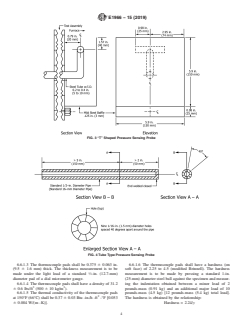
6.4 Pressure-sensing Probes—Where applicable, tolerances
specimens using factory manufactured ⁄4-in. (6-mm) outside
are 6 5 % of dimensions shown in Fig. 3 or Fig. 4.
diameter (OD), Inconel-sheathed, Type K, Chromel-Alumel
6.4.1 The pressure-sensing probes shall be either:
thermocouples. The time constant, in air, of the thermocouple
6.4.1.1 A T-shaped sensor as shown in Fig. 3,or
6.4.1.2 A tube sensor as shown in Fig. 4.
6.5 Unexposed Surface Thermocouples:
Inconel is a registered trade name of INCO Alloys, Inc., 3800 Riverside Dr.,
6.5.1 The wires for the unexposed thermocouple in the
Huntingdon, WV 25720.
length covered by the thermocouple pad are not to be heavier
Supporting data have been filed at ASTM International Headquarters and may
than No. 18 AWG (0.82 mm ) and are to be electrically
be obtained by requesting Research Report RR:E05-1001.
insulated with heat-resistant and moisture-resistant coatings.
TABLE 1 Conditions of Test Specimen Cycling
6.6 Thermocouple Pads:
6.6.1 The properties of thermocouple pads used to cover
NOTE 1—The terms used for movement are indicative of the cyclic rate
each thermocouple on the unexposed side of the test assembly
in expansion and contraction of the joint system and not of the magnitude
or direction of movement.
shall have the following characteristics.
6.6.1.1 They shall be dry, felted refractory fiber pads.
Movement Type Minimum Minimum Number of
Cycling Rates (cpm) Movement Cycles
6.6.1.2 Forjointshavingamaximumjointwidthoflessthan
Type I—Thermal 1 500
6 in. (152 mm) the length and width of the square pad shall
Type II—Wind Sway 10 500
Type III—Seismic 30 100 measure 2 6 0.04 in. (50 6 1 mm). For joints having a
Type IV—Combined Move- 30 100
maximum joint width equal to or greater than 6 in. (152 mm)
ment
the length and width of the square pad shall measure 6 6 0.12
followed by: 10 400
in. (152 6 3 mm).
E1966 − 15 (2019)
FIG. 3 “T” Shaped Pressure Sensing Probe
FIG. 4 Tube Type Pressure Sensing Probe
6.6.1.3 The thermocouple pads shall be 0.375 6 0.063 in. 6.6.1.6 The thermocouple pads shall have a hardness (on
(9.5 6 1.6 mm) thick. The thickness measurement is to be soft face) of 2.25 to 4.5 (modified Brinnell). The hardness
made under the light load of a standard ⁄2-in. (12.7-mm) measurement is to be made by pressing a standard 1-in.
diameter pad of a dial micrometer gauge. (25-mm) diameter steel ball against the specimen and measur-
6.6.1.4 The thermocouple pads shall have a density of 31.2 ing the indentation obtained between a minor load of 2
3 3
6 0.6 lbs/ft (500 6 10 kg/m ). pounds-mass (0.91 kg) and an additional major load of 10
6.6.1.5 The thermal conductivity of the thermocouple pads pounds-mass (4.5 kg) [12 pounds-mass (5.4 kg) total load].
at 150°F (66°C) shall be 0.37 6 0.03 Btu -in./h -ft -°F [0.053 The hardness is obtained by the relationship:
6 0.004 W/(m -K)]. Hardness = 2.24/y
E1966 − 15 (2019)
where: 6.10.1.4 A pressure tap for measuring the water pressure at
the base of the nozzle shall be normal to the surface of the
y = the difference in indentation [in. (mm)].
nipple, shall be centered in its length, and shall not protrude
6.7 Differential Pressure Measurement Instruments:
into the water stream.
6.7.1 The differential pressure measurement instrument
6.10.1.5 A suitable pressure gauge capable of reading a
shall be:
minimum of 0-50 psi (0-344.8 kPa) and graduated into no
6.7.1.1 A manometer or equivalent transducer.
greater than 2-psi (13.8-kPa) increments shall be used to
6.7.1.2 Capable of reading in graduated increments of no
measure the water pressure.
greater than 0.01 in. H O (2.5 Pa) with a precision of not less
than 6 0.005 in. HO(6 1.25 Pa).
7. Test Specimen
6.8 Cotton Pads:
7.1 Make the test assembly representative of the construc-
6.8.1 Their nominal size shall be 4 by 4 by ⁄4 in. (100 by
tion for which the fire resistance rating is desired with respect
100 by 19 mm). Cotton pads are to consist of new, undyed and
to materials, workmanship, and details. Install the test speci-
soft cotton fibers, without any admixture of artificial fibers.
meninaccordancewiththemanufacturer’sspecifiedprocedure
Each cotton pad is to weigh approximately 3 to 4 g.The cotton
for conditions representative of those found in building con-
pads are to be conditioned prior to use by drying in an oven at
struction.
212 6 9°F (100 6 5°C) for at least 30 min. After drying, the
7.2 Atest assembly often consists of multiple test specimen
cotton pads shall be stored in a desiccator for up to 24 h.
widths, joint configurations, test specimen configurations, sup-
6.8.2 The frame used to hold the cotton pad is to be formed
porting elements, and joint face materials. When multiple test
of No. 16 AWG (1.31-mm) steel wire and is to be provided
specimens are installed and tested simultaneously in a test
with a handle long enough to reach all points of the test
assembly, maintain the separation between adjacent test speci-
assembly.
mens to accommodate thermocouple placement and structural
6.9 Loading System:
and loading requirements.
6.9.1 Equipment, or a device, capable of inducing a desired
7.3 Test each test specimen with manufactured and field
load upon the joint system or supporting construction. An
splices. When the technique of the manufactured splice is the
example of a loading system is shown in Fig. 5.
same as the field splice, test only one splice. Make the
6.10 Hose Stream Delivery System:
minimum distance between a splice and the nearest furnace
6.10.1 The hose stream delivery system shall consist of:
wall 1.5 times the thickness of the supporting construction or
6.10.1.1 A standard 2 ⁄2-in. (64-mm) diameter hose at-
12 in. (305 mm), whichever is greater. Make the minimum
tached to a national standard play pipe as described in Practice
separation between splices within a test specimen 36 in. (914
E2226.
mm). Position splices so that they will be exposed to a
6.10.1.2 The play pipe shall have a length of 30 6 0.25 in.
minimum positive furnace pressure differential of 0.01 in. H O
(762 6 6 mm) and shall be equipped with a standard 1 ⁄8-in.
(2.5 Pa) during the fire exposure test.
(29-mm) discharge tip of the standard-taper-smooth-bore pat-
7.4 Test all test specimens at their maximum joint width.
tern without shoulder at the orifice.
6.10.1.3 The play pipe shall be fitted with a standard 2 ⁄2-in. 7.5 Test vertical asymmetrical test specimens from both
(64-mm) inside dimension by 6-in. (153-mm) long nipple sides unless they are designed for fire exposure on only one
mounted between the hose and the base of the play pipe. side or it is documented that the side with the lower fire
resistance rating is being tested.
7.6 Make vertical and horizontal test specimens with a
maximum joint width not greater than 4 in. (102 mm) at least
4 ft (1219 mm).
7.7 For maximum joint widths greater than 4 in. (102 mm),
make the vertical test specimens at least 9 ft (2744 mm) and
make the horizontal test specimens at least 12 ft (3658 mm).
7.8 Asymmetrical wall-to-wall joint systems shall be tested
in accordance with 7.5. Examples of asymmetrical and sym-
metrical wall-to-wall joint systems are illustrated in Fig. 6.
8. Preparation of Apparatus
8.1 Furnace Thermocouples:
8.1.1 Test Method E119—Make the exposed length of the
pyrometer tube and thermocouple in the furnace chamber not
less than 12 in. (305 mm).
8.1.2 Test Method E1529—Mount a minimum length of 20
diameters (125 mm) of the sheathed junction end of the
FIG. 5 Example of Loading System thermocouple parallel to the surface of the test specimen.
E1966 − 15 (2019)
8.3.3 For vertical furnaces, measure the differential pressure
along the furnace wall near each side of the furnace.
9. Calibration and Standardization
9.1 Test Method E119 does not contain a calibration proce-
dure.
9.2 Test Method E1529 calibration procedure is as follows:
9.2.1 Expose a test specimen to heat flux and temperature
conditions representative of total continuous engulfment in the
luminous flame regime of a large free burning fluid hydrocar-
bon fueled pool fire. Use calibration assemblies to demonstrate
that the required heat flux and temperature levels are generated
in the fire test facility.
9.2.2 Measure the total heat flux using a circular foil heat
flux gauge.
NOTE 3—The circular foil heat flux gauge may be called a Gardon
gauge after its developer.
9.2.3 Provide a test setup with an average total cold wall
heat flux on all exposed surfaces of the test specimen of 50 000
2 2
6 2 500 Btu/ft • h (158 6 8 kW/m ). Control the total cold
wall heat flux by varying the flow of fuel and air. Attain the
2 2
FIG. 6 Examples of Wall-to-Wall Joint Systems in Gypsum Wall-
coldheatfluxof50000Btu/ft •h(158 68kW/m )withinthe
board Assemblies
first 5 min of the test exposure; maintain this heat flux for the
duration of the test.
9.2.4 Generate a temperature environment with a heat flux
8.2 Furnace Thermocouple Locations: 2
of 50 000 Btu/ft • h of at least 1500°F (815°C) after the first
8.2.1 Uniformly distribute the thermocouples employed to
3 min of the test and between 1850°F (1010°C) and 2150°F
measure the temperature of the furnace to give the average
(1180°C) at all times after the first 5 min of the test.
temperature in the vicinity of the test specimen. Reference 6.3.
10. Conditioning
8.2.2 Position the furnace thermocouples before the start of
the fire exposure test. If a thermocouple will come in contact
10.1 Prior to testing, condition the supporting construction
with or will touch the test assembly during the test, reposition
and test specimen in air having 50 % relative humidity at 73 6
that thermocouple to avoid any contact with the test assembly.
5°F (23 6 3°C). Do not require the supporting construction to
8.2.3 Place the junction of each thermocouple 12 6 1 in.
be conditioned with the test specimen. When conditioning to
(305 6 25 mm) from the surface of horizontal construction or
thislevelcannotbeaccomplished,conductthetestingwhenthe
from the surface of specimens mounted in horizontal test
most damp portion of the supporting construction and test
assemblies.
specimen have achieved equilibrium resulting from storage in
8.2.4 Placethejunctionofeachthermocouple6 61in.(152
air having 50 % to 75 % relative humidity at 73 6 5°F (23 6
6 25 mm) from the surface of vertical assemblies or from the
3°C).
surface of test specimen mounted in vertical test assembly.
10.1.1 Exception—When an equilibrium condition is not
8.2.5 Use a minimum of three furnace thermocouples. For
achieved within a 12-month conditioning period; or if the test
the following, calculate the exposed area as the sum of the
assembly is such that hermetic sealing resulting from the
surface area of the test assembly exposed to the furnace fire.
conditioning has prevented drying of the interior of the
8.2.5.1 For horizontal assemblies, place no less than five
supporting construction or test specimen, then continue the
2 2
thermocouples per 100 ft (9 m ) of exposed area.
conditioning only until the supporting construction has devel-
8.2.5.2 For vertical assemblies, place no less than nine
oped sufficient strength to retain the test specimen securely in
2 2
thermocouples per 100 ft (9 m ) of exposed area.
position.
8.3 Furnace Pressure:
10.2 Determine the relative humidity within hardened con-
8.3.1 Make the minimum vertical distance between pressure
crete with a method that uses an electric sensing element.
sensors referenced in 6.4 one-half the height of the furnace
Determine the relative humidity within a supporting construc-
chamber. Locate the pressure sensors where they will not be
tion or test specimen made of materials other than concrete
subjected to direct impingement of convection currents. Make
with a method such as one that uses an electric sensing
tubing connected to each pressure sensor horizontal both in the
element.
furnace and at its egress through the furnace wall such that the
10.3 Do not use wood with a moisture content greater than
pressure is relative to the same elevation from the inside to the
13 % as determined by an electrical resistance method.
outside of the furnace.
8.3.2 For horizontal furnaces, measure the differential pres- 10.4 When it becomes necessary to use accelerated drying
sure near the vertical centerline of two opposing furnace walls. techniques, avoid procedures that will alter the characteristics
E1966 − 15 (2019)
of the test assembly from those produced as a result of drying 12.2.1 Provide unexposed surface thermocouples, reference
in accordance with the procedures specified in 10.1. 6.5, in conformance with the type required by the selected
time-temperature curve. Measure the temperatures of the
10.5 Within 72 h of the fire test, obtain information on the
unexposed surface (surface of test assembly opposite the
actual moisture content and distribution within the test assem-
exposure to furnace fire) with thermocouples placed under
bly. When the moisture condition of the test assembly is
thermocouple pads, reference 6.6. Immerse the wire leads of
capable of changing significantly from the 72 h sampling
the thermocouple under the pad and make them contact the
condition prior to test, make the sampling not later than 24 h
unexposed surface, parallel with the longitudinal direction of
prior to the test.
the joint, for not less than 1 in. (25 mm). Place the hot junction
of the thermocouple approximately under the center of the pad.
11. Movement Cycling Test Procedure
Firmly hold the pad against the surface and fit it closely about
11.1 Require movement cycling if the maximum joint width
the thermocouple.
does not equal the minimum joint width.
12.2.2 When necessary, deform the thermocouple pad to
NOTE 4—Reference 3.1.5 and 3.1.6, as well as Appendix X11, for follow the non-planar surface profile of the test specimen.
information useful in distinguishing between the concepts of maximum
When the maximum joint width is less than the specified pad
joint width and minimum joint width.
size, reduce the width of the pad to match the maximum joint
11.2 Prior to the fire exposure, subject test specimens that width. The pad length shall be as specified and parallel to the
meet the criteria of 11.1 to movement cycling. Use appropriate test specimen length. If the modified thermocouple pad cannot
cycling apparatus. Reference 6.1.
be placed on the contour of the surface, then no thermocouple
is required at that location.
11.3 The test sponsor selects the movement type desired for
12.2.3 Do not place unexposed surface thermocouples
the movement cycle test from Table 1.
closer to the furnace edge than 1.5 times the thickness of the
11.4 Install each test specimen at its nominal joint width.
supporting construction or 12 in. (305 mm), whichever is
Cycleeachtestspecimeninaccordancewiththecyclicrateand
greater.
number of movement cycles for the movement type selected
12.2.4 Locate unexposed surface thermocouples on the test
from Table 1.
assembly as follows:
11.5 Do not allow alterations or modifications which will
12.2.4.1 Place one on each splice of each test specimen, at
enhance the thermal performance of the test specimen during
the mid-point of the splice.
or after the movement cycling.
12.2.4.2 Place a minimum of one per linear meter along the
11.6 Examine the test specimen after movement cycling.
centerline of the joint, but not less than two per test specimen
Note, photograph, and report any indication of stress, defor- excluding the splice thermocouple.
mation or fatigue of the test specimen.
12.2.4.3 Place a minimum of one at the junction between
each supporting construction and each test specimen.
11.7 If a test specimen has been movement cycled separate
12.2.4.4 Place a minimum of three per test specimen on the
from its supporting construction, remove it from the cycling
adjacent supporting construction at a maximum distance “T”,
apparatus, install it in the supporting assembly, and set it at the
where T is equal to the maximum thickness of the adjacent
maximum joint width prior to fire testing.
supporting construction, from the blockout or joint edge.
NOTE 5—It is recommended that this process take no longer than 96 h.
12.2.5 When, in the opinion of the laboratory, potential
weak spots are identified; attach additional thermocouples to
12. Fire Resistance Test Procedure
these locations.An example of a weak spot is any irregularity,
12.1 Test Assembly:
such as a crack or tear, that has occurred to the test specimen
12.1.1 Seal the test assembly against the furnace with an
during the cycling or the installation process.
insulating gasket between the test assembly and the furnace.
12.2.6 Do not locate thermocouples over fasteners (such as
Reference 6.2. Tightly seal the open ends of the test specimen
screws, nails, or staples) that will be obviously higher or lower
against air flow. Throughout the test, periodically check the
in temperature than at a more representative location if the
seals at the ends of the test specimen and repair them, as
aggregate area of the fasteners on the unexposed surface is less
necessary, to prevent air flow.
than1 %oftheareawithinany6-in.(152-mm)diametercircle,
12.1.2 Protect the test equipment and test assembly from
unless the fasteners extend through the test specimen.
any condition of wind or weather that influences test results.
12.2.7 For test specimens tested between adjacent wall
Measure the ambient air temperature at the beginning of the
sections, do not place a thermocouple at an elevation below the
test; it is not to be less than 50°F (10°C). Measure the velocity
neutral pressure plane of the furnace.
of air moving horizontally across the unexposed surface of the
12.3 Fortestspecimensthataredesignedtobeloadbearing,
test assembly immediately before the test begins; it is not to
apply a superimposed load to the test specimen throughout the
exceed 4.4 ft/s (1.3 m/s) as determined by an anemometer
test.Thesuperimposedloadistosimulatethemaximumdesign
placed at right angles to the unexposed surface. When me-
load for the test specimen. Reference 6.9.
chanical ventilation is employed during the test, do not direct
an air stream across the surface of the test assembly.
12.4 Simultaneously start the furnace, measuring devices
12.2 Unexposed Surface Temperatures: and data acquisition equipment.
E1966 − 15 (2019)
12.5 Maintain the fire environment within the furnace in the test specimen in accordance with Section 13. Record the
accordance with the standard time-temperature curve shown in location, time, and results of each cotton pad application.
the Test Method E119 or the rapid temperature rise curve
12.11 Continue the test until failure occurs or until the test
shown in Test Method E1529.
specimen has satisfied all the applicable requirements in 15.2
12.6 Furnace Control: for the desired fire resistance rating.
12.6.1 TestMethodE119Time-TemperatureCurve—Control
12.12 For the purpose of obtaining additional performance
the furnace such that the area under the time-temperature
data, if desired, continue the test beyond the time that the fire
curve, obtained by averaging the results from the furnace
resistance rating is determined.
thermocouple readings, is within 10 % of the corresponding
area under the standard time-temperature curve for fire tests of
13. Integrity Test Procedure
1 h or less in duration, within 7.5 % for those over 1 h and not
13.1 Evaluate the integrity of the test specimen during the
more than 2 h, and within 5 % for tests exceeding2hin
fire resistance test for passage of flame and hot gasses using a
duration.
cotton pad in a wire frame provided with a handle. Reference
12.6.2 Test Method E1529 Time-Temperature Curve—
6.8.
Control the furnace such that the area under the time-
13.2 Hold the cotton pad directly over an observed crack or
temperature curve of the average of the gas temperature
hole in the test specimen, approximately 1 in. (25 mm) from
measurements is within 10 % of the corresponding curve
1 the breached surface, for a period of 30 6 1 s. When required,
developed in the furnace calibration for tests of ⁄2 h or less
make small adjustments in the position of the cotton pad to
duration, within 7.5 % of those over ⁄2 h and not more than 1
achieve the maximum effect from the hot gasses.
h, and within 5 % for tests exceeding 1 h.
13.3 When no ignition (defined as glowing or flaming) of
12.7 Take and record unexposed and furnace temperature
the cotton pad occurs during the 30-s application, make
readings at intervals not exceeding 1 min throughout the test.
“screening tests” that involve short duration applications of the
12.8 Furnace Pressure:
cotton pad to areas of potential failure and/or the movement of
12.8.1 Calculate the differential pressure between the ex-
a single pad over and around such areas. Charring of the pad
posed and unexposed surfaces of the test assembly based on
only provides an indication of imminent failure. Employ a
measurements taken at the specified locations and elevations,
previously unused cotton pad for an integrity failure to be
and based on the linear pressure gradient of the furnace.
confirmed.
Determine the linear pressure gradient of the furnace by the
differenceinmeasuredpressureofatleasttwopressuresensors
14. Hose Stream Test Procedure
separated by a vertical distance in the furnace.
14.1 Requirements
12.8.2 Operate a horizontal furnace such that a minimum
14.1.1 Within 10 min after the end of the fire resistance test,
pressure of 0.01 in. H O (2.5 Pa) is established at the lowest
subject test specimens that are extensions of walls to the
point of the test specimen.
impact, erosion, and cooling effects of a hose stream.
12.8.3 Operate a vertical furnace such that the 0.01 in. H O
14.1.2 Conduct the hose stream test on a duplicate test
(2.5 Pa) plane is at or below the mid-height of every test
assembly which has been conditioned, movement cycled, and
specimen. In the case of a horizontal joint, in a vertical test
subjected to a fire test equal to one-half of the fire resistance
assembly, subject the entire joint to a minimum pressure of
rating but not more than 60 min.
0.01 in. H O (2.5 Pa).
14.1.3 As an option and in lieu of the duplicate test
12.8.4 Read and record the differential pressures at intervals
assemblyin14.1.2,conductthehosestreamtestontheoriginal
not exceeding 1 min throughout the test. Reference 6.7.
testassemblyafterithascompleteditsfullfireresistancerating
12.8.5 After the initial 10 min of fire exposure, control the
test.
furnace pressure (at the locations specified) so that it will not
14.2 Application:
be less than 0.01 in. H O (2.5 Pa) for the last 25 % of the fire
14.2.1 Use the water pressure and duration of application as
exposure time period and an aggregate time period exceeding:
specified in Table 2 for the hourly fire rating achieved.
12.8.5.1 Ten percent of the fire exposure for fire tests of 1 h
Reference 6.10.
or less duration,
12.8.5.2 Seven and one-half percent of the fire exposure for
fire tests longer than 1 h but not longer than 2 h, and
TABLE 2 Water Pressure and Duration of Hose Stream
12.8.5.3 Five percent of the fire exposure for fire tests
NOTE 1—The rectangular area of the structure in which the joint system
exceeding2hin duration.
is mounted is to be considered as the exposed area, as the hose stream
12.9 Make observations of the exposed and unexposed
must traverse this calculated area during application.
surfaces of the test assembly throughout the test. At a maxi-
Fire Resistance Ratings Water Pressure at Base of Duration of Application,
2 2
(min) Nozzle, psi (kPa) s/ft (s/m ) exposed area
mum of 15 min time intervals, record observations, such as
(Hourly Fire Rating)
deformation, spalling, cracking, burning, and production of
240 < 480 45 (310) 3.0 (32)
smoke. Measure and record downward or lateral deflection.
120 < 240 30 (207) 1.5 (16)
90 < 120 30 (207) 0.9 (10)
12.10 When a crack or hole is observed on the unexposed
< 90 30 (207) 0.6 (6)
side of the test specimen during the test, verify the integrity of
E1966 − 15 (2019)
14.2.2 Locate the nozzle orifice no further than 20 ft (6.1 m) the standard time-temperature curve provided that the condi-
from the center of the exposed surface of the test assembly so tions of 12.6 are met. The correction is expressed by the
that, when directed at the center, its axis is normal to the following formula:
surfaceofthetestassembly.Whenthenozzleisunabletobeso
C 5 2I A 2 A /3 A 1L (1)
~ ! ~ !
s s
located, locate it on a line deviating not more than 30° fromthe
where:
line normal to the center of the test assembly.When so located,
its distance from the center of the test assembly is to be less C = correction to the indicated fire resistance period in the
same units as I,
than 20 ft (6.1 m) by an amount equal to 1 6 0.02 ft (305 6
I = indicated fire resistance period in min,
6.35 mm) for each 10° of deviation from the normal.
A = area under the actual time-temperature curve for the
14.2.3 Direct the hose stream first at the bottom and then at
first three fourths of the indicated fire resistance period
all parts of the exposed surface, making changes in direction
in °F • min (°C• min),
slowly. Keep the hose stream moving across the test assembly.
A = the area under the standard time-temperature curve for
Do not concentrate, make directional changes, or stop the hose s
the first three fourths for the same part of the indicated
stream on any point on the test assembly. Changes in direction
fire resistance period in °F • min (°C• min), and
of the hose stream shall be made within 1 ft (310 mm) outside
L = lag correction in the same units as A and A , 3240°F •
s
of the perimeter edge of the test assembly. The following is an
min (1800°C • min), when furnace thermocouples
acceptable pattern.
specified in 6.3.1 are used.
14.2.3.1 Direct the hose stream around the periphery of the
test assembly, starting upward from either bottom corner.
15.3 Integrity Test—When the cotton pad test is conducted,
14.2.3.2 After the hose stream has covered the periphery,
the fire resistive joint system shall not have allowed the
apply the hose stream in vertical paths approximately 1 ft (310
passage of flames or hot gases sufficient to ignite the cotton
mm) apart until the entire width has been covered.
pad.
14.2.3.3 After the hose stream has covered the width, apply
15.4 Load Application—When a load is applied, the fire
the hose stream in horizontal paths approximately 1 ft (310
resistive joint system shall have sustained the applied load for
mm) apart until the entire height has been covered.
the full fire resistance period.
14.2.4 Maintain the hose stream on the test assembly for the
2 2
duration of application in s/ft (s/m ) of exposed area as 15.5 Hose Stream Test—When the hose stream test is
prescribed in Table 2. If the required duration has not been conducted, the fire resistive joint system shall have withstood
reached and 14.2.3.3 is complete, then repeat 14.2.3 in reverse. the hose stream test without developing any opening that
permits a projection of water from the stream beyond the
unexposed surface.
15. Conditions of Compliance
15.5.1 Aprojection of water through a supporting construc-
15.1 Movement Cycling Test—When movement cycling is
tion within T/2, where T is equal to the maximum thickness of
conducted, the fire resistive joint system shall have completed
the adjacent supporting construction, of the longitudinal edge
atleasttheminimumnumberofmovementcyclesusingatleast
of the test specimen fails only that test specimen.
the minimum cyclic rate for the movement type selected.
15.5.2 Aprojection of water through a supporting construc-
15.2 Fire Resistance Test—Each fire resistive joint system
tionbetweentwotestspecimensoutsideT/2ofthelongitudinal
tested shall comply with the following.
edge of either test specimen shall not be deemed a failure of
15.2.1 The fire resistance rating of the fire resistive joint
either test specimen.
system shall be determined as the time at whichever of the
following conditions occurs first:
16. Report
15.2.1.1 The temperature rise of any one thermocouple on
the unexposed face of the test specimen or adjacent supporting 16.1 General Information—Include:
construction is more than 325°F (181°C) above the initial 16.1.1 The test date and a project number.
temperature, and
16.1.2 As a minimum, the following about the laboratory or
15.2.1.2 For maximum joint widths greater than 4 in. (102
test facility:
mm), the average temperature rise of the thermocouples on the
16.1.2.1 Name and Location.
unexposed face of the test specimen and its supporting con-
16.1.2.2 Adescription of the furnace used and test frame, if
struction is more than 250°F (139°C) above the initial tem-
any.
perature.
16.2 Test Assembly and Test Specimen Information—
15.2.2 When the test is continued beyond the fire resistance
Include a unique designation for each fire resistive joint system
rating period of the supporting construction, the unexposed
tested.When more than one fire resistive joint system is tested,
thermocouples on the supporting construction in 12.2.4.4 are
supply separate information for each of the following:
no longer considered in the conditions of compliance for the
16.2.1 Drawings of the supporting construction and each
test specimen.
fire resistive joint system detailing dimensions, materials and
15.2.3 When Test Method E119 is used and the indicated
composition.
fire resistance rating is 60 min or more, it shall be increased or
decreased by the following correction to compensate for 16.2.2 The curing time, if any, for any components of each
significant variation of the measured furnace temperature from fire resistive joint system.
E1966 − 15 (2019)
16.2.3 Themoisturecontentandthedistributionofmoisture 16.4.4 Report the recorded measurement of any deflection
within the test assembly. for each fire resistive joint system and its supporting construc-
16.2.4 The shape and dimensions of recesses (blockouts)
tion and control method, when applicable.
when formed in the supporting construction to secure any part
16.4.5 Report any observations made of the exposed and
of the fire-resistive joint system.
unexposed surfaces, such as deformation, spalling, cracking,
16.2.5 All installation procedures provided by the test
burning, and production of smoke.
sponsor, details of the equipment used and photographs of the
16.5 Integrity Test—When the integrity test is conducted,
installation procedure.
report the results for each fire resistive joint system. Clearly
16.2.6 The splicing method used, including the test spon-
state whether each fire resistive joint system passed or failed.
sor’s instructions and photographic documentation of the
installation.
16.6 Hose Stream Test—When the hose stream test is
16.2.7 Adescription of any fire resistive joint system that is
conducted, report the performance of each fire resistive joint
tested with a change in direction. Include the test sponsor’s
system. Clearly state whether each fire resistive joint system
installation or fabrication instructions or both, and photo-
passed or failed.
graphic documentation of the installation.
16.3 Movement Cycling Test—When movement cycling is
17. Precision and Bias
conducted, include the following information:
17.1 Movement Cycling Test—No information is presented
16.3.1 The nominal joint width.
about either the precision and bias of this test method for
16.3.2 The maximum joint width.
measuring the response of joint systems to a standard move-
16.3.3 The minimum joint width.
ment cycle test under controlled laboratory conditions because
16.3.4 The movement type selected from Table 1.
no material having an acceptable reference value has been
16.3.5 The minimum number of cycles completed.
determined.
16.3.6 The cyclic rate (cpm) used.
16.3.7 Whether or not the information in 16.3.5 and 16.3.6
17.2 Fire Resistance Test—Precision and bias of this test
satisfies the requirements of 16.3.4. Clearly state whether each
method for measuring the response of joint systems to heat and
fire resistive joint system passed or failed.
flame under controlled laboratory conditions are essentially as
16.3.8 Photographs of each fire resistive joint system tested
specified in Test Method E119 or E1529.
during and after the movement cycling.
17.3 Integrity Test—No information is presented about ei-
16.4 Fire Resistance Test—
thertheprecisionandbiasofthist
...