

ASTM D6087-22
(Test Method)Standard Test Method for Evaluating Asphalt-Covered Concrete Bridge Decks Using Ground Penetrating Radar
General Information
- Abstract
SIGNIFICANCE AND USE
3.1 This test method provides information on the condition of concrete bridge decks overlaid with asphaltic concrete without necessitating removal of the overlay, or other destructive procedures.
3.2 This test method also provides information on the condition of bridge decks without overlays and with portland cement concrete overlays.
3.3 A systematic approach to bridge deck rehabilitation requires considerable data on the condition of the decks. In the past, data has been collected using the traditional methods of visual inspection supplemented by physical testing and coring. Such methods have proven to be tedious, expensive, and of limited accuracy. Consequently, GPR provides a mechanism to rapidly survey bridges in an efficient, nondestructive manner.
3.4 Information on the condition of asphalt-covered concrete bridge decks is needed to estimate bridge deck condition for maintenance and rehabilitation, to provide cost-effective information necessary for rehabilitation contracts.
3.5 GPR is currently the only nondestructive method that can evaluate bridge deck condition on bridge decks containing an asphalt overlay.
SCOPE
1.1 This test method covers several ground penetrating radar (GPR) evaluation procedures that can be used to evaluate the condition of concrete bridge decks overlaid with asphaltic concrete wearing surfaces. These procedures can also be used for bridge decks overlaid with portland cement concrete and for bridge decks without an overlay. Specifically, this test method predicts the presence or absence of concrete or rebar deterioration at or above the level of the top layer of reinforcing bar.
1.2 Deterioration in concrete bridge decks is manifested by the corrosion of embedded reinforcement or the decomposition of concrete, or both. The most serious form of deterioration is that which is caused by corrosion of embedded reinforcement. Corrosion may be initiated by deicing salts, used for snow and ice control in the winter months, penetrating the concrete. In arid climates, the corrosion can be initiated by chloride ions contained in the mix ingredients. Deterioration may also be initiated by the intrusion of water and aggravated by subsequent freeze/thaw cycles, causing damage to the concrete and subsequent debonding of the reinforcing steel with the surrounding compromised concrete.
1.2.1 As the reinforcing steel corrodes, it expands and creates a crack or subsurface fracture plane in the concrete at or just above the level of the reinforcement. The fracture plane, or delamination, may be localized or may extend over a substantial area, especially if the concrete cover to the reinforcement is small. It is not uncommon for more than one delamination to occur on different planes between the concrete surface and the reinforcing steel. Delaminations are not visible on the concrete surface. However, if repairs are not made, the delaminations progress to open spalls and, with continued corrosion, eventually affect the structural integrity of the deck.
1.2.2 The portion of concrete contaminated with excessive chlorides is generally structurally deficient compared with non-contaminated concrete. Additionally, the chloride-contaminated concrete provides a pathway for the chloride ions to initiate corrosion of the reinforcing steel. It is therefore of particular interest in bridge deck condition investigations to locate not only the areas of active reinforcement corrosion, but also areas of chloride-contaminated and otherwise deteriorated concrete.
1.3 This test method may not be suitable for evaluating bridges with delaminations that are localized over the diameter of the reinforcement, or for those bridges that have cathodic protection (coke breeze as cathode) installed on the bridge or for which a conductive aggregate has been used in the asphalt (that is, blast furnace slag). This is because metals are perfect reflectors of electromagnetic waves, since th...
- Status
- Published
- Publication Date
- 31-Oct-2022
- Technical Committee
- D04 - Road and Paving Materials
- Drafting Committee
- D04.32 - Bridges and Structures
Buy Documents
ASTM D6087-22 - Standard Test Method for Evaluating Asphalt-Covered Concrete Bridge Decks Using Ground Penetrating Radar
REDLINE ASTM D6087-22 - Standard Test Method for Evaluating Asphalt-Covered Concrete Bridge Decks Using Ground Penetrating Radar
Overview
ASTM D6087-22 is the standard test method for evaluating asphalt-covered concrete bridge decks using ground penetrating radar (GPR). Developed by ASTM International, this nondestructive testing standard outlines procedures for assessing the condition of concrete bridge decks, both with and without asphaltic or portland cement concrete overlays. By employing GPR, engineers and maintenance teams can efficiently detect deterioration such as delamination and corrosion of reinforcing steel in bridge decks, all without the need for removing overlays or conducting destructive core sampling.
This procedure provides valuable condition data essential for bridge deck maintenance, rehabilitation planning, and overall asset management, contributing to cost-effective infrastructure management.
Key Topics
Nondestructive Condition Assessment
The standard details how GPR enables a rapid, comprehensive survey of bridge decks. This avoids the tedious and costly procedures associated with traditional visual inspections supplemented by physical testing or coring.Types of Deterioration Detected
- Corrosion of embedded reinforcement due to deicing salts or chloride ions
- Concrete decomposition from freeze/thaw cycles, intrusion of water, and subsequent debonding of steel reinforcement
- Delaminations, which are cracks or fracture planes within the concrete that can progress to open spalls and further structural damage if left untreated
Suitability and Limitations
- Most effective on bridge decks with asphalt overlays or concrete surfaces
- May be less suitable for decks with localized delaminations, cathodic protection systems, or those with conductive aggregates (e.g., blast furnace slag)
- Primarily intended for research and informational purposes, not for material acceptance or rejection
GPR Equipment and Methodology
- Utilizes either air-launched or ground-coupled antennas with specific operational frequencies (≥1 GHz)
- Procedures for GPR data collection include systematic passes over the deck in specified directions to map condition-related anomalies
Applications
Bridge Deck Surveys
Widely used by transportation agencies and engineers for periodic condition assessment of highway bridge decks, especially those covered with asphalt overlays that obscure visual inspection.Maintenance and Rehabilitation Planning
The information gathered using ASTM D6087-22 guides decisions on targeted maintenance, repairs, and budgeting by providing reliable data on the presence and extent of deterioration beneath overlays.Asset Management and Contract Documentation
Results can inform asset management systems and provide supporting evidence for rehabilitation contracts, ensuring funds are allocated to areas most in need.Supporting Engineering Investigations
Useful for preliminary investigations prior to in-depth structural evaluations or supplementary destructive testing if more localized or complex issues are suspected.
Related Standards
For comprehensive bridge deck evaluation and maintenance, the following related standards may also be relevant:
- ASTM D4748: Test Method for Determining the Thickness of Bound Pavement Layers Using Short-Pulse Radar Systems
- ASTM D6432: Guide for Using the Surface Ground Penetrating Radar Method for Subsurface Investigation
- ASTM D7007: Test Method for Evaluation of Asphalt-Covered Concrete Bridge Decks Using Ground Penetrating Radar
- ASTM C876: Test Method for Corrosion Potentials of Uncoated Reinforcing Steel in Concrete
- AASHTO R 37: Standard Practice for Assessing Pavement Layer Thickness Using Ground Penetrating Radar
Practical Value
ASTM D6087-22 provides engineers, bridge inspectors, and transportation agencies with a robust, nondestructive approach to evaluating the unseen condition of bridge decks. By leveraging ground penetrating radar, vital information on structural health can be obtained efficiently and cost-effectively, supporting proactive maintenance and prolonging the lifespan of key infrastructure assets. This test method ensures that decision-makers have reliable data necessary for prioritizing repairs and optimizing the allocation of maintenance resources.
Buy Documents
ASTM D6087-22 - Standard Test Method for Evaluating Asphalt-Covered Concrete Bridge Decks Using Ground Penetrating Radar
REDLINE ASTM D6087-22 - Standard Test Method for Evaluating Asphalt-Covered Concrete Bridge Decks Using Ground Penetrating Radar
Get Certified
Connect with accredited certification bodies for this standard

DIBt (Deutsches Institut für Bautechnik)
German Institute for Building Technology.
DIN CERTCO
DIN Group product certification.

Aboma Certification B.V.
Specialized in construction, metal, and transport sectors.
Sponsored listings
Frequently Asked Questions
ASTM D6087-22 is a standard published by ASTM International. Its full title is "Standard Test Method for Evaluating Asphalt-Covered Concrete Bridge Decks Using Ground Penetrating Radar". This standard covers: SIGNIFICANCE AND USE 3.1 This test method provides information on the condition of concrete bridge decks overlaid with asphaltic concrete without necessitating removal of the overlay, or other destructive procedures. 3.2 This test method also provides information on the condition of bridge decks without overlays and with portland cement concrete overlays. 3.3 A systematic approach to bridge deck rehabilitation requires considerable data on the condition of the decks. In the past, data has been collected using the traditional methods of visual inspection supplemented by physical testing and coring. Such methods have proven to be tedious, expensive, and of limited accuracy. Consequently, GPR provides a mechanism to rapidly survey bridges in an efficient, nondestructive manner. 3.4 Information on the condition of asphalt-covered concrete bridge decks is needed to estimate bridge deck condition for maintenance and rehabilitation, to provide cost-effective information necessary for rehabilitation contracts. 3.5 GPR is currently the only nondestructive method that can evaluate bridge deck condition on bridge decks containing an asphalt overlay. SCOPE 1.1 This test method covers several ground penetrating radar (GPR) evaluation procedures that can be used to evaluate the condition of concrete bridge decks overlaid with asphaltic concrete wearing surfaces. These procedures can also be used for bridge decks overlaid with portland cement concrete and for bridge decks without an overlay. Specifically, this test method predicts the presence or absence of concrete or rebar deterioration at or above the level of the top layer of reinforcing bar. 1.2 Deterioration in concrete bridge decks is manifested by the corrosion of embedded reinforcement or the decomposition of concrete, or both. The most serious form of deterioration is that which is caused by corrosion of embedded reinforcement. Corrosion may be initiated by deicing salts, used for snow and ice control in the winter months, penetrating the concrete. In arid climates, the corrosion can be initiated by chloride ions contained in the mix ingredients. Deterioration may also be initiated by the intrusion of water and aggravated by subsequent freeze/thaw cycles, causing damage to the concrete and subsequent debonding of the reinforcing steel with the surrounding compromised concrete. 1.2.1 As the reinforcing steel corrodes, it expands and creates a crack or subsurface fracture plane in the concrete at or just above the level of the reinforcement. The fracture plane, or delamination, may be localized or may extend over a substantial area, especially if the concrete cover to the reinforcement is small. It is not uncommon for more than one delamination to occur on different planes between the concrete surface and the reinforcing steel. Delaminations are not visible on the concrete surface. However, if repairs are not made, the delaminations progress to open spalls and, with continued corrosion, eventually affect the structural integrity of the deck. 1.2.2 The portion of concrete contaminated with excessive chlorides is generally structurally deficient compared with non-contaminated concrete. Additionally, the chloride-contaminated concrete provides a pathway for the chloride ions to initiate corrosion of the reinforcing steel. It is therefore of particular interest in bridge deck condition investigations to locate not only the areas of active reinforcement corrosion, but also areas of chloride-contaminated and otherwise deteriorated concrete. 1.3 This test method may not be suitable for evaluating bridges with delaminations that are localized over the diameter of the reinforcement, or for those bridges that have cathodic protection (coke breeze as cathode) installed on the bridge or for which a conductive aggregate has been used in the asphalt (that is, blast furnace slag). This is because metals are perfect reflectors of electromagnetic waves, since th...
SIGNIFICANCE AND USE 3.1 This test method provides information on the condition of concrete bridge decks overlaid with asphaltic concrete without necessitating removal of the overlay, or other destructive procedures. 3.2 This test method also provides information on the condition of bridge decks without overlays and with portland cement concrete overlays. 3.3 A systematic approach to bridge deck rehabilitation requires considerable data on the condition of the decks. In the past, data has been collected using the traditional methods of visual inspection supplemented by physical testing and coring. Such methods have proven to be tedious, expensive, and of limited accuracy. Consequently, GPR provides a mechanism to rapidly survey bridges in an efficient, nondestructive manner. 3.4 Information on the condition of asphalt-covered concrete bridge decks is needed to estimate bridge deck condition for maintenance and rehabilitation, to provide cost-effective information necessary for rehabilitation contracts. 3.5 GPR is currently the only nondestructive method that can evaluate bridge deck condition on bridge decks containing an asphalt overlay. SCOPE 1.1 This test method covers several ground penetrating radar (GPR) evaluation procedures that can be used to evaluate the condition of concrete bridge decks overlaid with asphaltic concrete wearing surfaces. These procedures can also be used for bridge decks overlaid with portland cement concrete and for bridge decks without an overlay. Specifically, this test method predicts the presence or absence of concrete or rebar deterioration at or above the level of the top layer of reinforcing bar. 1.2 Deterioration in concrete bridge decks is manifested by the corrosion of embedded reinforcement or the decomposition of concrete, or both. The most serious form of deterioration is that which is caused by corrosion of embedded reinforcement. Corrosion may be initiated by deicing salts, used for snow and ice control in the winter months, penetrating the concrete. In arid climates, the corrosion can be initiated by chloride ions contained in the mix ingredients. Deterioration may also be initiated by the intrusion of water and aggravated by subsequent freeze/thaw cycles, causing damage to the concrete and subsequent debonding of the reinforcing steel with the surrounding compromised concrete. 1.2.1 As the reinforcing steel corrodes, it expands and creates a crack or subsurface fracture plane in the concrete at or just above the level of the reinforcement. The fracture plane, or delamination, may be localized or may extend over a substantial area, especially if the concrete cover to the reinforcement is small. It is not uncommon for more than one delamination to occur on different planes between the concrete surface and the reinforcing steel. Delaminations are not visible on the concrete surface. However, if repairs are not made, the delaminations progress to open spalls and, with continued corrosion, eventually affect the structural integrity of the deck. 1.2.2 The portion of concrete contaminated with excessive chlorides is generally structurally deficient compared with non-contaminated concrete. Additionally, the chloride-contaminated concrete provides a pathway for the chloride ions to initiate corrosion of the reinforcing steel. It is therefore of particular interest in bridge deck condition investigations to locate not only the areas of active reinforcement corrosion, but also areas of chloride-contaminated and otherwise deteriorated concrete. 1.3 This test method may not be suitable for evaluating bridges with delaminations that are localized over the diameter of the reinforcement, or for those bridges that have cathodic protection (coke breeze as cathode) installed on the bridge or for which a conductive aggregate has been used in the asphalt (that is, blast furnace slag). This is because metals are perfect reflectors of electromagnetic waves, since th...
ASTM D6087-22 is classified under the following ICS (International Classification for Standards) categories: 91.080.40 - Concrete structures. The ICS classification helps identify the subject area and facilitates finding related standards.
ASTM D6087-22 is available in PDF format for immediate download after purchase. The document can be added to your cart and obtained through the secure checkout process. Digital delivery ensures instant access to the complete standard document.
Standards Content (Sample)
This international standard was developed in accordance with internationally recognized principles on standardization established in the Decision on Principles for the
Development of International Standards, Guides and Recommendations issued by the World Trade Organization Technical Barriers to Trade (TBT) Committee.
Designation: D6087 − 22
Standard Test Method for
Evaluating Asphalt-Covered Concrete Bridge Decks Using
Ground Penetrating Radar
This standard is issued under the fixed designation D6087; the number immediately following the designation indicates the year of
original adoption or, in the case of revision, the year of last revision.Anumber in parentheses indicates the year of last reapproval.A
superscript epsilon (´) indicates an editorial change since the last revision or reapproval.
1. Scope non-contaminated concrete. Additionally, the chloride-
contaminatedconcreteprovidesapathwayforthechlorideions
1.1 This test method covers several ground penetrating
to initiate corrosion of the reinforcing steel. It is therefore of
radar(GPR)evaluationproceduresthatcanbeusedtoevaluate
particular interest in bridge deck condition investigations to
the condition of concrete bridge decks overlaid with asphaltic
locate not only the areas of active reinforcement corrosion, but
concrete wearing surfaces. These procedures can also be used
also areas of chloride-contaminated and otherwise deteriorated
for bridge decks overlaid with portland cement concrete and
concrete.
for bridge decks without an overlay. Specifically, this test
method predicts the presence or absence of concrete or rebar
1.3 This test method may not be suitable for evaluating
deterioration at or above the level of the top layer of reinforc-
bridgeswithdelaminationsthatarelocalizedoverthediameter
ing bar.
of the reinforcement, or for those bridges that have cathodic
1.2 Deterioration in concrete bridge decks is manifested by
protection (coke breeze as cathode) installed on the bridge or
thecorrosionofembeddedreinforcementorthedecomposition
for which a conductive aggregate has been used in the asphalt
of concrete, or both. The most serious form of deterioration is
(that is, blast furnace slag). This is because metals are perfect
that which is caused by corrosion of embedded reinforcement.
reflectors of electromagnetic waves, since the wave imped-
Corrosion may be initiated by deicing salts, used for snow and
ances for metals are zero.
ice control in the winter months, penetrating the concrete. In
1.4 Since a precision estimate for this standard has not been
arid climates, the corrosion can be initiated by chloride ions
developed, the test method is to be used for research and
contained in the mix ingredients. Deterioration may also be
informational purposes only. Therefore, this standard should
initiated by the intrusion of water and aggravated by subse-
quent freeze/thaw cycles, causing damage to the concrete and not be used for acceptance or rejection of a material for
subsequent debonding of the reinforcing steel with the sur-
purchasing purposes.
rounding compromised concrete.
1.5 The values stated in SI units are to be regarded as
1.2.1 As the reinforcing steel corrodes, it expands and
standard. No other units of measurement are included in this
creates a crack or subsurface fracture plane in the concrete at
standard.
orjustabovethelevelofthereinforcement.Thefractureplane,
or delamination, may be localized or may extend over a
1.6 The text of this standard references notes and footnotes
substantial area, especially if the concrete cover to the rein-
which provide explanatory material.These notes and footnotes
forcement is small. It is not uncommon for more than one
(excluding those in tables and figures) shall not be considered
delamination to occur on different planes between the concrete
as requirements of the standard.
surface and the reinforcing steel. Delaminations are not visible
1.7 This standard does not purport to address all of the
on the concrete surface. However, if repairs are not made, the
safety concerns, if any, associated with its use. It is the
delaminations progress to open spalls and, with continued
responsibility of the user of this standard to establish appro-
corrosion, eventually affect the structural integrity of the deck.
priate safety, health, and environmental practices and deter-
1.2.2 The portion of concrete contaminated with excessive
mine the applicability of regulatory limitations prior to use.
chlorides is generally structurally deficient compared with
Specific precautionary statements are given in Section 5.
1.8 This international standard was developed in accor-
1 dance with internationally recognized principles on standard-
This test method is under the jurisdiction of ASTM Committee D04 on Road
and Paving Materials and is the direct responsibility of Subcommittee D04.32 on
ization established in the Decision on Principles for the
Bridges and Structures.
Development of International Standards, Guides and Recom-
Current edition approved Nov. 1, 2022. Published November 2022. Originally
ɛ1 mendations issued by the World Trade Organization Technical
approved in 1997. Last previous edition approved in 2015 as D6087–08 (2015) .
DOI: 10.1520/D6087-22. Barriers to Trade (TBT) Committee.
Copyright © ASTM International, 100 Barr Harbor Drive, PO Box C700, West Conshohocken, PA 19428-2959. United States
D6087 − 22
2. Summary of Test Method 4. Apparatus
2.1 ThedatacollectionequipmentconsistsofaGPRdevice, 4.1 GPR System—TherearetwocategoriesofGPRsystems,
data acquisition device, recording device, and data processing depending on the type of antenna utilized for data collection.
and interpretation equipment. The user makes repeated passes 4.1.1 GPR systems using air-launched horn antennas with
with the data collection equipment in a direction parallel or central frequencies 1 GHz and greater. The equipment may
perpendiculartothecenterlineacrossabridgedeckatspecified consist of an air-coupled, short-pulse monostatic or bistatic
locations.Bridgedeckconditionisquantifiedbasedonthedata antenna(s) with sufficient central frequency to provide the
obtained. accurate measurement ofa5cm thick asphalt pavement.
4.1.2 GPR systems using ground-coupled antennas with
3. Significance and Use
central frequencies greater than 1 GHz.
3.1 This test method provides information on the condition
4.2 Data Acquisition System—A data acquisition system,
of concrete bridge decks overlaid with asphaltic concrete
consisting of equipment for gathering GPR data at the mini-
without necessitating removal of the overlay, or other destruc-
mumfrequenciesspecifiedin4.1.1and4.1.2.Thesystemshall
tive procedures.
be capable of accurately acquiring GPR data with a minimum
of 60dB dynamic range.
3.2 This test method also provides information on the
condition of bridge decks without overlays and with portland
4.3 Distance Measurement System—A distance measure-
cement concrete overlays.
mentsystemconsistingofafifth-wheelorappropriatedistance
measurement instrument (DMI) with accuracy of
3.3 A systematic approach to bridge deck rehabilitation
6100mm⁄km and a resolution of 25 mm.
requires considerable data on the condition of the decks. In the
past, data has been collected using the traditional methods of
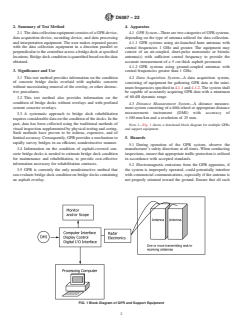
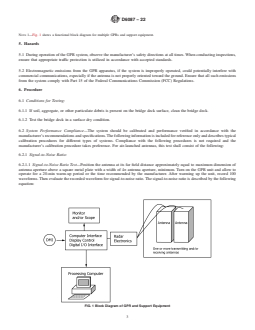
NOTE 1—Fig. 1 shows a functional block diagram for multiple GPRs
visual inspection supplemented by physical testing and coring. and support equipment.
Such methods have proven to be tedious, expensive, and of
5. Hazards
limitedaccuracy.Consequently,GPRprovidesamechanismto
rapidly survey bridges in an efficient, nondestructive manner.
5.1 During operation of the GPR system, observe the
3.4 Information on the condition of asphalt-covered con- manufacturer’s safety directions at all times.When conducting
crete bridge decks is needed to estimate bridge deck condition inspections,ensurethatappropriatetrafficprotectionisutilized
for maintenance and rehabilitation, to provide cost-effective in accordance with accepted standards.
information necessary for rehabilitation contracts.
5.2 Electromagnetic emissions from the GPR apparatus, if
3.5 GPR is currently the only nondestructive method that the system is improperly operated, could potentially interfere
can evaluate bridge deck condition on bridge decks containing with commercial communications, especially if the antenna is
an asphalt overlay. not properly oriented toward the ground. Ensure that all such
FIG. 1 Block Diagram of GPR and Support Equipment
D6087 − 22
emissions from the system comply with Part 15 of the Federal 6.2.3.1 Variations in Time Calibration Factor—Use the
Communications Commission (FCC) Regulations. sametestconfigurationasdescribedinthesignal-to-noiseratio
test, except that the metal plate can be replaced by any
6. Procedure reflecting object. Collect a single waveform and measure the
distance from the antenna to the reflector. Perform this test at
6.1 Conditions for Testing:
three different distances corresponding to approximately 15,
6.1.1 If soil, aggregate, or other particulate debris is present
30, and 50% of the time window normally used with the
on the bridge deck surface, clean the bridge deck.
system. The time delay between the echo from the aperture of
6.1.2 Test the bridge deck in a surface dry condition.
the transmitting antenna and that from the reflecting object is
6.2 System Performance Compliance—The system should
measured as time t (where subscript represents position 1,
1 1
be calibrated and performance verified in accordance with the
and so forth). The difference between t and t and between t
2 1 3
manufacturer’s recommendations and specifications. The fol-
and t represents the travel time for a fixed distance in air. The
lowinginformationisincludedforreferenceonlyanddescribes
factor Ci represents the speed between distance i and i+1. The
typical calibration procedures for different types of systems.
allowable variation in measured speed is shown as follows:
Compliance with the following procedures is not required and
C 2 C
1 2
the manufacturer’s calibration procedure takes preference. For
,2%, (3)
Meanof C and C
1 2
air-launched antennas, this test shall consist of the following:
6.2.1 Signal-to-Noise Ratio:
where:
6.2.1.1 Signal-to-Noise Ratio Test—Position the antenna at
C =
DistancefromPosition2 toPosition1
its far field distance approximately equal to maximum dimen-
T
sion of antenna aperture above a square metal plate with a
width of 4× antenna aperture, minimum.Turn on the GPR unit
C =
DistancefromPosition3 toPosition2
and allow to operate for a 20-min warm-up period or the time
t
recommended by the manufacturer.After warming up the unit,
record 100 waveforms. Then evaluate the recorded waveform
6.2.3.2 The variation in time calibration factor should be
for signal-to-noise ratio. The signal-to-noise ratio is described
less than 2%.
by the following equation:
6.2.4 Long-Term Stability Test:
SignalLevel A
~ !
mp
6.2.4.1 Long-Term Amplitude Variation—Use the same test
.20 ~26.0dB! (1)
NoiseLevel ~A !
n configuration as described in the signal-to-noise ratio test.
Switch on the GPR and allow to operate for 2 h continuously.
6.2.1.2 This will be performed on each of the 100 wave-
As a minimum, capture a single waveform every 1 min, 120
forms and the average signal-to-noise value of the 100 wave-
total. Calculate the amplitude of a metal plate reflection and
forms will be taken as the “signal-to-noise of the system.”
plotagainsttimeforeachwaveform.Forthesystemtoperform
Noise voltage (A ) is defined as the maximum amplitude
n
adequately, the amplitude of reflection should remain constant
occurringbetweenmetalplatereflectionandregionupto50%
after a short warm-up period. The stability criteria is as
of the time window after the metal plate reflection, normally
follows:
used with the antenna (that is, 1.0 GHz/20 ns: 10 ns.). The
signal level (A ) is defined as the amplitude of the echo from
A 2 A
mp
max 20
,0.03 ~3%! (4)
the metal plate.
A
6.2.1.3 Thesignal-to-noiseratiotestresultsfortheGPRunit
where:
should be greater than or equal to 20 (+26.0 dB).
A = the amplitude measured after 20 min, and
6.2.2 Signal Stability:
A = the largest amplitude measured between 20 min and
max
6.2.2.1 Signal Stability Test—Use the same test configura-
120 min.
tion as described in the signal-to-noise ratio test. Record 100
traces at the maximum data acquisition rate. Evaluate the
6.3 Pre-Operation Measurement:
signal stability using the following equation:
6.3.1 Free Space Signal (FSP)—The equipment manufac-
A 2 A
turer can require the GPR antenna to be mounted in an
max min
,0.01 ~1%! (2)
A operationalconfiguration,andatleast100waveformsgathered
avg
in the absence of the material to be inspected. Use the average
where:
of the gathered waveforms as a template for clutter removal.
A = the maximum amplitude of the metal plate reflection
max
6.3.2 Flat Metal Plate (FMP)—Position the GPR in an
for all 100 traces,
operation configuration, and gather at least 100 waveforms
A = the minimum amplitude of the metal plate reflection
min
while illuminating a flat plate with dimensions recommended
for all 100 traces, and
bythemanufacturer.Thisisameasureoftheemittedenergyto
A = the average trace amplitude of all 100 traces.
avg
be used in subsequent measurements, and as a template for
6.2.2.2 The signal stability test results for the GPR system
decorrelation or background removal, or both.
should be less than or equal to 1%.
6.4 GPR Data Acquisition:
6.2.3 Linearity in the Time Axis and Time Window Accu-
racy: 6.4.1 Air-Launched Antenna Systems:
D6087 − 22
6.4.1.1 MakeGPRinspectionp
...
This document is not an ASTM standard and is intended only to provide the user of an ASTM standard an indication of what changes have been made to the previous version. Because
it may not be technically possible to adequately depict all changes accurately, ASTM recommends that users consult prior editions as appropriate. In all cases only the current version
of the standard as published by ASTM is to be considered the official document.
´1
Designation: D6087 − 08 (Reapproved 2015) D6087 − 22
Standard Test Method for
Evaluating Asphalt-Covered Concrete Bridge Decks Using
Ground Penetrating Radar
This standard is issued under the fixed designation D6087; the number immediately following the designation indicates the year of
original adoption or, in the case of revision, the year of last revision. A number in parentheses indicates the year of last reapproval. A
superscript epsilon (´) indicates an editorial change since the last revision or reapproval.
ε NOTE—Removed converted inch-pound units editorially in June 2015.
1. Scope
1.1 This test method covers several ground penetrating radar (GPR) evaluation procedures that can be used to evaluate the
condition of concrete bridge decks overlaid with asphaltic concrete wearing surfaces. These procedures can also be used for bridge
decks overlaid with portland cement concrete and for bridge decks without an overlay. Specifically, this test method predicts the
presence or absence of concrete or rebar deterioration at or above the level of the top layer of reinforcing bar.
1.2 Deterioration in concrete bridge decks is manifested by the corrosion of embedded reinforcement or the decomposition of
concrete, or both. The most serious form of deterioration is that which is caused by corrosion of embedded reinforcement.
Corrosion may be initiated by deicing salts, used for snow and ice control in the winter months, penetrating the concrete. In arid
climates, the corrosion can be initiated by chloride ions contained in the mix ingredients. Deterioration may also be initiated by
the intrusion of water and aggravated by subsequent freeze/thaw cycles, causing damage to the concrete and subsequent debonding
of the reinforcing steel with the surrounding compromised concrete.
1.2.1 As the reinforcing steel corrodes, it expands and creates a crack or subsurface fracture plane in the concrete at or just above
the level of the reinforcement. The fracture plane, or delamination, may be localized or may extend over a substantial area,
especially if the concrete cover to the reinforcement is small. It is not uncommon for more than one delamination to occur on
different planes between the concrete surface and the reinforcing steel. Delaminations are not visible on the concrete surface.
However, if repairs are not made, the delaminations progress to open spalls and, with continued corrosion, eventually affect the
structural integrity of the deck.
1.2.2 The portion of concrete contaminated with excessive chlorides is generally structurally deficient compared with
non-contaminated concrete. Additionally, the chloride-contaminated concrete provides a pathway for the chloride ions to initiate
corrosion of the reinforcing steel. It is therefore of particular interest in bridge deck condition investigations to locate not only the
areas of active reinforcement corrosion, but also areas of chloride-contaminated and otherwise deteriorated concrete.
1.3 This test method may not be suitable for evaluating bridges with delaminations that are localized over the diameter of the
reinforcement, or for those bridges that have cathodic protection (coke breeze as cathode) installed on the bridge or for which a
conductive aggregate has been used in the asphalt (that is, blast furnace slag). This is because metals are perfect reflectors of
electromagnetic waves, since the wave impedances for metals are zero.
1.4 A precision and bias statement Since a precision estimate for this standard has not been developed at this time. developed, the
This test method is under the jurisdiction of ASTM Committee D04 on Road and Paving Materials and is the direct responsibility of Subcommittee D04.32 on Bridges
and Structures.
Current edition approved June 1, 2015Nov. 1, 2022. Published July 2015November 2022. Originally approved in 1997. Last previous edition approved in 20082015 as
ɛ1
D6087 – 08.D6087 – 08 (2015) . DOI: 10.1520/D6087-08R15E01.10.1520/D6087-22.
Copyright © ASTM International, 100 Barr Harbor Drive, PO Box C700, West Conshohocken, PA 19428-2959. United States
D6087 − 22
test method is to be used for research and informational purposes only. Therefore, this standard should not be used for acceptance
or rejection of a material for purchasing purposes.
1.5 The values stated in SI units are to be regarded as standard. No other units of measurement are included in this standard.
1.6 The text of this standard references notes and footnotes which provide explanatory material. These notes and footnotes
(excluding those in tables and figures) shall not be considered as requirements of the standard.
1.7 This standard does not purport to address all of the safety concerns, if any, associated with its use. It is the responsibility
of the user of this standard to establish appropriate safety safety, health, and healthenvironmental practices and determine the
applicability of regulatory limitations prior to use. Specific precautionary statements are given in Section 5.
1.8 This international standard was developed in accordance with internationally recognized principles on standardization
established in the Decision on Principles for the Development of International Standards, Guides and Recommendations issued
by the World Trade Organization Technical Barriers to Trade (TBT) Committee.
2. Summary of Test Method
2.1 The data collection equipment consists of a short-pulse GPR device, data acquisition device, recording device, and data
processing and interpretation equipment. The user makes repeated passes with the data collection equipment in a direction parallel
or perpendicular to the centerline across a bridge deck at specified locations. Bridge deck condition is quantified based on the data
obtained.
3. Significance and Use
3.1 This test method provides information on the condition of concrete bridge decks overlaid with asphaltic concrete without
necessitating removal of the overlay, or other destructive procedures.
3.2 This test method also provides information on the condition of bridge decks without overlays and with portland cement
concrete overlays.
3.3 A systematic approach to bridge deck rehabilitation requires considerable data on the condition of the decks. In the past, data
has been collected using the traditional methods of visual inspection supplemented by physical testing and coring. Such methods
have proven to be tedious, expensive, and of limited accuracy. Consequently, GPR provides a mechanism to rapidly survey bridges
in an efficient, non-destructivenondestructive manner.
3.4 Information on the condition of asphalt-covered concrete bridge decks is needed to estimate bridge deck condition for
maintenance and rehabilitation, to provide cost-effective information necessary for rehabilitation contracts.
3.5 GPR is currently the only non-destructivenondestructive method that can evaluate bridge deck condition on bridge decks
containing an asphalt overlay.
4. Apparatus
4.1 GPR System—There are two categories of GPR systems, depending on the type of antenna utilized for data collection.
4.1.1 GPR systems using air-launched horn antennas with centercentral frequencies 1 GHz and greater. The equipment may
consist of an air-coupled, short-pulse monostatic or bistatic antenna(s) with sufficient centercentral frequency to provide the
accurate measurement of a 5 cm thick asphalt pavement.
4.1.2 GPR systems using ground-coupled antennas with central frequencies greater than 1 GHz.
4.2 Data Acquisition System—A data acquisition system, consisting of equipment for gathering GPR data at the minimum data
rates frequencies specified in 4.1.1 and 4.1.2. The system shall be capable of accurately acquiring GPR data with a minimum of
60-dB60 dB dynamic range.
4.3 Distance Measurement System—A distance measurement system consisting of a fifth-wheel or appropriate distance
measurement instrument (DMI) with accuracy of 61006100 mm mm/km ⁄km and a resolution of 25 mm.
D6087 − 22
NOTE 1—Fig. 1 shows a functional block diagram for multiple GPRs and support equipment.
5. Hazards
5.1 During operation of the GPR system, observe the manufacturer’s safety directions at all times. When conducting inspections,
ensure that appropriate traffic protection is utilized in accordance with accepted standards.
5.2 Electromagnetic emissions from the GPR apparatus, if the system is improperly operated, could potentially interfere with
commercial communications, especially if the antenna is not properly oriented toward the ground. Ensure that all such emissions
from the system comply with Part 15 of the Federal Communications Commission (FCC) Regulations.
6. Procedure
6.1 Conditions for Testing:
6.1.1 If soil, aggregate, or other particulate debris is present on the bridge deck surface, clean the bridge deck.
6.1.2 Test the bridge deck in a surface dry condition.
6.2 System Performance Compliance—The system should be calibrated and performance verified in accordance with the
manufacturer’s recommendations and specifications. The following information is included for reference only and describes typical
calibration procedures for different types of systems. Compliance with the following procedures is not required and the
manufacturer’s calibration procedure takes preference. For air-launched antennas, this test shall consist of the following:
6.2.1 Signal-to-Noise Ratio:
6.2.1.1 Signal-to-Noise Ratio Test—Position the antenna at its far field distance approximately equal to maximum dimension of
antenna aperture above a square metal plate with a width of 4× antenna aperture, minimum. Turn on the GPR unit and allow to
operate for a 20-min warm-up period or the time recommended by the manufacturer. After warming up the unit, record 100
waveforms. Then evaluate the recorded waveform for signal-to-noise ratio. The signal-to-noise ratio is described by the following
equation:
FIG. 1 Block Diagram of GPR and Support Equipment
D6087 − 22
Signal Level A
~ !
mp
.20 ~26.0 dB! (1)
Noise Level ~A !
n
Signal Level ~A !
mp
.20 26.0 dB (1)
~ !
Noise Level A
~ !
n
6.2.1.2 This will be performed on each of the 100 waveforms and the average signal-to-noise value of the 100 waveforms will
be taken as the “signal-to-noise of the system.” Noise voltage (A ) is defined as the maximum amplitude occurring between metal
n
plate reflection and region up to 50 % of the time window after the metal plate reflection, normally used with the antenna (that
is, 1.0 GHz/20 ns: 10 ns.). The signal level (A ) is defined as the amplitude of the echo from the metal plate.
mp
6.2.1.3 The signal-to-noise ratio test results for the GPR unit should be greater than or equal to 20 (+26.0 dB).
6.2.2 Signal Stability:
6.2.2.1 Signal Stability Test—Use the same test configuration as described in the signal-to-noise ratio test. Record 100 traces at
the maximum data acquisition rate. Evaluate the signal stability using the following equation:
A 2 A
max min
,0.01 ~1%! (2)
A
avg
where:
A = the maximum amplitude of the metal plate reflection for all 100 traces,
max
A = the minimum amplitude of the metal plate reflection for all 100 traces, and
min
A = the average trace amplitude of all 100 traces.
avg
6.2.2.2 The signal stability test results for the GPR system should be less than or equal to 1 %.
6.2.3 Linearity in the Time Axis and Time Window Accuracy:
6.2.3.1 Variations in Time Calibration Factor—Use the same test configuration as described in the signal-to-noise ratio test, except
that the metal plate can be replaced by any reflecting object. Collect a single waveform and measure the distance from the antenna
to the reflector. Perform this test at three different distances corresponding to approximately 15, 30, and 50 % of the time window
normally used with the system. The time delay between the echo from the aperture of the transmitting antenna and that from the
reflecting object is measured as time t (where subscript represents position 1, and so forth). The difference between t and t
1 1 2 1
and between t and t represents the travel time for a fixed distance in air. The factor Ci represents the speed between distance i
3 2
and i+1. The allowable variation in measured speed is shown as follows:
C 2 C
1 2
,2%, (3)
Mean of C and C
1 2
where:
C =
Distance from Position 2 to Position 1
T
C =
Distance from Position 3 to Position 2
t
6.2.3.2 The variation in time calibration factor should be less than 2 %.
6.2.4 Long-Term Stability Test:
6.2.4.1 Long-Term Amplitude Variation—Use the same test configuration as described in the signal-to-noise ratio test. Switch on
the GPR and allow to operate for 2 h continuously. As a minimum, capture a single waveform every 1 min, 120 total. Calculate
the amplitude of a metal plate reflection and plot against time for each waveform. For the system to perform adequately, the
amplitude of reflection should remain constant after a short warm-up period. The stability criteria is as follows:
D6087 − 22
A 2 A
max 20
,0.03 ~3%! (4)
A
where:
A = the amplitude measured after 20 min, and
A = the largest amplitude measured between 20 min and 120 min.
max
6.3 Pre-Operation Measurement:
6.3.1 Free Space Signal (FSP)—The equipment manufacturer maycan require the GPR antenna to be mounted in an operational
configuration, and at least 100 waveforms gathered in the absence of the material to be inspected. Use the average of 100 the
gathered waveforms as a template for clutter removal.
6.3.2 Flat Metal Plate (FMP)—Position the GPR in an operation configuration, and gather at least 100 waveforms while
illuminating a flat plate with dimensions recommended by the manufacturer. This is a measure of the emitted energy to be used
in subsequent measurements, and as a templ
...