


ASTM G109-23
(Test Method)Standard Test Methods for Determining Effects of Chemical Admixtures on Corrosion of Embedded Steel Reinforcement in Concrete Exposed to Chloride Environments
Standard Test Methods for Determining Effects of Chemical Admixtures on Corrosion of Embedded Steel Reinforcement in Concrete Exposed to Chloride Environments
SIGNIFICANCE AND USE
3.1 These test methods provide a reliable means for predicting the inhibiting or corrosive properties of admixtures to be used in concrete.
3.2 The total integrated (coulombs) current is calculated to provide an indication of the corrosion that occurs due to the macrocell corrosion.
3.3 These test methods are useful for development studies of corrosion inhibitors to be used in concrete.
3.4 These test methods have been used elsewhere with good agreement between corrosion as measured by these test methods and corrosion damage on the embedded steel (1-4).4 These test methods might not properly rank the performance of different corrosion inhibitors, especially at concrete covers over the steel less than 40 mm (1.5 in.) or water-to-cement ratios above 0.45. The concrete mixture proportions and cover over the steel are chosen to accelerate chloride ingress. Some inhibitors might have an effect on this process, which could lead to results that would differ from what would be expected in actual use (5).
SCOPE
1.1 These test methods cover a procedure for determining the effects of chemical admixtures on the corrosion of metals in concrete. These test methods can be used to evaluate materials intended to inhibit chloride-induced corrosion of steel in concrete. It can also be used to evaluate the corrosivity of admixtures in a chloride environment.
1.2 The values stated in SI units are to be regarded as standard. The values given in parentheses after SI units are provided for information only and are not considered standard.
1.3 This standard does not purport to address all of the safety concerns, if any, associated with its use. It is the responsibility of the user of this standard to establish appropriate safety, health, and environmental practices and determine the applicability of regulatory limitations prior to use.
1.4 This international standard was developed in accordance with internationally recognized principles on standardization established in the Decision on Principles for the Development of International Standards, Guides and Recommendations issued by the World Trade Organization Technical Barriers to Trade (TBT) Committee.
General Information
- Status
- Published
- Publication Date
- 31-May-2023
- Technical Committee
- G01 - Corrosion of Metals
- Drafting Committee
- G01.14 - Corrosion of Metals in Construction Materials
Relations
- Effective Date
- 01-Jan-2024
- Effective Date
- 01-Jan-2024
- Effective Date
- 01-Sep-2023
- Effective Date
- 01-May-2019
- Effective Date
- 01-Apr-2019
- Effective Date
- 01-Apr-2017
- Effective Date
- 15-Mar-2016
- Effective Date
- 01-Feb-2016
- Effective Date
- 01-Feb-2016
- Effective Date
- 15-Dec-2015
- Effective Date
- 01-Jul-2015
- Effective Date
- 01-Jul-2015
- Effective Date
- 01-Apr-2015
- Effective Date
- 15-Dec-2014
- Effective Date
- 15-Nov-2014
Overview
ASTM G109-23 is the international standard that outlines test methods for determining the effects of chemical admixtures on the corrosion of embedded steel reinforcement in concrete, particularly when exposed to chloride-rich environments. Issued by ASTM International, this standard provides a systematic approach for assessing the inhibiting or corrosive properties of various admixtures used in concrete construction. The standard is widely utilized for the development and evaluation of corrosion inhibitors, ensuring the durability and longevity of reinforced concrete infrastructures.
Key Topics
- Corrosion of Reinforcing Steel: The primary focus is on methods to evaluate how chemical admixtures affect the corrosion rate of steel bars embedded in concrete, especially under chloride exposure.
- Chloride Ingress: Test procedures are designed to accelerate the penetration of chlorides, simulating aggressive service environments such as coastal or deicing salt exposure.
- Macrocell Corrosion Measurement: The standard specifies integrating current measurements (coulombs) to quantify the corrosion process, providing a quantifiable basis for comparing admixture performance.
- Test Specimen Preparation: Detailed requirements ensure consistent specimen size, bar placement, and the use of replicates for reliable results.
- Evaluation of Corrosion Inhibitors: The standard is specifically applicable for screening and comparing the effectiveness of different chemical admixtures intended to protect steel in concrete.
- Precision and Bias: Guidance on repeatability and reproducibility adds reliability to comparative results across laboratories.
Applications
ASTM G109-23 provides significant practical value in multiple sectors:
- Development of Corrosion Inhibitors: Researchers and manufacturers use these test methods to develop and validate new admixtures that mitigate corrosion risks in concrete structures.
- Quality Assessment: Materials engineers and quality control professionals apply these test methods for product evaluation and material certification.
- Infrastructure Design: Civil engineers utilize the standard when selecting protective admixtures, particularly for structures subject to chloride exposure, such as bridges, parking structures, marine installations, and highways.
- Performance Benchmarking: Comparative evaluation of various admixtures supports informed material selection during project planning and procurement.
- Regulatory Compliance: Projects often require documentation that materials meet recognized international standards for corrosion protection.
Related Standards
ASTM G109-23 references several related ASTM and industry standards to ensure comprehensive testing procedures and consistent terminology. Key related standards include:
- ASTM A615/A615M: For deformed and plain carbon-steel bars used as reinforcement
- ASTM C150/C150M: Specification for Portland Cement
- ASTM C595/C595M: Specification for Blended Hydraulic Cements
- ASTM C1152/C1152M: Test Method for Acid-Soluble Chloride in Mortar and Concrete
- ASTM C876: Test Method for Corrosion Potentials of Uncoated Reinforcing Steel
- ASTM C33/C33M and D448: For concrete aggregates and aggregates for road and bridge construction
- SSPC-SP 5/NACE No. 1: Standard for White Metal Blast Cleaning, referenced in specimen preparation
Practical Value
Adherence to ASTM G109-23 ensures a scientifically valid and internationally recognized approach to evaluating the impact of chemical admixtures on corrosion resistance of reinforced concrete exposed to chlorides. By following this standard, stakeholders can:
- Ensure structural durability and service life
- Optimize material selection and usage
- Minimize long-term maintenance costs due to corrosion damage
- Demonstrate compliance with international best practices
Keywords: ASTM G109-23, chemical admixtures, corrosion inhibition, embedded steel, concrete, chloride, corrosion testing, reinforcing steel, durability, infrastructure.
Buy Documents
ASTM G109-23 - Standard Test Methods for Determining Effects of Chemical Admixtures on Corrosion of Embedded Steel Reinforcement in Concrete Exposed to Chloride Environments
REDLINE ASTM G109-23 - Standard Test Methods for Determining Effects of Chemical Admixtures on Corrosion of Embedded Steel Reinforcement in Concrete Exposed to Chloride Environments
Get Certified
Connect with accredited certification bodies for this standard

ICC Evaluation Service
Building products evaluation and certification.

QAI Laboratories
Building and construction product testing and certification.

Aboma Certification B.V.
Specialized in construction, metal, and transport sectors.
Sponsored listings
Frequently Asked Questions
ASTM G109-23 is a standard published by ASTM International. Its full title is "Standard Test Methods for Determining Effects of Chemical Admixtures on Corrosion of Embedded Steel Reinforcement in Concrete Exposed to Chloride Environments". This standard covers: SIGNIFICANCE AND USE 3.1 These test methods provide a reliable means for predicting the inhibiting or corrosive properties of admixtures to be used in concrete. 3.2 The total integrated (coulombs) current is calculated to provide an indication of the corrosion that occurs due to the macrocell corrosion. 3.3 These test methods are useful for development studies of corrosion inhibitors to be used in concrete. 3.4 These test methods have been used elsewhere with good agreement between corrosion as measured by these test methods and corrosion damage on the embedded steel (1-4).4 These test methods might not properly rank the performance of different corrosion inhibitors, especially at concrete covers over the steel less than 40 mm (1.5 in.) or water-to-cement ratios above 0.45. The concrete mixture proportions and cover over the steel are chosen to accelerate chloride ingress. Some inhibitors might have an effect on this process, which could lead to results that would differ from what would be expected in actual use (5). SCOPE 1.1 These test methods cover a procedure for determining the effects of chemical admixtures on the corrosion of metals in concrete. These test methods can be used to evaluate materials intended to inhibit chloride-induced corrosion of steel in concrete. It can also be used to evaluate the corrosivity of admixtures in a chloride environment. 1.2 The values stated in SI units are to be regarded as standard. The values given in parentheses after SI units are provided for information only and are not considered standard. 1.3 This standard does not purport to address all of the safety concerns, if any, associated with its use. It is the responsibility of the user of this standard to establish appropriate safety, health, and environmental practices and determine the applicability of regulatory limitations prior to use. 1.4 This international standard was developed in accordance with internationally recognized principles on standardization established in the Decision on Principles for the Development of International Standards, Guides and Recommendations issued by the World Trade Organization Technical Barriers to Trade (TBT) Committee.
SIGNIFICANCE AND USE 3.1 These test methods provide a reliable means for predicting the inhibiting or corrosive properties of admixtures to be used in concrete. 3.2 The total integrated (coulombs) current is calculated to provide an indication of the corrosion that occurs due to the macrocell corrosion. 3.3 These test methods are useful for development studies of corrosion inhibitors to be used in concrete. 3.4 These test methods have been used elsewhere with good agreement between corrosion as measured by these test methods and corrosion damage on the embedded steel (1-4).4 These test methods might not properly rank the performance of different corrosion inhibitors, especially at concrete covers over the steel less than 40 mm (1.5 in.) or water-to-cement ratios above 0.45. The concrete mixture proportions and cover over the steel are chosen to accelerate chloride ingress. Some inhibitors might have an effect on this process, which could lead to results that would differ from what would be expected in actual use (5). SCOPE 1.1 These test methods cover a procedure for determining the effects of chemical admixtures on the corrosion of metals in concrete. These test methods can be used to evaluate materials intended to inhibit chloride-induced corrosion of steel in concrete. It can also be used to evaluate the corrosivity of admixtures in a chloride environment. 1.2 The values stated in SI units are to be regarded as standard. The values given in parentheses after SI units are provided for information only and are not considered standard. 1.3 This standard does not purport to address all of the safety concerns, if any, associated with its use. It is the responsibility of the user of this standard to establish appropriate safety, health, and environmental practices and determine the applicability of regulatory limitations prior to use. 1.4 This international standard was developed in accordance with internationally recognized principles on standardization established in the Decision on Principles for the Development of International Standards, Guides and Recommendations issued by the World Trade Organization Technical Barriers to Trade (TBT) Committee.
ASTM G109-23 is classified under the following ICS (International Classification for Standards) categories: 91.080.40 - Concrete structures. The ICS classification helps identify the subject area and facilitates finding related standards.
ASTM G109-23 has the following relationships with other standards: It is inter standard links to ASTM C231/C231M-24, ASTM C173/C173M-24, ASTM C173/C173M-23, ASTM G3-14(2019), ASTM C150/C150M-19, ASTM C595/C595M-17, ASTM C150/C150M-16, ASTM C192/C192M-16, ASTM C33/C33M-16e1, ASTM C881/C881M-15, ASTM C150/C150M-15, ASTM C595/C595M-15, ASTM A615/A615M-15, ASTM G3-14, ASTM C881/C881M-14. Understanding these relationships helps ensure you are using the most current and applicable version of the standard.
ASTM G109-23 is available in PDF format for immediate download after purchase. The document can be added to your cart and obtained through the secure checkout process. Digital delivery ensures instant access to the complete standard document.
Standards Content (Sample)
This international standard was developed in accordance with internationally recognized principles on standardization established in the Decision on Principles for the
Development of International Standards, Guides and Recommendations issued by the World Trade Organization Technical Barriers to Trade (TBT) Committee.
Designation: G109 − 23
Standard Test Methods for
Determining Effects of Chemical Admixtures on Corrosion
of Embedded Steel Reinforcement in Concrete Exposed to
Chloride Environments
This standard is issued under the fixed designation G109; the number immediately following the designation indicates the year of
original adoption or, in the case of revision, the year of last revision. A number in parentheses indicates the year of last reapproval. A
superscript epsilon (´) indicates an editorial change since the last revision or reapproval.
1. Scope C173/C173M Test Method for Air Content of Freshly Mixed
Concrete by the Volumetric Method
1.1 These test methods cover a procedure for determining
C192/C192M Practice for Making and Curing Concrete Test
the effects of chemical admixtures on the corrosion of metals in
Specimens in the Laboratory
concrete. These test methods can be used to evaluate materials
C231/C231M Test Method for Air Content of Freshly Mixed
intended to inhibit chloride-induced corrosion of steel in
Concrete by the Pressure Method
concrete. It can also be used to evaluate the corrosivity of
C511 Specification for Mixing Rooms, Moist Cabinets,
admixtures in a chloride environment.
Moist Rooms, and Water Storage Tanks Used in the
1.2 The values stated in SI units are to be regarded as
Testing of Hydraulic Cements and Concretes
standard. The values given in parentheses after SI units are
C595/C595M Specification for Blended Hydraulic Cements
provided for information only and are not considered standard.
C876 Test Method for Corrosion Potentials of Uncoated
1.3 This standard does not purport to address all of the Reinforcing Steel in Concrete
safety concerns, if any, associated with its use. It is the
C881/C881M Specification for Epoxy-Resin-Base Bonding
responsibility of the user of this standard to establish appro- Systems for Concrete
priate safety, health, and environmental practices and deter-
C1152/C1152M Test Method for Acid-Soluble Chloride in
mine the applicability of regulatory limitations prior to use. Mortar and Concrete
1.4 This international standard was developed in accor-
D448 Classification for Sizes of Aggregate for Road and
dance with internationally recognized principles on standard- Bridge Construction
ization established in the Decision on Principles for the
D632 Specification for Sodium Chloride
Development of International Standards, Guides and Recom-
E177 Practice for Use of the Terms Precision and Bias in
mendations issued by the World Trade Organization Technical ASTM Test Methods
Barriers to Trade (TBT) Committee.
E691 Practice for Conducting an Interlaboratory Study to
Determine the Precision of a Test Method
2. Referenced Documents
G3 Practice for Conventions Applicable to Electrochemical
Measurements in Corrosion Testing
2.1 ASTM Standards:
G33 Practice for Recording Data from Atmospheric Corro-
A615/A615M Specification for Deformed and Plain Carbon-
sion Tests of Metallic-Coated Steel Specimens
Steel Bars for Concrete Reinforcement
G46 Guide for Examination and Evaluation of Pitting Cor-
C33/C33M Specification for Concrete Aggregates
rosion
C143/C143M Test Method for Slump of Hydraulic-Cement
G193 Terminology and Acronyms Relating to Corrosion
Concrete
C150/C150M Specification for Portland Cement 2.2 SSPC/NACE Standards:
SSPC-SP 5/NACE No. 1 White Metal Blast Cleaning
3. Significance and Use
These test methods are under the jurisdiction of ASTM Committee G01 on
Corrosion of Metals and is the direct responsibility of Subcommittee G01.14 on
3.1 These test methods provide a reliable means for predict-
Corrosion of Metals in Construction Materials.
ing the inhibiting or corrosive properties of admixtures to be
Current edition approved June 1, 2023. Published June 2023. Originally
approved in 1992. Last previous edition approved in 2021 as G109 – 21. DOI: used in concrete.
10.1520/G0109-23.
For referenced ASTM standards, visit the ASTM website, www.astm.org, or
contact ASTM Customer Service at service@astm.org. For Annual Book of ASTM
Standards volume information, refer to the standard’s Document Summary page on Available from The Association for Materials Protection and Performance
the ASTM website. (AMPP), 800 Trumbull Drive, Pittsburgh, PA 15205, https://www.ampp.org.
Copyright © ASTM International, 100 Barr Harbor Drive, PO Box C700, West Conshohocken, PA 19428-2959. United States
G109 − 23
3.2 The total integrated (coulombs) current is calculated to 5.6 Sulfuric Acid, 10 % by mass, for pickling (optional).
provide an indication of the corrosion that occurs due to the 7,6
5.7 Electroplater’s Tape.
macrocell corrosion.
5.8 Neoprene Tubing, with 3 mm ( ⁄8 in.) wall thickness and
3.3 These test methods are useful for development studies
the same ID as the diameter of the bar used.
of corrosion inhibitors to be used in concrete.
5.9 Sodium Chloride, complying with Specification D632.
3.4 These test methods have been used elsewhere with good
5.10 Salt Solution, prepared by dissolving 3 parts of sodium
agreement between corrosion as measured by these test meth-
chloride (as described in 5.9) in 97 parts of water mass.
ods and corrosion damage on the embedded steel (1-4). These
test methods might not properly rank the performance of
5.11 Epoxy Sealer, for application to the concrete specimens
different corrosion inhibitors, especially at concrete covers after manufacture. This sealer shall be of Type III, Grade 1,
8,6
over the steel less than 40 mm (1.5 in.) or water-to-cement
Class C in accordance with Specification C881/C881M.
ratios above 0.45. The concrete mixture proportions and cover
5.12 Plastic Dams, 75 mm (3 in.) wide and 150 mm (6 in.)
over the steel are chosen to accelerate chloride ingress. Some
long with a minimum height of 75 mm (3 in.) for placement on
inhibitors might have an effect on this process, which could
the test specimens. The wall thickness shall be 61 mm ( ⁄8 in.
lead to results that would differ from what would be expected
6 ⁄32 in.).
in actual use (5).
5.13 Silicone Caulk, for sealing the outside of the plastic
9,6
4. Apparatus
dam to the top of the concrete specimen.
4.1 The apparatus required for the evaluation of corrosion
5.14 Hexane.
inhibitors includes a high impedance voltmeter (at least one
Mohm) capable of measuring to 0.001 mV, a 10 Ω (65 %)
6. Preparation of Test Specimens
resistor.
6.1 Method A Mill Scale Removed:
4.2 Reference Electrode, such as a saturated silver/silver
6.1.1 Power wire brush or sand blast the bars to near white
chloride or saturated calomel electrode for measuring the
metal (see SSPC-SP 5/NACE No. 1), clean by soaking in
corrosion potential of the bars, as defined in Terminology
hexane, and allow to air dry.
G193.
NOTE 3—Pickling the bars with 10 % sulfuric acid for 10 min to 15 min
and rinsing with potable water prior to wire brushing is recommended
5. Reagents and Materials
when the bars have an excessive amount of rust.
5.1 Cement, that conforms to Type I or Type II of Specifi-
6.2 Method B Mill Scale Not Removed:
cation C150/C150M or a Type 1L according to Specification
6.2.1 Bars with mill scale shall be chosen so that no visible
C595/C595M. Coarse aggregate shall conform to Specification
rust is present in the portion of the bar that will not be protected
C33/C33M and Classification D448, with nominal maximum
at the ends.
3 3
size between 9.5 mm and 19 mm ( ⁄8 in. and ⁄4 in.).
6.2.2 Ends to be protected shall have mill scale removed as
NOTE 1—Preferred maximum size aggregate is 12.5 mm (0.5 in.).
in 6.1.
5.2 Steel Reinforcement Bars, deformed, meeting the re-
6.3 Use the same method to clean all bars in the test
quirement of Specification A615/A615M; with a diameter
program.
between 10 mm (0.4 in.) and 16 mm (0.6 in.), and a length of
6.4 Drill and tap one end of each bar, attach a stainless steel
360 mm (14 in.), drilled and tapped at one end to be fitted with
screw and two nuts, as described in 5.3 and 5.4, and tape each
coarse-thread stainless steel and nuts, as described in 5.3 and
end of the bar with electroplater’s tape so that a 200 mm (8 in.)
5.4. These bars shall be used to manufacture the test specimens,
portion in the middle of the bar is bare. Place a 90 mm (3.5 in.)
as described in Section 6.
length of neoprene tubing, as described in 5.8, over the
NOTE 2—Interlaboratory test program and statistical data in Section 11
electroplater’s tape at each end of the bar, and fill the length of
are based upon 13 mm (0.5 in.) steel bars, 12.5 mm maximum size
tubing protruding from the bar ends with the two-part epoxy, as
aggregate, and 19 mm (0.75 in.) and 25 mm (1 in.) cover.
described in 5.5.
5.3 316 Stainless Steel Screws, with diameter smaller than
6.5 Specimen size is 280 mm by 150 mm by 115 mm (11 in.
bar diameter (coarse thread < 5 mm (0.2 in.)), 25 mm to 35 mm
by 6 in. by 4.5 in.). Place two bars, as described in 5.2, 25 mm
(1 in. to 1.5 in.) long (one per bar).
(1 in.) from the bottom, and one bar at the top such that the
5.4 316 Stainless Steel Nuts, two per bar to fit stainless steel
screws, as described in 5.3.
5,6
5.5 Two-part Waterproof Epoxy —This epoxy shall meet
If you are aware of alternative suppliers, please provide this information to
ASTM International Headquarters. Your comments will receive careful consider-
the chemical resistance requirements of a Type IV, Grade 3,
ation at a meeting of the responsible technical committee, which you may attend.
Class E of Specification C881/C881M.
The sole source of supply of the apparatus known to the committee at this time
is Minnesota Mining and Manufacturing Company (3M).
The boldface numbers in parentheses refer to a list of references at the end of The sole source of supply of the apparatus known to the committee at this time
this standard. is Epoxy Concrete Scaler # 12560, made by Devcon.
5 9
The sole source of supply of the apparatus known to the committee at this time The sole source of supply of the apparatus known to the committee at this time
is PC-Epoxy, made by Protective Coating Co., Allentown, PA. is 3M Marine Adhesive 5200.
G109 − 23
NOTE 1—The tolerances are within 65 %.
NOTE 1—The tolerances are within 65 %.
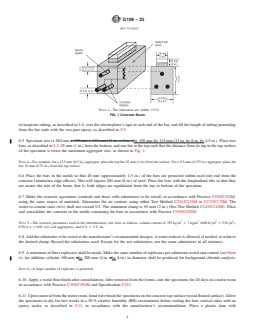
FIG. 1 Concrete Beam
FIG. 2 Concrete Beam (Side View)
distance from its top to the top surface of the specimen is twice
the maximum aggregate size, as shown in Fig. 1.
6.11 Upon removal from the moist room, hand wire brush
NOTE 4—For example, for a 12.5 mm (0.5 in.) aggregate, place the top
the specimens on the concrete top surface (wood floated
bar 25 mm (1 in.) from the surface. For a 9.5 mm (0.375 in.) aggregate,
surface). Allow the specimens to dry for two weeks in a 50 %
place the bar 19 mm (0.75 in.) from the top surface.
relative humidity (RH) environment before sealing the four
6.6 Place the bars in the molds so that 40 mm (approxi-
vertical sides with an epoxy sealer, as described in 5.11, in
mately 1.5 in.) of the bars are protected within each exit end
accordance with the manufacturer’s recommendation. Place a
from the concrete (minimizes edge effects). This will expose
plastic dam with dimensions as described in 5.12 on the
200 mm (8 in.) of steel. Place the bars with the longitudinal ribs
specimen, as shown in Fig. 1, and about 13 mm (0.5 in.) from
so that they are nearer the side of the beam, that is, both ridges
each side so that it does not extend over the taped sections of
are equidistant from the top or bottom of the specimen.
the bars (see Fig. 2). Use a silicone caulk to seal the dam from
6.7 Make the concrete specimens (controls and those with
the outside, and apply epoxy sealer to the top surface outside of
admixtures to be tested) in accordance with Practice C192/
the dam.
C192M, using the same source of materials. Determine the air
NOTE 7—Allowing the specimens to dry before applying the concrete
content, using either Test Method C231/C231M or C173/
epoxy will make the initial exposure to chloride more severe, and more
C173M. The water-to-cement ratio (w
...
This document is not an ASTM standard and is intended only to provide the user of an ASTM standard an indication of what changes have been made to the previous version. Because
it may not be technically possible to adequately depict all changes accurately, ASTM recommends that users consult prior editions as appropriate. In all cases only the current version
of the standard as published by ASTM is to be considered the official document.
Designation: G109 − 21 G109 − 23
Standard Test Methods for
Determining Effects of Chemical Admixtures on Corrosion
of Embedded Steel Reinforcement in Concrete Exposed to
Chloride Environments
This standard is issued under the fixed designation G109; the number immediately following the designation indicates the year of
original adoption or, in the case of revision, the year of last revision. A number in parentheses indicates the year of last reapproval. A
superscript epsilon (´) indicates an editorial change since the last revision or reapproval.
1. Scope
1.1 These test methods cover a procedure for determining the effects of chemical admixtures on the corrosion of metals in
concrete. These test methods can be used to evaluate materials intended to inhibit chloride-induced corrosion of steel in concrete.
It can also be used to evaluate the corrosivity of admixtures in a chloride environment.
1.2 The values stated in SI units are to be regarded as standard. The values given in parentheses after SI units are provided for
information only and are not considered standard.
1.3 This standard does not purport to address all of the safety concerns, if any, associated with its use. It is the responsibility
of the user of this standard to establish appropriate safety, health, and environmental practices and determine the applicability of
regulatory limitations prior to use.
1.4 This international standard was developed in accordance with internationally recognized principles on standardization
established in the Decision on Principles for the Development of International Standards, Guides and Recommendations issued
by the World Trade Organization Technical Barriers to Trade (TBT) Committee.
2. Referenced Documents
2.1 ASTM Standards:
A615/A615M Specification for Deformed and Plain Carbon-Steel Bars for Concrete Reinforcement
C33/C33M Specification for Concrete Aggregates
C143/C143M Test Method for Slump of Hydraulic-Cement Concrete
C150/C150M Specification for Portland Cement
C173/C173M Test Method for Air Content of Freshly Mixed Concrete by the Volumetric Method
C192/C192M Practice for Making and Curing Concrete Test Specimens in the Laboratory
C231/C231M Test Method for Air Content of Freshly Mixed Concrete by the Pressure Method
C511 Specification for Mixing Rooms, Moist Cabinets, Moist Rooms, and Water Storage Tanks Used in the Testing of Hydraulic
Cements and Concretes
C595/C595M Specification for Blended Hydraulic Cements
C876 Test Method for Corrosion Potentials of Uncoated Reinforcing Steel in Concrete
C881/C881M Specification for Epoxy-Resin-Base Bonding Systems for Concrete
These test methods are under the jurisdiction of ASTM Committee G01 on Corrosion of Metals and is the direct responsibility of Subcommittee G01.14 on Corrosion
of Metals in Construction Materials.
Current edition approved Dec. 15, 2021June 1, 2023. Published January 2022June 2023. Originally approved in 1992. Last previous edition approved in 20132021 as
G109G109 – 21.–07 (2013). DOI: 10.1520/G0109-21. DOI: 10.1520/G0109-23.
For referenced ASTM standards, visit the ASTM website, www.astm.org, or contact ASTM Customer Service at service@astm.org. For Annual Book of ASTM Standards
volume information, refer to the standard’s Document Summary page on the ASTM website.
Copyright © ASTM International, 100 Barr Harbor Drive, PO Box C700, West Conshohocken, PA 19428-2959. United States
G109 − 23
C1152/C1152M Test Method for Acid-Soluble Chloride in Mortar and Concrete
D448 Classification for Sizes of Aggregate for Road and Bridge Construction
D632 Specification for Sodium Chloride
E177 Practice for Use of the Terms Precision and Bias in ASTM Test Methods
E691 Practice for Conducting an Interlaboratory Study to Determine the Precision of a Test Method
G3 Practice for Conventions Applicable to Electrochemical Measurements in Corrosion Testing
G193 Terminology and Acronyms Relating to Corrosion
G33 Practice for Recording Data from Atmospheric Corrosion Tests of Metallic-Coated Steel Specimens
G46 Guide for Examination and Evaluation of Pitting Corrosion
G193 Terminology and Acronyms Relating to Corrosion
2.2 SSPC/NACE Standards:
SSPC-SP 5/NACE No. 1 White Metal Blast Cleaning
3. Significance and Use
3.1 These test methods provide a reliable means for predicting the inhibiting or corrosive properties of admixtures to be used in
concrete.
3.2 The total integrated (coulombs) current is calculated to provide an indication of the corrosion that occurs due to the macrocell
corrosion.
3.3 These test methods are useful for development studies of corrosion inhibitors to be used in concrete.
3.4 These test methods have been used elsewhere with good agreement between corrosion as measured by these test methods and
corrosion damage on the embedded steel (1-4). These test methods might not properly rank the performance of different corrosion
inhibitors, especially at concrete covers over the steel less than 40 mm (1.5 in.) or water-to-cement ratios above 0.45. The concrete
mixture proportions and cover over the steel are chosen to accelerate chloride ingress. Some inhibitors might have an effect on this
process, which could lead to results that would differ from what would be expected in actual use (5).
4. Apparatus
4.1 The apparatus required for the evaluation of corrosion inhibitors includes a high impedance voltmeter (at least one Mohm)
capable of measuring to 0.001 mV, a 10 Ω (65 %) resistor.
4.2 Reference Electrode, such as a saturated silver/silver chloride or saturated calomel electrode for measuring the corrosion
potential of the bars, as defined in Terminology G193.
5. Reagents and Materials
5.1 Cement, that conforms to Type I or Type II of Specification C150/C150M or a Type 1L according to Specification
C595/C595M. Coarse aggregate shall conform to Specification C33/C33M and Classification D448, with nominal maximum size
3 3
between 9.5 mm and 19 mm ( ⁄8 in. and ⁄4 in.).
NOTE 1—Preferred maximum size aggregate is 12.5 mm (0.5 in.).
5.2 Steel Reinforcement Bars, deformed, meeting the requirement of Specification A615/A615M; with a diameter between 10 mm
(0.4 in.) and 16 mm (0.6 in.), and a length of 360 mm (14 in.), drilled and tapped at one end to be fitted with coarse-thread stainless
steel and nuts, as described in 5.3 and 5.4. These bars shall be used to manufacture the test specimens, as described in Section 6.
NOTE 2—Interlaboratory test program and statistical data in Section 11 are based upon 13 mm (0.5 in.) steel bars, 12.5 mm maximum size aggregate, and
19 mm (0.75 in.) and 25 mm (1 in.) cover.
5.3 316 Stainless Steel Screws, with diameter smaller than bar diameter (coarse thread < 5mm5 mm (0.2 in.)), 25 mm to 35 mm
(1 in. to 1.5 in.) long (one per bar).
Available from The Association for Materials Protection and Performance (AMPP), 800 Trumbull Drive, Pittsburgh, PA 15205, https://www.ampp.org.
The boldface numbers in parentheses refer to a list of references at the end of this standard.
G109 − 23
5.4 316 Stainless Steel Nuts, two per bar to fit stainless steel screws, as described in 5.3.
5,6
5.5 Two-part Waterproof Epoxy —This epoxy shall meet the chemical resistance requirements of a Type IV, Grade 3, Class E
of Specification C881/C881M.
5.6 Sulfuric Acid, 10 % by mass, for pickling (optional).
7,6
5.7 Electroplater’s Tape.
5.8 Neoprene Tubing, with 3 mm ( ⁄8 in.) wall thickness and the same ID as the diameter of the bar used.
5.9 Sodium Chloride, complying with Specification D632.
5.10 Salt Solution, prepared by dissolving 3 parts of sodium chloride (as described in 5.9) in 97 parts of water mass.
5.11 Epoxy Sealer, for application to the concrete specimens after manufacture. This sealer shall be of Type III, Grade 1, Class
8,6
C in accordance with Specification C881/C881M.
5.12 Plastic Dams, 75 mm (3 in.) wide and 150 mm (6 in.) long with a minimum height of 75 mm (3 in.) for placement on the
1 1
test specimens. The wall thickness shall be 61 mm ( ⁄8 in. 6 ⁄32 in.).
9,6
5.13 Silicone Caulk, for sealing the outside of the plastic dam to the top of the concrete specimen.
5.14 Hexane.
6. Preparation of Test Specimens
6.1 Method A Mill Scale Removed:
6.1.1 Power wire brush or sand blast the bars to near white metal (see SSPC-SP 5/NACE No. 1), clean by soaking in hexane, and
allow to air dry.
NOTE 3—Pickling the bars with 10 % sulfuric acid for 10 min to 15 min and rinsing with potable water prior to wire brushing is recommended when the
bars have an excessive amount of rust.
6.2 Method B Mill Scale Not Removed:
6.2.1 Bars with mill scale shall be chosen so that no visible rust is present in the portion of the bar that will not be protected at
the ends.
6.2.2 Ends to be protected shall have mill scale removed as in 6.1.
6.3 Use the same method to clean all bars in the test program.
6.4 Drill and tap one end of each bar, attach a stainless steel screw and two nuts, as described in 5.3 and 5.4, and tape each end
of the bar with electroplater’s tape so that a 200 mm (8 in.) portion in the middle of the bar is bare. Place a 90 mm (3.5 in.) length
The sole source of supply of the apparatus known to the committee at this time is PC-Epoxy, made by Protective Coating Co., Allentown, PA.
If you are aware of alternative suppliers, please provide this information to ASTM International Headquarters. Your comments will receive careful consideration at a
meeting of the responsible technical committee, which you may attend.
The sole source of supply of the apparatus known to the committee at this time is Minnesota Mining and Manufacturing Company (3M).
The sole source of supply of the apparatus known to the committee at this time is Epoxy Concrete Scaler # 12560, made by Devcon.
The sole source of supply of the apparatus known to the committee at this time is 3M Marine Adhesive 5200.
G109 − 23
NOTE 1—The tolerances are within 65 %.
FIG. 1 Concrete Beam
of neoprene tubing, as described in 5.8, over the electroplater’s tape at each end of the bar, and fill the length of tubing protruding
from the bar ends with the two-part epoxy, as described in 5.5.
6.5 Specimen size is 280 mm × 150 mm × 115 mm (11 in. × 6 in. ×by 150 mm by 115 mm (11 in. by 6 in. by 4.5 in.). Place two
bars, as described in 5.2, 25 mm (1 in.) from the bottom, and one bar at the top such that the distance from its top to the top surface
of the specimen is twice the maximum aggregate size, as shown in Fig. 1.
NOTE 4—For example, for a 12.5 mm (0.5 in.) aggregate, place the top bar 25 mm (1 in.) from the surface. For a 9.5 mm (0.375 in.) aggregate, place the
bar 19 mm (0.75 in.) from the top surface.
6.6 Place the bars in the molds so that 40 mm (approximately 1.5 in.) of the bars are protected within each exit end from the
concrete (minimizes edge effects). This will expose 200 mm (8 in.) of steel. Place the bars with the longitudinal ribs so that they
are nearer the side of the beam, that is, both ridges are equidistant from the top or bottom of the specimen.
6.7 Make the concrete specimens (controls and those with admixtures to be tested) in accordance with Practice C192/C192M,
using the same source of materials. Determine the air content, using either Test Method C231/C231M or C173/C173M. The
water-to-cement ratio (w/c) shall not exceed 0.5. The minimum slump is 50 mm (2 in.) (See Test Method C143/C143M). Place
and consolidate the concrete in the molds containing the bars in accordance with Practice C192/C192M.
3 3 3 3
NOTE 5—The concrete parameters used in the interlaboratory test were as follows: cement content of 355 kg ⁄m 6 3 kg/m (600 lb ⁄yd 6 5 lb ⁄yd ),
0.50 w ⁄c 6 0.01 w/c (ssd aggregates), and 6 % 6 1 % air.
6.8 Add the admixture to be tested at the manufacturer’s recommended dosages. A water reducer is allowed, if needed, to achieve
the desired slump. Record the admixtures used. Except for the test admixtures, use the same admixtures in all mixtures.
6.9 A minimum of three replicates shall be made. Make the same number of replicates per admixture tested and control (see Note
6). An additio
...
Questions, Comments and Discussion
Ask us and Technical Secretary will try to provide an answer. You can facilitate discussion about the standard in here.
Loading comments...