

ASTM C1603-23
(Test Method)Standard Test Method for Measurement of Solids in Water
General Information
- Abstract
SIGNIFICANCE AND USE
4.1 This test method is used to determine the solids content of mixing water used to produce concrete when one or more of the water sources is wash water from concrete production operations or water that contains solids when batched as mixing water in concrete.
4.2 The test method provides a means to determine the relationship between the density and solids content of water for compliance with solids content limits of mixing water such as in Specification C1602/C1602M.
4.3 During production of concrete, the water property measured is its density, which can then be used to estimate the solids content from procedures described in this test method.
4.4 To develop a correlation between the density and solids content of water, water samples should be tested that cover the range of solids concentrations anticipated during production.
SCOPE
1.1 This test method covers the measurement of the solids content in water for use as mixing water in ready-mixed concrete and the measurement of its density. Solids content is expressed in terms of parts per million (ppm) or in terms of percent by mass of the water sample.
1.2 The values stated in SI units are to be regarded as standard. No other units of measurement are included in this standard.
1.3 The text of this standard references notes and footnotes that provide explanatory material. These notes and footnotes (excluding those in tables and figures) shall not be considered as requirements of the standard.
1.4 This standard does not purport to address all of the safety concerns, if any, associated with its use. It is the responsibility of the user of this standard to establish appropriate safety, health, and environmental practices and determine the applicability of regulatory limitations prior to use.
1.5 This international standard was developed in accordance with internationally recognized principles on standardization established in the Decision on Principles for the Development of International Standards, Guides and Recommendations issued by the World Trade Organization Technical Barriers to Trade (TBT) Committee.
- Status
- Published
- Publication Date
- 31-Jan-2023
- Technical Committee
- C09 - Concrete and Concrete Aggregates
- Drafting Committee
- C09.40 - Ready-Mixed Concrete

Overview
ASTM C1603-23: Standard Test Method for Measurement of Solids in Water defines procedures to determine the solids content and density in water used as mixing water in ready-mixed concrete. This test method is specifically valuable when one or more water sources are wash water from concrete production or when the mixing water contains solids. Accurate solids measurement in mixing water is crucial for maintaining the quality and performance of concrete, ensuring compliance with industry specifications, and meeting regulatory requirements.
Solids content is reported either as parts per million (ppm) or as a percentage by mass of the water sample. The method establishes a correlation between density and solids content, providing a practical approach for routine compliance checks during concrete production.
Key Topics
- Measurement of Solids Content: Establishes the process for quantifying solids in water, either directly or through density correlation, using calibrated apparatus and repeatable procedures.
- Density Testing: Describes standardized procedures for measuring the density of water samples, which facilitates estimation of solids content.
- Quality Control: Outlines best practices for collecting representative samples, especially from agitated sources, and maintaining consistent records for regulatory compliance.
- Correlation Development: Provides guidance on developing a site-specific relationship between water density and solids content to support ongoing monitoring.
- Reporting Requirements: Details the information needed for reporting, including test results in ppm or percentage, testing dates, and methodologies used.
- Precision and Bias: Presents data on reproducibility within and between testing operators to support confident application of results.
Applications
The ASTM C1603-23 standard is practically applied in multiple contexts within the concrete and construction industries:
- Ready-Mixed Concrete Production: Ensures that mixing water meets defined purity criteria, safeguarding concrete integrity and performance.
- Sustainable Water Management: Facilitates the safe reuse of wash water, supporting environmental regulations and sustainable construction practices.
- Onsite Quality Assurance: Allows producers to rapidly assess the suitability of various water sources, including recycled water, by linking water density with solids content.
- Regulatory Compliance: Assists organizations in adhering to solids limits set by standards such as ASTM C1602/C1602M for mixing water.
- Blending Water Sources: Provides methodical approaches for calculating blend ratios when combining water sources with different solids contents, optimizing reuse while maintaining product quality.
Related Standards
Several ASTM standards are referenced to support the procedures in ASTM C1603-23:
- ASTM C125: Terminology Relating to Concrete and Concrete Aggregates
- ASTM C185: Test Method for Air Content of Hydraulic Cement Mortar
- ASTM C188: Test Method for Density of Hydraulic Cement
- ASTM C670: Practice for Preparing Precision and Bias Statements for Test Methods for Construction Materials
- ASTM C1602/C1602M: Specification for Mixing Water Used in the Production of Hydraulic Cement Concrete
These related standards provide fundamental terms, calibration methods, and quality benchmarks integral to robust implementation of ASTM C1603-23.
Practical Value
The adoption of ASTM C1603-23 significantly enhances quality assurance within concrete production, particularly where alternative or recycled water sources are involved. By standardizing how solids content and density are measured, the standard supports consistent, repeatable testing and reliable compliance checks. This results in:
- Improved Concrete Quality: Reduces risks from unsuitable water impurities.
- Streamlined Operations: Enables fast onsite evaluation of water sources.
- Sustainability: Supports responsible water reuse in line with environmental best practices.
- Risk Mitigation: Assists in meeting contract and regulatory requirements, minimizing the risk of compliance issues and product failure.
Implementing this ASTM test method demonstrates a commitment to quality, compliance, and sustainability in concrete operations.
Relations
- Effective Date
- 01-Feb-2024
- Effective Date
- 01-Jan-2024
- Effective Date
- 01-Apr-2020
- Effective Date
- 15-Dec-2019
- Effective Date
- 01-Dec-2019
- Effective Date
- 01-Jan-2019
- Effective Date
- 01-Oct-2018
- Effective Date
- 01-Jul-2018
- Effective Date
- 01-Jan-2018
- Effective Date
- 15-Dec-2016
- Effective Date
- 15-Dec-2016
- Effective Date
- 15-Dec-2015
- Effective Date
- 01-Oct-2015
- Effective Date
- 01-Jul-2015
- Effective Date
- 01-Jul-2015
Get Certified
Connect with accredited certification bodies for this standard

DIBt (Deutsches Institut für Bautechnik)
German Institute for Building Technology.
DIN CERTCO
DIN Group product certification.

Aboma Certification B.V.
Specialized in construction, metal, and transport sectors.
Sponsored listings
Frequently Asked Questions
ASTM C1603-23 is a standard published by ASTM International. Its full title is "Standard Test Method for Measurement of Solids in Water". This standard covers: SIGNIFICANCE AND USE 4.1 This test method is used to determine the solids content of mixing water used to produce concrete when one or more of the water sources is wash water from concrete production operations or water that contains solids when batched as mixing water in concrete. 4.2 The test method provides a means to determine the relationship between the density and solids content of water for compliance with solids content limits of mixing water such as in Specification C1602/C1602M. 4.3 During production of concrete, the water property measured is its density, which can then be used to estimate the solids content from procedures described in this test method. 4.4 To develop a correlation between the density and solids content of water, water samples should be tested that cover the range of solids concentrations anticipated during production. SCOPE 1.1 This test method covers the measurement of the solids content in water for use as mixing water in ready-mixed concrete and the measurement of its density. Solids content is expressed in terms of parts per million (ppm) or in terms of percent by mass of the water sample. 1.2 The values stated in SI units are to be regarded as standard. No other units of measurement are included in this standard. 1.3 The text of this standard references notes and footnotes that provide explanatory material. These notes and footnotes (excluding those in tables and figures) shall not be considered as requirements of the standard. 1.4 This standard does not purport to address all of the safety concerns, if any, associated with its use. It is the responsibility of the user of this standard to establish appropriate safety, health, and environmental practices and determine the applicability of regulatory limitations prior to use. 1.5 This international standard was developed in accordance with internationally recognized principles on standardization established in the Decision on Principles for the Development of International Standards, Guides and Recommendations issued by the World Trade Organization Technical Barriers to Trade (TBT) Committee.
SIGNIFICANCE AND USE 4.1 This test method is used to determine the solids content of mixing water used to produce concrete when one or more of the water sources is wash water from concrete production operations or water that contains solids when batched as mixing water in concrete. 4.2 The test method provides a means to determine the relationship between the density and solids content of water for compliance with solids content limits of mixing water such as in Specification C1602/C1602M. 4.3 During production of concrete, the water property measured is its density, which can then be used to estimate the solids content from procedures described in this test method. 4.4 To develop a correlation between the density and solids content of water, water samples should be tested that cover the range of solids concentrations anticipated during production. SCOPE 1.1 This test method covers the measurement of the solids content in water for use as mixing water in ready-mixed concrete and the measurement of its density. Solids content is expressed in terms of parts per million (ppm) or in terms of percent by mass of the water sample. 1.2 The values stated in SI units are to be regarded as standard. No other units of measurement are included in this standard. 1.3 The text of this standard references notes and footnotes that provide explanatory material. These notes and footnotes (excluding those in tables and figures) shall not be considered as requirements of the standard. 1.4 This standard does not purport to address all of the safety concerns, if any, associated with its use. It is the responsibility of the user of this standard to establish appropriate safety, health, and environmental practices and determine the applicability of regulatory limitations prior to use. 1.5 This international standard was developed in accordance with internationally recognized principles on standardization established in the Decision on Principles for the Development of International Standards, Guides and Recommendations issued by the World Trade Organization Technical Barriers to Trade (TBT) Committee.
ASTM C1603-23 is classified under the following ICS (International Classification for Standards) categories: 91.080.40 - Concrete structures. The ICS classification helps identify the subject area and facilitates finding related standards.
ASTM C1603-23 has the following relationships with other standards: It is inter standard links to ASTM C670-24a, ASTM C670-24, ASTM C185-20, ASTM C125-19a, ASTM C185-19, ASTM C125-19, ASTM C125-18b, ASTM C125-18a, ASTM C125-18, ASTM C125-16, ASTM C188-16, ASTM C125-15b, ASTM C188-15, ASTM C185-15, ASTM C125-15a. Understanding these relationships helps ensure you are using the most current and applicable version of the standard.
ASTM C1603-23 is available in PDF format for immediate download after purchase. The document can be added to your cart and obtained through the secure checkout process. Digital delivery ensures instant access to the complete standard document.
Standards Content (Sample)
This international standard was developed in accordance with internationally recognized principles on standardization established in the Decision on Principles for the
Development of International Standards, Guides and Recommendations issued by the World Trade Organization Technical Barriers to Trade (TBT) Committee.
Designation: C1603 − 23
Standard Test Method for
Measurement of Solids in Water
This standard is issued under the fixed designation C1603; the number immediately following the designation indicates the year of
original adoption or, in the case of revision, the year of last revision. A number in parentheses indicates the year of last reapproval. A
superscript epsilon (´) indicates an editorial change since the last revision or reapproval.
1. Scope* for Test Methods for Construction Materials
C1602/C1602M Specification for Mixing Water Used in the
1.1 This test method covers the measurement of the solids
Production of Hydraulic Cement Concrete
content in water for use as mixing water in ready-mixed
concrete and the measurement of its density. Solids content is
3. Terminology
expressed in terms of parts per million (ppm) or in terms of
3.1 Definitions:
percent by mass of the water sample.
3.1.1 For definitions of terms used in this test method, refer
1.2 The values stated in SI units are to be regarded as
to Terminology C125.
standard. No other units of measurement are included in this
standard. 4. Significance and Use
1.3 The text of this standard references notes and footnotes 4.1 This test method is used to determine the solids content
that provide explanatory material. These notes and footnotes of mixing water used to produce concrete when one or more of
(excluding those in tables and figures) shall not be considered the water sources is wash water from concrete production
as requirements of the standard. operations or water that contains solids when batched as
mixing water in concrete.
1.4 This standard does not purport to address all of the
safety concerns, if any, associated with its use. It is the
4.2 The test method provides a means to determine the
responsibility of the user of this standard to establish appro-
relationship between the density and solids content of water for
priate safety, health, and environmental practices and deter-
compliance with solids content limits of mixing water such as
mine the applicability of regulatory limitations prior to use.
in Specification C1602/C1602M.
1.5 This international standard was developed in accor-
4.3 During production of concrete, the water property mea-
dance with internationally recognized principles on standard-
sured is its density, which can then be used to estimate the
ization established in the Decision on Principles for the
solids content from procedures described in this test method.
Development of International Standards, Guides and Recom-
4.4 To develop a correlation between the density and solids
mendations issued by the World Trade Organization Technical
content of water, water samples should be tested that cover the
Barriers to Trade (TBT) Committee.
range of solids concentrations anticipated during production.
2. Referenced Documents
5. Apparatus
2.1 ASTM Standards:
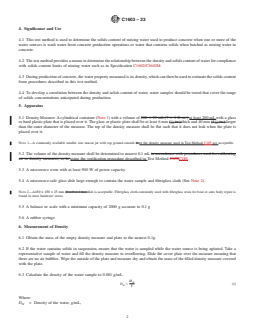
5.1 Density Measure: A cylindrical container (Note 1) with
C125 Terminology Relating to Concrete and Concrete Ag-
a volume of at least 200 mL with a glass or hard plastic plate
gregates
that is placed over it. The glass or plastic plate shall be at least
C185 Test Method for Air Content of Hydraulic Cement
6 mm thick and 40 mm larger than the outer diameter of the
Mortar
measure. The top of the density measure shall be flat such that
C188 Test Method for Density of Hydraulic Cement
it does not leak when the plate is placed over it.
C670 Practice for Preparing Precision and Bias Statements
NOTE 1—A commonly available smaller size mason jar with top ground
smooth or the density measure used in Test Method C185 are acceptable.
This test method is under the jurisdiction of ASTM Committee C09 on
5.2 The volume of the density measure shall be determined
Concrete and Concrete Aggregates and is the direct responsibility of Subcommittee
to nearest 0.1 mL using the verification procedure described in
C09.40 on Ready-Mixed Concrete.
Current edition approved Feb. 1, 2023. Published February 2023. Originally Test Method C185.
approved in 2004. Last previous edition approved in 2016 as C1603–16. DOI:
5.3 A microwave oven with at least 900 W of power
10.1520/C1603-23.
For referenced ASTM standards, visit the ASTM website, www.astm.org, or capacity.
contact ASTM Customer Service at service@astm.org. For Annual Book of ASTM
5.4 A microwave-safe glass dish large enough to contain the
Standards volume information, refer to the standard’s Document Summary page on
the ASTM website. water sample and fiberglass cloth (See Note 2).
*A Summary of Changes section appears at the end of this standard
Copyright © ASTM International, 100 Barr Harbor Drive, PO Box C700, West Conshohocken, PA 19428-2959. United States
C1603 − 23
NOTE 2—A450 × 450 × 25 mm dish is acceptable. Fiberglass cloth
Where:
commonly used with fiberglass resin for boat or auto body repair is found
M = Mass of dry solids,
s
in most hardware stores.
M = Mass of water with solids,
W
5.5 A balance or scale with a minimum capacity of 2000 g
S = Solids content in water, in percent, and
W
accurate to 0.1 g
S = Solids content in water, in ppm.
ppm
5.6 A rubber syringe
7.6 Repeat these measurements for water with different
solids content. Test water at 4 or more different levels of solids
6. Measurement of Density
content.
6.1 Obtain the mass of the empty density measure and plate
8. Relationship Between Density and Solids Content
to the nearest 0.1g.
8.1 Establish a relationship using linear regression analysis
6.2 If the water contains solids in suspension, ensure that the
(See Note 3) between the measured density and solids content
water is sampled while the water source is being agitated. Take
of water sample measurements for a range of solid concentra-
a representative sample of water and fill the density measure to
tions that cover the anticipated range in the production facility.
overflowing. Slide the cover plate over the measure ensuring
that there are no air bubbles. Wipe the outside of the plate and
NOTE 3—The linear regression analysis can be performed using
measure dry and obtain the mass of the filled density measure
spreadsheet software.
covered with the plate.
8.1.1 Express the relationship between the density of the
6.3 Calculate the density of the water sample to 0.001 g/mL water and the solids content as follows, such that the measured
density on a particular production day can be used to determine
M
W
D 5 (1)
the solids content of the water.
W
V
S 5 A1B × D (4)
ppm W
Where:
Where: A and B are regression constants
D = Density of the water, g/mL,
W
M = Net mass of water in the density measure, g, and
W
NOTE 4—Eq 4 provides an approximate linear relationship between
V = Volume of the density measure, mL.
solids content and measured density. The relationship between solids
content and density is non-linear (see Eq 5) and Eq 4 should not be used
to estimate the solids content of water outside the range of values used to
7. Measurement of Solids Content
establish the relationship in Eq 4.
7.1 Obtain the mass of the empty dish and a piece of fiber
NOTE 5—During concrete production, a producer might choose to
monitor the density of a water source using a hydrometer. It is recom-
glass cloth about 500 mm square to the nearest 0.1 g.
mended that the density of the water using a hydrometer be determined on
7.2 For the water sample used in the density measurement,
the water at the time of this density measurement to obtain a relationship,
keep the glass plate over the density measure and shake the
if needed, or to calibrate the hydrometer. The water sample should be
placed in a transparent volumetric measuring flask. The hydrometer
water suspension. If the density of water is not determined,
measurement should be taken within 10 s after filling the water in the
obtain at least 200 mL of a representative sample of water in a
flask. This is to ensure that significant settlement of solids has not occurred
container and determine the mass of the water sample to the
before the measurement is taken as that will affect the measured density.
nearest 0.1 g. Pour the water sample into the glass dish. Using
8.2 When the relationship between density and solids
...
This document is not an ASTM standard and is intended only to provide the user of an ASTM standard an indication of what changes have been made to the previous version. Because
it may not be technically possible to adequately depict all changes accurately, ASTM recommends that users consult prior editions as appropriate. In all cases only the current version
of the standard as published by ASTM is to be considered the official document.
Designation: C1603 − 16 C1603 − 23
Standard Test Method for
Measurement of Solids in Water
This standard is issued under the fixed designation C1603; the number immediately following the designation indicates the year of
original adoption or, in the case of revision, the year of last revision. A number in parentheses indicates the year of last reapproval. A
superscript epsilon (´) indicates an editorial change since the last revision or reapproval.
1. Scope*
1.1 This test method covers the measurement of the solids content in water for use as mixing water in ready-mixed concrete and
the measurement of its density. Solids content is expressed in terms of parts per million (ppm) or in terms of percent by mass of
the water sample.
1.2 The values stated in SI units are to be regarded as standard; inch-pound units are shown in parenthesis for information
only.standard. No other units of measurement are included in this standard.
1.3 The text of this standard references notes and footnotes that provide explanatory material. These notes and footnotes
(excluding those in tables and figures) shall not be considered as requirements of the standard.
1.4 This standard does not purport to address all of the safety concerns, if any, associated with its use. It is the responsibility
of the user of this standard to establish appropriate safety and health practices and to safety, health, and environmental practices
and determine the applicability of regulatory limitations prior to use.
1.5 This international standard was developed in accordance with internationally recognized principles on standardization
established in the Decision on Principles for the Development of International Standards, Guides and Recommendations issued
by the World Trade Organization Technical Barriers to Trade (TBT) Committee.
2. Referenced Documents
2.1 ASTM Standards:
C125 Terminology Relating to Concrete and Concrete Aggregates
C185 Test Method for Air Content of Hydraulic Cement Mortar
C188 Test Method for Density of Hydraulic Cement
C670 Practice for Preparing Precision and Bias Statements for Test Methods for Construction Materials
C1602/C1602M Specification for Mixing Water Used in the Production of Hydraulic Cement Concrete
3. Terminology
3.1 Definitions:
3.1.1 For definitions of terms used in this test method, refer to Terminology C125.
This test method is under the jurisdiction of ASTM Committee C09 on Concrete and Concrete Aggregates and is the direct responsibility of Subcommittee C09.40 on
Ready-Mixed Concrete.
Current edition approved Feb. 1, 2016Feb. 1, 2023. Published April 2016February 2023. Originally approved in 2004. Last previous edition approved in 20102016 as
C1603–10. DOI: 10.1520/C1603-16.–16. DOI: 10.1520/C1603-23.
For referenced ASTM standards, visit the ASTM website, www.astm.org, or contact ASTM Customer Service at service@astm.org. For Annual Book of ASTM Standards
volume information, refer to the standard’s Document Summary page on the ASTM website.
*A Summary of Changes section appears at the end of this standard
Copyright © ASTM International, 100 Barr Harbor Drive, PO Box C700, West Conshohocken, PA 19428-2959. United States
C1603 − 23
4. Significance and Use
4.1 This test method is used to determine the solids content of mixing water used to produce concrete when one or more of the
water sources is wash water from concrete production operations or water that contains solids when batched as mixing water in
concrete.
4.2 The test method provides a means to determine the relationship between the density and solids content of water for compliance
with solids content limits of mixing water such as in Specification C1602/C1602M.
4.3 During production of concrete, the water property measured is its density, which can then be used to estimate the solids content
from procedures described in this test method.
4.4 To develop a correlation between the density and solids content of water, water samples should be tested that cover the range
of solids concentrations anticipated during production.
5. Apparatus
5.1 Density Measure: A cylindrical container (Note 1) with a volume of 200 6 25 mL (7 6 1 fl. oz.) at least 200 mL with a glass
1 1
or hard plastic plate that is placed over it. The glass or plastic plate shall be at least 6 mm ( ⁄4 in.) thick and 40 mm (1 ⁄2-in.) larger
than the outer diameter of the measure. The top of the density measure shall be flat such that it does not leak when the plate is
placed over it.
NOTE 1—A commonly available smaller size mason jar with top ground smooth is or the density measure used in Test Method C185 are acceptable.
5.2 The volume of the density measure shall be determined to nearest 0.1 mL in accordance with procedures used for calibrating
air or density measures, as in using the verification procedure described in Test Method C670C185.
5.3 A microwave oven with at least 900 W of power capacity.
5.4 A microwave-safe glass dish large enough to contain the water sample and fiberglass cloth (See Note 2).
NOTE 2—A450 × 450 × 25 mm (9 × 9 × 1 in.) dish is acceptable. Fiberglass cloth commonly used with fiberglass resin for boat or auto body repair is
found in most hardware stores.
5.5 A balance or scale with a minimum capacity of 2000 g accurate to 0.1 g
5.6 A rubber syringe
6. Measurement of Density
6.1 Obtain the mass of the empty density measure and plate to the nearest 0.1g.
6.2 If the water contains solids in suspension, ensure that the water is sampled while the water source is being agitated. Take a
representative sample of water and fill the density measure to overflowing. Slide the cover plate over the measure ensuring that
there are no air bubbles. Wipe the outside of the plate and measure dry and obtain the mass of the filled density measure covered
with the plate.
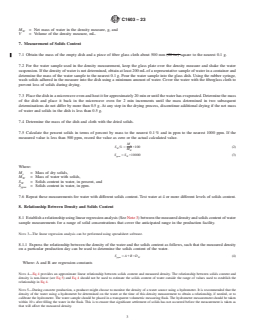
6.3 Calculate the density of the water sample to 0.001 g/mL
M
W
D 5 (1)
W
V
Where:
D = Density of the water, g/mL,
W
C1603 − 23
M = Net mass of water in the density measure, g, and
W
V = Volume of the density measure, mL.
7. Measurement of Solids Content
7.1 Obtain the mass of the empty dish and a piece of fiber glass cloth about 500 mm (20 in.) square to the nearest 0.1 g.
7.2 For the water sample used in the density measurement, keep the glass plate over the density measure and shake the water
suspension. If the density of water is not determined, obtain at least 200 mL of a representative sample of water in a container and
determine the mass of the water sample to the nearest 0.1 g. Pour the water sample into the glass dish. Using the rubber syringe,
wash solids adhered in the measure into the dish using a minimum amount of water. Cover the water with the fiberglass cloth to
prevent loss of solids during drying.
7.3 Place the dish in a microwave oven and heat it for approximately 20 min or until the water has evaporated. Determine the mass
of the dish and place it back in the microwave oven for 2 min increments until the mass determined in two subsequent
determinations do not differ by more than 0.5 g. At any step in the drying process, discontinue additional drying if the net mass
of water and solids in the dish is less than 0.5 g.
7.4 Determine the mass of the dish and cloth with the dried solids.
7.5 Calculate the percent solids in terms of percent by mass to the nearest 0.1 % and in ppm to the nearest 1000 ppm. If the
measured value is less than 500 ppm, record the value as zero or the actual calculated value.
M
s
S ,%5 ×100 (2)
W
M
W
S 5 S ×10 000 (3)
ppm W
Where:
M = Mass of dry solids,
s
M = Mass of water with solids,
W
S = Solids content in water, in percent, and
W
S = Solids content in water, in ppm.
ppm
7.6 Repeat these measurements for water with different solids content. Test water at 4 or more different levels of solids content.
8. Relationship Between Density and Solids Content
8.1 Establish a relationship using linear regression analysis (See Note 3) between the measured density and solids content of water
sample measurements for a range of solid concentrations that cover the anticipated range in the production facility.
NOTE 3—The linear regression analysis can be performed using spreadsheet software.
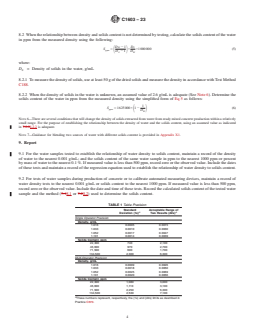
8.1.1 Express the relationship between the density of the water and the solids content as follows, such that the measured density
...