

ASTM D7234-22
(Test Method)Standard Test Method for Pull-Off Strength of Coatings on Concrete Using Portable Pull-Off Adhesion Testers
General Information
- Abstract
SIGNIFICANCE AND USE
5.1 The pull-off strength and mode of failure of a coating from a concrete substrate are important performance properties that are used in specifications. This test method serves as a means for uniformly preparing and testing coated surfaces, and evaluating and reporting the results.
5.2 Variations in strength results obtained using different instruments, different substrates, or different loading fixtures with the same coating are possible. Therefore, it is recommended that the specific test instrument and loading fixture be mutually agreed upon between the interested parties.
5.3 It is recommended that the coating be sufficiently cured to ensure cohesive strength and adhesion. This required minimum cure time before testing should be provided by the coating manufacturer, and may require an extension due to atmospheric conditions on site (for example, low temperature, and low or high humidity).
5.4 This test method may be adapted to determine surface strength of uncoated concrete (see X2.1). Test Method C1583 is also suitable for that determination.
5.5 The objective of this method is to determine the adhesion of a coating to concrete (or adapted for surface strength as stated in 5.4) and will result in failure in the coating or near the substrate surface. If evaluating the cohesive strength of the substrate or cementitious surfacers is the purpose of the testing, or if the substrate or cementitious surfacers have low strength, then Test Method C1583 may be more suitable.
SCOPE
1.1 This test method covers procedures for evaluating the pull-off strength of a coating on concrete. Pull-Off strength of coatings for other rigid substrates is described in Test Method D4541. The test determines the greatest perpendicular force (in tension) that a surface area can bear before a plug of material is detached. Failure will occur along the weakest plane within the system comprised of the loading fixture, glue, coating system, and substrate, and will be exposed by the fracture surface.
1.2 This test method uses a class of apparatus known as portable pull-off adhesion testers.2 They are capable of applying a concentric load and counter load to a single surface so that coatings can be tested even though only one side is accessible. Measurements are limited by the strength of adhesion bonds between the loading fixture, coating system and the substrate or the cohesive strengths of the glue, coating layers, and substrate.
1.3 This test method is suitable for both laboratory and field testing.
1.4 Pull-off strength measurements depend upon both material and instrumental parameters. There are different instruments used that comply with this test method. The specific instrument used should be identified when reporting results. This test is destructive and spot repairs may be necessary.
1.5 The values stated in SI units are to be regarded as the standard. The values given in parentheses are for information only.
1.6 This standard does not purport to address all of the safety concerns, if any, associated with its use. It is the responsibility of the user of this standard to establish appropriate safety, health, and environmental practices and determine the applicability of regulatory limitations prior to use.
1.7 This international standard was developed in accordance with internationally recognized principles on standardization established in the Decision on Principles for the Development of International Standards, Guides and Recommendations issued by the World Trade Organization Technical Barriers to Trade (TBT) Committee.
- Status
- Published
- Publication Date
- 30-Nov-2022
- Technical Committee
- D01 - Paint and Related Coatings, Materials, and Applications
- Drafting Committee
- D01.46 - Industrial Protective Coatings
Buy Documents
ASTM D7234-22 - Standard Test Method for Pull-Off Strength of Coatings on Concrete Using Portable Pull-Off Adhesion Testers
REDLINE ASTM D7234-22 - Standard Test Method for Pull-Off Strength of Coatings on Concrete Using Portable Pull-Off Adhesion Testers
Overview
ASTM D7234-22: Standard Test Method for Pull-Off Strength of Coatings on Concrete Using Portable Pull-Off Adhesion Testers is a widely recognized method developed by ASTM International for objectively measuring the pull-off strength-the greatest perpendicular force a material can withstand before detachment-of coatings on concrete substrates. This standard provides a consistent, calibrated approach using portable pull-off adhesion testers to evaluate coating adhesion and the mode of failure, delivering essential data for quality assurance and performance specifications in the construction, coatings, and flooring industries.
The test's significance lies in its ability to determine not only the strength of adhesion but also the weakest points within the system, helping users assess the integrity of the entire coating-substrate assembly. Both laboratory and field testing are supported, enhancing its applicability for real-world construction and maintenance activities.
Key Topics
Test Scope and Applicability
- Focuses on coated concrete surfaces; can be adapted for uncoated concrete strength measurement.
- Not suitable for non-concrete substrates (see ASTM D4541 for other rigid substrates).
Test Method Fundamentals
- Portable pull-off adhesion testers apply a concentric tensile force to a locally bonded loading fixture, or "dolly."
- Test area is scored, fixture is glued, and, after curing, force is gradually increased until detachment occurs.
- The type and percentage of failure mode (adhesive, cohesive, substrate, glue failure) are evaluated.
Instrument and Procedure Considerations
- Precision in instrument selection and reporting is critical; different testers and fixtures may yield different results.
- The coating must be sufficiently cured based on manufacturer guidelines before testing.
- Environmental conditions such as temperature and humidity can influence results.
Result Analysis and Reporting
- Results must state the instrument used, test conditions, description of the system (substrate, coating, glue), failure modes, and any deviations.
- A minimum of three replicated measurements per test area is recommended for statistical accuracy.
- Destructive nature of the test means spot repairs may be necessary after testing.
Applications
ASTM D7234-22 is a valuable standard in multiple domains:
Quality Control and Specification Compliance
- Ensures protective, decorative, or functional coatings meet established adhesion requirements on concrete.
- Used by manufacturers, contractors, and inspectors to validate new installations and coating system upgrades.
Asset Maintenance and Failure Investigation
- Identifies weak adhesion zones, inadequate surface preparation, or surface contamination, aiding in root cause analysis for premature coating failures or delamination.
Construction and Infrastructure
- Applied in commercial flooring, bridges, parking decks, industrial plants, water tanks, and other concrete structures where coating integrity directly affects durability and safety.
Surface Preparation Verification
- Before applying a new coating, the method can be adapted to assess the surface strength of uncoated concrete, ensuring suitability and longevity of future coatings.
Related Standards
- ASTM D4541 - Test Method for Pull-Off Strength of Coatings Using Portable Adhesion Testers (for non-concrete, rigid substrates).
- ASTM C1583 - Test Method for Tensile Strength of Concrete Surfaces and the Bond Strength of Concrete Repair/Overlay Materials by Direct Tension.
- ASTM D16 - Terminology for Paint, Related Coatings, Materials, and Applications.
- ASTM D2651 & D3933 - Guides for preparation of metal and aluminum surfaces for adhesive bonding.
- ASTM E177, E178, and E691 - Practices for precision, bias, and interlaboratory study for test methods.
By following ASTM D7234-22, professionals in coatings, construction, and maintenance benefit from standardized, reproducible, and internationally recognized procedures for evaluating the pull-off adhesion strength of coatings on concrete, ensuring performance, safety, and regulatory compliance.
Relations
- Effective Date
- 01-Jan-2024
- Effective Date
- 01-Nov-2017
- Effective Date
- 01-Jul-2016
- Effective Date
- 01-Jun-2016
- Effective Date
- 01-May-2016
- Effective Date
- 01-Dec-2014
- Effective Date
- 01-May-2014
- Effective Date
- 01-May-2013
- Effective Date
- 01-May-2013
- Effective Date
- 01-Aug-2012
- Effective Date
- 01-Nov-2011
- Effective Date
- 01-Jun-2011
- Effective Date
- 01-Jan-2011
- Effective Date
- 01-Oct-2010
- Effective Date
- 01-Oct-2010
Buy Documents
ASTM D7234-22 - Standard Test Method for Pull-Off Strength of Coatings on Concrete Using Portable Pull-Off Adhesion Testers
REDLINE ASTM D7234-22 - Standard Test Method for Pull-Off Strength of Coatings on Concrete Using Portable Pull-Off Adhesion Testers
Get Certified
Connect with accredited certification bodies for this standard

DIBt (Deutsches Institut für Bautechnik)
German Institute for Building Technology.
DIN CERTCO
DIN Group product certification.

Aboma Certification B.V.
Specialized in construction, metal, and transport sectors.
Sponsored listings
Frequently Asked Questions
ASTM D7234-22 is a standard published by ASTM International. Its full title is "Standard Test Method for Pull-Off Strength of Coatings on Concrete Using Portable Pull-Off Adhesion Testers". This standard covers: SIGNIFICANCE AND USE 5.1 The pull-off strength and mode of failure of a coating from a concrete substrate are important performance properties that are used in specifications. This test method serves as a means for uniformly preparing and testing coated surfaces, and evaluating and reporting the results. 5.2 Variations in strength results obtained using different instruments, different substrates, or different loading fixtures with the same coating are possible. Therefore, it is recommended that the specific test instrument and loading fixture be mutually agreed upon between the interested parties. 5.3 It is recommended that the coating be sufficiently cured to ensure cohesive strength and adhesion. This required minimum cure time before testing should be provided by the coating manufacturer, and may require an extension due to atmospheric conditions on site (for example, low temperature, and low or high humidity). 5.4 This test method may be adapted to determine surface strength of uncoated concrete (see X2.1). Test Method C1583 is also suitable for that determination. 5.5 The objective of this method is to determine the adhesion of a coating to concrete (or adapted for surface strength as stated in 5.4) and will result in failure in the coating or near the substrate surface. If evaluating the cohesive strength of the substrate or cementitious surfacers is the purpose of the testing, or if the substrate or cementitious surfacers have low strength, then Test Method C1583 may be more suitable. SCOPE 1.1 This test method covers procedures for evaluating the pull-off strength of a coating on concrete. Pull-Off strength of coatings for other rigid substrates is described in Test Method D4541. The test determines the greatest perpendicular force (in tension) that a surface area can bear before a plug of material is detached. Failure will occur along the weakest plane within the system comprised of the loading fixture, glue, coating system, and substrate, and will be exposed by the fracture surface. 1.2 This test method uses a class of apparatus known as portable pull-off adhesion testers.2 They are capable of applying a concentric load and counter load to a single surface so that coatings can be tested even though only one side is accessible. Measurements are limited by the strength of adhesion bonds between the loading fixture, coating system and the substrate or the cohesive strengths of the glue, coating layers, and substrate. 1.3 This test method is suitable for both laboratory and field testing. 1.4 Pull-off strength measurements depend upon both material and instrumental parameters. There are different instruments used that comply with this test method. The specific instrument used should be identified when reporting results. This test is destructive and spot repairs may be necessary. 1.5 The values stated in SI units are to be regarded as the standard. The values given in parentheses are for information only. 1.6 This standard does not purport to address all of the safety concerns, if any, associated with its use. It is the responsibility of the user of this standard to establish appropriate safety, health, and environmental practices and determine the applicability of regulatory limitations prior to use. 1.7 This international standard was developed in accordance with internationally recognized principles on standardization established in the Decision on Principles for the Development of International Standards, Guides and Recommendations issued by the World Trade Organization Technical Barriers to Trade (TBT) Committee.
SIGNIFICANCE AND USE 5.1 The pull-off strength and mode of failure of a coating from a concrete substrate are important performance properties that are used in specifications. This test method serves as a means for uniformly preparing and testing coated surfaces, and evaluating and reporting the results. 5.2 Variations in strength results obtained using different instruments, different substrates, or different loading fixtures with the same coating are possible. Therefore, it is recommended that the specific test instrument and loading fixture be mutually agreed upon between the interested parties. 5.3 It is recommended that the coating be sufficiently cured to ensure cohesive strength and adhesion. This required minimum cure time before testing should be provided by the coating manufacturer, and may require an extension due to atmospheric conditions on site (for example, low temperature, and low or high humidity). 5.4 This test method may be adapted to determine surface strength of uncoated concrete (see X2.1). Test Method C1583 is also suitable for that determination. 5.5 The objective of this method is to determine the adhesion of a coating to concrete (or adapted for surface strength as stated in 5.4) and will result in failure in the coating or near the substrate surface. If evaluating the cohesive strength of the substrate or cementitious surfacers is the purpose of the testing, or if the substrate or cementitious surfacers have low strength, then Test Method C1583 may be more suitable. SCOPE 1.1 This test method covers procedures for evaluating the pull-off strength of a coating on concrete. Pull-Off strength of coatings for other rigid substrates is described in Test Method D4541. The test determines the greatest perpendicular force (in tension) that a surface area can bear before a plug of material is detached. Failure will occur along the weakest plane within the system comprised of the loading fixture, glue, coating system, and substrate, and will be exposed by the fracture surface. 1.2 This test method uses a class of apparatus known as portable pull-off adhesion testers.2 They are capable of applying a concentric load and counter load to a single surface so that coatings can be tested even though only one side is accessible. Measurements are limited by the strength of adhesion bonds between the loading fixture, coating system and the substrate or the cohesive strengths of the glue, coating layers, and substrate. 1.3 This test method is suitable for both laboratory and field testing. 1.4 Pull-off strength measurements depend upon both material and instrumental parameters. There are different instruments used that comply with this test method. The specific instrument used should be identified when reporting results. This test is destructive and spot repairs may be necessary. 1.5 The values stated in SI units are to be regarded as the standard. The values given in parentheses are for information only. 1.6 This standard does not purport to address all of the safety concerns, if any, associated with its use. It is the responsibility of the user of this standard to establish appropriate safety, health, and environmental practices and determine the applicability of regulatory limitations prior to use. 1.7 This international standard was developed in accordance with internationally recognized principles on standardization established in the Decision on Principles for the Development of International Standards, Guides and Recommendations issued by the World Trade Organization Technical Barriers to Trade (TBT) Committee.
ASTM D7234-22 is classified under the following ICS (International Classification for Standards) categories: 91.080.40 - Concrete structures. The ICS classification helps identify the subject area and facilitates finding related standards.
ASTM D7234-22 has the following relationships with other standards: It is inter standard links to ASTM D16-24, ASTM D3933-98(2017), ASTM D16-16, ASTM E178-16, ASTM D2651-01(2016), ASTM D16-14, ASTM E177-14, ASTM E691-13, ASTM E177-13, ASTM D16-12, ASTM E691-11, ASTM D16-11a, ASTM D16-11, ASTM E177-10, ASTM D3933-98(2010). Understanding these relationships helps ensure you are using the most current and applicable version of the standard.
ASTM D7234-22 is available in PDF format for immediate download after purchase. The document can be added to your cart and obtained through the secure checkout process. Digital delivery ensures instant access to the complete standard document.
Standards Content (Sample)
This international standard was developed in accordance with internationally recognized principles on standardization established in the Decision on Principles for the
Development of International Standards, Guides and Recommendations issued by the World Trade Organization Technical Barriers to Trade (TBT) Committee.
Designation: D7234 − 22
Standard Test Method for
Pull-Off Strength of Coatings on Concrete Using Portable
Pull-Off Adhesion Testers
This standard is issued under the fixed designation D7234; the number immediately following the designation indicates the year of
original adoption or, in the case of revision, the year of last revision. A number in parentheses indicates the year of last reapproval. A
superscript epsilon (´) indicates an editorial change since the last revision or reapproval.
1. Scope 1.7 This international standard was developed in accor-
dance with internationally recognized principles on standard-
1.1 This test method covers procedures for evaluating the
ization established in the Decision on Principles for the
pull-off strength of a coating on concrete. Pull-Off strength of
Development of International Standards, Guides and Recom-
coatings for other rigid substrates is described in Test Method
mendations issued by the World Trade Organization Technical
D4541.Thetestdeterminesthegreatestperpendicularforce(in
Barriers to Trade (TBT) Committee.
tension) that a surface area can bear before a plug of material
is detached. Failure will occur along the weakest plane within
2. Referenced Documents
the system comprised of the loading fixture, glue, coating
2.1 ASTM Standards:
system, and substrate, and will be exposed by the fracture
C1583 Test Method for Tensile Strength of Concrete Sur-
surface.
faces and the Bond Strength or Tensile Strength of
1.2 This test method uses a class of apparatus known as
Concrete Repair and Overlay Materials by Direct Tension
portable pull-off adhesion testers. They are capable of apply-
(Pull-off Method)
ing a concentric load and counter load to a single surface so
D16 TerminologyforPaint,RelatedCoatings,Materials,and
that coatings can be tested even though only one side is
Applications
accessible. Measurements are limited by the strength of adhe-
D2651 GuideforPreparationofMetalSurfacesforAdhesive
sion bonds between the loading fixture, coating system and the
Bonding
substrate or the cohesive strengths of the glue, coating layers,
D3933 Guide for Preparation of Aluminum Surfaces for
and substrate.
Structural Adhesives Bonding (Phosphoric Acid Anodiz-
1.3 This test method is suitable for both laboratory and field
ing)
testing.
D4541 Test Method for Pull-Off Strength of Coatings Using
Portable Adhesion Testers
1.4 Pull-off strength measurements depend upon both ma-
E177 Practice for Use of the Terms Precision and Bias in
terial and instrumental parameters. There are different instru-
ASTM Test Methods
ments used that comply with this test method. The specific
E178 Practice for Dealing With Outlying Observations
instrument used should be identified when reporting results.
E691 Practice for Conducting an Interlaboratory Study to
This test is destructive and spot repairs may be necessary.
Determine the Precision of a Test Method
1.5 The values stated in SI units are to be regarded as the
standard. The values given in parentheses are for information
3. Terminology
only.
3.1 The terms and definitions in Terminology D16 apply to
1.6 This standard does not purport to address all of the
this test method.
safety concerns, if any, associated with its use. It is the
3.2 Definitions:
responsibility of the user of this standard to establish appro-
3.2.1 concrete, n—with respect to this test method, refers to
priate safety, health, and environmental practices and deter-
all forms of concrete including masonry units.
mine the applicability of regulatory limitations prior to use.
3.2.2 glue, n—with respect to this test method, glue refers to
the material that bonds the bottom of the loading fixture to the
This test method is under the jurisdiction of ASTM Committee D01 on Paint
top surface of the coating to be tested.
and Related Coatings, Materials, andApplications and is the direct responsibility of
Subcommittee D01.46 on Industrial Protective Coatings.
Current edition approved Dec. 1, 2022. Published December 2022. Originally
approved in 2005. Last previous edition approved in 2021 as D7234 – 21. DOI: For referenced ASTM standards, visit the ASTM website, www.astm.org, or
10.1520/D7234-22. contact ASTM Customer Service at service@astm.org. For Annual Book of ASTM
The term adhesion tester may be somewhat of a misnomer, but its adoption by Standards volume information, refer to the standard’s Document Summary page on
two manufacturers and at least two patents indicates continued usage. the ASTM website.
Copyright © ASTM International, 100 Barr Harbor Drive, PO Box C700, West Conshohocken, PA 19428-2959. United States
D7234 − 22
3.2.3 loading fixture, n—(also referred to as dollies or studs) 6. Apparatus
a metal structure that is flat on one end for bonding to the
6.1 Adhesion Tester, including the components and accesso-
coating surface and shaped on the other end for attachment to
ries described in 6.1.1 – 6.1.5.
the adhesion tester and is used to determine the pull-off
6.1.1 Loading Fixtures,havingaflatsurfaceononeendthat
strength of coatings.
can be adhered to the coating and a means of attachment to the
3.2.4 portable pull-off adhesion testers, n—instruments that
tester on the other end. The bonding surface may be round,
are capable of applying a concentric load and counter load to
square or rectangular. The round loading fixtures are usually
asinglesurfacesothatcoatingscanbetestedeventhoughonly
50 mm (2.0 in.) in diameter but may range from 20 mm
one side is accessible.
(0.75 in.) to 75 mm (3.0 in.) in diameter.
6.1.2 Detaching Assembly, having a central grip for engag-
4. Summary of Test Method
ing the loading fixture.
4.1 The general pull-off test is performed by scoring 6.1.3 Base, on the detaching assembly, for uniformly press-
through the coating down to the surface of the concrete ing against the coating surface around the fixture either
substrate at a diameter equal to the diameter of the loading directly, or by way of an intermediate bearing ring.Ameans of
fixture (dolly, stud), and securing the loading fixture normal aligning the base is needed so that the resultant force is normal
to the surface.
(perpendicular) to the surface of the coating with a glue.After
the glue is cured, a testing apparatus is attached to the loading 6.1.4 Force Applicator, means of moving the grip away
fixture and aligned to apply tension normal to the test surface. from the base in as smooth and continuous a manner as
The force applied to the loading fixture is then uniformly possible so that a torsion free, co-axial (opposing pull of the
increased and monitored until a plug of material is detached. grip and push of the base along the same axis) force results
When a plug of material is detached, the exposed surface between them.
represents the plane of limiting strength within the system.The 6.1.5 Force Indicator and Calibration Information, for
nature of the failure is qualified in accordance with the percent determining the actual force delivered to the loading fixture.
of adhesive and cohesive failures, and the actual interfaces and The force indicator shall be verified to be within 65 % of the
layers involved.The pull-off strength is computed based on the force measured by a calibrated testing machine at a frequency
maximum indicated load, the instrument calibration data, and determined by the user, typically once a year.
the surface area stressed. Pull-off strength results obtained
6.2 Timer, or means of limiting the rate of stress to less than
using different devices may be different because the results
or equal to 0.2 MPa/s (30 psi/s) so that the maximum stress
depend on instrumental parameters.
(failure) is obtained in about 5 to 30 s.
6.3 Solvent, or other means for cleaning the loading fixture
5. Significance and Use
surface.
5.1 The pull-off strength and mode of failure of a coating
6.4 Fine Sandpaper,orothermeansofcleaningorpreparing
from a concrete substrate are important performance properties
the coating that will not alter its integrity.
that are used in specifications. This test method serves as a
means for uniformly preparing and testing coated surfaces, and
6.5 Glue,forsecuringthefixturetothecoatingthatdoesnot
evaluating and reporting the results.
affect the coating properties. Two-component epoxies and
acrylics have been found to be the most versatile.
5.2 Variations in strength results obtained using different
instruments, different substrates, or different loading fixtures
6.6 Mechanical Clamps, if needed, for holding the fixture in
with the same coating are possible. Therefore, it is recom-
place while the glue cures.
mended that the specific test instrument and loading fixture be
6.7 Cotton Swabs, or other means for removing excess glue.
mutually agreed upon between the interested parties.
6.8 Core Bit with Drill Press or Hand Drill, and means to
5.3 It is recommended that the coating be sufficiently cured
ensure that the scoring is normal to the coating for the
to ensure cohesive strength and adhesion. This required mini-
procedures that use a round loading fixture. The core bit inside
mum cure time before testing should be provided by the
diameter should equal the diameter of the loading fixture. If a
coating manufacturer, and may require an extension due to
core bit with an inside diameter equal to the diameter of the
atmospheric conditions on site (for example, low temperature,
loadingfixtureisnotavailable,theclosestsizeavailableshould
and low or high humidity).
be used. The diameter of the scored area should be measured
5.4 This test method may be adapted to determine surface
and recorded for performing the calculations. The core bit or
strength of uncoated concrete (see X2.1). Test Method C1583
saw blades should be diamond tipped and, when required to
is also suitable for that determination.
minimize heat and suppress dust, supplemented with water
5.5 The objective of this method is to determine the adhe-
sion of a coating to concrete (or adapted for surface strength as
stated in 5.4) and will result in failure in the coating or near the
The sole source of supply of the acrylics known to the committee at this time
is Versiloc 201 and 204 with accelerator, available from Lord Corp., Industrial
substrate surface. If evaluating the cohesive strength of the
Adhesive Div., 2000 W. Grandview Blvd., P.O. Box 10038, Erie, PA 16514. If you
substrateorcementitioussurfacersisthepurposeofthetesting,
are aware of alternative suppliers, please provide this information to ASTM
or if the substrate or cementitious surfacers have low strength,
International Headquarters. Your comments will receive careful consideration at a
then Test Method C1583 may be more suitable. meeting of the responsible technical committee, which you may attend.
D7234 − 22
lubrication. For the test procedures that use a square or in a manner that does not twist or torque the test area and
rectangularloadingfixture,acircularsawisrequiredinsteadof minimizes heat generated and edge damage or microcracks to
acorebitanddrill.Alternately,forthinorelastomericcoatings, the coating and the concrete substrate. For thick coatings it is
a sharp knife or hole saw may be sufficient to score around the recommended to cool the coating and substrate during the
loading fixture. cutting process with water lubrication. If any defects of the
coating due to the scoring are observed, the test location shall
7. Test Preparation
be discarded and not recorded in the results. When using a
round loading fixture, scoring shall be performed before the
7.1 Themethodforselectingthecoatingsitestobeprepared
loading fixture is attached (see Fig. 1). When using square or
for testing depends upon the objectives of the test and
rectangular loading fixtures, scoring is typically performed
agreements between the contracting parties. There are,
after the loading fixture is attached (see Fig. 2).
however, a few physical restrictions imposed by the general
method and apparatus.The following requirements apply to all
NOTE 1—Since it is difficult to score the coating precisely “down to the
sites:
surface of the substrate,” especially for thicker coatings, it is acceptable to
7.1.1 The selected test area must be a flat surface large allow a range. This range for the whole circumference or edge should, at
the top end, ensure touching the surface of the substrate, and at the bottom
enoughtoaccommodatethespecifiednumberofreplicatetests.
end, be no more than 3 mm ( ⁄8 in.) below the substrate surface. In cases
The surface may have any orientation with reference to
wherethesubstrateisveryrough,thesurfaceofthesubstratewouldbethe
gravitational pull. Each test site must be separated by at least
lowest depth of continuous substrate with this same tolerance.
the distance needed to accommodate the detaching apparatus.
NOTE 2—(For concrete surfacers/patching materials under coatings.) It
The size of a test site is essentially that of the secured loading is common in recoating projects to apply a “surfacer” or patching material
to the concrete substrate to repair or level, or both, the concrete prior to
fixture. At least three replications are required in order to
recoating. This surfacer/patching material layer can range in thickness
statistically characterize the test area.
from very thin (essentially immeasurable on top of the remaining
7.1.2 The selected test areas must also have enough perpen-
concrete), up to 12 mm or more in small repair pockets. It is the option of
dicularandradialclearancetoaccommodatetheapparatus,and
thespecifieroftheprojecttodefinethesurfacer/patchingmaterialaseither
part of the coating system (where the underlying concrete would be the
be flat enough to permit alignment. It should be noted that
substrate) or as the substrate itself. This distinction would be relevant in
measurementsclosetoanedgemaynotberepresentativeofthe
determining the depth of scoring as detailed in 7.2.
coating as a whole.
NOTE 3—For vertical and overhead surfaces it is recommended to use
an attached template to ensure scoring is performed with a tool secured
7.2 Scoring the coating down to the surface of the substrate
and guided in a perpendicular angle.
is required for all coatings thicker than 0.5 mm (20 mils) and
for all reinforced or elastomeric coatings. While scoring is 7.3 Clean the surfaces in a manner that will not affect
recommended for coatings thinner than 0.5 mm (20 mils), the integrity of the coating or leave a residue. Clean the loading
test may be performed without scoring, but the results should fixture surface as indicated by the apparatus manufacturer.
note this exception. Scoring shall be performed in a manner Failures at the fixture-glue interface can often be avoided by
that ensures the cut is made normal to the coating surface and treating the fixture surfaces in accordance with an appropriate
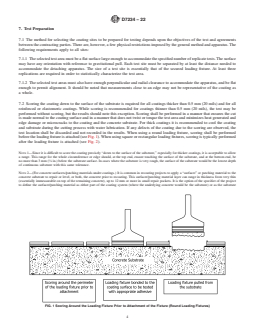
FIG. 1 Scoring Around the Loading Fixture Prior to Attachment of the Fixture (Round Loading Fixtures)
D7234 − 22
FIG. 2 Scoring Around the Loading Fixture After Attachment of the Fixture (Square or Rectangular Fixtures)
ASTM standard practice for preparing metal surfaces for 8. Test Procedure
adhesivebonding.Fingerprints,moisture,andoxidestendtobe
8.1 Select an adhesion tester having a force calibration
the primary contaminants.
spanning the range of expected values along with its compat-
NOTE 4—Guides D2651 and D3933 are typical of well-proven methods
ible loading fixture. Mid-range measurements are usually the
for improving adhesive bond strengths to metal surfaces.
best, but read the manufacturer’s operating instructions before
7.4 Prepare the glue in accordance with the glue manufac-
proceeding.
turer’s recommendations. Apply the glue to the fixture or the
8.2 If a bearing ring or comparable device is to be used,
surface to be tested, or both, using a method recommended by
placeitconcentricallyaroundtheloadingfixtureonthecoating
the glue manufacturer. Be certain to apply the glue across the
surface. If shims are required when a bearing ring is employed,
entire surface. Position fixture on the surface to be tested
place them between the tester base and bearing ring rather than
centered directly over the scored section with the fixture outer
on the coating surface.
sides lined up with the inside circumference of the scored
section. Carefully remove the excess glue from around the
8.3 Carefully connect the central grip of the detaching
fixture. (Warning—Movement, especially twisting, can cause
assembly to the loading fixture without bumping, bending, or
tiny bubbles to coalesce into large holidays that constitute
otherwise prestressing the sample and connect the detaching
stress discontinuities during testing.)
assembly to its control mechanism, if necessary. For nonhori-
NOTE 5—Adding about 1 % of #5 glass beads to the glue assists in even
zontal surfaces, support the detaching assembly so that its
alignment of the test fixture to the surface.
weight does not contribute to the force exerted in the test.
7.5 Based on the glue manufacturer’s recommendations and
8.4 Align the device according to the manufacturer’s in-
the anticipated environmental conditions, allow enough time
structions and set the force indicator to zero.
for the glue to set up and reach the recommended cure. During
the glue set and early cure stage, a constant contact pressure
NOTE 6—Proper alignment is critical. If alignment is require
...
This document is not an ASTM standard and is intended only to provide the user of an ASTM standard an indication of what changes have been made to the previous version. Because
it may not be technically possible to adequately depict all changes accurately, ASTM recommends that users consult prior editions as appropriate. In all cases only the current version
of the standard as published by ASTM is to be considered the official document.
Designation: D7234 − 21 D7234 − 22
Standard Test Method for
Pull-Off Adhesion Strength of Coatings on Concrete Using
Portable Pull-Off Adhesion Testers
This standard is issued under the fixed designation D7234; the number immediately following the designation indicates the year of
original adoption or, in the case of revision, the year of last revision. A number in parentheses indicates the year of last reapproval. A
superscript epsilon (´) indicates an editorial change since the last revision or reapproval.
1. Scope
1.1 This test method covers procedures for evaluating the pull-off adhesion strength of a coating on concrete. Pull-Off strength
of coatings for other rigid substrates is described in Test Method D4541. The test determines the greatest perpendicular force (in
tension) that a surface area can bear before a plug of material is detached. Failure will occur along the weakest plane within the
system comprised of the loading fixture, glue, coating system, and substrate, and will be exposed by the fracture surface.
1.2 This test method uses a class of apparatus known as portable pull-off adhesion testers. They are capable of applying a
concentric load and counter load to a single surface so that coatings can be tested even though only one side is accessible.
Measurements are limited by the strength of adhesion bonds between the loading fixture, coating system and the substrate or the
cohesive strengths of the glue, coating layers, and substrate.
1.3 This test method is suitable for both laboratory and field testing.
1.4 Pull-off adhesion strength measurements depend upon both material and instrumental parameters. There are different
instruments used that comply with this test method. The specific instrument used should be identified when reporting results. This
test is destructive and spot repairs may be necessary.
1.5 The values stated in SI units are to be regarded as the standard. The values given in parentheses are for information only.
1.6 This standard does not purport to address all of the safety concerns, if any, associated with its use. It is the responsibility
of the user of this standard to establish appropriate safety, health, and environmental practices and determine the applicability of
regulatory limitations prior to use.
1.7 This international standard was developed in accordance with internationally recognized principles on standardization
established in the Decision on Principles for the Development of International Standards, Guides and Recommendations issued
by the World Trade Organization Technical Barriers to Trade (TBT) Committee.
2. Referenced Documents
2.1 ASTM Standards:
This test method is under the jurisdiction of ASTM Committee D01 on Paint and Related Coatings, Materials, and Applications and is the direct responsibility of
Subcommittee D01.46 on Industrial Protective Coatings.
Current edition approved July 1, 2021Dec. 1, 2022. Published August 2021December 2022. Originally approved in 2005. Last previous edition approved in 20192021 as
D7234 – 19.D7234 – 21. DOI: 10.1520/D7234-21.10.1520/D7234-22.
The term adhesion tester may be somewhat of a misnomer, but its adoption by two manufacturers and at least two patents indicates continued usage.
For referenced ASTM standards, visit the ASTM website, www.astm.org, or contact ASTM Customer Service at service@astm.org. For Annual Book of ASTM Standards
volume information, refer to the standard’s Document Summary page on the ASTM website.
Copyright © ASTM International, 100 Barr Harbor Drive, PO Box C700, West Conshohocken, PA 19428-2959. United States
D7234 − 22
C1583 Test Method for Tensile Strength of Concrete Surfaces and the Bond Strength or Tensile Strength of Concrete Repair and
Overlay Materials by Direct Tension (Pull-off Method)
D16 Terminology for Paint, Related Coatings, Materials, and Applications
D2651 Guide for Preparation of Metal Surfaces for Adhesive Bonding
D3933 Guide for Preparation of Aluminum Surfaces for Structural Adhesives Bonding (Phosphoric Acid Anodizing)
D4541 Test Method for Pull-Off Strength of Coatings Using Portable Adhesion Testers
E177 Practice for Use of the Terms Precision and Bias in ASTM Test Methods
E178 Practice for Dealing With Outlying Observations
E691 Practice for Conducting an Interlaboratory Study to Determine the Precision of a Test Method
3. Terminology
3.1 The terms and definitions in Terminology D16 apply to this test method.
3.2 Definitions:
3.2.1 concrete, n—with respect to this test method, refers to all forms of concrete including masonry units.
3.2.2 glue, n—with respect to this test method, glue refers to the material that bonds the bottom of the loading fixture to the top
surface of the coating to be tested.
3.2.3 loading fixture, n—(also referred to as dollies or studs) a metal structure that is flat on one end for bonding to the coating
surface and shaped on the other end for attachment to the adhesion tester and is used to determine the pull-off adhesion strength
of coatings.
3.2.4 portable pull-off adhesion testers, n—instruments that are capable of applying a concentric load and counter load to a single
surface so that coatings can be tested even though only one side is accessible.
4. Summary of Test Method
4.1 The general pull-off adhesion test pull-off test is performed by scoring through the coating down to the surface of the concrete
substrate at a diameter equal to the diameter of the loading fixture (dolly, stud), and securing the loading fixture normal
(perpendicular) to the surface of the coating with a glue. After the glue is cured, a testing apparatus is attached to the loading fixture
and aligned to apply tension normal to the test surface. The force applied to the loading fixture is then uniformly increased and
monitored until a plug of material is detached. When a plug of material is detached, the exposed surface represents the plane of
limiting strength within the system. The nature of the failure is qualified in accordance with the percent of adhesive and cohesive
failures, and the actual interfaces and layers involved. The pull-off adhesion strength is computed based on the maximum indicated
load, the instrument calibration data, and the surface area stressed. Pull-off adhesion strength results obtained using different
devices may be different because the results depend on instrumental parameters.
5. Significance and Use
5.1 The pull-off adhesion strength and mode of failure of a coating from a concrete substrate are important performance properties
that are used in specifications. This test method serves as a means for uniformly preparing and testing coated surfaces, and
evaluating and reporting the results.
5.2 Variations in strength results obtained using different instruments, different substrates, or different loading fixtures with the
same coating are possible. Therefore, it is recommended that the specific test instrument and loading fixture be mutually agreed
upon between the interested parties.
5.3 It is recommended that the coating be sufficiently cured to ensure cohesive strength and adhesion. This required minimum cure
time before testing should be provided by the coating manufacturer, and may require an extension due to atmospheric conditions
on site (for example, low temperature, and low or high humidity).
5.4 This test method may be adapted to determine surface strength of uncoated concrete (see X2.1). Test Method C1583 is also
suitable for that determination.
D7234 − 22
5.5 The objective of this method is to determine the adhesion of a coating to concrete (or adapted for surface strength as stated
in 5.4) and will result in failure in the coating or near the substrate surface. If evaluating the cohesive strength of the substrate or
cementitious surfacers is the purpose of the testing, or if the substrate or cementitious surfacers have low strength, then Test
Method C1583 may be more suitable.
6. Apparatus
6.1 Adhesion Tester, including the components and accessories described in 6.1.1 – 6.1.5.
6.1.1 Loading Fixtures, having a flat surface on one end that can be adhered to the coating and a means of attachment to the tester
on the other end. The bonding surface may be round, square or rectangular. The round loading fixtures are usually 50 mm (2.0 in.)
in diameter but may range from 20 mm (0.75 in.) (0.75 in.) to 75 mm (3.0 in.) in diameter.
6.1.2 Detaching Assembly, having a central grip for engaging the loading fixture.
6.1.3 Base, on the detaching assembly, for uniformly pressing against the coating surface around the fixture either directly, or by
way of an intermediate bearing ring. A means of aligning the base is needed so that the resultant force is normal to the surface.
6.1.4 Force Applicator, means of moving the grip away from the base in as smooth and continuous a manner as possible so that
a torsion free, co-axial (opposing pull of the grip and push of the base along the same axis) force results between them.
6.1.5 Force Indicator and Calibration Information, for determining the actual force delivered to the loading fixture. The force
indicator shall be verified to be within 65 % of the force measured by a calibrated testing machine at a frequency determined by
the user, typically once a year.
6.2 Timer, or means of limiting the rate of stress to less than or equal to 0.2 MPa/s (30 psi/s) so that the maximum stress (failure)
is obtained in about 5 to 30 s.
6.3 Solvent, or other means for cleaning the loading fixture surface.
6.4 Fine Sandpaper, or other means of cleaning or preparing the coating that will not alter its integrity.
6.5 Glue, for securing the fixture to the coating that does not affect the coating properties. Two-component epoxies and acrylics
have been found to be the most versatile.
6.6 Mechanical Clamps, if needed, for holding the fixture in place while the glue cures.
6.7 Cotton Swabs, or other means for removing excess glue.
6.8 Core Bit with Drill Press or Hand Drill, and means to ensure that the scoring is normal to the coating for the procedures that
use a round loading fixture. The core bit inside diameter should equal the diameter of the loading fixture. If a core bit with an inside
diameter equal to the diameter of the loading fixture is not available, the closest size available should be used. The diameter of
the scored area should be measured and recorded for performing the calculations. The core bit or saw blades should be diamond
tipped and, when required to minimize heat and suppress dust, supplemented with water lubrication. For the test procedures that
use a square or rectangular loading fixture, a circular saw is required instead of a core bit and drill. Alternately, for thin or
elastomeric coatings, a sharp knife or hole saw may be sufficient to score around the loading fixture.
The sole source of supply of the acrylics known to the committee at this time is Versiloc 201 and 204 with accelerator, available from Lord Corp., Industrial Adhesive
Div., 2000 W. Grandview Blvd., P.O. Box 10038, Erie, PA 16514. If you are aware of alternative suppliers, please provide this information to ASTM International
Headquarters. Your comments will receive careful consideration at a meeting of the responsible technical committee, which you may attend.
D7234 − 22
7. Test Preparation
7.1 The method for selecting the coating sites to be prepared for testing depends upon the objectives of the test and agreements
between the contracting parties. There are, however, a few physical restrictions imposed by the general method and apparatus. The
following requirements apply to all sites:
7.1.1 The selected test area must be a flat surface large enough to accommodate the specified number of replicate tests. The surface
may have any orientation with reference to gravitational pull. Each test site must be separated by at least the distance needed to
accommodate the detaching apparatus. The size of a test site is essentially that of the secured loading fixture. At least three
replications are required in order to statistically characterize the test area.
7.1.2 The selected test areas must also have enough perpendicular and radial clearance to accommodate the apparatus, and be flat
enough to permit alignment. It should be noted that measurements close to an edge may not be representative of the coating as
a whole.
7.2 Scoring the coating down to the surface of the substrate is required for all coatings thicker than 0.5 mm (20 mils) and for all
reinforced or elastomeric coatings. While scoring is recommended for coatings thinner than 0.5 mm (20 mils), the test may be
performed without scoring, but the results should note this exception. Scoring shall be performed in a manner that ensures the cut
is made normal to the coating surface and in a manner that does not twist or torque the test area and minimizes heat generated and
edge damage or microcracks to the coating and the concrete substrate. For thick coatings it is recommended to cool the coating
and substrate during the cutting process with water lubrication. If any defects of the coating due to the scoring are observed, the
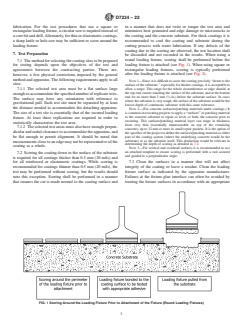
test location shall be discarded and not recorded in the results. When using a round loading fixture, scoring shall be performed
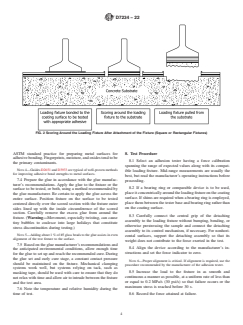
before the loading fixture is attached (see Fig. 1). When using square or rectangular loading fixtures, scoring is typically performed
after the loading fixture is attached (see Fig. 2).
NOTE 1—Since it is difficult to score the coating precisely “down to the surface of the substrate,” especially for thicker coatings, it is acceptable to allow
a range. This range for the whole circumference or edge should, at the top end, ensure touching the surface of the substrate, and at the bottom end, be
no more than 3 mm ( ⁄8 in.) below the substrate surface. In cases where the substrate is very rough, the surface of the substrate would be the lowest depth
of continuous substrate with this same tolerance.
NOTE 2—(For concrete surfacers/patching materials under coatings.) It is common in recoating projects to apply a “surfacer” or patching material to the
concrete substrate to repair or level, or both, the concrete prior to recoating. This surfacer/patching material layer can range in thickness from very thin
(essentially immeasurable on top of the remaining concrete), up to 12 mm or more in small repair pockets. It is the option of the specifier of the project
to define the surfacer/patching material as either part of the coating system (where the underlying concrete would be the substrate) or as the substrate
FIG. 1 Scoring Around the Loading Fixture Prior to Attachment of the Fixture (Round Loading Fixtures)
D7234 − 22
FIG. 2 Scoring Around the Loading Fixture After Attachment of the Fixture (Square or Rectangular Fixtures)
itself. This distinction would be relevant in determining the depth of scoring as detailed in 7.2.
NOTE 3—For vertical and overhead surfaces it is recommended to use an attached template to ensure scoring is performed with a tool secured and guided
in a perpendicular angle.
7.3 Clean the surfaces in a manner that will not affect integrity of the coating or leave a residue. Clean the loading fixture surface
as indicated by the apparatus manufacturer. Failures at the fixture-glue interface can often be avoided by treating the fixture
surfaces in accordance with an appropriate ASTM standard practice for preparing metal surfaces for adhesive bonding.
Fingerprints, moisture, and oxides tend to be the primary contaminants.
NOTE 4—Guides D2651 and D3933 are typical of well-proven methods for improving adhesive bond strengths to metal surfaces.
7.4 Prepare the glue in accordance with the glue manufacturer’s recommendations. Apply the glue to the fixture or the surface to
be tested, or both, using a method recommended by the glue manufacturer. Be certain to apply the glue across the entire surface.
Position fixture on the surface to be tested centered directly over the scored section with the fixture outer sides lined up with the
inside circumference of the scored section. Carefully remove the excess glue from around the fixture. (Warning—Movement,
especially twisting, can cause tiny bubbles to coalesce into large holidays that constitute stress discontinuities during testing.)
NOTE 5—Adding about 1 % of #5 glass beads to the glue assists in even alignment of the test fixture to the surface.
7.5 Based on the glue manufacturer’s recommendations and the anticipated environmental conditions, allow enough time for the
glue to set up and reach the recommended cure. During the glue set and early cure stage, a constant contact pressure should be
maintained on the fixture. Mechanical clamping systems work well, but systems relying on tack, such as masking tape, should be
used with care to ensure that they do not relax with time and allow air to intrude between the fixture and the test area.
7.6 Note the temperature and relative humidity during the time of test.
8. Test Procedure
8.1 Select an adhesion tester having a force calibration spanning the range of expected values along with its compatible loading
fixture. Mid-range measurements are usually the best, but read the manufacturer’s operating instructions before proceeding.
D7234 − 22
8.2 If a bearing ring or comparable device is to be used, place it concentrically around the loading fixture on the coating surface.
If shims are required when a bearing ring is employed, place them between the tester base and bearing ring rather than on the
coating surface.
8.3 Carefully connect the central grip of the detaching
...