

ASTM C1138M-19
(Test Method)Standard Test Method for Abrasion Resistance of Concrete (Underwater Method)
General Information
- Abstract
SIGNIFICANCE AND USE
4.1 This test method is intended to qualitatively simulate the behavior of swirling water containing suspended and transported solid objects that produce abrasion of concrete and cause potholes and related effects.
4.2 This test method should provide a relative evaluation of the resistance of concrete to such action.
4.3 The results are expected to be useful in selection of materials, mixtures, and construction practices for use where such action is to be expected.
4.4 The test method is not intended to provide a quantitative measurement of the length of service that may be expected from a specific concrete.
SCOPE
1.1 This test method covers a procedure for determining the relative resistance of concrete (including concrete overlays and impregnated concrete) to abrasion under water (see Note 1). This procedure simulates the abrasive action of waterborne particles (silt, sand, gravel, and other solids).
Note 1: Other procedures are available for measuring abrasion resistance of concrete surfaces not under water. These include Test Methods C418, C779/C779M, and C944/C944M.
1.2 The values stated in SI units are to be regarded as standard. No other units of measurement are included in this standard.
1.3 The text of this standard references notes and footnotes that provide explanatory material. These notes and footnotes (excluding those in tables and figures) shall not be considered as requirements of this standard.
1.4 This standard does not purport to address all of the safety concerns, if any, associated with its use. It is the responsibility of the user of this standard to establish appropriate safety, health, and environmental practices and determine the applicability of regulatory limitations prior to use. (Warning—Fresh hydraulic cementitious mixtures are caustic and may cause chemical burns to skin and tissue upon prolonged exposure.2)
1.5 This international standard was developed in accordance with internationally recognized principles on standardization established in the Decision on Principles for the Development of International Standards, Guides and Recommendations issued by the World Trade Organization Technical Barriers to Trade (TBT) Committee.
- Status
- Published
- Publication Date
- 30-Sep-2019
- Technical Committee
- C09 - Concrete and Concrete Aggregates
- Drafting Committee
- C09.62 - Abrasion Testing
Overview
ASTM C1138M-19, titled Standard Test Method for Abrasion Resistance of Concrete (Underwater Method), is a widely recognized international standard developed by ASTM International. This standard outlines a test method specifically designed to assess the relative abrasion resistance of concrete materials subjected to the erosive action of waterborne particles. Typical scenarios include concrete structures exposed to flowing water carrying abrasive solids such as silt, sand, and gravel. The purpose of this method is to provide a qualitative evaluation and comparative assessment of concrete's durability under simulated underwater wear conditions, supporting more informed selection of materials, mix designs, and construction practices in demanding environments.
Key Topics
- Simulated Underwater Abrasion: The method replicates the effects of swirling water with solid particles impacting the concrete, which is especially critical for infrastructure such as hydraulic structures, spillways, and marine installations.
- Relative Resistance Testing: Results yield a comparative measure of abrasion resistance, helping to rank different concretes or overlays in underwater conditions.
- Applicability: Suitable for a range of concrete types including overlays and impregnated surfaces, making it relevant for repair as well as new construction.
- Specimen Preparation & Testing: Involves specific requirements for specimen size, conditioning, and placement, as well as defined apparatus and procedures for agitation and abrasion measurement.
- Reporting and Evaluation: The method includes guidelines for documenting time versus abrasion loss, detailed specimen data, and assessment of precision between results.
- Safety Considerations: Cautions are provided for handling caustic cementitious materials and stress the user's responsibility for compliance with safety and environmental regulations.
Applications
This underwater abrasion resistance test method finds practical application in several areas:
- Design and Maintenance of Hydraulic Structures: Used extensively in the evaluation of concrete for dams, locks, spillways, and channels, where erosive water flow can shorten the service life of untested materials.
- Assessment of Repair Materials: Helps in the comparative selection of overlays and impregnated concrete for underwater repairs or rehabilitation projects.
- Quality Control of Marine and Waterfront Structures: Ensures that concrete used in piers, harbors, and jetties can withstand abrasion from suspended solids.
- Material and Mixture Selection: Guides engineers and specifiers in choosing appropriate aggregate types, mix proportions, and curing practices for enhanced durability.
- Research and Development: Supports comparative research in concrete technology, especially for new admixtures, fibers, or innovative cementitious products intended for submerged or abrasive environments.
While the test provides valuable comparative data, it is important to note that ASTM C1138M-19 does not offer a direct prediction of the expected service life of a concrete structure.
Related Standards
ASTM C1138M-19 references several other ASTM standards for complementary or alternative abrasion resistance testing:
- ASTM C418: Test Method for Abrasion Resistance of Concrete by Sandblasting - suitable for surfaces not under water.
- ASTM C779/C779M: Test Method for Abrasion Resistance of Horizontal Concrete Surfaces.
- ASTM C944/C944M: Test Method for Abrasion Resistance of Concrete or Mortar Surfaces by the Rotating-Cutter Method.
- ASTM C42/C42M: Method for Obtaining and Testing Drilled Cores and Sawed Beams of Concrete.
- ASTM C125: Terminology Relating to Concrete and Concrete Aggregates.
- ASTM C642: Test Method for Density, Absorption, and Voids in Hardened Concrete.
Practical Value
Adopting ASTM C1138M-19 provides a standardized, repeatable method for evaluating underwater abrasion resistance, supporting better material performance, longer-lasting structures, and cost-effective maintenance planning. Its use aligns with quality assurance protocols and internationally recognized best practices, making it an essential standard for projects involving concrete exposed to abrasive underwater environments.
Keywords: abrasion resistance, concrete, underwater testing, ASTM C1138M-19, hydraulic structures, durability, erosion, construction materials standards
Relations
- Replaces
ASTM C1138M-12 - Standard Test Method for Abrasion Resistance of Concrete (Underwater Method) - Effective Date
- 01-Oct-2019
- Effective Date
- 01-Feb-2024
- Effective Date
- 01-Jan-2024
- Effective Date
- 15-Dec-2019
- Refers
ASTM C779/C779M-19 - Standard Test Method for Abrasion Resistance of Horizontal Concrete Surfaces - Effective Date
- 01-Oct-2019
- Effective Date
- 01-Jan-2019
- Effective Date
- 01-Oct-2018
- Effective Date
- 01-Jul-2018
- Effective Date
- 01-Jul-2018
- Effective Date
- 15-Mar-2018
- Effective Date
- 01-Jan-2018
- Effective Date
- 01-Jul-2017
- Effective Date
- 15-Dec-2016
- Effective Date
- 01-Oct-2016
- Effective Date
- 15-Dec-2015
Get Certified
Connect with accredited certification bodies for this standard

DIBt (Deutsches Institut für Bautechnik)
German Institute for Building Technology.
DIN CERTCO
DIN Group product certification.

Aboma Certification B.V.
Specialized in construction, metal, and transport sectors.
Sponsored listings
Frequently Asked Questions
ASTM C1138M-19 is a standard published by ASTM International. Its full title is "Standard Test Method for Abrasion Resistance of Concrete (Underwater Method)". This standard covers: SIGNIFICANCE AND USE 4.1 This test method is intended to qualitatively simulate the behavior of swirling water containing suspended and transported solid objects that produce abrasion of concrete and cause potholes and related effects. 4.2 This test method should provide a relative evaluation of the resistance of concrete to such action. 4.3 The results are expected to be useful in selection of materials, mixtures, and construction practices for use where such action is to be expected. 4.4 The test method is not intended to provide a quantitative measurement of the length of service that may be expected from a specific concrete. SCOPE 1.1 This test method covers a procedure for determining the relative resistance of concrete (including concrete overlays and impregnated concrete) to abrasion under water (see Note 1). This procedure simulates the abrasive action of waterborne particles (silt, sand, gravel, and other solids). Note 1: Other procedures are available for measuring abrasion resistance of concrete surfaces not under water. These include Test Methods C418, C779/C779M, and C944/C944M. 1.2 The values stated in SI units are to be regarded as standard. No other units of measurement are included in this standard. 1.3 The text of this standard references notes and footnotes that provide explanatory material. These notes and footnotes (excluding those in tables and figures) shall not be considered as requirements of this standard. 1.4 This standard does not purport to address all of the safety concerns, if any, associated with its use. It is the responsibility of the user of this standard to establish appropriate safety, health, and environmental practices and determine the applicability of regulatory limitations prior to use. (Warning—Fresh hydraulic cementitious mixtures are caustic and may cause chemical burns to skin and tissue upon prolonged exposure.2) 1.5 This international standard was developed in accordance with internationally recognized principles on standardization established in the Decision on Principles for the Development of International Standards, Guides and Recommendations issued by the World Trade Organization Technical Barriers to Trade (TBT) Committee.
SIGNIFICANCE AND USE 4.1 This test method is intended to qualitatively simulate the behavior of swirling water containing suspended and transported solid objects that produce abrasion of concrete and cause potholes and related effects. 4.2 This test method should provide a relative evaluation of the resistance of concrete to such action. 4.3 The results are expected to be useful in selection of materials, mixtures, and construction practices for use where such action is to be expected. 4.4 The test method is not intended to provide a quantitative measurement of the length of service that may be expected from a specific concrete. SCOPE 1.1 This test method covers a procedure for determining the relative resistance of concrete (including concrete overlays and impregnated concrete) to abrasion under water (see Note 1). This procedure simulates the abrasive action of waterborne particles (silt, sand, gravel, and other solids). Note 1: Other procedures are available for measuring abrasion resistance of concrete surfaces not under water. These include Test Methods C418, C779/C779M, and C944/C944M. 1.2 The values stated in SI units are to be regarded as standard. No other units of measurement are included in this standard. 1.3 The text of this standard references notes and footnotes that provide explanatory material. These notes and footnotes (excluding those in tables and figures) shall not be considered as requirements of this standard. 1.4 This standard does not purport to address all of the safety concerns, if any, associated with its use. It is the responsibility of the user of this standard to establish appropriate safety, health, and environmental practices and determine the applicability of regulatory limitations prior to use. (Warning—Fresh hydraulic cementitious mixtures are caustic and may cause chemical burns to skin and tissue upon prolonged exposure.2) 1.5 This international standard was developed in accordance with internationally recognized principles on standardization established in the Decision on Principles for the Development of International Standards, Guides and Recommendations issued by the World Trade Organization Technical Barriers to Trade (TBT) Committee.
ASTM C1138M-19 is classified under the following ICS (International Classification for Standards) categories: 91.080.40 - Concrete structures. The ICS classification helps identify the subject area and facilitates finding related standards.
ASTM C1138M-19 has the following relationships with other standards: It is inter standard links to ASTM C1138M-12, ASTM C670-24a, ASTM C670-24, ASTM C125-19a, ASTM C779/C779M-19, ASTM C125-19, ASTM C125-18b, ASTM E18-18, ASTM C125-18a, ASTM C42/C42M-18, ASTM C125-18, ASTM E18-17, ASTM C125-16, ASTM C42/C42M-16, ASTM C125-15b. Understanding these relationships helps ensure you are using the most current and applicable version of the standard.
ASTM C1138M-19 is available in PDF format for immediate download after purchase. The document can be added to your cart and obtained through the secure checkout process. Digital delivery ensures instant access to the complete standard document.
Standards Content (Sample)
This international standard was developed in accordance with internationally recognized principles on standardization established in the Decision on Principles for the
Development of International Standards, Guides and Recommendations issued by the World Trade Organization Technical Barriers to Trade (TBT) Committee.
Designation: C1138M − 19
Standard Test Method for
Abrasion Resistance of Concrete (Underwater Method)
This standard is issued under the fixed designation C1138M; the number immediately following the designation indicates the year of
original adoption or, in the case of revision, the year of last revision. A number in parentheses indicates the year of last reapproval. A
superscript epsilon (´) indicates an editorial change since the last revision or reapproval.
1. Scope* 2. Referenced Documents
1.1 This test method covers a procedure for determining the 2.1 ASTM Standards:
C42/C42M Test Method for Obtaining and Testing Drilled
relative resistance of concrete (including concrete overlays and
impregnated concrete) to abrasion under water (see Note 1). Cores and Sawed Beams of Concrete
C125 Terminology Relating to Concrete and Concrete Ag-
This procedure simulates the abrasive action of waterborne
particles (silt, sand, gravel, and other solids). gregates
C418 Test Method for Abrasion Resistance of Concrete by
NOTE 1—Other procedures are available for measuring abrasion resis-
Sandblasting
tance of concrete surfaces not under water. These include Test Methods
C642 Test Method for Density, Absorption, and Voids in
C418, C779/C779M, and C944/C944M.
Hardened Concrete
1.2 The values stated in SI units are to be regarded as
C670 Practice for Preparing Precision and Bias Statements
standard. No other units of measurement are included in this
for Test Methods for Construction Materials
standard.
C779/C779M Test Method forAbrasion Resistance of Hori-
zontal Concrete Surfaces
1.3 The text of this standard references notes and footnotes
C944/C944M Test Method for Abrasion Resistance of Con-
that provide explanatory material. These notes and footnotes
crete or Mortar Surfaces by the Rotating-Cutter Method
(excluding those in tables and figures) shall not be considered
E18 Test Methods for Rockwell Hardness of Metallic Ma-
as requirements of this standard.
terials
1.4 This standard does not purport to address all of the
safety concerns, if any, associated with its use. It is the
3. Terminology
responsibility of the user of this standard to establish appro-
3.1 For definitions of terms used in this standard, refer to
priate safety, health, and environmental practices and deter-
Terminology C125.
mine the applicability of regulatory limitations prior to use.
(Warning—Fresh hydraulic cementitious mixtures are caustic
4. Significance and Use
and may cause chemical burns to skin and tissue upon
prolonged exposure. )
4.1 Thistestmethodisintendedtoqualitativelysimulatethe
1.5 This international standard was developed in accor-
behavior of swirling water containing suspended and trans-
dance with internationally recognized principles on standard-
ported solid objects that produce abrasion of concrete and
ization established in the Decision on Principles for the
cause potholes and related effects.
Development of International Standards, Guides and Recom-
4.2 This test method should provide a relative evaluation of
mendations issued by the World Trade Organization Technical
the resistance of concrete to such action.
Barriers to Trade (TBT) Committee.
4.3 The results are expected to be useful in selection of
materials, mixtures, and construction practices for use where
1 such action is to be expected.
This test method is under the jurisdiction of ASTM Committee C09 on
Concrete and ConcreteAggregates and is the direct responsibility of Subcommittee
C09.62 on Abrasion Testing.
Current edition approved Oct. 1, 2019. Published November 2019. Originally
approved in 1989. Last previous edition approved in 2012 as C1138M–12. DOI: For referenced ASTM standards, visit the ASTM website, www.astm.org, or
10.1520/C1138M-19. contact ASTM Customer Service at service@astm.org. For Annual Book of ASTM
Section on Safety Precautions, Manual of Aggregate and Concrete Testing, Standards volume information, refer to the standard’s Document Summary page on
Annual Book of ASTM Standards, Vol 04.02. the ASTM website.
*A Summary of Changes section appears at the end of this standard
Copyright © ASTM International, 100 Barr Harbor Drive, PO Box C700, West Conshohocken, PA 19428-2959. United States
C1138M − 19
4.4 The test method is not intended to provide a quantitative 5.5 Scales—Aplatformscalehavingacapacityofatleast45
measurement of the length of service that may be expected kg (100 lb) or more and accurate to within at least 5.0 g (0.01
from a specific concrete. lb) at any point within the range used in this test shall be used.
The scale shall be equipped with a suitable apparatus for
5. Apparatus
suspending the sample in its container in water from the center
of the weighing platform.
5.1 Rotating Device—A drill press or similar device with a
chuck capable of holding and rotating the agitation paddle
5.6 Weighing Basket—A wire basket or other suitable sup-
under test conditions at a speed of 1200 6 100 rpm shall be
port shall be provided for weighing the specimen in water. The
used.
weighing basket shall be constructed to prevent entrapping air
when it and the specimen are submerged.
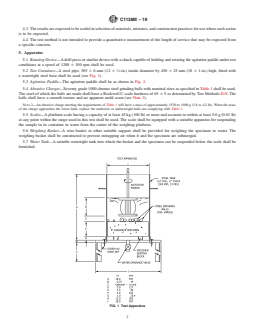
5.2 TestContainer—Asteelpipe,305 66-mm(12 6 ⁄4-in.)
inside diameter by 450 6 25-mm (18 6 1-in.) high, fitted with
5.7 Water Tank—A suitable watertight tank into which the
a watertight steel base shall be used (see Fig. 1).
basket and the specimen can be suspended below the scale
5.3 Agitation Paddle—The agitation paddle shall be as
shall be furnished.
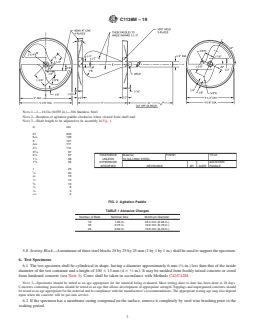
shown in Fig. 2.
5.8 Seating Block—A minimum of three steel blocks 25 by
5.4 Abrasive Charges—Seventy grade 1000 chrome steel
25 by 25 mm (1 by 1 by 1 in.) shall be used to support the
grinding balls with nominal sizes as specified in Table 1 shall
specimen.
be used. The steel of which the balls are made shall have a
Rockwell C-scale hardness of 65 6 5 as determined by Test
6. Test Specimens
Methods E18. The balls shall have a smooth texture and no
6.1 The test specimen shall be cylindrical in shape, having
apparent mold seam (see Note 2).
a diameter approximately 6-mm ( ⁄4-in.) less than that of the
NOTE 2—An abrasive charge meeting the requirements of Table 1 will
inside diameter of the test container and a height of 100 6 13
have a mass of approximately 1530 to 1900 g (3.8 to 4.2 lb). When the
mm (4 6 ⁄2 in.). It may be molded from freshly mixed
mass of the charge approaches the lower limit, replace the undersize or
concrete or cored from hardened concrete (see Note 3). Cores
underweight balls not complying with Table 1.
shall be taken in accordance with Methods C42/C42M.
NOTE 3—Specimens should be tested at an age appropriate for the
material being evaluated. Most testing done to date has been done at 28
days. Concretes containing pozzolans should be tested at an age that
allows development of appropriate strength. Toppings and impregnated
concretes should be tested at an age appropriate for the material and in
compliance with the manufacturer’s recommendations. The appropriate
testing age may also depend upon when the concrete will be put into
service.
6.2 If the specimen has a membrane curing compound on
the surface, remove it completely by steel wire brushing prior
to the soaking period.
6.3 Soak the specimen in lime-saturated water or in the
water to which the concrete shall be subjected in service for a
minimum of 48 h prior to testing.
6.4 Determine the average diameter of the top surface of the
specimen to be tested to the nearest 2 mm ( ⁄16 in.) by
averagingtwodiametersmeasuredatrightanglestoeachother
...
This document is not an ASTM standard and is intended only to provide the user of an ASTM standard an indication of what changes have been made to the previous version. Because
it may not be technically possible to adequately depict all changes accurately, ASTM recommends that users consult prior editions as appropriate. In all cases only the current version
of the standard as published by ASTM is to be considered the official document.
Designation: C1138M − 12 C1138M − 19
Standard Test Method for
Abrasion Resistance of Concrete (Underwater Method)
This standard is issued under the fixed designation C1138M; the number immediately following the designation indicates the year of
original adoption or, in the case of revision, the year of last revision. A number in parentheses indicates the year of last reapproval. A
superscript epsilon (´) indicates an editorial change since the last revision or reapproval.
1. Scope*
1.1 This test method covers a procedure for determining the relative resistance of concrete (including concrete overlays and
impregnated concrete) to abrasion under water (see Note 1). This procedure simulates the abrasive action of waterborne particles
(silt, sand, gravel, and other solids).
NOTE 1—Other procedures are available for measuring abrasion resistance of concrete surfaces not under water. These include Test Methods C418,
C779/C779M, and C944C944/C944M.
1.2 The values stated in SI units are to be regarded as standard. No other units of measurement are included in this standard.
1.3 The text of this standard references notes and footnotes that provide explanatory material. These notes and footnotes
(excluding those in tables and figures) shall not be considered as requirements of this standard.
1.4 This standard does not purport to address all of the safety concerns, if any, associated with its use. It is the responsibility
of the user of this standard to establish appropriate safety safety, health, and healthenvironmental practices and determine the
applicability of regulatory limitations prior to use. (Warning—Fresh hydraulic cementitious mixtures are caustic and may cause
chemical burns to skin and tissue upon prolonged exposure. )
1.5 This international standard was developed in accordance with internationally recognized principles on standardization
established in the Decision on Principles for the Development of International Standards, Guides and Recommendations issued
by the World Trade Organization Technical Barriers to Trade (TBT) Committee.
2. Referenced Documents
2.1 ASTM Standards:
C42/C42M Test Method for Obtaining and Testing Drilled Cores and Sawed Beams of Concrete
C125 Terminology Relating to Concrete and Concrete Aggregates
C418 Test Method for Abrasion Resistance of Concrete by Sandblasting
C642 Test Method for Density, Absorption, and Voids in Hardened Concrete
C670 Practice for Preparing Precision and Bias Statements for Test Methods for Construction Materials
C779/C779M Test Method for Abrasion Resistance of Horizontal Concrete Surfaces
C944C944/C944M Test Method for Abrasion Resistance of Concrete or Mortar Surfaces by the Rotating-Cutter Method
E18 Test Methods for Rockwell Hardness of Metallic Materials
3. Terminology
3.1 For definitions of terms used in this standard, refer to Terminology C125.
4. Significance and Use
4.1 This test method is intended to qualitatively simulate the behavior of swirling water containing suspended and transported
solid objects that produce abrasion of concrete and cause potholes and related effects.
4.2 This test method should provide a relative evaluation of the resistance of concrete to such action.
This test method is under the jurisdiction of ASTM Committee C09 on Concrete and Concrete Aggregates and is the direct responsibility of Subcommittee C09.62 on
Abrasion Testing.
Current edition approved Dec. 1, 2012Oct. 1, 2019. Published January 2013November 2019. Originally approved in 1989. Last previous edition approved in 20102012
ε1
as C1138M – 05 (2010)C1138M .–12. DOI: 10.1520/C1138M-12.10.1520/C1138M-19.
Section on Safety Precautions, Manual of Aggregate and Concrete Testing,Annual Book of ASTM Standards, Vol 04.02.
For referenced ASTM standards, visit the ASTM website, www.astm.org, or contact ASTM Customer Service at service@astm.org. For Annual Book of ASTM Standards
volume information, refer to the standard’s Document Summary page on the ASTM website.
*A Summary of Changes section appears at the end of this standard
Copyright © ASTM International, 100 Barr Harbor Drive, PO Box C700, West Conshohocken, PA 19428-2959. United States
C1138M − 19
4.3 The results are expected to be useful in selection of materials, mixtures, and construction practices for use where such action
is to be expected.
4.4 The test method is not intended to provide a quantitative measurement of the length of service that may be expected from
a specific concrete.
5. Apparatus
5.1 Rotating Device—A drill press or similar device with a chuck capable of holding and rotating the agitation paddle under test
conditions at a speed of 1200 6 100 rpm shall be used.
5.2 Test Container—A steel pipe, 305 6 6-mm (12 6 ⁄4-in.) inside diameter by 450 6 25-mm (18 6 1-in.) high, fitted with
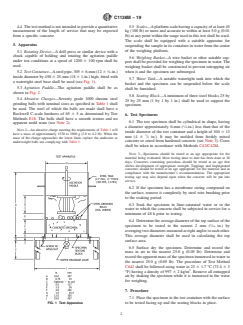
a watertight steel base shall be used (see Fig. 1).
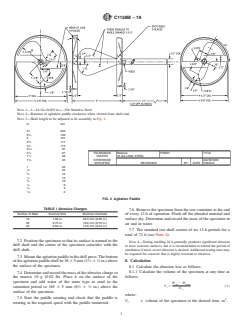
5.3 Agitation Paddle—The agitation paddle shall be as shown in Fig. 2.
5.4 Abrasive Charges—Seventy grade 1000 chrome steel grinding balls with nominal sizes as specified in Table 1 shall be used.
The steel of which the balls are made shall have a Rockwell C-scale hardness of 65 6 5 as determined by Test Methods E18. The
balls shall have a smooth texture and no apparent mold seam (see Note 2).
NOTE 2—An abrasive charge meeting the requirements of Table 1 will have a mass of approximately 1530 to 1900 g (3.8 to 4.2 lb). When the mass
of the charge approaches the lower limit, replace the undersize or underweight balls not complying with Table 1.
5.5 Scales—A platform scale having a capacity of at least 45 kg (100 lb) or more and accurate to within at least 5.0 g (0.01 lb)
at any point within the range used in this test shall be used. The scale shall be equipped with a suitable apparatus for suspending
the sample in its container in water from the center of the weighing platform.
5.6 Weighing Basket—A wire basket or other suitable support shall be provided for weighing the specimen in water. The
weighing basket shall be constructed to prevent entrapping air when it and the specimen are submerged.
5.7 Water Tank—A suitable watertight tank into which the basket and the specimen can be suspended below the scale shall be
furnished.
FIG. 1 Test Apparatus
C1138M − 19
NOTE 1—1—16 Ga (0.059 in.)—304 Stainless Steel
NOTE 2—Rotation of agitation paddle clockwise when viewed from shaft end.
NOTE 3—Shaft length to be adjusted to fit assembly in Fig. 1.
in. mm
21 533
5 ⁄8 130
5 127
4 ⁄8 117
4 ⁄2 114
3 ⁄16 97
2 ⁄4 57 TOLERANCE Material FINISH TITLE
1 ⁄2 38 UNLESS 16 GA.(.059) STEEL
1 ⁄8 35 OTHERWISE AGITATION
SPECIFIED REVISIONS BY DATE PADDLE
1 25
⁄8 22
⁄8 16
⁄2 13
⁄8 10
⁄4 6
⁄8 3
⁄16 2
FIG. 2 Agitation Paddle
TABLE 1 Abrasive Charges
Number of Balls Nominal Size Minimum Diameter
10 1.00 in. 25.3 mm (0.95 in.)
35 0.75 in. 19.0 mm (0.70 in.)
25 0.50 in. 12.6 mm (0.45 in.)
5.8 Seating Block—A minimum of three steel blocks 25 by 25 by 25 mm (1 by 1 by 1 in.) shall be used to support the specimen.
6. Test Specimens
6.1 The test specimen shall be cylindrical in shape, having a diameter approximately 6-mm ( ⁄4-in.) less than that of the inside
diameter of the test container and a height of 100 6 13 mm (4 6 ⁄2 in.). It may be molded from freshly mixed concrete or cored
from hardened concrete (see Note 3). Cores shall be taken in accordance with Methods C42/C42M.
NOTE 3—Specimens should be tested at an age appropriate for the material being evaluated. Most testing done to date has been done at 28 days.
Concretes containing pozzolans should be tested at an age that allows development of appropriate strength. Toppings and impregnated concretes should
be tested
...