

ASTM C779/C779M-19
(Test Method)Standard Test Method for Abrasion Resistance of Horizontal Concrete Surfaces
General Information
- Abstract
SIGNIFICANCE AND USE
4.1 The three test methods provide simulated abrasion conditions, which can be used to evaluate the effects on abrasion resistance of concrete, concrete materials, and curing or finishing procedures. They may also be used for quality acceptance of products and surface exposed to wear. They are not intended to provide a quantitative measurement of length of service.
4.2 The equipment used by each of these procedures is portable and thus suitable for either laboratory or field testing. The three procedures determine the relative wear of concrete surfaces as follows:
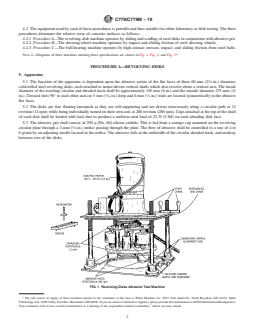
4.2.1 Procedure A—The revolving-disk machine operates by sliding and scuffing of steel disks in conjunction with abrasive grit.
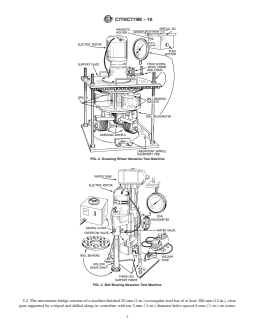
4.2.2 Procedure B—The dressing-wheel machine operates by impact and sliding friction of steel dressing wheels.
4.2.3 Procedure C—The ball-bearing machine operates by high-contact stresses, impact, and sliding friction from steel balls.
Note 2: Diagrams of three machines meeting these specifications are shown in Fig. 1, Fig. 2, and Fig. 3.4
FIG. 1 Revolving Disks Abrasion Test Machine
FIG. 2 Dressing Wheel Abrasion Test Machine
FIG. 3 Ball Bearing Abrasion Test Machine
SCOPE
1.1 This test method covers three procedures for determining the relative abrasion resistance of horizontal concrete surfaces. The procedures differ in the type and degree of abrasive force they impart, and are intended for use in determining variations in surface properties of concrete affected by mixture proportions, finishing, and surface treatment. They are not intended to provide a quantitative measurement of the length of service that may be expected from a specific surface.
1.2 The values stated in either SI units or inch-pound units are to be regarded separately as standard. Within the text, the inch-pound units are shown in brackets. The values stated in each system may not be exact equivalents; therefore, each system shall be used independently of each other.
1.3 The text of this standard references notes and footnotes that provide explanatory material. These notes and footnotes (excluding those in tables and figures) shall not be considered as requirements of this standard.
1.4 This standard does not purport to address all of the safety concerns, if any, associated with its use. It is the responsibility of the user of this standard to establish appropriate safety, health, and environmental practices and determine the applicability of regulatory limitations prior to use. (Warning—Fresh hydraulic cementitious mixtures are caustic and may cause chemical burns to skin and tissue upon prolonged exposure.2)
Note 1: Other procedures are available for measuring the abrasion resistance of concrete surfaces in addition to the three procedures contained in this test method. Consideration should be given to Test Methods C944/C944M and C418. The test method most closely representing service conditions should be used.
1.5 This international standard was developed in accordance with internationally recognized principles on standardization established in the Decision on Principles for the Development of International Standards, Guides and Recommendations issued by the World Trade Organization Technical Barriers to Trade (TBT) Committee.
- Status
- Published
- Publication Date
- 30-Sep-2019
- Technical Committee
- C09 - Concrete and Concrete Aggregates
- Drafting Committee
- C09.62 - Abrasion Testing
Buy Documents
ASTM C779/C779M-19 - Standard Test Method for Abrasion Resistance of Horizontal Concrete Surfaces
REDLINE ASTM C779/C779M-19 - Standard Test Method for Abrasion Resistance of Horizontal Concrete Surfaces
Overview
ASTM C779/C779M-19, Standard Test Method for Abrasion Resistance of Horizontal Concrete Surfaces, published by ASTM International, specifies standardized procedures to assess the abrasion resistance of horizontal concrete surfaces. Designed for both laboratory and on-site evaluation, the standard describes three different test methods, each simulating distinct abrasive conditions. These methods enable the comparison of concrete materials, finishing, and curing treatments with a focus on durability under wear, rather than service life estimation.
The standard is widely referenced in construction, quality control, and research settings to evaluate the resistance to surface wear in concrete floors, pavements, and other flatwork subject to abrasion from foot traffic, vehicles, or machinery.
Key Topics
Main Elements of ASTM C779/C779M-19:
Three Test Procedures:
- Procedure A (Revolving Disk): Uses sliding and scuffing of steel disks with abrasive grit to simulate wear.
- Procedure B (Dressing Wheel): Employs impact and sliding friction from steel dressing wheels.
- Procedure C (Ball Bearing): Applies high-contact stresses, impact, and sliding friction via steel balls.
Portability:
The apparatus used in these test methods is designed to be portable, suitable for field or laboratory testing.Comparative Abrasion Resistance:
Each method determines the relative abrasion resistance, allowing for comparison across different concrete mixes, surface treatments, or construction techniques.Test Specimens:
Guidance is provided on specimen dimensions and preparations to ensure consistent, reliable results.Reporting Requirements:
Records must include concrete mixture details, type and extent of finishing and curing, aggregate properties, and test conditions.Safety and Health Considerations:
Users are responsible for establishing and following safe procedures, especially since fresh cementitious mixtures can be caustic.
Applications
Practical Uses for ASTM C779/C779M-19:
Quality Control:
Used by contractors and concrete producers to verify abrasion resistance of concrete floors, sidewalks, industrial slabs, driveways, and warehouse spaces.Specification Compliance:
Helps ensure materials and finishing procedures meet owner, architect, or engineer requirements for surface durability.Material Evaluation:
Assists in research and development of new concrete mixes, surface treatments, or curing techniques to improve abrasion performance.Comparative Analysis:
Enables side-by-side evaluation of different concrete surfaces or products to select the most suitable for high-traffic or high-wear settings.Forensic Analysis:
Can aid in diagnosing surface wear issues or premature deterioration in existing concrete installations.
Related Standards
Other relevant ASTM and industry standards include:
ASTM C944/C944M: Test Method for Abrasion Resistance of Concrete or Mortar Surfaces by the Rotating-Cutter Method
(An alternative method for abrasion testing referenced in ASTM C779/C779M)ASTM C418: Test Method for Abrasion Resistance of Concrete by Sandblasting
(Another standardized approach for evaluating abrasion resistance)ASTM C125: Terminology Relating to Concrete and Concrete Aggregates
(Contains definitions of terms used in this standard)ASTM C670: Practice for Preparing Precision and Bias Statements for Test Methods for Construction Materials
Summary
ASTM C779/C779M-19 provides a comprehensive framework for evaluating the abrasion resistance of horizontal concrete surfaces. Through its three distinct test procedures, the standard supports quality acceptance, material development, and performance verification across a range of concrete applications. Adhering to this standard enhances the durability, longevity, and performance of concrete exposed to abrasive forces, making it essential for infrastructure and flooring projects requiring robust surface wear characteristics.
Relations
- Replaces
ASTM C779/C779M-12 - Standard Test Method for Abrasion Resistance of Horizontal Concrete Surfaces - Effective Date
- 01-Oct-2019
- Effective Date
- 01-Feb-2024
- Effective Date
- 01-Jan-2024
- Effective Date
- 15-Dec-2019
- Effective Date
- 01-Jan-2019
- Effective Date
- 01-Oct-2018
- Effective Date
- 01-Jul-2018
- Effective Date
- 01-Jan-2018
- Effective Date
- 15-Dec-2016
- Effective Date
- 15-Dec-2015
- Effective Date
- 01-Jul-2015
- Effective Date
- 01-Feb-2015
- Effective Date
- 01-Aug-2014
- Effective Date
- 15-Dec-2013
- Effective Date
- 01-Aug-2013
Buy Documents
ASTM C779/C779M-19 - Standard Test Method for Abrasion Resistance of Horizontal Concrete Surfaces
REDLINE ASTM C779/C779M-19 - Standard Test Method for Abrasion Resistance of Horizontal Concrete Surfaces
Get Certified
Connect with accredited certification bodies for this standard

DIBt (Deutsches Institut für Bautechnik)
German Institute for Building Technology.
DIN CERTCO
DIN Group product certification.

Aboma Certification B.V.
Specialized in construction, metal, and transport sectors.
Sponsored listings
Frequently Asked Questions
ASTM C779/C779M-19 is a standard published by ASTM International. Its full title is "Standard Test Method for Abrasion Resistance of Horizontal Concrete Surfaces". This standard covers: SIGNIFICANCE AND USE 4.1 The three test methods provide simulated abrasion conditions, which can be used to evaluate the effects on abrasion resistance of concrete, concrete materials, and curing or finishing procedures. They may also be used for quality acceptance of products and surface exposed to wear. They are not intended to provide a quantitative measurement of length of service. 4.2 The equipment used by each of these procedures is portable and thus suitable for either laboratory or field testing. The three procedures determine the relative wear of concrete surfaces as follows: 4.2.1 Procedure A—The revolving-disk machine operates by sliding and scuffing of steel disks in conjunction with abrasive grit. 4.2.2 Procedure B—The dressing-wheel machine operates by impact and sliding friction of steel dressing wheels. 4.2.3 Procedure C—The ball-bearing machine operates by high-contact stresses, impact, and sliding friction from steel balls. Note 2: Diagrams of three machines meeting these specifications are shown in Fig. 1, Fig. 2, and Fig. 3.4 FIG. 1 Revolving Disks Abrasion Test Machine FIG. 2 Dressing Wheel Abrasion Test Machine FIG. 3 Ball Bearing Abrasion Test Machine SCOPE 1.1 This test method covers three procedures for determining the relative abrasion resistance of horizontal concrete surfaces. The procedures differ in the type and degree of abrasive force they impart, and are intended for use in determining variations in surface properties of concrete affected by mixture proportions, finishing, and surface treatment. They are not intended to provide a quantitative measurement of the length of service that may be expected from a specific surface. 1.2 The values stated in either SI units or inch-pound units are to be regarded separately as standard. Within the text, the inch-pound units are shown in brackets. The values stated in each system may not be exact equivalents; therefore, each system shall be used independently of each other. 1.3 The text of this standard references notes and footnotes that provide explanatory material. These notes and footnotes (excluding those in tables and figures) shall not be considered as requirements of this standard. 1.4 This standard does not purport to address all of the safety concerns, if any, associated with its use. It is the responsibility of the user of this standard to establish appropriate safety, health, and environmental practices and determine the applicability of regulatory limitations prior to use. (Warning—Fresh hydraulic cementitious mixtures are caustic and may cause chemical burns to skin and tissue upon prolonged exposure.2) Note 1: Other procedures are available for measuring the abrasion resistance of concrete surfaces in addition to the three procedures contained in this test method. Consideration should be given to Test Methods C944/C944M and C418. The test method most closely representing service conditions should be used. 1.5 This international standard was developed in accordance with internationally recognized principles on standardization established in the Decision on Principles for the Development of International Standards, Guides and Recommendations issued by the World Trade Organization Technical Barriers to Trade (TBT) Committee.
SIGNIFICANCE AND USE 4.1 The three test methods provide simulated abrasion conditions, which can be used to evaluate the effects on abrasion resistance of concrete, concrete materials, and curing or finishing procedures. They may also be used for quality acceptance of products and surface exposed to wear. They are not intended to provide a quantitative measurement of length of service. 4.2 The equipment used by each of these procedures is portable and thus suitable for either laboratory or field testing. The three procedures determine the relative wear of concrete surfaces as follows: 4.2.1 Procedure A—The revolving-disk machine operates by sliding and scuffing of steel disks in conjunction with abrasive grit. 4.2.2 Procedure B—The dressing-wheel machine operates by impact and sliding friction of steel dressing wheels. 4.2.3 Procedure C—The ball-bearing machine operates by high-contact stresses, impact, and sliding friction from steel balls. Note 2: Diagrams of three machines meeting these specifications are shown in Fig. 1, Fig. 2, and Fig. 3.4 FIG. 1 Revolving Disks Abrasion Test Machine FIG. 2 Dressing Wheel Abrasion Test Machine FIG. 3 Ball Bearing Abrasion Test Machine SCOPE 1.1 This test method covers three procedures for determining the relative abrasion resistance of horizontal concrete surfaces. The procedures differ in the type and degree of abrasive force they impart, and are intended for use in determining variations in surface properties of concrete affected by mixture proportions, finishing, and surface treatment. They are not intended to provide a quantitative measurement of the length of service that may be expected from a specific surface. 1.2 The values stated in either SI units or inch-pound units are to be regarded separately as standard. Within the text, the inch-pound units are shown in brackets. The values stated in each system may not be exact equivalents; therefore, each system shall be used independently of each other. 1.3 The text of this standard references notes and footnotes that provide explanatory material. These notes and footnotes (excluding those in tables and figures) shall not be considered as requirements of this standard. 1.4 This standard does not purport to address all of the safety concerns, if any, associated with its use. It is the responsibility of the user of this standard to establish appropriate safety, health, and environmental practices and determine the applicability of regulatory limitations prior to use. (Warning—Fresh hydraulic cementitious mixtures are caustic and may cause chemical burns to skin and tissue upon prolonged exposure.2) Note 1: Other procedures are available for measuring the abrasion resistance of concrete surfaces in addition to the three procedures contained in this test method. Consideration should be given to Test Methods C944/C944M and C418. The test method most closely representing service conditions should be used. 1.5 This international standard was developed in accordance with internationally recognized principles on standardization established in the Decision on Principles for the Development of International Standards, Guides and Recommendations issued by the World Trade Organization Technical Barriers to Trade (TBT) Committee.
ASTM C779/C779M-19 is classified under the following ICS (International Classification for Standards) categories: 91.100.30 - Concrete and concrete products. The ICS classification helps identify the subject area and facilitates finding related standards.
ASTM C779/C779M-19 has the following relationships with other standards: It is inter standard links to ASTM C779/C779M-12, ASTM C670-24a, ASTM C670-24, ASTM C125-19a, ASTM C125-19, ASTM C125-18b, ASTM C125-18a, ASTM C125-18, ASTM C125-16, ASTM C125-15b, ASTM C125-15a, ASTM C125-15, ASTM C125-14, ASTM C125-13b, ASTM C125-13a. Understanding these relationships helps ensure you are using the most current and applicable version of the standard.
ASTM C779/C779M-19 is available in PDF format for immediate download after purchase. The document can be added to your cart and obtained through the secure checkout process. Digital delivery ensures instant access to the complete standard document.
Standards Content (Sample)
This international standard was developed in accordance with internationally recognized principles on standardization established in the Decision on Principles for the
Development of International Standards, Guides and Recommendations issued by the World Trade Organization Technical Barriers to Trade (TBT) Committee.
Designation: C779/C779M − 19
Standard Test Method for
Abrasion Resistance of Horizontal Concrete Surfaces
This standard is issued under the fixed designation C779/C779M; the number immediately following the designation indicates the year
of original adoption or, in the case of revision, the year of last revision. A number in parentheses indicates the year of last reapproval.
A superscript epsilon (´) indicates an editorial change since the last revision or reapproval.
1. Scope* Development of International Standards, Guides and Recom-
mendations issued by the World Trade Organization Technical
1.1 This test method covers three procedures for determin-
Barriers to Trade (TBT) Committee.
ing the relative abrasion resistance of horizontal concrete
surfaces. The procedures differ in the type and degree of
2. Referenced Documents
abrasive force they impart, and are intended for use in
2.1 ASTM Standards:
determining variations in surface properties of concrete af-
C125 Terminology Relating to Concrete and Concrete Ag-
fected by mixture proportions, finishing, and surface treatment.
gregates
Theyarenotintendedtoprovideaquantitativemeasurementof
C418 Test Method for Abrasion Resistance of Concrete by
the length of service that may be expected from a specific
Sandblasting
surface.
C670 Practice for Preparing Precision and Bias Statements
1.2 The values stated in either SI units or inch-pound units
for Test Methods for Construction Materials
are to be regarded separately as standard. Within the text, the
C944/C944M Test Method for Abrasion Resistance of Con-
inch-pound units are shown in brackets. The values stated in
crete or Mortar Surfaces by the Rotating-Cutter Method
each system may not be exact equivalents; therefore, each
system shall be used independently of each other.
3. Terminology
1.3 The text of this standard references notes and footnotes
3.1 For definitions of terms used in this standard, refer to
that provide explanatory material. These notes and footnotes
Terminology C125.
(excluding those in tables and figures) shall not be considered
4. Significance and Use
as requirements of this standard.
4.1 The three test methods provide simulated abrasion
1.4 This standard does not purport to address all of the
conditions, which can be used to evaluate the effects on
safety concerns, if any, associated with its use. It is the
abrasion resistance of concrete, concrete materials, and curing
responsibility of the user of this standard to establish appro-
or finishing procedures. They may also be used for quality
priate safety, health, and environmental practices and deter-
acceptance of products and surface exposed to wear. They are
mine the applicability of regulatory limitations prior to use.
notintendedtoprovideaquantitativemeasurementoflengthof
(Warning—Fresh hydraulic cementitious mixtures are caustic
service.
and may cause chemical burns to skin and tissue upon
prolonged exposure. )
4.2 The equipment used by each of these procedures is
portable and thus suitable for either laboratory or field testing.
NOTE 1—Other procedures are available for measuring the abrasion
resistance of concrete surfaces in addition to the three procedures The three procedures determine the relative wear of concrete
contained in this test method. Consideration should be given to Test
surfaces as follows:
Methods C944/C944M and C418. The test method most closely repre-
4.2.1 Procedure A—The revolving-disk machine operates
senting service conditions should be used.
by sliding and scuffing of steel disks in conjunction with
1.5 This international standard was developed in accor-
abrasive grit.
dance with internationally recognized principles on standard-
4.2.2 Procedure B—The dressing-wheel machine operates
ization established in the Decision on Principles for the
by impact and sliding friction of steel dressing wheels.
4.2.3 Procedure C—The ball-bearing machine operates by
high-contact stresses, impact, and sliding friction from steel
This test method is under the jurisdiction of ASTM Committee C09 on
balls.
Concrete and Concrete Aggregatesand is the direct responsibility of Subcommittee
C09.62 on Abrasion Testing.
Current edition approved Oct. 1, 2019. Published November 2019. Originally
approved in 1974. Last previous edition approved in 2012 as C779/C779M–12. For referenced ASTM standards, visit the ASTM website, www.astm.org, or
DOI: 10.1520/C0779_C0779M-19. contact ASTM Customer Service at service@astm.org. For Annual Book of ASTM
Section on Safety Precautions, Manual of Aggregate and Concrete Testing, Standards volume information, refer to the standard’s Document Summary page on
Annual Book of ASTM Standards, Vol 04.02. the ASTM website.
*A Summary of Changes section appears at the end of this standard
Copyright © ASTM International, 100 Barr Harbor Drive, PO Box C700, West Conshohocken, PA 19428-2959. United States
C779/C779M − 19
NOTE 2—Diagrams of three machines meeting these specifications are
5.3 The abrasive grit shall consist of 250 µ [No. 60] silicon
shown in Fig. 1, Fig. 2, and Fig. 3.
carbide. This is fed from a storage cup mounted on the
revolving circular plate through a 3-mm ( ⁄8-in.) orifice passing
through the plate. The flow of abrasive shall be controlled to a
PROCEDURE A—REVOLVING DISKS
rate of 4 to 6 g/min by an adjusting needle located in the
5. Apparatus orifice. The abrasive falls at the midwidth of the circular
abraded track, and midway between two of the disks.
5.1 The function of the apparatus is dependent upon the
abrasive action of the flat faces of three 60-mm (2 ⁄8-in.) 5.4 The micrometer bridge consists of a machine-finished
diameter, cold-rolled steel revolving disks, each attached to 25-mm (1-in.) rectangular steel bar of at least 300-mm (12-in.),
motor-driven vertical shafts which also revolve about a vertical
clear span supported by a tripod and drilled along its centerline
1 1
axis. The inside diameter of the resulting circular and abraded with ten 3-mm ( ⁄8-in.) diameter holes spaced 6-mm ( ⁄4 in.) on
track shall be approximately 150 mm (6 in.) and the outside center. The measuring instrument is a depth micrometre with a
diameter 275 mm (11 in.). Crossed slots 90° to each other and needle having an effective depth range of 25 to 50 mm (1 to 2
3 1
cut5mm( ⁄16 in.) deep and 6 mm ( ⁄4 in.) wide are located in.) and graduated to an accuracy of at least 0.025 mm (0.001
symmetrically in the abrasive flat faces. in.).
5.2 The disks are free floating inasmuch as they are self-
6. Test Specimen
supporting and are driven transversely along a circular path at
6.1 For laboratory test purposes, the machine is designed to
12 rev/min (12 rpm) while being individually turned on their
accommodate approximately 300 by 300-mm (12 by 12-in.)
own axis at 280 rev/min (280 rpm). Cups attached at the top of
test specimens. The apparatus is equipped with an adjusting
the shaft of each disk shall be loaded with lead shot to produce
handle linked by a sprocket and chain-drive assembly to the
a uniform total load of 22 N (5 lbf) on each abrading disk face.
four 25-mm (1-in.) diameter posts which support the entire
rotating abrasion element. This feature permits the abrasion of
test panels up to approximately 100-mm (4-in.) in thickness.A
The sole source of supply of these machines known to the committee at this
zero adjustment in the height of the abrasion assembly also
time isWhite Machine Co., 9591YorkAlpha Dr., North Royalton, OH 44133; Spirit
permits the use of the apparatus as a portable device for
Fabricating, Ltd., 9260 Valley View Rd., Macedonia, OH 44056. If you are aware
of alternative suppliers, please provide this information to ASTM International
measuring the abrasion resistance on the surfaces in place as
Headquarters.Your comments will receive careful consideration at a meeting of the
well as on test specimens.
responsible technical committee, which you may attend.
FIG. 1 Revolving Disks Abrasion Test Machine
C779/C779M − 19
FIG. 2 Dressing Wheel Abrasion Test Machine
FIG. 3 Ball Bearing Abrasion Test Machine
7. Procedure the abrasion machine for 5 min, after which the initial
measurements shall be taken. Obtain initial measurements to
7.1 Prior to the test period, precondition the sample to
an accuracy of at least 0.025 mm (0.001 in.) of the test area by
remove curing compound and surface irregularities by running
C779/C779M − 19
taking two series of 20 measurements each. Place the microm- wide path. The machine produces a circular abrasion path of
1 1
eter bridge so that the line of the second series of readings about 140-mm (5 ⁄2-in.) inside diameter and 220-mm (8 ⁄2-in.)
bisects at right angles to the first series of measurements. In outside diameter.
making measurements subsequent to the abrasion period, take
10.3 The apparatus shall consist of a motor-driven spider
care that the micrometer bridge is placed in precisely the same
arrangementturningat56rev/min(56rpm).Themotorshallbe
position in which the reference measurements were obtained.
mounted on a horizontal plate supported by four screw jacks
To ensure this, outline the ends of the positioned micrometer
allowing the motor to be raised and lowered. The spider shall
bridge on the surface prior to making the initial measurements.
be hung from the vertical motor shaft. The three vertical shafts
7.2 A test period of 30 min generally produces significant shall be mounted in the spider arrangement so that they rotate
wear on most concrete surfaces, but it is recommended to with the spider and are free to move up and down in
extend the test period to 60 min, if information on the longtime independent thrust-bearing sockets.
abrasion resistance is desired.
10.4 The three shafts shall be fitted with a yoke inside, upon
7.3 In using the device as a portable apparatus, take care in which a series of seven dressing wheels are placed on a
the selection of the areas to be tested.Although the base of the horizontal axle. The mass of each complete dressing wheel
apparatus is equipped with rubber pads, not only to prevent the assembly as it bears on the concrete surface shall be 7.5 kg
apparatus from creeping during the abrasion operation but also (16.5 lb).
to minimize the effect of slight variations in the level of the test
10.5 The dressing wheels shall have an outside diameter of
areas. Select test areas with a minimum of variation in level so
3 1
60 mm (2 ⁄8 in.) and a thickness of 3 mm ( ⁄8 in.) and shall be
as to eliminate the creeping effect.
provided with 18 flattened points, each having dimensions of
7.4 Take measurements of depth wear with a micrometer 3.0 by 2.0-mm (0.125 by 0.075 in.). The dressing wheels shall
bridge as described in 5.4 to an accuracy of at least 0.025 mm be assembled on the shaft alternated with steel washers. The
(0.001 in.). Prior to each set of measurements, clean the total width of seven dressing wheels and eight washers shall be
specimen surface carefully by removing loose particles. approximately 40 mm (1 ⁄2 in.). The dressing wheels must be
loose enough to turn freely and independently.
7.5 Make three tests on surfaces representative of the
concrete to be evaluated. When wear of the disks reduces the 10.6 The measuring instrument shall be a dial micrometer,
depth of the slots to less than 1.5 mm ( ⁄16 in.), they shall be reading to an accuracy of at least 0.025 mm (0.001 in.) with a
replaced.Newdiskfacesshallbesubjectedtoabreak-inperiod range of at least 10 mm (0.4 in.). The contact end of the
of at least 15 min. micrometer spindle shall have a spherical surface of 9.5-mm
( ⁄8-in.) diameter. A jig located on the underside of the spider
8. Interpretation of Results holdsthemicrometremagneticallyintheapproximatecenterof
the path of the dressing wheels.
8.1 The comparison of measurements of average depth of
wear of representative surfaces at 30 and 60-min exposure to
11. Test Specimen
abrasion will indicate the relative a
...
This document is not an ASTM standard and is intended only to provide the user of an ASTM standard an indication of what changes have been made to the previous version. Because
it may not be technically possible to adequately depict all changes accurately, ASTM recommends that users consult prior editions as appropriate. In all cases only the current version
of the standard as published by ASTM is to be considered the official document.
Designation: C779/C779M − 12 C779/C779M − 19
Standard Test Method for
Abrasion Resistance of Horizontal Concrete Surfaces
This standard is issued under the fixed designation C779/C779M; the number immediately following the designation indicates the year
of original adoption or, in the case of revision, the year of last revision. A number in parentheses indicates the year of last reapproval.
A superscript epsilon (´) indicates an editorial change since the last revision or reapproval.
1. Scope*
1.1 This test method covers three procedures for determining the relative abrasion resistance of horizontal concrete surfaces.
The procedures differ in the type and degree of abrasive force they impart, and are intended for use in determining variations in
surface properties of concrete affected by mixture proportions, finishing, and surface treatment. They are not intended to provide
a quantitative measurement of the length of service that may be expected from a specific surface.
1.2 The values stated in either SI units or inch-pound units are to be regarded separately as standard. Within the text, the
inch-pound units are shown in brackets. The values stated in each system may not be exact equivalents; therefore, each system shall
be used independently of each other.
1.3 The text of this standard references notes and footnotes that provide explanatory material. These notes and footnotes
(excluding those in tables and figures) shall not be considered as requirements of this standard.
1.4 This standard does not purport to address all of the safety concerns, if any, associated with its use. It is the responsibility
of the user of this standard to establish appropriate safety safety, health, and healthenvironmental practices and determine the
applicability of regulatory limitations prior to use. (Warning—Fresh hydraulic cementitious mixtures are caustic and may cause
chemical burns to skin and tissue upon prolonged exposure. )
NOTE 1—Other procedures are available for measuring the abrasion resistance of concrete surfaces in addition to the three procedures contained in this
test method. Consideration should be given to Test Methods C944C944/C944M and C418. The test method most closely representing service conditions
should be used.
1.5 This international standard was developed in accordance with internationally recognized principles on standardization
established in the Decision on Principles for the Development of International Standards, Guides and Recommendations issued
by the World Trade Organization Technical Barriers to Trade (TBT) Committee.
2. Referenced Documents
2.1 ASTM Standards:
C125 Terminology Relating to Concrete and Concrete Aggregates
C418 Test Method for Abrasion Resistance of Concrete by Sandblasting
C670 Practice for Preparing Precision and Bias Statements for Test Methods for Construction Materials
C944C944/C944M Test Method for Abrasion Resistance of Concrete or Mortar Surfaces by the Rotating-Cutter Method
3. Terminology
3.1 For definitions of terms used in this standard, refer to Terminology C125.
4. Significance and Use
4.1 The three test methods provide simulated abrasion conditions, which can be used to evaluate the effects on abrasion
resistance of concrete, concrete materials, and curing or finishing procedures. They may also be used for quality acceptance of
products and surface exposed to wear. They are not intended to provide a quantitative measurement of length of service.
This test method is under the jurisdiction of ASTM Committee C09 on Concrete and Concrete Aggregatesand is the direct responsibility of Subcommittee C09.62 on
Abrasion Testing.
Current edition approved Dec. 1, 2012Oct. 1, 2019. Published December 2012November 2019. Originally approved in 1974. Last previous edition approved in 20102012
as C779 – 05 (2010).C779/C779M–12. DOI: 10.1520/C0779_C0779M-12.10.1520/C0779_C0779M-19.
Section on Safety Precautions, Manual of Aggregate and Concrete Testing,Annual Book of ASTM Standards, Vol 04.02.
For referenced ASTM standards, visit the ASTM website, www.astm.org, or contact ASTM Customer Service at service@astm.org. For Annual Book of ASTM Standards
volume information, refer to the standard’s Document Summary page on the ASTM website.
*A Summary of Changes section appears at the end of this standard
Copyright © ASTM International, 100 Barr Harbor Drive, PO Box C700, West Conshohocken, PA 19428-2959. United States
C779/C779M − 19
4.2 The equipment used by each of these procedures is portable and thus suitable for either laboratory or field testing. The three
procedures determine the relative wear of concrete surfaces as follows:
4.2.1 Procedure A—The revolving-disk machine operates by sliding and scuffing of steel disks in conjunction with abrasive grit.
4.2.2 Procedure B—The dressing-wheel machine operates by impact and sliding friction of steel dressing wheels.
4.2.3 Procedure C—The ball-bearing machine operates by high-contact stresses, impact, and sliding friction from steel balls.
NOTE 2—Diagrams of three machines meeting these specifications are shown in Fig. 1, Fig. 2, and Fig. 3.
PROCEDURE A—REVOLVING DISKS
5. Apparatus
5.1 The function of the apparatus is dependent upon the abrasive action of the flat faces of three 60-mm (2 ⁄8-in.) diameter,
cold-rolled steel revolving disks, each attached to motor-driven vertical shafts which also revolve about a vertical axis. The inside
diameter of the resulting circular and abraded track shall be approximately 150 mm (6 in.) and the outside diameter 275 mm (11
3 1
in.). Crossed slots 90° to each other and cut 5 mm ( ⁄16 in.) deep and 6 mm ( ⁄4 in.) wide are located symmetrically in the abrasive
flat faces.
5.2 The disks are free floating inasmuch as they are self-supporting and are driven transversely along a circular path at 12
rev/min (12 rpm) while being individually turned on their own axis at 280 rev/min (280 rpm). Cups attached at the top of the shaft
of each disk shall be loaded with lead shot to produce a uniform total load of 22 N (5 lbf) on each abrading disk face.
5.3 The abrasive grit shall consist of 250 μ [No. 60] silicon carbide. This is fed from a storage cup mounted on the revolving
circular plate through a 3-mm ( ⁄8-in.) orifice passing through the plate. The flow of abrasive shall be controlled to a rate of 4 to
6 g/min by an adjusting needle located in the orifice. The abrasive falls at the midwidth of the circular abraded track, and midway
between two of the disks.
FIG. 1 Revolving Disks Abrasion Test Machine
The sole source of supply of these machines known to the committee at this time is White Machine Co., 9591 York Alpha Dr., North Royalton, OH 44133; Spirit
Fabricating, Ltd., 9260 Valley View Rd., Macedonia, OH 44056. If you are aware of alternative suppliers, please provide this information to ASTM International Headquarters.
Your comments will receive careful consideration at a meeting of the responsible technical committee, which you may attend.
C779/C779M − 19
FIG. 2 Dressing Wheel Abrasion Test Machine
FIG. 3 Ball Bearing Abrasion Test Machine
5.4 The micrometer bridge consists of a machine-finished 25-mm (1-in.) rectangular steel bar of at least 300-mm (12-in.), clear
1 1
span supported by a tripod and drilled along its centerline with ten 3-mm ( ⁄8-in.) diameter holes spaced 6-mm ( ⁄4 in.) on center.
C779/C779M − 19
The measuring instrument is a depth micrometre with a needle having an effective depth range of 25 to 50 mm (1 to 2 in.) and
graduated to an accuracy of at least 0.025 mm (0.001 in.).
6. Test Specimen
6.1 For laboratory test purposes, the machine is designed to accommodate approximately 300 by 300-mm (12 by 12-in.) test
specimens. The apparatus is equipped with an adjusting handle linked by a sprocket and chain-drive assembly to the four 25-mm
(1-in.) diameter posts which support the entire rotating abrasion element. This feature permits the abrasion of test panels up to
approximately 100-mm (4-in.) in thickness. A zero adjustment in the height of the abrasion assembly also permits the use of the
apparatus as a portable device for measuring the abrasion resistance on the surfaces in place as well as on test specimens.
7. Procedure
7.1 Prior to the test period, precondition the sample to remove curing compound and surface irregularities by running the
abrasion machine for 5 min, after which the initial measurements shall be taken. Obtain initial measurements to an accuracy of
at least 0.025 mm (0.001 in.) of the test area by taking two series of 20 measurements each. Place the micrometer bridge so that
the line of the second series of readings bisects at right angles to the first series of measurements. In making measurements
subsequent to the abrasion period, take care that the micrometer bridge is placed in precisely the same position in which the
reference measurements were obtained. To ensure this, outline the ends of the positioned micrometer bridge on the surface prior
to making the initial measurements.
7.2 A test period of 30 min generally produces significant wear on most concrete surfaces, but it is recommended to extend the
test period to 60 min, if information on the longtime abrasion resistance is desired.
7.3 In using the device as a portable apparatus, take care in the selection of the areas to be tested. Although the base of the
apparatus is equipped with rubber pads, not only to prevent the apparatus from creeping during the abrasion operation but also to
minimize the effect of slight variations in the level of the test areas. Select test areas with a minimum of variation in level so as
to eliminate the creeping effect.
7.4 Take measurements of depth wear with a micrometer bridge as described in 5.4 to an accuracy of at least 0.025 mm (0.001
in.). Prior to each set of measurements, clean the specimen surface carefully by removing loose particles.
7.5 Make three tests on surfaces representative of the concrete to be evaluated. When wear of the disks reduces the depth of
the slots to less than 1.5 mm ( ⁄16 in.), they shall be replaced. New disk faces shall be subjected to a break-in period of at least
15 min.
8. Interpretation of Results
8.1 The comparison of measurements of average depth of wear of representative surfaces at 30 and 60-min exposure to abrasion
will indicate the relative abrasion resistance of these surfaces.
9. Report
9.1 Report the depth of wear of each surface tested as well as the average obtained on replicate surfaces.
9.2 Record mixture proportions (including cement content and water-cement ratio), specific gravities, grading of fine and coarse
aggregates, Los Angeles abrasion test results, type and amount of material added to freshly placed concrete surface, type and extent
of troweling, curing details, and age of concrete when tested.
PROCEDURE B—DRESSING WHEELS
10. Apparatus
10.1 The function of the apparatus is dependent upon the abrasive action of three sets of steel dressing wheels riding in a circular
path over a horizontal concrete surface. The dressing wheels in each of the three sets of wheels turn freely on a horizontal axle
at the bottom of a free-floating, weighted, vertical steel shaft.
10.2 Each of the three sets of seven dressing wheels are spaced so that each set cuts approximately a 40-mm (1 ⁄2-in.) wide path.
1 1
The machine produces a circular abrasion path of about 140-mm (5 ⁄2-in.) inside diameter and 220-mm (8 ⁄2-in.) outside diameter.
10.3 The apparatus shall consist of a motor-driven spider arrangement turning at 56 rev/min (56 rpm). The motor shall be
mounted on a horizontal plate supported by four screw jacks allowing the motor to be raised and lowered. The spider shall be hung
from the vertical motor shaft. The three vertical shafts shall be mounted in the spider arrangement so that they rotate with the spider
and are free to move up and down in independent thrust-bearing sockets.
10.4 The three shafts shall be fitted with a yoke inside, upon which a series of seven dressing wheels are placed on a horizontal
axle. The mass of each complete dressing wheel assembly as it bears on the concrete surface
...