

ASTM C512/C512M-24
(Test Method)Standard Test Method for Creep of Concrete in Compression
General Information
- Abstract
SIGNIFICANCE AND USE
4.1 This test method measures the load-induced time-dependent compressive strain at selected ages for concrete under an arbitrary set of controlled environmental conditions.
4.2 This test method can be used to compare creep potentials of different concretes. A procedure is available, using the developed equation (or graphical plot), for calculating stress from strain data within massive non-reinforced concrete structures. For most specific design applications, the test conditions set forth herein must be modified to more closely simulate the anticipated curing, thermal, exposure, and loading age conditions for the prototype structure. Current theories and effects of material and environmental parameters are presented in ACI SP-135, Symposium on Creep and Shrinkage of Concrete: Effect of Materials and Environment.3
4.3 In the absence of a satisfactory hypothesis governing creep phenomena, a number of assumptions have been developed that have been generally substantiated by test and experience.
4.3.1 Creep is proportional to stress from 0 to 40 % of concrete compressive strength.
4.3.2 Creep has been conclusively shown to be directly proportional to paste content throughout the range of paste contents normally used in concrete. Thus, the creep characteristics of concrete mixtures containing aggregate of maximum size greater than 50 mm [2 in.] may be determined from the creep characteristics of the minus 50-mm [minus 2-in.] fraction obtained by wet-sieving. Multiply the value of the characteristic by the ratio of the cement paste content (proportion by volume) in the full concrete mixture to the paste content of the sieved sample.
4.4 The use of the logarithmic expression (Section 9) does not imply that the creep strain-time relationship is necessarily an exact logarithmic function; however, for the period of one year, the expression approximates normal creep behavior with sufficient accuracy to make possible the calculation of parameters that are useful...
SCOPE
1.1 This test method covers the determination of the creep of molded concrete cylinders subjected to sustained longitudinal compressive load. This test method is limited to concrete in which the maximum aggregate size does not exceed 50 mm [2 in.].
1.2 The text of this standard refers to notes and footnotes that provide explanatory material. These notes and footnotes (excluding those in tables and figures) shall not be considered as requirements of the standard.
1.3 Units—The values stated in either SI units or inch-pound units are to be regarded separately as standard. The values stated in each system are not necessarily exact equivalents; therefore, to ensure conformance with the standard, each system shall be used independently of the other, and values from the two systems shall not be combined. Combining values from the two systems may result in non-conformance with the standard.
1.4 This standard does not purport to address all of the safety concerns, if any, associated with its use. It is the responsibility of the user of this standard to establish appropriate safety, health, and environmental practices and determine the applicability of regulatory limitations prior to use.
1.5 This international standard was developed in accordance with internationally recognized principles on standardization established in the Decision on Principles for the Development of International Standards, Guides and Recommendations issued by the World Trade Organization Technical Barriers to Trade (TBT) Committee.
- Status
- Published
- Publication Date
- 31-Dec-2023
- Technical Committee
- C09 - Concrete and Concrete Aggregates
- Drafting Committee
- C09.61 - Testing for Strength
Overview
ASTM C512/C512M-24: Standard Test Method for Creep of Concrete in Compression defines procedures to measure the time-dependent compressive strain, also known as "creep," in molded concrete cylinders subjected to sustained longitudinal compressive load. This standard enables users to assess how concrete behaves under a constant load over time, particularly focusing on concrete where the maximum aggregate size does not exceed 50 mm (2 inches). It outlines standardized testing procedures, calculation methods, and reporting guidelines, ensuring consistent and reliable results across the construction and civil engineering industries.
Key Topics
- Creep Measurement: This method evaluates load-induced, time-dependent compressive strain at selected concrete ages under controlled environmental conditions.
- Concrete Comparison: The standard allows for comparisons between different concrete mixes regarding their potential for creep, which can influence long-term structural performance.
- Test Parameters:
- Specimens: Cylindrical samples, 150 mm diameter minimum, with lengths suitable for accurate strain measurement.
- Loading: Not to exceed 40% of the concrete’s compressive strength at the time of loading.
- Environment: Strict control over temperature and humidity or use of moisture-proof jackets to simulate specific design conditions.
- Assumptions and Limits:
- Creep is proportional to stress up to 40% of compressive strength.
- Proportionality to cement paste content within typical range.
- Creep characteristics for mixes with larger aggregate may be calculated based on smaller fractions.
- Data Calculation: Utilizes average strain values from loaded and control specimens, applying logarithmic expressions to estimate creep rate over up to one year.
- Reporting: Details on the mix, curing, loading, and measured strains are required, supporting traceability and reproducibility.
Applications
- Structural Engineering: Essential for assessing long-term deformation in massive non-reinforced concrete structures, providing data for reliable design and prediction of structural behavior.
- Concrete Mix Design: Assists manufacturers and engineers in evaluating and comparing the propensity for creep in various concrete mixtures, aiding material selection and proportioning.
- Quality Control: Standardized creep testing helps verify compliance with design requirements for critical infrastructure, such as bridges, buildings, and dams.
- Research and Development: Supports academic and industry research on the influence of environmental and material factors on concrete creep, ensuring advancements are based on validated measurements.
Related Standards
- ASTM C39/C39M - Standard Test Method for Compressive Strength of Cylindrical Concrete Specimens
- ASTM C125 - Terminology Relating to Concrete and Concrete Aggregates
- ASTM C192/C192M - Practice for Making and Curing Concrete Test Specimens in the Laboratory
- ASTM C470/C470M - Specification for Molds for Forming Concrete Test Cylinders Vertically
- ASTM C617/C617M - Practice for Capping Cylindrical Concrete Specimens
- ASTM C670 - Practice for Preparing Precision and Bias Statements for Test Methods for Construction Materials
Practical Value
Adhering to ASTM C512/C512M-24 ensures reliable determination of creep in concrete, which is critical for the safety and durability of concrete structures. The test results inform design choices, help mitigate long-term deformation risks, and contribute to the overall sustainability and performance of built environments. The standard supports international project consistency and is aligned with global best practices for concrete testing.
Keywords: concrete creep, compressive strain, concrete compression testing, ASTM C512, time-dependent deformation, concrete durability, structural engineering standards.
Relations
- Effective Date
- 01-Jan-2024
- Effective Date
- 01-Feb-2024
- Effective Date
- 01-Jan-2024
- Refers
ASTM C39/C39M-21 - Standard Test Method for Compressive Strength of Cylindrical Concrete Specimens - Effective Date
- 01-Mar-2021
- Effective Date
- 15-Jun-2015
- Effective Date
- 01-Jan-2024
Get Certified
Connect with accredited certification bodies for this standard

DIBt (Deutsches Institut für Bautechnik)
German Institute for Building Technology.
DIN CERTCO
DIN Group product certification.

Aboma Certification B.V.
Specialized in construction, metal, and transport sectors.
Sponsored listings
Frequently Asked Questions
ASTM C512/C512M-24 is a standard published by ASTM International. Its full title is "Standard Test Method for Creep of Concrete in Compression". This standard covers: SIGNIFICANCE AND USE 4.1 This test method measures the load-induced time-dependent compressive strain at selected ages for concrete under an arbitrary set of controlled environmental conditions. 4.2 This test method can be used to compare creep potentials of different concretes. A procedure is available, using the developed equation (or graphical plot), for calculating stress from strain data within massive non-reinforced concrete structures. For most specific design applications, the test conditions set forth herein must be modified to more closely simulate the anticipated curing, thermal, exposure, and loading age conditions for the prototype structure. Current theories and effects of material and environmental parameters are presented in ACI SP-135, Symposium on Creep and Shrinkage of Concrete: Effect of Materials and Environment.3 4.3 In the absence of a satisfactory hypothesis governing creep phenomena, a number of assumptions have been developed that have been generally substantiated by test and experience. 4.3.1 Creep is proportional to stress from 0 to 40 % of concrete compressive strength. 4.3.2 Creep has been conclusively shown to be directly proportional to paste content throughout the range of paste contents normally used in concrete. Thus, the creep characteristics of concrete mixtures containing aggregate of maximum size greater than 50 mm [2 in.] may be determined from the creep characteristics of the minus 50-mm [minus 2-in.] fraction obtained by wet-sieving. Multiply the value of the characteristic by the ratio of the cement paste content (proportion by volume) in the full concrete mixture to the paste content of the sieved sample. 4.4 The use of the logarithmic expression (Section 9) does not imply that the creep strain-time relationship is necessarily an exact logarithmic function; however, for the period of one year, the expression approximates normal creep behavior with sufficient accuracy to make possible the calculation of parameters that are useful... SCOPE 1.1 This test method covers the determination of the creep of molded concrete cylinders subjected to sustained longitudinal compressive load. This test method is limited to concrete in which the maximum aggregate size does not exceed 50 mm [2 in.]. 1.2 The text of this standard refers to notes and footnotes that provide explanatory material. These notes and footnotes (excluding those in tables and figures) shall not be considered as requirements of the standard. 1.3 Units—The values stated in either SI units or inch-pound units are to be regarded separately as standard. The values stated in each system are not necessarily exact equivalents; therefore, to ensure conformance with the standard, each system shall be used independently of the other, and values from the two systems shall not be combined. Combining values from the two systems may result in non-conformance with the standard. 1.4 This standard does not purport to address all of the safety concerns, if any, associated with its use. It is the responsibility of the user of this standard to establish appropriate safety, health, and environmental practices and determine the applicability of regulatory limitations prior to use. 1.5 This international standard was developed in accordance with internationally recognized principles on standardization established in the Decision on Principles for the Development of International Standards, Guides and Recommendations issued by the World Trade Organization Technical Barriers to Trade (TBT) Committee.
SIGNIFICANCE AND USE 4.1 This test method measures the load-induced time-dependent compressive strain at selected ages for concrete under an arbitrary set of controlled environmental conditions. 4.2 This test method can be used to compare creep potentials of different concretes. A procedure is available, using the developed equation (or graphical plot), for calculating stress from strain data within massive non-reinforced concrete structures. For most specific design applications, the test conditions set forth herein must be modified to more closely simulate the anticipated curing, thermal, exposure, and loading age conditions for the prototype structure. Current theories and effects of material and environmental parameters are presented in ACI SP-135, Symposium on Creep and Shrinkage of Concrete: Effect of Materials and Environment.3 4.3 In the absence of a satisfactory hypothesis governing creep phenomena, a number of assumptions have been developed that have been generally substantiated by test and experience. 4.3.1 Creep is proportional to stress from 0 to 40 % of concrete compressive strength. 4.3.2 Creep has been conclusively shown to be directly proportional to paste content throughout the range of paste contents normally used in concrete. Thus, the creep characteristics of concrete mixtures containing aggregate of maximum size greater than 50 mm [2 in.] may be determined from the creep characteristics of the minus 50-mm [minus 2-in.] fraction obtained by wet-sieving. Multiply the value of the characteristic by the ratio of the cement paste content (proportion by volume) in the full concrete mixture to the paste content of the sieved sample. 4.4 The use of the logarithmic expression (Section 9) does not imply that the creep strain-time relationship is necessarily an exact logarithmic function; however, for the period of one year, the expression approximates normal creep behavior with sufficient accuracy to make possible the calculation of parameters that are useful... SCOPE 1.1 This test method covers the determination of the creep of molded concrete cylinders subjected to sustained longitudinal compressive load. This test method is limited to concrete in which the maximum aggregate size does not exceed 50 mm [2 in.]. 1.2 The text of this standard refers to notes and footnotes that provide explanatory material. These notes and footnotes (excluding those in tables and figures) shall not be considered as requirements of the standard. 1.3 Units—The values stated in either SI units or inch-pound units are to be regarded separately as standard. The values stated in each system are not necessarily exact equivalents; therefore, to ensure conformance with the standard, each system shall be used independently of the other, and values from the two systems shall not be combined. Combining values from the two systems may result in non-conformance with the standard. 1.4 This standard does not purport to address all of the safety concerns, if any, associated with its use. It is the responsibility of the user of this standard to establish appropriate safety, health, and environmental practices and determine the applicability of regulatory limitations prior to use. 1.5 This international standard was developed in accordance with internationally recognized principles on standardization established in the Decision on Principles for the Development of International Standards, Guides and Recommendations issued by the World Trade Organization Technical Barriers to Trade (TBT) Committee.
ASTM C512/C512M-24 is classified under the following ICS (International Classification for Standards) categories: 91.100.30 - Concrete and concrete products. The ICS classification helps identify the subject area and facilitates finding related standards.
ASTM C512/C512M-24 has the following relationships with other standards: It is inter standard links to ASTM C512/C512M-15, ASTM C670-24a, ASTM C670-24, ASTM C39/C39M-21, ASTM C670-15, ASTM C1856/C1856M-17. Understanding these relationships helps ensure you are using the most current and applicable version of the standard.
ASTM C512/C512M-24 is available in PDF format for immediate download after purchase. The document can be added to your cart and obtained through the secure checkout process. Digital delivery ensures instant access to the complete standard document.
Standards Content (Sample)
This international standard was developed in accordance with internationally recognized principles on standardization established in the Decision on Principles for the
Development of International Standards, Guides and Recommendations issued by the World Trade Organization Technical Barriers to Trade (TBT) Committee.
Designation: C512/C512M − 24
Standard Test Method for
Creep of Concrete in Compression
This standard is issued under the fixed designation C512/C512M; the number immediately following the designation indicates the year
of original adoption or, in the case of revision, the year of last revision. A number in parentheses indicates the year of last reapproval.
A superscript epsilon (´) indicates an editorial change since the last revision or reapproval.
1. Scope* drical Concrete Specimens
C125 Terminology Relating to Concrete and Concrete Ag-
1.1 This test method covers the determination of the creep
gregates
of molded concrete cylinders subjected to sustained longitudi-
C192/C192M Practice for Making and Curing Concrete Test
nal compressive load. This test method is limited to concrete in
Specimens in the Laboratory
which the maximum aggregate size does not exceed 50 mm [2
C470/C470M Specification for Molds for Forming Concrete
in.].
Test Cylinders Vertically
1.2 The text of this standard refers to notes and footnotes
C617/C617M Practice for Capping Cylindrical Concrete
that provide explanatory material. These notes and footnotes
Specimens
(excluding those in tables and figures) shall not be considered
C670 Practice for Preparing Precision and Bias Statements
as requirements of the standard.
for Test Methods for Construction Materials
1.3 Units—The values stated in either SI units or inch-
3. Terminology
pound units are to be regarded separately as standard. The
values stated in each system are not necessarily exact equiva-
3.1 For definitions of terms used in this test method refer to
lents; therefore, to ensure conformance with the standard, each
Terminology C125.
system shall be used independently of the other, and values
4. Significance and Use
from the two systems shall not be combined. Combining values
from the two systems may result in non-conformance with the
4.1 This test method measures the load-induced time-
standard.
dependent compressive strain at selected ages for concrete
1.4 This standard does not purport to address all of the under an arbitrary set of controlled environmental conditions.
safety concerns, if any, associated with its use. It is the
4.2 This test method can be used to compare creep poten-
responsibility of the user of this standard to establish appro-
tials of different concretes. A procedure is available, using the
priate safety, health, and environmental practices and deter-
developed equation (or graphical plot), for calculating stress
mine the applicability of regulatory limitations prior to use.
from strain data within massive non-reinforced concrete struc-
1.5 This international standard was developed in accor-
tures. For most specific design applications, the test conditions
dance with internationally recognized principles on standard-
set forth herein must be modified to more closely simulate the
ization established in the Decision on Principles for the
anticipated curing, thermal, exposure, and loading age condi-
Development of International Standards, Guides and Recom-
tions for the prototype structure. Current theories and effects of
mendations issued by the World Trade Organization Technical
material and environmental parameters are presented in ACI
Barriers to Trade (TBT) Committee.
SP-135, Symposium on Creep and Shrinkage of Concrete:
Effect of Materials and Environment.
2. Referenced Documents
4.3 In the absence of a satisfactory hypothesis governing
2.1 ASTM Standards:
creep phenomena, a number of assumptions have been devel-
C39/C39M Test Method for Compressive Strength of Cylin-
oped that have been generally substantiated by test and
experience.
4.3.1 Creep is proportional to stress from 0 to 40 % of
This test method is under the jurisdiction of ASTM Committee C09 on
Concrete and Concrete Aggregates and is the direct responsibility of Subcommittee concrete compressive strength.
C09.61 on Testing for Strength.
4.3.2 Creep has been conclusively shown to be directly
Current edition approved Jan. 1, 2024. Published February 2024. Originally
proportional to paste content throughout the range of paste
approved in 1963. Last previous edition approved in 2015 as C512/C512M–15.
DOI: 10.1520/C0512_C0512M-24.
For referenced ASTM standards, visit the ASTM website, www.astm.org, or
contact ASTM Customer Service at service@astm.org. For Annual Book of ASTM SP-135 is currently out of print, however, the individual papers contained in the
Standards volume information, refer to the standard’s Document Summary page on publication are available from American Concrete Institute (ACI), P.O. Box 9094,
the ASTM website. Farmington Hills, MI 48333-9094, http://www.concrete.org.
*A Summary of Changes section appears at the end of this standard
Copyright © ASTM International, 100 Barr Harbor Drive, PO Box C700, West Conshohocken, PA 19428-2959. United States
C512/C512M − 24
contents normally used in concrete. Thus, the creep character- between header plates shall not exceed 1780 mm [70 in.].
istics of concrete mixtures containing aggregate of maximum When a hydraulic load-maintaining element is used, several
size greater than 50 mm [2 in.] may be determined from the frames may be loaded simultaneously through a central hy-
creep characteristics of the minus 50-mm [minus 2-in.] fraction draulic pressure-regulating unit consisting of an accumulator, a
obtained by wet-sieving. Multiply the value of the character- regulator, indicating gages, and a source of high pressure, such
istic by the ratio of the cement paste content (proportion by as a cylinder of nitrogen or a high-pressure pump. Springs such
volume) in the full concrete mixture to the paste content of the as railroad car springs may be used to maintain the load in
sieved sample. frames similar to those described above; the initial compres-
sion shall be applied by means of a portable jack or testing
4.4 The use of the logarithmic expression (Section 9) does
machine. When springs are used, care should be taken to
not imply that the creep strain-time relationship is necessarily
provide a spherical head or ball joint, and end plates rigid
an exact logarithmic function; however, for the period of one
enough to ensure uniform loading of the cylinders. Fig. 2
year, the expression approximates normal creep behavior with
shows an acceptable spring-loaded frame. Means shall be
sufficient accuracy to make possible the calculation of param-
provided for measuring the load to the nearest 2 % of total
eters that are useful for the purpose of comparing concretes.
applied load. It is not prohibited to use a permanently installed
4.5 There are no data that would support the extrapolation
hydraulic pressure gauge or a hydraulic jack and a load cell
of the results of this test to tension or torsion.
inserted in the frame when the load is applied or adjusted.
5.3 Strain-Measuring Device—Suitable apparatus shall be
5. Apparatus
provided for the measurement of longitudinal strain in the
5.1 Molds—Molds shall be cylindrical conforming to the
specimen to the nearest 10 millionths. It is not prohibited for
provisions of Practice C192/C192M, or to the provisions of
the apparatus to be embedded, attached, or portable. If a
Specification C470/C470M. If required, provisions shall be
portable apparatus is used, gauge points shall be attached to the
made for attaching gauge studs and inserts, and for affixing
specimen in a positive manner. Attached gages relying on
integral bearing plates to the ends of the specimen as it is cast.
friction contact are not permissible. If an embedded device is
5.1.1 Horizontal molds shall conform to the requirements of
used, it shall be situated so that its strain movement occurs
the section on horizontal molds for creep test cylinders of
along the longitudinal axis of the cylinder. If external devices
Practice C192/C192M. A horizontal mold that has proven
are used, strains shall be measured on not less than two gauge
satisfactory is shown in Fig. 1.
lines spaced uniformly around the periphery of the specimen.
5.2 Loading Frame, capable of applying and maintaining
The gages may be instrumented so that the average strain on all
the required load on the specimen, despite any change in the
gauge lines can be read directly. The effective gauge length
dimension of the specimen. In its simplest form the loading
shall be at least three times the maximum size of aggregate in
frame consists of header plates bearing on the ends of the
the concrete. The strain-measuring device shall be capable of
loaded specimens, a load-maintaining element that is either a
measuring strains for at least 1 year without change in
spring or a hydraulic capsule or ram, and threaded rods to take
calibration.
the reaction of the loaded system. Bearing surfaces of the
NOTE 1—Systems in which the varying strains are compared with a
header plates shall not depart from a plane by more than 0.025
constant-length standard bar are considered most reliable, but unbonded
mm [0.001 in.]. In any loading frame, it is not prohibited to
electrical strain gages are satisfactory.
stack several specimens for simultaneous loading. The length
6. Test Specimens
6.1 Specimen Size—The diameter of each specimen shall be
150 mm 6 1.5 mm [6 in. 6 0.6 in.], and the length shall be at
least 290 mm [11.5 in.]. When the ends of the specimen are in
contact with steel bearing plates, the specimen length shall be
at least equal to the gauge length of the strain-measuring
apparatus plus the diameter of the specimen. When the ends of
the specimen are in contact with other concrete specimens
similar to the test specimen, the specimen length shall be at
least equal to the gauge length of the strain-measuring appa-
ratus plus 40 mm [1.5 in.]. Between the test specimen and the
steel bearing plate at each end of a stack, a supplementary
noninstrumented cylinder whose diameter is equal to that of the
test cylinders and whose length is at least half its diameter shall
be installed.
6.2 Fabricating Specimens—The maximum size of aggre-
gate shall not exceed 50 mm [2 in.] (Section 4). Vertically cast
cylinders shall be fabricated in accordance with the provisions
of Practice C192/C192M. The ends of e
...
This document is not an ASTM standard and is intended only to provide the user of an ASTM standard an indication of what changes have been made to the previous version. Because
it may not be technically possible to adequately depict all changes accurately, ASTM recommends that users consult prior editions as appropriate. In all cases only the current version
of the standard as published by ASTM is to be considered the official document.
Designation: C512/C512M − 15 C512/C512M − 24
Standard Test Method for
Creep of Concrete in Compression
This standard is issued under the fixed designation C512/C512M; the number immediately following the designation indicates the year
of original adoption or, in the case of revision, the year of last revision. A number in parentheses indicates the year of last reapproval.
A superscript epsilon (´) indicates an editorial change since the last revision or reapproval.
1. Scope Scope*
1.1 This test method covers the determination of the creep of molded concrete cylinders subjected to sustained longitudinal
compressive load. This test method is limited to concrete in which the maximum aggregate size does not exceed 50 mm [2 in.].
1.2 The text of this standard refers to notes and footnotes that provide explanatory material. These notes and footnotes (excluding
those in tables and figures) shall not be considered as requirements of the standard.
1.3 Units—The values stated in either SI units or inch-pound units are to be regarded separately as standard. The values stated in
each system may not beare not necessarily exact equivalents; therefore, to ensure conformance with the standard, each system shall
be used independently of the other. other, and values from the two systems shall not be combined. Combining values from the two
systems may result in non-conformance with the standard.
1.4 This standard does not purport to address all of the safety concerns, if any, associated with its use. It is the responsibility
of the user of this standard to establish appropriate safety and healthsafety, health, and environmental practices and determine
the applicability of regulatory limitations prior to use.
1.5 This international standard was developed in accordance with internationally recognized principles on standardization
established in the Decision on Principles for the Development of International Standards, Guides and Recommendations issued
by the World Trade Organization Technical Barriers to Trade (TBT) Committee.
2. Referenced Documents
2.1 ASTM Standards:
C39/C39M Test Method for Compressive Strength of Cylindrical Concrete Specimens
C125 Terminology Relating to Concrete and Concrete Aggregates
C192/C192M Practice for Making and Curing Concrete Test Specimens in the Laboratory
C470/C470M Specification for Molds for Forming Concrete Test Cylinders Vertically
C617C617/C617M Practice for Capping Cylindrical Concrete Specimens
C670 Practice for Preparing Precision and Bias Statements for Test Methods for Construction Materials
3. Terminology
3.1 For definitions of terms used in this test method refer to Terminology C125.
This test method is under the jurisdiction of ASTM Committee C09 on Concrete and Concrete Aggregates and is the direct responsibility of Subcommittee C09.61 on
Testing for Strength.
Current edition approved Oct. 1, 2015Jan. 1, 2024. Published December 2015February 2024. Originally approved in 1963. Last previous edition approved in 20102015
as C512/C512M–10. DOI: 10.1520/C0512_C0512M-15.–15. DOI: 10.1520/C0512_C0512M-24.
For referenced ASTM standards, visit the ASTM website, www.astm.org, or contact ASTM Customer Service at service@astm.org. For Annual Book of ASTM Standards
volume information, refer to the standard’s Document Summary page on the ASTM website.
*A Summary of Changes section appears at the end of this standard
Copyright © ASTM International, 100 Barr Harbor Drive, PO Box C700, West Conshohocken, PA 19428-2959. United States
C512/C512M − 24
4. Significance and Use
4.1 This test method measures the load-induced time-dependent compressive strain at selected ages for concrete under an arbitrary
set of controlled environmental conditions.
4.2 This test method can be used to compare creep potentials of different concretes. A procedure is available, using the developed
equation (or graphical plot), for calculating stress from strain data within massive non-reinforced concrete structures. For most
specific design applications, the test conditions set forth herein must be modified to more closely simulate the anticipated curing,
thermal, exposure, and loading age conditions for the prototype structure. Current theories and effects of material and
environmental parameters are presented in ACI SP-135, Symposium on Creep and Shrinkage of Concrete: Effect of Materials and
Environment.
4.3 In the absence of a satisfactory hypothesis governing creep phenomena, a number of assumptions have been developed that
have been generally substantiated by test and experience.
4.3.1 Creep is proportional to stress from 0 to 40 % of concrete compressive strength.
4.3.2 Creep has been conclusively shown to be directly proportional to paste content throughout the range of paste contents
normally used in concrete. Thus, the creep characteristics of concrete mixtures containing aggregate of maximum size greater than
50 mm [2 in.] may be determined from the creep characteristics of the minus 50-mm [minus 2-in.] fraction obtained by wet-sieving.
Multiply the value of the characteristic by the ratio of the cement paste content (proportion by volume) in the full concrete mixture
to the paste content of the sieved sample.
4.4 The use of the logarithmic expression (Section 9) does not imply that the creep strain-time relationship is necessarily an exact
logarithmic function; however, for the period of one year, the expression approximates normal creep behavior with sufficient
accuracy to make possible the calculation of parameters that are useful for the purpose of comparing concretes.
4.5 There are no data that would support the extrapolation of the results of this test to tension or torsion.
5. Apparatus
5.1 Molds—Molds shall be cylindrical conforming to the provisions of Practice C192/C192M, or to the provisions of Specification
C470/C470M. If required, provisions shall be made for attaching gauge studs and inserts, and for affixing integral bearing plates
to the ends of the specimen as it is cast.
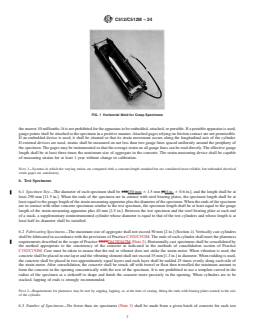
5.1.1 Horizontal molds shall conform to the requirements of the section on horizontal molds for creep test cylinders of Practice
C192/C192M. A horizontal mold that has proven satisfactory is shown in Fig. 1.
5.2 Loading Frame, capable of applying and maintaining the required load on the specimen, despite any change in the dimension
of the specimen. In its simplest form the loading frame consists of header plates bearing on the ends of the loaded specimens, a
load-maintaining element that is either a spring or a hydraulic capsule or ram, and threaded rods to take the reaction of the loaded
system. Bearing surfaces of the header plates shall not depart from a plane by more than 0.025 mm [0.001 in.]. In any loading
frame, it is not prohibited to stack several specimens for simultaneous loading. The length between header plates shall not exceed
1780 mm [70 in.]. When a hydraulic load-maintaining element is used, several frames may be loaded simultaneously through a
central hydraulic pressure-regulating unit consisting of an accumulator, a regulator, indicating gages, and a source of high pressure,
such as a cylinder of nitrogen or a high-pressure pump. Springs such as railroad car springs may be used to maintain the load in
frames similar to those described above; the initial compression shall be applied by means of a portable jack or testing machine.
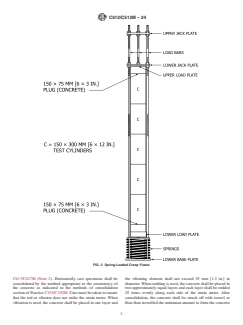
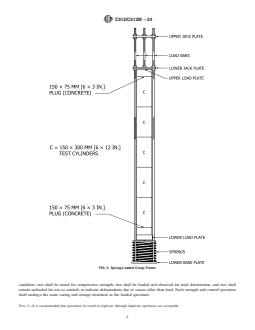
When springs are used, care should be taken to provide a spherical head or ball joint, and end plates rigid enough to ensure uniform
loading of the cylinders. Fig. 2 shows an acceptable spring-loaded frame. Means shall be provided for measuring the load to the
nearest 2 % of total applied load. It is not prohibited to use a permanently installed hydraulic pressure gauge or a hydraulic jack
and a load cell inserted in the frame when the load is applied or adjusted.
5.3 Strain-Measuring Device—Suitable apparatus shall be provided for the measurement of longitudinal strain in the specimen to
SP-135 is currently out of print, however, the individual papers contained in the publication are available from American Concrete Institute (ACI), P.O. Box 9094,
Farmington Hills, MI 48333-9094, http://www.concrete.org.
C512/C512M − 24
FIG. 1 Horizontal Mold for Creep Specimens
the nearest 10 millionths. It is not prohibited for the apparatus to be embedded, attached, or portable. If a portable apparatus is used,
gauge points shall be attached to the specimen in a positive manner. Attached gages relying on friction contact are not permissible.
If an embedded device is used, it shall be situated so that its strain movement occurs along the longitudinal axis of the cylinder.
If external devices are used, strains shall be measured on not less than two gauge lines spaced uniformly around the periphery of
the specimen. The gages may be instrumented so that the average strain on all gauge lines can be read directly. The effective gauge
length shall be at least three times the maximum size of aggregate in the concrete. The strain-measuring device shall be capable
of measuring strains for at least 1 year without change in calibration.
NOTE 1—Systems in which the varying strains are compared with a constant-length standard bar are considered most reliable, but unbonded electrical
strain gages are satisfactory.
6. Test Specimens
6.1 Specimen Size—The diameter of each specimen shall be 150150 mm 6 1.5 mm [6[6 in. 6 0.6 in.], and the length shall be at
least 290 mm [11.5 in.]. When the ends of the specimen are in contact with steel bearing plates, the specimen length shall be at
least equal to the gauge length of the strain-measuring apparatus plus the diameter of the specimen. When the ends of the specimen
are in contact with other concrete specimens similar to the test specimen, the specimen length shall be at least equal to the gauge
length of the strain-measuring apparatus plus 40 mm [1.5 in.]. Between the test specimen and the steel bearing plate at each end
of a stack, a supplementary noninstrumented cylinder whose diameter is equal to that of the test cylinders and whose length is at
least half its diameter shall be installed.
6.2 Fabricating Specimens—The maximum size of aggregate shall not exceed 50 mm [2 i
...