

ASTM C900-23
(Test Method)Standard Test Method for Pullout Strength of Hardened Concrete
General Information
- Abstract
SIGNIFICANCE AND USE
5.1 For a given test apparatus, pullout strengths can be related to compressive strength test results. Such strength relationships are affected by the configuration of the embedded insert, bearing ring dimensions, depth of embedment, and the type of aggregate (lightweight or normal weight). Before use, the relationship must be established experimentally for each test system using a range of concrete mixtures or the specific concrete mixtures to be used in the project. Such relationships are more reliable if both pullout test specimens and compressive strength test specimens are of similar size, consolidated to similar density, and cured under similar conditions.
Note 1: Published reports (1-19)4 by different researchers present their experiences in the use of pullout test equipment. Refer to ACI PRC-228.1 (14) for guidance on establishing a strength relationship and interpreting test results.
5.2 If a strength relationship has been accepted by the specifier of tests, pullout tests are used to estimate the in-place strength of concrete to establish whether it has reached a specified level so that, for example:
(1) post-tensioning may proceed;
(2) forms and shores may be removed;
(3) structure may be placed into service; or
(4) winter protection and curing may be terminated.
In addition, post-installed pullout tests may be used to estimate the strength of concrete in existing construction.
5.3 In planning pullout tests and analyzing test results, consideration should be given to the normally expected decrease of concrete strength with increasing height within a given concrete placement in a structural element.
5.4 The measured pullout strength is indicative of the strength of concrete within the region represented by the conic frustum defined by the insert head and bearing ring. For typical surface installations, pullout strengths are indicative of the quality of the outer zone of concrete members and can be of benefit in evaluating the cover zo...
SCOPE
1.1 This test method covers determination of the pullout strength of hardened concrete by measuring the force required to pull an embedded metal insert and the attached concrete fragment from a concrete test specimen or structure. The insert is either cast into fresh concrete or installed in hardened concrete. This test method does not provide statistical procedures to estimate other strength properties.
1.2 The values stated in SI units are to be regarded as the standard. No other units of measurement are included in this test method.
1.3 The text of this test method refers to notes and footnotes that provide explanatory material. These notes and footnotes (excluding those in tables and figures) shall not be considered as requirements of this test method.
1.4 This standard does not purport to address all of the safety concerns, if any, associated with its use. It is the responsibility of the user of this standard to establish appropriate safety, health, and environmental practices and determine the applicability of regulatory limitations prior to use. (Warning—Fresh hydraulic cementitious mixtures are caustic and may cause chemical burns to skin and tissue upon prolonged exposure.2)
1.5 This international standard was developed in accordance with internationally recognized principles on standardization established in the Decision on Principles for the Development of International Standards, Guides and Recommendations issued by the World Trade Organization Technical Barriers to Trade (TBT) Committee.
- Status
- Published
- Publication Date
- 14-Dec-2023
- Technical Committee
- C09 - Concrete and Concrete Aggregates
- Drafting Committee
- C09.64 - Nondestructive and In-Place Testing
Overview
ASTM C900-23: Standard Test Method for Pullout Strength of Hardened Concrete defines a procedure to determine the pullout strength of hardened concrete by measuring the force required to extract an embedded metal insert and the attached concrete fragment from a specimen or structure. Developed by ASTM International, this method supports the accurate estimation of in-place concrete strength, guiding critical construction decisions and quality assurance activities.
The pullout test, as described in ASTM C900-23, is widely used for assessing whether concrete has reached a particular strength level necessary to proceed with activities such as post-tensioning, formwork removal, or commissioning structures. It is applicable with inserts cast into fresh concrete or installed into existing hardened concrete, making it a versatile in-place concrete testing method.
Key Topics
Purpose of Pullout Testing
- Quantitatively measures the force required to pull an embedded insert from hardened concrete.
- Provides data to estimate the in-place strength of concrete at specific locations.
- Serves as a non-destructive or partially-destructive testing method, depending on application.
Testing Procedure
- Inserts may be cast-in-place during concrete placement or post-installed in cured concrete using specialized drilling and preparation tools.
- Load is applied via a hydraulic jack and measured with precision gauges to determine maximum pullout force.
- The method requires standardized apparatus including a pullout insert, loading system, and a bearing ring.
Factors Influencing Results
- Configuration of embedded insert and bearing ring dimensions.
- Depth of embedment.
- Type of concrete aggregate (lightweight or normal weight).
- Consistency in density, curing, and specimen dimensions enhances result reliability.
- Relationships between pullout strength and compressive strength must be experimentally established for each apparatus and mix.
Test Planning and Analysis
- Consider potential strength variations within a given concrete placement (e.g., vertical elements).
- Minimum spacing requirements for insert placements to ensure accurate results.
- Each pullout test provides an indication of concrete quality in the immediate region surrounding the insert.
Applications
Construction Quality Control
- Determine if in-place concrete has attained sufficient strength for construction activities such as:
- Post-tensioning of tendons.
- Removal of formwork and shoring.
- Allowing occupancy or service loads.
- Adjustments to curing and winter protection.
- Determine if in-place concrete has attained sufficient strength for construction activities such as:
Assessment of Existing Structures
- Post-installed pullout tests enable strength evaluations in existing buildings, bridges, and other concrete elements for maintenance or retrofitting decisions.
Surface and Cover Zone Evaluation
- Particularly useful for appraising the quality and strength of outer concrete zones and cover regions in reinforced concrete members.
Project-Specific Calibration
- Must establish a strength relationship for each concrete mix and testing system to accurately correlate pullout values with compressive strength requirements.
Related Standards
- ASTM C125: Terminology Relating to Concrete and Concrete Aggregates
- ASTM C670: Preparing Precision and Bias Statements for Construction Materials
- ASTM E4: Force Calibration and Verification of Testing Machines
- ASTM E74: Calibration for Force-Measuring Instruments
- ACI PRC-228.1: Report on Methods for Estimating In-Place Concrete Strength
Practical Value
ASTM C900-23 provides a standardized and repeatable method for pullout strength testing of concrete, helping engineers, contractors, and quality control professionals make critical decisions about structure safety and project progress. By enabling accurate estimation of in-place concrete properties, this test method safeguards structural integrity and ensures compliance with strength specifications, reducing risks and costly delays.
For optimal results, users must adhere to apparatus requirements, sampling criteria, and proper test planning outlined in the standard, and establish appropriate strength correlations for each project setup.
Relations
- Effective Date
- 15-Dec-2023
- Effective Date
- 01-Feb-2024
- Effective Date
- 01-Jan-2024
- Effective Date
- 15-Jun-2015
- Referred By
ASTM C1074-19e1 - Standard Practice for Estimating Concrete Strength by the Maturity Method - Effective Date
- 15-Dec-2023
- Effective Date
- 15-Dec-2023
- Effective Date
- 15-Dec-2023
Get Certified
Connect with accredited certification bodies for this standard

DIBt (Deutsches Institut für Bautechnik)
German Institute for Building Technology.
DIN CERTCO
DIN Group product certification.

Aboma Certification B.V.
Specialized in construction, metal, and transport sectors.
Sponsored listings
Frequently Asked Questions
ASTM C900-23 is a standard published by ASTM International. Its full title is "Standard Test Method for Pullout Strength of Hardened Concrete". This standard covers: SIGNIFICANCE AND USE 5.1 For a given test apparatus, pullout strengths can be related to compressive strength test results. Such strength relationships are affected by the configuration of the embedded insert, bearing ring dimensions, depth of embedment, and the type of aggregate (lightweight or normal weight). Before use, the relationship must be established experimentally for each test system using a range of concrete mixtures or the specific concrete mixtures to be used in the project. Such relationships are more reliable if both pullout test specimens and compressive strength test specimens are of similar size, consolidated to similar density, and cured under similar conditions. Note 1: Published reports (1-19)4 by different researchers present their experiences in the use of pullout test equipment. Refer to ACI PRC-228.1 (14) for guidance on establishing a strength relationship and interpreting test results. 5.2 If a strength relationship has been accepted by the specifier of tests, pullout tests are used to estimate the in-place strength of concrete to establish whether it has reached a specified level so that, for example: (1) post-tensioning may proceed; (2) forms and shores may be removed; (3) structure may be placed into service; or (4) winter protection and curing may be terminated. In addition, post-installed pullout tests may be used to estimate the strength of concrete in existing construction. 5.3 In planning pullout tests and analyzing test results, consideration should be given to the normally expected decrease of concrete strength with increasing height within a given concrete placement in a structural element. 5.4 The measured pullout strength is indicative of the strength of concrete within the region represented by the conic frustum defined by the insert head and bearing ring. For typical surface installations, pullout strengths are indicative of the quality of the outer zone of concrete members and can be of benefit in evaluating the cover zo... SCOPE 1.1 This test method covers determination of the pullout strength of hardened concrete by measuring the force required to pull an embedded metal insert and the attached concrete fragment from a concrete test specimen or structure. The insert is either cast into fresh concrete or installed in hardened concrete. This test method does not provide statistical procedures to estimate other strength properties. 1.2 The values stated in SI units are to be regarded as the standard. No other units of measurement are included in this test method. 1.3 The text of this test method refers to notes and footnotes that provide explanatory material. These notes and footnotes (excluding those in tables and figures) shall not be considered as requirements of this test method. 1.4 This standard does not purport to address all of the safety concerns, if any, associated with its use. It is the responsibility of the user of this standard to establish appropriate safety, health, and environmental practices and determine the applicability of regulatory limitations prior to use. (Warning—Fresh hydraulic cementitious mixtures are caustic and may cause chemical burns to skin and tissue upon prolonged exposure.2) 1.5 This international standard was developed in accordance with internationally recognized principles on standardization established in the Decision on Principles for the Development of International Standards, Guides and Recommendations issued by the World Trade Organization Technical Barriers to Trade (TBT) Committee.
SIGNIFICANCE AND USE 5.1 For a given test apparatus, pullout strengths can be related to compressive strength test results. Such strength relationships are affected by the configuration of the embedded insert, bearing ring dimensions, depth of embedment, and the type of aggregate (lightweight or normal weight). Before use, the relationship must be established experimentally for each test system using a range of concrete mixtures or the specific concrete mixtures to be used in the project. Such relationships are more reliable if both pullout test specimens and compressive strength test specimens are of similar size, consolidated to similar density, and cured under similar conditions. Note 1: Published reports (1-19)4 by different researchers present their experiences in the use of pullout test equipment. Refer to ACI PRC-228.1 (14) for guidance on establishing a strength relationship and interpreting test results. 5.2 If a strength relationship has been accepted by the specifier of tests, pullout tests are used to estimate the in-place strength of concrete to establish whether it has reached a specified level so that, for example: (1) post-tensioning may proceed; (2) forms and shores may be removed; (3) structure may be placed into service; or (4) winter protection and curing may be terminated. In addition, post-installed pullout tests may be used to estimate the strength of concrete in existing construction. 5.3 In planning pullout tests and analyzing test results, consideration should be given to the normally expected decrease of concrete strength with increasing height within a given concrete placement in a structural element. 5.4 The measured pullout strength is indicative of the strength of concrete within the region represented by the conic frustum defined by the insert head and bearing ring. For typical surface installations, pullout strengths are indicative of the quality of the outer zone of concrete members and can be of benefit in evaluating the cover zo... SCOPE 1.1 This test method covers determination of the pullout strength of hardened concrete by measuring the force required to pull an embedded metal insert and the attached concrete fragment from a concrete test specimen or structure. The insert is either cast into fresh concrete or installed in hardened concrete. This test method does not provide statistical procedures to estimate other strength properties. 1.2 The values stated in SI units are to be regarded as the standard. No other units of measurement are included in this test method. 1.3 The text of this test method refers to notes and footnotes that provide explanatory material. These notes and footnotes (excluding those in tables and figures) shall not be considered as requirements of this test method. 1.4 This standard does not purport to address all of the safety concerns, if any, associated with its use. It is the responsibility of the user of this standard to establish appropriate safety, health, and environmental practices and determine the applicability of regulatory limitations prior to use. (Warning—Fresh hydraulic cementitious mixtures are caustic and may cause chemical burns to skin and tissue upon prolonged exposure.2) 1.5 This international standard was developed in accordance with internationally recognized principles on standardization established in the Decision on Principles for the Development of International Standards, Guides and Recommendations issued by the World Trade Organization Technical Barriers to Trade (TBT) Committee.
ASTM C900-23 is classified under the following ICS (International Classification for Standards) categories: 91.100.30 - Concrete and concrete products. The ICS classification helps identify the subject area and facilitates finding related standards.
ASTM C900-23 has the following relationships with other standards: It is inter standard links to ASTM C900-19, ASTM C670-24a, ASTM C670-24, ASTM C670-15, ASTM C1074-19e1, ASTM C1857/C1857M-19, ASTM C1583/C1583M-20. Understanding these relationships helps ensure you are using the most current and applicable version of the standard.
ASTM C900-23 is available in PDF format for immediate download after purchase. The document can be added to your cart and obtained through the secure checkout process. Digital delivery ensures instant access to the complete standard document.
Standards Content (Sample)
This international standard was developed in accordance with internationally recognized principles on standardization established in the Decision on Principles for the
Development of International Standards, Guides and Recommendations issued by the World Trade Organization Technical Barriers to Trade (TBT) Committee.
Designation: C900 − 23
Standard Test Method for
Pullout Strength of Hardened Concrete
This standard is issued under the fixed designation C900; the number immediately following the designation indicates the year of
original adoption or, in the case of revision, the year of last revision. A number in parentheses indicates the year of last reapproval. A
superscript epsilon (´) indicates an editorial change since the last revision or reapproval.
1. Scope* C125 Terminology Relating to Concrete and Concrete Ag-
gregates
1.1 This test method covers determination of the pullout
C670 Practice for Preparing Precision and Bias Statements
strength of hardened concrete by measuring the force required
for Test Methods for Construction Materials
to pull an embedded metal insert and the attached concrete
E4 Practices for Force Calibration and Verification of Test-
fragment from a concrete test specimen or structure. The insert
ing Machines
is either cast into fresh concrete or installed in hardened
E74 Practices for Calibration and Verification for Force-
concrete. This test method does not provide statistical proce-
Measuring Instruments
dures to estimate other strength properties.
1.2 The values stated in SI units are to be regarded as the 3. Terminology
standard. No other units of measurement are included in this
3.1 Definitions:
test method.
3.1.1 For definitions of terms used in this method, refer to
1.3 The text of this test method refers to notes and footnotes Terminology C125.
that provide explanatory material. These notes and footnotes
4. Summary of Test Method
(excluding those in tables and figures) shall not be considered
as requirements of this test method.
4.1 A metal insert is either cast into fresh concrete or
installed into hardened concrete. When a measure of the
1.4 This standard does not purport to address all of the
in-place pullout strength is desired, the insert is pulled by
safety concerns, if any, associated with its use. It is the
means of a jack reacting against a bearing ring. The pullout
responsibility of the user of this standard to establish appro-
strength is determined by measuring the maximum force
priate safety, health, and environmental practices and deter-
required to pull the insert from the concrete mass.
mine the applicability of regulatory limitations prior to use.
Alternatively, the insert is loaded to a specified load to verify
(Warning—Fresh hydraulic cementitious mixtures are caustic
whether a minimum level of in-place pullout strength has been
and may cause chemical burns to skin and tissue upon
attained.
prolonged exposure. )
1.5 This international standard was developed in accor-
5. Significance and Use
dance with internationally recognized principles on standard-
5.1 For a given test apparatus, pullout strengths can be
ization established in the Decision on Principles for the
related to compressive strength test results. Such strength
Development of International Standards, Guides and Recom-
relationships are affected by the configuration of the embedded
mendations issued by the World Trade Organization Technical
insert, bearing ring dimensions, depth of embedment, and the
Barriers to Trade (TBT) Committee.
type of aggregate (lightweight or normal weight). Before use,
2. Referenced Documents
the relationship must be established experimentally for each
test system using a range of concrete mixtures or the specific
2.1 ASTM Standards:
concrete mixtures to be used in the project. Such relationships
are more reliable if both pullout test specimens and compres-
This test method is under the jurisdiction of ASTM Committee C09 on
sive strength test specimens are of similar size, consolidated to
Concrete and Concrete Aggregates and is the direct responsibility of Subcommittee
similar density, and cured under similar conditions.
C09.64 on Nondestructive and In-Place Testing.
Current edition approved Dec. 15, 2023. Published January 2024. Originally
NOTE 1—Published reports (1-19) by different researchers present their
approved in 1978. Last previous edition approved in 2019 as C900 – 19. DOI:
experiences in the use of pullout test equipment. Refer to ACI PRC-228.1
10.1520/C0900-23.
(14) for guidance on establishing a strength relationship and interpreting
Section on Safety Precautions, Manual of Aggregate and Concrete Testing,
test results.
Annual Book of ASTM Standards, Vol 04.02.
For referenced ASTM standards, visit the ASTM website, www.astm.org, or
contact ASTM Customer Service at service@astm.org. For Annual Book of ASTM
Standards volume information, refer to the standard’s Document Summary page on The boldface numbers refer to the list of references at the end of this test
the ASTM website. method.
*A Summary of Changes section appears at the end of this standard
Copyright © ASTM International, 100 Barr Harbor Drive, PO Box C700, West Conshohocken, PA 19428-2959. United States
C900 − 23
5.2 If a strength relationship has been accepted by the
specifier of tests, pullout tests are used to estimate the in-place
strength of concrete to establish whether it has reached a
specified level so that, for example:
(1) post-tensioning may proceed;
(2) forms and shores may be removed;
(3) structure may be placed into service; or
(4) winter protection and curing may be terminated.
In addition, post-installed pullout tests may be used to
estimate the strength of concrete in existing construction.
5.3 In planning pullout tests and analyzing test results,
consideration should be given to the normally expected de-
crease of concrete strength with increasing height within a
given concrete placement in a structural element.
5.4 The measured pullout strength is indicative of the
strength of concrete within the region represented by the conic
frustum defined by the insert head and bearing ring. For typical
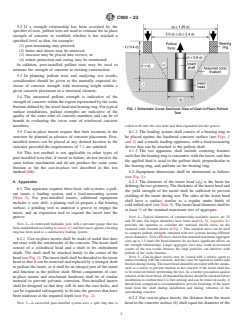
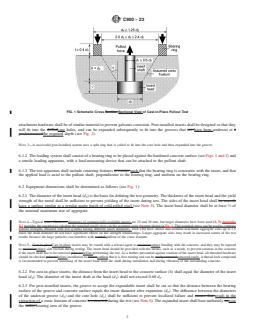
FIG. 1 Schematic Cross Sectional View of Cast-in-Place Pullout
surface installations, pullout strengths are indicative of the
Test
quality of the outer zone of concrete members and can be of
benefit in evaluating the cover zone of reinforced concrete
members.
coiled to fit into the core hole and then expanded into the groove.
5.5 Cast-in-place inserts require that their locations in the 6.1.2 The loading system shall consist of a bearing ring to
be placed against the hardened concrete surface (see Figs. 1
structure be planned in advance of concrete placement. Post-
installed inserts can be placed at any desired location in the and 2) and a tensile loading apparatus, with a load-measuring
device that can be attached to the pullout shaft.
structure provided the requirements of 7.1 are satisfied.
6.1.3 The test apparatus shall include centering features
5.6 This test method is not applicable to other types of
such that the bearing ring is concentric with the insert, and that
post-installed tests that, if tested to failure, do not involve the
the applied load is axial to the pullout shaft, perpendicular to
same failure mechanism and do not produce the same conic
the bearing ring, and uniform on the bearing ring.
frustum as for the cast-in-place test described in this test
6.2 Equipment dimensions shall be determined as follows
method (16).
(see Fig. 1):
6.2.1 The diameter of the insert head (d ) is the basis for
6. Apparatus
defining the test geometry. The thickness of the insert head and
6.1 The apparatus requires three basic sub-systems: a pull-
the yield strength of the metal shall be sufficient to prevent
out insert, a loading system, and a load-measuring system
yielding of the insert during test. The sides of the insert head
(Note 2). For post-installed inserts, additional equipment
shall have a surface similar to a regular matte finish of
includes a core drill, a planing tool to prepare a flat bearing
cold-rolled steel (see Note 5). The insert head diameter shall be
surface, a grinding tool to undercut a groove to engage the
at least ⁄3 of the nominal maximum size of aggregate.
insert, and an expansion tool to expand the insert into the
NOTE 4—Typical diameters of commercially-available inserts are 25
groove.
and 30 mm, but larger diameters have been used (1, 3). Appendix X1
NOTE 2—A center-pull hydraulic jack with a pressure gauge that has
provides the equation to calculate the nominal tensile stress on the
been standardized according to Annex A1 and that reacts against a bearing
assumed conic frustum shown in Fig. 1. This nominal stress can be used
ring has been used as a satisfactory loading system.
to compare pullout strengths obtained with test systems having different
insert diameters. Tests (15) have shown that nominal maximum aggregate
6.1.1 Cast-in-place inserts shall be made of metal that does
sizes up to 1.5 times the head diameter do not have significant effects on
not react with the constituents of the concrete. The insert shall
the strength relationships. Larger aggregate sizes may result in increased
consist of a cylindrical head and a shaft to fix embedment
scatter of the test results because the large particles can interfere with
pullout of the conic frustum.
depth. The shaft shall be attached firmly to the center of the
NOTE 5—Cast-in-place inserts may be coated with a release agent to
head (see Fig. 1). The insert shaft shall be threaded to the insert
reduce bonding with the concrete, and they may be tapered to reduce side
head so that it can be removed and replaced by a stronger shaft
friction during testing. The insert head should be provided with the means,
to pullout the insert, or it shall be an integral part of the insert
such as a notch, to prevent rotation in the concrete if the insert shaft has
and function as the pullout shaft. Metal components of cast-
to be removed before performing the test. As a further precaution against
rotation of the insert head, all threaded hardware should be checked before
in-place inserts and attachment hardware shall be of similar
installation to confirm that it is free-turning and can be removed easily. A
material to prevent galvanic corrosion. Post-installed inserts
thread-lock compound is recommended to prevent loosening of the insert
shall be designed so that they will fit into the core holes, and
head from the shaft during installation and during vibration of the
can be expanded subsequently to fit into the grooves that have
surrounding concrete.
been undercut at the required depth (see Fig. 2).
6.2.2 For cast-in–place inserts, the distance from the insert
NOTE 3—A successful post-installed system uses a split ring that is head to the concrete surface (h) shall equal the diameter of the
C900 − 23
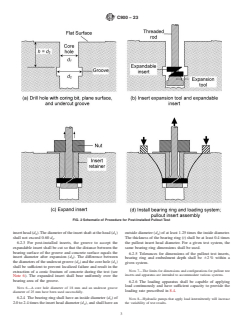
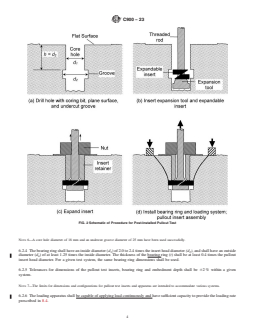
FIG. 2 Schematic of Procedure for Post-Installed Pullout Test
insert head (d ). The diameter of the insert shaft at the head (d ) outside diameter (d ) of at least 1.25 times the inside diameter.
2 1 4
shall not exceed 0.60 d . The thickness of the bearing ring (t) shall be at least 0.4 times
6.2.3 For post-installed inserts, the groove to accept the
the pullout insert head diameter. For a given test system, the
expandable insert shall be cut so that the distance between the same bearing ring dimensions shall be used.
bearing surface of the groove and concrete surface equals the
6.2.5 Tolerances for dimensions of the pullout test inserts,
insert diameter after expansion (d ). The difference between
2 bearing ring and embedment depth shall be 62 % within a
the diameters of the undercut groove (d ) and the core hole (d )
2 1 given system.
shall be sufficient to prevent localized failure and result in the
NOTE 7—The limits for dimensions and configurations for pullout test
extraction of a conic frustum of concrete during the test (see
inserts and apparatus are intended to accommodate various systems.
Note 6). The expanded insert shall bear uniformly over the
bearing area of the groove.
6.2.6 The loading apparatus shall be capable of applying
load continuously and have sufficient capacity to provide the
NOTE 6—A core hole diameter of 18 mm and an undercut groove
loading rate prescribed in 8.4.
diameter of 25 mm have been used successfully.
6.2.4 The bearing ring shall have an inside diameter (d ) of
3 NOTE 8—Hydraulic pumps that apply load intermittently will increase
2.0 to 2.4 times the insert head diameter (d ), and shall have an the variability of test results.
C900 − 23
NOTE 10—More than the minimum number of inserts should be
6.2.7 The gauge to measure pullout force is permitted to be
provided in case a test result is not valid or testing begins before adequate
of the analog or digital type. Analog gauges shall be designed
strength has developed.
so that the pullout force can be estimated to the nearest 0.5 kN.
7.2.3 If pullout tests are used for other purposes, the number
Digital gauges shall display the pullout force to the nearest 0.1
of tests shall be determined by the specifier of the test.
kN.
6.2.8 The force gauge shall have a means to preserve the
7.3 Test Locations—Inserts shall be located in those portions
maximum value of the load during a test.
of the structure that are critical in terms of exposure conditions
6.2.9 Pullout apparatus shall be standardized in accordance
and structural requirements.
with Annex A1 at least once a year and after all repairs.
Standardize the pullout apparatus using a testing machine
8. Procedure
verified in accordance with Practices E4 or using a Class A load
8.1 Cast-in-Place Inserts:
cell as defined in Practice E74. The indicated pullout force
8.1.1 Attach the pullout inserts to the forms using bolts or
based on the developed relationship shall be within 62 % of
by other methods that firmly secure the insert in its proper
the force measured by the testing machine or load cell.
location before concrete placement. All inserts shall be embed-
ded to the same depth. The axis of each shaft shall be
7. Sampling
perpendicular to the formed surface.
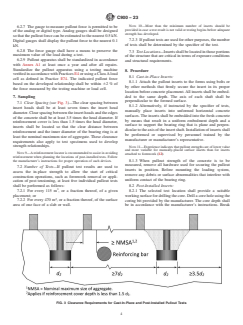
7.1 Clear Spacing (see Fig. 3)—The clear spacing between
8.1.2 Alternatively, if instructed by the specifier of tests,
insert heads shall be at least seven times the insert head
manually place inserts into unformed horizontal concrete
diameter. Clear spacing between the insert heads and the edges
surfaces. The inserts shall be embedded into the fresh concrete
of the concrete shall be at least 3.5 times the head diameter. If
by means that result in a uniform embedment depth and a
reinforcement cover is less than 1.5 times the head diameter,
surface to support the bearing ring that is plane and perpen-
inserts shall be located so that the clear distance between
dicular to the axis of the insert shaft. Installation of inserts shall
reinforcement and the inner diameter of the bearing ring is at
be performed or supervised by personnel trained by the
least the nominal maximum size of aggregate. These clearance
manufacturer or manufacturer’s representative.
requirements also apply to test specimens used to develop
strength relationships. NOTE 11—Experience indicates that pullout strengths are of lower value
and more variable for manually-placed surface inserts than for inserts
NOTE 9—A reinforcement locator is recommended to assist in avoiding
attached to formwork (12).
reinforcement when planning the locations of post-installed tests. Follow
8.1.3 When pullout strength of the concrete is to be
the manufacturer’s instructions for proper operation of such devices.
measured, remove all hardware used for securing the pullout
7.2 Number of Tests—If pullout test results are used to
inserts in position. Before mounting the loading system,
assess the in-place strength to allow the start of critical
remove any debris or surface abnormalities that interfere with
construction operations, such as formwork removal or appli-
uniform contact of the bearing ring.
cation of post tensioning, at least five individual pullout tests
shall be performed as follows: 8.2 Post-Installed Inserts:
7.2.1 For every 115 m , or a fraction thereof, of a given 8.2.1 The selected test location shall provide a suitable
placement; or working surface for drilling the core. Drill a core hole using the
7.2.2 For every 470 m , or a fraction thereof, of the surface coring bit provided by the manufacturer. The core depth shall
area of one face of a slab or wall. be in accordance with the manufacturer’s instructions. Break
FIG. 3 Clearance Requirements for Cast-In-Place and Post-Installed Pullout Tests
C900 − 23
off the core to provide a reference hole for subsequent 8.4.1 Do not test frozen concrete.
operations. The use of an impact drill is not permitted.
8.5 Rejection—Reject a test result if one or more of the
8.2.2 Use a surface planing tool in accordance with the
following conditions are encountered:
manufacturer’s instructions to prepare a flat surface that is
8.5.1 The large end of the conic frustum is not a complete
perpendicular to the axis of the core hole.
circle of the same diameter as the inside diameter of the
8.2.3 Use the grinding tool in accordance with the manu-
bearing ring;
facturer’s instructions to undercut a groove of the correct
8.5.2 The distance from the surface to the insert head (h in
diameter and at the correct depth in the core hole. The groove
Fig. 1 or Fig. 2) is not equal to the insert diameter;
shall be concentric with the core hole.
8.5.3 The diameter of the groove in a post-installed test is
NOTE 12—To control the accuracy of these operations, a support system
not equal to the manufacturer’s design value;
should be used to maintain the apparatus in the proper position during
8.5.4 The expanded insert diameter in a post-installed test is
these steps.
not equal to the manufacturer’s design value; or,
8.2.4 If water is used as a coolant, remove free-standing
8.5.5 A reinforcing bar is visible within the failure zone
water from the hole at the completion of the drilling, planing,
after the conic frustum is rem
...
This document is not an ASTM standard and is intended only to provide the user of an ASTM standard an indication of what changes have been made to the previous version. Because
it may not be technically possible to adequately depict all changes accurately, ASTM recommends that users consult prior editions as appropriate. In all cases only the current version
of the standard as published by ASTM is to be considered the official document.
Designation: C900 − 19 C900 − 23
Standard Test Method for
Pullout Strength of Hardened Concrete
This standard is issued under the fixed designation C900; the number immediately following the designation indicates the year of
original adoption or, in the case of revision, the year of last revision. A number in parentheses indicates the year of last reapproval. A
superscript epsilon (´) indicates an editorial change since the last revision or reapproval.
1. Scope*
1.1 This test method covers determination of the pullout strength of hardened concrete by measuring the force required to pull an
embedded metal insert and the attached concrete fragment from a concrete test specimen or structure. The insert is either cast into
fresh concrete or installed in hardened concrete. This test method does not provide statistical procedures to estimate other strength
properties.
1.2 The values stated in SI units are to be regarded as the standard. No other units of measurement are included in this test method.
1.3 The text of this test method refers to notes and footnotes that provide explanatory material. These notes and footnotes
(excluding those in tables and figures) shall not be considered as requirements of this test method.
1.4 This standard does not purport to address all of the safety concerns, if any, associated with its use. It is the responsibility
of the user of this standard to establish appropriate safety, health, and environmental practices and determine the applicability of
regulatory limitations prior to use. (Warning—Fresh hydraulic cementitious mixtures are caustic and may cause chemical burns
to skin and tissue upon prolonged exposure. )
1.5 This international standard was developed in accordance with internationally recognized principles on standardization
established in the Decision on Principles for the Development of International Standards, Guides and Recommendations issued
by the World Trade Organization Technical Barriers to Trade (TBT) Committee.
2. Referenced Documents
2.1 ASTM Standards:
C125 Terminology Relating to Concrete and Concrete Aggregates
C670 Practice for Preparing Precision and Bias Statements for Test Methods for Construction Materials
E4 Practices for Force Calibration and Verification of Testing Machines
E74 Practices for Calibration and Verification for Force-Measuring Instruments
3. Terminology
3.1 Definitions:
3.1.1 For definitions of terms used in this method, refer to Terminology C125.
This test method is under the jurisdiction of ASTM Committee C09 on Concrete and Concrete Aggregates and is the direct responsibility of Subcommittee C09.64 on
Nondestructive and In-Place Testing.
Current edition approved Dec. 15, 2019Dec. 15, 2023. Published February 2020January 2024. Originally approved in 1978. Last previous edition approved in 20152019
as C900 – 15.C900 – 19. DOI: 10.1520/C0900-19.10.1520/C0900-23.
Section on Safety Precautions, Manual of Aggregate and Concrete Testing, Annual Book of ASTM Standards, Vol 04.02.
For referenced ASTM standards, visit the ASTM website, www.astm.org, or contact ASTM Customer Service at service@astm.org. For Annual Book of ASTM Standards
volume information, refer to the standard’s Document Summary page on the ASTM website.
*A Summary of Changes section appears at the end of this standard
Copyright © ASTM International, 100 Barr Harbor Drive, PO Box C700, West Conshohocken, PA 19428-2959. United States
C900 − 23
4. Summary of Test Method
4.1 A metal insert is either cast into fresh concrete or installed into hardened concrete. When a measure of the in-place pullout
strength is desired, the insert is pulled by means of a jack reacting against a bearing ring. The pullout strength is determined by
measuring the maximum force required to pull the insert from the concrete mass. Alternatively, the insert is loaded to a specified
load to verify whether a minimum level of in-place pullout strength has been attained.
5. Significance and Use
5.1 For a given concrete and a given test apparatus, pullout strengths can be related to compressive strength test results. Such
strength relationships are affected by the configuration of the embedded insert, bearing ring dimensions, depth of embedment, and
the type of aggregate (lightweight or normal weight). Before use, the relationshipsrelationship must be established experimentally
for each test system and each new concrete mixture. using a range of concrete mixtures or the specific concrete mixtures to be used
in the project. Such relationships are more reliable if both pullout test specimens and compressive strength test specimens are of
similar size, consolidated to similar density, and cured under similar conditions.
NOTE 1—Published reports (1-1719) by different researchers present their experiences in the use of pullout test equipment. Refer to ACI
228.1RPRC-228.1 (14) for guidance on establishing a strength relationship and interpreting test results. The Appendix provides a means for comparing
pullout strengths obtained using different configurations.
5.2 If a strength relationship has been established experimentally and accepted by the specifier of tests, pullout tests are used to
estimate the in-place strength of concrete to establish whether it has reached a specified level so that, for example:
(1) post-tensioning may proceed;
(2) forms and shores may be removed;
(3) structure may be placed into service; or
(4) winter protection and curing may be terminated.
In addition, post-installed pullout tests may be used to estimate the strength of concrete in existing construction.
5.3 WhenIn planning pullout tests and analyzing test results, consideration should be given to the normally expected decrease of
concrete strength with increasing height within a given concrete placement in a structural element.
5.4 The measured pullout strength is indicative of the strength of concrete within the region represented by the conic frustum
defined by the insert head and bearing ring. For typical surface installations, pullout strengths are indicative of the quality of the
outer zone of concrete members and can be of benefit in evaluating the cover zone of reinforced concrete members.
5.5 Cast-in-place inserts require that their locations in the structure be planned in advance of concrete placement. Post-installed
inserts can be placed at any desired location in the structure provided the requirements of 7.1 are satisfied.
5.6 This test method is not applicable to other types of post-installed tests that, if tested to failure, do not involve the same failure
mechanism and do not produce the same conic frustum as for the cast-in-place test described in this test method (16).
6. Apparatus
6.1 The apparatus requires three basic sub-systems: a pullout insert, a loading system, and a load-measuring system (Note 2). For
post-installed inserts, additional equipment includes a core drill, a planing tool to prepare a flat bearing surface, a grinding tool
to undercut a groove to engage the insert, and an expansion tool to expand the insert into the groove.
NOTE 2—A center-pull hydraulic jack with a pressure gauge that has been standardized according to Annex A1 and that reacts against a bearing ring has
been used satisfactorily.as a satisfactory loading system.
6.1.1 Cast-in-place inserts shall be made of metal that does not react with the constituents of the concrete. The insert shall consist
of a cylindrical head and a shaft to fix embedment depth. The shaft shall be attached firmly to the center of the head (see Fig. 1).
The insert shaft shall be threaded to the insert head so that it can be removed and replaced by a stronger shaft to pullout the insert,
or it shall be an integral part of the insert and also function as the pullout shaft. Metal components of cast-in-place inserts and
The boldface numbers refer to the list of references at the end of this test method.
C900 − 23
FIG. 1 Schematic Cross Section Sectional View of Cast-in-Place Pullout Test
attachment hardware shall be of similar material to prevent galvanic corrosion. Post-installed inserts shall be designed so that they
will fit into the drilledcore holes, and can be expanded subsequently to fit into the grooves that are have been undercut at a
predeterminedthe required depth (see Fig. 2).
NOTE 3—A successful post-installed system uses a split ring that is coiled to fit into the core hole and then expanded into the groove.
6.1.2 The loading system shall consist of a bearing ring to be placed against the hardened concrete surface (see Figs. 1 and 2) and
a tensile loading apparatus, with a load-measuring device that can be attached to the pullout shaft.
6.1.3 The test apparatus shall include centering features to ensure such that the bearing ring is concentric with the insert, and that
the applied load is axial to the pullout shaft, perpendicular to the bearing ring, and uniform on the bearing ring.
6.2 Equipment dimensions shall be determined as follows (see Fig. 1):
6.2.1 The diameter of the insert head (d ) is the basis for defining the test geometry. The thickness of the insert head and the yield
strength of the metal shall be sufficient to prevent yielding of the insert during test. The sides of the insert head shall be smooth
have a surface similar to a regular matte finish of cold-rolled steel (see Note 5). The insert head diameter shall be at least ⁄3 of
the nominal maximum size of aggregate.
NOTE 4—Typical insert diameters diameters of commercially-available inserts are 25 and 30 mm, but larger diameters have been used (1, 3).Appendix
X1 provides the equation to calculate the nominal tensile stress on the assumed conic frustum shown in Fig. 1. This nominal stress can be used to compare
pullout strengths obtained with test systems having different insert diameters. Tests (15) have shown that nominal maximum aggregate sizes up to 1.5
times the head diameter do not have significant effects on the strength relationships. Larger aggregate sizes may result in increased scatter of the test
results because the large particles can interfere with normal pullout of the conic frustum.
NOTE 5—Cast-in–placeCast-in-place inserts may be coated with a release agent to minimizereduce bonding with the concrete, and they may be tapered
to minimizereduce side friction during testing. The insert head should be provided with the means, such as a notch, to prevent rotation in the concrete
if the insert shaft has to be removed prior to before performing the test. As a further precaution against rotation of the insert head, all threaded hardware
should be checked prior to before installation to ensureconfirm that it is free-turning and can be easily removed.removed easily. A thread-lock compound
is recommended to prevent loosening of the insert head from the shaft during installation and during vibration of the surrounding concrete.
6.2.2 For cast-in–place inserts, the distance from the insert head to the concrete surface (h) shall equal the diameter of the insert
head (d ). The diameter of the insert shaft at the head (d ) shall not exceed 0.60 d .
2 1 2
6.2.3 For post-installed inserts, the groove to accept the expandable insert shall be cut so that the distance between the bearing
surface of the groove and concrete surface equals the insert diameter after expansion (d ). The difference between the diameters
of the undercut groove (d ) and the core hole (d ) shall be sufficient to prevent localized failure and ensure that result in the
2 1
extraction of a conic frustum of concrete is extracted during the test (see Note 6). The expanded insert shall bear uniformly onover
the entire bearing area of the groove.
C900 − 23
FIG. 2 Schematic of Procedure for Post-Installed Pullout Test
NOTE 6—A core hole diameter of 18 mm and an undercut groove diameter of 25 mm have been used successfully.
6.2.4 The bearing ring shall have an inside diameter (d ) of 2.0 to 2.4 times the insert head diameter (d ), and shall have an outside
3 2
diameter (d ) of at least 1.25 times the inside diameter. The thickness of the bearing ring (t) shall be at least 0.4 times the pullout
insert head diameter. For a given test system, the same bearing ring dimensions shall be used.
6.2.5 Tolerances for dimensions of the pullout test inserts, bearing ring and embedment depth shall be 62 % within a given
system.
NOTE 7—The limits for dimensions and configurations for pullout test inserts and apparatus are intended to accommodate various systems.
6.2.6 The loading apparatus shall be capable of applying load continuously and have sufficient capacity to provide the loading rate
prescribed in 8.4.
C900 − 23
NOTE 8—Hydraulic pumps that permit continuous loading may give more uniform test results than pumps that apply load intermittently.apply load
intermittently will increase the variability of test results.
6.2.7 The gauge to measure pullout force is permitted to be of the analog or digital type. Analog gauges shall be designed so that
the pullout force can be estimated to the nearest 0.5 kN. Digital gauges shall display the pullout force to the nearest 0.1 kN.
6.2.8 The force gauge shall have a means to preserve the maximum value of the load during a test.
6.2.9 Pullout apparatus shall be standardized in accordance with Annex A1 at least once a year and after all repairs. Standardize
the pullout apparatus using a testing machine verified in accordance with Practices E4 or using a Class A load cell as defined in
Practice E74. The indicated pullout force based on the developed relationship shall be within 62 % of the force measured by the
testing machine or load cell.
7. Sampling
7.1 Clear Spacing (see Fig. 3)—Pullout test locations shall be separated so that the The clear spacing between inserts is insert
heads shall be at least seven times the pullout insert head diameter. Clear spacing between the inserts insert heads and the edges
of the concrete shall be at least 3.5 times the head diameter. Inserts shall be placed so that reinforcement is outside the expected
conical failure surface by more than one bar diameter, or the If reinforcement cover is less than 1.5 times the head diameter, inserts
shall be located so that the clear distance between reinforcement and the inner diameter of the bearing ring is at least the nominal
maximum size of aggregate, whichever is greater. aggregate. These clearance requirements also apply to test specimens used to
develop strength relationships.
NOTE 9—A reinforcement locator is recommended to assist in avoiding reinforcement when planning the locations of post-installed tests. Follow the
manufacturer’s instructions for proper operation of such devices.
7.2 Number of Tests—WhenIf pullout test results are used to assess the in-place strength in order to allow the start of critical
construction operations, such as formwork removal or application of post tensioning, at least five individual pullout tests shall be
performed as follows:
7.2.1 For every 115 m , or a fraction thereof, of a given placement; or
7.2.2 For every 470 m ,, or a fraction thereof, of the surface area of one face of a slab or wall.
NOTE 10—More than the minimum number of inserts should be provided in case a test result is not valid or testing begins before adequate strength has
developed.
FIG. 3 Clearance Requirements for Cast-In-Place and Post-Installed Pullout Tests
C900 − 23
7.2.3 Inserts shall be located in those portions of the structure that are critical in terms of exposure conditions and structural
requirements.If pullout tests are used for other purposes, the number of tests shall be determined by the specifier of the test.
7.3 Test Locations—When pullout tests are used for other purposes, the number of tests shall be determined by the specifier of
the test.Inserts shall be located in those portions of the structure that are critical in terms of exposure conditions and structural
requirements.
8. Procedure
8.1 Cast-in-Place Inserts:
8.1.1 Attach the pullout inserts to the forms using bolts or by other methods that firmly secure the insert in its proper location prior
to before concrete placement. All inserts shall be embedded to the same depth. The axis of each shaft shall be perpendicular to
the formed surface.
8.1.2 Alternatively, whenif instructed by the specifier of tests, manually place inserts into unformed horizontal concrete surfaces.
The inserts shall be embedded into the fresh concrete by means that ensure result in a uniform embedment depth and a surface
to support the bearing ring that is plane and perpendicular to the axis of the insert shaft. Installation of inserts shall be performed
or supervised by personnel trained by the manufacturer or manufacturer’s representative.
NOTE 11—Experience indicates that pullout strengths are of lower value and more variable for manually-placed surface inserts than for inserts attached
to formwork (12).
8.1.3 When pullout strength of the concrete is to be measured, remove all hardware used for securing the pullout inserts in
position. Before mounting the loading system, remove any debris or surface abnormalities to ensure a flat bearing surface that is
perpendicular to the axis of the insert.that interfere with uniform contact of the bearing ring.
8.2 Post-Installed Inserts:
8.2.1 The selected test surface shall be flat to location shall provide a suitable working surface for drilling the core and
undercutting the groove. core. Drill a core hole perpendicular to the surface to provide a reference point for subsequent operations
and to accommodate the expandable insert and associated hardware.using the coring bit provided by the manufacturer. The core
depth shall be in accordance with the manufacturer’s instructions. Break off the core to provide a reference hole for subsequent
operations. The use of an impact drill is not permitted.
8.2.2 If necessary, use Use a surface planing tool to prepare a flat surface so that the base of the tool for cutting the groove is
supported firmly and so that the bearing ring is supported uniformly during testing. The prepared surface shall bein accordance
with the manufacturer’s instructions to prepare a flat surface that is perpendicular to the axis of the core hole.
8.2.3 Use the grinding tool in accordance with the manufacturer’s instructions to undercut a groove of the correct diameter and
at the correct depth in the core hole. The groove shall be concentric with the core hole.
NOTE 12—To control the accuracy of these operations, a support system should be used to holdmaintain the apparatus in the proper position during these
steps.
8.2.4 If water is used as a coolant, remove free-standing water from the hole at the completion of the drilling, planing, and
undercutting operations. Protect the hole from ingress of additional water until completion of the test.
NOTE 13—Penetration of water into the failure zone could affect the measured pullout strength.
8.2.5 Use the expansion tool to position the expandable insert into the groove core hole and expand the insert to its proper size
within the groove in accordance with the manufacturer’s instructions.
8.3 Bearing Ring—Place the bearing ring around concentric with the pullout insert shaft, shaft and connect the pul
...