

ASTM C311/C311M-24
(Test Method)Standard Test Methods for Sampling and Testing Coal Ash or Natural Pozzolans for Use in Concrete
General Information
- Abstract
SIGNIFICANCE AND USE
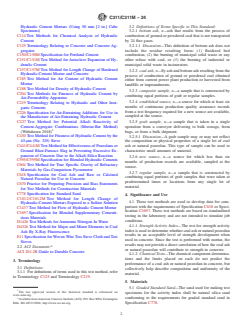
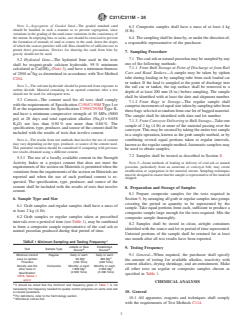
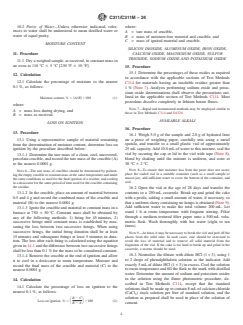
4.1 These test methods are used to develop data for comparison with the requirements of Specification C618 or Specification C1697. These test methods are based on standardized testing in the laboratory and are not intended to simulate job conditions.
4.1.1 Strength Activity Index—The test for strength activity index is used to determine whether coal ash or natural pozzolan results in an acceptable level of strength development when used in concrete. Since the test is performed with mortar, the results may not provide a direct correlation of how the coal ash or natural pozzolan will contribute to strength in concrete.
4.1.2 Chemical Tests—The chemical component determinations and the limits placed on each do not predict the performance of a coal ash or natural pozzolan in concrete, but collectively help describe composition and uniformity of the material.
SCOPE
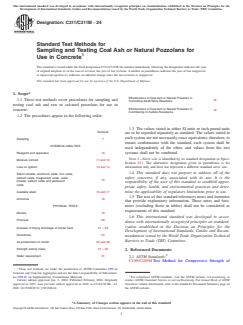
1.1 These test methods cover procedures for sampling and testing coal ash and raw or calcined pozzolans for use in concrete.
1.2 The procedures appear in the following order:
Sections
Sampling
7
CHEMICAL ANALYSIS
Reagents and apparatus
10
Moisture content
11 and 12
Loss on ignition
13 and 14
Silicon dioxide, aluminum oxide, iron oxide,
calcium oxide, magnesium oxide, sulfur
trioxide, sodium oxide and potassium
oxide
15
Available alkali
16 and 17
Ammonia
18
PHYSICAL TESTS
Density
19
Fineness
20
Increase of drying shrinkage of mortar bars
21 – 23
Soundness
24
Air-entrainment of mortar
25 and 26
Strength activity index
27 – 30
Water requirement
31
Effectiveness of Coal Ash or Natural Pozzolan in
Controlling Alkali-Silica Reactions
32
Effectiveness of Coal Ash or Natural Pozzolan in
Contributing to Sulfate Resistance
34
1.3 The values stated in either SI units or inch-pound units are to be regarded separately as standard. The values stated in each system are not necessarily exact equivalents; therefore, to ensure conformance with the standard, each system shall be used independently of the other, and values from the two systems shall not be combined.
Note 1: Sieve size is identified by its standard designation in Specification E11. The alternative designation given in parentheses is for information only and does not represent a different standard sieve size.
1.4 This standard does not purport to address all of the safety concerns, if any, associated with its use. It is the responsibility of the user of this standard to establish appropriate safety, health, and environmental practices and determine the applicability of regulatory limitations prior to use.
1.5 The text of this standard references notes and footnotes that provide explanatory information. These notes and footnotes (excluding those in tables) shall not be considered as requirements of this standard.
1.6 This international standard was developed in accordance with internationally recognized principles on standardization established in the Decision on Principles for the Development of International Standards, Guides and Recommendations issued by the World Trade Organization Technical Barriers to Trade (TBT) Committee.
- Status
- Published
- Publication Date
- 31-Dec-2023
- Technical Committee
- C09 - Concrete and Concrete Aggregates
- Drafting Committee
- C09.24 - Supplementary Cementitious Materials
Buy Documents
ASTM C311/C311M-24 - Standard Test Methods for Sampling and Testing Coal Ash or Natural Pozzolans for Use in Concrete
REDLINE ASTM C311/C311M-24 - Standard Test Methods for Sampling and Testing Coal Ash or Natural Pozzolans for Use in Concrete
Overview
ASTM C311/C311M-24, published by ASTM International, details standard test methods for sampling and testing coal ash and natural pozzolans (both raw and calcined) intended for use in concrete. This standard ensures consistency and quality control for supplementary cementitious materials by providing clear laboratory testing procedures. The methods specified in ASTM C311/C311M-24 develop data for evaluating materials against ASTM C618 and ASTM C1697 requirements, helping determine suitability for concrete applications with respect to chemical and physical properties. Importantly, these methods are designed for laboratory environments and do not replicate site or job conditions.
Key Topics
- Sampling Procedures
- Guidelines for collecting representative samples from bulk storage, shipments, or production lines, including grab, regular, and composite samples.
- Chemical Analysis
- Standardized procedures for assessing key chemical components such as silicon dioxide, aluminum oxide, iron oxide, calcium oxide, magnesium oxide, sulfur trioxide, sodium oxide, potassium oxide, available alkali, and ammonia content.
- Physical Testing
- Tests include density determination, fineness (wet-sieving on 45 µm sieve), drying shrinkage of mortar bars, soundness, air-entrainment, strength activity index, water requirement, and the effectiveness of coal ash or natural pozzolan in controlling alkali-silica reactions and improving sulfate resistance.
- Strength Activity Index
- Measurement indicating whether coal ash or pozzolan provides adequate strength development in concrete, though the test itself uses mortar, not concrete.
- Safety and Units
- Safety, health, and environmental protocols to be observed; values are reported separately in SI and inch-pound units.
Applications
Organizations involved in concrete production, such as ready-mix producers, quality assurance laboratories, and cement and pozzolan suppliers, rely on ASTM C311/C311M-24 for:
- Quality Control: Provides repeatable methods for verifying material uniformity and composition, crucial for meeting project specifications and ensuring performance.
- Specification Compliance: Enables comparison of coal ash or pozzolans to recognized standards, such as ASTM C618 and C1697, for determining acceptability in construction projects.
- Material Selection: Helps engineers and material suppliers identify suitable supplementary cementitious materials for concrete mixes, improving durability, strength, and sustainability.
- Performance Evaluation: Tests for controlling alkali-silica reaction and sulfate resistance help mitigate common durability issues found in concrete structures.
- Documentation and Reporting: Supplies protocols for documenting materials’ properties and ensuring transparency throughout supply chains.
Related Standards
ASTM C311/C311M-24 references several other key standards that together provide a comprehensive framework for supplementary cementitious materials in concrete:
- ASTM C618: Specification for Coal Ash and Raw or Calcined Natural Pozzolan for Use in Concrete
- ASTM C1697: Specification for Blended Supplementary Cementitious Materials
- ASTM C109/C109M: Test Method for Compressive Strength of Hydraulic Cement Mortars
- ASTM C114: Test Methods for Chemical Analysis of Hydraulic Cement
- ASTM C204 & C430: Test Methods for Fineness of Hydraulic Cement
- ASTM C157/C157M: Test Method for Length Change of Hardened Hydraulic-Cement Mortar and Concrete
- ASTM C441/C441M: Test Method for Effectiveness of Pozzolans in Preventing Alkali-Silica Reaction
- ASTM C1012/C1012M: Test Method for Sulfate Resistance of Hydraulic-Cement Mortars
By adhering to ASTM C311/C311M-24 and these related standards, stakeholders can ensure reliable, safe, and high-quality materials for concrete construction projects worldwide, supporting durability, performance, and sustainability in the built environment.
Relations
- Effective Date
- 01-Jan-2024
- Effective Date
- 01-Apr-2024
- Effective Date
- 01-Apr-2024
- Effective Date
- 01-Feb-2024
- Effective Date
- 01-Jan-2024
- Effective Date
- 01-Dec-2023
- Refers
ASTM C204-23 - Standard Test Methods for Fineness of Hydraulic Cement by Air-Permeability Apparatus - Effective Date
- 01-Apr-2023
- Effective Date
- 15-Jul-2021
- Effective Date
- 01-Aug-2020
- Effective Date
- 15-Dec-2018
- Effective Date
- 01-Apr-2018
- Effective Date
- 15-Jun-2015
- Effective Date
- 01-Jan-2024
- Effective Date
- 01-Jan-2024
- Effective Date
- 01-Jan-2024
Buy Documents
ASTM C311/C311M-24 - Standard Test Methods for Sampling and Testing Coal Ash or Natural Pozzolans for Use in Concrete
REDLINE ASTM C311/C311M-24 - Standard Test Methods for Sampling and Testing Coal Ash or Natural Pozzolans for Use in Concrete
Get Certified
Connect with accredited certification bodies for this standard

DIBt (Deutsches Institut für Bautechnik)
German Institute for Building Technology.
DIN CERTCO
DIN Group product certification.

Aboma Certification B.V.
Specialized in construction, metal, and transport sectors.
Sponsored listings
Frequently Asked Questions
ASTM C311/C311M-24 is a standard published by ASTM International. Its full title is "Standard Test Methods for Sampling and Testing Coal Ash or Natural Pozzolans for Use in Concrete". This standard covers: SIGNIFICANCE AND USE 4.1 These test methods are used to develop data for comparison with the requirements of Specification C618 or Specification C1697. These test methods are based on standardized testing in the laboratory and are not intended to simulate job conditions. 4.1.1 Strength Activity Index—The test for strength activity index is used to determine whether coal ash or natural pozzolan results in an acceptable level of strength development when used in concrete. Since the test is performed with mortar, the results may not provide a direct correlation of how the coal ash or natural pozzolan will contribute to strength in concrete. 4.1.2 Chemical Tests—The chemical component determinations and the limits placed on each do not predict the performance of a coal ash or natural pozzolan in concrete, but collectively help describe composition and uniformity of the material. SCOPE 1.1 These test methods cover procedures for sampling and testing coal ash and raw or calcined pozzolans for use in concrete. 1.2 The procedures appear in the following order: Sections Sampling 7 CHEMICAL ANALYSIS Reagents and apparatus 10 Moisture content 11 and 12 Loss on ignition 13 and 14 Silicon dioxide, aluminum oxide, iron oxide, calcium oxide, magnesium oxide, sulfur trioxide, sodium oxide and potassium oxide 15 Available alkali 16 and 17 Ammonia 18 PHYSICAL TESTS Density 19 Fineness 20 Increase of drying shrinkage of mortar bars 21 – 23 Soundness 24 Air-entrainment of mortar 25 and 26 Strength activity index 27 – 30 Water requirement 31 Effectiveness of Coal Ash or Natural Pozzolan in Controlling Alkali-Silica Reactions 32 Effectiveness of Coal Ash or Natural Pozzolan in Contributing to Sulfate Resistance 34 1.3 The values stated in either SI units or inch-pound units are to be regarded separately as standard. The values stated in each system are not necessarily exact equivalents; therefore, to ensure conformance with the standard, each system shall be used independently of the other, and values from the two systems shall not be combined. Note 1: Sieve size is identified by its standard designation in Specification E11. The alternative designation given in parentheses is for information only and does not represent a different standard sieve size. 1.4 This standard does not purport to address all of the safety concerns, if any, associated with its use. It is the responsibility of the user of this standard to establish appropriate safety, health, and environmental practices and determine the applicability of regulatory limitations prior to use. 1.5 The text of this standard references notes and footnotes that provide explanatory information. These notes and footnotes (excluding those in tables) shall not be considered as requirements of this standard. 1.6 This international standard was developed in accordance with internationally recognized principles on standardization established in the Decision on Principles for the Development of International Standards, Guides and Recommendations issued by the World Trade Organization Technical Barriers to Trade (TBT) Committee.
SIGNIFICANCE AND USE 4.1 These test methods are used to develop data for comparison with the requirements of Specification C618 or Specification C1697. These test methods are based on standardized testing in the laboratory and are not intended to simulate job conditions. 4.1.1 Strength Activity Index—The test for strength activity index is used to determine whether coal ash or natural pozzolan results in an acceptable level of strength development when used in concrete. Since the test is performed with mortar, the results may not provide a direct correlation of how the coal ash or natural pozzolan will contribute to strength in concrete. 4.1.2 Chemical Tests—The chemical component determinations and the limits placed on each do not predict the performance of a coal ash or natural pozzolan in concrete, but collectively help describe composition and uniformity of the material. SCOPE 1.1 These test methods cover procedures for sampling and testing coal ash and raw or calcined pozzolans for use in concrete. 1.2 The procedures appear in the following order: Sections Sampling 7 CHEMICAL ANALYSIS Reagents and apparatus 10 Moisture content 11 and 12 Loss on ignition 13 and 14 Silicon dioxide, aluminum oxide, iron oxide, calcium oxide, magnesium oxide, sulfur trioxide, sodium oxide and potassium oxide 15 Available alkali 16 and 17 Ammonia 18 PHYSICAL TESTS Density 19 Fineness 20 Increase of drying shrinkage of mortar bars 21 – 23 Soundness 24 Air-entrainment of mortar 25 and 26 Strength activity index 27 – 30 Water requirement 31 Effectiveness of Coal Ash or Natural Pozzolan in Controlling Alkali-Silica Reactions 32 Effectiveness of Coal Ash or Natural Pozzolan in Contributing to Sulfate Resistance 34 1.3 The values stated in either SI units or inch-pound units are to be regarded separately as standard. The values stated in each system are not necessarily exact equivalents; therefore, to ensure conformance with the standard, each system shall be used independently of the other, and values from the two systems shall not be combined. Note 1: Sieve size is identified by its standard designation in Specification E11. The alternative designation given in parentheses is for information only and does not represent a different standard sieve size. 1.4 This standard does not purport to address all of the safety concerns, if any, associated with its use. It is the responsibility of the user of this standard to establish appropriate safety, health, and environmental practices and determine the applicability of regulatory limitations prior to use. 1.5 The text of this standard references notes and footnotes that provide explanatory information. These notes and footnotes (excluding those in tables) shall not be considered as requirements of this standard. 1.6 This international standard was developed in accordance with internationally recognized principles on standardization established in the Decision on Principles for the Development of International Standards, Guides and Recommendations issued by the World Trade Organization Technical Barriers to Trade (TBT) Committee.
ASTM C311/C311M-24 is classified under the following ICS (International Classification for Standards) categories: 91.100.30 - Concrete and concrete products. The ICS classification helps identify the subject area and facilitates finding related standards.
ASTM C311/C311M-24 has the following relationships with other standards: It is inter standard links to ASTM C311/C311M-22, ASTM C219-24, ASTM C1012/C1012M-24, ASTM C670-24a, ASTM C670-24, ASTM C151/C151M-23, ASTM C204-23, ASTM C109/C109M-21, ASTM C219-20a, ASTM C1012/C1012M-18b, ASTM C151/C151M-18, ASTM C670-15, ASTM C1897-20, ASTM D5759-12(2020), ASTM C802-14(2022). Understanding these relationships helps ensure you are using the most current and applicable version of the standard.
ASTM C311/C311M-24 is available in PDF format for immediate download after purchase. The document can be added to your cart and obtained through the secure checkout process. Digital delivery ensures instant access to the complete standard document.
Standards Content (Sample)
This international standard was developed in accordance with internationally recognized principles on standardization established in the Decision on Principles for the
Development of International Standards, Guides and Recommendations issued by the World Trade Organization Technical Barriers to Trade (TBT) Committee.
Designation: C311/C311M − 24
Standard Test Methods for
Sampling and Testing Coal Ash or Natural Pozzolans for
Use in Concrete
This standard is issued under the fixed designation C311/C311M; the number immediately following the designation indicates the year
of original adoption or, in the case of revision, the year of last revision. A number in parentheses indicates the year of last reapproval.
A superscript epsilon (´) indicates an editorial change since the last revision or reapproval.
This standard has been approved for use by agencies of the U.S. Department of Defense.
1. Scope*
Effectiveness of Coal Ash or Natural Pozzolan in
1.1 These test methods cover procedures for sampling and
Controlling Alkali-Silica Reactions
testing coal ash and raw or calcined pozzolans for use in
Effectiveness of Coal Ash or Natural Pozzolan in
concrete.
Contributing to Sulfate Resistance
1.2 The procedures appear in the following order:
1.3 The values stated in either SI units or inch-pound units
Sections
are to be regarded separately as standard. The values stated in
each system are not necessarily exact equivalents; therefore, to
Sampling 7
ensure conformance with the standard, each system shall be
CHEMICAL ANALYSIS
used independently of the other, and values from the two
systems shall not be combined.
Reagents and apparatus 10
NOTE 1—Sieve size is identified by its standard designation in Speci-
Moisture content 11 and 12
fication E11. The alternative designation given in parentheses is for
Loss on ignition 13 and 14 information only and does not represent a different standard sieve size.
1.4 This standard does not purport to address all of the
Silicon dioxide, aluminum oxide, iron oxide,
calcium oxide, magnesium oxide, sulfur safety concerns, if any, associated with its use. It is the
trioxide, sodium oxide and potassium
responsibility of the user of this standard to establish appro-
oxide
priate safety, health, and environmental practices and deter-
Available alkali 16 and 17 mine the applicability of regulatory limitations prior to use.
1.5 The text of this standard references notes and footnotes
Ammonia 18
that provide explanatory information. These notes and foot-
PHYSICAL TESTS notes (excluding those in tables) shall not be considered as
requirements of this standard.
Density 19
1.6 This international standard was developed in accor-
Fineness 20
dance with internationally recognized principles on standard-
ization established in the Decision on Principles for the
Increase of drying shrinkage of mortar bars 21 – 23
Development of International Standards, Guides and Recom-
Soundness 24
mendations issued by the World Trade Organization Technical
Barriers to Trade (TBT) Committee.
Air-entrainment of mortar 25 and 26
Strength activity index 27 – 30
2. Referenced Documents
Water requirement 31
2.1 ASTM Standards:
C109/C109M Test Method for Compressive Strength of
These test methods are under the jurisdiction of ASTM Committee C09 on
Concrete and Concrete Aggregates and are the direct responsibility of Subcommit-
tee C09.24 on Supplementary Cementitious Materials. For referenced ASTM standards, visit the ASTM website, www.astm.org, or
Current edition approved Jan. 1, 2024. Published February 2024. Originally contact ASTM Customer Service at service@astm.org. For Annual Book of ASTM
approved in 1953. Last previous edition approved in 2022 as C311/C311M – 22. Standards volume information, refer to the standard’s Document Summary page on
DOI: 10.1520/C0311_C0311M-24. the ASTM website.
*A Summary of Changes section appears at the end of this standard
Copyright © ASTM International, 100 Barr Harbor Drive, PO Box C700, West Conshohocken, PA 19428-2959. United States
C311/C311M − 24
Hydraulic Cement Mortars (Using 50 mm [2 in.] Cube 3.2 Definitions of Terms Specific to This Standard:
Specimens) 3.2.1 bottom ash, n—ash that results from the process of
C114 Test Methods for Chemical Analysis of Hydraulic combustion of ground or powdered coal that is not transported
Cement by 24 flue gases.
C125 Terminology Relating to Concrete and Concrete Ag- 3.2.1.1 Discussion—This definition of bottom ash does not
gregates include the residue resulting from: (1) fluidized bed
C150/C150M Specification for Portland Cement combustion, (2) the burning of municipal solid waste or any
C151/C151M Test Method for Autoclave Expansion of Hy- other refuse with coal, or (3) the burning of industrial or
draulic Cement municipal solid waste in incinerators.
C157/C157M Test Method for Length Change of Hardened
3.2.2 coal ash, n—fly ash and bottom ash resulting from the
Hydraulic-Cement Mortar and Concrete
process of combustion of ground or powdered coal obtained
C185 Test Method for Air Content of Hydraulic Cement
either from current power plant production or harvested from
Mortar
landfills or impoundments.
C188 Test Method for Density of Hydraulic Cement
3.2.3 composite sample, n—a sample that is constructed by
C204 Test Methods for Fineness of Hydraulic Cement by
combining equal portions of grab or regular samples.
Air-Permeability Apparatus
3.2.4 established source, n—a source for which at least six
C219 Terminology Relating to Hydraulic and Other Inor-
months of continuous production quality assurance records
ganic Cements
from a test frequency required for a new source are available,
C226 Specification for Air-Entraining Additions for Use in
sampled at the source.
the Manufacture of Air-Entraining Hydraulic Cement
C227 Test Method for Potential Alkali Reactivity of 3.2.5 grab sample, n—a sample that is taken in a single
Cement-Aggregate Combinations (Mortar-Bar Method)
operation from a conveyor delivering to bulk storage, from
(Withdrawn 2018) bags, or from a bulk shipment.
C430 Test Method for Fineness of Hydraulic Cement by the
3.2.5.1 Discussion—A grab sample may or may not reflect
45-μm (No. 325) Sieve the composition or physical properties of a single lot of coal
C441/C441M Test Method for Effectiveness of Pozzolans or
ash or natural pozzolan. This type of sample can be used to
Ground Blast-Furnace Slag in Preventing Excessive Ex- characterize small amounts of material.
pansion of Concrete Due to the Alkali-Silica Reaction
3.2.6 new source, n—a source for which less than six
C595/C595M Specification for Blended Hydraulic Cements
months of production records are available, sampled at the
C604 Test Method for True Specific Gravity of Refractory
source.
Materials by Gas-Comparison Pycnometer
3.2.7 regular sample, n—a sample that is constructed by
C618 Specification for Coal Ash and Raw or Calcined
combining equal portions of grab samples that were taken at
Natural Pozzolan for Use in Concrete
predetermined times or locations from any single lot of
C670 Practice for Preparing Precision and Bias Statements
material.
for Test Methods for Construction Materials
C778 Specification for Standard Sand
4. Significance and Use
C1012/C1012M Test Method for Length Change of
4.1 These test methods are used to develop data for com-
Hydraulic-Cement Mortars Exposed to a Sulfate Solution
parison with the requirements of Specification C618 or Speci-
C1437 Test Method for Flow of Hydraulic Cement Mortar
fication C1697. These test methods are based on standardized
C1697 Specification for Blended Supplementary Cementi-
testing in the laboratory and are not intended to simulate job
tious Materials
conditions.
D1426 Test Methods for Ammonia Nitrogen In Water
4.1.1 Strength Activity Index—The test for strength activity
D4326 Test Method for Major and Minor Elements in Coal
index is used to determine whether coal ash or natural pozzolan
Ash By X-Ray Fluorescence
results in an acceptable level of strength development when
E11 Specification for Woven Wire Test Sieve Cloth and Test
used in concrete. Since the test is performed with mortar, the
Sieves
results may not provide a direct correlation of how the coal ash
2.2 ACI Document:
or natural pozzolan will contribute to strength in concrete.
ACI 201.2R Guide to Durable Concrete
4.1.2 Chemical Tests—The chemical component determina-
tions and the limits placed on each do not predict the
3. Terminology
performance of a coal ash or natural pozzolan in concrete, but
3.1 Definitions:
collectively help describe composition and uniformity of the
3.1.1 For definitions of terms used in this test method, refer
material.
to Terminology C125 and Terminology C219.
5. Materials
5.1 Graded Standard Sand—The sand used for making test
The last approved version of this historical standard is referenced on
specimens for the activity index shall be natural silica sand
www.astm.org.
conforming to the requirements for graded standard sand in
Available from American Concrete Institute (ACI), P.O. Box 9094, Farmington
Hills, MI 48333-9094, http://www.aci-int.org. Specification C778.
C311/C311M − 24
NOTE 2—Segregation of Graded Sand—The graded standard sand
6.3 Composite samples shall have a mass of at least 4 kg
should be handled in such a manner as to prevent segregation, since
(8 lb).
variations in the grading of the sand cause variations in the consistency of
6.4 The sampling shall be done by, or under the direction of,
the mortar. In emptying bins or sacks, care should be exercised to prevent
the formation of mounds of sand or craters in the sand, down the slopes
a responsible representative of the purchaser.
of which the coarser particles will roll. Bins should be of sufficient size to
permit these precautions. Devices for drawing the sand from bins by
7. Sampling Procedure
gravity should not be used.
7.1 The coal ash or natural pozzolan may be sampled by any
5.2 Hydrated Lime—The hydrated lime used in the tests
one of the following methods:
shall be reagent-grade calcium hydroxide, 95 % minimum
7.1.1 From Bulk Storage at Point of Discharge or from Rail
calculated as Ca(OH) (Note 3), and have a minimum fineness
Cars and Road Tankers—A sample may be taken by siphon
of 2500 m /kg as determined in accordance with Test Method
tube during loading or by sampling tube from each loaded car
C204.
or tanker. If the load is sampled at the point of discharge into
NOTE 3—The calcium hydroxide should be protected from exposure to
the rail car or tanker, the top surface shall be removed to a
carbon dioxide. Material remaining in an opened container after a test
depth of at least 200 mm (8 in.) before sampling. The sample
should not be used for subsequent tests.
shall be identified with at least the date and shipment number.
5.3 Cement—The cement used for all tests shall comply
7.1.2 From Bags in Storage—The regular sample shall
with the requirements of Specification C150/C150M Type I or
comprise increments of equal size taken by sampling tube from
II or the requirements for Specification C595/C595M Type IL
three bags selected at random from one lot of bagged material.
and have a minimum compressive strength of 35 MPa (5000
The sample shall be identified with date and lot number.
psi) at 28 days and total equivalent alkalies (Na O + 0.658
7.1.3 From Conveyor Delivering to Bulk Storage—Take one
K O) not less than 0.50 % nor more than 0.80 %. The
sample of 2 kg (4 lb) or more of the material passing over the
specification, type, producer, and source of the cement shall be
conveyor. This may be secured by taking the entire test sample
included with the results of tests that involve cement.
in a single operation, known as the grab sample method, or by
combining several equal portions taken at regular intervals,
NOTE 4—The results from test methods that involve the use of cement
may vary depending on the type, producer, or source of the cement used.
known as the regular sample method. Automatic samplers may
This potential variation should be considered if comparing with previous
be used to obtain samples.
test results obtained using a different cement.
7.2 Samples shall be treated as described in Section 8.
5.3.1 The use of a locally available cement in the Strength
Activity Index or a project cement that does not meet the NOTE 5—Some methods of loading or delivery of coal ash or natural
pozzolan, particularly from an airstream or conveyor belt, may create
requirements of the section on Materials is permitted when the
stratification or segregation in the material stream. Sampling techniques
variations from the requirements of the section on Materials are
must be designed to ensure that the sample is representative of the material
reported and when the use of such portland cement is re-
shipped.
quested. The specification, type, producer, and source of the
cement shall be included with the results of tests that involve
8. Preparation and Storage of Samples
cement.
8.1 Prepare composite samples for the tests required in
Section 9, by arranging all grab or regular samples into groups
6. Sample Type and Size
covering the period or quantity to be represented by the
6.1 Grab samples and regular samples shall have a mass of
sample. Take equal portions from each, sufficient to produce a
at least 2 kg (4 lb).
composite sample large enough for the tests required. Mix the
6.2 Grab samples or regular samples taken at prescribed
composite sample thoroughly.
intervals over a period of time (see Table 1), may be combined
8.2 Samples shall be stored in clean, airtight containers
to form a composite sample representative of the coal ash or
identified with the source and lot or period of time represented.
natural pozzolan produced during that period of time.
Untested portions of the sample shall be retained for at least
one month after all test results have been reported.
A
TABLE 1 Minimum Sampling and Testing Frequency
Jobsite or New Established
9. Testing Frequency
Test Sample Type
B B
Source Source
9.1 General—When required, the purchaser shall specify
Moisture content Regular Daily or each Daily or each
c C
Loss on ignition 90 Mg 360 Mg
the amount of testing for available alkalies, reactivity with
(400 Tons)
Fineness (100 Tons)
cement alkalies, drying shrinkage, and air-entrainment. Make
Density and the Composite Monthly or each Monthly or each
C C
all other tests on regular or composite samples chosen as
other tests in 1 800 Mg 2 900 Mg
(2 000 Tons) (3 200 Tons)
Specification
specified in Table 1.
C618, Tables 1
and 2
CHEMICAL ANALYSIS
A
It should be noted that the minimum test frequency given in Table 1 is not
necessarily the frequency needed for quality control programs on some coal ash
10. General
or natural pozzolans.
B
For definitions, refer to the Terminology section.
C 10.1 All apparatus, reagents and techniques shall comply
Whichever comes first.
with the requirements of Test Methods C114.
C311/C311M − 24
10.2 Purity of Water—Unless otherwise indicated, refer- where:
ences to water shall be understood to mean distilled water or
A = tare mass of crucible,
water of equal purity.
B = mass of moisture-free material and crucible, and
C = mass of ignited material and crucible.
MOISTURE CONTENT
SILICON DIOXIDE, ALUMINUM OXIDE, IRON OXIDE,
11. Procedure CALCIUM OXIDE, MAGNESIUM OXIDE, SULFUR
TRIOXIDE, SODIUM OXIDE AND POTASSIUM OXIDE
11.1 Dry a weighed sample, as received, to constant mass in
an oven at 110 °C 6 5 °C [230 °F 6 10 °F].
15. Procedure
15.1 Determine the percentages of these oxides as required
12. Calculation
in accordance with the applicable sections of Test Methods
12.1 Calculate the percentage of moisture to the nearest
C114 for materials having an insoluble residue greater than
0.1 %, as follows:
1 % (Note 7). Analysts performing sodium oxide and potas-
sium oxide determinations shall observe the precautions out-
lined in the applicable section of Test Methods C114. Most
Moisture content, % 5 ~A/B! × 100 (1)
pozzolans dissolve completely in lithium borate fluxes.
where:
NOTE 7—Rapid and instrumental methods may be employed similar to
A = mass loss during drying, and
those in Test Methods C114 and D4326.
B = mass as received.
AVAILABLE ALKALI
LOSS ON IGNITION
16. Procedure
13. Procedure
16.1 Weigh 5.0 g of the sample and 2.0 g of hydrated lime
13.1 Using a representative sample of material remaining on a piece of weighing paper, carefully mix using a metal
spatula, and transfer to a small plastic vial of approximately
from the determination of moisture content, determine loss on
ignition by the procedure described below: 25 mL capacity. Add 10.0 mL of water to this mixture, seal the
vial by securing the cap or lid to the vial with tape (Note 8),
13.1.1 Determine the tare mass of a clean, cool, uncovered,
blend by shaking until the mixture is uniform, and store at
porcelain crucible, and record the tare mass of the crucible (A)
38 °C 6 2 °C.
to the nearest 0.0001 g.
NOTE 8—To ensure that moisture loss from the paste does not occur,
NOTE 6—The tare mass of crucibles should be determined by preheat-
place the sealed vial in a sealable container (such as a small sample or
ing the empty crucible to constant mass at the same temperature and under
mason jar), add sufficient water to cover the bottom of the container, and
the same conditions as used for the final ignition of a residue, and cooling
seal.
in a desiccator for the same period of time used for the crucible containing
the residue.
16.2 Open the vial at the age of 28 days and transfer the
contents to a 250 mL casserole. Break up and grind the cake
13.1.2 In the crucible, place an amount of material between
0.5 and 4 g and record the combined mass of the crucible and with a pestle, adding a small amount of water, if necessary, so
that a uniform slurry containing no lumps is obtained (Note 9).
material (B) to the nearest 0.0001 g.
Add sufficient water to make the total volume 200 mL. Let
13.1.3 Ignite the crucible and material to constant mass in a
stand 1 h at room temperature with frequent stirring. Filter
furnace at 750 6 50 °C. Constant mass shall be obtained by
through a medium-textured filter paper onto a 500 mL volu-
any of the following methods: 1) firing for 45 minutes, 2)
metric flask. Wash thoroughly with hot water (eight to ten
successive firings until constant mass is established by mea-
times).
suring the loss between two successive firings. When using
successive firings, the initial firing duration shall be at least
NOTE 9—At times it may be necessary to break the vial and peel off the
15 minutes and subsequent firings at least 5 minutes in dura-
plastic from the solid cake. In such cases, care should be exercised to
tion. The loss after each firing is calculated using the equation avoid the loss of material and to remove all solid material from the
fragments of the vial. If the cake is too hard to break up and grind in the
given in 14.1 and the difference between two successive firings
casserole, a mortar should be used.
shall be less than 0.1 % for the mass to be considered constant.
16.3 Neutralize the filtrate with dilute HCl (1 + 3), using 1
13.1.4 Remove the crucible at the end of ignition and allow
to 2 drops of phenolphthalein solution as the indicator. Add
it to cool in a desiccator to room temperature. Measure and
exactly 5 mL of dilute HCl (1 + 3) in excess. Cool the solution
record the final mass of the crucible and material (C) to the
to room temperature and fill the flask to the mark with distilled
nearest 0.0001 g.
water. Determine the amount of sodium and potassium oxides
in the solution using the flame photometric procedure, de-
14. Calculation
scribed in Test Methods C114, except that the standard
14.1 Calculate the percentage of loss on ignition to the
solutions shall be made up to contain 8 mL of calcium chloride
nearest 0.1 %, as follows:
(CaCl ) stock solution per litre of standard solution, and the
B 2 C
solution as prepared shall be used in place of the solution of
Loss on ignition, % 5 × 100 (2)
S D
B 2 A cement.
C311/C311M − 24
NOTE 10—The standard solutions made up with 8 mL of calcium
FINENESS, AMOUNT RETAINED WHEN WET-SIEVED ON
chloride (CaCl ) stock solution contain the equivalent of 504 ppm of CaO.
A45-μm (NO. 325) SIEVE
Tests have shown that this amount closely approximates the amount of
calcium dissolved in the test solution.
20. Procedure
17. Calculation and Report
20.1 Determine the amount of the sample retained when
wet-sieved on a 45 μm (No. 325) sieve, in accordance with Test
17.1 Calculate the results as weight percent of the original
Method C430, with the following exceptions.
sample material. Report as equivalent percentage of sodium
20.1.1 Calibrate the 45-μm (No. 325) sieve using a cement
oxide (Na O), calculated as follows:
standard (SRM 114). Calculate the sieve correction factors as
follows:
Equivalent Na O, % 5 Na O, %10.658 × K O, % (3)
2 2 2
CF 5 std 2 obs (5)
AMMONIA
where:
CF = the sieve correction factor, %, (include a negative
18. Procedure
sign when appropriate),
18.1 Weigh 1.00 g of the coal ash sample into a 125-mL
std = the certified residue value for the SRM, %, and
Erlenmeyer flask. Add 100 mL of ammonia-free water. Place a
obs = the observed residue value for the SRM, %.
neoprene rubber stopper on the flask and swirl the contents to
20.1.2 Calculate the fineness of the coal ash or natural
thoroughly mix the sample and the water.
pozzolan to the nearest 0.1 % as follows:
18.2 Filter the mixture using a medium-textured filter paper
and save the filtrate for the ammonia determination.
R 5 R 1CF (6)
C S
18.3 Determine the concentration of ammonia in the filtrate
where:
in accordance with the procedures outlined in Test Methods
R = corrected sieve residue, %,
C
D1426, Method A–Direct Nesslerization or Method B–Selec-
R = observed residue for the test sample, %, and
S
tive Ion Electrode.
CF = the sieve correction factor, %.
18.4 Calculate the ammonia concentration of the coal ash as
If the residue retained for the test sample is equal to zero
follows:
(R = 0), then the sieve correction factor shall not be added to
S
Ammonia, mg/kg 5 N × V /W (4)
the test result to calculate the corrected sieve residue. In such
W W fa
cases, the corrected fineness shall be reported as zero.
where:
N = ammonia concentration of the water extract deter- NOTE 11—Test Method C430 has been adopted for testing coal ash
W
fineness. However, certain requirements, such as cleaning of sieves and
mined by Test Methods D1426, mg/L,
interpretation of the test results, are sometimes not appropriate for coal
V = volume of water used for extracting ammonia from
W
ashes.
the coal ash sample, mL, and
W = mass of coal ash sample used in the test, g.
20.2 Numerical examples for calibrating a fineness sieve
fa
and calculating the corrected fineness.
PHYSICAL TESTS
20.2.1 Calibrating a fineness sieve (NIST standard reference
material SRM 114p was used in this example):
DENSITY
Certified residue retained on a 45 2 μm sieve
19. Procedure
58.24 % ~obtained from standard certificate!
Measured residue retained on a 45 2 μm sieve
19.1 Determine the density of the sample in accordance
57.12 % measured in the laboratory
with the procedure described in Test Method C188 or Test ~ !
Method C604 as modified below.
Correction factor CF
~ !
5standard value std 2 observed value obs
~ ! ~ !
19.2 For Test Method C188, follow the procedure except
58.24 2 7.12 5 1.12 %
use a quantity of coal ash or natural pozzolan weighed to the
nearest 0.05 g, of about 50 g.
20.2.2 Calculating a corrected fineness value for a cali-
brated sieve (coal ash A was used in this example):
19.3 For Test Method C604 use an amount of material that
is appropriate for the instrument.
Amount of coal ash A retained on the sieve:R
s
19.3.1 Determine the density of the material as received. Do
515.2 % expressed as a % of sample mass
~ !
not prepare sample as described in Section 6 of Test Method
Corrected sieve residue for coal ash A:R
c
C604.
5R 1CF
s
515.211.12
19.4 In the final report of the density value, indicate which
test method was used in measuring density. 516.3 %
C311/C311M − 24
INCREASE OF DRYING SHRINKAGE OF MORTAR BARS average drying shrinkage of the test specimens, prefix a minus
sign to the increase of drying shrinkage of mortar bars
21. Test Specimen
reported. Report the specification, type, producer, and source
21.1 The cement used in the Drying Shrinkage of Mortar of the hydraulic cement used.
Bars test shall comply with the requirements in the section on
SOUNDNESS
Materials
21.2 Prepare test specimens in accordance with the proce-
24. Procedure
dures described in Test Method C157/C157M, except mold
24.1 Conduct the soundness test in accordance with Test
three mortar bars from both the control mix and the test mix
Method C151/C151M, except the specimens shall be molded
using the following proportions:
from a paste compo
...
This document is not an ASTM standard and is intended only to provide the user of an ASTM standard an indication of what changes have been made to the previous version. Because
it may not be technically possible to adequately depict all changes accurately, ASTM recommends that users consult prior editions as appropriate. In all cases only the current version
of the standard as published by ASTM is to be considered the official document.
Designation: C311/C311M − 22 C311/C311M − 24
Standard Test Methods for
Sampling and Testing FlyCoal Ash or Natural Pozzolans for
Use in Portland-Cement Concrete
This standard is issued under the fixed designation C311/C311M; the number immediately following the designation indicates the year
of original adoption or, in the case of revision, the year of last revision. A number in parentheses indicates the year of last reapproval.
A superscript epsilon (´) indicates an editorial change since the last revision or reapproval.
This standard has been approved for use by agencies of the U.S. Department of Defense.
1. Scope*
1.1 These test methods cover procedures for sampling and testing flycoal ash and raw or calcined pozzolans for use in
portland-cement concrete.
1.2 The procedures appear in the following order:
Sections
Sampling 7
CHEMICAL ANALYSIS
Reagents and apparatus 10
Moisture content 11 and 12
Loss on ignition 13 and 14
Silicon dioxide, aluminum oxide, iron oxide,
calcium oxide, magnesium oxide, sulfur
trioxide, sodium oxide and potassium
oxide
Available alkali 16 and 17
Ammonia 18
PHYSICAL TESTS
Density 19
Fineness 20
Increase of drying shrinkage of mortar bars 21 – 23
Soundness 24
These test methods are under the jurisdiction of ASTM Committee C09 on Concrete and Concrete Aggregates and are the direct responsibility of Subcommittee C09.24
on Supplementary Cementitious Materials.
Current edition approved Feb. 1, 2022Jan. 1, 2024. Published February 2022February 2024. Originally approved in 1953. Last previous edition approved in 20182022
as C311/C311M – 18.C311/C311M – 22. DOI: 10.1520/C0311_C0311M-22.10.1520/C0311_C0311M-24.
*A Summary of Changes section appears at the end of this standard
Copyright © ASTM International, 100 Barr Harbor Drive, PO Box C700, West Conshohocken, PA 19428-2959. United States
C311/C311M − 24
Air-entrainment of mortar 25 and 26
Strength activity index with portland cement 27 – 30
Strength activity index 27 – 30
Water requirement 31
Effectiveness of Fly Ash or Natural Pozzolan in
Controlling Alkali-Silica Reactions
Effectiveness of Coal Ash or Natural Pozzolan in
Controlling Alkali-Silica Reactions
Effectiveness of Fly Ash or Natural Pozzolan in
Contributing to Sulfate Resistance
Effectiveness of Coal Ash or Natural Pozzolan in
Contributing to Sulfate Resistance
1.3 The values stated in either SI units or inch-pound units are to be regarded separately as standard. The values stated in each
system are not necessarily exact equivalents; therefore, to ensure conformance with the standard, each system shall be used
independently of the other, and values from the two systems shall not be combined.
NOTE 1—Sieve size is identified by its standard designation in Specification E11. The alternative designation given in parentheses is for information only
and does not represent a different standard sieve size.
1.4 This standard does not purport to address all of the safety concerns, if any, associated with its use. It is the responsibility
of the user of this standard to establish appropriate safety, health, and environmental practices and determine the applicability of
regulatory limitations prior to use.
1.5 The text of this standard references notes and footnotes that provide explanatory information. These notes and footnotes
(excluding those in tables) shall not be considered as requirements of this standard.
1.6 This international standard was developed in accordance with internationally recognized principles on standardization
established in the Decision on Principles for the Development of International Standards, Guides and Recommendations issued
by the World Trade Organization Technical Barriers to Trade (TBT) Committee.
2. Referenced Documents
2.1 ASTM Standards:
C109/C109M Test Method for Compressive Strength of Hydraulic Cement Mortars (Using 50 mm [2 in.] Cube Specimens)
C114 Test Methods for Chemical Analysis of Hydraulic Cement
C125 Terminology Relating to Concrete and Concrete Aggregates
C150/C150M Specification for Portland Cement
C151/C151M Test Method for Autoclave Expansion of Hydraulic Cement
C157/C157M Test Method for Length Change of Hardened Hydraulic-Cement Mortar and Concrete
C185 Test Method for Air Content of Hydraulic Cement Mortar
C188 Test Method for Density of Hydraulic Cement
C204 Test Methods for Fineness of Hydraulic Cement by Air-Permeability Apparatus
C219 Terminology Relating to Hydraulic and Other Inorganic Cements
C226 Specification for Air-Entraining Additions for Use in the Manufacture of Air-Entraining Hydraulic Cement
C227 Test Method for Potential Alkali Reactivity of Cement-Aggregate Combinations (Mortar-Bar Method) (Withdrawn 2018)
C430 Test Method for Fineness of Hydraulic Cement by the 45-μm (No. 325) Sieve
C441/C441M Test Method for Effectiveness of Pozzolans or Ground Blast-Furnace Slag in Preventing Excessive Expansion of
Concrete Due to the Alkali-Silica Reaction
C595/C595M Specification for Blended Hydraulic Cements
C604 Test Method for True Specific Gravity of Refractory Materials by Gas-Comparison Pycnometer
C618 Specification for Coal Ash and Raw or Calcined Natural Pozzolan for Use in Concrete
C670 Practice for Preparing Precision and Bias Statements for Test Methods for Construction Materials
For referenced ASTM standards, visit the ASTM website, www.astm.org, or contact ASTM Customer Service at service@astm.org. For Annual Book of ASTM Standards
volume information, refer to the standard’s Document Summary page on the ASTM website.
The last approved version of this historical standard is referenced on www.astm.org.
C311/C311M − 24
C778 Specification for Standard Sand
C1012/C1012M Test Method for Length Change of Hydraulic-Cement Mortars Exposed to a Sulfate Solution
C1437 Test Method for Flow of Hydraulic Cement Mortar
C1697 Specification for Blended Supplementary Cementitious Materials
D1426 Test Methods for Ammonia Nitrogen In Water
D4326 Test Method for Major and Minor Elements in Coal Ash By X-Ray Fluorescence
E11 Specification for Woven Wire Test Sieve Cloth and Test Sieves
2.2 ACI Document:
ACI 201.2R Guide to Durable Concrete
3. Terminology
3.1 Definitions:
3.1.1 For definitions of terms used in this test method, refer to Terminology C125 and Terminology C219.
3.2 Definitions of Terms Specific to This Standard:
3.2.1 bottom ash, n—ash that results from the process of combustion of ground or powdered coal that is not transported by 24 flue
gases.
3.2.1.1 Discussion—
This definition of bottom ash does not include the residue resulting from: (1) fluidized bed combustion, (2) the burning of
municipal solid waste or any other refuse with coal, or (3) the burning of industrial or municipal solid waste in incinerators.
3.2.2 coal ash, n—fly ash and bottom ash resulting from the process of combustion of ground or powdered coal obtained either
from current power plant production or harvested from landfills or impoundments.
3.2.3 composite sample, n—a sample that is constructed by combining equal portions of grab or regular samples.
3.2.4 established source, n—a source for which at least six months of continuous production quality assurance records from a test
frequency required for a new source are available, sampled at the source.
3.2.5 grab sample, n—a sample that is taken in a single operation from a conveyor delivering to bulk storage, from bags, or from
a bulk shipment.
3.2.5.1 Discussion—
A grab sample may or may not reflect the composition or physical properties of a single lot of flycoal ash or natural pozzolan. This
type of sample can be used to characterize small amounts of material.
3.2.6 new source, n—a source for which less than six months of production records are available, sampled at the source.
3.2.7 regular sample, n—a sample that is constructed by combining equal portions of grab samples that were taken at
predetermined times or locations from any single lot of material.
4. Significance and Use
4.1 These test methods are used to develop data for comparison with the requirements of Specification C618 or Specification
C1697. These test methods are based on standardized testing in the laboratory and are not intended to simulate job conditions.
4.1.1 Strength Activity Index—The test for strength activity index is used to determine whether flycoal ash or natural pozzolan
results in an acceptable level of strength development when used with hydraulic cement in concrete. Since the test is performed
with mortar, the results may not provide a direct correlation of how the flycoal ash or natural pozzolan will contribute to strength
in concrete.
4.1.2 Chemical Tests—The chemical component determinations and the limits placed on each do not predict the performance of
a flycoal ash or natural pozzolan with hydraulic cement in concrete, but collectively help describe composition and uniformity of
the material.
Available from American Concrete Institute (ACI), P.O. Box 9094, Farmington Hills, MI 48333-9094, http://www.aci-int.org.
C311/C311M − 24
5. Materials
5.1 Graded Standard Sand—The sand used for making test specimens for the activity index with lime or portland cement shall
be natural silica sand conforming to the requirements for graded standard sand in Specification C778.
NOTE 2—Segregation of Graded Sand—The graded standard sand should be handled in such a manner as to prevent segregation, since variations in the
grading of the sand cause variations in the consistency of the mortar. In emptying bins or sacks, care should be exercised to prevent the formation of
mounds of sand or craters in the sand, down the slopes of which the coarser particles will roll. Bins should be of sufficient size to permit these precautions.
Devices for drawing the sand from bins by gravity should not be used.
5.2 Hydrated Lime—The hydrated lime used in the tests shall be reagent-grade calcium hydroxide, 95 % minimum calculated as
Ca(OH) (Note 3), and have a minimum fineness of 2500 m /kg as determined in accordance with Test Method C204.
NOTE 3—The calcium hydroxide should be protected from exposure to carbon dioxide. Material remaining in an opened container after a test should not
be used for subsequent tests.
5.3 Portland Cement—The portland cement used in the Strength Activity Index with Portland Cement test cement used for all tests
shall comply with the requirements of Specification C150/C150M Type I or II or the requirements for Specification C595/C595M
Type IL and have a minimum compressive strength of 35 MPa (5000 psi) at 28 days and total equivalent alkalies (Na O + 0.658
K O) not less than 0.50 % nor more than 0.80 %. The specification, type, producer, and source of the cement shall be included with
the results of tests that involve cement.
NOTE 4—The results from test methods that involve the use of cement may vary depending on the type, producer, or source of the cement used. This
potential variation should be considered if comparing with previous test results obtained using a different cement.
5.3.1 The use of a locally available portland cement in the Strength Activity Index or a project cement that does not meet the
requirements of the section on Materials is permitted when the variations from the requirements of the section on Materials are
reported and when the use of such portland cement is requested. The specification, type, producer, and source of the cement shall
be included with the results of tests that involve cement.
6. Sample Type and Size
6.1 Grab samples and regular samples shall have a mass of at least 2 kg (4 lb).
6.2 Grab samples or regular samples taken at prescribed intervals over a period of time (see Table 1), may be combined to form
a composite sample representative of the flycoal ash or natural pozzolan produced during that period of time.
6.3 Composite samples shall have a mass of at least 4 kg (8 lb).
6.4 The sampling shall be done by, or under the direction of, a responsible representative of the purchaser.
A
TABLE 1 Minimum Sampling and Testing Frequency
Jobsite or New Established
Test Sample Type
B B
Source Source
Moisture content Regular Daily or each Daily or each
c C
Loss on ignition 90 Mg 360 Mg
(400 Tons)
Fineness (100 Tons)
Density and the Composite Monthly or each Monthly or each
C C
other tests in 1 800 Mg 2 900 Mg
(2 000 Tons) (3 200 Tons)
Specification
C618, Tables 1
and 2
A
It should be noted that the minimum test frequency given in Table 1 is not
necessarily the frequency needed for quality control programs on some flycoal ash
or natural pozzolans.
B
For definitions, refer to the Terminology section.
C
Whichever comes first.
C311/C311M − 24
7. Sampling Procedure
7.1 The flycoal ash or natural pozzolan may be sampled by any one of the following methods:
7.1.1 From Bulk Storage at Point of Discharge or from Rail Cars and Road Tankers—A sample may be taken by siphon tube
during loading or by sampling tube from each loaded car or tanker. If the load is sampled at the point of discharge into the rail
car or tanker, the top surface shall be removed to a depth of at least 200 mm (8 in.) before sampling. The sample shall be identified
with at least the date and shipment number.
7.1.2 From Bags in Storage—The regular sample shall comprise increments of equal size taken by sampling tube from three bags
selected at random from one lot of bagged material. The sample shall be identified with date and lot number.
7.1.3 From Conveyor Delivering to Bulk Storage—Take one sample of 2 kg (4 lb) or more of the material passing over the
conveyor. This may be secured by taking the entire test sample in a single operation, known as the grab sample method, or by
combining several equal portions taken at regular intervals, known as the regular sample method. Automatic samplers may be used
to obtain samples.
7.2 Samples shall be treated as described in Section 8.
NOTE 5—Some methods of loading or delivery of flycoal ash or natural pozzolan, particularly from an airstream or conveyor belt, may create stratification
or segregation in the material stream. Sampling techniques must be designed to ensure that the sample is representative of the material shipped.
8. Preparation and Storage of Samples
8.1 Prepare composite samples for the tests required in Section 9, by arranging all grab or regular samples into groups covering
the period or quantity to be represented by the sample. Take equal portions from each, sufficient to produce a composite sample
large enough for the tests required. Mix the composite sample thoroughly.
8.2 Samples shall be stored in clean, airtight containers identified with the source and lot or period of time represented. Untested
portions of the sample shall be retained for at least one month after all test results have been reported.
9. Testing Frequency
9.1 General—When required, the purchaser shall specify the amount of testing for available alkalies, reactivity with cement
alkalies, drying shrinkage, and air-entrainment. Make all other tests on regular or composite samples chosen as specified in Table
1.
CHEMICAL ANALYSIS
10. General
10.1 All apparatus, reagents and techniques shall comply with the requirements of Test Methods C114.
10.2 Purity of Water—Unless otherwise indicated, references to water shall be understood to mean distilled water or water of equal
purity.
MOISTURE CONTENT
11. Procedure
11.1 Dry a weighed sample, as received, to constant mass in an oven at 110 °C 6 5 °C [230 °F 6 10 °F].
12. Calculation
12.1 Calculate the percentage of moisture to the nearest 0.1 %, as follows:
C311/C311M − 24
Moisture content,%5 A/B ×100 (1)
~ !
where:
A = mass loss during drying, and
B = mass as received.
LOSS ON IGNITION
13. Procedure
13.1 Using a representative sample of material remaining from the determination of moisture content, determine loss on ignition
by the procedure described below:
13.1.1 Determine the tare mass of a clean, cool, uncovered, porcelain crucible, and record the tare mass of the crucible (A) to the
nearest 0.0001 g.
NOTE 6—The tare mass of crucibles should be determined by preheating the empty crucible to constant mass at the same temperature and under the same
conditions as used for the final ignition of a residue, and cooling in a desiccator for the same period of time used for the crucible containing the residue.
13.1.2 In the crucible, place an amount of material between 0.5 and 4 g and record the combined mass of the crucible and material
(B) to the nearest 0.0001 g.
13.1.3 Ignite the crucible and material to constant mass in a furnace at 750 6 50 °C. Constant mass shall be obtained by any of
the following methods: 1) firing for 45 minutes, 2) successive firings until constant mass is established by measuring the loss
between two successive firings. When using successive firings, the initial firing duration shall be at least 15 minutes and subsequent
firings at least 5 minutes in duration. The loss after each firing is calculated using the equation given in 14.1 and the difference
between two successive firings shall be less than 0.1 % for the mass to be considered constant.
13.1.4 Remove the crucible at the end of ignition and allow it to cool in a desiccator to room temperature. Measure and record
the final mass of the crucible and material (C) to the nearest 0.0001 g.
14. Calculation
14.1 Calculate the percentage of loss on ignition to the nearest 0.1 %, as follows:
B 2 C
Loss on ignition, % 5 ×100 (2)
S D
B 2 A
where:
A = tare mass of crucible,
B = mass of moisture-free material and crucible, and
C = mass of ignited material and crucible.
SILICON DIOXIDE, ALUMINUM OXIDE, IRON OXIDE, CALCIUM OXIDE, MAGNESIUM OXIDE, SULFUR TRIOXIDE,
SODIUM OXIDE AND POTASSIUM OXIDE
15. Procedure
15.1 Determine the percentages of these oxides as required in accordance with the applicable sections of Test Methods C114 for
materials having an insoluble residue greater than 1 % (Note 67). Analysts performing sodium oxide and potassium oxide
determinations shall observe the precautions outlined in the applicable section of Test Methods C114. Most pozzolans dissolve
completely in lithium borate fluxes.
NOTE 7—Rapid and instrumental methods may be employed similar to those in Test Methods C114 and D4326.
C311/C311M − 24
AVAILABLE ALKALI
16. Procedure
16.1 Weigh 5.0 g of the sample and 2.0 g of hydrated lime on a piece of weighing paper, carefully mix using a metal spatula, and
transfer to a small plastic vial of approximately 25 mL capacity. Add 10.0 mL of water to this mixture, seal the vial by securing
the cap or lid to the vial with tape (Note 78), blend by shaking until the mixture is uniform, and store at 38 °C 6 2 °C.
NOTE 8—To ensure that moisture loss from the paste does not occur, place the sealed vial in a sealable container (such as a small sample or mason jar),
add sufficient water to cover the bottom of the container, and seal.
16.2 Open the vial at the age of 28 days and transfer the contents to a 250 mL casserole. Break up and grind the cake with a pestle,
adding a small amount of water, if necessary, so that a uniform slurry containing no lumps is obtained (Note 89). Add sufficient
water to make the total volume 200 mL. Let stand 1 h at room temperature with frequent stirring. Filter through a medium-textured
filter paper onto a 500 mL volumetric flask. Wash thoroughly with hot water (eight to ten times).
NOTE 9—At times it may be necessary to break the vial and peel off the plastic from the solid cake. In such cases, care should be exercised to avoid the
loss of material and to remove all solid material from the fragments of the vial. If the cake is too hard to break up and grind in the casserole, a mortar
should be used.
16.3 Neutralize the filtrate with dilute HCl (1 + 3), using 1 to 2 drops of phenolphthalein solution as the indicator. Add exactly
5 mL of dilute HCl (1 + 3) in excess. Cool the solution to room temperature and fill the flask to the mark with distilled water.
Determine the amount of sodium and potassium oxides in the solution using the flame photometric procedure, described in Test
Methods C114, except that the standard solutions shall be made up to contain 8 mL of calcium chloride (CaCl ) stock solution per
litre of standard solution, and the solution as prepared shall be used in place of the solution of cement.
NOTE 10—The standard solutions made up with 8 mL of calcium chloride (CaCl ) stock solution contain the equivalent of 504 ppm of CaO. Tests have
shown that this amount closely approximates the amount of calcium dissolved in the test solution.
17. Calculation and Report
17.1 Calculate the results as weight percent of the original sample material. Report as equivalent percentage of sodium oxide
(Na O), calculated as follows:
Equivalent Na O,%5 Na O,%10.658 ×K O,% (3)
2 2 2
AMMONIA
18. Procedure
18.1 Weigh 1.00 g of the flycoal ash sample into a 125-mL Erlenmeyer flask. Add 100 mL of ammonia-free water. Place a
neoprene rubber stopper on the flask and swirl the contents to thoroughly mix the sample and the water.
18.2 Filter the mixture using a medium-textured filter paper and save the filtrate for the ammonia determination.
18.3 Determine the concentration of ammonia in the filtrate in accordance with the procedures outlined in Test Methods D1426,
Method A–Direct Nesslerization or Method B–Selective Ion Electrode.
18.4 Calculate the ammonia concentration of the flycoal ash as follows:
Ammonia, mg/kg 5 N ×V /W (4)
W W fa
where:
N = ammonia concentration of the water extract determined by Test Methods D1426, mg/L,
W
C311/C311M − 24
V = volume of water used for extracting ammonia from the fly ash sample, mL, and
W
V = volume of water used for extracting ammonia from the coal ash sample, mL, and
W
W = mass of fly ash sample used in the test, g.
fa
W = mass of coal ash sample used in the test, g.
fa
PHYSICAL TESTS
DENSITY
19. Procedure
19.1 Determine the density of the sample in accordance with the procedure described in Test Method C188 or Test Method C604
as modified below.
19.2 For Test Method C188, follow the procedure except use a quantity of flycoal ash or natural pozzolan weighed to the nearest
0.05 g, of about 50 g.
19.3 For Test Method C604 use an amount of material that is appropriate for the instrument.
19.3.1 Determine the density of the material as received. Do not prepare sample as described in Section 6 of Test Method C604.
19.4 In the final report of the density value, indicate which test method was used in measuring density.
FINENESS, AMOUNT RETAINED WHEN WET-SIEVED ON A45-μm (NO. 325) SIEVE
20. Procedure
20.1 Determine the amount of the sample retained when wet-sieved on a 45 μm (No. 325) sieve, in accordance with Test Method
C430, with the following exceptions.
20.1.1 Calibrate the 45-μm (No. 325) sieve using a cement standard (SRM 114). Calculate the sieve correction factors as follows:
CF 5 std 2 obs (5)
where:
CF = the sieve correction factor, %, (include a negative sign when appropriate),
std = the certified residue value for the SRM, %, and
obs = the observed residue value for the SRM, %.
20.1.2 Calculate the fineness of the flycoal ash or natural pozzolan to the nearest 0.1 % as follows:
R 5 R 1CF (6)
C S
where:
R = corrected sieve residue, %,
C
R = observed residue for the test sample, %, and
S
CF = the sieve correction factor, %.
If the residue retained for the test sample is equal to zero
(R = 0), then the sieve correction factor shall not be added to the test result to calculate the corrected sieve residue. In such cases,
S
the corrected fineness shall be reported as zero.
NOTE 11—Test Method C430 has been adopted for testing flycoal ash fineness. However, certain requirements, such as cleaning of sieves and
interpretation of the test results, are sometimes not appropriate for flycoal ashes.
C311/C311M − 24
20.2 Numerical examples for calibrating a fineness sieve and calculating the corrected fineness.
20.2.1 Calibrating a fineness sieve (NIST standard reference material SRM 114p was used in this example):
Certified residue retained on a 45 2 μm sieve
58.24 % obtained from standard certificate
~ !
Measured residue retained on a 45 2 μm sieve
57.12 % measured in the laboratory
~ !
Correction factor ~CF!
5standard value ~std! 2 observed value ~obs!
58.24 2 7.12 5 1.12 %
20.2.2 Calculating a corrected fineness value for a calibrated sieve (fly(coal ash A was used in this example):
Amount of fly ash A retained on the sieve:R
s
515.2 % expressed as a % of sample mass
~ !
Amount of coal ash A retained on the sieve:R
s
515.2 % expressed as a % of sample mass
~ !
Corrected sieve residue for fly ash A:R
c
5R 1CF
s
515.211.12
516.3 %
Corrected sieve residue for coal ash A:R
c
5R 1CF
s
515.211.12
516.3 %
INCREASE OF DRYING SHRINKAGE OF MORTAR BARS
21. Test Specimen
21.1 The cement used in the Drying Shrinkage of Mortar Bars test shall comply with the requirements in the section on Materials
21.2 Prepare test specimens in accordance with the procedures described in Test Method C157/C157M, except mold three mortar
bars from both the control mix and the test mix using the following proportions:
Control Mix Test Mix
Portland cement, g 500 500
Cement, g 500 500
Fly ash or natural None 125
pozzolan, g
Coal ash or natural None 125
pozzolan, g
Graded standard 1375 1250
sand, g
Water sufficient to produce a flow of 100 to 115 %
22. Procedure
22.1 Cure and measure the test specimens in accordance with Test Method C157/C157M, except that the moist-curing period
(including the period in the molds) shall be 7 days, and the comparator reading at the age of 24 h 6 ⁄2 h shall be omitted.
...