

ASTM C1583/C1583M-20
(Test Method)Standard Test Method for Tensile Strength of Concrete Surfaces and the Bond Strength or Tensile Strength of Concrete Repair and Overlay Materials by Direct Tension (Pull-off Method)
General Information
- Abstract
ABSTRACT
This specification covers standard test method for tensile strength of concrete surfaces and the bond strength or tensile strength of concrete repair and overlay materials by direct tension (pull-off method). This test method is suitable for both field and laboratory use to determine one or more of the following: the near-surface tensile strength of the substrate as an indicator of the adequacy of surface preparation before application of a repair or overlay material; the bond strength of a repair or an overlay material to the substrate; and the tensile strength of a repair or overlay material, or an adhesive used in repairs, after the material has been applied to a surface. The following apparatus shall be utilized: core drill; core barrel; steel disk; tensile loading device; and a coupling device. This test shall be performed on the surface of a prepared concrete base before application of a concrete repair overlay material, or on the surface of a concrete repair overlay material after the material has been applied to the prepared concrete surface. The test specimen shall be formed by drilling a shallow core into and perpendicular to the surface of the substrate, and leaving the intact core attached to the concrete. A steel disk shall be bonded to the top surface of the test specimen. A tensile load shall be applied to the steel disk until failure occurs. The failure load and the failure mode shall be recorded and the nominal tensile stress at failure shall be calculated.
SIGNIFICANCE AND USE
5.1 This test method determines the tensile strength of concrete near to the prepared surface, which can be used as an indicator of the adequacy of surface preparation before applying a repair or an overlay material.
5.2 When the test is performed on the surface of a repair or an overlay material, it determines the bond strength to the substrate or the tensile strength of either the overlay or substrate, whichever is weaker.
5.3 The method may also be used to evaluate the adhesive strength of bonding agents.
5.4 When the test is performed on the surface of a material applied to the substrate, the measured strength is controlled by the failure mechanism requiring the least stress. Thus it is not possible to know beforehand which strength will be measured by the test. For this reason, the failure mode has to be reported for each individual test result, and tests results are averaged only if the same failure mode occurs.
SCOPE
1.1 This test method is suitable for both field and laboratory use to determine one or more of the following:
1.1.1 The near-surface tensile strength of the substrate as an indicator of the adequacy of surface preparation before application of a repair or overlay material.
1.1.2 The bond strength of a repair or an overlay material to the substrate.
1.1.3 The tensile strength of a repair or overlay material, or an adhesive used in repairs, after the material has been applied to a surface.
1.2 The values stated in either SI units or inch-pound units are to be regarded separately as standard. The values stated in each system may not be exact equivalents; therefore, each system shall be used independently of the other. Combining values from the two systems may result in non-conformance with the standard.
1.3 The text of this standard refers to notes and footnotes that provide explanatory material. These notes and footnotes (excluding those in tables and figures) shall not be considered as requirements of this standard.
1.4 This standard does not purport to address all of the safety concerns, if any, associated with its use. It is the responsibility of the user of this standard to establish appropriate safety, health, and environmental practices and determine the applicability of regulatory limitations prior to use.
1.5 This international standard was developed in accordance with internationally recognized principles on standardization established in the Decision o...
- Status
- Published
- Publication Date
- 31-Mar-2020
- Technical Committee
- C09 - Concrete and Concrete Aggregates
- Drafting Committee
- C09.25 - Organic Materials for Bonding
Buy Documents
ASTM C1583/C1583M-20 - Standard Test Method for Tensile Strength of Concrete Surfaces and the Bond Strength or Tensile Strength of Concrete Repair and Overlay Materials by Direct Tension (Pull-off Method)
REDLINE ASTM C1583/C1583M-20 - Standard Test Method for Tensile Strength of Concrete Surfaces and the Bond Strength or Tensile Strength of Concrete Repair and Overlay Materials by Direct Tension (Pull-off Method)
Overview
ASTM C1583/C1583M-20, “Standard Test Method for Tensile Strength of Concrete Surfaces and the Bond Strength or Tensile Strength of Concrete Repair and Overlay Materials by Direct Tension (Pull-off Method),” is a key standard developed by ASTM International. This test method enables the assessment of the tensile strength of concrete surfaces as well as the bond strength or tensile strength of repair and overlay materials using a direct tension, or pull-off, method. This procedure is widely adopted in both field and laboratory environments, offering concrete professionals a reliable way to evaluate surface preparation, bonding quality, and overall material performance, crucial for concrete repair projects and overlays.
Key Topics
Tensile Strength Measurement: The standard specifies procedures for determining the near-surface tensile strength of concrete substrates. This is a primary indicator of surface preparation adequacy before applying repair or overlay materials.
Bond Strength Evaluation: By measuring the bond strength of repair or overlay materials to concrete substrates, the test reveals whether the repair or overlay will perform reliably in service.
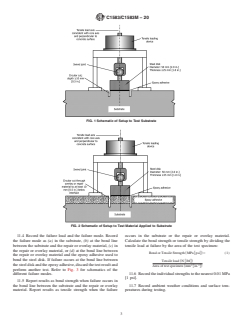
Direct Tension (Pull-off) Method: The method involves drilling a shallow core into the surface, bonding a steel disk to the exposed core, and applying a tensile load until failure. The force and failure mode are carefully recorded.
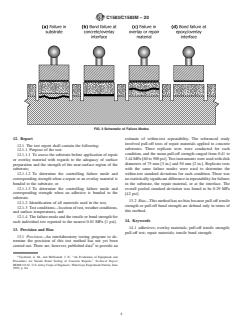
Failure Modes: The result of the test depends on the weakest link in the composite system-be it the substrate, the repair/overlay material, or the adhesive. Reporting and interpreting the failure mode is essential.
Precision and Reliability: The method provides repeatable results when similar failure modes are achieved, ensuring consistency especially in comparing materials or surface preparations.
Applications
ASTM C1583/C1583M-20 serves as a foundational test method for engineers, contractors, and material manufacturers involved in concrete repair and restoration. Typical applications include:
Surface Preparation Verification: Determining if concrete surfaces have sufficient tensile strength for reliable application of overlays or repair materials, reducing the risk of premature failure.
Quality Control for Repair Materials: Assessing the bond strength of patching, overlay, or repair material to the existing concrete substrate, ensuring compliance with project specifications and industry standards.
Assessment of Overlay Performance: Comparing tensile or bond strength of different overlay systems to select the most appropriate product for long-term durability.
Adhesive Evaluation: Testing the performance of bonding agents used in concrete repair to verify their effectiveness under specific site conditions.
By providing clear data on tensile and bond strength, this standard supports safer, longer-lasting, and higher-quality concrete construction and repair.
Related Standards
ASTM C1583/C1583M-20 references and builds on several other important standards in the concrete and materials testing field:
- ASTM C125: Terminology Relating to Concrete and Concrete Aggregates
- ASTM C881/C881M: Specification for Epoxy-Resin-Base Bonding Systems for Concrete
- ASTM C900: Test Method for Pullout Strength of Hardened Concrete
- ACI 503R: Use of Epoxy Compounds with Concrete (American Concrete Institute)
These documents collectively set the terminology, materials, and additional test methods relevant to assessing concrete surface performance and the effectiveness of repair and bonding systems.
Keywords: ASTM C1583, tensile strength of concrete, bond strength, pull-off test, overlay materials, repair materials, direct tension method, surface preparation, concrete testing, adhesive evaluation.
Relations
- Effective Date
- 01-Apr-2020
- Effective Date
- 15-Dec-2023
- Effective Date
- 15-Dec-2019
- Effective Date
- 15-Dec-2019
- Effective Date
- 01-Jan-2019
- Effective Date
- 01-Oct-2018
- Effective Date
- 01-Jul-2018
- Effective Date
- 01-Jan-2018
- Effective Date
- 15-Dec-2016
- Effective Date
- 15-Dec-2015
- Effective Date
- 15-Dec-2015
- Effective Date
- 01-Jul-2015
- Effective Date
- 01-May-2015
- Effective Date
- 01-Feb-2015
- Effective Date
- 15-Nov-2014
Buy Documents
ASTM C1583/C1583M-20 - Standard Test Method for Tensile Strength of Concrete Surfaces and the Bond Strength or Tensile Strength of Concrete Repair and Overlay Materials by Direct Tension (Pull-off Method)
REDLINE ASTM C1583/C1583M-20 - Standard Test Method for Tensile Strength of Concrete Surfaces and the Bond Strength or Tensile Strength of Concrete Repair and Overlay Materials by Direct Tension (Pull-off Method)
Get Certified
Connect with accredited certification bodies for this standard

DIBt (Deutsches Institut für Bautechnik)
German Institute for Building Technology.
DIN CERTCO
DIN Group product certification.

Aboma Certification B.V.
Specialized in construction, metal, and transport sectors.
Sponsored listings
Frequently Asked Questions
ASTM C1583/C1583M-20 is a standard published by ASTM International. Its full title is "Standard Test Method for Tensile Strength of Concrete Surfaces and the Bond Strength or Tensile Strength of Concrete Repair and Overlay Materials by Direct Tension (Pull-off Method)". This standard covers: ABSTRACT This specification covers standard test method for tensile strength of concrete surfaces and the bond strength or tensile strength of concrete repair and overlay materials by direct tension (pull-off method). This test method is suitable for both field and laboratory use to determine one or more of the following: the near-surface tensile strength of the substrate as an indicator of the adequacy of surface preparation before application of a repair or overlay material; the bond strength of a repair or an overlay material to the substrate; and the tensile strength of a repair or overlay material, or an adhesive used in repairs, after the material has been applied to a surface. The following apparatus shall be utilized: core drill; core barrel; steel disk; tensile loading device; and a coupling device. This test shall be performed on the surface of a prepared concrete base before application of a concrete repair overlay material, or on the surface of a concrete repair overlay material after the material has been applied to the prepared concrete surface. The test specimen shall be formed by drilling a shallow core into and perpendicular to the surface of the substrate, and leaving the intact core attached to the concrete. A steel disk shall be bonded to the top surface of the test specimen. A tensile load shall be applied to the steel disk until failure occurs. The failure load and the failure mode shall be recorded and the nominal tensile stress at failure shall be calculated. SIGNIFICANCE AND USE 5.1 This test method determines the tensile strength of concrete near to the prepared surface, which can be used as an indicator of the adequacy of surface preparation before applying a repair or an overlay material. 5.2 When the test is performed on the surface of a repair or an overlay material, it determines the bond strength to the substrate or the tensile strength of either the overlay or substrate, whichever is weaker. 5.3 The method may also be used to evaluate the adhesive strength of bonding agents. 5.4 When the test is performed on the surface of a material applied to the substrate, the measured strength is controlled by the failure mechanism requiring the least stress. Thus it is not possible to know beforehand which strength will be measured by the test. For this reason, the failure mode has to be reported for each individual test result, and tests results are averaged only if the same failure mode occurs. SCOPE 1.1 This test method is suitable for both field and laboratory use to determine one or more of the following: 1.1.1 The near-surface tensile strength of the substrate as an indicator of the adequacy of surface preparation before application of a repair or overlay material. 1.1.2 The bond strength of a repair or an overlay material to the substrate. 1.1.3 The tensile strength of a repair or overlay material, or an adhesive used in repairs, after the material has been applied to a surface. 1.2 The values stated in either SI units or inch-pound units are to be regarded separately as standard. The values stated in each system may not be exact equivalents; therefore, each system shall be used independently of the other. Combining values from the two systems may result in non-conformance with the standard. 1.3 The text of this standard refers to notes and footnotes that provide explanatory material. These notes and footnotes (excluding those in tables and figures) shall not be considered as requirements of this standard. 1.4 This standard does not purport to address all of the safety concerns, if any, associated with its use. It is the responsibility of the user of this standard to establish appropriate safety, health, and environmental practices and determine the applicability of regulatory limitations prior to use. 1.5 This international standard was developed in accordance with internationally recognized principles on standardization established in the Decision o...
ABSTRACT This specification covers standard test method for tensile strength of concrete surfaces and the bond strength or tensile strength of concrete repair and overlay materials by direct tension (pull-off method). This test method is suitable for both field and laboratory use to determine one or more of the following: the near-surface tensile strength of the substrate as an indicator of the adequacy of surface preparation before application of a repair or overlay material; the bond strength of a repair or an overlay material to the substrate; and the tensile strength of a repair or overlay material, or an adhesive used in repairs, after the material has been applied to a surface. The following apparatus shall be utilized: core drill; core barrel; steel disk; tensile loading device; and a coupling device. This test shall be performed on the surface of a prepared concrete base before application of a concrete repair overlay material, or on the surface of a concrete repair overlay material after the material has been applied to the prepared concrete surface. The test specimen shall be formed by drilling a shallow core into and perpendicular to the surface of the substrate, and leaving the intact core attached to the concrete. A steel disk shall be bonded to the top surface of the test specimen. A tensile load shall be applied to the steel disk until failure occurs. The failure load and the failure mode shall be recorded and the nominal tensile stress at failure shall be calculated. SIGNIFICANCE AND USE 5.1 This test method determines the tensile strength of concrete near to the prepared surface, which can be used as an indicator of the adequacy of surface preparation before applying a repair or an overlay material. 5.2 When the test is performed on the surface of a repair or an overlay material, it determines the bond strength to the substrate or the tensile strength of either the overlay or substrate, whichever is weaker. 5.3 The method may also be used to evaluate the adhesive strength of bonding agents. 5.4 When the test is performed on the surface of a material applied to the substrate, the measured strength is controlled by the failure mechanism requiring the least stress. Thus it is not possible to know beforehand which strength will be measured by the test. For this reason, the failure mode has to be reported for each individual test result, and tests results are averaged only if the same failure mode occurs. SCOPE 1.1 This test method is suitable for both field and laboratory use to determine one or more of the following: 1.1.1 The near-surface tensile strength of the substrate as an indicator of the adequacy of surface preparation before application of a repair or overlay material. 1.1.2 The bond strength of a repair or an overlay material to the substrate. 1.1.3 The tensile strength of a repair or overlay material, or an adhesive used in repairs, after the material has been applied to a surface. 1.2 The values stated in either SI units or inch-pound units are to be regarded separately as standard. The values stated in each system may not be exact equivalents; therefore, each system shall be used independently of the other. Combining values from the two systems may result in non-conformance with the standard. 1.3 The text of this standard refers to notes and footnotes that provide explanatory material. These notes and footnotes (excluding those in tables and figures) shall not be considered as requirements of this standard. 1.4 This standard does not purport to address all of the safety concerns, if any, associated with its use. It is the responsibility of the user of this standard to establish appropriate safety, health, and environmental practices and determine the applicability of regulatory limitations prior to use. 1.5 This international standard was developed in accordance with internationally recognized principles on standardization established in the Decision o...
ASTM C1583/C1583M-20 is classified under the following ICS (International Classification for Standards) categories: 91.080.40 - Concrete structures. The ICS classification helps identify the subject area and facilitates finding related standards.
ASTM C1583/C1583M-20 has the following relationships with other standards: It is inter standard links to ASTM C1583/C1583M-13, ASTM C900-23, ASTM C125-19a, ASTM C900-19, ASTM C125-19, ASTM C125-18b, ASTM C125-18a, ASTM C125-18, ASTM C125-16, ASTM C125-15b, ASTM C881/C881M-15, ASTM C125-15a, ASTM C900-15, ASTM C125-15, ASTM C881/C881M-14. Understanding these relationships helps ensure you are using the most current and applicable version of the standard.
ASTM C1583/C1583M-20 is available in PDF format for immediate download after purchase. The document can be added to your cart and obtained through the secure checkout process. Digital delivery ensures instant access to the complete standard document.
Standards Content (Sample)
This international standard was developed in accordance with internationally recognized principles on standardization established in the Decision on Principles for the
Development of International Standards, Guides and Recommendations issued by the World Trade Organization Technical Barriers to Trade (TBT) Committee.
Designation: C1583/C1583M − 20
Standard Test Method for
Tensile Strength of Concrete Surfaces and the Bond
Strength or Tensile Strength of Concrete Repair and Overlay
Materials by Direct Tension (Pull-off Method)
This standard is issued under the fixed designation C1583/C1583M; the number immediately following the designation indicates the
year of original adoption or, in the case of revision, the year of last revision. A number in parentheses indicates the year of last
reapproval. A superscript epsilon (´) indicates an editorial change since the last revision or reapproval.
1. Scope* 2. Referenced Documents
2.1 ASTM Standards:
1.1 This test method is suitable for both field and laboratory
C125 Terminology Relating to Concrete and Concrete Ag-
use to determine one or more of the following:
gregates
1.1.1 The near-surface tensile strength of the substrate as an
C881/C881M Specification for Epoxy-Resin-Base Bonding
indicator of the adequacy of surface preparation before appli-
Systems for Concrete
cation of a repair or overlay material.
C900 Test Method for Pullout Strength of Hardened Con-
1.1.2 The bond strength of a repair or an overlay material to
crete
the substrate.
1.1.3 The tensile strength of a repair or overlay material, or
3. Terminology
an adhesive used in repairs, after the material has been applied
3.1 Definitions—For definitions of terms used in this test
to a surface.
method refer to Terminology C125 and ACI 503R .
1.2 The values stated in either SI units or inch-pound units
4. Summary of Test Method
are to be regarded separately as standard. The values stated in
each system may not be exact equivalents; therefore, each
4.1 This test is performed on the surface of a prepared
system shall be used independently of the other. Combining
concrete base before application of a concrete repair or overlay
values from the two systems may result in non-conformance
material, or on the surface of a concrete repair or overlay
with the standard.
material after the material has been applied to the prepared
concrete surface.
1.3 The text of this standard refers to notes and footnotes
that provide explanatory material. These notes and footnotes 4.2 The test specimen is formed by drilling a shallow core
into and perpendicular to the surface of the substrate, and
(excluding those in tables and figures) shall not be considered
as requirements of this standard. leaving the intact core attached to the concrete. A steel disk is
bonded to the top surface of the test specimen.
1.4 This standard does not purport to address all of the
4.3 A tensile load is applied to the steel disk until failure
safety concerns, if any, associated with its use. It is the
occurs. The failure load and the failure mode are recorded and
responsibility of the user of this standard to establish appro-
the nominal tensile stress at failure is calculated.
priate safety, health, and environmental practices and deter-
mine the applicability of regulatory limitations prior to use.
5. Significance and Use
1.5 This international standard was developed in accor-
5.1 This test method determines the tensile strength of
dance with internationally recognized principles on standard-
concrete near to the prepared surface, which can be used as an
ization established in the Decision on Principles for the
indicator of the adequacy of surface preparation before apply-
Development of International Standards, Guides and Recom-
ing a repair or an overlay material.
mendations issued by the World Trade Organization Technical
Barriers to Trade (TBT) Committee.
5.2 When the test is performed on the surface of a repair or
an overlay material, it determines the bond strength to the
1 2
This test method is under the jurisdiction of ASTM Committee C09 on For referenced ASTM standards, visit the ASTM website, www.astm.org, or
Concrete and ConcreteAggregates and is the direct responsibility of Subcommittee contact ASTM Customer Service at service@astm.org. For Annual Book of ASTM
C09.25 on Organic Materials for Bonding. Standards volume information, refer to the standard’s Document Summary page on
Current edition approved April 1, 2020. Published May 2020. Originally the ASTM website.
approved in 2004. Last previous edition approved in 2013 as C1583/C1583M – 13. ACI 503R-93 (Reapproved 1998), “Use of Epoxy Compounds with Concrete,”
DOI: 10.1520/C1583_C1583M-20. American Concrete Institute (ACI), P.O. Box 9094, Farmington Hills, MI 48333.
*A Summary of Changes section appears at the end of this standard
Copyright © ASTM International, 100 Barr Harbor Drive, PO Box C700, West Conshohocken, PA 19428-2959. United States
C1583/C1583M − 20
substrate or the tensile strength of either the overlay or 8.4 The center-to-center distance of adjacent test specimens
substrate, whichever is weaker. shall be at least two disk diameters. The distance from the
center of a test specimen and a free edge of the test object shall
5.3 The method may also be used to evaluate the adhesive
be at least one disk diameter.
strength of bonding agents.
5.4 When the test is performed on the surface of a material 9. Preparation of Surface
applied to the substrate, the measured strength is controlled by
9.1 Preparation to Determine Tensile Strength of Substrate:
the failure mechanism requiring the least stress. Thus it is not
9.1.1 Remove all surface contaminants and loose or dete-
possible to know beforehand which strength will be measured
riorated concrete to obtain a clean, undamaged surface.
by the test. For this reason, the failure mode has to be reported
9.1.2 Prepare the surface using the same method to be used
for each individual test result, and tests results are averaged
in the full-scale repair or overlay.
only if the same failure mode occurs.
9.1.3 The surface must be in the same condition regarding
dryness and cleanliness as specified for the actual work.
6. Apparatus
9.2 Preparation to Determine Bond or Tensile Strength of
6.1 Core Drill, for preparing test specimen.
the Repair or Overlay Material:
6.2 Core Barrel,withdiamondimpregnatedbits-nominally
9.2.1 Prepare the surface in accordance with 9.1.
50 mm [2.0 in.] inside diameter.
9.2.2 Apply and cure the repair or overlay material in
6.3 Steel Disk, nominally 50 mm [2.0 in.] diameter and at accordance with specifications for the repair or overlay opera-
tion.
least 25 mm [1.0 in.] thick.
6.4 Tensile Loading Device, with a load-indicating system
10. Preparation of Test Specimen
and nominal capacity of 22 k N (5,000 lbf) and capable of
10.1 Using the coring equipment, drill a circular cut per-
applying load at the specified rate.The loading device includes
pendicular to the surface. For tests of substrate concrete, drill
a tripod or bearing ring for distributing the force to the
to a depth of at least 10 mm [0.5 in.]. For tests of repair or
supporting surface.
overlay materials, drill to at least 10 mm [0.5 in.] below the
6.4.1 Within the operating range, the indicated tensile force
concrete-overlay interface. The test specimen is left intact,
shall be within 6 2 % of the force measured by a calibrated
attached to the substrate. Measure the diameter of the test
testing machine or load cell. Verify the tensile loading device
specimenintwodirectionsatrightanglestoeachother.Record
at least once a year and after repairs and adjustments.
the average diameter to the nearest 0.2 mm [0.01 in.].
NOTE 1—See Test Method C900 for suitable verification schemes.
10.2 Remove any standing water; clean the surface of any
6.4.2 A coupling device shall be used to connect the steel
debris from the drilling operation and allow to dry.
disk to the tensile loading device. The coupling device shall be
10.3 Attach the s
...
This document is not an ASTM standard and is intended only to provide the user of an ASTM standard an indication of what changes have been made to the previous version. Because
it may not be technically possible to adequately depict all changes accurately, ASTM recommends that users consult prior editions as appropriate. In all cases only the current version
of the standard as published by ASTM is to be considered the official document.
Designation: C1583/C1583M − 13 C1583/C1583M − 20
Standard Test Method for
Tensile Strength of Concrete Surfaces and the Bond
Strength or Tensile Strength of Concrete Repair and Overlay
Materials by Direct Tension (Pull-off Method)
This standard is issued under the fixed designation C1583/C1583M; the number immediately following the designation indicates the
year of original adoption or, in the case of revision, the year of last revision. A number in parentheses indicates the year of last
reapproval. A superscript epsilon (´) indicates an editorial change since the last revision or reapproval.
1. Scope Scope*
1.1 This test method is suitable for both field and laboratory use to determine one or more of the following:
1.1.1 The near-surface tensile strength of the substrate as an indicator of the adequacy of surface preparation before application
of a repair or overlay material.
1.1.2 The bond strength of a repair or an overlay material to the substrate.
1.1.3 The tensile strength of a repair or overlay material, or an adhesive used in repairs, after the material has been applied to
a surface.
1.2 The values stated in either SI units or inch-pound units are to be regarded separately as standard. The values stated in each
system may not be exact equivalents; therefore, each system shall be used independently of the other. Combining values from the
two systems may result in non-conformance with the standard.
1.3 The text of this standard refers to notes and footnotes that provide explanatory material. These notes and footnotes
(excluding those in tables and figures) shall not be considered as requirements of this standard.
1.4 This standard does not purport to address all of the safety concerns, if any, associated with its use. It is the responsibility
of the user of this standard to establish appropriate safety safety, health, and healthenvironmental practices and determine the
applicability of regulatory limitations prior to use.
1.5 This international standard was developed in accordance with internationally recognized principles on standardization
established in the Decision on Principles for the Development of International Standards, Guides and Recommendations issued
by the World Trade Organization Technical Barriers to Trade (TBT) Committee.
2. Referenced Documents
2.1 ASTM Standards:
C125 Terminology Relating to Concrete and Concrete Aggregates
C881/C881M Specification for Epoxy-Resin-Base Bonding Systems for Concrete
C900 Test Method for Pullout Strength of Hardened Concrete
3. Terminology
3.1 Definitions—For definitions of terms used in this test method refer to Terminology C125 and ACI 503R .
4. Summary of Test Method
4.1 This test is performed on the surface of a prepared concrete base before application of a concrete repair or overlay material,
or on the surface of a concrete repair or overlay material after the material has been applied to the prepared concrete surface.
4.2 The test specimen is formed by drilling a shallow core into and perpendicular to the surface of the substrate, and leaving
the intact core attached to the concrete. A steel disk is bonded to the top surface of the test specimen.
This test method is under the jurisdiction of ASTM Committee C09 on Concrete and Concrete Aggregates and is the direct responsibility of Subcommittee C09.25 on
Organic Materials for Bonding.
Current edition approved April 1, 2013April 1, 2020. Published April 2013May 2020. Originally approved in 2004. Last previous edition approved in 20042013 as
C1583/C1583M – 04E01, which was withdrawn in January 2013 and reinstated in April 2013. DOI: 10.1520/C1583_C1583M-13.13. DOI: 10.1520/C1583_C1583M-20.
For referenced ASTM standards, visit the ASTM website, www.astm.org, or contact ASTM Customer Service at service@astm.org. For Annual Book of ASTM Standards
volume information, refer to the standard’s Document Summary page on the ASTM website.
ACI 503R-93 (Reapproved 1998), “Use of Epoxy Compounds with Concrete,” American Concrete Institute (ACI), P.O. Box 9094, Farmington Hills, MI 48333.
*A Summary of Changes section appears at the end of this standard
Copyright © ASTM International, 100 Barr Harbor Drive, PO Box C700, West Conshohocken, PA 19428-2959. United States
C1583/C1583M − 20
4.3 A tensile load is applied to the steel disk until failure occurs. The failure load and the failure mode are recorded and the
nominal tensile stress at failure is calculated.
5. Significance and Use
5.1 This test method determines the tensile strength of concrete near to the prepared surface, which can be used as an indicator
of the adequacy of surface preparation before applying a repair or an overlay material.
5.2 When the test is performed on the surface of a repair or an overlay material, it determines the bond strength to the substrate
or the tensile strength of either the overlay or substrate, whichever is weaker.
5.3 The method may also be used to evaluate the adhesive strength of bonding agents.
5.4 When the test is performed on the surface of a material applied to the substrate, the measured strength is controlled by the
failure mechanism requiring the least stress. Thus it is not possible to know beforehand which strength will be measured by the
test. For this reason, the failure mode has to be reported for each individual test result, and tests results are averaged only if the
same failure mode occurs.
6. Apparatus
6.1 Core Drill, for preparing test specimen.
6.2 Core Barrel, with diamond impregnated bits - nominally 50 mm [2.0 in.] inside diameter.
6.3 Steel Disk, nominally 50 mm [2.0 in.] diameter and at least 25 mm [1.0 in.] thick.
6.4 Tensile Loading Device, with a load-indicating system and nominal capacity of 22 k N (5,000 lbf) and capable of applying
load at the specified rate. The loading device includes a tripod or bearing ring for distributing the force to the supporting surface.
6.4.1 Within the operating range, the indicated tensile force shall be within 6 2 % of the force measured by a calibrated testing
machine or load cell. Verify the tensile loading device at least once a year and after repairs and adjustments.
NOTE 1—See Test Method C900 for suitable verification schemes.
6.4.2 A coupling device shall be used to connect the steel disk to the tensile loading device. The coupling device shall be
designed to withstand the tensile load capacity without yielding, and to transmit the tensile force parallel to and in line with the
axis of the cylindrical test specimen without imparting torsion or bending to the test specimen.
7. Materials
7.1 Epoxy adhesive material for bonding the steel disk to the test specimen. It shall be a fast-curing paste or gel meeting the
requirements of Specification C881/C881M for Type IV, Grade 3, except that a shorter gel time is permitted.
8. Sampling
8.1 Three individual test results with similar failure modes shall be obtained for each test site.
8.2 The field test site shall be large enough so that all methods to be used in the full-scale repair or overlay operation, including
surface preparation, are used for preparing test specimens. The test site shall be at least 1 by 1 m [3 by 3 ft]. It shall be selected
to be representative of actual field conditions.
8.3 If concrete cover is less than 20 mm [ ⁄4 in.], do not locate test specimens directly over bars in the layer of reinforcement
nearest to the surface.
NOTE 2—The location of reinforcement may be established using reinforcement locators or metal detectors. Follow the manufacturer’s
recommendations for proper operation of such devices.
8.4 The center-to-center distance of adjacent test specimens shall be at least two disk diameters. The distance from the center
of a test specimen and a free edge of the test object sh
...