


SIST-TS CEN/TS 18272-1:2026
(Main)Textiles - Circular economy for textile products - Part 1: General principles and guidance
General Information
- Abstract
This document lists circular economy principles and provides guidance for circular economy across the textile value chain and value network and circularity for textile products.
This document applies to textiles, textile products, including non-textile components and materials.
This document excludes leather, fur products and footwear.
- Status
- Published
- Publication Date
- 23-Jul-2026
- Technical Committee
- ITEK - Textile and textile products
- Current Stage
- 6060 - National Implementation/Publication (Adopted Project)
- Start Date
- 23-Jul-2026
- Due Date
- 27-Sep-2026
- Completion Date
- 24-Jul-2026

Overview
SIST-TS CEN/TS 18272-1:2026 sets out general principles and guidance for implementing a circular economy within the textile industry and its broad value network. Developed by SIST in alignment with CEN/TS 18272-1:2026, this technical specification offers a framework for textile products-covering textiles, blended materials, and products with non-textile components-excluding leather, fur products, and footwear.
This standard directly addresses increasing environmental concerns and legislative requirements linked to textile production and consumption, in particular by establishing a shared understanding and actionable guidance for circularity across the textile sector. It supports European and global sustainability goals, including the UN Sustainable Development Goals (SDGs) and relevant EU policies.
Key Topics
SIST-TS CEN/TS 18272-1:2026 features essential principles and guidance in the following areas:
- Circular Economy Principles in Textiles: Outlines the foundational principles of a circular economy for the textile sector, focusing on minimizing resource extraction, preventing waste and pollution, maximizing the value of products and materials, and regenerating natural systems.
- Circular Value Networks: Details how to create value networks that promote sustainable business models, reverse logistics, innovative collection, and sorting of textile products for continual circulation.
- R-Strategies for Circularity: Provides a comprehensive framework of “R-strategies” such as Refuse, Rethink, Reduce, Reuse, Repair, Refurbish, Remanufacture, Repurpose, Recycle, and Recover. These strategies promote narrowing, slowing, and closing material flows throughout the textile lifecycle.
- Technical and Biological Cycles: Introduces the distinction between technical cycles (e.g., mechanical, thermo-mechanical, and chemical recycling) and biological cycles (e.g., biobased waste management and biodegradability), explaining their importance in enhancing textile circularity.
- Lifecycle Perspective: Emphasizes the value of assessing materials’ inflows and outflows, highlighting the importance of sourcing both virgin and non-virgin inputs, and implementing effective circular sourcing and reverse logistics.
Applications
SIST-TS CEN/TS 18272-1:2026 is relevant for:
- Textile Manufacturers and Brands: Supporting the adoption of circular business models, eco-design, and innovative production processes that meet evolving regulations, such as the EU Ecodesign for Sustainable Products Regulation (ESPR) and upcoming Digital Product Passport requirements.
- Textile Product Designers and Developers: Incorporating design-for-circularity principles to create more durable, repairable, reusable, and recyclable textile products.
- Supply Chain and Waste Managers: Facilitating improved collection, sorting, and recycling methods to maximize material recovery and minimize landfill waste.
- Compliance and Sustainability Officers: Ensuring alignment with key frameworks like the EU Green Deal, Green Claims Directive, and Corporate Sustainability Reporting Directive (CSRD).
- Policy Makers and Industry Stakeholders: Providing a reference for harmonizing practices and terminology across the European textile sector and supporting international sustainability agendas.
The standard is applicable across the entire value chain, from raw material sourcing, manufacturing, and distribution to product use, reuse, recycling, and end-of-life management.
Related Standards
For comprehensive implementation of circular economy principles in the textile industry, the following standards and initiatives complement SIST-TS CEN/TS 18272-1:2026:
- ISO 59004:2024: Framework for the Circular Economy
- EN ISO 5157:2023: Definitions and terms for textile materials
- EN ISO 11610:2023: Textile product and clothing definitions
- ISO 8159:2025: Definitions for yarn and related terms
- BS 8001:2017: Circular Economy Principles for Organizations
- Ecodesign for Sustainable Products Regulation (ESPR)
- EU Green Claims Directive and CSRD
By following SIST-TS CEN/TS 18272-1:2026 along with related standards, organizations in the textile sector can effectively transition towards circularity, drive sustainable value creation, and demonstrate compliance with leading environmental and economic directives.
Get Certified
Connect with accredited certification bodies for this standard

BSI Group
BSI (British Standards Institution) is the business standards company that helps organizations make excellence a habit.

Bureau Veritas
Bureau Veritas is a world leader in laboratory testing, inspection and certification services.

DNV
DNV is an independent assurance and risk management provider.
Sponsored listings
Frequently Asked Questions
SIST-TS CEN/TS 18272-1:2026 is a technical specification published by the Slovenian Institute for Standardization (SIST). Its full title is "Textiles - Circular economy for textile products - Part 1: General principles and guidance". This standard covers: This document lists circular economy principles and provides guidance for circular economy across the textile value chain and value network and circularity for textile products. This document applies to textiles, textile products, including non-textile components and materials. This document excludes leather, fur products and footwear.
This document lists circular economy principles and provides guidance for circular economy across the textile value chain and value network and circularity for textile products. This document applies to textiles, textile products, including non-textile components and materials. This document excludes leather, fur products and footwear.
SIST-TS CEN/TS 18272-1:2026 is classified under the following ICS (International Classification for Standards) categories: 13.020.20 - Environmental economics. Sustainability; 59.080.01 - Textiles in general. The ICS classification helps identify the subject area and facilitates finding related standards.
SIST-TS CEN/TS 18272-1:2026 is available in PDF format for immediate download after purchase. The document can be added to your cart and obtained through the secure checkout process. Digital delivery ensures instant access to the complete standard document.
Standards Content (Sample)
SLOVENSKI STANDARD
01-september-2026
Tekstilije - Krožno gospodarstvo za tekstilne izdelke - 1. del: Splošna načela in
smernice
Textiles - Circular economy for textile products - Part 1: General principles and guidance
Textilien - Circular Economy für Textilerzeugnisse - Teil1: Allgemeine Grundsätze und
Leitlinien
Textiles - Économie circulaire pour les produits textiles - Partie 1: Principes généraux et
recommandations
Ta slovenski standard je istoveten z: CEN/TS 18272-1:2026
ICS:
13.020.20 Okoljska ekonomija. Environmental economics.
Trajnostnost Sustainability
59.080.01 Tekstilije na splošno Textiles in general
2003-01.Slovenski inštitut za standardizacijo. Razmnoževanje celote ali delov tega standarda ni dovoljeno.
CEN/TS 18272-1
TECHNICAL SPECIFICATION
SPÉCIFICATION TECHNIQUE
July 2026
TECHNISCHE SPEZIFIKATION
ICS 13.020.20; 59.080.01
English Version
Textiles - Circular economy for textile products - Part 1:
General principles and guidance
Textiles - Économie circulaire pour les produits textiles Textilien - Circular Economy für Textilerzeugnisse -
- Partie 1: Principes généraux et recommandations Teil1: Allgemeine Grundsätze und Leitlinien
This Technical Specification (CEN/TS) was approved by CEN on 8 June 2026 for provisional application.
The period of validity of this CEN/TS is limited initially to three years. After two years the members of CEN will be requested to
submit their comments, particularly on the question whether the CEN/TS can be converted into a European Standard.
CEN members are required to announce the existence of this CEN/TS in the same way as for an EN and to make the CEN/TS
available promptly at national level in an appropriate form. It is permissible to keep conflicting national standards in force (in
parallel to the CEN/TS) until the final decision about the possible conversion of the CEN/TS into an EN is reached.
CEN members are the national standards bodies of Austria, Belgium, Bulgaria, Croatia, Cyprus, Czech Republic, Denmark, Estonia,
Finland, France, Germany, Greece, Hungary, Iceland, Ireland, Italy, Latvia, Lithuania, Luxembourg, Malta, Netherlands, Norway,
Poland, Portugal, Republic of North Macedonia, Romania, Serbia, Slovakia, Slovenia, Spain, Sweden, Switzerland, Türkiye and
United Kingdom.
EUROPEAN COMMITTEE FOR STANDARDIZATION
COMITÉ EUROPÉEN DE NORMALISATION
EUROPÄISCHES KOMITEE FÜR NORMUNG
CEN-CENELEC Management Centre: Rue de la Science 23, B-1040 Brussels
© 2026 CEN All rights of exploitation in any form and by any means reserved Ref. No. CEN/TS 18272-1:2026 E
worldwide for CEN national Members.
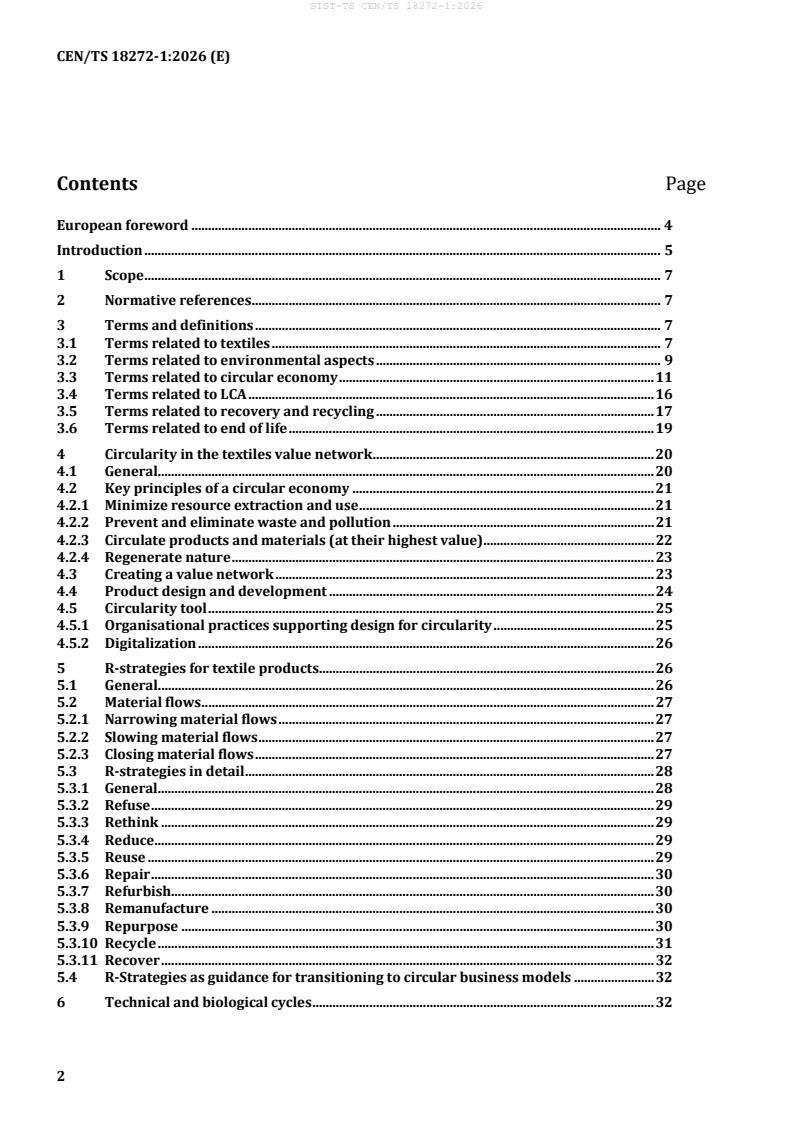
Contents Page
European foreword . 4
Introduction . 5
1 Scope . 7
2 Normative references . 7
3 Terms and definitions . 7
3.1 Terms related to textiles . 7
3.2 Terms related to environmental aspects . 9
3.3 Terms related to circular economy . 11
3.4 Terms related to LCA . 16
3.5 Terms related to recovery and recycling . 17
3.6 Terms related to end of life . 19
4 Circularity in the textiles value network . 20
4.1 General. 20
4.2 Key principles of a circular economy . 21
4.2.1 Minimize resource extraction and use . 21
4.2.2 Prevent and eliminate waste and pollution . 21
4.2.3 Circulate products and materials (at their highest value) . 22
4.2.4 Regenerate nature . 23
4.3 Creating a value network . 23
4.4 Product design and development . 24
4.5 Circularity tool . 25
4.5.1 Organisational practices supporting design for circularity . 25
4.5.2 Digitalization . 26
5 R-strategies for textile products. 26
5.1 General. 26
5.2 Material flows . 27
5.2.1 Narrowing material flows . 27
5.2.2 Slowing material flows . 27
5.2.3 Closing material flows . 27
5.3 R-strategies in detail . 28
5.3.1 General. 28
5.3.2 Refuse . 29
5.3.3 Rethink . 29
5.3.4 Reduce . 29
5.3.5 Reuse . 29
5.3.6 Repair . 30
5.3.7 Refurbish. 30
5.3.8 Remanufacture . 30
5.3.9 Repurpose . 30
5.3.10 Recycle . 31
5.3.11 Recover . 32
5.4 R-Strategies as guidance for transitioning to circular business models . 32
6 Technical and biological cycles . 32
6.1 General . 32
6.2 Technical cycle . 32
6.2.1 Mechanical recycling . 32
6.2.2 Thermo-mechanical recycling . 33
6.2.3 Chemical recycling . 33
6.2.4 Factors that influence recyclability of textile products . 33
6.3 Biological Cycle . 33
6.3.1 General . 33
6.3.2 Biobased waste . 34
6.3.3 Biodegradability . 34
7 Materials in- and outflows . 34
7.1 General . 34
7.2 Lifecycle perspective . 35
7.3 Virgin input material . 35
7.4 Non-virgin input material . 35
7.5 Circular sourcing . 36
7.5.1 General . 36
7.5.2 Reverse logistics . 36
7.5.3 Collection and sorting of textiles . 37
Bibliography . 38
European foreword
This document (CEN/TS 18272-1:2026) has been prepared by Technical Committee CEN/TC 248
“Textiles and textile products”, the secretariat of which is held by BSI.
Attention is drawn to the possibility that some of the elements of this document may be the subject of
patent rights. CEN shall not be held responsible for identifying any or all such patent rights.
Any feedback and questions on this document should be directed to the users’ national standards body.
A complete listing of these bodies can be found on the CEN website.
According to the CEN/CENELEC Internal Regulations, the national standards organisations of the
following countries are bound to announce this Technical Specification: Austria, Belgium, Bulgaria,
Croatia, Cyprus, Czech Republic, Denmark, Estonia, Finland, France, Germany, Greece, Hungary, Iceland,
Ireland, Italy, Latvia, Lithuania, Luxembourg, Malta, Netherlands, Norway, Poland, Portugal, Republic of
North Macedonia, Romania, Serbia, Slovakia, Slovenia, Spain, Sweden, Switzerland, Türkiye and the
United Kingdom.
Introduction
The textile sector is woven into our daily lives. It generates high levels of employment, and significant
revenues, providing products essential to human welfare. However, the industry’s significant ecological
footprint, as well as its health and societal risks have come under increasing scrutiny. A crisis exacerbated
by both the volume and the patterns of our production and consumption. The textile sector faces
significant sustainability challenges that need to be addressed to ensure more sustainable patterns of
production and consumption. There is urgent need for transformation.
Circular economy for textile products requires a fundamental shift in how we value natural resources,
business models, textile products, and production processes. The extraction and use of new natural
resources needs to be minimized. New circular business models for textiles need to be introduced along
the value chain. New processes, like reverse logistics, collection and sorting of textiles, need to work
seamlessly together for a circular business ecosystem to function effectively. To contribute to solving the
global textile waste problem, and to be able to replace some of the virgin materials with recycled textile
materials, recycling technologies are at the centre of innovation.
The EU Green Deal is driving the expansion of circular economy practices across key economic sectors,
providing a decisive legislative framework to help the EU reach climate neutrality by 2050. In doing so, it
aims to decouple economic growth from natural resource use. On a global level, sustainable management
and efficient use of natural resources is addressed in the UN Sustainable Development Goals (SDG) since
2015.
The EU Sustainable and Circular Textiles Strategy aims “to counter fast fashion and textile waste and to
make textiles more durable, repairable, reusable and recyclable.” To support the textile strategy, the
Ecodesign for Sustainable Products Regulation (ESPR) was introduced, which aims to reduce the
environmental impacts of products throughout their life cycle and improve the circularity performance
of products. The ESPR stipulates that circularity performance will be communicated to end consumers
through a digital product passport (DPP). The DPP will store and enable exchange of relevant information
supporting products’ sustainability, circularity and regulatory compliance.
Another key EU legislative directive supporting the textile strategy is the Green Claims Directive (GCD).
It aims to make green claims reliable, comparable and verifiable across the EU and protect consumers
from greenwashing. An additional EU tool to support circularity, involving the financial sector is the
Corporate Sustainability Reporting Directive (CSRD). It requires reporting on material flows and
circularity through the European Sustainability Reporting Standard (ESRS) E5.
The Waste Framework Directive (WFD) established basic concepts and definitions for waste
management, including definitions of waste recycling and recovery. In July 2023, the European
Commission has proposed a targeted amendment to introduce mandatory Extended Producer
Responsibility (EPR) for textiles, obliging producers to take financial and organisational responsibility
for the end of life of the products they place on the EU market. These are among the most innovative
points of the proposed rule change, which aims for a more circular and sustainable management of textile
waste, in line with the EU Strategy for Sustainable and Circular Textiles.
This document is intended to help textile organizations and individuals working in the textile industry to
consider and implement more circular and sustainable practices within their businesses, providing more
circular products and/or rethinking the entire business model and value chain. It provides a common
understanding and establishes the general principles of circular economy in textile products. See the
work program of CEN/TC 248/WG 39 “Circular economy for textile products and the textile chain” for
more standards development on circular textiles.
This document describes the general principles of circular economy across the textile value chain and
value network and circularity for textile products.
The standard is divided into four main areas. Clause 4 introduces the key principles of a circular economy,
providing further key supporting areas and enablers to create a circular value network. Clause 5 offers a
comprehensive analysis of the R-strategies. These strategies provide the core framework of the transition
toward circular value creation and are based on the principles of narrowing, slowing, and closing material
flows and the need to expand reverse logistics, collection and sorting of textiles. Clause 6 provides
insights into the differences between the technical and biological cycles and explains the need to enhance
fibre-to-fibre recycling. Clause 7 gives a brief introduction into materials in- and outflows and the
importance of lifecycle perspective
This document also supports organizations in advancing the objectives of the UN Sustainability
Development Goals (SDG):
— 8 Decent work and economic growth
— 9 Industry, innovation, and infrastructure
— 12 Responsible consumption and production
— 13 Climate action
Note to the reader on normative language: In this document, the following verbal forms are used in
accordance with the CEN/CENELEC Internal Regulations Part 3:2022, Clause 7:
— “shall” indicates a requirement;
— “should” indicates a recommendation;
— “may” indicates a permission;
— “can” indicates a possibility or a capability;
— “must” indicates an external constraint.
1 Scope
This document lists circular economy principles and provides guidance for circular economy across the
textile value chain and value network of textile products.
This document applies to textiles and textile products, including non-textile components and materials.
This document excludes leather, fur products and footwear.
2 Normative references
There are no normative references in this document.
3 Terms and definitions
For the purposes of this document, the following terms and definitions apply.
ISO and IEC maintain terminology databases for use in standardization at the following addresses:
— ISO Online browsing platform: available at https://www.iso.org/obp/
— IEC Electropedia: available at https://www.electropedia.org/
3.1 Terms related to textiles
3.1.1
blended fabric
fabric produced with a combination of two or more types of different textile fibres (3.1.10)
[SOURCE: EN ISO 5157:2023, definition 3.1.1.2, modified — “or yarns” was deleted]
3.1.2
clothing
general provisions from design to distribution intended for covering the body with everything except the
footwear
Note 1 to entry: The term “clothing” is intended for referring to the concept of clothing in opposition to the clothing
product.
Note 2 to entry: In English, the terms “clothing” and “garment” have been used as synonyms in the standards.
Depending on the context, the term “clothing” refers either to “clothing” (3.1.2) or to “garment” (3.1.5). Henceforth,
definitions have been introduced in this document for clarification.
[SOURCE: EN ISO 11610:2023, definition 4.1.1]
3.1.3
component
part of a textile product (3.1.11) with a distinctive content, shape and structure
3.1.4
fabric
item showing a spread surface in regard to its thickness, formed by entanglement of any textile materials,
having a cohesion given by any textile process
Note 1 to entry: Textile processes include weaving, knitting, braiding, lacing, tufting, and nonwoven bonding.
[SOURCE: EN ISO 11610:2023, definition 4.3.1, modified — “materials” was deleted; reference to 4.1.5
was deleted]
3.1.5
garment
single article of clothing (3.1.2)
Note 1 to entry: The term “garment” is intended for referring to the product (3.1.8).
Note 2 to entry: Garments consist of either a single layer or multiple layers.
EXAMPLE Trousers, jacket, coats, socks, etc.
[SOURCE: EN ISO 11610:2023, definition 4.1.2, modified — “gloves” and “gaiters” were deleted in the
Example]
3.1.6
mono material textile
textiles made of textile fibres (3.1.10) which is only composed of single type of chemical composition
EXAMPLE A woven fabric made of 100 % cotton yarn.
Note 1 to entry: One fibre type can consist of different chemical compositions. For example, polyamide-6 is a
different material than polyamide-6.6.
[SOURCE: EN ISO 5157:2023, definition 3.1.1.6]
3.1.7
multi material textile
textiles made of textile fibres (3.1.10) or materials made from more than one chemical composition
EXAMPLE 1 Bi-component fibres are a multi material textile.
EXAMPLE 2 Multi material textiles are e.g. intimate blend of polyester and cotton fibre, different fibres in warp
and weft or a polyurethane coated polyester fabric.
[SOURCE: EN ISO 5157:2023, definition 3.1.1.8]
3.1.8
product
physical-based object designed for or utilized with a purpose
[SOURCE: ISO 59004:2024, definition 3.2.2, modified — Note 1 to entry was deleted]
3.1.9
textile
any raw, semi-worked, worked, semi-manufactured, manufactured, semi-made-up or made-up product
(3.1.8) which is exclusively composed of textile fibres (3.1.10), regardless of the mixing or assembly
process employed
[SOURCE: EU Regulation 1007/2011, article 3, definition 1.a]
3.1.10
textile fibre
unit of matter characterized by its flexibility, fineness and high ratio of length to maximum transverse
dimension, which render it suitable for textile applications
[SOURCE: EN ISO 5157:2023, definition 3.1.1.12]
3.1.11
textile product
product (3.1.8) made mainly of textile fibres (3.1.10), yarns (3.1.12) and/or fabrics (3.1.4) and intended
to be used, as such or in conjunction with other textile or non-textile elements
Note 1 to entry: These articles can contain non-textile parts, such as plastics (e.g. buttons and membrane or
coatings) or metals.
[SOURCE: EN ISO 5157:2023, definition 3.1.1.13, modified — references to 3.1.8, 3.1.12 and 3.1.4 were
added]
3.1.12
yarn
textile product (3.1.11) of substantial length and relatively small cross-section of fibres and/or filaments
with or without twist
Note 1 to entry: The “yarn” is a general term covering all the specific types of yarns.
[SOURCE: ISO 8159:2025, definition 3.2.1, modified; reference to 3.1.3 was deleted; reference to 3.1.11
was added]
3.2 Terms related to environmental aspects
3.2.1
biobased materials
derived from material of biological origin, excluding material embedded in geological formations or
transformed to fossilized material and excluding peat
Note 1 to entry: This includes organic material (both living and dead) from above and below ground, e.g. trees,
crops, grasses, tree litter, algae, animals and waste (3.6.6) of biological origin, e.g. manure.
Note 2 to entry: This definition is derived from the definition of “biomass” in EN ISO 5157:2023, definition 3.1.2.4.
3.2.2
hazardous substance
substance which can adversely affect human health or the environment with immediate or retarded effect
Note 1 to entry: Manufacturers can determine the hazardous substances according to national or regional
regulations.
[SOURCE: ISO 23434-1:2021, definition 3.21]
3.2.3
microplastic
material consisting of a solid polymer containing particles, to which additives or other substances can be
added, and where a weight fraction of ≥1% particles have:
a) all sizes 100 nm ≤ × ≤ 5 mm,
b) for fibres, a length of 300 nm ≤ × ≤ 15 mm and a length/diameter ratio > 3
Note 1 to entry: Polymers that occur in nature that have not been chemically modified (other than by hydrolysis)
are excluded, as are polymers that are (bio) degradable.
[SOURCE: ISO 4484-2:2023, definition 3.1, modified — admitted term “MP” was deleted]
3.2.4
pollution
alteration of water, air or soil quality, mainly by discharge of organic, microbiologic and chemical
substances coming from anthropic activities or from natural sources
[SOURCE: ISO 6107:2021, definition 3.414, modified — “(e.g. volcanic ash)” was deleted]
3.2.5
regenerate
improve or restore a degraded ecosystem
[SOURCE: ISO 59004:2024, definition 3.5.27, modified — reference to 3.1.17 was deleted]
3.2.6
regenerated fibres
fibres produced from naturally occurring polymers of cellulose or protein, where processing by
dissolution is needed to convert them into fibre form
[SOURCE: EN ISO 5157:2023, definition 3.1.3.5]
3.2.7
renewable
replenishable naturally at source at a rate at least the same as consumption
Note 1 to entry: This can apply to materials and energy.
[SOURCE: EN ISO 5157:2023, definition 3.2.2.13]
3.2.8
virgin resource
primary resource
natural resource or energy that is used as a resource for the first time as input in a process or for creating
a solution
Note 1 to entry: Virgin resources can be either a renewable resource or non-renewable resource.
[SOURCE: ISO 59004:2024, definition 3.2.2, modified — “note 2 to entry” was deleted]
3.3 Terms related to circular economy
3.3.1
business model
organization’s chosen system of interconnected and interdependent decisions and activities that
determines how it creates, delivers and captures value over the short, medium and long term
Note 1 to entry: A business model is more than the organization’s processes and products (3.1.8) or the services it
provides.
Note 2 to entry: A business model can be deemed to be “disruptive” if it disrupts an existing market and value
network, displacing established market leading firms, products (3.1.8), services and alliances.
[SOURCE: BS 8001:2017, definition 2.8]
3.3.2
design and development
process that transforms requirements into a product (3.1.8)
Note 1 to entry: Design and development usually follows a series of steps, e.g. starting with an initial idea,
transforming the idea into a formal specification, through to the creation of a new product, its possible redesign and
consideration of end-of-life.
Note 2 to entry: Design and development can include taking a product idea from planning to product provision and
review of the product. It can include considerations on business strategies, marketing, research methods and design
aspects that are used. It includes improvements or modifications of existing products.
[SOURCE: EN IEC 62430:2019, definition 3.1.4 and ISO 14006:2020, definition 3.2.1, modified –
references to other terms were deleted]
3.3.3
design for circularity
DfC
design and development (3.3.2) based on the circular economy (3.3.10) principles
Note 1 to entry: This field of design builds on and is related to ecodesign.
Note 2 to entry: Other terminology used worldwide includes circular design.
[Source: ISO 59004:2024, definition 3.5.12, modified – references to 3.1.3 and 3.5.11 were deleted; Note
2 to entry was added]
3.3.4
industrial urban symbiosis
IUS
identification of new circular business opportunities and invocation of under-utilized resources, for
example materials, energy, water, by-products, waste, capacity and expertise, throughout the entire
circular textile ecosystem
Note 1 to entry: The actors involved in the I-US activities consist of the entire circular textile ecosystem consisting
of three groups of actors:
— commercial companies (for example producers and manufacturers of textile products, textile retailers,
companies collecting and sorting pre- and post-consumer textile waste, recycling companies);
— communities, urban areas and citizens;
— supporting companies (for example research organizations, digital services providers).
[SOURCE: Concept Note Collaboration between the EIT Community Circular Economy and the ECESP
#EUCircularTalks – Industrial Symbiosis (2024) and the tExtended project, modified]
3.3.5
durability
ability of a textile product (3.1.11) to retain its required properties in specified conditions for an intended
lifespan
Note 1 to entry: The durability of textile articles only takes into account their physical, objective and quantifiable
characteristics (intrinsic properties, functionalities, etc.) and excludes the emotional or subjective and difficult to
quantify aspects.
Note 2 to entry: Lifespan is for a given number of use times or time period.
[SOURCE: EN ISO 5157:2023, definition 3.2.2.8, modified — “article” was replaced by “product”]
3.3.6
biological cycle
cycle through which biological nutrients are restored into the biosphere in a way that rebuilds natural
capital and enables the regeneration of renewable resources
Note 1 to entry: Such cycles can involve, at various stages, cascading, composting, anaerobic digestion or the
extraction of biochemicals.
Note 2 to entry: A material is defined as belonging to either the technical or the biological cycle depending on which
of these it feeds back to, not necessarily which one it originates from.
[SOURCE: BS 8001:2017, definition 2.18.1, modified – reference to Figure 5 in Note 2 to entry was
deleted]
3.3.7
technical cycle
cycle(s) within the social system through which resources are used, recovered (3.6.5), restored and
utilized within existing or new solutions
Note 1 to entry: Resources flow into and within a technical cycle, which involves activities such as sharing,
maintenance, reuse (3.3.25), repair (3.3.21), remanufacturing (3.3.20) and recycling (3.5.3).
[SOURCE: ISO 59004:2024, definition 3.1.20, modified – several references to other terms were deleted]
3.3.8
traceability
ability to trace the history, application and location of that which is under consideration
Note 1 to entry: When considering a solution, traceability can relate to:
— the origin of products (3.1.8);
— the process and service history;
— the distribution and location of the product;
— the product composition.
Note 2 to entry: When considering a resource, traceability can relate to:
— the origin of the resource (e.g. whether it is a virgin (3.2.8) or recovered (3.6.5) resource);
— the process history;
— the distribution and location of the resource.
[SOURCE: ISO 59004:2024, definition 3.6.9, modified – several references to other terms were deleted]
3.3.9
circularity
degree of alignment with the principles for a circular economy (3.3.10)
[SOURCE: ISO 59004:2024, definition 3.1.15, modified – reference to 3.1.13 was deleted]
3.3.10
circular economy
economic system that uses a systemic approach to maintain a circular flow of resources, by recovering
(3.6.5), retaining or adding to their value (3.4.4), while contributing to sustainable development
Note 1 to entry: Resources can be considered concerning both stocks and flows.
Note 2 to entry: The inflow of virgin resources (3.2.8) is kept as low as possible, and the circular flow of resources
is kept as closed as possible to minimize waste (3.6.6), losses and releases from the economic system.
[SOURCE: ISO 59004:2024, definition 3.1.1, modified – references to other terms were deleted]
3.3.11
circular sourcing
sourcing according to circularity principles
3.3.12
closed loop
loop where textile fibres (3.1.10) flow to textile fibres
Note 1 to entry: this includes flows from textile products (3.1.11) to textiles, textile products (3.1.11) and textile
fibres (3.1.10).
3.3.13
modularity
set of characteristics which allow products (3.1.8) to be separated into separate components (3.1.3) and
recombined
[SOURCE: ISO 8373:2021, definition 9.2, modified – “systems” was replaced by “products”; “modules”
was replaced by “components”; “discreate” was replaced by “separate”; references to 3.1.8 and 3.1.3 were
added]
3.3.14
open loop
loop where non-textile materials flow into a textile product (3.1.11) or a loop where textile fibres (3.1.10)
flow into a non-textile product
3.3.15
reduce
increase efficiency in product (3.1.8) manufacture or use by consuming fewer natural resources and
materials
[SOURCE: ISO 59004:2024, Table 1]
3.3.16
refurbish
restore an item, during its expected service life, to a useful condition for the same purpose with at least
similar quality and performance characteristics
[SOURCE: ISO 59004:2024, definition 3.5.18, modified — “recondition” as admitted term was deleted]
3.3.17
refurbishing
refurbishment
process by which an item, during its expected life, is restored to a useful condition for the same purpose
and with at least similar quality and performance characteristics
Note 1 to entry: Refurbishing does not include restoration after the expected life.
Note 2 to entry: Refurbishing can include activities such as repair (3.3.21), rework, and replacement of worn parts
but does not include activities that result in significant changes of product (3.1.8) performances.
[SOURCE: ISO 59004:2024, definition 3.5.19, modified — “reconditioning” as admitted term was deleted;
reference to 3.5.5 was deleted]
3.3.18
refuse
make product (3.1.8) redundant by abandoning its function or by offering the same function by a radically
different (e.g. digital) solution
[SOURCE: European Commission, Categorisation System for the Circular Economy, modified – “product
or service” replaced by “solution”]
3.3.19
remanufacture
return an item to a like-new condition from both a quality and performance perspective
Note 1 to entry: From the performance perspective, the functionality of the item is an important consideration as
it relates to the fulfilment of a particular need.
[SOURCE: ISO 59004:2024, definition 3.5.20, modified – “using an industrial process” was deleted]
3.3.20
remanufacturing
process by which an item is returned to a like-new condition from both a quality and performance
perspective
Note 1 to entry: The item can be previously sold, leased, used, worn, remanufactured (3.3.19) or a non-functional
product (3.1.8) or part.
Note 2 to entry: A like-new condition can also be described as “same-as-when-new” or “better-than-when-new”
[SOURCE: ISO 59004:2024, definition 3.5.21, modified – “industrial” was deleted; reference to 3.5.5 was
deleted]
3.3.21
repair
restore a product (3.1.8) to a condition needed for the product to function according to its intended
purpose
Note 1 to entry: Actions can include renewal or replacement of worn, damaged or degraded parts of the product.
[SOURCE: ISO 59004:2024, definition 3.5.16]
3.3.22
repurpose
adapt a product (3.1.8) or its component (3.1.8) parts for use in a different function than it was originally
intended for, without making major modifications to its physical, chemical or mechanical structure
[SOURCE: ISO 59004:2024, definition 3.5.22, modified — reference to 3.1.8 was added]
3.3.23
repurposing
process by which a product (3.1.8) or its component (3.1.3) parts are adapted for use in a different
function than it was originally intended for without making major modifications to its physical, chemical
or mechanical structure
[SOURCE: ISO 59004:2024, definition 3.5.23]
3.3.24
rethink
reconsider design and manufacturing decisions and make product (3.1.8) use more intensive (e.g.
through product-as-a service, reuse (3.3.25) and sharing models or by putting multi-functional products
on the market)
[SOURCE: European Commission, Categorisation System for the Circular Economy, modified –
“reconsider design and manufacturing decisions and” was added]
3.3.25
reuse
use a product (3.1.8) or its component (3.1.3) parts after their initial use, for the same purpose for which
they were originally designed
Note 1 to entry: Utilization intended by the original design can involve either single-use or multiple-uses by the
initial user or customer over time.
Note 2 to entry: Minor treatment (e.g. cleaning) of the product can be needed by the user to allow for reuse (3.3.25).
[SOURCE: ISO 59004:2024, definition 3.5.17, modified — references to 3.2.2, 3.4.4 and 3.4.3 were deleted;
references to 3.1.8, 3.1.3 and 3.3.25 were added and “note 3 to entry” was deleted]
3.4 Terms related to LCA
3.4.1
life cycle
consecutive and interlinked stages in the life of a solution
Note 1 to entry: The interlinked stages can include acquisition of natural resources, design, production,
transportation or delivery, use, reuse (3.3.25), remanufacturing (3.3.20) and recycling (3.5.3).
Note 2 to entry: Within a circular economy (3.3.10), traditional linear life cycle understanding is transformed by
the thinking that a life cycle can consist of several end of use (3.5.2) (e.g. multiple use cycles) and eventually ends
at the end of life (3.6.4).
[SOURCE: ISO 59004:2024, definition 3.2.4, modified — several references to other terms were deleted,
additional references were added]
3.4.2
life cycle assessment
LCA
compilation and evaluation of the inputs, outputs and the potential environmental impacts of a product
system throughout its life cycle
[SOURCE: EN ISO 14040:2006, definition 3.2]
3.4.3
stakeholder
interested party
person or organization that can affect, be affected by, or perceive itself to be affected by a decision or
activity
Note 1 to entry: To “perceive itself to be affected” means the perception has been made known to the organization.
[SOURCE: ISO 59004:2024, definition 3.4.2, modified – references to 3.4.1 was deleted; “stakeholder” and
“interested party” have been swapped as term and admitted term]
3.4.4
value
gain(s) or benefit(s) from satisfying needs and expectations, in relation to the use and conservation of
resources
EXAMPLE Revenue, savings, productivity, sustainability, satisfaction, empowerment, engagement, experience,
public health, trust.
Note 1 to entry: Value is relative to, and determined by the perception of, those interested party(ies) able to capture
it.
Note 2 to entry: Value can be financial or non-financial, e.g. social, environmental, other gains or benefits.
Note 3 to entry: Value is dynamic over time.
[SOURCE: ISO 59004:2024, definition 3.1.7, modified — references to 3.1.5 and 3.4.2 were deleted]
3.4.5
value chain
entire sequence of activities or parties that create or receive value through the provision of a product
(3.1.8)
[SOURCE: EN ISO 14050:2020, definition 3.5.28]
3.4.6
versatility
ability to accommodate different functions with minor changes
[SOURCE: ISO 20887:2020, definition 3.40, modified – “with minor system changes” was changed “to with
minor changes”]
3.5 Terms related to recovery and recycling
3.5.1
disassembly
process whereby a textile product (3.1.11) is taken apart in such a way that it could subsequently be
reassembled and reused (3.3.25) or remade
[SOURCE: EN ISO 5157:2023, definition 3.2.6.9]
3.5.2
end of use
point in time at which a product (3.1.8) or resource is transferred by the holder to some other holder
Note 1 to entry: The holder can transfer the product or resource internally within their own organization.
[SOURCE: ISO 59004:2024, definition 3.5.29, modified — references to 3.2.2, 3.1.5, 3.4.5 and 3.4.1 were
deleted; reference to 3.1.8 was added]
3.5.3
recycle
recover (3.6.5) materials, including waste (3.6.6), as new resources to be reprocessed into new products
(3.1.8), materials or substances whether for the original or other purposes
Note 1 to entry: It includes the reprocessing of organic material but does not include energy recovery and the
reprocessing into materials that are to be used as fuels or for backfilling operations.
[SOURCE: European Commission, Categorisation System for the Circular Economy, modified from source]
3.5.4
recycling
recycling activities to obtain recovered resources for use in a process or a product (3.1.8), excluding
energy recovery
Note 1 to entry: Activities to obtain recovered resources include recovery, collection, transport, sorting, cleaning
and re-processing.
Note 2 to entry: Recycling does not include reuse (3.3.25).
[SOURCE: ISO 59004:2024, definition 3.5.24, modified — several references to other terms were deleted;
additional references were added]
3.5.5
recyclability
ability of component (3.1.3) parts, materials or both to be separated and reprocessed from products
(3.1.8) and subsequently used as recovered (3.6.5) resource input for the same or different use or
function
[SOURCE: ISO 20887:2020, definition 3.26, modified – “and systems” was deleted; “material” was
replaced by “recovered resource”; references to 3.1.3, 3.1.8 and 3.6.5 were added]
3.5.6
recyclable
characteristic of a product (3.1.8) or associated component (3.1.3) that can be recovered (3.6.5) from
resources (including waste (3.6.6)) through available processes and can be collected, processed and
returned to use in the form of raw materials or products
[SOURCE: ISO 20887:2020, definition 3.27, modified – all notes to entry were deleted; “diverted” was
replaced by “recovered”; “the waste stream” was replaced by “resources (including waste)”; references
to 3.1.8, 3.6.5 and 3.6.6 were added]
3.5.7
recyclate
resources resulting from recycling (3.5.3) of waste (3.6.6), that ceased to be waste, and can be used for
the manufacturing of new articles or products (3.1.8)
Note 1 to entry: Recyclates can be reformulated using additives.
[SOURCE: EN 17615:2022, definition 3.209, modified – admitted terms “recycled plastic” and “secondary
raw
...