

SIST EN 1915-2:2026
(Main)Aircraft ground support equipment - General requirements - Part 2: Stability and strength requirements, calculations and test methods
General Information
- Abstract
This document specifies the conditions to be taken into consideration when calculating the strength and the stability of GSE. It also specifies general test methods.
This part of EN 1915 is intended to be used in conjunction with EN 1915-1:2023, EN ISO 31915-3:2026 (for self-propelled GSE) and EN 1915-4:2004+A1:2009, and with the relevant part of EN 12312 to give the requirements for the types of GSE within the scope of EN 12312.
When EN 12312 does not contain a relevant part for a GSE, EN 1915 (all parts) gives general requirements that may apply, although additional machine specific requirements, to be determined by the manufacturer, are likely to be required.
NOTE The methods given in this document demonstrate one way of achieving an acceptable safety level. Methods that produce comparable results can be used.
This document does not establish additional requirements for the following:
a) operation elsewhere than in an airport environment;
b) operation in severe conditions, e.g. ambient temperature below −20 °C or over 50 °C, tropical or saturated salty atmospheric environment;
c) hazards caused by wind velocity in excess of the figures given in this document;
d) earthquake, flood, landslide, lightning and more generally any natural catastrophe.
This document is not applicable to GSE which are manufactured before the date of publication by CEN of this document.
- Status
- Published
- Public Enquiry End Date
- 17-Sep-2025
- Publication Date
- 29-Sep-2026
- Technical Committee
- I13 - Imaginarni 13
- Current Stage
- 6060 - National Implementation/Publication (Adopted Project)
- Start Date
- 29-Sep-2026
- Due Date
- 04-Dec-2026
- Completion Date
- 30-Sep-2026

Overview
SIST EN 1915-2:2026 is a European standard for aircraft ground support equipment (GSE) that focuses on stability and strength requirements, calculations, and test methods. It supports manufacturers, designers, and conformity assessment teams in evaluating the structural safety of airport ground service equipment used in normal airport environments.
This standard is intended to be used together with EN 1915-1:2023, the relevant vibration and noise parts of EN 1915, and the applicable product-specific part of EN 12312. Where a specific EN 12312 part is not available, EN 1915 provides general requirements that may still apply, with additional machine-specific requirements determined by the manufacturer.
The document is especially relevant for airport safety, mechanical design verification, and GSE testing, helping ensure acceptable safety levels through recognized calculation and test approaches.
Key Topics
Strength calculations for metal or metallic constructions
- Covers calculation models such as finite element analysis, truss structure analysis, and hand calculations
- Supports verification of stress, combined stresses, and fatigue behavior
- Includes consideration of materials, load combinations, and structural stability
Stability calculations
- Addresses dead weight, live load, snow load, wind load, dynamic forces, and secondary dynamic forces
- Includes ground slope, elastic deflection, and flat tyre conditions
- Provides criteria for tipping resistance and stability under intended use
Safety-related machinery parts
- Includes requirements for chain lifting elements, cylinders, pipes, hoses, wire ropes, winches, winching plants, and stabilizers
- Establishes calculation principles for lifting systems and load-bearing components
- Highlights safety factors and verification methods for critical components
Testing and verification
- Defines general test methods for strength and stability
- Supports both calculation-based and test-based verification
- Encourages use of comparable methods that achieve equivalent safety levels
Scope and limits
- Applies to GSE used in airport environments
- Does not add requirements for severe climates, natural catastrophes, or operation outside airports
- Is not applicable to equipment manufactured before the CEN publication date
Applications
SIST EN 1915-2:2026 is widely useful for:
- Aircraft ground support equipment design
- Airport equipment procurement and conformity assessment
- Structural safety verification for GSE
- Manufacturer technical documentation and risk reduction
- Testing of lifting, support, and stabilizing systems
Typical equipment covered through the EN 1915 and EN 12312 framework includes passenger stairs, baggage tractors, boarding bridges, aircraft jacks, catering vehicles, deicers, and ground power units.
For manufacturers, the standard provides a practical route to demonstrate structural integrity, stability under load, and safe operation for airport ground service equipment.
Related Standards
SIST EN 1915-2:2026 should be read in conjunction with key related standards, including:
- EN 1915-1:2023 - Basic safety requirements
- EN 1915-3:2004+A1:2009 - Vibration measurement methods and reduction
- EN 1915-4:2004+A1:2009 - Noise measurement methods and reduction
- EN 12312 series - Specific requirements for different types of aircraft ground support equipment
- EN ISO 12100:2010 - Risk assessment and risk reduction
- EN ISO 4413:2010 - Hydraulic fluid power safety
- EN 1993-1-9:2025 - Fatigue design of steel structures
- ISO 2408:2017 - Steel wire ropes requirements
This standard is a valuable reference for aircraft ground support equipment safety, airport machinery compliance, and GSE structural design verification.
Relations
- Effective Date
- 17-Sep-2026
- Effective Date
- 17-Sep-2026
- Effective Date
- 17-Sep-2026
- Effective Date
- 17-Sep-2026
- Effective Date
- 17-Sep-2026
- Effective Date
- 17-Sep-2026
- Effective Date
- 17-Sep-2026
- Effective Date
- 17-Sep-2026
- Effective Date
- 17-Sep-2026
- Effective Date
- 17-Sep-2026
- Effective Date
- 17-Sep-2026
- Effective Date
- 17-Sep-2026
- Effective Date
- 17-Sep-2026
- Effective Date
- 17-Sep-2026
- Effective Date
- 17-Sep-2026
Get Certified
Connect with accredited certification bodies for this standard

BUREAU VERITAS Certification Germany
Bureau Veritas certification in Germany.

Element Materials Technology
Materials testing and product certification.

AQMS Ltd.
AQMS provides ISO certification to SMEs across the UK.
Sponsored listings
Frequently Asked Questions
SIST EN 1915-2:2026 is a standard published by the Slovenian Institute for Standardization (SIST). Its full title is "Aircraft ground support equipment - General requirements - Part 2: Stability and strength requirements, calculations and test methods". This standard covers: This document specifies the conditions to be taken into consideration when calculating the strength and the stability of GSE. It also specifies general test methods. This part of EN 1915 is intended to be used in conjunction with EN 1915-1:2023, EN ISO 31915-3:2026 (for self-propelled GSE) and EN 1915-4:2004+A1:2009, and with the relevant part of EN 12312 to give the requirements for the types of GSE within the scope of EN 12312. When EN 12312 does not contain a relevant part for a GSE, EN 1915 (all parts) gives general requirements that may apply, although additional machine specific requirements, to be determined by the manufacturer, are likely to be required. NOTE The methods given in this document demonstrate one way of achieving an acceptable safety level. Methods that produce comparable results can be used. This document does not establish additional requirements for the following: a) operation elsewhere than in an airport environment; b) operation in severe conditions, e.g. ambient temperature below −20 °C or over 50 °C, tropical or saturated salty atmospheric environment; c) hazards caused by wind velocity in excess of the figures given in this document; d) earthquake, flood, landslide, lightning and more generally any natural catastrophe. This document is not applicable to GSE which are manufactured before the date of publication by CEN of this document.
This document specifies the conditions to be taken into consideration when calculating the strength and the stability of GSE. It also specifies general test methods. This part of EN 1915 is intended to be used in conjunction with EN 1915-1:2023, EN ISO 31915-3:2026 (for self-propelled GSE) and EN 1915-4:2004+A1:2009, and with the relevant part of EN 12312 to give the requirements for the types of GSE within the scope of EN 12312. When EN 12312 does not contain a relevant part for a GSE, EN 1915 (all parts) gives general requirements that may apply, although additional machine specific requirements, to be determined by the manufacturer, are likely to be required. NOTE The methods given in this document demonstrate one way of achieving an acceptable safety level. Methods that produce comparable results can be used. This document does not establish additional requirements for the following: a) operation elsewhere than in an airport environment; b) operation in severe conditions, e.g. ambient temperature below −20 °C or over 50 °C, tropical or saturated salty atmospheric environment; c) hazards caused by wind velocity in excess of the figures given in this document; d) earthquake, flood, landslide, lightning and more generally any natural catastrophe. This document is not applicable to GSE which are manufactured before the date of publication by CEN of this document.
SIST EN 1915-2:2026 is classified under the following ICS (International Classification for Standards) categories: 49.100 - Ground service and maintenance equipment. The ICS classification helps identify the subject area and facilitates finding related standards.
SIST EN 1915-2:2026 has the following relationships with other standards: It is inter standard links to SIST EN 12312-12:2017, SIST EN 12312-15:2006+A1:2009, SIST EN 12312-7:2005+A1:2009, SIST EN 12312-16:2005+A1:2009, SIST EN 12312-8:2005+A1:2009, SIST EN 12312-11:2005, SIST EN 12312-5:2005+A1:2009, SIST EN 12312-14:2007+A1:2009, SIST EN 1915-1:2013, SIST EN 12312-12:2003+A1:2009, SIST EN 12312-17:2005+A1:2009, SIST EN 12312-9:2014, SIST EN 12312-20:2005+A1:2009, SIST EN 12312-10:2005+A1:2009, SIST EN 12312-18:2005+A1:2009. Understanding these relationships helps ensure you are using the most current and applicable version of the standard.
SIST EN 1915-2:2026 is associated with the following European legislation: EU Directives/Regulations: 2006/42/EC, 2023/1230; Standardization Mandates: M/396, M/605. When a standard is cited in the Official Journal of the European Union, products manufactured in conformity with it benefit from a presumption of conformity with the essential requirements of the corresponding EU directive or regulation.
SIST EN 1915-2:2026 is available in PDF format for immediate download after purchase. The document can be added to your cart and obtained through the secure checkout process. Digital delivery ensures instant access to the complete standard document.
Standards Content (Sample)
SLOVENSKI STANDARD
01-november-2026
Podporna oprema na tleh za letalski promet - Splošne zahteve - 2. del: Zahteve za
stabilnost in vzdržljivost, izračuni in preskusni postopki
Aircraft ground support equipment - General requirements - Part 2: Stability and strength
requirements, calculations and test methods
Luftfahrt-Bodengeräte - Allgemeine Anforderungen - Teil 2: Standsicherheits- und
Festigkeitsanforderungen, Berechnungen und Prüfverfahren
Matériel au sol pour aéronefs - Exigences générales - Partie 2: Prescriptions de stabilité
et de résistance mécanique, calculs et méthodes d'essai
Ta slovenski standard je istoveten z: EN 1915-2:2026
ICS:
49.100 Oprema za servis in Ground service and
vzdrževanje na tleh maintenance equipment
2003-01.Slovenski inštitut za standardizacijo. Razmnoževanje celote ali delov tega standarda ni dovoljeno.
EN 1915-2
EUROPEAN STANDARD
NORME EUROPÉENNE
September 2026
EUROPÄISCHE NORM
ICS 49.100 Supersedes EN 1915-2:2001+A1:2009
English Version
Aircraft ground support equipment - General
requirements - Part 2: Stability and strength requirements,
calculations and test methods
Matériel au sol pour aéronefs - Exigences générales - Luftfahrt-Bodengeräte - Allgemeine Anforderungen -
Partie 2 : Exigences de stabilité et de résistance Teil 2: Standsicherheits- und
mécanique, calculs et méthodes d'essai Festigkeitsanforderungen, Berechnungen und
Prüfverfahren
This European Standard was approved by CEN on 5 July 2026.
CEN members are bound to comply with the CEN/CENELEC Internal Regulations which stipulate the conditions for giving this
European Standard the status of a national standard without any alteration. Up-to-date lists and bibliographical references
concerning such national standards may be obtained on application to the CEN-CENELEC Management Centre or to any CEN
member.
This European Standard exists in three official versions (English, French, German). A version in any other language made by
translation under the responsibility of a CEN member into its own language and notified to the CEN-CENELEC Management
Centre has the same status as the official versions.
CEN members are the national standards bodies of Austria, Belgium, Bulgaria, Croatia, Cyprus, Czech Republic, Denmark, Estonia,
Finland, France, Germany, Greece, Hungary, Iceland, Ireland, Italy, Latvia, Lithuania, Luxembourg, Malta, Netherlands, Norway,
Poland, Portugal, Republic of North Macedonia, Romania, Serbia, Slovakia, Slovenia, Spain, Sweden, Switzerland, Türkiye and
United Kingdom.
EUROPEAN COMMITTEE FOR STANDARDIZATION
COMITÉ EUROPÉEN DE NORMALISATION
EUROPÄISCHES KOMITEE FÜR NORMUNG
CEN-CENELEC Management Centre: Rue de la Science 23, B-1040 Brussels
© 2026 CEN All rights of exploitation in any form and by any means reserved Ref. No. EN 1915-2:2026 E
worldwide for CEN national Members.
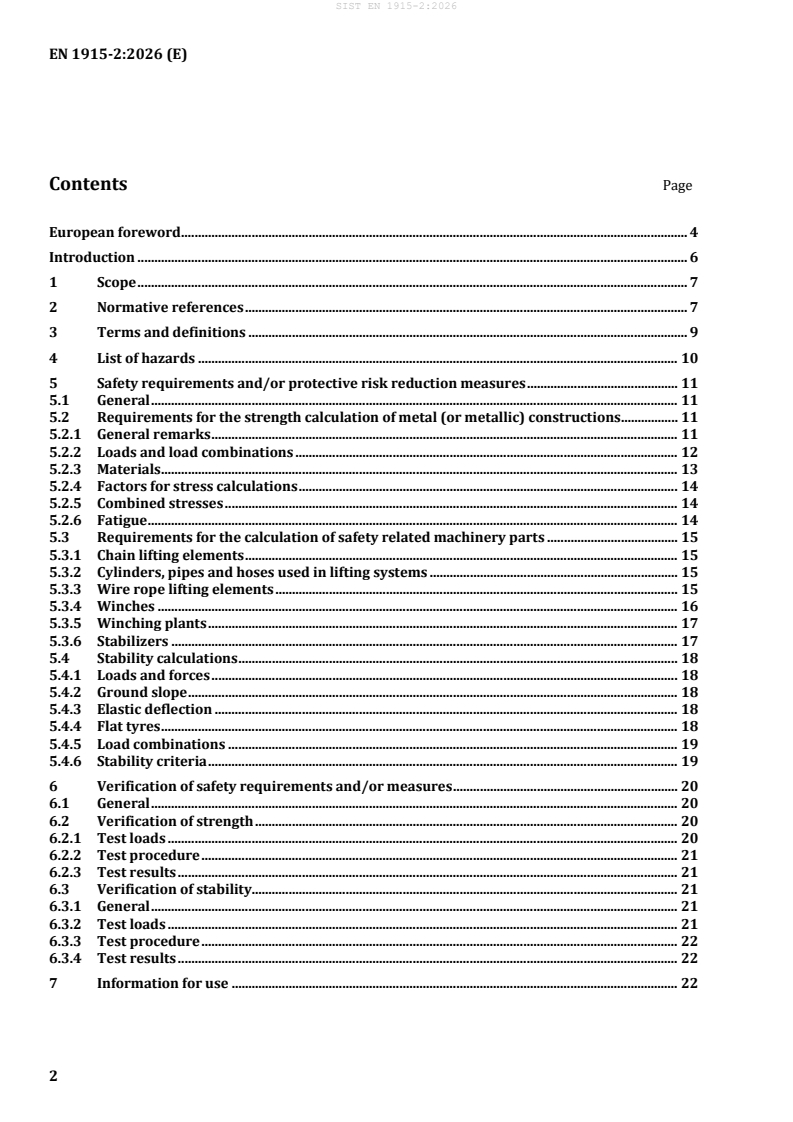
Contents Page
European foreword . 4
Introduction . 6
1 Scope . 7
2 Normative references . 7
3 Terms and definitions . 9
4 List of hazards . 10
5 Safety requirements and/or protective risk reduction measures . 11
5.1 General . 11
5.2 Requirements for the strength calculation of metal (or metallic) constructions . 11
5.2.1 General remarks . 11
5.2.2 Loads and load combinations . 12
5.2.3 Materials . 13
5.2.4 Factors for stress calculations . 14
5.2.5 Combined stresses . 14
5.2.6 Fatigue . 14
5.3 Requirements for the calculation of safety related machinery parts . 15
5.3.1 Chain lifting elements . 15
5.3.2 Cylinders, pipes and hoses used in lifting systems . 15
5.3.3 Wire rope lifting elements . 15
5.3.4 Winches . 16
5.3.5 Winching plants . 17
5.3.6 Stabilizers . 17
5.4 Stability calculations . 18
5.4.1 Loads and forces . 18
5.4.2 Ground slope . 18
5.4.3 Elastic deflection . 18
5.4.4 Flat tyres . 18
5.4.5 Load combinations . 19
5.4.6 Stability criteria . 19
6 Verification of safety requirements and/or measures . 20
6.1 General . 20
6.2 Verification of strength . 20
6.2.1 Test loads . 20
6.2.2 Test procedure . 21
6.2.3 Test results . 21
6.3 Verification of stability. 21
6.3.1 General . 21
6.3.2 Test loads . 21
6.3.3 Test procedure . 22
6.3.4 Test results . 22
7 Information for use . 22
Annex A (informative) List of significant hazards . 23
Annex B (informative) Examples for load geometry . 24
Annex C (normative) Wind shape factors . 30
Annex ZA (informative) Relationship between this European Standard and the essential
requirements of Regulation (EU) 2023/1230 aimed to be covered. 32
Bibliography . 37
European foreword
This document (EN 1915-2:2026) has been prepared by Technical Committee CEN/TC 274 “Aircraft
ground support equipment”, the secretariat of which is held by DIN.
This European Standard shall be given the status of a national standard, either by publication of an
identical text or by endorsement, at the latest by March 2027, and conflicting national standards shall be
withdrawn at the latest by March 2027.
Attention is drawn to the possibility that some of the elements of this document may be the subject of
patent rights. CEN shall not be held responsible for identifying any or all such patent rights.
This document supersedes EN 1915-2:2001+A1:2009.
This document includes the following significant technical changes with respect to EN 1915-
2:2001+A1:2009:
a) the Introduction was updated;
b) the Scope was updated;
c) Clause 2, Normative references, was updated;
d) requirements for steel constructions changed to metal (or metallic) constructions;
e) the methods of calculation changed;
f) factors for stress calculations have new bases;
g) fatigue strength factors were updated;
h) it has been determined when inspections can be dispensed with (see 6.1);
i) Annex A, List of significant hazards, was added;
j) Annex ZA was updated;
k) the Bibliography was updated.
This document has been prepared under a standardization request addressed to CEN by the European
Commission. The Standing Committee of the EFTA States subsequently approves these requests for its
Member States.
For the relationship with EU Legislation, see informative Annex ZA, which is an integral part of this
document.
EN 1915, Aircraft ground support equipment ― General requirements, consists of the following parts:
— Part 1: Basic safety requirements;
— Part 2: Stability and strength requirements, calculations and test methods (the present document);
— Part 3: Vibration measurement methods and reduction;
— Part 4: Noise measurement methods and reduction.
EN 12312, Aircraft ground support equipment ― Specific requirements, consists of the following parts:
— Part 1: Passenger stairs;
— Part 2: Catering vehicles;
— Part 3: Conveyor belt vehicles;
— Part 4: Passenger boarding bridges;
— Part 5: Aircraft fuelling equipment;
— Part 6: Deicers and deicing/antiicing equipment;
— Part 7: Aircraft movement equipment;
— Part 8: Maintenance or service stairs and platforms;
— Part 9: Container/Pallet loaders;
— Part 10: Container/Pallet transfer transporters;
— Part 11: Container/Pallet dollies and loose load trailers;
— Part 12: Potable water service equipment;
— Part 13: Lavatory service equipment;
— Part 14: Disabled/incapacitated passenger boarding vehicles;
— Part 15: Baggage and equipment tractors;
— Part 16: Air start equipment;
— Part 17: Air conditioning equipment;
— Part 18: Nitrogen or Oxygen units;
— Part 19: Aircraft jacks, axle jacks and hydraulic tail stanchions;
— Part 20: Electrical ground power units.
Any feedback and questions on this document should be directed to the users’ national standards body.
A complete listing of these bodies can be found on the CEN website.
According to the CEN-CENELEC Internal Regulations, the national standards organisations of the
following countries are bound to implement this European Standard: Austria, Belgium, Bulgaria, Croatia,
Cyprus, Czech Republic, Denmark, Estonia, Finland, France, Germany, Greece, Hungary, Iceland, Ireland,
Italy, Latvia, Lithuania, Luxembourg, Malta, Netherlands, Norway, Poland, Portugal, Republic of North
Macedonia, Romania, Serbia, Slovakia, Slovenia, Spain, Sweden, Switzerland, Türkiye and the United
Kingdom.
Introduction
The abbreviation GSE means a complete item of aircraft ground support equipment in the context of this
document.
When compiling this document, it was assumed that:
a) components without specific requirements are:
1) designed in accordance with good engineering practice and calculation codes;
2) of sound mechanical and electrical construction;
3) made of materials with adequate strength and of suitable quality;
4) made of materials free of defects;
b) components are kept in good repair and working order, so that the required characteristics remain
despite wear;
c) by design of the load bearing elements, a safe operation of the machine is ensured for loading ranges
from zero to 100 % of the rated possibilities and during tests;
d) a negotiation took place between the user and the manufacturer concerning particular conditions for
the use and places of use of the GSE;
e) the place of operation allows a safe use of GSE.
The extent to which hazards are covered is indicated in the scope of this document.
The minimum essential criteria are considered to be of primary importance in providing safe, economical
and usable GSE. Deviation from the recommended methods and conditions should occur only after careful
consideration, extensive testing and thorough in-service evaluation have shown alternative methods or
conditions to be satisfactory. Such deviations are outside the scope of this document and a manufacturer
should be able to demonstrate an equivalent level of protection.
This European Standard is a Type C standard as defined in EN ISO 12100:2010.
The machinery concerned and the extent to which hazards, hazardous situations or hazardous events are
covered are indicated in the Scope of this document.
When requirements of this type C standard are different from those which are stated in type A or type B
standards, the requirements of this type C standard take precedence over the requirements of the other
standards for machines that have been designed and built according to the requirements of this type C
standard.
1 Scope
This document specifies the conditions to be taken into consideration when calculating the strength and
the stability of GSE. It also specifies general test methods.
This part of EN 1915 is intended to be used in conjunction with EN 1915-1:2023, EN ISO 31915-3:2026
(for self-propelled GSE) and EN 1915-4:2004+A1:2009, and with the relevant part of EN 12312 to give
the requirements for the types of GSE within the scope of EN 12312.
When EN 12312 does not contain a relevant part for a GSE, EN 1915 (all parts) gives general
requirements that may apply, although additional machine specific requirements, to be determined by
the manufacturer, are likely to be required.
NOTE The methods given in this document demonstrate one way of achieving an acceptable safety level.
Methods that produce comparable results can be used.
This document does not establish additional requirements for the following:
a) operation elsewhere than in an airport environment;
b) operation in severe conditions, e.g. ambient temperature below −20 °C or over 50 °C, tropical or
saturated salty atmospheric environment;
c) hazards caused by wind velocity in excess of the figures given in this document;
d) earthquake, flood, landslide, lightning and more generally any natural catastrophe.
This document is not applicable to GSE which are manufactured before the date of publication by CEN of
this document.
2 Normative references
The following documents are referred to in the text in such a way that some or all of their content
constitutes requirements of this document. For dated references, only the edition cited applies. For
undated references, the latest edition of the referenced document (including any amendments) applies.
EN 1915-1:2023, Aircraft ground support equipment — General requirements — Part 1: Basic safety
requirements
EN ISO 31915-3:2026, Aircraft ground support equipment — General requirements — Part 3: Vibration
measurement methods and reduction
EN 1915-4:2004+A1:2009, Aircraft ground support equipment — General requirements — Part 4: Noise
measurement methods and reduction
EN 1993-1-9:2025, Eurocode 3: Design of steel structures — Part 1-9: Fatigue
EN 12312-1:2024, Aircraft ground support equipment — Specific requirements — Part 1: Passenger stairs
EN 12312-2:2014, Aircraft ground support equipment — Specific requirements — Part 2: Catering vehicles
EN 12312-3:2017+A1:2020, Aircraft ground support equipment — Specific requirements — Part 3:
Conveyor belt vehicles
EN 12312-4:2024, Aircraft ground support equipment — Specific requirements — Part 4: Passenger
boarding bridges
EN 12312-5:2021+A1:2025, Aircraft ground support equipment — Specific requirements — Part 5:
Aircraft fuelling equipment
EN 12312-6:2017, Aircraft ground support equipment — Specific requirements — Part 6: Deicers and de-
icing/anti-icing equipment
EN 12312-7:2020, Aircraft ground support equipment — Specific requirements — Part 7: Aircraft
movement equipment
EN 12312-8:2018, Aircraft ground support equipment — Specific requirements — Part 8: Maintenance or
service stairs and platforms
EN 12312-9:2013, Aircraft ground support equipment — Specific requirements — Part 9: Container/Pallet
loaders
EN 12312-10:2005+A1:2009, Aircraft ground support equipment — Specific requirements — Part 10:
Container/Pallet transfer transporters
EN 12312-11:2005, Aircraft ground support equipment — Specific requirements — Part 11:
Container/Pallet dollies and loose load trailers
EN 12312-12:2017, Aircraft ground support equipment — Specific requirements — Part 12: Potable water
service equipment
EN 12312-13:2017, Aircraft ground support equipment — Specific requirements — Part 13: Lavatory
service equipment
EN 12312-14:2014, Aircraft ground support equipment — Specific requirements — Part 14:
Disabled/incapacitated passenger boarding vehicles
EN 12312-15:2020+A2:2025, Aircraft ground support equipment — Specific requirements — Part 15:
Baggage and equipment tractors
EN 12312-16:2005+A1:2009, Aircraft ground support equipment — Specific requirements — Part 16: Air
start equipment
EN 12312-17:2004+A1:2009, Aircraft ground support equipment — Specific requirements — Part 17: Air
conditioning equipment
EN 12312-18:2005+A1:2009, Aircraft ground support equipment — Specific requirements — Part 18:
Nitrogen or Oxygen units
EN 12312-19:2005+A1:2009, Aircraft ground support equipment — Specific requirements — Part 19:
Aircraft jacks, axle jacks and hydraulic tail stanchions
EN 12312-20:2026, Aircraft ground support equipment — Specific requirements — Part 20: Electrical
ground power units
EN ISO 4413:2010, Hydraulic fluid power — General rules and safety requirements for systems and their
components (ISO 4413:2010)
EN ISO 12100:2010, Safety of machinery — General principles for design — Risk assessment and risk
reduction (ISO 12100:2010)
ISO 2408:2017, Steel wire ropes — Requirements
ISO 8625-1:2018, Aerospace — Fluid systems — Vocabulary — Part 1: General terms and definitions
related to pressure
3 Terms and definitions
For the purposes of this document, the terms and definitions given in EN ISO 12100:2010, EN 1915-
1:2023 and ISO 8625-1:2018, and the following apply.
ISO and IEC maintain terminology databases for use in standardization at the following addresses:
— ISO Online browsing platform: available at https://www.iso.org/obp/
— IEC Electropedia: available at https://www.electropedia.org/
3.1
dead weight
mass of that part of the GSE, for which the strength is to be calculated
3.2
live load
maximum mass (including persons) a GSE or a part of it is intended to carry
3.3
local loads
loads derived from the live load for the calculation of the strength of particular parts of the GSE
3.4
snow load
maximum mass of snow or ice the GSE is intended to carry
3.5
static test load
test load or combination of tests, used to simulate operational loading
3.6
dynamic forces
forces resulting from acceleration of a mass
EXAMPLE Acceleration forces, retardation forces, centrifugal forces.
3.7
secondary dynamic forces
forces caused by the movement of persons
Note 1 to entry: These forces act horizontally at the centre of gravity of the body of a person. The centre of gravity
of persons is assumed to be 1,1 m above the standing area.
3.8
retardation forces
forces on particular parts of GSE caused by the maximum deceleration of the GSE
Note 1 to entry: These forces act at the centre of gravity of the particular part in the direction of motion.
3.9
spring reaction force
force in the suspension under the condition of loading
3.10
wind load
force acting on a GSE or part of it due to wind pressure
Note 1 to entry: This force acts horizontally at the geometric centre of the body of the GSE.
3.11
tipping edge
those part(s) of the GSE in contact with the ground, located farthest out on the most heavily loaded side
3.12
tipping moment
total of the products of those forces which tend to tip the GSE, and their distance normal to the tipping
edge
3.13
burst pressure, actual
pressure at which a component bursts or shows excessive leakage due to structural failure
[SOURCE: ISO 8625-1:2018, 3.7]
3.14
maximum working pressure
highest pressure at which the system is to operate
3.15
accidental load
that load resulting from unforeseen or rare events
Note 1 to entry: Those events can be e.g. failure of one lifting device and impacts.
3.16
resonance
phenomenon where a system vibrates with maximum amplitude at specific frequencies, known as natural
frequencies
Note 1 to entry: Resonance can only be considered during the intended use of the GSE, e.g. passengers at
passenger boarding bridges.
4 List of hazards
This list of risks and hazards (given in Table A.1) is based on EN ISO 12100:2010 and contains the hazards
and hazardous situations, as far as they are dealt with in this document, identified by risk assessment as
significant for this type of machinery and which require action to eliminate or reduce risks. See also the
complementary list of hazards in the other parts of EN 1915 and in the different parts of EN 12312.
5 Safety requirements and/or protective risk reduction measures
5.1 General
GSE shall comply with the safety requirements and/or protective measures of this clause, with the
requirements of EN 1915-1:2023, EN ISO 31915-3:2026 and EN 1915-4:2004+A1:2009 as relevant, as
well as with the requirements of the relevant part of EN 12312. In addition, the machine shall be designed
according to the principles of EN ISO 12100:2010 for relevant but not significant hazards, which are not
dealt with by this document.
Where a standard automotive or truck chassis is used, the manufacturer of the GSE should pay attention
to and appropriate gross mass rating for the intended use.
5.2 Requirements for the strength calculation of metal (or metallic) constructions
5.2.1 General remarks
The method of calculation shall take into account the complexity of each individual type of GSE. The
pertinence of the method of calculation shall be stated in the technical file.
Calculation models shall be performed either by
a) finite element analysis;
b) truss structure analysis;
c) hand calculations
or combinations of these.
Design verification methods shall be performed either by
d) recognized engineering design methods and engineering codes;
e) actual stress measurements
or combinations of these.
NOTE Information about load geometry is given in Annex B, Table B.1 and Figures B.1 to B.5.
The source of the design methods and engineering codes, if generally accessible, shall be stated in the
case of any unusual formulae or calculation methods. Otherwise, only formulae or calculation methods
which can be verified shall be used.
The general stress analysis shall be carried out to ensure safe levels of stress in relation to the yield stress
of the material used.
Safe levels of stress related to the loading conditions shall be demonstrated for all supporting structures.
The principal dimensions, cross sections, materials and fastening means shall be stated.
The calculation shall be performed considering second order theory or large displacements analysis. Test
results, if available, shall be used to modify calculation parameters. The analysis of the load case
combinations intended shall be carried out to ensure that the severest individual load ratings can be
identified.
The global and local stability (buckling) of the GSE shall be proven according to design verification
methods given in 5.2.1. Eigenvalue buckling analysis is permitted.
Consideration shall be given to high dynamic forces which can be caused by the operation of a safety
device for the prevention of unintentional movements if there is an escape of fluid in a piping system or
a rope, chain, nut or gear fails.
The design of mechanical restraint devices shall take into account all loads and forces occurring during
blocking.
Where a system has two or more lifting elements in parallel, design shall ensure the loads resulting from
the failure of one element shall not have effects jeopardising safety. These loads shall be considered in
structural design to ensure the safety and integrity of the structure under exceptional circumstances. The
structure shall be stable but plastic deformations and / or local instabilities are allowed. The loading
condition for this accidental case shall be the combination of all vertical loads: 1,0 × dead weight +
1,1 × (live load + snow load). Resonance effects shall be avoided for live load.
Strength calculations can be performed using recognized methods such as Eurocode 3 for steel structures
(EN 1993-1-3:2024), the FKM-Guidelines, Computational strength verification of machine components ,
EN 13001-2:2021 or other recognized calculation methods.
5.2.2 Loads and load combinations
5.2.2.1 The following loads or worse combinations thereof shall be taken into account:
a) dead weight;
b) live load;
c) local loads;
d) snow load;
e) dynamic forces;
f) resonance;
g) wind load.
NOTE Load combinations are given in 5.4.5.
5.2.2.2 Loads shall be used in the calculation of the strength of the elements concerned at the most
unfavourable positions, values and directions, e.g. Table 3.
5.2.2.3 The live load shall be stated, and shall be not less than 3200 N/m . Where the intended use
of the GSE is to carry persons, the live load shall be calculated on the basis of four persons per m , each
person at 80 kg.
5.2.2.4 Dynamic forces effective at the same time shall be measured under intended use conditions
or be calculated.
For GSE not designed to be driven during operation, vertical dynamic forces shall be considered to be at
least 10 % of the component mass and live load, subject to verification by a competent authority.
NOTE See also the EN 12312 series.
Available from: VDMA Services GmbH, Lyoner Straße 18, D-60528 Frankfurt am Main, Germany.
5.2.2.5 For simplification of the calculation, secondary dynamic forces are introduced into the
calculation as static forces by the formula:
F = 200 N x Σ (1/i)
s
i.e. F = 200 N (1/1+1/2+1/3+.+1/i)
s
where:
i is the number of persons on the entire GSE.
5.2.2.6 The snow load shall be specified in the manufacturer instruction manual.
NOTE The snow load is depending on the geographical area of use of the GSE and can be agreed between
manufacturer and user (see introduction – negotiation).
5.2.2.7 The wind force is generally calculated by the formula:
W = c q A
where:
c is the shape factor;
A is the surface area in square metres;
q is the dynamic wind pressure in Pascals.
The dynamic wind pressure is calculated by the formula:
ρv
q =
where:
v is the wind velocity, in metres per second;
ρ is the density of air in kilograms per cubic metre.
An air density at the lowest operating temperature shall always be used. As a reference, at an operating
temperature of +15 °C, an air density of 1,225 kg per cubic metre can be used.
The maximum wind velocity shall be specified in the manufacturer instruction manual. A minimum
constant wind velocity of 20,58 m/s (40 kn) shall be considered.
NOTE The operating conditions to resist higher wind gust velocities can be agreed between manufacturer and
user (see introduction – negotiation).
For simplification, the wind velocity shall be assumed to be constant over the height of the GSE.
The shape factor c is given in Annex C, Table C.1 and Figures C.1 to C.3.
5.2.3 Materials
Type, grade, chemical composition, weldability and mechanical characteristics (e.g. yield strength,
modulus of elasticity, shear modulus) of materials used shall be stated in the technical file.
5.2.4 Factors for stress calculations
The stress factors S as specified in Table 1 are applicable for constructional metal up to a yield of
355 N/mm .
Only for accidental load, local plastic analysis is allowed.
Table 1 — Stress factors S
a a
Structural elements
Butt welds Fillet welds
Equivalent stress σ 1,3 1,7 (1,4) 2,1 (1,7)
V
Tensile stress σ
Z
Compressive stress σ 1,4 1,7 (1,4) 1,8 (1,5)
D
Shear stress τ 1,7 2,1 (1,7) 2,1 (1,7)
a
The stress factors between brackets can be used for welding quality B according to EN ISO 5817:2023 and
welds in accordance with EN ISO 3834-1:2021, EN ISO 3834-2:2021, EN ISO 3834-3:2021 and EN ISO 3834-
4:2021.
The established stress resulting from the multiplication of the calculated stress by the stress factor S shall
not exceed the yield stress of the respective material.
5.2.5 Combined stresses
Where situations of combined plane stresses exist, the equivalent stress shall be verified, paying attention
to the plus or minus signs, as follows:
2 2 2
σ σσσ+ − σ + 3τ
v x y x y
5.2.6 Fatigue
A fatigue calculation shall be carr
...