

kSIST-TS FprCEN/TS 18345-2:2026
(Main)Paper and board - Laboratory test method for recyclability assessment of paper and board-based materials and products - Part 2: Flotation-deinking recycling process
General Information
- Abstract
This document describes a laboratory test method for determining the key parameters for evaluating the level of technical recyclability of a paper-based material and product using a white or off-white substrate, emulating the relevant phases of paper and board mills with alkaline flotation deinking recycling process.
The assessment of the technical recyclability is out of the scope of this document.
- Status
- Not Published
- Public Enquiry End Date
- 30-Jul-2026
- Technical Committee
- VPK - Pulp, paper, board and products
- Current Stage
- 5520 - Unique Acceptance Procedure (UAP) (Adopted Project)
- Start Date
- 10-Jun-2026
- Due Date
- 28-Oct-2026
- Completion Date
- 03-Aug-2026

Overview
kSIST-TS FprCEN/TS 18345-2:2026 specifies a laboratory test method for the recyclability assessment of paper and board-based materials and products, focusing on the flotation-deinking recycling process. Developed by the European Committee for Standardization (CEN), this technical specification provides a standardized approach to simulate the industrial recycling stages typical of paper and board mills using an alkaline flotation-deinking process. The method is designed for materials and products with white or off-white substrates and is essential for supporting the recycling value chain, eco-design, and regulatory compliance in the paper industry.
The scope of this document is limited to defining the laboratory procedures for measuring key parameters relevant to recyclability. The actual assessment and interpretation of technical recyclability remain outside the specification.
Key Topics
- Flotation-Deinking Process Simulation: The standard outlines laboratory procedures that replicate the main phases of industrial alkaline flotation-deinking recycling, enabling accurate measurement of how paper products behave during recycling.
- Sample Preparation and Analysis: Guidance is provided for preparing representative samples, including procedures for both homogeneous and composite materials, dry matter and ash content determination, and test conditions.
- Measurement of Process and Quality Parameters:
- Coarse and fine reject content
- Luminance and color values of the deinked pulp
- Dirt speck area and intensity
- Analysis of adhesive contaminants (e.g., stickies)
- Chemical oxygen demand (COD) and dissolved substances
- Yield and fiber concentration after flotation
- Laboratory Equipment and Chemicals: Detailed requirements for the apparatus (e.g., ovens, pH meters, filtration equipment, flotation cells) and chemicals (e.g., sodium hydroxide, calcium chloride, hydrogen peroxide, oleic acid) used in the test.
- Reporting Requirements: Instructions for documenting and reporting test results to ensure comparability and reproducibility.
Applications
kSIST-TS FprCEN/TS 18345-2:2026 delivers practical value to a variety of stakeholders within the paper recycling industry and beyond:
- Paper and Board Manufacturers: Evaluate new and existing products for ease of recyclability using a consistent laboratory approach, inform eco-design decisions, and innovate towards more recyclable products.
- Recycling Facilities and Laboratories: Standardize testing procedures to ensure comparability of results across different laboratories and regions, facilitating high recycling rates and improving process efficiency.
- Compliance and Regulatory Assurance: Align test methods with relevant European recycling targets and legislation (such as 2018/851/EU and 2018/852/EU), and support declarations related to recyclability grades required by third-party organizations and regulations.
- Research and Development: Provide a platform for investigating the recyclability impact of new additives, coatings, or product designs under controlled laboratory conditions.
- Sustainability Initiatives: Contribute directly to circular economy strategies by validating the end-of-life recyclability of paper-based materials and products.
Related Standards
kSIST-TS FprCEN/TS 18345-2:2026 references and complements several key international standards relevant to paper and board testing and recycling processes:
- EN ISO 187: Standard atmosphere for conditioning and testing
- EN ISO 638-1: Determination of dry matter content by oven-drying
- ISO 1762: Determination of residue (ash content) on ignition
- EN ISO 5269-2: Laboratory sheet preparation for testing
- ISO 2469, ISO 2470-1: Measurement of reflectance factor and brightness
- ISO 4119: Determination of stock concentration
- ISO 14487: Standard water for testing
- ISO 15705, ISO 5815-1: Chemical and biochemical oxygen demand
- TAPPI/ANSI T275: Screening of pulp
- ISO 21993: Deinked pulp and fiber yield testing
These and related standards facilitate harmonized testing, support accurate benchmarking, and underpin the reliability of recyclability assessments in the paper and board sector.
Keywords: Paper recyclability, flotation deinking, laboratory test method, paper and board, CEN standard, recycling process, industrial simulation, sustainability, eco-design, compliance, sample preparation, pulp analysis, adhesive contaminants, fiber yield, ash content, ISO standards.
Get Certified
Connect with accredited certification bodies for this standard

Control Union Certifications
Global certification for agriculture and sustainability.

Gozdarski inštitut Slovenije
Slovenian Forestry Institute. Forest management certification support, timber testing.
Sponsored listings
Frequently Asked Questions
kSIST-TS FprCEN/TS 18345-2:2026 is a draft published by the Slovenian Institute for Standardization (SIST). Its full title is "Paper and board - Laboratory test method for recyclability assessment of paper and board-based materials and products - Part 2: Flotation-deinking recycling process". This standard covers: This document describes a laboratory test method for determining the key parameters for evaluating the level of technical recyclability of a paper-based material and product using a white or off-white substrate, emulating the relevant phases of paper and board mills with alkaline flotation deinking recycling process. The assessment of the technical recyclability is out of the scope of this document.
This document describes a laboratory test method for determining the key parameters for evaluating the level of technical recyclability of a paper-based material and product using a white or off-white substrate, emulating the relevant phases of paper and board mills with alkaline flotation deinking recycling process. The assessment of the technical recyclability is out of the scope of this document.
kSIST-TS FprCEN/TS 18345-2:2026 is classified under the following ICS (International Classification for Standards) categories: 85.020 - Paper production processes. The ICS classification helps identify the subject area and facilitates finding related standards.
kSIST-TS FprCEN/TS 18345-2:2026 is available in PDF format for immediate download after purchase. The document can be added to your cart and obtained through the secure checkout process. Digital delivery ensures instant access to the complete standard document.
Standards Content (Sample)
SLOVENSKI STANDARD
01-julij-2026
Papir, karton in lepenka - Laboratorijska preskusna metoda za oceno zmožnosti
recikliranja materialov in izdelkov iz papirja in kartona - 2. del: Postopek
recikliranja s flotacijo in odstranjevanjem črnila
Paper and board - Laboratory test method for recyclability assessment of paper and
board-based materials and products - Part 2: Flotation-deinking recycling process
Papier und Pappe - Laborprüfverfahren zur Bewertung der Rezyklierbarkeit von
Materialien und Produkten auf der Basis von Papier und Pappe – Teil 2: Flotations-
Entfärbungs-Recyclingverfahren
Papier et carton - Méthode d’essai en laboratoire pour l’évaluation de la recyclabilité des
matériaux et produits à base de papier et carton - Partie 2 : Procédé de recyclage avec
désencrage par flottation
Ta slovenski standard je istoveten z: FprCEN/TS 18345-2
ICS:
85.020 Postopki v proizvodnji papirja Paper production processes
2003-01.Slovenski inštitut za standardizacijo. Razmnoževanje celote ali delov tega standarda ni dovoljeno.
FINAL DRAFT
TECHNICAL SPECIFICATION
FprCEN/TS 18345-2
SPÉCIFICATION TECHNIQUE
TECHNISCHE SPEZIFIKATION
May 2026
ICS 85.020
English Version
Paper and board - Laboratory test method for recyclability
assessment of paper and board-based materials and
products - Part 2: Flotation-deinking recycling process
Papier et carton - Méthode d'essai en laboratoire pour Papier und Pappe - Laborprüfverfahren zur Bewertung
l'évaluation de la recyclabilité des matériaux et der Rezyklierbarkeit von Materialien und Produkten
produits à base de papier et carton - Partie¿2 : Procédé auf der Basis von Papier und Pappe - Teil 2: Flotations-
de recyclage avec désencrage par flottation Entfärbungs-Recyclingverfahren
This draft Technical Specification is submitted to CEN members for Vote. It has been drawn up by the Technical Committee
CEN/TC 172.
CEN members are the national standards bodies of Austria, Belgium, Bulgaria, Croatia, Cyprus, Czech Republic, Denmark, Estonia,
Finland, France, Germany, Greece, Hungary, Iceland, Ireland, Italy, Latvia, Lithuania, Luxembourg, Malta, Netherlands, Norway,
Poland, Portugal, Republic of North Macedonia, Romania, Serbia, Slovakia, Slovenia, Spain, Sweden, Switzerland, Türkiye and
United Kingdom.
Recipients of this draft are invited to submit, with their comments, notification of any relevant patent rights of which they are
aware and to provide supporting documentation.
Warning : This document is not a Technical Specification. It is distributed for review and comments. It is subject to change
without notice and shall not be referred to as a Technical Specification.
EUROPEAN COMMITTEE FOR STANDARDIZATION
COMITÉ EUROPÉEN DE NORMALISATION
EUROPÄISCHES KOMITEE FÜR NORMUNG
CEN-CENELEC Management Centre: Rue de la Science 23, B-1040 Brussels
© 2026 CEN All rights of exploitation in any form and by any means reserved Ref. No. FprCEN/TS 18345-2:2026 E
worldwide for CEN national Members.
FprCEN/TS 18345-2:2026 (E)
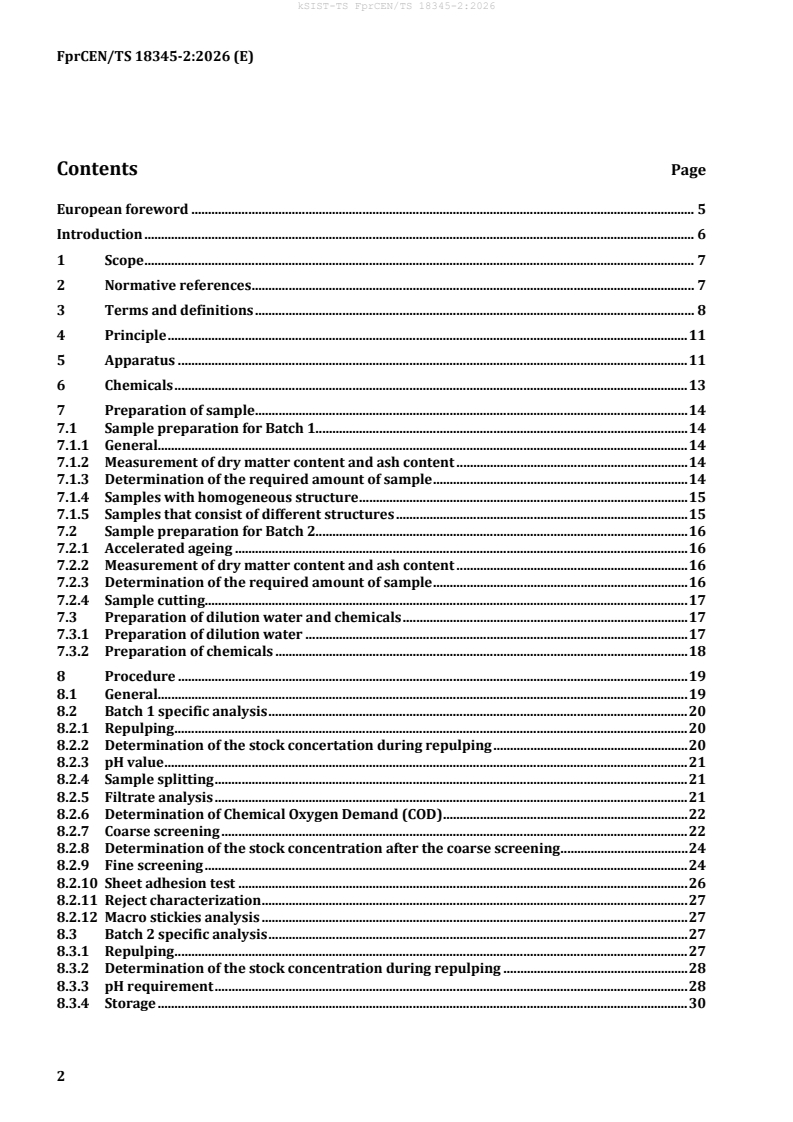
Contents Page
European foreword . 5
Introduction . 6
1 Scope . 7
2 Normative references . 7
3 Terms and definitions . 8
4 Principle . 11
5 Apparatus . 11
6 Chemicals . 13
7 Preparation of sample . 14
7.1 Sample preparation for Batch 1. 14
7.1.1 General. 14
7.1.2 Measurement of dry matter content and ash content . 14
7.1.3 Determination of the required amount of sample . 14
7.1.4 Samples with homogeneous structure . 15
7.1.5 Samples that consist of different structures . 15
7.2 Sample preparation for Batch 2. 16
7.2.1 Accelerated ageing . 16
7.2.2 Measurement of dry matter content and ash content . 16
7.2.3 Determination of the required amount of sample . 16
7.2.4 Sample cutting. 17
7.3 Preparation of dilution water and chemicals . 17
7.3.1 Preparation of dilution water . 17
7.3.2 Preparation of chemicals . 18
8 Procedure . 19
8.1 General. 19
8.2 Batch 1 specific analysis . 20
8.2.1 Repulping . 20
8.2.2 Determination of the stock concertation during repulping . 20
8.2.3 pH value . 21
8.2.4 Sample splitting . 21
8.2.5 Filtrate analysis . 21
8.2.6 Determination of Chemical Oxygen Demand (COD) . 22
8.2.7 Coarse screening . 22
8.2.8 Determination of the stock concentration after the coarse screening . 24
8.2.9 Fine screening . 24
8.2.10 Sheet adhesion test . 26
8.2.11 Reject characterization . 27
8.2.12 Macro stickies analysis . 27
8.3 Batch 2 specific analysis . 27
8.3.1 Repulping . 27
8.3.2 Determination of the stock concentration during repulping . 28
8.3.3 pH requirement . 28
8.3.4 Storage . 30
FprCEN/TS 18345-2:2026 (E)
8.3.5 Dilution . 30
8.3.6 Flotation . 30
8.3.7 Yield . 30
9 Specimen preparation . 31
9.1 General . 31
9.2 Filter pads. 31
9.3 Membrane filters . 32
9.4 Handsheets for dirt speck measurement . 33
10 Analysis . 33
10.1 General . 33
10.2 Reflectance measurements . 33
10.2.1 General . 33
10.2.2 Reflectance factors . 33
10.2.3 Filtrate darkening . 34
10.3 Filtrate darkening . 34
10.4 Dirt particle measurement . 34
10.4.1 Scanner . 34
10.4.2 Procedure for dirt particle measurement . 34
11 Test report . 35
Annex A (normative) Description of the plate for the coarse screening . 36
Annex B (normative) Description of the thickener . 38
Annex C (normative) Testing the flotation time of filter paper . 39
C.1 General . 39
C.2 Materials . 39
C.3 Test equipment. 39
C.4 Preparation . 39
C.5 Testing . 39
C.6 Documentation . 40
Annex D (normative) Repulping device . 41
D.1 Determination of pulper operating conditions . 41
D.2 Hobart pulper N 50 . 41
D.3 Kenwood pulper KMM 020 . 41
Annex E (informative) Scanner specifications and dirt specks classification . 42
E.1 Threshold value determination . 42
E.2 Size classification dirt specks . 42
Annex F (informative) Flowchart . 43
Annex G (normative) Reject characterization template . 45
Annex H (informative) Measurement of adhesive particles – macro stickies . 47
H.1 General . 47
H.2 Equipment . 47
H.3 Procedure . 47
FprCEN/TS 18345-2:2026 (E)
H.4 Scanner specification. 49
H.5 Calculation . 50
Annex I (informative) Testing the pH of smaller sample amount . 51
Annex J (informative) Example of flotation cells . 52
TM
J.1 Voith Delta 25 . 52
J.2 PTS Flotation cell . 52
Annex K (informative) Biological oxygen demand – BOD5 . 53
K.1 Procedure . 53
K.2 Procedure . 53
K.3 Calculation . 53
Bibliography . 54
FprCEN/TS 18345-2:2026 (E)
European foreword
This document (FprCEN/TS 18345-2:2026) has been prepared by Technical Committee CEN/TC 172
“Pulp, paper and board”, the secretariat of which is held by DIN.
This document is currently submitted to the Vote on TS.
FprCEN/TS 18345-2:2026 (E)
Introduction
The paper and paper board value chain is an example for circularity, displaying very high recycling rates.
Moreover, technical innovation is creating new products from paper and board-based materials which
are aimed to become papers and boards for recycling after their use.
To maintain and further increase the sustainability and circularity of the paper and board value chain
and to help EU Member States and other European countries meet high recycling targets , it is important
to ensure that paper and board-based products are recyclable by the paper industry. A laboratory test
method is needed for assessing the technical recyclability of these materials and products.
The test method in this document emulates the most common phases of the industrial processes to
measure the main parameters of recyclability of paper and board-based products based on current
knowledge and technology.
This makes it possible to:
— supplement the evaluation of recyclability required by EN 13430 with regard to paper and board-
based products that are sent for recycling in the paper industry;
— guide eco-design, in terms of recyclability, of paper and board-based products currently in use, as
well as new materials under development and new additives that can affect the recyclability of the
final product;
— support declarations related to the recyclability of materials or products based on grading systems
developed by third-party organizations and regulation.
Directives 2018/851/EU, 2018/852/EU set high recycling targets for municipal waste and paper-based packaging
(85% by 2025, 90% by 2030).
FprCEN/TS 18345-2:2026 (E)
1 Scope
This document describes a laboratory test method for determining the key parameters for evaluating the
level of technical recyclability of a paper-based material and product using a white or off-white substrate,
emulating the relevant phases of paper and board mills with alkaline flotation deinking recycling process.
The assessment of the technical recyclability is out of the scope of this document.
2 Normative references
The following documents are referred to in the text in such a way that some or all of their content
constitutes requirements of this document. For dated references, only the edition cited applies. For
undated references, the latest edition of the referenced document (including any amendments) applies.
EN ISO 187, Paper, board and pulps — Standard atmosphere for conditioning and testing and procedure
for monitoring the atmosphere and conditioning of samples (ISO 187)
EN ISO 638-1:2022, Paper, board, pulps and cellulosic nanomaterials — Determination of dry matter
content by oven-drying method — Part 1: Materials in solid form (ISO 638-1:2022)
EN ISO 5269-2, Pulps — Preparation of laboratory sheets for physical testing — Part 2: Rapid-Köthen
method (ISO 5269-2)
ISO 1762, Paper, board, pulps and cellulose nanomaterials — Determination of residue (ash content) on
ignition at 525 °C
ISO 2469:2024, Paper, board and pulps — Measurement of diffuse radiance factor (diffuse reflectance
factor)
ISO 2470-1, Paper, board and pulps — Measurement of diffuse blue reflectance factor – Part 1: Indoor
daylight conditions (ISO brightness)
ISO 3310-1, Test sieves — Technical requirements and testing — Part 1: Test sieves of metal wire cloth
ISO 4119:1995, Pulps — Determination of stock concentration
ISO 5631-1, Paper and board — Determination of colour by diffuse reflectance — Part 1: Indoor daylight
conditions (C/2°)
ISO 5815-1, Water quality — Determination of biochemical oxygen demand after n days (BODn) Part 1:
Dilution and seeding method with allylthiourea addition
ISO 12641-1:2025, Graphic technology — Prepress digital data exchange —Part 1: Colour targets for input
scanner calibration
ISO 13130, Laboratory glassware — Desiccators
ISO 14487, Pulps — Standard water for physical testing
ISO 15705, Water quality — Determination of the chemical oxygen demand index (ST-COD) — Small-scale
sealed tube method
TAPPI/ANSI T275, Screening of pulp (Somerville-type equipment)
FprCEN/TS 18345-2:2026 (E)
3 Terms and definitions
For the purposes of this document, the following terms and definitions apply.
ISO and IEC maintain terminology databases for use in standardization at the following addresses:
— ISO Online browsing platform: available at https://www.iso.org/obp/
— IEC Electropedia: available at https://www.electropedia.org/
3.1
paper
generic term for a range of materials in the form of a coherent sheet or web, excluding sheets or laps of
pulp as commonly understood for paper making or dissolving purposes and non-woven products, made
by deposition of vegetable, mineral, animal or synthetic fibres, or their mixtures, from a fluid suspension
onto a suitable forming device, with or without the addition of other substances
Note 1 to entry: Papers may be coated, impregnated or otherwise converted, during or after their manufacture,
without necessarily losing their identity as paper. In conventional papermaking processes, the fluid medium is
water; new developments, however, include the use of air and other fluids.
Note 2 to entry: In the generic sense, the term “paper” may be used to describe both paper and board as defined in
this part of ISO 4046. The primary distinction between paper and board is normally based upon thickness or
grammage, though in some instances the distinction will be based on the characteristics and/or end-use. For
example, some materials of lower grammage, such as certain grades of folding boxboard and corrugating raw
materials, are generally referred to as “board”, while other materials of higher grammage, such as certain grades of
blotting paper, felt paper and drawing paper, are generally referred to as “paper”.
[SOURCE: ISO 4046-3:2016, 3.95]
3.2
board
cardboard
paperboard
generic term applied to certain types of paper frequently characterized by their relatively high rigidity
Note 1 to entry: In the generic sense, the term “paper” may be used to describe both paper and board as defined in
this part of ISO 4046. The primary distinction between paper and board is normally based upon thickness or
grammage, though in some instances the distinction will be based on the characteristics and/or end-use. For
example, some materials of lower grammage, such as certain grades of folding boxboard and corrugating raw
materials, are generally referred to as “board”, while other materials of higher grammage, such as certain grades of
blotting paper, felt paper and drawing paper, are generally referred to as “paper”.
[SOURCE: ISO 4046-3:2016, 3.16]
3.3
paper-based product
article, predominantly consisting of paper or board
Note 1 to entry: Moulded products are included.
3.4
deinking
process of ink removal from pulp during the recycling process
[SOURCE: ISO/TS 21331:2020, 3.2.2]
FprCEN/TS 18345-2:2026 (E)
3.5
flotation
process step intended to selectively remove ink particles from recycled pulp
Note 1 to entry: Air is injected into diluted pulp, intended to carry ink particles to the surface of the pulp and to
form a froth there.
3.6
recyclability
ability of a paper or board product to be recycled into new paper and board
3.7
deinked pulp
pulp obtained from printed paper products, and deinked according to this document
[SOURCE: ISO 21993:2020]
3.8
undeinked pulp
pulp obtained from printed paper products, pulped with added deinking chemicals according to this
document, prior to flotation
[SOURCE: ISO 21993:2020, 3.2]
3.9
stock concentration
ratio of the oven-dry organic and inorganic mass of material that can be filtered from a stock sample, to
the mass of the unfiltered sample
Note 1 to entry: the stock concentration is expressed as a percentage by mass [% (m/m)].
[SOURCE: ISO 4119:1995, 3.2]
3.10
fibre concentration
ratio of the oven-dry mass of organic material, that can be filtered from a stock sample, to the mass of the
unfiltered sample
Note 1 to entry: Organic material is the total material, less its ash.
Note 2 to entry: The organic material mainly consists of cellulosic fibres and fines.
[SOURCE: ISO 21993:2020, 3.4]
3.11
fibre yield
ratio of the oven-dry mass of organic material after flotation to the oven-dry mass of organic material
before flotation
Note 1 to entry: Organic material is the total material, less its ash.
Note 2 to entry: The organic material mainly consists of cellulosic fibres and fines.
[SOURCE: ISO 21993:2020, 3.5]
FprCEN/TS 18345-2:2026 (E)
3.12
non-fibrous coarse-screenable material
non-fibrous part of the sample which can be removed in the coarse sreening
Note to entry: The removal into the coarse reject is determined in batch 1.
3.13
constant mass
mass of the test piece determined at the equilibrium condition after drying until the difference between
two successive dryings and weighings, separated in time by at least half the initial drying period, does
not exceed 0,1 % mass fraction of the test piece before drying
[SOURCE: EN ISO 638-1:2022, 3.2]
Note 1 to entry: The removal into the coarse reject is determined in batch 1.
3.14
paper recycling process with flotation deinking
type of process that typically takes in paper for recycling which is based on white or off-white paper and
board, and removes ink by flotation deinking
3.15
oven-dry mass
mass obtained on drying pulp at 105 °C ± 2 °C, until constant mass is reached
[SOURCE: ISO 801-3:1994, 3.5]
3.16
constituents
part from which a material or its components are made and which cannot be separated by hand or by
using simple physical means
[SOURCE: ISO 18601:2013, 3.12 - modified by deleting “packaging” from the term and “packaging
constituent” and by replacing “packaging” by “material” in the definition]
3.17
technical recyclability
ability of a paper and board product to be recycled into new paper and board by means of an established
recycling process
Note 1 to entry: The assessment of the technical recyclability is typically done by mimicking the recycling process
by a suitable laboratory method and an appropriate assessment scheme.
Note 2 to entry: The term recyclability can also mean recyclability at scale.
FprCEN/TS 18345-2:2026 (E)
4 Principle
The method defined in this document enables analysis of both the process parameters (coarse reject, fine
reject, luminance gain within the flotation, filtrate darkening, dissolved, and colloidal substances) and
quality parameters of the pulp obtained from the processing of the paper-based product (luminance and
a* value of deinked pulp, dirt specks area of deinked pulp, sheet adhesion and interfering materials e.g.
stickies). Two subsequent repulping batches are required: the first batch is used to determine dissolved
and colloidal substances, Chemical Oxygen Demand (COD), the coarse screening and the fine-screening
reject amount as well as an assessment of the adhesives. The second batch is to ascertain the flotation-
deinking criteria.
For the repulping for the deinking test the amount of non-fibrous coarse-screenable material that can be
removed in coarse screening needs to be considered for the second batch calculations (i.e. to adjust
chemical dosages and fibre concentration). The recyclability of paper-based products, introduced in the
flotation deinking stream, is determined through a laboratory procedure emulating the relevant
industrial phases in typical alkaline flotation-deinking mills dedicated to the recycling of paper and board.
5 Apparatus
The usual apparatus and, in particular, the following shall be used:
5.1 Forced air oven, able to maintain the required temperatures (60 °C, 105 °C and 130°C) with
accuracy of ± 2 °C.
5.2 pH meter.
5.3 Analytical balance, up to 50 g with an accuracy of at least ± 0,001 g.
5.4 Filter paper grade 388, with diameter of 150 mm (basis weight 84 g/m , filtration speed
10 s/10 ml, deposition range 12 µm to 15 μm).
5.5 Büchner funnel, diameter 125 mm and 150 mm equipped with suction flask.
5.6 Aluminium trays, for the determination of the evaporation residue.
5.7 Refrigerator (optional), to store the filtrate.
5.8 Somerville-fractionator, compliant with TAPPI/ANSI T275.
5.9 Perforated screen plate, with 5 mm hole diameter (for details see Annex A).
5.10 Sample containers, beakers, buckets or barrels.
5.11 Filter paper grade 388, with a diameter of 125 mm (basis weight 84 g/m , filtration speed
10 s/10 ml, deposition range 12 µm to 15 μm).
5.12 Stopwatch/timer.
5.13 Thickener, as described in Annex B, with a test sieve compliant to ISO 3310-1.
5.14 Rapid Köthen sheet former, compliant with EN ISO 5269-2.
5.15 Carrier boards and cover sheets, compliant with EN ISO 5269-2.
FprCEN/TS 18345-2:2026 (E)
5.16 Metal plates (brass or steel), for adhesiveness test, weighing (3,7 ± 0,1) kg and with a diameter
of 20 cm (corresponding to a pressure of 1 180 Pa).
5.17 Desiccator, compliant with ISO 13130.
The desiccator should be filled with desiccant to such an extent that there is at least a 10 mm gap between
the desiccant and the perforated plate, sieve or grid. The use of a drying cabinet is possible, but ensure
that the results are the same.
The temperature and relative humidity in the desiccator shall be measured regularly before and after
each test with a suitable measuring device. Each laboratory should maintain a constant value, otherwise
the desiccant shall be regenerated.
No specific value is set for the temperature and relative humidity. The values are rather for checking the
correct functioning of the desiccator and the desiccant and should be recorded and checked regularly
before, during and after each test.
5.18 LED light box, with a recommended LED light source of 5 500 K to 6 500 K (daylight range) and
illuminance of at least 5 000 lx.
5.19 Glass bottle (optional), to store the filtrate.
5.20 Cutting mat, for photo documentation.
5.21 Balance, up to 2 kg with an accuracy of at least ±0,1 g.
5.22 Balance, up to 30 kg with an accuracy of ±5 g.
5.23 Digital thermometer, with an accuracy of ±0,1 °C.
5.24 Vacuum device, with a pressure difference ≥ 60 000 Pa.
5.25 Vacuum filtration unit, with 39 mm bottom inner diameter of the funnel.
5.26 Couching roller, compliant with EN ISO 5269-2.
5.27 Slotted screen plate, with 0,15 mm wide slots (for details see TAPPI/ANSI T275).
5.28 Filter paper grade 1289, Grammage of (84 ± 4) g/m , filtration time for deionized water (20 ± 4)
s, tested according to Annex C and wet burst strength > 30 kPa according to ISO 3689. The definition of
the filter paper is much stricter than in ISO 3688, because the filtrate is used for further analysis (filtrate
darkening). For example, the filter paper Ahlstrom Munktell 12891 meets these requirements.
5.29 Muffle furnance, according to ISO 1762.
5.30 Crucible with lid, for determination of residue (ash content) on ignition at 525 °C.
5.31 Laboratory repulping device, capable of repulping about 200 g to 500 g of paper products under
the conditions set in 8.2.1 and 8.3.1. Examples of suitable devices and operating conditions are listed in
Annex D.
5.32 Flatbed scanner or camera, a) Optical scan resolution ≥ 600 dpi, equivalent to a pixel size
of ≤ 42 μm; b) Colour depth 24 bit; c) Optical density, DMAX ≥ 4,0; d) with the IT8 calibration (*.ICM-File)
according to ISO 12641-1 (see also Annex E IT8 7.2 calibration) and reach a mean grey value of (115 ± 2)
for all fields of the IT8 colour calibration sheet according to Annex E.
FprCEN/TS 18345-2:2026 (E)
5.33 Image analysis software, according to Annex E.
5.34 Colour measuring device, according to ISO 2469.
5.35 Flotation cells, according to Annex J.
5.36 COD cuvette tests, (e.g. ranges 15 mg/l to 150 mg/l O and 150 mg/l to 1 000 mg/l O ).
2 2
5.37 Eppendorf variable pipette, 1 000 μl to 5 000 μl.
5.38 Cuvette rack.
5.39 Cuvette heating block.
5.40 Photometer measuring device, for Chemical Oxygen Demand (COD) and Biological Oxygen
Demand (BOD) measurement.
5.41 BOD5 Bio kit, for preparation of the dilution water.
6 Chemicals
The following reagents shall be used.
6.1 Water, distilled or deionized, according to ISO 14487.
®2
6.2 Calcium chloride dihydrate (CaCl · 2 H O), CAS Registry Number : 10035-04-8.
2 2 ®
6.3 Sodium hydroxide (NaOH), pro analysis, CAS Registry Number : 1310-73-2.
3 3
6.4 Sodium silicate, 1,3 g/cm to 1,4 g/cm (38 °Bé to 40 °Bé).
6.5 Hydrogen peroxide (H O ), e.g. 35 %.
2 2 ®
6.6 Oleic acid (C H O) purified, CAS Registry Number : 112-80-1, with the following
18 34 2
specifications:
a) acid number: 198 to 240;
b) iodine number: 92 to 100;
c) linoleic acid (C18:2): max. 18 %;
d) oleic acid (C18:1): min. 72 %;
e) palmitic acid (C16:0): max. 8 %;
f) palmitoleic acid (C16:1): max. 1 %;
g) stearic acid (C18:0): max. 4 %.
CAS Registry Number® (CAS RN®) is a trademark American Chemical Society (ACS). This information is
given for the convenience of users of this document and does not constitute an endorsement by CEN of the
product named. Equivalent products may be used if they can be shown to lead to the same results.
FprCEN/TS 18345-2:2026 (E) ®
6.7 Saturated aluminium sulphate solution Al (SO ) , CAS Registry Number : 10035-04-8; a
2 4 3
concentration of 330 g/l is considered as a saturated aluminium sulphate solution.
7 Preparation of sample
Take a sample which is representative of the material to be tested. The recommended amount of each
sample is 1 500 g air-dry mass.
7.1 Sample preparation for Batch 1
7.1.1 General
The preparation of samples shall differ depending on the type of the sample: if not converted, it can be
made of the same structure on its whole surface. (mono-material or paper-based composite material with
various constituents, cellulosic or not). In the case of a semi-finished or a finished product, it can also
contain integrated or separate components.
NOTE 1 Information on the composition of the product can be found in the technical specification if available.
In case of finished products, they shall be emptied from any product and material not being part of this
paper-based product before testing. The quantity of tested material or product shall be sufficient to carry
out all the measurements indicated by the method.
Samples shall be tested at least 15 days after the production date.
If the material or product has been produced less than 15 days before the test or if the production date is
unknown, it shall be stored at ambient conditions for the remaining time needed to reach 15 days from
the date of production.
If the material or product contains WSA and has been produced less than 30 days before the test or if the
production date and exact composition of the sample is unknown, it shall be stored at ambient conditions
for the remaining time needed to reach at least 30 days from the date of production.
NOTE 2 The curing time for wet strength agents used in papermaking is the time to reach maximum
effectiveness. It depends on various factors, including the type of wet strength agent and climate conditions, such
as temperature and humidity.
7.1.2 Measurement of dry matter content and ash content
Determine the dry matter content according to EN ISO 638-1. Use this sample afterwards to determine
the ash content sample according to ISO 1762. A representative portion of the sample shall be taken if it
comprises different paper grades with different ash contents and/or has non-paper constituents.
7.1.3 Determination of the required amount of sample
The viscosity of a pulp slurry is – among other parameters – dependent on its ash content. Low viscosity
due to high ash content can result in insufficient disintegration of the sample. Therefore, the repulping
procedure is defined with an oven-dry fibre concentration of 12 %. Consequently, the total amount of the
sample for the test is not constant but has to be calculated according to its ash content, non-fibrous
coarse-screenable material, and moisture content. As the non-fibrous coarse-screenable material are first
determined during batch 1, these cannot yet be considered here.
FprCEN/TS 18345-2:2026 (E)
Determination of the oven-dry sample mass for 200 g fibre mass is calculating using Formula (1):
m 200× (1)
s, od
100− C
ash,s
where
m is the mass of the oven-dry sample in gram (g);
s,od
c is the ash content of the sample expressed as a percentage (%).
ash,s
Determination of the air-dry sample mass is calculated using Formula (2):
m
s,od
m 100× (2)
s
100− C
s
where
m is the mass of the sample, expressed in gram (g);
s
m is the mass of the oven-dry sample, expressed in gram (g);
s,od
C is the moisture content of the sample, expressed as a percentage (%).
s
7.1.4 Samples with homogeneous structure
A minimum indicative quantity is 600 g air-dry mass.
Weigh, using a balance (5.21), an amount of sample calculated in 7.1.3.
Cut the sample into pieces of (3,0 ± 0,5) cm × (3,0 ± 0,5) cm for the repulping step.
7.1.5 Samples that consist of different structures
A minimum indicative quantity is 600 g air-dry mass and comprises at least 4 units. Separate components
shall be separated and tested individually, even if they are made of paper or board (as they could be
sorted in different streams). Integrated components with a risk that they could damage the pulper shall
then be removed from the sample to be tested before the pulping step. In such cases the ratio of the dry
mass removed to the dry mass of the total sample, Rem , need to be determined according to Formula (3).
D
mw×
SRem dmRem
Rem ×100 (3)
D
m × w + m × w
S dm,,S SRem dm Rem
where
Rem is the ratio of the dry mass removed to the dry mass of the total sample, expressed in
D
percentage (%);
m is the mass removed from total sample, expressed in gram (g);
Srem
m is the mass of sample, excluding removed mass, expressed in gram (g);
S
wdm,Rem is the ratio of the dry mass of removed material to its mass before drying, expressed in
percentage (%);
w is the ratio of the dry mass of sample without removed material to its mass before drying,
dm,s
expressed in percentage (%).
=
=
=
FprCEN/TS 18345-2:2026 (E)
NOTE Rem corresponds also be the ratio of the dry mass removed to the dry mass of the test piece.
D
Fibre-material which can be fragmentated or dissolved during the disintegration step shall not be
removed. Integrated components shall not be removed from the sample to be tested.
Weigh, using a balance (5.21), an amount of sample calculated in 7.1.3. The sample shall be representative
from the item, contains the same proportion of components different from the base product or material
(e.g. labels, seals, hot-melt application, metallisation, ink application, varnish etc).
Cut the sample into pieces of (3 ± 0,5) cm × (3 ± 0,5) cm. Avoiding cutting non-paper and integrated
components. The removed integrated components shall be then weighed separately from the rest of the
sample, and their mass shall be added to the total coarse reject.
7.2 Sample preparation for Batch 2
7.2.1 Accelerated ageing
Take care that the thickness of the sample stacks does not influence the accelerated aging. The stack
weight should not be higher than 1 600 g/m or 100 g per A4 equivalent. Place the sample for Batch 2 in
a drying oven (5.1) for accelerated ageing at (60 ± 3) °C for 72 h.
7.2.2 Measurement of dry matter content and ash content
Determine the dry matter content according to EN ISO 638-1. A representative portion of the sample shall
be taken if it comprises different paper grades with different ash contents and/or has non-paper
constituents.
It can be assumed that the ash content of the sample in Batch 1 is the same as in Batch 2. Therefore, the
ash content from Batch 1 can be used.
7.2.3 Determination of the required amount of sample
If the product or material weighs more than 600 g, the sample shall contain the same proportion of
elements different from the base product or material (e.g. labels, seals, hot-melt application,
metallisation, ink application, etc.) as the tested product or material. Any relevant information allowing
a correct and proportional sampling shall be present in the technical data sheet provided with the sample.
The viscosity of a pulp slurry is – among other parameters – dependent on its ash content. Low viscosity
due to high ash content can result in insufficient disintegration of the sample. Therefore, the repulping
procedure is defined with an oven-dry fibre concentration of 12 %. Consequentl
...