

SIST-TS CEN/TS 18212-3:2026
(Main)Personal identification - Requirements for biometric products - Part 3: Functionality evaluation methodology
- Abstract
The CEN/TS 18212 series specifies a generic framework for the establishment of requirements and their evaluation methodology for biometric products. The requirements depend on the biometric mode considered and are adapted to each scenario, through the definition of a variety of application profiles.
The CEN/TS 18212 series specifies the evaluation methodology, the individual tests and the application profiles (with their particular requirements).
This document specifies:
— The different kind of evaluations to be performed.
— The terms used during the description of the tests to be applied.
— The parameters used, whose values are defined by each application profile, for each of the individual tests.
— Test data used, and considerations dealing with personal data protection.
— How to perform technology evaluations.
— Execution flow for functionality scenario evaluations.
— Execution flow for attack resistance evaluations.
NOTE 1 Future parts of the CEN/TS series are planned to address the specifics of each biometric mode.
For each of these modalities, this document specifies application-independent tests, as well as a set of application profiles, that detail the applicable tests, the evaluation parameters and the passing criteria.
The CEN/TS 18212 series can be taken by any certification body and/or sector, to define and evaluate the requirements for their biometric products within their selected applications.
NOTE 2 National regulations and requirements can apply.
NOTE 3 Regarding biometrics for public sector applications, see also BSI TR-03121 [8] which can apply.
NOTE 4 For an overview of sectors addressed in the Cybersecurity Act, see Regulation (EU) 2019/881 [2].
- Status
- Published
- Public Enquiry End Date
- 08-Mar-2026
- Publication Date
- 14-Jun-2026
- Technical Committee
- ITC - Information technology
- Current Stage
- 6060 - National Implementation/Publication (Adopted Project)
- Start Date
- 02-Jun-2026
- Due Date
- 07-Aug-2026
- Completion Date
- 15-Jun-2026

SIST-TS CEN/TS 18212-3:2026 is the Slovene adoption of CEN/TS 18212-3:2026, published by CEN and made available by SIST. It specifies the functionality evaluation methodology for biometric products, with separate evaluation paths for performance in real use and resistance to presentation attacks. It is aimed at conformity assessment bodies, manufacturers, vendors, sponsors, and sectors that need a common way to define and check biometric product requirements.
What does SIST-TS CEN/TS 18212-3:2026 specify?
SIST-TS CEN/TS 18212-3:2026 specifies the generic methodology for evaluating biometric functionality within the CEN/TS 18212 series. The focus is on how to run the evaluations, what terms and parameters to use, what test data may be used, and how to structure the execution flow for Phase 2 and Phase 3.
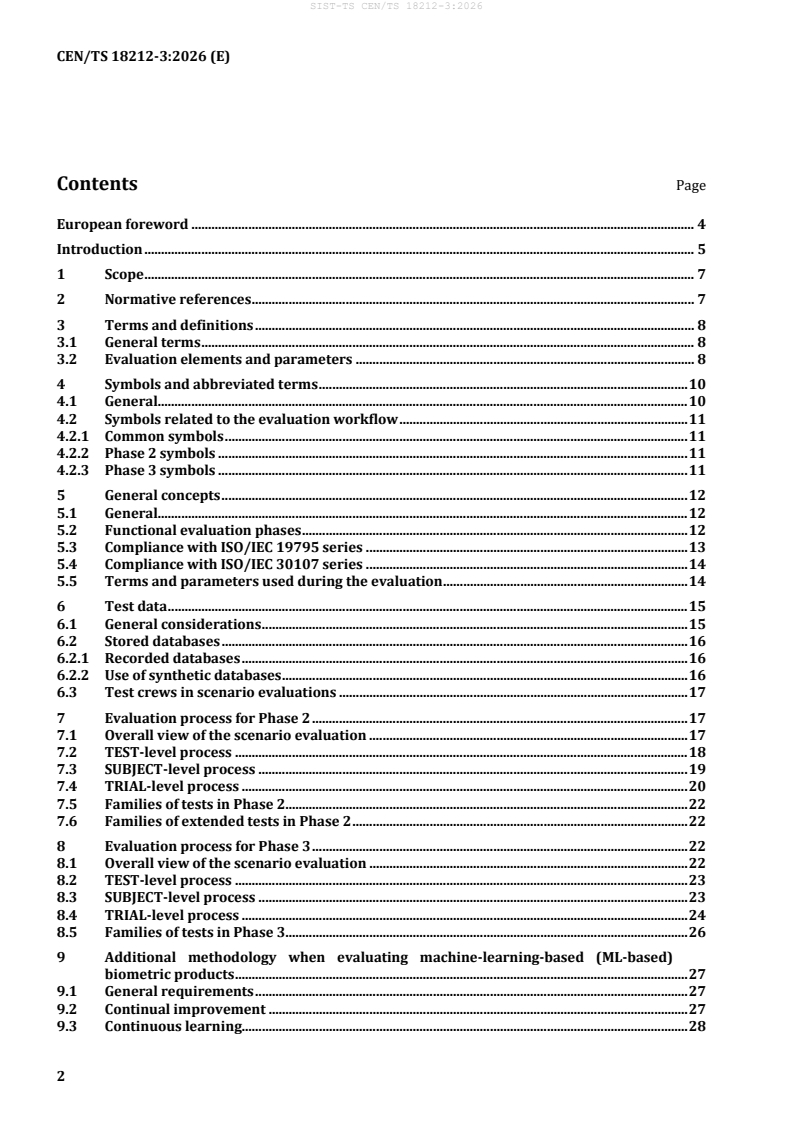
The document is organized into an introduction, Clauses 1 to 9, and a bibliography. Clause 1 states the scope, Clause 2 lists the normative references, Clause 3 defines terms, Clause 4 lists symbols and abbreviated terms, Clause 5 sets out the general concepts, Clauses 6 to 9 cover test data, Phase 2, Phase 3, and additional rules for machine-learning-based biometric products.
What are the key requirements of SIST-TS CEN/TS 18212-3:2026?
SIST-TS CEN/TS 18212-3:2026 defines two functional evaluation phases for biometric products: Phase 2 for performance and suitability, and Phase 3 for vulnerability to presentation attacks. In practice, this means a product is first checked for how well it performs in the intended application profile (AP), and then for whether an attacker can make it accept a false identity.
Phase 2 and Phase 3 are evaluated in sequence
Clause 5.2 states that Phase 2 and Phase 3 are normally executed sequentially. Phase 2 verifies the behavior declared by the supplier, while Phase 3 checks whether the biometric target of evaluation (TOE) is vulnerable to attacks such as impostor or concealer attacks. For buyers and evaluators, this matters because a product may perform well in normal use but still fail attack-resistance testing.
The evaluation is driven by APs, settings, subjects and trials
Clauses 5, 7 and 8 use a common workflow built around TESTs, SETTINGS, SUBJECTs, TRIALs and ATTEMPTs. A TEST contains multiple settings and subjects, and each trial can allow several attempts up to MAX_ATTEMPTS. In practice, this gives testing laboratories (TLs) a repeatable structure for running evaluations and documenting how a result was reached.
Minimum sample sizes can be increased when errors prevent conclusive results
Clause 5.5 states that MIN_TRIALS, MIN_SETTINGS and MIN_SUBJECTS define the minimum counts for each TEST, and the TL may increase them if too many errors occur. The document also requires the TL to justify any deviation and record it in the evaluation technical report (ETR). This matters because it allows robust testing without hiding inconclusive runs.
Phase 2 uses pass/fail limits on non-matches and errors
Clause 7 defines the Phase 2 process. The TL counts MATCH, NON-MATCH and ERROR outcomes across trials, subjects and settings, and applies limits such as MAX_SUBJECT_NON_MATCHES, MAX_TEST_NON_MATCHES, MAX_SUBJECT_ERRORS and MAX_TEST_ERRORS. In practice, this turns functionality testing into a controlled decision process: too many non-matches or errors can end a subject, a setting, or the whole test with FAIL.
Phase 3 treats a successful attack as a PASS for the test
Clause 8 reverses the interpretation for attack resistance. In Phase 3, a TEST result of PASS means the attack succeeded and the TOE is vulnerable; the desired outcome for the biometric product is FAIL. For evaluators and certification bodies, this is important because the result language reflects attack success, not product success.
Test data must be representative and privacy-aware
Clause 6 allows recorded databases for technology evaluations and requires them to represent the target population. Synthetic databases may also be used, but only if they are representative and realistic enough for state-of-the-art algorithms to behave similarly to real data. The clause also addresses anonymization and privacy protection, which matters when biometric samples and personal data are handled during testing.
Scenario evaluations use real test crews, not databases
Clause 6.3 states that when a scenario-based test is required, the evaluation uses real users as the test crew. The text also notes that crew diversity, similarity, and role flexibility may matter depending on the test. For the reader, this means some evaluations require live operational conditions rather than laboratory datasets.
Machine-learning-based products need extra control of updates
Clause 9 separates biometric products into static biometric functionality, continual improvement, and continuous learning. For ML-based products, the training data set must be different from the evaluation data set, and products with continual improvement or continuous learning need re-evaluation after retraining or update. In practice, this means product version control, backup and restore steps, and periodic re-testing are part of the evaluation record.
What terms does SIST-TS CEN/TS 18212-3:2026 define?
- application profile (AP) - A defined application context that sets the applicable tests, parameters and passing criteria for a biometric product.
- target of evaluation (TOE) - The biometric product or system being assessed in the evaluation.
- testing laboratory (TL) - The body that carries out the evaluation process and records the results.
- presentation attack detection (PAD) - The biometric function that detects presentation attacks, as used in the ISO/IEC 30107 series.
- level of assurance (LoA) - The assurance level used in the Cybersecurity Act context: Basic, Substantial or High.
- evaluation technical report (ETR) - The report that records the evaluation approach, deviations, results and justification.
- machine learning (ML) - Learning-based methods used in biometric subsystems such as neural networks or Gaussian mixture models.
- TRIAL - One interaction between the SUBJECT and the TOE within a TEST.
Who uses SIST-TS CEN/TS 18212-3:2026?
SIST-TS CEN/TS 18212-3:2026 is used by conformity assessment bodies, testing laboratories, manufacturers, product vendors and sponsors that need to define or verify biometric product requirements. It is also relevant to sectors and public-sector users that build certification schemes or procurement checks around biometric systems.
In practice, these users apply it to evaluate biometric products for identity verification, remote services, enrollment, recognition and attack resistance. The document also fits organizations that need audit trails, repeatable test methods, and documented results for product selection or certification.
Which standards are used with SIST-TS CEN/TS 18212-3:2026?
| Standard | What it contributes |
|---|---|
| CEN/TS 18212-1 | General requirements and application profile definition for the CEN/TS 18212 series. |
| CEN/TS 18212-2 | The interoperability part of the series, referred to for Phase 1 context. |
| ISO/IEC 2382-37 | Biometrics vocabulary used for terms and definitions. |
| ISO/IEC 19795 (all parts) | The biometric performance testing framework used for Phase 2. |
| ISO/IEC 30107 (all parts) | The biometric presentation attack detection framework used for Phase 3. |
| ISO/IEC 30108 (all parts) | Identity attributes verification services, used for remote and interoperable evaluation setups. |
The document also refers to ISO/IEC 19795-1, -2, -3 and -9 for performance testing details, and to ISO/IEC 30107-3 for PAD methodology and reporting.
What does the SIST-TS CEN/TS 18212-3:2026 document contain?
The document contains definitions, symbols and a stepwise evaluation workflow for biometric testing. Clauses 7 and 8 include hierarchical process descriptions for TEST, SUBJECT and TRIAL execution, supported by Figures 1 to 8.
It also includes a formula for the minimum number of conclusive results, plus rules for when a TL may extend the number of settings, subjects or trials. Clause 6 gives the handling rules for recorded databases, synthetic databases and real test crews, while Clause 9 gives the extra procedure for ML-based biometric products, including backup, re-evaluation and restoration steps.
Several test families are described at a high level, including regular functionality tests, extended boundary tests, zero-effort attacks, enrolment-based attacks and attacks during recognition. These descriptions help readers understand how the methodology is applied in certification, product testing and scenario-based assessment.
Relations
- Effective Date
- 02-Sep-2026
- Effective Date
- 01-Jul-2026
Get Certified
Connect with accredited certification bodies for this standard

BSI Group
BSI (British Standards Institution) is the business standards company that helps organizations make excellence a habit.

NYCE
Mexican standards and certification body.
Sponsored listings
Frequently Asked Questions
SIST-TS CEN/TS 18212-3:2026 is a technical specification published by the Slovenian Institute for Standardization (SIST). Its full title is "Personal identification - Requirements for biometric products - Part 3: Functionality evaluation methodology". This standard covers: The CEN/TS 18212 series specifies a generic framework for the establishment of requirements and their evaluation methodology for biometric products. The requirements depend on the biometric mode considered and are adapted to each scenario, through the definition of a variety of application profiles. The CEN/TS 18212 series specifies the evaluation methodology, the individual tests and the application profiles (with their particular requirements). This document specifies: — The different kind of evaluations to be performed. — The terms used during the description of the tests to be applied. — The parameters used, whose values are defined by each application profile, for each of the individual tests. — Test data used, and considerations dealing with personal data protection. — How to perform technology evaluations. — Execution flow for functionality scenario evaluations. — Execution flow for attack resistance evaluations. NOTE 1 Future parts of the CEN/TS series are planned to address the specifics of each biometric mode. For each of these modalities, this document specifies application-independent tests, as well as a set of application profiles, that detail the applicable tests, the evaluation parameters and the passing criteria. The CEN/TS 18212 series can be taken by any certification body and/or sector, to define and evaluate the requirements for their biometric products within their selected applications. NOTE 2 National regulations and requirements can apply. NOTE 3 Regarding biometrics for public sector applications, see also BSI TR-03121 [8] which can apply. NOTE 4 For an overview of sectors addressed in the Cybersecurity Act, see Regulation (EU) 2019/881 [2].
The CEN/TS 18212 series specifies a generic framework for the establishment of requirements and their evaluation methodology for biometric products. The requirements depend on the biometric mode considered and are adapted to each scenario, through the definition of a variety of application profiles. The CEN/TS 18212 series specifies the evaluation methodology, the individual tests and the application profiles (with their particular requirements). This document specifies: — The different kind of evaluations to be performed. — The terms used during the description of the tests to be applied. — The parameters used, whose values are defined by each application profile, for each of the individual tests. — Test data used, and considerations dealing with personal data protection. — How to perform technology evaluations. — Execution flow for functionality scenario evaluations. — Execution flow for attack resistance evaluations. NOTE 1 Future parts of the CEN/TS series are planned to address the specifics of each biometric mode. For each of these modalities, this document specifies application-independent tests, as well as a set of application profiles, that detail the applicable tests, the evaluation parameters and the passing criteria. The CEN/TS 18212 series can be taken by any certification body and/or sector, to define and evaluate the requirements for their biometric products within their selected applications. NOTE 2 National regulations and requirements can apply. NOTE 3 Regarding biometrics for public sector applications, see also BSI TR-03121 [8] which can apply. NOTE 4 For an overview of sectors addressed in the Cybersecurity Act, see Regulation (EU) 2019/881 [2].
SIST-TS CEN/TS 18212-3:2026 is classified under the following ICS (International Classification for Standards) categories: 35.240.15 - Identification cards. Chip cards. Biometrics. The ICS classification helps identify the subject area and facilitates finding related standards.
SIST-TS CEN/TS 18212-3:2026 has the following relationships with other standards: It is inter standard links to SIST-TS CEN/TS 18212-1:2026, SIST-TS CEN/TS 18212-5:2026. Understanding these relationships helps ensure you are using the most current and applicable version of the standard.
SIST-TS CEN/TS 18212-3:2026 is available in PDF format for immediate download after purchase. The document can be added to your cart and obtained through the secure checkout process. Digital delivery ensures instant access to the complete standard document.
Standards Content (Sample)
Contents
- Introduction
- 1 Scope
- 2 Normative references
- 3 Terms and definitions
- 3.1 General terms
- 3.1.1 biometric subsystem
- 3.2 Evaluation elements and parameters
- 3.2.1 ARTEFACT
- 3.2.2 ATTACKER
- 3.2.3 ATTEMPT
- 3.2.4 ERROR
- 3.2.5 FAIL
- 3.2.6 MATCH
- 3.2.7 NON-MATCH
- 3.2.8 OPERATOR
- 3.2.9 PASS
- 3.2.10 SERVER
- 3.2.11 SETTING
- 3.2.12 SUBJECT
- 3.2.13 TEST
- 3.2.14 TEST_ERROR
- 3.2.15 TRIAL
- 3.2.16 USER
- 4 Symbols and abbreviated terms
- 4.1 General
- 4.2 Symbols related to the evaluation workflow
- 5 General concepts
- 5.1 General
- 5.2 Functional evaluation phases
- 5.3 Compliance with ISO/IEC 19795 series
- 5.4 Compliance with ISO/IEC 30107 series
- 5.5 Terms and parameters used during the evaluation
- 6 Test data
- 6.1 General considerations
- 6.2 Stored databases
- 6.3 Test crews in scenario evaluations
- 7.1 Overall view of the scenario evaluation
- 7.2 TEST-level process
- 7.3 SUBJECT-level process
- 7.4 TRIAL-level process
- 8.1 Overall view of the scenario evaluation
- 8.2 TEST-level process
- 8.3 SUBJECT-level process
- 8.4 TRIAL-level process
- 9 Additional methodology when evaluating machine-learning-based (ML-based)
- 9.1 General requirements
- 9.2 Continual improvement
- 9.3 Continuous learning
- Bibliography
Introduction
The use of remote services has increased significantly. This was boosted during 2020-2021, when many service providers and administrations migrated most of their processes to online handling. Many online services can now be found, such as opening of a bank account, claiming expenses, paying taxes, starting legal actions, etc.
For all these services there is the need of identifying the persons claiming for that service, and doing it in a comfortable, universal, reliable and auditable way. Even though some of those services, in some countries, were deployed using public key infrastructures (PKIs), as recommended by eIDAS [9], this approach was far away from being used by a significant part of the population. Biometric recognition has been considered as a technology to solve the binding between the system and the consumer. Adding biometric recognition to all kind of systems is a common practice nowadays. In this context, service providers and administrations define their own requirements, select the products and deploy the solution. On the other hand, manufacturers implement different solutions to different customers, in order to fulfil each of those requirement sets. Both sides would benefit from standards and regulations, on which to rely for the product definition. Everybody benefits from having a common way of defining those requirements, and a detailed evaluation methodology. These two items can be used by conformity assessment bodies or by business owners, to create their own certification schemes for this kind of technology/products, by following applicable standards.
NOTE ISO/IEC 17000 and related standards are examples of applicable conformity assessment standards. This document is addressing this need for the case of biometric products, analysing and merging all current works, and defining a detailed set of requirements, a biometric-mode-specific evaluation methodology, and the passing criteria for different application profiles. This document has been developed with consideration for GDPR [1] principles.
Application profiles (APs) are targeting the evaluation of a specific range of products using biometric recognition. APs are the baseline for checking conformity with the CEN/TS 18212 series. Indeed, a product manufacturer (PM), product vendor (PV) or sponsor can ask a conformity assessment body (CAB) for the evaluation of a specific product to check its conformity according to the CEN/TS 18212 series and a specific AP at a certain level of assurance (basic, substantial or high). The specifications given in this document are based on EN ISO/IEC 15408-1, ISO/IEC 19989-3 and the ISO/IEC 17000 family of standards, including ISO/IEC 17007, EN ISO/IEC 17025 and EN ISO/IEC 17065. These standards specify processes dealing with evaluation and certification of products and services, either related to their performance or to their security. These objectives are reached by the development of a multipart Technical Specification (i.e. the CEN/TS 18212 series) with the following structure:
- Parts 1-3: Defining the generic principles and methodologies, not requiring a biometric mode specific approach.
In particular, these parts are:
- Part 1: General requirements and application profile definition;
- Part 2: Interoperability tests;
- Part 3: Functionality evaluation methodology.
- Parts 4-n: Planned future parts of the CEN/TS 18212 series, defining the particularities of each biometric mode (e.g. specific tests, specific requirements) and containing a set of APs that establish
SIST-TS CEN/TS 18212-3:2026 CEN/TS 18212-3:2026 (E) the test and requirements applicable for a specific application and context. Those APs will be addressed in individual annexes, following the structure provided in CEN/TS 18212-1. For example, these parts can be:
- Part 4: Fingerprint biometrics;
- Part 5: Face biometrics.
CEN/TS 18212-3 is focused on the definition of the biometric evaluation methodology, both for Phase 2 and Phase 3, in a biometric-mode-independent way.
SIST-TS CEN/TS 18212-3:2026 CEN/TS 18212-3:2026 (E)
1 Scope
The CEN/TS 18212 series specifies a generic framework for the establishment of requirements and their evaluation methodology for biometric products. The requirements depend on the biometric mode considered and are adapted to each scenario, through the definition of a variety of application profiles. The CEN/TS 18212 series specifies the evaluation methodology, the individual tests and the application profiles (with their particular requirements).
This document specifies:
- The different kind of evaluations to be performed.
- The terms used during the description of the tests to be applied.
- The parameters used, whose values are defined by each application profile, for each of the individual tests.
- Test data used, and considerations dealing with personal data protection.
- How to perform technology evaluations.
- Execution flow for functionality scenario evaluations.
- Execution flow for attack resistance evaluations.
NOTE 1 Future parts of the CEN/TS series are planned to address the specifics of each biometric mode. For each of these modalities, this document specifies application-independent tests, as well as a set of application profiles, that detail the applicable tests, the evaluation parameters and the passing criteria. The CEN/TS 18212 series can be taken by any certification body and/or sector, to define and evaluate the requirements for their biometric products within their selected applications. NOTE 2 National regulations and requirements can apply.
NOTE 3 Regarding biometrics for public sector applications, see also BSI TR-03121 [8] which can apply. NOTE 4 For an overview of sectors addressed in the Cybersecurity Act, see Regulation (EU) 2019/881 [2].
2 Normative references
The following documents are referred to in the text in such a way that some or all of their content constitutes requirements of this document. For dated references, only the edition cited applies. For undated references, the latest edition of the referenced document (including any amendments) applies. CEN/TS 18212-1, Personal identification — Requirements for biometric products — Part 1: General requirements and application profile definition ISO/IEC 2382-37, Information technology — Vocabulary — Part 37: Biometrics ISO/IEC 19795 (all parts), Information technology — Biometric performance testing and reporting ISO/IEC 30107 (all parts), Information technology — Biometric presentation attack detection ISO/IEC 30108 (all parts), Biometrics — Identity attributes verification services
SIST-TS CEN/TS 18212-3:2026 CEN/TS 18212-3:2026 (E)
3 Terms and definitions
For the purposes of this document, the terms and definitions given in CEN/TS 18212-1, the ISO/IEC 19795 series, ISO/IEC 30107 series, ISO/IEC 2382-37 and the following apply. ISO and IEC maintain terminology databases for use in standardization at the following addresses:
- ISO Online browsing platform: available at https://www.iso.org/obp/ - IEC Electropedia: available at https://www.electropedia.org/ NOTE Certain terms, being common-use words, are used in capitals throughout the text to make it clear for the reader that they are evaluation parameters, not regular terms.
3.1 General terms
3.1.1 biometric subsystem
set of modules that perform the biometric functions within the biometric product Note 1 to entry: Examples of biometric functions are quality checking, pre-processing, comparison, presentation attack detection methods.
3.2 Evaluation elements and parameters
3.2.1 ARTEFACT
artificial object or representation, that present a copy of the biometric characteristics of a SUBJECT
3.2.2 ATTACKER
person that attacks the system EXAMPLE An imposter using an ARTEFACT for attempting a presentation attack
3.2.3 ATTEMPT
each of the individual interactions between the SUBJECT and the TOE within a TRIAL
3.2.4 ERROR
situation in which the TOE is not able to operate correctly, and therefore, is not able to accomplish a result of the biometric comparison EXAMPLE The TOE is not able to acquire a biometric sample from a bona-fide SUBJECT due to low quality samples captured.
Note 1 to entry: In the case of a PAD TEST, an ERROR (once the maximum number of allowed ATTEMPTS has been reached) can be considered as a NON-MATCH, as the ARTEFACT was not able to be properly captured.
3.2.5 FAIL
final result for TESTs which, within Phase 2, indicates that the TOE behaviour is not appropriate or, within Phase 3, indicates that the attack has not been successful and, therefore, the TOE behaviour is the correct one
SIST-TS CEN/TS 18212-3:2026 CEN/TS 18212-3:2026 (E)
3.2.6 MATCH
positive result of a biometric comparison during a TRIAL EXAMPLE A bona-fide SUBJECT acceptance in a functional TEST.
Note 1 to entry: In the case of a PAD TEST, a MATCH is the non-desired result, as it indicates that the ARTEFACT used was able to achieve a successful comparison.
3.2.7 NON-MATCH
negative result of a biometric comparison during a TRIAL EXAMPLE A bona-fide SUBJECT rejection in a functional TEST.
3.2.8 OPERATOR
human being that, based on the TOE acquired data and result, takes the decision on whether the transaction is valid or not
3.2.9 PASS
final result for TESTs which, within Phase 2, indicates that the TOE is presenting an appropriate behaviour or, within Phase 3, indicates that the attack has been successful and, therefore, the TOE is vulnerable
3.2.10 SERVER
computer-based equipment in which the TOE stores the acquired data during the biometric recognition process Note 1 to entry: Such data can be analysed later by an OPERATOR.
3.2.11 SETTING
execution context for a TRIAL within a TEST Note 1 to entry: The SETTING can be the description of equipment to use, the way the SUBJECT has to interact with the TOE, ambient conditions, ARTEFACTs to be used, etc. For each TEST, one or several SETTINGs have to be specified.
3.2.12 SUBJECT
individual whose biometric data is intended to be enrolled or compared as part of the evaluation Note 1 to entry: Traditionally, the SUBJECT is a USER, but in certain evaluations the SUBJECT would be a combination of a USER and some additional property or element. EXAMPLE 1 In the case of a videoconference system, where the TOE is being used with a USER and potentially a variety of documents, the SUBJECT would be the combination of USER plus document. EXAMPLE 2 In the case Phase 3 test, the SUBJECT is the combination of USER, ARTEFACT, and any other relevant property.
SIST-TS CEN/TS 18212-3:2026 CEN/TS 18212-3:2026 (E)
3.2.13 TEST
action to evaluate the behaviour of the TOE for certain features Note 1 to entry: One TEST is composed of several TRIALS, which involve several SUBJECTS and, probably, several SETTINGs.
3.2.14 TEST_ERROR
situation in which, within a TEST, the TRIALs corresponding to a certain SUBJECT get over the limit MAX_SUBJECT_ERRORS
3.2.15 TRIAL
each of the interactions between the SUBJECT and the TOE, during the TEST Note 1 to entry: Depending on the TOE, each TRIAL may allow several ATTEMPTS. EXAMPLE The TOE may ask the SUBJECT to repeat the biometric presentation due to acquisition errors. In such a case, the new presentation would be considered as a new ATTEMPT within the same TRIAL.
3.2.16 USER
human being that takes part in a TRIAL Note 1 to entry: Depending on the TEST, the USER could be a bona-fide SUBJECT or an ATTACKER, or it can behave in one TRIAL as a bona-fide SUBJECT, and in another TRIAL as an ATTACKER.
4 Symbols and abbreviated terms
4.1 General
For the purposes of this document, the following symbols and abbreviations apply:
AP Application profile CSA Cybersecurity Act [2] eIDAS Electronic identification, authentication and trust services (see the eIDAS Regulation [9]) ETR Evaluation technical report EU European Union / European GDPR General Data Protection Regulation [1] ID Identity LoA Level of assurance PAD Presentation attack detection (as described in ISO/IEC 30107-1) TL Testing laboratory TOE Target of evaluation
SIST-TS CEN/TS 18212-3:2026 CEN/TS 18212-3:2026 (E)
4.2 Symbols related to the evaluation workflow
4.2.1 Common symbols
The symbols listed here are constants to be used while explaining the evaluation process in both Phase 2 (see Clause 7) and Phase 3 (see Clause 8). These constants shall be the limiting values for the workflow of the evaluation.
- MAX_ATTEMPTS: Maximum number of ATTEMPTS allowed for a TRIAL, before resulting in an ERROR for that TRIAL.
- MIN_SETTINGS: Minimum number of SETTINGS defined.
- MIN_SUBJECTS: Minimum number of SUBJECTS defined.
- MIN_TRIALS: Minimum number of TRIALS defined.
4.2.2 Phase 2 symbols
The symbols listed here are constants to be used while explaining the evaluation process only in Phase 2 (see Clause 7). These constants shall be the limiting values for the workflow of the evaluation.
- MAX_SETTING_NON_MATCHES: Maximum number of TRIALS, among all required for a SETTING during a TEST, that provide a NON-MATCH result. When this number is reached, the TEST is considered as FAIL for that SETTING. This is only applicable to Phase 2.
- MAX_SUBJECT_ERRORS: Maximum number of ERRORs allowed for the sum of all TRIALS for a single SUBJECT, within a particular SETTING and TEST. This is only applicable to Phase 2.
- MAX_SUBJECTS_FAIL: Maximum number of SUBJECTs, for which TRIALS within a SETTING and TEST have reached the limit of MAX_SUBJECT_NON_MATCHES. This is only applicable to Phase 2.
- MAX_SUBJECT_NON_MATCHES: Maximum number of TRIALS with a NON-MATCH result, allowed for a single SUBJECT within one SETTING. This is only applicable to Phase 2.
- MAX_TEST_ERRORS: Maximum number of SUBJECTS, within a TEST, for which its TRIALS have reached the limit given by MAX_SUBJECT_ERRORS. This is only applicable to Phases 2.
- MAX_TEST_NON_MATCHES: Maximum number of TRIALS, among all included in a TEST, with a NON-MATCH result. If such number is reached, the TEST is considered as FAIL. This is only applicable to Phase 2.
4.2.3 Phase 3 symbols
The symbols listed here are constants to be used while explaining the evaluation process only in Phase 3 (Clause 8). These constants shall be the limiting values for the workflow of the evaluation. In a Phase 3 TEST, a PASS result means that the TOE is vulnerable for that attack. - MAX_SETTING_MATCHES: Maximum number of TRIALS, among all required for a SETTING during a TEST, that provide a MATCH result. When this number is reached, the TEST is considered as a PASS for that SETTING. This is only applicable to Phase 3.
- MAX_SUBJECT_MATCHES: Maximum number of TRIALS with a MATCH result, allowed for a single SUBJECT within one SETTING. This is only applicable to Phase 3.
SIST-TS CEN/TS 18212-3:2026 CEN/TS 18212-3:2026 (E) - MAX_SUBJECTS_PASS: Maximum number of SUBJECTs, for which TRIALS within a SETTING and TEST have reached the limit of MAX_SUBJECT_MATCHES. This is only applicable to Phase 3. - MAX_TEST_MATCHES: Maximum number of TRIALS, among all included in a TEST, with a MATCH result. If such number is reached, the TEST is considered as a PASS. This is only applicable to Phase 3.
5 General concepts
5.1 General
The evaluation of a biometric product is done through 3 phases, where Phase 1, detailed in CEN/TS 18212-2, is focused on the interoperability aspects relevant to the TOE and the AP. But Phases 2 and 3 are focused on evaluating the biometric functionality of the TOE, regarding performance and suitability to the AP (Phase 2), and robustness against presentation attacks (Phase 3). This document defines the basis for all the functional evaluation, i.e. the tasks to execute Phases 2 and 3. This functional evaluation is based on the specifications provided by the ISO/IEC 19795 series and the ISO/IEC 30107 series.
Future parts of the CEN/TS 18212 series are planned to specify the biometric mode-specific tests to be executed, as well as a set of APs. Each of those APs determines the main characteristics of the TOE for which the AP is applicable, as well as which are the applicable tests, and the acceptance criteria for each of the tests, as well as for the overall functional evaluation. In order to better understand the general testing methodology, Clause 5 revisits the evaluation phases introduced in CEN/TS 18212-1, as well as the relationship with the ISO/IEC 19795 series and the ISO/IEC 30107 series.
Test data shall be handled in accordance with Clause 6. The methodology for Phase 2 shall be according to Clause 7, and the methodology for Phase 3 shall be according to Clause 8. The additional methodology that shall be applied for those cases where the biometric subsystem of the TOE has been developed using machine learning tools shall be according to Clause 9.
5.2 Functional evaluation phases
Within this conformity assessment methodology, the evaluation of the TOE shall be in accordance with the phases defined in CEN/TS 18212-1. This document is focussed on the definition of Phases 2 and 3, which are expected to be executed in a sequential manner:
- Phase 2: TOE performance evaluation
- The main target of these TESTs is to verify the TOE behaviour according to what has been declared by the product supplier. This is to be checked using the relevant SETTINGs for the AP selected.
- In addition, this phase also defines extended tests which
- The main target of these TESTs is to learn about the TOE, as to be able to locate the operating boundaries in using the TOE with bona-fide SUBJECTs.
- This knowledge can help evaluators to discover strategies to attack the TOE during Phase 3 tests.
- Results obtained shall be checked with the TOE documentation, as to check if the FAILed tests are clearly excluded from the TOE usage.
SIST-TS CEN/TS 18212-3:2026 CEN/TS 18212-3:2026 (E) - Phase 3: Vulnerability assessment - The main target of these tests is to determine if the TOE is vulnerable to presentation attacks, either Type 1 or Type 2 attacks (as defined in ISO/IEC 30107-1 and CEN/TS 18099). - According to the AP, the evaluated attacks can be impostor attacks, concealer attacks or both. NOTE The EU Cybersecurity Act (EUCSA, Regulation 2019/881 [2]) defines 3 levels of assurance (LoA), named as Basic, Substantial and High.
- Under an LoA of “High”, any Phase 3 ATTEMPT resulting in a PASS shall declare a FAIL for the biometric product to achieve an LoA of “High”. This shall be determined by analysing that the attack is not exceeding the maximum attack potential for the TOE evaluation.
...