

SIST-TP CEN/TR 18108:2025
(Main)Personal identification - Usage of biometrics in breeder documents
General Information
- Abstract
This document provides guidance on usage of biometrics in breeder documents, in particular regarding
- encoding of biometric reference data;
- data quality maintenance for biometric reference data;
- data authenticity maintenance for biometric reference data; and
- privacy preservation of biometric reference data.
This document addresses advantages and disadvantages of biometric modes, in particular regarding
- verification performance;
- privacy impact;
- feasibility of biometric acquisition considering the age of the capture subjects;
- limits of validity and need for updating biometric reference data.
The following aspects are out of scope:
- format and structure of breeder documents;
- general security aspects, which are covered in CEN/TS 17489-1 [1].
- Status
- Published
- Public Enquiry End Date
- 16-Jul-2024
- Publication Date
- 07-Jan-2025
- Technical Committee
- ITC - Information technology
- Current Stage
- 6060 - National Implementation/Publication (Adopted Project)
- Start Date
- 10-Dec-2024
- Due Date
- 14-Feb-2025
- Completion Date
- 08-Jan-2025

Overview
CEN/TR 18108:2024 - "Personal identification: Usage of biometrics in breeder documents" is a CEN Technical Report (approved September 2024) that provides guidance on using biometrics in breeder documents (e.g., birth and marriage certificates). The report focuses on how biometric reference data should be encoded, maintained, authenticated and protected for reliable identity verification, and compares biometric modes (fingerprint, face, iris, palmprint, footprint, palm/finger vein) with respect to verification performance, privacy impact, collectability across age groups, and template aging.
Key topics and technical requirements
Scope and purpose
- Guidance on encoding of biometric reference data, data quality maintenance, data authenticity, and privacy preservation for breeder documents.
- Evaluates advantages and disadvantages of biometric modes for identity verification and lifecycle management.
- Excludes breeder document format/structure and general security (those fall under CEN/TS 17489-1).
Constraints for biometric use
- Biometric data must be adequate and limited to what is necessary.
- Samples must be easy to acquire at issuance and verification and maintain sufficient quality.
- Biometric characteristics should be sufficiently invariant over time (consider template aging and update needs).
Operational requirements
- Trusted enrolment, integrity and authenticity of biometric reference data (e.g., digital signatures / PKI).
- Controlled access and confidentiality during storage and transmission.
- Measures for presentation attack detection, while noting trade-offs (PAD can increase false non-match rates).
- Interoperability requirements so data can be used by different suppliers’ systems.
Mode-specific considerations
- The report compares biometric modes on verification performance, privacy impact, collectability by age, template aging, and interoperability.
- Example: Fingerprint-two-finger standardized minutiae templates: FNMR ~0.15% at FMR 0.1%; proprietary templates can reach ~0.06% FNMR at FMR 0.1%. Infant fingerprints are unreliable for identity verification.
- DNA profiles are explicitly excluded due to high privacy risk.
Applications and who should use this standard
- Relevant to:
- National civil registration authorities issuing breeder documents.
- Government agencies and passport/ID issuing offices verifying identity for travel document issuance.
- System integrators and vendors developing enrolment, secure storage (chip/server) and verification solutions.
- Privacy officers and policy makers assessing biometric risk/benefit for foundational identity documents.
- Practical uses:
- Deciding which biometric modes to collect at enrolment (age-appropriate choices).
- Designing data-encoding and lifecycle workflows (when to update templates, how to sign/verify data).
- Assessing privacy-preserving measures and interoperability requirements for multi-vendor ecosystems.
Related standards
- CEN/TS 17489 series (breeder document security and format guidance)
- ISO/IEC 2382-37 (biometric terminology)
- ICAO TRIP Guide (evidence of identity)
Keywords: CEN/TR 18108:2024, biometrics, breeder documents, biometric reference data, identity verification, data authenticity, privacy preservation.
Get Certified
Connect with accredited certification bodies for this standard

BSI Group
BSI (British Standards Institution) is the business standards company that helps organizations make excellence a habit.

NYCE
Mexican standards and certification body.
Sponsored listings
Frequently Asked Questions
SIST-TP CEN/TR 18108:2025 is a technical report published by the Slovenian Institute for Standardization (SIST). Its full title is "Personal identification - Usage of biometrics in breeder documents". This standard covers: This document provides guidance on usage of biometrics in breeder documents, in particular regarding - encoding of biometric reference data; - data quality maintenance for biometric reference data; - data authenticity maintenance for biometric reference data; and - privacy preservation of biometric reference data. This document addresses advantages and disadvantages of biometric modes, in particular regarding - verification performance; - privacy impact; - feasibility of biometric acquisition considering the age of the capture subjects; - limits of validity and need for updating biometric reference data. The following aspects are out of scope: - format and structure of breeder documents; - general security aspects, which are covered in CEN/TS 17489-1 [1].
This document provides guidance on usage of biometrics in breeder documents, in particular regarding - encoding of biometric reference data; - data quality maintenance for biometric reference data; - data authenticity maintenance for biometric reference data; and - privacy preservation of biometric reference data. This document addresses advantages and disadvantages of biometric modes, in particular regarding - verification performance; - privacy impact; - feasibility of biometric acquisition considering the age of the capture subjects; - limits of validity and need for updating biometric reference data. The following aspects are out of scope: - format and structure of breeder documents; - general security aspects, which are covered in CEN/TS 17489-1 [1].
SIST-TP CEN/TR 18108:2025 is classified under the following ICS (International Classification for Standards) categories: 35.240.15 - Identification cards. Chip cards. Biometrics. The ICS classification helps identify the subject area and facilitates finding related standards.
SIST-TP CEN/TR 18108:2025 is available in PDF format for immediate download after purchase. The document can be added to your cart and obtained through the secure checkout process. Digital delivery ensures instant access to the complete standard document.
Standards Content (Sample)
SLOVENSKI STANDARD
01-februar-2025
Osebna identifikacija - Uporaba biometričnih podatkov v izvornih dokumentih
Personal identification - Usage of biometrics in breeder documents
Personenidentifizierung - Verwendung biometrischer Daten in Hoheitsdokumenten
Identification des personnes - Utilisation des données biométriques dans les documents
sources
Ta slovenski standard je istoveten z: CEN/TR 18108:2024
ICS:
35.240.15 Identifikacijske kartice. Čipne Identification cards. Chip
kartice. Biometrija cards. Biometrics
2003-01.Slovenski inštitut za standardizacijo. Razmnoževanje celote ali delov tega standarda ni dovoljeno.
CEN/TR 18108
TECHNICAL REPORT
RAPPORT TECHNIQUE
September 2024
TECHNISCHER REPORT
ICS 35.240.15
English Version
Personal identification - Usage of biometrics in breeder
documents
Identification des personnes - Utilisation des données Personenidentifizierung - Verwendung biometrischer
biométriques dans les documents sources Daten in Hoheitsdokumenten
This Technical Report was approved by CEN on 19 August 2024. It has been drawn up by the Technical Committee CEN/TC 224.
CEN members are the national standards bodies of Austria, Belgium, Bulgaria, Croatia, Cyprus, Czech Republic, Denmark, Estonia,
Finland, France, Germany, Greece, Hungary, Iceland, Ireland, Italy, Latvia, Lithuania, Luxembourg, Malta, Netherlands, Norway,
Poland, Portugal, Republic of North Macedonia, Romania, Serbia, Slovakia, Slovenia, Spain, Sweden, Switzerland, Türkiye and
United Kingdom.
EUROPEAN COMMITTEE FOR STANDARDIZATION
COMITÉ EUROPÉEN DE NORMALISATION
EUROPÄISCHES KOMITEE FÜR NORMUNG
CEN-CENELEC Management Centre: Rue de la Science 23, B-1040 Brussels
© 2024 CEN All rights of exploitation in any form and by any means reserved Ref. No. CEN/TR 18108:2024 E
worldwide for CEN national Members.
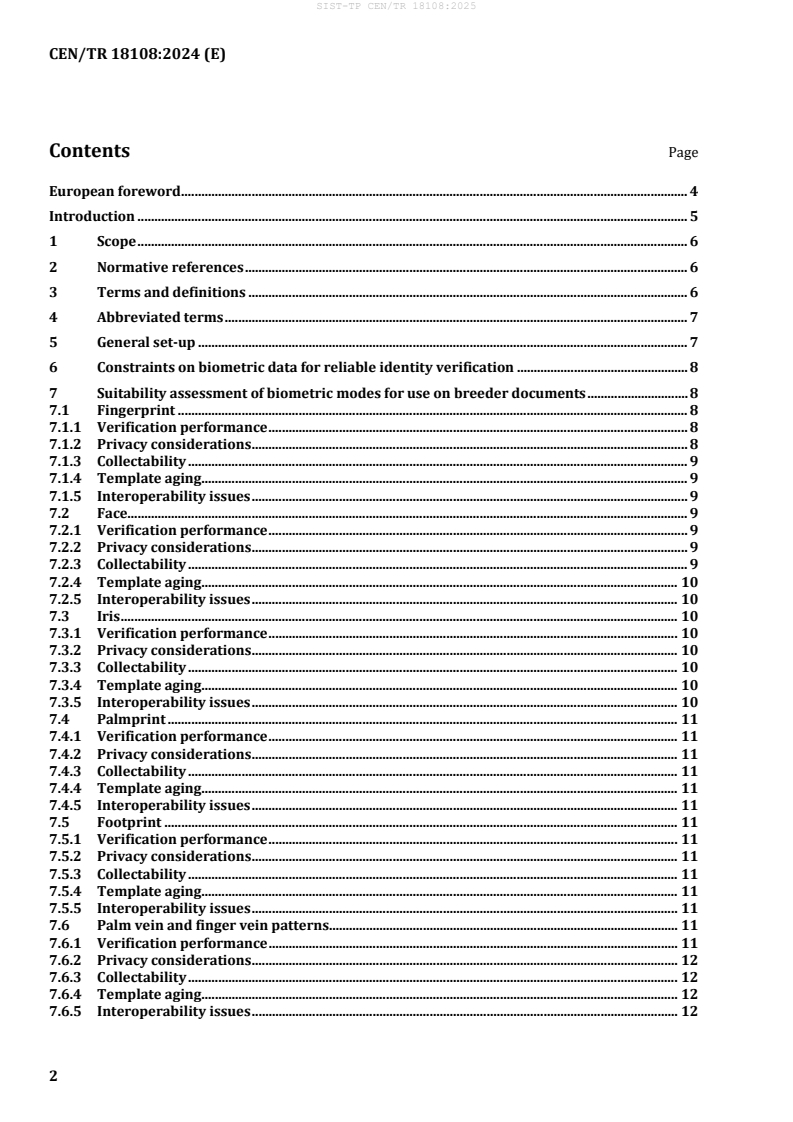
Contents Page
European foreword . 4
Introduction . 5
1 Scope . 6
2 Normative references . 6
3 Terms and definitions . 6
4 Abbreviated terms . 7
5 General set-up . 7
6 Constraints on biometric data for reliable identity verification . 8
7 Suitability assessment of biometric modes for use on breeder documents . 8
7.1 Fingerprint . 8
7.1.1 Verification performance . 8
7.1.2 Privacy considerations . 8
7.1.3 Collectability . 9
7.1.4 Template aging . 9
7.1.5 Interoperability issues . 9
7.2 Face. 9
7.2.1 Verification performance . 9
7.2.2 Privacy considerations . 9
7.2.3 Collectability . 9
7.2.4 Template aging . 10
7.2.5 Interoperability issues . 10
7.3 Iris . 10
7.3.1 Verification performance . 10
7.3.2 Privacy considerations . 10
7.3.3 Collectability . 10
7.3.4 Template aging . 10
7.3.5 Interoperability issues . 10
7.4 Palmprint . 11
7.4.1 Verification performance . 11
7.4.2 Privacy considerations . 11
7.4.3 Collectability . 11
7.4.4 Template aging . 11
7.4.5 Interoperability issues . 11
7.5 Footprint . 11
7.5.1 Verification performance . 11
7.5.2 Privacy considerations . 11
7.5.3 Collectability . 11
7.5.4 Template aging . 11
7.5.5 Interoperability issues . 11
7.6 Palm vein and finger vein patterns . 11
7.6.1 Verification performance . 11
7.6.2 Privacy considerations . 12
7.6.3 Collectability . 12
7.6.4 Template aging . 12
7.6.5 Interoperability issues . 12
8 Summary . 12
8.1 General . 12
8.2 Choices for paper-based breeder documents . 15
8.3 Choices for hardware-based breeder documents . 15
8.4 Choices for server-based breeder documents . 15
Bibliography . 16
European foreword
This document (CEN/TR 18108:2024) has been prepared by Technical Committee CEN/TC 224
“Personal identification and related personal devices with secure element, systems, operations and
privacy in a multi-sectorial environment”, the secretariat of which is held by AFNOR.
Attention is drawn to the possibility that some of the elements of this document may be the subject of
patent rights. CEN shall not be held responsible for identifying any or all such patent rights.
Any feedback and questions on this document should be directed to the users’ national standards body.
A complete listing of these bodies can be found on the CEN website.
Introduction
Birth certificates and marriage certificates are collectively referred to as breeder documents. Obtaining
authentic travel documents based on false breeder documents poses a major threat. The CEN/TS 17489
series [1] provides guidance on secure and interoperable European breeder documents that can be
used for establishing and verifying identity in various scenarios such as application for ePassports and
other identity documents.
A secure binding of breeder documents to their legitimate holders would increase the trust in the
breeder documents and prevent identity theft. This can be achieved using biometrics, but several
challenges arise in the context of breeder documents: In the case of birth certificates, the acquisition of
biometric characteristics from infants can be impractical. Furthermore, as some biometric
characteristics are sensible to ageing, linking breeder documents to their legitimate holders can become
difficult after some time.
This document discusses options for the use of biometrics in breeder documents. It compares
fingerprint, face, iris, palmprint, footprint, palm vein and finger vein recognition regarding verification
performance, privacy impact, feasibility of biometric acquisition in different age groups and
permanence of biometric features. Though resistance against presentation attacks (spoofing) is also
required, a comparison regarding presentation attack resistance is omitted because these biometric
modes can fulfil this criterion to a similar extent. Several studies have presented ways in which
biometric characteristics can be forged. Presentation attack detection is possible but can increase the
FNMR.
Even though non-coding DNA profiles allow a reliable verification of identity over the entire lifetime,
DNA profiles are not taken into consideration for use in breeder documents. The reason is that
processing of genetic material poses prohibitive risks to the rights and freedoms of natural persons
because it can give rise to discrimination as it can reveal ethnic origin or genetic diseases [2].
1 Scope
This document provides guidance on usage of biometrics in breeder documents, in particular regarding
— encoding of biometric reference data;
— data quality maintenance for biometric reference data;
— data authenticity maintenance for biometric reference data; and
— privacy preservation of biometric reference data.
This document addresses advantages and disadvantages of biometric modes, in particular regarding
— verification performance;
— privacy impact;
— feasibility of biometric acquisition considering the age of the capture subjects;
— limits of validity and need for updating biometric reference data.
The following aspects are out of scope:
— format and structure of breeder documents;
— general security aspects, which are covered in CEN/TS 17489-1 [1].
2 Normative references
There are no normative references in this document.
3 Terms and definitions
For the purposes of this document, the terms and definitions given in ISO/IEC 2382-37 [3] and the
following apply.
ISO and IEC maintain terminological databases for use in standardization at the following addresses:
— IEC Electropedia available at https://www.electropedia.org/;
— ISO Online Browsing Platform available at https://www.iso.org/obp.
3.1
biometric characteristic
biological and behavioural characteristic of an individual from which distinguishing, repeatable
biometric features can be extracted for the purpose of biometric recognition
[SOURCE: ISO/IEC 2382-37:2022 [3], 37.01.02]
3.2
biometric data
biometric sample or aggregation of biometric samples at any stage of processing
[SOURCE: ISO/IEC 2382-37:2022 [3], 37.03.06]
3.3
biometric mode
combination of a biometric characteristic type, a sensor type and a processing method
[SOURCE: ISO/IEC 2382-37:2022 [3], 37.02.05]
3.4
breeder document
foundational document
evidentiary document issued as a physical token of an event or status for a person and used by issuing
authorities to establish identity and confirm entitlement
EXAMPLE Breeder documents include birth certificates and marriage certificates.
[SOURCE: ICAO TRIP Guide on evidence of identity [4]]
4 Abbreviated terms
DNA deoxyribonucleic acid
FMR false match rate
FNMR false non-match rate
MRTD machine-readable travel document
5 General set-up
According to CEN/TS 17489-1 [1], breeder document data must be digitally signed to ensure the
integrity and authenticity of the data. The digital signature can be verified using a public key
infrastructure (PKI). The signature verification can be performed offline (provided that all data
required for the signature verification, i.e. public-key certificates and certificate revocation lists, are
available) or online (server-based).
The CEN/TS 17489 series [1] distinguishes between
— Paper-based breeder documents, on which the breeder document data are printed in a human-
readable format as well as in form of machine-readable two-dimensional (2D) bar codes,
— Hardware-based breeder documents, which provide the breeder document data in a machine-
readable format on an integrated circuit, also called chip, and
— Server-based breeder documents, for which the digital signature is stored on the server.
A 2D bar code provides only limited storage space (about 3 kByte). The storage space on a chip and on a
server is much less restricted.
A digital signature has a limited validity period. After expiration of the validity period, the digital
signature cannot be used any longer to ensure the integrity and authenticity of the breeder document
data. Therefore, the breeder documents have to be re-issued after expiration of the validity period
unless the digital signature is stored and renewed on a server.
Threats to breeder documents include that someone else than the legitimate holder uses a genuine
breeder document to establish identity or confirm entitlement. To enable reliable identity verification,
biometric reference data of the document holder can be stored on the breeder document or on a trusted
and certified European server [5].
6 Constraints on biometric data for reliable identity verification
This clause summarizes external constraints that do not originate from this document. To be suitable
for verifying the identity of the holder of a breeder document, biometric characteristics must fulfil the
following requirements:
— The biometric data must be adequate and limited to what is necessary for verifying the identity of
the document holder.
— It must be easy to acquire biometric samples of sufficient quality at the time of breeder document
issuance and at the time of breeder document verification.
— The biometric characteristics must be invariant over a sufficiently long time.
A system that employs biometrics for reliable identity verification of breeder-document holders must
meet requirements and recommendations defined outside this document, among others:
— Starting from a trusted enrolment system, the integrity and authenticity of the biometric reference
data must be ensured.
— Access to the biometric reference data must be controlled, and their confidentiality must be
protected during transmission.
— It must be possible to distinguish between bona-fide presentations and presentation attacks or data
injection attacks or morphing attacks.
— The biometric reference data must be technically usable by other suppliers’ subsystems.
7 Suitability assessment of biometric modes for use on breeder documents
7.1 Fingerprint
7.1.1 Verification performance
In case of two-finger comparisons and an adult population, the most accurate fingerprint comparison
systems using standardized finger minutiae templates yield an FNMR of 0,15 % (about 1 in 667) at an
FMR of 0,1 % (1 in 1000) [6]. The most accurate fingerprint comparison systems using proprietary
templates achieve an FNMR of 0,06 % (about 1 in 1667) at an FMR of 0,1 % (1 in 1000) in case of two-
finger comparisons and an adult population [7].
Babies’ fingerprints do not allow reliable verification of identity [8][9][10]. Fusing the comparison
results of baby thumb and index fingers significantly improves the verification performance [11].
A reliable verification of identity of children aged between 6 years and 12 years is achievable if the
finger image quality is adequate [12].
7.1.2 Privacy considerations
Fingerprints are considered more sensitive personal information than face images. Therefore, access to
fingerprints is to be protected using additional cryptographic access control mechanisms when stored
in MRTDs [13].
Storing biometric templates containing extracted feature data instead of raw image data does not
strongly protect the privacy of the stored biometric data as, in case of data leakage, a matching synthetic
sample can be reconstructed from an unprotected template [14].
7.1.3 Collectability
Several feasibility studies concluded that fingerprinting babies is virtually impossible using ordinary
(500 pixels per inch) fingerprint scanners [15][16][17]. A high-resolution sensor with a spatial
sampling rate of at least 1000 pixels per inch is required for capturing babies’ fingerprints of sufficient
quality [8][9].
7.1.4 Template aging
Fingerprint growth can be modelled using an isotropic growth model, and recognition performance of
fingerprint systems can be improved by scaling up the fingerprint images using this model when
comparing fingerprints of adolescents collected over time [18].
There is no widespread fingerprint ageing effect in adult populations [19][20].
7.1.5 Interoperability issues
To be usable by other suppliers’ subsystems, the biometric reference data must be stored in a
standardized format. MRTDs are required to carry image data in a standardized data interchange
format ([21][22]) because image data can offer a higher level of interoperability in multi-vendor
systems than processed feature d
...