

SIST-TP CEN/TR 18030:2024
(Main)Personal identification - Biometrics - Overview of biometric verification systems implemented across Europe
- Abstract
This Technical Report provides an overview of the current deployment of biometric systems within Europe. It addresses the challenges that are being faced, in order to detect the current needs for improving the specifications for the implementation and deployment of biometric systems. This Technical Report considers all kind of deployments, from border control to ad-hoc services. As most of the deployed systems are based on the use of fingerprints or face recognition, this Technical Report will focus on these two biometric modalities, from the system integrator and interoperability points of view.
Identity documents, in terms of production, structure, interoperability, etc., are out of the scope of this TR. The TR is focused on the performance at system level.
The current European legislative initiatives around this topic (e.g., Entry/Exit System, framework for interoperability between EU information systems, etc.) need a robust framework study about the availability of standard technologies to improve interoperability in biometric products around the European Union.
By showing these needs, a set of recommendations for future standardization works is provided.
From a methodological perspective, the report gathers information of different entities with this classification:
- Capture/enrolment of biometrics including the quality assurance and the generation of feature or biometric models from the images.
- Best practices and guidelines to use biometrics in Europe.
- Data Quality environment using biometrics in European networks.
- Status
- Published
- Publication Date
- 15-Apr-2024
- Technical Committee
- ITC - Information technology
- Current Stage
- 6060 - National Implementation/Publication (Adopted Project)
- Start Date
- 20-Mar-2024
- Due Date
- 25-May-2024
- Completion Date
- 16-Apr-2024

Overview
SIST-TP CEN/TR 18030:2024 offers an extensive overview of the deployment and interoperability of biometric verification systems across Europe. Developed by the Slovenski inštitut za standardizacijo (SIST) and aligned with the CEN/TR 18030:2023 guidelines, this Technical Report is an essential resource for understanding current challenges, standardization needs, and best practices regarding biometric modalities-especially fingerprint and facial recognition-in European environments. It specifically addresses system-level performance, focusing on integration and interoperability, while excluding identity document production and structure.
This Technical Report is particularly relevant given the expanding role of biometrics in border control, public administration, and various ad-hoc services, along with evolving European legislative frameworks such as the Entry/Exit System and interoperability frameworks between EU information systems. The document aims to inform ongoing and future standardization work, enhancing the reliability, security, and interoperability of biometric solutions deployed throughout the European Union.
Key Topics
- Biometric Modalities: Focuses primarily on fingerprint and facial recognition systems, the most widely adopted modalities across Europe.
- System Integration and Interoperability: Examines the integration challenges that system providers face, addressing the need for standard APIs, data formats, and seamless interaction between devices and systems.
- Quality Assurance: Discusses the importance of data quality-both at enrolment and during verification-and references existing standards for assessing and maintaining biometric data quality.
- Communication and Data Security: Covers standardization related to data storage, secure transmission between biometric nodes, and privacy protection mechanisms for sensitive biometric information.
- Environmental and User Interaction Factors: Analyzes the impact of environmental conditions and user interactions on system performance and the need for corresponding evaluation methodologies.
- Legislative Context: Explores the interplay between biometric technology deployments and key EU legislative initiatives requiring robust, interoperable frameworks.
Applications
European biometric systems are deployed in a variety of settings, including:
- Border Control: Automated border control systems (e.g., ePassports, ABC gates) rely heavily on interoperable biometric verification to efficiently and securely process travelers.
- National Identification and eGovernment Services: Biometrics enhance authentication and access to public services, promoting simplicity and security.
- Critical Infrastructure Access: Secure facilities utilize biometric verification to manage controlled access robustly and resist impersonation or spoofing attacks.
- Ad-hoc and Private Sector Solutions: From healthcare access to banking, standardized biometric systems strengthen identity assurance and user convenience.
The Technical Report provides valuable recommendations aimed at improving interoperability, performance evaluation, quality assurance, and security measures in each of these areas.
Related Standards
SIST-TP CEN/TR 18030:2024 references and builds upon a broad set of European and international standards, including:
- EN 17054: Biometrics multilingual vocabulary.
- ISO/IEC 2382-37: Vocabulary for biometrics.
- ISO/IEC 19794, ISO/IEC 39794: Interchange formats for biometric data.
- ISO/IEC 19785 (CBEFF): Common Biometric Exchange Formats Framework.
- ISO/IEC 19795 Series: Evaluation of biometric system performance.
- ISO/IEC 29197, ISO/IEC 21472: Evaluation methodologies for environmental and user interaction influences.
- ISO/IEC 30107: Presentation Attack Detection (PAD).
- CEN/TS 16634, CEN/TS 16428: Biometric recommendations for European border control.
- ICAO Doc 9303: Machine Readable Travel Documents and biometric integration in ePassports.
By harmonizing best practices from these standards, SIST-TP CEN/TR 18030:2024 helps promote the deployment of interoperable, secure, and high-performance biometric verification systems throughout Europe.
Keywords: biometric verification systems, biometric standards Europe, fingerprint recognition interoperability, facial recognition system integration, biometric data quality, border control biometrics, EU biometric framework, biometric security standards, CEN/TR 18030
Relations
- Effective Date
- 28-Jan-2026
Get Certified
Connect with accredited certification bodies for this standard

BSI Group
BSI (British Standards Institution) is the business standards company that helps organizations make excellence a habit.

NYCE
Mexican standards and certification body.
Sponsored listings
Frequently Asked Questions
SIST-TP CEN/TR 18030:2024 is a technical report published by the Slovenian Institute for Standardization (SIST). Its full title is "Personal identification - Biometrics - Overview of biometric verification systems implemented across Europe". This standard covers: This Technical Report provides an overview of the current deployment of biometric systems within Europe. It addresses the challenges that are being faced, in order to detect the current needs for improving the specifications for the implementation and deployment of biometric systems. This Technical Report considers all kind of deployments, from border control to ad-hoc services. As most of the deployed systems are based on the use of fingerprints or face recognition, this Technical Report will focus on these two biometric modalities, from the system integrator and interoperability points of view. Identity documents, in terms of production, structure, interoperability, etc., are out of the scope of this TR. The TR is focused on the performance at system level. The current European legislative initiatives around this topic (e.g., Entry/Exit System, framework for interoperability between EU information systems, etc.) need a robust framework study about the availability of standard technologies to improve interoperability in biometric products around the European Union. By showing these needs, a set of recommendations for future standardization works is provided. From a methodological perspective, the report gathers information of different entities with this classification: - Capture/enrolment of biometrics including the quality assurance and the generation of feature or biometric models from the images. - Best practices and guidelines to use biometrics in Europe. - Data Quality environment using biometrics in European networks.
This Technical Report provides an overview of the current deployment of biometric systems within Europe. It addresses the challenges that are being faced, in order to detect the current needs for improving the specifications for the implementation and deployment of biometric systems. This Technical Report considers all kind of deployments, from border control to ad-hoc services. As most of the deployed systems are based on the use of fingerprints or face recognition, this Technical Report will focus on these two biometric modalities, from the system integrator and interoperability points of view. Identity documents, in terms of production, structure, interoperability, etc., are out of the scope of this TR. The TR is focused on the performance at system level. The current European legislative initiatives around this topic (e.g., Entry/Exit System, framework for interoperability between EU information systems, etc.) need a robust framework study about the availability of standard technologies to improve interoperability in biometric products around the European Union. By showing these needs, a set of recommendations for future standardization works is provided. From a methodological perspective, the report gathers information of different entities with this classification: - Capture/enrolment of biometrics including the quality assurance and the generation of feature or biometric models from the images. - Best practices and guidelines to use biometrics in Europe. - Data Quality environment using biometrics in European networks.
SIST-TP CEN/TR 18030:2024 is classified under the following ICS (International Classification for Standards) categories: 35.240.15 - Identification cards. Chip cards. Biometrics. The ICS classification helps identify the subject area and facilitates finding related standards.
SIST-TP CEN/TR 18030:2024 has the following relationships with other standards: It is inter standard links to SIST EN ISO/IEC 2382-37:2024. Understanding these relationships helps ensure you are using the most current and applicable version of the standard.
SIST-TP CEN/TR 18030:2024 is associated with the following European legislation: EU Directives/Regulations: 2016/679; Standardization Mandates: M/487. When a standard is cited in the Official Journal of the European Union, products manufactured in conformity with it benefit from a presumption of conformity with the essential requirements of the corresponding EU directive or regulation.
SIST-TP CEN/TR 18030:2024 is available in PDF format for immediate download after purchase. The document can be added to your cart and obtained through the secure checkout process. Digital delivery ensures instant access to the complete standard document.
Standards Content (Sample)
SLOVENSKI STANDARD
01-junij-2024
Osebna identifikacija - Biometrija - Pregled sistemov biometričnega preverjanja, ki
se izvajajo po Evropi
Personal identification - Biometrics - Overview of biometric verification systems
implemented across Europe
Persönliche Identifikation - Verwendung biometrischer Verifikationsdaten in allen EU-
Ländern und Szenarien
Ta slovenski standard je istoveten z: CEN/TR 18030:2023
ICS:
35.240.15 Identifikacijske kartice. Čipne Identification cards. Chip
kartice. Biometrija cards. Biometrics
2003-01.Slovenski inštitut za standardizacijo. Razmnoževanje celote ali delov tega standarda ni dovoljeno.
CEN/TR 18030
TECHNICAL REPORT
RAPPORT TECHNIQUE
December 2023
TECHNISCHER REPORT
ICS 35.240.15
English Version
Personal identification - Biometrics - Overview of
biometric verification systems implemented across Europe
Persönliche Identifikation - Verwendung biometrischer
Verifikationsdaten in allen EU-Ländern und Szenarien
This Technical Report was approved by CEN on 24 December 2023. It has been drawn up by the Technical Committee CEN/TC
224.
CEN members are the national standards bodies of Austria, Belgium, Bulgaria, Croatia, Cyprus, Czech Republic, Denmark, Estonia,
Finland, France, Germany, Greece, Hungary, Iceland, Ireland, Italy, Latvia, Lithuania, Luxembourg, Malta, Netherlands, Norway,
Poland, Portugal, Republic of North Macedonia, Romania, Serbia, Slovakia, Slovenia, Spain, Sweden, Switzerland, Türkiye and
United Kingdom.
EUROPEAN COMMITTEE FOR STANDARDIZATION
COMITÉ EUROPÉEN DE NORMALISATION
EUROPÄISCHES KOMITEE FÜR NORMUNG
CEN-CENELEC Management Centre: Rue de la Science 23, B-1040 Brussels
© 2023 CEN All rights of exploitation in any form and by any means reserved Ref. No. CEN/TR 18030 E
worldwide for CEN national Members.
Contents Page
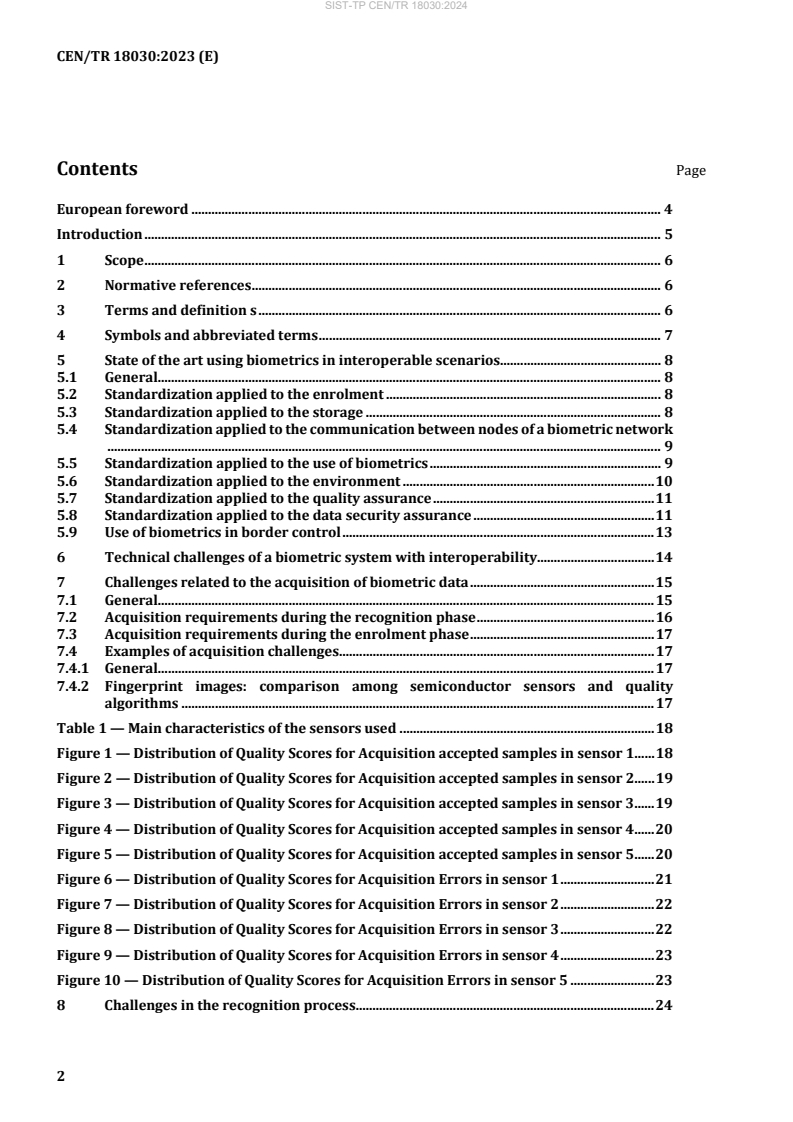
European foreword . 4
Introduction . 5
1 Scope . 6
2 Normative references . 6
3 Terms and definition s . 6
4 Symbols and abbreviated terms . 7
5 State of the art using biometrics in interoperable scenarios. 8
5.1 General. 8
5.2 Standardization applied to the enrolment . 8
5.3 Standardization applied to the storage . 8
5.4 Standardization applied to the communication between nodes of a biometric network
..................................................................................................................................................................... 9
5.5 Standardization applied to the use of biometrics . 9
5.6 Standardization applied to the environment . 10
5.7 Standardization applied to the quality assurance . 11
5.8 Standardization applied to the data security assurance . 11
5.9 Use of biometrics in border control . 13
6 Technical challenges of a biometric system with interoperability. 14
7 Challenges related to the acquisition of biometric data . 15
7.1 General. 15
7.2 Acquisition requirements during the recognition phase . 16
7.3 Acquisition requirements during the enrolment phase . 17
7.4 Examples of acquisition challenges . 17
7.4.1 General. 17
7.4.2 Fingerprint images: comparison among semiconductor sensors and quality
algorithms . 17
Table 1 — Main characteristics of the sensors used . 18
Figure 1 — Distribution of Quality Scores for Acquisition accepted samples in sensor 1 . 18
Figure 2 — Distribution of Quality Scores for Acquisition accepted samples in sensor 2 . 19
Figure 3 — Distribution of Quality Scores for Acquisition accepted samples in sensor 3 . 19
Figure 4 — Distribution of Quality Scores for Acquisition accepted samples in sensor 4 . 20
Figure 5 — Distribution of Quality Scores for Acquisition accepted samples in sensor 5 . 20
Figure 6 — Distribution of Quality Scores for Acquisition Errors in sensor 1 . 21
Figure 7 — Distribution of Quality Scores for Acquisition Errors in sensor 2 . 22
Figure 8 — Distribution of Quality Scores for Acquisition Errors in sensor 3 . 22
Figure 9 — Distribution of Quality Scores for Acquisition Errors in sensor 4 . 23
Figure 10 — Distribution of Quality Scores for Acquisition Errors in sensor 5 . 23
8 Challenges in the recognition process . 24
8.1 General . 24
8.2 Examples of recognition challenges. 24
8.2.1 General . 24
8.2.2 Face recognition in Spanish ABC points . 24
Table 2 — EER values obtained by the different algorithms/versions used . 25
Table 3 — FRR values obtained by the different algorithms/versions used . 26
8.2.3 Face verification results in NIST FRVT 1:1 on-going evaluation . 26
Figure 11 — FRVT 1:1 Verification results for products 1 to 6 . 28
Figure 12 — FRVT 1:1 Verification results for products 121 to 126 . 29
Figure 13 — FRVT 1:1 Verification results for products 391 to 396 . 29
8.2.4 Fingerprint verification results in public evaluations/competitions . 30
Table 4 — Excerpt of some results from FVC 2006 . 31
9 Recommendations for the future . 32
Bibliography . 33
European foreword
This document (CEN/TR 18030:2023) has been prepared by Technical Committee CEN/TC 224
“Personal identification and related personal devices with secure element, systems, operations and
privacy in a multi sectorial environment”, the secretariat of which is held by AFNOR.
Attention is drawn to the possibility that some of the elements of this document may be the subject of
patent rights. CEN shall not be held responsible for identifying any or all such patent rights.
Any feedback and questions on this document should be directed to the users’ national standards body.
A complete listing of these bodies can be found on the CEN website.
Introduction
From the beginning of the century, the use of biometrics in real applications has been more and more
extended to other environments different than forensic analysis. With this focus, thorough studies about
normalized mechanisms to harmonize the use of biometrics have been made. Many relevant institutions,
public and private, have collaborated to obtain standards, technical reports, etc. towards best practices
of biometrics.
From the point of view of organizations at the international, European and national level, a big
organizational process has been developed. Other organizations have used and adapted current
standards to produce their own normative related with the use of biometrics (i.e. ICAO, Frontex, Eu-Lisa,
etc).
Biometrics networks where lots of nodes collaborate to obtain the distributed biometrics storage and
matching have been implemented in the public (Eurodac, Interpol, etc) and private scenarios.
It is well known the huge number of challenges that have to be faced when a biometric solution is being
deployed, in particular when trying to cover a high level of interoperability. One example of these
challenges is the difficulty that system integrators (and service providers) have to face when choosing
which capture device will they use, as they can only rely on the figures provided by the manufacturer,
which sometimes are incomplete. Another example is the rigourness in applying quality requirements to
biometric references and probes in different applications or even countries.
A perfect example of this challenge is border control, where the system has to be able to manage
ePassports from all around the world, as well as subjects of all kinds. Even with the high number of
international standards available nowadays, plus some additional requirements (e.g. those issued by
FRONTEX), a huge variety of cases have to be handled, including differences in how the information is
stored in the ePassports, the acquisition scenario and requirements, or even the acceptance thresholds.
The aim of this technical report is to analyse the current state of art in biometrics standardization, its use,
and the identification of gaps between all the relevant standards used in environments applying the
European laws and normative to the applications.
The detected gaps are identified in order to promote the modification of the current standards on
biometrics or/and the generation of new standards in Europe.
1 Scope
This document provides an overview of the current deployment of biometric systems within Europe. It
addresses the challenges that are being faced, in order to detect the current needs for improving the
specifications for the implementation and deployment of biometric systems. This document considers all
kind of deployments, from border control to ad hoc services. As most of the deployed systems are based
on the use of fingerprints or face recognition, this document will focus on these two biometric modalities,
from the system integrator and interoperability points of view.
Identity documents, in terms of production, structure, interoperability, etc., are out of the scope of this
document. The document is focused on the performance at system level.
The current European legislative initiatives around this topic (e.g. Entry/Exit System, framework for
interoperability between EU information systems, etc.) need a robust framework study about the
availability of standard technologies to improve interoperability in biometric products around the
European Union.
By showing these needs, a set of recommendations for future standardization works is provided.
From a methodological perspective, the report gathers information of different entities with this
classification:
— Capture/enrolment of biometrics including the quality assurance and the generation of feature or
biometric models from the images.
— Best practices and guidelines to use biometrics in Europe.
— Data Quality environment using biometrics in European networks.
2 Normative references
The following documents are referred to in the text in such a way that some or all of their content
constitutes requirements of this document. For dated references, only the edition cited applies. For
undated references, the latest edition of the referenced document (including any amendments) applies.
EN 17054, Biometrics multilingual vocabulary based upon the English version of ISO/IEC 2382-37:2012
ISO/IEC 2382-37, Information technology — Vocabulary — Part 37: Biometrics
3 Terms and definition s
For the purposes of this document, the terms and definitions given in ISO/IEC 2382-37 and EN 17054
apply.
ISO and IEC maintain terminology databases for use in standardization at the following addresses:
— ISO Online browsing platform: available at https://www.iso.org/obp/
— IEC Electropedia: available at https://www.electropedia.org/
4 Symbols and abbreviated terms
ABC Automated Border Control
ACBio Authentication context for biometrics (ISO/IEC 24761:2019)
API Application Programming Interface
BIP BioAPI Internetworking Protocol (see ISO/IEC 24708:2008)
CBEFF Common Biometric Exchange Formats Framework (see ISO/IEC 19785-1:2020)
DET Detection Error Tradeoff curve (see ISO/IEC 19795-1:2021)
DO Data Object (see ISO/IEC 7816-4:2020)
EER Equal Error Rate (see ISO/IEC 19795-1:2021)
FAR False Acceptance Rate (see ISO/IEC 19795-1:2021)
FIPS Federal Information Processing Standards
FMR False Match Rate (see ISO/IEC 19795-1:2021)
FNMR False Non-Match Rate (see ISO/IEC 19795-1:2021)
FRR False Rejection Rate (see ISO/IEC 19795-1:2021)
FRVT Face Recognition Vendor Test (see https://www.nist.gov/programs-projects/face-
recognition-vendor-test-frvt)
FVC Fingerprint Verification Competition (see
https://biolab.csr.unibo.it/fvcongoing/UI/Form/Home.aspx)
ICAO International Civil Aviation Organization (see
https://www.icao.int/Pages/default.aspx)
ICC Integrated Circuit Card (see ISO/IEC 7816-4:2020)
ID1 ID1 Form Factor for Identification cards (see ISO/IEC 7816-1:2011)
LDS Logic data Structure, as defined by ICAO Doc 9303–10 (see
https://www.icao.int/publications/pages/publication.aspx?docnum=9303)
MRTD Machine Readable Travel Document, as defined by ICAO Doc 9303 (see
https://www.icao.int/publications/pages/publication.aspx?docnum=9303)
NFIQ NIST Fingerprint Image Quality, as defined in https://www.nist.gov/services-
resources/software/nfiq-2
NIST National Institute for Standards and Technology (see https://www.nist.gov/)
NTWG ICAO's New Technologies Working Group (see http://www.icao.int)
OASIS Organization for the Advancement of Structured Information Standards (see
https://www.oasis-open.org/)
PAD Presentation Attack Detection (see ISO/IEC 30107-1:2023)
ppi points per inch (also known as ppi – points per inch)
PPs Protection Profiles, as defined in https://www.commoncriteriaportal.org/pps/
REST Representational State Transfer (see ISO/IEC 30108-2:2023)
ROC Receiver Operating Characteristic (see ISO/IEC 19795-1:2021)
SOA Service Oriented Architecture
SOAP Simple Object Access Protocol
STs Security Targets, as defined in https://www.commoncriteriaportal.org/
TD1-TD3 as defined by ICAO Doc 9303 (see
https://www.icao.int/publications/pages/publication.aspx?docnum=9303)
XML Extensible Markup Language
5 State of the art using biometrics in interoperable scenarios
5.1 General
The use of biometrics is subject to a set of standards and specifications. Within this clause, several
subclauses deal with the standards and documents involved. The idea is to direct the reader to those
documents that are applicable and that can help to better understand the content of this Technical Report.
5.2 Standardization applied to the enrolment
From the application point of view, ISO/IEC TR 29196 “Information technology — Guidance for biometric
enrolment” consolidates information relating to successful, secure and usable implementation of
biometric enrolment processes, while indicating risk factors that organisations proposing to use
biometric technologies will address during procurement, design, deployment and operation.
CEN/TS 17661 consolidates information relating to successful and high-quality biometric enrolment
processes of facial and fingerprint systems, while indicating risk factors and providing appropriate
mitigations.
On the other hand, CEN/TS 16634:2014 “Personal identification - Recommendations for using biometrics
in European Automated Border Control” provides very valuable information on the use of biometrics for
border control, but enrolment is considered out of its scope.
5.3 Standardization applied to the storage
For the storage of information there are two topics that are of importance. The first one is about the
format of the data where biometric information is provided, and the second one is how to store that data
into a storage device.
Regarding the first point, biometric data formats are mainly provided ISO/IEC JTC1/SC37 WG3, while
their encapsulation is provided by ISO/IEC JTC1/SC37 WG2. ISO/IEC 19794 series provide interoperable
ways to code biometric data, depending on the modality. This multipart standard provides a framework
to be applied to all parts, some data formats for captured sample data (e.g. sample images), and some
others for processed sample data (e.g. fingerprint minutiae data). This family of standards have currently
two different generations defined, that are both still accepted. Also, there is a 3rd generation standardized
under the series ISO/IEC 39794 for extensible interchange biometric data formats, which are expected
to supersede ISO/IEC 19794 in a near future. Currently, only the first generation is considered for border
control, and in particular the use of finger image, face image and/or iris image. In a future, 3rd generation
(i.e. ISO/IEC 39794) is expected to be applicable to ePassports. ISO/IEC TR 30117 provides an in-depth
explanation on the structures and differences between ISO/IEC 19794 and ISO/IEC 39794 family of
standards.
In addition to the data formats defined in ISO/IEC 19794 and ISO/IEC 39794 which are defined as to
include the information from a single user and a single modality, SC 37 has also defined a meta-structure
called CBEFF (i.e. ISO/IEC 19785 series of standards), that allows:
— the coding of biometric information from more than a single user;
— the coding of biometric information from more than one modality; and
— protecting biometric data by using security mechanisms that will cipher and/or authenticate the data
included into the CBEFF BIR structure.
In-depth explanation on CBEFF can also be found in ISO/IEC TR 30117. For the case of adding biometrics
into a document, such as an ePassport, Clause 11 of ISO/IEC 19785-3 is important, as it provides the
structure on how the information has to be stored.
Regarding the way biometric data are placed into a storage device, there is a comprehensive
standardization provided by ISO/IEC JTC1/SC17. In the case of using an Integrated Circuit Card (ICC),
biometric data are encapsulated according to ISO/IEC 7816 series, where either the biometric
information template DO’7F60’ or the biometric information group template DO’7F61’ defined in
ISO/IEC 7816-11 are considered. In particular, ISO/IEC 7816-11 provides the information on how
biometric information has to be recorded in an ICC.
Last, but not least, when border control is in the scope, the specification provided in ICAO 9303 is
mandatory for Machine Readable Travel Documents (MRTD), such as the ePassport.
5.4 Standardization applied to the communication between nodes of a biometric
network
When a recognition system has to exchange biometric information, it is important to refer to ISO/IEC
JTC1/SC37 WG2 developed standards. In 2008 they published ISO/IEC 24708 “BioAPI Interworking
Protocol” (BIP), but unfortunately has not been widely adopted, mainly due to huge changes into client-
server architecture technologies.
Nowadays is more frequent to talk about web-service based solutions, and in order to address this need
BIAS (i.e. Biometric Identity Assurance Services) was created by OASIS. Later on, BIAS was submitted to
ISO/IEC JTC1 SC37, where it was refined and renamed, becoming ISO/IEC 30108-1 “Identity Attributes
Verification Services — Part 1: IAVS Services”. This first part of IAVS was developed as an XML-based
specification for allowing the exchange of identity information (including also non-biometric data) in
Service Oriented Architectures (SOA). It was intentionally created as implementation independent,
although it gets pretty close to Simple Object Access Protocol (SOAP), i.e. the Microsoft approach to web
services.
But many applications prefer to use REST (i.e. Representational State Transfer), due to being simpler and
lighter. Therefore, SC 37 decided to develop ISO/IEC 30108-2 for the specification of IAVS in accordance
to a RESTful implementation.
5.5 Standardization applied to the use of biometrics
There are several standards and technical reports published, that are a reference for a system designer
and/or developer, when defining certain applications. This is defined under the umbrella of different
WGs, and includes a reasonable number of standards:
— ISO/IEC JTC 1/SC 37 WG4 defines some biometric application profiles. In particular the following
documents could be of interest:
— ISO/IEC 20027, Information technology - Guidelines for slap tenprint fingerprintture
— ISO/IEC TR 30125, Biometrics used with mobile devices
— ISO/IEC TR 29195, Traveller processes for biometric recognition in automated border control
systems
— ISO/IEC 24713-1, Biometric profiles for interoperability and data interchange –Part1: Overview
of biometric systems and biometric profiles
— ISO/IEC 24713-2, Biometric profiles for interoperability and data interchange –Part2: Physical
access control for employees at airports
— ISO/IEC 24713-3, Biometric profiles for interoperability and data interchange–Part3: Biometric
based verification and identification of seafarers
— ISO/IEC JTC 1/SC 37 WG6 defines those jurisdictional and social issues around the use of biometrics.
From those the following can be applicable:
— ISO/IEC 24779 - Information Technology - Cross-jurisdictional and societal aspects of
implementation of biometric technologies - Pictograms, Icons and Symbols for use with
Biometric Systems, which specifies a family of icons and symbols used in association with
devices for biometric enrolment, verification and/or identification. Four different parts have
been developed:
— Part 1 General Principles
— Part 4 Fingerprint Applications
— Part 5 Face Applications
— Part 9 Vascular Applications
— ISO/IEC TR 20322- Information technology - Cross jurisdictional and societal aspects of
implementation of biometric technologies - Biometrics and elderly people.
— ISO/IEC TS 21419 - Information technology - Cross jurisdictional and societal aspects of
implementation of biometric technologies Biometrics - Use of biometrics for identity
management in healthcare
— ISO/IEC 24714 - Biometrics - Cross-jurisdictional and societal aspects of biometrics - General
guidance
Also, CEN/CENELEC TC224 WG6, based on user interface for identification, is interesting for its
application to recognition systems. Its work is focussed in two projects:
— A multipart standard, called EN 1332 titled “Identification card systems – Human-machine interface”,
composed of 4 parts
— And CEN/TS 15291, titled “Identification card system - Guidance on design for accessible card-
activated devices”
5.6 Standardization applied to the environment
In the past, some environment conditions (e.g. excess of backwards illumination when using an ABC
system) have caused several issues in the deployment of border control systems. ISO/IEC 29197
“Evaluation methodology for environmental influence in biometric system performance” will help in
deciding which is the impact of the environment into the performance of the biometric recognition. This
kind of evaluations also provide hints on changes in the deployment that will be of help.
Also, the way the user interacts with the system is of importance. ISO/IEC 21472 “Evaluation
methodology for user interaction influence in biometric system performance” is also helpful for this.
5.7 Standardization applied to the quality assurance
In the use of biometrics, the quality of the data used plays a major role in the performance and usability
of the system. Data quality has to be analysed, so as to allow the system to reject the input if a minimum
quality threshold is not achieved. This is not only important for the biometric probe, but even more
important for the biometric reference. If the reference presents low quality, then the performance of the
rest of the verifications is compromised. Therefore, the system designer has to be aware if there are some
quality specifications for the application, or if not, to define those for both, enrolment and verification.
Data quality thresholds can be more restrictive for enrolment, than for verification, to ensure a proper
operation in the daily use of the system. There are standards devoted to the definition of quality metrics
for several biometric modalities, such as the ISO/IEC 29794 series. Unfortunately, not all parts have the
same level of definition of quality methods and thresholds, so interoperability is difficult when trying to
compare quality scores. This standard has the following structure:
— Part 1 – “Framework”: in which the basis on what quality is and how this is coded is specified. This
coding will be included into the quality fields inside the Biometric Information Record defined in
either ISO/IEC 19794 or ISO/IEC 39794. This part is modality independent, so no methods to define
the quality score are given.
— Part 4 – “Finger Image Data”: although the first edition was drafted as a Technical Report, the revision
promoted the work to an International Standard. It now defines a method to measure quality of 500
dpi optical sensors, which has been implemented and made publicly available as NFIQ-2.
Nevertheless, this method is not universal, and is not intended be used for others technologies (e.g.
capacitive, semiconductor, etc.) or resolution.
— Part 5 – “Face Image Data”: the only edition published is a Technical Report, defining only high-level
quality metrics. It is currently under revision, trying to get some universal methods that can score
the quality of a face image.
— Part 6 – “Iris Image Data”: This part was studied in detail in its first edition, generating an
International Standard with a series of very detailed metrics to asses on the quality of an iris image.
It is being used as a model for the revision of other parts.
But quality is not limited only to data quality, but also algorithm and system performance have to be
considered. For this ISO/IEC JTC1/SC37 WG5 provide a series of well-defined standards that deal with
the evaluation of biometrics. Among all different projects carried out in such WG, it is of major importance
the ISO/IEC 19795 series, which defines the principles for the evaluation of biometrics, plus some specific
application of those principles to certain scenarios. A technology evaluation of a biometric algorithm in a
computer can be performed following ISO/IEC 19795-1 and ISO/IEC 19795-2.
5.8 Standardization applied to the data security assurance
Biometric data are considered in many scenarios as personal data, and protection of such data are
required. As already mentioned, CBEFF (i.e. ISO/IEC 19785) defines a security block in part 1. Such
security block is intended to hold information for protecting the biometric data (e.g. cryptographic
checksum which provides integrity (authenticity)). Furthermore, ISO/IEC 19785-4 specifies the format
for the security block. But in order to reach interoperability the international standards and reports
defined within ISO/IEC JTC1/SC27 have to be considered. SC27 covers the security and privacy in all
Information Technology fields. Within its works, the major ones related to biometrics are:
— Dealing with application design and security and privacy scenarios the following works are initiated:
— ISO/IEC 29100 on Privacy architecture framework
— ISO/IEC 29101 on the Privacy Reference Architecture
— ISO/IEC 29146 on Framework for Access Management
— ISO/IEC 24760 on Framework for Identity Management
— ISO/IEC 29115 on Entity Authentication Assurance Framework
— ISO/IEC 29191 on Requirements for partially anonymous, partially unlinkable authentication
— ISO/IEC 29190 on Privacy capability assessment model
— ISO/IEC 19792 on Security Evaluation of Biometrics.
— ISO/IEC 24761 on Authentication Context for Biometrics (ACBio). This International Standard
specifies the way that security mechanisms are to be used, and how information is to be coded
into the security block (as defined in ISO/IEC 19785-1).
— ISO/IEC 24745 on Biometric Information Protection, which specifies the way biometric
information can be used to achieve cancellable biometric references, i.e. what is also known in
the industry as “biometric template protection”.
— ISO/IEC 20889 on Privacy enhancing data de-identification techniques.
— ISO/IEC 19989 on Criteria and methodology for security evaluation of biometric systems. This
multipart standard has the following parts:
— Part 1 specifying the framework.
— Part 2 specifying the performance in biometric recognition.
— Part 3 specifying the Presentation Attack Detection (PAD).
— ISO/IEC 27553 on the security requirements for authentication using biometrics on mobile
devices (currently under preparation).
In addition to CBEFF, ISO/IEC JTC1/SC37 has several projects related to security in biometrics. The first
one is a Technical Report (ISO/IEC TR 29156) on Guidance for specifying performance requirements to
meet security and usability needs in applications using biometrics. Also, API-related standards, such as
Object Oriented BioAPI (ISO/IEC 30106-x) also mention requirements for securing biometric data.
But one of the most important series of standards related to security (from the point of view of ISO/IEC
JTC1/SC37), is the multipart standard ISO/IEC 30107 on Biometric presentation attack detection (PAD),
which has been taken by ISO/IEC JTC1/SC27 as a basis for the definition of ISO/IEC 19989-3. This series,
currently composed of 4 parts, provide specifications on how to detect those attacks at the presentation
level (e.g. spoofing samples or obfuscating attempts).
— Part 1 gives the framework, with the general definitions on the topic.
— Part 2 defines an interchangeable data format for enclosing PAD-related data, in case the PAD
decision has to be shared in between systems.
— Part 3 provides the methodology to evaluate PAD capabilities of a biometric system.
— Part 4 refines such methodology to be applied to mobile systems.
For an ICC (e.g. ePassport), ISO/IEC JTC1/SC17 provides ISO/IEC 7816-4 specifying security architecture
mainly for protecting data in an ICC, secure messaging for protecting command/response and basic
security handling commands. It also provides ISO/IEC 7816-8 specifying commands and mechanisms for
security operations.
In order to evaluate the security level achieved with the developed solution, Common Criteria is the major
reference. The works in Common Criteria are subsequently standardized under ISO/IEC 15408. Dealing
with biometrics, SC27 has developed the ISO/IEC 19792 standard that specifies a methodology for
evaluating security in biometric systems. Within Common Criteria Portal
(http://www.commoncriteriaportal.org/) there are some Protection Profiles (PPs) and Security Targets
(STs) that are applicable to on-card biometric comparison products, and in the future, some PPs and/or
STs can appear being specific to this technology.
5.9 Use of biometrics in border control
For the specific case of border control, there are some documents of reference for any implementation.
ICAO started to work on machine readable travel documents in 1968. In 1984, ICAO established the
Technical Advisory Group on Machine Readable Travel Documents (TAG/MRTD), also known nowadays
as the Technical Advisory Group on the Traveller Identification Programme (TAG/TRIP). Later on, in
1998, the New Technologies Working Group (NTWG) of the TAG/MRTD began to work in establishing
the most effective biometric identification system and associated means of data storage for use in MRTD
applications, particularly in relation to document issuance and immigration considerations. But the
events on September 11, 2001, boosted the finalization of these works and few years later, a new
generation of passports started to be issued. That new passport contained, among many other new
features, the possibility of contactless electronic access, the inclusion of ICC technology, and the use of
biometric technologies.
This technology is specified within the multiple parts of ICAO's document 9303. By the time this
document has been published, ICAO Doc 9303 was divided in 12 parts being those the following:
— Part 1: Introduction
— Part 2: Specifications for the Security of the Design, Manufacture and Issuance of MRTDs
— Part 3: Specifications Common to all MRTDs (Amendment for New Part B in Page 28 and Part D in
page 29)
— Part 4: Specifications for Machine Readable Passports (MRPs) and other TD3 Size MRTDs
— Part 5: Specifications for TD1 Size Machine Readable Official Travel Documents (MROTDs)
— Part 6: Specifications for TD2 Size Machine Readable Official Travel Documents (MROTDs)
— Part 7: Machine Readable Visas
— Part 8: Emergency Travel Documents
— Part 9: Deployment of Biometric Identification and Electronic Storage of Data in eMRTDs
— Part 10: Logical Data Structure (LDS) for Storage of Biometrics and Other Data in the Contactless
Integrated Circuit (IC)
— Part 11: Security Mechanisms for MRTDs
— Part 12: Public Key Infrastructure for MRTDs
Document ICAO 9303 defines 3 different types of documents, referred as TD1, TD2 and TD3, where TD3
is the typical passport booklet, while the other sizes are reserved for other official travel documents.
Nowadays, due to several reasons including world-wide interoperability, passports have to use the
booklet form factor. This is why, even though the technology included is based on ICCs, the ID1 card form
factor is not used, and a contactless interface is chosen. The implementation of ICAO 9303 as a TD3
document is typically known as ePassport or as Biometric Passport.
In addition, CEN TC224 WG18 has also the following projects to be considered:
— CEN/TS 16428:2012 - Biometrics Interoperability profiles - Best Practices for slap tenprint captures
— CEN/TS 16634:2014 - Personal identification - Recommendations for using biometrics in European
Automated Border Control
— CEN/TS 16920:2016 - Environmental influence testing methodology for operational deployments of
European ABC systems
— CEN/TS 16921:2016 - Personal identification - Borders and law enforcement application profiles for
mobile biometric identification systems
— CEN/TS 17261:2018 - Biometric authentication for critical infrastructure access control -
Requirements and Evaluation
— CEN/TS 17262:2018 - Personal identification - Robustness against biometric presentation attacks -
Application to European Automated Border Control
— CEN/TS 17631:2021 - Personal identification - Biometric group access control
— EN 17054:2019 - Biometrics multilingual vocabulary based upon the English version of
ISO/IEC 2382-37:2012
6 Technical challenges of a biometric system with interoperability
The structure of a biometric system is very well described in ISO/IEC TR 24741. For the scope of this
Technical Report, a special focus is going to be placed on those items critical for reaching interoperability.
In particular, it is important to analyse the following:
a) Acquisition of biometric data
1) Interoperability among several capture devices:
i. In quality of the data captured and stored
ii. In terms of data format.
iii. In terms of application programming interfaces (API)
2) Conformance of the acquired data
b) Storage of biometric references
1) Readability of the information stored
2) Conformance of the read data
3) Quality assurance of the biometric reference
c) Subsystem performance
1) Performance rates
2) APIs for interconnecting subsystems
d) Overall performance
1) Under stable conditions
2) Performance under scenario adaptation (e.g. 24h operation)
e) Security and robustness
1) Robustness against presentation attacks (PAD)
2) Security of each of the interoperable links
3) Of the reference storage
All these items have to be analysed, mandating the application of those available standards, or
recommending the creation of new standards.
7 Challenges related to the acquisition of biometric data
7.1 General
The acquisition of biometric data can be considered as the most critical step in a biometric system, as
failures in the input data will derive in even worse situation in the overall system. In this respect, it is not
only important to study the recognition scenario, but also the enrolment process.
In any of these cases, from the device interoperability point of view, it is important that those devices
comply with:
— For any implementation:
— The use of common data formats for the interchange of biometric information, such as:
— ISO/IEC 19785 (all parts) “Information technology – Common Biometric Exchange
Framework Format”
— The relevant part of ISO/IEC 19794 “Information technology – Biometric data interchange
formats”
— The relevant part of ISO/IEC 39794
— Sometimes it is needed an interoperability model for proprietary and standardized data as
many manufacturers do not generate data following international standards and therefore
the comparison is not possible using other comparison algorithms.
EXAMPLE This has been implemented for the case of the Spanish National ID card.
— For local implementations:
— For object-oriented implementations, the relevant part of ISO/IEC 30106 “Information
technology – Object oriented BioAPI”
— For non-object-oriented implementations:
— ISO/IEC 19784-1 “Information technology – Biometric application programming interface –
Part 1: BioAPI specification”
— ISO/IEC 19784-4 “Information technology – Biometric application programming interface –
Part 4: Biometric sensor function provider interface”
— For client-server implementations:
— ISO/IEC 30108-1 Identity Attributes Verification Services — Part 1: IAVS services
— ISO/IEC 30108-2 Identity Attributes Verification Services — Part 2: RESTful specification
— Or open implementation such as “Web Services for Biometric Devices (WS-Biometric Devices)”,
NIST Special Publication 500-288, https://www.nist.gov/itl/iad/ig/upload/NIST-SP-500-288-
v1.pdf
7.2 Acquisition requirements during the recognition phase
The current requirements for the acquisition of biometric data are the following:
— Conformance of the quality subsystem in the acquisition devices to the following standards (for both,
enrolment and recognition, although the enrolment is addressed in the following subclause):
— Facial image:
— ISO/IEC 19794-5 “Information technology – Biometric data interchange formats – Part 5:
Face image data”
— ISO/IEC 29794-5 “Information technology – Biometric sample quality – Part 5: Face image
data”
— ISO/IEC 39794-5 “Information technology – Extensible biometric data interchange formats
– Part 5: Face image data”
— It might be recommended to use quality guidelines, such as the ones given in
ISO/IEC 39794-5:2019 Annex D
— Fingerprint image:
— ISO/IEC 19794-4 “Information technology – Biometric data interchange formats – Part 4:
Finger image data”
— ISO/IEC 29794-4 “Information technology – Biometric sample quality – Part 4: Finger image
data”
— ISO/IEC 39794-4 “Information technology – Extensible biometric data interchange formats
– Part 4: Finger image data”
— And for minutiae-based systems: ISO/IEC 19794-2 “Information technology – Biometric
data interchange formats – Part 2: Finger minutiae data”
— Consider the inclusive and accessibility requirements provided by ISO/IEC TR 29194 “Information
Technology – Biometrics – Guide on designing accessible and inclusive biometric systems”
— Ensure the correct probe acquisition in those different scenarios and users, by analysing its
performance using:
— ISO/IEC 29197 “Information technology – Evaluation methodology for environmental influence
in biometric system performance”
— And the future ISO/IEC 21472 “Information technology – Scenario evaluation methodology for
user interaction influence in biometric system performance”
— In case of using ten slap fingerprint devices, the conformance to ISO/IEC 20027 “Information
technology – Guidelines for slap tenprint fingerprint” and CEN/TS 16428 “Biometrics
Interoperability profiles - Best Practices for slap ten print captures”.
— Robustness against Presentation Attacks (PAD), following ISO/IEC 30107-3 “Information technology
– Biometric presentation attack detection – Part 3: Testing and reporting”. This is particularly
important in those unattended systems, although it is something interesting for all kind of systems,
even supervised ones.
7.3 Acquisition requirements during the enrolment phase
In addition to the requirements given for the recognition phase, the enrolme
...