

SIST EN 16319:2027
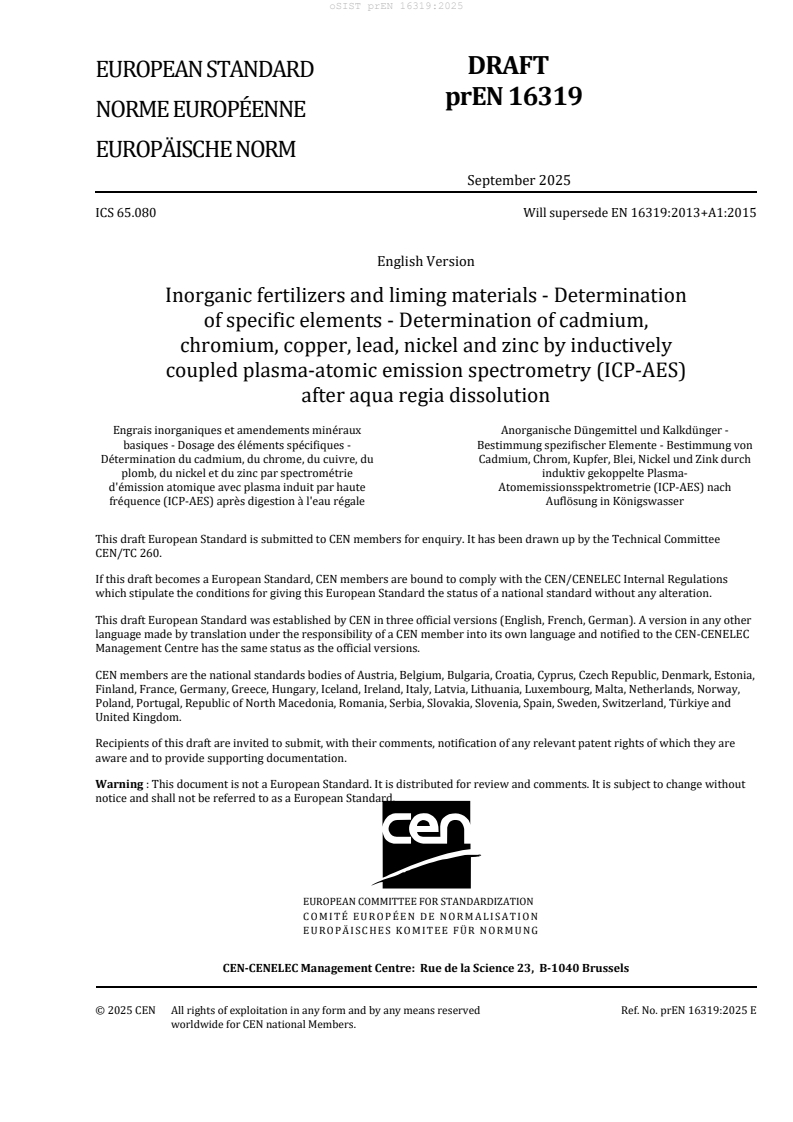
(Main)Inorganic fertilizers and liming materials - Determination of specific elements - Determination of cadmium, chromium, copper, lead, nickel and zinc by inductively coupled plasma-atomic emission spectrometry (ICP-AES) after aqua regia dissolution
- Abstract
This document specifies a method for the determination of the content of cadmium, chromium, copper, lead, nickel and zinc in fertilizers and liming materials using inductively coupled plasma-atomic emission spectrometry (ICP-AES) after aqua regia dissolution. Limits of quantification are dependent on the sample matrix as well as on the instrument, but can roughly be expected to be 0,3 mg/kg for cadmium (Cd) and 1 mg/kg for chromium (Cr), copper (Cu), nickel (Ni), lead (Pb) and zinc (Zn).
This document is applicable to fertilizing product blends, where the blend is a mix of at least two of the following components: fertilizers, liming materials, soil improvers, growing media, inhibitors, plant biostimulants and where the following category: inorganic fertilizers and liming materials is the highest % in the blend by mass or volume, or in the case of liquid form by dry mass. If inorganic fertilizers and liming materials is not the highest % in the blend, the European Standard for the highest % of the blend applies. In case a fertilizing product blend is composed of components in equal quantity, the user decides which standard to apply.
NOTE 1 Variations in analytical methods for fertilizing product blends can lead to differing results as some components or matrix interactions can affect the outcome. Validation procedures have shown that developed standard methods are robust and reliable across diverse product compositions, but possible interferences and unexpected results when analysing fertilizing product blends are possible.
NOTE 2 The term fertilizer is used throughout this document and is taken to include liming materials unless otherwise indicated.
NOTE 3 Dissolution by aqua regia is equivalent to digestion and extract and digest are equivalent terms in this sense for the purposes of this document.
- Status
- Not Published
- Public Enquiry End Date
- 01-Dec-2025
- Technical Committee
- KAT - Soil quality
- Current Stage
- 6060 - National Implementation/Publication (Adopted Project)
- Start Date
- 13-Nov-2026
- Due Date
- 18-Jan-2027

SIST EN 16319:2027 is the SIST standard for measuring cadmium, chromium, copper, lead, nickel and zinc in inorganic fertilizers and liming materials. It specifies an ICP-AES method after aqua regia dissolution, so it is aimed at laboratories that need comparable results for product control, conformity checking or routine analysis.
What does SIST EN 16319:2027 specify?
SIST EN 16319:2027 specifies a laboratory method for determining the content of cadmium, chromium, copper, lead, nickel and zinc in fertilizers and liming materials by inductively coupled plasma-atomic emission spectrometry (ICP-AES) after aqua regia dissolution. The method is written for elemental content in the sample, with expected quantification limits that depend on the matrix and instrument.
The scope also covers certain fertilizing product blends. The blend has to contain at least two listed components, and the category inorganic fertilizers and liming materials must be the highest percentage by mass or volume, or by dry mass for liquid forms. If another component class is dominant, the standard for that dominant class applies; if quantities are equal, the user chooses the applicable standard.
The document is organized into clauses for scope, normative references, terms and definitions, principle, sampling and sample preparation, reagents, apparatus, procedure, calculation and expression of results, precision, and test report. It also includes three informative annexes.
| Annex | What it covers |
|---|---|
| Annex A | Adjustment of the procedure to 150 ml, 100 ml, or 50 ml final volumes |
| Annex B | Inter-laboratory study and precision results |
| Annex ZA | Relationship with Regulation (EU) 2019/1009 |
What are the key requirements of SIST EN 16319:2027?
Sample preparation and dissolution
Clause 5 points users to representative sampling and to EN 1482-2:2024 for general sample preparation provisions. In practice, the result depends on receiving a sample that still represents the product as taken.
Clause 8.1 requires digestion of the prepared sample in aqua regia under reflux for 2 hours, followed by dilution to the stated final volume. This step matters because incomplete dissolution would leave part of the metals out of the test solution.
The procedure allows filtration or centrifugation if needed, and test solutions may be stored in closed vessels for up to 15 days. Annex A gives adjusted acid and mass settings for smaller or different final volumes, which helps when laboratories use heating blocks or graphite blocks.
Reagents, apparatus and measurement
Clauses 6 and 7 require analytical-grade reagents, clean water, standard stock solutions, common laboratory glassware, an analytical balance, digestion equipment and an ICP-AES instrument with axial, radial or dual plasma viewing. The practical point is that reagent purity and instrument setup can affect trace-element results, especially at low concentration.
Clause 8.4 sets up calibration with blank and working standard solutions, and Clause 8.5 requires measurement of calibration solutions, blank solution and test solutions in the plasma. The instrument should be checked during the series, and suitable reference samples are recommended for each batch.
Calibration, matrix effects and interferences
Clause 8.2 provides a spike-recovery approach for unknown matrices. A known spike is added without changing the matrix, and the recovery is used to correct the external calibration result. This is important for mixed or unusual fertilizers where matrix effects can distort the reading.
Clause 8.5.3 also discusses standard additions, matrix matching, internal standardization, dilution and spectral-line selection as ways to manage interferences. The document notes that high concentrations of Cu, Fe and Mn can cause spectral interference and that suitable emission lines should be selected for each instrument.
Calculation, precision and reporting
Clause 9 gives the calculation steps for spike recovery and for element content in mg/kg, including dry-matter correction and dilution factors. In practice, this means the lab must report a final value that reflects the sample mass, any further dilution and the dry matter content where relevant.
Clause 10 summarizes repeatability and reproducibility from an inter-laboratory study, with results given for cadmium, chromium, copper, nickel, lead and zinc. Users rely on these figures to judge whether two results are close enough within one lab or between laboratories.
Clause 11 sets the minimum test-report content, including sample identification, the method used, digest preparation, results, sampling details if known, completion date and any optional deviations or incidents. This is what makes the result traceable in quality control or regulatory work.
What terms does SIST EN 16319:2027 define?
- Analyte - the parameter that is determined in the analysis.
- Blank calibration solution - a calibration solution prepared in the same way as the calibration solution but without the analytes.
- Blank test solution - a solution prepared like the test sample solution, but without the test portion.
- Calibration solution - the solution used to calibrate the instrument, prepared from stock solutions with acids, buffer, reference element and salts as needed.
- Digestion - the mineralization of the organic matter of a sample and the dissolution of its mineral part by a reagent mixture.
- Digest - the solution obtained after that digestion step.
- Stock solution - a solution with accurately known analyte concentration(s), prepared from pure chemicals.
- Test sample solution - the solution prepared after extraction or digestion of the test sample according to the relevant specification.
Who uses SIST EN 16319:2027?
SIST EN 16319:2027 is used by laboratories that test inorganic fertilizers, liming materials and fertilizing product blends for cadmium, chromium, copper, lead, nickel and zinc. It is relevant to quality control teams, regulatory laboratories, manufacturers, and buyers who need analytical results for batch release, incoming-material checks or compliance verification.
It is especially useful where matrix effects can occur, such as in mixed products, liquids and materials with different mineral compositions. The method’s precision data and spike-recovery approach help users decide how confidently they can compare results across runs and across laboratories.
What changed in SIST EN 16319:2027 from the previous edition?
SIST EN 16319:2027 supersedes EN 16319:2013+A1:2015. The foreword states these technical changes:
- determination of Cu and Zn was added to Clause 1, Clause 6 and Clause 8
- the extraction procedure in 8.1 was adapted for technical progress, including graphite blocks and smaller acid volumes
- normative references and the bibliography were updated
- terms and definitions were updated
- Clause 10 on precision was updated
- Annex B was updated with inter-laboratory study results
- Annex ZA was added
Which standards are used with SIST EN 16319:2027?
- EN 1482-2:2024 - gives general sample preparation provisions used for the sample before analysis.
- EN 1482-1 - is cited as the recommended sampling method for obtaining a representative sample.
- EN 12944-1:1999, EN 12944-2:1999 and EN 12944-3:2019 - provide the fertilizer and liming-material vocabulary used in the document.
- EN 14787:2005 - is used for determining water content or dry matter content in the result calculation.
- ISO 5725-1 and ISO 5725-3 - are used for evaluating repeatability and reproducibility in the precision study.
What does the SIST EN 16319:2027 document contain?
The document contains the full analytical workflow, from sample digestion through ICP-AES measurement to result calculation and reporting. It includes the calibration scheme, spike-recovery correction, guidance on interferences and recommended emission lines, plus formulas for recovery, corrected concentration, mass fraction and dilution factor.
It also provides a calibration table, precision tables for cadmium, chromium, copper, nickel, lead and zinc, and a test-report checklist. Annex A recalculates the procedure for smaller final volumes, Annex B gives the inter-laboratory study data, and Annex ZA links the analytical results to the relevant essential safety requirements of Regulation (EU) 2019/1009.
Relations
- Effective Date
- 11-Nov-2026
- Effective Date
- 11-Nov-2026
- Effective Date
- 11-Nov-2026
- Effective Date
- 11-Nov-2026
- Effective Date
- 11-Nov-2026
- Effective Date
- 31-Jan-2027
Get Certified
Connect with accredited certification bodies for this standard

ECOCERT
Organic and sustainability certification.

Control Union Certifications
Global certification for agriculture and sustainability.

FSC International
Forest Stewardship Council certification.
Sponsored listings
Frequently Asked Questions
SIST EN 16319:2027 is a draft published by the Slovenian Institute for Standardization (SIST). Its full title is "Inorganic fertilizers and liming materials - Determination of specific elements - Determination of cadmium, chromium, copper, lead, nickel and zinc by inductively coupled plasma-atomic emission spectrometry (ICP-AES) after aqua regia dissolution". This standard covers: This document specifies a method for the determination of the content of cadmium, chromium, copper, lead, nickel and zinc in fertilizers and liming materials using inductively coupled plasma-atomic emission spectrometry (ICP-AES) after aqua regia dissolution. Limits of quantification are dependent on the sample matrix as well as on the instrument, but can roughly be expected to be 0,3 mg/kg for cadmium (Cd) and 1 mg/kg for chromium (Cr), copper (Cu), nickel (Ni), lead (Pb) and zinc (Zn). This document is applicable to fertilizing product blends, where the blend is a mix of at least two of the following components: fertilizers, liming materials, soil improvers, growing media, inhibitors, plant biostimulants and where the following category: inorganic fertilizers and liming materials is the highest % in the blend by mass or volume, or in the case of liquid form by dry mass. If inorganic fertilizers and liming materials is not the highest % in the blend, the European Standard for the highest % of the blend applies. In case a fertilizing product blend is composed of components in equal quantity, the user decides which standard to apply. NOTE 1 Variations in analytical methods for fertilizing product blends can lead to differing results as some components or matrix interactions can affect the outcome. Validation procedures have shown that developed standard methods are robust and reliable across diverse product compositions, but possible interferences and unexpected results when analysing fertilizing product blends are possible. NOTE 2 The term fertilizer is used throughout this document and is taken to include liming materials unless otherwise indicated. NOTE 3 Dissolution by aqua regia is equivalent to digestion and extract and digest are equivalent terms in this sense for the purposes of this document.
This document specifies a method for the determination of the content of cadmium, chromium, copper, lead, nickel and zinc in fertilizers and liming materials using inductively coupled plasma-atomic emission spectrometry (ICP-AES) after aqua regia dissolution. Limits of quantification are dependent on the sample matrix as well as on the instrument, but can roughly be expected to be 0,3 mg/kg for cadmium (Cd) and 1 mg/kg for chromium (Cr), copper (Cu), nickel (Ni), lead (Pb) and zinc (Zn). This document is applicable to fertilizing product blends, where the blend is a mix of at least two of the following components: fertilizers, liming materials, soil improvers, growing media, inhibitors, plant biostimulants and where the following category: inorganic fertilizers and liming materials is the highest % in the blend by mass or volume, or in the case of liquid form by dry mass. If inorganic fertilizers and liming materials is not the highest % in the blend, the European Standard for the highest % of the blend applies. In case a fertilizing product blend is composed of components in equal quantity, the user decides which standard to apply. NOTE 1 Variations in analytical methods for fertilizing product blends can lead to differing results as some components or matrix interactions can affect the outcome. Validation procedures have shown that developed standard methods are robust and reliable across diverse product compositions, but possible interferences and unexpected results when analysing fertilizing product blends are possible. NOTE 2 The term fertilizer is used throughout this document and is taken to include liming materials unless otherwise indicated. NOTE 3 Dissolution by aqua regia is equivalent to digestion and extract and digest are equivalent terms in this sense for the purposes of this document.
SIST EN 16319:2027 is classified under the following ICS (International Classification for Standards) categories: 65.080 - Fertilizers; 71.040.50 - Physicochemical methods of analysis. The ICS classification helps identify the subject area and facilitates finding related standards.
SIST EN 16319:2027 has the following relationships with other standards: It is inter standard links to SIST EN 12944-1:2002, SIST EN 12944-2:2002, SIST EN 1482-2:2025, SIST EN 12944-3:2026, SIST EN 14787:2005, SIST EN 16319:2013+A1:2016. Understanding these relationships helps ensure you are using the most current and applicable version of the standard.
SIST EN 16319:2027 is associated with the following European legislation: EU Directives/Regulations: 2019/1009; Standardization Mandates: M/564. When a standard is cited in the Official Journal of the European Union, products manufactured in conformity with it benefit from a presumption of conformity with the essential requirements of the corresponding EU directive or regulation.
SIST EN 16319:2027 is available in PDF format for immediate download after purchase. The document can be added to your cart and obtained through the secure checkout process. Digital delivery ensures instant access to the complete standard document.
Standards Content (Sample)
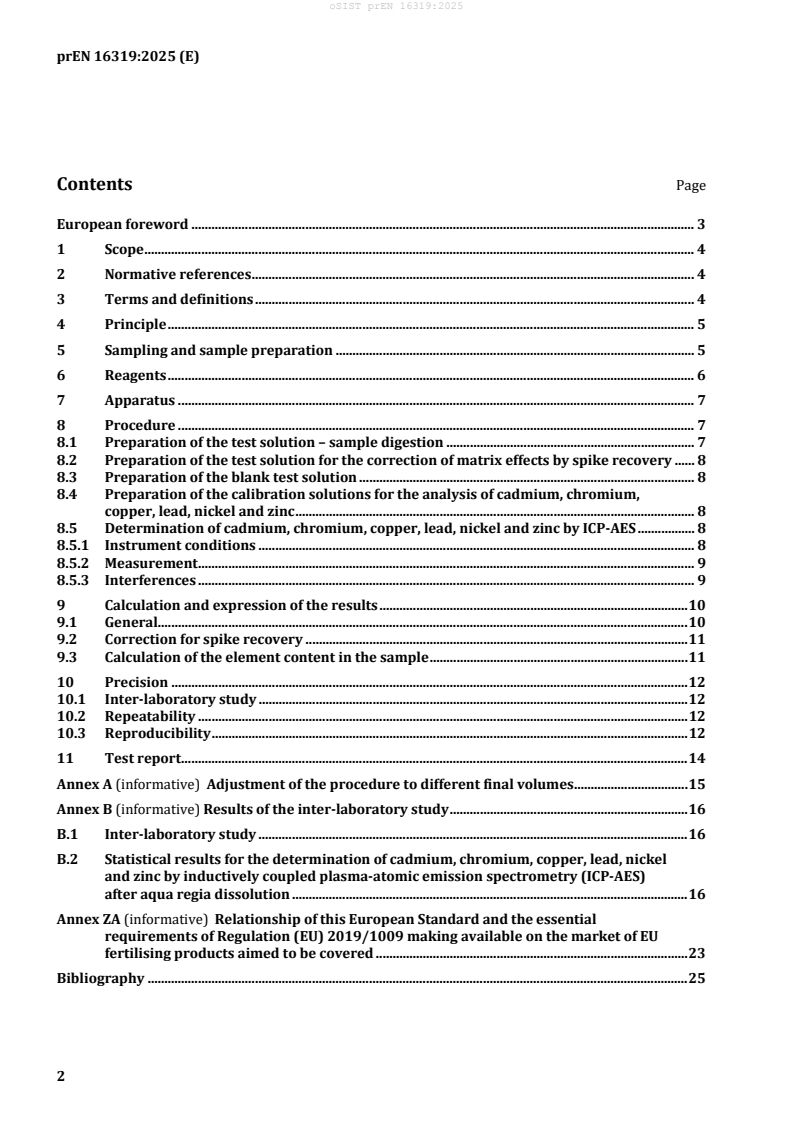
Contents
- 1 Scope
- 2 Normative references
- 3 Terms and definitions
- 3.1 analyte
- 3.2 blank calibration solution
- 3.3 blank test solution
- 3.4 calibration solution
- 3.5 digestion
- 3.6 digest
- 3.7 stock solution
- 3.8 test sample solution
- 4 Principle
- 5 Sampling and sample preparation
- 6 Reagents
- 6.5 Standard stock solutions, cadmium, chromium, copper, lead, nickel and zinc standard stock
- 7 Apparatus
- 8 Procedure
- 8.1 Preparation of the test solution – sample digestion
- 8.2 Preparation of the test solution for the correction of matrix effects by spike recovery
- 8.3 Preparation of the blank test solution
- 8.5 Determination of cadmium, chromium, copper, lead, nickel and zinc by ICP-AES
- 9 Calculation and expression of the results
- 9.1 General
- 9.2 Correction for spike recovery
- 9.3 Calculation of the element content in the sample
- 10 Precision
- 10.1 Inter-laboratory study
- 10.2 Repeatability
- 10.3 Reproducibility
- 11 Test report
- Annex A
- Annex B
- Annex ZA
- Bibliography
1 Scope
This document specifies a method for the determination of the content of cadmium, chromium, copper, lead, nickel and zinc in fertilizers and liming materials using inductively coupled plasma-atomic emission spectrometry (ICP-AES) after aqua regia dissolution. Limits of quantification are dependent on the sample matrix as well as on the instrument, but can roughly be expected to be 0,3 mg/kg for Cd and 1 mg/kg for Cr, Cu, Ni, Pb and Zn.
This document is applicable to the fertilizing products blends where a blend is a mix of at least two of the following components: fertilizers, liming materials, soil improvers, growing media, inhibitors, plant biostimulants and where the following category: inorganic fertilizers and liming materials is the highest % in the blend by mass or volume, or in the case of liquid form by dry mass. If inorganic fertilizers and liming materials is not the highest % in the blend, the European Standard for the highest % of the blend applies. In case a fertilizing product blend is composed of components in equal quantity, the user decides which standard to apply.
NOTE 1 The term fertilizer is used throughout this document and needs to be taken to include liming materials unless otherwise indicated.
NOTE 2 Dissolution by aqua regia is equivalent to digestion and extract and digest are equivalent terms in this sense for the purposes of this standard.
2 Normative references
The following documents are referred to in the text in such a way that some or all of their content constitutes requirements of this document. For dated references, only the edition cited applies. For undated references, the latest edition of the referenced document (including any amendments) applies. EN 1482-2:2024, Fertilizers, liming materials and inhibitors — Sampling and sample preparation — Part 2: General sample preparation provisions
EN 12944-1:1999, Fertilizers and liming materials — Vocabulary — Part 1: General terms
EN 12944-2:1999, Fertilizers and liming materials — Vocabulary — Part 2: Terms relating to fertilizers EN 12944-3:2019, Fertilizers and liming materials — Vocabulary — Part 3: Terms relating to liming materials EN 14787:2005, Fertilizers and liming materials — Determination of water content — Guidelines and recommendations
3 Terms and definitions
For the purposes of this document, the terms and definitions given in EN 12944-1:1999, EN 12944-2:1999 and EN 12944-3:2019, and the following apply.
ISO and IEC maintain terminology databases for use in standardization at the following addresses:
- ISO Online browsing platform: available at https://www.iso.org/obp/
- IEC Electropedia: available at https://www.electropedia.org/
As impacted by EN 12944-1:1999/AC:2000.
As impacted by EN 12944-2:1999/AC:2000.
oSIST prEN 16319:2025 prEN 16319:2025 (E)
3.1 analyte
parameter to be determined
3.2 blank calibration solution
solution prepared in the same way as the calibration solution but leaving out the analytes
3.3 blank test solution
solution prepared in the same way as the test sample solution but omitting the test portion
3.4 calibration solution
solution used to calibrate the instrument, prepared from stock solutions by adding acids, buffer, reference element and salts as needed
3.5 digestion
mineralization of the organic matter of a sample and dissolution of its mineral part, more or less completely, when reacting with a reagent mixture
3.6 digest
solution received after mineralization of the organic matter of a sample and dissolution of its mineral part, more or less completely, when reacting with a reagent mixture
3.7 stock solution
solution with accurately known analyte concentration(s), prepared from pure chemicals (6.5)
3.8 test sample solution
solution prepared after extraction or digestion of the test sample according to appropriate specifications
4 Principle
The samples are digested by boiling in aqua regia for two hours under reflux conditions. The concentrations of the elements in the digests are measured by inductively coupled plasma–atomic emission spectrometry (ICP-AES). Multi-element determinations using sequential or simultaneous optical systems and axial, radial or dual viewing of the plasma may be used.
5 Sampling and sample preparation
Sampling is not part of the method specified in this document. A recommended sampling method is given in EN 1482-1.
It is important that the laboratory receives a sample that is representative of both the product under consideration and the given analysis, respectively. The sample should not have been damaged or changed during transport or storage.
Sample preparation shall be carried out in accordance with EN 1482-2:2024.
oSIST prEN 16319:2025 prEN 16319:2025 (E)
6 Reagents
Use only reagents of recognized analytical grade. The concentration of the analyte or interfering substances in the reagents and the water should be negligible compared to the lowest concentration to be determined.
6.1 Water with a specific conductivity not higher than 0,2 mS/m at 25 °C, free from the elements to be determined.
6.2 Hydrochloric acid, c(HCl) = 12 mol/l; 37 % volume fraction; ρ ≈ 1,18 g/ml. 6.3 Nitric acid, c(HNO ) = 16 mol/l; not less than 65 % volume fraction; ρ ≈ 1,42 g/ml.
6.4 Mixed solution of 0,8 mol/l nitric acid and 1,8 mol/l hydrochloric acid. Mix 150 ml of hydrochloric acid (6.2) and 50 ml nitric acid (6.3) to 1,0 l volumetric flask and fill by water (6.1) to the mark.
6.5 Standard stock solutions, cadmium, chromium, copper, lead, nickel and zinc standard stock
solutions, e.g. ρ = 1 000 mg/l for each element.
Use suitable stock solutions. Both single-element stock solutions and multi-element stock solutions with adequate specification stating the acid used and the preparation technique are commercially available. It is recommended to use commercially available standard stock solutions for cadmium, chromium, copper lead, nickel, and zinc. Multi-element stock solutions are usually available at the individual mass concentration ρ = 100 mg/l for each element. These solutions are considered to be stable for more than one year, but in reference to guaranteed stability, the recommendations of the manufacturer should be considered. Alternatively, the stock solutions may be prepared by dissolution of high purity metals. 6.6 Working standard solutions.
Depending on the scope, different working standard solutions might be necessary. In general, when combining elements in working standard solutions, their chemical compatibility shall be regarded. Spectral interferences from other elements present in working standard solutions also need to be considered. Various combinations of elements at different concentrations may be used, provided that the standard stock solutions (6.5) are diluted with the same acid and in equal concentration as the acid in the test solution.
6.6.1 Working standard solution I, ρ = 100 mg/l for cadmium, chromium, copper, lead, nickel and
zinc.
Use commercially available solution of this concentration for each element or pipette 10,0 ml of each standard stock solution of cadmium, chromium, copper, lead, nickel and zinc (6.5) to 100,0 ml with the mixed acid solution (6.4) in the same 100 ml flask. If non-equal concentrations of cadmium, chromium, copper, lead, nickel and zinc are needed, dilute the required volumes into 100,0 ml. This solution is used to prepare spiked test solutions and standard and calibration solutions.
6.6.2 Working standard solution II, ρ = 10 mg/l for cadmium, chromium, copper, lead, nickel and
zinc.
Pipette 10,0 ml of the working standard solution I of cadmium, chromium, copper, lead, nickel and zinc (6.6.1) to 100,0 ml with the mixed acid solution (6.4) in a 100 ml flask. If non-equal concentrations of cadmium, chromium, copper, lead, nickel and zinc are needed, dilute the required volume from the standard stock solutions (6.5) into 100,0 ml. This solution is used to prepare spiked test solutions and calibration solutions.
oSIST prEN 16319:2025 prEN 16319:2025 (E)
7 Apparatus
7.1 Common laboratory glassware.
7.2 Analytical balance, capable of weighing to the nearest 1 mg. 7.3 Apparatus for thermal heating digestion with digestion vessels. 7.4 Inductively coupled plasma-atomic emission spectrometer, with axial, radial or dual viewing of the plasma.
The settings of the working conditions (e.g. gas flows, RF or plasma power, sample uptake rate, integration time and number of replicates) shall be optimized according to the manufacturer’s instructions.
7.5 Filter paper, ash free and of recognized and tested quality.
8 Procedure
CAUTION — Suitable precautions shall be taken to avoid any contact of laboratory staff with acid fumes. The digestion procedure shall be carried out in a well-ventilated fume cupboard.
8.1 Preparation of the test solution – sample digestion
Weigh 1,5 g to 3 g of the prepared sample, to the nearest 0,001 g and transfer it to a suitable reaction vessel. Liquid samples are preferably weighed directly into the reaction vessel. Moisten the sample with about 0,5 ml to 1,0 ml of water (6.1) and add, whilst mixing, (21 ± 0,1) ml of hydrochloric acid (6.2) followed by (7 ± 0,1) ml of nitric acid (6.3) drop by drop if necessary to reduce foaming. Connect a condenser to the reaction vessel and let the mixture stand at room temperature until any effervescence almost ceases to allow for slow oxidation of any organic mass in the sample. Transfer to the heating device and raise the temperature of the reaction mixture slowly to reflux conditions. Maintain for 2 h, ensuring that the condensation zone is lower than 1/3 of the height of the condenser, then allow to cool. Rinse the condenser a further with 10 ml of water (6.1).
Transfer the digested sample quantitatively into a 150 ml volumetric flask and dilute to the mark with water (6.1).
Test solutions may be filtered or centrifuged, if necessary. Use ash-free filter paper of recognized and tested quality (7.5) and discard the first portion of the filtrate (approximately 20 ml). Carry out the measurement immediately or store the extracts in tightly closed vessels for up to 15 days. The procedure may be modified for the use of 100 ml or 50 ml volumetric flasks or graduated plastic tubes, especially when using heating blocks with different heating zones or graphite blocks. In this case the mass of the sample and volumes of the acids should be changed accordingly. For more information see Annex A.
Test solutions are diluted with the mixed acid solution (6.4) to obtain the concentration of the elements in the calibration range.
NOTE The digestion procedure using microwave digestion can be applied if the user demonstrates equivalence of the results.
oSIST prEN 16319:2025 prEN 16319:2025 (E)
8.2 Preparation of the test solution for the correction of matrix effects by spike recovery
For an unknown matrix a spiked test solution with a known addition of a (multi-element) standard solution is recommended. The addition of a spike of the standard solution shall be between 0,4 and 2 times the expected sample mass concentration without changing the matrix of the test solution. It is important that the total dilution of the test solution 8.1 is equal to the dilution of the spiked test solution 8.2.
EXAMPLE Spiking procedure: pipette 10 ml of a test sample solution or diluted digest into two test tubes, add 0,1 ml of a standard solution (6.6.1) into the first test tube and 0,1 ml of blank test solution (8.3) into the second test tube. Mix well and measure. To achieve a higher concentration of an element by spiking, stock solutions of higher concentration may be used.
8.3 Preparation of the blank test solution
Carry out a blank test at the same time as the extraction with only the reagents and follow the same procedure as for the samples.
8.4 Preparation of the calibration solutions for the analysis of cadmium, chromium, copper, lead, nickel and zinc Prepare the calibration solutions by dilution of suitable working standard solutions (6.6.1 and 6.6.2) with the mixed acid solution (6.4). Pipette 0 ml, 0,1 ml, 0,5 ml, 1 ml and 5 ml of working standard solution II (6.6.2) into five 100 ml volumetric flasks respectively and 1 ml, 2 ml and 5 ml of working standard solution I (6.6.1) into three other 100 ml volumetric flasks respectively. Fill the volumetric flasks to the mark with the mixed acid solution (6.4). An overview of the concentrations in the calibration solutions is given in Table 1. Different concentrations of elements in the calibration solutions are possible. NOTE Autosamplers equipped with autodilution systems can be applied for instrument calibration using stock solutions (6.5) or working standard solutions (6.6).
Table 1 — Calibration solutions calibration solution number 1 2 3 4 5 6 7 8 concentration mg/l 0 0,01 0,05 0,1 0,5 1 2 5 Small differences in acid concentration between test sample solutions and calibration solutions do not affect the measurement.
Use solutions number 1, 2, 3, 4, 5, 6 and 7 for calibration of cadmium and use solutions 1, 4, 5, 6, 7 and 8 for calibration of chromium, copper, lead, nickel and zinc. A different calibration range may be used if the curve is linear. At least 4 calibration solutions should be used to calibrate each element, including blank calibration solution (solution number 1).
...